NUMBERS BEFORE NUMERALS: THE LIMITS OF EXTERNALIST ACCOUNTS
OF NUMERICAL COGNITION
THESIS
SUBMITTED TO UQAM
IN PARTIAL FULLFILLMENT OF THE REQUIREMENTS OF THE DEGREE OF PHD IN PHILOSOPHY
BY
JEAN-CHARLES PELLAND
LES NUMÉRAUX A V ANT LES NOMBRES ? LES LIMITES DES MODÈLES EXTERNALISTES
DE L'ORIGINE DES NOMBRES
THÈSE PRÉSENTÉE
COMME EXIGENCE PARTIELLE DU DOCTORAT EN PHILOSOPHIE
PAR
JEAN-CHARLES PELLAND
Avertissement
La diffusion de cette thèse se fait dans le respect des droits de son auteur, qui a signé le formulaire Autorisation de reproduire et de diffuser un travail de recherche de cycles supérieurs (SDU-522 - Rév.10-2015). Cette autorisation stipule que «conformément à l'article 11 du Règlement no 8 des études de cycles supérieurs, [l'auteur] concède à l'Université du Québec à Montréal une licence non exclusive d'utilisation et de publication de la totalité ou d'une partie importante de [son] travail de recherche pour des fins pédagogiques et non commerciales. Plus précisément, [l'auteur] autorise l'Université du Québec à Montréal à reproduire, diffuser, prêter, distribuer ou vendre des copies de [son] travail de recherche à des fins non commerciales sur quelque support que ce soit, y compris l'Internet. Cette licence et cette autorisation n'entraînent pas une renonciation de [la] part [de l'auteur] à [ses] droits moraux ni à [ses] droits de propriété intellectuelle. Sauf entente contraire, [l'auteur] conserve la liberté de diffuser et de commercialiser ou non ce travail dont [il] possède un exemplaire.»
While I have generally been sceptical of the worth of presenting acknowledgements at the beginning of a book, given that most readers do not know or care about the people the author wishes to thank, and most people mentioned in the acknowledgements have nothing to do with the material presented in the main text, I have corne to appreciate the value of publicly thanking those who have contributed to the realization of projects such as this doctoral dissertation. For while it is a potentially uninteresting preface to the work for the anonymous reader, for the author it represents perhaps the only opportunity to express his or her thanks to those who have helped the project become a reality. Also, there is a sense in which putting such thanks in writing adds more weight to them, given the relative permanence of written over oral communication. Plus, in cases such as this dissertation, the acknowledgements might be the only part of the text that those who have helped it along the way can understand! With these thoughts in mind, then, I will allow myself a few thanks of my own, in no particular order, with the the following explicit warning: these thanks in no way guarantee the present work's worth and in no way are those being thanked in any way responsible for its inevitable shortcomings. In short, for better or for worse, I take full responsibility for what lies below.
First I would like to thank my director, Mathieu Marion. I suppose most of all I wish to thank him for his confidence: over the many years I have known him .- first during my masters and then my PhD - Mathieu has managed to keep to himself any doubts he might have had about my abilities to carry out my projects. He has always let me do things my way and never asked me to back down from my ideas, no matter how ridiculous many of them turned out to be. I have been lucky to have him watch over me from a distance over these years. It has always been a comfort to me to know that, should I chose to, I could have access to a brilliant mind whose knowledge of foundations of mathematics still amazes me. I have also been blessed with his friendship. Thanks doc M.
I would also like to thank other professors and fellow students at the philosophy department of Université du Québec à Montréal for_ their support. In particular, Luc Faucher has been a valuable asset. His thorough and detailed reading and criticism of my work have considerably improved it and helped me significantly broaden the scope of my research, on top of injecting it with a much-needed reality check. I also want to thank Alain V oizard for his help and wisdom over the years, even though he is responsible for introducing me to Kripkenstein, which was both a curse to my thesis
and a mind-warping philosophical experience. I_ would be remiss if I did not thank Mauro Rossi for letting me feed offhis experience and for sharing his invaluable advice throughout the years, as well as for·his unusually pleasant company. Of course, some of my fellow students often provided much needed moral support throughout the long years during which I worked on this dissertation, including Sarah "Ssssarrrahhhh" Arnaud, Denis "Destination Chernobyl" Courville, and Alice "lvdrlvdrlvdr" Livadaru. Merci mes ami-e-s.
I would also like to take this opportunity to thank those whom I met during my time spent at the institute of philosophy in London. In particular, Ophelia Deroy has significantly affected my thinking on many issues presented here. Merely hanging around the IP in London allowed me to soak in great ideas and radically expanded my understanding of how to factor in empirical data to study philosophical issues. I was lucky to benefit from many great conversations with Ophelia and people like Nick Shea, as well as with my dear friend Laura Silva. Being in London also allowed me to spend time with Brian Ball, who was kind enough to read and comment on parts of this thesis and engage in long discussions on a variety of topics of philosophical interest, many of which ended up in this thesis. I treasure our friendship and am lucky to be able to benefit from Brian's expertise. Thanks B.
Thanks also to Snoo for her support in London during this part of my life. So much love.
I have been blessed to be surrounded by a family that has always supported me. My parents have given me not only material and financial support, but also unwavering moral support, even if it was sometimes in the form of guilt trips. They are both sources of inspiration for me, in completely different ways, and I am thankful to have had them as models to look up to when my confidence in this project faltered. It's tough to be a cynic when people are actually accomplishing things all around you. My sister was also a source of inspiration for me, as well as a source of counsel and support, both emotional and physical. I thank her for saGrificing her time at the cabin to allow me to reap the benefits that solitude in the woods offered me, and, of course, the use of her adjustable table! Her patience and understanding in the face of my deteriorating mental state throughout the gruelling last months of writing this thesis should not go unmentioned. I know no one who is as close to their family as I am. Merci beaucoup,
.
.
.LIST OF FIGURES ... ix
RÉSUMÉ ... ; ... x
ABSTRACT ... xii
INTRODUCTION ... 1
CHAPTERI THE OBJECT-FILE SYSTEM ... 21
Introduction ... 21
1.2 Evidence for two Systems ... 23
1.2.1 Subitizing ... 23
1.2.2 Two paths to enumeration ... 25
1.2.3 Subitizing as pattern recognition ... 30
1.2.4 Trick and Pylyshyn's visual indexes ... 31
1.2.5 Support for parallel visual indexing ... 35
1.2.6 Attention and subitizing ... 37
1.3 The Object-File System ... 46
1.3.l From visual indexes to object files ... .46
1.3.2 Evidence of innateness and phy logenetic origins ... 51
1.3.3 Violation of Expectancy ... 53
1.3.4 Three properties of object files in infants and animals ... 56
1.3.5 Capacity limits ... 59
1.3.6 Primacy of spatio-temporal information in abject files ... 60
CHAPTERII
THE APPROXIMATE NUMBER SYSTEM ... 68
2.1 Introduction ... 68
2.2 Support for the ANS in adult humans ... 69
2.2.l Studying numerical abilities with symbols ... 69
2.2.2 Perceptual effects? ... 71
2.2.3 Distance and size: What do these effects mean? ... 73
2.2.4 The Weber ratio: a representational system with limited accuracy ···:···75
2.2.5 Modeling distance and size effects ... 77
2.2.6 Non-symbolic tasks: an amodal representation of numerosity ... 80
2.3 The approximate number system in preverbal infants ... 83
2.3.1 Empirical support ... 83
2.3.2 Continuity in development ... 87
2.4 Numerical skills in animais? ... 89
2.5 Approximate representations ofnumbers and analog magnitudes ... 96
2.6 The Gap Problem in numerical cognition ... 104
CHAPTERIII DEHAENE'S NUMBER SENSE ... 106
3.1 Introduction ... 106
3 .2 Modelling the cognitive architecture for number ... 108
3.2.l Abstract numbers and numerical format.. ... 108
3.2.2 McCloskey's abstract code model ... 111
3.2.3 Campbell's Encoding Complex Hypothesis ... 114
3.2.4 Dehaene's triple-code model ... 117
3.3 Neuronal Recycling ... 121
3.3.l Introduction to neuronal recycling ... 121
3.3.2 Support for Neuronal Recycling ... 125
3.3.3 Neuronal Recycling and mapping to the ANS ... 131
3.4 Problems with Dehaene's mapping ... 133
3.4.1 Mapping in stages ... 134
CHAPTERIV
CAREY' S BOOTSTRAP ... 140
4.1 Introduction: the problem oflearning ... 140
4.2 Perception vs conception ... 141
4.3 Core cognition vs other representational systems ... 144
4.4 Core Cognition in humans ... 149
4.5 Set-Based Quantification ... 152
4.6 Learning through discontinuity? ... 159
4.7 Quinian Bootstrapping ... _. ... 163
4.7.l Meaningless lists of symbols ... 163
4.7.2 Partial meaning and quantifiers ... 166
4.7.3 Enriched Parallel Individuation ... 168
4.7.4 The crucial analogy and CP-knowledge ... 171
4.8 The origins problem ... 172
CHAPTER V EXTERNALISM AND NUMERICAL COGNITION ... 177
5.1 Introduction: external supports for numerical cognition ... 177
5 .2 'The Extended Mind' ... 179
5.2.l Thinking outside the box ... 179
5 .2.2 Support for seeing the mind as extended ... 184
5.2.3 Extended cognition and explanation ... 186
5.3 Numerical cognition and externalism ... 189
5 .4 Constitutivity of external o bjects in arithmetical practices ... 191
5.4.l The synchronie level mathematical practice ... 191
5.4.2 The ontogenetic development of mathematical abilities ... 194
5 .4.3 The historical development of mathematics ... 196
5.5 Challenges to constitutivity ... 199
5.5.1 Notation and construction ... 199
5.5.2 Challenges to constitutivity in ontogeny ... 203
5.5.3 Which came first, the number or the numeral? ... 205
5 .6.1 Material Engagement Theory ... 207
5.6.2 Tokens for numbers ... 210
5.6.3 Problems with Material Engagement theory ... 213
5. 7 Quantificational abilities in anumerate cultures ... 216
5.7.1 The Mundurucu ... 216
5.7.2 The Piraha ... 220
5 .8 Limiting the scope of constitutivity ... 221
CHAPTER VI CUL TURE AND NUMERICAL COGNITION ... 227
6.1 Introduction ... 227
6.2 Helen De Cruz's Darwinian approach to numerical cognition ... 229
6.2.1 Introduction: Darwinism outside of biology ... 229
6.2.2 Darwinism and the evolution ofmathematics ... 232
6.2.3 Extended cognition and cultural evolution: where's the variation? ... 235
6.3 What's new: Innovation and enculturation of arithmetical practices ... 240
6.3.1 Innovation and enculturation ... 240
6.4 Culture in cognition ... 242
6.5 Enculturation and the origins of the first numerical practices ... 244
6.5.1 Numbers in non-numerical niches ... 245
6.5.2 The limits of pressures ... 249
6.5.3 Niches are only as strong as their inhabitants ... 253
6.6 Extending innovation through time ... 254
6.6.1 Is innovation social? ... 255
6.6.2 Complementary levels of innovation? ... 259
6.7 Innovation and Public Practices ... 261
6.8 The explanatory limits of cultural evolution and extended cognition ... 266
CONCLUSION ... 270
FIGURE PAGE
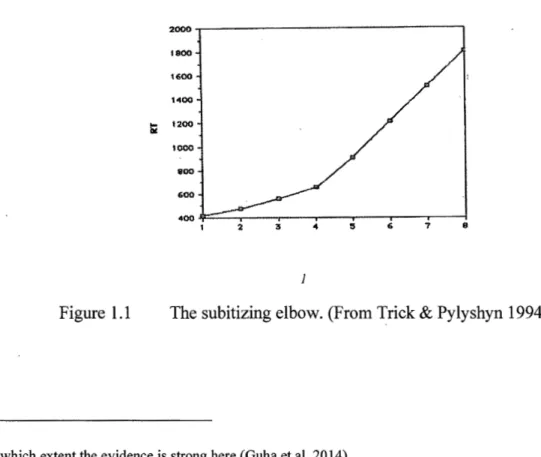
Figure 1.1 The subitizing elbow 24
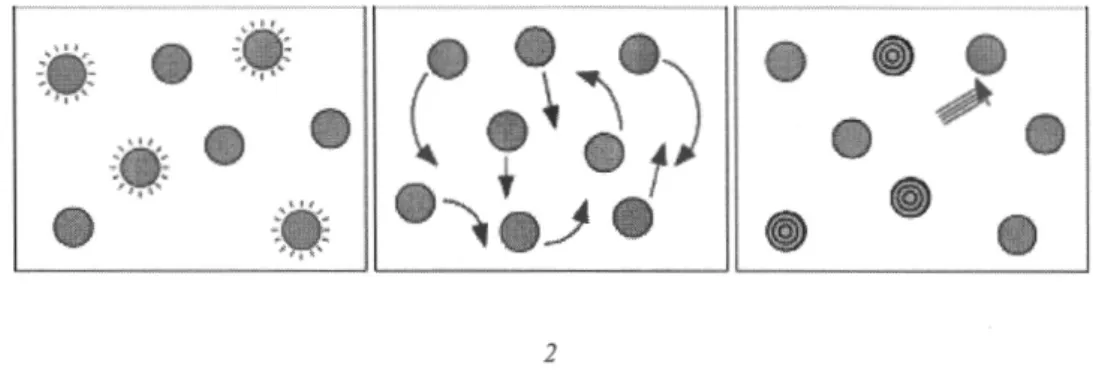
Figure 1.2 Multiple-Object Tracking 33
Figure 1.3 Experimental set-up from Vetter et al. 2008 43
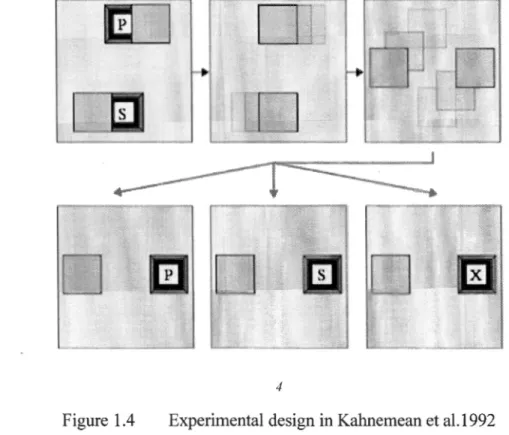
Figure 1.4 Experimental design in Kahnemean et al.1992 50
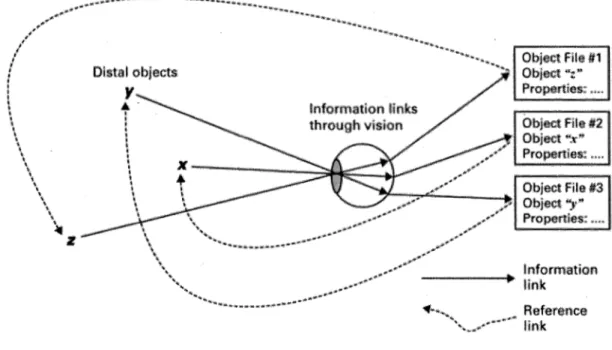
Figure 1.5 Relation between object-files and finsts 51
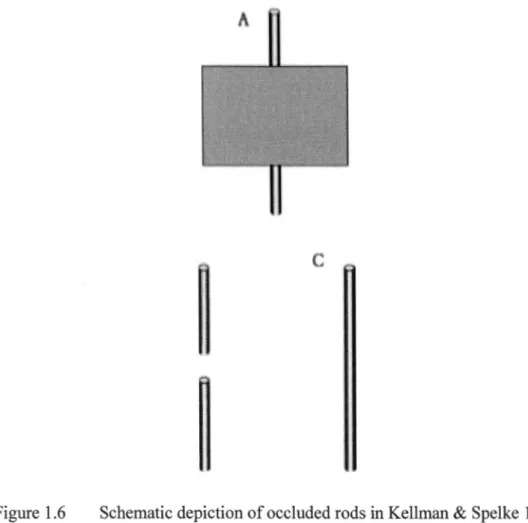
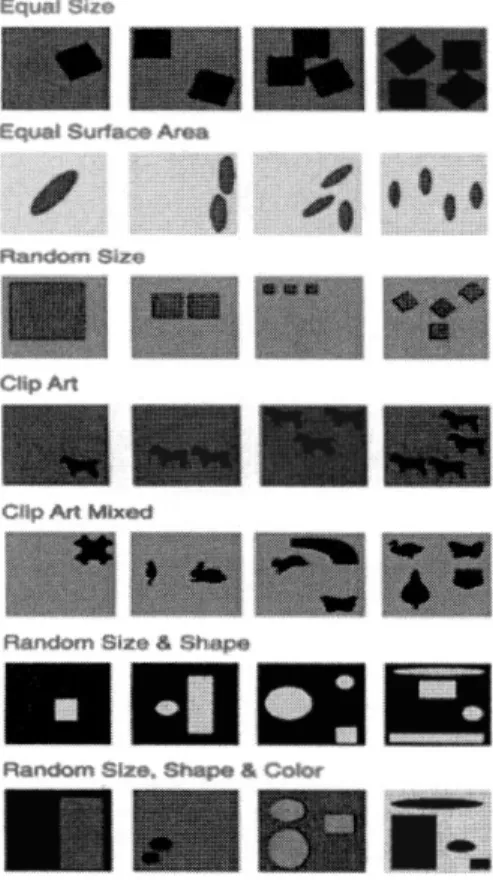
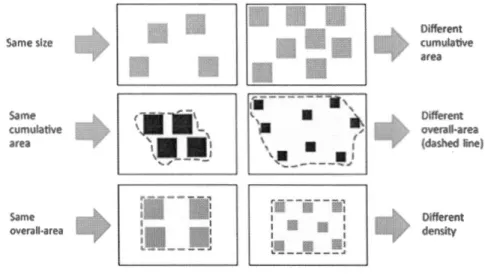
Figure 1.6 Schematic depiction of occluded rods in Kellman & Spelke 1983 57 Figure 2.1 Variations in stimulus presentation from Brannon and Terrace 1998 95 Figure 2.2 Correlation between numerosity and continuous magnitudes 102
Figure 3.1 Abstract Code Model 112
Figure 3.2 Encoding Complex Hypothesis 115
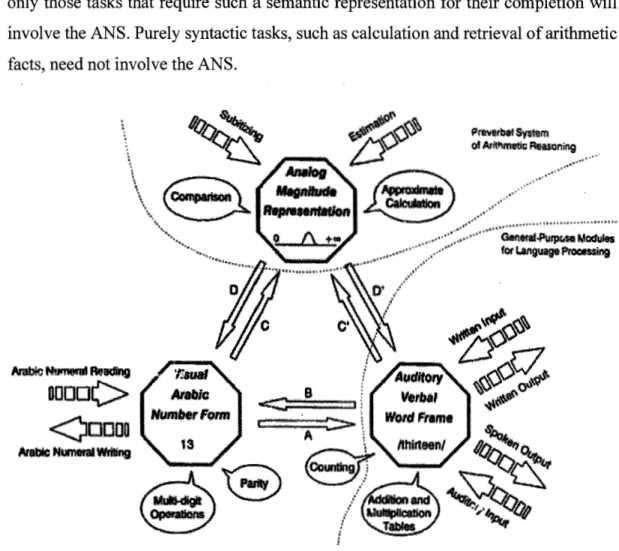
Figure 3.3 Dehaene' s Triple-Code Model 118
Figure 5.1 Clay envelope with impressed token-shapes 211
RÉSUMÉ
Propulsée par le développement de nouvelles technologies et méthodes d'investigation dans divers domaines de recherche, l'étude de la cognition numérique progresse à un rythme fulgurant depuis quelques années. Des domaines aussi variés que la psychologie développementale, l'anthropologie, la linguistique, la neuropsychologie, l' éthologie, et la philosophie contribuent tous à une explosion de données qui nous permettent de croire que l'on pourrait bientôt percer le mystère de comment notre système nerveux pourrait nous permettre de représenter des entités objectives comme les nombres naturels. Une des plus importantes découvertes tirées de ce progrès est celle de ce q11:'il est maintenant coutume d'appeler le« Approximate Number System» (ANS), un ensemble de neurones qui nous permet de déterminer la quantité approximative d'objets dans des collections auxquelles nous portons notre attention. Un autre système, le« Object-File System» (OFS), serait quant à lui dédié à garder en tête les propriétés spatiotemporelles d'un nombre restreint d'objets. Malheureusement, les limitations évidentes de ces systèmes indiquent qu'ils ne peuvent à eux seuls expliquer l'émergence de nos ·capacités arithmétiques : tandis que le ANS est sévèrement limité dans sa précision, la portée du OFS est limitée à un maximum de 4 objets. Considérant ces limitations, nous sommes donc encore loin de savoir comment nous obtenons des représentations avec la précision et l'objectivité des concepts de nombres utilisés dans les mathématiques à partir de systèmes comme le ANS et le OFS. Pour expliquer comment nous arrivons à traverser le fossé conceptuel entre le contenu quantitatif produit par nos cerveaux et celui qui nous permet de pratiquer l'arithmétique formel, plusieurs modèles de l'origine de nos concepts de nombres ont été offerts récemment. Dans ma thèse de doctorat, je propose une analyse critique des modèles dominants du développement historique et ontogénétique des concepts de nombre. Après un survol des principales données empiriques dans les deux premiers chapitres, . je présente un résumé des grandes lignes de deux théories souvent citées dans la
Dehaene (2011) dans le chapitre trois et celle de la cognition de base de Susan Carey (2009) dans le chapitre quatre. Bien qu'elles fassent appel à des processus bien distincts, ces théories se fient à l'existence de symboles numériques dans l'environnement pour expliquer le développement de nos concepts de nombre. L'idée ici serait que notre esprit et les symboles numériques forment un seul système cognitif dans lequel tant notre cerveau que les symboles jouent un rôle actif dans le développement des concepts de nombre, en conformité avec l' externalisme actif proposé par Andy Clark et David Chalmers dans leur théorie de l'esprit étendu (1998). Or, selon l'argument principal de ma thèse, l'existence de ces symboles numériques présuppose la présence des mêmes concepts de nombre dont on tente d'expliquer l'origine. En se fiant à une interaction entre des symboles numériques et notre esprit pour expliquer l'origine de nos concepts de nombre, on place donc la charrue devant les bœufs.
Pour démontrer que cette position est problématique, j'analyse l'approche externaliste à la cognition numérique de Catarina Dutilh Novaes (2013) et de Lambros Malafouris (2010) dans le chapitre cinq pour déterminer à quel point ces théories sont en mesure d'expliquer le développement de contenu conceptuel numérique dans un environnement qui ne contient pas de symboles pour des nombres. Je prétends que ces théories sont incapables de préciser ce qui différencie un individu ayant développé des concepts de nombre d'un individu sans concepts de nombre quand ces individus ont tous les deux accès au même environnement. Par la suite, j'évalue à quel point l'évolution culturelle ou l'extension de la cognition pour inclure notre environnement culturel peuvent aider l'approche externaliste dans le chapitre six. Je présente des arguments selon lesquels ces options ne peuvent aider l'externaliste, puisqu'ils font appel à des mécanismes actifs à l'échelle d'une population, tandis que la cognition numérique a lieu au niveau de l'individu. Si mes arguments tiennent la route, l'externalisme dans l'étude des fondements de la cognition numérique ne permet pas d'expliquer le développement de concepts de nombre dans un environnement sans soutien externe à cette cognition. L'approche externaliste à la cognition numérique devrait donc être limitée aux cas qui requièrent des soutiens externes au-delà d'un segment initial des nombres naturels, dont l'origine doit être expliquée en faisant appel à des modèles internalistes.
MOTS-CLÉS : cognition numérique; esprit étendu; sens des nombres; fondements des mathématiques ; évolution culturelle ; cognition de base
The study of the cognitive and perceptual systems underlying our numerical abilities has progressed tremendously in the past few decades, yielding scores of data on the potential role played by the so-called Approximate Number System (ANS) and the Object-File System (OFS) in the development of natural number concepts (Dehaene 1997/2011 ). While there is still disagreement on the relationship between these systems and on the extent to which they produce representations with numerical content, there is overwhelming consensus that, on their own, neither of these systems produces representations with sufficient precision and numerical range to account for the development of natural number concepts.
The question I am interested in in my doctoral thesis is, given these systems' limitations, how do we manage to build representations with mathematically-viable numerical content? That is, how do we bridge the gap between the quantity-related content produced by our evolutionarily ancient brains and the mathematically-viable numerical content associated with numeration systems like Indo-Arabic or Roman numerals? This is what I refer to as the gap problem. It is the main problem that concems us in this thesis. While many answers have been proposed to this question over the years, virtually all of them rely on culturally-inherited symbols and extemal artefacts to bridge the gap between natural numbers and the output of our innate cognitive machinery. And yet, as I argue in my thesis, if we want to bridge the gap between natural number concepts and the content produced by systems like the ANS and the OFS, such extemalist approaches to cognition are limited in their explanatory power. The main problem with extemalist accounts is what I call the origins problem: how can we explain the origins of numerical cognition by appealing to extemal symbols for numbers, when these symbols in tum depend for internai representations of number for their origins?
To support my daim that extemalism is unable to answer this problem, the first two chapters start by summarizing data conceming the main cognitive systems involved in numerical cognition. Then I present the main· lines of two of the most influential extemalist accounts, Stanislas Dehaene's Number Sense (chapter 3) and Susan Carey's Quinian Bootstrap ( chapter 4 ), in order to illustrate extemalist approaches to the gap problem. I show that despite their differences, both accounts attribute a central role to extemal representations of numbers like number words in explaining how we bridge
the gap, and that this seems problematic given that there are historical cases of development of numerical content without such extemal support. In chapter 5, I take a doser look at the philosophical motivations behind this extemalism in Clark &
Chalmer' s classic 1998 paper on the extended mind before exploring the constitutivity of extemal supports for cognition, as framed by Catarina Dutilh Novaes (2013). This leads me to discuss the relationship between extemal and intemal representations for numbers at both ontogenetic and historical timescales. To ground this discussion, I then discuss data conceming possible origins of the first abstract symbols for numbers in Sumeria (Malafouris 2010) and then explore the limits of anumerate cultures like the Pirahà and the Mundurucu in order to determine whether there is evidence that we can explain the origins of the concept of precise quantity by appealing to the ability to put objects into one-to-one correspondence. I argue that the data do not support this conclusion, and thus that extemalists do not have an account of how the first numerical content emerged in a numeral-free environment. In chapter 6, I explore two potential extemalist replies to my gap problem based on the potential constructive role of culture. The first is to try to explain the emergence of novel numerical content by appealing to mechanisms of cultural evolution, as described by Helen De Cruz (2007). I argue that this doesn't help, since such mechanisms are population-level, while the generation of novel content occurs at the level of the individual. I then consider Richard Menary's (20 l 5a) enculturated approach to numerical cognition to see if extending cognition to include our cultural niche can help the extemalist, and find this option wanting as well. Here, I argue that innovation matters in how we want to answer the gap problem and that enculturation is not well equipped to describe the individual-level construction of novel content, due to its focus on population-level processes of innovation. The upshot is that extemalist approaches need to be restricted in order to make room for intemalist theories of the development of numerical content for an initial segment of the natural numbers.
KEYWORDS: Numerical cognition; Extended Mind; Approximate Number Sense; Object-File System; Cultural Evolution; Foundations ofMathematics
1 Why foundations of mathematics needs psychology
While the study of numerical cognition was limited to a few brave psychologists until the end of the 20th century, the last twenty years have witnessed a complete reversai ofthis trend. Nowadays, fields as diverse as developmental psychology, neuroscience, ethology, anthropology, archeology, and philosophy have all contributed to a recent surge of interest into the cognitive foundations of our ability to think about - and with - numbers. While the opening of these experimental floodgates is certainly a step forward into our understanding of the cognitive and neural systems involved in representing numbers, it also poses difficult questions concerning the relation between psychology and mathematics. After all, empirical research into numerical cognition does more than welcome psychological description of mathematical entities: by its very nature, it tries to ground the concept of number in broadly psychological facts.
For a while, identifying or reducing logical and mathematical concepts to the mental processes or representations responsible for them was an acceptable, if not 'prevalent' (Dummett 2001: xxi) approach to logic. Mill, for example, wrote that logic is "not a Science distinct from, and co-ordinate with Psychology. So far as it is a science at all, it is a part, or branch, of Psychology" (Mill 1979, 359). Mill was far from being alone in espousing a form of psychologism with respect to logic and mathematics:1 in the
1 Though there is debate as to whether Mill's philosophy of mathematics was in fact a psychologistic, it
years following Hegel's death, many German philosophers (e.g. Wundt, Erdmann, Lipps, Sigwart, Jerusalem, and others)2 took a naturalist turn in which mathematics and logic were founded in psychology.
However, in addition to this naturalist tum, the 19th century also witnessed the birth of a number of revolutionary developments in mathematics, including group theory, real analysis, as well as non-Euclidean and projective geometries, to name a few. With these new mathematical practices came increasingly abstract concepts, which spurred the need to secure solid conceptual foundations for mathematics, to ensure that such innovations were free from paradox, contradiction, and. the subjectivity of human intuition. It is of little surprise, then, that these innovations in mathematical practice generally steered clear of the relationship between mind and mathematics. After all, if one of the main foundationalist goals is to guarantee the generality and objectivity of mathematics, then accepting concerns related to how our subjective mind interacts with mathematical entities might seem counterproductive. At best, such empirical concems would be irrelevant. Arguably, these foundational efforts- and the accompanying anti-psychologism - reached their apex with Frege's definition of number in his Grundlagen (1884). There, Frege defined number using only logical tools, thus laying the conceptual groundwork needed to found mathematics on the apparently objective and paradox-free edifice of logic.
Frege's anti-psychologistic comments in his Grundlagen and, to a lesser extent, in the foreword to his Grundgesetze (1893) contained many of the same arguments that would be developed in a more detailed and systematic attack in Husserl's Logical investigations (1900).3 Though discussing these arguments and their similarities is not
2 See Kusch 1995 for a more exhaustive list.
3 It is worth mentioning that a likely (though contested) reason Husserl renounced the psychologism of
his Philosophy of Arithmetic (1891) was Frege's (1894) 'savage' critique ofthis work (Dummett 2001, xxi). See also Mohanti 1982 and Drummond 1985 for more on the relationship between their views.
necessary here, it is worth observing that both Frege and Husserl held that any appeal to psychological notions in explaining the validity of logical or mathematical laws led . to some form of relativism, subjectivism, or idealism - all of which run counter to the objectivity, precision, and universality of mathematical truth.4 On their view, mathematical facts concem etemal and objective platonic entities, whereas psychological facts are about subjective, relative, and temporal things.
Thus, in stark contrast to Mill, Frege wrote that "number is no whit more an object of psychology or the product of mental operations than, let us say, the North Sea is" (Frege.
1884/1960, 34). Further, were we to accept the relevance of the psychological origins of an idea when defining or proving it, Frege daims we would be forced to include psychological facts in mathematical proofs: "in proving Pythagoras' theorem we should be reduced to allowing for the phosphorous content of the human brain" (Frege 1884/1960, xviii). As Frege saw things, not only would allowing psychological concems in foundationalist efforts be counter-productive, it would undermine the objectivity and certainty of mathematics. After all, while ideas about what words like 'tree' and 'number' mean may vary from person to person, the meanings themselves are supposed to be objective: regardless of what we think, 2 plus 2 equals 4. It is no surprise, then, that Frege' s review of Mill' s mathematical empiricism was particularly scathing, including a passage where Frege describes Mill's views as an 'apocalypse' (Frege 1884/1960, 9). For Frege, numbers are as mind-independent as the water in the North Sea is. If this is the case, then how can psychology teach us anything about them? In short, the success of Frege and Husserl's anti-psychologistic crusade at the tum of the 20th century did not bode well for naturalistically-inclined philosophers of mathematics - including those interested in Mill and the empirical study of number concepts. In a sense, this dismissal of empirical and psychological matters has been
vindicated: despite the foundational crisis of the early 1900s, mathematics has grown by leaps and bounds and its effectiveness in describing and modelling reality has reached unimaginable heights. Most mathematicians don't care about the foundations of their discipline, since most don't ever encounter problems of the sort identified by Russell and Godel, for example. Those few who do bother to think about foundational issues are generally platonists on weekdays and formalists on Sundays, as Davis &
Hersh ( 1981) famously put it. From a mathematician' s point of view, th en, foundational issues that concem the ontological status of mathematical objects is of no consequence, as elegantly illustrated by Morris Kline:
The developments in this [twentieth] century bearing on the foundations of mathematics are best summarized in a story. On the banks of the Rhine, a beautiful castle has been standing for centuries. In the cellar of the castle, an intricate network of webbing had been constructed by industrious spiders who lived there. One day a strong wind sprang up and destroyed the web. Frantically the spiders worked to repair the damage. They thought it was their webbing that was holding up the castle. (Kline 1980, 277)
There is then a sense in which we can accept that foundational issues haven't been resolved, since this lacuna has had little effect on actual mathematical practice.
And yet there is also a sense in which, from a philosophical point of view, the situation is unacceptable. For while it could be argued that concepts like SET,5 SUCCESSOR
and NUMBER have given mathematics solid conceptual footing, the ontological status of these foundational notions remains completely mysterious, as does our epistemic access to these. To provide a true foundations of mathematics, then, foundations of mathematics must widen its area of enquiry to include the practices of real-life mathematicians (cf. Wang 1974, 242-243). This is especially true if we wish to think of mathematics from a naturalist perspective, and thus conceive of it as a (uniquely)
human enterprise with roots in evolution.
So while their carnpaign was largely successful in eliminating psychologistic tendencies from foundations of mathematics, there are reasons to doubt that the alternatives proposed by Frege and Husserl represent an improvement. Not only did few aspects of their anti-psychologism survive unscathed,6 their attempts to free
mathematics and logic from the limitations of the human mind have been accused of closet psychologism.7 But more importantly, from a naturalistic point of view, what is
especially problematic is that both Frege and Husserl rely on mysterious, platonic entities to replace the more familiar psychological notions they reject.
Of course, a well-known problem with banishing nurnbers to an abstract platonic realm is that we have no idea how subjective, temporal beings like humans can grasp objective, ideal propositions, since these are independent from time, space, and mind (e.g. Benacerraf 1973). By its very nature, the anti-psychologistic picture seems incomplete with respect to the epistemological question of how we could interact with the objects of mathematical practices. Worse, there is something essentially mysterious, if not esoteric, in postulating the existence of a separate, abstract world outside of space and time. 8 In short, by replacing psychologism with platonism, it looks
like Frege was providing "an explanation of the obscure by the more obscure" (Philipse
6 See Kusch 1995 for a review of contemporary (ch.4) and modern (appendix II) criticism oftheir anti-psychologism. See also Aach 1990.
7 For example, while Frege talks of primitive and self-evident truths (e.g. Frege 1884/1960, 4) and objective meanings, Husserl speaks ofideal thought content and atemporal propositions. Frege's reliance on self-evident truths seems to involve the difficult notion of a self that is neither subjective nor psychological. Similarly, Husserl's ideal laws are 'intuited a priori'. But what are such intuitions if not psychological processes? Kusch 1995 lists authors who argued Husserl was a closet psychologicist (see
also Baker & Hacker 1989, 81-2; Tieszen 1990). ·
8 Rav (2007, 87) expresses his views on Platonism thus: '"How is it that the Platonistic conception of mathematical objects can be so convincing, so fruitful and yet so clearly false?' writes Paul Ernest in a review ... I disagree with Ernest on only one point: 1 do not think that Platonism is fruitful. As a matter of fact, Platonism has negative effects on research by blocking a dynamical and dialectic outlook."
1989, 67).
Considering the mysterious nature of platonic entities, it may be wise to give mathematical psychologism another chance. After all, the witch-hunt for psychologism took place at a time when psychology was still in its infancy. As Sober put it: "It is no wonder that Frege conceived of psychological phenomena as variable and erratic, given the way psychology was done at the time" (Sober 1978, 169).9 Nowadays, given the advances made in various branches of cognitive sciences, the claim that psychological facts are necessarily subjective and mind-dependent seems false. Facts about how brains and minds work seem more and more akin to facts about, say, the water of the North Sea. As neurologist Stanislas Dehaene put it, "With such bridging laws from neurons to behavior, psychology cornes increasingly close to being an exact science" (Dehaene 2011, 250).10
It could be argued that some attempts at providing. purely logical foundatio,ns to arithmetic include some form of implicit reliance on properties of real-life mathematicians. Dedekind, who was criticised by Russell and Dummett for importing non-mathematical notions in the foundationalist enterprise is one possible example, while widespread reliance on the axiom of choice could similarly be interpreted along subjectivist lines. But even in these cases, we have no idea how foundational notions like numbers and sets fit into a world in which atoms, brains, hamburgers, and colors
9 Frege himself seemed to be aware of the embryonic state of psychology at the time, writing that "It would be strange if the most exact of all the sciences had to seek support from psychology, which is still feeling its way none too surely." (Frege 1884/1960, 38). Schlick also seemed aware of these growing pains, but argued that this should not affect the principles behind psychologism: "all processes in nature and mind occur according to laws, and these laws are without exceptions, just like the rules of format logic. The laws are not inexact, our knowledge of them is insufficient-this is a huge difference" (Schlick 1918, 128).
10 As Luc Faucher pointed out tome, it is worth mentioning that Dehaene's claim here should be taken with a grain of salt: while it is undeniable that psychology has grown by leaps and bounds, it is still far away from being anywhere as exact as physics, say. Perhaps more importantly, we are also far from having general bridge laws that fit Dehaene's description here.
also figure. By focusing on securing solid concepts on which to base mathematical practice, classical foundationalism has voluntarily kept as far away as possible from such empirical matters.
Thus, while it is true that mathematical practice does not need to address empirical and foundational issues in order to proceed, philosophy of mathematics certainly does. This is especially true for naturalistically inclined philosophers, pace Quine. Indeed, for philosophers, the 'unreasonable effectiveness' of mathematics only adds to the mystery: for not only must we try to understand how abstract and objective mathematical concepts are related to our subjective minds, we must also explain how they are so perfectly suited and effective in describing and predicting events in the material world.
2 New wave foundationalism: the rise of numerical cognition studies
Of course, the fact that mathematical objects have puzzling properties is not new: the ontological status of mathematical entities is one of the oldest questions in the documented history of western philosophy, and platonism towards mathematical entities has long been considered problematic ( e.g. see Benacerraf 1965, 1973; Bemays 1935). What is new, however, is the emerging body of empirical research into the cognitive foundations of numbers. While research in this field was not widespread until late in the second half of the 20th century (Piaget being a notable, if flawed, exception), things started to change around the time Gelman & Gallistel published their landmark book The Child's Understanding of Number (1978). At around the same time, in the six:ties in seventies, Lakatos (1976) wrote a series of articles that eventually laid the groundwork for the study of mathematical practice, describing the historical development of mathematics as a dialectic process of proofs followed by refutations. Bringing the discussion to the broader implications of mathematical practice, Kitcher
(1984) and, more recently, Ferreiros (2015), have embraced an interdisciplinary approach to the study of mathematics, framing it as a human activity .11 So while talking about the relationship between mind and number is still anathema in many philosophical circles, there is hope for the naturalistically-inclined philosopher of mathematics.
This multi-faceted research has led to numerous findings, including the discovery of evolutionarily shared representational systems that could be the source of adult humans' developed arithmetical abilities. When Dehaene (1997) published his classic monograph, The Number Sense, interest in the relationship between mind and math was rejuvenated to the point where the cognitive bases of our ability to represent numbers are now the focus of studies in a wide variety of domains of research. Many competing accounts of the relationship between brain and number have tried to make sense of all this data, sparking a new and fascinating debate surrounding the empirical status and developmental bases of numbers. After thousands of years of being in the dark, it looks like science is beginning to shed light on the relationship between world and mathematics.
3 The gap problem
Unfortunately, with the opening of these experimental floodgates cornes new questions about the concept NUMBER. The problem, in a nutshell, is this: how do we combine data from developmental psychology, ethnology, linguistics, evolutionary biology, cognitive psychology, neuropsychology, and anthropology to forma mathematically-viable number concept? For example, while the evidence supporting the existence of innate neuronal systems capable of producing imprecise representations of the quantity
of objects to which we are paying attention is well established, how this and other systems housed inside brains can be responsible for the objectivity, generality, and efficiency of concepts like NUMBER is still very much an open question.
Putting aside questions conceming whether such results could even meet Benacerraf s (1973) challenge and take us to the promised land of naturalized numbers, a less metaphysi_cally-motivated difficulty we face in answering how such findings relate to abstract objects like numbers is that, in the state they arrive following their long evolutionary joumey into our inherited neurological makeup, the psychological systems that figure in most explanations of the material implementation of representations of numbers, including the Approximate Number System (hereafter, ANS) and the Object-File System (hereafter, OFS), are in no shape to produce content with the scope and precision of natural numbers. As I explore in detail in the first two chapters of this the sis, the ANS produces representations that grow increasingly fuzzy as the numerosity it responds to increases (Dehaene 1997/2011), while the OFS likely does not produce any explicit numerical content, and if it did, it would be limited to trackin.g about four objects (Carey 2009; Kahneman et al.1992). In short, with the discovery of these systems cornes the responsibility of explaining what happens to them in order for representations of precise quantities of discrete objects of the sort used in the practice of arithmetic to emerge.
Thus, despite the tremendous progress made by research into the origins of numerical cognition since the late 20th century, an important question remains unanswered: given the limitations of our innate cognitive machinery, how do we manage to build representations with mathematically-viaple numerical content? That is, how do we bridge this gap between the quantity-related content produced by our evolutionarily ancient brains and the mathematically-viable numerical content associated with numeration systems like Indo-Arabic or Roman numerals? This is what I will refer to as the gap problem. It is the main problem that will concem us in this thesis.
While many have addressed this issue, 12 most proposed solutions rely on the presence
of numerical representations in the environment, often in linguistic format, to bridge the gap between the output of our innate representational systems and the content of our advanced number concepts. In this th~sis, I argue that this extemalist approach
needs to be restricted to allow room for one that focuses more on internai cognitive processes, since any appeal to external symbols for numbers must corne after we have explained the emergence of numerical cognition internally, given that extemal symbols for numbers depend on the construction of intemal representations with numerical content for their existence.
The main contribution I wish to make with my thesis is methodological: I want to highlight the limitations of extemalist approaches to numerical cognition in order to· motivate adopting intemalist solutions to the gap problem. To do this, I will argue that relying on extemal representations of numbers in explaining what makes advanced numerical cognition possible leads us to an incomplete - or, worse, circular- account of the origins of our advanced numerical abilities, since extemalist accounts have difficulty explaining how numerical content can originate in cultures and environments where there are no extemal representations for numbers. This is what I will call the origins problem. It will orient most of my criticism of extemalist approaches. I daim that extemalist approaches to numerical cognition cannot explain how we first came up with representations with numerical content both in our heads and in the world -because they take for granted the very thing we are trying to explain. I will argue that the solution to my origins problèm is to restrict the scope of extemalism and adopt an intemalist approach for an initial segment of the natural numbers.
12 For example, Gelman & Gallistel 1978; Gallistel et al. 2006; Hurford 1987; Dehaene 1997/2011; Butterworth 1999; Lakoff & Nunez 2000; Wiese 2004; De Cruz 2007, 2008; Rips et al. 2008a; Carey 2009; Coolidge & Overmann 2012; Menary 2015a; Malafouris 2010.
4 Thesis outline
In addition to this introduction and the conclusion, my thesis can be usefully divided into three main sections, each containing two chapters. In the first section of the thesis, which includes the first two chapters, I summarize data conceming cognitive systems that are often considered to be the building blocks of numerical cognition - the OFS, explored in detail in chapter 1, and the ANS, in chapter 2 - and describe how their limitations prevent them from providing the full story of the origin of the content our advanced number concepts. This will involve taking a look at ,data from a wide variety of domains of empirical research as well as their methods. Of course, given the incredible variety of studies that have tackled the empirical foundations of our arithmetical abilities, I cannot list every potentially relevant experiment done in this field. Rather, I will try to limit my treatment to studies suggesting that the ANS and the OFS are present in human adults and preverbal infants as well as in the animal kingdom. If we eventually wish to explain where our numerical abilities corne from and how we can represent abstract objects like numbers, it is important to show that the systems that appear recruited in these abilities have evolutionary origins, since this can help explain the origins of numerical content by appealing to Darwinian principles of evolution through natural selection.
The purpose of these initial chapters is twofold: first, in order to set the stage for the gap problem it is important to be clear on what sort of content we can expect to get from our innate cognitive machinery. As will become clear in the first two chapters, there are many complications that arise from the empirical study of numbers, due to their abstract nature. The first two chapters will allow me to set up the gap problem by presenting and evaluating the empirical support for the existence of cognitive systems whose properties make them likely cognitive foundations for our ability to practice arithmetic. By identifying the evolutionarily-inherited cognitive systems that appear recruited in numerical cognition, as well as their limitations, it will become clear that
we need an explanation of what happens to these systems in order to explain their use in numerical cognition. The data summarized in the first two chapters will then be used as empirical constraints any account of numerical cognition must satisfy in order to bridge the gap between what these systems allow us to do and what we actually do in the practice of arithmetic.
Such accounts of how we bridge the gap will be presented in the second section of my thesis, which includes chapters 3 and 4. Here, I summarize the main lines oftwo of the most influential accounts of how we can use the data presented in chapters 1 and 2 to explain the emergence of numerical content. These are Stanislas Dehaene's (1997/2011) number sense, presented in chapter 3, and Susan Carey's (2009) Quinian [sic] Bootstrapping account, which I develop in chapter 4. The main objective ofthese chapters is to illustrate what sort of strategies have been proposed to explain the precise role of the systems pr~sented in the first two chapters in representing natural numbers,
and what sort of transformation on these can explain the development of numerical cognition. These chapters will also highlight the extemalist commitments of these àccounts of the origins of numerical cognition by identifying the precise role played by objects and symbols outside our heads in the development and practice of numerical cognition.
There are, of course, other proposais on offer. I chose these specific accounts for two main reasons. First, both of these are easily among the most influential in the literature, each author almost invariably popping up in the references section of works dealing with numerical cognition. Second, both these authors offer incredibly detailed and varied empirical support for their accounts, covering data from a wide range of domains. Given the broad range of disciplines that can inform the nature of our arithmetical abilities, this makes them ideal candidates for a philosophical treatment of answers to the gap problem, which requires covering data from many disciplines. While Dehaene's work could arguably be described as focusing more on the neurological
aspects of our arithmetical abilities, Carey's can be described as focusing on the developmental side of this topic, including critical data obtained by Karen Wynn (1990, 1992) on the stages children go through when leaming the meaning of number words. In this sense, although both accounts cover data from a wide range of domains, they are complementary approaches.
These models are also opposites, in a sense, given that Dehaene attributes a central role to the ANS in his account, while Carey argues that the ANS only cornes into the picture once the OFS has done the hard work, along with other systems that I discuss in chapter 4. As will become clear, despite the differences in Dehaene and Carey's approaches, both crucially rely on the presence of extemal symbols and artefacts with numerical content to explain both the historical and developmental origins of our ability to practice arithmetic. The fact that both can be considered extemalists about the development of numerical cognition despite considerable differences in their approaches illustrates the variety of extemalist answers to the gap problem and their shared commitments. At the end of chapter 4, I discuss my main issue with extemalism (i.e. the origins problem described above) and show that it applies to both accounts. This sets up the last section of the thesis, which comprises chapters 5 and 6.
In these last two chapters, I explore potential extemalist replies to my origins problem. These rely on considerations related to attributing a constitutive role to extemal artefacts in numerical cognition, explored in chapter 5, and explaining the development of numerical content by appealing to cultural evolution and the constructive power of our cultural environment, discussed in chapter 6. The first reply to my origins problem involves setting up the motivation for adopting an extemalist framework. I do this in chapter 5 by sketching the main lines of Andy Clark and David Chalmer' s classic 1998 article, 'The Extended Mind', easily considered the locus classicus of active extemalism. This is followed by a brief summary of Clark' s (1998) explanatory criteria for extended cognitive systems, which I will use to evaluate to which extent adopting
an extemalist approach to numerical cognition can bridge the gap. I then illustrate how this extemalist framework has been applied to numerical cognition by summarizing Catarina Dutilh Novaes' (2013) analysis of three levels of constitutivity of extemal representations of numbers and the as~ociated daim that numerical content does not
emerge in our head. In my criticism of this account, I take a look at the fascinating case of anumerate cultures like the Pirahâ (Frank et al. 2008) and the Mundurucu (Pica et al. 2004) as well as data conceming the development of extemal representations for numbers in Sumeria around 5000 years ago (Malafouris 2010; Schmandt-Besserat 2010), in order to characterize the conditions in which numerical content can emerge. My main contention in this chapter is that extemalist accounts fail to explain what makes the difference between an individual that has bridged the gap and one who has not in situations where both have access to the same extemal support for cognition, since the difference in these cases lies squarely in our head.
Last, in chapter 6, I consider replies to this intemalist criticism by exploring the potential contribution of culture to the gap problem. In the first section of this chapter, I take a look at Helen De Cruz' (2007) Darwinian approach to numerical cognition, which applies elements of cultural evolution to the historical development of mathematics, in order to determine to which extent appealing to mechanisms of cultural evolution can help the externalist bridge the gap. I argue that the problem with appealing to mechanisms of cultural evolution to explain the development of novel content is that these mechanisms operate at the level of populations, while the novel content emerges inside individuals' heads.
This is followed in the second section of chapter 6 by a presentation of Richard Menary's (2015a) enculturated approach to numerical cognition, according to which cognition extends into our cultural niche. Here, I argue that while Menary's enculturated framework can help explain what makes the difference between numerate and anumerate cultures, it cannot help specify what makes the difference between
numerate and anumerate individuals. I argue that enculturation does not have an account of innovation capable of explaining how individuals manage to improve and modify the practices of their cultural niche. This is because enculturation focuses mostly on the inheritance and transmission of practices, not on their origins, which involve individual-level understanding, rather than population-level practices and social pressures. The upshot is that culture provides the necessary background conditions against which individuals can innovate. This role is crucial in the development of numerical abilities - crucial, but explanatorily limited.
5 Terminological digression
Before starting with chapter 1, it may be useful to clear up potential terminological issues that could arise given the multidisciplinary nature of the topic covered in this thesis. After all, the abstract nature of numbers means that one must tread particularly carefully when trying to determine their relationship with material things like human brains. This is because numbers are a unique object of study, in that they appear to be as mind-independent as it gets, and yet, unlike rocks and other mind-independent things, they also appear to be a human creation. De Cruz et al. (2010) describe this . peculiar aspect of numbers well:
numbers . are not just abstract entities that are subject to mathematical ruminations-they are represented, used, embodied, and manipulated in order to achieve many different goals, e.g., to count or denote the size of a collection of objects, to trade goods, to balance bank accounts, or to play the lottery. Consequently, numbers are both abstract and intimately connected to language and to our interactions with the world. (De Cruz et al. 2010, 59)
Given that the philosophical study of numerical cognition lies at the intersection of so many disciplines, it is important to attempt to clarify, as much as possible, what it is we are talking about, and which aspects ofnumbers and cognition we wish to describe.
For while it may be acceptable in certain disciplines to talk of animais having number concepts and preverbal infants doing arithmetic, such loose usage of central terms can lead to confusion when trying to pinpoint exactly what sort of properties · we can attribute to human and animal behavior that seems to result from variations of discrete quantities of objects in the environment.13 While efforts will certainly be made in the following text to introduce any technical terms as they corne up, a few central one are worth discussing at the outset.
First, given that a central topic here is the origins of numerical cognition, it is important to qualify what is meant by this expression. After all, as Nunez (2017) has argued, the literature on numerical cognition is polluted by loose and inaccurate use of important terms, especially all things 'numerical'. In an attempt to limit my contribution to this unfortunate trend, throughout this text, I will strive to use the general expression 'numerical cognition' to describe only the type of cognition observed in the practice of formai arithmetic, as done by people who have mastered numeration systems like the Indo-Arabic numerals and the physical manipulation of abacuses. Numeration systems will be considered systems containing rules for the manipulation of external representations for numbers. Here, the term 'symbol' will be used as a synonym for representation. So, on this reading, there can be symbols and representations for numbers in the world, for example, in the form of written numerals or spoken number words, and there can ~e internai representations and symbols for numbers, in the form
of patterns of brain activity. While I will allow myself the luxury of using the term 'numeral' to describe any external representation of number for stylistic simplification, there will be cases where it will be relevant to distinguish these from number words, tallies, and other external symbols for numbers. In such cases, the term 'numeral' will be restricted to written symbols for numbers, as implemented by Indo-Arabic or Roman
numerals. The context should make it clear whether or not the term is being used in this restricted sense.
The difficulty of knowing where to draw the line between those that understand what numbers are and those that do not is well known ( e.g. Rips et al. 2008a; see also Relaford-Doyle & Nufiez 2018, Nufiez 2017). I will often talk about levels of arithmetical abilities to describe levels of mastery of formai rules of arithmetic. 'Numerical abilities' is a more general expression here, and can refer both to the ability to respond to variations of numbers of obj~cts in our environment, which is shared by
infants and animais, as well as to a variety of levels of mastery of numeration systems. On the other hand, 'numeration skills' will be used to describe the human ability to enumerate collections of objects. Thus, numeration skills are a type of numerical ability here.
Strictly speaking, then, numerical cognition is only something educated adults can do. However, to reflect different stages of mastery of numeration systems - or lack thereof - I will often qualify the expression 'numerical' to emphasize to which extent an individual can be described as being proficient in the practice offormal arithmetic. For example, 'formai numerical cognition' and 'formai numerical practices' will be used to highlight mastery of the practice of formai arithmetic using numeration systems like the Indo-Arabic numerals, while 'rudimentary' numerical cognition will describe individuals who are in possession of the building blocks of formai numerical cognition, including the ANS and the OFS, but who are not capable of distinguishing between collections of arbitrary sizes based on the number of items they contain. In this sense, animais and preverbal infants can be considered as having the rudiments of numerical cognition, or as being able to perform rudimentary numerical cognition, since they possess cognitive systems that react to variations of numerical information in their environment. but they have not developed the ability to distinguish between
collections14 of arbitrary sizes based on the number of items they contain. However, they do not possess what 1 will often call 'proto-numerical abilities' nor formal numerical abilities.
Rather, 1 will reserve the term 'proto-numerical' to refer to what could be considered an intermediate stage in the development of numerical cognition. At this stage of development of numerical cognition, individuals have the ability to accurately count beyond the subitizing range (i.e. 'beyond four objects), but their ability to label the numerosity of collections does not include mastery of the generative syntax of a formai numeration system capable of labelling the numerosity of reasonably large collections (see Schlimm 2018 for why it would be inaccurate to speak of 'arbitrarily' large collections here). For example, as I detail in chapter 5, neither the Mundurucu (Pica et al. 2008) nor the Piraha (Gordon 2004; Frank et al. 2008) would be considered as having proto-numerical skills here, since it is debatable whether the Piraha have labels for numbers at all (Frank et al. 2008) while the Mundurucu lexicon only contains words for the first five numbers, and these are not used consistently (Pica et al. 2008). Individuals from cultures like the Oksapmin, whose body-part-based numeration system stops at 27 (Saxe 1981 ), could be considered as having proto-numerical abilities, as do children who have mastered the ability to use number words to accurately label the number of objects in collections containing more than four objects. Individuals from cultures like ours that master numeration systems that can be extended indefinitely will be described as having advanced, fully-fledged, or developed numeration skills or abilities.15
14 To avoid confusion with the technical notion ofa set as used in set theory, I will try to avoid speaking of groups of material objects using this term, and will instead follow De Cruz et. al (2010) as well as Schlimm (2018) in adopting the more neutral term 'collection'.
15 Both advanced and proto-numerical skills could further be distinguished from the non-numerical skills
of individuals and cultures like the Piraha (Gordon 2004; Frank et al. 2008) that seem to entirely lack any form of explicit representation of discrete quantities. For those cultures like the Mundurucu (Izard
While there is good reason to think that there have been. many degrees of complexity and expressive power of systems of representations of discrete quantities throughout history ( e.g. Ifrah 1998; Chrisomalis 201 O; Menninger 1969), it would appear pointless to distinguish numeration systems based on the exact number of items they have developed symbols for. For example, it would seem useless to distinguish between systems that have symbols for up to 27 items, and systems that have symbols for up to 29 items, say. To describe the expressive power of such relatively limited systems, 1 will use the same term as 1 use to describe the skills of those individuals that master them, i.e., 'proto-numerical'.
As for motivation behind drawing the lines as 1 have here, the idea here is to reflect different stages of understanding of what numbers are. These distinctions need not be considered as being set in stone but can hopefully facilitate the discussion. As is usually the case, the context in which terms are used should clarify in which sense they are being used.
One arguably important aspect of numbers that will corne up here is that they are representations of quantities of discrete objects, as opposed to quantities of continuous magnitudes like size or luminosity, as will become clear in chapter 2. While it may be argued that understanding that numbers can be extended indefinitely is a key aspect of numerical abilities, 1 tend to favor the opposite view, according to which what matters in attributing numerical abilities is the extent to which an individual can distinguish collections based on the number of discrete objects they contain, not their understanding of the infinite nature of the natural numbers. The main explanatory challenge 1 want to tackle here is that of explaining the ability to distinguish collections containing sufficiently large numbers of objects based on the precise number ofdiscrete
et al. 2008; Pica & Lecomte 2008)) who have words for discrete quantities, but not beyond the subitizing range (up to four objects), we could reserve the term pre-numerical, though this level of distinction will not be required here.
objects they contain, given that no innate cognitive system allows this. In this sense, once we have bridged the gap, the ability to extend our numeration abilities seems like a separate, though clearly related matter. A similar thought could be behind Crossley's comment that "once the idea of counting has emerged, then the idea to go on counting ·does not seem to lie far below the surface" (Crossley 1987, 13).
As 1 see it, the transition from rudimentary to proto-numerical cognition is the most important developmental step, since it is this step that allows individuals to determine the precise number of items in collections beyond the subitizing range, even if this ability does not extend indefinitely, as it might for people who have mastered formal numeration systems like the Indo-Arabic numerals. The bottom line for me here is that if individuals can count, calculate, and trade using their symbols for discrete quantities, they should be considered as having some form of understanding of what numbers are - or at least, more so than individuals who cannot count or calculate at all - even if they can't easily tell the difference between 1000 and 1001, for example. The gap problem 1 want to talk about in this thesis is how individuals get from this absence of an ability to precisely quantify to such proto-numerical skills. For this purpose, knowing how we manage to extend our understanding of what numbers are into the realm of the infini te seems like a separate · matter from how we manage to build re.presentations of precise quantities in the first place. 17 To understand what sort of tools
we are equipped with to deal with this problem, 1 now turn to the literature on representational systems that appear to underlie our ability to represent quantities of discrete objects.
17 Indeed, there is evidence that it takes roughly two years for children to learn that all numbers have a successor once they can use number words accurately (Cheung et al. 2017), while understanding the infinite divisibility of the number line seems related to mastery of notation for fractions (Smith et al. 2005).
THE OBJECT-FILE SYSTEM
1 Introduction
For the naturalistically-oriented philosopher, this is a great time to be interested in the foundations of mathematics. Contrary to the foundationalist approaches of the early twentieth century, whose focus was exclusively on providing formal tools capable of serving as secure, contradiction-fre-e conceptual foundatioris for mathematics, it is now acceptable to inquire into the epistemological question of how material beings like humans can corne to know anything about abstract objects like numbers. In direct opposition to the rampant ànti-psychologism of traditional approaches to foundations of mathematics, numerical cognition is now a thriving field of scientific enquiry. By looking for behavioral and activation patterns associated with tasks that require processing information about discrete objects in our environment- i.e. numerical tasks - in both symbolic and non-symbolic format, researchers from a wide variety of fields are starting to uncover the distinguishing properties of the representational systems underlying behavior in such tasks, thereby shining light on the possible origins of our advanced numerical abilities. This is good news for the naturalist, since it finally opens the door for a ~oncentrated, well-supported alternative account of how numbers could
be the product of human minds that does not share the mysticism and disregard for actual psychological processes that plagued intuitionism. In short, there has never been
a better time to be interested in the way our brain constructs our advanced numerical abilities.
Of course, it would be folly to claim that there is a straight road from numerical cognition data to psychologism in mathematics. For while this road is certainly a tempting one for man y - especially, perhaps, those coming from the scientific si de of the debate - there is still considerable philosophical work to do before cognitive scientists can even start a discussion with philosophers of mathematics to offer them a viable alternative to platonism and the anti-psychologism that cornes with it. In fact, some philosophers have even gone the opposite route, using numerical cognition data to prove that platonism in mathematics is alive and well (De Cruz 2016).
In this chapter, I take the first steps on the road towards providing a naturalistic account of the psychological origins of mathematically viable number concepts by summarizing findings concerning one of the two main candidate cognitive systems underlying our basic numerical abilities, so that I can then sketch how these systems could produce representations with the abstract character of numbers in later chapters. In section 1.2, I survey findings supporting the existence of two distinct systems underlying our ability to enumerate, including serial counting and subitizing, and I argue that the best way to explain subitizing is via Trick and Pylyshyn's (1994) visual indexing model. Then, in section 1.3 I describe the relationship between these visual indexes and object files, summarizing evidence for the existence of an object file system in infants and anim.als. I close the chapter by discussing to which extent the evidence supports attributing numerical content to this system.