HAL Id: hal-00865252
https://hal-imt.archives-ouvertes.fr/hal-00865252
Submitted on 17 Jul 2020
HAL is a multi-disciplinary open access
archive for the deposit and dissemination of
sci-entific research documents, whether they are
pub-lished or not. The documents may come from
teaching and research institutions in France or
abroad, or from public or private research centers.
L’archive ouverte pluridisciplinaire HAL, est
destinée au dépôt et à la diffusion de documents
scientifiques de niveau recherche, publiés ou non,
émanant des établissements d’enseignement et de
recherche français ou étrangers, des laboratoires
publics ou privés.
The CO-SI Card method: how to refine and validate
concepts through a scenario generator framework
Cédric Mivielle, Maxence Mauduit, Annie Gentes
To cite this version:
Cédric Mivielle, Maxence Mauduit, Annie Gentes. The CO-SI Card method: how to refine and validate
concepts through a scenario generator framework. IASDR, Aug 2013, Tokyo, Japan. pp.4477-4488.
�hal-00865252�
1
The CO-SI Card method: how to refine and validate concepts
through a scenario generator framework.
Cédric Mivielle*, Maxence Mauduit**, Annie Gentes***
* Alcatel Lucent Bell Labs & Telecom ParisTech, [email protected] ** Groupe 3S Informatique, [email protected]
*** Chair of Design Theory and Methods of Innovation, MinesTelecom-Paristech, [email protected]
Abstract: This paper describes a design method named “CO-SI Card” that was created and used in a collaborative project with a multidisciplinary team for the design of crossmedia services. This method allows the creation of a tangible and visual tool that generates intermediate representations of situations of communication. These representations optimize the collaboration between members in engaging and playful ways. The purpose of this method is to refine and validate concept(s) by confronting them to random communication scenarios built with the cards but also to explore the communicational potential of the project. We argue first that it is necessary to create tools that allow collaborative team to both diverge and converge in the design process. Then we consider how creating intermediary objects that support a semiotic system where transformations can be operated helps this divergent/convergent process. We then present the method that the team developed - communication situations cards stack - that is a scenario generator framework and how to replicate it. Third, we analyze the case of a project in service design where this method was implemented. Finally, we discuss possible improvements and limitations.
Key words: Design method, intermediary object, scenario generator, communication situation
1. Introduction
Designers use different kind of tools, to generate creativity, organize communication and collaboration, and also fix ideas. On the one hand, scholars [13, 16, 20], have studied how designers used generative methodologies such as brainstorming and game cards and why these methodologies are important for the creativity and the ideation part of the design process. These tools have to be accessible by a diversity of actors in a collaborative way. The challenge for designers is therefore to create tools and methods that support the design process in efficient, engaging and playful ways. Researchers in participatory design such as [6, 8, 14, 19, 22] showed that it was important to create and use intermediary objects to improve collaboration, organization and communication between members of a multidisciplinary design team. As defined by Boujut, “Intermediary objects act as boundary objects in the sense of Star [19]. But intermediary objects are also intermediate states of the product if we consider the objects as mediators translating and representing the future product.” [6] The purpose is to support mutual understanding of the project and ideas. In this respect, intermediary objects can improve collaborative creativity between members of a team but they also stabilize ideas in forms and structures. Other methodologies such as
2
cluster and vote are aimed to fix and validate ideas and proposals. One of the main challenges is therefore to create tools that help decide. The designer has an interest to use or invent tools and methods that enable the decision process and help the team switch from divergent mode to convergent mode in the collaborative work.
These different goals can be supported by the same tools and methods. For instance, Bouchard et al. in [5] present an example of creation and use of intermediate representations (the representation part of the intermediary object) and their value in the design process both as a creativity and mediation tool. In their case study, they show that intermediate representations on visual cards not only help create intermediary objects that refined the project but also that they supported communication between persons involved and that they stimulated the collective creativity. According to these authors, “Cards have a playful effect, recognized for its efficiency during creative sessions involving sometimes conflictual debates between different corporations… The use of visual matter, such as illustrations and photographs, and of simple keywords, answered the need for very simple representations”. According to Mer [14], intermediary objects can also support creativity and decision making. Intermediary objects can open the scope and options of the project or close and limit the choices, depending on the time and purpose of their introduction in the global design process. In [10] openness means that an object gives the user some leeway within which he or she can more or less diverge. In contrast, a closed object decreases the number of options and tends to limit this flexibility. The open object encourages a divergence and a work of interpretation, while the closed object transmits a prescription.
Based on these researches, we propose to focus on the anticipation of the communication situations. While this is not necessarily a problem when working on tangible artifacts, it can be a serious drawback when designing information and communication technologies. Before actually submitting the communication platform to users evaluation, the hypothesis was that a better definition of what are the communication stakes was needed. Within the project VUE, the research team had to develop an e-learning platform that addressed the challenges of loneliness, attention, focus, and sharing. They needed to organize a mediated situation of communication between an instructor and students. The designers (including the authors) therefore considered how they could develop a tool that would help consider the different aspects of this mediated situation of communication. The team therefore created a method called the CO-SI Card (Communication Situation Card). Its goal was to organize the creative and decision making process by presenting the communication alternatives after the exploratory phase was done.
In this paper, we first present the theoretical background that led to the choice of this specific format (modular cards) that allow collaborative team to both diverge and converge in the design process. We consider how creating intermediary objects that support a semiotic system where transformations can be operated helps the divergent/convergent process. We also present how a communication design tool includes a model of the situation of communication. We then present the method that the team developed - the communication situations cards stack - that is a communication scenario generator framework. Third, we analyze the use case VUE where this method was implemented and give an example of how these cards built a new perspective on the users. Finally, we discuss possible improvements and limitations.
3
2. Theoretical background
We focus on designing tools and methods for creativity and decision making. Creativity here is considered as the divergent process and decision-making is a convergent process. A tool that supports design creativity and decision-making therefore must embed divergent and convergent processes. Cards have been used to support all of these ends and we suggest that a semiotic analysis of the way a stack of cards organize meaning making gives insight into design as a combinatory semiotic process.
2.1 Divergence and convergence in the design process
Often designers describe themselves as creating many options (diverging) and then narrowing down their options (converging). Alexander [1] and other designers have described the analysis as a process of decomposing a problem into units. Synthesis follows as re-ordering the units based on dependencies, solving each sub-units, and finally recombining all the units back together. This decomposition-recombination process also contributes to the divergent and then convergent process. Another point of view, equally important, is to describe the process as narrowing down and expanding out, a convergence process leading to a definition and then a divergence process leading to a diversity of options and choices. At each stage of the transformation, the concept or solution becomes clearer and more refined and subsequently leads to the design proposal.
Banathy writes [3], “We first diverge as we consider a number of inquiry boundaries, a number of major design options, and sets of core values and core ideas. Then we converge, as we make choices and create an image of the future system. The same type of divergence-convergence operates in the design solution space. For each of the substantive design domains (core definition, specifications, functions, enabling systems, systemic environment) we first diverge as we create a number of alternatives for each, and then converge as we evaluate the alternatives and select the most promising and most desirable alternative.” And Cross observes [9], “Normally, the overall aim of a design strategy will be to converge on a final, evaluated and detailed design proposal, but within the process of reaching that final design there will be times when it will be appropriate and necessary to diverge, to widen the search or to seek new ideas and starting points. The overall process is therefore convergent, but it will contain periods of deliberate divergence.” What these different analyses suggests is that the convergent/ divergent process is supported by methods and tools that avoid one compact solution but on the contrary play on a diversity of options on the basis of minimum “units” or elements of the design problem. The next section elaborates on these findings by offering a semiotic analysis of the modularity of the system.
2.2 A meaning making system: syntagmatic and paradigmatic axes
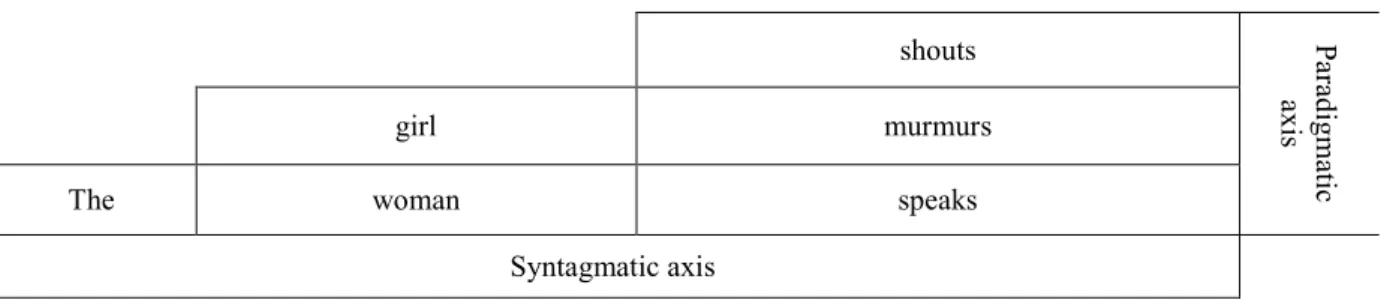
In the field of semiotic analysis, research work following up on Saussure [17] is interested in structural analysis. Structural semiotic analysis is used to identify the constituent elements of a semiotic system (such as a text or socio-cultural practices) and the structural relationships between these units. In the structural analysis, a semiotic system can be constructed in two dimensions, the syntagmatic dimension (this plane is that of the combination of 'this-and-this-and-this' in the composition of the situation or construction of the sentence) and the paradigmatic dimension (this plane is that of the selection of 'this-or-this-or-this' in the choice of alternatives that are not yet available ) (Table 1).
4
Table 1. An example of a semiotic system.
shouts Pa ra di gm ati c ax is girl murmurs
The woman speaks
Syntagmatic axis
Following Jakobson’s work who extended this model to non-linguistic languages, Roland Barthes [4] clarified and made explicit this paradigmatic/syntagmatic model by taking non-textual examples such as the garment system or the meal system (Table 2).
Table 2. Examples of non-textual systems – Roland Barthes
System Paradigmatic elements Syntagmatic elements
Garment
Items which cannot be worn at the same time on the same part of the body, variations corresponds to a change of dress meaning.
(dress, skirt, slacks).
Juxtaposition of different elements at the same time in a complete ensemble from
hat to shoes. Meal Different varieties of starters, courses or desserts (tiramisu, ice cream, chocolate
fondant).
Concatenation of selected dishes of the meal along. For example: starter, course,
dessert.
Susan Spiggle in [18] shows that, in interpretive consumer research, it is important not only to decompose user practice into data but to use qualitative analysis and focus upon meanings. This qualitative analysis also decomposes user practice in a system of units of meaning and the analysis of these units of meaning allows us to understand situations and possibilities. The question is how a situation of communication can be described. The authors chose to follow Hymes’ model of communication because it includes not only linguistic aspects but the whole situation of communication [12]. Hymes brings together sociolinguistics and anthropology of communication. He demonstrates that meaning making is dependent on a context that needs to be observed. He presents a model “S.P.E.A.K.I.N.G” that takes into consideration: “Setting” that is the temporal and spatial framework of communication; Participants that is people who are present whether they speak or not; Ends: the goal of the exchange; Acts: what the participants produce, contents and style of the contents; Key: the style, the tone of the exchanges; Instrumentalities: the tools and media used to communicate; Norms: the values and rules that organize the interaction and the interpretation; Genre: what type of communication activity it is (in our instance, a course). It is therefore possible to decompose a situation of communication into a system of units of meaning. In the interest of our project, we considered designing communication situations from a system composed of interchangeable units belonging to the same class or that can be organized by the rules that bind them.
5
3. Method
This method allows a team to create an intermediary object shaped as a card game. Based on Hymes’ model of situated communication, we divided the cards into four categories plus one that is an animation tool for the design process itself. The four communication categories include the following elements that we describe in more details in 3.2: participants, actions related to goals, contexts of use (where, when, how long), norms/values. These cards provide the ability to generate many communication situations. The purpose of this method is to refine and validate concept(s) by confronting them to random scenarios built with the cards but also to explore the potential scenarios for this project.
In its implementation, this method is based on keeping all the elements gathered during the analysis stage. The analysis stage consists in listing the different elements of a design situation (character profiles, observation of practices, technology watch...). This list of elements is then implemented in a card game. The cards are then mixed with “challenge” cards. Once the cards are made, the teamwork can begin by engaging different players to constitute these random situations to improve the concept.
The CO-SI card method is integrated to a main design process which will be detailed below. This method pursues several goals. First it has to be part of a design process and work as a generative tool to allow a high degree of personalization. It must be flexible enough to help designing complex scenarios such as the ones required in a crossmedia design service. This point leads to another one: the method must use materials gathered in the former stages of the design process. Keeping all material given by the analysis is important to allow for a maximum modularity in the scenario. Also this method should support a collaborative workflow engaging not only designers but also different participants working on the project. This collaborative way to refine concepts wants to enlarge the scope basically given by a design team and it also wants to motivate a team by giving them a role into the conception process through a playful way: a card game.
3.1 Introduction of CO-SI card in the design process
We chose to work on a four step design process inspired by [9, 10, 15]. The first stage, which starts after the brief, is composed by the analysis. From this stage, a positioning has to emerge to bring the creative process to the second stage: the conceptualization. This step builds storyboards, scenarios to finally produce concepts. These concepts will be refined during the third stage. The CO-SI card method has to be implemented during this third stage to refine concepts and validate scenarios. Once one of the scenarios is validated, it will goes to the specification process to finally be given to the development team. A scenario which could not be validated at the end of the refining step will return to the conceptualization step.
(Figure.1) shows how we integrated our method in a global design process. (Figure.2) shows in detail the operation of the CO-SI card method.
6
7
8
3.2 Cards generator
The authors chose to divide the card game into only five categories. We created a first category which is not directly related to the project itself but which suggests ways of managing the design process with the cards and provide with various rules to play the cards: the challenge cards
This category is only here to bring some “constraints” and give a more playful experience, for example a challenge card would be to add a rule like “the scenario has to be done in less than 1 minute” (...). The challenge cards category is the only category which does not use materials from the project to make cards, these cards can be generated freely or could be present by default in the CO-SI card game set.
The four other categories (participants, actions, context of use, values) are inspired by Hymes’ model of communication. .
- Participants who are potentially required to manipulate or participate in the service;
- Actions and ends (as they are described by Hymes are reunited here) which are aimed to be done with or on the service; for example checking the level of acquisition of the student
- Context of use, which set the way it can be used (mainly where, when and how long);
- Values: this category has to challenge ideas through the main social values of the project. It ensures the homogeneity of the proposals in relation to the global positioning of the project.
The team decided that the Genre was provided by the brief of the project: building an e-learning platform and therefore making sure that a teaching/learning situation is provided by the platform. Instrumentalities in Hymes’ model correspond to the design goal: the group has to develop appropriate media to support the activities of the participants [7]. The stylistic keys are also later incorporated in the design process on the basis of the strategy of communication that has been defined.
Cards are edited thanks to a graphical template which allows to edit the five different categories of family cards. The cards generation is made by the designers, this step is not shared with the rest of the team and is still the responsibility of the creative team. Each card has a title, a category color and name, a short description and an illustration (Figure.3, Figure.4).
9
3.3 How to use the CO-SI Card method
The CO-SI method cards should be used as a combinatory toy. All team members gather around a table and try to find ideas or solutions that would best respond to the communication situation that is presented. They should not forget that ideas must take into account all the cards.
We consider two different approaches, systematic and random:
- The systematic approach consists in combining all the different possibilities one by one. If the combination does not seem pertinent to the idea or concept, the designers can skip to the next one. This systematic approach works only if there are not too many options/cards for each family.
- The random approach consists in picking one card out of each family of cards without seeing them in advance.
Two types of interactions between members of the design team are possible: - They can try to collectively create the best idea or solution.
- They can each create an idea and then make a presentation. The ideas are then discussed and the best one is chosen collectively. This method can generate more ideas and avoid excessive fixation effects.
4. Use case: context and first results
The CO-SI card method has been tested and first validated into a design service project named “Vue Project”. The design process began in April 2011 and finished two months later after the concept had been validated and the project transmitted to define its specifications. The “Vue Project is about a virtual environment dedicated to online learning, merging real time classes with asynchronous tools such as forums, tchats and a full playback space for past formations [7, 11]. This learning environment allows crossmedia modularity.
This project was initiated by a partnership between a service development company and a research laboratory. A team made of interaction designers, engineers, researchers (telecommunication, interaction design, information and communication sciences) and a project manager, worked together for two months from the start brief, passing by the analysis and the conceptualization phases to finally proceed to the refining stage. The conception of the card game was initiated by the interaction design researcher and the interaction designer.
Once the card game was ready, the whole team was called to participate in the game. For example, the players got: participant card: student; action and ends card: knowledge evaluation; context of use card: user with a small amount of time (waiting for the bus, for example); value card: playful; challenge card: draw another “context card” (and get, for example, poor connectivity). The players easily imagined the following scenario: the learner is in the metro; she goes home; the connectivity is not good but she wants to optimize her time by doing exercises. She takes her smartphone and connects to the VUE portal. It detects the device and adapts its interface. Then, the user easily access a series of multiple choice questions related to the course. To stimulate user engagement, some playful mechanisms like points and leaderboard are implemented. Thanks to the cards, the developers, designers, managers and researchers worked together to generate scenarios and refine the concept. The first experiments showed that CO-SI Cards facilitated communication within the team thanks to the size of the stack of cards, the easiness to handle it. They also contributed to creating situations of communication for the service, situations that participants would not have imagined or anticipated otherwise.
10
The method brought unexpected results and several months later the industrial partners are still using the scenarios as they were built in the design process with CO-SI card method. The CO-SI method works as an intermediary object that brings consistency and coherence between the different parts of this complex project. The first development of this project was operated as a short-term project. The next step is to bring the same workflow to a long term vision of how to design other e-learning platforms, using the same values used in this first iteration. While the method was initiated to conceptualize a virtual campus and virtual classes, now the industrial partners are operating a 360 degree spectrum to develop a full virtual environment composed of meeting rooms, conference rooms or collaborative workspaces, following the same rules the design researchers initialized.
5. Discussion
The CO-SI card game supports the three goals of collaborative design work
- it supports communication because team members have to agree on the understanding of the design elements and discuss in a playful way of the different options.
- it supports creativity because it reopens to a variety of scenarios along paradigmatic and syntagmatic axes. - it supports decision making because it clarifies the alternatives on the basis of the analysis (the team does
not re-start from scratch) and helps the team clearly considers the alternatives to dismiss those that do not fit the goals of the project.
If the method showed some good results, some questions are still pending and some new problematic elements have been encountered. This first step in the development of a method showed us how complicated it is to make a method which can be adapted and fitted to different use case. The next step will be to figure out if this method can fit other service design projects or even a totally different design project. On the other hand, the collaborative way to refine and validate concepts was credited by very positive feedbacks from the team. Engaging people through a card game really was felt to be a good experience for the design team as much as for the rest of the team project. The notion of game was an important aspect of this tool. The team was working together to build something in a very playful way.
These first results give us an indication of what to observe during the next use of the method. It will be easier to measure and validate the benefits of the method. And it will be easier to choose appropriate analytical tools (interview with appropriate surveys, creative performance [2, 21]…) and validate the benefits of the method.
6. Conclusion
In this paper, we considered the diversity of goals that design tools and methods need to pursue. Amongst them we argue that divergence and convergence as fundamental elements of the creativity and decision process, rely on a semiotic process of meaning making that play on two axes: paradigmatic and syntagmatic axes. Elementary units are organized and reorganized to explore the design situation. Based on this analysis, we developed a stack of cards that organizes a combinatory process. The CO-SI cards are a method and a tool that can be used to create an intermediary objects which provide some representations of communication situations. These intermediary objects support divergence and convergence at the same time and seem suitable for the phase of refinement and validation. By creating tangible and playful cards we could observe new exploratory dimensions of the created concept and a pleasurable effect when the project team used them.
11
Feedbacks showed us that this method improved some positive results for this very specific use case. The next step for this method will be to be challenged with different use case and see if it is a viable method in different design processes. In the next few months, the method will be used in two different projects, one will still be about crossmedia service design, the other one will extrapolate and talk about space and product design to observe and experiment the method’s limitations. This method is basically thought for a specific kind of design process, the next question is to know if it can be used in a more general design process and if not what changes could be implemented so that it could be of a more universal use.
6. References
[1] Alexander, C. (1964) Notes on the Synthesis of Form. Harvard University Press. [2] Amabile, T. (1983) The social psychology of creativity. Springer-Verlag. [3] Banathy, B.H. (1996) Designing Social Systems in a Changing World. Springer. [4] Barthes, R. (1977) Elements of Semiology. Hill and Wang.
[5] Bouchard, C., Camous, R. and Aoussat, A. Nature and role of intermediate representations (IR) in the design , International journal of vehicle design, vol. 38, no. 1, pp 1–25.
[6] Boujut, J.-F. and Blanco, E. (2003) Intermediary Objects as a Means to Foster Co-operation inEngineering
Design, Comput. Supported Coop. Work, vol. 12, no. 2, pp 205–219.
[7] Cambone, M. and Gentès, A. (2013) DESIGNING EMPATHY: THE ROLE OF A, Interactive Technology and Smart Education, vol. 10, no. 1, pp 3–3.
[8] Carlile, P.R. (2002) A Pragmatic View of Knowledge and Boundaries: Boundary Objects in New Product
Development, Organization Science, vol. 13, no. 4, pp 442–455.
[9] Cross, N. (2008) Engineering Design Methods: Strategies for Product Design. Wiley-Blackwell (an imprint of John Wiley & Sons Ltd).
[10] French, M.J. (1985) Conceptual design for engineers. Design Council.
[11] Gentès, A. and Jutant, C. (2012) The game mechanics of pervasive applications: visiting the uncanny, New Review of Hypermedia and Multimedia, vol. 18, no. 1-2, pp 91–108.
[12] Hymes, D. (2001) Foundations in Sociolinguistics: An Ethnographic Approach. Routledge.
[13] McCormack, J., Dorin, A. and Innocent, T. (2004) Generative Design: A Paradigm for Design Research, Futureground Conference Proceedings.
[14] Mer, S., Jeantet, A. and Tichkiewitch, S. Les objets intermédiaires de la conception: modélisation et
coordination, Le communicationnel pour concevoir, Europia-Productions, pp 21–41.
[15] Mozota, B.B. de (2001) Design management. Editions d’Organisation.
[16] Roozenburg, N.F.M. and Eekels, J. (1995) Product Design: Fundamentals and Methods. Wiley. [17] Saussure, F. de and Harris, R. (1998) Course in General Linguistics. Open Court.
12
[18] Spiggle, S. (2004) Creating the Frame and the Narrative: From Text to Hypertext, Representing Consumers: Voices, Views and Visions, Routledge, pp 156–190.
[19] Star, S.L. (1990) The structure of ill-structured solutions: boundary objects and heterogeneous distributed
problem solving, Distributed artificial intelligence, vol. 2, L. Gasser and M.N. Huhns, eds., Morgan Kaufmann
Publishers Inc., 37–54.
[20] Sutton, R.I. and Hargadon, A. (1996) Brainstorming Groups in Context: Effectiveness in a Product Design
Firm, Administrative Science Quarterly, vol. 41, no. 4, pp 685.
[21] Torrance, E.P. (1974) Torrance tests of creative thinking. Scholastic Testing Service.
[22] Vinck, D. and Jeantet, A. (1995) Mediating and Commissioning Objects in the Sociotechnical Process of