HAL Id: tel-01656464
https://pastel.archives-ouvertes.fr/tel-01656464v3
Submitted on 18 Jul 2018HAL is a multi-disciplinary open access archive for the deposit and dissemination of sci-entific research documents, whether they are pub-lished or not. The documents may come from teaching and research institutions in France or
L’archive ouverte pluridisciplinaire HAL, est destinée au dépôt et à la diffusion de documents scientifiques de niveau recherche, publiés ou non, émanant des établissements d’enseignement et de recherche français ou étrangers, des laboratoires
Leader for Creativity : Modelling and Experimenting
Defixation-oriented Leadership
Hicham Ezzat
To cite this version:
Hicham Ezzat. Leader for Creativity : Modelling and Experimenting Defixation-oriented Leadership. Business administration. Université Paris sciences et lettres, 2017. English. �NNT : 2017PSLEM056�. �tel-01656464v3�
THÈSE DE DOCTORAT
de l’Université de recherche Paris Sciences et Lettres
PSL Research University
Préparée à MINES ParisTech
Leader for Creativity: Modeling and Experimenting Defixation-oriented Leadership
(Volume 1)
pour la Créativité : Modéliser et Expérimenter un Leadership orienté Défixation
COMPOSITION DU JURY :
Mme Nathalie BONNARDEL Aix-Marseille Université, Rapporteur M. Peter MAGNUSSON Université de Karlstad, Rapporteur M. Jean-Philippe DENIS Université Paris Sud, Président du jury M. Nathan CRILLY Université de Cambridge, Examinateur
M. Mathieu CASSOTTI Université Paris Descartes, Examinateur M. Benoit WEIL MINES ParisTech, Examinateur M. Pascal LE MASSON MINES ParisTech, Examinateur
Soutenue par Hicham
EZZAT
le 30 novembre 2017
h
Ecole doctorale
n°
396
ECONOMIE, ORGANISATIONS ET SOCIÉTÉ
Spécialité
SCIENCES DE GESTION
Dirigée par
Pascal LE MASSON
Benoit WEIL
Mines ParisTech n’entend donner aucune approbation ni improbation aux opinions émises dans cette thèse. Ces opinions doivent être considérées comme propres à l’auteur.
« Science in itself is morally neutral; it becomes good or evil according as it is applied » Aldous Huxley
Remerciements
Je remercie Dieu. Je remercie le Ministère des Affaires Etrangères d’Egypte pour m’avoir offert la possibilité de me détacher pendant 3 ans pour réaliser cette thèse. Je remercie mon pays de cœur – la France – de m’avoir si bien accueilli avec ma petite famille. Je remercie Benoit Weil avec qui j’ai eu la chance, et l’immense plaisir de travailler pendant ces trois années. Je lui suis reconnaissant pour son encadrement, son écoute, et ses conseils. Sans ses questions toujours aussi pertinentes lors de nos réunions de travail, sa vision large des choses, et surtout sa longue expérience de recherche, jamais cette thèse n’aurait été la même. Je remercie Pascal Le Masson – leader défixateur de ce projet de thèse – de m’avoir recruté, de m’avoir fait confiance, et de m’avoir accompagné de si près pendant ces trois années. Son dynamisme, sa présence malgré un emploi du temps de directeur de laboratoire, son leadership, ses efforts consacrés sur mes travaux, et ses capacités exceptionnelles m’ont sans aucun doute aidé à pousser les limites de ce que je pensais être irréalisable.
Je remercie mon jury: Nathalie Bonnardel et Peter Magnusson d’avoir consacré leur temps précieux en tant que rapporteurs pour évaluer ma thèse, et Jean‐Phillipe Denis, Nathan Crilly, Mathieu Cassotti et Hervé Le Lous d’avoir si gentiment accepté d’examiner mes travaux. Votre présence en tant que membres de mon jury de thèse est un honneur pour moi.
Je remercie Marine Agogué et Mathieu Cassotti d’avoir collaboré avec moi pendant ces trois années, et de m’avoir bien introduit au monde de la psychologie cognitive en m’ouvrant les portes du laboratoire LaPsyDÉ. Leurs travaux ont été une source d’inspiration principale dans ma thèse. Je les remercie et de m’avoir accompagné dans l’écriture et la relecture de mes publications. Je remercie aussi Anaëlle, de m’avoir introduit au monde expérimental avec l’expérience de l’inhibition sociale (où je jouais le rôle du méchant expert en créativité).
Je remercie infiniment Armand Hatchuel d’avoir été une source d’inspiration pour moi et pour tous. Je le félicite pour sa légion d’honneur si bien méritée. Je remercie Blanche Segrestin pour son excellente gestion de l’école doctorale, et particulièrement pour m’avoir ouvert de nouvelles pistes intéressantes dans mon travail de thèse lors de mes présentations aux journées doctorales. Je remercie Sophie Hooge de m’avoir permis d’expérimenter dans ses cours, de m’avoir transférer le bagage de connaissance nécessaire à travers ses formations. Merci aussi à Kevin Levillain d’avoir pris le relai avec Sophie.
Je remercie mes trois collègues de bureau Yanyan, Juliette, et Rachelle. Tout simplement vous trois, votre bonne humeur, nos conversations ensemble – qu’elles soient géopolitiques ou autres – ont créés l’environnement nécessaire pour réaliser cette thèse agréablement. Je remercie particulièrement chacun des membres du CGS – doctorant, post‐ doctorant ou chercheur – Philippe, Akin, Olga, Shenle, Benjamin, Dominique, Mario, Daniel, Maxime, Bin, Mariam, Adam, Morgane B, Morgane L, Hélène, Léo, Olivier, Rémi, Yohann, Nicolas, Joël, Michaël, Chloé, Laure‐Anne, Agathe, mais aussi les anciens Laura, Kenza, Milena, Fabien, Sylvain, ..
Je remercie Céline, Stéphanie, et Marie‐Michelle pour leur gentillesse, leur aide, et pour avoir si bien gérer le secrétariat et nos dossiers, toujours avec humour et bienfaisance.
Je remercie particulièrement Thomas Gillier et Christophe Haon pour m’avoir accueilli à GEM pendant les derniers mois de ma thèse.
Au niveau personnel, je remercie infiniment ma femme Kawsar Korayem – ma psychologue, ma coach – pour avoir toujours été à mes côtés pendant cette thèse, d’avoir même exploré avec moi en détail plusieurs pistes intéressantes dans ma thèse, d’avoir relu mon manuscrit, et d’avoir toujours posé les questions scientifiques les plus pertinentes et inspiratrices. Je remercie aussi mes deux trésors Hamza & Maryam pour m’avoir fait oublier mes problèmes de thésard en me conduisant dans leur monde imaginaire de Robocar Poli. Je remercie de tout mon cœur mes parents pour leur soutien continu, et mon frère Motaz pour ses nombreux encouragements et pour avoir pu booster ma motivation au bon moment. Finalement, je remercie M. Nat et sa famille.
À Hamza et Maryam,
Table of Contents
CHAPTER I: INTRODUCTION & MAIN RESEARCH ISSUES ... 13
I. Abstract of the Ph.D. Thesis: “Leaders for Creativity: Modeling and Experimenting Defixation‐ oriented Leadership” ... 13
II. Introduction to the Research Context & Problem: Fixation, a Key Challenge for Creative Leaders in an Innovation‐Dependent Economy ... 14
1. Fixation versus Creativity: A Double Cognitive‐Design Issue ... 14
2. Can Leadership Defixate? ... 15
III. Research Questions: How To Set Up New Forms Of Leadership That Can Help Their Teams Overcome Fixation: A “Defixator Leadership”? ... 18
IV. Research Objectives: Set Up Figures Of “Defixator Leaders” Based On Ideation’s Cognitive Approaches ... 19
V. Research Methodology: Shaping “Defixator Leaders” Through Theory‐driven Experiments ... 22
VI. Structure of the Ph.D. Research Thesis: Synopsis ... 23
VII. Summary of Chapter I ... 25
CHAPTER II: FIXATION: A MAJOR CHALLENGE FOR CREATIVE LEADERSHIP ... 27
I. Research Context: The Innovation Economy ... 27
1. Creativity: A Fundamental Constituent of the Innovation Economy ... 27
2. Innovating or Dying: A Threat to the Survival of Firms within the Innovation Economy ... 28
3. Rethinking The Essence of Leadership for Innovation: From Creative Leadership to Leading for Creativity ... 29
II. Research Problem: New Types of Challenges for Tomorrow’s Creative Leaders in Early Innovation Processes .. 30
1. Confronting the Struggles of the Early Innovation Stages: Ideation ... 30
2. Fixation: A Cognitive Bias to Creative Ideation ... 31
III. Research Need: A New Type of Leadership to Manage Fixation ... 33
1. Leading Ideation for Creativity: Need for New Forms of “Defixator” Leaders ... 33
2. Revision of Leadership Identity: Need to Shift the Focus From Social Influence to Cognitive Influence ... 34
IV. Summary of Chapter II ... 35
CHAPTER III: DO TODAY’S CREATIVE LEADERS PLAY A ROLE OF DEFIXATOR? ... 37
I. Conceptual Evolution of Leadership ... 37
1. Leadership Definitions: A Process of Social Influence ... 37
3. Leadership Styles: “Creativity‐less” Types ... 42
4. Leadership Competencies: Creativity, an Indispensable Leadership Skill ... 45
II. Leadership versus Creativity ... 46
1. A Balance between Control and Freedom ... 46
2. A Double Standard Model of Creative Leadership: “The Innovators” & “The Facilitators” ... 48
III. The Hidden Cognitive Dimension behind Creative Leadership Models ... 49
1. The Innovator Creative Leadership: Characteristics of Defixated but Not Defixator Leaders ... 49
2. The Facilitator Creative Leadership: Characteristics of Indirect Defixator Leaders ... 51
3. The Hidden Cognitive Aspects of The Innovator & The Facilitator ... 54
IV. Summary of Chapter III ... 56
CHAPTER IV: HOW TO HIGHLIGHT NEW FORMS OF DEFIXATOR LEADERS? ... 57
I. State of the Art: What to Learn from Defixation Processes? ... 57
1. Better Understanding of Cognitive Mechanisms of Creativity: A Design/Cognitive Psychology Perspective ... 57
2. Varied Methodologies to Study Defixation: The Key Role of Experimental Procedures ... 59
II. How to Set Up Figures of “Defixator” Leaders? ... 62
1. “Defixator” Leaders: Means of Actions, Minimal Competencies and Contingent Strategies ... 62
2. Implementing the Minimal Possible Profile of “Defixator” Leader ... 63
3. Neutralizing Multiple Classical Variables of Creative Leadership Models ... 64
4. Designing a Leadership‐driven Ideation Mechanism ... 64
III. Research Methodology: Forming A New Figure of Defixator Leader Through Theory‐driven Experiments ... 65
1. General Research Method: An Articulation Between Organizations And Laboratories ... 65
2. Is The Research Method Appropriate To Answer Research Questions? ... 67
IV. Summary of Chapter IV ... 68
CHAPTER V: A LEADERSHIP‐DRIVEN IDEATION MODEL ... 69
I. Theoretical Model of Ideation based on Interdisciplinary Approach Mixing Design and Probability Theories ... 69
1. C‐K Theory: A Framework to Model Ideation ... 69
1.1. What is Concept‐Knowledge Theory? ... 69
1.2. Modeling the Generation of Ideas in Fixation/Expansion using C‐K Theory ... 70
2.1. State of the Art of Sequential Ideation ... 73
2.2. Modeling Ideator’s Sequence of Ideas as a Trajectory in C‐K Spaces ... 75
2.3. Fixation versus Expansion: A Two‐State Markov Chain ... 76
3. Identifying Ideators’ Creative Performance ... 78
3.1. Iso‐Expansion Curves: Fast and Slow Ideation ... 78
3.2. Ideators Cognitive Ideation Styles ... 81
II. Integrating The Role of Defixator Leaders In The Ideation Model ... 82
1. A New Role for Defixator Leaders: “Forcing” Ideation Paths ... 82
2. How to Manage Defixation Processes? The Dual Challenge of Defixator Leaders ... 83
3. A Contingency Approach to the Leadership‐driven Ideation Model ... 84
III. An Instrument to Measure Creative Ideation Performance ... 87
1. Fluency/Flexibility/Originality: Torrance Components of Creative Thinking ... 87
2. Fixation/Expansion Score: An Additional Divergent Thinking Criteria ... 88
3. Alpha/Beta Probabilities: Defixation and Expansion Persistence ... 89
4. Are these Criteria Efficient to Measure The Effects of Defixator Leaders on Ideators’ Creative Performances? . 89
IV. Summary of Chapter V ... 91
CHAPTER VI: DESIGN OF EXPERIMENTS (DOE): SHAPING THE FIGURES OF DEFIXATOR LEADERS THROUGH “LEADERSHIP‐DRIVEN” IDEATION ... 93
I. Starting Point: A Creativity Task and A Referential Study Case ... 93
1. A Universal Knowledge‐Independent Creativity Task: The Hen’s Egg Task ... 93
2. “Defixator Leaders 0”: Leaders with the Capacity to Formulate Expansive Examples ... 95
II. Derived Theory‐driven Model I for “Defixator Leaders 1”: Initial Instructions to Close Out Teams’ Solution Space in Fixation ... 97
1. Attenuating the Competencies of “Defixator Leaders 1” ... 97
2. State of the Art: The Role of “Constraints on Examples” for Creativity ... 98
3. Designing “Defixator Leaders 1”: Leaders Formulating Initial Instructions Warning Their Teams to Prevent Them From Ideating inside the Fixation Space ... 100
III. Derived Theory‐driven Model II for “Defixator Leaders 2”: Repetitive Feedbacks to Overcome Fixation Regardless of Teams’ Ideas ... 103
1. Attenuating the Competencies of “Defixator Leaders 2” and Intensifying Their Means of Actions ... 103
2. State of the Art: The Role of Feedbacks for Creativity ... 103
3. Designing “Defixator Leaders 2”: Leaders Providing Their Teams With Repetitive Feedbacks Regardless From Their Ideas ... 105
IV. Derived Theory‐driven Model III for “Defixator Leaders 3”: Directive Feedbacks to Lead
Ideation outside Fixation Depending on Teams’ Ideas with Perfect Knowledge ... 107
1. Increasing the Competencies of “Defixator Leaders 3” and Maintaining Their Means of Actions ... 107
2. State of the Art: The Role of Directive “Executive” Feedbacks and Inhibitory Control for Creativity ... 108
3. Designing “Defixator Leaders 3”: Leaders Formulating Directive Feedbacks Depending on the Nature of the Ideas of Teams with Perfect Knowledge of F/E Type ... 110
V. Derived Theory‐driven Model IV for “Defixator Leaders 4”: Directive Feedbacks to Lead Ideation outside Fixation Depending on Teams’ Ideas with Imperfect Knowledge ... 112
1. Attenuating the Competencies of “Defixator Leaders 4” ... 112
2. State of the Art: The Role of Knowledge, Evaluation and Fixation Recognition for Creativity ... 113
3. Designing “Defixator Leaders 4”: Feedback Depending on the F/E Type of Generated Idea with Imperfect Knowledge of F/E Type ... 114
VI. Summary of Chapter VI ... 117
CHAPTER VII: EXPERIMENTING THE NEW FIGURES OF DEFIXATOR LEADER ... 119
I. Theory‐driven Experiment I for “Defixator Leaders 1”: Initial Instructions to Close Out Teams’ Solution Space in Fixation ... 119
1. Theoretical Hypothesis ... 119
2. Method ... 119
2.1. Participants ... 119
2.2. Procedure ... 120
3. Experimental Results ... 121
3.1. Fluency/Flexibility/Originality ... 121
3.2. Fixation/Expansion Score ... 122
3.3. Alpha/Beta Probabilities ... 124
4. Conclusion & Discussion: Efficient Instructions But Requiring High Levels of Competencies from “Defixator Leaders 1” ... 125
II. Theory‐driven Experiment II for “Defixator Leaders 2”: Repetitive Feedbacks to Overcome Fixation Regardless of Teams’ Ideas ... 127
1. Theoretical Hypothesis ... 127
2. Method ... 127
2.1. Participants ... 127
2.2. Procedure ... 127
3. Experimental Results ... 129
3.1. Fluency/Flexibility/Originality ... 129
3.2. Fixation/Expansion Score ... 130
3.3. Alpha/Beta Probabilities ... 132
4. Conclusion & Discussion: No Effects of “Defixator Leaders 2” Leading Regardless of Teams’ Ideas ... 132
III. Theory‐driven Experiment III for “Defixator Leaders 3”: Directive Feedbacks to Lead Ideation outside Fixation Depending on Teams’ Ideas with Perfect Knowledge ... 133
1. Theoretical Hypothesis ... 133
2. Method ... 134
2.1. Participants ... 134
2.2. Procedure ... 134
3. Experimental Results ... 135
3.1. Fluency/Flexibility/Originality ... 135
3.2. Fixation/Expansion Score ... 136
3.3. Alpha/Beta Probabilities ... 138
4. Conclusion & Discussion: Efficient Strategy But Still Requires Competencies from “Defixator Leaders 3” to Recognize Fixation ... 139
IV. Theory‐driven Experiment IV for “Defixator Leaders 4”: Directive Feedbacks to Lead Ideation outside Fixation Depending on Teams’ Ideas with Imperfect Knowledge ... 141
1. Theoretical Hypothesis ... 141
2. Method ... 141
2.1. Participants ... 141
2.2. Procedure ... 141
3. Experimental Results ... 143
3.1. Fluency/Flexibility/Originality ... 143
3.2. Fixation/Expansion Score ... 144
3.3. Alpha/Beta Probabilities ... 145
4. Conclusion & Discussion: Contingent Strategies Depending on the Capacities of “Defixator Leaders 4” to Recognize Teams’ Creative Ideation Competencies ... 146
V. Summary of Chapter VII ... 147
CHAPTER VIII: HOW CAN LABORATORY EXPERIMENTS HELP UNCOVER THE MANAGERIAL LEVERS OF DEFIXATOR LEADERS IN ORGANIZATIONS? ... 149
I. Features of Defixator Leaders As Emerging From Experiments ... 149
1. Defixator Leaders’ Means of Actions ... 149
3. Defixator Leaders’ Contingent Strategies ... 152
II. Standard Figure of Defixator Leaders ... 154
1. Laboratory Experimental‐based Defixation Rules ... 154
2. Specific Contingent Strategies of Defixator Leaders ... 155
III. Rethinking Leadership Organizational Practices for Defixation ... 156
1. Why are “Managerial Implications” not Sufficient? ... 156
2. Contextualizing Experimental Rules in Organizational Contexts? ... 157
2.1. From Fixation Detection to Dominant Design Recognition ... 157
2.2. From Leaders’ Instructional Processes to Leadership Organizational Practices ... 158
2.3. Observed and Latent Leadership Variables for Team Creative Performance in Organizations ... 159
3. Shedding the Light on New Variables that Can Execute Defixation Rules ... 160
3.1. The Defixator Recruiter ... 160
3.2. The Defixator Resource and Time Allocator ... 162
3.3. The Defixator Evaluator ... 163
3.4. The Defixator Decision‐Maker ... 164
3.5. The Defixator Goal‐Setter ... 165
3.6. The Defixator Climate Creator ... 165
3.7. The Defixator Motivator ... 166
IV. Summary of Chapter VIII ... 169
CHAPTER IX: CONCLUSIONS AND DISCUSSIONS ... 171
I. Major Contributions of the Research Thesis ... 171
1. New Figures of “Defixator” and “Fixator” Leaders ... 171
2. Redefinition of Leadership for Creativity ... 172
2.1. Redefinition of Leadership Centered on Cognitive Approaches of Creative Ideation ... 172
2.2. Intermediate Figures between the Innovator and the Facilitator ... 173
3. Modeling Leadership‐driven Idea Generation Mechanisms ... 173
4. New Defixation Methodologies ... 174
4.1. Defixation using Constraints on Abstract Reformulation of Uncreative Examples: The Role of Categorization ... 174
4.2. Defixation using Minimal Executive Feedbacks ... 174
5. Shedding the Light on New Leadership Practices for Defixation in Organizational Contexts ... 175
7. The Process of Defixation is not Enough: The Importance of Maintaining Expansion ... 176
II. Limitations ... 177
1. Students as Experimental Participants ... 177
2. Short Duration of the Experiments ... 177
3. Not Involving Ordinary Participants in the Evaluation of Creative Ideas ... 177
4. No Post‐Experimental Interviews ... 178
5. Defixation from Laboratory Settings to “Real World” Settings ... 178
III. Future Perspectives ... 179
1. Learning Process of Defixator Leaders ... 179
2. Memory‐less Markov‐based Model: Leadership‐driven Ideation ... 180
3. Future Experiments Inspired from Novelty‐Search Algorithm: Search For Novelty without Objectives ... 180
4. Group Creativity and the Role of Social Biases ... 181
REFERENCES ... 183
TABLE OF FIGURES ... 192
TABLE OF TABLES ... 194
APPENDIX I: CATEGORIES OF SOLUTIONS OF THE HEN’S EGG TASK ... 195
APPENDIX II: FULL MARKOV‐BASED LEADERSHIP‐DRIVEN IDEATION MODEL ... 196
APPENDIX III: PUBLICATIONS ... 205
Chapter I: Introduction & Main Research Issues
I. Abstract of the Ph.D. Thesis: “Leaders for Creativity: Modeling and
Experimenting Defixation‐oriented Leadership”
What is creative leadership? Who are creative leaders? How do they manage innovation? The literature review on creative leadership presents two distinctive figures of creative leaders: the innovators, and the facilitators. The first ones are innovative geniuses and visionary entrepreneurs. They come up with creative ideas, they are revolutionary and drive their teams according to their visions. Late Apple’s Steve Jobs or Tesla’s Elon Musk are perfect illustrations of this first class of creative leaders. The second types of creative leaders are perfect administrators, mediators, and facilitators of the innovative process. They manage the set of factors that foster creativity by creating the appropriate conditions and climate, by motivating their teams through incentives and rewards, by encouraging their teams to take risks, or by recruiting creative members among their teams. IDEO’s David Kelley or Google’s Larry Page would perfectly fit in this second category of creative leaders.
But the questions are: from where do these two figures of creative leadership arise? Are there other figures of creative leadership? Are these figures of creative leadership sufficient to confront the challenges faced by their teams in the innovation process?
Today, the advances in the comprehension of the underlying mechanisms of creativity from both cognitive psychology perspective (with a better comprehension of phenomena such as cognitive biases against creativity), and design perspective (with the formalisms to defy these phenomena and overcome these cognitive biases against creativity) have opened different perspectives for new potential figures of creative leaders. What are exactly these new figures of creative leadership? How to highlight and uncover these new figures? Why are they so important for today’s organizations?
In chapter I, we go through a brief review of the research context & problem of our research thesis, the research questions, the research objectives that were set for this thesis, the research methodology used to answer research questions, and we end the chapter with the structure of the Ph.D. thesis.
II. Introduction to the Research Context & Problem: Fixation, a Key
Challenge for Creative Leaders in an Innovation‐Dependent Economy
1. Fixation versus Creativity: A Double Cognitive‐Design Issue
In today’s world, creativity is considered a highly appreciated, not to say indispensable element. In almost every occupation, there is a place for a certain level of creativity and innovative thinking required. Creativity has been described as the capacity to generate ideas that are both novel and useful (Amabile, 1996), and constitutes one of the key cognitive skills that individuals use daily in various contexts. Indeed, the creativity of employees has constantly been seen as the fundamental element for organizations’ success and continuous development.
However, generating creative ideas is not an easy task, and despite the favourable conditions and necessary resources available in organizations to innovate, most employees have been facing serious difficulties to constantly generate creative ideas. One origin of these obstacles occurring during innovation processes is well known in the domain of cognitive psychology. Indeed, cognitive psychology studies have highlighted the negative role played by cognitive biases during innovation processes. Cognitive biases are individuals’ tendencies to reason in certain ways that can lead to systematic deviations from a standard of rationality (Haselton, Nettle, & Murray, 2005). These cognitive traps restrain individuals’ capacity to generate creative ideas and solutions to problems.
Such cognitive biases against creativity generally occur during the very early stages of the innovation process, most precisely during the stage of creative ideation. However, it is worth taking into consideration that these biases do not only occur during ideation but may also arise along the different stages of the innovation process. One of the most common and major of these cognitive biases against creativity is no doubt the fixation effect, which is originally called functional fixedness (Duncker & Lees, 1945; Jansson & Smith, 1991), “mechanization of thought” (Luchins, 1942) or sometimes also referred to as a “mental set”. In what follows, we will refer to this phenomenon as fixation.
Fixation has been considered a central topic of study in numerous fields, ranging from cognitive psychology to other domains such as mechanical engineering, design sciences, and recently management sciences. Fixation’s definition differs according to sectors’ perspectives. From a psychological point of view, it is a “mental block against using an object in a new way that is required to solve a problem” (Duncker & Lees, 1945). In creative ideation literature, it is frequently described as the fact that some knowledge and obvious solutions are spontaneously activated in individuals’ mind during a context of creative ideation, and consequently constrain individuals’ ability to
generate more creative ideas and solutions (Agogué et al., 2014a; Cassotti, Camarda, Poirel, Houdé, & Agogué, 2016b).
Due to its growing importance, overcoming fixation (or defixation) became a key topic of study for several researchers across multiple disciplines such as design, engineering, cognitive psychology, or management.
2. Can Leadership Defixate?
Over the last decades, leadership has repeatedly been known to play a fundamental role in innovation processes (Denti & Hemlin, 2012). Highly creative leaders such as Steve Jobs, Thomas Edison or Mark Zuckerberg have transformed the way we use and see things, and have no doubt impacted our everyday life. However, such exceptional figures of creative leaders – that are capable of leading their firms for innovation – are not countless, and today’s traditional forms of creative leaders seem to be inadequate to confront the cognitive traps faced by their teams.
Contrarily to one might think, it is worth pointing out that despite the fact that existing methods for overcoming fixation have ignored the role played by leadership, in almost all existing defixation methods, we could model a figure of leader that is implicitly present before or during the ideation process, and that plays a direct or indirect role to help individuals (designers, engineers, experts, etc.) bypass the cognitive obstacles against creativity.
For the above‐mentioned reasons, uncovering the role of leadership for defixation is becoming a principal challenge, and more precisely designing new forms of creative leadership capable of driving their teams to “think out of fixation” in order to achieve successful innovations is a key research and industrial challenge. Despite this fact, to date, few studies successfully attempted to determine the precise role of leaders for defixation. In other words, very little is known about the role that should be played by leaders for defixation in creativity situations.
Therefore, the research questions become more precise and defined: Are today’s existing figures of “creative leaders” adequate to help their teams overcome these cognitive traps against innovation? More precisely, do current creative leadership models play an explicit role of “defixator” for their teams? If not, how can creative leaders lead their teams in a way to overcome fixation effects occurring during creative ideation contexts? The research problem and question could be illustrated according to the figure below.
FIGURE 1: RESEARCH CONTEXT & PROBLEM
On one hand, in the literature of leadership, numeral studies have lately paid attention to the role of leadership for creativity, without particularly paying attention to the cognitive biases against creativity, not because it is not a priority but rather due to the difficulty to accurately treat this question. As an indication of this fact, famous leadership journals (such as the Leadership Quarterly for instance), have dedicated various studies linking leadership to creativity but – as we will show in the literature review – no studies linking leadership to fixation.
Moreover, today’s existing figures of creative leadership could seem at first sight not to be appropriate enough to help their teams overcome the critical cognitive biases they face during creative ideation. In other words, current standard models of creative leadership do not play an explicit and clear role of “defixator” for their teams, most probably because the cognitive dimension behind these creative leadership styles is not well highlighted, or seems to be hidden among multiple traditional variables of the creative leadership equation (such as motivation for example).
Manifestly, there is growing evidence in the literature review of leadership that the existing forms of creative leadership incorporate certain cognitive dimensions that seem to play an implicit and indirect role of defixation for their teams. However, much focus should be placed on these defixating procedures made by creative leaders. In other words, we could say that the underlying cognitive mechanisms of defixation are not well emphasized in creative leadership models, and not clearly demonstrated in the literature.
On another hand, in the literature review related to defixation processes, it is very clear that developing tools, methods and managerial procedures for defixation has always been a priority for
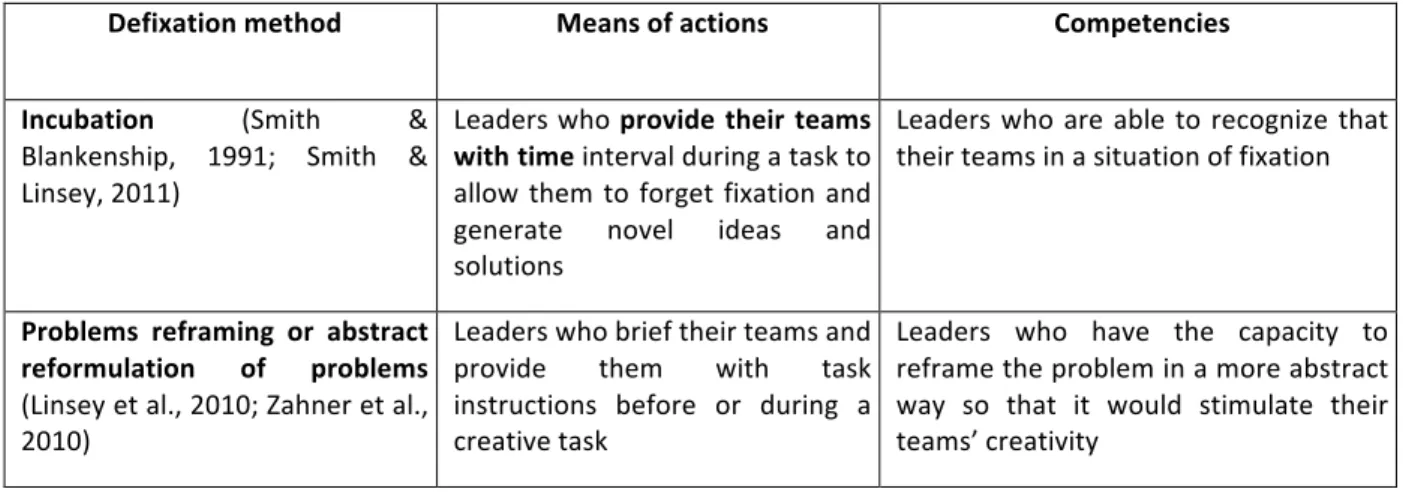
could be made through expansive examples, i.e. examples of ideas and solutions that are outside the fixation effect, and that help increase the creative generation capacities of individuals (Agogué et al., 2014a). Other studies showed that we could overcome fixation by reframing problems (Zahner, Nickerson, Tversky, Corter, & Ma, 2010), providing analogies (Bonnardel, 2000; Moreno, Yang, Hernández, Linsey, & Wood, 2015; Tseng, Moss, Cagan, & Kotovsky, 2008), providing open and abstract goals (Ward, Patterson, & Sifonis, 2004; Zahner et al., 2010), or even enabling incubation (Smith & Blankenship, 1991).
In the field of innovative design, several researchers have identified creativity stimulation techniques to overcome cognitive biases against creativity (Kowaltowski, Bianchi, & De Paiva, 2010). For instance, innovative design methods like the Concept‐Knowledge theory (Hatchuel & Weil, 2003), and KCP method (Hatchuel, Le Masson, & Weil, 2009) are well recognized to help individuals and teams not only identify but also bypass fixation in contexts of innovative design, respectively at the individual and collective levels.
At first sight, and by going through all these diverse creativity stimulation methodologies, one could inaccurately consider that they do not require any type of leadership, and that these “leaderless” defixation methodologies seem to be simply reduced to simple instructional processes. Moreover, this would be an excellent indication for management and creativity theorists claiming that creativity does not necessarily require “leadership” control. In other words, it would be perfectly consistent with the idea that creativity flourishes from certain levels of freedom and autonomy. However, by looking much deeper into these defixation procedures; we could model a very particular type of leader (with very specific managerial actions and competencies), hidden behind these instructional means.
FIGURE 2: THE RELATIONSHIP BETWEEN DEFIXATION METHODS & CREATIVE LEADERSHIP De$ixation Methods • Seemingly "Leadership‐less" De$ixation methods • But, possibility to extract Implicit Figures of Creative Leaders from De$ixation Methods Creative Leadership • Seemingly "De$ixation‐less" Creative Leadership Models • But possibility to Uncover De$ixation Practices in Creative Leadership
To illustrate the above‐mentioned fact, studies on the role of expansive examples as a defixation procedure (Agogué et al., 2014a) model figures of leader that have the competence not only to identify fixation but also to provide their teams with examples of solutions outside fixation, as well as a certain level of legitimacy to impose the given expansive example on their teams. Therefore, it is worth mentioning that although most defixation methodologies seem at first glance to be leaderless, they implicitly hide an important role of leadership with specific means of actions, competencies and strategies. The figure above illustrates this issue from both defixation and leadership perspectives.
III. Research Questions: How To Set Up New Forms Of Leadership
That Can Help Their Teams Overcome Fixation: A “Defixator
Leadership”?
Based on the above research context and problem, the principal research question is summarized as follows:
How to set up new figures of creative leadership that could play the role of “defixator” for their teams?
In order to set up and construct these figures of defixator leaders, three major variables (extracted from the evolutionary tree of leadership theories that we will present later) should be taken into consideration (see the three characteristics of defixator leaders in the figure below):
1. The means of actions of these figures of defixator leaders, which means the managerial tools, stimuli, and actions they use. In point of fact, this first sub‐question would consist of examining what are defixator leaders’ means of action, i.e. what should be defixator leaders’ management tools and actions to manage fixation/defixation processes? And what leadership practices should they use to enable defixation?
2. The minimal competencies of these figures of defixator leaders. Indeed, in order to defixate, defixator leaders should have certain competencies, or at least minimal competencies. Such competencies could be related to cognitive abilities of defixator leaders, their capacity to recognize certain things, to detect other things, etc. As a matter of fact, this second sub‐question would consist of determining what should be defixator leaders’ cognitive capacities to help their teams defixate, i.e. what should be their skills to defixate their teams?
3. The contingent strategies of these figures of defixator leaders are as well an indispensable variable. Basically, defixator leaders could be effective in certain situations, and with certain types of followers. However, they could fail in other situations, and with other types of followers. For this reason, the third sub‐question would consist of better understanding how should defixator leaders’ behave in front of teams with varying levels of expertise? In other words, what would happen if defixator leaders were less (or more) competent than their teams?
FIGURE 3: CHARACTERISTICS OF DEFIXATOR LEADERSHIP
Hence, in line with the above, the principal research question includes four narrower sub‐ questions that could be divided as follows: 1. What are defixator leaders’ means of actions? 2. What should be defixator leaders’ minimal competencies? 3. What are defixator leaders’ contingent strategies?
IV. Research Objectives: Set Up Figures Of “Defixator Leaders” Based
On Ideation’s Cognitive Approaches
In this thesis, we attempted to bring into light new figures of defixator leaders by bridging the existing research gap between creative leadership literature and defixation literature. Throughout our work, and in order to set up these precise figures of defixator leaders, we decided to fix specific research objectives: Means of Actions Minimal Competences Figures of "De-ixator Leadership" Contingent Strategies
• Designing the minimal profile of defixator leaders. In fact, one of the standard models of creative leadership is the innovator. Innovators are lone geniuses that have the creative ideas themselves and drive their teams according to their visions. One of the main challenges of our research work was to implement figures of defixator leaders that are not necessarily innovators (do not generate the creative ideas themselves, are not the lone geniuses behind the innovation). There are three principal reasons for this choice: o The first one is that no leader can possibly have all the answers and solutions for all problems. Figures of innovator leaders (such as Steve Jobs or Thomas Edison) are no doubt extremely effective but very hard to find because of their high levels of expertise and personality. Today leadership has passed from an individual into a more shared approach, in which leaders have to empower their followers and delegate some of their responsibilities (decision‐making, evaluation, recruitment, etc.) to them.
o The second one is that minimal profile of defixator leaders could easily be reinforced with further variables (such as charisma to inspire followers, or incentives to motivate followers, or creative thinking skills to stimulate and challenge followers, etc.).
o The third one is that by designing the minimal profile of defixator leaders, the necessary managerial conditions required for defixation could be easily extracted. This minimal profile of defixator leader could help organizational leaders to integrate basic managerial practices for defixation within their organizations.
• Involving defixator leaders intensively in the innovation process. In fact, another standard model of creative leadership is the facilitator. Facilitators are not highly involved in the innovation process but simply manage and handle the contextual factors for creativity. They create a creativity‐supportive climate, a culture of innovation within their teams, they motivate their teams, etc. Another challenge of our research work was to implement figures of defixator leaders that are highly involved in the innovation processes, and not simply facilitating it.
• Disclose the contingency nature of defixator leaders, by adapting their behaviours according to the cognitive skills of the teams they manage. What are exactly the contingency variables? How to enlighten them? As a matter of fact, leadership scholars emphasized the importance of the situational and contingency theories of leadership in the sixties, in which they focused more on the behaviors that the leader should adopt given situational factors, providing that a leadership style which is effective in a certain situation may not be equally
effective in another. For this reason, it is important to design new figures of defixator leaders that would adapt to different teams with varying levels of expertise.
• Neutralizing most of the classical variables inherited from creative leadership literature. Leaders give incentives to their teams, leaders create creativity‐supportive environments, leaders recruit creative individuals to stimulate creativity among team members, leaders provide their team with creative ideas or with relevant resources, etc. Most of these variables have different cognitive effects on their teams’ creativity. However, we don’t know how they could affect the defixation processes of their teams. In order to isolate and enlighten the effect of the defixation process, we had to neutralize most of these classical leadership organizational variables. In other words, we could say that another objective of our research work consisted of shedding light on the “cognitive influence” of leaders rather than the classical “social influence” of leaders.
• Designing a leadership‐driven ideation model by bringing into light the leadership characteristics present in the defixation processes literature (instructional processes, legitimacy, defixation strategies, cognitive abilities, etc.). In fact, designing figures of defixator leaders requires first modelling the process of ideation, then integrating into this model the precise means of actions of these figures of leaders, and finally validating this model experimentally. Moreover, the model could help us to identify what competencies are required by the leaders to defixate, as well as developing contingent strategies for defixation by simulating this model in various situations.
• Generating precise leadership rules and strategies for defixation based on experimental settings. As a matter of fact, the literature on creative idea generation has put aside the role of leaders during defixation processes. One research objective would be to shed light on the critical role leaders could play for defixation.
• Contextualizing the experimental‐based rules of leadership for defixation in organisational settings, using classical leadership organisational practices. In fact, very little is known about the role leaders should play for defixation in organisational contexts. Another research objective would be to understand how leadership classical organisational practices could be tailored in organisations for defixation purposes.
V. Research Methodology: Shaping “Defixator Leaders” Through
Theory‐driven Experiments
To answer these research questions and fulfill our research objectives, we adopted a specific research method in management sciences mixing “theory‐driven experiments” with empirical research method and empirical studies of innovative leaders.
The theory‐driven experimental method is usually applied to design experimental procedures in cognitive psychology. Theory‐driven experiments’ methodology relies on random assignment and laboratory control to ensure the most valid and reliable results. We chose this particular research method among others because answering research questions required having highly controlled settings, in order to neutralize most of the typical variables of creative leadership literature as we have explained in the research objectives.
Given the above, we first built a theoretical model of “leadership‐driven ideation”, based on both design and probability theories. Secondly, we used this theoretical model to define the necessary means of actions and competencies required for leaders to accomplish specific defixation objectives. We then conducted a series of experiments that enabled us to shape the principal characteristics of figures of defixator leader. Gradually in each experiment, we provided our figures of leaders with specific means of actions, and minimal competencies possible to play this role of defixator.
The research method we proposed articulates between the role of leadership for defixation at the individual and group levels (laboratory) and its more realistic implications at the organizational level (organization). As illustrated in the figure below, theory‐driven experimental research method highlights the hidden cognitive dimension regarding the role of leaders for defixation (step 1). The model of defixator leaders enables us to have contingent rules for leadership‐ driven defixation (step 2). Finally, getting back to an empirical research method post‐experiments remains essential to fill the gap between the artificiality of the experimental outcomes, and its more realistic implications in organizational contexts (step 3).
Using this research method, we were able to define the precise and contingent roles of leaders for defixation could be extracted from the experiments. Moreover, we attempted to search in the biographies of great leaders, as well as in other empirical studies, for empirical evidence that could confirm or refute these experimental‐based rules. The articulation between the experimental field and the empirical field helped to redesign new figures of leadership that could handle fixation at the individual and organizational level.
FIGURE 4: THE INTERPLAY BETWEEN LABORATORY & ORGANIZATION SETTINGS
VI. Structure of the Ph.D. Research Thesis: Synopsis
The Ph.D. thesis is structured into nine chapters as illustrated in the synopsis below. In chapter I, we presented an introduction to the Ph.D. research thesis, which included a brief review of the research context, problem, questions, objectives, and methodology.
Chapters II and III represents the step 1 of our research method. In chapter II, we introduce why fixation is a crucial challenge for future creative leaders. In fact, in a new context of innovation economy, where firms innovate or die, we show that a new critical challenge appears for tomorrow’s creative leaders: the role of defixator, i.e. how leaders should manage the process of defixation in context of creative ideation.
In chapter III, we examine in the literature review whether or not creative leaders play the role of defixators. First, we define the concept of leadership and then compare creativity and leadership. We then present the standard models of creative leadership: the innovator and the facilitator. Given these standard models, we look further into creative leadership styles and their underlying cognitive dimension.
FIGURE 5: SYNOPSIS OF THE THESIS
Chapters IV and V represent the step 2A of our research method. In chapter IV, we take advantage from the existing literature on defixation processes to uncover the implicit figure of leadership present in it, and this as a starting point for our main research question on how to set up new forms of defixator leaders. In this chapter, we then list our sub‐research questions, our research objectives, as well as our specific research methodology.
In chapter V, we propose a leadership‐driven ideation model. We begin by modeling ideation based on design theories, then “sequential ideation” based on probability theories. Then, we introduce the role of defixator leaders based on this ideation model. Finally, we design an instrument to measure creative ideation performance.
Chapters VI and VII represent the step 2B of our research method. In chapter VI, based on leadership‐driven ideation model, we and introduce the creativity task for our series of experiments, gradually build each of the four figures of defixator leaders, and present the general hypothesis for each figure.
In chapter VII, we experiment each of the four figures of defixator leaders presented in the previous chapter. In this chapter, we present the statistical results in terms of fluency/flexibility/originality, fixation/expansion scores, as well as transition probabilities parameters based on our instrument to measure creative ideation performance presented in chapter V. We finally discuss our principal results.
Chapters VIII and IX represent the step 3 of our research method. In chapter VIII, we present the characteristics of the new figures of defixator leaders, their features, and the standard figure of defixator leadership. We end the chapter by demonstrating how we could revisit leadership for defixation in organizational contexts using our laboratory‐based experiments (step 3 of our research methodology presented in chapter IV).
We end our thesis dissertation with chapter IX, which concludes with the major contributions of our research thesis, the limitations, the future perspectives, and the thesis‐related publications.
VII. Summary of Chapter I
Below is a summary box presenting the key points of chapter I in the form of a more detailed synopsis of the thesis as presented in the previous section:STEP 1:
chapters II &
III
Main Research Issues * Need for "De$ixator" leadership styles * Dif$iculty to uncover the cognitive dimension related to the roles of leadership for de$ixation in organizations * Therefore: need to neutralize classical creative leadership variables to precisely study de$ixation processes alone, and shape new $igures of "de$ixator leaders"STEP 2:
A: chapters IV & V
B: chapters VI & VII
A: Leadership‐ driven ideation model * To shape new $igures of "de$ixator leaders": need of an ideation model based on Design and Probability theories * Integrate the role of leaders in the model to see how they could de$ixate their teams (what means of actions, competencies, and contingent strategies) B: Leadership De-ixation Rules * Design new $igures of de$ixator leaders using step 2A (Leadership‐ driven ideation model) * Select a creativity task & Design of the Experiments (DOE) * Extract Leadership De$ixation Rules from ExperimentsSTEP 3:
chapters
VIII & IX
Back to Organizations * Adding back the variables neutralized in step 1 (classical practices of creative leaders in organizations) * What managerial implications in organizations can be obtained from step 2B (Leadership De$ixation Rules)? * Empirical validation using biographies of great leadersChapter II: Fixation: A Major Challenge for Creative Leadership
I. Research Context: The Innovation Economy
1. Creativity: A Fundamental Constituent of the Innovation Economy
FIGURE 6: FRONT PAGE HEADLINES OF THE BUSINESS WEEK ‐ 75TH ANNIVERSARY
Becoming faster, smarter, and increasingly complex, today’s world emphasizes the need for creativity and innovation (Dess & Picken, 2001). Creativity is nowadays considered a highly appreciated, not to say indispensable element. In almost every occupation, there is a place for a certain level of creativity and innovative thinking required (Shalley & Gilson, 2004). The creativity of employees constitutes a fundamental element for organizations’ success and continuous development (Bruch & Ghoshal, 2003).
Creativity has usually been described as the ability to generate ideas that are both novel and useful, while innovation extends this definition, and involve taking those creative ideas and carrying them through to implementation (Amabile, 1983). Creativity has become a fundamental constituent of the so‐called “innovation economy”, which has come to replace knowledge‐ dependent economy. In fact, the economic benefit resulting from creativity is undeniable. The more innovations (products/services) are generated in markets, and the more job opportunities are In chapter II, we introduce why fixation is a main challenge for future creative leaders. In fact, in a new context of innovation economy, where firms innovate or die, we show that a new critical challenge appears for tomorrow’s creative leaders: the role of defixator, i.e. how leaders should manage the process of defixation in context of creative ideation.
created in societies, which then result in economic growth. Therefore, creativity and innovations stand today as one of the principal motors that drive the world economy.
To illustrate this new phenomenon, the world’s best‐selling magazine Business Week has published a special issue entitled “innovation economy” in honor of its 75th birthday, highlighting in it the achievements of great innovators such as Apple late CEO Steve Jobs or the World Wide Web inventor Tim Berners‐Lee, and presenting in its edition a variety of inspiring strategic innovation articles such as “Building an Idea Factory”.
Within this new economy, it is worth pointing out that innovation is more than a goal for organizations, rather it is perceived as a fundamental philosophy and culture that should be encouraged at the governmental levels. Indeed, this new innovation economy came to shift the focus of governments and societies to encourage creativity, to develop novel and useful business models, as well as innovative products and services.
2. Innovating or Dying: A Threat to the Survival of Firms within the Innovation
Economy
In light of this rise of the so‐called “innovation economy”, organizations are committed to continuously innovate in order to compete with each other in the business scene. However, in most of the cases, innovating is not only a requirement for firms but rather an unavoidable obligation (Jagersma, 2003; Tushman & O’Reilly, 1996). Nowadays, every organizational leader is aware that his/her business should be innovative in order to subsist.
There are numerous examples of companies that failed to innovate and consequently disappeared from the business scene. During the decade 1990‐2000, Nokia was no doubt the number one mobile maker and the principal brand people used to own. In the early 2000s, Samsung and Apple strongly expelled the Finnish company from the smartphone industry, until it had disappeared completely from the business scene. Nokia is not the only example; indeed the list of innovation failures is long and comprises numerous giant companies such as BlackBerry, Kodak or Blockbuster (Binns, Harreld, O'Reilly, & Tushman, 2014).
Counterexamples also exist. 3M and Apple are two excellent examples of companies that succeeded to achieve amazing achievements, after passing by extremely critical failure times. It is only the crucial role of their great creative leadership that saved these companies from chaos. These
leaders succeeded in implementing within their companies a true and effective innovation culture, as well as new product development systems that reward and encourage creativity.
Consequently, if businesses want to compete in the market within this new innovation‐ dependent environment, they should learn, find and adopt new methods to “think outside the box”, or more precisely generate ideas beyond the box, ideas that would be the future successful innovation (product or service). In fact, to do that, they should be more flexible, and more creative to quickly adapt to the demands of this new and fast‐changing market.
Besides, this requires businesses to improve their ways of doing things, change the existing paradigms that have shown its limitations, to encourage creativity among their employees, to redirect their research and development strategies towards “research, innovation, and development” (Hatchuel, Le Masson, & Weil, 2001). Most importantly, this requires first rethinking the essence of leadership, its new roles to adapt to these fast and competitive innovation‐based markets. It requires giving new shapes to leadership, in such similar ways that management is today reshaped with novel concepts to better adapt to the future (Denis, 2014).
3. Rethinking The Essence of Leadership for Innovation: From Creative Leadership
to Leading for Creativity
To cope with the above‐mentioned environmental factors changing fast, where competitive markets and businesses are changing so rapidly that companies are either innovating or expiring, there is a need for a new vision of creative leadership. This new vision would come to replace the classical figure of creative leadership where the leader is creative and has all the answers, and replace it with an adequate figure of creative leadership where the leader manages and leads creative processes without being the lone genius.
For these reasons, and by considering leadership as a key and central factor to foster creativity among followers, many efforts have been made by management scholars throughout the last decades to shape different forms of leadership that could strongly manage and control the necessary conditions for creativity (Amabile & Gryskiewicz, 1987).
Creative leaders nowadays should play a key and determinant role in this new innovation economy. Creative leaders should have the necessary managerial means to enable the stimulation of creative ideas among their teams. They should push their organizations towards success through endless and constant innovation. Most importantly, creative leaders should have the ability to
identify the new challenges required by this new economy, and learn to play new and more adaptive roles to help their teams confront these challenges.
As a matter of fact, innovation economy requires rethinking the essence of leadership (Davenport, Leibold, & Voelpel, 2007) to adapt it to their new challenges. For this reason, redesigning the art of leading people towards the generation and production of creative outcomes stands no doubt as a fundamental requirement for this new economy. But what are the principal challenges faced by leaders of innovation in this new innovation economy? What are the key obstacles faced by leaders of innovation?
II. Research Problem: New Types of Challenges for Tomorrow’s Creative Leaders in
Early Innovation Processes
1. Confronting the Struggles of the Early Innovation Stages: Ideation
Innovation is a relatively long multistage process, comprising stages such as idea generation, evaluation, development or implementation. According to Oxford dictionary, innovation means the introduction of something new, such as a new product, service or process into the marketplace. The early stage of the innovation process is usually considered to be ideation.
FIGURE 7: INNOVATION PROCESS STAGES
Ideation or idea generation is the process of coming up or bringing into being new ideas, while creative ideation consists of coming up with creative ideas, i.e. ideas that are both novel and useful (Amabile, 1996). The concept “idea” is vague and unclearly defined in the literature of idea management (Sukhov, Magnusson, & Olsson, 2015). Divergent thinking theorists usually consider
Idea Generation Idea Evaluation Idea Development Idea Implementation