HAL Id: hal-00636039
https://hal.archives-ouvertes.fr/hal-00636039
Submitted on 26 Oct 2011
HAL is a multi-disciplinary open access
archive for the deposit and dissemination of
sci-entific research documents, whether they are
pub-lished or not. The documents may come from
teaching and research institutions in France or
abroad, or from public or private research centers.
L’archive ouverte pluridisciplinaire HAL, est
destinée au dépôt et à la diffusion de documents
scientifiques de niveau recherche, publiés ou non,
émanant des établissements d’enseignement et de
recherche français ou étrangers, des laboratoires
publics ou privés.
Decomposition of terminology graphs for domain
knowledge acquisition.
Fidelia Ibekwe-Sanjuan, Eric Sanjuan, Michael Vogeley
To cite this version:
Fidelia Ibekwe-Sanjuan, Eric Sanjuan, Michael Vogeley.
Decomposition of terminology graphs
for domain knowledge acquisition..
17th ACM conference on Information and knowledge
management (CIKM ’08), Oct 2008, Napa Valley, California, United States.
pp.1463-1464,
�10.1145/1458082.1458334�. �hal-00636039�
Decomposition of Terminology Graphs for Domain
Knowledge Acquisition
Fidelia Ibekwe-SanJuan
ELICO - University of Lyon 3 France
[email protected]
Eric SanJuan
LIA - University of Avignon France
[email protected]
Michael S. Vogeley
Department of Physics -Drexel University Philadelphia, PA 19104 USA[email protected]
ABSTRACT
We propose a graph decomposition algorithm for analyz-ing the structure of complex graph networks. After multi-word term extraction, we apply techniques from text mining and visual analytics in a novel way by integrating symbolic and numeric information to build clusters of domain top-ics. Terms are clustered based on surface linguistic vari-ations and clusters are inserted in an association network based on their intersection with documents. The graph is then decomposed based on atom graph structure into cen-tral (non-decomposable) atom and peripheral atoms. The whole process is applied to publications from the Sloan Dig-ital Sky Survey (SDSS) project in the Astronomy field. The mapping obtained was evaluated by a domain expert and appeared to have captured interesting conceptual relations between different domain topics.
Categories and Subject Descriptors
H.3.1 [Information Storage and Retrieval]: Content analysis and indexing; H.3.3 [Information Storage and Retrieval]: Clustering
Keywords
Knowledge acquisition, Mapping knowledge domains, Graph decomposition, Information visualization, User evaluation
1.
INTRODUCTION
We address the knowledge acquisition needs of domain specialists by automatically mapping the structure of a spe-cialty in the field of Astronomy, that of the Sloan Digi-tal Sky Survey (SDSS) project. We designed a text min-ing system called TermWatch which extracts terms (multi-word noun phrases) from running texts and clusters them based on an integrated approach combining symbolic (lin-guistic) and numerical relations (co-occurrence). It relies on
Permission to make digital or hard copies of all or part of this work for personal or classroom use is granted without fee provided that copies are not made or distributed for profit or commercial advantage and that copies bear this notice and the full citation on the first page. To copy otherwise, to republish, to post on servers or to redistribute to lists, requires prior specific permission and/or a fee.
CIKM’08 October 26–30, 2008 Napa Valley, California USA
Copyright 2008 ACM 978-1-59593-991-3/08/10 ...$5.00.
a graph-based approach using a hierarchical clustering algo-rithm named CPCL (Classification by Preferential Clustered Link)[2]. The results are evaluated by a domain expert in-volved in the SDSS project who is also co-author of this paper.
2.
METHODOLOGY
2.1
SDSS dataset
The corpus consisted of bibliographic records of peer-reviewed journal papers related to the SDSS project, published be-tween 1991 and 2006. The records were retrieved from the Web of Science. 1,293 bibliographic records were thus ex-tracted. While this collection does not constitute the whole set of publications on SDSS, it represents a body of peer reviewed publications indexed by the ISI.
2.2
Feature extraction and selection
TermWatch extracts multi-word terminological noun phrases based on our set of morpho-syntactic rules and POS (part-of-speech) information by (TreeTagger, Schmid 1994). We devised an adapted weighting function which takes the ge-ometric mean (Gmean) of the inertia induced by two tf.idf
functions.
2.3
Term Clustering
The next step is to build a network of semantic variants based on linguistic relations which relate synonymous terms (orthographic variants, WordNet synonyms), siblings (ex-pansions of the same terms) or create a loose type of asso-ciation. In a first phase, tight semantic relations are used to form connected components of the input network. These components capture the synonymous variants of the same concept, thus ensuring that semantically equivalent terms or near equivalent are not dispersed in several clusters at the end of the process. The next phase is the clustering proper using a coefficient to compute strength of between compo-nents. The CPCL algorithm has been evaluated against vari-ants of hierarchical clustering and k-means and was found to produce more homogeneous clusters. See [3] for more details.
2.4
Atom decomposition of association graphs
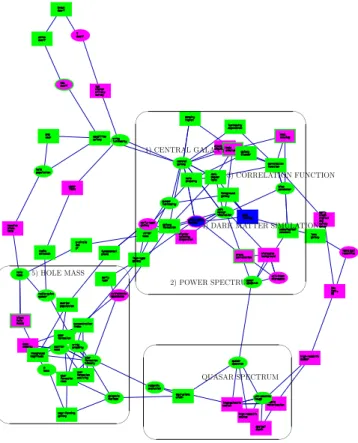
It involves two major steps: the construction of an as-sociation graph from any two information units and graph decomposition. To analyze assocation in documents between clusters, we compute overlapping atoms instead of disjoint connected components.' & $ % 1) CENTRAL GALAXY 2) POWER SPECTRUM 3) CORRELATION FUNCTION
4) DARK MATTER SIMULATION
QUASAR SPECTRUM ' & $ % ' & $ % 5) HOLE MASS
Figure 1: Central atom
To analyse such network, we rely on the intrinsic graph structure.
For that we use the the concept of graph atom that can be defined based on (a, b)-clique separators. These are com-plete subgraphs such that there exists two vertices a, b such that any path from a to b necessarily contains at least one element in the separator. We shall say that a graph is clique inseparable if there is no subgraph that is a complete sepa-rator. We shall call atom of a graph any connected maximal subgraph that is clique inseparable. By definition, an atom Aof Gk contains at least one complete separator S of Gk.
However S is not a separator of A. Atoms overlap if they contain the same separator of Gk. The decomposition of Gk
in atoms is unique and it can be decomposed in O(|V ||E|). In previous experiments [1], we observed that graphs of the form Gk(V, E) for k between 1 and 3 have a central atom
with long cycles that involves almost 50% of the vertices and numerous peripheral atoms of small size that are almost chordal (circles have less than three elements).
3.
RESULTS
3.1
The central atom in SDSS research
This graph portrays a subset of inseparable nodes as de-fined previously. In terms of domain knowledge, it can be seen as a set of tightly interwoven topics that could be core in the domain.Figure 1 shows the general layout of the graph of associa-tions between clusters before atom decomposition using the AiSee graph display package (http://www.aisee.com).
3.2
Evaluation
The clusters are labeled automatically by the system. The central atom graph was presented to the expert for evalua-tion. Globally, the structure of the central atom was found to be coherent, in some cases highlighting interesting and unexpected connections between domain topics.
The most prominent node labelled “central galaxy” is po-sitioned at the center of the central atom. The fact that the system placed this cluster in a central position was judged an unexpected but interesting finding by the domain expert. It also made sense because new theoretical ideas about how galaxies populated dark matter halos (the “Halo Occcupa-tion DistribuOcccupa-tion” model), observaOcccupa-tional studies to deter-mine the masses of central galaxies by observing velocities of satellites, and related observational studies using weak lensing, all focus on “central galaxies”. Thus, the system was successful in highlighting as such, a passageway in the domain without external domain knowledge.
“Power spectrum” the is 2nd node by betweenness cen-trality and is strategically placed between the first group on “central galaxy” and a group of topics in the southern region of the central atom. Expert evaluation confirmed that the links around power spectrum were valid.
“Correlation function” is ranked 3rd by betweenness cen-trality. This cluster shares an indirect link with “central galaxy” via “dark matter halo”. Expert evaluation confirmed that this term is in some cases related to the power spectrum statistic (in such cases they are the Fourier transform of one another). “Dark matter simulation” is 4th by betweenness centrality. This cluster is linked to other clusters labeled “galaxy-galaxy lensing, galaxy formation, body simulation”. They focus on recent techniques or functions to study galax-ies and measure dark matter haloes.
“Hole mass” ranked 5th by betweenness is located at the extreme left of the graph and seems to be part of a network of publications on the study of black holes.
4.
CONCLUSION
We designed a system for automatically mapping the struc-ture of a specialty field. Our graph decomposition method has accurately isolated in a central atom the core topics and correctly related them without external semantic knowl-edge. The structure of the core topics could not have been grasped by reading up publications or by a pre-existing do-main knowledge representation.
5.
REFERENCES
[1] M. D. Biha, B. Kaba, M.-J. Meurs, and E. SanJuan. Graph decomposition approaches for terminology graphs. In MICAI, pages 883–893, 2007.
[2] F. Ibekwe-SanJuan. A linguistic and mathematical method for mapping thematic trends from texts. In Proceedings of the 13th European Conference on Artificial Intelligence (ECAI), pages 170–174, Brighton, UK, August 1998.
[3] E. SanJuan and F. Ibekwe-SanJuan. Text mining without document context. Inf. Process. Manage., 42(6):1532–1552, 2006.