HAL Id: hal-00717219
https://hal.inria.fr/hal-00717219
Submitted on 12 Jul 2012
HAL is a multi-disciplinary open access
archive for the deposit and dissemination of
sci-entific research documents, whether they are
pub-lished or not. The documents may come from
teaching and research institutions in France or
abroad, or from public or private research centers.
L’archive ouverte pluridisciplinaire HAL, est
destinée au dépôt et à la diffusion de documents
scientifiques de niveau recherche, publiés ou non,
émanant des établissements d’enseignement et de
recherche français ou étrangers, des laboratoires
publics ou privés.
Compilation
Jean-Marc Jézéquel, Benoit Combemale, Steven Derrien, Clément Guy,
Sanjay Rajopadhye
To cite this version:
Jean-Marc Jézéquel, Benoit Combemale, Steven Derrien, Clément Guy, Sanjay Rajopadhye. Bridging
the Chasm Between MDE and the World of Compilation. Software and Systems Modeling, Springer
Verlag, 2012, 11 (4), pp.581-597. �10.1007/s10270-012-0266-8�. �hal-00717219�
(will be inserted by the editor)
Bridging the Chasm Between MDE and the World of Compilation
Jean-Marc Jézéquel1, Benoit Combemale1, Steven Derrien1, Clément Guy1, Sanjay Rajopadhye2 ⋆
1 University of Rennes 1, IRISA, Inria e-mail: {name.lastname}@irisa.fr 2 Colorado State University
e-mail: [email protected] Received: date / Revised version: date
Abstract Modeling and transforming have always been the
cornerstones of software system development, albeit often in-vestigated by different research communities. Modeling ad-dresses how information is represented and processed, while transformation cares about what the results of processing this information are. To address the growing complexity of soft-ware systems, Model-Driven Engineering (MDE) leverages Domain Specific Languages (DSL) to define abstract models of systems and automated methods to process them. Mean-while, compiler technology mostly concentrates on advanced techniques and tools for program transformation. For this, it has developed complex analyses and transformations (from lexical and syntaxic to semantic analyses, down to platform-specific optimizations). These two communities appear today quite complementary and are starting to meet again in the Software Language Engineering (SLE) field. SLE addresses all the stages of a software language lifecycle, from its defini-tion to its tooling. In this article, we show how SLE can lean on the expertise of both MDE and compiler research commu-nities and how each community can bring its solutions to the other one. We then draw a picture of the current state of SLE, and of the challenges it has still to face.
1 Introduction
During the 70s, tools such as Lex, Yacc, cc, Make and SCCS basically defined the extent of software engineering tools. As time passed, these tools were extended, refined and produced offsprings in a variety of ways. Among the many research strands stemming out of this initial set, we will concentrate in this article on two that initially took very different routes, namely Compilation and Model Driven Engineering (MDE). ⋆ This work is the result of a close collaboration between Inria and Colorado State University (CSU), involving two teams in MDE (the Triskell team at Inria and the SE group at CSU), and 2 teams in opti-mizing compilers (the CAIRN team at Inria and the Mélange group at CSU). This collaboration is partially funded by Inria associated teams MoCAA and LRS.
On the one hand, research in compilation significantly pushed the state of the art with respect to processing software language constructs. Major advances include efficient parsing and parser generation, advanced grammar formalisms (e.g. higher order attribute grammars [1]), source transformation systems and languages such as DMS [2], Rascal [3], Strat-ego [4], or TXL [5] that provide powerful general-purpose sets of capabilities for addressing a wide range of software analysis problems.Important contributions in program and dataflow analysis, include type checking, abstract interpre-tation, alias and shape analysis, and whole program analysis. On the code generation side, much progress has been made to address the variety and complexity of modern processors (e.g. complex instruction sets, power-consumption issues, hi-erarchical memory structures, multi-cores, etc.) with sophis-ticated algorithms handling (data and control) flow analysis, aliasing analysis, register allocation, etc.
A key driver of compiler research is the constant quest of maximal efficiency, both at code level and at meta-level (i.e., in the algorithms implemented in the compilers them-selves), to the point where we can truly speak of a culture of efficiency in the compiler community. However, a clear and recent concern is the extremely complex architectures of sophisticated compilers, that start to pose classical software engineering problems of reliability, development cost, main-tainability, etc.
On the other hand, research in MDE originated in the problem context of representing and manipulating complex data. Beyond the initial issues of Chen’s Entity-Relationship modeling, MDE was used widely enough to address Separa-tion of Concerns (SoC) issues, by breaking down complex systems into as many models as needed in order to make all the relevant concerns understandable. These models may be expressed with a general-purpose modeling language such as the UML [6], or with Domain Specific Languages (DSL) when it is more appropriate. Each of these models can be seen as the abstraction of an aspect of reality for handling a given concern.
Models have long been used as descriptive artifacts, which was already extremely useful. The idea of MDE is to
go beyond that, i.e., to make it possible to perform computa-tions on models, for example to simulate some behavior [7], or to generate code or tests from them [8]. This requires that models are no longer informal, and that the language used to describe them has a well defined syntax and semantics.
In many domains engineers rely on DSLs to solve the complex issues of engineering software at the right level of abstraction. These DSLs define modeling constructs that are tailored to the specific needs of a particular domain. When such a new DSL is needed, it is now often first defined through a meta-model, i.e., a model describing its abstract syntax [9] when traditional language engineering would have started with the grammar of the language. Relying on well tooled standards such as MOF [10], the meta-modeling ap-proach makes it possible to readily benefit from a set of tools such as reflexive editors, or XML serialization of models. More importantly, having such a tool-supported de facto stan-dard for defining models and meta-models paves the way to-wards a rich ecosystem of interoperable tools working seam-lessly with these models and meta-models, e.g., Kermeta, which is a Model Driven Engineering platform for building rich development environments around meta-models using an aspect-oriented paradigm [7, 11]. However, people building such tools often re-invent solutions that are well known in the compiler community.
The goal of this article is to explore how research in MDE and research in Compilation could cross-fertilize and might even converge on Software Language Engineering [12], af-ter 30 years of diverging evolution. Several groups around the world have already started to investigate several aspects
of this idea. For instance, Eclipse tools such as EMFtext1
or Xtext2 already bridge the world of meta-modeling and
grammar parsing. JastAdd [13] combines higher order at-tribute grammars with object-orientation and simple aspect-orientation (static introductions) to provide better modularity mecanisms. Rather than reviewing such examples individu-ally, we take a holistic view: what could compiler research bring to MDE (Section 2)? And conversely, what could MDE research bring to compilation (Section 3)? We show in Sec-tion 4 how the synergies between these two fields can ben-efit Software Language Engineering (SLE) as well as two key challenges which cannot be solved by these synergies. Finally, Section 5 concludes and presents some perspectives about other possible cross-fertilizations for SLE.
2 Leveraging Compilation Breakthroughs for MDE Because computer programming evolved from machine lan-guage up through assembly and higher level lanlan-guages, pilation has been one of the oldest areas of research in com-puter science. It has had a tremendous influence on and ben-efitted from many core areas in computer science.
In addition, modern compiler design practices also of-fer an interesting perspective from the software engineering
1 http://www.emftext.org/index.php/EMFText 2 http://www.eclipse.org/Xtext ! " # $ % & ! ' ( # & ! ' " # ) & * + )
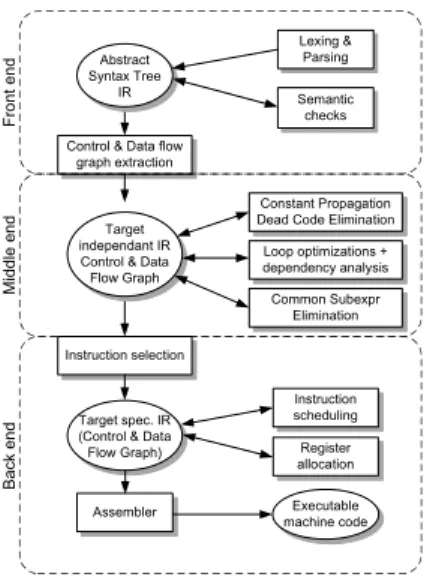
Figure 1: The typical organization of a compiler flow
point of view. It is indeed widely acknowledged that modern industrial strength compilers are extremely complex pieces of software, and that designing a compiler is a very challenging task. As a matter of fact, most modern compiler infrastruc-tures are organized according to strict design rules, that are
best practicesand are the result of more than four decades of experience in compiler software design.
This typical compiler toolchain organization is illustrated in Figure 1, and consists of three stages, namely the front-end which deals with parsing and semantic checks, the middle end stage, where all the machine independent analyses and optimizations are performed, and the back-end stage whose role is to efficiently generate efficient machine code.
We present in this section some experiences from compi-lation that could benefit MDE.
2.1 Parsers
One of the most obvious contributions of the compiler com-munity to MDE lies in the design/proposal of efficient al-gorithms to automate the parsing of languages from formal specifications.
For context free grammars, the main breakthrough oc-curred more than 40 years ago with the introduction of LR and LL parser generators [14, 15] that could efficiently deal with a large subset of context free grammars. Most program-ming languages are too complex to be expressed with such grammars, and these techniques were subsequently extended (e.g., Generalized Left Right Parsing (GLR) [16] and LL(*) parsers [17]) to support a wider class of grammars.
Interestingly, compiler compiler frameworks started about 15 years ago to offer additional features which go well beyond strict parsing. As an example, smart error recovery schemes [18] are used either to help programmers find the cause of an error or to suggest possible corrections. Similarly incremental/lazy parsing [19] is also receiving more and more
interest. This comes from the fact that syntactic analysis is nowadays tightly coupled to programming environment (e.g., it enables on-the-fly syntactic checking). In this context pars-ing speed may become an issue, and hence requires adequate techniques and algorithms.
With the growing use of DSLs the MDE community faces a growing need for parsing tools, and has started to build on many achievements of the compiler research community. These achievements served as a base to build MDE rich lan-guage toolset. Indeed many lanlan-guages have been introduced for a range of problems such as: GUI specification, verifica-tion and prototyping [20], multiagent system definiverifica-tion [21], model validation (e.g., using the Object Constraint Lan-guage [22]), model-to-model transformations (e.g., through dedicated languages such as the standard QVT [23] or ad hoc
ones such as Kermeta3or ATL4) and model-to-text
transfor-mations (e.g., template languages such as Acceleo, Xpand, etc). Note that all these language toolsets were designed in an ad hoc manner, with little reuse. This lack of reuse is one of the motivations behind SLE workbenches such as Xtext and EMFText.
2.2 Sophisticated algorithms
Most compilers perform very complex analyses or transfor-mations on the program representation before targeting a given execution platform. These analyses rely on very so-phisticated algorithms, that are generally either specific to the compiler target language or specific to a family of languages (imperative, with or without dynamic typing, functional, etc). These algorithms (as explained in the next subsections) seek to obtain accurate information about the program behav-ior, while remaining scalable. They can be used for source code verification purposes (e.g., for detecting memory er-rors at compile time), for optimization purposes (e.g., finding statements that can be executed in parallel) or both.
Examples include shape analysis [24], dependency
anal-ysis, pointer analysis and type inference [25], just to name
a few. Altough there exist many established algorithms for these problems, static analysis is a very important and very active facet/contribution of compiler research.
Similarly loop transformations are also key optimizations that focus on specific portion of a program and seek to adapt the ordering of computations in loop nests kernels to suit the target machine memory hierarchy (cache memory, processor registers) or machine parallel processing capabilities (thread or data level parallelism). Of course machine dependant algo-rithms have also received a lot of attention. Such algoalgo-rithms include register allocation and instruction selection and in-struction scheduling algorithms which seek to find the best mapping between a program and a given machine instruction set or micro-architecture.
Again, such a transformation framework leverages very complex algorithms, involving many challenging
combina-3 http://www.kermeta.org/
4 http://eclipse.org/atl/
torial optimizations problems and platform-specific knowl-edge.
On the other hand, because the idea behind MDE is to provide models in which most domain specific knowledge is made explicit in the representation, developers do not gen-erally need (or do not seek) to rely on sophisticated tools and algorithms to derive their systems implementations. In-deed, even though the implementation of many model trans-formations consists of very complex structural transforma-tions, their complexity derives from the complexity of the models involved in the transformation, rather than from the algorithm used in the transformation. However, since mod-ern MDE increasingly advocates the use of DSLs to describe software systems, compilation chains for these DSLs will eventually have to consider more complex transformations, even with the use of more suitable structures for model trans-formations. Therefore, MDE could benefit from the long time experience of the compilation community in the development of such complex algorithms.
2.3 Program transformation paradigms
Most compiler representations are either based on (i) a tree based structure, which more-or-less directly corresponds to the Abstract Syntax Tree (AST) of the target language, or (ii) on a Control Flow Graph (CFG) representation in which the high level control structure is flattened to expose the program as a graph of basic blocs in which the execution is strictly se-quential. Usually, most compiler infrastructures manipulate both representations (front end analyses and transformations operate on ASTs whereas middle and back end stages gener-ally operate on CFGs).
Many transformations/analyses operating on AST (resp. CFGs) have a lot in common. Therefore, there has long been interest in proposing program transformation/analysis paradigms to enable capturing and expressing a large family of transformations within a single workbench [26, 27].
Transformations known as term rewriting techniques [28, 4] fall into this category as they allow compiler writers to con-cisely express complex pattern matching and rewriting oper-ations on trees. Term rewriting techniques make it possible to combine powerful pattern matching techniques with high-level rewriting ’strategies’ that allow users to define the tree term traversal in a concise and yet very flexible way, by com-bining simple low-level primitives. In addition to conciseness and expressivity, the underlying formal definition of such term rewriting techniques also brings additional opportunities for formal proof and verification (e.g., completeness, consis-tency). MDE tries leverage such techniques for model
trans-formation. Among others we can cite tools such as AGG5or
TOM-EMF6. This is also the goal of the QVT [23] standard
which defines a declarative/operational hybrid language for
5 http://user.cs.tu-berlin.de/~gragra/agg/
6 http://tom.loria.fr/wiki/index.php5/
model transformations, although the standard does not give any reference implementation for this language.
2.4 Program analysis paradigms
Another class of popular compiler analyses/transformations, which are usually applied to CFG like structures, are those based on dataflow analysis [29]. These analyses are used to gather information about the possible values manipulated at different control flow points of a program, the information collected then being used to drive verification and optimiza-tion processes.
The analysis is based on the principle of dataflow
equa-tions, which are used to propagate information between pairs of connected basic blocks (either forward along or backward against the actual program control flow) using a transfer
func-tion. These equations are then solved iteratively until a fixed
point is obtained.
Because of the genericity of the technique, several dataflow analysis workbenches (some of them leveraging DSLs) have been proposed [30, 31, 32]. Their goal is to help automate part (or all) the implementation of a dataflow anal-ysis for a given compiler infrastructure and a (family of) lan-guages.
At first glance, it may seem that these advanced tech-niques are very specific to general-purpose programming
lan-guages from which a control flow can be extracted7.
How-ever, many domain-specific languages embed constructs to describe behaviors, these behaviors following either imper-ative or functional programming semantics. All these lan-guages are hence also amenable to dataflow analysis, and can therefore benefit from all existing dataflow-based Verification and Validation (V&V) techniques.
2.5 Efficiency, scalability
Compiler designers always emphasize scalability when inte-grating or devising new analyses and transformations in their
flow. As an illustration, production compilers such as gcc8or
Intel’s icc9are expected to compile a 100k-loc program in a
matter of minutes, whether or not optimizations are enabled. These constraints are even tighter for just-in-time compilers, which are becoming more and more widely used due to the wide adoption of virtual machines such as the JVM and .Net. In these latter cases, compilation time directly impacts pro-gram execution and only very fast and scalable algorithms (i.e., linear complexity algorithms) can be allowed.
Achieving such a scalability while preserving good per-formance in the compiled code is therefore a very difficult 7 This includes functional languages where the notion of dataflow analysis is well known
8 http://gcc.gnu.org/
9 http://software.intel.com/en-us/articles/
intel-compilers
challenge, especially since many of the optimization prob-lems involved in compiler back-ends (register allocation, in-struction scheduling and selection and other combinatorial optimization problems) are NP-complete or NP-hard and suf-fer from combinatorial explosion.
In the MDE world, performance has not been such a cern so far. The software engineering community has con-stantly been benefiting from the Moore’s law driven progress of Very-Large-Scale Integration technology combined with the numerous breakthrough in programmable processor ar-chitectures (RISC, super-scalar ISA, etc.). Such evolutions enable the introduction of more and more complex frame-works, whose role is to abstract away the underlying machine as much as possible. As a consequence, and from an opti-mizing compiler point of view, modern software engineering workbenches are perceived as resource hungry, slow and suf-fering from significant scalability issues.
As a matter of fact, when it comes to execution effi-ciency, the MDE community has been long confronted with a chicken-and-egg dilemma. Performance issues will only be addressed by the community when there is a sufficiently large user base with such strong performance requirements. In the mean time, potential users seeking good performance will remain reluctant to use MDE technologies. We believe this dilemna will soon have to be addressed by the MDE com-munity. Indeed, the outbreak of multicore and manycore ar-chitectures will require a major shift in the way software is designed, since benefiting from processor performance im-provements will no longer happen for free. Among other challenges, software implementations will be forced to ex-plicitly expose considerable amounts of usable parallelism and this could be the first step toward a more systematic con-cern for implementation efficiency. Consideration of such ef-ficiency and scalability issues would benefit MDE, and par-ticularly in domains such as embedded systems, green com-puting or high performance comcom-puting.
2.6 Platform Description Model
Compilers are meant to produce efficient code, and producing efficient code obviously requires a deep knowledge and un-derstanding of the target execution platform. For this reason, there has been a lot of effort on optimization, i.e., to improve the efficiency of the code generated by compilers.
The problem tackled in the optimizing compiler com-munity goes from high level target agnostic optimization (dead code elimination, constant propagation, common sub-expression elimination, etc.) to more machine dependent ones (register allocation, instruction selection, automatic paral-lelization, etc).
Because of the high development cost required to port an existing compiler to a new processor architecture, significant research was devoted to trying to automate part of this effort, by making the infrastructure retargetable [33].
In optimizing compilers, target description languages are commonly used to describe in a systematic manner, the
fea-tures of interest of the underlying platform. In addition to tar-get portability they expose some cost feature to the compil-er/code generator so that the quality of the generated code can be optimized. Such concerns are usually distant from the MDE community.
This is made possible through the use of a formal machine description, which captures all the information/knowledge about the target platform [34, 35]. As an example, most com-piler infrastructures are designed to be easily retargeted to a new processor. This retargetability is achieved through the use of a formal description of the processor instruction set (operational semantics, execution cost, binary format, etc). This description is then used to automatically regenerate an optimizing back-end for the new architecture (code selector, register allocation, assembler, etc).
Later, a similar principle was also followed by the MDE community: for example Model-Driven Architecture (MDA) [36] aims at achieving a good separation of concerns through the use of Platform Independent Models (PIM) and Platform Specific Models (PSM). The transformation from PIM models to PSM models is then performed using a Plat-form Description Model (PDM) whose role is to provide an abstract description of the target platform that is supposed to drive the transformation process [37, 38].
Experience shows that only few MDA workbenches ac-tually follow this approach. In practice most PIM to PSM transformations do not use an explicit model of the target platform: the platform specificities are instead implicitly cap-tured within the transformations. Even when PDM are ex-plicitly used in the flow, they almost never serve to optimize the performance, or other QoS aspects, of the generated code, unlike what a compiler would do.
Their weakness is that most PDMs do not expose enough semantics and/or details to enable optimized PIM to PSM transformations. This lack of formalization of platform fea-tures can be explained by the difficulty of describing com-plex software platform (such as J2EE, .NET, Android, etc.) at the right level of abstraction. As far as this issue is con-cerned, the MDE community has probably a lot to learn from the optimizing compiler community.
3 Leveraging MDE Breakthroughs for Compilation Model driven engineering (MDE) is the result of a long evo-lution in software engineering to handle the increasing com-plexity of software development. In particular, MDE benefits from the modeling and programming evolution and their best practices such as complex data representation, separation of concerns or design-by-contract.
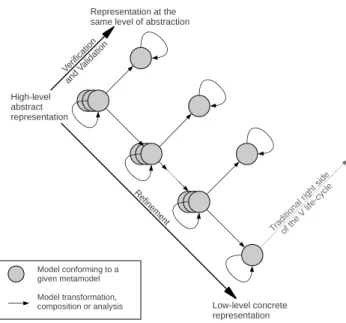
As shown in Figure 2, MDE workbenches often use high-level models to describe a system, each one representing an
aspect of the system. These models are then composed and transformed into lower level models in successive steps un-til we obtain an executable representation of (some part of) the system (e.g., executable code, configuration scripts, etc.). Moreover, this process can also include early Verification and
Trad ition al ri ght s ide of th e V life -cyc le R efin em ent High-level abstract representation Low-level concrete representation Model conforming to a given metamodel Model transformation, composition or analysis Verif icat ion and Valid atio n Representation at the same level of abstraction
Figure 2: MDE in the left-hand side of the V life-cycle
Validation (V&V) stages at every step of the refinement, by the transformation of the (domain specific) models into suit-able models for V&V (e.g., petri nets for model checking).
This process, which is represented by the refinement axis, is of course very similar to compilation which produces a low-level executable code from a high-level source code by successive semantic-preserving steps of transformations. We now present some of the best practices of MDE in soft-ware development and describe how compilation could ben-efit from them.
3.1 Complex Data Representation
MDE is primarily concerned with reducing the accidental complexities associated with developing complex software systems [39]. This is accomplished through the use of tech-nologies that support rigorous analysis and transformation of abstract descriptions of software to concrete implementa-tions [40]. To handle the design of such descripimplementa-tions, MDE technologies take advantage of the experience acquired in the fields of databases and programming languages, and thus in-tegrate more advanced paradigms to represent complex data. In particular, the object-oriented principles are shifted from programming to modeling with languages such as UML [6]. Nowadays, these principles are at the heart of the domain-specific knowledge capitalization in the metamodeling activ-ity thanks to languages such as MOF [10]. Consequently, a metamodel can be seen as the object-oriented model of an Abstract Syntax Tree (AST) and the corresponding symbol table [41, 9].
Usually, metamodeling environments also provide built-in support for serialization, model built-interchange, visualization and more recently configuration management. Thus, one ob-vious way that MDE can contribute to the world of
compi-lation lies in the best-practices for representing and manip-ulating the complex data structures at the heart of modern optimizing compilers.
Moreover, the high-level information contained by mod-els can be used for domain-specific optimizations, whereas the same information may be difficult for a compiler to ex-tract from a lower-level representation (e.g., a classical com-piler IR) [42, 43].
3.2 Separation of Concerns
Each model represents an aspect of the software (aka. view-point) and allows a clear separation of concerns (SoC) in the development activity. Thus, each domain expert can focus on her very particular problem and benefit from a special-ized toolset without having to consider any other concerns. This principle is illustrated in Figure 2 where different mod-els, conforming to different languages supporting dedicated tools are used to represent a software system. These models can then be composed and refined into models at a lower ab-straction level which capture new concerns (as shown on the refinement axis on Figure 2). Moreover, at each step of the refinement, it is possible to transform the models into suit-able models for an early V&V of the system (as shown on the V&V axis of Figure 2). The V&V concern is thus separated from other concerns, thanks to the use of specific models.
SoC could benefit the compilation community to enable a clear identification of the different concerns in a com-piler toolchain (performance optimization, semantic analysis, translation between languages, etc.)
Each concern in a compilation chain could be addressed through dedicated models that would then ease the design of the compiler passes. Such SoC is already (partially) achieved in most compilation workbenches, which generally rely on several different intermediate representations (IRs) corre-sponding to the different stages of a compiler toolchain. These IRs range from enriched ASTs that are used during the early stage of the compilers, to low level machine specific de-scriptions of the program, which serve for the back-end stage. Nevertheless, each IR of a compiler mostly corresponds to a complete/full featured description of the program, and almost always contains information that is irrelevant to the transfor-mation (or analysis) at hand. For example, register allocation is performed on an IR which contains a complete machine level description of the program, even though the algorithm only needs an enriched conflict graph structure to operate.
3.3 A Uniform Model-Driven Approach for Software and Language Engineering
One of the main contribution of MDE is to provide method-ological and technmethod-ological foundations to design and imple-ment DSLs and their tooling. For this purpose, MDE lever-ages a similar approach as the design and implementation of systems (object-oriented paradigm, design by contract, etc).
This approach makes the modeling of a DSL (aka. metaeling) very similar to the modeling of a system. Indeed, mod-eling a software system or a modmod-eling language for software systems end up being the same, and can therefore be tackled within a unified workbench.
While the abstraction of a software system is called a model, the model of the abstract syntax of a language is gen-erally referred to as a metamodel. The modeling of a lan-guage is enabled by a metamodeling lanlan-guage or metalan-guage (which is to metamodels what a modeling lanmetalan-guage is to models) such as MOF. It is then possible to define tools on this metalanguage (i.e., metatools), and particularly genera-tive metatools. This enables the tooling of metamodels con-forming to the metalanguage, by automating all or part of the development tasks (e.g., textual and graphical editor genera-tor, simulator generagenera-tor, etc). Structural software design pat-terns are a perfect example of such generic concepts that can be shared between metamodels. As a consequence, express-ing them at the metalanguage level provides a powerful tool-box to the developers who can apply or reuse these patterns into all their metamodels.
The notion of generative metatools is not new to compi-lation community. For example, BEG [44] and BURG [45] are two tools which are used to generate processor instruc-tion selectors, and PAG [30] and DFAGen [32] are two data-flow analysis generators. Such tools could benefit from a shift from the program level (i.e., model level) to the program-ming language level (i.e., metamodel level) of compilation techniques (e.g., transformation paradigms presented in Sec-tion 2.3).
Moreover, instances of IRs are abstractions of the com-piled program, and thus are models. Therefore, the use of metamodels to define the abstract syntax of the intermediate languages seems a natural choice. In this context, each pass of the compilation chain becomes a model transformation.
Two examples of compiler infrastructures based on
meta-modeling and model transformations are GeCoS10 and
Alp-haZ11. These two research-oriented optimizing compiler
in-frastructures have faced the same software engineering is-sues during their development, and decided to use MDE to tackle them [46]. Indeed, compilers are composed of multi-ple passes manipulating several intermediate languages. As such, compiler developers face well known software engi-neering challenges such as maintainability of the code, doc-umentation production or time consuming and error prone development tasks. With the use of metamodeling comes a homogenization of development practices such as naming conventions. Metamodels also offer an abstract representa-tion of the software, and document many important design choices. These abstract representations include an object-oriented graph (e.g., with the notion of specialization/gener-alization) and a tree (the containment tree). Moreover, they offer through a graphical representation an holistic and struc-tured view of the software. Additionally, metatools and
meta-10 http://gecos.gforge.inria.fr
tooling greatly help in automating many of the time consum-ing and error prone development tasks. Finally, we observed that metatools and generative approaches operate as creativity boosters as they enable very fast prototyping and evaluation of many new ideas.
3.4 Design-by-Contract
Design-by-contract [47] has been first proposed in object-oriented languages as a way to express assume-guarantee conditions [48] on the behavior of software by edicting pre-cise invariants and pre and post-conditions on its execution. It is now integral part of MDE through languages such as the Object Constraint Language (OCL) [22], allowing to use assume-guarantee conditions on models and model transfor-mations as for any other software. Thus, it is possible to ex-press conditions on the input and the output of a transforma-tion, or of a compilation pass. These conditions can be used to ensure a sound combination of the successive passes, driv-ing the design space exploration with respect to the current state of the compiled program and the desired result. Pre-conditions can express the expected state of the input rep-resentation of the program and post-conditions can express the result in terms of optimization metrics (e.g., performance cost models, code/memory size, parallelism). Such informa-tion are generally only known by the developers of compiler analyses and transformations and implicitly expressed by the order of the compilation passes, making it difficult to design a modular compiler.
4 Convergence into SLE
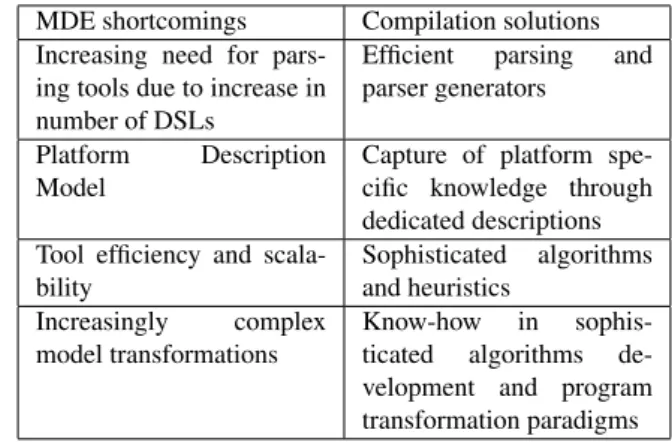
As seen in the two previous sections, the compiler research community has already proposed some solutions relating to several of the problems faced by MDE (e.g., efficient pars-ing, platform specific knowledge capture, scalability and ef-ficiency issues). This is also true the other way round (e.g., complex data representation, separation of concerns and de-sign by contract). These solutions to shortcomings from the two communities are summarized in Tables 1 and 2. These tables reflect the focus of each community: compilation em-phasizes what is the result of data transformation (to a first approximation, more efficient code) whereas MDE concen-trates on how data is represented (well defined domains able to better capture specific knowledge and know-how).
Cross-fertilization of these two worlds hence leads to an engineering of software languages that addresses both the representation of data (i.e., the design of tool-supported soft-ware languages) and the analysis and transformation of this data (i.e., the implementation of supporting tools for such lan-guages). Some recent work has already been following this direction, by providing generic tools for language design and implementation.
In this section we present the road already covered in the cross-fertilization of the compilation and MDE worlds section 4.1) as well as the road we still have to cover
(Sub-Table 1: Solutions from compilation to MDE shortcomings
MDE shortcomings Compilation solutions
Increasing need for pars-ing tools due to increase in number of DSLs
Efficient parsing and
parser generators
Platform Description
Model
Capture of platform spe-cific knowledge through dedicated descriptions Tool efficiency and
scala-bility Sophisticated algorithms and heuristics Increasingly complex model transformations Know-how in
sophis-ticated algorithms
de-velopment and program transformation paradigms
Table 2: Solutions from MDE to compilation shortcomings
Compilation shortcomings MDE solutions IRs contain more and more
complex information,
more and more complex IR processings,
Complex data represen-tation and Separation of Concerns
Maintainability Homogeneization of
soft-ware through generative approaches
Documentation Metamodels as
documen-tation Error-prone and time con-suming development tasks
Automation through meta-tools and metatooling Ordering of the
compila-tion pass
Design-by-Contract to
limit possible choices to meaningful choices
section 4.2). We point out two challenges we believe to be of high interest to Software Language Engineering (SLE): the increasing number of software languages, and the need to bring V&V methods into SLE.
4.1 The Road Already Covered in Cross-fertilizing
The term software language refers to all the kinds of artifi-cial languages which are implied in software systems devel-opment, including programming and modeling languages but also data models, DSLs or ontologies [49].
The number of such languages is constantly increas-ing [12, chap.1], mainly due to two reasons. The first one is the increasingly broad spectrum of domains addressed by software systems (e.g., avionics, home automation, etc.), rais-ing the need for languages to care for the specificities of these domains, along with a need to make language design and im-plementation methods accessible to non-computer scientists (i.e., domain experts).
The second reason is the ever growing size and complex-ity of software systems, leading to a need for breaking down the systems into smaller understandable pieces (objects, as-pects, etc).
MDE Compilation Software Language Craft Software Language Engineering
Many domain experts Few language experts
Time
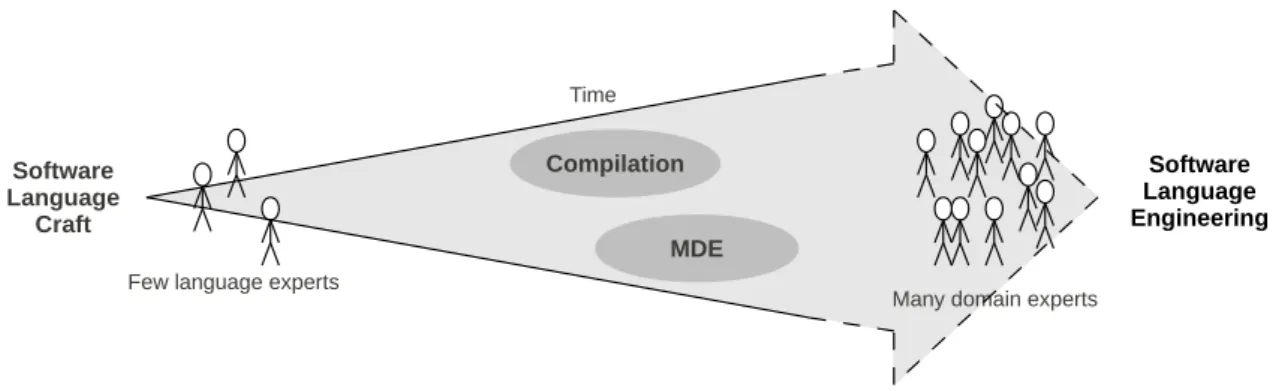
Figure 3: The role of MDE and compilation communities in the evolution from a craft to an engineering of software languages; opening the way to design and implementation of software languages by few language experts to many domain experts
These two reasons lead to the continuous creation of new
languages, as well as the evolution of old ones12.
This increasing number of software languages hence brings a need to shift from a software language "craft", prac-ticed by only a few language experts, to a systematic ap-proach for the design and implementation of tool-supported software languages, that is usable by a large number of non-expert users. There is a need to create new tools and meth-ods for the design and implementation of languages as well as a need to bring existing tools to domain experts. Some of these tools and methods have existed for a long time. Such tools include the BNF and EBNF metalanguages, and lexer and parser generators like Lex and yacc allow the automatic tooling of the languages defined from these metalanguages. However, mastering even such well established tools requires an amount of work that is generally not affordable to domain experts. Moreover, defining an entirely new language for ev-ery system concern is not an option when considering the ef-fort needed. One of the goals of SLE is to provide accessible tools and methods addressing all the stages of the software language lifecycles, from design and implementation to use and evolution.
MDE fosters the use of DSLs for the representation of software systems and provides theoretical and methodolog-ical foundations for the design of these DSLs. Moreover, MDE is interested in manipulating models (i.e., description
artifactscoming from modeling languages). Meanwhile com-pilation develops tools for languages of different program-ming paradigms (imperative, functional, etc.) and compilers manipulate programs (i.e., description artifacts coming from programming languages) through different transformations and analyses.
Because SLE is interested in all the software languages, and therefore all the description artifacts coming from these languages (e.g., models, programs, etc.; also called mograms by Kleppe [12, chap. 3]), the cross-fertilization of MDE and compilation can bring the experience of both communities to SLE. Compiler and editor generators already go into this di-12 Note that DSLs are also a way for companies to protect their Intellectual Property Rights on their knowledge capitalization.
rection and allow domain experts to generate tools for their languages based on language specifications. Tools like XText and EMFText provide concrete textual syntax relying on the abstract syntax of the language, and generate tools such as parsers, lexers, serializers or editors with syntax highlighting, on-the-fly code completion and correction. To do so, such tools rely on a metamodel describing the abstract syntax of the language and, for example, on the LL(*) ANTLR parser generator workbench, so as to offer understandable represen-tation of the abstract syntax and fast, flexible parsing. The
TOPCASED project13, an open source MDE toolkit for the
design of safety critical applications and systems [50], goes even further providing a graphical editor generator as well as simulator generator and facilities to use several V&V tech-niques (e.g., model checking).
Figure 3 illustrates how MDE and compilation contribute to the design and implementation of tool-supported software languages, putting them within the reach of domain experts (i.e., people who are not software language experts, even not computer scientists).
4.2 Still a Long Way to Go in Cross-fertilization
There still remain many challenges ahead for SLE to provide a complete workbench for the whole lifecycle of software lan-guages, if this workbench aims for broad adoption by domain experts. Domain experts need to manipulate concepts relative to their domain only. This could be achieved by automating processes out of the given domain and offering facilities to design and implement DSLs and their respective tooling.
Some of these facilities already exist (e.g., partial automa-tion and facilities for the language design and implementa-tion) but we have still to cope with the increasing number of software languages.
Language designers also need to make sure that the tools they use enforce some properties and that they do not seri-ously modify the nature of their work (e.g., the binary code 13 Toolkit in OPen-source for Critical Applications & SystEms Development, cf. http://www.topcased.org
Graph Graph Node Edge WeightedColoredGraph Graph color: String weight: int Node Edge Graph color: String Node Edge ColoredGraph Graph weight: int Node Edge WeightedGraph
Figure 4: A family of graph languages
produced by a compiler must preserve the semantics of the source code).
Some of these needs have been addressed in different con-texts by other fields of computer science, particularly in pro-gramming languages semantics and theory, and formal meth-ods. The expertise developed in these domains must also to be incorporated into SLE, along with many other results from other fields and/or communities of computer science.
4.2.1 Amortization of Language and Tool Definition and Im-plementation As mentioned previously, the number of soft-ware languages defined and used is growing. This increase is there to answer the various needs of an equally growing number of domain experts. However, methods enabling the construction of a language from other existing languages, and for the reuse of different tools (e.g., analyses and transforma-tions) between such languages, are still lacking.
MDE provides tools to ease the design of software lan-guages. However, these languages are most often still created from scratch even though they could benefit from concepts and structures defined in already existing languages. An en-gineering of software languages hence needs to provide meth-ods to enable the derivation of a language from another one, but also to incrementally define families of languages.
Figure 4 presents an example of such an incrementally defined family of languages, where dashed lines represent the derivation from a language to another. This family is composed of graphs, colored graphs, weighted graphs and weighted colored graphs, where each language shares some concepts with the others (namely Graph, Node and Edge) while specializing them (e.g., adding attributes such as color). This situation leads to a lattice of graph languages inheriting from one another.
Moreover, manipulations (e.g., analyses and transforma-tions) written for the new languages are most often imple-mented from scratch whereas at least a part of them is already implemented for several other languages and could therefore be reused. Here again, such facilities should be integrated in the engineering of software languages.
For example, Dead Code Elimination (DCE) is a classi-cal optimization in a vast majority of compilers for impera-tive languages. However, a similar optimization can be done on a hardware circuit description to eliminate useless hard-ware components (e.g., components which are not connected to an output), or in functional languages. The basis of DCE is a reachability analysis processed on a Control-Flow Graph (CFG), all unreachable code blocks then being removed. In a hardware description, we can do a similar reachability anal-ysis, using output ports as roots, to find and remove useless components. Rather than implementing such an analysis for each language, it would be interesting to amortize the effort between all the languages with a minimum of adaptations.
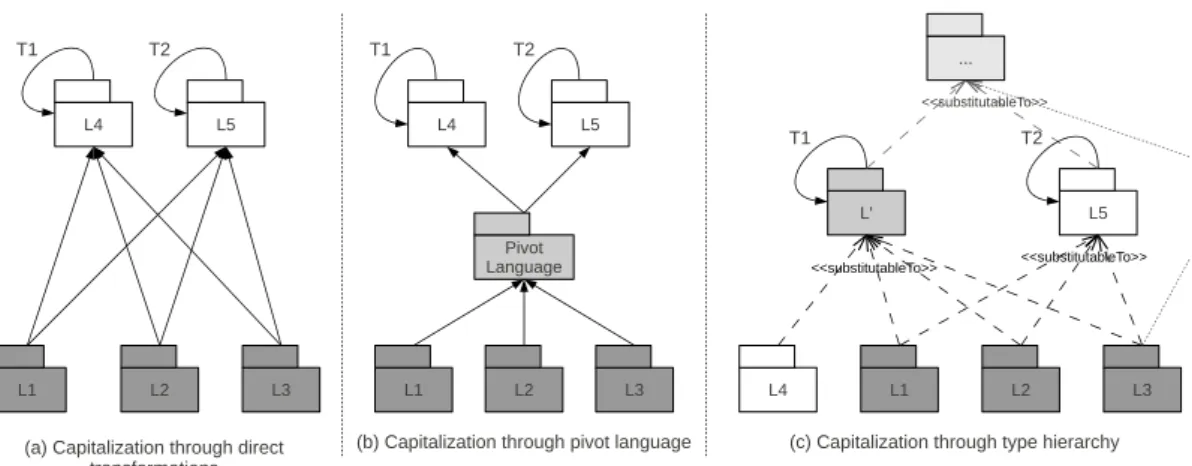
Figure 5(a) illustrates one way to cope with this issue, where plain arrows represent mogram manipulations such as analyses or endogenous transformations (e.g., T1 or T2) or exogenous transformations (e.g., L1 to L4). Here, a total of six ad hoc transformations are needed to use the two anal-yses defined on languages L4 and L5 on mograms coming from L1, L2 and L3. Many mogram manipulations (six trans-formations and two analyses) are developped as the two anal-yses have been implemented separately for each language.
To solve this problem, pivot languages (cf. Fig. 5(b)), which are intermediate languages between two sets of lan-guages, have been intensively investigated in the last decade,
e.g., in V&V and for domain-specific model checking
pur-poses [51, 52, 53, 54]. Their interests are twofold:
– decrease the semantic gap between two sets of languages
to ease the design of translations between them,
– capitalize and share some translation passes.
Nevertheless, the mere definition of the concept of pivot lan-guage raises several problems. In particular, the concept of pivot language implies a certain universality of the pivot. Every concept possibly defined in existing or future lan-guages has to be somehow included in the pivot. The ex-isting work has shown the difficulty of defining such a
uni-versal "union". For example, TOPCASEDhas defined the
lan-guage Fiacre [54], inspired from V-Cotre [52] and NTIF [51], which is a pivot language between the DSL of the IDE (e.g., UML, AADL, etc.) and the various V&V environments. This language has reduced the distance between the DSL seman-tics and the formalisms dedicated to the V&V (namely, Petri nets and timed automata), and allowed each DSL to share the transformations from the pivot language to dedicated
V&V formalisms. In practice in TOPCASED, the design of
a pivot language allowing the translation of very different languages requires very different concepts and appeared to be quite impossible. This difficulty has led to design a pivot language family, such as synchronous and asynchronous ver-sions whose combination also proved to be difficult. Even if
Pivot Language L4 L5 L1 L2 L3 L4 L5 L1 L2 L3 <<substitutableTo>> <<substitutableTo>> L4 L5 L1 L2 L3
(a) Capitalization through direct transformations
(b) Capitalization through pivot language (c) Capitalization through type hierarchy
L' ... <<substitutableTo>> T1 T1 T1 T2 T2 T2
Figure 5: Some approaches for the capitalization of model manipulations
this approach is interesting for the reuse of some model ma-nipulations, the concept of pivot language is hence difficult to implement in the general case (i.e., for any set of languages). Several other approaches have been proposed within MDE in order to enable the reuse of model manipulations over a family of metamodels [55]. One of the issues faced by these approaches is the presence of structural heterogeneities between the metamodels of a family. As an example, consider two graph metamodels, the first one where edges are modeled with a class Edge and the second where edges are modeled as references from class Node to itself. A manipulation imple-menting a graph traversal defined on one of these two meta-models cannot easily be reused on the other, although they clearly belong to the same family. To cope with this prob-lem, the existing approaches generally use one or two of the following mechanisms:
– adapting the metamodel on which the model
manipula-tion will be reused (e.g., adding a class Edge in the second metamodel);
– adapting the manipulation to be reused (e.g.,
automati-cally generating a new manipulation which traverses a graph).
Some examples of approaches using the first solution are those which introduce genericity at the metamodel level, by means of templates [56], as well as concepts and mixin
lay-ers [57]. Other approaches which adapt the metamodel
in-clude patterns with variable entities (i.e., patterns expressing the needed concepts only) for declarative model manipulation rules [58], bidirectional model manipulation DSLs [59] and static introduction in order to make two metamodels struc-turally equivalent [60]. Wimmer et al. presented an hybrid approach (i.e., adaptation of the metamodel and the model manipulation) based on above mentioned concepts that gen-erates a metamodel-specific manipulation from a generic one defined for a metamodel family [61].
Incremental design and manipulation reuse have also been largely addressed in programming languages, especially in the object-oriented paradigm. Facilities such as
inheri-tance, genericity, subtyping and polymorphism allow two kinds of reuse through:
– the incremental design and specialization of types and
classes, and thus, the reuse of structure (signature) and implementation,
– the implementation of manipulations for a family of types
rather than for each members of the family.
To bring some of these facilities into SLE, languages should be considered as first-class entities, i.e., types, hence enabling relationships such as inheritance or subtyping be-tween languages. Since MDE represents the abstract syntax of a language as a metamodel (i.e., a set of classes and their relations), this has been made possible by leveraging work on type groups [62] and family polymorphism [63] which al-low such relationships between families of classes. The intro-duction of inheritance or subtyping relationships then enables reuse across languages and reuse of mogram manipulations.
Model typing is an existing approach introduced in MDE as a way to allow reuse of model manipulations and incre-mental design and implementation of modeling languages through typing relations. In this context, Steel et al. intro-duced the notion of model type as the set of object types for all the objects contained in a model and their relations [64]. Based of this notion of model type, we have defined four subtyping relations between model types [65]. These rela-tions can be used to implement a model-oriented type sys-tem providing facilities such as reuse of model manipulation and incremental language definition (by means of incremen-tal model type definition), but also auto-completion, impact analyses or type-guided compiler optimizations.
We believe that such a type system for mograms, includ-ing mograms and mogram manipulation typinclud-ing, inheritance, genericity and subtyping would enable new possibilities for the design and implementation of tool-supported languages. Indeed a mogram type including both object types for objects which could belong to a mogram and signatures of manipu-lations (such as introduced by Vignaga et al. [66]) defined on this mogram would contain abstract syntax (a set of ob-ject types can be seen as a metamodel) and semantics given
GeCoS DSLs Common Mogram Types <<substitutableTo>> <<substitutableTo>> Constant Propagation Mogram Type Elimination Mogram Type Control Flow Graph Instruction Description Language Hardware Description Language CFG Dead Code Elimination CFG Constant Propagation Instruction Description Constant Propagation Circuit Trimming Derived analyses Capitalized analyses 2D Positioning Mogram Type <<substitutableTo>> Common Elimination Common Constant Propagation Common 2D positioning
Component Positioning Instruction Description Dead Code Elimination
Figure 6: Capitalization of model manipulations in the GeCoS research-oriented compiler infrastructure using model typing
by the manipulations (e.g., translational semantics given by a code generator) of a language. In this context, inheritance be-tween languages (or mogram types) would enable incremen-tal design of languages through inheritance and specialization of structures, and genericity and subtyping would enable the reuse of mogram manipulations by introducing substitutabil-ity of mograms.
One advantage of such facilities compared to pivot lan-guages is the possibility of defining a type lattice, where a type is the "intersection" of its subtypes and not the "union" as in a pivot language. This way a language can inherit from the manipulations of interest defined at the highest possible level, i.e., the level in the type hierarchy which contains the minimal set of necessary information to express the manip-ulations. This is illustrated in Fig. 5(c) where dashed arrows represent the subtyping relationships between two languages and thus the substitutability of the mograms coming from the "sub-language" to the mograms coming from the "super-language" in manipulations (e.g., mograms from L2 and L3 can be used as mograms from L5 for the manipulations de-fined on the latter). To follow this approach, it is however mandatory to precisely define how a language and a mogram type are related, and then how such a type can inherit from another one.
As an example, the various DSLs used by the GeCoS compiler infrastructure: CFG, hardware description language (HDL) or processor instruction description language are illus-trated in Figure 6. It is possible to perform several analyses on mograms coming from these DSLs. For example, anal-yses which eliminate useless parts of the mograms such as dead code elimination or circuit trimming, but also more spe-cific analyses such as loop optimizations on CFG. Several analyses, while performed on mograms coming from differ-ent formalisms (data or control flow) presdiffer-ent similarities and could be written only once for a common mogram type and shared between the DSLs by subtyping or genericity instead of being written again and again.
4.2.2 Inter-language Reasonning With the growing size of software systems, and particularly with the growing number of languages used for the design and implementation of one system, there is an increasing need for globally reasoning on a system through different viewpoints. To reason about such a system, a tool would need to be able to browse the links (im-plicit or ex(im-plicit) between the languages in which viewpoints are defined.
For example, checking the consistency of several views of a system requires knowing which elements of these views are related (i.e., which elements have to be consistent with each other) and how they are related (i.e., how to check the consistency of a set of related elements). The links indicat-ing which elements are related can be implicit (e.g., elements with the same names are related) or explicit.
DeRemer and Kron [67]; working in the context of programming-in-the-large vs. programming-in-the-small, were probably the first to introduce such explicit links. They introduce the notion of modules written in a language and linked by another language, dedicated to this goal.
Of course, ever since the dawn of the history of soft-ware systems, compilers have created such links between lan-guages, mapping structures from high-level languages to their equivalent in processor instructions sets, but these links were generally implicit and embedded into the transformation from one language to another.
The possibility of defining relationships between several languages, in order to reason about these relationships, has been already explored in MDE. For instance, Megamodels are models whose elements are themselves models linked by various kinds of relationships (e.g., conformance, transforma-tion, etc.) [68]. They were primarly meant to manage model dependencies [69]. Other approaches use relationships be-tween languages to ensure the consistency bebe-tween models of the same system [70], to help the design of complex sys-tems [71], to specify transformations from one language to another [72, 73] or to ensure the traceability of such transfor-mations [74].
We believe that making these links explicit and clearly separating them from the semantics they carry should ease their manipulation as well as their reuse. Hence such structure should be an inherent part of a metalanguage.
4.2.3 Verification and Validation Automatic transforma-tions of mograms play a decisive role in compilation and MDE. Such transformations can be the translation from one language to another (e.g., code generation targeting a specific platform) or mogram refactorings (e.g., code optimization). As for any other automated task, there is a need to ensure that some structural and behavioral properties are preserved by successive transformations. Hence we consider V&V as a key concern of SLE. It requires the integration of formal methods while remaining as transparent as possible to domain experts who define languages and transformations.
There are of course several benefits in using DSLs rather than general-purpose programming languages with respect to V&V. V&V tools often face intractable or even undecidable
problems due to the high expressivity of general-purpose lan-guages. DSLs can be engineered to be less expressive than general-purpose programming languages, using a reduced number of domain-specific concepts. This reduced expressiv-ity makes it possible to use V&V tools. Typically, the reduced number of concepts of a DSL implies a reduced size of the in-put domain to be covered by analyses.
DSLs also come with separation of concerns, enabling the division of large and complex systems into several smaller pieces (i.e., into several domain-specific mograms rather than one program). Such small mograms allow the use of V&V tools (e.g., model-checking) which would not scale on com-plete systems.
However the use of DSLs instead of general-purpose lan-guages raises new problems and needs. Widely used general-purpose languages can rely on a huge number of users writing different kinds of mograms, which provides many test cases for the compilers (e.g., gcc). DSLs by definition do not have such a wide user base, implying the need to formally assess the DSL tooling, and to automate the V&V tasks.
V&V of transformations to ensure preservation of prop-erties has been explored by the CompCert project [75] which aims at providing an entirely verified optimizing C compiler and which is based on several DSLs such as CLight (a sub-set of C) or a language for Linear Temporal Logic and on a memory model designed to be formally analysed [76]. Sev-eral other authors address the verification of model transfor-mations using bi-simulation of input and ouput models [77, 78] or graph transformation rules [79]. However, these trans-formations are still manually verified by their developers.
Automated testing of model transformations is another way to ensure property preservation for transformations which cannot or must not be entirely verified. Baudry et
al. [80] have identified barriers to such an automated
test-ing, namely the inherent complexity of the graph structures manipulated by the transformations, the lack of maturity of model management environment and the heterogeneity of transformation languages and techniques.
5 Conclusion and Perspectives
According to Hutchinson et al. [81], one of the main suc-cessful uses of MDE in industry is in the design and imple-mentation of DSLs, each specially built to handle a given con-cern. We should probably better account for this fact when we teach MDE to both engineers and students. This article can be seen as going one step further. Our collective expe-rience is that both communities – MDE and compilation – have a lot to gain in a better understanding of the other side’s experience and technologies. We hope that this article will raise the interest of both communities in bridging the chasm, making, on one hand, MDE more efficient and, on the other hand, allowing compiler technology to better leverage soft-ware engineering and to meet in a new Softsoft-ware Language
Engineering.
While SLE is becoming a key concern in software en-gineering, some challenges should be tackled by relying on
MDE and compilation expertise. Nevertheless, some other challenges cannot be solved directly by synergies between MDE and compilation, and should also benefit from other fields of computer science (e.g., formal methods).
References
1. Harald Vogt, S. Doaitse Swierstra, and Matthijs F. Kuiper. Higher-order attribute grammars. In Richard L. Wexelblat, ed-itor, Proceedings of the ACM SIGPLAN 1989 Conference on
Programming language design and implementation (PLDI ’89),
pages 131–145. ACM, 1989.
2. Ira D. Baxter, Christopher Pidgeon, and Michael Mehlich. DMS: Program Transformations for Practical Scalable Soft-ware Evolution. In Anthony Finkelstein, Jacky Estublier, and David S. Rosenblum, editors, Proceedings of the 26th
Interna-tional Conference on Software Engineering (ICSE ’04), pages
625–634. IEEE, 2004.
3. Paul Klint, Jurgen J. Vinju, and Tijs van der Storm. Language design for meta-programming in the software composition do-main. In Alexandre Bergel and Johan Fabry, editors, Proceed-ings of the 8th International Conference on Software
Compo-sition (SC ’09), number 5634 in Lecture Notes in Computer
Science, pages 1–4. Springer, 2009.
4. Martin Bravenboer, Karl Trygve Kalleberg, Rob Vermaas, and Eelco Visser. Stratego/xt 0.17. a language and toolset for pro-gram transformation. Science of Computer Propro-gramming, 72(1-2):52–70, 2008.
5. James R. Cordy. The TXL source transformation language.
Sci-ence of Computer Programming, 61(3):190–210, 2006.
6. OMG. Unified Modeling Language (UML) 2.1.2 Superstruc-ture, 2007.
7. Pierre-Alain Muller, Franck Fleurey, and Jean-Marc Jézéquel. Weaving Executability into Object-Oriented Meta-languages. In Lionel C. Briand and Clay Williams, editors, Proceedings of the 8th International Conference on Model Driven
Engineer-ing Languages and Systems (MODELS/UML ’2005), number
3713 in Lecture Notes in Computer Science, pages 264–278. Springer, 2005.
8. Simon Pickin, Claude Jard, Thierry Jeron, Jean-Marc Jézéquel, and Yves Le Traon. Test Synthesis from UML Models of Dis-tributed Software. IEEE Transactions on Software Engineering, 33(4):252–269, 2007.
9. Pierre-Alain Muller, Frédéric Fondement, Franck Fleurey, Michel Hassenforder, Rémi Schnekenburger, Sébastien Gérard, and Jean-Marc Jézéquel. Model Driven Analysis and Synthesis of Textual Concrete Syntax. Journal of Software and Systems
Modeling, 7(4):423–442, 2008.
10. OMG. Meta Object Facility (MOF) 2.0 Core Specification, 2006.
11. Jean-Marc Jézéquel. Model driven design and aspect weav-ing. Journal of Software and Systems Modeling, 7(2):209–218, 2008.
12. Anneke Kleppe. Software Language Engineering: Creating
Domain-Specific Languages Using Metamodels.
Addison-Wesley Professional, 2008.
13. Torbjörn Ekman and Görel Hedin. The JastAdd system - modu-lar extensible compiler construction. Science of Computer
Pro-gramming, 69(1–3):14–26, 2007.
14. Donald E. Knuth. On the translation of languages from left to rigth. Information and Control, 8(6):607–639, 1965.
15. Donald E. Knuth. Top-down syntax analysis. Acta Informatica, 1:79–110, 1971.
16. Masaru Tomita. Efficient Parsing for Natural Language: A Fast
Algorithm for Practical Systems. Kluwer Academic Publishers,
1985.
17. T. J. Parr and R. W. Quong. Antlr: a predicated-ll(k) parser generator. Software: Practice and Experience, 25(7):789–810, 1995.
18. Pierpaolo Degano and Corrado Priami. Comparison of syntac-tic error handling in LR parsers. Software: Pracsyntac-tice and
Expe-rience, 25(6):657–679, 1995.
19. Tim A. Wagner and Susan L. Graham. Efficient and flexible incremental parsing. ACM Transactions on Programming
Lan-guages and Systems, 20(5):980–1013, 1998.
20. Matteo Risoldi and Didier Buchs. A domain specific language and methodology for control systems GUI specification, verifi-cation and prototyping. In Proceedings of the IEEE Symposium on Visual Languages and Human-Centric Computing (VLHCC ’07), pages 179–182. IEEE, 2007.
21. Christian Hahn. A domain specific modeling language for mul-tiagent systems. In Lin Padgham, David C. Parkes, Jörg P. Müller, and Simon Parsons, editors, Proceedings of 7th Inter-national Conference on Autonomous Agents and Multi-Agent
Systems (AAMAS ’08), pages 233–240. IFAAMAS, 2008.
22. OMG. UML Object Constraint Language (OCL) 2.0 Specifica-tion, 2003.
23. OMG. MOF 2.0 Query/ View/ Transformation (QVT)
Specifi-cation, 2008.
24. Mooly Sagiv, Thomas Reps, and Reinhard Wilhelm. Parametric shape analysis via 3-valued logic. In Andrew W. Appel and Alex Aiken, editors, Proceedings of the 26th ACM SIGPLAN-SIGACT Symposium on Principles of Programming Languages
(POPL ’99), pages 105–118. ACM, 1999.
25. Alfred V. Aho, Monica S. Lam, Ravi Sethi, and Jeffrey D. Ull-man. Compilers: Principles, Techniques, and Tools (2nd
Edi-tion). Addison Wesley, 2006.
26. D.S. Wile. POPART: Producer of Parsers and Related Tools,
System Builder’s Manual.USC/Information Sciences Institute,
1982.
27. Dominique Clement, Janet Incerpi, and Gilles Kahn. CEN-TAUR: towards a software tool box for programming environ-ments. In Fred Long, editor, Proceedings of the International
Workshop on Software Engineering Environments (SEE ’90),
number 467 in Lecture Notes in Computer Science, pages 287– 304. Springer, 1990.
28. Emilie Balland, Pierre-Etienne Moreau, and Antoine Reilles. Rewriting Strategies in Java. Electronic Notes in Theoretical
Computer Science, 219:97–111, 2008.
29. Gary A. Kildall. A unified approach to global program opti-mization. In Patrick C. Fischer and Jeffrey D. Ullman, editors, Proceedings of the 1st annual ACM SIGACT-SIGPLAN
Sym-posium on Principles of Programming Languages (POPL ’73),
pages 194–206. ACM, 1973.
30. Florian Martin. PAG, - an efficient program analyzer generator. International Journal on Software Tools for Technology Trans-fer, 2(1):46–67, 1998.
31. Jia Zeng, Chuck Mitchell, and Stephen A. Edwards. A Domain-Specific Language for Generating Dataflow Analyzers.
Elec-tronic Notes in Theoretical Computer Science, 164(2):103–119,
2006.
32. Andrew Stone, Michelle Strout, and Shweta Behere. May/must analysis and the DFAGen data-flow analysis generator.
Infor-mation and Software Technology, 51(10):1440–1453, 2009.
33. Christopher W. Fraser. A retargetable compiler for ANSI C.
SIGPLAN Notices, 26(10):29–43, 1991.
34. George Hadjiyiannis, Silvina Hanono, and Srinivas Devadas. Isdl: an instruction set description language for retargetability. In Proceedings of the 34th annual Design Automation
Confer-ence (DAC ’97), pages 299–302. ACM, 1997.
35. Hristo Nikolov, Todor Stefanov, and Ed F. Deprettere. Sys-tematic and automated multiprocessor system design, program-ming, and implementation. IEEE Transactions on
Computer-Aided Design of Integrated Circuits and Systems, 27(3):542–
555, 2008.
36. OMG. Model Driven Architecture (MDA) Guide, v1.0.1, 2003. 37. Joao Paulo Almeida, Remco Dijkman, Marten van Sinderen, and Luis Ferreira Pires. On the Notion of Abstract Platform in MDA Development. In Proceedings of the 8th IEEE Interna-tional Conference on Enterprise Distributed Object Computing
(EDOC ’04), pages 253–263. IEEE, 2004.
38. Dennis Wagelaar and Viviane Jonckers. Explicit Platform Mod-els for MDA. In Lionel C. Briand and Clay Williams, edi-tors, Proceedings of the 8th International Conference on Model
Driven Engineering Languages and Systems (MODELS ’05),
number 3713 in Lecture Notes in Computer Science, pages 367–381. Springer, 2005.
39. Robert France and Bernhard Rumpe. Model-driven develop-ment of complex software: A research roadmap. In Lionel C. Briand and Alexander L. Wolf, editors, Proceedings of the
Fu-ture of Software Engineering Symposium (FOSE ’07), pages
37–54. IEEE, 2007.
40. D.C. Schmidt. Guest editor’s introduction: Model-driven engi-neering. IEEE Computer, 39(2):25–31, 2006.
41. Manuel Wimmer and Gerhard Kramler. Bridging grammarware and modelware. In Jean-Michel Bruel, editor, Proceedings of
Satellite Events at the MODELS 2005 Conference (WiSME ’05),
number 3844 in Lecture Notes in Computer Science, pages 159–168. Springer, 2005.
42. Johan Eker, Jorn Janneck, Edward A. Lee, Jie Liu, Xiaojun Liu, Jozsef Ludvig, Sonia Sachs, and Yuhong Xiong. Taming het-erogeneity - the Ptolemy approach. Proceedings of the IEEE, 91(1):127–144, 2003.
43. Asma Charfi, Chokri Mraidha, Sébastien Gérard, François Ter-rier, and Pierre Boulet. Toward optimized code generation through model-based optimization. In Proceedings of the 13th Design, Automation and Test in Europe Conference (DATE ’10), pages 1313–1316. IEEE, 2010.
44. Helmut Emmelmann, Friedrich-Wilhelm Schröer, and Rudolf Landwehr. BEG - A Generator for Efficient Back Ends. In Richard L. Wexelblat, editor, Proceedings of the ACM SIG-PLAN’89 Conference on Programming Language Design and
Implementation (PLDI ’89), pages 227–237. ACM, 1989.
45. Christopher W. Fraser, Robert R. Henry, and Todd A. Proebst-ing. BURG: fast optimal instruction selection and tree parsProebst-ing.
SIGPLAN Notices, 27(4):68–76, 1992.
46. Antoine Floch, Tomofumi Yuki, Clément Guy, Steven Der-rien, Benoit Combemale, Sanjay Rajopadhye, and Robert France. Model-Driven Engineering and Optimizing Compil-ers: A bridge too far? In Jon Whittle, Tony Clark, and Thomas Kühne, editors, Proceedings of the 15th International Confer-ence on Model Driven Engineering Languages and Systems
(MODELS ’11), number 6981 in Lecture Notes in Computer
Science, pages 608–622. Springer, 2011.
47. Bertrand Meyer. Applying "Design by Contract". IEEE