
Pépite | Développement et applications d’expériences RMN de corrélation, à travers les liaisons et l’espace, entre noyaux de spin-1/2 et quadripolaires dans les solides cristallins et amorphes
159
0
0
Texte intégral
(2) Thèse de Hiroki Nagashima, Lille 1, 2017. © 2017 Tous droits réservés.. lilliad.univ-lille.fr.
(3) Thèse de Hiroki Nagashima, Lille 1, 2017. Acknowledgement At first, I would like to express my gratitude to all supervisors. Prof. Olivier Lafon provided me the opportunity to be PhD student in his group and provided me a nice environment, good insight into NMR theory and great new ideas for the SS-NMR study. His passion and ability to understand the physics for the SS-NMR always encouraged me to do my best. Thanks to Dr. François Méar for the advices from chemical point of view and kind support of my PhD in thin film NMR. Thanks to Dr. Frédérique Pourpoint for her support of the experiment, the presentation, the article and the advices. I would like to thank other menbers of group. Thanks to Dr. Julien Trébosc for guiding me SS-NMR experiment, processing and simulation and giving me great new ideas for my study. His skills and knowledges are greatest in the SS-NMR field. I learned many SS-NMR techniques from him. Thanks to Prof. Jean-Paul Amoureux for help in writing the articles and giving me the new idea and the advices. Thanks to Prof. Lionel Montagne for giving me many advices and suggestions from chemical point of view in the thin film NMR project. Thank to Dr. Laurent Delevoye for the coordination of ‘NMR and inorganic material’ group. I acknowledge all members of the defense committee: Prof. Dominique Massiot, Prof. Christel Gervais, Prof. Annie Pradel, and Prof. Jonathan Yates for evaluating my thesis in spite of their busy schedule. The DNP NMR experimental studies would not be possible without the support from Dr. Torsten Gutmann and Dr. Aany Sofy Lilly Thankamony in Darmstadt, Dr. Fabien Aussenac and Patrick Dorffer in Wissembourg, Dr. Sachin Rama Chaudhari in Lyon, Dr. Nicolas.Birlirakis, Dr. Diego Carnevale and Dr. Mathieu Baudin in Paris. Also, the simulation study for DNP, 14N overtone and adiabatic SFAM would not be possible without the support from Prof. Ilya Kuprov, Dr. Frédéric Mentink-Vigier, Dr. Zhehong Gan and Dr. Gwendal Kervern. I would like to thank NMR facility staff in Lille: Dr. Xavier Trivelli, Dr. Bertrand Revel, Dr. Bertrand.Doumert, Dr. Gregory Tricot and Dr. Marc Bria for their support. I would like to thank my colleagues: Dr. Baudouin Dillmann, Dr. Ming Shen, Dr. Yixuan Li, Dr. Thibault Carlier, Dr. Denys Grekov, Raynald Giovine, Pauline.Glatz, Kadiali.Bodiang and Pereira Luiz for their help and good atmosphere in the lab. Thanks to Luc Noureux, Alison Mclellan and Shantanu Lanke for the opportunity of the SS-NMR teaching. I would like to thank Robert and Hiromi ADANT for the support of life in France. Finally, I would like to special thank my parents and my wife for encouraging and trust me for my challenges.. © 2017 Tous droits réservés.. lilliad.univ-lille.fr.
(4) Thèse de Hiroki Nagashima, Lille 1, 2017. © 2017 Tous droits réservés.. lilliad.univ-lille.fr.
(5) Thèse de Hiroki Nagashima, Lille 1, 2017. Contents Abstract Chapter 1: General introduction 1.1. Theoretical basis …………………………………………………………………. 1.1.1. Rotations …………………………………………………………………… 1.1.2. Effective Hamiltonian ……………………………………………………… 1.1.3. Interaction frame …………………………………………………………… 1.1.4. Magic angle spinning ………………………………………………………. 1.1.5. Cross polarization ………………………………………………………….. 1.2. NMR of quadrupolar nuclei ……………………………………………………… 1.2.1. Quadrupolar interaction ……………………………………………………. 1.2.2. CT selective pulse …………………………………………………………. 1.2.3. Non selective pulse ………………………………………………………… 1.3. Sensitivity enhancement methodology for half-integer quadrupolar nuclei ……. 1.3.1. Population transfer from satellite transition ……………………………….. 1.3.2. (Q)CPMG acquisition ……………………………………………………… 1.4. High resolution methodology for half-integer quadrupolar nuclei ……………... 1.4.1. MQMAS …………………………………………………………………… 1.4.2. STMAS …………………………………………………………………….. 1.5. Heteronuclear dipolar recoupling ……………………………………………….. 1.5.1. R3 …………………………………………………………………………... 1.5.2. REDOR ……………………………………………………………………. 1.5.3. Symmetry based recoupling ……………………………………………….. 1.5.4. SR412 ……………………………………………………………………….. 1.5.5. SFAM ……………………………………………………………………… 1.6. 2D-HETCOR between spin-1/2 and half-integer quadrupolar nuclei …………... 1.6.1. Through bond correlation ………………………………………………….. 1.6.2. Through space correlation …………………………………………………. 1.6.2.1. The CP-HETCOR experiment ……………………………………… 1.6.2.2. D-RINEPT experiment ……………………………………………... 1.6.2.3. PRESTO experiment ……………………………………………….. 1.6.2.4. D-HMQC experiment ………………………………………………. 1.6.3. More advanced 2D-HETCOR method …………………………………….. 1.7. Objective of the thesis …………………………………………………………... 1.8. References ……………………………………………………………………….. Chapter 2:. 71. Ga-77Se connectivities and proximities in gallium selenide crystal and glass probed by solid-state NMR. 2.1. Introduction ……………………………………………………………………... 2.2. Methods …………………………………………………………………………. 2.2.1. NMR methods ……………………………………………………………... 2.2.1.1. Acquiring 71Ga 1D MAS spectrum ………………………………… 2.2.1.2. CPMG and QCPMG ………………………………………………... 2.2.1.3. 71Ga 2D STMAS-QCPMG …………………………………………. 2.2.1.4. 77Se-{71Ga} J-RINEPT-CPMG …………………………………….. 2.2.1.5. 71Ga-{77Se} J- or D-HMQC-CPMG ………………………………. 2.2.1.6. Measurement of T’2,71Ga and T’2,77Se time constants ………………... 2.2.2. Analytical expressions of 71Ga-77Se J-HETCOR transfers ………………... 2.3. Experimental section …………………………………………………………….. 2.3.1. Synthesis of crystalline -Ga2Se3 …………………………………………. © 2017 Tous droits réservés.. 1 2 3 4 6 7 8 8 11 11 11 11 13 15 15 17 18 19 20 21 23 24 26 27 28 29 30 31 32 41 43 44. 48 51 51 51 51 51 52 53 53 55 57 57. lilliad.univ-lille.fr.
(6) Thèse de Hiroki Nagashima, Lille 1, 2017. 2.3.2. Solid-state NMR …………………………………………………………… 2.4. Results and discussion …………………………………………………………... 2.4.1. Crystalline -Ga2Se3 ……………………………………………………….. 2.4.1.1. 1D MAS spectra ……………………………………………………. 2.4.1.2. J-RINEPT and J-HMQC build-up curves ………………………….. 2.4.1.3. Comparison of the J-RINEPT and J- or D-HMQC 2D spectra ……. 2.4.2. 71Ga-77Se correlations for 0.2Ga2Se3-0.8GeSe2 glass (GGS0.2) …………… 2.5. Conclusion ………………………………………………………………………. 2.6. References ……………………………………………………………………….. 57 60 60 60 64 68 70 75 76. Chapter 3: -independent through-space hetero-nuclear correlation between spin-1/2 and quadrupolar nuclei in solids 3.1. Introduction ……………………………………………………………………... 3.2. Theory …………………………………………………………………………... 3.2.1. Recoupling schemes ……………………………………………………….. 3.2.2. D-HMQC sequences ……………………………………………………….. 3.2.2.1. Recoupling applied to the indirectly detected isotope ……………… 3.2.2.2. Recoupling applied to the detected isotope ………………………… 3.3. Simulation and experimental section …………………………………………… 3.3.1. Numerical simulations for an isolated 13C-15N spin pair …………………... 3.3.2. NMR experiments …………………………………………………………. 3.3.2.1. 13C-{15N} correlations ……………………………………………… 3.3.2.1. 31P-{27Al} and 27Al-{31P} correlations ……………………………... 3.4. Results and discussion …………………………………………………………... 3.4.1. Numerical simulation ……………………………………………………… 3.4.1.1. Build-up curves …………………………………………………….. 3.4.1.2. Robustness to rf inhomogeneity ……………………………………. 3.4.1.3. Robustness to offset ………………………………………………… 3.4.1.4. Robustness to CSAI ………………………………………………… 3.4.1.5. MAS frequency variation …………………………………………... 3.4.2. Experimental verification ………………………………………………….. 3.4.2.1. 13C-{15N} D-HETCOR ……………………………………………... 3.4.2.2. 27Al-31P D-HETCOR on VPI-5 at 9.4 T ……………………………. 3.4.2.3. 31P-{27Al} D-HETCOR on Na7(AlP2O7)4PO4 at 18.8 T …………… 3.5. Conclusion ………………………………………………………………………. 3.6. References ……………………………………………………………………….. 79 82 82 87 87 88 92 92 93 93 93 95 95 95 96 100 100 102 104 106 107 111 113 114. Chapter 4: General conclusion and perspectives 4.1. General conclusion ……………………………………………………………… 4.2. Perspectives ……………………………………………………………………... 4.2.1. Correlation experiment for Gallium Selenide material ……………………... 4.2.2. 𝛾 independent D-HMQC pulse sequence …………………………………... 118 119 119 120. CV Appendix : Bruker pulse program A.1. D, J-HMQC-QCPMG pulse sequence …………………………………………. A.2. J-RINEPT-CPMG pulse sequence ……………………………………………... A.3. Split-t1 STMAS-QCPMG pulse sequence ……………………………………… A.4. D-HUQC (with R𝑁𝑛𝜈 recoupling) pulse sequence ……………………………… A.5. D-HUQC (with R3 recoupling) pulse sequence ………………………………… A.6. Including file (preset.incl) and AU program (for DFS and SFAM) …………….. © 2017 Tous droits réservés.. 124 129 133 136 139 141. lilliad.univ-lille.fr.
(7) Thèse de Hiroki Nagashima, Lille 1, 2017. Abstract My PhD thesis focuses on the development of the through-bond and through-space correlation solid state NMR experiments involving half-integer quadrupolar nuclei in order to characterize chemical structure of inorganic material at atomic level. This thesis consists of two part. First, we introduce two-dimensional (2D). 71. Ga-77Se through-bond and through-space. heteronuclear correlation (HETCOR) experiments. Such correlations are achieved using (i) the J-mediated Refocused Insensitive Nuclei Enhanced by Polarization Transfer (J-RINEPT) method with 71Ga excitation and 77Se Carr-Purcell-Meiboon-Gill (CPMG) detection, as well as (ii) the J- or dipolar-mediated Heteronuclear Multiple-Quantum Correlation (J- or D-HMQC) schemes with 71Ga excitation and quadrupolar CPMG (QCPMG) detection. These methods are applied to the crystalline -Ga2Se3 and the 0.2Ga2Se3-0.8GeSe2 glass. We also report 2D 71Ga Satellite Transition Magic-Angle Spinning (STMAS) spectrum of -Ga2Se3 using QCPMG detection at high magnetic field, high Magic-Angle Spinning frequency, and high rf-field. Second, we introduce novel sequences using indirect detection to correlate quadrupolar nuclei and spin-1/2 isotopes, other than 1H and 19F. These sequences use γ-encoded symmetry-based RNnν schemes that reintroduce the space component |m| = 1 of the heteronuclear dipolar coupling. These schemes can be applied to the indirectly detected spin in Dipolar-mediated Heteronuclear Multiple-Quantum Correlation (D-HMQC) sequence or to the detected isotope in a novel sequence, named Dipolar-mediated Heteronuclear Universal-Quantum Correlation (D-HUQC). The performance of the sequences have been compared to conventional D-HMQC with R3 and SFAM recoupling via SIMPSON simulations and NMR experiments, including 13. C-{15N} heteronuclear correlation on glycine and. 31. P-27Al ones on VPI-5 and. Na7(AlP2O7)4PO4.. © 2017 Tous droits réservés.. lilliad.univ-lille.fr.
(8) Thèse de Hiroki Nagashima, Lille 1, 2017. © 2017 Tous droits réservés.. lilliad.univ-lille.fr.
(9) Thèse de Hiroki Nagashima, Lille 1, 2017. Chapter 1: General introduction This thesis focuses on the heteronuclear correlation NMR experiments involving half-integer quadrupolar nuclei. Hence, chapter 1 summarizes the important tool, concept and the state of the art in this field. The section 1.1 introduces the basic principles of solid-state NMR experiments. The section 1.2 describes the property of quadrupolar nuclei. The section 1.3 and 1.4 summarizes sensitivity enhancement and high resolution methodology for quadrupolar nuclei. The section 1.5 describes the heteronuclear dipolar recoupling sequence applied to single channel in HETCOR sequence. The section 1.6 is the review of 2D HETCOR experiments between spin-1/2 and half-integer quadrupolar nuclei.. 1.1. Theoretical basis A brief description of the theoretical basis of solid-state NMR spectroscopy is provided here. More detailed description can be found in the references [1-5]. The dynamics of nuclear spins during NMR experiments is described by the Liouville-von Neuman equation: 𝑑 ̂ (𝑡), 𝜌̂(𝑡)] 𝜌̂(𝑡) = −𝑖[𝐻 𝑑𝑡. (1.1). ̂ (𝑡) represent the density operator and the Hamiltonian, respectively. The where 𝜌̂(𝑡) and 𝐻 formal solution of the time evolution of the density operator can be recast in Hilbert space as follow ̂ (𝑡)𝜌̂(0)𝑈 ̂ † (𝑡) 𝜌̂(𝑡) = 𝑈. (1.2). with 𝑡. ̂ (𝑡) = 𝑇̂𝑒 −i ∫0 𝐻̂(𝑡)𝑑𝑡 𝑈. (1.3). ̂ (𝑡) is called propagator, and 𝑇̂ is the Dyson time-ordering operator. Signal detection where 𝑈 can be performed as 𝑆(𝑡) = ⟨𝑄̂ ⟩(𝑡) = 𝑇𝑟{𝜌̂(𝑡)𝑄̂ }. (1.4). The Hamiltonian consists of external and internal terms ̂ (𝑡) = 𝐻 ̂𝑒𝑥𝑡 + 𝐻 ̂𝑖𝑛𝑡 𝐻. (1.5). where the first term represents external interactions, including Zeeman and radiofrequency (rf) interaction, while the second one contains internal parts of the nuclear spin Hamiltonian. In the laboratory (LAB) frame, the external Hamiltonian takes the form ̂𝑒𝑥𝑡 = 𝐻 ̂0 + 𝐻 ̂1 (𝑡) = 𝜔0 𝐼̂𝑧 + 2𝜔1 cos(𝜔ref 𝑡 + 𝜙)𝐼̂𝑧 𝐻. (1.6). 1 © 2017 Tous droits réservés.. lilliad.univ-lille.fr.
(10) Thèse de Hiroki Nagashima, Lille 1, 2017. with 𝜔1 = −𝛾𝐵1 , 𝜔ref and 𝜙 denoting the rf nutation angular frequency, the angular carrier frequency and phase of the rf-field, respectively, and 𝐵1 the rf field amplitude and γ the gyromagnetic ratio. The internal components of the Hamiltonian may conveniently be expressed in an irreducible tensor representation 𝑗. 2. ̂𝑖𝑛𝑡 = ∑ 𝐻 ̂𝜆 ; 𝐻. 𝐿 𝜆 𝜆 ̂𝜆 = 𝐶 𝜆 ∑ ∑ (−1)𝑚 [𝐴𝑗,−𝑚 𝐻 ] 𝑇̂𝑗,𝑚. 𝜆. (1.7). 𝑗=0 𝑚=−𝑗. 𝜆 𝜆 where 𝐴𝑗,𝑚 and 𝑇̂𝑗,𝑚 represents spatial and spin dependencies, respectively, and 𝐶 𝜆 is a. fundamental interaction dependent constant. j describe the rank of the tensor, while the superscript L designate that the description applies in LAB frame. The analytical procedure of NMR experiments is as follows: (i) Transformation into an appropriate interaction frame, (ii) The calculation of the effective Hamiltonian, (iii) The calculation of the response of the initial density operator to the effective Hamiltonian We need to introduce the concept of the rotations, average Hamiltonian (AH) and interaction frame to carry out those analytical calculations.. 1.1.1. Rotations Rotation of spin operators in cyclic 3D subspace Assume that 𝜌̂(0) = 𝐴̂, H(t) = ω(t)𝐵̂, and the operator 𝐴̂, 𝐵̂, and 𝐶̂ is cyclic commutative ([[𝐴̂, 𝐵̂] = i𝐶̂ , [𝐵̂, 𝐶̂ ] = i𝐴̂, [𝐶̂ , 𝐴̂] = i𝐵̂), the time-evolution of the density operator is given by 𝜌̂(𝑡) = 𝑒 −𝑖𝜙𝐵̂ 𝐴̂𝑒 𝑖𝜔𝜙𝐵̂ = cos(𝜙)𝐴̂ – sin(𝜙)𝑖[𝐵̂ , 𝐴̂] = cos(𝜙)𝐴̂ − sin(𝜙)𝐶̂. (1.8). 𝑡. where 𝜙 = ∫0 𝜔(𝑡)𝑑𝑡 (e.g., 𝜙 = 𝜔1 𝑡 for constant amplitude rf irradiation). The important things is to calculate the commutator [𝐵̂ , 𝐴̂]. If the commutator can be calculated easily (for instance, typical sets of non-commuting operators are {𝐼̂𝑥 , 𝐼̂𝑦 , 𝐼̂𝑧 }, {𝐼̂𝑥 , 2𝐼̂𝑦 𝑆̂𝑧 , 2𝐼̂𝑧 𝑆̂𝑧 }, {2𝐼̂𝑥 𝑆̂𝑧 , 𝐼̂𝑦 , 2𝐼̂𝑧 𝑆̂𝑧 }), this representation is preferable.. Rotation of irreducible spherical tensor operators In irreducible spherical tensor representation, operator T of rank-j transforms as 𝑗 𝜆 [𝑇̂𝑗,𝑚 ]. 𝐹2. 𝜆 = ∑ [𝑇̂𝑗,𝑚 ′]. 𝐹1. (𝑗). 𝐷𝑚′ ,𝑚 (Ω). (1.9). 𝑚′=−𝑗. 2 © 2017 Tous droits réservés.. lilliad.univ-lille.fr.
(11) Thèse de Hiroki Nagashima, Lille 1, 2017. where 𝐷(𝑗) is a rank-j Wigner rotation matrix and 𝛺 = {𝛼, 𝛽, 𝛾} is the Euler angles separating the two frames F1 and F2. We consider here positive angles referring to counter-clockwise rotations, with the Wigner rotation being: a rotation by α around the original z-axis, rotation by β around the new y-axis, and finally rotation by γ around resulting z-axis. The Wigner matrix may be conveniently expressed in terms of reduced Wigner matrix (𝑑 (𝑗) ) elements (𝑗). ′. (𝑗). 𝐷𝑚′ ,𝑚 (Ω) = 𝑒 −𝑖𝑚 𝛼 𝑑𝑚′ ,𝑚 (𝛽)𝑒 −𝑖𝑚𝛾. (1.10). First and second rank reduced Wigner matrix elements are given in Table.1.1. (𝑗). Table 1.1. Reduced Wigner matrix elements 𝑑𝑚′ ,𝑚 (𝛽) for j = 1, 2 m’ \ m. j. -2. 1 2 (1 + 𝑐𝛽 ) 4 1 − (1 + 𝑐𝛽 )𝑠𝛽 2. -1 1 (1 + 𝑐𝛽 ) 2 1 − 𝑠𝛽 √2 1 (1 − 𝑐𝛽 ) 2 1 (1 + 𝑐𝛽 )𝑠𝛽 2 1 𝑐𝛽2 − (1 − 𝑐𝛽 ) 2. √3/8 𝑠𝛽2. −√3/8 𝑠2𝛽. -1 1. 0 1 -2 -1. 2. 0 1 2. * 𝑠𝛽 and 𝑐𝛽. stand. 1. 0. √2. 𝑠𝛽. 𝑐𝛽 −. 1 √2. 𝑠𝛽. √3/8 𝑠𝛽2 √3/8 𝑠2𝛽 1 (3𝑐𝛽2 − 1) 2. 1 1 − (1 − 𝑐𝛽 )𝑠𝛽 (1 + 𝑐𝛽 ) − 𝑐𝛽2 2 2 1 1 2 (1 − 𝑐𝛽 ) − (1 − 𝑐𝛽 )𝑠𝛽 4 2 for sin 𝛽 and cos 𝛽. −√3/8 𝑠2𝛽 √3/8 𝑠𝛽2. 1 1 (1 − 𝑐𝛽 ) 2 1 𝑠𝛽 √2 1 (1 + 𝑐𝛽 ) 2 1 (1 − 𝑐𝛽 )𝑠𝛽 2. 2. 1 (1 + 𝑐𝛽 ) − 𝑐𝛽2 2. 1 2 (1 − 𝑐𝛽 ) 4 1 (1 − 𝑐𝛽 )𝑠𝛽 2. √3/8𝑠2𝛽. √3/8 𝑠𝛽2. 1 𝑐𝛽2 − (1 − 𝑐𝛽 ) 2 1 − (1 + 𝑐𝛽 )𝑠𝛽 2. 1 (1 + 𝑐𝛽 )𝑠𝛽 2 1 2 (1 + 𝑐𝛽 ) 4. 1.1.2. Effective Hamiltonian In NMR theory, most Hamiltonian is time dependent. It is effective to obtain time independent Hamiltonian by approximation methods in order to calculate density operator. Typical approximative expression of the Hamiltonian series is as follow. ̅ ̅ ̂𝑒𝑓𝑓 (𝑡) = 𝐻 ̂ (1) + 𝐻 ̂ (2) + . . . 𝐻. (1.11). There are some approximation procedure to drive this effective Hamiltonian. Most popular approximation theory is average Hamiltonian theory (AHT) [3,4] and Floquet theory.[6] AHT treatment is sufficient in this thesis. Advantage of Floquet theory is in the situation of asynchronous condition.. In AHT, lowest order terms are defined as 𝜏𝑐 ̅ (1) = 1 ∫ 𝐻 ̂ ̂ (𝑡 ′ )𝑑𝑡 ′ 𝐻 𝜏𝑐 0. (1.12). 3 © 2017 Tous droits réservés.. lilliad.univ-lille.fr.
(12) Thèse de Hiroki Nagashima, Lille 1, 2017. ". 𝜏𝑐 𝑡 ̅ (2) = 1 ∫ 𝑑𝑡 " ∫ [𝐻 ̂ ̂ (𝑡 " ), 𝐻 ̂ (𝑡 ′ )]𝑑𝑡 ′ 𝐻 𝑖𝜏𝑐 0 0. (1.13). where 𝜏c denoting the period over which the averaging is performed. This simple expansion and later variants have proven extremely useful for simplifying the description of NMR experiments, for example, using a first-order approximation of the Hamiltonian in an interaction frame parameterizing out the dependency on rf-fields.. 1.1.3. Interaction frame In the analysis of NMR experiments, it is useful to transform to interaction frame when considering only the effect of the interesting internal parts of the Hamiltonian, which truly affects the spin dynamics. Frequently, Zeeman interaction itself complicates the contribution of internal Hamiltonian to the evolution of the density operator. The transformation to the frame of Zeeman interaction permits to simplify the calculation of the evolution of the density operator. A typical Hamiltonian in NMR consists of large terms, such as Zeeman interaction and small ones, such as chemical shift, dipolar coupling and quadrupolar coupling etc. as follow. ̂ (𝑡) = 𝐻 ̂𝑏𝑖𝑔 (𝑡) + 𝐻 ̂𝑠𝑚𝑎𝑙𝑙 (𝑡) 𝐻. (1.14). ̂𝑠𝑚𝑎𝑙𝑙 on the spin system, we decompose the Here, if we only want to discuss the effect of 𝐻 ̃ ̂ (𝑡) = 𝑈 ̂𝑏𝑖𝑔 (𝑡)𝑈 ̂ (𝑡) and then by manipulating the density operator and propagator into 𝑈 ̂𝑏𝑖𝑔 as follows. Hamiltonian with 𝑈 † ̂𝑏𝑖𝑔 ̂𝑏𝑖𝑔 𝜌̂̃(𝑡) = 𝑈 𝜌̂(𝑡)𝑈. (1.15). † ̂ † 𝑑 ̂ ̃ ̃ ̂ (𝑡) = 𝑈 ̂𝑏𝑖𝑔 ̂𝑏𝑖𝑔 − 𝑖𝑈 ̂𝑏𝑖𝑔 ̂𝑠𝑚𝑎𝑙𝑙 (𝑡) 𝐻 𝐻 (𝑡)𝑈 𝑈 (𝑡) = 𝐻 𝑑𝑡 𝑏𝑖𝑔. (1.16). 𝐻𝑏𝑖𝑔 can be removed and converted to interaction frame. Eq.(1.15) and (1.16) fulfill the 𝑑 ̃ ̂ (𝑡), 𝜌̂̃(𝑡)]. In the thesis, the interaction frame Liouville-von Neuman equation 𝑑𝑡 𝜌̂̃(𝑡) = −𝑖[𝐻. symbol “~” is abbreviated from below. Truncated Hamiltonian in high magnetic field can be derived from combination of AHT and Zeeman interaction frame: (1) 𝜆 𝐿 ̂𝜆 𝜆 𝐿 ̂𝜆 ̅̅̅ ̂𝜆 𝐻 = 𝐶 𝜆 {[𝐴0,0 ] 𝑇0,0 + [𝐴2,0 ] 𝑇2,0 }. (1.17). Thus, all components with m ≠ 0 vanish in a first-order approximation and only the terms which commute with 𝐼̂𝑧 are remained. Truncated Hamiltonians of all internal interaction are given in Table.1.2 and 1.3.. 4 © 2017 Tous droits réservés.. lilliad.univ-lille.fr.
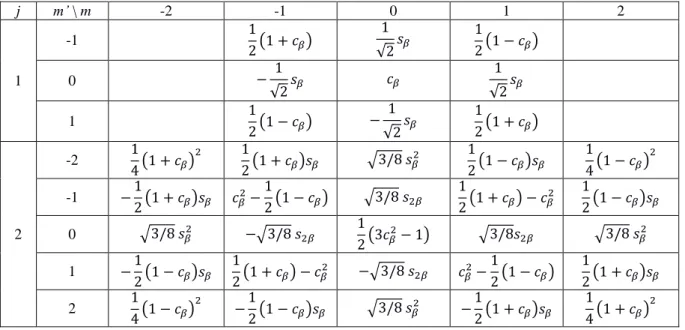
(13) Thèse de Hiroki Nagashima, Lille 1, 2017. Table.1.2. Construction of Truncated Hamiltonian [5] 𝐿. 𝜆. 𝐶𝜆. 𝜆 [𝐴0,0 ]. CS. −𝛾𝐼. −√3𝛿𝑖𝑠𝑜. 𝜆 𝑇̂0,0. −. 1 √3. ̂𝜆𝑖𝑠𝑜 𝐻. 𝐵0 𝐼̂𝑧. 𝜆 [𝐴2,0 ]. 𝛿𝑖𝑠𝑜 𝜔0 𝐼̂𝑧. [𝐴𝐶𝑆 2,0 ]. 𝐿. 𝐿. DII. 1. DIS. 1. [𝐴𝐷,𝐼𝑆 2,0 ] −. JII. 1. −2𝜋√3𝐽𝐼𝐼𝑖𝑠𝑜. JIS. 1. 𝑖𝑠𝑜 − −2𝜋√3𝐽𝐼𝑆. Q (1st). 1 √3 1 √3. 𝐽,𝐼𝐼 𝐿 [𝐴2,0 ]. 𝐼̂ ∙ 𝑆̂. 𝐽,𝐼𝑆 [𝐴2,0 ]. 𝑖𝑠𝑜 ̂ ̂ 2𝜋𝐽𝐼𝑆 𝐼∙𝑆. 2. √3 𝜔𝐶𝑆𝐴 𝐼̂𝑧. 𝑗 (3𝐼̂𝑧 𝐼̂𝑧𝑘 − 𝐼̂𝑗. [𝐴𝑄2,0 ]. 𝑗 𝜔𝐷,𝐼𝐼 (3𝐼̂𝑧 𝐼̂𝑧𝑘 − 𝐼̂𝑗 ⋅ 𝐼̂𝑘 ). 2. √3 𝐼̂𝑧 𝑆̂𝑧. 𝜔𝐷,𝐼𝑆 2𝐼̂𝑧 𝑆̂𝑧. 𝑗 (3𝐼̂𝑧 𝐼̂𝑧𝑘 − 𝐼̂𝑗 √6 ⋅ 𝐼̂𝑘 ). 𝑎𝑛𝑖𝑠𝑜 𝜔𝐽,𝐼𝐼 (3𝐼̂𝑧 𝐼̂𝑧𝑘 − 𝐼̂𝑗 𝑘 ̂ ⋅𝐼 ). 1. 𝐿. 𝑗. 𝑎𝑛𝑖𝑠𝑜 ̂ ̂ 𝜔𝐽,𝐼𝑆 𝐼𝑧 𝑆𝑧. 2. √3 𝐼̂𝑧 𝑆̂𝑧 1. 2𝜋𝐶𝑄 2𝐼(2𝐼 − 1). 2. √6 ⋅ 𝐼̂𝑘 ). 𝐿. 𝐼̂𝑗 ⋅ 𝐼̂𝑘 2𝜋𝐽𝐼𝐼𝑖𝑠𝑜 𝐼̂𝑗 ⋅ 𝐼̂𝑘. ̂𝜆𝑎𝑛𝑖𝑠𝑜 𝐻. −√3 𝐵0 𝐼̂𝑧 1. 𝐿 [𝐴𝐷,𝐼𝐼 2,0 ]. 𝜆 𝐿 [𝑇̂2,0 ]. 𝐿. 𝜔𝑄. 𝐿. [𝐴𝑄2,0 ] (3𝐼̂𝑧2 3√6 − 𝐼(𝐼 + 1)). (3𝐼̂𝑧2 − 𝐼(𝐼. √6 + 1)). Table.1.3. Second rank spatial tensor in the principal axis system [5] 𝜆 [𝐴2,0 ]. 𝜆. 𝑃. 𝜆 [𝐴2,±1 ]. 𝑃. 𝜆 [𝐴2,±2 ]. 𝑃. CS. √2 𝛿𝑎𝑛𝑖𝑠𝑜. 0. 1 − 𝜂𝛿𝑎𝑛𝑖𝑠𝑜 2. DII. √6 𝑏𝐼𝐼 √6 𝑏𝐼𝑆. 0. 0. 0. 0. 3. DIS. 3. JII. 2𝜋√2 𝐽𝐼𝐼𝑎𝑛𝑖𝑠𝑜. JIS. 𝑎𝑛𝑖𝑠𝑜 2𝜋√2 𝐽𝐼𝑆. Q (1st order). √2. 1 − 𝜂 𝐽𝐼𝐼𝑎𝑛𝑖𝑠𝑜 2 1 𝑎𝑛𝑖𝑠𝑜 − 𝜂 𝐽𝐼𝑆 2 1 − 𝜂𝑄 2. 0. 3. 0. 3. 0. 𝜆 * Second rank spatial tensor in LAB frame, [𝐴2,0 ] 𝑃. 𝐿. 𝐿. 𝜆 is defined as [𝐴2,0 ] = 𝑃. (2) 𝜆 𝜆 ∑2𝑚=−2[𝐴2,𝑚 ] 𝐷𝑚,0 (Ω𝑃𝐿 ) in the case of static condition . [𝐴2,𝑚 ] with 𝑚 = 0, ±1, ±2 is 𝐿. 𝜆 necessary in order to obtain [𝐴2,0 ] . The anisotropies of the spatial tensors (e.g., 𝛿𝑎𝑛𝑖𝑠𝑜 and 𝐽𝑎𝑛𝑖𝑠𝑜 ) 𝐼𝐼 𝑃. are defined as 𝐴𝑎𝑛𝑖𝑠𝑜 = [𝐴𝑧𝑧 ]𝑃 − 𝐴𝑖𝑠𝑜 with 𝐴𝑖𝑠𝑜 = 1⁄3 ([𝐴𝑥𝑥 ]𝑃 + [𝐴𝑦𝑦 ] + [𝐴𝑧𝑧 ]𝑃 ) . The 𝑃. 𝑃. 𝑃. asymmetry parameter is defined by 𝜂 = ([𝐴𝜆𝑦𝑦 ] − [𝐴𝜆𝑥𝑥 ] )⁄([𝐴𝜆𝑧𝑧 ] − 𝐴𝑖𝑠𝑜 ) . The dipolar 𝛾 2 𝜇0 ℏ. coupling constatnts are defined by 𝑏𝐼𝐼 = − (𝑟𝐼3 ). 4𝜋. 𝛾𝐼 𝛾𝑆 𝜇0ℏ. and 𝑏𝐼𝑆 = − (. 𝑟3. ). 4𝜋. in rads−1 where. 𝜇0 = 4𝜋 ∙ 107 NC−2s2 is the permeability of a vacuum, 𝛾 is gyromagnetic ratio, 𝑟 is the internuclear distance. 𝐶𝑄 = (𝑒 2 𝑞𝑄)/ℎ (see section. 1.2 in detail) with ℎ = 6.62608 ∙ 10−34 Js is Planck’s constant. ℏ is Planck’s constant divided by 2π.. 5 © 2017 Tous droits réservés.. lilliad.univ-lille.fr.
(14) Thèse de Hiroki Nagashima, Lille 1, 2017. 1.1.4. Magic angle spinning The sensitivity and resolution of NMR spectra of disordered solids may be improved significantly by rapidly rotating the sample about an axis at the “magic angle”, 𝛽𝑅𝐿 = tan−1 √2 ≈ 54.74, with respect to the static magnetic field (Fig.1.1). This technique is called magic-angle spinning (MAS). The Fig.1.1. Definition of the frame in MAS experiments (adapted from [36]). spatial rotation of the sample causes the orientation-dependent. anisotropic. spin. interactions to become time-dependent and to be averaged out in the case of rapid sample spinning. Let us check how heteronuclear dipolar coupling is averaged out by MAS. The coefficient (including spatial part) of dipolar coupling is given by 𝜔𝐷,𝐼𝑆 (𝑡) =. 1 √6. 𝐷. 𝐶 𝜆 [𝐴2,0𝐼𝑆 ]. 𝐿. (1.18). In the static case of the powder sample, assuming Euler angle 𝛺𝑃𝐿 = {𝛼𝑃𝐿 , 𝛽𝑃𝐿 , 𝛾𝑃𝐿 } between principal axis system (PAS) frame and LAB frame, 𝜔𝐷,𝐼𝑆 =. 1. 1 𝐷 𝑃 (2) 𝐶 𝜆 [𝐴2,0𝐼𝑆 ] 𝑑0,0 (𝛽𝑃𝐿 ) = 𝑏𝐼𝑆 (3 cos2 (𝛽𝑃𝐿 ) −1) 2 √6. (1.19). where the constant and the spatial tensor in PAS frame is shown in Table.1.2 and 1.3. In static 𝛾𝐼 𝛾𝑆. condition of the powder sample, 𝜔𝐷,𝐼𝑆 only depend on βPL angle. 𝑏𝐼𝑆 = − (. 𝑟3. 𝜇. ) 4𝜋0 is the. dipolar coupling constant in rads−1. In the spinning case, LAB frame is associated with PAS frame via rotor-fixed (ROTOR) frame. Euler angle is defined as 𝛺𝑃𝑅 = {𝛼𝑃𝑅 , 𝛽𝑃𝑅 , 𝛾𝑃𝑅 }, 𝛺𝑃𝐿 = {𝜔𝑅 , 𝛽𝑅𝐿 , 𝛾𝑅𝐿 }. 𝜔𝐷,𝐼𝑆 (𝑡) under MAS is 2 (𝑚). 𝜔𝐷,𝐼𝑆 (𝑡) = ∑ 𝜔𝐷,𝐼𝑆 𝑒 𝑖𝑚𝜔𝑅𝑡. (1.20). 𝑚=−2. with. (𝑚). (2). (2). 𝜔𝐷,𝐼𝑆 = 𝑏𝐼𝑆 𝑒 𝑖𝑚𝛾𝑃𝑅 𝑑0,−𝑚 (𝛽𝑃𝑅 )𝑑−𝑚,0 (𝛽𝑅𝐿 ). (1.21). In MAS case, 𝜔𝐷,𝐼𝑆 (𝑡) depends on not only 𝛽𝑃𝑅 angle but also 𝛾𝑃𝑅 angle unlike static case. Since 𝛾𝑅𝐿 angle is related to the rotation around MAS axis, 𝛾𝑅𝐿 angle is especially important in (𝑚). rotating solids. In MAS case, 𝜔𝐷,𝐼𝑆 for m = 0, ±1, ±2 are 6 © 2017 Tous droits réservés.. lilliad.univ-lille.fr.
(15) Thèse de Hiroki Nagashima, Lille 1, 2017. 1 (0) 𝜔𝐷,𝐼𝑆 = 𝑏𝐼𝑆 (3cos2 (𝛽𝑃𝑅 ) − 1)(3cos 2 (𝛽𝑅𝐿 ) − 1) = 0 4 1 (±1) 𝜔𝐷,𝐼𝑆 = − 𝑏𝐼𝑆 sin(2𝛽𝑃𝑅 ) 𝑒 ±𝑖𝛾𝑃𝑅 2√2 1 (±2) 𝜔𝐷,𝐼𝑆 = 𝑏𝐼𝑆 sin2(𝛽𝑃𝑅 ) 𝑒 ±𝑖2𝛾𝑃𝑅 4. (1.22) (1.23) (1.24). Assuming sampling at rotor echo and magic angle 𝛽𝑅𝐿 = tan−1 √2 2. 𝜙= ∑ ∫. 𝑛𝜏𝑅. 𝑚=−2 0. (𝑚). (0). 𝜔𝐷,𝐼𝑆 𝑒 𝑖𝑚𝜔𝑅𝑡 𝑑𝑡 = 𝜔𝐷,𝐼𝑆 = 0. (1.25). Dipolar coupling is averaged out. As mentioned later, rotor synchronized t1 acquisition in 2D experiments is necessary for averaging dipolar coupling, CSA and quadrupolar interaction (especially, first-order terms). In infinite spinning case, by AHT treatment 2𝜋. (1) 𝜔 𝜔 (0) ̅̅̅̅̅̅ ̂𝐷,𝐼𝑆 = 𝑅 ∫ 𝑅 𝐻 ̂𝐷,𝐼𝑆 𝑑𝑡 = 𝜔𝐷,𝐼𝑆 ̂𝑧 = 0 𝐻 2𝐼̂𝑧 𝑆 2𝜋 0. (1.26). implying that the dipolar coupling does not affect the spin evolution. The above derivation is only valid for commuting dipolar interactions. However, in the case of non-commuting homonuclear dipolar interactions (homogeneous case), it is difficult to remove the dipolar coupling only by MAS. High resolution spectrum can be obtained by combination of MAS and decoupling sequence (which manipulate spin part in Hamiltonian).. 1.1.5. Cross polarization Cross polarization (CP) enhances the NMR signal of low-γ nuclei coupled through dipolar interaction with high-γ nuclei. The pulse sequence is shown in Fig.1.2. The cross polarization consists in. Fig.1.2 schematic diagram of the basic IS cross polarization experiment.. (i) Generating transverse magnetization on the I channel by π/2 pulse and applying a rf-field 𝜔1,𝐼 , sufficient to lock it.. 7 © 2017 Tous droits réservés.. lilliad.univ-lille.fr.
(16) Thèse de Hiroki Nagashima, Lille 1, 2017. (ii) Satisfying the Hartmann-Hahn (HH) matching condition with a suitable rf-field 𝜔1,𝑆 . (iii) Adjusting the contact time for which two rf-fields are applied. The optimal contact time depends on 𝑏𝐼𝑆 . Under MAS, it is complicated task to understand HH matching condition at quantum mechanics level.[7] Heteronuclear dipolar recoupled AH under MAS is 0Q condition: 𝜔1,𝐼 − 𝜔1,𝑆 = 𝑛𝜔𝑅 (1) 1 |𝑛| ̅̅̅̅̅̅ ̂𝐷,𝐼𝑆 = 𝜔𝐷,𝐼𝑆 𝐻 {cos(𝛾𝑃𝑅 )(𝐼̂+ 𝑆̂− + 𝐼̂− 𝑆̂+ ) ± sin(𝛾𝑃𝑅 )(𝐼̂+ 𝑆̂− − 𝐼̂− 𝑆̂+ )} 4. (1.27). 2Q condition: 𝜔1,𝐼 + 𝜔1,𝑆 = 𝑛𝜔𝑅 (1) 1 |𝑛| ̅̅̅̅̅̅ ̂𝐷,𝐼𝑆 = 𝜔𝐷,𝐼𝑆 𝐻 {cos(|𝑛|𝛾𝑃𝑅 )(𝐼̂+ 𝑆̂+ + 𝐼̂− 𝑆̂− ) ± sin(|𝑛|𝛾𝑃𝑅 )(𝐼̂+ 𝑆̂+ − 𝐼̂− 𝑆̂− )} 4 with n = ±1, ±2 and 1 |𝑛|=1 𝜔𝐷,𝐼𝑆 = − 𝑏𝐼𝑆 sin(2𝛽𝑃𝑅 ) 2√2 1 |𝑛|=2 𝜔𝐷,𝐼𝑆 = 𝑏𝐼𝑆 sin2 (𝛽𝑃𝑅 ) 4. (1.28). (1.29) (1.30). 𝜔1,𝐼 − 𝜔1,𝑆 = 𝑛𝜔𝑅 condition is called zero quantum (0Q) matching because of flip-flop transition. 𝜔1,𝐼 + 𝜔1,𝑆 = 𝑛𝜔𝑅 condition is called double quantum (2Q) matching because of flip-flip (or flop-flop) transition. Hence, HH matching condition under MAS is summarized as follow. 𝜔1,𝑆 = 𝜀𝜔1,𝐼 + 𝑛𝜔𝑅 (𝜀 = ±1; 𝑛 = ±1, ±2). (1.31). From this results, in case of moderate spinning speed region (νR = 10 ~ 20 kHz) or large rfamplitude, 0Q condition (ε = +1) can be chosen. On the other hand, in case of very high spinning speed or low rf-amplitude, 2Q condition (ε = –1) can be better than 0Q condition.. 1.2. NMR of quadrupolar nuclei 1.2.1. Quadrupolar interaction Around 75% of NMR-active nuclei are quadrupolar (i.e. have a spin quantum number I > 1/2).[8-12] A quadrupolar nucleus possesses an electric quadrupolar moment, 𝑒𝑄 , which interacts with the electric field gradient (EFG) created by the charges (electrons, other nuclei). The EFG is defined by three components, 𝑉𝑥𝑥 , 𝑉𝑦𝑦 and 𝑉𝑧𝑧 , where 𝑉𝑧𝑧 = 𝑒𝑞, in its principal axis system. This interaction between 𝑒𝑄 and the EFG is generally described in terms of the quadrupolar coupling constant, 𝐶𝑄 = 𝑒 2 𝑞𝑄/ℎ and the asymmetry parameter, 𝜂𝑄 = (𝑉𝑥𝑥 − 𝑉𝑦𝑦 )/𝑉𝑧𝑧 . The quadrupolar Hamiltonian in the LAB frame can be written as. 8 © 2017 Tous droits réservés.. lilliad.univ-lille.fr.
(17) Thèse de Hiroki Nagashima, Lille 1, 2017. 2. 𝜔 𝐿 ̂𝑄 = 𝑄 ∑ (−1)𝑚 [𝐴𝑄2,−𝑚 ] 𝑇̂2,𝑚 𝐻 3. (1.32). 𝑚=−2. with 𝜔𝑄 = 2𝜋. 3𝐶𝑄 2𝐼(2𝐼 − 1). (1.33). The quadrupolar Hamiltonian can then be approximated in the high field case using AHT and expressed with Clebsch-Gordan coefficients for second-order term. First- and second-order quadrupolar Hamiltonian under fast MAS speed are 𝐼 𝜔 𝑅 (2) ̅̅̅̅ ̂𝑄 = 𝑄 [𝐴𝑄2,0 ] 𝑑0,0 (β𝑅𝐿 ) (3𝐼̂𝑧2 − 𝐼(𝐼 + 1)) 𝐻 3√6. (1.34). 𝜔𝑄2 𝐼𝐼 𝑄 𝑅̂ 𝑄 𝑅 (2) 𝑄 𝑅 (2) ̅̅̅̅ ̂ ̂2 + [𝐵4,0 ̂4 ) 𝐻𝑄 = ([𝐵0,0 ] 𝐾0 + [𝐵2,0 ] 𝑑0,0 (β𝑅𝐿 )𝐾 ] 𝑑0,0 (β𝑅𝐿 )𝐾 9𝜔0 Where ̂0 = 𝐾. 1 √5. ̂4 = − 𝐾 𝑄 𝑅 [𝐵𝑙,0 ]. 𝐼̂𝑧 (3𝐼̂𝑧2 − 𝐼(𝐼 + 1)) , 1. 2√70. ̂2 = − 𝐾. 1 2√14. (1.35). 𝐼̂𝑧 (12𝐼̂𝑧2 − 8𝐼(𝐼 + 1) + 3), (1.36). 𝐼̂𝑧 (34𝐼̂𝑧2 − 18𝐼(𝐼 + 1) + 5). 𝑚. 𝑝. (2). 𝑄 = ∑ [𝐵𝑙,𝑛 ] 𝐷𝑛,0 (Ω𝑃𝑅 ). (1.37). 𝑛=−𝑚 𝑝. 𝑄 [𝐵0,0 ] = 𝑄 𝑝 [𝐵4,0 ]. =. 2 3+𝜂𝑄. 𝑝. 𝑄 , [𝐵2,0 ] = 2√5. 2 18+𝜂𝑄. 2√70. ,. 𝑝 𝑄 [𝐵4,±2 ]. 2 −3+𝜂𝑄. √14. =. 3𝜂𝑄. ,. 2√7. 𝑝. 3. 𝑄 , [𝐵2,±2 ] = √7 𝜂𝑄 , 𝑝 𝑄 [𝐵4,±4 ]. =. 2 𝜂𝑄. 4. (1.38). ,. Transition frequency between eigenstates |𝑠⟩ and |𝑟⟩ can be derived from ̅̅̅̅ ̅̅̅̅ ̂𝑄 |𝑟⟩ − ⟨𝑠|𝐻 ̂𝑄 |𝑠⟩ 𝜔𝑝,𝑞 = 𝜔𝑠⟶𝑟 = ⟨𝑟|𝐻. (1.39). It is convenient to express transition frequency in terms of 𝑝 = 𝑟 − 𝑠 (coherence order) and 𝑞 = 𝑟 2 − 𝑠 2 (satellite order).[2] For the first-order quadrupolar interaction, transition frequency is given by 𝜔𝑄 𝑄 𝑅 (2) 𝐼 𝜔𝑝,𝑞 =𝑞 [𝐴2,0 ] 𝑑0,0 (β𝑅𝐿 ) √6. (1.40). For half-integer spins, 1Q Central Transition (CT: -1/2 ↔ 1/2) and symmetric Multiple Quantum (MQ: − p/2 ↔ p/2) coherence (q = 0) are not affected by the first-order term. On the other hand, the Satellite transitions (STs: m−1 ↔ m) (q ≠ 0) are not strongly affected by the first-order quadrupolar interaction. For the second-order quadrupolar interaction, transition frequency is given by. 9 © 2017 Tous droits réservés.. lilliad.univ-lille.fr.
(18) Thèse de Hiroki Nagashima, Lille 1, 2017. (0). (2). (4). 𝐼𝐼 𝜔𝑝,𝑞 = 𝜔𝑝,𝑞 + 𝜔𝑝,𝑞 + 𝜔𝑝,𝑞. where (0) 𝜔𝑝,𝑞. (1.41) 2. (1 + 𝜂𝑄2 /3) (𝜔𝑄 ) 3 𝑞2 = −𝑝 (𝐼(𝐼 + 1) − (𝑝2 + 3 2 )) 30 𝜔0 4 𝑝. (2). 𝜔𝑝,𝑞 = 𝐶2 (Ω𝑃𝑅 ) (3 (𝑝2 + (4). 𝜔𝑝,𝑞 = 𝐶4 (Ω𝑃𝑅 ) (. (1.42). 3𝑞 2 (2) ) − 𝑝(8𝐼(𝐼 + 1) − 3)) 𝑑0,0 (β𝑅𝐿 ) 𝑝2. (1.43). 17 2 3𝑞 2 (4) (𝑝 + 2 ) − 𝑝(18𝐼(𝐼 + 1) − 5)) 𝑑0,0 (β𝑅𝐿 ) 2 𝑝. (1.44). with 𝑅. 𝑄 1 𝜔𝑄2 [𝐵2,0 ] (Ω ) 𝐶2 𝑃𝑅 = − 9 𝜔0 2√14. (1.45). 𝑅. 𝑄 1 𝜔𝑄2 [𝐵4,0 ] 𝐶4 (Ω𝑃𝑅 ) = − 9 𝜔0 2√70. (1.46). 1 (4) 𝑑0,0 (β𝑅𝐿 ) = [35 cos4 (β𝑅𝐿 ) − 30 cos 2 (β𝑅𝐿 ) + 3] 8. (1.47). (0). 𝜔𝑝,𝑞 term is an isotropic quadrupolar-induced frequency which do not broaden the spectrum. (2). (4). 𝜔𝑝,𝑞 and 𝜔𝑝,𝑞 terms are anisotropic and broaden the CT spectrum of powder samples. (4). (4). Especially, 𝜔𝑝,𝑞 term cannot be removed completely by MAS owing to 𝑑0,0 (β𝑅𝐿 ). Secondorder quadrupolar broadening is proportional to 1/𝜔0 . Hence, the use of high magnetic fields improves the spectral resolution. The energy level diagram of I = 3/2 is shown in Fig.1.3.. Fig.1.3 schematic energy level diagram of a nucleus with I = 3/2.. 10 © 2017 Tous droits réservés.. lilliad.univ-lille.fr.
(19) Thèse de Hiroki Nagashima, Lille 1, 2017. 1.2.2. CT selective pulse Another difficulty for quadrupolar nuclei is the manipulation of the magnetization using a rf-field since such field ranging from tens to hundreds kilohertz is typically weaker than the strength of the first-order quadrupolar interaction. In the limit case, where the rf-field is much smaller than the quadrupolar interaction, the CT is selectively excited and the general formula for rf nutation frequency is 1 𝜔𝑛𝑢𝑡 = (𝐼 + ) 𝜔1 2. (1.48). An additional result of selective excitation is that it reduces the intensity of the resulting central transition signal. If the signal following a non-selective pulse of length can be described by 𝑆(𝜏𝑝 ) = 𝑆0 sin(𝜔1 𝜏𝑝 ). (1.49). then the signal following a CT selective pulse is 𝑆(𝜏𝑝 ) =. 𝑆0 sin ((𝐼 + 1/2)𝜔1 𝜏𝑝 ) 𝐼 + 1/2. (1.50). The π/2 and π CT-selective pulses are employed in numerous pulse sequences described below. Therefore, setting up a spin echo experiment using π/2 and π CT-selective on a model sample or better on target sample is always useful.. 1.2.3. Non selective pulse The excitation pulses using larger rf-field yield more intense NMR signals than CT-selective ones. In general, the maximal possible rf-field remains smaller than or comparable to the strength of the quadrupolar interaction. In this intermediate regime, the spin dynamics of quadrupolar nuclei becomes complex and highly dependent on the strength of the quadrupolar interaction. These non-selective rf pulses are notably employed for the acquisition of 1D NMR spectra. Furthermore, for quantitative NMR spectra, the quadrupolar nuclei are excited by a single non-selective pulse producing small flip angle of the CT magnetization. Non-selective pulses are also employed to excite the STs as well as MQ transitions.. 1.3. Sensitivity enhancement methodology for half-quadrupolar nuclei 1.3.1. Population transfer from satellite transitions The intensity enhancement of the CT of half-integer spin quadrupolar nuclei can be achieved via a change of the populations of the various energy levels.[13] Two limit cases are by saturation or inversion of the ST populations. Simultaneous saturation of the STs equalizes the populations of all the lower and upper energy levels and enhances CT signal intensity by a. 11 © 2017 Tous droits réservés.. lilliad.univ-lille.fr.
(20) Thèse de Hiroki Nagashima, Lille 1, 2017. factor of (I +1/2). On the other hand, population inversion enhance CT signal intensity by a factor of 2I.. RAPT. In 1999, Madhu et al. used a phase-alternating pulse train (Fast Amplitude Modulation: FAM) to enhance MQ to 1Q coherence transfer in MQMAS experiment.[14] Yao et al. employed the same pulse train in 1D experiments to obtain enhancement and proposed Rotor Assisted Population Transfer (RAPT).[15] The RAPT pulse train with alternating phases creates sidebands generated from the carrier frequency, 𝜈ref , at frequency intervals of 𝜈𝜙 − 𝜈ref = (Δ𝜙/360°)𝜏p. (1.51). where 𝜙 is the phase increment between the pulses in degree and 𝜏𝑝 , which is equal to the sum of 𝑑𝑅𝐴𝑃𝑇 and 𝑃𝑅𝐴𝑃𝑇 , is the RAPT time in seconds shown in Fig.1.4.. Fig.1.4. Schematic diagram of RAPT pulse sequence Two parameters, the RAPT modulation frequency, 𝜈𝑚 = [2(𝑑𝑅𝐴𝑃𝑇 + 𝑃𝑅𝐴𝑃𝑇 )]−1, and the rfamplitude are expected to have a greater influence on the signal enhancement. Yao et al. observed maximum enhancement (I +1/2) around 𝜈𝑚 = 𝐶𝑄 /4 for I = 3/2 nucleus. [15]. DFS. Kentgens et al. proposed Double Frequency Sweep (DFS).[16] These pulses simultaneously sweep both the high- and low- frequency STs in a symmetric manner with the use of an amplitude-modulated pulse. A linear DFS is obtained if the rf-amplitude is varied smoothly from a start frequency (𝜔𝑠 ) to a final frequency (𝜔𝑓 ) in a cosinusoidal fashion as follows 𝜔1 (𝑡) = 𝜔1𝑚𝑎𝑥 cos (𝜔𝑠 𝑡 − (𝜔𝑠 − 𝜔𝑓 ). 𝑡2 ) 2𝜏𝑝. (1.52). where 𝜔1𝑚𝑎𝑥 is the maximum rf-amplitude and 𝜏𝑝 is the length of the DFS pulse. This generates rf carrier sidebands which are swept over the STs. The carrier sidebands are swept smoothly over the STs which yields a more complete ST population inversion. When a powdered sample is spun rapidly at the magic angle, different crystallites will experience largely different sweep rates, as well as a different number of sweeps. Different crystallites will experience different enhancements ranging from 1 to 2I. The effect of the DFS, when applied to spinning samples, is generally to saturate the STs.. 12 © 2017 Tous droits réservés.. lilliad.univ-lille.fr.
(21) Thèse de Hiroki Nagashima, Lille 1, 2017. HS. Wasylishen and co-workers used hyperbolic secant (HS) inversion pulse to induce perfect inversion of spin population.[17] The pulse is smoothly turned on and off as the amplitude is modulated by a hyperbolic secant function, whereas the phase is modulated to induce a sweep with a hyperbolic tangent profile 2𝑡 𝜔1 (𝑡) = 𝜔1𝑚𝑎𝑥 sech (𝛽 ( − 1)) 𝜏p. (1.53). 𝜆 𝜏𝑝 2𝑡 ϕ(𝑡) = ( ) ( ) 𝑙𝑛 [sech (𝛽 ( − 1))] + Δ𝜔ref 𝑡 𝛽 2 𝜏p. (1.54). where the parameters λ and β are associated with the maximum frequency and truncation of the sech function, respectively. Δ𝜔ref is a rf-offset. The amplitude may be further modulated with a cosine function so that the HS pulse affects both the high- and low-frequency STs. Under MAS conditions, it was possible to approach the theoretical maximum enhancements expected for complete inversion of the STs in spinning samples. A key aspect of their breakthrough was that the largest enhancements were obtained if the HS sweep width equaled the spinning frequency such that only a single ST sideband was targeted. Generally, HS outperform RAPT and DFS under MAS condition.. 1.3.2. (Q)CPMG acquisition The CPMG (Carr-Purcell-Meiboom-Gill) experiment is a very common technique in NMR spectroscopy.[18] The CPMG experiment consists of a π pulses as in Fig.1.4, refocusing the signal during acquisition. The Fourier transformed spectrum is composed of a series of regularly spaced sharp peaks (spikelet). CPMG is most successful on samples with long T2’ relaxation times, as the signal can be refocused multiple times. The CPMG experiment has been used to obtain signal enhancement for I = 1/2 nuclei as well as the measurement T2’ before being applied to quadrupolar nuclei.[19] CPMG experiments on quadrupolar nuclei are termed QCPMG, although the method is not fundamentally different from the conventional CPMG except for CT selective pulse. The condition. Under MAS, the CPMG echo period (te) is chosen to be rotor synchronized as illustrated in Fig.1.4. 𝑡𝑒 = 2𝑚𝜏𝑅 = 𝑡𝜋 + 𝑡𝑎 + 2𝑑𝑒. (1.55). with ta is the one echo acquisition period, and de the dead time during which the Free-Induction Decay (FID) is not recorded. A factor of 2 in 𝑡e = 2𝑚𝜏R is originated from the rotor synchronization of the period between π /2 pulse and π pulse. NE is a number of echoes which is set to acquire as many echoes as possible. 13 © 2017 Tous droits réservés.. lilliad.univ-lille.fr.
(22) Thèse de Hiroki Nagashima, Lille 1, 2017. Fig.1.4 Schematic diagram of the CPMG pulse sequence The resolution of CPMG spectrum is determined by the spikelet spacing, 1/(𝑡𝑒 ), and the width of the spikelet is related to T2’. There is also the option to add all of the echoes together to form a full-echo, and to recover the original lineshape instead of spikelets. 0Q coherence. If the refocusing pulse is not a perfect π pulse, some signal will be passed through 0Q coherence. This is so-called stimulated echoes. Modulation of the spikelet manifold arises due to the difference in time at which Hahn and stimulated echoes form. Hence, the severity of the spectral distortion is correlated to an increase in the magnitude of the 0Q coherences as the flip angle deviates from 180o. This 0Q coherence can be completely filtered by phase cycle (16 step phase cycle or PIETA method) after every π pulse keeping only the ±1Q coherences.[19,20] However, if filtration of 0Q coherence is carried out, the first echo remains completely unperturbed, while a significant loss of intensity is observed for subsequent echoes. Thus, the first echo is a pure Hahn echo, while subsequent echoes are a combination of Hahn and stimulated echoes, i.e., echoes which form due to coherence transfer pathways that pass through 0Q order. Moreover, 0Q coherence can result in slower decay rates since it depends on the spin-lattice relaxation T1 which is larger than T2’ in solids. The amount of observable signal is therefore maximized by the use of a minimal phase cycling scheme. Modified CPMG. The CPMG can refocus the anisotropic interaction such as CSA, secondorder quadrupolar coupling and heteronuclear dipolar coupling. On the other hand, homonuclear dipolar coupling cannot be refocused by CPMG as Hahn echo and paramagnetic center affect T2’ to be short as known paramagnetic relaxation enhancement (PRE). Hence, T2’ will be shorter and the width of spikelets will be broadened in the presence of homonuclear dipolar couplings and paramagnetic substances. R. Siegel et al. proposed modified CPMG sequence in which π pulse is replaced into π/2 pulse except for first π pulse.[21] By this sequence, the property of homonuclear dipolar decoupling is more effective than regular CPMG and T2’ will be longer for non-dilute system without spectral distortion although second and third echo intensity of a modified CPMG is a less than that of regular CPMG. Consequently, Modified CPMG is 1.5 ~ 2 times efficient than regular CPMG in non-dilute system.[22] However, utilizing CPMG is basically preferable for dilute spin system and non-paramagnetic system. This CPMG with minimal phase cycling have been combined with CP, PRESTO and MQMAS so far and significant sensitivity enhancement have been observed. 14 © 2017 Tous droits réservés.. lilliad.univ-lille.fr.
(23) Thèse de Hiroki Nagashima, Lille 1, 2017. 1.4. High resolution methodology for half-integer quadrupolar nuclei A major issue with half-integer quadrupolar nuclei (I > 1/2) is that even under MAS, the second-order quadrupolar broadening is not completely eliminated. As a consequence, overlapping of resonances with distinct isotropic chemical shifts, δiso, often occurs and a simple determination of the number of sites in a compound is rendered difficult. In order to overcome this problem, a few research groups have proposed in the late 80s, two methods where the sample is rotated at two different angles either simultaneously (DOuble Rotation, DOR) [23] or sequentially (Dynamic Angle Spinning, DAS).[24] The set of angles are chosen to cancel both first and second-order terms of the quadrupolar interaction. Even if the development of DOR and DAS methods has been very important in the beginning of the 90s, their use is nowadays limited to rare applications due to the obvious technical challenge that is associated to them. From 1995 on, two 2D pulse sequences, the Multiple-Quantum MAS (MQMAS)[25] and the Satellite Transition MAS (STMAS)[26] have been proposed to cancel out the broadening due to the whole quadrupolar interaction.. 1.4.1. MQMAS MQMAS is designed to remove the second-order broadening of the CT transition in NMR spectra of half-integer spin quadrupolar nuclei (I >1/2). From Eq.(1.40), the contribution from the 1st order quadrupolar perturbation for the symmetric transition vanishes. We then only (2). consider the second order effect. In Eq.(1.41 – 1.47), The 𝑑0,0 (β𝑅𝐿 ) terms vanishes owing to MAS and isotropic part can be ignored since it does not contribute to phase dispersion and only induce an isotropic quadrupolar induced shift. Therefore, only the rank-4 term in Eq.(1.44) remains. In conventional MQMAS sequence, first rf pulse excites symmetrical MQ coherence (–p/2 ↔ p/2), which evolve during t1 period, and then second rf pulse converts them to 1Q coherence which can be detected (Fig.1.5).. Fig.1.5. Schematic diagram of the original MQMAS experiment The total evolution phase is given by (4). (4). Φ(𝑡) = 𝜔𝑝,0 (β𝑅𝐿 )𝑡1 + 𝜔−1,0 (β𝑅𝐿 )𝑡2. (1.56). 15 © 2017 Tous droits réservés.. lilliad.univ-lille.fr.
(24) Thèse de Hiroki Nagashima, Lille 1, 2017. From this equation, the isotropic echo can be observed by satisfying following condition (4). 𝜔𝑝,0 (β𝑅𝐿 ). 1 𝑝(−17𝑝2 + 36𝐼(𝐼 + 1) − 10) 𝑡2 = − (4) 𝑡1 = = 𝑘𝑡1 9 4𝐼(𝐼 + 1) − 3 𝜔−1,0 (β𝑅𝐿 ). (1.57). Thus, rank-4 terms are cancelled out. The values k for various spin I is shown in Table.1.4. Table.1.4. The value k for various half-integer quadrupolar spin. I\p 3/2 5/2 7/2 9/2. 3 -7/9 19/12 101/45 91/36. 5. 7. 9. -25/12 11/9 95/36. -161/45 7/18. -31/6. MQMAS spectra are presented after a shearing transformation to obtain pure absorption 2D spectrum [27]. However, the original MQMAS sequence does not give pure absorption 2D spectra. In order to overcome this problem, some modified MQMAS sequences have been proposed. Z filter method.[28] The z-filter approach was thus added to the original sequence in order to symmetrize the echo and anti-echo coherence transfer pathways. This method can be used on samples with both long and very short T2’. It needs shearing. Split-t1 method.[29] The split-t1 sequence divides the t1 time between MQ and 1Q evolution periods in a proportion k, that avoids the post-acquisition shearing procedure. The disadvantage is that the shifted-echo type pulse sequences depend on the decay rate, 1/T2', of transverse losses, which is not refocused by a CT-selective π pulse, and the z-filter should thus be preferred when facing short T2' relaxation values There are several approaches for sensitivity improvement approach. 3Q to 1Q conversion. The main disadvantage of the MQMAS method lies in its lack of sensitivity that suffers from a very inefficient conversion rate from 3Q to 1Q (or 0Q for the zfilter sequence) coherences. Therefore, several studies have been carried out to increase this conversion by modifying conversion pulse with FAM, DFS or HS. [30] MQMAS-QCPMG. Another sensitivity improvement approach is to combine MQMAS with QCPMG detection. F.H.Larsen et al. introduced QCPMG acquisition into MQMAS experiment.[31] This represents the amplitude-modulated split-t1 preparation for 3Q-QCPMGMAS sequence with z filter applied to spin I = 3/2.. 16 © 2017 Tous droits réservés.. lilliad.univ-lille.fr.
(25) Thèse de Hiroki Nagashima, Lille 1, 2017. 1.4.2. STMAS The main limitation of MQMAS is its low sensitivity, which is due to the low efficiency in excitation and conversion of MQ transitions. STMAS 2D experiment, which correlates the 1Q ST and CT coherences, was proposed in 2000 by Gan as an alternative to MQMAS to obtain a high-resolution spectrum for half-integer quadrupolar nucleus, since ST excitation and conversion show superior efficiencies. Like MQMAS, the STMAS pulse sequence is based on a quadrupolar echo but with pulse conditions and phase cycling optimized to excite STs. Likewise, we assume the spin system at magic angle and ignore isotropic part. First rf pulse excite non-symmetrical (m−1 ↔ m) ST coherence, which evolve during t1 period, and then second rf pulse converts them to 1Q coherence which can be detected. The total evolution phase is given by (4). (4). Φ(𝑡) = 𝜔−1,𝑞 (β𝑅𝐿 )𝑡1 + 𝜔−1,0 (β𝑅𝐿 )𝑡2. (1.58). From this equation, the isotropic echo can be observed by satisfying following condition (4). 𝜔−1,𝑞 (β𝑅𝐿 ). 17 𝑞2 𝑡2 = − (4) 𝑡1 = − 1 = 𝑘 ′ 𝑡1 (4𝐼(𝐼 3 + 1) − 3) (β ) 𝜔−1,0 𝑅𝐿. (1.59). Thus, rank-4 terms are cancelled out. The values k’ for various spin I is represented in Table.1.5. Table.1.5. The value k’ for various half-integer quadrupolar spin I\m 3/2 5/2 7/2 9/2. 3/2 -8/9 7/24 28/45 55/72. 5/2. 7/2. 9/2. -11/6 -23/45 1/18. -12/5 -9/8. -25/9. Disadvantage of STMAS.. (i) Since those STs are affected by the first-order quadrupolar interaction, the STMAS experiment is extremely sensitive to a precise setting of the magic angle. STs evolve during t1 period and rotor-synchronization t1 acquisition is mandatory to eliminate the first-order quadrupolar broadening of STs. The required precision is about 0.002–0.005°.. (ii) Even when taking all necessary precautions, STMAS spectra always contain an unwanted autocorrelation signal stemming from the CT evolution during t1 and t2 periods, which cannot be cancelled out by phase cycling. In order to avoid this problem, some approaches have been proposed so far.. 17 © 2017 Tous droits réservés.. lilliad.univ-lille.fr.
(26) Thèse de Hiroki Nagashima, Lille 1, 2017. DQF methods.[32] the transfer between 1Q and 2Q coherences is performed with an additional soft CT-selective π pulse just before 1Q conversion pulse, called Double Quantum Filter (DQF), which also inverts the CT magnetization (1Q ↔ −1Q), and does not affect outer satellite 1Q coherences of spin 5/2, 7/2, and 9/2. Since ±2Q is selected by phase cycle, CT-CT correlations are removed. Split-t1 method.[33] An additional soft CT-selective π pulse is placed on after t1 = n/9τR evolution. The magnetization spends 1/9th of the evolution time on ±1Q levels, and 8/9th on ±2Q levels. Likewise, since ±2Q is selected by phase cycle, CT-CT correlations are removed. The post-acquisition shearing procedure is not needed for split-t1 STMAS. Both DQF and split-t1 have z filter duration after 1Q conversion pulse.. 1.5. Heteronuclear dipolar recoupling This thesis focuses on 2D HETCOR between spin-1/2 and half-integer quadrupolar nuclei. Under magic-angle spinning (MAS) for resolution purpose, these heteronuclear dipolar (DIS) couplings between two isotopes I and S are averaged out and their exploitation requires the use of DIS recoupling sequences. Here, we concentrate on recoupling schemes which can reintroduce dipolar interactions between spin-1/2 and quadrupolar nuclei. In that case, the DIS recoupling must be achieved without the application of rf-field to the quadrupolar nucleus because of the intricate spin dynamics of quadrupolar nuclei in the presence of rf-field. An ideal DIS recoupling method should have the following characteristics:. (i) The spin interactions other than the desired DIS coupling must be suppressed from the average Hamiltonian (AH) or must have no influence on the time evolution of the density matrix; (these undesired interactions comprise homonuclear dipolar (DII) coupling, DIS coupling, isotropic chemical shift, chemical shift anisotropy (CSA), quadrupole interaction, and interaction between nuclei and unpaired electrons in the case of paramagnetic compounds);. (ii) The magnitude of the scaled recoupled DIS coupling must be larger than the decay rate of the signal (due to effective T2′ or T1ρ under the recoupling if applied to the observed nucleus);. (iii) The employed rf-field in the DIS recoupling must be compatible with the probe specifications;. (iv) The DIS recoupling sequence must be robust to rf-inhomogeneities; (v) The DIS recoupling sequence must be robust to MAS frequency instabilities;. 18 © 2017 Tous droits réservés.. lilliad.univ-lille.fr.
(27) Thèse de Hiroki Nagashima, Lille 1, 2017. (vi) When the goal is to measure internuclear distances, the sampling frequency of the recoupling sequence must be faster than the signal dephasing produced by the recoupled dipolar interaction. However, there is no ideal DIS recoupling method possessing the properties (i) to (vi) and choice of the method thus depends on its application. γ encoding in heteronuclear case. The property of DIS recoupling methods depend on 𝛾𝑃𝑅 Euler angle. The definition of γ encoding is that the norm of DIS recoupled average Hamiltonian does not depend on 𝛾𝑃𝑅 Euler angle.[34] This norm is equal to effective dipolar coupling (𝜔𝐷,𝐼𝑆 ). The property regarding γ encoding is as follow.. (i) Non-γ encoding recoupling sequence is 25 % less efficient than γ encoding recoupling; (ii) Dipolar oscillation of build-up curve of non-γ encoding is less pronounced, compared to γ encoding sequence;. (iii) γ encoding recoupling is more robust to MAS fluctuation, since γ encoding does not depend on 𝛾𝑃𝑅 angle around MAS axis;. (iv) In case of DIS recoupling, dipolar truncation effect [𝐻̂(𝑖) , 𝐻̂(𝑗) ] ≠ 0 is linked to γ encoding. Non-γ encoded DIS recoupled AH is formed by longitudinal-two-order-spin (𝐼̂𝑧 𝑆̂𝑧 ). On the other hand, γ encoded DIS recoupled AH contains 1Q terms which lead to dipolar truncation.. (v) Also, γ encoded DIS recoupled AH does not commute with CSA recoupled AH. This lead to detrimental effect on the efficiency. On the other hand, non-γ encoded DIS recoupling sequence is not affected by CSA since DIS recouped AH commute with CSA recoupled AH. For instance, as already described in Eq.(1.27-1.30), CP is γ-encoded recoupling and dipolar truncated although CP is not a single channel recoupling. In the following, frequently used single channel DIS recoupling sequences are presented.. 1.5.1. R3 Rotary-Resonance Recoupling (R3) [34, 35] consists in the rf irradiation of a single-spin system, the spin-1/2 here, with a rf-amplitude equal to a multiple (q = 1, 2) of the MAS frequency. The q = 1 condition recouples both DIS coupling and DII while the q = 2 recouples only DIS coupling. Therefore, the latter condition must be used in the presence of a strong DII coupling.. 19 © 2017 Tous droits réservés.. lilliad.univ-lille.fr.
(28) Thèse de Hiroki Nagashima, Lille 1, 2017. Under MAS, assuming rf irradiation of single channel 𝜔1 𝑆̂𝑥 and S spin subject to CSA and DIS coupling with I spin, first order AH is 1 (−𝑞) 𝑖 (𝑞) (−𝑞) (𝑞) ̅ ̂ (1) = (𝜔𝐶𝑆𝐴,𝑆 𝐻 + 𝜔𝐶𝑆𝐴,𝑆 ) 𝑆̂𝑧 − (𝜔𝐶𝑆𝐴,𝑆 − 𝜔𝐶𝑆𝐴,𝑆 ) 𝑆̂𝑦 2 2 (−𝑞) + (𝜔𝐷,𝐼𝑆 (±𝑞). +. (𝑞) 𝜔𝐷,𝐼𝑆 ) 𝐼̂𝑧 𝑆̂𝑧. −. (−𝑞) 𝑖 (𝜔𝐷,𝐼𝑆. −. (𝑞) 𝜔𝐷,𝐼𝑆 ) 𝐼̂𝑧 𝑆̂𝑦. (1.60) + (𝜔1 − 𝑞𝜔𝑅 )𝑆̂𝑥 (−𝑞). (±𝑞). where 𝜔𝐶𝑆𝐴,𝑆 and 𝜔𝐷,𝐼𝑆 are the complex amplitudes of the Hamiltonian. If not sup {|𝜔𝐶𝑆𝐴,𝑆 ± (𝑞). (−𝑞). (𝑞). 𝜔𝐶𝑆𝐴,𝑆 | , |𝜔𝐷,𝐼𝑆 ± 𝜔𝐷,𝐼𝑆 |} ≫ |𝜔1 − 𝑞𝜔𝑅 |, R3 is strongly sensitive to rf-inhomogeneity. Hence, in the case of small CSA and small DIS coupling, R3 exhibits poor efficiency due to rfinhomogeneity inside the MAS rotor. Therefore, R3 often practically is not chosen. DIS recoupled AH of R3 (q = 1, 2) can be written as (1) |𝑚| ̅̅̅̅̅̅ ̂𝐷,𝐼𝑆 = 2𝜔𝐷,𝐼𝑆 𝐻 [cos(𝑞𝜑)𝐼̂𝑧 𝑆̂𝑧 − sin(𝑞𝜑)𝐼̂𝑧 𝑆̂𝑦 ]. (1.61). 0 𝜑 = 𝛾𝑃𝑅 + 𝛼𝑅𝐿 − 𝜔𝑅 𝑡 0. (1.62). with q = 1: q = 2:. |𝑚|=1. 𝜔𝐷,𝐼𝑆. 1. = − 2√2 𝑏𝐼𝑆 sin(2𝛽𝑃𝑅 ). |𝑚|=2. 𝜔𝐷,𝐼𝑆. 1. = 4 𝑏𝐼𝑆 sin2 (𝛽𝑃𝑅 ). (1.63) (1.64). Since effective dipolar coupling ( 𝜔𝐷,𝐼𝑆 ) is independent of 𝛾𝑃𝑅 angle, R3 has γ encoding property. This means that R3 benefits from a good robustness to MAS fluctuations and dipolar truncation effect. Inverse supercycled R3 (SPI-R3) improve the robustness to rf-inhomogeneity, but γ encoding is lost. The setup of R3 consists in finding the optimal recoupling time as well as the optimum rf-field. Such setting must be precise in the case of small CSA.. 1.5.2. REDOR The REDOR scheme for DIS recoupling has been extensively used for distance measurements.[36, 37] It is constituted of π pulses applied every half rotor period under with a variety of rf phasing scheme 𝑥𝑥-4, 𝑥𝑥̅ -4 and supercycles (xy-4, xy-8 or xy-16) designed to increase the robustness to rf-offset and rf-inhomogeneity. DIS recoupled AH of REDOR xy-4 and xx-4 are (1) ̅̅̅̅̅̅ ̂𝐷,𝐼𝑆 = 2𝜔𝐷,𝐼𝑆 𝐼̂𝑧 𝑆̂𝑧 𝐻. REDOR xy-4 with REDOR xx-4. |𝑚|=1. 𝜔𝐷,𝐼𝑆. =−. √2 𝜅𝑏𝐼𝑆 sin(2𝛽𝑃𝑅 ) cos(𝜑) 𝜋. (1) ̅̅̅̅̅̅ ̂𝐷,𝐼𝑆 = 𝜔𝐷,𝐼𝑆 [cos(𝜑) 2𝐼̂𝑧 𝑆̂𝑧 − 𝜓 sin(𝜑) 𝐼̂𝑧 𝑆̂𝑦 ] 𝐻. (1.65) (1.66) (1.67). 20 © 2017 Tous droits réservés.. lilliad.univ-lille.fr.
(29) Thèse de Hiroki Nagashima, Lille 1, 2017. |𝑚|=1. 𝜔𝐷,𝐼𝑆. with where. √2 𝜅𝑏𝐼𝑆 sin(2𝛽𝑃𝑅 ) 𝜋 cos(𝜓 𝜋/2) 𝜅= 1 − 𝜓2. (1.68). =−. 𝜓=. (1.69). 2𝜏p 𝜏R. (1.70). The factor 𝜅 describes the finite π pulse effect and 𝜓 is the fraction of the rotor period occupied by the pulses. In the case of infinite π pulse (i.e. 𝜓 = 0, 𝜅 =1), REDOR xy-4 and xx-4 have nonγ encoding property and non-dipolar truncation effect. In case of windowless RF irradiation (i.e. 𝜓 = 1, 𝜅 = 𝜋/4 ), REDOR xx-4 and REDOR xy-4 are analogous to R3 (q = 1) and SPI-R3 (q = 1) respectively. Thus, the factor 𝜅 decrease with increasing π pulse length. REDOR also recouples DII couplings, and the size of the recoupled terms depends on the ratio of pulse width with respect to the period of the sample rotation. Hence, only in the limit of short pulses with respect to the rotation period, DII decoupling is achieved, while under very fast MAS substantial recoupling of the DII occurs. Nevertheless, in the D-HMQC context, the REDOR scheme may be an interesting option as it is a well-established technique in the measurement of distances and because its setup is easy, as only rf-amplitude and the length of the π pulses must be determined.. 1.5.3. Symmetry based recoupling The symmetry-based rotor-synchronized pulse sequence C𝑁𝑛𝜈 and R𝑁𝑛𝜈 has been developed by M Levitt et al.[38, 39] They make use of symmetry properties of the spin interactions of quantum numbers l, m, λ, and μ (Table.1.6). The beauty of C𝑁𝑛𝜈 and R𝑁𝑛𝜈 is that they can remove those components of spin interaction we do not want and to keep those we do. Hundreds of composition can be useful for different type of dipolar coupling manipulation. Here we concentrate on DIS recoupled R𝑁𝑛𝜈 sequence which is more restricted than C-type sequence. Table.1.6. Components of spin interactions in the interaction frame under MAS Interaction δiso CSA DII DIS JII JIS. Space rank l 0 2 2 2 0 0. Space component m 0 -2, -1, 1, 2 -2, -1, 1, 2 -2, -1, 1, 2 0 0. Spin rank λ 1 1 2 1 0 1. Spin component μ -1, 0, 1 -1, 0, 1 -2, -1, 0, 1, 2 -1, 0, 1 0 -1, 0, 1. 21 © 2017 Tous droits réservés.. lilliad.univ-lille.fr.
Figure
Documents relatifs
