HAL Id: hal-03091545
https://hal.archives-ouvertes.fr/hal-03091545
Submitted on 31 Dec 2020HAL is a multi-disciplinary open access archive for the deposit and dissemination of sci-entific research documents, whether they are pub-lished or not. The documents may come from teaching and research institutions in France or abroad, or from public or private research centers.
L’archive ouverte pluridisciplinaire HAL, est destinée au dépôt et à la diffusion de documents scientifiques de niveau recherche, publiés ou non, émanant des établissements d’enseignement et de recherche français ou étrangers, des laboratoires publics ou privés.
Geologically Recent Landslides on Mars
A. Guimpier, S. J. Conway, A. Mangeney, N. Mangold
To cite this version:
A. Guimpier, S. J. Conway, A. Mangeney, N. Mangold. Geologically Recent Landslides on Mars. 51st Lunar and Planetary Science Conference, Mar 2020, The Woodlands, Houston, Texas, United States. �hal-03091545�
GEOLOGICALLY RECENT LANDSLIDES ON MARS A. Guimpier1, S. J. Conway1, A. Mangeney2 and N.
Mangold1, 1Laboratoire de Planétologie et Géodynamique CNRS UMR6112, Université de Nantes, France, 2Institut
de Physique du Globe de Paris, France.
Introduction: There is a wide morphological
diver-sity of landslides on Mars [1–3]. These landslides can mobilize from 106 to 1012 m3 of material [4]. Landslides
formed during the Amazonian (3.1 Gyr to present) are generally interpreted as forming without liquid water [e.g., 5,6]. This study focuses on four landslides not ex-ceeding an estimated volume of 107 m3, located in Nili
Fossae region at 27°N latitude, 76°W longitude. We made morphological and rheological comparisons be-tween these martian landslides and terrestrial analogues. We have identified notable rheological similarities be-tween our martian landslides and terrestrial earthflows, which require liquid water to move. We then assess the potential role of volatiles in the formation of these land-slides on Mars.
Approach: To conduct the morphological analysis
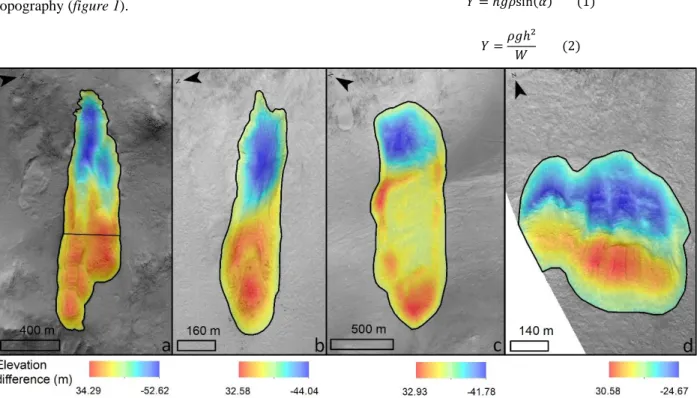
of the martian landslides, we used ConTeXt imager (CTX) at 6m/pix, Colour and Stereo Surface Imaging System (CaSSIS) images with a resolution of 5 m/pix and High Resolution Imaging Science Experiment (HiRISE) images with a resolution of 25-50 cm/pix. We used Digital Elevation Model (DEM) at 2m/pix from HiRISE stereo images produced using the Ames Stereo Pipeline [7] and SocetSet [8] to measure the slopes and topography (figure 1).
To conduct the rheological comparison, we searched for terrestrial analogues with similar morphological fea-tures, and we find that the studied martian landslides are most similar to terrestrial mudflows, submarine land-slides, earthflows, rock glaciers and andesite lava flows. We then compared the yield strength values of these dif-ferent flow types in the literature with those obtained for our four landslides. By assuming a Bingham rheology, we calculated the yield strength (Y) of the materials making up the martian landslides using the morphology of the deposit [9–12]. We used the following two rela-tions:
𝑌 = ℎ𝑔𝜌sin(𝛼) (1) 𝑌 =𝜌𝑔ℎ²
𝑊 (2)
Figure 2: Thickness map of four martian landslide in Nili Fossae region calculated using the methods in Conway
and Balme [13]. Black line in (a) show where the cross profile was taken for figure 1. (a) HiRISE image ESP_027480_2075; (b), (c), (d) HiRISE image ESP_027480_2075.
Figure 1: Cross-section of a martian landslide
showing the average structure of the levees.
1925.pdf 51st Lunar and Planetary Science Conference (2020)
Where ρ is the material density, h is the levée height, α the slope inclination, g the gravitational acceleration and W the width of the landslide cross-section.
Morphological and rheological comparison re-sults: The martian landslides are all located on the inner
slopes of a 25 km diameter impact crater. There are clearly marked erosion and depositional zones and each landslide has variably expressed lateral levées. From a morphological point of view, these four landslides are similar to mudflows, earthflows, submarine landslides, rock glaciers and lava flows, in that they have: (1) low propagation slopes, (2) lateral levees and (3) high relief lobate flow fronts. Mudflows have an irregular scar and ridges aligned perpendicular to the flow direction which are also observed in landslides a and b on figure 2. Rock glacier also have ridges aligned perpendicular to the flow direction and well-defined lobate flow front as ob-served on figure 2a and b. Lava flows have steep angu-lar lateral levees and well-defined compression ridges similar to those in the landslide on figure 2a. Some dif-ferences are also observed between these terrestrial an-alogs and the Martian landslides. For example, with re-gard to lava flows and rock glaciers, the absence of an erosion zone leading to the formation of the different flows. These terrestrial analogues are characterized by fluids which have relatively high yield strengths (Table 1), and the inclination of the levees on either side of the martian landslides is consistent with high cohesion of the material [14].
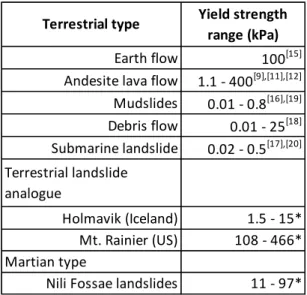
We made a rheological comparison between our martian landslides and these terrestrial analogues (Table 1) and found that the studied landslides have a yield
strength with the same order magnitude as earthflows and andesite lava flows.
Future work: We will perform numerical
model-ling using the Bingham rheology to back calculate the viscosity to better understand the rheology of the mar-tian landslides and estimate the potential contribution of liquid water. In addition, we intend to use the liquid limit theory to estimate the amount of liquid water that would be needed to initiate movement in the martian landslides [21].
Conclusions: (1) The comparison between martian
and terrestrial landslides reveals similarities to terres-trial geophysical flows, particularly earthflows (2) Earthflows necessarily imply the presence of liquid wa-ter, so the morphological and rheological similarities between these landslides and earthflows raises the ques-tion of the involvement of volatiles in forming these martian landslides.
Acknowledgements: This thesis is funded by a
min-isterial grant. We are grateful for the support of the Pro-gramme National de Planétologie, the French Space Agency CNES.
References: [1] M.T. Brunetti et al. (2014) Earth Planet. Sci. Lett., 405, 156–168. [2] G.B. Crosta et al. (2013) in 44, 2283. [3] G.B. Crosta et al. (2018) Earth Space Sci., 5, 89–119. [4] A. Lucas et al. (2011) J. Ge-ophys. Res., 116. [5] V. Soukhovitskaya and M. Manga (2006) Icarus, 180, 348–352. [6] C. Quantin et al. (2004) Planet. Space Sci., 52, 1011–1022. [7] M.J. Broxton and L.J. Edwards (2008) LPSC, 2008. [8] R.L. Kirk et al. (2008) J. Geophys. Res. Planets, 113. [9] G. Hulme (1974) Geophys. J. Int., 39, 361–383. [10] G. Hulme and G. Fielder (1977). [11] D.M. Pyle and J.R. Elliott (2006) Geosphere, 2, 253–268. [12] J.A. Hunt et al. (2019) Geochem. Geophys. Geosystems, 20, 1508– 1538. [13] S.J. Conway and M.R. Balme (2014) Ge-ophys. Res. Lett., 41, 5402–5409. [14] J. Corominas (1994) 26. [15] A.L. Nereson and N.J. Finnegan (2015) AGU Fall Meet. Abstr., 2015, EP41C-0943. [16] L. Jing et al. (2018) J. Geophys. Res. Earth Surf., 123, 2004– 2023. [17] S.W. Jeong (2013) Eng. Geol., 154, 1–5. [18] R.A.T. Gomes et al. (2013) Remote Sens., 5, 2219– 2237. [19] D. Craig (1981) Eng. Geol., 17, 273–281. [20] D.E. Sawyer et al. (2012) Mar. Geol., 307–310, 28–39. [21] F.V. De Blasio (2011) Earth Planet. Sci. Lett., 312, 126–139.
Table 1: Yield strength range of some terrestrial
flows compare to martian landslides. *This study using the equations (1) and (2).
Earth flow 100[15] Andesite lava flow 1.1 - 400[9],[11],[12] Mudslides 0.01 - 0.8[16],[19] Debris flow 0.01 - 25[18] Submarine landslide 0.02 - 0.5[17],[20] Terrestrial landslide analogue Holmavik (Iceland) 1.5 - 15* Mt. Rainier (US) 108 - 466* Martian type
Nili Fossae landslides 11 - 97*
Yield strength range (kPa) Terrestrial type
1925.pdf 51st Lunar and Planetary Science Conference (2020)