HAL Id: hal-01093794
https://hal.archives-ouvertes.fr/hal-01093794
Submitted on 11 Dec 2014
HAL is a multi-disciplinary open access
archive for the deposit and dissemination of
sci-entific research documents, whether they are
pub-lished or not. The documents may come from
teaching and research institutions in France or
abroad, or from public or private research centers.
L’archive ouverte pluridisciplinaire HAL, est
destinée au dépôt et à la diffusion de documents
scientifiques de niveau recherche, publiés ou non,
émanant des établissements d’enseignement et de
recherche français ou étrangers, des laboratoires
publics ou privés.
Formal Behavioral Modeling of Real-Time Operating
Systems
Cédrick Lelionnais, Matthias Brun, Jérôme Delatour, Olivier Henri Roux,
Charlotte Seidner
To cite this version:
Cédrick Lelionnais, Matthias Brun, Jérôme Delatour, Olivier Henri Roux, Charlotte Seidner.
For-mal Behavioral Modeling of Real-Time Operating Systems. The 14th International Conference on
Enterprise Information Systems (ICEIS (2) 2012), Jun 2012, Wroclaw, Poland. �hal-01093794�
Formal Behavioral Modeling of Real-Time Operating Systems
C´edrick Lelionnais
1, Matthias Brun
1, J´erˆome Delatour
1, Olivier H. Roux
2and Charlotte Seidner
21ESEO-TRAME, 4 rue Merlet de la Boulaye, B.P.30926, 49009 ANGERS cedex 01, FRANCE
2LUNAM Universit´e, IRCCyN-Ecole Centrale de Nantes, 1 rue de la Noe, B.P.92101, 44321 NANTES cedex 03, FRANCE
{cedrick.lelionnais, matthias.brun, jerome.delatour}@eseo.fr, {olivier-h.roux, charlotte.seidner}@irccyn.ec-nantes.fr
Keywords: Model Driven Engineering, Real-time operating systems, Behavioral modeling, Formalization, Time Petri Nets, Application deployment
Abstract: Faced with the growing problems of complexity, heterogeneity and upgradability of Real-Time Embedded Systems (RTESs), model-based frameworks dedicated to the application deployments facilitate the design and the development of such systems. Within these frameworks, taking into account the Real-Time Operating Systems (RTOSs) has become essential. These frameworks include transformation tools able to generate a code that is portable to the specified RTOS. Moreover, certain tools can generate formal models that are used for the verification and validation of the RTESs. However, the RTOSs technological concepts are considered in an implicit way, which involves a lack of genericity of the transformations. Some works have focused on the explicit description of the RTOSs. Such a description offers the possibility to take into account a model entirely dedicated to a targeted RTOS as a parameter of the transformation. Nevertheless, this method does not allow to verify the expected properties on the application, since the RTOSs behavior is not observable. The methodology presented in this paper tends to explicitly consider the formal description of the RTOSs behavior during an application deployment. This approach aims both at making each transformation generic and at verifying the deployment correctness.
1
INTRODUCTION
Nowadays, Real-Time Embedded Systems (RTESs) increasingly surround us in various domains (air-crafts, automotive, cell phones, robotics...). RTES engineers are confronted with the challenge of de-veloping more complex, higher quality systems, with shorter development cycles at lower costs. Within this context, reuse, maintainability and portability have become major issues in RTES design processes.
From this point of view, some frameworks have been developed with the aim of generating code. Starting from a detailed model written in such a lan-guage as AADL (Society of Automotive Engineer (SAE), 2004) or UML (Object Management Group (OMG), 2007b), the specific code for the deployment of an application on a Real-Time Operating System (RTOS) is then generated. These code generating frameworks are generally used after some Verification and Validation (V&V) activities have been performed on the models. In this way, some research works have dealt with the transformation of those models into formal models, using such formalisms as Time Petri Nets (TPNs) or Finite State Machines (FSMs)...)
as presented for instance in (Renault et al. , 2009, ) (Berthomieu et al. , 2010, ).
However, the correctness of the application de-ployed on the RTOS is not verified during these V&V activities. It is therefore difficult to ensure that the generated code effectively corresponds to what was designed. Moreover the consideration of the RTOSs is often embeded within the processus of generation (or seen in simplified terms). This approach is then far from flexible since each translation must be adapted in accordance with the targeted RTOS. Due to the signif-icant number of existing RTOSs, this results in having to maintain a large amount of translations.
In consequence, this paper relates to the following issues. Which methodology should be adopted in or-der to both deploy an application on a targeted RTOS and check the correctness of such a deployment? Is it possible to consider any RTOS during the deploy-ment? (and if so, how?) How can the behavior of any RTOS be described within such frameworks? To bring an answer to these questions, a method has been experimented to take these factors into account within a single framework. The basic idea is to add the for-mal description of any RTOS. Each description can
then be considered as a parameter of the transforma-tion, so as to keep the framework generic. Lastly, this formalization should let V&V tools able to verify the correctness of such deployments.
This paper is divided into the following sections. Section 2 presents some works in conjunction with the issues described above. As a result of that re-search, the approach adopted is developed in Sec-tion 3. It has proven the need to consider the behav-ior of RTOSs during a deployment of an application. Then Section 4 presents the strategy proposed to for-mally take into account the behavioral description of RTOSs. Consequently the benefits and the limits of the strategy are showed in Section 5 and discussed in Section 6. Finally we conclude in Section 7.
2
RELATED WORK
2.1
Code generating frameworks
Code generating frameworks are used in a context of application deployment. Code generation is the pro-cess of transforming code from one representation to another one. Often, this is from a higher level, such as an UML diagram modeling an application, to a lower level, such as a C code program that is portable to an execution software platform.
From a real-time point of view, code generating frameworks are used in a context of application de-ployment to a specific RTOS. The information con-cerning RTOSs are given in a program which im-plements the deployment. For instance, Ocarina de-scribed the information of a middleware with Ada code in its Gaia generator (Vergnaud and Zalila, 2006).
Similarly, the Real-Time Workshop (RTW) tool (The MathWorks, 2007) uses templates catching both technological concepts of the RTOS and program-ming language information. These templates struc-ture the source code to generate.
As a result, these frameworks involve an implicit description of the RTOSs during the processus of gen-eration. This raises the problem of genericity of these frameworks since each deployment corresponds to a unique code generator.
2.2
RTOSs modeling
In order to describe the Operating Sytems (OSs) con-cepts, some model-based frameworks have been de-veloped. Some works have focused on both structural and behavioral aspects of the OSs. Revolving around
these two axes, the description of the OSs is made ex-plicit and observable through formal models. Exex-plicit means that such a description is entirely dedicated to the representation of the OS.
Metropolis (Team, 2004) uses formal languages such as the Linear Temporal Logic. It offers the pos-sibility to verify some properties of an application de-ployed on a wide range of OSs.
Generic Modeling Environment (GME) (Davis, 2003) contributes to the description of OSs which are not necessarely real-time and analysis platforms. GME proposes assistance tools for the migration from one OS to another. In addition, this environment of-fers the possibility to insert formal metamodels. The descriptions thereby made can be used by V&V tools. Nevertheless, the genericity of the modeling lan-guages used within these frameworks does not make the modeling of platforms easier dedicated to a partic-ular domain, such as the real-time domain, any easier. More specifically to the RTESs, Ptolemy (Lee, 2003) is a framework which describes execution mod-els. Most of these models support the actor-oriented design focused on the concurrency and the communi-cation between the components of a RTES. However, the concepts of structural representation from this ap-proach are only intended for the applications model-ing, but not for RTESs themselves.
In spite of the fact that the OSs description is ex-plicit, the works outlined above are less in line with the RTESs. Furthermore, the separation of the con-cerns does not clearly appear. This impacts on the in-tervention of each domain specialist such as the appli-cation or the OSs technology. The lack of genericity previously noted arises once again.
Other researches have led to consider the de-scription of RTOS during the application deployment. This approach relies on a Model Driven Engineer-ing (MDE) context. MDE promotes the distinction of platform-specific modeling artefacts from those that are platform-independent. The platform (RTOS) model is considered as a parameter of this deploy-ment. Each model is described by a modeling lan-guage. Concerning the RTOS modeling, we can note the Software Resource Modeling (SRM) (Thomas
et al. , 2008, ) package which is a MARTE’s UML
profile (Object Management Group (OMG), 2007a). With SRM, RTOSs can be modeled using stereotyped concepts from the real-time software domain.
For another example, RTEPML (Real-Time Em-bedded Platform Modeling Language) (Brun and De-latour, 2011) was developped with the aim of defining concepts dedicated to the real-time domain for mod-eling RTOSs.
and RTEPML better separate the concerns previously highlighted (RTOSs structure, transformations, de-ployments choice...). Nevertheless, only the structural aspect is taken into account with these modeling lan-guages. The behavior resulting from the concurrent activities of the RTESs components is not observable in the deployed application models. As a result, no V&V activities can be applied to check the correct-ness of such a deployment.
3
APPROACH ADOPTED
The previous section showed the interest to well dis-tinguish the concerns for the intervention of each spe-cialist for real-time applications deployment. In addi-tion, it has been raised to explicitly consider the de-scription of the RTOSs behavior within a code gen-erating framework. Our approach relies therefore on the extension of a model-based framework to formally observe the behavior of a deployed application on a RTOS. This should add other concerns such as the RTOSs behavior and some V&V activities on the de-ployment at design phase.
As a result, we have chosen the RTEPML frame-work as it has been developed within our team. In addition this modeling language already contributes to the explicit description of the RTOSs. However, the behavioral aspect of RTOSs can not be modeled with RTEPML. Therefore modeling behavior with RTEPML means extending this language. That is why we have sought to enrich it in order to define behav-ioral concepts of RTOSs.
3.1
RTEPML with MDE
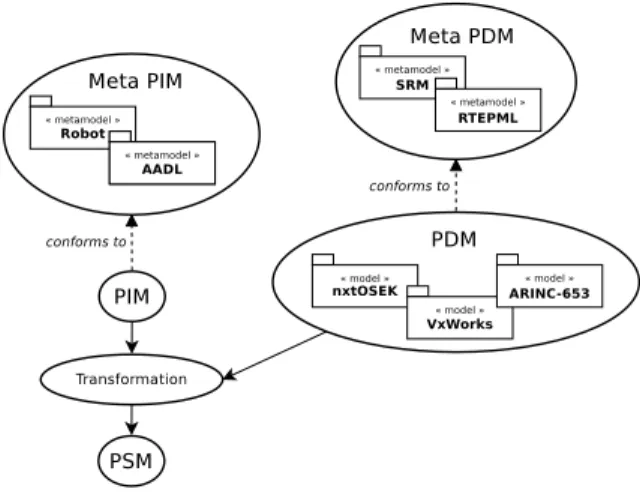
Based on the MDE initiative, the application deploy-ment emanates from semi-generic transformations of models. MDE is based on an architecture (Model Driven Architecture (MDA)) (Object Management Group (OMG), 2001) (see Figure 1) involving a de-sign process where a Platform-Independent Model (PIM) (description of the application without consid-ering the platform) is transformed into a Platform-Specific Model (PSM) (description of the application deployed on the platform), according to a Platform Description Model (PDM) (description of the plat-form). Each model conforms to a modeling language, also named metamodel.
In accordance with Figure 1, RTEPML is a meta-model which has been built to meta-model PDMs. The concepts of the targeted RTOS are then defined by a PDM. So far, the modeling with RTEPML goes through the structural characterizations (resources
Figure 1: MDA principle
and services) of RTOSs. The resources represent the concepts offered by the platform. For instance, in a RTOS, the tasks, the semaphores, the mailboxes are considered as resources. The services are offered by the resources and caught at API’s level (Application Programming Interface). For example, services asso-ciated with semaphores are the take and release prim-itives.
Consequently, in conjunction with this approach, the deployment consists both in instantiating RTOS resources and in using RTOS call services for imple-menting the application. Then the generated PSM is provided for a code generation process. Finally, it is worth noting that the transformation serving to the de-ployment is generic thanks to the explicit considera-tion of the RTOSs.
3.2
Illustration around semaphore
sharing
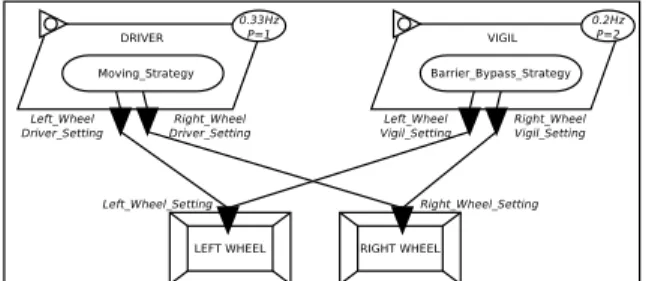
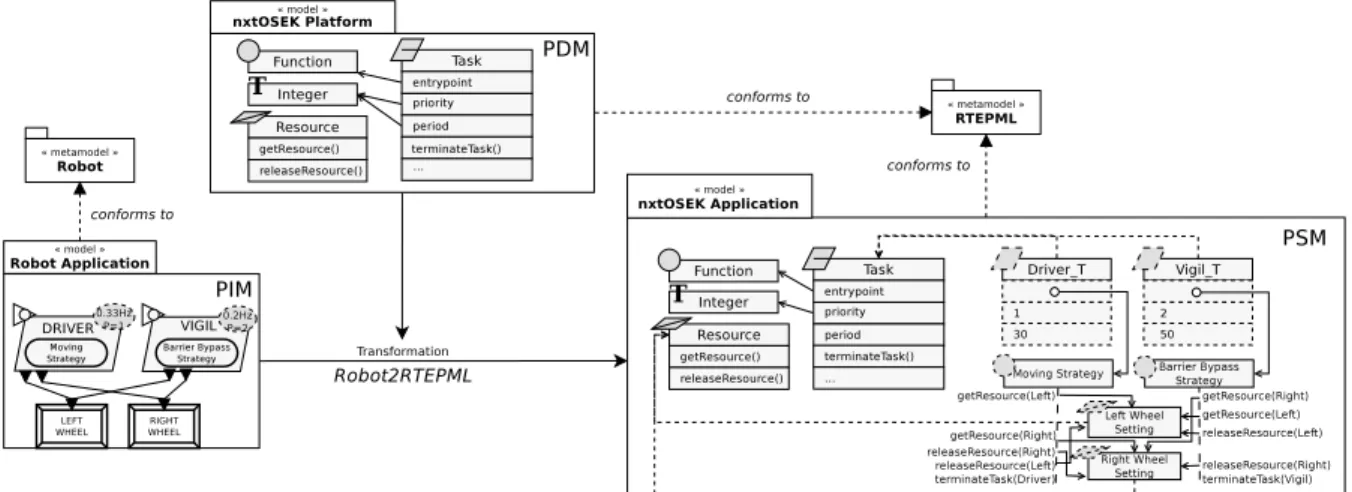
We have mentioned the idea to extend RTEPML at the beginning of this section. This extension should en-able to consider the RTOS behavior during an appli-cation deployment. To illustrate this behavioral lack, a deployment is presented Figure 3 1 based on an example of Robot application (see Figure 2). Obvi-ously several concepts instantiations of the considered RTOS are possible following the application. Accord-ingly, this illustration is focused on a particular case : the semaphore sharing.
In this way, the PIM representing the robot ap-plication combines two periodic activities (a Driver activity for driving the robot and a Vigil activity for avoiding barriers). On the one hand, the Driver
in-1The languages used in Figures 2 to 5 come from the
graphic description of each metamodel (their concrete syn-tax)
Figure 2: Model of a Robot application
vokes a Moving Strategy program. On the other hand, the Vigil invokes a Barrier Bypass Strategy program. Then two wheels allow the robot to move thanks to two settings updated according to the activities. Fi-nally each periodic activity owns a priority according to its role.
The PDM described by RTEPML for this deploy-ment is a model of the nxtOSEK’s RTOS (nxtOSEK, 2009). nxtOSEK is based on OSEK/VDX standard (OSEK/VDX Group, 2005) and is widely used in LEGO MINDSTORMS NXT educational projects. According to our needs, some resources have been de-fined to be instantiated with regards to the application. The Task concept is instantiated to represent each ac-tivity, the Function concept to execute each program and the Resource (semaphore concept in nxtOSEK) concept to protect each wheel setting updating.
The PSM results in a model of the application de-ployed on the nxtOSEK platform. However the con-current activities which are governed by both appli-cation and technological concepts do not concretely appear in the final model. For instance we do not know whether each Resource (protection for updating each wheel setting) is available or not (empty or full). Moreover the state in which each Task (the Driver T and the Vigil T) is set cannot be clearly distinguished. Finally the impact of the properties such as the
prior-ity and the period of the tasks is not directly verifiable.
Consequently this illustration shows how difficult it is to interpret the behavior of the resources instan-tiated. The behavioral aspect of the generated model is not observable. In this approach, it is therefore dif-ficult (if not impossible) to undertake some V&V ac-tivities to verify the correctness of the deployment. In order to be able to check the properties on the de-ployed application, formal behavioral aspects have to be introduced within the description of the software platform.
4
STRATEGY OF BEHAVIORAL
FORMALIZATION
In accordance to the previous conclusion, RTEPML has been enriched to bring a behavioral aspect in the RTOSs description. On this point, we have extended the abstract syntax of RTEPML in which executive concepts have been defined to explicitly describe any platform.
Once RTEPML extended (newly called RTEPML BEHAVIOR), the implementation of a transformation process could have been put in place to make the model of the deployed appli-cation behavioral. To meet the requirements of V&V activities, the formalization of the PSM is necessary. RTEPML BEHAVIOR has therefore been designed to take into account any formal language. This solution has been thought in order to make the transformation independant of other formal languages.
4.1
Behavioral Consideration
Taking into account the RTOSs behavior necessitates the identification of the behavior of each resource (scheduling task, state of a semaphore...). The same applies to the behavioral description of each service offered by resources (task terminating, semaphore ac-quisition...). Lastly, each behavioral impact associ-ated with each resource property (task priority, task period, semaphore tokens number...) should also be treated during the deployment.
To keep on the previous focus, an example of be-havioral consideration around the semaphore is de-picted Figure 4. As explained earlier, some concepts have been added in RTEPML BEHAVIOR to repre-sent the behavior of the RTOSs resources. Thus, the behavioral prototype of the semaphore concept, called
ResourceBehavioralPrototype, has been defined on
the Behavioral PDM. As a reminder, Resource (on Behavioral PDM) represents the semaphore con-cept of nxtOSEK RTOS, whereas ”Resource” is the RTEPML BEHAVIOR metaconcept allowing to de-scribe any RTOS resource. In other words, Resource conforms to MutualExclusionResource.
The formalism used to express the behavioral pro-totype is Time Petri Net (TPN) (see (Boyer and Roux, 2008) for a survey). TPNs have been prefered be-cause of their expressiveness. This formalism is in-deed adapted to the description of concurrency activ-ities such as resources schedulability, resource shar-ing, call services sequence, time constraints... Fur-thermore, TPNs propose known time extensions (such as stopwatch TPNs) which allow to model real-time
Figure 3: Robot application deployment
schedulings implemented in V&V tools like Romeo (Gardey et al. , 2005, ) (Lime et al. , 2009, ) or Tina (Berthomieu et al. , 2004, ).
Figure 4: MER behavior
As can be seen on Figure 4, a behavioral proto-type can be composed of several behavior elements. Indeed, a RTOS resource includes services and prop-erties. The appearance of roles (defined at meta-model level) within the Behavioral PDM, enables to precise certain behavior elements. In the nxtOSEK semaphore case, serviceBehavioralDescription role comes to describe the services behavior of
getRe-source and releaseRegetRe-source, whereas defines role
comes to define the value of the semaphore.
4.2
Deployment with
RTEPML BEHAVIOR
The behavioral description of RTOSs has been made possible with RTEPML BEHAVIOR. Moreover the
possibility to define formally the behavior elements, contributes to the formalisation of the application de-ployment. This important point should enable to ver-ify its correctness before the code generation.
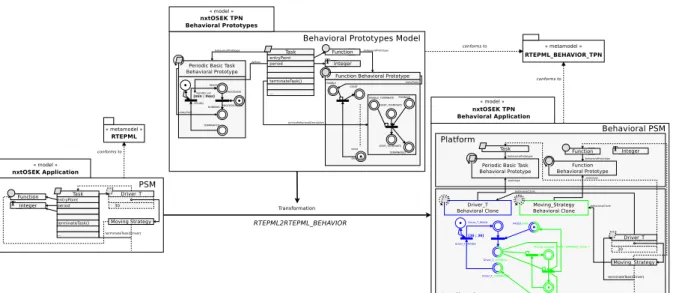
In accordance with the adopted approach, a trans-formation has been developed to consider explicitly a behavioral PDM of the targeted RTOS. We have taken the same robot application from the previous section to illustrate an example of formalisation of the de-ployment (see Figure 5). For the sake of simplicity and clarity, we have reduced the Robot PIM to the
Driver T instance representing the periodic Driver
activity. Driver T has an entry point on the Moving
Strategy in which only a service is called for
termi-nating itself.
The involved prototypes in the transformation are those of the resources for the needs of the application. Once the prototypes are detected, the latter are cloned according to each instance of the application. It may be observed that the cloned prototypes corresponding to the behavior of the Driver T and the Moving
Strat-egy (including the service of terminating) have been
composed through this example.
As a result, the TPN Behavioral PSM achieved is more expressive than the previous one. Its expressive-ness helps us to easily see its liveexpressive-ness (the different states of Driver T, its periodicity...).
The composition of the building blocks repre-sented by cloned behavioral prototypes (semaphore, task, communication, priority...) make up the gener-ated model. In TPNs case, the composition is car-ried out by merging places interfacing all the blocks. This presents some advantages. The semantics of the places merging is obvious, while the one of the tran-sitions merging is ambiguous. Indeed, the fact of as-signing different time constraints on mergeable tran-sitions makes their merging difficult. In addition, the
Figure 5: Formalisation of robot application in TPN
places merging preserves the blocks behavior, which enables to validate more easily the building.
In this paper, the purpose is neither to describe exhaustively the modeling of the behavioral proto-types and the composition of their clones, nor to prove that it is correct. The aim is only to present the ap-proach and the methodology which allows it. That is why no proof of the building validity has been given. Notwithstanding, this proof is greatly simplified by our composition approach.
5
BENEFITS OF THE STRATEGY
The main benefits of our methodology are both the formalization and the moving of the application de-ployment into the design phase. This should allow to ensure its correctness before generating code. Bas-ing our approach on MDE, a formalization of the de-ployed application model can be carried out. V&V activities will become applicable thanks to the use of model-checking tools.
A second benefit is the separation of the skills highlighted in the second section. The distinction of modeling artefacts allows both RTOSs behavior and formal verification experts to interact on the application deployment (see Figure 6). Thanks to RTEPML BEHAVIOR, the specialist of the RTOSs behavior can be assisted by the one more highly skilled in the formal verification. The latter one can also interpret the most adapted formalism following the case.
To put our strategy into practice, we have chosen to verify a necessary and well-known condition in the
Figure 6: Intervention of specialists
RTESs domain: the absence of deadlock. Once the PSM generated in TPN, the formal model can be pro-cessed by ROMEO (Gardey et al. , 2005, ). ROMEO has been developed within the Real-Time team at IR-CCyN2lab. One of the reasons for choosing ROMEO is that this tool is dedicated to Transition-TPN (T-TPN) verification, i.e. the time is only assigned to the transitions. Algorithms were proposed for applying verification on T-TPN extended to scheduling.
Despite the combinatorial explosion risk of the generated TPN, ROMEO has given a deadlock out-come. This diagnosis could seem foreseeable from the specification since the wheels settings updating is protected by semaphores. Notwithstanding, this veri-fication helps us to evaluate the right protocol to use for this application. Indeed, the Priority Ceiling Pro-tocol (PCP) (OSEK/VDX Group, 2005) should have been chosen to remedy this situation during the de-ployment.
We have exposed the deadlock case but other be-havioral properties could have been tested. For in-stance we could deal with liveness properties such
as termination of actions, occurency of expected events... But we could also handle time constraints such as Worst-Case Execution Time (WCET), respect of a deadline...
6
LIMITS
This experimentation has showed the feasability of generating a formal model to observe the behavior of the application deployed on a RTOS. Nonetheless, the behavior of some of concepts (the notification sources such as the events or the communication re-sources such as the messages...) are not yet taken into account within RTEPML BEHAVIOR. As a result, an optimization of the latter modeling language must be widened in order to cover such concepts.
Another limit raised is the interpretation of other formalisms to model the behavior during the deploy-ment. Only TPNs have been presented through our strategy but the implementation of other formal lan-guages deserves to be examined.
Lastly, a deadlock has been detected during the deployment. It has been deduced that the deploy-ment was not correct. That being so, this decision does not affect the correspondence between the ap-plication and the targeted RTOS. Indeed, a proto-col changement (Priority Ceiling Protoproto-col (nxtOSEK, 2009) (OSEK/VDX Group, 2005)) is just sufficient to prove it. This leads us to say that the framework does should integrate decision support tools for guiding the experts involved in the RTOS choice.
7
CONCLUSION
Through this study, a methodology has been pre-sented to consider the behavior of a real-time execu-tion software platform (RTOS) during an applicaexecu-tion deployment. The deployment which enables to im-plement an application on a specific RTOS, has been moved at design phase. The purpose of this choice is to enable the different specialists to intervern more easily on the deployment following its domain. In-deed, thanks to the modeling with RTEPML and the MDE approach, the separation of concerns (applica-tion and RTOS) has been made explicit.
The description of the RTOSs behavior has been made feasible by enriching RTEPML (RTEPML BEHAVIOR). In addition, each be-havioral model can be formally described. A transformation has been developed to generate a formal model of the deployed application. The formalization has the advantage of applying V&V
activities for checking the correctness of the deploy-ment, even before generating the code useful to the implementation of the application.
However, certain limits of our methodology have arisen. Future prospects are the subject of our next works to improve and to check the feasibility of such a strategy. In accordance to the previous section, the be-havioral concepts missing in RTEPML BEHAVIOR will have to be created. Then, to ensure the genericity of the formalisation, other languages will have to be interpreted. Finally, a large number of formal proofs will have to be written within our framework. This should contribute to the verification of necessary and sufficient conditions for validating such deployments.
REFERENCES
Berthomieu, B., Bodeveix, J.-P., Dal Zilio, S., Dissaux, P., Filali, M., Gaufillet, P., Heim, S., and Vernadat, F. (2010). Formal Verification of AADL models with Fiacre and Tina. In ERTSS 2010 - Embedded Real-Time Software and Systems, pages 1–9, TOULOUSE (31000), France. 9 pages DGE Topcased.
Berthomieu, B., Ribet, P.-O., and Vernadat, F. (2004). The tool tina – construction of abstract state spaces for Petri nets and time Petri nets. International Journal of Production Research, 42(4).
Boyer, M. and Roux, O. H. (2008). On the compared ex-pressiveness of arc, place and transition time Petri nets. Fundamenta Informaticae, 88(3):225–249. Brun, M. and Delatour, J. (2011). Contribution on the
soft-ware execution platform integration during an appli-cation deployment process. First Topcased Day. Davis, J. (2003). GME: the Generic Modeling
Environ-ment. In OOPSLA ’03: Companion of the 18th an-nual ACM SIGPLAN conference on Object-oriented programming, systems, languages, and applications, pages 82–83, New York, NY, USA. ACM.
Gardey, G., Lime, D., Magnin, M., and Roux, O. H. (2005). Rom´eo: A tool for analyzing time Petri nets. In 17th International Conference on Computer Aided Verifi-cation (CAV’05), volume 3576 of Lecture Notes in Computer Science, pages 418–423, Edinburgh, Scot-land, UK. Springer.
Lee, E. A. (2003). Overview of the Ptolemy project. Tech-nical Report UCB/ERL M03/25, EECS Department, University of California, Berkeley.
Lime, D., Roux, O. H., Seidner, C., and Traonouez, L.-M. (2009). Romeo: A parametric model-checker for Petri nets with stopwatches. In Kowalewski, S. and Philip-pou, A., editors, 15th International Conference on Tools and Algorithms for the Construction and Anal-ysis of Systems (TACAS 2009), volume 5505 of Lec-ture Notes in Computer Science, pages 54–57, York, United Kingdom. Springer.
nxtOSEK (2009). NXTOSEKOperating System, version 2.10. http://lejos-osek.sourceforge.net/.
Object Management Group (OMG) (2001). Model Driven Architecture (MDA) Guide, version 1.0.1. http://www.omg.org/mda/.
Object Management Group (OMG) (2007a). UMLProfile for Modeling and Analysis of Real Time and Embbe-ded systems (MARTE), second revision submission. http://www.omg.org/marte/.
Object Management Group (OMG) (2007b). Unified Model-ing Language (UML) : Superstructure, version 2.1.2. http://www.omg.org/mda/.
OSEK/VDX Group (2005). OSEK/VDX Operating Sys-tem Specification, version 2.2.3. http://www.osek-vdx.org/.
Renault, X., Kordon, F., and Hugues, J. (2009). From aadl architectural models to petri nets: Checking model vi-ability. In ISORC, pages 313–320.
Society of Automotive Engineer (SAE) (2004). Architec-ture Analysis & Design Language (AADL) AS5506, version 1.0.
Team, M. P. (2004). The metropolis meta model - version 0.4. Technical Report UCB/ERL M04/38, EECS De-partment, University of California, Berkeley. The MathWorks (2007). Real-Time Workshop User’s
Guide. The MathWorks Inc., Natick, MA, USA. Thomas, F., Grard, S., Delatour, J., and Terrier, F. (2008).
Embedded Systems Specification and Design Lan-guages, Selected Contributions from FDL’07, vol-ume Embedded Systems Specification and Design Languages of FDL selected papers, chapter Soft-ware Real-Time Resource Modeling, pages 169–182. Springer, Barcelona, Spain, springer science+business media b.v. edition.
Vergnaud, T. and Zalila, B. (2006). Ocarina, a com-piler for the AADL. Technical report, Paris, France. http://ocarina.enst.fr.