Aging across the tree of life: the importance of a comparative perspective for
1the use of animal models in aging
2 3 Alan A. Cohena* 4 5 aGroupe de recherche PRIMUS, Department of Family Medicine, University of Sherbrooke, 6
3001 12e Ave N, Sherbrooke, QC, J1H 5N4, Canada. 7
8
* Correspondence to: [email protected]. 9
10
Highlights 11
Many animals do not age, and physiological mechanisms of aging vary across species 12
Nonetheless, conserved aging-related signalling pathways exist 13
Aging is thus highly multi-factorial, complex, and particular to each species 14
Animal models should include both traditional and non-traditional species 15
Results should be interpreted cautiously and within a broad comparative perspective 16
17
18 *Manuscript
Abstract 19
Use of model organisms in aging research is problematic because our ability to extrapolate 20
across the tree of life is not clear. On one hand, there are conserved pathways that regulate 21
lifespan in organisms including yeast, nematodes, fruit flies, and mice. On the other, many 22
intermediate taxa across the tree of life appear not to age at all, and there is substantial variation 23
in aging mechanisms and patterns, sometimes even between closely related species. There are 24
good evolutionary and mechanistic reasons to expect this complexity, but it means that model 25
organisms must be used with caution and that results must always be interpreted through a 26
broader comparative framework. Additionally, it is essential to include research on non-27
traditional and unusual species, and to integrate mechanistic and demographic research. There 28
will be no simple answers regarding the biology of aging, and research approaches should reflect 29 this. 30 31 Keywords 32
Aging, comparative biology, complexity, disposable soma, diversity, model organism 33
1. Introduction 34
This special issue is devoted to animal models of aging. The term “animal model” implies that 35
the final objective is not in fact to understand the species studied for its own sake, but to be able 36
to draw some general conclusions with respect to human aging. Paradoxically, this generates the 37
need for a comparative/ evolutionary perspective in order to identify which animals might have 38
something important to teach us about ourselves. In most cases, this is relatively simple. For 39
example, basic cellular respiration is relatively similar across eukaryotes, so any simple, easy-to-40
work-with organism such as yeast may serve as a good model [1]. The immune system differs 41
substantially between mammals and other vertebrates, implying that for most questions only 42
mammalian immune models are likely to be pertinent. And for questions such as complex social 43
behavior, the list of potential models might be limited to gregarious primates, carnivores, and 44
cetaceans. 45
However, in the case of aging, things are not so simple. First, there is no real consensus about 46
what aging is or how to define it [2, 3], though there is increasing agreement that it is at least 47
multi-factorial [4, 5], and potentially an emergent property of a formally complex system [6, 7]. 48
Second, there is conflicting evidence about the extent to which aging is a process that is similar 49
across all organisms or particular to each species [3, 8]. Third, there is reason to expect that 50
aging is systematically different in long-lived and short-lived species, such that in some cases 51
long-lived birds might be better models for human aging than mice (Mus musculus), despite the 52
much closer phylogenetic relationship between humans and mice [9, 10]. This obviously presents 53
a challenge for the long-term follow-up of the aging process within individuals. Fourth, there are 54
a wide variety of questions that can be asked about aging, requiring different models. 55
The goal of this article is to take the view from on high, asking what we know about aging 56
across the entire tree of life and searching for both commonalities and particularities that would 57
point to what organisms are good models for what questions. In some cases, this perspective can 58
be used to identify model organisms that may have unique strategies to combat aging, from 59
which we might learn. In other cases, it is the broad patterns themselves that generate insight into 60
what aging is. More than perhaps any other field in basic biology, a comprehensive 61
understanding of aging will require a multi-faceted back-and-forth between findings in specific 62
model organisms, findings in non-model organisms, a broad comparative perspective, 63
evolutionary theory, and basic principles of biology and physiology. 64
65
2. Key concepts to understand the diversity of aging 66
The diversity of life forms on our planet is so astounding that the familiar concept of aging we 67
know as humans cannot be directly transferred to many other species. Here I introduce several 68
concepts that are important to understand that diversity and how we define aging. 69
70
2.1 The germ line-soma distinction 71
In humans, other vertebrates, and a wide variety of organisms, not all cells have the potential to 72
contribute genetic material to the next generation. The cells that do are called the germ line, 73
while those that do not are called the soma. This is analogous to the situation in eusocial insects, 74
where only the queen and the males reproduce, and the workers serve no function except to aid 75
the reproduction of the queen. August Weismann [11] first pointed out the germ line-soma 76
distinction and noted that this implied that aging should occur only in the soma (otherwise aging 77
would occur across generations and life itself would end). This was further developed by 78
Kirkwood [4, 12] into the Disposable Soma theory of aging, which posits that the soma sacrifices 79
itself to transmit the germ line, and that constraints on the acquisition and use of energy and 80
other resources would force the soma to trade off between reproduction and maintenance (i.e., 81
survival). 82
However, not all organisms have a distinct germ line and soma. Unicellular organisms 83
(bacteria, protists, yeasts, etc.) obviously do not. Fungi, and many marine/aquatic invertebrates 84
(including, starfish, hydra, and jellyfish) also do not: they appear to be able to revert apparent 85
somatic cells to a germ line state [13]. Plants were long thought to lack a distinct soma as well, 86
but this is somewhat less clear in light of recent findings suggesting that both long-lived and 87
short-lived plants have similar numbers of cell-divisions before producing germ cells [14]. 88
Species without a distinct soma are not necessarily predicted to age [4], and it thus may be 89
crucial to understand if aging patterns differ systematically between organisms with and without 90
the germ line-soma distinction [15, 16]. Note, however, that an implicit assumption of the 91
importance of the germ line-soma distinction is that aging primarily a cellular phenomenon that 92
scales up to the individual level. If aging is driven primarily by factors at higher organisational 93
levels (tissues, organs, organism), the germ line-soma distinction could be less important or even 94
irrelevant. While the implicit assumption in much of the aging literature is that aging is primarily 95
cellular, there is evidence for both cellular and higher-order processes (e.g. systemic 96
dysregulation, wing damage in insects) [6, 17, 18], and no good evidence as to their relative 97
contributions. 98
99
2.2 Asymmetrical division and budding 100
Many organisms lacking a germ line-soma distinction reproduce by splitting one organism into 101
two (asexual reproduction), rather than by creating a specific seed or egg (usually sexual 102
reproduction). Again, unicellular organisms do this, but also many invertebrates and plants. For 103
example, the hydra, a small freshwater cnidarian, reproduces by budding, a process in which a 104
small mass of cells separates from the body stem and grows into a separate individual [19]. In 105
most of these cases, the division of the individual is not perfectly symmetrical: it is possible to 106
identify a “mother” cell or individual, and a “daughter” cell or individual. This is true even in 107
unicellular organisms such as bacteria and yeast (Saccharomyces cerevisae) [4, 20, 21]. 108
Accordingly, it is possible to consider aging in such species as long as it is possible to identify 109
and follow the mother across multiple division/budding events [20]. 110
111
2.3 Ramets and genets 112
In organisms such as humans that reproduce only sexually, each individual has a unique 113
genotype and is easy to identify. However, in the case of asexual reproduction, many apparent 114
individuals can share the same genotype. With the exception of unicellular organisms, most 115
species that can reproduce asexually also reproduce sexually. This means that certain aggregates 116
of individuals will be descended asexually from a single, sexually-produced progenitor and will 117
share their genotype [19, 22-24]. Each physically separate organism is called a ramet, and the 118
collection of ramets sharing a genotype is called a genet. Examples include ascidians, hydra, 119
corals, and a great diversity of plants, including entire stands of aspen (Populus tremuloides) [25]. 120
Questions of aging in species with both ramets and genets can be particularly tricky because the 121
genet may be essentially immortal once enough ramets are produced, and yet ramets might age in 122
a programmed fashion that increases the fitness of the genet, particularly in structured colonies 123
[22]. 124
125
3. What is aging, and how does it vary across the tree of life? 126
3.1 Demographic aging: Measurement 127
From a demographic perspective, aging can be defined as an inexorable increase in mortality 128
and/or decrease in fertility with age. Usually, the focus of research is on mortality, though 129
reproductive aging is of particular interest in humans with our long female post-reproductive 130
lifespan [26, 27]. Note that this definition decouples aging from lifespan: some organisms with 131
very high extrinsic mortality due to predation, etc. appear not to age at all (i.e., mortality is 132
unchanged with age, such as in hydra [19]), whereas some very long-lived organisms such as 133
humans show clear aging (i.e., the probability of death increases steadily with age). A note on 134
terminology: some authors refer to this aging-lifespan distinction as the shape vs. the pace of 135
aging [28] or as senescence (decline) vs. aging (progression of time) [3]. 136
There are limits to a purely demographic perspective, particularly when we wish to apply 137
comparative findings to humans. Demographic patterns may or may not clearly reflect the kind 138
of physiological deterioration we tend to associate with the term “aging.” In plants in particular, 139
there is now a clear understanding that size is often more important than age in determining 140
mortality risk [29-31], such that demographic patterns of aging (or lack thereof) may not be 141
driven at all by physiological processes of interest from a human perspective. Species with 142
indeterminate growth and/or increasing reproduction with size might be expected to show 143
different aging patterns [32], despite Hamilton’s original predictions [33]. Likewise, 144
demographic patterns can depend strongly on environmental conditions. For example, in the 145
hydra, Hydra vulgaris appears to show no aging under standard laboratory conditions, whereas H. 146
oligactis can show aging depending on the precise temperature [34]. More broadly, the 147
distinction between intrinsic and extrinsic causes of mortality is falling into disfavor as we begin 148
to understand the importance of internal conditions for determining susceptibility to external 149
causes [35, 36]. This implies that both rates and patterns of demographic aging are highly 150
dependent on environmental conditions that may affect not just mortality rates, but how mortality 151
affects different age classes [36]. Between such environmental influences and methodological 152
questions, it is possible to observe both aging and its apparent absence in different populations of 153
the same species. For example, painted turtles (Chrysemys picta) were long thought to be a good 154
example of a species that showed no apparent aging [37]; however, a recent study in a much 155
shorter-lived population appears to show aging [38], and it is not clear whether this reflects a 156
genuine difference between the populations (which would be surprising), a data artefact, or a 157
methodological issue in one or the other study. 158
Despite these caveats and the challenges of acquiring detailed demographic data for a wide 159
array of taxa, demographic data on aging is currently the most promising path for broad 160
comparisons across the tree of life. Demographic patterns can be standardized and compared 161
across taxa relatively easily, regardless of how complex or varied the underlying mechanisms 162
[28]. (Note that the problem of defining the unit in clonal species is present both for 163
demographic and mechanistic studies.) Because of this potential to standardize, a major effort 164
has been invested in the compilation of these data (outlined below; [39-41]). Additionally, there 165
is an increasing body of theoretical work on the comparative demography of aging. This work 166
shows (a) that we should expect a wide array of patterns, including both absence of aging and 167
“negative senescence” (declining mortality with age) [32, 42, 43]; (b) that it is possible to 168
distinguish the pace of aging (i.e., lifespan) from the shape of aging (how abruptly aging sets in 169
toward the end of the lifespan) [28, 44]; and (c) that understanding aging mechanisms may be 170
critical to understanding variation in aging demography [6, 15, 43, 45]. Thus, while there are 171
certain challenges to the demographic comparative study of aging, these challenges are dwarfed 172
by the challenges related to the comparative physiology of aging. 173
174
3.2 Demographic aging: Patterns 175
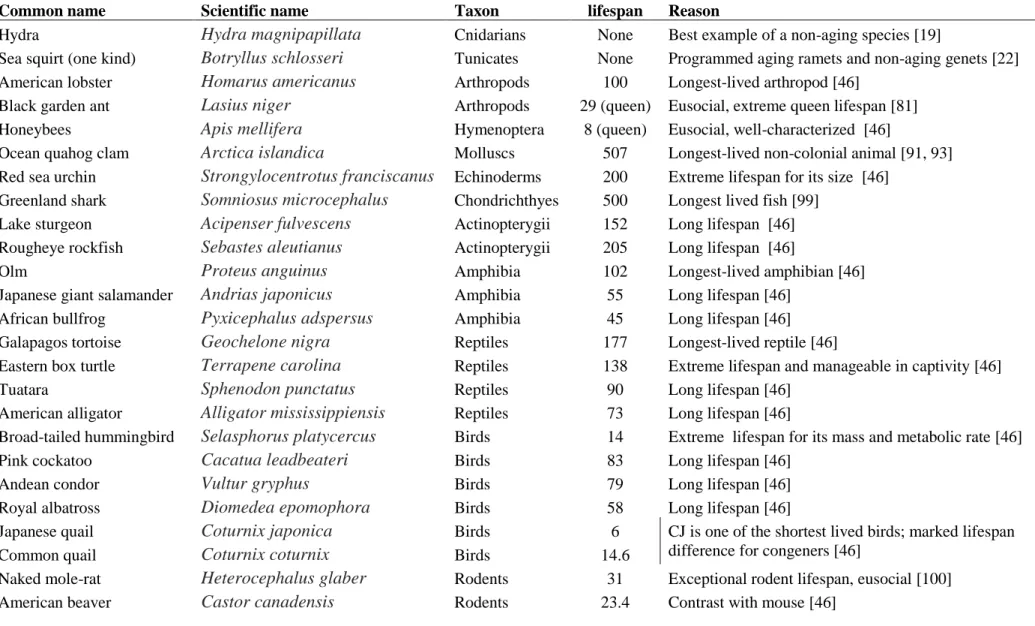
Perhaps the simplest measure of demographic aging is maximum observed lifespan (Table 1). 176
This measure conflates aging and lifespan and pace vs. shape, as noted above, with the potential 177
for short-lived species not to age and long-lived species to age quickly relative to their lifespan. 178
Nonetheless, exceptionally long-lived species are doing something quite differently from many 179
other species, regardless of whether they can be formally shown not to age, and maximum 180
observed lifespan is available for a wide array of organisms, many of which (particularly 181
vertebrates) are compiled in the AnAge database [46]. The taxonomic bias on the availability of 182
data makes strong inferences problematic; nonetheless, a quick perusal of the longest-lived 183
species is striking for the repetition of closely related taxa: of the 42 vertebrates with 80+ year 184
lifespans, 31 are whales, turtles, rockfish, sturgeon, or oreo fish. 185
More sophisticated analyses including both shape and pace have confirmed the importance of 186
slow, negligible, and negative aging [44]. One of the most striking findings in recent years is that 187
demographic aging appears to be far from universal [3, 39]. The compilation of data for large 188
numbers of species now allows us to see for the first time that non-aging species are not simply 189
rare, weird exceptions, but are rather common across the tree of life (Fig. 1). Some turtles, fish, 190
trees, and marine invertebrates were long suspected not to show aging [47], but it is now possible 191
to see that a large fraction of the tree of life does not appear to show aging. So far, all mammals 192
and birds appear to age [48, 49]; perhaps it is our bias as mammals that led us to consider this the 193
default state of most organisms. Across the rest of the tree, examples of aging and non-aging 194
species are often closely interspersed, with even closely related taxa showing differing patterns. 195
Some plants age, others do not [16, 24, 39]. Some arthropods age, others do not [39]. Some 196
reptiles and amphibians age, others do not [39]. Some fish age, others do not [46, 50]. Some 197
fungi age, others do not [23]. Some organisms with distinct somas age, others do not [39]. Some 198
organisms without distinct somas age [16], others do not [19]. Moreover, changes in mortality 199
with age often show more complex patterns, not just monotonic increases or flat, unchanging 200
levels [39]. Generally, aging patterns can be classified using the schema in Table 2, with broad 201
representation for most patterns. 202
This finding is crucial and paradigm-shifting because it implies that there is no single, 203
universal aging pathway. At most, there might be a pathway that is shared when aging is present 204
but can be turned off. However, this would imply that aging is programmed, which does not 205
appear to be the case (see below), and does not address the distinct possibility that non-aging is 206
the default state, with aging evolving independently multiple times across the tree of life. 207
Moreover, the taxonomic distribution of aging patterns observed so far does not appear to agree 208
with predictions made based on aging as a programmed phenomenon [51]. The finding also 209
presents challenges for the Disposable Soma theory, which does not provide a way to understand 210
why some organisms with distinct somas could avoid aging, nor to understand why some 211
organisms without distinct somas would age [15]. 212
213
3.3 Programmed aging: the rare exception 214
Most researchers studying the evolution of aging consider aging to be non-adaptive in the sense 215
that it appears to be a by-product or side effect of other biological and evolutionary processes 216
rather than an end in itself [51-53]. In this sense, aging is also seen as non-programmed: not the 217
result of a specific pathway that has evolved in order to carry out the aging process. The 218
multiplicity of mechanisms and their heterogeneity across species (see below) confirms this. 219
While most of what we call aging follows this non-programmed paradigm, there are a small 220
number of exceptions where aging is clearly programmed. For example, the colonial marine 221
invertebrate Botryllus schlosseri kills off its modules through programmed senescence prior to 222
replacing them [22], an excellent example of ramet but not genet aging. The catastrophic aging 223
observed in semelparous organisms such as annual plants, Pacific salmon (Oncorhynchus spp.), 224
and even some mammals may also be an example of programmed aging, though this is not fully 225
clear [52-55]. These examples are interesting both ecologically, and as a contrast that reinforces 226
the conclusion that most aging is non-programmed [52]. Nonetheless, their relevance for 227
understanding aging in humans specifically or in animals generally is somewhat limited, 228
precisely because most aging does not appear programmed in this way. 229
230
3.4 Physiological aging: mechanisms 231
Physiological aging here refers to the myriad mechanisms and processes that lead to inexorable 232
organism-level declines in functional capacity and/or health state. Overall physiological aging is 233
generally non-programmed, though some portions of it may include molecular programs that 234
exist for other purposes [51]. Physiological aging encompasses structural wear and tear (e.g. 235
insect wings, tooth wear), cellular processes, tissue and organ processes, and organism-level 236
processes. In 1990, Medvedev listed hundreds of mechanistic processes [2], and a brief survey of 237
the literature will turn up numerous semi-competing, semi-complementary theories: oxidative 238
stress, inflammation, telomere shortening, cellular senescence, mitochondrial dysfunction, and 239
accumulation of misfolded proteins, to name some of the most popular. A recent review 240
proposed nine hallmarks of aging: genomic instability, telomere attrition, epigenetic alterations, 241
loss of proteostasis, deregulated nutrient sensing, mitochondrial dysfunction, cellular senescence, 242
stem cell exhaustion, and altered intercellular communication [5], though the authors noted that 243
the choice reflected a mammal-centric perspective and that the precise list could be discussed. 244
For example, epigenetic alterations might be expected to at least partially underlie almost any of 245
the other hallmarks. 246
All of this goes to show that there is very little consensus on what the basic mechanisms of 247
aging are, or their relative importance. Personally I think an effort to identify hallmarks is 248
premature, with the proposed list excluding or simplifying many important processes (e.g. 249
inflammation), as well as giving a false sense that the hallmarks are independent. However, 250
efforts like this are useful to the extent that they demonstrate an increasing consensus that aging 251
is multifactorial. Indeed, the aging phenotype is surprisingly heterogeneous both among 252
individuals within species and across species. Taking the familiar example of humans, each 253
individual has a unique aging profile in terms of diseases, affected organ systems, molecular 254
profiles, etc. Unlike for many other biological phenomena, no single biomarker appears to have a 255
particularly strong correlation with human age, with even telomere length only correlating at |r| < 256
0.5 [56]. While the complex nature of the aging phenotype does not exclude the possibility of a 257
simpler upstream cause, our failure to identify such a universal cause to date makes its existence 258
seem increasingly less likely. 259
The majority of research on the biological mechanisms of aging occurs at the cellular level, 260
and there is indeed good evidence for cellular aging processes and the contribution of these 261
processes to the aging of the organism [17, 57]. Nonetheless, there is no a priori reason to 262
suspect that all or even most of physiological aging can be explained by cellular processes. For 263
example, the accumulation of chronic stress and related allostatic load appear to have numerous 264
consequences for the aging phenotype, but are organism-level phenomena [58]. Likewise, 265
structural wear and tear may affect the ability to forage and thereby nutritional state or other 266
aspects of the aging process [59]. Indeed, the cellular machinery of most organisms is relatively 267
similar, despite differences in lifespan approaching 1 million-fold [60]. 268
Aging is thus clearly multi-factorial. It is also likely to be complex, in the formal sense that it 269
is an emergent property of a complex dynamic system. The molecular regulatory networks that 270
maintain homeostasis at levels ranging from intracellular to whole-organism are a textbook 271
example of a complex dynamic system [6]. Unlike ecological networks or climate systems, 272
biological systems are directed complex systems, in the sense that they have been shaped by 273
evolution for the express purpose of maintaining and adjusting homeostasis [61]. To achieve this, 274
they can rely only on structural properties of the regulatory network itself (redundancy, feedback 275
loops, etc.); should homeostasis be lost to the point where the network cannot correct itself, there 276
is no external “reset” mechanism (with the exception of modern medicine). Any such complex 277
system has a certain tolerance to variation in external and internal conditions, but the tolerance is 278
not infinite, and there are structural trade-offs between high tolerance to common conditions and 279
broad tolerance to rare conditions [7]. This implies that the regulatory networks are subject to 280
dysregulation, which, when system tolerance is exceeded, could manifest either as sudden death 281
or as a gradual decline in system performance where dysregulation in one part of the system 282
engenders other dysregulation elsewhere in the system [6]. 283
The multiplicity of aging mechanisms, their diverse manifestations even among individuals 284
within a species, and the apparent complex interactions and feedback loops among the 285
mechanisms [62] all suggest a major challenge for the use of animal models in the context of 286
aging. On the one hand, the complexity of the phenomenon means that animal models will be 287
particularly important, while on the other hand it means that the lessons to be drawn are not 288
always straightforward, and the ecological and evolutionary context of the organism will need to 289
be carefully considered before drawing broad conclusions. 290
291
4. Conserved aging-related signalling pathways 292
Some readers may at this point be confused: isn’t it well known that there are conserved aging-293
related signalling pathways present in organisms ranging from yeast to mammals? And indeed 294
there are [63], most notably insulin/insulin-like growth factor 1 (IGF-1) signalling 295
[64], mechanistic target of rapamycin (mTOR) signalling [65], and nicotinamide adenine 296
dinucleotide (NAD+)-dependent sirtuins [66]. The challenge is to reconcile these conserved 297
pathways with the diversity of demographic and physiological aging/non-aging patterns. Part of 298
the answer almost certainly stems from the ecological/evolutionary function of these pathways. 299
They appear to be related to caloric restriction and nutrient sensing, with the function of helping 300
organisms decide whether to invest in current reproduction at a potential cost to survival (when 301
resources are sufficient), or to invest in physiological maintenance/diapause at the expense of 302
reproduction, thereby helping the organism survive to reproduce another day [67]. Much as is the 303
case with conservation of eye development across the animal kingdom, the upstream control 304
mechanism has been conserved, but the downstream impacts of that control vary, allowing each 305
species to experience “private” impacts of the regulation tailored to its physiological and 306
ecological context [67]. 307
Still, the challenge is larger than this. The impact of these pathways on lifespan (increases of 308
more than 100% in some model systems [64]) is notable from an intraspecific perspective, but is 309
minimal from an interspecific perspective, where lifespans can range from several days to 310
hundreds of years, without even considering all the species that do not age at all [60]. Model 311
organisms are also chosen specifically for their short lifespans, meaning that, in contrast to 312
humans, they may have substantial margin for regulatory up-regulation of lifespan. Furthermore, 313
as noted above, some aging mechanisms such as wear and tear would seem to be largely 314
independent of these pathways. Other mechanisms, such as inflammation and systemic 315
dysregulation, might be subject to some degree of modulation by the conserved pathways, but 316
would likely contribute to aging to some extent regardless of how down-regulated they were by 317
conserved pathways. In other words, conserved pathways clearly control certain aging 318
mechanisms and have the potential to affect aging rates, but it seems highly unlikely that, even 319
taken together, they represent a sufficient mechanistic explanation for aging. They also do not 320
explain why some organisms do not age. 321
Despite their relatively modest effects on individual lifespan (as viewed from a comparative 322
perspective), it is also likely that these conserved pathways play at least some role in modulating 323
lifespan over evolutionary time [68]. For example, IGF-1 appears to mediate much of the 324
variation in lifespan across dog breeds, perhaps because an IGF-1 allele affecting body size 325
(which is strongly selected for via artificial selection) also produces marked effects on lifespan 326
pleiotropically [69]. 327
328
5. An integrative understanding of variation in aging across the tree of life 329
Combining the insights that conserved aging-related signalling pathways explain a modest but 330
non-negligible portion of the aging process, and that aging is both mechanistically and 331
demographically quite heterogeneous across the tree of life, the inescapable but rather 332
unsatisfying conclusion is that aging is highly particular: that each species will have evolved 333
aging patterns that reflect a combination of the physiological constraints imposed by its 334
evolutionary history and its current environment and selection pressures. In some taxa, this may 335
include the possibility of non-aging, and in others aging may be inevitable. When aging exists, it 336
may exist for very different reasons in different taxa. 337
While there are not necessarily any universal aging mechanisms, some mechanisms might be 338
present in a wide range of species. For example, it is possible that oxidative stress is one 339
mechanism among many in species ranging from plants [70] to yeast [71] to mice [72]. However, 340
naked mole rats (Heterocephalus glaber), which are very closely related to mice compared to 341
plants or yeast, have extremely long lifespans despite high levels of oxidative damage [73], 342
implying that the importance of oxidative stress as an aging mechanism can shift over relatively 343
short evolutionary timescales. Extrapolating this example, we should expect substantial 344
complexity in patterns of aging mechanisms across the tree of life. Some mechanisms may only 345
exist in one or a few closely related species that have a particular physiological vulnerability or 346
ecological situation. Some mechanisms may be broadly important within a large taxon, but not 347
outside the taxon. Some mechanisms may appear more or less frequently across the entire tree of 348
life. In most or all cases, aging will be the result not of a single mechanism but of the confluence 349
of a large number of mechanisms, in combinations that vary markedly across the tree of life and 350
even sometimes among closely related species. 351
However, this complexity in not completely intractable: clear patterns exist. For example, 352
within relatively large taxa such as birds, mammals, bats, and marsupials, there are clear 353
relationships between aging rate and factors such as body size, extrinsic mortality, and metabolic 354
rate [74-78]. This implies that aging rate is under coherent genetic control in ways that permit it 355
to respond to selection pressures. This explains variation in lifespan among dog (Canis 356
familiaris) breeds, for example: lifespan might be difficult to select on independently of factors 357
such as body size and personality [69, 79], but it nonetheless can be altered dramatically by 358
selection over relatively short evolutionary timescales. Indeed, it is likely that the conserved 359
aging-related signalling pathways discussed above play an important role in allowing selection to 360
act coherently on aging rate [68]. Such upstream mechanisms might be crucial to canalize 361
physiological complexity, which would otherwise prove intractable evolutionarily [61]. 362
Nonetheless, there is also good reason to suspect that the conserved aging-related signalling 363
pathways identified so far are not the only upstream control mechanisms that selection targets to 364
adjust aging rate. First, as noted above, experimental manipulation of these pathways does not 365
seem to account for sufficient variation in lifespan. Second, there are likely to be taxon-specific 366
control mechanisms that are adapted to a taxon’s ecological context. For example, in eusocial 367
insects, queens often have lifespans that are orders of magnitude longer than workers [80]. 368
Control of lifespan across castes in these species appears to be at least partially regulated by 369
normal insect hormones (vitellogenin and juvenile hormone) that have been somewhat 370
repurposed with altered roles in this context [81]. Third, control mechanisms can be emergent 371
properties of the underlying regulatory network such that they are hard to trace to a single 372
molecule or pathway. Although this has yet to be demonstrated for evolutionarily conserved 373
control mechanisms, it appears to be the case for variation in some aging mechanisms within 374
individuals [82], and similar principles are likely to apply for evolutionary control. 375
376
6. Implications for the use of model organisms in aging 377
The integrative understanding of aging presented above implies on the one hand that a diversity 378
of model organisms will be essential to achieve a full understanding of the aging process, and on 379
the other that extreme caution will be needed in their interpretation. For example, the finding that 380
insulin/IGF signalling is important in yeast, nematodes, fruit flies, and mice has been interpreted 381
as proof of the (near) universality of this aging-related signalling pathway, but this is 382
contradicted by the absence of aging in many species nested within the clade containing these 383
conserved pathways (hydra, some turtles, some fish, etc.). Of course, it is possible that the trait of 384
aging was lost repeatedly, but there is no current evolutionary explanation for why this would 385
happen in this particular pattern. Here I present several approaches to the use of model organisms 386
in aging research based on the above perspective. Many of my suggestions have been previously 387
discussed by Steve Austad, perhaps the foremost champion of the use of unusual animal models 388
in aging research [60, 76, 83-90]. 389
390
6.1 Identification of unique anti-aging strategies in long-lived species 391
Some species are exceptionally long-lived, either in general or for their taxonomic group, and 392
this implies that they may have evolved specific mechanisms to avoid aging. Understanding 393
these mechanisms might generate potential benefits for human health, and might help understand 394
the ecological, evolutionary, and physiological context of extreme lifespans. For example, the 395
longest-lived known non-colonial animal is a small, coldwater clam, Arctica islandica. Its record 396
lifespan is 507 years, and it demonstrates a number of unique features, including marked stress 397
resistance and proteostasis throughout its lifespan [91-93]. Understanding the basis of this 398
proteostasis might provide avenues for the prevention or treatment of Alzheimer’s disease. 399
Similarly, the naked mole-rat is the only eusocial mammal, with a social system like many ants, 400
bees, and wasps. As in eusocial insects, the queens have much longer lifespans than the workers, 401
living for 30+ years. Surprisingly, despite their long lifespan, naked mole-rats accumulate 402
oxidative damage at rates similar to mice and have rather poor oxidative defence systems [73]. 403
Rather, it seems they have evolved mechanisms to tolerate high levels of macromolecular 404
damage, such as increased proteasome activity [94]. 405
These are important, fascinating findings, but again we must be cautious about their 406
interpretation, given what is known about the complexity of aging. Other, undiscovered aging 407
mechanisms may also be involved in determining the extreme lifespans of these species, and it is 408
not clear that interventions designed to replicate these mechanisms in humans would have the 409
desired effect without replicating the entire physiological context of these organisms more 410
broadly. Long lifespan likely requires evolution of mechanisms to mitigate many potential 411
underlying processes. It will also be important to develop a large number of such model 412
organisms to understand the diversity of strategies that might be adopted. Based on these two 413
well-known examples, it appears that each has chosen a different strategy. 414
415
6.2 Generation of broad, comparative data 416
Which aging mechanisms are universal within certain taxa, such as mammals? Which aging 417
mechanisms covary with lifespan across species, and which do not? How variable is 418
demographic aging within and across taxa at different levels? All of these questions and more 419
require an enormous effort to collect data in a relatively standardized or comparable way across 420
large numbers of species. It is precisely such efforts that have led to recent demographic insights. 421
A parallel effort for biological mechanisms is needed. The challenge is that data is often 422
collected by many different laboratories in ways that are not easily standardized. Curated 423
databases such as AnAge might provide an excellent vehicle to encourage such efforts [46]. 424
425
6.3 Disadvantages of standard laboratory model organisms 426
There can be no doubt that standard laboratory model organisms – yeast, nematodes 427
(Caenhorabditis elegans), fruit flies (Drosophila melanogaster), and mice – have generated 428
major advances in our understanding of aging, including the identification of conserved 429
pathways. However, the limits of such model organisms are also more pronounced in the field of 430
aging than in many other contexts [89]. This is in large part because aging is a highly plastic 431
phenotype that depends heavily on the environment, both at the individual level in terms of how 432
it evolves. Here are several major challenges/limits of typical model organisms in a laboratory 433
context: 434
1) Short lifespans. Laboratory organisms are chosen because of their short generation times 435
and concomitant short lifespans. Because the pace and shape of life are not necessarily 436
linked, it should be possible to choose short-lived non-aging species as model organisms 437
(e.g. hydra). Nonetheless, all the standard model organisms have both short lifespans and 438
fast aging. Just as there might be some shared biological features of long-lived organisms 439
across very different taxa, there may also be some shared features of fast-aging organisms 440
that make them more similar to each other than to other members of their respective taxa 441
[89]. There may also be particularities of their aging processes. For example, telomerase 442
is not expressed in human somatic tissues, but is expressed in mouse tissues. Though this 443
appears to be attributable to body size differences more than lifespan [9], it still suggests 444
that the aging process in mice may differ from that in many other mammals in important 445
ways. One crucial impact of the use of fast-aging models is that they may have more 446
room to express increases in lifespan. For example, if evolution has modulated insulin 447
signalling pathways to generate short lifespans in mice and long lifespans in humans 448
(within the basic constraints of mammalian physiology), it is possible that even though 449
manipulation of this pathway markedly extends lifespan in mice [95], it might have little 450
to no effect in humans, which may have already maxed out the potential of this pathway 451
in order to generate their current life histories. 452
2) Genetic homogeneity [96]. Laboratory animals, particularly mice, are often highly 453
inbred, for the good reason that this minimizes the impact of genetic variation on results. 454
However, it also creates problems for research on aging. Results are based on a single 455
genotype that may have many particularities, and thus results may not be generalizable. 456
The inbreeding process itself may create unexpected forms of selection, and near-457
universal homozygosity may have important biological consequences. 458
3) Selection for laboratory survival and reproduction. All environments create selective 459
pressures, including the laboratory environment. Long-lived mutants that have been 460
identified in lab populations only rescue the phenotype of wild populations [97]. There 461
may be behavioural and physiological adaptations [96], both of which may impact 462
lifespan and aging [79]. Also, relaxation of selective pressures present in the wild may 463
cause important changes relative to the wild phenotype. For example, the primary cause 464
of mortality in wild mice is cold exposure (i.e., insufficient thermogenesis) [98], and 465
pathogen exposure is presumably another main cause, meaning selection will be very 466
strong. Neither cold exposure nor pathogens is a major cause of laboratory mortality, 467
implying that laboratory mice could differ substantially from their wild counterparts in 468
terms of immune function and energy metabolism, both known to be important in aging. 469
4) Lack of ecological context. Organisms are adapted for their particular ecological niches, 470
and taking them out of this context can produce major impacts on their demography and 471
physiology. For example, a mutation that increases longevity without apparent costs to 472
reproduction in a lab may or may not have a similar effect in the wild: the mutation might 473
increase susceptibility to pathogens, might decrease real-world reproductive success (e.g. 474
obtaining a mate in a competitive environment), or might even accelerate physiological 475
aging under realistic conditions such as variable nutrition and/or high pathogen exposure. 476
Of course, none of these limitations is a reason to abandon or disparage studies of model 477
organisms; rather, they are factors to consider both in the planning and interpretation of such 478
studies, and they are reasons to complement research on model organisms with other research 479
from a broad comparative perspective [89]. 480
481
7. Conclusions 482
Aging remains one of the most complex known biological processes. While it is still poorly 483
understood, there is now clear evidence that aging is multi-factorial, probably formally complex, 484
and varies across the tree of life not just in the specifics of its mechanisms but in whether or not 485
it exists in anything like the form we know it as humans. For these reasons, the choice and use of 486
model organisms is particularly challenging. Familiar model organisms – yeast, nematodes, fruit 487
flies, and mice – will continue to have important roles, but a wide variety of other organisms will 488
also be needed in specific contexts. It will be important to study very slow-aging and long-lived 489
organisms to understand their particularities, and to study broad comparative patterns. Aging 490
appears to be heavily dependent on evolutionary history, a species’ ecological context, and an 491
organism’s particular environment, and results must therefore be interpreted with caution and 492
always in a comparative context. The mysteries of aging will only be unravelled through 493
continued use of a multi-pronged strategy including standard laboratory models, unusual 494
laboratory models, wild models, and comparative physiological and demographic data. 495
496
Acknowledgements 497
We thank O.R. Jones and A. Scheuerlein for comments on the manuscript. A.A.C. is a member 498
of the Fonds de recherche du Québec-santé (FRQ-S)-supported Centre de recherche sur le 499
vieillissement and Centre de recherche du CHUS, and a funded New Investigator with the 500
Canadian Institutes of Health Research. This project was supported by the National Science and 501
Engineering Research Council Discovery [grant number 402079-2011] and by the Canadian 502
Institutes of Health Research [grant number 119485]. 503
504
References 505
[1] E.G. Barron, J.A. Muntz, B. Gasvoda, Regulatory mechanisms of cellular respiration, The Journal of 506
General Physiology, 32 (1948) 163-178. 507
[2] Z.A. Medvedev, An attempt at a rational classification of theories of ageing, Biological Reviews, 65 508
(1990) 375-398. 509
[3] R.P. Shefferson, O.R. Jones, R. Salguero-Gomez, The Evolution of Senescence in the Tree of Life, in, 510
Cambridge University Press, Cambridge, UK, 2017. 511
[4] T.B.L. Kirkwood, Understanding the Odd Science of Aging, Cell, 120 (2005) 437-447. 512
[5] C. López-Otín, M.A. Blasco, L. Partridge, M. Serrano, G. Kroemer, The hallmarks of aging, Cell, 153 513
(2013) 1194-1217. 514
[6] A.A. Cohen, Complex systems dynamics in aging: new evidence, continuing questions, 515
Biogerontology, 17 (2016) 205-220. 516
[7] A. Kriete, Robustness and aging—a systems-level perspective, Biosystems, 112 (2013) 37-48. 517
[8] L. Guarente, C. Kenyon, Genetic pathways that regulate ageing in model organisms, Nature, 408 518
(2000) 255-262. 519
[9] V. Gorbunova, M. Bozzella, A. Seluanov, Rodents for comparative aging studies: from mice to 520
beavers, AGE, 30 (2008) 111-119. 521
[10] M.F. Haussmann, D.W. Winkler, K.M. O'Reilly, C.E. Huntington, I.C.T. Nisbet, C.M. Vleck, 522
Telomeres shorten more slowly in long-lived birds and mammals than in short–lived ones, Procedings of 523
the Royal Society B: Biological Sciences, 270 (2003) 1387-1392. 524
[11] A. Weismann, The germ-plasm: a theory of heredity, Scribner's, 1893. 525
[12] T.B.L. Kirkwood, Evolution of ageing, Nature, 270 (1977) 301-304. 526
[13] K. Seipel, N. Yanze, V. Schmid, The germ line and somatic stem cell gene Cniwi in the jellyfish 527
Podocoryne carnea, International Journal of Developmental Biology, 48 (2003) 1-7. 528
[14] J.M. Watson, A. Platzer, A. Kazda, S. Akimcheva, S. Valuchova, V. Nizhynska, M. Nordborg, K. 529
Riha, Germline replications and somatic mutation accumulation are independent of vegetative life span in 530
Arabidopsis, Proceedings of the National Academy of Sciences, (2016) 201609686. 531
[15] A.A. Cohen, Taxonomic Diversity, Complexity and the Evolution of Senescence, in: R.P. Shefferson, 532
O.R. Jones, R. Salguero-Gomez (Eds.) The Evolution of Senescence in the Tree of Life, Cambridge 533
University Press, Cambridge, UK, 2017, pp. 83-101. 534
[16] J.P. Dahlgren, F. Colchero, O.R. Jones, D.-I. Øien, A. Moen, N. Sletvold, Actuarial senescence in a 535
long-lived orchid challenges our current understanding of ageing, in: Proc. R. Soc. B, vol. 283, The 536
Royal Society, 2016, pp. 20161217. 537
[17] J. Campisi, F.d.A. di Fagagna, Cellular senescence: when bad things happen to good cells, Nature 538
reviews Molecular cell biology, 8 (2007) 729-740. 539
[18] O. Rueppell, Aging of social insects, Organization of insect societies. Harvard University Press, 540
Cambridge, (2009) 51-73. 541
[19] R. Schaible, F. Ringelhan, B.H. Kramer, A. Scheuerlein, Hydra: Evolutionary and Biological 542
Mechanisms for Non-Senescence, in: R.P. Shefferson, O.R. Jones, R. Salguero-Gomez (Eds.) The 543
Evolution of Senescence in the Tree of Life, Cambridge University Press, Cambridge, UK, 2017, pp. 238-544
253. 545
[20] U.K. Steiner, A. Lenart, M. Ni, P. Chen, X. Song, F. Taddei, A. Lindner, J. Vaupel, Two stochastic 546
processes shape diverse senescence patterns in a single-cell organism, bioRxiv, (2017) 105387. 547
[21] E.J. Stewart, R. Madden, G. Paul, F. Taddei, Aging and death in an organism that reproduces by 548
morphologically symmetric division, PLoS Biol, 3 (2005) e45. 549
[22] B. Rinkevich, Senescence in Modular Animals: Botryllid Ascidians as a Unique Ageing System, in: 550
R.P. Shefferson, O.R. Jones, R. Salguero-Gomez (Eds.) The Evolution of Senescence in the Tree of Life, 551
Cambridge University Press, Cambridge, UK, 2017, pp. 220-237. 552
[23] M.F.P.M. Maas, A.J.M. Debets, B.J. Zwaan, A.D.v. Diepeningen, Why Some Fungi Senesce and 553
Others Do Not: An Evolutionary Perspective on Fungal Senescence, in: R.P. Shefferson, O.R. Jones, R. 554
Salguero-Gomez (Eds.) The Evolution of Senescence in the Tree of Life, Cambridge University Press, 555
Cambridge, UK, 2017, pp. 341-361. 556
[24] J.P. Dahlgren , D.A. Roach, Demographic Senescence in Herbaceous Plants, in: R.P. Shefferson, 557
O.R. Jones, R. Salguero-Gomez (Eds.) The Evolution of Senescence in the Tree of Life, Cambridge 558
University Press, Cambridge, UK, 2017, pp. 303-319. 559
[25] J. DeWoody, C.A. Rowe, V.D. Hipkins, K.E. Mock, “Pando” lives: molecular genetic evidence of a 560
giant aspen clone in central Utah, Western North American Naturalist, 68 (2008) 493-497. 561
[26] A.A. Cohen, Female post-reproductive lifespan: a general mammalian trait, Biological Reviews, 79 562
(2004) 733-750. 563
[27] D.A. Levitis, O. Burger, L.B. Lackey, The human post-fertile lifespan in comparative evolutionary 564
context, Evolutionary Anthropology: Issues, News, and Reviews, 22 (2013) 66-79. 565
[28] A. Baudisch, The pace and shape of ageing, Methods in Ecology and Evolution, 2 (2011) 375-382. 566
[29] M. Mencuccini, J. Martínez-Vilalta, D. Vanderklein, H.A. Hamid, E. Korakaki, S. Lee, B. Michiels, 567
Size-mediated ageing reduces vigour in trees, Ecology Letters, 8 (2005) 1183-1190. 568
[30] M. Mencuccini, S. Munné-Bosch, Physiological and Biochemical Processes Related to Ageing and 569
Senescence in Plants, in: R.P. Shefferson, O.R. Jones, R. Salguero-Gomez (Eds.) The Evolution of 570
Senescence in the Tree of Life, Cambridge University Press, Cambridge, UK, 2017, pp. 257-283. 571
[31] H. Caswell, R. Salguero‐Gómez, Age, stage and senescence in plants, Journal of Ecology, 101 572
(2013) 585-595. 573
[32] J.W. Vaupel, A. Baudisch, M. Dölling, D.A. Roach, J. Gampe, The case for negative senescence, 574
Theoretical Population Biology, 65 (2004) 339-351. 575
[33] W.D. Hamilton, The moulding of senescence by natural selection, Journal of Theoretical Biology, 12 576
(1966) 12-45. 577
[34] A.J. Bellantuono, D. Bridge, D.E. Martínez, Hydra as a tractable, long-lived model system for 578
senescence, Invertebrate reproduction & development, 59 (2015) 39-44. 579
[35] P.D. Williams, T. Day, Antagonistic pleiotropy, mortality source interactions, and the evolutionary 580
theory of senescence, Evolution, 57 (2003) 1478-1488. 581
[36] A. Furness, D. Reznick, The Evolution of Senescence in Nature, in: R.P. Shefferson, O.R. Jones, R. 582
Salguero-Gomez (Eds.) The Evolution of Senescence in the Tree of Life, Cambridge University Press, 583
Cambridge, UK, 2017, pp. 175-197. 584
[37] J.D. Congdon, R.D. Nagle, O.M. Kinney, R.C. van Loben Sels, T. Quinter, D.W. Tinkle, Testing 585
hypotheses of aging in long-lived painted turtles (Chrysemys picta), Experimental Gerontology, 38 586
(2003) 765-772. 587
[38] D.A. Warner, D.A. Miller, A.M. Bronikowski, F.J. Janzen, Decades of field data reveal that turtles 588
senesce in the wild, Proceedings of the National Academy of Sciences, (2016) 201600035. 589
[39] O.R. Jones, A. Scheuerlein, R. Salguero-Gomez, C.G. Camarda, R. Schaible, B.B. Casper, J.P. 590
Dahlgren, J. Ehrlen, M.B. Garcia, E.S. Menges, P.F. Quintana-Ascencio, H. Caswell, A. Baudisch, J.W. 591
Vaupel, Diversity of ageing across the tree of life, Nature, 505 (2014) 169-173. 592
[40] R. Salguero‐Gómez, O.R. Jones, C.R. Archer, C. Bein, H. Buhr, C. Farack, F. Gottschalk, A. 593
Hartmann, A. Henning, G. Hoppe, COMADRE: a global data base of animal demography, Journal of 594
Animal Ecology, 85 (2016) 371-384. 595
[41] R. Salguero‐Gómez, O.R. Jones, C.R. Archer, Y.M. Buckley, J. Che‐Castaldo, H. Caswell, D. 596
Hodgson, A. Scheuerlein, D.A. Conde, E. Brinks, The COMPADRE Plant Matrix Database: an open 597
online repository for plant demography, Journal of Ecology, 103 (2015) 202-218. 598
[42] A. Baudisch, Hamilton's indicators of the force of selection, Proceedings of the National Academy of 599
Sciences, USA, 102 (2005) 8263-8268. 600
[43] M.J. Wensink, T.F. Wrycza, A. Baudisch, No senescence despite declining selection pressure: 601
Hamilton's result in broader perspective, Journal of Theoretical Biology, 347 (2014) 176-181. 602
[44] A. Baudisch, R. Salguero‐Gómez, O.R. Jones, T. Wrycza, C. Mbeau‐Ache, M. Franco, F. Colchero, 603
The pace and shape of senescence in angiosperms, Journal of Ecology, 101 (2013) 596-606. 604
[45] M. Wensink, Age-specificity and the evolution of senescence: a discussion, Biogerontology, 14 605
(2013) 99-105. 606
[46] J. De Magalhaes, J. Costa, A database of vertebrate longevity records and their relation to other 607
life‐history traits, Journal of Evolutionary Biology, 22 (2009) 1770-1774. 608
[47] C.E. Finch, Longevity, Senescence, and the Genome, University of Chicago Press, Chicago, 1990. 609
[48] J.-M. Gaillard, M. Garratt, J.-F. Lemaitre, Senescence in Mammalian Life History Traits, in: R.P. 610
Shefferson, O.R. Jones, R. Salguero-Gomez (Eds.) The Evolution of Senescence in the Tree of Life, 611
Cambridge University Press, Cambridge, UK, 2017, pp. 126-155. 612
[49] S. Bouwhuis, O. Vedder, Avian Escape Artists? Patterns, Processes and Costs of Senescence in Wild 613
Birds, in: R.P. Shefferson, O.R. Jones, R. Salguero-Gomez (Eds.) The Evolution of Senescence in the 614
Tree of Life, Cambridge University Press, Cambridge, UK, 2017, pp. 156-174. 615
[50] D.N. Reznick, M.J. Bryant, D. Roff, C.K. Ghalambor, D.E. Ghalambor, Effect of extrinsic mortality 616
on the evolution of senescence in guppies, Nature, 431 (2004) 1095-1099. 617
[51] A.A. Cohen, Physiological and comparative evidence fails to confirm an adaptive role for aging in 618
evolution, Current Aging Science, 8 (2015) 14-23. 619
[52] S.N. Austad, Is aging programed?, Aging Cell, 3 (2004) 249-251. 620
[53] Thomas B.L. Kirkwood, S. Melov, On the Programmed/Non-Programmed Nature of Ageing within 621
the Life History, Current Biology, 21 (2011) R701-R707. 622
[54] L.T. Burghardt, C.J.E. Metcalf, The Evolution of Senescence in Annual Plants: The Importance of 623
Phenology and the Potential for Plasticity, in: R.P. Shefferson, O.R. Jones, R. Salguero-Gomez (Eds.) The 624
Evolution of Senescence in the Tree of Life, Cambridge University Press, Cambridge, UK, 2017, pp. 284-625
302. 626
[55] D.O. Fisher, C.R. Dickman, M.E. Jones, S.P. Blomberg, Sperm competition drives the evolution of 627
suicidal reproduction in mammals, Proceedings of the National Academy of Sciences, 110 (2013) 17910-628
17914. 629
[56] A. Benetos, K. Okuda, M. Lajemi, M. Kimura, F. Thomas, J. Skurnick, C. Labat, K. Bean, A. Aviv, 630
Telomere length as an indicator of biological aging, Hypertension, 37 (2001) 381-385. 631
[57] D.J. Baker, T. Wijshake, T. Tchkonia, N.K. LeBrasseur, B.G. Childs, B. Van De Sluis, J.L. Kirkland, 632
J.M. van Deursen, Clearance of p16Ink4a-positive senescent cells delays ageing-associated disorders, 633
Nature, 479 (2011) 232-236. 634
[58] T.L. Gruenewald, T.E. Seeman, A.S. Karlamangla, C.A. Sarkisian, Allostatic Load and Frailty in 635
Older Adults, Journal of the American Geriatrics Society, 57 (2009) 1525-1531. 636
[59] A. Higginson, C. Barnard, Accumulating wing damage affects foraging decisions in honeybees (Apis 637
mellifera L.), Ecological Entomology, 29 (2004) 52-59. 638
[60] C.E. Finch, S.N. Austad, History and prospects: symposium on organisms with slow aging, 639
Experimental Gerontology, 36 (2001) 593-597. 640
[61] A.A. Cohen, L.B. Martin, J.C. Wingfield, S.R. McWilliams, J.A. Dunne, Physiological regulatory 641
networks: ecological roles and evolutionary constraints, Trends in Ecology & Evolution, 27 (2012) 428-642
435. 643
[62] A. Kowald, T.B.L. Kirkwood, A network theory of ageing: the interactions of defective mitochondria, 644
aberrant proteins, free radicals and scavengers in the ageing process, Mutation Research/DNAging, 316 645
(1996) 209-236. 646
[63] S.-i. Imai, The NAD World 2.0: the importance of the inter-tissue communication mediated by 647
NAMPT/NAD+/SIRT1 in mammalian aging and longevity control, npj Systems Biology and 648
Applications, 2 (2016) 16018. 649
[64] C.J. Kenyon, The genetics of ageing, Nature, 464 (2010) 504-512. 650
[65] M.N. Stanfel, L.S. Shamieh, M. Kaeberlein, B.K. Kennedy, The TOR pathway comes of age, 651
Biochimica et Biophysica Acta (BBA)-General Subjects, 1790 (2009) 1067-1074. 652
[66] S.-i. Imai, L. Guarente, NAD+ and sirtuins in aging and disease, Trends in cell biology, 24 (2014) 653
464-471. 654
[67] L. Partridge, D. Gems, Mechanisms of aging: public or private?, Nat Rev Genet, 3 (2002) 165-175. 655
[68] B. Dantzer, E.M. Swanson, Mediation of vertebrate life histories via insulin‐like growth factor‐1, 656
Biological Reviews, 87 (2012) 414-429. 657
[69] N.B. Sutter, C.D. Bustamante, K. Chase, M.M. Gray, K. Zhao, L. Zhu, B. Padhukasahasram, E. 658
Karlins, S. Davis, P.G. Jones, A single IGF1 allele is a major determinant of small size in dogs, Science, 659
316 (2007) 112-115. 660
[70] M. Morales, S. Munné-Bosch, Oxidative Stress: A Master Regulator of Plant Trade-Offs?, Trends in 661
Plant Science, 21 (2016) 996-999. 662
[71] V. Lutchman, Y. Medkour, E. Samson, A. Arlia-Ciommo, P. Dakik, B. Cortes, R. Feldman, S. 663
Mohtashami, M. McAuley, M. Chancharoen, Discovery of plant extracts that greatly delay yeast 664
chronological aging and have different effects on longevity-defining cellular processes, Oncotarget, 7 665
(2016) 16542. 666
[72] Y. Zhang, A. Unnikrishnan, S.S. Deepa, Y. Liu, Y. Li, Y. Ikeno, D. Sosnowska, H. Van Remmen, A. 667
Richardson, A new role for oxidative stress in aging: The accelerated aging phenotype in Sod1−/− mice is 668
correlated to increased cellular senescence, Redox Biology, 11 (2017) 30-37. 669
[73] B. Andziak, T.P. O’Connor, W. Qi, E.M. DeWaal, A. Pierce, A.R. Chaudhuri, H. Van Remmen, R. 670
Buffenstein, High oxidative damage levels in the longest-living rodent, the naked mole-rat, Aging Cell, 5 671
(2006) 463-471. 672
[74] S.N. Austad, K.E. Fischer, Mammalian aging, metabolism, and ecology: evidence from the bats and 673
marsupials, Journal of Gerontology: Biological Sciences, 46 (1991) B47-B53. 674
[75] S.N. Austad, K.E. Fischer, Primate longevity: Its place in the mammalian scheme, American Journal 675
of Primatology, 28 (1992) 251-261. 676
[76] D.J. Holmes, S.N. Austad, Birds as animal models for the comparative biology of aging: a 677
prospectus, Journal of Gerontology: Biological Sciences, 50A (1995) B59-B66. 678
[77] R.E. Ricklefs, Evolutionary theories of aging: confirmation of a fundamental prediction, with 679
implications for the genetic basis and evolution of life span, American Naturalist, 152 (1998) 24-44. 680
[ ] J.o.P. De Magalh es, J. Costa, G.M. Church, An analysis of the relationship between metabolism, 681
developmental schedules, and longevity using phylogenetic independent contrasts, The Journals of 682
Gerontology Series A: Biological Sciences and Medical Sciences, 62 (2007) 149-160. 683
[79] V. Careau, D. Réale, M.M. Humphries, Donald W. Thomas, The Pace of Life under Artificial 684
Selection: Personality, Energy Expenditure, and Longevity Are Correlated in Domestic Dogs, The 685
American Naturalist, 175 (2010) 753-758. 686
[80] L. Keller, M. Genoud, Extraordinary lifespans in ants: a test of evolutionary theories of ageing, 687
Nature, 389 (1997) 958-960. 688
[81] E. Lucas, L. Keller, Explaining Extraordinary Life Spans: The Proximate and Ultimate Causes of 689
Differential Life Span in Social Insects, in: R.P. Shefferson, O.R. Jones, R. Salguero-Gomez (Eds.) The 690
Evolution of Senescence in the Tree of Life, Cambridge University Press, Cambridge, UK, 2017, pp. 198-691
219. 692
[82] A.A. Cohen, E. Milot, Q. Li, P. Bergeron, R. Poirier, F. Dusseault-Bélanger, T. Fülöp, M. Leroux, V. 693
Legault, E.J. Metter, Detection of a Novel, Integrative Aging Process Suggests Complex Physiological 694
Integration, PloS One, 10 (2015) e0116489. 695
[83] S. Austad, Methusaleh's Zoo: how nature provides us with clues for extending human health span, 696
Journal of comparative pathology, 142 (2010) S10-S21. 697
[84] S.N. Austad, The comparative perspective and choice of animal models in aging research, Aging-698
Clinical & Experimental Research, 5 (1993) 259-267. 699
[85] S.N. Austad, The uses of intraspecific variation in aging research, Experimental Gerontology, 31 700
(1996) 453-463. 701
[86] S.N. Austad, Animal models of aging (worms to birds), Generations, 24 (2000) 25-30. 702
[87] S.N. Austad, Comparative Biology of Aging, The Journals of Gerontology Series A: Biological 703
Sciences and Medical Sciences, 64A (2009) 199-201. 704
[88] S.N. Austad, Is there a role for new invertebrate models for aging research?, The Journals of 705
Gerontology Series A: Biological Sciences and Medical Sciences, (2009) gln059. 706
[89] S.N. Austad, A. Podlutsky, A critical evaluation of nonmammalian models for aging research, 707
Handbook of the Biology of Aging, 6 (2006). 708
[90] R.L. Sprott, S. Austad, Animal models for aging research, Handbook of the Biology of Aging, 4 709
(1996) 3-23. 710
[91] H. Gruber, W. Wessels, P. Boynton, J. Xu, S. Wohlgemuth, C. Leeuwenburgh, W. Qi, S.N. Austad, 711
R. Schaible, E.E. Philipp, Age-related cellular changes in the long-lived bivalve A. islandica, AGE, 37 712
(2015) 90. 713
[92] S. Treaster, I. Ridgway, C. Richardson, M. Gaspar, A. Chaudhuri, S. Austad, Superior proteome 714
stability in the longest lived animal, Age, 36 (2014) 1009-1017. 715
[93] D. Munro, P.U. Blier, The extreme longevity of Arctica islandica is associated with increased 716
peroxidation resistance in mitochondrial membranes, Aging Cell, 11 (2012) 845-855. 717
[94] V.I. Pérez, R. Buffenstein, V. Masamsetti, S. Leonard, A.B. Salmon, J. Mele, B. Andziak, T. Yang, 718
Y. Edrey, B. Friguet, Protein stability and resistance to oxidative stress are determinants of longevity in 719
the longest-living rodent, the naked mole-rat, Proceedings of the National Academy of Sciences, 106 720
(2009) 3059-3064. 721
[95] M. Holzenberger, J. Dupont, B. Ducos, P. Leneuve, A. Geloen, P.C. Even, P. Cervera, Y. le Bouc, 722
IGF-1 receptor regulates lifespan and resistance to oxidative stress in mice, Nature, 421 (2003) 182-187. 723
[96] R. Miller, S. Austad, D. Burke, C. Chrisp, R. Dysko, A. Galecki, A. Jackson, V. Monnier, Exotic 724
mice as models for aging research: polemic and prospectus, Neurobiol Aging, 20 (1999) 217-231. 725
[97] C.C. Spencer, C.E. Howell, A.R. Wright, D.E. Promislow, Testing an 'aging gene' in long-lived 726
drosophila strains: increased longevity depends on sex and genetic background, Aging Cell, 2 (2003) 123-727
130. 728
[98] R. Berry, F. Bronson, Life history and bioeconomy of the house mouse, Biological Reviews, 67 729
(1992) 519-550. 730
[99] J. Nielsen, R.B. Hedeholm, J. Heinemeier, P.G. Bushnell, J.S. Christiansen, J. Olsen, C.B. Ramsey, 731
R.W. Brill, M. Simon, K.F. Steffensen, J.F. Steffensen, Eye lens radiocarbon reveals centuries of 732
longevity in the Greenland shark (Somniosus microcephalus), Science, 353 (2016) 702-704. 733
[100] R. Buffenstein, Negligible senescence in the longest living rodent, the naked mole-rat: insights from 734
a successfully aging species, Journal of Comparative Physiology B, 178 (2008) 439-445. 735
[1 1] J.o.P. De Magalh es, Species selection in comparative studies of aging and antiaging research, 736
Handbook of Models for Human Aging, (2006) 9-20. 737
[1 2] M.B. Blanco, L.R. Godfrey, Does Hibernation Slow the “Pace of Life” in Dwarf Lemurs 738
(Cheirogaleus spp.)?, International Journal of Primatology, 34 (2013) 130-147. 739
[103] M. Perret, Change in Photoperiodic Cycle Affects Life Span in a Prosimian Primate (Microcebus 740
murinus, Journal of biological rhythms, 12 (1997) 136-145. 741
742 743
Figure legends 744
Figure 1. Relative mortality (red) and fertility (blue) as functions of age, from maturity to the 745
age when only 5% of the adult population is still alive; mortality and fertility are scaled relative 746
to their means. Subplots are arranged in order of decreasing relative mortality at the terminal age. 747
Survivorship (on a log scale) from maturity is depicted by the shaded areas. Broken lines, for 748
trajectories derived from projection matrices, start at the age when cohorts have converged to 749
within 5% of their quasi-stationary distribution. Reprinted by permission from Macmillan 750
Publishers Ltd: Nature Publishing Group (Jones, O.R. et al., Nature 505, 169–173), copyright 751
(2013). 752
Table 1: Notable non-model animals in aging research 753
Common name Scientific name Taxon
Maximum
lifespan Reason
Hydra Hydra magnipapillata Cnidarians None Best example of a non-aging species [19]
Sea squirt (one kind) Botryllus schlosseri Tunicates None Programmed aging ramets and non-aging genets [22] American lobster Homarus americanus Arthropods 100 Longest-lived arthropod [46]
Black garden ant Lasius niger Arthropods 29 (queen) Eusocial, extreme queen lifespan [81] Honeybees Apis mellifera Hymenoptera 8 (queen) Eusocial, well-characterized [46]
Ocean quahog clam Arctica islandica Molluscs 507 Longest-lived non-colonial animal [91, 93] Red sea urchin Strongylocentrotus franciscanus Echinoderms 200 Extreme lifespan for its size [46]
Greenland shark Somniosus microcephalus Chondrichthyes 500 Longest lived fish [99] Lake sturgeon Acipenser fulvescens Actinopterygii 152 Long lifespan [46] Rougheye rockfish Sebastes aleutianus Actinopterygii 205 Long lifespan [46]
Olm Proteus anguinus Amphibia 102 Longest-lived amphibian [46]
Japanese giant salamander Andrias japonicus Amphibia 55 Long lifespan [46]
African bullfrog Pyxicephalus adspersus Amphibia 45 Long lifespan [46]
Galapagos tortoise Geochelone nigra Reptiles 177 Longest-lived reptile [46]
Eastern box turtle Terrapene carolina Reptiles 138 Extreme lifespan and manageable in captivity [46]
Tuatara Sphenodon punctatus Reptiles 90 Long lifespan [46]
American alligator Alligator mississippiensis Reptiles 73 Long lifespan [46]
Broad-tailed hummingbird Selasphorus platycercus Birds 14 Extreme lifespan for its mass and metabolic rate [46]
Pink cockatoo Cacatua leadbeateri Birds 83 Long lifespan [46]
Andean condor Vultur gryphus Birds 79 Long lifespan [46]
Royal albatross Diomedea epomophora Birds 58 Long lifespan [46]
Japanese quail Coturnix japonica Birds 6 CJ is one of the shortest lived birds; marked lifespan difference for congeners [46]
Common quail Coturnix coturnix Birds 14.6
Naked mole-rat Heterocephalus glaber Rodents 31 Exceptional rodent lifespan, eusocial [100]
North American Porcupine Erethizon dorsatus Rodents 23.4 Contrast with mouse [9, 101]
Little brown bat Myotis lucifugus Chiroptera 34 Contrast with each other; LBB exceptionnaly long-lived for its mass and metabolic rate [87]
Evening bat Nycticeius humeralis Chiroptera 6
Bowhead whale Balaena mysticetus Cetaceans 211 Longest-lived mammal [46]
Killer whale Orcinus orca Cetaceans 90
Very long-lived; highly social with menopause analog [46]
Common marmoset Callithrix jacchus Primates 16 Short-lived for a primate [87]
Fat-tailed dwarf lemur Cheirogaleus medius Primates 23 Hibernation in a primate [101, 102]
Gray mouse lemur Microcebus murinus Primates 18
Photoperiod/torpor effects; model of brain aging [101, 103]
This table compiles both species with exceptional potential for aging studies as well as species notable for their longevity within their group. Most 754
records are based on the AnAge database [46], and the taxonomic bias of this resource should be noted: there are records for 4212 species of 755
vertebrate, but only 8 species of arthropod, even though most species on earth are arthropods. This reflects a paucity of high-quality data on these 756
other taxa. The list is intended to be illustrative rather than exhaustive. 757