Full Terms & Conditions of access and use can be found at
https://www.tandfonline.com/action/journalInformation?journalCode=tcus20
Journal of Curriculum Studies
ISSN: (Print) (Online) Journal homepage: https://www.tandfonline.com/loi/tcus20
Education in conflict: how Islamic State
established its curriculum
Olivier Arvisais & Mathieu Guidère
To cite this article: Olivier Arvisais & Mathieu Guidère (2020): Education in conflict: how Islamic State established its curriculum, Journal of Curriculum Studies, DOI: 10.1080/00220272.2020.1759694
To link to this article: https://doi.org/10.1080/00220272.2020.1759694
Published online: 05 May 2020.
Submit your article to this journal
View related articles
Education in conflict: how Islamic State established its curriculum
Olivier Arvisaisaand Mathieu Guidèreb
aUniversité du Québec à Montréal, Canada;bUniversité de Paris 8, France
ABSTRACT
In places where Islamic State (ISIS) took hold in Syria and Iraq between 2014 and 2017, its domination was followed by an elaborate educational system. As such, the terrorist organization’s ‘state program’ is a unique case in recent history. Indeed, not only did it overturn the existing educa-tion system in Syria and Iraq, resulting in a hiatus in the schooling of children and teens, the organization went a step further by creating its own alternative educational system in its stronghold regions replacing the Syrian and Iraqi formal system. This topical paper presents a case study whose purpose is to produce a description and interpretations through interviews and official document analysis of the way ISIS established its education system. To understand these unique, unprecedented circum-stances, we retrace the steps taken by ISIS to institute its education system. Our results show among other things that ISIS acted as a proto-state and attempted to redefine education through the lens of a sectarian vision of Islam. By this study, we hope to shine light on the unique context in which the curriculum was prepared and implemented.
KEYWORDS
Education in conflict; curriculum; alternative educational system; Islamic State
Introduction
UNICEF (2018) estimates that nearly 250 million children around the world are growing up in regions and countries touched by conflict. Nearly 125 million of them are directly affected by violence (Charland et al.,2017). Iraq (since 2003) and Syria (since 2011) have ranked high on the tragic list of violence places. In both countries, children have been bearing witness to the horrors of civil war— mass terrorism, the death of loved ones, injury and amputation—for many years. They also experi-ence all sorts of violexperi-ence: displacement, kidnapping, human trafficking, and sexual mutilation. Given their surroundings, children in such places often find their education interrupted, whether by bombings that destroy schools or by unexploded ordnance and mines. Girls’ education is also frequently halted by child marriage, while boys are forced to enlist in armed groups (UNICEF,
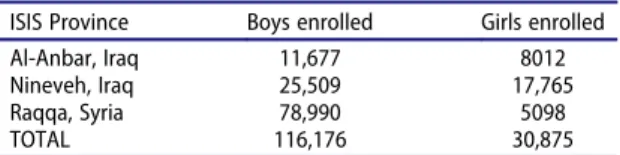
2018). As shown inTable 1, girls are much less enrolled in school.
Syria and Iraq saw a spike in violence towards children and teens with the rise of Islamic State (ISIS), which took root in large swaths of both countries between 2014 and 2017. In places where ISIS took hold, its domination was followed by an elaborate educational system. As such, the terrorist organization’s ‘state program’ is a unique case in recent history, and the mass of documentation we possess on the subject offers a shocking glimpse into the enterprise of indoctrination conducted under the guise of education reform (Horgan et al.,2017).
ISIS presents a matchless situation: Not only did it overturn the existing education system in Syria and Iraq, resulting in a prolonged hiatus in the schooling of children and teens, the organization went a step further by creating its own educational system in its stronghold regions, complete with
CONTACTOlivier Arvisais [email protected] Research School of Biology, Didactics Department, Université du Québec à Montréal, P.O. Box 8888, Downtown Branch Montreal (Quebec), H3C 3P8, Canada.
https://doi.org/10.1080/00220272.2020.1759694
its own curriculum, schools, teachers, and textbooks, thereby forming a sort of proto-state that replaced the Syrian and Iraqi states (Guidère,2017).
This study is part of the literature on political transitions and their effects on educational systems, which has been developing since the 1990s (Bray,1997; Pape,1998). The curriculum as the core of an education system is a political object under tension (Arvisais & Charland,2015). Thus, this study proposes to understand the links between the political setting and the educational system, through the particular case of the ISIS in Iraq. This political transition unfolded with violence is for sure a unique case. Political transitions take various forms according to the place and time they occur. As a result of those transitions, education also varies according to each specific context. As mention by De Santisteban (2002, p. 146):‘Because of this, it is very difficult to find useful commonalities, let alone to try any comparisons’. Nevertheless, even if comparisons are barely not possible, it is still necessary to produce knowledge in particular cases to enrich the curriculum study literature.
To understand these unprecedented circumstances we mustfirst retrace ISIS’s journey that led it to take root in Syria and Iraq. Next, we will look at the steps taken by ISIS to institute its education system and replace the existing system. Finally, we will discuss its curriculum, around which the group’s political agenda quickly became centred. In doing so, we hope to shine light on the exceptional context in which the textbooks were written and the impact they had on children’s education.1Finally, it is important to mention that this article only addresses the process of setting up the education system and the context of preparation of the curriculum. For an in-depth analysis of the content of textbooks, a series of articles on different disciplinary didactics is to be published and an article on the integration of religious elements in textbooks for secular disciplines has been published (Arvisais & Guidère,2020).
Context: how ISIS took root in Iraq and Syria
ISIS was born during the Iraqi civil war that began under the American occupation between 2003 and 2011. By 2004, in Sunni-majority regions of Iraq, a decentralized terrorist group led by
Table 1.Number of enrolled students.
ISIS Province Boys enrolled Girls enrolled
Al-Anbar, Iraq 11,677 8012
Nineveh, Iraq 25,509 17,765
Raqqa, Syria 78,990 5098
TOTAL 116,176 30,875
Table 2.Fundamental and additional subjects.
‘Fundamental’ Subjects ‘Additional’ Subjects Doctrine (starting in year 1)
Qur’anic Studies (year 1) Calligraphy (year 1) Physical Education (year 1) Prophetic Traditions (year 2) Life of the Prophet (year 2) Islamic Education (year 2) Arabic (year 3) Science (year 1) Mathematics (year 1) History (year 1) Geography (year 1) Computers (year 4) English (year 4) Physics (year 5) Chemistry (year 6)
Table 3.Language and Islam in the curriculum.
Year 1 of primary school Calligraphy + Doctrine and Qur’anic Studies Year 2 Reading + Tradition and Islamic Education Year 3 Writing + Tradition and Islamic Education
Jordanian Abu Musab al-Zarqawi had begun to take shape. It was called Jama’at al-Tawhid wal-Jihad [Oneness and wal-Jihad], though it quickly came to be known as Al-Qaeda in Iraq. The organization’s power peaked between 2004 and 2006 and became the central element in the ‘jihadist resistance’ against American occupation and the new Shia government installed by the Americans in Iraq (Guidère, 2017).
When the group’s chief, Zarqawi, died in June 2006 during a raid by the United States, jihadist leaders decided to join forces under a single name and chose to call their new group Islamic State in Iraq (ISI). They elected an Iraqi known as Abu Omar al-Baghdadi, who would be killed four years later, in 2010, just before American troops left Iraq. He was succeeded by another Iraqi, Abu Bakr al-Baghdadi, who soon bestowed upon the group an entirely different mission.
Between 2007 and 2011, the organization conducted low-level guerrilla actions and steadily lost ground in the face of counterinsurgencies by the American military. But the withdrawal of the Americans at the end of 2011 and the near-simultaneous start of the civil war in neighbouring Syria gave ISI a second wind and new prospects for growth, as early on, many of its members joined the armed opposition to the Syrian regime and fought against loyalist troops.
Atfirst, ISI combatants were overshadowed by the number of combatants from the insurgency’s primary group, the Free Syrian Army (FSA). But ISI quickly made a name for itself thanks to its experiencefighting Americans in Iraq, distinguishing itself by its exceptional military actions and soon gaining the upper hand over the other factions.
By 2013, the FSA had been subsumed, and most combatant forces were on the side of the jihadists. But two groups fought for the favour of jihadist combatants: al-Nusra Front, led by Syrian Abu Mohammad al-Julani, and Islamic State, headed by Iraqi Abu Bakr al-Baghdadi. Both leaders were staunch jihadists and had known each other for a long time, but al-Julani was an Islamic nationalist who fought to keep Syria’s borders as they were, while al-Baghdadi wanted to redraw borders to create a transnational entity uniting Sunni peoples in the region (Guidère,2017).
In 2013, al-Baghdadi suggested uniting the jihadist forces in Syria and Iraq under his authority and announced the creation of the Islamic State in Iraq and Syria (Daesh in Arabic, EIIL in French, ISIS in English). But the leader of al-Nusra Front rejected the proposition and hurriedly swore allegiance to the head of al-Qaeda, Ayman al-Zawahiri, who made al-Nusra Front an official branch of the al-Qaeda group in Syria, calling it al-Qaeda in Syria.
This announcement triggered infighting that left hundreds dead among jihadists who excommu-nicated each other, but confirmed the leadership of al-Baghdadi, who made the city of Raqqa in Syria his capital. Backed by foreign combatants whoflocked to support him, al-Baghdadi sent his troops to conquer Sunni-majority territories in central and northern Iraq. He was assisted by a group of opportunistic former Baathist officers from Saddam Hussein’s army who had been edged out by the Shia-dominated Iraqi government (Guidère,2017).
On 29 June 2014, after the capture of Mosul, the country’s second city, al-Baghdadi announced the establishment of a caliphate and abolished the existing borders between Syria and Iraq. At the time, his group controlled an area the size of Great Britain (300,000 km2) containing a population of over 10 million people. From then on, ISIS functioned as an ‘authoritarian regime’ and created a number of‘ministries’, one of the first of which was the ministry of education (Winter,2015).
As part of its plan to form a separate state, ISIS immediately focused on‘teaching and education’ and quickly founded an‘alternative system’ in the cities and territories it controlled, supplanting the pre-ISIS education system.
Methodology
This article presents a case study whose purpose is to produce a description and sophisticated interpretations of the way ISIS established its education system. We place importance on ‘thick descriptions’ of important elements of the establishment process in Iraq and Syria (Stake,1995). This case study attempts to provide a holistic explanation of the dynamic of a particular social unit (ISIS’s
education system) during a particular time period (2014 to 2017) (Stoecker,1991). The objective is to form an idiosyncratic theory of the phenomenon and its specific processes (Gagnon, 2005). Consequently, this case study is also strongly influenced by Strauss’s grounded theory approach (Strauss & Corbin,1997). The goal of this influence is also to help form an independent theory to increase the potential for humanitarian workers to reuse information resulting from this study, an important consideration in ourfield of research (Nilsson et al.,2011).
First, to achieve the goal of this research, interviews were conducted. The discussion took place in standard Arabic and sometimes in Iraqi Arabic in two broad phases. The first phase occurred in December 2015, and the second in March 2017. In the first phase, unstructured, ethnographic conversational interviews were conducted with Iraqi university and secondary school students and teachers (n = 7) (Coulon,1987; Guillemette & Luckerhoff,2012; Laperrière,2016). The interviews were held over the phone and via encrypted messaging services. No audio recordings were made, but ethnographic notetaking techniques were employed (Beaud, 1996). Ethnographic notetaking was a two-step process. First, the researcher halted the interview and recorded what had just been said (Doray,1997). Then, the description consisted of‘producing a relatively coherent representation of the participant’s reality’ (Traimond, 1999). According to Doquet (2009), that is when ‘the researcher is distanced from dialogs and observations and encounters deep descriptions’. When recorded in the midst of and not at a distance from the conversations, the notes allow a subject to be analysed in its natural environment (Doquet,2009). The Ethnographic notes were coded directly in Arabic. These preliminary interviews were necessary to be able to design a framework for semi-structured interviews. The decision to combine unstructured conversational interviews with individual semi-structured inter-views turned out to be a wise one. It helped make up for the lack of scientific literature and freed us from interpretations given in grey and journalist literature, as well as allowed us to crosscheck data obtained from participants. This sequential approachfits the exploratory nature of the research and made allowances for the complexity of the study’s focus.
In the second phase, using the framework we created after conducting the unstructured conversational interviews, we held semi-structured interviews also in standard and Iraqi Arabic, but this time in person with Syrian refugee students and teachers and asylum-seekers (n = 7). Semi-directed interviews are ‘a verbal interaction between people engaging voluntarily in the same relationship in order to share knowledge and help each other understand a subject of interest to the persons present’ (Savoie-Zajc, 2009). In addition, according to Boutin (1997), semi-structured interviews are recognized by methodologists as being particularly useful in exploring newfields of study. In both cases, the individual interviews lasted anywhere from 30 to 120 minutes. The verbatims were coded directly in Arabic. In the interviews, participants were asked to talk about education under ISIS in general (education, teaching, schools, universities, teachers, students, curriculum, etc.). More precisely, educational issues were dis-cussed along the following general interview outline:
(1) Situation of education and teaching in the country in general (Iraq);
(2) Situation of education and teaching in the provinces under the control of EI (Mosul and Kirkuk);
(3) Situation of primary schools (past and present situation, changes?); (4) Situation of secondary schools (past and present situation, changes?); (5) Status of universities (past and present situation, changes?);
(6) Teachers’ situation (past and present situation, changes?); (7) Students’ situation (past and present situation, changes?); (8) Curriculum situation (past and present situation, changes?); (9) Textbook situation (past and present situation, changes?);
Finally, again for the purposes of this research, we analysed a corpus of primary sources. Those sources are written documents and videos taken from the internet and collected in thefield. Most of the documents were official directives from ISIS’s Ministry of Education. Please find the complete list of these documents in Appendix 1. All of the documents were analysed in their original Arabic version by the researchers. Furthermore, all of the primary sources were authenticated prior to use using a standardized verifiability three-step protocol:
(1) External material authentication: verifying the source of the document (direct or indirect source, known or unknown, ID certificate); verifying the integrity of the document (whether the content has been modified, whether the modifications were authorized, whether the document was digitally altered); verifying whether the document was created digitally.
(2) Internal content authentication: verifying the author’s identity and signature (at the top and bottom of the document); verifying the date (whether it is written on the document); examining the chronological order of elements mentioned in the document (facts, names, places); examining cohesion (relationship between the document’s different segments and portions); examining the document’s coherence (contradictions between places, dates, and entities mentioned); examining the document’s consistency (comparing its form and function with previous documents); examining usage frequency (studying language patterns and typical lexemes).
(3) Authentication by crosschecking: verifying whether the documents are the same at other institutions that oversee this type of information or that monitor violent extremist groups, such as IntelCenter (https://intelcenter.com/aboutus.html) and SITE Intelligence Group (https://ent.siteintelgroup.com).
If the three conditions are met, and ISIS does not deny it is the source of a document released in its name, then the document is considered authentic and archived in the Radicalization Watch Project database for research and education.2This methodology for verification has been used since 2014 to authenticate documents (Guidère,2014). Once the corpus was authenticated, we analysed the content of the documents. We chose to employ a content analysis method to reveal the most appropriate units of meaning (Gauthier & Bourgeois, 2016). We used Berelson’s definition (Berelson, 1971), which says that ‘Content analysis is a research technique for the objective, systematic, and quantitative description of the manifest content of communication’. We worked to ‘detect and quantify ideas present in the corpus, which is typically formless’ (Gauthier & Bourgeois,2016).
Limitations of the study
Firstly, the most important limitation appears to be that of the generalization of the results. Indeed, this study is specific to the unique case of the implementation of the ISIS curriculum and does not allow for a generalization to the wider Islamic education movements. Consequently, it was perilous to forge links or to make a comparative analysis with other Islamist education programmes implemented elsewhere or in other historical periods. Consequently, the interpretations formulated are particularistic (Merriam, 1988). It concerns only the object under study, as well as each of the phenomena studied and their specific processes. Second, although means have been taken to ensure the validity of this qualitative research, the scientific criteria of a case study such as this one are mainly related to the level of relevance, workability, verifiability and falsifiability of the knowledge produced (Bryant & Charmaz, 2010; Merriam,1988).
Overview of study results
Establishment of ISIS’s education system
The documents available to us and eyewitness accounts of events in Iraq and Syria3allowed us to retrace the broad strokes by which ISIS established its education system and wrote the textbooks used in Iraqi and Syrian schools in territories under its control.
We began with the capture of Mosul in June 2014. Prior to then, though ISIS controlled the city of Raqqa, considered its capital in Syria, it had not yet instated an‘education system’ or any sort of real ‘education policy’. It wasn’t until the ‘caliphate was announced’ on 29 June 2014 that the system began to be methodically instated in all territories under ISIS’s control, affecting about one-third of the population of Iraq and Syria (Stern & Berger,2015).
Thefirst decisions began coming down in July 2014, the first of which formed the Ministry of Education and Teaching (Diwan al-Tarbiyya wa al-Ta`lim) and appointed Dhu al-Qarnayn as minister.4Dhu al-Qarnayn is the nom de guerre of Reda Seyam,5an Egyptian-born German citizen who would be the primary decision-maker in matters of teaching and ISIS’s education system between 2014 and 2017.
In those 3 years, the cities of Mosul and Raqqa were the only ones that remained fully under the control of ISIS. There, the education system was developed continuously and methodically, with the result that the two cities became a laboratory where ISIS could experiment. They are now a source of unprecedented testimony and extraordinary documentation for the study of how ISIS operated during that period.
It should be noted that in 2014, the state of education in the regions was poor. Both the Syrian and Iraqi school systems were nearly paralysed by incessant attacks by armed groups and by retaliatory bombings of schools and educational institutions used by ISIS as bases or shelters. Infrastructure suffered greatly during this period of fighting between jihadist and loyalist forces (Robinson et al.,2017).
In addition, the education system that existed before the arrival of ISIS experienced a lack of specialized faculty due to the departure of a great many veteran instructors, forced into exile as refugees or immigrants to neighbouring countries, then on to Europe and other Western countries (Ahmad,2018).
Finally, the decline in safety and the destruction of utilities infrastructure (water, electricity, gas) made it difficult to operate schools and educational institutions, as did the lack of resources and teaching materials, which was acute at the time (UNICEF,2015).
By early summer 2014, schools were deserted—first, because ISIS closed a number of schools when it took control of the cities; second, because it forced many young men who continued to attend the rare school still open to enlist; and finally, because ISIS did not yet possess total control over all districts and had not yet formed the bureaucracy to manage them, as it would later (Donner,2017). In the weeks that followed the takeover of Mosul, ISIS took specific actions targeting educational institutions. It began by turning some schools into barracks or places for military assemblies. It expropriated equipment and resources from other schools for its own use. Last but not least, it closed schools whose names or activities were perceived as a violation of Islamic rules, for example, schools named after Syrian or Iraqi politicians. One school was converted into a school for imams and preachers.
According to several witnesses, by the time ISIS hadfinished in late August 2014, there were only about 20 schools still open in Mosul in Iraq, and only a dozen in Raqqa in Syria.
In early September 2014—on September 10, to be exact—ISIS published a ‘ministerial decision’ (ta’mim) that passed all students for the current school year, except students in their sixth year of primary school, who were forced to repeat a year. This decision was made to reassure parents concerned about their children’s future under the new ISIS administration and to temporarily freeze the situation by preventing sixth-year students from entering secondary school before ISIS had finished its teaching ‘reform’.
ISIS’s teaching ‘reform’
On 24 November 2014, ISIS published a document titled‘Teaching Policy in the Islamic Caliphate’. The document contained a number of major decisions concerning the former Syrian and Iraqi education systems:
(1) Adopt the Muslim Hijri calendar in all grades and at all ages, as has already been done in official documents of the Caliphate.
(2) Schooling begins at age six. Primary school lasts 5 years, secondary school 2 years and high school 2 years. Studentsfinish their schooling at age 15.
(3) The academic year lasts 33 weeks and is divided into two semesters. Thefirst semester is 18 weeks long and the second is 15 weeks.
(4) The curriculum is also divided into two semesters, meaning lessons are spread across two semesters.
(5) The vacation days and holidays are: the Friday of each week, the last 10 days of the month of Ramadan, and the two Eid festivals.
(6) Classes begin early in the morning, at precisely eight o’clock.
(7) There are onlyfive class periods per day. General classes are 45 minutes long, and profes-sional classes are 50 minutes. There is a five-minute break between classes and a 15-min recess after the third period.
(8) Computer literacy will be taught as a mandatory science class starting in thefirst year of secondary school (year 6).
(9) English will be taught as a mandatory subject starting in the fourth year of primary school (year 4).
(10) There are three cumulative exams per month in each semester.
(11) The monthly exams account for 60% of thefinal grade, and the final exam (at the end of the semester) accounts for 40%. To pass, students must earn at least the class grade across both semesters divided by two.
(12) Thefinal exam, which is held at the end of each semester, lasts 2 weeks.
(13) Students are held back if they fail to earn 50% of the overall grade across both semesters. (14) School vacation between semesters lasts 2 weeks.
(15) Students who fail three subjects or fewer may take a makeup exam during summer vaca-tion.” (Signature of the Minister)
These directives reorganized the school system, but remained ineffective as long as there were no new teaching materials. In its official document dated 24 November 2014, entitled: ‘Education Policy in the Islamic Caliphate State’, the organization stated that it did not intend to base itself on any model other than the‘voice of the Salafs’ (the first Muslims) and that it intended to make a blank slate of the past because, it believed, all existing educational systems were‘corrupted by Western influence’. That being said, some teachers’ statements reported that foreign teachers who sym-pathized with IS used one or two Saudi textbooks (religious textbooks), but these textbooks would soon be banned by the organization, as it developed its own Islamic textbooks. Indeed, once ISIS consolidated its control over the cities, it required parents to send their children to newly reopened schools and established a specific process for writing new textbooks.
After regulating primary and secondary schools, ISIS published a decision on 18 October 2014 aimed at higher education. In the decision,‘Minister Dhu al-Qarnayn’ eliminated numerous colleges and departments, including colleges of law, political science colleges, fine arts colleges, sports education colleges, philosophy departments, and tourism and hotel management departments.
The decision took effect immediately (in October 2014) at universities run by ISIS: the Universities of Mosul, al-Anbar, al-Furat, and Raqqa. At these universities, the main decision affecting the
curriculum reduced the length of schooling, from 4 years to two for master’s degrees in most life science and social science colleges.
The ta’mim also changed the structure of medical schools, removing general medicine colleges, dental schools, surgical schools, etc. from the purview of the Ministry of Teaching and placing them under the aegis of the Ministry of Health (Diwan al-Sihha) newly created by ISIS.
The duration of medical school was reduced from 6 years to four for doctors, and from 2 years to one for other medical staff (nurses, nursing assistants, orderlies, etc.). New directives reoriented the curriculum essentially towards wartime medick duties (treating injured ISIS members, emergency operations, medical support for troops, etc.).
Finally, some (religious and secular) private universities were forced to close and relocate to the Kurdish part of the country, in Kirkuk. This happened to the University of Al-Hadbâ’ and the University of al-Nour, which were based in Mosul and forced to reopen in Kirkuk.
In response to these decisions by ISIS, the Iraqi Ministry of Higher Education and Scientific Research published a decision cancelling exams that were to be held in regions under ISIS’s control, deeming education taught in the regions to be null and void, and calling upon students to continue their education in other‘free’ Iraqi cities.6
Despite the crackdown on ISIS, many students fleeing the regions of Mosul, al-Anbar, and Salaheddine (controlled by ISIS) were admitted to Iraqi universities that remained outside of ISIS’s reach. However, this was not the case in Syria, where Bashar al-Assad’s regime gave no instruction to accept studentsfleeing ISIS-controlled regions. Those students were forced to leave the country and join refugee camps in neighbouring countries, in particular in Lebanon, Jordan, and Turkey, as well as in Europe and elsewhere in the world. At the height of the crisis, it is estimated that 45% of people left regions controlled by ISIS.7
In response, ISIS issued legal opinions (fatwas) declaring infidel the government education dispensed by the Iraqi and Syrian regimes in schools and universities. Students and teachers who took part in the government’s education system or who refused to participate in the new system installed by ISIS risked severe punishment, ranging from publicflogging to partial or total expropria-tion of property to the death penalty.
Purging existing textbooks
After he was appointed‘Minister of Teaching’, in August 2014, Dhu al-Qarnayn formed a ‘Curriculum Office’ (Mudiriyyat al-Manahij) officially tasked with ‘reforming school curricula and textbooks’. The new office reported to him and operated under his direct supervision.
Dhu al-Qarnayn outlined his policy in a four-page framework document, sent to all the satellite offices of his ‘ministry’ in Syria and Iraq. The first page of the document listed the general principles guiding his education reform:‘Radical changes must be made to the education system, as well as to the curriculum. We must absolutely lighten the curriculum in general and reduce the amount of time spent teaching, in view of students’ ability to absorb learning’ (p. 1).
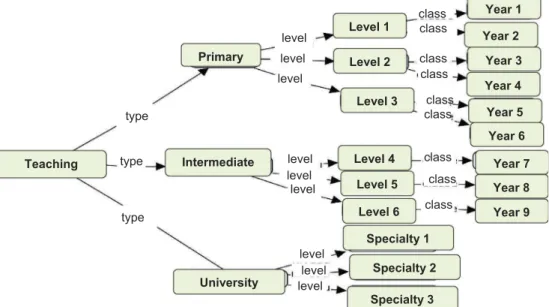
The document also contained a diagram (See Figure 1 below) of the new teaching structure favoured by ISIS (p. 2):
This three-cycle system is not exactly revolutionary in comparison to the previous education structure. In Iraq, the primary cycle lasted 5 years (ages 6 to 11), the elementary cycle 2 years (ages 12 to 14), and the secondary cycle 3 years (ages 15 to 18). Thus, ISIS merely shortened schooling by 2 years, eliminating 1 year from each cycle.
However, ISIS maintained the division of the school year into two semesters, with two-weekfinal exams at the end of each semester and assessments in years 3 and 5 of the primary cycle and in year 2 of the elementary cycle to mark the advancement from one level of study to the next. ISIS also retained the two-month summer vacation, though it introduced new holidays (the last 10 days of Ramadan).
The reduction in the number of years of schooling (from 12 to 9) called into question the amount of education students would receive, a concern that the minister addressed directly in his framework
document:‘In regards to the amount of education received by students, it must be conceded that, given the difficult conditions in which they live, we should not expect them to achieve the high standards established for them; instead, we must lighten the curriculum to match students’ actual abilities’ (p. 3).
To comply with the principles stated in the framework document, the Curriculum Office was forced to publish a decision eliminating certain subjects and providing specific directives on how to navigate the‘transition phase’. The full text of the decision, published on 2 August 2014, reads as follows:
“To all educational and academic institutions:
(1) The following subjects are to be permanently removed from existing school curriculum: Art and music, civics, art and sculpting, social studies and history, sports, philosophy, sociology, psychology, Islam, and Christianity.
(2) The term‘Syrian Arab Republic’ must be removed everywhere where it appears and replaced with‘Islamic State’.
(3) Remove the term ‘Ministry of Education’ and replace it with ‘Ministry of Education and Teaching of Islamic State’.
(4) Any images that do not comply with Islamic law must be blurred. (5) The Syrian Arab anthem must be removed from wherever it appears.
(6) Do not teach the concepts of patriotism or nationalism. Instead, teach ideas of belonging to Islam and to the Muslim community, of repudiation of polytheism and its followers, and that the Muslim country is any land in which Islamic law is applied.
(7) Teachers must compensate for gaps in Arabic grammar that will result from the removal of examples that contradict Sharia and replace them with examples in keeping with Islamic State policy.
(8) Wherever they appear, the words ‘homeland, their homeland, my homeland, Syria’ must be replaced by‘Islamic State, their Islamic State, the Country of Muslims, the Province of Sham’, etc. (9) Any example that refers to usury, interest rates, democracy or elections must be removed
from mathematics classes.
Teaching Primary Intermediate University Specialty 1 Specialty 2 Specialty 3 Level 1 Level 2 Level 3 Year 1 Year 2 Year 3 Year 4 Year 5 Year 6 Year 7 Year 8 Year 9 Level 4 Level 5 Level 6 level level level level level level level level level class class class class class class class class class type type type
(10) Anything that has to do with Darwin’s theory, creation by nature or creation from nothing-ness must be removed from science classes; all creation must be attributed to God Almighty. (11) When teaching physics and chemistry, it must be constantly repeated that all laws of physics
and chemistry are laws of divine origin inspired by God in his creation.
(12) These directives are mandatory. Failure to observe them is punishable by law.” (Signature of the Minister)
As we can see, the goal of the directives was to alter existing lesson plans manually and to correct the actions of existing approved teachers to navigate the transition phase while waiting for new text-books to be published.
But the framework letter from the‘ministry’ set specific objectives for each level of study. ‘In primary school, each student must learn to become a keeper of morals at home,8learning to criticize acts considered heretical [. . .] Intermediary school will become a very important time. We require more religious encounters and Islamic competitions in schools instead of in public places. In this phase, we must also intensify jihadist teachings so that students learn individual weapons handling and war tactics [. . .] As for higher education, we must open specialized institutions that meet our needs in terms of medicine and accounting’ (p. 3–4).
To reach these objectives and make the‘transition phase’ a success, ISIS required all approved teachers working in educational institutions under its control to undergo ‘religious training’ to correct their beliefs and instil in them the doctrine promoted by ISIS, so that their lessons observed the group’s new education policies. Training spanned 2 months and was mandatory for any approved teacher who wished to continue working in ISIS’s schools.
Purging approved teachers
On 5 August 2014, the Ministry of Education and Teaching of Islamic State published a decision announcing that a‘religious training course’ (dawra shar`iyya) would be held for all school directors and, later, for all teachers who worked in schools before ISIS arrived.
The course was mandatory and required for any existing education staff to continue working. Failure to take the training course was ‘punishable by law’ (fines, expropriation, flogging, even execution).
Training courses were held under threats by ISIS agents, called hisba (religious police), across cities occupied by ISIS. The Raqqa course began on 30 August 2014 and was held at the College of Education for men and at the former College of Arts for women.
Through the training courses, ISIS hoped to quickly ‘reform’ approved education staff and, through them, apply its new programs and policies. But the course turned out to be insufficient. At inspection visits conducted early on by‘Minister Dhu al-Qarnayn’ in person, it was revealed that few teachers had followed the directives published, and some were even hostile towards them. In particular, they refused to correct existing textbooks and to remove the concepts of ‘nation’ and ‘homeland’ and replace them with religious concepts promoted by ISIS (umma, jihad, alle-giance, etc.).
In a video by ISIS called Teaching in the Shadow of the Caliphate, Dhu al-Qarnayn explained‘As you know, from the beginning we have tried to use this [transition] phase to purge curricula and textbooks by leaving schools open. However, many teachers refused [our directives] and continued to teach infidel material. Thus, the best solution was to close the schools’.
ISIS decided to suspend classes and close schools only 2 months after the start of the school year. It conceded its failure by publishing a new decision on 21 December 2014. The decision suspended all approved teachers from their duties ‘until the repentance procedure is complete’ (p. 1).
A list of teachers and selection centres was drawn up, and the Committee for the Examination of Repentance for the Provinces of Sham (Syria) got to work on 20 February 2015. A decision by ISIS
published 1 week earlier, on 14 February 2015, included a list of places (mostly mosques) and convenient methods for the examination of conscience.
The examination date was set for 23 February 2015, and thefirst cities targeted—Raqqa, Deir ez-Zor, al-Shaddadah, al-Hawl, al-Bab, Jarabulus, and Manbij—were Syrian, due to strong resistance by approved teachers in those places. In all of them, the repentance hearing was public. It was held just after the main Friday prayer and consisted of public recognition of one’s ‘apostasy’ and a reading of a text in Arabic under the watchful eyes of members of the Examination Committee.
The repentance text to be read aloud in all territories was a solemn one written in classical Arabic: ‘I, (name), repent to God Almighty for the apostasy into which I have fallen. I hereby repudiate my affiliation with the previous education system and with all infidel activities in which I took part, in particular Baathist thought and allegiance to polytheist tyrants. Of my own accord, I submit to the judgement of God Almighty, and I solemnly swear never to disobey in goodness; not to fight Muslims nor to help anyone fight them, by word or by action; to fully observe what God has forbidden; and not to violate his dictates. If ever I renounce or change my pledge, I accept the judgment of God Almighty upon myself’.
After the examination of conscience, the teacher was to appear at the nearest tribunal to sign a certificate of repentance (wathiqat istitaba), at the top of which was their photo, along with their first and last name, date and place of birth, and the name of a guarantor, someone who accompanied the penitent teacher as a witness and attested to their identity and sincerity.9
In practice, repentant teachers agreed not to communicate with their prior (Syrian or Iraqi) administration and not to accept or receive wages from it. This included retirees and former civil servants who had retired from teaching.10
At the end of ISIS’s video Teaching in the Shadow of the Caliphate, the spokesperson for minister Dhu al-Qarnayn announced,‘Once we have completed the repentance process for former teachers, we will open the doors to hiring anyone who wishes to work in Islamic State schools’.
This meant that even after repenting, existing teachers would not be kept on or reinstated. The ‘ISIS Committee for Legal Opinions and Studies’ immediately published a booklet titled Memorandum Explaining the Ruling Deeming the Syrian Government’s Education System Infidel. In the booklet, which was used as the basis for work by the Repentance Examination Committee, ISIS theologians explained in detail their arguments on the question of what the ruling should be for education staff who worked in the previous regime’s schools.
To answer the question, they described several cases offigures whose rulings varied depending on the quality of the person and their position in the Syrian or Iraqi education system. They created the categories of national education inspector, school director, and teaching union member per-forming union-related tasks.
All categories received the ruling of infidel, which was justified as follows: ‘All are infidels because they promoted nationalism, called upon others to join the ranks of the Baath party, and submitted to the party’s leaders. They promoted socialism and wished to cultivate democracy in the hearts of students’ (Livret, p. 7).
The ruling for approved teachers was more nuanced and less extreme. According to the Memorandum, they were to receive the benefit of the doubt because they had been ‘forced by the regime’. But to demonstrate their eagerness and their observance of the principles of the new regime (the Caliphate) installed by Islamic State, repentant teachers had to comply with the following rules to‘visibly’ attest to the sincerity of their promise.
First, male and female students and teachers were to be separated. In practice, this translated into separate buildings for boys and girls, or alternating class days (one day for boys, and one day for girls11). Second, they were required to follow the‘Islamic dress code’, both at school and outside school. Women were required to wear a full black veil, and men were assigned a two-piece outfit called a shalwar kameez, a long, cinched tunic over baggy pants.12
At the same time, all educational content created or published by the Syrian or Iraqi government was deemed‘infidel material’ (maddat kufr). Hence, at the end of his interview with ISIS’s media,
al-Buraq, ISIS minister Dhu al-Qarnayn announced,‘Thanks to God, we are currently preparing a new curriculum, and we are progressing well. We are currentlyfinalizing the textbooks. We have more than 400 brothers working on writing textbooks specific to ISIS’.
This announcement provides an idea of the amount of manpower employed by ISIS (400 people) to write new textbooks in record time (under a year). The textbook writers were Iraqis who were regular teachers in public schools but who had to undergo training sessions to comply with the new education policy.
Writing new textbooks
In September 2014, the Ministry of Education and Teaching of ISIS held an open meeting for teachers and instructors who sympathized with the group to form a new committee for the development of new curricula and textbooks. The committee was to be entirely dedicated to its mission and paid only for that task. Its official title was the Committee for the Development of Curricula and Textbooks. Initially, the committee consisted of 50 members grouped by subject, with four tofive members per subject. But as the committee fell behind, it was forced to add members, ballooning to nearly 400 in total in the final months and included teacher-authors, inspector-editors, secretaries, research assistants, modellers, graphic artists, computer specialists, and more.
Some members were permitted to serve on two committees, but this was rare. Instances included subjects like Arabic, calligraphy, the Qur’an and Islamic education, history and geography, and physics and chemistry.
Some members were retired teachers, while others were still in the workforce. Some were volunteers, while others were forced to serve on the committee under threat of punishment or under threats by the minister and his associates.
Each subject’s work group was chaired by a member of the ministry, who had the last word on the curriculum’s general direction and the content of the textbook for the subject under his supervision. The entire committee was placed under the direct authority of ISIS’s minister, Dhu al-Qarnayn. He oversaw the committee’s work directly, visiting regularly, twice a week, and providing specific instructions for each curriculum’s orientation and textbook content.
Multiple accounts by Iraqi teachers say that once the committee was formed, it was decided that it would meet and work at the Central Library of the University of Mosul. The committee would meet there to develop curricula and write textbooks. The library’s employees were told to leave and prevented from returning to their workplace as long as the committee was at task.
In a video released by ISIS in honour of thefirst anniversary of the capture of Mosul (June 2015), in which the group celebrated the advancements it had made in one year, there was a clip dedicated to the development of new school curricula. In the clip, the Central Library of the University of Mosul wasfilmed first from the outside, then from the inside, where the doors of reading rooms can be seen bearing signs with names such as‘Geography Committee’ and ‘Mathematics Committee’.
The committees worked behind closed doors, but were inspected regularly by high-ranking ISIS supervisors, who tracked their progress closely. They worked this way for more than 9 months under constant pressure from the minister.
According to some accounts from the University of Mosul, the committee used documents from the Central Library to develop the new curricula and textbooks. But there were two very clear official directives to guide the committee’s work: to ‘simplify’ curricula and textbooks as much as possible, and to‘Islamicize’ the content by removing all traces of previous secular teachings. The committee was permitted to consult textbooks used previously but not to draw inspiration from them. In particular, committee members had to invent new examples and exercises compatible with the caliphate’s new policies and doctrine.
Despite the committee’s efforts, it took nearly a year to complete the new curricula and textbooks and unveil them to the public. In July 2015, ISIS created PR buzz around its new curricula by leaking the new textbook covers. One of thefirst covers to make the rounds on social media was the Physical
Preparation (al-i`dad al-badani) textbook for year 1 of primary school. It depicted students in combat gear, prepared tofight in a circular arena under the black banner of Islamic State.
When school began in September 2015, ISIS had been unable to print all the textbooks needed for all schools. ISIS thus began distributing the textbooks on CD-ROM and told students to print their own version themselves. However, faced with backlash from parents and with grumbling over the poor quality of photocopies, ISIS was forced to create an official printer tasked with printing textbooks and other government documents: laws and regulations, birth certificates, registers of official family documents, passports, etc.
All discs (CD-ROMs) of textbooks published by ISIS contained two versions of the book: one for students, and one for teachers. The teacher’s version was called the Teacher’s Guide and included specific instructions on how to introduce the course, what content should be emphasized, relevant classroom activities, and additional reading to do to prepare the course in advance.
The student version of the textbook did not have the instructions but featured the same‘general introduction’ and the same ‘topic introduction’. The courses were structured in the same way. Only the references to additional reading were omitted, resulting in more white space on the page and between text.
The two versions, for students and for teachers, made it easy to circulate the textbooks on a large scale (in PDF format) and to send them well beyond the regions controlled by ISIS by posting them on the internet and social media.13
Not long after the textbooks were released on CD-ROM, in October 2015, ISIS published a report of the number of students that received electronic copies of the new books, providing exact data on the size of schools at the time14:
As we can see, there is a considerable discrepancy between the number of boys and girls enrolled in ISIS’s schools (one-fourth as many). This is explained in part by the fact that ISIS did not promote education for girls, but rather encouraged them to stay home. Furthermore, the‘minister’ Dhu al-Qarnayn encouraged girls to marry young (at menarche), and a number of reports from Mosul claimed that when visiting schools, he suggested that girls marry ISIS combatants, causing most parents to withdraw their daughters from school.
Added to that was the fact that teaching materials and textbooks clearly focused on ‘jihadist education’ of boys and contained few topics likely to be of interest to girls’ education. The separation of boys and girls in all grades served as a pretext for introducing lessons targeted to girls: home economics, sewing, cooking, motherhood, childcare, etc. In other words, in developing a chauvinistic, phallocratic vision glorifying violence in all its forms, girls’ education was devalued and diminished.
Content of ISIS textbooks
It is important to analyse and pay particular attention to the content of ISIS textbooks for two main reasons. First, because they were the only teaching materials used in class and therefore had a monopoly over learners’ minds. And second, because they contained elements of doctrine that extended far beyond a simple cultural impression and formed an important ideological component, for teachers forced to use the textbooks in class, as well as for students forced to learn the content or even memorize it in most subjects.
These two aspects (lesson content and ideological scope) are so intertwined in ISIS’s textbooks that it is difficult to address one without the other. However, it is possible to distinguish blocks of lessons based on the nature of the subjects referenced in the textbooks.
There is also a block of religious teachings considered ‘fundamental’ (asliyya) by ISIS, each receiving its own textbook. These include Doctrine, Qur’anic Studies, Prophetic Traditions, the Life of the Prophet, Calligraphy, the Arabic language (grammar and dictation), Islamic Education, and Physical Education.
There is also a block of lessons labelled‘supplementary’ (takmiliyya) in official documents by ISIS. These include textbooks for Science, Mathematics, Physics/Chemistry, History, Geography, Computers, and English (Table 2).
Even though the ‘additional’ subjects are supposedly ‘non-religious’, their textbooks contain a significant number of religious elements, such as Qur’anic verses, prophetic sayings and theo-logical references. As a result, the textbooks are difficult to analyse strictly in terms of individual subject—and that is before considering the religious lessons that are methodically and system-atically woven in, as evidenced by the instructions included in the teacher’s version of the textbook.
In some textbooks, such as history, there are two versions: one for the‘religious section’ and another for the ‘secular section’. Sometimes the same textbook is used for both sections, the difference being the amount of time spent on religious themes rather than the nature of the religious themes themselves. According to some accounts by teachers from Mosul, students in religious sections spent about half of their class time discussing religious aspects, while the other sections spent only about one-third of the total time on it.15
A detailed, multifaceted study is all the more important since we have observed cross-references and citations, similarities and differences between textbooks from a variety of subjects. There is also a certain progression in the topic introductions in the curriculum and, within a given subject, in the chronology and presentation of the content.
For example, the Arabic language, on which ISIS places special emphasis due to the intrinsic relationship between Arabic and religion in Islam,16is taught in phases in a way intended to portray the language as holy:
This intent to make the Arabic language holy can be seen in the classroom activities (e.g., praying in Arabic in class) and the course objectives. Each textbook contains specific introductions and objectives that demonstrate the‘educational intent’ of the authors (Table 3).
The general introduction that appears in all the textbooks expresses ISIS’s intentions clearly: ‘Islamic State is entering a new era, laying the foundation for a form of Islamic teaching based on the Qur’anic method and prophetic guidance, as well as on an understanding of the first Muslims and the Righteous Predecessors, following a clear vision that is neither Eastern nor Western, but prophetic and Qur’anic [. . .] Developing this curriculum is the first step in the journey and the keystone to building the Caliphate’ (p. 3).
In the history textbooks, the educational intent is expressed through general objectives:‘To purify history and eliminate the lies that have been inserted; to teach students the Tradition of the best of men [Muhammad] and encourage them to follow his example; to reinforce jihadist values in children in the community; to explain to students the concepts of allegiance and repudiation based on the well-guided Tradition of the Prophet and Caliphate’ (p. 5).
In geography textbooks, the introduction gives the teacher clear instructions:‘Any time the word “nature” or “natural” is mentioned, explain that the phenomenon in question is a creation of God Almighty, with no human intervention. This is to counter theories put forth by atheists such as communists’ (p. 5).
The same occurs in the science textbooks, where the general objectives reveal educational intentions heavily punctuated by religion: ‘To understand the power of God Almighty and his grandeur through the truths and concepts learned in the science curriculum in primary school [. . .] To teach students that God Almighty is the Creator who grants his creatures all sorts of gifts and blessings. It is He who created us, who gave us food and drink, and who made us Muslims’ (p. 5).
Not even the computer science textbooks (for classes on programming in the computer language Scratch) are spared. The general introduction emphasizes that the ultimate goal of the class is to train a new generation of combatants ‘who not only know how to use but to develop advanced technology for use in both peacetime and war’ (p. 3).
Finally, the same pattern is observed in objectives assigned to the teaching of physical education: ‘In this textbook, we present a program specifically designed to ensure physical fitness in all its forms,
for maximum physical performance and to fulfill what the Prophet said: “Strong believers are better and closer to God than weak believers, but both have their own merits”’ (p. 4).
Through all of this, we observe the consistent, pervasive presence of the Qur’an and the Prophetic Tradition, regardless of the subject or textbook. Using a system of cross-references and repeated citations, the textbooks are linked to each other through the same intertextual network, despite the disparate content and specific objectives.
The same teaching methodology can be seen in all of ISIS’s textbooks. It uses practical and deductive techniques that always start with general principles and end with specific, concrete cases. All lessons conclude with a series of exercises to ensure the content has been learned and a cumulative test to anchor it in students’ minds.
Memorization is repeatedly given as an instruction throughout the textbooks. This instruction not only applies to religious subjects, such as the Doctrine, the Qur’an, the Tradition or the Life of the Prophet. It is also recommended for so-called ‘secular’ subjects, including the natural sciences, mathematics, and the physical sciences. It is clear that the authors of the textbooks abhor critical thinking and value quantity of information over quality.
Conclusion
This study contributes to thefield of curriculum studies by highlighting the particularities according to which the ISIS curriculum was designed and implemented. This violent and rapid political transition will have generated an education system that will have lasted several years. Indeed, the last city to apply ISIS’s education system and to use its textbooks was Hajin, located on the east bank of the Euphrates (south of Deir ez-Zor, in eastern Syria). It was not until late October 2018 that the city was recaptured by Syrian Democratic Forces, with help from strikes by the international coalition, a year after the fall of ISIS in Iraq and the dismantling of ISIS’s education system. In the 4 years of its existence, ISIS acted as a proto-state and attempted to redefine education through the lens of a sectarian vision of Islam, a tactic that was visible in the group’s propaganda and textbooks. Out of the 800,000 youth that lived under occupation by ISIS (UNHCR, 2018), it is estimated that over 250,000 of them attended ISIS-run schools or were partially educated by the group, especially in the Iraqi provinces of Nineveh, Salaheddine, and al-Anbar, as well as in the Syrian regions of Raqqa, Aleppo, and Deir ez-Zor. We mustfirst comprehend the conditions under which these children were educated and the content of the lessons they were taught before we can determine their educa-tional needs and begin to repair the trauma caused by their education under Islamic State.
Notes
1. We possess the entire set of primary school textbooks used by ISIS in Syria and Iraq, in both paper and electronic (PDF) formats. The original paper versions were found on-site in Iraq, while the electronic versions were taken from the web. There are more than 30 textbooks in all, forming a singular corpus of study never seen before.
2. The Radicalization Watch Project (RWP) is a joint program by France, the United States, and Canada. It was founded in 2004 by the Laboratory for Analysis of Strategic Information and Technological Monitoring at the Saint-Cyr Coetquidan Schools Research Centre (CREC) under the leadership of professor Mathieu Guidère. The program tracks information in multiple languages from radical groups around the world.
3. We have stayed in touch with teacher colleagues who were there at the time, in particular in Mosul, ISIS’s Iraqi capital. We were able to gather detailed accounts from them of how ISIS’s education system came to be, as long as we agreed to keep them anonymous to protect their lives and the lives of their loved ones, whether they were refugees or still living in the country.
4. Dhu al-Qarnayn—literally ‘he of the two horns’ (Qarn)—is a figure mentioned in the Qur’an (18:83–98). He erected a protective wall to contain the invading peoples Gog and Magog. Some believe he was Alexander the Great (356–323 BCE), while others think he was Cyrus the Great (559–530 BCE), both founders of immense empires in the Middle East.
5. Reda Seyam was born in 1960 and fought in Bosnia in 1994 before moving to Saudi Arabia in 1998. Suspected of having helpedfinance the Bali attacks in 2002, he was arrested and imprisoned in Indonesia. It was there that he
adopted the pseudonym Dhu al-Qarnayn, which is pronounced Zulkarnaen or Zulkarnain in Indonesian and is a common family name in Indonesia. He returned to Germany in 2003, where he became an importantfigure in Salafism, and made a name for himself in 2009 when the German Ministry of the Interior brought a case against him for naming his son Jihad. In March 2013, he went off to fight in Syria. In July 2014, he was appointed Minister of Teaching and Education by ISIS leader al-Baghdadi. He moved to Mosul but travelled throughout the ‘caliphate’ territories and became known for his religious zeal and brutality. He was finally killed in December 2017, in the company of the University of Mosul’s president (appointed by ISIS) by a drone strike by the international coalition targeting his vehicle.
6. The Iraqi Ministry of Higher Learning also ceased paying over 200 teachers accused of‘collaborating with the enemy’.
7. In late 2014, UNICEF estimated at 5,000 the number of Iraqi schools destroyed by combat, closed or converted into shelters for refugees and displaced persons.
8. The term used in the framework document is `unsur hisba, which means member of the religious police.
9. It should be noted that the guarantor was legally responsible towards the tribunal if the penitentfled or lapsed.
10. To provide an idea of the scope of the events, in March 2015 alone, there were no fewer than 2,000 certificates of repentance signed in the small town of Tell Abyad in Syria.
11. ISIS experimented with alternating days in the early period after its capture of Mosul, in 2014, as a way to work around the lack of usable facilities. Later, in 2015 and 2016, ISIS designated separate buildings for each gender.
12. This outfit was inspired by the perahan tunban, a traditional outfit worn in Pakistan and Afghanistan and called the Kandahar outfit by ISIS. It became widespread, and was made mandatory for all male students at the start of the 2015–2016 school year, at the same time that the veil became required for all girls in primary school.
13. During our research into documents to verify and authenticate teaching materials found in thefield, we noted that the majority of the textbooks could still be viewed online and downloaded in their original format (PDF).
14. Of course, these numbers should be viewed with caution, but it seems that one-third of schools had reopened in 2015 and that in 2016, almost all schools were up and running again with ISIS’s new textbooks. We estimate that over 250,000 students passed through ISIS’s education system between 2014 and 2017.
15. To get a better grasp of the weight of the religious elements, a study should be conducted of the textbooks, and it should be quantitative, qualitative, and semiotic to encompass the entire spectrum of verbal and non-verbal, subject-specific, cultural, and ideological meanings conveyed by the linguistic and non-linguistic symbols.
16. To Muslims in general, and to ISIS in particular, Arabic is holy because Islam’s holy book, the Qur’an, was revealed in Arabic, and God was said to have spoken in Arabic to his prophet Muhammad through the angel Gabriel. For that reason, classical Arabic continues to be used both as a liturgical language and a language of communica-tion. In any case, believers believe that only the Arabic version of the Qur’an is valid; translations are permitted only to help readers grasp the meaning.
Disclosure statement
No potential conflict of interest was reported by the authors.
Notes on contributors
Dr. Olivier Arvisaisis a professor in the Department of Didactics of the Faculty of Education at UQAM and Scientific Director of the Canadian Observatory on Crises and Humanitarian Aid (OCCAH). His research is divided into two poles. Firstly, it focuses on the didactics of human and social sciences at primary and post-secondary levels. Secondly, he is also a specialist in education in emergencies situations. In this part, his research focuses on education initiatives in refugee camps, child protection through socio-emotional learning and education under armed groups or totalitarian proto-states.
Dr. Mathieu Guidèreis full Professor at the University of Paris 8, France, and Research Director at the "National Institute of Health and Medical Research" (INSERM, France). He is also Editor of the "Journal of Applied Research in Human and Social Sciences" (JARHSS) and Director of various scientific series (DeBoeck, Harmattan).
References
Ahmad, P. (2018). The Middle East refugee crisis. Syria and Iraq case. In E. Balica & V. Marinescu (Eds.), Migration and crime (pp. 15–43). Springer International Publishing. doi.10.1007/978-3-319-95813-2_2
Arvisais, O., & Charland, P. (2015). Enjeux éducationnels, curriculum et langue d’enseignement dans les camps de réfugiés: état des connaissances et perspectives de recherche. Canadian Journal for New Scholars in Education, 6, 2. https://journalhosting.ucalgary.ca/index.php/cjnse/article/view/30694
Arvisais, O., & Guidère, M. (2020). The integration of religious elements into ISIS textbooks. Religion & Education, 1–16.
https://doi.org/10.1080/15507394.2020.1728027
Beaud, S. (1996). L’usage de l’entretien en sciences sociales. plaidoyer pour l’«entretien ethnographique. Politix. Revue Des Sciences Sociales Du Politique, 9(35), 226–257. doi:10.3406/polix.1996.1966
Berelson, B. (1971). Content analysis in communication research. Hafner.
Boutin, G. (1997). L’entretien de recherche qualitatif. Presses de l’Université du Québec.
Bray, M. (1997). Education and colonial transition: The Hong Kong experience in comparative perspective. Comparative Education, 33(2), 157–170.https://doi.org/10.1080/03050069728505
Bryant, A., & Charmaz, K. (2010). The SAGE handbook of grounded theory. SAGE.
Charland, P., Arvisais, O., Cyr, S., & Gadais, T. (2017). Défis éducatifs des enfants migrants ou réfugiés. AFKAR/IDEES, 55, 30–32. https://cudc.uqam.ca/en/2018/11/10/defis-educatifs-des-enfants-migrants-ou-refugies-2/
Coulon, A. (1987). L’ethnomethodologie. Paris Presses universitaires de France.
de Santisteban, A. V. (2002). Palestinian education: A national curriculum against all odds. International Journal of Educational Development, 22(2), 145–154.https://doi.org/10.1016/S0738-0593(01)00009-8
Donner, F. M. (2017). The formation of the Islamic State. In Fred M. Donner, (ed.,), The articulation of early Islamic State structures (pp. 1–14). Routledge.
Doquet, A. (2009). Le terrain des notes.: enquête, notes de terrain et raisonnement de l’anthropologue. Langage et société, 127(1), 52.https://doi.org/10.3917/ls.127.0052
Doray, M.-F. (1997). Clifford James, Malaise dans la culture. L’ethnographie, la littérature et l’art au XXe siècle. Revue Française de Sociologie, 38(1) 188–190.https://doi.org/10.2307/3322393
Gagnon, Y.-C. (2005). L’étude de cas comme méthode de recherche: Guide de réalisation. Presses de l’Université du Québec.
Gauthier, B., & Bourgeois, I. (Eds.). (2016). Recherche sociale: de la problématique à la collecte des données (6e édition). Presses de l’Université du Québec. 670 pages.
Gauthier, B., & Bourgeois, I. (Eds.). (2016). Recherche sociale: de la problématique à la collecte des données (6th ed.). Presses de l’Université du Québec.
Guidère, M. (2014). The Timbuktu letters: New Insights about AQIM. Res Militaris, 25. https://hal.archives-ouvertes.fr/hal-01081769
Guidère, M. (2017). L’État islamique en 100 questions. Editions Tallandier, coll. Texto.
Guillemette, F., & Luckerhoff, J. (Eds.). (2012). Méthodologie de la théorisation enracinée. Presses de l’Université du Québec.
Iraq AnnualReport 2017 (p. 50) (2018). UNICEFhttps://www.unicef.org/about/annualreport/files/Iraq_2017_COAR.pdf
Horgan, J. G., Taylor, M., Bloom, M., & Winter, C. (2017). From cubs to lions: A six stage model of child socialization into the Islamic State. Studies in Conflict & Terrorism, 40(7), 645–664.https://doi.org/10.1080/1057610X.2016.1221252
Merriam, S. B. (1988). Case study research in education: A qualitative approach (1st ed.). Jossey-Bass.
Nilsson, S., Sjöberg, M., Kallenberg, K., & Larsson, G. (2011). Moral stress in international humanitarian aid and rescue operations: A grounded theory study. Ethics & Behavior, 21(1), 49–68.https://doi.org/10.1080/10508422.2011.537570
Pape, J. (1998). Changing education for majority rule in Zimbabwe and South Africa. Comparative Education Review, 42 (3), 253–266.https://doi.org/10.1086/447508
Robinson, E., Egel, D., Johnston, P. B., Mann, S., Rothenberg, A. D., & Stebbins, D. (2017). When the Islamic State comes to town. RAND Corporation.
Savoie-Zajc, L.2009. L’entrevue semi-dirigée. In Recherche sociale : de la problématique à la collecte des données, 5th. Presses de l’Université du Québec. 71–89.
Stake, R. E. (1995). The art of case study research. Sage Publications. Stern, J., & Berger, J. M. (2015). ISIS: The state of terror (Vol. 7). William Collins.
Stoecker, R. (1991). Evaluating and rethinking the case study. The Sociological Review, 39(1), 88–112.https://doi.org/10. 1111/j.1467-954X.1991.tb02970.x
Strauss, A. L., & Corbin, J. M. (Eds.). (1997). Grounded theory in practice. Sage Publications.
Traimond, B. (1999). Geertz, Clifford. -Ici et Là-Bas. L’anthropologue comme auteur. Cahiers d’Études Africaines, 154, 442–445. https://www.persee.fr/doc/cea_0008-0055_1999_num_39_154_1320_t1_0442_0000_3
UNHCR (2018). Rapport annuel, UNHCR, juin 2018.http://www.unhcr.org/fr/medias.html
UNICEF (2015). UNICEF Annual Report 2015 Iraq, Unicef Publications. Retrieved June, 2016, from.https://www.unicef.org/ about/annualreport/files/Iraq_2015_COAR.pdf
UNICEF (2018, June). Annual Report 2017, UNICEF Publications.https://www.unicef.fr/article/rapport-unicef-international -2017
Winter, C. (2015). The virtual‘caliphate’: Understanding Islamic State’s propaganda strategy (Vol. 25). Quilliam.https:// core.ac.uk/download/pdf/30671634.pdf
Appendix 1
List of All Documents and Directives Analysed in this Article:
(1) Official IS document dated 24 November 2014, entitled: ‘Education Policy in the Islamic Caliphate State’ (2) Directive of 18 October 2014, reorganizing higher education in social science and humanities in the territory under
IS control
(3) Directive of 20 October 2014, reorganizing higher education in medicine in the territory under IS control (4) Ministerial Decision (ta’mim) of 20 October 2014, removing medical schools from under the authority of the
‘Ministry of Education’ and placing them under IS’s newly created ‘Ministry of Health’ (Diwan al-Sihha)
(5) Iraqi Ministry of Higher Education and Scientific Research Ministerial Decision, dated 10 December 2014, cancelling exams in regions under IS control
(6) IS Ministerial Decision (ta’mim) dated 2 August 2014, creating a ‘Curriculum Directorate’ (Mudiriyyat al-manahij) in charge of‘textbook and curriculum reform’
(7) IS Ministerial Decision (ta’mim) of 2 August 2014, outlining arrangements for managing the ‘transition phase’ (8) IS Ministerial Decision (ta’mim) of 5 August 2014, announcing a ‘religious training course’ (dawra shar`iyya) to be
held for all education staff working in public schools prior to IS’s arrival
(9) IS Ministerial Decision (ta’mim) of 30 August 2014, establishing arrangements for the Raqqa religious training course
(10) IS Ministerial Decision (ta’mim) of 5 September 2014, announcing the formation of the ‘Textbook and Curriculum Development Commission’
(11) IS Ministerial Decision (ta’mim) of 21 December 2014, suspending all regular teachers from their duties ‘until the end of the repentance process’
(12) IS Ministerial Decision (ta’mim) of 20 February 2015, setting up the ‘Repentance Examination Commission for the Provinces of Sham (Syria)’
(13) IS Ministerial Decision (ta’mim) of 14 February 2015, establishing the list of sites and practical arrangements for the repentance examination
(14) IS Ministerial Decision (ta’mim) of 23 February 2015, setting the examination date in Syrian cities
(15) IS Ministerial Decision (ta’mim) of 12 July 2015, announcing the upcoming publication of the new curricula (16) Official announcement of 10 October 2015, giving the number of students who received soft copies of the new
educational materials
(17) ‘IS Legal Opinions and Studies Committee’ booklet entitled: ‘Letter Explaining the Nonbelief Judgment Issued Against the Syrian Government’s Education System’
(18) Disk (CD-ROM) containing the textbook version for teachers, entitled‘Teacher’s Guide’ (19) IS video entitled‘Education in the Shade of the Caliphate’