Representing Interval Orders by Weighted Bases:
some Complexity Results
Pierre Marquis
CRIL, Université d’Artois
[email protected]
Meltem Öztürk
CRIL, Université d’Artois
[email protected]
ABSTRACT
This paper is centered on the notion of interval order as a model for preferences. We introduce a family of represen-tation languages for such orders, parameterized by a scale and an aggregation function. We show how interval orders can be represented by elements of those languages, called weighted bases. We identify the complexity of the main de-cision problems.
1.
INTRODUCTION
Dealing with preferences is an important issue in many fields, like economics, decision theory, artificial intelligence and data bases.
In general, a preference relation is defined as a complete preorder (i.e., a reflexive and transitive relation) over the set of alternatives. However, such a model does not prove adequate to all situations, and other models (generalizing the complete preorder one) have been pointed out. In par-ticular, a well-known problem with the complete preorder structure for preference is that the associated indifference relation is necessarily transitive, and it is known that such a property may be violated in the presence of thresholds as shown in the famous example of Luce [13] with a sweetened cup of coffee.
Among other relational structures like quasi-orders, tol-erance orders, split semiorders, etc. (for more details, see e.g. [9]), interval orders have been introduced for handling such scenarios. Indeed, in contrast to the associated strict preference relation, the indifference relation induced by an interval order is not necessarily transitive. In their classical numerical representation an interval (with a uniform length in the case of semiorders) is associated to each alternative and each alternative is said to be preferred to another one if and only if its associated interval is completely to the right of the other’s interval. This is what we call an interval rep-resentation of an interval order in the following.
Unfortunately, when the set of alternatives is huge, nei-ther the explicit representation of the interval order (i.e.,
Permission to copy without fee all or part of this material is granted provided that the copies are not made or distributed for direct commercial advantage, the VLDB copyright notice and the title of the publication and its date appear, and notice is given that copying is by permission of the Very Large Data Base Endowment. To copy otherwise, or to republish, to post on servers or to redistribute to lists, requires a fee and/or special permission from the publisher, ACM.
VLDB ‘07, September 23-28, 2007, Vienna, Austria.
Copyright 2007 VLDB Endowment, ACM 978-1-59593-649-3/07/09.
its representation by pairs) nor its interval representations are feasible; especially when the set of alternatives has a combinatorial structure, i.e., it is a cartesian product of a finite domain for each one of a set of variables. Hence, it is important to define more compact representation languages for interval orders and to evaluate them. For this purpose, the following three criteria are of great value:
• Simplicity and modularity: a representation language is expected to have a simple (yet formal) semantics expressing the connection between the representation and the corresponding (explicit) preference relation. Modularity is the ability to specify the preference rela-tion within the representarela-tion language in a piecewise way.
• Complexity issues: they indicate the computational ef-fort which must be spent to achieve a number of treat-ments of interest on the preference relation represented in the chosen language. Some basic queries consist in determining whether a given alternative is preferred or not to another and determining whether a given alter-native is undominated. The focus is typically laid on worst case scenarios.
• Expressiveness and spatial efficiency: expressiveness gives the aptitude of a representation language to en-code a family of preference relations (total order, pre-order, partial pre-order, etc.), while spatial efficiency gives its aptitude to do it using few space (it refines expres-siveness)
Since the complexity of any algorithm is a function relating its input size with the amount of resources (time or space) needed to achieve the computation, the complexity results for treatments based on a given representation language must be interpreted in light of its spatial efficiency.
The first criterion (simplicity and modularity) is funda-mental in the perspective of preference elicitation and other human-computer interactions about the preference relation. It shows the perspective of preference representation more general than preference compilation, which mainly consists in turning a given preference representation into another one, so as to optimize at least one of the last two criteria.
While much effort has been devoted to the representation issue for utility functions or preorders (complete or partial) for the last years (see among others [7, 1, 2, 3, 10, 12, 4]), the compact representation of interval orders has not been addressed so far (as far as we know).
In this paper, we contribute to fill this gap by showing how interval orders can be compactly encoded by weighted bases. The paper is organized as follows. Some formal pre-liminaries are given in Section 2. How interval orders can be represented in a simple, modular way by weighted bases is shown in Section 3. The expressiveness and spatial effi-ciency issues are addressed in Section 4. Complexity results are provided in Section 5. Section 6 concludes the paper and gives some perspectives for further research.
2.
FORMAL PRELIMINARIES
2.1
Propositional logic
We consider a propositional language P ROPP Sgenerated
in the usual way from a finite set P S of propositional atoms and the connectives ∧, ∨, ⇒, ⇔, and the Boolean constants true (verum), f alse (falsum). A world over P S is a total function (i.e., a mapping) ω from P S to {0, 1}. The set of all worlds is denoted by 2P S. The notion of satisfaction is
defined in the standard truth functional way. When a world ω satisfies a formula φ, we write ω |= φ and say that ω is a model of φ. M od(φ) denotes the set of all models of φ. Inference is defined as model containment, `a la Tarski. |= denotes logical entailment and ≡ logical equivalence. For every formula Σ from P ROPP S, V ar(Σ) denotes the set of
all atoms from P S occurring in Σ.
2.2
Binary relations, scales and intervals
Let A be a set and R ⊆ A × A be a relation over A: • The relation IRover A defined by ∀a1, a2∈ A, (a1, a2)
∈ IR if and only if (a1, a2) ∈ R and (a2, a1) ∈ R is
called the symmetric part of R.
• The relation PRover A defined by ∀a1, a2∈ A, (a1, a2)
∈ PR if and only if (a1, a2) ∈ R and (a2, a1) 6∈ R is
called the asymmetric part of R.
By construction, IR is a symmetric relation and PR an
asymmetric one. If R is interpreted as a relation such that (a1, a2) ∈ R if and only if a1 is at least as preferred as a2,
then IRis the associated indifference relation ((a1, a2) ∈ IR
if and only if a1 and a2are equally preferred) and PR is the
associated strict preference relation ((a1, a2) ∈ PR if and
only if a1 is strictly preferred to a2).
A scale S is a totally ordered set whit a least element ⊥ and a greatest element ⊤ (⊤ 6= ⊥). ≤ denotes the corre-sponding order. Let = denote the identity relation over S. We denote by <, >, ≥ the binary relations over S given re-spectively by s1 < s2if and only if s1≤ s2and not (s1= s2),
s1> s2 if and only if not (s1≤ s2) and s1≥ s2 if and only
if not (s1< s2), whatever the elements s1 and s2 of S.
The set of all intervals over S is IntSgiven by
IntS= {[s1, s2], [s1, s2), (s1, s2], (s1, s2) | s1, s2∈ S},
Observe that such intervals can be equal to the empty set (especially when s1> s2).
(IntS, ⊆) is a lattice, ∅ is the least element of IntS and
S = [⊥, ⊤] is the greatest one. For any non-empty interval i of IntS of the form i = [s1, s2], [s1, s2), (s1, s2], or (s1, s2),
we note l(i) = s1 and u(i) = s2. lc(i) (resp. rc(i)) means
that i is left-closed (resp. right-closed). Let >IntS, ∼IntS
and ≥IntS be the relations from IntS× IntS s.t. for every
pair of non-empty intervals i1 and i2, we have:
• i1>IntS i2 if and only if
– l(i1) ≥ u(i2) if not rc(i2),
– l(i1) > u(i2) otherwise;
• i1∼IntS i2 if and only if i1∩ i2 6= ∅;
• i1≥IntS i2 if and only if i1>IntS i2or i1∼IntS i2.
Let S be a scale. Given an element s1 of S, each
rela-tional operator r ∈ {=, ≤, ≥, <, >} characterizes the interval r(s1) = {s2∈ S | s2 r s1} of IntS. Each set r(s1) consists
of the set of all elements from S which are located between two elements of S among s1, ⊤, ⊥, one of them being s1:
• = (s1) = [s1, s1] = {(s1, s1)};
• ≤ (s1) = [⊥, s1]; ≥ (s1) = [s1, ⊤];
• < (s1) = [⊥, s1); > (s1) = (s1, ⊤].
3.
REPRESENTING INTERVAL ORDERS
3.1
Interval orders
Let us first give a formal definition of interval orders: Definition 1. An interval order R ⊆ A × A is a relation which is:
• Complete: ∀a1, a2∈ A, (a1, a2) ∈ R or (a2, a1) ∈ R.
• Ferrers: ∀a1, a2, a3, a4∈ A, if (a1, a2) ∈ R and (a3, a4)
∈ R, then (a1, a4) ∈ R or (a3, a2) ∈ R.
Interval orders are not necessarily transitive relations (and this is where they depart from preorders). Nevertheless, PR
associated to an interval order R is transitive and Ferrers. Example 1. Let A = {a, b, c, d} and let R = {(a, a), (a, b), (a, c), (a, d), (b, a), (b, b), (b, c), (b, d), (c, b), (c, c), (c, d), (d, c), (d, d)}. R is an interval order over A (but not a preorder over A since e.g., we have (c, b) ∈ R and (b, a) ∈ R but (c, a) 6∈ R).
The following representation theorem due to Fishburn [8] shows that any interval order over a countable set can be characterized by intervals over R:
Proposition 1. [8] Let A be a countable set. A binary relation R ⊆ A × A is an interval order if and only if there exist a mapping g from A to R and a mapping q from R to R+ such that for any a1, a2∈ A, we have
(a1, a2) ∈ R if and only if g(a1) + q(g(a1)) ≥ g(a2).
Indeed, the mappings g and q come down to associating to any element a of A an interval [la= g(a), ua= g(a)+q(g(a))]
over R such that for any a1, a2∈ A, we have:
• (a1, a2) ∈ PRif and only if la1> ua2,
• (a1, a2) ∈ IRif and only if la1 ≤ ua2 and la2 ≤ ua1.
Example 2. Let g and q such that: g(a) = 6, g(b) = 4, g(c) = 2, g(d) = 0, and q(x) = 3 for every x ∈ R. (g, q) represents the relation R given in the previous example.
When A is finite, Fishburn’s theorem (Proposition 1) can be specialized so that closed intervals of N included in [0, 2× Card(A) − 1] are enough.
3.2
Weighted bases
We are now ready to define the notion of weighted base, at the syntax level first and then from a semantical point of view:
Definition 2. Let P S be a finite set of atomic proposi-tions and S be a scale. A weighted base B over P S and S is a finite multiset B of (φ, r1, s1, r2, s2) where φ is a
for-mula of P ROPP S, r1(resp. r2) is a relational operator from
{=, >, ≥} (resp. {=, <, ≤}) and s1, s2 are elements of S.
Example 3. Let P S = {x, y, z} and S = [⊥ = 0, ⊤ = 100] ⊆ R naturally ordered. B = {(¬x, ≥, 30, ≤, 80), (¬z, ≥ , 20, ≤, 60), (x ∧ ¬y, ≥, 20, ≤, 40), (x ∧ z, ≥, 50, ≤, 100)} is a weighted base over P S and S.
Intuitively, (φ, r1, s1, r2, s2) must be viewed as pieces of
preferential evidence, corresponding to imprecise evaluations of the alternatives under consideration w.r.t. different cri-teria or w.r.t. different sources.
Remark 1. For sake of notation simplicity, when one of the bound s1 or s2 of the interval associated to a formula is
also the bound of the scale S, a triple (φ, r, s) may be used instead of (φ, r1, s1, r2, s2). For example the last 5-uple of
the previous example may be written as (x ∧ z, ≥, 50) since 100 is one of the bounds of S = [0, 100].
Putting the criteria or sources together calls for aggrega-tion funcaggrega-tions:
Definition 3. Let f be any mapping from IntS× IntS
to IntSwhich is associative, commutative, has a neutral
el-ement nf ∈ IntS. f is called an S-aggregation function. It
is extended to a mapping from any finite subset of IntS to
IntS, also referred to as f , and defined inductively by:
• f (∅) = nf, f ({i}) = i,
• f ({i1, i2, . . . , in}) = f (i1, f ({i2, . . . , in})).
We are now ready to define the notion of satisfaction of a weighted base by an interpretation. I(ω) is the interval where the actual (qualitative) utility of world ω lies.
Definition 4. Let P S be a finite set of atomic proposi-tions and let S be a scale. Let I be an interpretation over P S and S, i.e., a mapping from 2P S to Int
S. Let f be an
S-aggregation function. I f-satisfies a weighted base B over P S and S, noted I |=f B if and only if ∀ω ∈ 2P S, we have
I(ω) ⊆ f ({r1(s1)∩r2(s2) | (φ, r1, s1, r2, s2) ∈ B and ω |= φ}).
The neutral element of the S-aggregation function will be used as the interpretation of a word which satisfies none of the formulae of the given weighted base.
Among the possible S-aggregation functions f for any scale S are ∩, whose neutral element n∩is S = [⊥, ⊤] and +
which is such that for any i1, i2∈ IntS, i1+ i2 is the
small-est interval (w.r.t. ⊆) containing both i1 and i2. Clearly
enough, the neutral element n+ is the empty interval ∅. It
is obvious to show that ∩ is the infimum function for the lattice (IntS, ⊆), and that + is the supremum function for
this lattice.
Simple S-aggregation functions are min and max: when none of i1 and i2 is the empty interval, l(i1 min i2) is the
minimum of l(i1) and l(i2), u(i1 min i2) is the minimum of
u(i1) and u(i2). Otherwise, i1 min i2 is the empty interval
(i.e., ∅ is an absorbing element). We have nmin= [⊤, ⊤].
When none of i1and i2is the empty interval, l(i1 max i2)
is the maximum of l(i1) and l(i2), u(i1 max i2) is the
maxi-mum of u(i1) and u(i2). Otherwise, i1 max i2 is the empty
interval. We have nmax= [⊥, ⊥].
Another simple S-aggregation function (containing 0) is sum: when none of i1and i2is the empty interval, l(i1 sum
i2) is the sum of l(i1) and l(i2), u(i1 sum i2) is the sum
of u(i1) and u(i2), lc(i1 sum i2) holds iff lc(i1) and lc(i2)
holds and rc(i1 sum i2) holds if and only if rc(i1) and rc(i2)
holds; otherwise, i1 sum i2 is the empty interval. We have
nsum= [0, 0]. b − sum (bounded sum) is a variant of sum.
It can be used instead of sum as an S-aggregation function when S is a numerical scale containing 0, but not closed under addition at the bounds; for instance, consider the scale S = [0, 100], S is not closed under addition since the sum of u(i1) and u(i2) with i1, i2 ∈ IntS may be greater than
100. In any case where the sum of two values from S would exceed ⊤ by above (resp. ⊥ by below), their bounded sum is equal to ⊤ (resp. ⊥) (for example in the case of S = [0, 100], we have [0, 60] b-sum [30, 55] = [30, 100]).
For instance, the weighted base B = {(sea ∧ summer, >= , 20), (sea ∧ summer, <=, 30), (¬sea ∧ summer, >=, 10), (¬sea ∧ summer, <=, 25), (sea, >=, −10), (sea, <=, −5)} can be used to represent preferences concerning the period (during summer or not) and the location (near the sea or not) of future vacations; 5-uples can be concerned here with two criteria: pleasure and cost (for the last two). sum, min and max are (among others) natural ways to aggregate in-tervals associated to 5-uples in this case.
B = {(electric − guitar, >=, 20), (electric − guitar, <= , 1000), (electric − guitar, >=, 200), (electric − guitar, <= , 500), (electric − guitar, >=, 300), (electric − guitar, <= , 700)} collects evidence given by three friends when asking them whether we should buy an electric guitar. Here ∩ is a natural aggregation function if the sources are equally reliable (it leads to uncertainty reduction).
The presence of several criteria or several sources explains why a multiset representation of weighted bases is more con-venient than a set-based one: it can be the case that two criteria (or sources) evaluate alternatives in the same way; while this has no impact when the aggregation function un-der consiun-deration is idempotent (like ∩ and +), this is not the case in the remaining case (just consider sum).
3.3
Canonical interpretations
In general, a weighted base can be associated to many interpretations that f -satisfy it. However, one of them plays a specific role: the f -canonical interpretation.
Definition 5. Let P S be a finite set of atomic proposi-tions and let S be a scale. Let f be any S-aggregation func-tion. The f -canonical interpretation If
B associated to the
weighted base B over P S and S and f is the interpretation over P S and S given by: for any ω ∈ 2P S,
If
B(ω) = f ({r1(s1)∩r2(s2) | (φ, r1, s1, r2, s2) ∈ B and ω |= φ}).
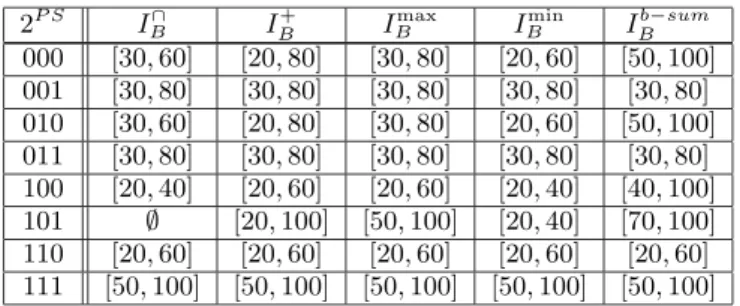
Example 4. Let P S = {x, y, z} ordered in this way. Let S be the scale [0, 100] ⊆ R naturally ordered. B = {(¬x, ≥ , 30, ≤, 80), (¬z, ≥, 20, ≤, 60), (x ∧ ¬y, ≥, 20, ≤, 40), (x ∧ z, ≥ , 50, ≤, 100)} is a weighted base over P S and S. Table 1 gives interval representations of IB∩, IB+, I
max
2P S I∩
B IB+ IBmax IBmin IBb−sum
000 [30, 60] [20, 80] [30, 80] [20, 60] [50, 100] 001 [30, 80] [30, 80] [30, 80] [30, 80] [30, 80] 010 [30, 60] [20, 80] [30, 80] [20, 60] [50, 100] 011 [30, 80] [30, 80] [30, 80] [30, 80] [30, 80] 100 [20, 40] [20, 60] [20, 60] [20, 40] [40, 100] 101 ∅ [20, 100] [50, 100] [20, 40] [70, 100] 110 [20, 60] [20, 60] [20, 60] [20, 60] [20, 60] 111 [50, 100] [50, 100] [50, 100] [50, 100] [50, 100]
Table 1: Canonical interpretations.
Now, a notion of f -equivalence between weighted bases over P S and S can be easily defined: two bases B1 and B2
are said to be f -equivalent when the set of all interpretations f -satisfying B1 is equal to the set of all interpretations f
-satisfying B2. It is easy to prove that two weighted bases
are f -equivalent whenever they are associated to the same f -canonical interpretation:
Proposition 2. Let P S be a finite set of atomic proposi-tions and let S be a scale. Let B1, B2 be two weighted bases
over P S and S. Let f be any S-aggregation function. B1
and B2 are f -equivalent if and only if IBf1= I f B2.
In order to make precise the connection between IBf and
the corresponding interval order, we still need two notions, namely the notion of f -consistent weighted base and the notion of f -possible world.
Obviously enough, the trivial interpretation I∅s.t. ∀ω ∈
2P S, I(ω) = ∅ f -satisfies any weighted base B. For this
reason, the notion of f -consistency of a weighted base cannot be defined as the existence of an interpretation f -satisfying it but has to be a bit more elaborate:
Definition 6. Let P S be a finite set of atomic propo-sitions and let S be a scale. Let f be any S-aggregation function. A weighted base B over P S and S is said to be f-consistent if and only if there exists an interpretation I over P S and S such that I |=f B and I 6= I∅.
Example 5. The base B given in Example 4 is f -consis-tent for f among ∩, +, max, min, sum, b − sum. The base {(x, >, 3), (x, =, 2), (¬x, <, 1), (¬x, >, 3)} is not ∩-consistent but is +-∩-consistent.
It is easy to prove that every weighted base B is +-consistent if and only if B is not the empty multiset and that every weighted base B is min-consistent, max-consistent, sum-consistent and b − sum-consistent except when it con-tains a 5-uple (φ, r1, s1, r2, s2) such that r1(s1) ∩ r2(s2) = ∅
(i.e., the interval specified by r1, s1, r2, s2 is empty).
Now, the preimage of ∅ by If
B is a subset of 2
P Sof worlds
which are considered as impossible given B:
Definition 7. Let P S be a finite set of atomic proposi-tions and let S be a scale. Let B be a weighted base over P S and S. Let f be any S-aggregation function. Let ω be a world from 2P S. ω is said to be f-impossible given B if and
only if If
B(ω) = ∅. ω is said to be f-possible when it is not
f -impossible.
P ossiblef(B) denotes the subset of 2P S consisting of all
worlds which are f -possible given B. Clearly enough, we have P ossiblef(B) = ∅ if and only if B is not f -consistent
if and only if IBf = I∅.
Example 6. Let us consider again the base B used in the running example. We have P ossible∩(B) = 2P S\ {101}.
f -possible worlds correspond to feasible alternatives and f -consistency ensures that at least some alternative is feasi-ble.
We are now ready to define the preference relations in-duced by a weighted base and an aggregation function:
Definition 8. Let P S be a finite set of atomic propo-sitions and let S be a scale. Let f be any S-aggregation function. Let B be a f -consistent weighted base over P S and S. We define the binary relations ≻f
B, ∼ f B and º
f B⊆
P ossiblef(B)×P ossiblef(B) by: let ω1, ω2∈ P ossiblef(B),
• ω1 ≻fB ω2 if and only if I f B(ω1) >IntS I f B(ω2); • ω1 ∼fB ω2 if and only if I f B(ω1) ∼IntS I f B(ω2); • ω1 ºfB ω2 if and only if ω1≻ f B ω2 or ω1∼ f Bω2.
The next result is a soundness one: it shows that every weighted base and S-aggregation function actually specifies an interval order over S:
Proposition 3. Let P S be a finite set of atomic propo-sitions and let S be a scale. Let f be any S-aggregation function. Let B be a f -consistent weighted base over P S and S. ºf
B is an interval order on P ossiblef(B). ∼fB (resp.
≻f
B) is its symmetric (resp. asymmetric) part.
Finally, notice that two f -equivalent weighted bases spec-ify the same interval order but the converse is false. There-fore, we define another, less demanding, notion of equiva-lence called (f, g)-order-equivaequiva-lence: if f is an S1-aggregation
function and g is an S2-aggregation function, then a weighted
base B1over P S and S1 is said to be (f, g)-order-equivalent
to B2over P S and S2 if and only if ºfB1=º g B2.
3.4
Simplicity and modularity
Basically, in our approach, 5-uples (φ, r1, s1, r2, s2) of B
are viewed as pieces of preferential evidence and are aggregated using a suited function f ; the corresponding f -canonical interpretation maps each interpretation (repre-senting an alternative) to an interval; the associated interval order follows in an obvious way once alternatives associated to the empty interval have been removed.
In our opinion, this semantics is simple; of course, simplic-ity has no formal definition but let us stress that the seman-tics of weighted propositional formulae (or penalty-based representations) as considered in [11, 5, 12, 4] and used for representing cardinal preferences is very close to the seman-tics we point out. Indeed, in penalty logic, weighted bases P are sets of pairs of the form (φ, α) where φ ∈ P ROPP S
and α ∈ R ∪ {+∞}; α is the penalty to be paid when-ever φ is not satisfied; associated to each weighted base P is a propositional formula K used to discriminate impossi-ble worlds: the possiimpossi-ble worlds are restricted to the models of K. Disutilities α are aggregated in an additive way so
that the disutility of any world ω ∈ M od(K) is given by d(ω) =P(φ,α)∈P | ω6|=φα.
The main differences between penalty-based tions and our framework are: in penalty-based representa-tions, the purpose is to represent complete preorders (and not interval orders); each piece of preferential evidence al-lows to map worlds to values from a numerical scale S (disu-tilities) and not to intervals over any S; sum is the aggre-gation function (while we consider other functions in our framework); finally, a further propositional formula K is used to discriminate impossible worlds in the penalty-based approach (while we consider as impossible those worlds as-sociated to the empty interval).
The modularity of the representation in our framework is achieved, at the syntax level, by the multiset representation of weighted base (5-uples can be considered in a separate way) and at the semantical level, by the compositionality of the construction of the f -canonical interpretation.
4.
EXPRESSIVENESS AND SPATIAL
EFFI-CIENCY
After the soundness result given by Proposition 3, let us first show that a completeness result can be achieved for some specific choices of scales S, whatever the chosen S-aggregation function f . Of specific interest is the scale S = [0, 2 × Card(A) − 1] ⊆ N.1 From Fishburn’s result, it comes
that any interval order over a finite set of alternatives A can be represented by a weighted base in our setting:
Proposition 4. Let A be a finite set of alternatives and º an interval order on A. For every S-aggregation func-tion f with S = [0, 2 × Card(A) − 1] ⊆ N, there exists a set of propositional atoms P S and a weighted base B over P S and S such that there is a bijection b between A and P ossiblef(B) and for every a1, a2∈ A, we have a1º a2 if
and only if b(a1) ºfBb(a2).
Obviously enough, this proposition can be trivially ex-tended to every case a scale isomorphic to [0, 2 × Card(A) − 1] ⊆ N (naturally ordered) is considered. This proposition also shows that the choice of the aggregation function has no impact on the expressiveness issue, as soon as such a scale is considered.
Let us now show that a language of weighted bases for representing interval orders is strictly more expressive than the language of penalty-based representations for cardinal preferences:
Proposition 5. Every complete preorder on A can be represented in the language of weighted bases using S = R∪ {−∞, +∞} as the scale and sum as the S-aggregation function. Contrastingly, it is not the case that every interval order can be represented in the language of penalty logic.
Let us finally turn to the spatial efficiency issue and briefly compare our representation languages using weighted bases
1Alternatively, we could consider the scale S = R ∪
{−∞, +∞} where ≤ extends the standard ordering on real numbers so that ⊥ = −∞ is the least element of S and ⊤ = +∞ is the greatest element of S. Our preference to in-tegers instead of reals is motivated by representational and computational issues.
to both the explicit representation and the interval repre-sentations or interval orders.
The explicit representation of interval orders given by Def-inition 1 is just as compact as its representation using inter-vals over R. Indeed, from Fishburn’s theorem (see Propo-sition 1), we immediately get that for any pair (a1, a2) of
alternatives occurring in SI, (a1, a2) ∈ R if and only if
la1 > ua2 or (la1 ≤ ua2 and la2 ≤ ua1). Hence from any
set SI of pairs (a, i) representing an interval order R,
deriv-ing the correspondderiv-ing explicit representation of R requires O(|SI|2) time in the worst case (hence a polynomial amount
of space). Conversely, the explicit representation of an inter-val order being given, an interinter-val representation of this order can be computed in polynomial time. For instance Doignon [6] pointed out a polynomial time algorithm for computing the (minimal) interval representation of an interval order.
Contrastingly, the ability offered by propositional logic to represent sets of worlds in a compact way is enough for en-suring that the languages of weighted bases are strictly more compact that both the explicit representation and the inter-val representations. Indeed, the problem with the explicit representation and the interval representations is that they both require an explicit representation of the alternatives. Assume that A = 2P S for a given set P S of n symbols:
the explicit representation of any interval order R over A contains at least 2n elements; this is also the case for any
interval representation of A. However, some interval orders over A can be represented in a much more compact way using a weighted base. For instance, if P S = {x1, . . . , xn},
B = {(x1∨ . . . ∨ xn, =, ⊤)} can be used for representing
a complete preorder where all the models of x1∨ . . . ∨ xn
are indifferent but strictly preferred to the remaining world (where all atoms are set to 0) (it is enough to consider max as the aggregation function).
5.
COMPLEXITY RESULTS
In this section, we investigate the complexity of exploit-ing weighted bases as interval orders representations. We mainly assume that f is a polytime function. Under this assumption (which holds for any of ∩, +, min, max, sum and b − sum), it is obvious that for any world ω ∈ 2P S and
any weighted base B, the value of IBf(ω) can be computed in
time polynomial in the size of B plus the size of ω. We also assume that the ordering ≤ on any scale S can be decided in polynomial time and that we can decide in polynomial time whether a given interval from IntS is empty (this clearly
depends on S since e.g. (2, 3) is empty when S = N but not empty when S = R).
The first question to be addressed is whether B is f -consistent.
Definition 9. f -consistency is the decision problem gi-ven by
• Input: A weighted base B over P S and S. • Question: Is B f -consistent?
Since the set of alternatives characterized by a weighted base is not always equal to the set of all worlds, another important question is to determine when a world is among the alternatives:
Definition 10. f -possibility is the decision problem gi ven by
• Input: A weighted base B over P S and S and a world ω ∈ 2P S.
• Question: Is ω f -possible given B?
Since many different bases share the same f -canonical in-terpretation in the general case, it is important to identify the complexity of deciding whether two given bases are f -equivalent; indeed, if two bases are f -equivalent then they represent the same interval order:
Definition 11. f -equivalence is the decision problem given by
• Input: Two weighted bases B1 and B2 over P S and
S.
• Question: Are B1 and B2 f -equivalent?
Similarly, it is important to identify the complexity of deciding whether a first base is (f, g)-order-equivalent to a second base (since, as we have seen, it can be the case that two bases that are not f -equivalent nevertheless represent the same interval order); we assume here that both f and g are polytime aggregation functions (possibly over different scales S1 and S2):
Definition 12. (f, g)-order-equivalence is the deci-sion problem given by
• Input: A weighted base B1 over P S and S1, and a
weighted base B2 over P S and S2.
• Question: Is B1 (f, g)-order-equivalent to B2?
The following three decision problems are in some sense natural problems when dealing with compactly represented interval orders (and, as such, have been considered in other papers from the literature dealing with compact representa-tion of preferences, see [12]); let R be an element of {º, ≻, ∼}:
Definition 13. f -comparison(R) is the decision prob-lem given by
• Input: A f -consistent weighted base B over P S and S and two worlds ω1, ω2∈ P ossiblef(B).
• Question: Is ω1RfBω2 true?
Definition 14. f -non-dominance is the decision prob-lem given by:
• Input: A f -consistent weighted base B over P S and S and a world ω ∈ P ossiblef(B).
• Question: Is ω undominated w.r.t. ≻fB in the set of
all worlds f -possible given B?
Definition 15. f -cand-opt-sat is the decision problem given by:
• Input: A f -consistent weighted base B over P S and S and a formula φ ∈ P ROPP S.
• Question: Does there exist a undominated world ω w.r.t. ≻f
B in the set of all worlds f -possible given B
s.t. ω |= φ?
We have derived the following results: Proposition 6.
• f -consistency is in NP; it is NP-complete for f = ∩ and in P for f = +, f = min, f = max, f = sum, f = b − sum. • f -possibility is in P. • f -equivalence is coNP-complete. • (f, g)-order-equivalence is coNP-complete. • f -comparison(R) is in P. • f -non-dominance is coNP-complete. • f -cand-opt-sat is in Σp
2. It is both NP-hard and
coNP-hard (hence it is not in NP ∪ coNP unless the polynomial hierarchy collapses).
– If card(S) ≥ card(B), f -cand-opt-sat is Θp2 -hard.
– Let PBf be the set of potential intervals given B
and f defined as the subset of IntS consisting of
all intervals f ({r1(s1)∩r2(s2) | (φ, r1, s1, r2, s2) ∈
B}). If a superset P of Pf
B can be computed in
polynomial time in the size of B, then f -cand-opt-sat is in Θp2.
– If B can be turned in polynomial time into a (f, sum)-order-equivalent base B′ over P S and S′ s.t. every 5-uple (φ, r1, s1, r2, s2) satisfies r1 =≥
and r2=≤, and S′ is a closed interval of N
con-taining 0, then sum-cand-opt-sat is in ∆p2.
We present in the following the two hardest proofs of these results.
Proof. • f -cand-opt-sat: Membership to Σp 2comes
from the following non-deterministic polytime algo-rithm using an NP-oracle: (1) guess ω ∈ 2V ar(B); (2) check that ω is f -possible; (3) check that ω is not dom-inated w.r.t. ≻fB using one call to an NP-oracle; (4)
check that ω |= φ.
NP-hardness comes from the following reduction from the satisfiability problem sat: let Σ be any CNF for-mula from P ROPP S; to Σ let us associate in
polyno-mial time the base B = {(true, =, ⊤)} and the formula φ = Σ. By construction, Σ is satisfiable if and only if there exists a undominated world ω w.r.t. ≻f
B in the
set of all worlds f -possible given B such that ω |= φ. Indeed, any model ω of Σ does the job.
coNP-hardness comes from a straightforward polyno-mial reduction from f -non-dominance: ω is not dom-inated w.r.t. ≻f
B if and only if there exists a
undom-inated world ω w.r.t. ≻f
B in the set of all worlds f
– When card(S) ≥ card(B), Θp2-hardness comes
from a polynomial reduction from parity-sat [17]: given a sequence φ1, . . ., φn of formulae from
P ROPP S such that for all i ∈ {1, . . . , n − 1},
if φi is unsatisfiable then φi+1 is unsatisfiable,
is the maximum index i such that φi is
satisfi-able an odd number? n = 2m is assumed even without loss of generality. The reduction is as follows: to φ1, . . ., φn ∈ P ROPP S, let us
asso-ciate in polynomial time the base B = {(φi∧
newi∧Vj=1...n,j6=i¬newj, =, si) | i ∈ {1, . . . , n}}
and the formula φ =Wm−1j=0 φ2j+1. By
construc-tion, the maximum index i such that φiis
satis-fiable is odd if and only if there exists a model ω of φ which is not dominated w.r.t. ≻f
B.
– Let us now show the membership of f -cand-opt-sat to Θp
2 in a restricted case. Roughly, the
ap-proach consists in determining an interval imaxof
IntSwhich is maximal w.r.t. >IntS and such that
there exists a world ω satisfying If
B(ω) = imax;
this is done using binary search and an NP-oracle; then it is enough to check using one call to an NP-oracle that there exists a model ω of φ s.t. IBf(ω) ∼IntS imax.
The difficulty here lies in binary searching since >IntS is not necessarily complete; especially, it
can be the case that imaxis not unique. In order
to overcome it, we refrain from considering >IntS
directly, but a complete, strict ordering ≻ closely related to it. Formally, let ≻ be the binary rela-tion over the set of all non-empty intervals from IntS defined by i1≻ i2if and only if l(i1) > l(i2)
or (l(i1) = l(i2) and ((lc(i1) and not lc(i2)) or
u(i1) > u(i2) or (u(i1) = u(i2) and rc(i1) and not
rc(i2)))). For any non-empty subset E of IntS
consisting of non-empty intervals, max(E, ≻) is a singleton {iE
max}. It is obvious that ∀i1, i2 ∈ E,
if i1>IntS i2 then i1 ≻ i2. We also have the
fol-lowing lemma:
Lemma 1. Let E be any non-empty subset of IntSconsisting of non-empty intervals. We have:
max(E, >IntS) = {i ∈ E | i ∼IntS i
E max}.
Based on this lemma, one can design a polynomial time algorithm Solve-f -CAND-OPT-SAT-1 for deciding f -cand-opt-sat (under the requirements given in the proposition), using a logarithmic num-ber of calls to an NP-oracle. It mainly consists in binary searching {iE
max} in the set of
poten-tial intervals (or the given superset of it); here, E = {i ∈ P \ {∅} | ∃ω ∈ 2V ar(B)∪V ar(φ) s.t.
IBf(ω) = i}.
(1) compute P = PBf (or a superset of it) in time
polynomial in the size of B and remove from it the empty interval (if present); let O be the re-sulting (finite and non-empty) set;
(2) sort the elements of O w.r.t. ≻;
(3) if O is a singleton {imax}, then go to (5);
(4) consider the interval i of rank ⌊card(O)/2⌋ in O; if there exists ω ∈ 2V ar(B)∪V ar(φ) such that
IBf(ω) ∈ O and I f
B(ω) ≻ i then remove from O
every interval j such that IBf(ω) ≻ j and resume
from (3) else remove from O every interval j such that j ≻ i and resume from (3);
(5) if there exists ω ∈ 2V ar(B)∪V ar(φ) such that
ω |= φ and IBf(ω) ∼IntS imaxthen RETURN(true)
else RETURN(false).
The evaluation of the condition of each condi-tional in Solve-f -CAND-OPT-SAT-1 requires one call to an NP-oracle. The total number of calls to such an oracle is thus upper bounded by ⌈log2Card(P )⌉ + 1; the result then follows
imme-diately since Card(P ) is upper bounded by p(|B|) where p is a polynomial such that |P | = p(|B|). – Let us now finally show the membership of f
-cand-opt-sat to ∆p
2 in a second restricted case.
Roughly, the algorithm Solve-f -CAND-OPT-SAT-2 used to prove it consists in first computing B′, then in binary searching m = l(iE
max) with
E = {i ∈ IntS′\ {∅} | ∃ω ∈ 2V ar(B
′)∪V ar(φ)
s.t. IBg′(ω) = i}, in the interval [0, M =
P
(φ,≥,s1,≤,s2)∈B′s2] ⊆ S
′. Indeed, for any
inter-val i ∈ IntS′, we have that i ∼IntS′ i
E max if and only if m ∈ i. (1) l = 0 and u = M ; (2) while l 6= u do m = ⌊(l + u)/2⌋;
if there exists ω ∈ 2V ar(B′)∪V ar(φ)
s.t. Ig B′(ω) 6=
∅ and l(Ig
B′(ω)) > m
then l = m + 1
else if there exists ω ∈ 2V ar(B′)∪V ar(φ) s.t. m ∈ Ig
B′(ω)
then l = u = m else u = m;
(3) if there exists ω ∈ 2V ar(B′)∪V ar(φ)
such that ω |= φ and m ∈ IBg′(ω) then RETURN(true) else
RETURN(false).
The evaluation of the condition of each condi-tional in Solve-f -CAND-OPT-SAT-2 requires one call to an NP-oracle. The total number of calls to such an oracle is thus upper bounded by 2 × ⌈log2 M + 1⌉ + 1. Finally, the number of bits
in the binary representation of any s2in B′is
up-per bounded by p(|B|) where p is a polynomial such that |B′| = p(|B|); similarly, the cardinal of
B′ is upper bounded by p(|B|), and as a
conse-quence the number of bits in the binary repre-sentation of M is upper bounded by 2 × p(|B|); it comes that the value of M is upper bounded by 22×p(|B|); thus, the total number of calls to
an NP-oracle in Solve-f -CAND-OPT-SAT-2 is upper bounded by 2 × ⌈log2 (22×p(|B|)) + 1⌉ + 1 =
2 × ⌈2 × p(|B|) + 1⌉ + 1, hence by a polynomial in the input size, and the result follows.
To conclude with the complexity results, observe that the set {[s1, s2], [s1, s2), (s1, s2], (s1, s2) | ((φ1, r1, s1) ∈ B or
s1 ∈ {⊥, ⊤}) and ((φ2, r2, s2) ∈ B or s2 ∈ {⊥, ⊤})} is a
superset of both PB∩, PB+, P min
computed in time polynomial in the size of B; this shows that ∩-cand-opt-sat, +-cand-opt-sat, min-cand-opt-sat and max-cand-opt-min-cand-opt-sat are in Θp2.
In light of our results, it turns out that several key decision problems when dealing with preferences (f -comparison(R), f -possibility) remain tractable when interval orders are represented by weighted bases, while some other key deci-sion problems (f -non-dominance, f -equivalence, (f, g)-order-equivalence, f -consistency) become “mildly” har-der than the corresponding problems based on explicit or interval representations (which are tractable). This appears as the price to be paid for the gain in spatial efficiency offered by our representation languages. We do not know whether f -cand-opt-sat is at the first level of the polynomial hi-erarchy or at the second level in the general case but our results show it at the first level of the polynomial hierarchy for many interesting cases.
Finally, our results show that the additional expressive power offered by our approach does not lead to a complexity shift compared to the penalty-based approach to complete preorders representation. Indeed, the complexity results for f -possibility, f -comparison(R) and f -non-dominance coincide with the complexity results for the corresponding problems reported in [12]. In contrast to our framework, the complexity of cand-opt-sat in the penalty-based ap-proach is in ∆p2 while this is not ensured in our approach;
the difficulty comes from the fact that not only the scale is not necessarily numerical in our setting, but it is not part of the input of the decision problem (hence there is no way to compute a notion of “mean” value, which is required for binary searching).
6.
CONCLUSION
In this paper, we have shown how interval orders can be encoded as weighted bases, subject, in our knowledge, that has not been studied before. Our presentation is simple and general in the sense that aggregation functions are not fixed but just have to satisfy some basic properties. Among other things, we have shown that all interval orders can be repre-sented using some weighted bases and we have identified the complexity of a number of decision problems pertaining to the exploitation of compactly represented interval orders.
This work calls for a number of perspectives. One of them consists in designing compact representations for other pref-erence relations, including partially ordered intervals and P QI interval orders. P QI interval orders are preference structures with three relations P (strict preference relation), Q (weak preference relation) and I (indifference). They have been introduced and characterized by Tsouki`as and Vincke [15, 16]. P QI interval orders have an interval representa-tion: P holds when one interval is completely to the right of the other one, Q holds when two intervals have a non-empty intersection without inclusion and finally I holds in case of inclusion. Concerning their numerical representation Ngo The and Tsouki`as ([14]) have given two algorithms, the first one in O(n2) determines a general representation of these structures and the second one in O(n) minimizes the first one. Our weighted base representation appears appropriate for these structures.
A second perspective consists in investigating further the expressiveness and spatial efficiency issues. Indeed, the choice of S and f has a clear impact on both issues in the general
case. It turns out that some spatial efficiency results from [5] for complete preorders can be easily extended to the case of interval orders (for instance, when a numerical scale is considered, the inability of compactly encoding some expo-nentially long PR-chains using min or max can be exploited
to show the corresponding languages less succinct than those for which sum is used). It would prove valuable to deter-mine the expressiveness landscape and the spatial efficiency landscape for various choices of the parameters S and f .
7.
REFERENCES
[1] F. Bacchus and A.J. Grove. Utility independence in a qualitative decision theory. In Proc. of KR’96, pages 542–552, 1996.
[2] S. Bistarelli, H. Fargier, U. Montanari, F. Rossi, Th. Schiex, and G. Verfaillie. Semiring-based CPSs and valued CSPs: Framework, properties and comparison. Constraints, 4(3):199–240, 1999.
[3] C. Boutilier, R. Brafman, C. Domshlak, H. Hoos, and D. Poole. CP-nets: a tool for representing and reasoning with conditional ceteris paribus statements. Journal of Artificial Intelligence Research, 21:135–191, 2004.
[4] Y. Chevaleyre, U. Endriss, and J. Lang. Expressive power of weighted propositional formulas for cardinal preference modeling. In Proc. of KR’06, pages 145–152, 2006.
[5] S. Coste-Marquis, J. Lang, P. Liberatore, and P. Marquis. Expressive power and succinctness of propositional languages for preference representation. In Proc. of KR’04, pages 203–212, 2004.
[6] J.P. Doignon. Sur les repr´esentations minimales des semiordres et des ordres d’intervalles. Math´ematiques et Sciences Humaines, 101:49–59, 1988.
[7] J. Doyle and M.P. Wellman. Preferential semantics for goals. In Proc. of AAAI’91, pages 698–703, 1991. [8] P.C. Fishburn. Interval orders and interval graphs.
John Wiley and Sons, 1985.
[9] P.C Fishburn. Generalisations of semiorders: a review note. Journal of Mathematical Psychology, 41:357–366, 1997.
[10] Ch. Gonzales and P. Perny. GAI networks for utility elicitation. In Proc. of KR’04, pages 224–234, 2004. [11] C. Lafage and J. Lang. Logical representation of
preferences for group decision making. In Proc. of KR’00, pages 457–468, 2000.
[12] J. Lang. Logical preference representation and combinatorial vote. Annals of Mathematics and Artificial Intelligence, 42(1-3):37–71, 2004. [13] R.D. Luce. Semi-orders and a theory of utility
discrimination. Econometrica, 24, 1956. [14] A. Ngo The and A. Tsouki`as. Numerical
representation of PQI interval orders. Discrete Applied Mathematics, 147:125–146, 2005.
[15] A. Tsouki`as and Ph. Vincke. Double threshold orders: A new axiomatization. Journal of Multi-criteria Decision Analysis, 7:285–301, 1998.
[16] A. Tsouki`as and Ph. Vincke. A characterization of PQI interval orders. Discrete Applied Mathematics, 127(2):387–397, 2003.
[17] K.W. Wagner. Bounded query classes. SIAM Journal on Computing, 19(5):833–846, 1990.