T
T
H
H
È
È
S
S
E
E
En vue de l'obtention du
D
D
O
O
C
C
T
T
O
O
R
R
A
A
T
T
D
D
E
E
L
L
’
’
U
U
N
N
I
I
V
V
E
E
R
R
S
S
I
I
T
T
É
É
D
D
E
E
T
T
O
O
U
U
L
L
O
O
U
U
S
S
E
E
Délivré par l'Université Toulouse III - Paul Sabatier Discipline ou spécialité : Géochimie de surface
JURY
A. Dia DR CNRS, Géosciences Rennes Rapporteur J. Ingri Professeur Luleå University of Technology Rapporteur S. Lapitsky DR Université d’Etat de Moscou Rapporteur F. Martin Professeur UPS, LMTG Toulouse Examinateur V. Shevchenko CR Académie des Sciences, Moscou Examinateur B. Dupré DR CNRS, OMP Toulouse Directeur de thèse O. Pokrovsky CR1 CNRS, LMTG Toulouse Directeur de thèse A. Shishkin Professeur SPbSTU, St.Pétersbourg Co-directeur de thèse
Ecole doctorale : Sciences de l'Univers, de l'Environnement et de l’Espace
Présentée et soutenue par Ekaterina VASYUKOVA Le 27 janvier 2009
A
A
l
l
t
t
é
é
r
r
a
a
t
t
i
i
o
o
n
n
c
c
h
h
i
i
m
m
i
i
q
q
u
u
e
e
d
d
e
e
s
s
r
r
o
o
c
c
h
h
e
e
s
s
e
e
t
t
m
m
i
i
g
g
r
r
a
a
t
t
i
i
o
o
n
n
d
d
e
e
s
s
é
é
l
l
é
é
m
m
e
e
n
n
t
t
s
s
d
d
a
a
n
n
s
s
l
l
a
a
z
z
o
o
n
n
e
e
b
b
o
o
r
r
é
é
a
a
l
l
e
e
(
(
N
N
o
o
r
r
d
d
-
-
O
O
u
u
e
e
s
s
t
t
d
d
e
e
l
l
a
a
R
R
u
u
s
s
s
s
i
i
e
e
)
)
The chemical weathering of rocks and migration of elements in the boreal zone (North-West Russia)
T
T
H
H
È
È
S
S
E
E
En vue de l'obtention du
D
D
O
O
C
C
T
T
O
O
R
R
A
A
T
T
D
D
E
E
L
L
’
’
U
U
N
N
I
I
V
V
E
E
R
R
S
S
I
I
T
T
É
É
D
D
E
E
T
T
O
O
U
U
L
L
O
O
U
U
S
S
E
E
Délivré par l'Université Toulouse III - Paul Sabatier Discipline ou spécialité : Géochimie de surface
JURY
A. Dia DR CNRS, Géosciences Rennes Rapporteur J. Ingri Professeur Luleå University of Technology Rapporteur S. Lapitsky DR Université d’Etat de Moscou Rapporteur F. Martin Professeur UPS, LMTG Toulouse Examinateur V. Shevchenko CR Académie des Sciences, Moscou Examinateur B. Dupré DR CNRS, OMP Toulouse Directeur de thèse O. Pokrovsky CR1 CNRS, LMTG Toulouse Directeur de thèse A. Shishkin Professeur SPbSTU, St.Pétersbourg Co-directeur de thèse
Ecole doctorale : Sciences de l'Univers, de l'Environnement et de l’Espace
Présentée et soutenue par Ekaterina VASYUKOVA Le 27 janvier 2009
A
A
l
l
t
t
é
é
r
r
a
a
t
t
i
i
o
o
n
n
c
c
h
h
i
i
m
m
i
i
q
q
u
u
e
e
d
d
e
e
s
s
r
r
o
o
c
c
h
h
e
e
s
s
e
e
t
t
m
m
i
i
g
g
r
r
a
a
t
t
i
i
o
o
n
n
d
d
e
e
s
s
é
é
l
l
é
é
m
m
e
e
n
n
t
t
s
s
d
d
a
a
n
n
s
s
l
l
a
a
z
z
o
o
n
n
e
e
b
b
o
o
r
r
é
é
a
a
l
l
e
e
(
(
N
N
o
o
r
r
d
d
-
-
O
O
u
u
e
e
s
s
t
t
d
d
e
e
l
l
a
a
R
R
u
u
s
s
s
s
i
i
e
e
)
)
The chemical weathering of rocks and migration of elements in the boreal zone (North-West Russia)
Acknowledgements
This PhD thesis has been elaborated from October 2005 till November 2008 between the University Paul Sabatier of Toulouse, France, and Saint-Petersburg State Polytechnic University, Russia, within the French government scholarship programme for a double-supervised dissertation.
In the first place, I would like to address my acknowledgements to my scientific directors – Bernard Dupré and Alexander Shishkin – for the offered topic for this thesis, for their professional supervision each in his own manner, and for giving me their constant support and criticism throughout all stages of the research program which contributed to the success of this work.
I am deeply thankful to my co-supervisor Oleg Pokrovsky for guiding me throughout the dissertation and discovering for me the world of geochemistry. I thank him for the invaluable help from the field work and laboratory experiments till the manuscript preparation, permanent availability, talent and endless understanding in the moments of disappointment.
I would like to thank kindly Jérôme Viers who helped me a lot during this time, especially on isotope geochemistry, inveigled me into the cuisine of “salle blanche”, and with gentleness and patience invested time (and maybe nerves) throughout my French language mastering.
I am also very grateful to Priscia Oliva for very agreeable moments of working together, for transmitting her knowledge, helpful discussions and her sympathy towards me.
Finally, I would like to express my sincere gratitude to François Martin, who took me under his wing, and not only brought me into mineralogy, but also encouraged and supported with all his kindness especially during the last most important and difficult stage of the PhD. I had a great pleasure to work with him and to derive my strength and inspiration from his optimism and sense of humour.
I am thankful to all these people for the freedom I enjoyed during our work together and for the knowledge and confidence they brought towards me.
I would also like to thank the opponents Aline Dia, Johan Ingri and Sergey A. Lapitsky of this thesis for having accepted to judge my work and for the interest they showed in it.
Without the support of technical and engineering staff at LMTG, I would have been lost sometimes with my experiments and analysis, so big thanks go to Carole Boucayrand, Carole Causserand, Maïté Carayon, Fabienne de Parceval, Fréderic Candaudap, Sébastien Gardoll, Cyril Zouiten, Thierry Aigouy, Philippe de Parceval, and Pierre Brunet.
I am also very grateful to geologists from the Moscow State University – Yana, Andrey and Dmitriy Bychkovy – for their professional help with data, maps and team work in
Certainly, I would like to mention, without paying special attention to the order, my friends from Toulouse but at the same time from all over the world who shared nice moments with me during this fascinating journey: Elena, Ludmila, Nastya, Teresa, Camille, Ana, Riccardo, Sergey, Pierre, Chris, Guilhem, Guiseppe, Quintin, Gwénaël, Yann, Fabrice and many others from LMTG. Special thanks go to Laurent – the best office-mate – for his patience, readiness to help whatever was the need, time spent together, and chronically good mood.
I would like to finish with the people who are precious to me:
My parents, Irina and Vladimir, who brought me to this level of education, always leaving me a choice in my professional orientation. They are my invaluable encouragement since I was born and especially over these years far away from home. I thank all my family for their support, patience and faith in me.
And finally, I reserve a particular mention to Ilya, who always knew how to inspire me even in the most difficult moments. I am deeply indebted to you for everything that you had to put away throughout this time and that you did sincerely to make these years the most precious time of my life. A part of this work belongs to you.
Abstract
The objective of this thesis is to improve our understanding of the weathering processes of mafic silicate rocks and element speciation and migration in the boreal environments (White Sea basin, North-Western Russia). Specific goals are to i) characterize and describe the mechanisms governing the chemical weathering and mineral formation in subarctic zone, ii) assess the role of the rock lithology (granitic environment vs. basaltic) in trace elements (TE) speciation and organo-mineral colloids formation in surface waters of boreal high latitude river basins, and iii) reveal the pH-dependence of TE speciation in order to predict possible changes in elements bioavailability in natural water due to their acidification caused by environmental changes. The main originality of the work is to combine, for the first time on the same natural objects, the geochemical, isotope, physico-chemical and mineralogical techniques to better understand the factors that control biogeochemical cycling of elements in the subarctic region.
The first part is devoted to general introduction and the insight into the problems. The second chapter is aimed at studying the geochemical migration and partition of major and trace elements between rock and soil reservoirs during chemical weathering process. In particular, we investigate soil forming processes on mafic rocks under strong influence of glacier moraine in North-Western Russia, and related surface water hydrochemistry, and provide the estimation of mafic rocks weathering intensity in view the importance of weathering of these rocks in atmospheric CO2 consumption. The third chapter gives a quantitative characterization of TE colloidal speciation in pristine, organic-rich rivers and surface waters where the role of colloidal status of elements and their transport in surface waters is addressed. In this part we compare two contrasting techniques, dialysis and ultrafiltration, both used for the assessment of the elements speciation in water, and we test the role of the rock lithology (granitic vs. basaltic catchments) in colloids formation and their chemical nature. The fourth chapter describes the results of experimental modeling conducted with natural surface waters at different pH using the equilibrium dialysis technique. We evaluate the complexation of TE with natural organo-mineral colloids present in boreal surface waters and quantify empirical distribution coefficients of TE between dissolved and colloidal pools as a function of pH. Investigations carried out in this part of the study should contribute to the prediction of water acidification phenomena expected to be mostly pronounced in the Arctic due to global climate warming.
Keywords: geochemistry, boreal zone, subarctic, trace element, colloid, speciation,
Résumé
Cette thèse a pour but d’améliorer notre compréhension des processus d’altération des roches mafiques silicatées, de la spéciation des éléments et de leur migration dans le milieu boréal (bassin versant de la mer Blanche, Nord-Ouest de la Russie). Les objectifs principales du travail sont i) de caractériser et décrire les mécanismes responsables de l’altération chimique et de la formation des minéraux dans la zone subarctique, ii) évaluer le rôle de la lithologie (environnement granitique versus basaltique) dans la spéciation des éléments traces (ET) et la formation des colloïdes organo-minéraux dans les eaux de surface des bassins versants boréaux des hautes latitudes, et iii) révéler la dépendance de la spéciation des ET en fonction du pH de la solution pour prédire des changements éventuels dans la bioaccumulation des éléments dans les eaux naturelles à cause de leur acidification. L’originalité de cette thèse est de combiner, pour la première fois sur les mêmes objets naturels, les techniques physico-chimique, minéralogique et isotopique afin de mieux comprendre les facteurs qui contrôlent les cycles biogéochimiques des éléments dans les régions subarctiques.
La première partie de la thèse consiste en une introduction générale de la problématique. Le deuxième chapitre est consacré à l’étude de la migration géochimique et de la partition des éléments majeurs et traces entre la roche et le sol au cours du processus d’altération chimique. Notamment, nous étudions le processus de la formation des sols sur les roches mafiques soumis à une forte influence de la moraine glacière (dans la zone Nord-Ouest de la Russie), ainsi que la chimie des eaux associées. Nous présentons l’estimation de l’intensité d’altération des roches mafiques en lien avec la consommation du CO2 atmosphérique. La troisième partie de la thèse est consacrée à la caractérisation quantitative de la spéciation colloïdale des ET dans les rivières et les eaux de surface naturelles. Le rôle du statut colloïdal des éléments, ainsi que de leur transport dans les eaux de surface est considéré. Dans cette partie, nous réalisons une comparaison de deux techniques contrastantes, dialyse et ultrafiltration, utilisées pour l’estimation de la spéciation des éléments dans l’eau. Nous contrôlons le rôle de la lithologie des roches (bassins versants granitiques vs. basaltiques) dans la formation des colloïdes et leur nature chimique. Le quatrième chapitre comprend les résultats d’une modélisation expérimentale conduite sur les eaux naturelles de surface à différents pH en utilisant la technique de dialyse en équilibre. Nous évaluons la complexation des ET avec les colloïdes organo-minéraux naturels présents dans les eaux de surface boréales, et estimons les coefficients de distribution empiriques des ET entre les fractions colloïdale et dissoute en fonction du pH. L’étude menée dans cette partie vise à contribuer à la prévision du phénomène d’acidification supposé être prononcé dans les régions Arctiques suite au réchauffement climatique globale.
Mots clés: géochimie, zone boréale, subarctic, élément trace, colloïde, spéciation, eaux
naturelles, ultrafiltration, dialyse, podzol, roche mafic, altération chimique.
Резюме Данная диссертация направлена на изучение процессов химического выветривания мафических силикатных горных пород, форм нахождения и миграции элементов в бореальных ландшафтах (бассейн Белого моря, Северо-Запад России). В рамках работы были поставлены следующие задачи: i) охарактеризовать и описать механизмы, ответственные за химическое выветривание и образование минералов в субарктической зоне, ii) оценить роль литологии (гранитные водосборные бассейны против базальтовых) в распределении форм нахождения микроэлементов и формировании органо-минеральных коллоидов в поверхностных водах бассейнов бореальных рек, и iii) выявить зависимость форм нахождения элементов от pH раствора с целью предсказать возможные изменения в биоаккумуляции элементов в природных водах вследствие их асидификации, вызванной влиянием на окружающую среду. Научная новизна диссертации заключается в объединении геохимического, изотопного, физико-химического и минералогического методов исследований, примененных впервые на одних и тех же природных объектах, с целью выявления факторов, контролирующих биогеохимические циклы элементов в субарктической зоне. В первой главе работы дается общее введение в проблематику. Вторая глава посвящена изучению геохимической миграции и распределения макро- и микроэлементов между горными породами и почвами в процессе химического выветривания. В частности, мы исследовали процесс формирования почв на основных породах, подверженных сильному влиянию ледниковых моренных отложений в северо-западной части России, а также химический состав соответствующих поверхностных вод. Была дана оценка интенсивности выветривания основных горных пород в виду его важности в процессе потребления атмосферного углекислого газа. Третья глава посвящена количественной оценке коллоидных форм микроэлементов в реках и поверхностных водах, богатых органическим веществом и неподверженных антропогенному воздействию. В этой части проводится сравнение двух контрастных методов, диализа и ультрафильтрации, используемых для оценки форм нахождения элементов в воде, а также оценивается роль литологии подстилающих горных пород (кислых и основных) в формировании коллоидных веществ и их химическом составе. В
проведенного с природными поверхностными водами при различных pH с помощью метода равновесного диализа. Проведена оценка комплексации микроэлементов с природными органо-минеральными коллоидами, присутствующими в бореальных поверхностных водах, а также расчет эмирических коэффициентов распределения микроэлементов между растворенной и коллоидной фазой как функция pH. Исследования, проведенные в этой части работы, призваны внести вклад в прогнозирование феномена асидификации природных вод, который может быть более выраженным в арктических регионах вследствие глобального потепления климата. Ключевые слова: геохимия, бореальная зона, субарктический, микроэлементы, коллоиды, формы нахождения, природные воды, ультрафильтрация, диализ, подзол, основные породы, химическое выветривание.
CONTENTS
Acknowledgements….……….5 Abstract………..………...7 Key words………...………..7 Résumé……….………...8 Mots clés………...………9 Резюме………..9 Ключевые слова...10 Letter combinations………...15Chapter 1. General introduction….……….17
1.1. Background of the study………...19
1.1.1. Speciation of elements in boreal zone……….19
1.1.2. Nature of colloids and their role in mobilisation of trace elements………….22
1.1.3. Methods of colloids’ separation………..25
1.1.4. Change of trace element speciation in the light of the global climate warming………...26
1.1.5. Podzols in boreal zone……….27
1.1.6. Role of chemical weathering in elements transport to the oceans and associated CO2 consumption………...30
1.2. Description of the region………..32
1.2.1. Characteristics of the boreal zone………32
1.2.2. Study site……….33
1.3. Objectives and scope of the study………35
1.4. Thesis organisation………...36
Chapter 2. Chemical weathering of mafic rocks in boreal subarctic environment (North-West Russia) under glacial moraine deposits……….39
Abstract………41
2.1. Introduction……….….42
2.2.1.1. Vetreny Belt paleorift……….49
2.2.1.2. Kivakka layered intrusion………...49
2.2.2. Climate and hydrology………50
2.3. Materials and methods………..50
2.3.1. Sampling of rocks, soils, surface waters and soil pore waters………50
2.3.2. Analytical techniques………..51
2.3.2.1. Mineralogical and chemical analysis of rocks and soils……….51
2.3.2.2. Chemical analysis of river, surface swamp and soil pore waters……...60
2.3.2.3. Isotope analysis of river waters and soils………...61
2.4. Results………..62
2.4.1. Bedrock mineralogy and chemistry……….62
2.4.2. Soil mineralogy………63
2.4.2.1. Evolution of the soil chemical composition as a function of depth……67
2.4.3. Hydrochemistry………...68
2.5. Discussion……….69
2.5.1. Moraine influence over the full depth of soil profile………...69
2.5.1.1. Major elements………...69
2.5.1.2. REE upper crust normalized diagrams………...72
2.5.1.3. Extended upper crust normalized diagrams………74
2.5.2. Actual weathering processes: waters versus soils and rocks……….…..75
2.5.6. Isotope study………80
2.5.7. Chemical weathering rates………...83
2.6. Conclusions………..84
References………...86
Chapter 3. Trace elements in organic- and iron-rich surficial fluids of boreal zone: Assessing colloidal forms via dialysis and ultrafiltration………....97
Preface……….99
Abstract………..101
3.1. Introduction………102
3.2. Sample area………104
3.3. Materials and methods………106
3.3.2. Analysis………..…...109
3.4. Results and discussion………110
3.4.1. Comparison between dialysis and ultrafiltration………...110
3.4.2. Major and trace element speciation………..….113
3.4.2.1. Organic carbon and iron………...113
3.4.2.2. Alkali metals, alkaline earths, divalent transition and heavy metals……….115
3.4.2.3. Trivalent metals: Al, Ga, Y and REE……….…..117
3.4.2.4. Tetravalent metals: Ti, Zr, Hf and Th…….………..121
3.4.2.5. Other trace elements: V, Cr, Mo, W, As, Sb, Sn, Nb and U………….122
3.4.3. Effect of lithology on element distribution among various types of colloid………125
3.4.4. Thermodynamic analysis………...128
3.5. Conclusions………130
References……….132
Chapter 4. Experimental measurement of trace elements association with natural organo-mineral colloids using dialysis………...139
Abstract………..141
4.1. Introduction………142
4.2. Materials and methods………144
4.2.1. Sampling………144
4.2.2. Dialysis procedure and analyses………147
4.3. Results………148
4.3.1. Methodology of dialysis at different pH………149
4.3.2. The pH-dependence of the percentage of dissolved form and the distribution coefficient Kd of the trace elements………...149
4.3.3. Thermodynamic modeling of metal complexation with dissolved organic matter……….…152
4.4. Discussion……….……..164
4.4.1. Possible artifacts of dialysis procedure and colloids aggregation……...…..164 4.4.2. Relative role of organic matter vs. adsorption or coprecipitation of trace
4.5. Conclusions and implications: change of trace elements speciation and
bioavailability during acidification of surface waters………...168
References……….170
Chapter 5. Conclusions and perspectives………..177
5.1. Conclusions………..………..179 5.2. Perspectives………..………..182 Bibliography……….185 List of figures………...206 List of tables……….209 ANNEXES………211
Letter combinations and abbreviations AAS Atomic Absorption Spectrometry
Alk Alkalinity (concentration)
DOC Dissolved Organic Carbon (concentration)
FA Fulvic Acid
HA Humic Acid
HPLC High Performance Liquid Chromatography
ICP-AES Inductively-Coupled Plasma Atomic Emission Spectrometry ICP-MS Inductively-Coupled Plasma Mass Spectrometer
Kd Iron-normalized trace element partition coefficient between dissolved and colloidal fraction
LOI Loss On Ignition
OC Organic Carbon
OM Organic Matter
TE Trace Elements
STEM Scanning Transmission Electronic Microscopy SEM Scanning Electron Microscopy
UF Ultrafiltration
WHAM Windermere Humic Aqueous Model
Chapter 1
1.1. Background of the study
1.1.1. Speciation of elements in boreal zone
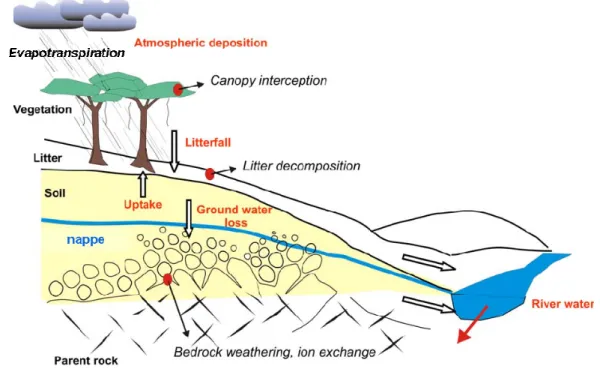
One of the major goals of the geochemistry is to quantify the element fluxes occurring between different reservoirs represented by continents, oceans and atmosphere, and to identify the mechanisms which control these fluxes. This exchange takes place at all scales, from the globe surface to a smaller scale of a soil or soil horizon. Figure 1.1 (after Viers et al., 2007) illustrates these matter transfer processes at a river basin scale, and defines the main processes which control these exchanges.
Fig. 1.1. Scheme describing the main matter exchange between different reservoirs (soil-rock system,
vegetation, and atmosphere) of a watershed (after Viers et al., 2007).
The understanding of the role of continental erosion on the biogeochemical cycles of elements requires thorough studies on the interactions between different biogeochemical reservoirs (oceans, atmosphere, biosphere, and hydrosphere). Chemical and physical erosion of continental rocks plays a fundamental role in these processes. It can be mechanical, initiated by physical processes, gravity, temperature contrasts, frosting and defrosting, or chemical, initiated by dissolution of minerals under the
some chemical elements remain in situ in the form of newly-formed minerals, and constitute a soil together with primary minerals. Other elements are exported with water flows in dissolved (< 0.22 or 0.45 µm) or particulate (> 0.22 or 0.45 µm) form. Water flows are responsible of 90% of the substances transfer from continent to the ocean, and for many elements this transport mostly occurs in particulate form (Gaillardet et al., 2003; Viers et al., 2007, 2008). At the same time, there is a growing understanding of the importance of colloidal1 fluxes, which can represent an essential part of flux for many usually insoluble elements (Viers et al., 2007). This colloidal transport is especially important for the boreal regions of the world, where river contain high concentration of dissolved organic matter and iron. Thus, quantitative and qualitative estimation of fluxes of dissolved and particulate matter exported with water flows is essential to acquire better understanding of the process of continental weathering.
Boreal2 regions of the Russian Arctic play a crucial role in the transport of elements from continents to the ocean at high latitudes. In view of the importance of these circumpolar zones for our understanding of ecosystem response to global warming, it is very timely to carry out detailed regional studies of trace elements3 (TE) geochemistry in boreal landscapes. These zones represent one of the most important organic carbon reservoirs in the form of peat bogs, wetlands and soils very rich in organic matter. As a consequence, trace elements in water are likely to be transferred in
1
Colloids are defined as small particles, organic or inorganic, having the size between 1 µm and 1 nm (Stumm and Morgan, 1996).
2
Boreal is defined by W. Köppen (1931) as the zone having a definite winter with snow, and a short
summer, generally hot. It includes a large part of North America between the Arctic Zone and about 40°N, extending to 35°N in the interior. In Central Europe and in Asia the boreal zone extends southward from the tundra to 40°–50°N. 2. A biogeographical zone or region characterized by a northern type of fauna or flora. The term boreal region is used mainly by American biologists, and includes the area between the mean summer isotherm of 18°C or 64.4°F (roughly 45°N latitude) and the Arctic Zone. 3
Trace elements (TE) are defined as elements that are present at low concentrations (1 mg/l or less) in
natural waters. This means that trace elements are not considered when “total dissolved solids” are calculated in rivers, lakes, or groundwaters, because their combined mass in not significant compared to
the sum Na+, K+, Ca2+, Mg2+, H4SiO4, HCO3-, CO32-, SO42-, Cl-, and NO3-. Being TEs in natural waters
does not necessarily qualify them as TEs in rocks (Gaillardet et al., 2003). In general, this definition covers almost all elements of the periodical table but this thesis is focused on the most commonly used elements such as trace metals and metalloids of a considerable geochemical importance.
the form of organic and organo-mineral colloids as it was shown in several recent studies on the estuaries of major Siberian rivers (e.g., Martin et al., 1993; Dai and Martin, 1995). There is a large amount of previous studies which addressed the speciation4 and transport of trace elements in water in tropical (Viers et al., 1997; Braun et al., 1998; Dupré et al., 1999) and temperate (Pokrovsky et al., 2005a,) zones. Despite the increasing interest to boreal permafrost5-dominated areas among aquatic geochemists, these particular zones remain much less investigated. In contrast with the west European environments lying at the Baltic Sea and North Sea coast in a relatively mild climate, the understanding of the geochemistry of ecosystems situated at the Arctic sea coast, including White Sea, is still largely insufficient. Indeed, geochemical processes in the “eastern” boreal zone undergo in different climatic conditions, with higher temperature variations in winter and summer. In comparison to the western boreal zone, in the eastern part the precipitation is much less influenced by marine aerosols. The influence of atmospheric pollution, local anthropogenic pressure and anthropogenically induced concentrations in precipitates, as well as the effect of acidic rains, are more pronounced in the Western Europe compared to pristine zone of the Russian Arctic. Landscape properties in these two parts also differ, in particular, more important proportion of wetland areas in eastern boreal zone provides higher concentrations of dissolved (< 0.22 µm) organic matter (from 10 to 150 mg/l) and Fe (up to 10 mg/l) in surface waters. As a consequence, in eastern boreal regions, the nature of dissolved organic matter, iron and aluminium colloids, as well as the estuarine behaviour of TE, may be different from that observed in the “model” Kalix river, draining the western boreal zone in northern Sweden, which has been very thoroughly studied over the past decades (Pontér et al., 1990, 1992; Ingri and Widerlund, 1994; Ingri et al., 1997, 2000, 2005, 2006; Land and Öhlander, 1997, 2000; Porcelli et al., 1997; Andersson et al., 1998, 2001; Land et al., 2000; Dahlqvist et al., 2004, 2005, 2007; van Dongen et al., 2008). Except for a few works on trace elements measurements in the Russian Arctic (Dai and Martin, 1995; Guieu et al., 1996; Moran and Woods, 1997; Zhulidov et al., 1997), studies addressing colloidal vs. dissolved
4
Speciation is defined as chemical form in which the metals occur in the solid and solution phase. 5
forms and transport of TE in organic-rich waters from pristine permafrost landscapes are scarce (Ingri et al., 2000; Pokrovsky and Schott, 2002; Dahlqvist et al., 2004; Pokrovsky et al., 2006a).
Over the last several decades, a revolutionary change of attitude towards the importance of metal speciation has occurred and considerable research effort has been devoted to measuring the concentrations of biologically important trace elements in soil and surface water. At the present time, it is generally recognized by environmental scientists that the particular behaviour of trace metals in the environment is determined by their specific physico-chemical forms rather than by their total concentration. The speciation affects the extent to which the chemical element participates in various transport and transformation processes (Gustaffson and Gschwend, 1997). The research in this field requires a multidisciplinary approach, i.e., combination of chemical, geological, hydrological, (micro)biological studies.
1.1.2. Nature of colloids and their role in mobilisation of trace elements
In order to understand the role of colloids in aquifer systems, it is important to determine their occurrence and origin.
Natural colloids can be found in different milieus: natural surface and groundwater, sea and ocean, as well as soil pore water. Fig. 1.2 (after Gaillardet et al., 2003) shows an example of the distribution of a number of mineral and organic species which are present in natural environment as a function of their size.
Colloids in surface water (Gustaffson and Gschwend, 1997; in this study we define colloids as entities between 1 nm and 0.22 µm size) originate, in general, from the soil horizons, and can be organic, inorganic and organo-mineral (Ingri and Widerlund, 1994; Gustafsson and Gschwend, 1997; Viers et al., 1997; Gustafsson et al., 2000; Dahlqvist et al., 2004, 2007; Pokrovsky et al., 2005a, 2006a; Allard, 2006; Andersson et al., 2006; Allard and Derenne, 2007). Degradation of plant litter on the soil’s surface yields a family of organic colloids (soluble humic substances, i.e., humic and fulvic acids) which constitute, in an insoluble form, the upper mineral soil horizon. They are usually combined with mineral soils particles creating either organo-mineral clay-humic complexes (i.e., Fe and Al hydroxides stabilized by organic matter) in well-drained environments, or dispersed complexes if the soil is not well-drained enough. In this
Fig. 1.2. Distribution of mineral and organic colloids as a function of size in aquatic systems (after
Gaillardet et al., 2003).
upper horizon, trace elements are also present in colloidal form, being released from the decomposition of the plant litter. In boreal regions, the presence of wetlands, abundant precipitation and sufficient plant production creates favourable conditions for formation of organic rich soils, providing high concentrations of organic matter in surficial waters and thus, colloidal status of many elements in waters.
Mineral inorganic colloids are most commonly represented by metal oxyhydroxides (e.g., iron-, aluminium- and manganese-oxyhydroxides), siliceous phases and clays. They are formed during intensive chemical weathering6 of primary soil minerals (silicates and multiple oxides) in the upper soil horizon. This process is usually called a podzolisation process (e.g., Duchaufour, 1951, 1997; Buurman and Jongmans, 2005). It takes place in an aggressive acid medium created by plant litter decomposition products, and is controlled by the influence of a mixture of organic acids and complexing agents. Cations Ca2+, Mg2+, K+, Na+ are removed together with iron and aluminium. This leaching is accompanied by migration and subsequent accumulation of
6
iron and/or aluminium organo-mineral complexes in a soil horizon B called podzolic. Further description of podzols is given in Section 1.1.5.
One of the colloids’ properties is strong scavenging capacities towards cations. They play a major role in the mobilization of trace elements in soils and waters affecting elemental distribution in natural systems through interfacial adsorption or complexation processes (Buffle, 1988). Quantitative modeling of migration and bioavailability of TE requires the knowledge of stability constants for complexation reactions of trace metals with colloidal organic matter. The most powerful and precise method of assessing these constants is voltammetry and potentiometry; however, their use is restricted by very low number of transition metals (Zn, Cu, Cd, Pb) and some rare earth elements (Stevenson and Chen, 1991; Johannesson et al., 2004; Chang Chien et al., 2006; Prado et al., 2006). Up to present time, large number of trace elements, including trivalent and tetravalent elements, remains unexplored and the quantification of their stability constants with natural colloidal matter is not possible. This hampers the progress in applying quantitative physico-chemical models such as WHAM (Tipping and Hurley, 1992; Tipping, 1994; Tipping, 1998; Tipping, 2002), WinHumicV based on WHAM model (Gustafsson, 1999), NICA-Donnan (Benedetti et al., 1995; Kinniburgh et al., 1999; Milne et al., 2001, 2003; Tipping, 2002) for assessing trace elements speciation in continental waters.
Generally speaking, chemical composition of the most of surface and ground waters is a result of the rain-water-rock interaction on the earth surface and especially in the soil zone (Drever, 1982). From ultrafiltration experiments in tropical environment (Cameroon), Dupré et al. (1999) demonstrated the key role of organic colloids in the transport of elements such as Al and Fe, the major constituents of the soil minerals. Experimental study of the TE speciation in waters of boreal forest landscapes performed by Dobrovolsky (1983) demonstrated an important role of complex organic compounds of metals, as well as colloidal particles. Forms of monatomic ions of iron participating in water migration in boreal zones play here a subordinate role, whereas organic complexes can constitute up to 80% of the overall soluble metals in soil. Notably, the percentage of these forms increases in more boreal landscapes, i.e., proportion of organic complexes depends on the proportion of wetlands of a territory (Laudon et al., 2004; Frey and Smith, 2005). Hence, the first goal of this thesis consists in quantitative
characterization of trace element speciation in pristine, organic-rich boreal rivers and surface waters.
1.1.3. Methods of colloids’ separation
There is a whole range of currently available strategies for separation and analysis of colloids in natural water. An important progress in characterizing the behaviour of TE in aquatic environments has been done thanks to development of high resolution analytical instrumentation and techniques (Gaillardet et al., 2003). Techniques like dialysis, voltammetry, gels diffusion (DET and DGT) are routinely used to obtain in situ information for small colloids, whereas a combination of rapid fractionation procedures, including filtration, field-flow fractionation, split-flow lateral-transport thin (SPLITT) separation cells, and cross-flow ultrafiltration (CFF) can be used for the ex-situ characterisation of TE association with colloids.
Ultrafiltration is most often used to characterize the proportion of dissolved and colloidal forms in surficial rivers, lakes, groundwater and seawater (Hoffman et al., 1981, 2000; Guo and Santschi, 1996; Viers et al., 1997; Dupré et al., 1999; Eyrolle and Benaim, 1999; Olivié-Lauquet et al., 1999, 2000; Ingri et al., 2000, 2004; Pokrovsky and Schott, 2002; Pokrovsky et al., 2005a, 2006a, 2006b; Dia et al., 2000; Pourret et al., 2007; Pédrot et al., 2008). In contrast, only few authors used dialysis as an in situ technique of colloid characterization (Benes and Steiness, 1974; Borg and Andersson, 1984; Berggren, 1989; Alfaro-De la Torre et al., 2000; Gimpel et al., 2003; Nolan et al., 2003; Buschmann and Sigg, 2004; Pokrovsky et al., 2005a).
Though ultrafiltration is widely used, some artifacts of this procedure such as charge separation, clogging of the filter membrane induced by forced filtration, various sources of contamination (filter, apparatus, tubing, recipient) etc. (Viers et al., 1997; Dupré et al., 1999) make the separation and characterization of colloids in water difficult. As a result, there are several main requests raising as necessary to develop nowadays, such as sampling methods with conservation of species, rapid, simple and inexpensive methods for the assessment of TE speciation, and separation of species including in situ methods. In this context, the dialysis method allows a rapid and relatively inexpensive in situ assessment of the equilibrium distribution of solutes
fractionation of TE in colloids using two contrasting techniques, dialysis and ultrafiltration, and recommended an easily-available separation procedure for routine assessment of the colloidal state of TEs in boreal waters.
1.1.4. Change of trace elements speciation in the context of the global climate warming
Metals speciation in natural waters is of increasing interest and importance because toxicity, bioavailability, environmental mobility, biogeochemical behaviour, and potential risk in general are strongly dependent on the chemical species of metals (Fytianos, 2001). To allow an explanation of the diverging degrees of bioavailability and toxicity of different elements, enhanced knowledge is needed about the chemical forms in which the trace elements are present in water.
Arctic and subarctic regions are among the most fragile zones in the world due to their low resistance to the industrial impact, low productivity of terrestrial biota, limited biological activity over the year, and thus, low ability of the ecosystem for self-recovering. In view of the importance of these circumpolar zones for our understanding of ecosystems response to the global warming, detailed regional studies of trace elements geochemistry in the boreal landscapes are very timely.
Mobility of the organic carbon (OC) and associated TE during permafrost thawing caused by the climate warming is the main change happening in boreal zones and one of the principal environmental and scientific challenges nowadays. Continuous increase of the runoff of Russian arctic rivers during the last several decades (Serreze et al., 2002) together with the liberation of carbon and metals scavenged to present day by this permafrost (Guo et al., 2004) can modify fluxes of elements exported to the oceans (Hölemann et al., 2005), as well as their speciation in river water and soil solutions.
The effect of global environmental change consisting not only in rising the surface temperature but also in acidification of water reservoirs is expected to be mostly pronounced in the Arctic. Acidification of surface waters is nowadays one of the major issues of concern (Seip, 1986; Reuss, 1987; Borg et al., 1989; Moiseenko, 1995; Aggarwal et al., 2001; Evans et al., 2001; Galloway, 2001; Skjelkvåle et al., 2001, 2005; Davies et al., 2005). Naturally, the acidity of water in freshwater lakes and streams is predominantly determined by the soil and rock types of an area. However, it was shown
by Reuss et al. (1987) that waters sensitive to increased acidification typically drain areas underline by granitic or other highly siliceous bedrock covered by thin and patchy soils. In terms of anthropogenic influence, the acidification of waters is related to numerous factors, e.g., increasing acid precipitation caused by increased emissions of sulphur and nitrogen oxides, afforestation, soils acidification caused by changes in land use and depositions of compounds of anthropogenic origin (Seip, 1986). The increased content of the carbon dioxide in the atmosphere leads to uptake of CO2 by surface
waters and increase of water pH due to carbonic acid (H2CO3) dissociation.
Acidification of surface waters can change not only the speciation of TE, but consequently, the proportion of labile and biologically available forms of metals and thus, pollutants migration and bioavailability. In most cases the ‘bioavailable’ fraction is found to be the free metal ion (Slaveykova & Wilkinson, 2002) or labile metal species in the form of small-size organic and inorganic complexes (Mylon et al., 2003). Also, the toxicity of TE depends not only on their abundance and speciation but also on their bioavailability.
Quantitative prediction of these phenomena requires rigorous knowledge of the proportion of colloidal forms of TE in solution as a function of pH. One of the goals of this study is to develop a simple in-situ method which allows quantifying distribution coefficients and degree of TE association with organo-mineral colloids. It is anticipated that achieving this goal will allow better understanding of TE speciation and, consequently, their bioavailability in natural waters of subarctic regions.
1.1.5. Podzols in boreal zone
Podzolic soils (also known as spodosols) are characteristic for cool and humid boreal regions, notably, the taiga zone. The vegetation of podzols consists largely of coniferous trees, which are well adapted to this climate. Podzols are typically found on siliceous or silicate coarsely textured base-poor parent materials such as sands and sandy tills, often in Precambrian Shield granitic/gneissic environments (Lundström et al., 2000a). The name of these soils is derived from the Russian words pod (under) and
zola (ash), because their eluvial E-horizon has a grey-ash colour.
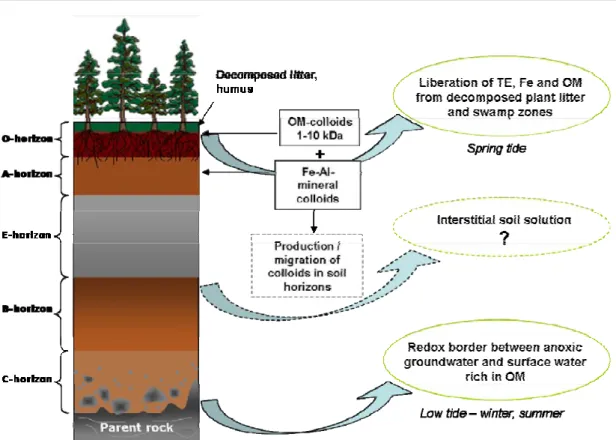
some podzols, the E horizon is absent, being either masked by biological activity or obliterated by disturbance. Podzols with little or no E horizon development are often classified as brown podzolic soils. The E horizon, which is usually 4-8 cm thick, is low in Fe and Al oxides and humus. It is found under a layer of surface organic material (acidic plant litter) undergoing the process of decomposition (O horizon which is usually 5-10 cm thick). Plant material decomposition releases organic acids that mix with carbonic acid in rainwater and then percolate into the soil in the form of small size organic molecules and colloids (1-10 kDa). In the underlying mineral layer these acids cause the dissolution of silicates, removing iron and aluminium thus forming mineral Fe-Al-colloids. Cation lixiviation in this horizon leads to bleaching, whereas OM-colloids of plant litter degradation transform into Fe-Al-OM-colloids and Fe-Al-OM-OM-colloids often identified in interstitial soil solutions (i.e., Pokrovsky et al., 2005a). It was shown recently (Lundström et al., 2000a) that very high concentrations of dissolved organically-complexed Fe and Al are present in the organic surface layer (O horizon) in podzols. Undergoing microbiological decomposition, mobile cations are washed out of the soil, but aluminium and in the lesser degree iron are accumulated in the underlying horizon together with humus thus producing aluminium-rich solid horizon (Al(OH)3)
and large-size organo-ferric colloids (Fe-OM). These colloids contribute significantly to the trace metal load of surface waters especially when they are flushed from the upper soil layers into the stream by rising water levels during spring flood and heavy rains (Andersson et al., 2006; Björkvald et al., 2008). Other possibility of colloids formation is a Fe-oxyhydroxide phase present in boreal streams and rivers, which is formed from anoxic groundwaters reaching surface waters during the low tide in winter and summer.
Podzols in Russia were first described by Dokuchaev V.V. in 1880, and then followed by Georgievsky (1888), Glinka (1932), Ponomareva (1964), Perelman (1974). Elsewhere, the formation of podzols was described in numerous reviews and books of European researchers (e.g., Muir, 1961; Anderson et al., 1982; Buurman, 1984; Righi and Chauvel, 1987; Lundström, 1993; Courchesne and Hendershot, 1997; Lundström et al., 2000a; Buurman and Jongmans, 2005).
In northern Europe, notably, in Sweden and Finland, a number of recent works addressed mineralogical and major and trace element composition, and provided the calculation of weathering losses of podzols and spodosols developed on granite-gneiss
Fig. 1.3. Schematic representation of a typical podzol soil of the boreal forest.
glacial moraine deposits typical for this zone (Olsson and Melkerud, 2000; Öhlander et al., 1996, 2003; Land et al., 1999a, 1999b, 2002; Giesler et al., 2000; Land and Öhlander, 2000; Melkerud et al., 2000; Tyler, 2004; Starr and Lindroos, 2006). In particular, Lundström et al. (2000b) reported results of a multidisciplinary study combining geochemical, mineralogical, micromorphological, microbiological, hydrochemical and hydrological investigations, aimed at testing existing theories on the formation of podzols and acquitting better understanding of the fundamental mechanisms of this process. Weathering release rates of heavy metals (Cd, Cu, Ni, Pb and Zn) were calculated for a Haplic podzol in eastern Finland by Starr et al. (2003). Clay mineralogy and chemical weathering of soils in a recently deglaciated environment in Arctic-Alpine Sweden were studied by Allen et al. (2001). Also, chemical and mineralogical composition of soils developed on hard (i.e., nepheline syenite, amphibolite, metamorphized diabase) rocks influenced by granitic moraine depositions in the NW Russia was recently reported by Lesovaya et al., 2008. However, there is still a lack of studies addressing the issue of the soil formation process on mafic rocks and
especially introducing a multidisciplinary approach (e.g., using mineralogical, chemical and isotope investigations).
1.1.6. Role of chemical weathering in elements transport to the oceans and
associated CO2 consumption
During two last decades, significant attention has been paid to study of major chemical composition of rivers with regard to the consumption of atmospheric CO2 by
chemical weathering of rocks. Chemical weathering of crustal rocks is considered to be one of the principal processes controlling the geochemical cycle of elements at the Earth surface (Viers et al., 2007). It controls the chemical and physical properties of the soil being the major chemical process by which soils are generated. Within the different reservoirs (continent, ocean, and atmosphere) chemical weathering is the major source of elements delivered by rivers to the oceans (Martin and Whitfield, 1983; Viers et al., 2007). This natural phenomenon involves consumption of atmospheric and/or endogenous carbon dioxide and metals leached from the rocks, these latter being released to rivers and shallow groundwaters and finally discharged into the ocean. Moreover, as chemical weathering consumes a greenhouse gas, it is likely to strongly influence the evolution of the Earth's climate over a long period of time.
Boreal regions can potentially play a major role in regulation of the CO2 content
in the atmosphere due to the chemical weathering of important surface of rocks and carbon sinks. Indeed, these zones have large territories of surfaces exposed to weathering and are covered both by organic-rich soils of the permafrost type and wetland zones which constitute an important sink of carbon (Botch et al., 1995). The circumpolar boreal biome7 is one of the world’s largest biomes, covering ~20*106 km2, which constitutes ~13% of the earth’s surface, and containing ~800 Pg (800*10-15 g) of arbon in biomass, detritus, soil, and peat carbon pools (Apps et al., 1993; Dixon et al., 1994).
7
Biome is a climatically and geographically defined area of ecologically similar climatic conditions such as communities of plants, animals, and soil organisms, and are often referred to as ecosystems. Major terrestrial biomes include tropical rain forest, northern coniferous forest, tundra, desert, grassland, savanna, and chaparral.
In order to acquire better understanding of the process of continental erosion and evolution of climate, numerous works on chemical weathering balance and consumption of CO2 have been conducted at the global scale (Berner et al., 1983; Meybeck, 1987;
Ludwig et al., 1998; Gaillardet et al., 1999; Dessert et al., 2003), as well as at the scale of large river basins like Amazon (Gaillardet et al., 1997) or Congo (Gaillardet et al., 1995), and small catchments (Zakharova et al., 2005, 2007).
Garrels and MacKenzie (1971) have shown that only silicate rock weathering consume the atmospheric CO2 during long-term carbon cycle. In this context, basic
rocks dominated watersheds are useful to investigate since, among the rocks of volcanic origin, they are particularly important for regulating the long-term CO2 cycle (Dessert et
al., 2003). Many previous works were dedicated to the estimation of mechanical erosion, chemical weathering rates and associated atmospheric CO2 consumption rates
for basaltic rocks using river chemical composition (Louvat and Allègre, 1997, 1998; Dessert et al., 2001; Pokrovsky et al., 2005b; Rad et al., 2006). The effect of basalt rock crystallinity, secondary minerals formation, rock age, vegetative/glacial cover, and runoff on fluxes of dissolved elements to the ocean in Southwest Iceland were thoroughly studied by Gislason et al. (1996) and Stefansson and Gislason (2001).
Karelia and Kola provinces (NW Russia) considered in the present work, offer a possibility of studying the weathering of the coexisting mafic (e.g., olivinite, gabbronorite) and felsic (e.g., gneiss, granite) rocks. The region is characterised by abundant presence of glacial moraine deposits. Different genetic moraine types of a similar composition for this region were determined in Finland, and their geochemistry, mineralogy and morphology were studied in several works (Peuraniemi, 1982; Peuraniemi et al., 1997 and references therein; Sarala, 2005), e.g., ground moraine, Rogen moraine, Pulju moraine, Sevetti moraine, Kianta moraine, De Geer moraine etc. according to the classification given by Hättestrand (1997). Land et al. (1999) and Land and Öhlander (2000) estimated chemical weathering and erosion rates of granitic till in northern Sweden, and Thorn et al. (2006) calculated weathering rates of surficial pebble in this zone. Also, Akselsson et al. (2006) studied the relations between elemental content in till, mineralogy of till and bedrock mineralogy in southern Sweden in order to find a mechanism that controls the mineralogical composition of till. However,
boreal zone, as well as soil formation process on these rocks, are still poorly documented in the literature.
Thus, the third part of the present work is aimed at improving our knowledge of weathering of mafic silicate rocks in boreal climate and peculiarities of the soil forming process over these rocks influenced by glacial moraine deposits, especially in view of the importance of this type of rocks in the atmospheric CO2 regulation. For this, we
used a multidisciplinary approach combining physico-chemical, isotopic and mineralogical investigations of rocks, soils and related surface waters.
1.2. Description of the region
1.2.1. Characteristics of the boreal zone
The study of pristine river geochemistry, apart of some undeveloped tropical regions and temperate areas of the southern hemisphere, has a tendency to be more and more limited to the subarctic regions. The boreal zone’s remoteness and harsh winter climate have led to much of it being sparsely populated by people. Although not completely isolated from anthropogenic influence, the subarctic environments are relatively pristine which is significant for the studies of basic biogeochemical mechanisms operating in the terrestrial biosphere.
Covering most of inland Russia (especially Siberia), Sweden, Finland, Norway, Alaska and Canada, as well as parts of the extreme northern continental United States, northern Kazakhstan and Japan (Fig. 1.4), the taiga or boreal forest is the world's largest terrestrial biome extending throughout the middle and high latitudes (from 55°N up to the North Pole Circle) (Sayre, 1994).
Taiga zone has a harsh continental climate with a very large temperature range between summer and winter varying from -50°C to 30°C throughout the whole year. Aside from the tundra and permanent ice caps, it is the coldest biome on Earth. The zone experiences relatively low precipitation throughout the year (300-850 mm annually on average), primarily as rain during the summer months, but also as fog and snow; as evaporation is also low for most of the year, precipitation exceeds evaporation and is sufficient for the dense vegetation growth (Sayre, 1994). The forests of the taiga are largely coniferous, dominated by larch, spruce, fir, and pine, but some broadleaf trees also occur, notably birch, aspen, willow, and rowan.
Fig. 1.4. Geographical distribution of the taiga zone (after the Köppen-Geiger climate classification world
map) corresponding to “Dfc” and “Dfd” zones (http://fr.wikipedia.org/wiki/Image:Taiga.png).
Rocks of the NW Russia boreal zone are very heterogeneous and presented by Archean granites, basalts, ultramafic rocks. Much of the area was glaciated about 10-15 thousand years ago. As the glaciers receded, they left depressions that have since filled with water, creating lakes and bogs (especially muskeg8 soil). Elsewhere the rocks are covered by granitic moraine released by glaciers in retreat.
Boreal soils tend to be geologically young and poorly developed varying in depth from 30-40 cm in the north to 60-85 cm in the south and mostly presented by podzols in the European zone. They tend to be acidic due to the decomposition of organic materials (e.g., plant litter) and either nutrient-poor or have nutrients unavailable because of low temperatures (Sayre, 1994).
1.2.2. Study site
The difficult and costly access to the Central and Eastern Russian Arctic has hampered progress in understanding the geochemistry of boreal zones. Hence, the more easy accessible small catchments of the White Sea basin are of interest since they may be representative of extensive zones of the Russian Arctic.
8
Muskeg is a soil type (also a peatland or wetland type called a bog) common in arctic and boreal areas. Muskeg itself consists of dead plants in various states of decomposition (i.e., peat), ranging from fairly
A part of the boreal region considered in this work is situated between latitudes 67°N and 63°N and longitudes 30°E and 36°E in North-Western part of Russia around the White Sea which constitutes a part of the Arctic Ocean. Sites where sampling campaigns were held are indicated on the map (Fig. 1.5). Several series of water, soil and rock samples were taken during extensive field campaigns in summer period around a mountain range Vetreny (Windy – in English) Belt (1) and in Paanajarvi national park around the Kivakka layered intrusion zone (2).
Fig. 1.5. Map of the White Sea with the studied Vetreny Belt paleorift zone (1) and Kivakka intrusion
zone (2).
Four main factors were determinant for choosing the sites:
• Small Karelian rivers can be representative of the extensive zones of the Russian Arctic;
• These zones due to their limited accessibility and absence of anthropogenic load can be considered as pristine with natural levels of elements concentrations in water and soil;
• Karelia and Kola provinces (NW Russia) offer a possibility of studying the weathering of the geographically coexisting mafic (e.g., olivinite, gabbro-norite, peridotite) and felsic (e.g., gneiss, granite) rocks;
• There is a strong geological and petrological background acquired by Russian colleagues of more than 20 years study of Vetreny Belt and Kivakka intrusions.
In the south-eastern part of the Baltic Shield, three large early Precambrian lithotectonic units are juxtaposed, comprising an Archean amphibolite-gneiss-migmatite and granite-greenstone unit and a Lower Proterozoic volcanic-sedimentary unit. The Archean units are volumetrically dominant. They constitute the Karelian granite-greenstone terrain, which occupies a total area of ca. 350,000 km2 (Puchtel et al., 1997). The area around one of the large belts, the early Proterozoic Vetreny Belt (~2.5 Ga, Puchtel et al., 1997), situated on the territory of Arkhangelsk and south-eastern Karelian regions and composed entirely of komatiitic basalts, is the subject of this study. The belt can be traced from Lake Vyg south-eastward over a distance of more than 250 km (Kulikov, 1988).
Another studied site is situated in the northern part of Karelia in Paanajarvi national park, eastern Baltic Shield. The Polar Circle is just several kilometers from its northern boundary. Paleoproterozoic layered intrusions (~2.5 Ga, Amelin and Semenov, 1996) and associated mafic dykes occurring within granitic gneisses are widespread over this zone. The considered in this study zone is situated around the Kivakka intrusion which belongs to the Olanga group of layered peridotite-gabbro-norite intrusions hosted by migmatized biotite and amphibole gneisses, granite-gneisses, and granodiorite-gneisses of Late Archean age (Bychkova et al., 2007). More detailed geomorphological description of the chosen sites is presented in corresponding chapters.
1.3. Objectives and scope of the study
This study is aimed at improving our understanding of the weathering processes of mafic silicate rocks and trace element speciation and migration in specific conditions of a boreal environment.
The main objectives of the study are:
1. To describe the partition of elements between basic and acid rocks and soils formed after the last glaciation period, and to characterize the mechanisms governing the chemical weathering and mineral formation in subarctic zone; 2. To recognize the factors responsible for the chemical composition of surface
water of boreal high latitude river basins and to assess the role of the rock lithology (granitic environment versus basaltic) in TE speciation and organo-mineral colloids formation;
3. To reveal the pH-dependence of TE speciation in order to predict possible changes in elements bioavailability in natural subarctic waters due to their acidification caused by local anthropic pressure or the global climate warming. The main originality of the thesis is to combine, for the first time on the same natural objects, the geochemical, isotope, physico-chemical and mineralogical techniques to better understand the factors that control biogeochemical cycling of elements in the subarctic region. It is anticipated that the knowledge gained in this study should provide a basis for a possible evaluation of the impact of climate warming on boreal environments.
1.4. Thesis organisation
The manuscript is composed of the main thesis based on publications, submitted or in preparation, addressing the above mentioned objectives, and the supplementary information which comprises several extended annexes presenting analytical results.
The principal part of the manuscript comprises four chapters considering the issue of geochemical behaviour and forms of migration of elements in subarctic zone, including a comparative study of chemical alteration process in basaltic versus granitic environments and its effect on chemical fluxes of elements in surficial fluids:
• Chapter 2: Chemical weathering of mafic rocks in boreal subarctic
environment (North-West Russia) under glacial moraine deposits. This
chapter is organised in form of a manuscript (Vasyukova et al., 2008a, in preparation) and aimed at studying geochemical migration and partition of major and trace elements between rock and soil reservoirs during chemical weathering