HAL Id: tel-02003025
https://tel.archives-ouvertes.fr/tel-02003025
Submitted on 1 Feb 2019
HAL is a multi-disciplinary open access
archive for the deposit and dissemination of
sci-entific research documents, whether they are
pub-lished or not. The documents may come from
teaching and research institutions in France or
abroad, or from public or private research centers.
L’archive ouverte pluridisciplinaire HAL, est
destinée au dépôt et à la diffusion de documents
scientifiques de niveau recherche, publiés ou non,
émanant des établissements d’enseignement et de
recherche français ou étrangers, des laboratoires
publics ou privés.
Construction of extended topological quantum field
theories
Marco de Renzi
To cite this version:
Marco de Renzi. Construction of extended topological quantum field theories. Geometric Topology
[math.GT]. Université Sorbonne Paris Cité, 2017. English. �NNT : 2017USPCC114�. �tel-02003025�
Université Sorbonne Paris Cité
Université Paris Diderot – Paris 7
École Doctorale de Sciences Mathématiques de Paris Centre
Institut de Mathématiques de Jussieu – Paris Rive Gauche
Thèse de Doctorat
Discipline : Mathématiques
Présentée par
Marco De Renzi
Construction of Extended
Topological Quantum Field Theories
Dirigée par Christian Blanchet
Soutenue le 27 octobre 2017 devant le jury composé de :
M
meAnna Beliakova
Universität Zürich
Examinatrice
M. Christian Blanchet
Université Paris Diderot
Directeur
M. Francesco Costantino
Université Toulouse III
Rapporteur
M. Louis Funar
Université Grenoble Alpes
Président
M. Azat Gainutdinov
LMPT
Examinateur
M. Christoph Schweigert Universität Hamburg
Examinateur
M. Alexis Virelizier
Université Lille 1
Examinateur
Absent lors de la soutenance :
Institut de Mathématiques de Jussieu – Paris Rive Gauche, UMR 7586
Université Paris Diderot – Paris 7 Bâtiment Sophie Germain
Boite Courrier 7012 75205 Paris Cedex 13
École Doctorale de Sciences Mathéma-tiques de Paris Centre, ED 386
Université Paris Diderot – Paris 7 Bâtiment Sophie Germain
Boite Courrier 7012 75205 Paris Cedex 13
There is no royal road to geometry. Euclid
Contents
Contents v Abstract ix Keywords ix Résumé x Mots-clés x Acknowledgements xi Introduction xiiiWhy are TQFTs interesting? xiii
What is a TQFT? xiv
A brief history of quantum topology xv
Pleasures and pains of semisimple theories xvi
Non-semisimple theories xvii
What is an Extended TQFT? xviii
Results xix
Préface xxi
Pourquoi les TQFTs sont-elles intéressantes ? xxi
Qu’est-ce qu’une TQFT ? xxii
Brève histoire de la topologie quantique xxiii
Joies et douleurs des théories semi-simples xxiv
Théories non semi-simples xxv
Qu’est-ce qu’une TQFT Étendue ? xxvi
Résultats xxvii
Chapter 1. Semisimple Extended Topological Quantum Field Theories 1
1.1. Introduction 1
1.1.1. Main results 1
1.1.2. Outline of the construction 2
1.1.3. Structure of the exposition 2
1.2. Modular categories 2
1.2.1. Ribbon categories 3
1.2.2. Colored ribbon graphs 4
1.2.3. Main definitions 7
1.3. Decorated cobordisms 10
1.3.1. 2-Category of decorated cobordisms 10
1.3.2. Extended universal construction for decorated cobordisms 12
1.4. Surgery axioms 13
1.5. Connection Lemma 16 1.6. Witten-Reshetikhin-Turaev invariants 18 1.7. Skein modules 19 1.8. Morita reduction 21 1.9. Monoidality 23 1.10. TQFT 28
1.11. Universal linear categories 33
1.12. Universal linear functors 34
1.12.1. 2-Discs 34
1.12.2. 2-Pants 36
1.12.3. Examples of computations 41
Chapter 2. Non-Semisimple Extended Topological Quantum Field Theories 43
2.1. Introduction 43
2.1.1. Main results 44
2.1.2. Outline of the construction 45
2.1.3. Structure of the exposition 46
2.2. Relative modular categories 47
2.2.1. Group structures and homogeneous colored ribbon graphs 47
2.2.2. Traces on ideals and ambidextrous objects 48
2.2.3. Group realizations 49
2.2.4. Main definitions 50
2.3. Admissible cobordisms 53
2.3.1. Group colorings on decorated cobordisms 53
2.3.2. 2-Category of decorated cobordisms 55
2.3.3. 2-Category of admissible cobordisms 59
2.3.4. Extended universal construction for admissible cobordisms 60
2.4. Surgery axioms 61
2.5. Connection Lemma 68
2.6. Costantino-Geer-Patureau invariants 74
2.7. Admissible skein modules 76
2.8. Morita reduction 78 2.9. Graded extensions 82 2.9.1. 2-Spheres 82 2.9.2. 3-Discs 87 2.9.3. 3-Pants 88 2.9.4. Suspension systems 95
2.9.5. Graded quantization 2-functors 96
2.10. Monoidality 98
2.11. Symmetry 101
2.12. Graded TQFT 102
2.13. Universal graded linear categories 111
2.14. Universal graded linear functors 116
2.14.1. 2-Discs 116 2.14.2. 2-Pants 119 2.14.3. 2-Cylinders 132 2.14.4. Examples of computations 135 2.14.4.1. Generic surfaces 136 2.14.4.2. Critical tori 137
CONTENTS vii
Appendix A. Algebraic appendices 139
A.1. Monoidal categories 139
A.2. Enriched categories 143
A.3. 2-Categories 146
A.4. Monoidal 2-categories 153
A.5. Complete linear categories 158
A.6. Complete graded linear categories 162
A.7. Extended universal construction 169
Appendix B. Topological appendices 173
B.1. Manifolds with corners 173
B.2. Collars 175 B.3. Gluing 176 B.4. Cobordisms 178 B.5. Ribbon graphs 183 B.6. Maslov index 186 Bibliography 195
Abstract
The central position held by Topological Quantum Field Theories (TQFTs) in the study of low dimensional topology is due to their extraordinarily rich structure, which allows for various interactions with and applications to questions of geo-metric nature. Ever since their first appearance, a great effort has been put into extending quantum invariants of 3-dimensional manifolds to TQFTs and Extended TQFTs (ETQFTs). This thesis tackles this problem in two different general frame-works. The first one is the study of the semisimple quantum invariants of Witten, Reshetikhin and Turaev issued from modular categories. Although the correspond-ing ETQFTs were known to exist for a while, an explicit realization based on the universal construction of Blanchet, Habegger, Masbaum and Vogel appears here for the first time. The aim is to set a golden standard for the second part of the thesis, where the same procedure is applied to a new family of non-semisimple quantum invariants due to Costantino, Geer and Patureau. These invariants had been pre-viously extended to graded TQFTs by Blanchet, Costantino, Geer an Patureau, but only for an explicit family of examples. We lay the first stone by introducing the definition of relative modular category, a non-semisimple analogue to modular categories. Then, we refine the universal construction to obtain graded ETQFTs extending both the quantum invariants of Costantino, Geer and Patureau and the graded TQFTs of Blanchet, Costantino, Geer and Patureau in this general setting.
Keywords
Extended TQFTs, Non-Semisimple Categories, Topological Quantum Field Theo-ries, Quantum Invariants, Modular CategoTheo-ries, 2-Categories
Résumé
La position centrale occupée par les Théories Quantiques des Champs Topologiques (TQFTs) dans l’étude de la topologie en basse dimension est due à leur structure extraordinairement riche, qui permet différentes interactions et applications à des questions de nature géométrique. Depuis leur première apparition, un grand effort a été mis dans l’extension des invariants quantiques de 3-variétés en TQFTs et en TQFT Étendues (ETQFTs). Cette thèse s’attaque à ce problème dans deux cadres généraux différents. Le premier est l’étude des invariants quantiques semi-simples de Witten, Reshetikhin et Turaev issus de catégories modulaires. Bien que les ET-QFTs correspondantes étaient connues depuis un certain temps, une réalisation explicite basée sur la construction universelle de Blanchet, Habegger, Masbaum et Vogel apparaît ici pour la première fois. L’objectif est de tracer la route à suivre dans la deuxième partie de la thèse, où la même procédure est appliquée à une nouvelle famille d’invariants quantiques non semi-simples due à Costantino, Geer et Patureau. Ces invariants avaient déjà été étendus en TQFTs graduées par Blan-chet, Costantino, Geer and Patureau, mais seulement pour une famille explicite d’exemples. Nous posons la première pierre en introduisant la définition de caté-gorie modulaire relative, un analogue non semi-simple aux catécaté-gories modulaires. Ensuite, nous affinons la construction universelle pour obtenir des ETQFTs gra-duées étendant à la fois les invariants quantiques de Costantino, Geer et Patureau et les TQFTs graduées de Blanchet, Costantino, Geer et Patureau dans ce cadre général.
Mots-clés
TQFTs Étendues, Catégories Non Semi-Simples, Théories Quantiques des Champs Topologiques, Invariants Quantiques, Catégories Modulaires, 2-Catégories
Acknowledgements
I have a long list of people I would like to thank for all the support I received during the long preparation of this work.
First of all, I would like to thank my supervisor, Christian Blanchet. There are many things I am grateful to him for. To begin with, the subject he proposed me is fascinating, and it matches incredibly well my interests and abilities. During these three years, thanks to his broad vision and to his deep understanding of the mathematics I was using, he was always capable, with few words, to clearly show me the right perspective to take on my work. Many times he addressed fundamental problems of my research in advance, and it sufficed to go back to the notes I took during our meetings to find the ideas I was looking for. He also constantly encouraged me to step out of my comfort zone in order to broaden my knowledge and develop a more complete understanding. He was always very supportive, he made sure I could talk about my research in front of people who cared for it, and he made it possible for me to find the collaborations that constitute my present work. He was also extremely effective in providing me with the chance to come to Paris in the first place. For all of this, I am deeply thankful to him.
I would like to thank my rapporteurs, François Costantino and Vladimir Tu-raev. Their inspiring research literally provided the basis for all the constructions I developed during my thesis, so heartfelt thanks are due for introducing me to the theories and to the problems I am studying now. I am further grateful for their thorough work in reading my manuscript, for the useful discussions we had about its form and content, and for the helpful and encouraging comments they provided. I would like to thank Anna Beliakova, Louis Funar, Azat Gainutdinov, Muriel Livernet, Christoph Schweigert, and Alexis Virelizier for accepting to take part in my PhD thesis defense as members of the jury. Their work was very important for my research, and I am honoured by their presence. I would like to warmly thank them for inviting me to Switzerland (many times), to Hamburg, and to Lille. I am also deeply grateful for the precious comments and advices they had for me during our discussions.
I would like to thank Nathan Geer and Bertrand Patureau, with whom I started a collaboration right after the completion of this thesis. They are extremely sup-portive, incredibly helpful, and extraordinarily nice, something which means a lot to me. I am learning a great deal from them, and at a much faster rate than ever before. I feel I am very lucky to have the chance to work with such accomplished researchers, whose constructions and discoveries I studied all along my PhD. I am also very grateful I got the chance to personally experience how much better it is to collaborate than to work on my own.
I would like to thank Jun Murakami for his support, for inviting me to Tokyo, for the time he dedicated to me while I was there, for the inspiring discussions we had and for his beautiful work in general.
I would like to thank Claire Lavollay, Sakina Madel-Kawami, Elodie Destre-becq, and Christine Le Sueur for assisting me countless times during these three years, always with a smile.
I would like to thank all the people that taught and organized the courses for which I was teaching assistant, for their guidance and help: Sami Abbes, Paul Laurain, Stéphane Vassout, Matteo Ruggiero, Jaouad Sahbani, Mathilde Herblot, and Patrick Simonetta. Thanks also to Hussein Mourtada for his work in the organisation of the PhD student seminar, for his kind comments and for his support. I would like to thank my former academic siblings Catherine, Hoël, Louis-Hadrien, and Lukas for advising me, discussing with me, welcoming me, for inviting me to Montpellier and to Genève, and for being so nice. I would like to thank my present academic siblings too, Cristina and Daniel, for all the time we spent together at conferences and workshops, and for our mutual support in these challenging times.
I would like to thank all my mathematician friends Jules, Léo, Maÿlis, Xavier, Fathi, Renaud, Ramanujan, Delphine, as well as those I met less frequently: Anne, Damien, Guillem, Julien, Mounir, Anthony, Livio. They all welcomed me when I came to France for the first time, and they showed great endurance during my stuttering first dialogues. They were all friends and family to me, they made it fun to attend even the most terrible talks, and I am sure they will continue to do so in the future.
I would like to thank all the office mates I had through these three years: Rémi, Reda, Zhengfang, Kai, Ana, Alice, Riwan, Colin. Thanks also to all the students of Paris 7: Vito, Valerio, Mauro, Joël, Juan Pablo, Jean-Michel, Esther, Sacha, Marco, Kevin, Antoine, Léa, Alexandre, and all the others. Our office was always a nice place to be, to have discussions about music, movies, football, politics, and maths.
I would like to thank all my friends that contributed to bring Italy to Paris: Sara, Annina, Mauro, Leo, Cinzia, Cecilia, David, Giulia, Marche, Matthew, Paola, Aurora, Béatrice, Lorenzo, Michele, Mattia. Thanks also to all my friends who spread Italy across Europe, and to those who stayed in Pisa, making our come-backs always feel like coming home: Fabio, Chiara, Tommaso, Stefano, Veronica, Costanza, Pietro, Luca, Danny, Stefano, Enrico, Fra, Luca, Giani. Despite all the fear I had of leaving Pisa three years ago, it is thanks to them that moving to Paris was no shock at all, and now I know we will all grow old together.
All my love goes to my family: my parents, my sister, my grandparents, my aunts and uncles, and my cousins. Their caring presence keeps my footing firm and makes me feel I’m home, even when I’m far away. To my grandfather Ennio, whom I miss very much, I dedicate this thesis.
Introduction
The main purpose of this thesis is to develop a general theory for the con-struction of non-semisimple Extended Topological Quantum Field Theories for the Costantino-Geer-Patureau quantum invariants of closed 3-manifolds defined in [CGP14]. This short chapter is intended to provide motivation for this work by outlining a rough overview of the domain and a brief introduction to its main concepts.
Why are TQFTs interesting?
The study of Topological Quantum Field Theories represents a paramount ex-ample of the fruitful interaction between physics and mathematics, and a rather exceptional one too: it proves that the domains do not interact exclusively when mathematical theories are used as a tool in order to approach problems or to con-struct models of physical interest. Indeed, the converse happens as well: physics can be an outstanding propeller for new ideas in mathematics. This is exactly what happened with quantum topology, a mathematical discipline which stemmed from some groundbreaking discoveries in theoretical physics. By now Topological Quan-tum Field Theories, often abbreviated to the acronym TQFT, have taken a life of their own within the boundaries of pure mathematics. It is even possible to work on related research themes while knowing little or nothing of the physical concepts that brought the subject into being. It is however fascinating to think that this beautiful and elegant mathematical theory was inspired by physics, and that some of the deepest questions and conjectures in the field are still provided by physical insight.
Before setting out to explain what quantum topologists mean by TQFTs, which is often different, at least on the level of terminology, from what theoretical physi-cists mean, let us try to answer a more fundamental question: why should we care about them? We begin with what is arguably the most naïve motivation: TQFTs provide numerical invariants for closed manifolds, called quantum invari-ants, which enjoy good locality properties. In other words, in order to compute their global value on a complicated closed manifold we can cut the latter along codimension 1 submanifolds and we can then recombine the data assigned to the simpler pieces obtained. In particular, it is sufficient to understand quantum in-variants in local settings where the topology is simpler. This is a highly valuable feature, as powerful topological invariants tend to be hard to explicitly compute in general. Now, to be honest, it should not be thought that people actually build TQFTs in order to obtain invariants for closed manifolds, at least not in dimen-sion 3. Indeed, for what concerns all of the constructions treated in this thesis, this picture would be misleading. Most of the time we start with some numerical invariant of closed manifolds we already know, and then we try to extend it to a
TQFT, which is not necessarily an easy job. If we succeed in doing so, then we can understand how local behaviours determine global ones, thus highly improving the computability features of the invariant we started with. At any rate, the production of closed manifold invariants is probably not the real reason people try to construct TQFTs. Their true appeal lies in the richness of their structure, a feature which allows for a number of interactions with and applications to questions of geometric nature. The better known of them, at least in low dimensional topology, is the study of Mapping Class Groups of surfaces. These elementary algebraic structures are very easy to define and, at the same time, extraordinarily hard to understand, with many open questions about them being active research themes. One of the most famous conjectures in the field concerns their linearity, that is the existence of faithful representations. Since in general Mapping Class Group representations are quite hard to construct, every machinery that produces them is extremely helpful in the investigation. This makes 3-dimensional TQFTs highly attractive as they naturally induce representations of Mapping Class Groups of surfaces, called quan-tum representations, which are among the most effective tools at our disposal in order to tackle these kinds of problems.
What is a TQFT?
We have already mentioned Topological Quantum Field Theories in several places, but we have not yet given a precise definition. This is because the mathe-matical formalisation of the concept has a rather abstract flavor, and it is therefore natural, at first glance, to wonder why we should even consider such a notion.
In extremely concise terms, a TQFT is a symmetric monoidal functor from a cobordism category to a linear category. For the 3-dimensional theory, to which we will exclusively confine for this thesis, it involves associating a vector space with every closed surface in such a way that the topological operation of dis-joint union of surfaces corresponds to the algebraic operation of tensor product of vector spaces. At the same time, a 3-dimensional TQFT associates with every 3-dimensional cobordism between closed surfaces a linear map between the corre-sponding vector spaces in such a way that the topological operation of gluing of cobordisms is translated to the algebraic operation of composition of linear maps. This means that by realizing a closed 3-manifold as the gluing of a finite family of cobordisms we can compute its invariant as the composition of the corresponding linear maps. It also means that TQFTs can be used for constructions which were completely out of the reach of numerical invariants of closed 3-manifolds. For in-stance, it is thanks to the rich structure provided by vector spaces and linear maps that quantum representations of Mapping Class Group can be obtained.
The definition of TQFT provided here is essentially due to Atiyah. It was first published in his 1988 paper [A88] and it was inspired by an analogue set of axioms for Conformal Field Theories which had been previously proposed by Segal in [S88]. However, as it often happens, the concept had already been considered before the scientific community agreed on its actual definition. It made its first appearance in a 1978 paper [S78] by Schwarz, where quantum field theories whose dynamics is independent of the metric were first discussed. The first family of examples was constructed only ten years later, and at the physical level of rigor, by Witten, but in order to understand its importance we first need to outline a rough historical overview of the events leading to this discovery.
A BRIEF HISTORY OF QUANTUM TOPOLOGY xv
A brief history of quantum topology
For a long time the only known polynomial invariant of knots was the Alexan-der polynomial. Its definition, which first appeared in the 1928 paper [A28] by Alexander, is derived from the homology of the infinite cyclic cover of the knot complement. In particular, its geometric interpretation is rather clear, as its con-struction allows for a concrete intuition of the topological properties it measures. This means its limits are also well understood: for instance, a knot and his mirror image always share the same Alexander polynomial. For more than sixty years all the polynomial invariants of knots that were discovered were systematically proven to boil down to some renormalization of the Alexander polynomial.
In 1985 a short paper [J85] by Jones introduced what is now known as the Jones polynomial. This discovery started a small revolution in knot theory. Indeed, an early computation by Jones and Birman shows that this invariant is not yet another version of the Alexander polynomial, as it distinguishes the left trefoil from the right trefoil. The definition, which is based on representations of braid groups in Von Neumann algebras, makes it hard to understand what topological properties of knots are detected, and to this day we are still missing a geometric interpretation. On the other hand, thanks to skein calculus, the Jones polynomial turns out to be rather easy to compute and quite a powerful invariant. For instance, whether or not it is capable of detecting the unknot is still an open question.
The mysterious nature of the Jones polynomial is the main reason topolo-gists were so excited when in 1989 a theoretical physics paper [W89] by Witten showed the world an unexpected manifestation of this knot invariant in the con-text of quantum field theory. Indeed, the birth of the domain known today as quantum topology can probably be traced back to this event. Witten constructed a new family of invariants of closed 3-manifolds which recovered and generalized the Jones polynomial, and at the same time he predicted these invariants should be understood as part of a richer structure provided by a family of TQFTs. His construction made use of Feynman’s path integral, a tool which has not yet been formalized on a mathematical level. More precisely, Witten’s definition involves fixing a closed 3-manifold and integrating the Chern-Simons functional over the whole infinite-dimensional space of connections on its tangent bundle. Since it is not clear what sense should be made of a measure on such space, the mathematical foundations of this approach are rather shaky. The insight it provides however is remarkable, as many open conjectures about these 3-manifold invariants are in-spired by the original construction. Witten remains to date the only physicist to have ever been awarded the Fields medal, a sign that his talents for mathematics are widely acknowledged.
This thrilling discovery sparked the interest of topologists in quantum field the-ory, and many of them set out to try and formalize Witten’s results. Reshetikhin and Turaev were the first who managed to produce a rigorous, although completely different, construction of Witten’s family of 3-manifold invariants. Shortly after-wards Turaev succeeded in completing Witten’s program by extending these invari-ants through the construction, in a very general setting, of the family of TQFTs known today as Witten-Reshetikhin-Turaev. His work is what we call in this thesis the semisimple theory, and in Chapter1we entirely rephrase it in order to set the golden standard for its non-semisimple generalization.
Pleasures and pains of semisimple theories
Although, as we mentioned earlier, TQFTs are not that easy to build, the first and most famous family of examples comes in several different incarnations. The existence of various interpretations for it is an essential feature of the semisimple theory which ensure connections with many areas of mathematics. It allows indeed for the study of related questions under different perspectives and it makes room for the use of diverse techniques in order to reach deep results. Here is a non-exhaustive list of the main different realizations of the Witten-Reshetikhin-Turaev family of quantum invariants and TQFTs:
(i ) The original construction was performed by Witten in his 1988 paper [W88]. Although its mathematical basis is not firm, its main advantage lies in the unique insight it provides. An example of the deep open questions which are inspired by this approach is Witten’s asymptotic conjecture, the prediction of a relation between a certain limit stated in terms of Witten-Reshetikhin-Turaev quantum invariants and some expression involving classical invariants such as Reidemeister torsions, Chern-Simons invariants and the spectral flow of representations of the fundamental group.
(ii ) The first rigorous construction was obtained by Reshetikhin and Turaev in their 1991 paper [RT91], for what concerns quantum invariants, and by Turaev in his 1994 book [T94], for what concerns TQFTs. Their ap-proach is based on the semisimple representation theory of the restricted version of the quantum group of sl2 at roots of unity. Its rather
alge-braic flavor makes it the best suited for generalizations. Indeed, all of the constructions which will be central to this thesis are derived from this version of the theory.
(iii ) In their 1992 paper [BHMV92] Blanchet, Habegger, Masbaum and Vogel delivered a completely combinatorial construction of these quan-tum invariants, which they extended to TQFTs in their 1995 paper [BHMV95]. Their definition relies on the bracket polynomial intro-duced by Kauffman in [K87]. The advantage of this approach is that it makes computations easier by translating them into a problem of skein calculus. They are also to be credited with the introduction of the uni-versal construction, a very general machinery on which all of the results in this thesis will heavily rely.
(iv ) More recently, in a series of paper which culminated with [AU15], An-dersen and Ueno gave a geometric interpretation of the previous construc-tions which allows for the use of analytic methods in order to approach a number of open questions like the Andersen-Masbaum-Ueno conjecture on the dynamics of diffeomorphisms of surfaces. An example of the deep results within the reach of geometric techniques is given by the asymp-totic faithfulness of Mapping Class Group representations established by Andersen in [A06].
As it is witnessed by the previous list, Witten-Reshetikhin-Turaev quantum invari-ants and TQFTs have been studied extensively since their first appearance. In fact, they provide a very active research theme to this day. Although much more remains to be discovered, certain weaknesses of this family of examples are already known:
NON-SEMISIMPLE THEORIES xvii
(i ) There exist infinite families of pairs of inequivalent closed 3-manifolds which cannot be distinguished by the Witten-Reshetikhin-Turaev quan-tum invariants. Examples are provided by pairs of lens spaces which are homotopically equivalent but not homeomorphic.
(ii ) Quantum representations of Mapping Class Groups induced by Witten-Reshetikhin-Turaev TQFTs are never faithful. In particular Dehn twists along simple closed curves always act on TQFT vector spaces of closed surfaces with finite order.
(iii ) In general the theory is not well-suited to treat certain fundamental ques-tions. An example is provided by the volume conjecture first proposed by Kashaev in [K97] and later generalized by Murakami and Murakami in [MM01] and by Murakami, Murakami, Okamoto, Takata and Yokota in [MMOTY02]. In its complex form, it consists in the prediction of a relation between some expression involving the hyperbolic volume of the complement of a hyperbolic link, together with its Chern-Simons invari-ant, and a certain limit stated in terms of the Jones polynomials colored with the Steinberg representations of quantum sl2. Since the latter are
not featured in the construction of Reshetikhin and Turaev, certain as-pects of these questions are out of the reach of semisimple quantum invariants.
Non-semisimple theories
In the algebraic construction by Reshetikhin and Turaev there is substantial room for improvement, as only small semisimple quotients of representation cate-gories of quantum sl2 enter the picture. We could hope to obtain more powerful
quantum invariants and TQFTs by adapting their machinery in order to take into account also non-semisimple parts of categories of representations. This has been done quite early, most notably in the 1996 paper [H96] by Hennings and in a series of publications by Kerler and Lyubashenko which culminated in their joint 2001 book [KL01]. These constructions of non-semisimple quantum invariants and TQFTs would deserve to be discussed at lenght, but we will not focus on them in this thesis. We just point out that non-semisimple Hennings invariants vanish on all closed 3-manifolds with positive first Betti number and that Kerler-Lyubashenko TQFTs are defined only for connected surfaces. In particular, though it is extremely interesting, this version of the non-semisimple theory still has some weaker points. What was probably lacking from earlier attempts at producing powerful non-semisimple constructions is the theory of traces on ideals which was developed by Geer and Patureau through a number of collaborations with Turaev, Kujawa and Virelizier. This body of work constitutes the ground on which more recent non-semisimple constructions have been erected. In their 2014 paper [CGP14] Costantino, Geer and Patureau defined a new family of quantum invariants of closed 3-manifolds of Witten-Reshetikhin-Turaev type which are based on the non-semisimple representation theory of the unrolled version of quantum sl2. In their
2017 paper [BBG17] Beliakova, Blanchet and Geer defined, in the case of restricted quantum sl2, a logarithmic version of Hennings’ invariants which integrates the new
technology of traces on ideals into the construction.
This thesis builds on the first of these two works. Indeed, TQFTs extending the Costantino-Geer-Patureau invariants in the case of quantum sl2 have already been
defined in [BCGP16] by Blanchet, Costantino, Geer and Patureau, and a series of remarkable properties, which mark a sharp contrast with the Witten-Reshetikhin-Turaev theory, have been established:
(i ) The Costantino-Geer-Patureau quantum invariants are strictly finer than the Witten-Reshetikhin-Turaev ones. Indeed, they recover various classi-cal invariants such as the Reidemeister torsion, which naturally appears in a standard normalization. This allows to recover the whole classifica-tion of lens spaces.
(ii ) All of the quantum representations of Mapping Class Groups induced by the Blanchet-Costantino-Geer-Patureau TQFTs have unprecedented behaviours, with Dehn twists along non-separating simple closed curves always acting with infinite order. In particular, nothing is known to be in the kernels of these representations, as all diffeomorphisms which were there in the semisimple theory no longer are.
(iii ) The inclusion of Steinberg representations of quantum sl2, also known
as Kashaev colors, into the construction makes it possible to use these quantum invariants and TQFTs in order to extend the volume conjecture to links in arbitrary manifolds and to prove it for an infinite family of examples.
What is an Extended TQFT?
What this thesis actually deals with is the construction of Extended TQFTs, which will be often abbreviated with the acronym ETQFT. The idea is that, just like invariants of closed manifolds, TQFTs may be hard to compute in general. One thing we could try to do then is to localize them also in their codimension 1 parts. This means extending their definition so to allow computations of vector spaces associated with codimension 1 submanifolds to be made by cutting the latter along codimension 2 submanifolds and then recombining the data assigned to the various simpler pieces obtained. In the same abstract terms used before, an ETQFT can then be defined as a symmetric monoidal 2-functor from a cobordism 2-category to a linear 2-category. The possible targets this time are many, and different choices can give rise to slightly different theories. For the purpose of this thesis we may think of a 3-dimensional ETQFT as associating a complete linear category with every closed 1-manifold, a linear functor with every 2-dimensional cobordism and a natural transformation with every 3-dimensional cobordism with corners.
In what sense does the above notion do the job we introduced it for in the first place? Well, exactly in the same way TQFTs provided the analogue service for quantum invariants. Indeed, computing the quantum invariant of a closed 3-manifold by means of a TQFT amounts to do the following: we start by interpreting the closed 3-manifold as a cobordism between two copies of the empty surface. Then the TQFT associates with it a linear endomorphism of a certain vector space which, as a consequence of monoidality, is isomorphic to the base field, the unit for the tensor product of vector spaces. Such a map is just a product with some fixed number, which we can interpret as the quantum invariant of the closed 3-manifold. This idea directly generalizes to the extended setting. Indeed, if we want to compute the TQFT vector space of a closed surface by means of an ETQFT, the procedure is the same: we start by interpreting the closed surface as a cobordism between two copies of the empty 1-manifold. Then the ETQFT associates with it a linear
RESULTS xix
endofunctor of a certain linear category which, as a consequence of monoidality, is equivalent to the category of finite-dimensional vector spaces, the unit for the tensor product of complete linear categories. Such a functor is equivalent to a tensor product with some fixed vector space, which we can interpret as the TQFT vector space of the closed surface. In particular, hidden behind the higher structure of a symmetric monoidal 2-functor, we still have a recipe which associates a complex number with every closed 3-manifold and a vector space with every closed surface.
Results
It has been known for a while that Witten-Reshetikhin-Turaev TQFTs extend to ETQFTs. In fact, all semisimple ETQFTs have been classified by Bartlett, Douglas, Schommer-Pries and Vicary in their 2015 paper [BDSV15]. Once again, there are several ways of constructing all of these ETQFTs. In Chapter1we present a completely general and explicit recipe for doing so which mixes two of the classical approaches: the algebraic formalism of Turaev, and the universal construction of Blanchet, Habegger, Masbaum and Vogel. None of the results contained in this first part of the thesis is original, but we provide a detailed construction all the same in order to chart a course we will later follow while trying to develop an analogous theory in the previously unexplored non-semisimple setting. The two key algebraic structures introduced by Turaev which allow for the implementation of the whole procedure are non-degenerate pre-modular categories and modular categories. A non-degenerate pre-modular category is precisely what is needed, in the most general version of the theory, in order to obtain an associated Witten-Reshetikhin-Turaev quantum invariant. A modular category is just a pre-modular category satisfying a strong non-degeneracy condition which implies the weaker one required to construct closed 3-manifold invariants. The main result then is that the Witten-Reshetikhin-Turaev quantum invariant associated with a modular category extends to an ETQFT. We can even give a combinatorial description of this ETQFT and a meaningful interpretation of its various components in terms of algebraic structures on the modular category at use.
In Chapter 2we play the same game, but starting from the Costantino-Geer-Patureau quantum invariants. This time we implement the universal construction of Blanchet, Habegger, Masbaum and Vogel in the context of the algebraic formal-ism introduced by Costantino, Geer and Patureau. Results in this second half of the thesis are new, and they combine to provide a very general theory for the pro-duction of non-semisimple ETQFTs. The key algebraic structures underlying the construction of Costantino-Geer-Patureau quantum invariants are non-degenerate relative pre-modular categories. We should think of these categories as some sorts of non-semisimple analogues to the building blocks for Witten-Reshetikhin-Turaev quantum invariants. Our first contribution is the identification of the new concept of relative modular category, an algebraic structure which will play the role of mod-ular categories in this non-semisimple setting. Our main result can be then stated as follows:
Theorem. The Costantino-Geer-Patureau quantum invariant associated with a relative modular category extends to a graded ETQFT.
In order to build these graded ETQFTs we have to construct 2-categories of cobordisms whose decorations involve cohomology classes. We point out that this
time the theory is significantly more complicated, as the procedure we implemented in the semisimple setting does not directly produce an ETQFT. Indeed, we face obstructions to monoidality, and the strategy to tackle them will be to refine the universal construction by integrating them into its structure. This phenomenon is responsible for the appearance of gradings in this non-semisimple version of the theory. Finally, a combinatorial description and a meaningful interpretation of the various components can be derived for this graded ETQFT in complete analogy with the semisimple case, although some of the explicit characterizations this time are decidedly more complicated.
Préface
Le but principal de cette thèse est de développer une théorie générale pour la construction de Théories Quantiques des Champs Topologiques Étendues non semi-simples pour les invariants quantiques de Costantino-Geer-Patureau de 3-variétés fermées définis dans [CGP14]. Ce court chapitre est consacré à motiver ce tra-vail en esquissant une vue d’ensemble du domaine et une brève introduction à ses principaux concepts.
Pourquoi les TQFTs sont-elles intéressantes ?
L’étude des Théories Quantiques des Champs Topologiques représente un écla-tant exemple de l’interaction fructueuse entre la physique et les mathématiques qui est plutôt exceptionnel : il prouve que les domaines n’interagissent exclusivement lorsque des théories mathématiques sont utilisées comme outil pour aborder des pro-blèmes ou pour construire des modèles d’intérêt physique. En effet, le phénomène inverse se produit aussi : la physique peut être un propulseur exceptionnel pour de nouvelles idées en mathématiques. C’est exactement ce qui s’est produit avec la topologie quantique, une discipline mathématique née à partir de découvertes révolutionnaires en physique théorique. Maintenant, les Théories Quantiques des Champs Topologiques, souvent abrégées par l’acronyme TQFT, ont évolué en des concepts autonomes en mathématiques fondamentales. Il est même possible de tra-vailler sur des thèmes de recherche connexes tout en connaissant peu ou pas les concepts physiques qui ont amené à la naissance le sujet. C’est pourtant fascinant de penser que cette belle et élégante théorie mathématique a été inspirée de la phy-sique et que certaines des questions les plus profondes et des conjectures les plus importantes du domaine sont toujours inspirées par une compréhension physique.
Avant d’expliquer ce que les topologues quantiques entendent par TQFT, qui est souvent différent, au moins sur le plan de la terminologie, de ce que les physi-ciens théoriques entendent, essayons de répondre à une question plus fondamentale : pourquoi devrions-nous nous en préoccuper ? Nous commençons par ce qui est sans doute la motivation la plus naïve : les TQFTs produisent des invariants numériques pour les variétés fermées, appelés invariants quantiques, qui satisfont de bonnes propriétés de localité. En d’autres termes, afin de calculer leur valeur globale sur une variété fermée compliquée, nous pouvons couper cette dernière le long de sous-variétés de codimension 1 et nous pouvons ensuite recombiner les données associées aux morceaux plus simples obtenues. En particulier, il suffit de comprendre les invariants quantiques dans des contextes locaux où la topologie est plus simple. Cette caractéristique est très précieuse, d’autant plus que les invariants topolo-giques puissants ont tendance à être difficiles à calculer explicitement en général. Or, pour dire vrai, il ne faut pas penser que les gens construisent des TQFTs afin d’obtenir des invariants pour les variétés fermées, au moins pas en dimension 3.
En effet, pour ce qui concerne toutes les constructions traitées dans cette thèse, cette image serait trompeuse. La plupart du temps, on commence avec un invariant numérique des variétés fermées qu’on connaît déjà, puis on essaie de l’étendre en une TQFT, ce qui n’est pas nécessairement facile. Si nous arrivons à le faire, nous pouvons comprendre comment les comportements locaux déterminent les compor-tements globaux, améliorant ainsi considérablement les propriétés de calculabilité de l’invariant de départ. En tout cas, la production d’invariants des variétés fermées n’est probablement pas la vraie raison pour laquelle les gens essaient de construire des TQFTs. Leur véritable attrait réside dans la richesse de leur structure, une caractéristique qui permet un certain nombre d’interactions et d’applications à des questions de nature géométrique. La plus connue d’entre elles, au moins en topo-logie en basse dimension, est l’étude des Mapping Class Groups de surfaces. Ces structures algébriques élémentaires sont très faciles à définir et, en même temps, extraordinairement difficiles à comprendre, avec beaucoup de questions ouvertes à ce sujet qui constituent des thèmes de recherche actifs. L’une des conjectures les plus célèbres dans le domaine concerne leur linéarité, c’est à dire l’existence de représentations fidèles. Puisque, en général, les représentations des Mapping Class Groups sont assez difficiles à construire, toutes les machines qui les produisent sont extrêmement utiles dans l’enquête. Cela rend les TQFTs de dimension 3 très inté-ressantes car elles produisent naturellement des représentations des Mapping Class Groupes de surfaces, appelées représentations quantiques, qui sont parmi les outils les plus efficaces à notre disposition pour s’attaquer à ces types de problèmes.
Qu’est-ce qu’une TQFT ?
Nous avons déjà mentionné les Théories Quantiques des Champs Topologiques à plusieurs endroits, mais nous n’avons pas encore donné une définition précise. C’est parce que la formalisation mathématique du concept a une saveur plutôt abstraite, et il est donc naturel, à première vue, de se demander pourquoi on devrait même considérer une telle notion.
En termes extrêmement concis, une TQFT est un foncteur monoïdal symétrique d’une catégorie de cobordisme vers une catégorie linéaire. Pour ce qui concerne la théorie en dimension 3, à laquelle nous allons nous restreindre dans cette thèse, il s’agit d’associer un espace vectoriel à chaque surface fermée de telle sorte que l’opé-ration topologique d’union disjointe de surfaces correspond à l’opél’opé-ration algébrique de produit tensoriel d’espaces vectoriels. Au même temps, une TQFT en dimension 3 associe à chaque cobordisme de dimension 3 entre surfaces fermées une applica-tion linéaire entre les espaces vectoriels correspondants de telle sorte que l’opéraapplica-tion topologique de recollement de cobordismes soit traduite dans l’opération algébrique de composition d’applications linéaires. Cela signifie que, en réalisant une 3-variété fermée comme le recollement d’une famille finie de cobordismes, nous pouvons calcu-ler son invariant comme la composition des applications linéaires correspondantes. Cela signifie également que les TQFTs peuvent être utilisés pour des constructions qui étaient totalement hors de portée des invariants numériques de 3-variétés fer-mées. Par exemple, c’est grâce à la riche structure fournie par les espaces vectoriels et les applications linéaires que les représentations quantiques des Mapping Class Groups peuvent être obtenues.
BRÈVE HISTOIRE DE LA TOPOLOGIE QUANTIQUE xxiii
La définition de TQFT fournie ici est essentiellement due à Atiyah. Elle a été publiée pour la première fois dans son article daté de 1988 [A88] et elle a été inspi-rée par un ensemble analogue d’axiomes pour les Théories Conformes des Champs qui avait déjà été proposé par Segal dans [S88]. Cependant, comme cela arrive sou-vent, le concept avait déjà été considéré avant que la communauté scientifique ne se mette d’accord sur sa définition. Il a fait sa première apparition en 1978 dans un article de Schwarz [S78], où des théories quantiques des champs dont la dynamique est indépendante de la métrique ont été discutées pour la première fois. La pre-mière famille d’exemples a été construite seulement dix ans plus tard, et au niveau physique de la rigueur, par Witten, mais pour comprendre son importance, il faut d’abord donner un aperçu historique des événements menant à cette découverte.
Brève histoire de la topologie quantique
Pendant longtemps, le seul invariant polynomial des nœuds connu était le po-lynôme d’Alexander. Sa définition, qui est apparue pour la première fois en 1928 dans l’article d’Alexandre [A28], est dérivé de l’homologie du revêtement cyclique infinie du complément du nœud. En particulier, son interprétation géométrique est assez claire, car sa construction permet une intuition concrète des propriétés topologiques qu’il mesure. Cela signifie également que ses limites sont bien com-prises : par exemple, un nœud et son image miroir partagent toujours le même polynôme d’Alexander. Pendant plus de soixante ans, chaque découverte d’un nou-veau invariant polynomial des nœuds a été systématiquement démontré aboutir à une renormalisation du polynôme d’Alexander.
En 1985, un court article [J85] de Jones a introduit ce qu’on appelle maintenant le polynôme de Jones. Cette découverte a déclenché une petite révolution dans la théorie des nœuds. En effet, un calcul de Jones et Birman a montré tout de suite que cet invariant n’était pas une autre version du polynôme d’Alexander, car il arrive a distinguer le trèfle gauche du trèfle droit. La définition, qui est basé sur des représentations des groupes de tresses dans des algèbres de Von Neumann, rend difficile de comprendre quelles propriétés topologiques des nœuds sont détectées et, à ce jour, nous n’avons encore pas trouvé une interprétation géométrique. D’autre part, grâce aux relations d’écheveaux, le polynôme de Jones s’avère être plutôt facile à calculer et assez puissant comme invariant. Par exemple, la question de comprendre s’il est capable de détecter le nœud trivial reste encore ouverte.
La nature mystérieuse du polynôme de Jones est la raison principale de l’enthou-siasme qui s’est diffusé parmi les topologues lorsque, en 1989, un article de physique théorique de Witten [W89] a montré au monde une manifestation inattendue de cet invariant des nœud dans le contexte de la théorie quantique des champs. En effet, la naissance du domaine connu aujourd’hui sous le nom de topologie quan-tique peut être probablement remonté à cet événement. Witten a construit une nouvelle famille d’invariants des 3-variétés fermées qui retrouvent et généralisent le polynôme de Jones, et en même temps il a prédit que ces invariants devraient être compris comme faisant partie d’une structure plus riche fournie par une famille de TQFTs. Sa construction utilisait l’intégrale de chemin de Feynman, un outil qui n’a pas encore a été formalisé au niveau mathématique. Plus précisément, la défini-tion de Witten consiste à fixer une 3-variété fermée et à intégrer la foncdéfini-tionnelle de Chern-Simons sur l’espace de dimension infinie des connexions sur son fibré tangent. Comme il n’est pas clair quel sens doit être fait d’une mesure sur un tel espace, les
fondements mathématiques de cette approche sont plutôt fragiles. Le point de vue qu’il fournit cependant est remarquable, car de nombreuses conjectures ouvertes à propos de ces invariants des 3-variétés s’inspirent de la construction originale. Witten reste à ce jour le seul physicien à avoir reçu la médaille Fields, signe que ses talents pour les mathématiques sont largement reconnus.
Cette découverte passionnante a suscité l’intérêt des topologues dans la théorie quantique des champs, et beaucoup d’entre eux ont entrepris d’essayer de forma-liser les résultats de Witten. Reshetikhin et Turaev ont été les premiers qui ont réussi à produire une construction rigoureuse, bien que complètement différente, de la famille d’invariants des 3-variétés de Witten. Peu de temps après, Turaev a réussi à compléter le programme de Witten en étendant ces invariants à travers la construction, dans un cadre très général, de la famille de TQFTs connue aujour-d’hui comme de Witten-Reshetikhin-Turaev. Son travail est ce que nous appelons dans cette thèse la théorie semi-simple. Dans le Chapitre 1 nous allons présenter une reformulation de ces résultats afin de tracer la route pour leur généralisation non semi-simple.
Joies et douleurs des théories semi-simples
Bien que, comme nous l’avons mentionné plus tôt, les TQFTs ne soient pas faciles à construire, la première et la plus célèbre famille d’exemples se présente dans plusieurs incarnations différentes. L’existence d’interprétations diverses est une caractéristique essentielle de la théorie semi-simple qui assure connexions avec de nombreux domaines des mathématiques. Elle permet en effet d’étudier des questions connexes sous différentes perspectives et elle permet de recourir à des techniques variées afin d’atteindre des résultats profonds. Voici une liste non exhaustive des principales réalisations différentes de la famille d’invariants quantiques et de TQFTs de Witten-Reshetikhin-Turaev :
(i ) La construction originale a été réalisée en 1988 par Witten dans son article [W88]. Bien que sa base mathématique ne soit pas ferme, son principal avantage réside dans la perspective unique qu’elle fournit. Un exemple des questions profondes ouvertes qui s’inspire de cette approche est la conjecture asymptotique de Witten, la prédiction d’une relation entre une limite exprimée en termes des invariants quantiques de Witten-Reshetikhin-Turaev et une certaine expression impliquant des invariants classiques tels que la torsion de Reidemeister, les invariants de Chern-Simons et le flot spectral des représentations du groupe fondamental. (ii ) La première construction rigoureuse a été obtenue en 1991 par
Reshe-tikhin et Turaev dans leur article [RT91], pour ce qui concerne les in-variants quantiques, et en 1994 par Turaev dans son livre [T94], pour ce qui concerne les TQFTs. Leur approche est basée sur la théorie semi-simple de représentation de la version restreinte du groupe quantique de sl2 aux racines de l’unité. Sa saveur plutôt algébrique le rend le mieux
adapté aux généralisations. En effet, toutes les constructions au centre de cette thèse sont dérivées de cette version de la théorie.
(iii ) Dans leur article daté de 1992 [BHMV92] Blanchet, Habegger, Mas-baum et Vogel ont livré une construction entièrement combinatoire de ces invariants quantiques, qu’ils ont étendus en TQFTs dans leur article
THÉORIES NON SEMI-SIMPLES xxv
daté de 1995 [BHMV95]. Leur définition repose sur le polynôme du cro-chet introduit par Kauffman dans [K87]. L’avantage de cette approche est qu’il rend les calculs plus faciles en les traduisant en un problème de calcul d’écheveaux. Ils sont également à créditer pour l’introduction de la construction universelle, une procédure très générale de laquelle tous les résultats de cette thèse dépendront fortement.
(iv ) Plus récemment, dans une série d’articles qui ont abouti à [AU15], An-dersen et Ueno ont donné une interprétation géométrique des construc-tions précédentes qui permet l’utilisation de méthodes analytiques pour aborder un certain nombre de questions ouvertes comme le Conjecture Andersen-Masbaum-Ueno sur la dynamique des difféomorphismes des surfaces. Un exemple des résultats profonds à la portée des techniques géométriques est donné par la fidélité asymptotique des représentations des Mapping Class Groups établie par Andersen dans [A06].
Comme le montre la liste précédente, les invariants quantiques et les TQFTs de Witten-Reshetikhin-Turaev ont été largement étudiés depuis leur première appari-tion. En fait, ils constituent un thème de recherche très actif à ce jour. Bien qu’il reste encore beaucoup à découvrir, certaines faiblesses de cette famille d’exemples sont déjà connues :
(i ) Il existe des familles infinies de paires de 3-variétés inéquivalentes qui ne peuvent pas être distingués par les invariants quantiques de Witten-Reshetikhin-Turaev. Des exemples sont fournis par des paires d’espaces lenticulaires qui sont homotopiquement équivalents, mais pas homéo-morphes.
(ii ) Les représentations quantiques des Mapping Class Groups induites par les TQFTs de Witten-Reshetikhin-Turaev ne sont jamais fidèles. En par-ticulier, les twists de Dehn le long de courbes fermées simples agissent toujours avec ordre fini sur les espaces vectoriels de TQFT des surfaces fermées.
(iii ) En général, la théorie n’est pas bien adaptée pour traiter certaines ques-tions fondamentales. Un exemple est fourni par la conjecture de volume proposée d’abord par Kashaev dans [K97] et généralisée plus tard par Murakami et Murakami dans [MM01] et par Murakami, Murakami, Oka-moto, Takata et Yokota dans [MMOTY02]. Dans sa forme complexe, elle consiste en la prédiction d’une relation entre une expression impli-quant le volume hyperbolique du complément d’un entrelacs hyperbo-lique, ainsi que son invariant de Chern-Simons, et une certaine limite exprimée en termes des polynômes de Jones coloriés avec les représen-tations de Steinberg de sl2 quantique. Comme ces dernières ne figurent
pas dans la construction de Reshetikhin et Turaev, certains aspects de ces questions sont hors de portée des invariants quantiques semi-simples.
Théories non semi-simples
Dans la construction algébrique de Reshetikhin et Turaev, il existe une grande marge d’amélioration, car seuls des petits quotients semi-simples de catégories de représentations de sl2 quantique interviennent. Nous pourrions espérer obtenir des
invariants quantiques et des TQFTs plus puissants en adaptant leur construction afin de prendre en compte également des parties non semi-simples des catégories
de représentations. Cela a été fait assez tôt, notamment dans l’article de Hennings daté de 1996 [H96] et dans une série de publications de Kerler et Lyubashenko qui ont abouti à leur livre en collaboration [KL01] en 2001. Ces constructions d’invariants quantiques et de TQFTs non semi-simples mériteraient d’être discutés longuement, mais nous ne nous concentrerons pas sur eux dans cette thèse. Nous soulignons simplement que les invariants non semi-simples de Hennings s’annulent sur toutes les 3-variétés fermées avec premier nombre de Betti positif et que les TQFTs de Kerler-Lyubashenko sont définies uniquement pour les surfaces connexes. En particulier, bien qu’elle soit extrêmement intéressante, cette version de la théorie non semi-simple a encore des points faibles.
Ce qui manquait probablement dans les tentatives précendentes de produire des constructions non semi-simples puissantes, c’est la théorie des traces sur des idéaux développée par Geer et Patureau à travers un certain nombre de collaborations avec Turaev, Kujawa et Virelizier. Ce corps de travail constitue le terrain sur lequel des constructions non semi-simples plus récentes ont été érigées. Dans leur article daté de 2014 [CGP14] Costantino, Geer et Patureau ont défini une nouvelle famille d’in-variants quantiques de 3-variétés fermées de type Witten-Reshetikhin-Turaev qui sont basés sur la théorie non semi-simple des représentations de la version déroulé de sl2 quantique. Dans leur article daté de 2017 [BBG17] Beliakova, Blanchet et
Geer définissent, dans le cas de sl2 quantique restreint, une version logarithmique
des invariants de Hennings qui intègre la nouvelle technologie des traces sur des idéaux dans la construction.
Cette thèse s’appuie sur la première de ces deux œuvres. En effet, des TQFTs étendants les invariants de Costantino-Geer-Patureau dans le cas de sl2 quantique
ont déjà été définies dans [BCGP16] par Blanchet, Costantino, Geer et Patureau, et une série de propriétés remarquables, qui marquent une nette différence avec la théorie de Witten-Reshetikhin-Turaev, ont été établies :
(i ) Les invariants quantiques de Costantino-Geer-Patureau sont strictement plus fins que les invariants de Witten-Reshetikhin-Turaev. En effet, ils retrouvent plusieurs invariants classiques comme la torsion de Reide-meister, qui apparait dans une normalisation standard. Cela permet de récupérer la classification complète des espaces lenticulaires.
(ii ) Toutes les représentations quantiques des Mapping Class Groups induites par les TQFTs de Blanchet-Costantino-Geer-Patureau ont des comporte-ments sans précédent, avec les twists de Dehn le long de courbes fermées simples non séparantes agissant toujours avec ordre infini. En particulier, on ne connait rien dans les noyaux de ces représentations, car tous les diffeomorphismes qui étaient là dans la théorie semi-simple n’y sont plus. (iii ) L’inclusion dans la construction des représentations de Steinberg de sl2
quantique, également connues sous le nom de couleurs de Kashaev, per-met d’utiliser ces invariants quantiques et ces TQFTs pour étendre la conjecture de volume aux entrelacs dans des variantes arbitraires et pour la prouver pour une famille infinie d’exemples.
Qu’est-ce qu’une TQFT Étendue ?
Ce que cette thèse traite en réalité est la construction de TQFTs Étendues, qui seront souvent abrégé avec l’acronyme ETQFT. L’idée est que, tout comme les
RÉSULTATS xxvii
invariants des variétés fermées, les TQFTs peuvent être difficiles à calculer en géné-ral. Une chose que nous pourrions tenter de faire alors est de les localiser également dans leurs parties de codimension 1. Cela signifie étendre leur définition de manière à permettre de réaliser les calculs d’espaces vectoriels associés aux sous-variétés de codimension 1 en coupant ces dernières le long de sous-variétés de codimen-sion 2 et ensuite en recombinant les données associées aux différentes morceaux plus simples obtenues. Dans les mêmes termes abstraits utilisés précédemment, une ETQFT peut alors être définie comme un 2-foncteur monoïdal symétrique d’une 2-catégorie de cobordismes vers une 2-catégorie linéaire. Les cibles possibles cette fois sont nombreuses, et différents choix peuvent donner lieu à des théories légè-rement différentes. Aux fins de cette thèse, nous pouvons penser qu’une ETQFT en dimension 3 associe une catégorie linéaire complète à chaque 1-variété fermée, un foncteur linéaire à chaque cobordisme de dimension 2 et une transformation naturelle à chaque cobordisme à coins de dimension 3.
Dans quel sens la notion ci-dessus fait-elle ce pour lequel nous l’avons introduite en premier lieu ? Exactement de la même manière que les TQFTs fournissaient le service analogue pour les invariants quantiques. En effet, le calcul de l’invariant quantique d’une 3-variété fermée au moyen d’une TQFT se fait comme suit : on commence par interpréter la 3-variété fermée comme un cobordisme entre deux co-pies de la surface vide. Ensuite, la TQFT lui associe un endomorphisme linéaire d’un certain espace vectoriel qui, en conséquence de la monoïdalité, est isomorphe au corps de base, l’unité pour le produit tensoriel d’espaces vectoriels. Une telle application n’est qu’un produit avec un nombre fixe, ce que l’on peut interpréter comme l’invariant quantique de la 3-variété fermée. Cette idée se généralise direc-tement au cas étendu. En effet, si nous voulons calculer l’espace vectoriel de TQFT d’une surface fermée au moyen d’une ETQFT, la procédure est la même : on com-mence par interpréter la surface fermée comme un cobordisme entre deux copies de la 1-variété vide. Ensuite, l’ETQFT lui associe un endofoncteur linéaire d’une certaine catégorie linéaire qui, en conséquence de la monoidalité, équivaut à la ca-tégorie des espaces vectoriels de dimension finie, l’unité pour le produit tensoriel de catégories linéaires complètes. Un tel foncteur équivaut à un produit tensoriel avec un espace vectoriel fixe, que l’on peut interpréter comme l’espace vectoriel de TQFT de la surface fermée. En particulier, cachée derrière la structure supérieure de 2-foncteur monoïdal symétrique, nous avons encore une recette qui associe un nombre complexe à chaque 3-variété fermée et un espace vectoriel à chaque surface fermée.
Résultats
On sait depuis un certain temps que les TQFTs de Witten-Reshetikhin-Turaev s’étendent en ETQFTs. En fait, toutes les ETQFTs semi-simples ont été classées par Bartlett, Douglas, Schommer-Pries et Vicary dans leur article daté de 2015 [BDSV15]. Encore une fois, il existe plusieurs façons de construire toutes ces ET-QFTs. Dans le Chapitre 1, nous présentons une recette complètement générale et explicite pour faire cela, qui mélange deux des approches classiques : le forma-lisme algébrique de Turaev et la construction universelle de Blanchet, Habegger, Masbaum et Vogel. Aucun des résultats contenus dans cette première partie de la thèse n’est original, mais nous fournissons une construction détaillée tout de
même pour tracer une route que nous suivrons plus tard en essayant de dévelop-per une théorie analogue dans le cadre non semi-simple précédemment inexploré. Les deux structures algébriques clés introduites par Turaev qui permettent la mise en œuvre de la procédure sont les catégories pré-modulaires non dégénérées et les catégories modulaires. Une catégorie pré-modulaire non dégénérée est précisément ce qui est nécessaire, dans la version la plus générale de la théorie, afin d’obte-nir un invariant quantique de Witten-Reshetikhin-Turaev. Une catégorie modulaire est juste une catégorie pré-modulaire satisfaisant une condition de non dégénéres-cence plus forte qui implique celle plus faible requise pour construire des invariants des 3-variétés fermées. Le résultat principal est alors que l’invariant quantique de Witten-Reshetikhin-Turaev associé à une catégorie modulaire s’étend en une ET-QFT. Nous pouvons même donner une description combinatoire de cette ETQFT et une interprétation significative de ses différentes composantes en termes de struc-tures algébriques sur la catégorie modulaire utilisée.
Dans le Chapitre 2, nous jouons le même jeu, mais à partir des invariants quantiques de Costantino-Geer-Patureau. Cette fois, nous mettons en œuvre la construction universelle de Blanchet, Habegger, Masbaum et Vogel dans le cadre du formalisme algébrique introduit par Costantino, Geer et Patureau. Les résul-tats de cette deuxième moitié de la thèse sont nouveaux et ils se combinent pour fournir une théorie très générale pour la production d’ETQFTs non semi-simples. Les structures algébriques clés sous-jacentes à la construction des invariants quan-tiques de Costantino-Geer-Patureau sont les catégories pré-modulaires relatives non dégénérées. Il faut penser à ces catégories comme à une sorte d’analogue non semi-simple aux briques fondamentales des invariants quantiques de Witten-Reshetikhin-Turaev. Notre première contribution est l’identification du nouveau concept de ca-tégorie modulaire relative, une structure algébrique qui jouera le rôle des caca-tégories modulaires dans ce cadre non semi-simple. Notre résultat principal peut alors être énoncé comme suit :
Théorème. L’invariant quantique de Costantino-Geer-Patureau associé à une catégorie modulaire relative s’étend en une ETQFT graduée.
Afin de construire ces ETQFTs graduées, nous sommes obligés d’introduire des 2-catégories de cobordismes dont les décorations impliquent des classes de cohomo-logie. Nous soulignons que, cette fois, la théorie est beaucoup plus compliquée, car la procédure que nous avons mise en œuvre dans le cadre semi-simple ne produit pas directement une ETQFT. En effet, nous sommes confrontés à des obstacles à la monoïdalité, et la stratégie pour les franchir sera d’affiner la construction universelle en les intégrant dans sa structure. Ce phénomène est responsable de l’apparition des graduations dans cette version non semi-simple de la théorie. Enfin, une description combinatoire et une interprétation significative des différents composants peuvent être dérivées pour cette ETQFT graduée en parfaite analogie avec le cas précédent, bien que certaines des caractérisations explicites cette fois soient décidément plus compliquées.
CHAPTER 1
Semisimple Extended Topological Quantum Field
Theories
This chapter builds the general theory for the construction of 3-dimensional ETQFTs extending the Witten-Reshetikhin-Turaev quantum invariants defined in [T94]. As pointed out by Schommer-Pries in [S11], these ETQFTs have been well-known for some time, so the results we present here are by no means original. What we provide is a new explicit construction, whose main purpose is to set the golden standard for future non-semisimple generalizations. The approach we choose is based on the work of Turaev on modular categories, but it also exploits a 2-categorical version of the universal construction introduced by Blanchet, Habegger, Masbaum and Vogel. The 1+1+1 TQFTs thus obtained are realized by symmetric monoidal 2-functors defined over 2-categories of cobordisms decorated with colored ribbon graphs and taking values in 2-categories of complete linear categories.
1.1. Introduction
In his 1994 book [T94] Turaev developed the general theory for the construction of Witten-Reshetikhin-Turaev quantum invariants. His work is based on surgery presentations and it exploits some algebraic structures called non-degenerate pre-modular categories, which consist of semisimple ribbon linear categories featuring some finiteness properties. For every such category C Turaev builds an invariant WRTC of closed 3-manifolds M equipped with C-colored ribbon graphs Tϕ.
The original construction of [RT91] fits into this picture as follows: for every natural number r> 2 we can fix a primitive 2r-th root of unity q and we can con-sider the category ¯Uqsl2-mod of finite-dimensional integral-weight representations
of the restricted version of quantum sl2. The category obtained from ¯Uqsl2-mod
by quotienting negligible morphisms is then pre-modular and non-degenerate, and the induced Witten-Reshetikhin-Turaev invariant coincides with the corresponding invariant of [RT91].
1.1.1. Main results. The algebraic structures which allow for the construc-tion of ETQFTs extending the Witten-Reshetikhin-Turaev quantum invariants are called modular categories. They constist of pre-modular categories satisfying a slightly stronger non-degeneracy condition with respect to the one which is needed in order to obtain invariants of closed 3-manifolds. The quotients of ¯Uqsl2-mod we
mentioned earlier provide important examples of modular categories. We state here the main result of this chapter.
Theorem 1.1.1. If C is a modular category then WRTC extends to an ETQFT
ˆ
EC : CobC3 → ˆCatC.
The 2-functor ˆEC can be described in terms of the modular category C which
is used as a building block: the generating object of CobC3, the circle, is mapped to a linear category which is Morita equivalent to C, and generating 1-morphisms of CobC3, discs and pants, can be interpreted as algebraic structures on C.
1.1.2. Outline of the construction. We will essentially follow the approach of Blanchet, Habegger, Masbaum and Vogel’s paper [BHMV95] in the context of the general formalism of Turaev’s book [T94]. The strategy will be to consider a non-degenerate pre-modular category C and to plug the associated quantum invariant WRTC into a machinery called the extended universal construction. This
operation produces a 2-functor denoted ˆ
EC : CobC3 → ˆCatC.
Here CobC3 is a symmetric monoidal 2-category of C-decorated cobordisms of di-mension 1+1+1, ˆCatC is the symmetric monoidal 2-category of complete linear categories and ˆEC is the completion of a 2-functor which is called the covariant
quantization 2-functor associated with WRTC. If the category C is modular then
the monoidality of the 2-functor ˆEC can be shown thanks to a set of surgery
ax-ioms satisfied by WRTC. These properties allow for the reduction of the proof to
a problem of skein calculus, which can be studied and solved in situations where the topology is simple. Once the result is established, the same techniques can be used to produce a more combinatorial description of the 2-functor ˆEC in terms of
the modular category C.
1.1.3. Structure of the exposition. The chapter is organized as follows: we begin by introducing the main ingredients of our construction, modular cate-gories, in Section 1.2. We devote Section 1.3 to the detailed construction of the symmetric monoidal 2-categories of decorated cobordisms, which we will then use as the domains for our semisimple ETQFTs. In Section 1.4we introduce a set of surgery axioms derived from [BHMV95] and in Section1.5 we use them to dra-matically simplify the study of vector spaces of morphisms by restricting to fixed connected cobordisms with corners. In Section 1.6 we recall the definition of the Witten-Reshetikhin-Turaev quantum invariants of closed 3-manifolds and we prove they satisfy the surgery axioms. Starting from Sections 1.7and1.8 we fix a mod-ular category C, we consider the associated Witten-Reshetikhin-Turaev quantum invariant and we study the associated quantization 2-functor. The main results are contained in Section1.9, where we show that the 2-functor ˆEC is indeed symmetric
monoidal. Section 1.10contains a detailed discussion of the relationship between this ETQFT and the associated Witten-Reshetikhin-Turaev TQFT. Sections1.11
and 1.12 are devoted to the explicit description, in terms of the relative modu-lar category C, of the linear categories and of the linear functors associated with generating objects and 1-morphisms of CobC3 respectively.
1.2. Modular categories
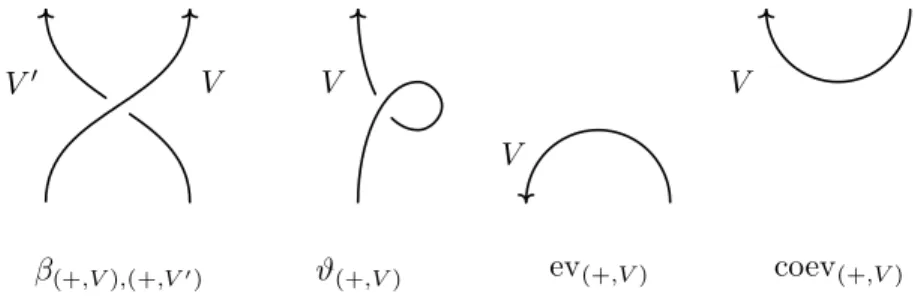
This section is devoted to the definition of the algebraic structures which are going to play the leading role in the construction. We first set the ground by recalling classical concepts like ribbon categories and colored ribbon graphs.


![Figure 15. The morphism P i∈I dim C (V i ) · [X i,V ∗ X i,V ].](https://thumb-eu.123doks.com/thumbv2/123doknet/2322665.29442/69.918.188.677.119.793/figure-the-morphism-dim-x-v-x-v.webp)