2015 Surveillance of group B streptococcus (GBS) strains
isolated from invasive diseases among adults in Belgium:
Bacteriological and clinical characteristics.
OBJECTIVES
Clinical manifestations
Even if GBS disease risk is highest during the first trimester of life, GBS is also an important cause of invasive infection in adults, especially the elderly, the immunocompromised or patients with chronic illnesses.
To provide an overview of bacteriological and clinical characteristics of GBS causing invasive diseases in non-pregnant adult in Belgium. 1. To describe the main reported clinical
manifestations and suspected focus.
2. To characterize relevant epidemiological markers of the isolated GBS strains.
• Determination of their
capsular-polysaccharide (CPS) types and distribution.
• Determination of their pili types and
distribution.
• Determination and description of their
antimicrobial susceptibility profile.
• Determination and distribution of macrolide /lincosamide (MLS) resistance genotypes
.
In Belgium, GBS invasive diseases are not notifiable but a regular surveillance of diseases and characterization of GBS isolates is organized by the Belgian National Reference Centre (NRC) for Streptococcus agalactiae (GBS).
Antimicrobial susceptibility profile
§
In Belgium, bacteremia without identified focus and skin-soft tissue infections were the main clinical manifestations of GBS causing
invasive infection among non-pregnant adults.
§
Bacteriological characteristics of GBS isolated from adults with invasive disease were consistent with reported data among European
countries; CPS types Ia, II and V accounting 67.7%.
§
Macrolides/lincosamides resistance rate (35.7%) has slightly increased during the last decade and is mainly associated to CPS type V and
to ermB determinants.
STUDY POPULATION AND METHODS
RESULTS
CONCLUSION
Pili characterization:
PI1, PI2a & PI2b • Multiplex PCR (Springman, AC. et al.2014 BMC Microbiol. 19;14:159 )Antimicrobial susceptibility testing
(EUCAST 2017) • Disk diffusion, categorization S.I.R. • Dtest screening for inducible resistance to lincosamide. • Screening for reduced susceptibility to beta-lactams,using oxacilline, ceftizoxime and ceftibuten disks according to Kimura et al (2009, J. Clin. Microbiol. 47, 4154–7) • Determination of MICs • Etest diffusion method • Microdilution method, using Sensititre® system with customized microplates
Molecular characterization of MLS resistance
• Multiplex PCR for ErmB, ErmTr, MefA and LSaC genesPopulation:
• Overall during the year 2015, on a voluntary base, laboratories belonging to the national surveillance network sent to the NRC a total of143 GBS strainsisolated from invasive disease among non-pregnant adults.
• Laboratories were asked to fill a short Case Report Form for each reported case.
CPS Typing:
types Ia, Ib,II to IX• Serotyping, Latex agglutination (Strep B Latex, Statens Serum Institut, Denmark)
• Genotyping, PCR.
• Multiplex PCR, Types Ia, Ib, II to VIII, Poyart, C. et al. 2007 J. Clin. Microbiol.
45, 1985–8
• PCR type IX, Kong, F. et al. 2008 J. Clin. Microbiol. 46, 2745–50.
Distribution of CPS types and pili types
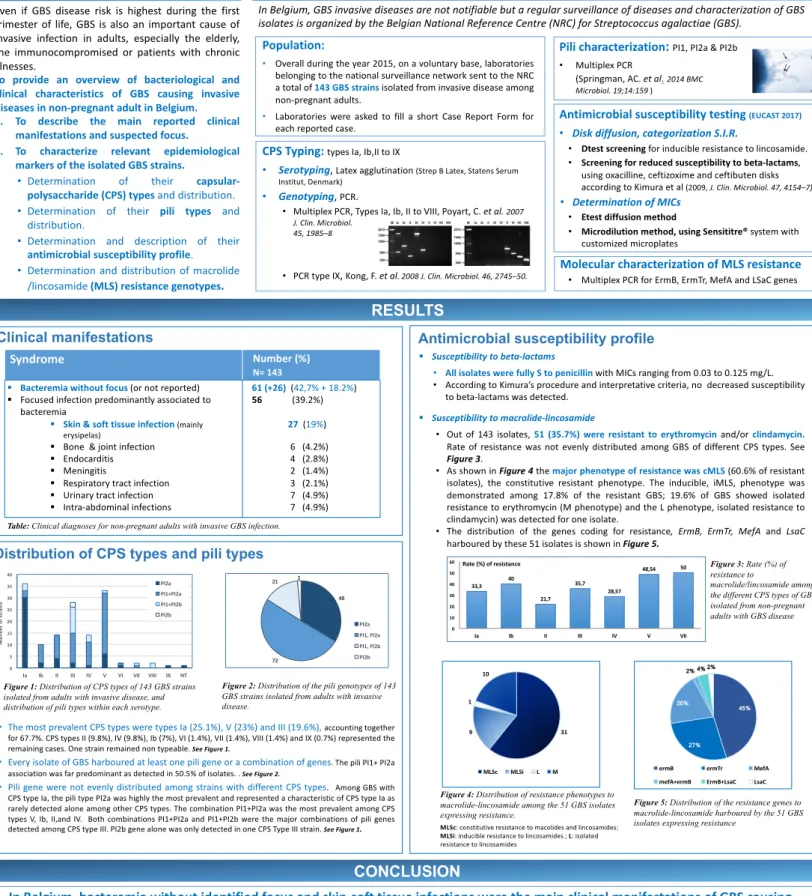
• The most prevalent CPS types were types Ia (25.1%), V (23%) and III (19.6%),accounting together for 67.7%. CPS types II (9.8%), IV (9.8%), Ib (7%), VI (1.4%), VII (1.4%), VIII (1.4%) and IX (0.7%) represented the remaining cases. One strain remained non typeable.See Figure 1.
• Every isolate of GBS harboured at least one pili gene or a combination of genes. The pili PI1+ PI2a association was far predominant as detected in 50.5% of isolates. .See Figure 2.
• Pili gene were not evenly distributed among strains with different CPS types. Among GBS with CPS type Ia, the pili type PI2a was highly the most prevalent and represented a characteristic of CPS type Ia as rarely detected alone among other CPS types. The combination PI1+PI2a was the most prevalent among CPS types V, Ib, II,and IV. Both combinations PI1+PI2a and PI1+PI2b were the major combinations of pili genes detected among CPS type III. PI2b gene alone was only detected in one CPS Type III strain.See Figure 1. Table: Clinical diagnoses for non-pregnant adults with invasive GBS infection.
§ Susceptibility to beta-lactams
• All isolates were fully S to penicillinwith MICs ranging from 0.03 to 0.125 mg/L.
• According to Kimura’s procedure and interpretative criteria, no decreased susceptibility to beta-lactams was detected.
§ Susceptibility to macrolide-lincosamide
• Out of 143 isolates,51 (35.7%) were resistant to erythromycinand/orclindamycin.
Rate of resistance was not evenly distributed among GBS of different CPS types. See
Figure 3.
• As shown in Figure 4 themajor phenotype of resistance was cMLS(60.6% of resistant isolates), the constitutive resistant phenotype. The inducible, iMLS, phenotype was demonstrated among 17.8% of the resistant GBS; 19.6% of GBS showed isolated resistance to erythromycin (M phenotype) and the L phenotype, isolated resistance to clindamycin) was detected for one isolate.
• The distribution of the genes coding for resistance, ErmB, ErmTr, MefA and LsaC harboured by these 51 isolates is shown in Figure 5.
Figure 5: Distribution of the resistance genes to
macrolide-lincosamide harboured by the 51 GBS isolates expressing resistance
Figure 4: Distribution of resistance phenotypes to
macrolide-lincosamide among the 51 GBS isolates expressing resistance.
MLSc: constitutive resistance to macolides and lincosamides; MLSi: inducible resistance to lincosamides ; L: isolated resistance to lincosamides
20-23 February 2018, CapeTown, South Africa
Rosalie Sacheli
1, Cécile Meex
2, Julie Descy
2, Pascale Huynen
2, Marie-Pierre Hayette
2, Pierrette Melin
1,2(1) National Reference Centre Streptococcus agalactiae, Clinical microbiology, University Hospital of Liege, CIRM, Liege, Belgium (2) Clinical microbiology, University Hospital of Liege, CIRM, Liege, Belgium
Corresponding author’s E-mail: [email protected]
Syndrome
Number (%)N= 143
§ Bacteremia without focus (or not reported)
§ Focused infection predominantly associated to bacteremia § Skin & soft tissue infection (mainly erysipelas) § Bone & joint infection § Endocarditis § Meningitis § Respiratory tract infection § Urinary tract infection § Intra-abdominal infections 61 (+26) (42,7% + 18.2%) 56 (39.2%) 27(19%) 6 (4.2%) 4 (2.8%) 2 (1.4%) 3 (2.1%) 7 (4.9%) 7 (4.9%)
Figure 2: Distribution of the pili genotypes of 143
GBS strains isolated from adults with invasive disease.
Figure 1: Distribution of CPS types of 143 GBS strains
isolated from adults with invasive disease, and distribution of pili types within each serotype.
0 5 10 15 20 25 30 35 40
Ia Ib II III IV V VI VII VIII IX NT
Nu m be rof st ra in s PI2a PI1+PI2a PI1+PI2b PI2b 48 72 21 2 PI2a PI1, PI2a PI1, PI2b PI2b 33,3 40 21,7 35,7 28,57 48,54 50 0 10 20 30 40 50 60 Ia Ib II III IV V VII
Rate (%) of resistance Figure 3: Rate (%) of
resistance to
macrolide/lincosamide among the different CPS types of GBS isolated from non-pregnant adults with GBS disease
31 9 1 10 MLSc MLSi L M 45% 27% 20% 2% 4% 2%
ermB ermTr MefA mefA+ermB ErmB+LsaC LsaC