HAL Id: halshs-01260070
https://halshs.archives-ouvertes.fr/halshs-01260070
Submitted on 29 May 2018
HAL is a multi-disciplinary open access
archive for the deposit and dissemination of
sci-entific research documents, whether they are
pub-lished or not. The documents may come from
teaching and research institutions in France or
abroad, or from public or private research centers.
L’archive ouverte pluridisciplinaire HAL, est
destinée au dépôt et à la diffusion de documents
scientifiques de niveau recherche, publiés ou non,
émanant des établissements d’enseignement et de
recherche français ou étrangers, des laboratoires
publics ou privés.
Are Protected Areas really sustainable? How to develop
sustainibility within Nature conservation
Samuel Depraz
To cite this version:
Samuel Depraz. Are Protected Areas really sustainable? How to develop sustainibility within Nature
conservation. J. Comby, K.A.T. Eames et al. Developing Sustainability, The Dorich House Research
Group, Stambul Bilgi University Press, pp.225-230, 2012. �halshs-01260070�
DEPRAZ, S. (2012), “Are Protected Areas really sustainable? How to develop sustainibility within Nature conservation”. In Comby J., Eames K.A.T. et al. Developing Sustainability, The Dorich House Research Group, Stambul Bilgi University Press, pp. 225-230〈halshs-01260070〉
ARE PRO TECTE D ARE AS RE AL Y S US TAI N ABL E ?
How to develop Sustainability within Nature ConservationDr. Samuel DEPRAZ, Maître de Conférences for Geography and Regional Planning
University of Lyon (Jean Moulin-Lyon 3)
7 rue Chevreul 69007 LYON, FRANCE – (0033) 4 78 78 76 10 Laboratoire « Environnement, ville, sociétés » - UMR 5600 du CNRS [email protected]
Summary :
The management of Protected Areas, once mainly devoted to ecosystems conservation and driven by a rather radical ecologic approach, has been significantly unsettled by the paradigm of sustainable development for a decade or two. The sector of Nature conservation has now to be socially responsible and shall take in account, in its policy, the ecological, economical and cultural fields at the same time. However, the global shift towards sustainability in the management practices of Protected Areas is not always obvious, and several examples of this reservation will be successively developed here, in the three above mentioned fields. Therefore a comprehensive assessment of Protected Areas effectiveness is needed in order to legitimate the role of nature conservation in the local development prospects, with the broader aim to foster a more integrated territorial governance at the local level.
Key Words :
Protected Areas, Nature Conservation, Integrated Management, Territorial Governance.
________
The sustainability of Protected Areas has not really been questioned before recent times: as long as protected areas have been solely considered from an ecological point of view, there was no point at asking whether they were carrying any socio-economic added value, or were at least socially and financially bearable for human societies. They were but considered as a necessary expense in the eyes of Nature conservation, as they were the most obvious and proud evidence of the achievement of public policies in the matter of environmental actioni. Moreover, it was not questioned whether they were a good way of protecting Nature or not, even from an ecological point of view: based on an inherited conception of Nature conservation that protected the most remarkable places and species, and embedded with many representations on wilderness, natural landscapes and aesthetic sites (Larrère, 1997), they were far beyond any rational criticism regarding their scientific legitimacy.
However, sustainability does not only mean nature conservation; neither is it a pure aesthetic and emotional approach of environmental questions in our contemporary world. At least, the paradigm of sustainability – if one refers to the most widely acknowledged definition of the term after Brundtland (1987) – leads to consider that any environmental action has also to be assessed in the scope of its social and economic function. In other words, conservation policies have to be scrutinized under a more integrated, socio-economic approach. In return, a more comprehensive planning of territorial development and regional governance, that includes environmental protection, will help conservation projects to gain more efficiency and legitimacy. This new paradigm of sustainability is consequently re-defining the way how Nature protection has to be lead in the three fields of a sustainable management – environment, economy and society – in order to reach a difficult optimal balance between a higher social acceptance without compromising the initial ecological goals.
Are protected Areas really protecting Nature?
From an ecological point of view, the answer to that first question is not obvious anymore. If one refers, in the history of nature sciences (Acot, 1988; Deléage, 1991; Drouin, 1993) to the fundamentals of ecology (Odum & Odum, 1953), the analysis of natural areas seems to be mainly based on static principles that show the homeostasis of ecosystems, fighting against changes in order to maintain or re-reach their idealistic state, the climax (after Clements, 1916). This nature is mainly considered apart the – necessarily bad – influence of human societies. Protected areas are thus a spatial response to this theoretic dichotomy, since they draw a clear line between human and natural areas, so as to protect the most exceptional species from any destruction. The very strict level of protection in many National parks or Reserves in the world has indeed to do with this inherited radical approach in the history of the scientific ecology.
However, the introduction of the key-concept of biodiversity in the 80’s (Soule & Wilcox, 1980 ; Pickett &White, 1985) has had unexpected side-effects on the way to protect nature. First of all, a more dynamic vision of natural areas has developed, focusing on the capacity of adaptation of ecosystems, regardless to their initial state. Moreover, the climax theory has been criticized, in so far as biodiversity is not always at the highest level in quasi-natural areas – if not a myth, since there is no more “natural areas”, but always different evolutions of secondary vegetations because of permanent disturbances on every ecosystem. Therefore, human influence can sometimes even increase the scope of species, since some agricultural practices, such as the selective cutting of woods, the maintenance of natural hedges or terraced cultures for instance, create specific transitional areas that constitute unexpected resources for pioneer species, heliophytes, etc.
Most of all, biodiversity is not only a question of protecting the most valuable areas and species; it is also including an “ordinary nature” (Mougenot, 2003), made of small, common species for which a lack of recognition has long existed, but which appear to have a key-role in the functioning of nature. Those species are identified as “target species” and can serve as strong indicators of the state of conservation for a whole ecologic series. Conservation is therefore not that much a question of spaces anymore, but rather a question of species: a global protection, considering group of species and their circulation, their symbiotic relationships, that is ecological processes more than the current location of valuable items, has become very relevant and is making the protection beyond protected areas also very important.
In this regard, protected areas cannot work as a closed laboratory, sealing the most valuable ecosystems behind a tight wall: they need to be included in a more global approach, they have to be interconnected in order to constitute a coherent network, with biological corridors, buffer zones or even areas of sustainable human activities (Langhammer & al., 2007). They are not protecting necessarily a nice nature, but mostly a significant level of biodiversity. There is also not a single type of protected area, but different degrees and ways of protection, with specific management levels, sometimes tolerating adapted human activities, or even asking for specific intervention on ecosystems: monitoring, measures for the restoration of degraded milieus, management or regulation of species, etc. (Larrère & Larrère, 2009). However, this new integrative approach of Nature management in Protected Areas is not always easy to develop, especially when management authorities have been built for decades in a radical state of mind, only with biologists and without specific considerations for local development and neighbouring societies – if not in opposition with the latter. One has to take in account the weight of institutional routines, that is a “path dependency” that makes changes in the field of conservation policies even harder.
Protected Areas, up to which financial expense?
The integration of nature conservation in a broader approach of human territories and spatial planning, mainly based on sustainable development, has also raised new economic challenges in the management of protected areas. The shrinking of public financing in a global neo-liberal context, added to a new contractual and co-operative approach in regional and rural planning, has also impacted on the way protected areas are managed. Those structures have now to justify their ecological action and to struggle for financial means by establishing projects and explaining their management – in a word, by proving their legitimacy in the field of the “economics of sustainable development” (Bürgenmeier, 2004).
However, this legitimacy, if transformed in raw financial data and pure economic considerations, can be seriously questioned. In a narrow sense indeed, a costs-benefits analysis will always show that the costs for establishing, managing or developing a protected area are always much higher that the
socio-economic benefits of it, since the expenses for a protected area are precisely located in the budget of the Authority in charge of the protected area – often a public institution, with a specific budget – and will mostly account as direct expenses. In contrary, the benefits are spatially and socially diluted, shared among a broad number of stakeholders (Authority, private enterprises living from tourism around the protected area, etc.), that is, they mostly account as indirect expenses. This spatial and social dilution of the economic benefits generated by protected areas makes their evaluation uneasy. How far does the influence of the protected areas go, and what share of the benefits can be explained by the protected areas? There is indeed a large span in the possible answers, and consequently in the financial assessment of the impact of the protected areas on the local economy. The balance often appears to be negative, making economic criticism against the cost of Nature protection easier.
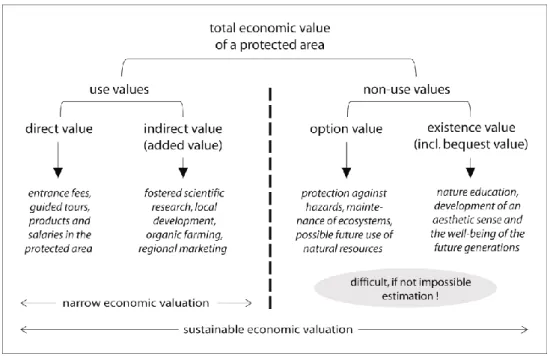
In a broader sense, the principle itself of the economic valuation of protected areas appears however to be highly questionable, since the added socio-economic value of a protected area is not only a monetary one (see figure 1). The “optional” costs and benefits caused by protected areas has also to be assessed (costs : diminution of economic opportunities in the protected areas; benefits : increase of biodiversity and future natural resources, protection against some pollutions and risks, etc.), which is a difficult exercise since one has to measure virtual data that have not occurred yet (Dixon & Sherman, 1990; Balmford & al., 2002).
Last, but not least, there is also a strictly social value of protected areas, that is the increase of knowledge, of well-being and the legacy that will be maintained for future generation. This is the key answer to economic criticism against protected areas, but the evaluation is against very difficult, not to say impossible. Many economic models are trying to convert this non-monetary, non-use value into a financial equivalent, such as the hedonic prices method, the cost of travel method, the renouncement cost method, or the most recent choice experiment or contingent valuation methods (Hanley & al., 1998; Hanemann, 1994). But, fundamentally, this “existence value”, mostly based on moral and ideological considerations, is turning every macro-economic analysis into a nonsense: indeed, if one considers that the preservation of ecosystems and biodiversity is a key action for the perpetuation of humanity itself, then the economic value of protected areas will tend to infinite.
Figure 1: the economic valuation of the spatial impact of protected areas (Depraz, 2008).
In this regard, the economic sustainability of protected areas cannot be correctly assessed in a sole macro-economic valuation of costs and benefits. The question has to be laid on the political field; the cost of nature protection is rather a question of socio-economic priorities, and a relevant assessment of protected areas would rather consist in a costs-efficiency analysis (Hockings, 1998; Hockings & al, 2006): are the financial investments put in protected areas correctly translated into ecological improvements? Are the ecological goals of the protected areas socially relevant? Are the results
reflecting properly the initial goals of the protected areas? Many NGOs working in the field of nature conservation have thus introduced new tools for the evaluation of the stage of nature conservation and the assessment of the efficiency of nature protection institutions – the RAPPAM methodology by the WWF (2003) for tropical forests, the Forest Management Effectiveness Tracking tool by the WWF and the World Bank, the Threat-Ranking System by TNC (2007), etc. – so that protected areas managers are now developing a new professional culture, clearly deriving from the private sector field.
Such questions were actually raised during the world commission of protected areas congress of the IUCN in Caracas (1992), where a task force about conservation effectiveness assessment had been launched at an international level. The Convention on Biological Diversity (CBD), in a 2004 meeting, also asked all Member States to act for a better management in existing protected areas. On a socio-economic point of view, it would be indeed irrelevant to raise the number of protected areas without securing the existing ones, and checking their action in regard to the new ecological objectives of the planet. Thus, 30% of protected areas had to be endowed with a management plan before 2010, and should strive for new financial resources by making the best possible projects, or even raising funds with public-private partnership, as any other territorial development project (Emerton & al., 2006; Stolton & Dudley, 1999). Developing the economic sustainability of protected areas has definitely turned them towards managerial considerations.
The social disservices of Protected Areas
On the social point of view, one can consider that there is a rather broad acceptance of the idea of protected areas, since it is easily bound to the contemporaneous “categorical imperative” that intimates modern societies to protect Nature. Many NGOs are now acting in the field of Nature protection, especially in English-speaking countries, and their action is considered as a charity one, since the well-being of the future generations is at stake. However, are protected areas, and the action of their promoters, always socially sustainable? There is actually a strong debate in the conservation field between rather radical approaches, that claim for a nature conservation that has to be considered above any individual interests, since it is a universal priority – also the general interest has to overwhelm any local consideration. But other conservationist circles will point out the social cost of establishing protected areas, especially in poor or developing countries. Is the ecological expense socially bearable, when compared to the question of reducing poverty or fighting against hunger (Brunel, 2008)? Shall most vulnerable people pay for others, when a protected area is created on their usual hunting territory, depriving them from natural resources? Environmental NGOs have now enough power to secure land by purchasing lots in poor countries, or intervene on national policies by the “debt or nature swap” method, making them a real global stakeholder of conservation (Dumoulin & Rodary, 2005).
In the 80’s, political contests have arisen among local societies in eastern Africa, in South America or South-Eastern Asia against the “green imperialism” of western NGOs and their ecologic influence on poor countries (Crosby, 2004; Rossi, 2000). The social impact of protected areas has now been taken into consideration at an international level. The IUCN, after the Nairobi summit on protected areas, has developed a more participative approach of nature conservation (Kamstra, 1994; Borrini-Feyerabend et al., 2004), followed by most of the biggest NGOs since it was the best way to get more social acceptance of nature conservation. In Australia for instance, the establishment of Indigenous Protected Areas in the 80’s was the first tangible experience of a real devolution of nature conservation on a voluntary and contractual basis. Other co-management programmes are currently implemented in most protected areas, with the idea of linking nature protection and local development by a promotion of sustainable tourism or new local resources (Scherl et al., 2004).
However, such a policy needs strong local communities and the recognition of their collective rights to be successful. In many cases, the implementation of conservation policies remain actually very conflicting on the field. In India for instance, a very radical approach of nature conservation is still applying. Living in a national park is forbidden, as is the hunting or the use of any natural resource. However, the strong social pressure for firewood, for game or even for place to stay make these rules difficult to observe. The situation around national parks leads to a “shoot on sight” policy against poaching, and forced evictions occur, concerning not only informal housing, but also against Adivasis, which are the indigenous people traditionally living in mostly natural areas (Mathews, 2005; Zérah, 2007). Violent cases of forced evictions are also frequently recorded in Africa (Brockington & Schmidt-Soltau, 2007; Brockington & Igoe, 2006). After Geisler (2003), this could be the case of 14 million people around the world, constituting a new category of “refugees of the conservation”. Even if this number remains highly questionable, and has even been attacked by some NGOs that raised severe doubts about the scientific value of those calculations (Redford & Fearn, 2007), the case has to be at
least taken in account, as some programs financed by the World Environmental Fund of the World Bank are still openly planning some “voluntary resettlement” or “soft evictions” policies.
The case of forced evictions is the most evident case of the possible gap between protected areas and sustainability, making the need for participatory and socially policies even more urgent.
Conclusion
A French defender of Nature Protection in the Northern Alps, Jean Eyerhalde, had these words, as he campaigned for the creation of Nature reserves in the 60’s in Savoyen: “Nature reserves are
conceived to disappear” (quoted in Mauz, 2009). He was right in a certain way, for protected areas,
since their creation at the end of the 19th Century, are carrying some principles that might go in the reverse direction of sustainability. If they still lay on a radical vision of a preserved wilderness, especially in populated areas, they create economic, social disservices and might even have no grasp on biodiversity losses at a broader scale; however, if they are cleverly managed in a way that makes their goals merge into local development prospects, they can contribute to a better understanding of the goals of nature conservation, and bring an improvement of nature management even out of their borders, so that the principles of nature conservation could apply without differences in and out of protected areas.
But as long as protected areas are necessary, they will surprisingly enough prove that a sustainable development has not been reached yet, since human societies have not been able to completely integrate the ecological imperatives in their management of territories.
References:
Acot P, 1988. Histoire de l’écologie. Paris: PUF.
Balmford, A., Bruner, A., Cooper, P., Costanza, R., Farber, S., Green, R.E., Jenkins, M., Jefferiss, P., Jessamy, V., Madden, J., Munro, K., Myers, N., Naeem, S., Paavola, J., Rayment, M., Rosendo, S., Roughgarden, J., Trumper, K. and Turner, R.K. (2002); Economic Reasons for Conserving Wild Nature. Science 297, 950–53.
Borrini-Feyerabend, G, Kothari, A. and Oviedo, G., 2004. Indigenous and Local Communities and Protected Areas: Towards Equity and Enhanced Conservation. Best Practice Protected Area
Guidelines Series 11. Gland/Cambridge: IUCN.
Brockington, D., Schmidt-Soltau K., 2007. Protected Areas and Resettlement: what scope for voluntary relocation? World Development 35 (12), 2182-2202.
Brockington, D., Igoe J., 2006. Eviction for Conservation: a Global Overview. Conservation and
Society 4(3), 424-470.
Brundtland G. H. (Ed.), 1987. Our common future: The World Commission on Environment and Development, Oxford: Oxford University Press.
Brunel S., 2008. A qui profite le développement durable?, Paris: Larousse.
Bürgenmeier B., 2004, Économie du développement durable, Bruxelles: De Boeck.
Clements F., 1916. Plant Succession. An Analysis of the Development of Vegetation, new edition 2009, Whitefish: Kessinger Publishing.
Crosby A. W., 2004. Ecological imperialism: the biological expansion of Europe, 900-1900, Cambridge: Cambridge University Press.
Deléage J.-P., 1991. Histoire de l’écologie, une science de l’homme et de la nature, Paris : La
Découverte.
Dixon J. A., Sherman P. B., 1990. Economics of Protected Areas: A New Look at Benefits and Costs. Covelo: Island Press.
Drouin J.-M., 1993. L’écologie et son histoire - réinventer la nature. Paris: Flammarion.
Dumoulin D., Rodary E., 2005. Les ONG, au centre du secteur mondial de la conservation de la biodiversité, in Aubertin C. (Ed.), Représenter la nature ? ONG et biodiversité, Paris: IRD.
Emerton L., Bishop J., Thomas L. (Ed.), 2006, Sustainable financing of protected areas: A global review of challenges and options, Gland / Cambridge: IUCN.
Geisler C., 2003. A New Kind of Trouble: Evictions in Eden, International Social Science Journal 175: 30-42.
Hanemann W. M., 1994. Valuing the Environment Through Contingent Valuation, The Journal of
Economic Perspectives, 8 (4), 19-43.
Hanley N., Wright R. E., Adamowicz V., 1998, Using Choice Experiments to Value the Environment: Design Issues, Current experiences and Future Prospects, Environmental and Resource
Economics 11 (3/4), 413-428.
Hockings M., 1998. Evaluating management of protected areas: integrated planning and evaluation.
Environmental Management 22 (3), 337–46.
Hockings, M., Stolton, S. Leverington F., Dudley N., Courrau J., 2006. Evaluating Effectiveness: A Framework for Assessing the Management of Protected Areas. Best Practice Protected Area
Guidelines Series 6, 2nd Edition, Gland/Cambridge: IUCN.
Kamstra J. (Ed.), 1994. Protected areas: towards a participatory approach, Amsterdam: Dutch
Committee of the l’UICN.
Langhammer P. F., Bakarr M. I., Bennun L. 2007. Identification and Gap Analysis of Key Biodiversity Areas. Targets for Comprehensive Protected Area Systems, Gland/Cambridge: IUCN.
Larrère C., 1997. Les philosophies de l’environnement, Paris : PUF.
Larrère C. & Larrère R., 2009. Du « principe de naturalité » à la « gestion de la diversité biologique », in Larrère R., Lizet B. & Berlan-Darqué M., Histoire des parcs nationaux, comment prendre soin de
la nature ?, Paris: Quae/MNHN.
Mathews S., 2005. Imperial Imperatives and the Global Financing of Protected Areas Ecodevelopment and the Resistance of Adivasis of Nagarhole National Park, India, Law, Social Justice & Global
Development Journal [Internet] 2005(1) <http:www.go.warwick.ac.uk/elj/lgd/2005_1/Mathews>
[Accessed 15th March 2011].
Mauz I., 2009. Les Alpes, de la société de la vache au parc animalier, in Larrère R., Lizet B. & Berlan-Darqué M., Histoire des parcs nationaux, comment prendre soin de la nature ?, Paris: Quae/MNHN.
Mougenot C., 2003. Prendre soin de la nature ordinaire, Paris: éditions de la Maison des sciences de l'homme.
Odum E. P., Odum H. T., 1953. Fundamentals of Ecology, Philadelphie: Saunders.
Pickett S. T. A., White P. S., 1985. The Ecology of Natural Disturbance and Patch Dynamics. New-York: Academic Press.
Redford K. H., Fearn E. (Ed.), 2007. Protected Areas and Human Displacement: a Conservation
Rossi G., 2000. L’ingérence écologique, Paris: CNRS Editions, coll. « Espaces et milieux ».
Scherl L. M., Wilson A., Wild R., Blochhus J., Franks P., McNeely J. A., McShane T. O., 2004. Can
Protected Areas Contribute to Poverty Reduction? Opportunities and Limitations,
Gland/Cambridge, IUCN.
Soule M. E., Wilcox B. A., 1980. Conservation Biology: An Evolutionary-Ecological Approach.
Sunderland: Sinauer Associates.
Stolton S., Dudley N. (Ed.), 1999, Partnership for protection, New Strategies for Planning and
Management for Protected Areas, Gland: UICN & London: Earthscan.
TNC, 2007. The Nature Conservancy’s Threat-ranking system [Internet]. <http://www.conservationgateway.org/sites/default/files/TNC_Threat_Scoring_2.doc> [Accessed 14th March, 2011].
WWF, 2003. Rapid Assessment and Prioritization of Protected Area Management (RAPPAM) Methodology [Internet]: <http://www.panda.org/downloads/forests/rappam.pdf> [Accessed 15th
March 2011].
Zérah M.-H., 2007. Conflict between green space preservation and housing needs: the case of the Sanjay Gandhi National Park in Mumbai, Cities, 24 (2): 122-132.
i
For a broader analysis of the historical and geographic context of Protected Areas, as well as more developed explanations about the main concepts that are mentioned throughout this chapter, see more generally Depraz, 2008.