HAL Id: dumas-01355226
https://dumas.ccsd.cnrs.fr/dumas-01355226
Submitted on 22 Aug 2016
HAL is a multi-disciplinary open access archive for the deposit and dissemination of sci-entific research documents, whether they are pub-lished or not. The documents may come from teaching and research institutions in France or abroad, or from public or private research centers.
L’archive ouverte pluridisciplinaire HAL, est destinée au dépôt et à la diffusion de documents scientifiques de niveau recherche, publiés ou non, émanant des établissements d’enseignement et de recherche français ou étrangers, des laboratoires publics ou privés.
The lipstick effect and the self-enhancement motives
Maria Isabel Motta de Nadai
To cite this version:
Maria Isabel Motta de Nadai. The lipstick effect and the self-enhancement motives. Economics and Finance. 2015. �dumas-01355226�
UNIVERSITÉ PARIS 1 – PANTHÉON-SORBONNE MASTER 2 RESEARCH – ECONOMICS AND PSYCHOLOGY
2014 – 2015
MASTER THESIS
THE LIPSTICK EFFECT AND THE
SELF-ENHANCEMENT MOTIVES
MARIA ISABEL MOTTA DE NADAI
Advised by: Professor Hélène Huber
L’Université de Paris 1 Panthéon-Sorbonne n’entend donner aucune approbation, ni désapprobation aux opinions émises dans ce mémoire; elles doivent être considerées comme prope à leus auteur.
TABLE OF CONTENTS
Introduction………...…1
Chapter 1 – The Lipstick Effect………....…2
1.1 – Defining the Lipstick Effect………...2
1.2 – Economic Recessions and Emotional Downturns………...…….7
Chapter 2 – Cosmetics Consumption & Self-Enhancement Motives………9
2.1 – Self-Enhancement………...10
2.1.1 – Self-Esteem………..13
2.1.2 – Beauty in the World……….14
2.2 – What is Beautiful is Good………...15
2.2.1 – Remarks on Beauty and Personal Life……….18
2.3 – Beauty in the Labour Market………..19
2.3.1 – Grooming and the Labour Market………...21
2.3.2 – Risk-Aversion………..23
2.3.3 – Remarks on Beauty and Labour………...23
2.4 – General Hypothesis……….24
Chapter 3 – The Self-Enhancement Motives Behind the Lipstick Effect………...24
3.1 – Experiment Design……….24
3.2 – Sample………26
3.3 – Dependent Variable………26
3.5 – Model……….…28 3.6 – Results and Discussion………...29 Conclusion………...32 Appendix
ACKNOWLEDGMENTS
Foremost, I would like to thank my parents for providing me with the opportunity to pursue this Masters and for all the support they constantly gave me. Without them I would have never been able to conduct this or any other research.
My sincere thank you to Professor Hélène Huber, for all her guidance, patience, and interest in my topic. I deeply appreciate all the time she spent with me and all the knowledge she shared.
Thank you for Mr. Thomas Brown for the constant support and for talking to me about the same topic over and over again.
Thank you to Ms. Alexia Lochmann for the all the conversations about the lipstick effect and my econometric model.
Last but not least, I’d like to thank Mr. Paulo Motta for being by eternal source of inspiration.
ABSTRACT
The lipstick effect is defined as women spending relatively more on beauty products during economic recessions. The aim of this research is to understand the underlying motives leading women to shift their consumer priorities during economic downturns. Our findings suggest that the two main factors driving the lipstick effect are: (i) women searching to feel happier with their overall personal life, regardless of romantic relationships (i.e. overall level of happiness, sociability and self-esteem); and (ii) women searching to feel more confident in their professional lives. Contrary to previous research we find that romantic relationships are only a driver for the lipstick effect when
1
Introduction
It is of common knowledge that during economic recessions consumers react by economising: they spend less and they defer expenses (Katona, 1975). It has recently been noticed that despite the fact that many industries suffer a decrease in sales during economic downturns, one industry seamed to do reasonably well: the cosmetics industry. Although spending on most consumer products during the Great Recession of 2007-2009 predictably declined, cosmetics consumption continued to increase (Allison & Martinez, 2010; Schaefer, 2008; Statista, 2014). For instance, in 2008, when the rest of the economy was suffering from declined sales, L’Oréal – the biggest cosmetics company in the world – increased its sales by 5,3% (L’Oréal, 2010).
The idea that women spend relatively more on beauty products during economic recessions has been dubbed by journalists as the lipstick effect (Nelson, 2001). The aim of this research is to investigate which motives lead consumers to spend relatively more on beauty products during economic downturns.
To our knowledge, only one research has tried investigate the consumer behaviour behind the lipstick effect. Rodeheffer et al, (2012) concluded in their research that the lipstick effect is driven by women’s desire to attract mates with resources and depends on the perceived mate attraction function served by these products.
Although we do not exclude this possibility, we believe that because of the feelings trigged by economic recessions, other factors may also be responsible for the lipstick effect. We believe that alongside romantic relationship reasons (considering finding a partner, finding a financially secure partner and maintaining a partner), the changes in the consumer’s overall personal life, regardless of romantic relationships (i.e. overall
2 level of happiness, sociability and self-esteem) during economic downturns and the insecurity in job market, may also be driving the lipstick effect.
In order to analyse our hypothesis, we conducted an experiment with 270 participants, from both developed and developing economies, where our potential consumer was primed with a crises scenario and then asked to make decisions for a fictional character through the ability of perspective-taking.
To start presenting our hypothesis, in Chapter 1 we will define the lipstick effect, what type of consumer is behind it and what are the different types of feelings, emotions and behaviours trigged by economic crisis. In Chapter 2 we will define why people purchase cosmetics and which aspects of life we believe that would also lead to an increase in cosmetics consumption during economic crisis: overall personal life, regardless of romantic relationships, and professional life.
In Chapter 3 we will present our experiment and the results obtained from the present research.
Chapter 1 – The Lipstick Effect
1.1 Defining the Lipstick Effect
The term “lipstick effect” was first introduced to the world by Mr. Leonard Lauder (chairman of the Estée Lauder companies) in an interview to the New York Times in 2003. After the terrorist attacks of 2001 that deflated the American economy, Mr. Lauder noticed that his company was selling more lipstick than usual. He hypothesized that lipstick purchases are a way to gauge the economy. When it’s shaky, he said, sales increase as women boost their mood with inexpensive lipstick purchases instead of something much more expensive (Schaefer, 2008).
3 There is much to be said about this topic and little research on it. If lipstick sales are a good indicator of how the economy of a country is doing it is still debatable. Still, although the term was first used to indicate an increase in lipstick consumption during times of economic recession, more recently it has been used to refer to the idea that women may spend relatively more money on attractiveness-enhancing products during times of economic recessions (Nelson, 2001).
In fact, the idea that economic recessions increase relative spending on cosmetics is not new. Elliot (2008), states that evidence shows that the lipstick effect can be traced back to the Great Depression of the 1930s. In the four years from 1929 and 1933, the industrial production in the U.S. halved, but cosmetics sales increased. The author also states that in Germany, the total unemployment rose to 6 million, but those working for Beiersdorf (one of the biggest cosmetics companies until today) did not suffer. The company was able to boast that it did not layoff a single employee.
Rodeheffer et al (2012) were the first and only authors to empirically examine the idea of the lipstick effect. They first started by examining the relationship between economic recessions and consumer spending priorities. They accessed real-world data on monthly fluctuations in U.S. unemployment over the period between 1992 and 2011 to test how these fluctuations relate to the percentage of money that U.S. consumers allocate toward different non-essential consumer products. The choice for using unemployment changes as the main economic indicator of recessions was done due to the fact that unemployment is likely to be a valid measure of actual economic hardship and harshness. The products chosen to estimate consumer spending were allocated in two categories: (i) products that can be used to enhance attractiveness (clothing and cosmetics), and (ii) products that are generally not used to enhance attractiveness (furniture, electronics, and leisure/hobby products).
4 To assess whether the lipstick effect is supported by consumer spending priorities, the authors first divided the total amount spent in each product category by the total amount spent across all product categories for each period, resulting in the percentage of total retail sales in each of the five product categories. This provided a measure of relative spending for each category of products, allowing them to capture consumption spending priorities in the face of budgetary constraints.
Their results indicated a negative correlation between unemployment and relative spending on furniture, electronics and leisure/hobby products, meaning that as unemployment increases, the consumption of furniture, electronics and leisure/hobby products decreased. However, they found positive correlations between unemployment and relative spending on cosmetics and clothing products. Taken together, these findings provide evidence that economic recessions may lead to an important shift in consumer spending priorities.
As we believe that the lipstick effect is a worldwide effect, and not something that can be observed only in developed economies (such as The United States as seen in the Rodeheffer et al article), we chose to conduct our experiment with participants from both developed and developing economies. In order to capture participants from developed economies we conducted one survey in English that was mostly distributed in France, and in order to capture participants from developing economies we conducted one survey in Portuguese, that was mostly distributed in Brazil.
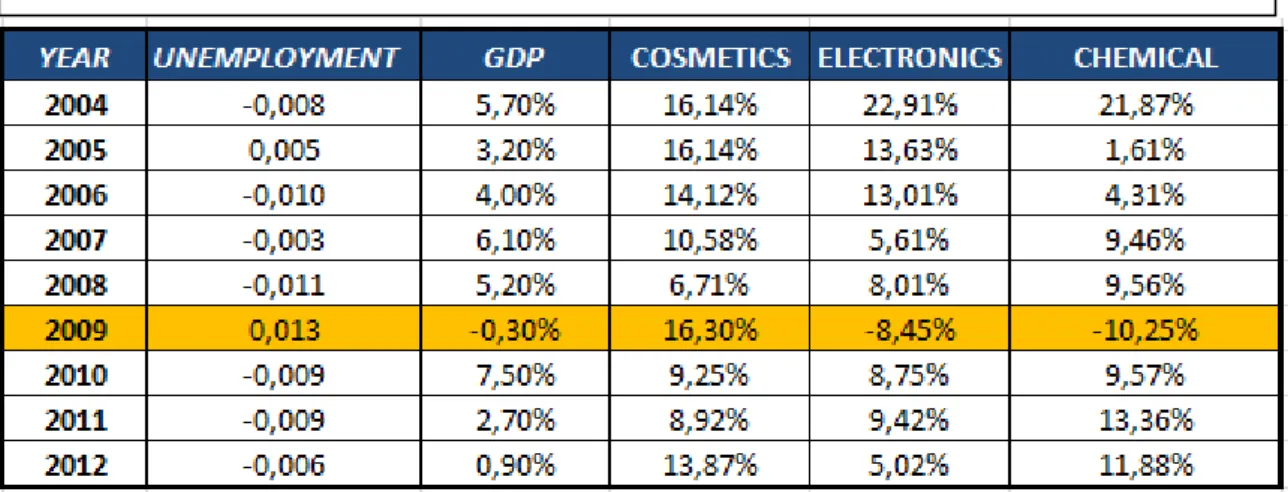
In our experiment, 52,96% of the participants are Brazilian. In order to briefly demonstrate the performance of the cosmetics industry in Brazil during the latest economic recession, table 1 shows the real growth of different industries (cosmetics,
5 TABLE 1 – PERCENTAGE OF REAL GROWTH OF COSMETICS, CHEMICAL AND ELECTRONICS INDUSTRY, REAL GDP
GROWTH AND CHANGES IN PP IN UNEMPLOYMENT - BRAZIL
Source: IBGE, ABHIPEC, ABINEE, ABIQUIM .
electronics and chemical) over the period of 2004 until 2012. It also shows real GDP growth and change in percentage points in unemployment over the same period.
Figure 1 displays the graph for the data presented in table 1. As we can see, in the year of 2009, the most disturbing one in the Brazilian economy during the Great Recession of 2007-2009, with the change in pp of unemployment reaching a peak and the overall production of the country decreasing, both the electronics industry and the chemical industry have a decrease in revenues, with the exception of the cosmetics industry, that grew 16%. For instance, in 2009, when the Brazilian economy was suffering record declines in sales, L’Oréal Brazil presented a 16% growth in sales revenues (L’Oréal, 2010).
As women represent 95% of the consumers in the cosmetics market, it is reasonable to assume that the lipstick effect is mostly caused by female consumers switching their priorities during economic recessions (ABHIPEC, 2015). As it was our belief that the lipstick effect is mostly caused by female consumers, we chose to conduct our experiment with women only. In their study, Rodeheffer et al (2012) examined the hypothesis of whether the lipstick effect is driven by women, or if its driven by men or both.
6
Source: IBGE, ABHIPEC, ABINEE, ABIQUIM
FIGURE 1 – PERCENTAGE OF REAL GROWTH OF COSMETICS, CHEMICAL AND ELECTRONICS INDUSTRY, REAL GDP GROWTH (LEFT AXIS) AND CHANGES IN PP IN UNEMPLOYMENT (RIGHT AXIS)- BRAZIL
………
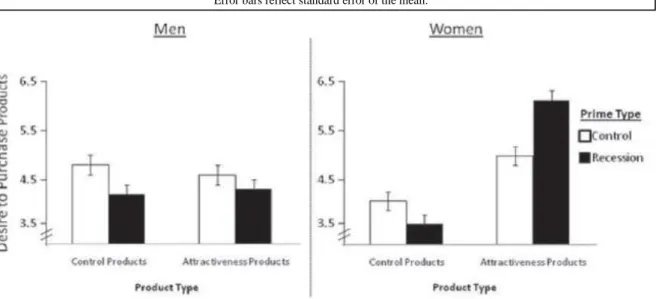
The authors first exposed participants to economic recession cues (primes) by having them read either a news article about the turmoil of economic recessions or a control article about modern architecture. The participants then proceeded to indicate their desire to purchase different products (products that can be used for enhancing attractiveness, such as cosmetics, and products that cannot be used to enhance attractiveness).
Consistent with our hypothesis that the lipstick effect is mostly caused by a shift in female consumers priority, Rodeheffer et all found that for men, the results revealed no main effect of product type on purchasing desires, and it was also observed a significant main effect of priming condition on desire to purchase products of either type. This is consistent with the idea that spending usually decreases during times of economic recession, as men in the recession condition displayed less interest in purchasing either type of product than men in the control condition.
7
Source: Rodeheffer et al, 2012.
FIGURE 2 – DESIRE TO PURCHASE PRODUCTS THAT CAN AND CANNOT ENHANCE ATTRACTIVENESS TO MATES AS A FUNCTION OF ECONOMIC RECESSION PRIME AND PARTICIPANT SEX.
Error bars reflect standard error of the mean.
For women, as for men, the desire to purchase products that cannot be used to enhance attractiveness was significantly diminished in the recession condition versus in the control condition. However, for products that can be used to enhance attractiveness, women in the recession condition reported a significantly greater desire to purchase the products compared with women in the control condition.
Figure 2 displays the results found by Rodeheffer et al (2012) in their second study. As we can see, women display significant change in their purchasing behaviour of goods that can be used to enhance attractiveness when primed with an economic recession scenario.
1.2 – Economic Recessions and Emotional Downturns
The aim of our research is to understand what factors lead women to purchase relatively more cosmetics during economic recessions. Because of the nature of the cosmetic product, as a non-essential good, it is of our understanding that the lipstick effect is driven by different emotional and psychological factors. In order to comprehend why
8 the desire for cosmetic products increases in times of economic downturns, we first must observe what type of feelings and emotions economic crisis bring into people.
It is easy to assume that economic recessions have a high impact on how people feel. In the OECD countries, just like unemployment and GDP per capita deteriorated during the economic crisis of 2009, subjective well-being also deteriorated. The decline in life satisfaction was especially visible in the euro area, especially in countries most affected by the crisis. For instance, from 2008 to 2012, the average life satisfaction declined more than 20% in Greece and by around 12% in Italy and 10% in Spain. There is also evidence of growing feelings of anger, stress and worry, and of lower feelings of joy and contentment in many OECD countries. The main channel through which the crisis may have affected subjective well-being is higher unemployment. (OECD, 2013).
The impacts of recessions on mental health are not restricted to the direct effect of unemployment. Increased job insecurity, feelings of powerlessness, increased workload, and changes in job scope – as well as anger or sympathy for laid-off co-workers – can affect mental health (Bulgard et al, 2009; Bulgard et al, 2012; Modrek et al, 2013; Roca et al, 2013; Saad, 2014). Modrek et al (2015) showed that even those who remained employed during the Great Recession of 2008-2009 experienced worsening mental health.
Graham et al (2010) show that the average happiness in the United States fell 11% from 6.94 prior to the onset of the crisis to a low of 6.19 on November 16, 2008. Graham (2011) shows that the drops in happiness for Americans virtually mirrored the drops in the Dow Jones industrial average until the market stabilized in March 2009.
Social connections are also affected by economic crisis. Since 2007, expected support from others dropped sharply in most OECD countries. Such drop is not surprising, as it
9 may reflect people’s concerns about the crisis and its possible negative effects on the help that people may expect to receive from friends and family (OECD, 2013).
Further still, psychological research suggests that a natural reaction to cope with the self-threatening consequences of an economic crisis in an increase in the need to be connected with others. When people feel threatened, they seek support from others (Kenrick et al, 2010). Consequently, threat and fear signals activate a desire for affiliation and social connectedness (Baumeister & Leary, 1995). When experiencing an increased desire for connectedness, individuals tend to allocate their attention to social opportunities and try to build connections with others (Gardner, Pickett & Knowles, 2005; Griskevicius et al, 2009). The logic suggests that during economic crisis, the need for connectedness should increase, which should affect consumer choices (Yabar et al, 2012). In chapter 2 we will see how using cosmetics and beauty are related to people’s level of sociability and connectedness.
It is our assumption that the fact that overall people have a decrease in life satisfaction, increased uncertainty and stress, among other negative emotions and feelings, leads women to consume more cosmetics during economic recessions.
Chapter 2 – Cosmetics Consumption & Self-Enhancement Motives
The only existing paper that aims to assess the reasons behind the lipstick effect was also the one conducted in 2012 by Rodeheffer et al, and the authors based their hypothesis on the life history theory. According to this theory the fundamental trade-off between reproductive and somatic effort is influenced by ecological conditions (Kaplan & Gangestad, 2005). For instance, research finds that individuals living in harsh environments marked by ecological resource scarcity and financial impoverishment tend to allocate effort toward more immediate reproduction than those living in more
10 resource-abundant, financially secure environments (Belsky, Scholmer & Elis, 2011). Rodeheffer et al proceed then to consider economic recessions like cues signalling environmental harshness (as economic recessions are also marked by dwindling resource access and poverty) and conclude that the lipstick effect happens because of women’s increased desire to attract mates with resources (financially secure partners). The aim of this research is to increase the scope of explanations behind the lipstick effect, considering reasons for the relative increase in cosmetics consumption, other than just attracting financially secure mates. In this chapter, we will observe a brief explanation of other underlying motives that could possibly lead to women’s purchase of relatively more cosmetics during economic recessions.
As we have seen in Chapter 1, the lipstick effect is defined as women spending relatively more on attractiveness-enhancing products during times of economic recession. In this research, we will be focusing solely on cosmetic products.
The second step of our analysis consists of examining up closer the self-enhancement features of cosmetics: how does the perception of third parties changes when one is using cosmetics and how is our self-perception affected when we use cosmetics.
2.1 Self-Enhancement
The use of cosmetics by women for aesthetic enhancement is a visibly prominent practice in the world as has been true in many cultures for centuries (Cordwell, 1976; Ligget, 1974). The word “cosmetics” is derived from the Greek word Kosmetikos, which means “skilled at decorating”. It refers to any of several preparations (excluding soap) that are applied to the human body for beautifying, preserving, or altering the appearance (Britannica, 2011). As early as 4.000 B.C., Egyptians already took great pride in their appearance. They used scented oils and ointments to clean and soften their
11 skin and mask body odour, as well as dyes and paints to colour their skin and hair (Chaudhri & Jain, 2009). By the middle of the 20th century, cosmetics were widely used in nearly all societies around the world (Eze et al, 2012). More recently, in 2012, for instance, the cosmetics industry made worldwide approximately 180 billion euros (estimated by Ernst & Young).
In our experiment, out of our 270 participants, 97% of respondents reported that they buy cosmetic products. As for grooming, only 6.3% of our respondents reported spending less than 5 minutes on grooming in the morning, whereas 27.6% reported spending from 5 to 15 minutes, 32,8% reported spending from 15 to 30 minutes, 22% reported spending from 30 to 45 minutes and 11.2% reported spending more than 45 minutes.
Literature examining the role of cosmetics on social perception shows that, overall, makeup is associated with positive evaluation of females’ appearance (Guéguen, 2008). The use of cosmetics on women has been positively associated with femininity, sexiness, attractiveness, health, professional success and confidence (Cox & Glick, 1986; Workman and Johnson, 1991; Cash et al, 1989; Nash et al, 2006; Miller & Cox, 1982).
For instance, Graham and Jouhar (1981) conducted an experiment on the affects that facial cosmetics and hair grooming have on how women of average attractiveness are viewed by others. They find that (i) the use of cosmetics leads to more favourable appearance ratings by others; and that (ii) the use of cosmetics leads to more favourable ratings of personality as perceived by others.
Guéguen (2008) conducted a field experiment where it was measured male responses to women wearing cosmetics in an evening out. Guéguen finds that women wearing
12 makeup is associated with higher male contact and a shorter latency for the first contact. These results obtained in a real social setting are congruent with the data obtained from previous studies conducted in laboratories.
In spite of wide use cosmetics in our society, there has been little scientific research directed towards understanding what the social and personal consequences of cosmetics use might be. When considering the effects of physical attractiveness and cosmetics on self-perception, findings indicate that physical attractiveness and self-evaluation are positively correlated. Therefore, the more attractive you are, the more highly you think of yourself. Research shows that (because physical attractiveness is associated with positive self-evaluation) an improvement in attractiveness with the use of cosmetics should lead to more favourable evaluation of how we see ourselves (Graham & Jouhar 1981; Graham & Jouhar, 1983; Kelson et al ,1990; Miller & Cox, 1982; Theberge & Kernaleguen, 1979).
For instance, Cash & Cash (1982) conducted a study that aimed at evaluating women’s self-evaluative changes when wearing cosmetics. They find that with respect to ratings of self-confidence, women report feeling significantly more self-confident under conditions of use than non-use of cosmetics. Similar results were obtained for subjects’ ratings of situational avoidance – that is, how strongly they wished to leave situations. The desire to avoid or escape situations was stronger under non-use conditions. Their analysis indicates that the women that are cosmetic users report greater comfort and confidence in a variety of situations when engaging in their characteristic pattern of use than they experienced when no makeup was worn.
Graham & Jouhar (1983) tried to identify the psychological effects of wearing makeup as experienced by female consumers, and to relate this to age. They found that there are
13 certain self-perceived psychological benefits from using cosmetics, which are pervasive across different age groups. There also appeared to be rather different motivations governing the use of makeup in people of different ages. In particular, they found some suggestion that makeup was serving important psychological functions in terms of issues relevant to heterosexual attraction and competition, for the younger individuals (aged less than 40 years) and issues relevant to aging and physical and mental health for the more middle-aged individuals (40 to 60 years).
Moreover, other studies have revealed a relationship between appearance and health, and emphasized the supporting effects of makeup products on mental health of women affected by severe illness. It was also shown that feeling confident about one’s appearance has a beneficial impact on one’s mood, as some positive influences of cosmetics on the well-being and self-esteem result in positive emotional states. For example, emotions with positive valance (i.e. induced by a pleasant odour or colourful cosmetics) induce a decreased heart rate, whereas negative valence stimuli induce opposite effects (Korichi et al, 2008; Lêveque, 1996; Graham, 1986; Barkat et al, 2003, Holme et al, 2002).
In our sample, 73.8% of the respondents reported that wearing cosmetics makes them feel good about themselves and 65% reported that wearing cosmetics make them feel more confident.
2.1.1 Self-Esteem
As we have seen in the section above, using cosmetics make women feel more confident and better about themselves. Studies show that there are many benefits to having a positive view on the self. Those who have high self-esteem are presumed to be psychologically healthy and happy (Branden, 1994; Taylor and Brown, 1988). High
14 self-esteem is positively correlated with coping effectively with challenges and negative feedback, and living in a social world in which one believes that people values and respects her (Baumeister, 1998). In our sample, 60% of the participants reported having high self-esteem (we used the Rosenberg self-esteem scale).
Evidence also shows a link between low self-esteem and depression, shyness, loneliness, and alienation (Heatherton et al, 2003). In our sample, 30% of the respondents reported a low self-esteem.
2.1.2 Beauty in the World
As we have seen, the main purpose of wearing cosmetics is self-enhancement. The question left for us to answer is, why is it that women show this prominent quest for beauty during times of economic recessions, or in other words, in which aspects of life do women consider beauty to be important, especially in times of economic recessions. Rodeheffer et al (2012) only tested for the hypothesis that women consumed relatively more cosmetics during economic downturns because they were in a quest for a financially secure partner. We, on the other hand, believe that although it is possible that women may be trying to find a financially secure partner, other feelings might also be responsible for this shift in consumer priorities.
Considering that life satisfaction and happiness go down during economic recessions, that there are lower feelings of joy and increasing feeling of powerless, we believe that women may consume cosmetics simply because they perceive beautiful women as being happier overall in their lives, which doesn’t necessarily refer to romantic relationships. Times of crisis also increase people’s need to feel connected with others. Using cosmetics not only leads third parties to give better ratings for one’s personality but it also increases our self-esteem, facilitating a more active social life, regardless of
15 romantic relationships. Another possibility that we raise is that because the main channel through which crisis may affect subjective well-being is unemployment, cosmetics consumption goes up due to the relationship between beauty and the labour market. In the next two sessions, we will be analysing these two hypotheses.
2.2 What is Beautiful is Good
A person’s physical appearance, along with his/hers sexual identity, is the personal characteristic most obvious and accessible to others in social interaction. The bias in favour of physically attractive people is robust, with attractive people being perceived as more sociable, happier and more successful than unattractive people (Hatfield et al, 1972; Eagly, Ashmore, Makhjiani & Longo, 1991; Hatfield & Sprencher, 1986, Watkins & Johnston, 2000; Hamermesh & Abrevaya, 2013). Attractiveness discrimination has been noticed in different occupational areas such as teacher judgments of students (Clifford & Walster, 1973), voter preferences for political candidates (Efran & Patterson, 1974) and jury judgments in simulated trials (Efran, 1974). In this section we will analyse more closely two of the studies that we perceive as particularly important in this field of research.
Hatfield et al (1972) analysed how the perception of people’s personality traits by third parties was affected according their physical image, or their “level of beauty”. The authors found an effect that they called “what is beautiful is good”. Their study showed that attractive individuals were judged to possess more socially desirable personality traits than unattractive individuals. Hatfield et al showed that the subjects in their experiment also assumed that attractive stimulus people are likely to secure more prestigious jobs than those of lesser-attractiveness, as well as experiencing happier marriages and enjoying more fulfilling social and occupational lives. Attractive stimulus
16 people were assumed to have better prospects for social and professional lives. Subjects assumed that better looking people were also more likely to find an acceptable partner, to marry earlier and to be less likely to remain single. All in all, Hatfield et al showed that the attractive stimulus people were expected to have more total happiness in their lives than those of lesser attractiveness.
The results obtained in this study suggest that a physical attractiveness stereotype exists and that its content is perfectly compatible with the “what is beautiful is good idea”. Not only better looking people are assumed to possess more socially desirable personalities than those of lesser attractiveness, but it is also presumed that their lives will be happier and more successful (Hatfield et al, 1972).
Hamermesh and Abrevaya (2013) measured the impact of individuals’ looks on life satisfaction and happiness. The central question in their research was how beauty affects happiness and how much of the effect, if any, works through monetary measures. The authors used six different data sets, from Canada, Germany, the United Kingdom and the United States. For each data set they initially estimate a Specification 1, measuring the total effect of beauty on happiness, including as regressors only the beauty measures, a quadratic in age and a measure of race or ethnicity, which might affect happiness but which cannot be caused by differences in beauty. Next, they estimated a Specification 2 that added a number of covariates that have been shown to affect happiness and that may be affected by beauty. These include educational attainment, marital status and self-assessed health, and other variables, including location, as they are available in the various surveys. It also included a measure of the respondent’s own earnings and, where it is available, his/her spouse’s earnings or income.
17 Hamermesh and Abrevaya show that the effects of differences in beauty on happiness are not small in neither data set. For example, in one of the American data sets (Quality of Americal Life – QAL survey, undertaken in 1971) going from the bottom eight of women’s looks (those rated below-average) to the top third (those rated above-average) raises happiness by 0.24 pp. In the 1978 QAL data set, similar calculations showed effects of 0.30 pp. These gross effects are substantial, implying movements up the distribution of happiness of at least five percentiles.
When adding all the covariates, both non-monetary and monetary, that might be affected by differences in beauty and that in turn might affect happiness, they find that for the 1971 data the estimated effects drop by half. In the 1978 data they decrease by about 25%, showing that in these data at least some of the impact of beauty on happiness works indirectly.
The analysis of the six data sets strongly support the notion that better looks produce a gross positive effect on happiness, even after they adjusted for a large number of monetary and non-monetary factors that might affect happiness and that might themselves be correlated with or caused by differences in beauty. The results for Specification 2 suggested that, among both men and women as much as half of the increase in happiness generated by beauty is indirect, resulting because better-looking people achieve more desirable educational, health and labour-market outcomes (higher earnings) and do better in the marriage market (including obtaining higher-income spouses). While the majority of the indirect impact arises from non-monetary outcomes that are correlated with beauty, they showed that monetary measures do have some indirect impacts on happiness, especially for men.
18 Moreover, they find that overall the results in the expanded specifications imply that a one standard-deviation increase in beauty raises happiness by 0,069 pp among women. Among women essentially none of the indirect effect is due to its effects on women’s earnings. The gross and direct effects of beauty on happiness do not differ by gender, while the indirect effect is significantly larger among men (Hamermesh and Abrevaya, 2013).
In our experiment, 49% of respondents consider that looks are important when making new friends (whereas 31,70% are neutral about it and 19,2% find that looks are not important when making new friends), 89,5% of respondents find that looks are important when meeting possible new partners (whereas 12,8% are neutral about it and 5,6% find that looks are not important). Also, 43,6% of our respondents find that looks matter on how they perceive others (whereas 31,6% are neutral about it and 42,8% stated that looks do not matter on how they perceive others) and 80,8% stated that they believe that looking better could be of assistance in one’s personal life.
As for cosmetics usage linked to personal life (including romantic relationships), 98,9% of our respondents reported that they wear cosmetics when going out on dates and 97% reported that they wear cosmetic when going out with friends. 68,6% of our respondents stated that wearing cosmetics helps them to feel more secure when socializing with people and 78,5% stated that wearing cosmetic helps them to feel more secure when going out on dates.
2.2.1 Remarks on Beauty and Personal Life
As we have seen, during economic recessions people’s level of happiness decreases and they feel a higher need of social connectedness. Better looking people are perceived to be more successful, sociable and happier than unattractive people. So, it is of our
19 understanding that women may consume relatively more cosmetics during economic crisis because they want to feel happier and increase their level of sociability and connectedness with other people, regardless of romantic aspirations.
It has also been shown that more attractive people are believed to have happier marriages and to be less likely to remain single. Therefore, we do not dismiss the possibility that the increase in cosmetics consumption may also be due to romantic relationship reasons.
2.3 Beauty in the Labour Market
Discrimination in the labour market is not something that can be considered a new topic. Several studies have analysed, for instance, the effects of discrimination against blacks, Hispanics, women, linguistic minorities and handicapped workers on wages (Cain, 1986).
Hamermesh and Biddle (1994) were the first authors to successfully conduct a research that assesses the relationship between beauty and the labour market – more specifically, they assess rather there is discrimination against the “ugly” within the labour market. They examined the impact of looks on earnings using interviewers’ ratings of respondent’s physical appearance and personal data of the respondents.
The authors find that plain people earn less than average-looking people, who earn less than the good-looking. The plainness penalty is 5 to 10%, which is slightly larger than the beauty premium. The effects for men are at least as great as for women. Regarding the explanations behind the beauty premium and plainness penalty, they state that better looking people sort into occupations where beauty may be productive enhancing; but the impact of individuals’ looks is mostly independent of the type of employment, suggesting the existence of pure employer discrimination (Hamermesh & Biddle, 1994).
20 In a later study conducted in 1998, Hamermesh and Biddle examined longitudinal data on a large sample of graduates from law school and measured beauty by rating matriculation photographs. They found that beauty doesn’t just correlate with, but it actually causes difference in earnings. Hamermesh and Biddle show that (i) better-looking attorneys who graduated in the 1970s earned more than others after 5 years of practice, and that the effect of beauty on earnings grew as they matured in their practices. Moreover, they also showed that (ii) attorneys in the private sector are better-looking than those in the public sector, differences that rise with age.
Bosman et al (2000) used a specific example, the Dutch advertising industry, to make an analysis of affective human capital on firm performance. Their results showed that greater employee (more specifically, executives) beauty is associated with higher revenues, so firms with better-looking executives have higher revenues than do otherwise identical firms whose executives are not so good-looking. They also showed that the increases in revenue almost certainly exceed the higher labour cost associated with hiring more attractive employees, implying that employees’ beauty enhances their firms’ profitability. Consistent with this evidence, they find a positive relationship between employees’ beauty and firm growth.
Although productivity enhancing effects are important in some occupations with a lot of social interactions, they do not seem to explain the extent of the overall beauty premium. Mobius & Rosenblat (2006) decomposed the beauty premium that arises during the wage negotiation process between employer and worker in an experimental labour market. They abstract away the productivity enhancing effects of beauty by having the workers performing a task that requires a true skill that is unrelated with physical attractiveness. They vary the degree of visual and oral interaction between
21 workers and employers in order to decompose the beauty premium, and they also measure the workers’ level of confidence.
Mosbius & Roseblat (2006) find that although physical attractiveness does not raise actual productivity, it does raise both the worker’s and the employer’s estimates of the worker’s productivity. The authors proceed to identify three transmission channels of the beauty premium: (1) Physically-attractive workers are more confident and higher confidence increases wages; (2) For a given level of confidence, physically-attractive workers are (wrongly) considered more able by employers; and (3) Controlling for worker confidence, physically attractive workers have oral skills (such as communication and social skills) that aid to raise their wages when interacting with employers.
In our sample, 86,3% of our respondents stated that they find that looking good is important when searching for a job (whereas 8,3% were neutral about it and 5,3% don’t find it important), and 77,4% of our respondents stated that they find that looking good is important in one’s work environment (whereas 15,8% were neutral about it and 6,8% found that it was not important).
2.3.1 Grooming and the Labour Market
More recently researchers revisited the idea of a beauty premium in the labour market and extended the beauty literature by considering new non-cognitive personal traits on earnings. Robins et al (2011) reconstructed the original Hamermesh & Biddle experiment and proceeded to add grooming and personality attractiveness to the model.
In the basic model, they followed the initial specification of Hamermesh and Biddle (1994) as closely as possible to permit direct comparisons with their findings. Separate equations were estimated for men and women. Robins et al found an estimated beauty
22 premium of approximately 12% for very physically attractive men, 7% for very physically attractive women, and 4% for physically attractive men and women. The estimated “plainness penalty” for those who were considered “below average” was of 1.8% for men and 2.5% for women, but neither penalty is statistically significant. Therefore, when accounting only for beauty measures, Robins et al’s results were qualitatively similar to those of Hamermesh & Biddle.
Next, personality attractiveness and grooming were added sequentially to determine their independent effects on income and whether their inclusion alters the inferences for the beauty measures. They found that when personality attractiveness measures are added to the model, the beauty premiums essentially remains unchanged for men, but it decreases for women. The plainness penalties remain unchanged and statistically insignificant for both men and women. The personality attractiveness variables are statistically insignificant for men, but there is between 4 and 5% premium for above average personalities for women. When both personality attractiveness and grooming are included in the model, the beauty premium is reduced slightly for men and is no longer significant for women. On the other hand, being well groomed gave rise to a statistically significant premium for both men and women. These results suggest that part of the beauty premium estimated by Hamermesh and Biddle (1994) can actually be reflecting better grooming for men and women, and a pleasant personality for women (Robins et al, 2011).
In our sample, 98,8% of our respondents reported that they wear cosmetics when going on job interviews and 94,7% reported that they wear cosmetics in their work environment. 59% of our respondents stated that they find that looking good could be of assistance into making them feel more secure in their jobs. 44% of our sample stated that wearing cosmetics helps them to feel more secure in their jobs.
23
2.3.2 – Risk Aversion
Differences between men and women in their responses to risk are well documented. Most evidence suggests that women perceive risks as greater, engage in less risky behaviour, and choose alternatives that involve less risk (Eckel and Grossman, 2008). Studies have found differences between women and men in the perceived riskiness of various recreational and social activities (Boverie et al, 1994). Women are also found to choose less risky investment portfolios than men (Jianakoplos and Bernasek, 1998), and to have a lower propensity towards financial risk than men (Barsky et al, 1997). Powell and Ansic (1997) also show that women choose less risky alternative in investment behaviour.
A meta-analysis of 150 studies found a significant difference in the risk attitudes of men and women (Byrnes et al, 1999), with women preferring less risk. In general, men were greater risk takes, and the difference was also greater among older participants.
We believe that because women are more risk averse than men, it is possible that the shift in consumption priorities for female consumers may be related to the higher uncertainty in the job market.
2.3.3 – Remarks on Beauty and Labour
More attractive women are perceived to be more successful in their professional lives and have higher earnings. As times of economic recessions bring so much uncertainty in the labour market, we believe that it is possible that women increase their relative purchase of cosmetics because they wish to feel more secure in their jobs (if employed) or because they want to increase their chances of making a good impression in job interviews (if unemployed).
24
2.4 General Hypothesis
In the present experiment we will be testing the hypothesis that in times of economic crisis, women increase their relative consumption of cosmetic products because: (i) they wish to feel happier with their personal life, regardless of romantic relationships (overall level of happiness, sociability and self-esteem); (ii) they wish to attain a stable romantic relationship (considering finding a partner, finding a financially secure partner and maintaining a partner); and (iii) they wish to feel more secure in their jobs or in job interviews.
Chapter 3 – The Self-Enhancement Motives Behind the Lipstick Effect
3.1 Experiment Design
Our experiment consisted of an online survey. First the respondents were asked to answer some demographic questions (such as age, nationality, country current living, marital status, employment situation, and income level), some questions to help us assess the respondent’s personality traits (such as self-esteem, extroversion and risk aversion) and questions on their cosmetics purchasing preferences and grooming habits. The questions on cosmetics consumption were also used to create a self-anchor in the participants before they answered the second part of the survey.
Following this, the respondents were primed with a crisis scenario where they read a story about a fictional character, who is currently living in a country that is going through an economic recession. Participants then were asked to answer questions on that fictional character’s consumer choices through the ability to take perspective. Perspective-taking is the ability to exchange roles with one another in mental life (i.e. symbolically). It allows people to “read” others’ minds, and to construct their social
25 preferences in a context-dependent way (Piaget, 1932). As our impartial judge lacks information on others, or in our case, lacks information about the fictional character, we are dealing with perspective-taking when the judge projects his own characteristics onto others (Dunning and Hayed, 1996; Cadinu and Rothbart, 1996; Gramzow, Gaertner and Sedikides, 2001).
About projecting our own characteristics onto others for taking perspective, Adam Smith said in the Theory of Moral Sentiments:
“As we have no immediate experience of what other men feel, we can form no idea of the manner in which they are affected, but by conceiving what we ourselves should feel in the like situation. […] Every
faculty in one man is the measure by which he judges of the like faculty in another. I judge of your sight
by my sight, of your ear by my ear, of your reason by my reason, of your resentment by my resentment,
of your love by my love. I neither have, nor can have, any other way of judging about them” (Adam
Smith, 1982 , pp. 9 and 19).
In order to have a broader response from the public, we had one survey in English (focusing on capturing respondents living in developed economies) and one survey, that contained exactly the same questions, in Portuguese (focusing on capturing respondents from developing economies, more specifically from Brazil). The surveys in both languages were sent out to the public on Facebook. For the survey in Portuguese we also counted with it being distributed in the waiting room of a medical clinic. For the English version we counted with the help of the Laboratoire D’Economie Expérimentale de Paris, that sent out the survey to a number of respondents. A copy of the English survey can be seen in Appendix 1.
Taking under consideration the second experiment conducted by Rodeheffer et al (2012) we only considered female respondents for our experiment.
26
3.2 Sample
Our sample consisted of 270 female respondents. The age range went from 16 to 67 years (mean 32.7). Our respondents were from 32 different nationalities with the majority being from Brazil (52,96%), France (27,04%), Italian (3,3%) and American (1,85%). In total our respondents are currently living in 18 different countries, with the majority living in Brazil (52.22%), France (37.38%) and USA (2,59%).
47.39% of the respondents were single, 33,21% were married, 11,57% were living together with a partner, 3,36% were in a civil partnership, 2,61% were separated, 1,49% were widowed and 0,37% were divorced.
As for employment status, 23,07% were employed full-time, 26.59% were students, 11,61% were employed part-time, 10,11% were self-employed, 4,12% were housewives, 3,37% were retired and 1,12% were unemployed. Out of our respondents that were employed, 92,49% stated that they have to interact with other people at work on a daily basis.
3.3 Dependent Variable
To construct our dependent variable, we first told respondents how much a fictional character spends per month on cosmetics products. After answering questions regarding emotional reasons behind the character’s purchases, the respondents were asked to choose from a list of different products which ones they think our character should buy in that moment of crisis to lift up her mood. Our variable for the lipstick effect is a dummy variable that takes the value of 1 if the total amount spent on those products were greater than our pre-settled amount, and 0 if smaller.
27
3.4 Independent Variables
The main parameters we are testing in our experimenter are work (representing how much females are affected by work related reasons during the lipstick effect), personal life (representing how much females were affected by personal life related reasons – not including romantic relationships - during the lipstick effect) and love (representing how much females were affected by romantic relationship related reasons during the lipstick effect).
The parameter for work was constructed using a measure of how much respondents believed that cosmetics consumption of others during crisis were related to work reasons, if the respondents believe that putting an effort into looking better could be of assistance into making people more secure in their jobs, if using cosmetics can help them feel more secure in their jobs and if work related reasons are more likely to induce them into making an emotional purchase.
The parameter for personal life was constructed using a measure of how much respondents believed that cosmetics consumption of others during crisis were related to personal reasons (unrelated to romantic relationships), if the respondents believe that putting an effort into looking better could be of assistance into making people more secure in their personal lives, if using cosmetics can help them to feel confident and good about themselves and if personal life related reasons are more likely to induce them into making an emotional purchase.
Our parameter for love was constructed taking into consideration 3 dimensions: finding a partner, finding a financially secure partner and maintaining a partner. We measured how much respondents believed that cosmetics consumption of others during crisis were related to romantic reasons (for the 3 dimensions mentioned above), if using cosmetics
28 helps them too feel more secure when going on dates and if romantic relationship related reasons are more likely to induce them into making an emotional purchase.
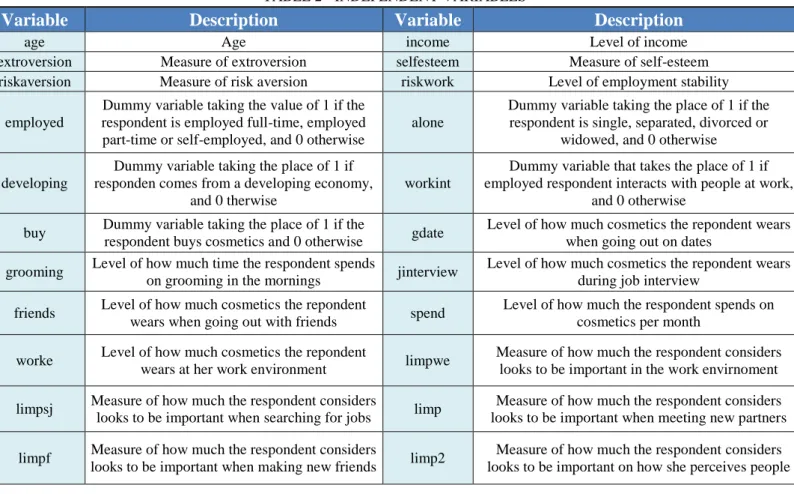
The rest of our control variables are as per table 2.
TABLE 2 - INDEPENDENT VARIABLES
Variable Description Variable Description
age Age income Level of income extroversion Measure of extroversion selfesteem Measure of self-esteem riskaversion Measure of risk aversion riskwork Level of employment stability
employed
Dummy variable taking the value of 1 if the respondent is employed full-time, employed part-time or self-employed, and 0 otherwise
alone
Dummy variable taking the place of 1 if the respondent is single, separated, divorced or
widowed, and 0 otherwise
developing
Dummy variable taking the place of 1 if responden comes from a developing economy,
and 0 therwise
workint
Dummy variable that takes the place of 1 if employed respondent interacts with people at work,
and 0 otherwise buy Dummy variable taking the place of 1 if the
respondent buys cosmetics and 0 otherwise gdate
Level of how much cosmetics the repondent wears when going out on dates
grooming Level of how much time the respondent spends
on grooming in the mornings jinterview
Level of how much cosmetics the repondent wears during job interview
friends Level of how much cosmetics the repondent
wears when going out with friends spend
Level of how much the respondent spends on cosmetics per month
worke Level of how much cosmetics the repondent
wears at her work environment limpwe
Measure of how much the respondent considers looks to be important in the work envirnoment
limpsj Measure of how much the respondent considers
looks to be important when searching for jobs limp
Measure of how much the respondent considers looks to be important when meeting new partners
limpf Measure of how much the respondent considers
looks to be important when making new friends limp2
Measure of how much the respondent considers looks to be important on how she perceives people
3.5 Model
As mentioned in section 3.3, our dependent variable (lipstick effect) is a dummy variable that takes the place of 1 if the respondent shows a consumer behavior consistent with the lipstick effect and 0 otherwise. We have chosen to use a logistic model to measure how the different independent variables affect the probability of y = 1.
29 Our initial model consisted of our 3 main parameters (work, love and personal life) and all of the other independent variables as control variables. Model 1 goes as follows:
We then proceeded to run an F-test on all of our independent variables to see if the model would be valid with all of them. We had from it a p-value of .26 indicating that this model is not adequate. It is important to notice that because our sample is relatively small (only 270 observations) instead of using a threshold of .05 we chose to use a threshold of .1.
Our next step was running an F-test on all of the control variables that were not significant in Model 1. The control variables that were not significant in Model 1 were: age, extroversion, selfesteem, riskaversion, riskwork, employed, alone, workint, gdate, jinterview, friends, spend, worke, limpwe, limpsj, limp, limpf and limp2. From testing these variables we obtained a p-value of .9 meaning that we don’t reject the null hypothesis that they do not have an impact on the lipstick effect and therefore we can remove them from our model.
We then proceeded to create a new model (Model 2) that goes as follows:
3.6 Results and Discussion
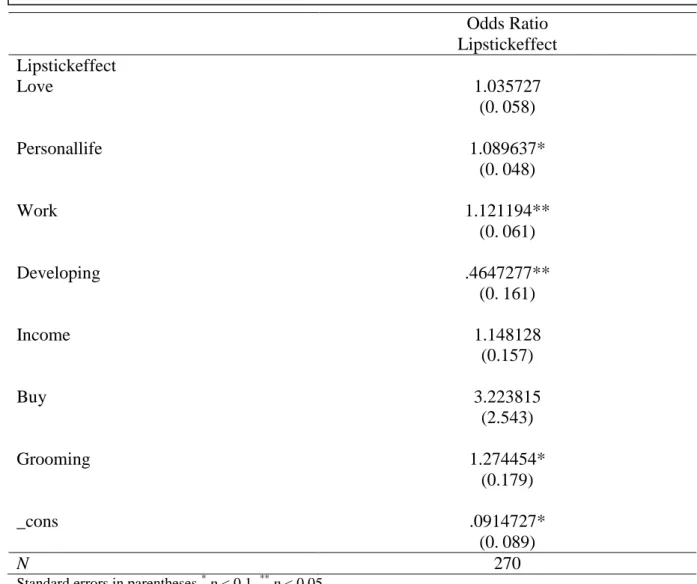
When running Model 2, our model passed the F-test (p-value = .02), showing that we reject the hypothesis that our variables do not affect the lipstick effect, and therefore
lipstickeffect = α + β1 work + β2 love + β3 personallife + β4 age + β5 income + β6 extroversion + β7
selfesteem + β8 riskaversion + β9 riskwork + β10 employed + β11 alone + β12 developing + β13 workint + β14
buy + β15 gdate + β16 grooming + β17 jinterview + β18 friends + β19 spend + β20 worke + β21 limpwe + β22
limpsj + β23 limp + β24 limpf + β25 limp2 +
ε
30 validate our model. As we can observe from table 3 we have a positive and significant impact of work and personal life on the lipstick effect, but an insignificant impact of love. Our odds ratio shows us that an increase of 1 unit in the personal life index, leads to an increase in the odds of incurring in the lipstick effect of 8,9%. Likewise, an increase of 1 unit in the work index leads to an increase in the odds of incurring in the lipstick effect of 12%. Odds Ratio Lipstickeffect Lipstickeffect Love 1.035727 (0. 058) Personallife 1.089637* (0. 048) Work 1.121194** (0. 061) Developing .4647277** (0. 161) Income 1.148128 (0.157) Buy 3.223815 (2.543) Grooming 1.274454* (0.179) _cons .0914727* (0. 089) N 270
Standard errors in parentheses * p < 0.1, ** p < 0.05.
As we stated in Chapter 2, Rodeheffer et al (2012) presented results showing that the lipstick effect was caused due to the fact that women were searching for financially secure partners during economic recessions. It was our initial hypothesis that other
31 factors that were not related to romantic relationships also influenced the lipstick effect. We have shown that when considering work and personal life (unrelated to romantic relationships) love does not affect the lipstick effect. To check if our results were consistent with those obtained by Rodeheffer et al we then removed the parameters for work and personal life to check how love by itself influenced the lipstick effect.
When testing for love alone we find that love has a positive and significant impact on lipstick effect, showing that romantic relationships are only significant to the increase in relative consumption of cosmetics when work and other aspects of our personal life that do not relate to romantic relationships are not considered. In Appendix 2 we can see the results of our regression.
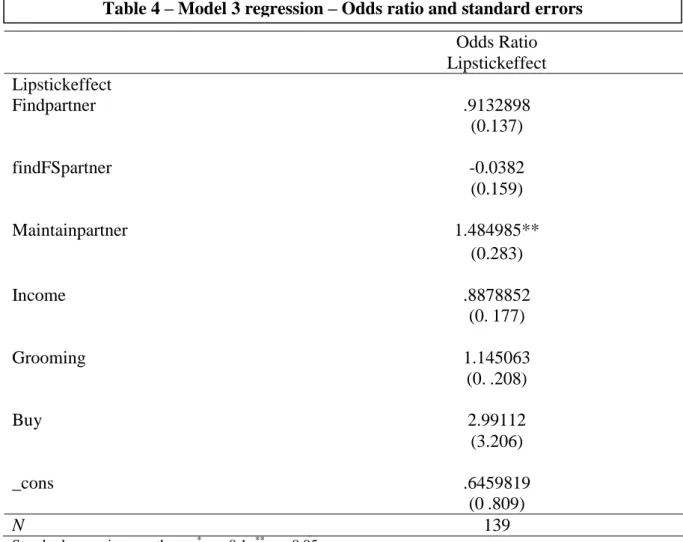
Further on, we used the same model but separated the love parameter into three dimensions: (i) finding a partner, (ii) finding a financially secure partner and (iii) maintaining a partner, and we also controlled for women that were single. Table 4 shows the results obtained.
As we can observe, for our respondents, even when controlling only for respondents that are single, the lipstick effect is not explained by finding a partner. Our results suggest that women would only be willing to increase their relative cosmetic consumption during times of economic recessions in order to maintain a partner. According to our data, an increase of 1 unit in the dimension maintain a partner leads to an increase in the odds of incurring in the lipstick effect of 48%, when not taking under consideration work and personal life.
32 Odds Ratio Lipstickeffect Lipstickeffect Findpartner .9132898 (0.137) findFSpartner -0.0382 (0.159) Maintainpartner 1.484985** (0.283) Income .8878852 (0. 177) Grooming 1.145063 (0. .208) Buy 2.99112 (3.206) _cons .6459819 (0 .809) N 139
Standard errors in parentheses * p < 0.1, ** p < 0.05,
Conclusion
As we have seen, during economic recessions women tend to increase their relative consumption of cosmetics, the so called lipstick effect. In a study conducted in 2012, Rodeheffer et al, concluded that the lipstick effect is driven by women’s desire to attract mates with resources and depends on the perceived mate attraction function served by these products. In this research we showed that when adding other explanatory motives for the lipstick effect, romantic relationships become an insignificant driver.
Our results suggest that romantic relationships only explain the lipstick effect when other aspects of life, in which an increase in beauty leads to a positive outcome, are not
33 considered. When adding to our model overall personal life (i.e. overall level of happiness, sociability and self-esteem), regardless of romantic relationships and professional life, romantic relationships no longer explain the lipstick effect. Moreover, even when taking under consideration only single participants, finding a partner still did not explain the lipstick effect. On the other hand, we have shown that personal life and work are positively and significantly correlated with the lipstick effect.
Our findings shed light to a whole new perspective on the consumer behavior for cosmetics products and what is the relationship that women have with them. Although we are aware that the reliability of our online survey is not the same as that of an experiment controlled in a laboratory, and that social desirability and interpretation biases may affect the results obtained through perspective-taking, we believe that our findings are consistent.
There is still a lot to be said about the lipstick effect and the scope for future research is very broad. Future research should focus on examining real world-data of different countries to assess in which areas the lipstick effect can be detected or if it is a worldwide phenomenon. It would be interesting to examine the behavior of the job market and unemployment rates against cosmetics consumption in the economies affected by the lipstick effect, as well as how differences in life-satisfaction and other well-being measures relate to cosmetics consumption during economic downturns in those areas.
Appendix 1
Welcome to our questionnaire! We are conducting research on cosmetics consumption and want to thank you for your participation!
Please note that this questionnaire is completely anonymous.
We consider cosmetics to be the following products: Products for Bath and Shower, Fragrances, Skin Care, Hair Care, Depilatories, Color Cosmetics (including make-up and nail polish), and Premium
Cosmetics.
Questionnaire
1. In what year were you born? 2. What is your gender? 3. What is your nationality?
4. In which country are you currently living?
5. Are you currently:
a) Married
b) Living together with a partner
c) Civil Partnership
d) Divorced
e) Separated
f) Widowed
g) Single
6. Are you currently:
a) Employed full-time
b) Employed part-time
c) Self-employed
d) Retired/ pensioned
e) Housewife not otherwise employed
f) Student
g) Unemployed
7. What is your average income per year:
a) None
c) Between 30K and 60K
d) Between 60K and 90K
e) More than 90K
8. Does your work require you to interact with other people on a daily basis?
a) Yes
b) No
9. Please choose your first, second and third option for the following question, “You mostly interact with other people during work by”:
a) Assisting and caring for others
b) Communicating with people outside your company
c) Establishing and maintaining interpersonal relationships within the company d) Performing for or working directly with the public
e) Selling or influencing others f) Managing employees g) Other (Please state)
10. “How stable is your employment situation”? On a scale from 1 to 5, where one means “low risk of losing my job” and 5 means “high risk of losing my job”, please chose the option that would best describe your employment stability:
a) 1
b) 2
c) 3
d) 4
e) 5
11. “Are you in general a person who takes risks or do you try to evade risk?” On a scale from 1 to 5, where one means “not at all prepared to take risks” and 5 means “very much prepared to take risks”, please self-grade the choice that would best describe you:
a) 1
b) 2
c) 3
d) 4
e) 5
12. On a scale from 1 to 5 where 1 means “strongly disagree” and 5 means “strongly agree”, please state whether the following statements are similar to your beliefs or not.
a) Looking good is important when making new friends
c) Looking good is important when searching for a job
d) Looking good is important in one’s work environment (mainly when working in an office) e) Looks are not important for how I perceive others
13. On a scale from 1 to 5 where 1 means “strongly disagree” and 5 means “strongly agree”, please state if the following statements are similar to your beliefs or not.
a) I feel that I am a person or worth, at least on an equal plane with others
b) I feel that I have a number of good qualities
c) All in all, I am inclined to feel that I am a failure
d) I am able to do things as well as most people
e) I feel I do not have much to be proud of
f) I take a positive attitude towards myself
g) On the whole, I am satisfied with myself
h) I wish I could have more respect for myself
i) I certainly feel useless at times
j) At times I think that I am no good at all
14. On a scale from 1 to 5, where 1 means “strongly disagree” and 5 means “strongly agree”, please state if the following statements are similar to your beliefs or not.
a) I feel very comfortable when speaking to an audience b) I feel very comfortable talking to people I don’t know yet
c) When I go out with my friends I tend to be very outgoing and I talk to everyone
d) I enjoy meeting new people
e) I am very shy
f) In my work I feel uncomfortable when I have to talk to colleagues/clients that I don’t know
15. Please state your first, second and third option for the following question: “What type of
cosmetics do you mostly buy?”
a) Make-up
b) Skin care
c) Hair care / Hair colouring
d) Fragrances
e) Hair salon visits (including manicure)