L'INFORMATION SOCIALE
INFLUENCE
L'ÉVALUATION ET
LE
CHOIX
DE
PARCELLE DE
NOURRITURE
DES
DIAMANTS MANDARINS
(TAENIOPYGIA
GUTTATA)
MÉMOIRE PRÉSENTÉ
COMME EXIGENCE PARTIELLE DE LA MAÎTRISE EN BIOLOGIE
PAR
SIMONE TOMMASINA
UNIVERSITÉ OU QUÉBEC
À
MONTRÉAL
Service des bibliothèques
·
Avertissement
La
diffus
i
on de ca mémoire sa fait dans le
i
respect des droits de son auteur, qui a signé
le formulaire
Autorisation ds repiuduirs
.
et dtJ diffussr un travail dtJ rechsrchs ds cycles
<Jupérlsurs (SOU-522- Rév
.
01-2006). Cette autorisation stipule que <<conformément
à
l
'
article 11 du Règlement no 8 dea études de cycles supérieurs, [l'auteur] concède
à
l'
Université du Québec
à
Montréal une
llc~ncenon exclusive d'utilisation et de
.
p
ublication de la totalité ou d'une partie Importante de [son] travail de rechercha pour
d
es fins pédagogiques et non commerciales.
Plus précisément, [l'auteur) autorise
l'Université du Québec à Montréal
à reproduire, diffuser, prêter, distribuer ou vendre dea
copies de
.
[son} travail de recherche
à dea flna non commerciales sur quelque support
que ce soit,
y
compris l'Internet Cette licence et cette autorisation n'antralnent pas une
renonciation de [la) part [de l'auteur]
à [ses] droits moraux ni
à [ses) droits de propriété
intellectuelle. Sauf ententé contraire, [l'auteur) conserve la liberté de diffuser et da
commercialiser ou non ce travail d
on
t
[
i
l
] po
ssède un exemp
l
a
i
re.
»
son soutien et ses précieux conseils qui m'ont énormément aidé au cours de ces deux an -nées de maîtrise. Je remercie beaucoup Carolyn
Hall
pour tous les commentaires sur mon manuscrit, pour son aide lors de l'interprétation de mes données et tout le temps qu'elle a employé à m'aider. En suite, un gros mercià tous les membres du labo
: Mohammad Afshar, Marie-Pierre Bonin, Sophie Godde et Mewen Le Hô; sans vous les heures passées au bureau auraient étés vraiment moins plaisantes, merci pour le feedback continu que vous m'avez donné, pour votre soutien tout le long de mon projet ainsi que pour les belles jour-nées/soirées passées ensemble. Je remercie également Denis Réale qui, parfois malgré lui, m'a beaucoup aidé pendant ces 2 années et surtout lors des analyses statistiques. Enfin un « grazie » spécialà
François Dumont qui m'a permis de découvrir les traditions, la culture, la beauté du Québec et sans lequel je ne serais même pas arrivéà
Montréal.Last but not least, l'd like to thank Heikki Hirvonen which allowed me to come to Finland and stay at the University of Helsinki writing my paper. Thanks to him, Jussi Koskinen and Christina Grüber for ali the good comments, useful discussions and new perspectives on my work as for the opportunity ofvisiting Finland.
Sono consapevole di non aver ringraziato tantissime persane che mi hanna accompagnato durante questa magnifica esperienza. Anche non vi ho menzionati cio non vuol dire che mi sia dimenticato di voi. A voi tutti che avete fatto parte della mia vita, anche solo per un memento fugace, vaglio dirvi: grazie di tutto cuore.
TABLE DES MATIÈRES
LISTE DES FIGURES ... V
RÉSUMÉ ... VI
INTRODUCTION ... 1
Quand utiliser un type d'information plutôt qu'un autre? ... 2
Information sociale incorrecte et risque de cascades d'information ... 5
Le diamant mandarin (Taeniopygia guttata) .................................... B Les repasses vidéos ... 10
Objectifs de recherche ... 12
NOTE SUR LE CHAPITRE ... 13
CHAPITRE 1 ZEBRA FINCHES AVOlD INFORMATIONAL CASCADES BY DYNAMIC INTEGRATION OF PER-SONALAND SOCIAL FORAGING INFORMATION ... 14
1.11ntroduction ... 15
1.2 Material and methods ... 17
1.2.1 Experimental subjects ... 17
1.2.2 Recording and editing video sequences ... 17
1.2.3 Apparatus ... 18 1.2.4 Procedure ... 20 1.2.4.1 Training trials ... 20 1.2.4.2 Experimental trials ... 21 1.2.5 Statistical analysis ... 21 1.3 Results ... · ... 23
1.4.1 Social information is used only when persona! information is costly ... 28
1.4.2 Initial patch choice is not a reliable indicator of social information use ... 28
1.4.3 Patch departure decision is affei:ted by bath position and type of social information ... 29
1.4.4 Overall sampling effort is influenced by unreliable persona! past experience ... 30
1.4.5 Conclusion and future perspectives ... 31
CONCLUSION ... 32
LISTE DES FIGURES
Figure Page
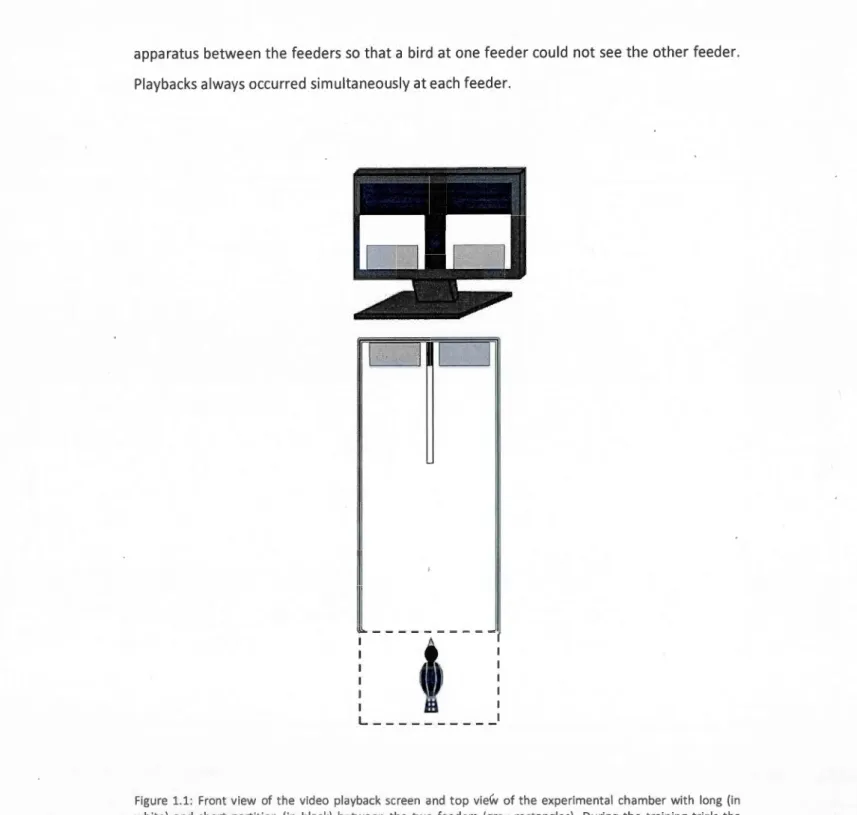
1.1 View of the experimental chamber with long and short partitions between the
two feeders 19
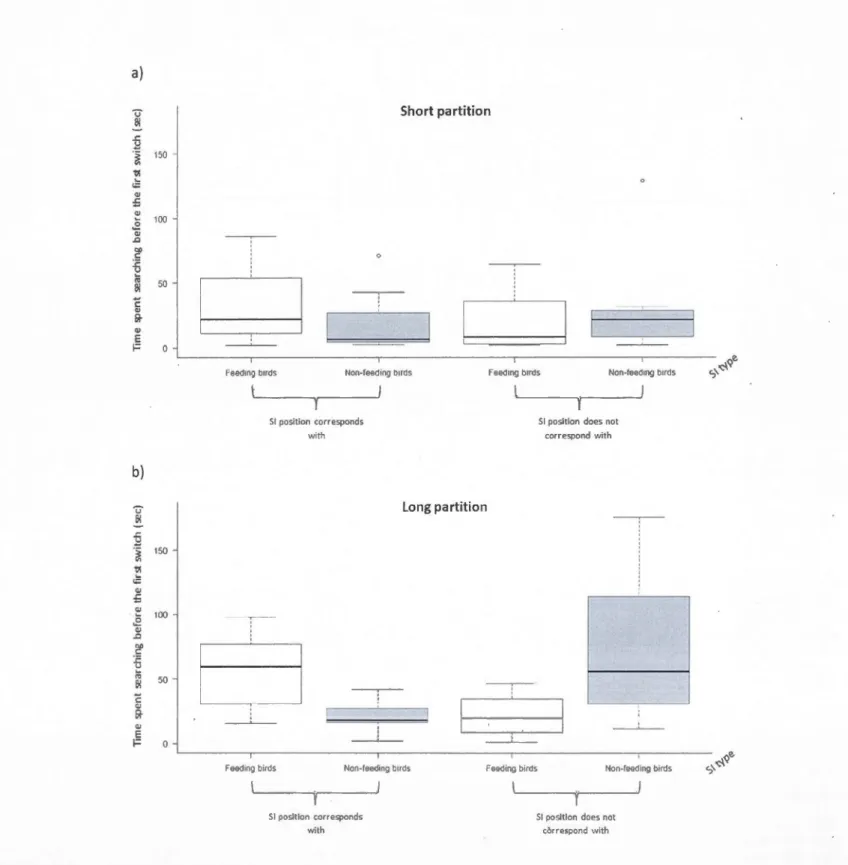
1.2a Ti me spent searching in the first feeder visited before switching as a function of SI type when the first feeder visited corresponds and does not correspond with SI position in the short partition condition. 26
1.2b Ti me spent searching in the first feeder visited before switching as a function of SI type when the first feeder visited corresponds and does not correspond
d'évaluer l'environnement. Cette information peut être obtenue personnellement ou en observant le comportement d'autres individus (i.e. information sociale). L'information so-ciale est généralement avantageuse mais en certaines occasions peut être en conflit avec l'information personnelle et les animaux doivent choisir
à
quelle source d'information se rallier. Il peut arriver que des animaux, après avoir observé les décisions des congénères, décident d'outrepasser l'information acquise par appréciation personnelle afin de se con- . formerà
l'information sociale. Il s'agit alors d'une cascade d'information, mécanisme qui peutà
l'occasion amener les animauxà
prendre des décisions erronées. Une cascade d'information a plus de chances de se former lorsque l'information personnelle est ambigüe ou l'échantillonnage couteux, car les individus seront enclinsà
utiliser l'information sociale. On a testé si le coût d'acquisition ainsi que l'ambiguïté de l'information personnelle influen-cent l'utilisation d'information sociale par des diamants mandarins (Taeniopygia guttata). Dans une première expérience, les individus avaient la possibilité d'échantillonner 2 man -geoires après avoir observé des vidéos de congénères en train de manger ou simplement se perchantà
1 des 2 alternatives. Par la suite, on a ajouté une longue partition entre les man-geoires qui forçait les individusà
faire un détour et augmentait le coût de l'échantillonnage personnel. L'information sociale n'influençait pas le choix initial de la mangeoire et l'effort de recherche global. Par contre, l'information sociale affectait le temps passéà
la première mangeoire visitée avant de la quitter, mais seulement avec la partition longue. Lorsque l'information sociale étaità
la même parcelle échantillonnée, les individus cherchaient plus longtemps s'ils avaient observé des congénères en train de manger et quittaient plus tôt lorsque les congénères se perchaient sans manger. Quand l'information sociale était diffu -séeà
la mangeoire opposéeà
celle échantillonnée, les individus cherchaient moins long -temps s'ils avaient observé des congénères en train de manger et restaient plus longtemps si les congénères s'y perchaient sans manger. Nos résultats démontrent que l'information sociale est utilisée lorsque l'échantillonnage personnel ne permet pas de trouver de la nour-riture et l'acquisition d'information personnelle est coûteuse. L'effet de l'information so -ciale est par contre temporaire et les individus outrepassent cette information quand leur échantillonnage démontre son imprécision, leur permettant de réduire les coûts d'utilisation de l'information socjale erronée ainsi que les chances de rester engagé dans une cascade d'information.---~---~
INTRODUCTION
Les animaux doivent régulièrement acquérir de l'information concernant l'environnement dans lequel ils vivent afin d'ajuster leurs comportements et maximiser leur aptitude (Galef
& Giraldeau 2001,
Danchin et al. 2004). Pendant les activités d'approvisionnement, les ani -maux peuvent utiliser différentes stratégies pour déterminer la qualité de la nourriture et la productivité de la parcelle qu'ils sont en train d'échantillonner. Lorsque les individus possè-dent des informations qui peuvent être incomplètes, la répartition de l'effort d'exploitation des différentes parcelles est faite sur la base d'une estimation la plus précise possible, faite en combinant différents types d'informations (Stephens 1989). Les individus solitaires ont généralement accèsà deux types d'information
: le premier est ·acquis de façon personnelle en échantillonnant les parcelles et est généré par le résultat des interactions de l'individu avec l'environnement (Valone 1991). Le deuxième est appelé «information a priori » et consiste en l'ensemble des informations sur la parcelle emmagasinées dans la mémoire des individus (Valone 1991). Les animaux grégaires (ainsi que certains animaux solitaires, par exemple te tamias rayéTamias striatus)
ont accès aussià
un troisième type d'information, obtenu en surveillant les interactions des autres membres du groupe avec l'environnement et transmis par leur comportement et leurs décisions. Cette information, appelée« informa-tion sociale fournie par inadvertance» (Danchin et al. 2004), peut fournir aux animaux une base supplémentaire pour ajuster leurs stratégies d'approvisionnement. Il existe deux types d'information sociale fournie par inadvertance : les « indices sociaux » sont générés par chacune des décisions des animaux du groupe et fournissent une information discrète sur la présence/absence de la nourriture et sur sa localisation (ex. attraction locale, Veen 1977). Le deuxième type d'information sociale fournie par inadvertance est appelé « information publique » (Valone 1989) et est dérivé de l'observation des performances d'autres individus exploitant une ressource (Danchin et al. 2004). L'information publique diffère des indices sociaux puisqu'elle fournit des informations quantitatives sur la qualité de la nourriture et sur la productivité de la parcelle exploitée (Valone 1989, Danchin et al. 2004).Les individus tirent bénéfice de l'information sociale fournie par inadvertance puisqu'elle permet de réduire les coûts associés
à
l'acquisition d'information par interaction avec l'environnement, ainsi que d'estimer plus rapidement et précisément les paramètres envi-ronnementaux (Clark& Mangel
1984, 1986, Valone 1989, Giraldeau et al. 1994, Giraldeau 1997, Danchin et al. 2001, Galef&
Giraldeau 2001, Doligez et al. 2003). Par conséquent on peut supposer qu'un individu ayant accèsà
cette information, comparéà
un animal soli-taire, pourrait évaluer la qualité des différentes alternatives avec plus de précision et effec-tuer des meilleurs choix (Clark & Mangel1986).Quand
utiliser un
type d'information plutôt
qu'un
autre?
L'utilisation d'information sociale fournie par inadvertance (ci-après appelée «information sociale») est généralement considérée un bénéfice pour les animaux; toutefois il a été re-marqué que certaines espèces n'utilisent pas ce type d'information. Ces observations ont récemment poussé les chercheurs en écologie comportementale
à
investiguer les circons-tances et les conditions écologiques dans lesquelles les animaux sont enclinsà
utiliser l'information sociale plutôt que l'information personnelle (voir Laland 2004 et Kendal et al. 2005 pour une revue).Dans certaines occasions l'acquisition simultanée d'information personnelle et d'information sociale pourrait être impossible. Par exemple,
à
cause de limitations senso-rielles ou cognitives, il est possible que les animaux soient incapables d'acquérir ou de trai-ter les deux informations en même temps et par conséquent doivent décider quelle infor-mation utiliser. Lorsque l'acquisition simultanée d'information personnelle et sociale est impossible, les animaux préfèrent utiliser leur appréciation personnelle. Ceci a été démon-tré chez les étourneaux sansonnets (Sturnus vulgaris) dans un contexte d'approvisionnement (Templeton & Giraldeau 1995). Lorsqu'en échantillonnant des man-geoires les conditions expérimentales empêchaient le contact visuel avec les autres
3
membres du groupe, les individus se ralliaient seulement à leur information personnelle et ne tenaient pas compte de l'information sociale. Au contraire, lorsque l'acquisition des deux types d'informations était compatible, les animaux profitaient de l'information sociale comme base supplémentaire sur laquelle fonder leurs décisions (Templeton
& Giraldeau
1995).L'usage d'information sociale dépend aussi directement des coûts associés à l'acquisition et
à
l'utilisation de l'information personnelle. Quand acquérir de l'information personnelle -ment est risqué ou coûteux en termes d'énergie ou de temps, les animaux préfèrent plutôt utiliser l'information sociale (Boulinier&
Danchin 1997, Valone&
Templeton 2002, Dall et al. 2005). Des études sur deux espèces d'épinoches (Pungitus pungitius - épinocheà
neuf épines et Gasterosteus aculeatus- épinocheà trois épines) ont mis en évidenc
e que dans un contexte d'approvisionnement la première espèce utilise l'information sociale, c ontraire-ment à la deuxième, laquelle base ses décisions exclusivement sur l'information acquise par appréciation personnelle (Coolen et al. 2003, 2005). Les chercheurs expliquent cette diffé-rence, remarquée dans deux espèces phylogénétiquement rapprochées, en observant que les épinochesà
neuf épines sont soumisesà un risqu
e de prédation plus élevé alors que les épinochesà
trois épines, possédant un corps plus robuste et trois épines dorsales plus épaisses, sont moins vulnérables aux prédateurs. En étant plusà
risque, le coût de l'apprentissage individuel pour les épinochesà
neuf épines est plus élevé que pour les épi -nochesà
trois épines, ce qui procure un avantageà
prêter plus attention aux comporte -ments de autres individus. Chez les guppies (Poecilia reticulata), il a été mis en évidence que des individus précédemment entraînésà
discerner la qualité de deux mangeoires igno-rent toute information sociale générée par des congénères engagés dans des activités
d'approvisionnement, même si les deux sources d'information fournissent des informations conflictuelles. Toutefois, quand le coût d'utilisation de l'information personnelle est trop élevé, comme lorsqu'il entraîne une perte de contact visuel avec le reste du groupe, les in-dividus suivent l'information sociale plutôt que leur information personnelle (Kendal et al. 2004). Ces expériences confirment les analyses théoriques employées dans l'exploration des
avantages de l'apprentissage sociat lesquelles concluent que les animaux devraient se ral -lier plus à l'information sociale quand les coûts de l'apprentissage individuel augmentent (Boyd
&
Richerson 1985, 1988, Laland 2004).La qualité de l'information personnelle peut également influencer son utilisation. En 1996, Templeton et Giraldeau ont démontré chez les étourneaux (S. vulgaris) que lorsque des individus pouvaient avoir accès à une information personnelle précise et fiable, ils igno-raient alors les décisions prises par les autres et se ralliaient uniquement à l'information acquise par appréciation personnelle. Au contraire, quand cette information devenait am -bigüe, les animaux utilisaient plus l'information sociale. Également Van Bergen, Coolen et Laland en 2004 ont obtenu le même résultat chez les épinoches à neuf épines (P. pungitius). Dans cette expérience ils ont expérimentalement modifié l'information sociale concernant la richesse de deux mangeoires: les animaux pouvaient décider de suivre leur information personnelle ou l'information sociale fournie par inadvertance par leurs congénères. Lorsque l'information personnelle était précise, c'est-à-dire que les animaux pouvaient discriminer précisément par eux-mêmes la différence de qualité entre les deux mangeoires, leur usage d'information sociale diminuait et ce même si les deux sources d'informations étaient con -tradictoires. Par contre, lorsque la discrimination se faisait plus difficile, les épinoches em-ployaient en majeure partie l'information sociale pour faire leurs choix. Donc, lorsque les animaux peuvent acquérir de l'information personnelle précise et fiable les individus de -vraient ignorer l'information sociale et se fier seulement à leur propre expérience, ce qui éviterait d'éventuelles erreurs liées à l'utilisation d'information sociale imprécise (Tem-pleton & Giraldeau 1996, Laland 2004).
Enfin, le type d'information sociale disponible ainsi que son «pouvoir de persuasion » in -fluencent son utilisation. Par exemple, l'information publique générée de l'observation des performances des autres animaux est une source d'information plus précise que les indices sociaux, générés de l'observation des décisions seulement (Giraldeau et al. 2002). Lorsque les deux types d'information sont disponibles en même temps, l'usage d'information pu
-5
blique devrait donc être préféré aux indices sociaux (Doligez et al. 2003). Une étude sur les épinoches
à
neuf épines (P. pungitus) démontre cette préférence expérimentalement en montrant que les poissons préfèrent visiter la mangeoire associée avec la majorité des dé-monstrateurs lorsque les deux mangeoires ne fournissent aucune information publique concernant la qualité de la mangeoire. Par contre, lorsque les deux mangeoires contiennent de la nourriture et donc le comportement des poissons fournit de l'information publique, les individus choisissent la mangeoire associée au groupe qui démontrait la plus haute vitesse d'approvisionnement, indépendamment de leur nombre (Coolen et al. 2005). De plus, Rieu
-cau et Giraldeau (2009a) ont démontré que des capucins damiers (Lonchura punctulata) ayant une information personnelle très fiable, peuvent l'outrepasser pour se conformer aux choix
d'un groupe lorsque ce dernier fournit une information sociale suffisamment persuasive. Dans cette expérience les individus focaux devaient choisir parmi deux mangeoires, l'une des deux
portant une tache verte que les animaux avaient appris
à
associer avec la mangeoire de meil-leure qualité. L'information sociale, sous forme de démonstrateurs projetés sur un écran der-rière une des deux mangeoires, était balancée en montrant un nombre variable d'animaux
engagés dans des activités d'approvisionnement, ou se perchant
à
la mangeoire sans manger.Lorsque le nombre d'oiseaux projetés derrière la mangeoire sans la tache verte (donc reconnue
comme de pire qualité) augmentait, une majorité d'individus décidait de se conformer
à
la décision du groupe, en rejetant leur information personnelle même si elle était très précise. Parcontre, ceci n'advenait pas lorsque les démonstrateurs sur l'écran se perchaient sur la man -geoire sans manger, ce qui a confirmé que l'information publique générée par des animaux engagés dans des activités d'approvisionnement est plus persuasive que les indices sociaux générées simplement par la présence d'animaux dans une parcelle.
Information socia
l
e incorrecte et r
i
s
q
ue de casca
d
es d'
i
n
f
orma
ti
on
Si d'un côté l'usage de l'information sociale fournie par inadvertance représente un
-ner des coûts (Giraldeau
et al.
2002). Quand les conditions environnementales changent très rapidement, la diffusion d'information sociale peut être en retard par rapport auxchangements environnementaux et entraîner la transmission d'informations caduques
(Feldman
et al.
1996, Giraldeau& Rieucau 2011)
. Ces prédictions théoriques ont étés véri-fiées par Laland et Williams (1998) chez les guppies (P.reticulata)
.
Les chercheurs ont dé-montré qu'une information sociale erronée concernant le choix de la meilleure route pourarriver
à
une mangeoire pouvait être transmise et maintenue, promouvant la formation detraditions sous-optimales.
L'usage combiné d'informations personnelle et sociale peut générer un phénomène appelé
«cascade d'information» (Bikhchandani
et al
.
1992). Ceci se vérifie dans des conditions où un individu, en observant une séquence de décisions prises par d'autres animaux, incorpore cette information socialeà
sa propre appréciation personnelle afin de décider de soncom-portement. Lorsque l'information personnelle est ambigüe, il arrive que la somme de
l'information sociale ait plus de poids dans la décision que l'information personnelle, ce qui entraîne le début d'une cascade d'information (Bikhchandani
et al.
1992). Un individu adopte alors une option même si son information personnelle vaà
l'encontre de ce choix. Les animaux engagés dans une cascade peuventà
l'occasion suivre une information sociale incorrecte menantà
la diffusion de choix inappropriés au sein du groupe entraînant des coûts plus ou moins élevés. La théorie de la cascade d'information a été proposée comme explication pour des phénomènes comme les alarmes et les fuites collectives, le choix des perchoirs nocturnes parmi les oiseaux coloniaux et le copiage des choix du partenaire sexuel (Giraldeauet a
i
.
2002). De plus, chez les humains, le phénomène est proposé comme expli-cation de phénomènes tels le crash des marchés financiers ou les fuites de panique dans les foules (Giraldeau et al. 2002).Pour expliquer ce phénomène imaginons un individu qui, face au choix de manger dans la mangeoire A ou dans la mangeoire B, décide après échantillonnage que la mangeoire B est de meilleure qualité. Le deuxième individu, confronté avec les mêmes options, décide lui
7
aussi sur les bases de son_ propre échantillonnage que la mangeoire B est de meilleure quali-té et, ayant observé le même choix chez l'animal précédent, il est maintenant plus certain que cette mangeoire est la meilleure option. Supposons maintenant qu'un troisième indi-vidu, par appréciation personnelle, au contraire de ses prédécesseurs trouve que la man-geoire A est meilleure que la manman-geoire B. Si cet individu tient compte du choix de ses deux prédécesseurs et accorde
à
cette information sociale le même poids que son information personnelle (i.e. son propre indice acquis en échantillonnant les mangeoires), alors l'information sociale générée par ses deux prédécesseurs pèsera plus lourd dans son choix que son information personnelle. Dans ce cas, ce troisième individu sera enclinà
ignorer son information personnelle età
suivre le choix des deux autres (Bikhchandaniet al.
1992, Gi-raldeauet al
.
2002). Quand cette situation se vérifie, une cascade d'information débute et tous les animaux suivants suivront l'information sociale en ignorant complètement leur propre expérience.Dès qu'une cascade se forme, il n'y a plus aucune accumulation d'information et les ind i-vidus ne vont plus utiliser leur information personnelle car la décision optimale n'en dépen-dra plus (Anderson
&
Holt 1997). Les cascades d'information sont sensibles aux premières séquences décisionnelles. Dépendamment de l'ambigüité des indices il peut arriver que les cascades génèrent des réponses incorrectes. Si le deuxième individu de la séquence, par appréciation personnelle, avait trouvé qu'il était mieux de s'approvisionnerà
la mangeoire A alors que le premier avait décidé d'exploiter la mangeoire B, il se serait retrouvé dans une condition où la décision de manger dans la mangeoire A ou la mangeoire B sont équipro-bables. Si cet individu, faisant faceà
un choix ambigüe, avait décidé de prendre la même décision que son congénère (et donc rejeter son information personnelle), il aurait été dans la même situation que le troisième individu décrit dans le premier exemple, sauf que la cas-cade qui en serait dérivée aurait été probablement incorrecte.
Les cascades d'information sont très fragiles
à
l'arrivée de toute nouvelle information. Lors-qu'une cascade d'information se forme, l'apparition d'un individu mieux informé ou «surpersonnelle, peut briser la cascade (Bikhchandani et al
.
1992, Noth&
Weber 2003). De plus,des cascades d'information basées sur des décisions erronées ne peuvent pas persister très longtemps, car l'accès aux indices sur lesquels les autres animaux ont basé leurs décisions permettra d'avoir un feedback sur le comportement adopté, d'évaluer la précision de l'information sociale et un mauvais choix pourra ainsi être reconnu sans ambiguïté (Bik -chandani
et al
.
1992). Les animaux devraient donc baser leur comportement sur ces indices plutôt que sur les actions des autres car cela permettrait d'éviter de copier aveuglément des décisions qui peuvent être erronées (Giraldeauet
al
.
2002). Cependant, si l'accès aux indices est impossible ou l'acquisition d'information personnelle coûteuse, la décision optimale serait de suivre les actions des prédécesseurs au lieu de s'engager dans des investigations coûteuses de l'environnement (Giraldeau et al. 2002, Coolenet al
.
2005), même si le risque de rester engagé dans une cascade d'information est plus élevé (Anderson & Holt 1997).Le
di
a
m
a
nt m
a
nd
ar
in
(Taeniopygia guttata)
Le diamant mandarin
(T.
guttata
,
Vieillot 1817) est un petit oiseau mesurant de 8à
12 cm pour une masse moyenne d'environ 13 g et est l'estrildidé (ordre des Passériformes) le pluscommun du centre de l'Australie. Cette espèce habite les steppes ouvertes de l'Australie et est présente partout sauf sur les côtes du nord et du sud de l'île. Le diamant mandarin est adapté aux perturbations humaines et se présente même dans les villes; de plus, en étant une espèce spécialiste granivore, elle tire profit des champs, des cultures et des espaces ouverts par la déforestation. Les sexes présentent un léger dimorphisme concernant les couleurs du plumage et du bec; de plus, les mâles possèdent un chant particulier. Par contre il n'y a pas de différence de taille entre les sexes. Cette espèce se reproduit
à
la suite d'importantes périodes de pluie,à
n'importe quel moment de l'année ; ceci est une adapta -tion aux climats secs présents dans l'Australie du centre et permetà
cette espèce d'avoir une large aire de répartition. Cette espèce est très sociale et forme des groupesà
longueur d'année.À
cause de la proximité entre les individus l'agression est commune et se vérifie- - - -- - - -- -- - - - -- - -- -- - - - -- ---,
9
souvent pendant le choix des sites de nidification et des partenaires; il n'y a cependant au-cune forme de dominance stable (Zann 1996).
Le diamant mandarin est un sujet approprié pour une étude sur le comportement d'approvisionnement social. En effet, il a été démontré que son succès reproducteur est directement corrélé avec son efficacité dans un contexte alimentaire. En 1993, Lemon a mesuré l'aptitude de 4 groupes de diamants mandarins soumis
à
différentes conditions d'approvisionnement. En changeant la proportion de graines de millet et d'écales (la partie externe non comestible qui enveloppe la graine) dans les mangeoires offertes aux oiseaux, le chercheur a observé que le temps passéà
chercher de la nourriture était inversement corrélé avec le succès des animaux. Le groupe'expérimental ayant la mangeoire contenant une proportion d'écales plus élevée était celui qui démontrait un intervalle de temps majeur entre les couvées, tout en diminuant la taille moyenne de la couvée, la survie des juvéniles et la survie des adultes. Conséquemment, pour cette espèce il est très important de maxi-miser le nombre de graines mangés par unité de temps et de diminuer l'énergie employée pour trouver de la nourriture. Il est donc raisonnable de s'attendre que le diamant mandarin emploie des stratégies d'approvisionnement efficaces, lui permettant d'évaluer précisément la profita bi lité des différentes parcelles tout en minimisant les coûts.À
cause de la facilitéà
maintenir et faire reproduire cette espèce en captivité, le diamant mandarin est largement employé en laboratoire dans différentes expériences portant sur le comportement et sur les systèmes neuronaux des animaux. Ces expériences incluent desétudes sur les performances de chant (ex. Béihner 1990, Airey
&
DeVoogd 2000Ll'apprentissage (ex. Boogert
et al.
2008L le choix du partenaire (ex. Dubois 2007L lessys-tèmes visuels des oiseaux (Bowmaker
et
al .. 1997) et l'approvisionnement social (jeu produc-teur-chapardeur, Giraldeau et al. 1990, Beauchamp 2001, Dubois
&
Giraldeau 2005, Mathot&
Giraldeau 2008). Toutefois,à
cause de l'interdiction d'exportation de toute espèceavienne Australienne, les oiseaux utilisés dans nos expériences sont une variété de diamant
L
es re
p
asse
s vid
é
o
s
Dans le domaine du comportement animal la technique des repasses vidéo a été employée avec succès chez plusieurs espèces dans différents contextes parmi lesquels les comporte-ments de parades nuptiales (ex.
Cervus elaphus,
Rebyet al.
2005), la sélection des parte-naires sexuels (ex.Maevia inclemens
,
Clark& Uetz 1993
,T. guttata
Adret 1997,Poecilia
latipinna
,
Witte& Klink 2005), les interactions agonistiques (ex.
G. aculeatus
,
McKinnon&
McPhail1996) de la reconnaissance des congénères (ex.Melopsittacu
s
undulatus
,
Mottley & Heyes 2003) et de l'approvisionnement social (ex.L.
punctulata
,
Rieucau & Giraldeau 2009a). Avec le développement de la technologie digitale cette technique offre aux che r-cheurs plusieurs bénéfices, et est en train de se diffuser de plus en plus dans les recherches portant sur le comportement animal. Le bénéfice le plus important est de pouvoir contrôler précisément les stimuli présentés aux animaux testés ainsi que s'assurer que tous les sujets expérimentaux reçoivent exactement le même traitement. L'accèsà
de l'instrumentation de haute qualité (caméras vidéo, logiciels de retouche et montage, appareillage de diffusion de vidéo) permet de capturer, modifier et réorganiser précisément les séquences vidéo afin d'obtenir les stimuli souhaités (D'Eath 1998, Rosenthal 2000).Toutefois, il existe certaines limites
à
l'application des repasses vidéo (Fieishmannet al
.
1997, D'Eath 1998, Fleishman
&
Endler 2000, Oliveiraet al
.
2000). Une des principales cri-tiquesà
cette technique est que l'appareillage utilisé pour la diffusion des images (télévi -seurs et écrans d'ordinateur) est spécifiquement développé pour stimuler le système visuel humain, qui est quelques fois très différent de celui de certaines espèces animales et, tout particulièrement des oiseaux (Adret 1997, D'Eath 1998).Les oiseaux diurnes possèdent une perception des couleurs très développée (Cuthill
et al
.
2000). Les cônes présents dans l'œil sont les structures dédiéesà
la vision des couleurs; contrairement aux êtres humains qui en possèdent de trois types, les oiseaux en possèdent quatre, sensibles aux ondes courtes, moyennes/longues, aux ultraviolets et une classe de cônes doubles (Chen& Goldsmith 1986
). Les oiseaux diurnes ont donc une vision allant des ultraviolets jusqu'aux infrarouges, de 320à
700 nm (Vorobyevet al
.
1998). Toute sorte11
d'écran n'est pas en mesure de diffuser des courtes longueurs d'onde comme les ultravio-lets et, conséquemment, il est presque impossible de présenter des stimuli totalement simi-laires à la réalité. Toutefois, la littérature nous offre plusieurs exemples de recherches con-duites sur des diamants mandarins avec la technique des repasses vidéo et l'utilisation de séquences vidéo a été efficace même dans des études portant sur le choix du partenaire sexuel, où les couleurs des individus présentés sont particulièrement importants (ex. Brazas & Shimizu 2002, Campbell & Hauber 2009, Druillon & Dubois 2008, Galoch & Bishof 2006, lkebuchi
&
Okanoya 1999, Swaddle et al. 2006).Les écrans de télévision et d'ordinateur sont réglés pour l'œil humain et présentent une fréquence de fusion du vacillement comprise entre 60 et 100 Hz. Ceci permet l'impression d'une image réaliste du mouvement sur la rétine humaine; par contre les oiseaux ont un seuil plus haut qui se situe entre 100 et 140 Hz (Maddocks et al. 2001). Si une image peut sembler stable pour l'œil humain, les oiseaux pourront quand même percevoir un fort vacil-lement. L'emploi d'écrans à cristaux liquides (LCD) est donc recommandé afin de limiter l'effet du vacillement (D'Eath 1998).
Jusqu'à présent la technologie tridimensionnelle n'est pas encore assez précise pour permettre la projection d'imager 3D lors des expériences; conséquemment les images vi
-déo pourront seulement être bidimensionnelles et aucune indication de profondeur n'est possible pour l'instant (Cuthill et al. 2000).
Malgré ces limitations, la technique des repasses vidéos reste un outil puissant qui peut donner des résultats satisfaisants. Rieucau
&
Giraldeau {2009b) ont utilisé avec succès cette technique dans un contexte d'approvisionnement social chez une autre espèce d'estrildidé, le capucin damier (L. punctulata). Dans cette étude les deux chercheurs ont validé lamé-thode des repasses vidéo en démontrant que les stimuli générés par des individus projetés sur des écrans LCD déclenchaient une réponse similaire à celle déclenchée par des animaux
réels. De plus, Rieucau
& Giraldeau (2009a) ont
appliqué cette technique lors d'une étude sur l'influence de l'information sociale sur les choix de parcelle .toujours parmi les capucins damiers, espèce de la même famille des diamants mandarins qui possède un système visuelObj
ec
tif
s
d
e
re
c
h
e
r
c
h
e
La présente étude explore comment des diamants mandarins soumis
à
l'influence d'information sociale erronée utilisent cette dernière dans leur évaluation et leur choix de parcelle, dépendamment du coût d'acquisition de l'information personnelle. Notre but est aussi de déterminer la fragilité d'une cascade d'information lorsque les individus ont la pos -sibilité d'évaluer la précision de l'information sociale.Les individus utilisés dans cette étude ont étés entrainés
à
reconnaitre et exploiter la plus profitable de deux mangeoires, l'une contenant une mixture de graines de millet et de leurs écales et l'autre contenant que des écales, sans aucune graine. Par conséquent, après cet entrainement les individus s'attendaientà
ce qu'une seule mangeoire contienne de la nourriture, mais ne pouvaient pas prévoir sa position avant d'y accéder.Pendant les tests expérimentaux, les individus auront la possibilité d'échantillonner deux mangeoires ne contenant
à
leur insu que des écales, après avoir été en présence d'une vi-déo montrant 5 congénères
à
une mângeoire et une vidéo montrant une mangeoire sans aucun oiseauà
l'autre. Le comportement des congénères sera varié de sorte qu'ils seront soit tous en train de manger, soit simplement perchés sur la mangeoire sans manger.Dans une première expérience, les mangeoires seront rapprochées et les individus pourront passer de l'une
à
l'autre facilement. Le but de cette expérience sera de tester comment l'information sociale influence le choix de la mangeoire et le temps passéà
chercher de la nourriture dans la première mangeoire visitée avant de la quitter lorsque le coût d'acquisition d'information personnelle est faible.Dans la deuxième expérience, la même méthodologie sera appliquée mais on introduira
une partition entre les mangeoires qui forcera les individus
à
faire un détour. Cette partition augmentera le coût de passer d'une parcelleà
l'autre et donc le coût d'acquisition de- - - -- - - -
-NOTE SUR LE CHAPITRE
Ce
mémoire est présenté
sous
forme d'article scientifique qui
sera
soumis
pour publication. Les auteurs
sont
Simone Tommasina
et
Luc-Alain Giraldeau.
INTEGRATION OF
PERSONAL
AND SOCIAL FORAGING INFORMATION
During foraging activities animais acquire information about their surrounding environment that can be used to improve their decisions. This information can be obtained through per-sona! sampling or by observing the behavior of others (social information). Social infor-mation is generally advantageous but in some cases it can be misleading and influence ani-mals into making erroneous decisions. We tested whether incorrect social information pro-vided by videos of either feeding or non-feeding conspecifics at one of two alternative food patches affected the patch choice and patch departure decisions of zebra finches (Taenio -pygia guttata) tested individually. ln addition, we explored the effect of persona! patch
sampling costs on social information use by changing the length of the partition between the feeders. Neither initial patch choice nor overall sampling effort was affected by social information. However, social information did influence the persistence of sampling in the initial patch visited, but only when persona! information was costly to acquire. When the birds' initial patch choice coincided with the position of the social information, they sam pied longer when having seen feeding conspecifics but left sooner when these were non-feeding. When the birds' initial patch choice did not coïncide with the position of the social inf
or-mation, however, the opposite was true: they sampled for longer when non-feeding con -specifies ~ad been seen and left sooner when conspecifics had been feeding. Zebra finches, therefore, used social information dynamically: it served as a "plan B" when persona!
infor-mation was costly to acquire, but eventually disregarded it when persona! sampling re -vealed its inaccuracy. This dynamic interplay between persona! and social information value reduces the risk of being engaged in erroneous informational cascades even when persona! sample information is ambiguous.
15
1.1 Introduction
During foraging activities, animais acquire information about the options available to them. Solitary animais obtain persona! information from their foraging activities, called "patch -sample information" and integrate this with information derived from their past experience, called "pre-harvest information" (Valone 1991). Group foragers have access to another source of information, ca lied "social information", which is acquired by observing the forag-ing decisions of other animais (Danchin
et
al.
2004). Animais benefit from using social in-formation when it reduces the costs associated with the acquisition of persona! inin-formation by sampling and allows the estimation of environmental quality more rapidly and precisely than persona! information alone (Clark& Mangel 1986
, Valone 1989, Giraldeauet al.
1994, Giraldeau 1997, Danchinet al
.
2001).The conditions under which animais use persona! or social information have been widely studied (see Laland 2004 and Kendal
et al.
2005 for a review) and appear to depend mainly on three factors. First, the degree to which animais rely on social information depends on the ease with which persona! and social information can be simultaneously acquired (Tem-pleton& Giraldeau 1995)
. Second, the use of social information is affected by the costs as -sociated with the acquisition or the use of persona! information. When acquiring persona! information is risky, energetically costly or time consuming, animais will take advantage of social information (Boyd& Richerson 1985)
. Similarly, when the cast of using persona! in -formation is high, for example when using pre-harvest information requires a loss of visual contact with the rest of the group, relying on social information might be optimal (Ke nd alet
al.
2004). Finally, the ambiguity of persona! information might influence its use. When sam-pling provides individuals with clear unambiguous information, they should ignore social information. On the other hand, when persona! information is unclear or ambiguous, indi-viduals should prefer to use social information (Templeton
&
Giraldeau 1996, Laland 2004).Although generally considered advantageous, in some occasions social information pro-vides no benefit and can even be costly (Giraldeau
et al.
2002). For example, persona! and social information may contradict each other and, in this case, animais must decide which information to follow. This can generate a phenomenon known as "informational cascade"where the weight of social information is such that it completely outweighs the value of persona! information. ln such situations the individual"blindly copies" the decisions of ath-ers and completely disregards its persona! information (Bikhchandani et al. 1992). lnforma -tional cascades often result in the adoption of correct responses but, depending on the am-biguity of the persona! information, they sometimes generate incorrect responses (Bikhchandani et al. 1998, Laland
&
Williams 1998, Giraldeau et al. 2002, Noth&
Weber 2003). Evidence for informational cascades in non-human animais has been argued to be found in observations on mate choice copying, the accumulation of individuals on the same night roost and flock alarm flights (Giraldeau et al 2002, Giraldeau&
Rieucau 2011). lnfor -mational cascades are more likely to start when persona! information is ambiguous (Hirsh-leifer 1995, Bikhchandani et al. 1998) but a study on captive nutmeg mannikins (Lonchura punctulata) showed that individuals provided with sufficiently convincing social information can be induced to disregard even clear, unambiguous and reliable persona! information about patch quality (Rieucau & Giraldeau 2009a). The researchers argue that when persona! information is unambiguous, it is unlikely that a long lasting informational cascade would occur, because individuals sampling the feeders could easily evaluate the inaccuracy of so-cial information and adjust their behavior. On the other hand, when persona! information is ambiguous, individuals should rely more on social information and a long lasting erroneous informational cascades would be more likely to occur.We tested whether captive zebra finches (Taeniopygia guttata) having access to ambig-uous persona! information could be misled into engaging in a long lasting erroneous infor-mational cascade. The test subjects were trained to detect by sampling the difference in richness of two concurrent feeders, and then were tested under ambiguous persona! infor -mation conditions. During the experimental trials, individuals were provided with social information in the form of video playbacks showing conspecifics at one of the two feeders. ln arder to control for a possible effect of local enhancement, where an individual is sim ply attracted by the presence of other animais (Baird et al. 1991), we varied the type of social information provided by showing birds that were either ali feeding or either ali perching at the feeder without feeding. If birds use social information, we predict that they would be
17
more likely to choose and persist sampling in the feeder that was attended by companions over the one in which no bird had been seen. Furthermore, we predict that focal birds will persist longer sampling in the feeder where they had seen feeding companions, compared to non-feeding companions. We also predict that the relative weight of social information
should be greater when the cast of persona! sampling is high (Boyd
&
Richerson 1985). We tested this by changing the length of a partition between the feeders: some birds foraged with a short partition that allowed quick shuttling from one feeder to the other while others were forced togo around a longer partition to sample.1.2 Material
and
methods
1.2.1 Experimental subjects
ln this study, 30 adult male zebra finches (T.
guttata)
were randomly chosen from a colonyof 55 males. Twenty individuals were used as focal birds in the experiments and ten for the ma king of the video sequences (see below). Birds used for video sequences were not used in
the experimental trials. Ali birds were identified with an orange numbered leg band and were housed individually in cages of 38 X 53 X 30 cm equipped with two perches, and single feeder, water bottle, and cuttlebone as weil as ad libitum oyster shells. Animais were
locat-ed in the Université du Québec
à
Montréal animal facilities, maintained on a 12-12 hlight-dark cycle and their diet consisted of millet seeds, vegeta bles and a hard-boiled egg mixture.
Ad libitum water was always available, except during the individual trials.
1.2.2 Recording and editing video sequences
To produce the video playback sequences, 5 birds were chosen. at random from the 10
available birds and placed in a 23 X 19 X 18 cm box containing a feeder (10 X 5 X 21 cm) fil led with white millet seeds. The bottom and three sides of the box were made of opaque
corrugated plastic; the remaining side was made of clear Plexiglas, to allow videorecording, and wire mesh covered the top. The birds' behavior was filmed through a peephole in a
black curtain with a Canon HDR-SR12 camera fixed to a tripod. The shape of the feeder was
such that individuals had to feed side-by-side on the same plane, facing the video camera,
so that each subject was of the same size during the playback. The camera was positioned
level with the feeder, so that the contents of the feeder were not visible du ring playbacks.
Video sequences were recorded in NTSC HO format (1920 X 1080 pixels, 29.97 fps). Birds
were food-deprived for 14 h (overnight
+
2h) and for 90 min between recording sessions.The identity of individuals forming each group was chosen randomly before each recording session and each bird was videotaped 4 times per day for 5 consecutive days. After the last
session of the day, animais were provided with ad libitum millet seeds for 1 h, after which
the food was removed and the lights turned off.
The video sequences used in the experiment were edited using Adobe Première
Ele-ments 9 software to produce a 3 min clip of 5 birds either ali feeding or ali non-feeding,
followed by a 12 min clip of a feeder with no birds. The clips used during training, (see
be-law) showed a fixed image of the feeder with no birds for 15 minutes. To li mit the effect of
pseudoreplication (McGregor 2000), we created 5 distinct video clips of each feeding and
non-feeding birds and played them randomly to the focal birds.
1.
2.3
App
a
r
a
tu
s
The experimental apparatus (figure 1.1) consisted of a 122 X 50 X 61 cm corrugated plastic chamber. The bird's home cage was placed at one end and separated from the apparatus by an opaque panel that could be lifted remotely by the experimenter (ST). The door to the
cage cou Id a Iso be lifted remotely, so that the experimenter could control the ability of the
bird to see and to enter the apparatus independently. One LCD TFT screen (Samsung Sync
Master 2253 BW 22", maximal resolution 1680 X 1050, refresh rate 60 Hz), placed at the
opposite end of the chamber facing the entrance, was used for video playbacks. Two iden-tical feeders of 10 X 5 X 21 cm were placed on the floor just in front of the screen and asso -ciated to the site the birds in the playback were perching at or feeding from. An opaque longitudinal partition (either short- 10cm, or long- 50 cm) was present in the center of the
19
apparatus between the feeders so that a bird at one feeder could not see the other feeder.
Playbacks always occurred simultaneously at each feeder.
1
t
1L - - - _1
Figure 1.1: Front view of the video playback screen and top view of the experimental chamber with long (in
white) and short partition (in black) between the two feeders (gray rectangles). During the training trials the screen shows a still image of two feeders without any attending bi rd. During the experimental trials the screen shows a still image of a feeder without any attending bi rd on one side of the partition, and a video of 5 conspe-cifics feeding or perching at the feeder without feeding at the other.
1.
2
.
4
Proc
e
dur
e
Ali birds went through a series of training trials before being tested. The purpose of these
trials was to accustom the subjects to the experimental environment, allowing them to lo
-cate the seeds by spontaneously switching between the feeders as weil as providing the
information that the location of the seed-containing feeder could not be predicted from its
position in the previous session. Ali procedures were carried out on sets of 5 birds but the
subjects were placed in the apparatus individually, except on day 1 of training (see below).
Sessions started 2h after the lights came on, ended 1h before the lights turned off and took
place from March to June 2012. Ten individuals were trained and tested with a short
parti-tion between feeders and another 10 with a long partiparti-tion.
1
.
2.
4
.1 Tr
a
ining tri
a
ls
On day 1, the 5 birds were placed in the experimental apparatus together for 9 h, with two
feeders filled with a deep layer of millet seeds under a thin layer of millet husks, four
perch-es and two water botties. Beginning at the end of day 1, the birds were food-deprived in
their home cages for 14 h (overnight
+
2 h) and for 90 min between each training trial. Eachbird performed 6 training trials per day for a mean of 29.26 ± 7.2 days of training with the
short partition and 56± 29.3 days with the long partition. During training, one feeder con -tained 8 g of millet seeds mixed with 16 g of husks (1:16 volume ratio) while the other
con-tained only 18 g of husks. The position of the feeder containing seeds was chosen randomly
before trials 1, 3 and 5 and reversed for trial 2, 4 and 6. To fi nd the seed-containing feeder the bird had to sample, and feeding from it was slow (0.076 ± 0.03 seeds/s, n= 10).
Before each training trial, the experimenter placed the subject in its home cage in front of the entrance panel of the apparatus. The experimenter then retreated from the room, started the video playback showing a still image of the feeder without any birds at each si de of the partition, and lifted the panel so that the apparatus, its feeders and the video
play-backs were visible from the bird's home cage. After 3 min, the cage door was opened re -motely using a string and pulley system and the bird was allowed into the apparatus. A tim
-21
er was started once the bird started searching in one of the two feeders by moving its bill through the husks. If the bird happened togo to the husk-only feeder first, it was allowed to stay there for up to 5 min. Then, if it had not sampled the other feeder, the experimenter entered the room, gently coaxed it towards the seed-containing feeder and left the room again. Once the bird went to the seed-containing feeder, it could feed there for 5 min be-fore being gently enticed back into its home cage by the experimenter. Training trials were repeated until the individual could locate the feeder containing seeds by spontaneously switching from one feeder to the other. A bird was deemed trained when, in 5/6 trials where it sampled the empty feeder first, it spontaneously switched away from it within 150 s. When an individual met this criterion, experimental trials and data collection started.
1.2.4.2
Experimental trials
The procedure for experimental trials was the same as for training trials, except for two differences. First, the videos played before the birds were allowed into the apparatus pro-vided social information (SI) and showed 5 conspecifics (either feeding or non-feeding) at one feeder and a still image of a feeder without any birds at the other. There were two so-cial information types: 1) feeding birds (hereafter referred as FB), in which 5 birds were feeding at the feeder and 2) non-feeding birds (hereafter referred as NFB), in which 5 birds were simply perching at the feeder without feeding. After 3 min the playback ceased and the screens displayed a fixed image of the feeders without any bird, as in training trials. Second, during an experimental trial neither feeder contained seeds and bath were filled
with 18 g of husks. Birds experienced each SI type twice in random arder, providing four experimental trials per individual. Between each experimental trial, the birds took part in four training trials, following the procedure explained above, to reinforce the expectation of a seed-containing feeder before being tested aga in with two empty feeders.
1.2.5 Stat
i
s
t
ica
l
a
n
a
l
ys
i
s
Generalized linear mixed models (GLMM) were used to assess how SI affected: the first feeder chosen, the latency to switch to the other feeder and the cumulative search effort
searched through the husks with its bill), we used a logistic regression with binomial distri-bution of errors using the function glmer from package lme4, in which the binary response of the position of the first feeder visited by the focal bi rd (0
=
left, 1 = right) was modeled as a function of the position (0 = left, 1 = right) and the type of SI (0 = FB, 1 = NFB), and the interaction between position and type of SI. We could thus assess the effect of SI on patch choice by seeing whether the first choice was on the sa me si de as the SI, and the effect of SI type by looking at the interaction between SI position and SI type, even though we make no prediction for SI type alone. ln addition, to control for the possibility that the birds might bebiased towards the feeder where they were last successful, the position of the
seed-containing feeder in the previous training trial (0 = left, 1 = right) was included in the madel, although we do not predict it will have a significant effect on the birds' first choice.
To assess the influence of SI on the latency to switch to the other feeder, the time spent
searching in the first feeder visited before switching was modeled as a function of the SI type (0 = FB, 1 = NFB), whether the first feeder visited matched the position of the SI (0 =no,
1= yes), whether it matched the position of the seed-containing feeder in the previous
train-ing trial (0 =no, 1 = yes) and the interaction between the SI type and whether the first feed-er visited matched the position of SI. As in the previous analysis, we evaluated the effect of
SI type using this interaction, to take into account whether or not the bird was currently at the feeder where it had observed the SI type, and made no predictions about the effect of SI type alone. ln this analysis we used a negative binomial distribution and, to control for over-dispersion, we estimated p-values using penalized quasi-likelihood (Bolker et al. 2008). Ob -servations in which a focal bird never switched were excluded (n = 4 with the short parti-tion, n = 5 with the long partition).
----
--~---23
Finally, we examined the cumulative search effort invested in each feeder by modeling the proportion of ti me spent searching for food in the feeder on the right (chosen arbitrarily) as a function of SI position (0 = left, 1 = rightL SI type (0 = FB, 1 = NFBL the position of the seed-containing feeder in the previous training trial (0 = left, 1 = rightL and the interaction between SI type and position. Since package lme4 does not provide a p-value for analysis with a Gaussian distribution, in this analysis we calculated the 95% Bayesian confidence intervals (i.e. 95% Cl) for estimated fixed-effect coefficients in the mode! with Markov chain Monte Carlo methods using the mcmcsamp function from package lme4. lntervals that did not include zero were considered as being significantly different from random search.
1.3 Results
The birds were submitted to 1216 training trials lasting some 160 h, with an average of 60.8 training trials per bird. During the experimental trials the birds were observed for a total of 6 h 40 min during which they spent a total of 3 h 18 min searching for food, with an average of 144 s/trial (48% of time) in the short partition condition and 153 s/trial (51% of time) in the long partition condition. Birds in the short partition condition required less training to reach the criterion than those in the long partition (respectively 456 and 760 training trialsL and during experimental trials they spent less ti me exploiting the first feeder visited before switching (GLMM: ~ = -0.60 ± 0.3, t = -2.36, p = 0.03) and switched between feeders signifi-cantly more (GLMM: ~
=
0.90±
0.3, z=
3.02, p=
0.003).1.
3
.1 Short partition
:
low
e
r s
a
mplin
g
co
s
t
Neither SI type (i.e. FB or NFB; ~ = -1.09
±
1.02, z = -1.08, p = 0.28) nor SI positionW
= -0.60±
1.00, z = -0.60, p = 0.55) affected the feeder that the bi rd first chose to visit, nor was therean interaction between SI type and SI position
W
= -0.06± 1.
54, z = -0.04, p = 0.97). Firstchoice was not affected by the position of the seed-containing feeder in the previous train
The time spent searching in the first feeder visited before switching (figure 1.2 a) was unaffected by SI type (~= 0.39
±
0.52, t = 0.74, p = 0.47) irrespective of whether the feeder currently searched matched SI position(~= 0.50±
0.58, t = 0.86, p = 0.40) and there was no interaction between SI type and whether the feeder currently searched matched SI position (~ = -0.92±
0.82, t = -1.12, p = 0.27). Time spent searching in the first feeder visited before switching was not affected by whether the feeder currently searched matched the position of the seed-containing feeder in the previous training trial (~ = 0.20±
0.43, t = 0.46, p = 0.65).Over the course of the whole trial, SI had no effect on the proportion of ti me a bi rd spent searching at each feeder (SI type: ~ = 9.77
±
6.61, t = 1.48, 95% Cl = -4.40-24.72; SI behind the feeder on the right: ~ = 0.57±
6.80, t = 0.08, 95% Cl= -14.30-15.45; interaction between SI position and type: ~= -5.77±
9.48, t = -0.61, 95% Cl= -26.41-15.16). However, birds spent significantly more time searching for food at the feeder that had also contained seeds dur-ing the previous training trial(~= 18.78±
5.41, t = 3.47, 95% Cl= 7.41-29.85, which does not include zero).1.
3.2 Lo
n
g
p
a
rtition: high
e
r
sa
mplin
g
cast
Neither SI type
W
= -1.59±
1.09, z = -1.46, p = 0.14) nor SI position (~ = -0.39±
1.00, z = -0.40, p = 0.69) affected the choice of the first feeder, and the interaction between SI type and position was also not significant (~ = 0.08±
1.44, z = 0.05, p = 0.96). However, birds were more likely to visit first the feeder that contained seeds in the previous training trial(~ = 1.77±
0.80, z = 2.21, p = 0.03).ln contrast to the results with the short partition, when birds had to fly around a long partition to sample, the amount of time that they spent searching in the first feeder before leaving it was affected by SI type (FB: ~ = 1.06
±
0.31, t = 3.44, p = 0.003) and SI position(~= 0.98±
0.33, t = 2.99, p = 0.007). When the first feeder visited matched the position of the SI, focal birds searched longer before switching, and when the first feeder visited was opposite to SI, they switched sooner. Finally, the interaction between SI type and whether the posi -tion of SI matched the individual's first choice was highly statistically significantW
= -1.93±
- -- - - -- · - ·
25
0.46, t = -4.17, p = 0.0004). When the first patch visited coincided with the position ofthe SI,
the time spent searching before switching was longer if individuals had seen FB and shorter if they had seen NFB. When the position of the SI did not coïncide with the patch chosen, individuals switched sooner if they had seen FB, and switched later if they had seen NFB
(figure 1.2 b). The time spent searching in the first feeder visited before leaving it was not
affected by whether or not the first patch chosen had contained seeds in the previous
train-ing trial W = 0.25
±
0.26, t = 0.97, p = 0.34).The proportion of ti me spent searching for seeds in each feeder was not affected by
ei-ther the SI type(~= -0.75 ± 8.95, t = -0.08, 95% Cl= -21.44-19.21) or SI position(~= 0.53 ±
8.83, t = 0.06, 95% Cl = -19.90-20.41), and there was no significant effect of the interaction
between SI type and position(~= -0.85
±
12.50, t = -0.07, 95% Cl= -28.99-27.88). However,as in the short partition condition, individuals spent significantly more time searching for
seeds in the feeder that had contained seeds during the previous training trial
W
= 15.23±
a) b) ~ ·~ 11i
.:
w fi 150 100 50 0 150 ~ 100 ~"'
.D w E 50 F o Short partition 0Feedulg blrds Non-feed1ng b1rds
Sl position corresponds with
Feedlllg blrds Non-fced1ng blrds
SI position does not correspond with
Long partition
Feedmg b1rds Non-feed1ng b~rds
SI position corresponds with
Feeding b1rds Non-feed1ng btrds
SI position does not côrrespond with
Figure 1.2: Ti me spent searching in the first feeder visited before switching as a function of SI type (feeding or non-feeding birds) when the first feeder visited corresponds and does not correspond with SI position, in short (a; N=lO) and a long partition (b; N=lO) conditions. ln the wh isker plots, the thick li ne represents the median, the bottom and top of the box show the first and third quartiles, respectively, the whiskers re present 1.5 times the
27
1.4 Discussion
ln our study, when the cost of personally sampling patches was low, social information did not influence the birds' foraging decisions. The location of the food in the last training trial did not affect the first choice of feeder or the latency to switch, but did affect the overall sampling effort in the two feeders, suggesting that when sampling failed to produce any reliable persona! information about the location of food, the birds' patch preference was increasingly influenced by the memory of the position of the last seed-containing feeder.
Even when the cost of sampling was high, social information still did not influence the initial patch choice, in contrast to the results of an earlier study on a closely related species (Ri-eucau
&
Giraldeau 2009a). lnstead, when the cost of sampling was high, the birds' initial patch choice was affected by the me mory of the position of the last seed-containing feeder, even though in our experiment this position had no predictive value. However, when the cost of sampling was high, social information affected the sampling persistence in the first patch visited, and had a complex effect depending on both its type and position. When the birds were at the patch where they had seen birds in the video, they stayed longer when the birds had been feeding, but switched sooner when the birds had not been feeding. When the birds had seen birds in the video at the opposite patch, the effect of social information type was reversed: they persisted longer when the birds in the video at the other patch had not been feeding and switched sooner if the birds in the video at the other patch had been feeding. As was true with low sampling costs, when sampling failed to produce any reliable persona! information about the location of food, the birds' overall patch preference wasinfluenced by the memory of the position of the last seed-containing feeder experienced.
The behavior performed by our test subjects allowed them to limit the costs of using
incor-rect social information by personally adjusting their behavior to the current environmental
conditions and avoiding the possibility of being engaged in an incorrect informational