
Pépite | Modèle inverse de robots souples basé sur des méthodes d’optimisation, avec prise en compte des contacts
170
0
0
Texte intégral
(2) Thèse de Eulalie Coevoet, Université de Lille, 2019. © 2019 Tous droits réservés.. lilliad.univ-lille.fr.
(3) Thèse de Eulalie Coevoet, Université de Lille, 2019. Abstract Soft robotics draws its inspiration from nature, from the way living organisms move and adapt their shape to their environment. In opposition to traditional rigid robots, soft robots are built from highly compliant materials, allowing them to accomplish tasks with more flexibility and adaptability. They are safer when working in fragile environment. They have the advantages of producing low forces that are suitable for manipulating/interacting with sensitive objects/surroundings without harming them. These characteristics allow for potential use of soft robotics in the fields of manufacturing and medicine. But the field of soft robotics brings new challenges, in particular for modeling and control. Within this thesis we aim at providing generic methods for soft robot modeling, without assumptions on the geometry. The methods are based on the finite element method to capture the deformations of the robot’s structure and of its environment when deformable. We formulate the problem of their inverse kinematics and dynamics as optimization programs, allowing easy handling of constraints on actuation and singularity problems. We are able to control several types of actuation, such as cable, pneumatic and hydraulic actuations. Moreover, most of the applications involve interaction of the robot with obstacles. Yet soft robots kinematics is highly dependent on environmental factors. We propose new methods that include contacts into the optimization process. These methods make an important step as we think that the knowledge of contacts in the modeling is all the more important. Finally, we propose to control some soft robots during locomotion and grasping tasks which require the use of contact with static friction. We give a particular attention to provide solutions with real-time performance, allowing online control in evolving environments.. 3. © 2019 Tous droits réservés.. lilliad.univ-lille.fr.
(4) Thèse de Eulalie Coevoet, Université de Lille, 2019. © 2019 Tous droits réservés.. lilliad.univ-lille.fr.
(5) Thèse de Eulalie Coevoet, Université de Lille, 2019. ´sume ´ Re La robotique souple tire son inspiration de la nature, de la mani`ere dont les organismes vivants se d´eplacent et adaptent leur forme `a leur environnement. Contrairement aux robots rigides traditionnels, les robots souples sont construits `a partir de mat´eriaux souples, leur permettant d’accomplir des tˆaches avec plus de flexibilit´e et d’adaptabilit´e. Ils sont plus sˆ urs pour des environnements fragiles. Ils ont l’avantage de produire des forces faibles, adapt´ees a` la manipulation/interaction avec les objets/environnement sans leur nuire. Ces caract´eristiques permettent une utilisation potentielle de la robotique souple dans les domaines de la fabrication et de la m´edecine. Mais le domaine de la robotique souple pose de nouveaux d´efis, en particulier pour la mod´elisation et le contrˆole. Dans cette th`ese, nous visons a` fournir des m´ethodes g´en´eriques pour la mod´elisation de robot souple, sans hypoth`ese sur la g´eom´etrie. Les m´ethodes sont bas´ees sur la m´ethode des ´el´ements finis pour capturer les d´eformations de la structure du robot, et de son environnement, quand il est d´eformable. Nous formulons le probl`eme de leur cin´ematique inverse et dynamique inverse comme un programme d’optimisation, permettant de g´erer facilement des contraintes aux actionneurs et des probl`emes de singularit´e. Nous sommes en mesure de contrˆoler plusieurs types d’actionnement, tels que les actionnements par cˆables, pneumatiques et hydrauliques. De plus, la plupart des applications impliquent une interaction du robot avec des obstacles. Pourtant, la cin´ematique des robots souples d´epend fortement des facteurs environnementaux. Nous proposons de nouvelles m´ethodes qui prennent en compte les contacts dans le processus d’optimisation. Ces m´ethodes constituent une ´etape importante, car nous pensons que la connaissance des contacts dans la mod´elisation est des plus importante. Enfin, nous proposons de contrˆoler certaines tˆaches de locomotion et de pr´ehension n´ecessitant l’utilisation de contacts frottants (statique). Nous accordons une attention particuli`ere `a fournir des solutions avec des performances temps r´eel, permettant un contrˆole en ligne dans des environnements changeant.. 5. © 2019 Tous droits réservés.. lilliad.univ-lille.fr.
(6) Thèse de Eulalie Coevoet, Université de Lille, 2019. © 2019 Tous droits réservés.. lilliad.univ-lille.fr.
(7) Thèse de Eulalie Coevoet, Université de Lille, 2019. Glossary DoF Degree of Freedom 14 DoFs Degrees of Freedom 14, 22 FE Finite Element 14 FEM Finite Element Method 13, 25, 37, 47 ID Inverse Dynamics 21, 33 IK Inverse Kinematics 21, 33 IP Inverse Problem 21, 22, 45, 141 LCP Linear Complementarity Problem 98, 101, 119 MCP Mixed Complementarity Problem 99 NLCP Non-Linear Complementarity Problem 119, 120 QP Quadratic Program 29, 39, 47, 70, 137 QPCC Quadratic Program with Complementarity Constraint 29, 46, 47, 99, 100, 114, 120, 136 SOFA Simulation Open Framework Architecture 13, 27, 73 7. © 2019 Tous droits réservés.. lilliad.univ-lille.fr.
(8) Thèse de Eulalie Coevoet, Université de Lille, 2019. 8. CONTENTS. Contents 1 Overall Introduction 1.1 Introduction . . . . . . . . . . . 1.2 Soft robotics . . . . . . . . . . . 1.3 Numerical simulation . . . . . . 1.4 Contributions . . . . . . . . . . 1.5 Organization of the manuscript. . . . . .. . . . . .. . . . . .. . . . . .. . . . . .. . . . . .. . . . . .. . . . . .. 2 State of the Art: Inverse Model and Contact 2.1 Introduction . . . . . . . . . . . . . . . . . . . 2.2 Inverse kinematics and inverse dynamics . . . 2.3 IK and ID with contact handling . . . . . . . 2.4 Conclusion . . . . . . . . . . . . . . . . . . . . 3 Inverse Model of Deformable Structures 3.1 Introduction . . . . . . . . . . . . . . . . 3.2 Modeling . . . . . . . . . . . . . . . . . . 3.3 Solving the constraints . . . . . . . . . . 3.4 Experiments and results . . . . . . . . . 3.5 Applications . . . . . . . . . . . . . . . . 3.6 Conclusion . . . . . . . . . . . . . . . . . 4 Inverse Model with Contact 4.1 Introduction . . . . . . . . 4.2 Contact model . . . . . . . 4.3 Solving the constraints . . 4.4 QPCC solver . . . . . . . 4.5 Experiments and results . 4.6 Applications . . . . . . . . 4.7 Conclusion . . . . . . . . .. Hanlding . . . . . . . . . . . . . . . . . . . . . . . . . . . . . . . . . . . . . . . . . . . . . . . . .. . . . . . . .. . . . . . .. . . . . . . .. . . . . . .. . . . . . . .. 5 Inverse Model with Stick Contact Handling. © 2019 Tous droits réservés.. . . . . . .. . . . . . . .. . . . . .. . . . . .. . . . . .. . . . . .. . . . . .. . . . . .. Handling . . . . . . . . . . . . . . . . . . . . . . . .. . . . . . .. . . . . . . .. . . . . . .. . . . . . . .. . . . . . .. . . . . . . .. . . . . . .. . . . . . . .. . . . . . .. . . . . . . .. . . . . . .. . . . . . . .. . . . . .. . . . .. . . . . . .. . . . . . . .. . . . . .. . . . .. . . . . . .. . . . . . . .. . . . . .. . . . .. . . . . . .. . . . . . . .. . . . . .. 11 13 13 25 29 30. . . . .. 31 33 33 45 49. . . . . . .. 51 53 53 68 72 81 89. . . . . . . .. 91 93 94 98 100 105 112 115 117. lilliad.univ-lille.fr.
(9) Thèse de Eulalie Coevoet, Université de Lille, 2019. CONTENTS 5.1 5.2 5.3 5.4 5.5 5.6 5.7 5.8. Introduction . . . . . . . . Formulation of the IP with Specific solver . . . . . . . Well-posed problem . . . . Locomotion . . . . . . . . Manipulation . . . . . . . Performance . . . . . . . . Conclusion . . . . . . . . .. 9 . . . . . . . . . . sticking contact . . . . . . . . . . . . . . . . . . . . . . . . . . . . . . . . . . . . . . . . . . . . . . . . . . . . . . . . . . . . .. . . . . . . . .. . . . . . . . .. . . . . . . . .. . . . . . . . .. . . . . . . . .. . . . . . . . .. . . . . . . . .. . . . . . . . .. . . . . . . . .. . . . . . . . .. . . . . . . . .. 119 119 120 121 123 126 131 132. 6 Conclusion 133 6.1 Summary and assessment . . . . . . . . . . . . . . . . . . . . . 135 6.2 Future work and perspectives . . . . . . . . . . . . . . . . . . . 136. © 2019 Tous droits réservés.. List of Publications. 139. List of Figures. 141. List of Tables. 148. Bibliography. 151. lilliad.univ-lille.fr.
(10) Thèse de Eulalie Coevoet, Université de Lille, 2019. © 2019 Tous droits réservés.. lilliad.univ-lille.fr.
(11) Chapter. Thèse de Eulalie Coevoet, Université de Lille, 2019. 1 Overall Introduction. Contents 1.1 1.2. 1.3. 1.4 1.5. Introduction . . . . . . . . . . . . . . . . Soft robotics . . . . . . . . . . . . . . . . 1.2.1 Definitions and properties . . . 1.2.2 Bio-inspiration and motivations 1.2.3 Design and fabrication . . . . . Material . . . . . . . . . . . . . Actuation . . . . . . . . . . . . 1.2.4 Modeling and control . . . . . . Motion control . . . . . . . . . . Sensing . . . . . . . . . . . . . . Numerical simulation . . . . . . . . . . . 1.3.1 Finite element method . . . . . Benefits . . . . . . . . . . . . . Limitations . . . . . . . . . . . 1.3.2 Simulation software . . . . . . . Realistic simulation . . . . . . . 1.3.3 SOFA framework . . . . . . . . SoftRobots plugin . . . . . . . . Contributions . . . . . . . . . . . . . . . Organization of the manuscript . . . . .. . . . . . . . . . . . . . . . . . . . .. . . . . . . . . . . . . . . . . . . . .. . . . . . . . . . . . . . . . . . . . .. . . . . . . . . . . . . . . . . . . . .. . . . . . . . . . . . . . . . . . . . .. . . . . . . . . . . . . . . . . . . . .. . . . . . . . . . . . . . . . . . . . .. . . . . . . . . . . . . . . . . . . . .. . . . . . . . . . . . . . . . . . . . .. . . . . . . . . . . . . . . . . . . . .. . . . . . . . . . . . . . . . . . . . .. . . . . . . . . . . . . . . . . . . . .. . . . . . . . . . . . . . . . . . . . .. . . . . . . . . . . . . . . . . . . . .. 13 13 14 16 18 18 20 22 22 24 25 25 25 26 26 27 27 29 29 30. 11. © 2019 Tous droits réservés.. lilliad.univ-lille.fr.
(12) Thèse de Eulalie Coevoet, Université de Lille, 2019. © 2019 Tous droits réservés.. lilliad.univ-lille.fr.
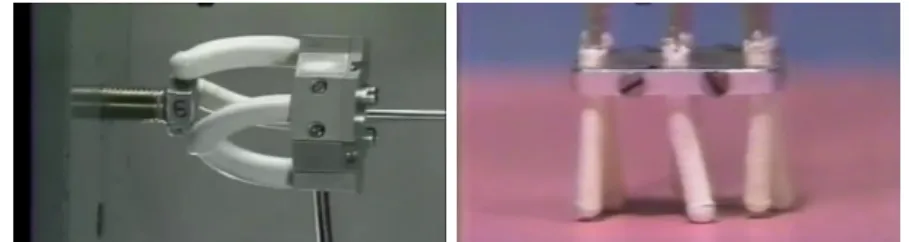
(13) Thèse de Eulalie Coevoet, Université de Lille, 2019. CHAPTER 1. OVERALL INTRODUCTION. 1.1. 13. Introduction. The context of the thesis is wide, as it involves soft robotics and numerical simulation. We give this first chapter to an overall introduction of this context. Note that the state of the art related to the thesis contributions (i.e. control of soft robots) will be discussed in chapter 2. We start this chapter with a section dedicated to the soft robotic field 1.2. We first set the definitions that give to a soft robot its characteristics and properties. We then briefly present the motivations around soft robotics, talk about their design and the extent of possibilities handled by our methods. We finally end the section by introducing the challenge we are interested in, that is their modeling and motion control. The methods we propose are based on a numerical representation of the robot using the Finite Element Method (FEM). The third section of this chapter is thus dedicated to numerical simulation 1.3, as it is the foundation of our algorithms. We start this third section by briefly introducing the FEM, and in particular the benefits and limits of the method. We then discuss the possibilities in terms of simulation software, and present the Simulation Open Framework Architecture (SOFA) that we use for this thesis. We finally give an end to this overall introduction, by stating the thesis contributions 1.4, and giving the manuscript outlines 1.5.. 1.2. Soft robotics. Robots are primarily known for the way they revolutionized the manufacturing sector, by replacing mankind with difficult and repetitive tasks. They are also revolutionizing the medical sector, where they are now assisting surgeons in the operating room with minimally invasive surgical procedures. All these robotic systems are traditionally made from stiff materials. Yet, one issue of robotics is to remain safe for interactions with fragile environments. Indeed, for instance, it is of interest to have robots able to manipulate fragile items in the manufacturing sector, to work with humans in a collaborative way without harming them, or having surgical robots that can interact safely with human organs. This issue has been the driving factor for soft robotics’ emergence, as using soft materials could clearly improve the safeness. The first so called soft robot is maybe the one proposed by Suzumori. First, in (Suzumori et al. 1991), Suzumori et al. proposed a soft micro-actuator made of fiber-reinforced rubber and driven by pressure with a very simple mechanism. This work was inspired by the need of medical micro-robots for inspecting the body. In (Suzumori 1996), Suzumori applies these actuators as robot fingers, creating soft robots able to grasp objects, or even screw bolts (see Figure 1.1).. © 2019 Tous droits réservés.. lilliad.univ-lille.fr.
(14) Thèse de Eulalie Coevoet, Université de Lille, 2019. 14. CHAPTER 1. OVERALL INTRODUCTION. Figure 1.1: Soft robots from (Suzumori 1996). (left) Soft robot ables to screw a bolt. (right) Small-scale soft robot ables to walk.. They also created small-scale robots able to walk. This work was pioneer, and it took ten years for the field of soft robotics to emerge and become active. We identify distinct classes of research within the soft robotics field: design, fabrication, modeling and control. The most active ones are maybe design and fabrication, while we are interested in the modeling and control part. First let us give some definitions.. 1.2.1 Definitions and properties Some terminologies classify the robots, such as redundant, continuum, hard and soft. In this section we provide definitions of these terms widely used in the robotics community. These definitions, that give the characteristics and properties of soft robots, are key elements to understand the problematic of their control: Soft Robots: Class of robot made of soft materials, usually with Young moduli between 104 and 109 Pa (Majidi 2014), such as silicone rubber and soft plastic. Hard Robots: This refers to the class of robot made of hard materials, usually with Young moduli greater that 109 Pa (Majidi 2014), such as metals and hard plastics. We may also call them Rigid robots. Hybrid Robots: Class of robot made of both hard and soft materials. Continuum Robot: A continuum robot is a robot capable of continuous deformations. Note that all soft robots are capable of continuous deformations, but not all continuum robots are soft. Robots made of certain hard materials such as shape memory alloys can also be designed to have continuous deformations (Trivedi et al. 2008). Note that here we consider that a continuum robot should deform its structure to behave.. © 2019 Tous droits réservés.. lilliad.univ-lille.fr.
(15) Thèse de Eulalie Coevoet, Université de Lille, 2019. CHAPTER 1. OVERALL INTRODUCTION. 15. DoFs: Degrees of Freedom (DoFs) designate the number of possible independent relative motions of a robot. For example, traditional manipulators made of rigid links connected by joints have a finite number of DoFs, generally up to six (three rotations, three translations), while continuum robots have theoretically an infinite number of DoFs; the way they continuously bend their structure leads to an infinite number of possible independent relative motions. Note that the notion of Degree of Freedom (DoF) has quite the same meaning in FEM: we discretize continuous structures with a large but finite number of Finite Element (FE) DoFs, referring to the vertices of the FE mesh, where models can deform. Discrete: Said of a robot with a finite number of DoFs. Redundant: As kinematically redundant. Kinematic redundancy occurs when a robotic system has more DoFs than the end-effectors. In particular, when the DoFs space is greater than the task space (Siciliano 1990). With rigid robots, the redundancy is a relative concept, as it holds with respect to a given task, while all continuum robots are redundant. Note that with soft robotics, these extra DoFs can be used to follow an obstacle’s surface, or to avoid contact (when these extra DoFs are controllable). Hyper-redundant: The word hyper-redundant is used to denote robots that have a large or infinite degree of kinematic redundancy (Burdick & Chirikjian 1998), which is the case with continuum robots. Underactuated: A robot is said to be underactuated if it does not have an actuator for each of its DoFs, which is the case for continuum robots since their structures possess infinite number of DOFs. To summarize, soft robots have an infinite number of DoFs, they are hyperredundant, underactuated, capable of continuous deformations, and as defined in (Trivedi et al. 2008), are classified on the basis of the compliance of their underlying materials. The reader can refer to the scheme 1.2 for an illustration of these characteristics inclusions, and example of robots falling in each category. The methods proposed in this thesis have only been tested on robots entirely made of soft material, but there is no apparent limitation on applying these methods to hybrid robots. We use a simulation framework that handles the modeling of both hard and soft materials, and that allows to simulate hybrid structures. Such design should make no difference in our process of finding the inverse of the robot model, neither for the management of contacts.. © 2019 Tous droits réservés.. lilliad.univ-lille.fr.
(16) Thèse de Eulalie Coevoet, Université de Lille, 2019. 16. CHAPTER 1. OVERALL INTRODUCTION. Hard. Hyper-Redundant. Discrete Non-Redundant. Continuum Redundant. Soft. Figure 1.2: Image and description from (Thuruthel et al. 2018). Evolution of rigidlink manipulators based on discrete mechanisms to bioinspired continuum robotic manipulators based on structures capable of continuous bending, studied in detail in (Trivedi et al. 2008).. 1.2.2 Bio-inspiration and motivations Today’s soft robots are particularly inspired by living organisms we can find in nature, such as snakes, caterpillars, octopi’s tentacle, or elephants’ trunk (see Figure 1.3). These organisms have a continuous, highly deformable structure, and yet demonstrate inspiring complicated motions. Nature made them evolve over millions years to achieve certain behaviors. Using this natural optimization to develop robots with new capabilities is needless to say of great interest.. Figure 1.3: (left) Our elephant’s trunk with its simulated FE model. (middle) Octopus’ tentacle from the BioRobotics Institute of the Scuola Superiore Sant’Anna. (right) Snake like soft robot from the MIT’s CSAIL lab.. If we had to present just one example of bio-inspiration, it would be the recent work of Rafsanjani et al. on a soft robot locomotion based on crawling (Rafsanjani et al. 2018). They drew their inspiration from the friction-assisted locomotion of snakes, and introduced a flexible skin with anisotropic frictional. © 2019 Tous droits réservés.. lilliad.univ-lille.fr.
(17) Thèse de Eulalie Coevoet, Université de Lille, 2019. CHAPTER 1. OVERALL INTRODUCTION. 17. properties (with the use of Kirigami) that enables a single soft actuator to propel itself (see Figure 1.4). This work is really nice and promising. At present, their robot is limited as it can only move forward. To enable the robot to bend and change direction, it would require the use of additional actuators.. Figure 1.4: Snakeskin robot from the Harvard John A. Paulson SEAS (Rafsanjani et al. 2018).. Soft robotics is thus an opportunity to provide robots with new capabilities, and to re-think the way they are designed and used. These robots are usually cheap and easier to fabricate than rigid robot, and yet still capable of complex motions. We already mentioned that their compliance decreases risks of damage for both the robot and its surrounding, but also, using large strain deformation, they can reduce or extend their nominal dimensions, bend, and adapt their shape to the environment. These characteristics make them particularly suitable for exploration and manipulation in congested and sensitive environments. Soft robots are indeed mainly designed for grasping and locomotion. Hawkes et al. are for example looking at soft robots that navigate their environment through growth (inspired by plants), for rescue applications (Hawkes et al. 2017). Cianchetti et al. propose to use soft robots for locomotion and grasping under water (Cianchetti et al. 2015). They can also be used for other tasks. For example, Roche et al. investigate the use of soft robotics to help hearts beat, potentially opening new treatment options for people suffering from heart failure (Roche et al. 2017). For this thesis, we designed and built several soft robots with very simple behaviors. One of them, shown in Figure 1.3, was inspired by the elephants’ trunk. Its design is presented in chapter 3. We mainly designed and built these robots to demonstrate the feasibility of the methods we propose. Note that, we also confront our controllers with a simulated version of some soft robots proposed by other labs.. © 2019 Tous droits réservés.. lilliad.univ-lille.fr.
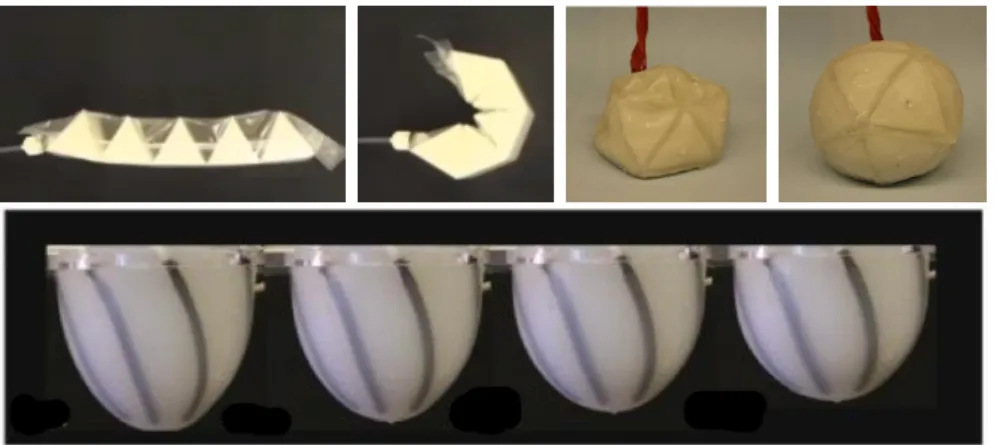
(18) Thèse de Eulalie Coevoet, Université de Lille, 2019. 18. CHAPTER 1. OVERALL INTRODUCTION. 1.2.3 Design and fabrication The use of soft materials greatly challenges researchers with design and fabrication. They have to make use of new techniques to make the structure able to deform itself, and also rethink the actuation like Rafsanjani et al. did. Material Soft robots can be built from silicone rubbers like in (Shepherd et al. 2011), soft plastics (e.g. grippers from Soft Robotics Inc), and also fabrics like in (Yuen et al. 2014). Several works like (Zehnder et al. 2017) also propose to use composite silicone to exhibit desired macroscopic mechanical properties (see Figure 1.5 (top-left)). Silicone rubber is often used when targeting high compliance. The usual fabrication process consists in casting the silicone into a 3D printed mold. An interesting work proposes a computational approach to design flexible 3D printed molds automatically (Malomo et al. 2016), and ease the process. It becomes more complex when dealing with multiple rigidities or with cavities: several parts may need to be casted separately and then recombined (like illustrated in Figure 1.5 (top-right)). In such cases the casting may introduce small asymmetries.. Figure 1.5: (top-left) MetaSilicone from (Zehnder et al. 2017). (top-right) 3D printed pneumatic objects with desired deformations from (Ma et al. 2017). (bottom-left) Printable hydraulics from (MacCurdy et al. 2016). (bottom-right) Liquid printed inflatable from BMW and MIT.. Advances in additive manufacturing enable direct 3D printing of flexible materials. Note that these materials are not as soft as some silicone rubbers. Here is a nice review on 3D printing for soft robotic systems (Wallin et al. 2018). In (Ma et al. 2017), Ma et al. propose to optimize chamber structures and material distribution inside the object to reach target deformations (see. © 2019 Tous droits réservés.. lilliad.univ-lille.fr.
(19) Thèse de Eulalie Coevoet, Université de Lille, 2019. CHAPTER 1. OVERALL INTRODUCTION. 19. Figure 1.5 (top-right)). Another great work has been made on fully 3D printed soft robots actuated with liquids (MacCurdy et al. 2016). What is interesting in this work, is that they print liquids together with solids (hard and soft), and thus print one part actionable objects (see Figure 1.5 (bottom-left)). An astonishing work on liquid printed deformable and inflatable objects has been recently proposed by BMW Design and MIT’s Self-Assembly Lab (see Figure 1.5 (bottom-right) and weblink). Based on the new 3D-printing technology proposed by the MIT, they are able to directly print silicone within a gel suspension. This technique enables printing highly inflatable objects without dealing with cavity support removal. Interesting work, from the computer graphics community, also look at the use of micro-structures to reach macroscopic target elasticity. For example, in (Schumacher et al. 2015, Panetta et al. 2015) authors proposed to use assembly of elementary material tiles, and (Mart´ınez et al. 2016) suggested using micro-structures inspired by Voronoi open-cell foams, each of them to fabricate objects with spatially varying elasticity. (Ion et al. 2016) and (Zhu et al. 2017) went a bit further by proposing to use micro-structures (multimaterial microstructures for Zhu et al.) to perform mechanical tasks. It consists of building a single block of material, with defined and arranged cells, which together achieve desired macroscopic movement. See Figure 1.6. We think these works could be interesting for the design of soft robots. It could for example help in reducing the number of actuators, by using passive structural behaviors. Note that high compliance can be reached with some of these approaches.. Figure 1.6: (left) Procedural Voronoi foams from (Mart´ınez et al. 2016). (middle) Meta-material mechanism from (Ion et al. 2016). (right) Multi-material microstructures mechanism from (Zhu et al. 2017). As already mentioned, the methods we propose are based on a numerical representation and simulation of the soft structures. Although we will discuss numerical simulation in section 1.3, we would like to already give a few comments on the modeling of these different materials. From a simulation point of view, plain structures, made of silicones or soft plastics for example, are easy to model. Structures like meta-silicone are a bit more complex to handle: they. © 2019 Tous droits réservés.. lilliad.univ-lille.fr.
(20) Thèse de Eulalie Coevoet, Université de Lille, 2019. 20. CHAPTER 1. OVERALL INTRODUCTION. require taking into account the materials’ boundaries into the FE mesh, i.e. they require having points on these boundaries in order to isolate elements corresponding to the different materials. The simulation framework we use, proposes tools, based on the Computational Geometry Algorithms Library (CGAL), to generate such meshes. With a distribution of different Young’s moduli over the structure it is then possible to simulate composite silicone. Other techniques can also be used, like coarse embeddings proposed in (Nesme et al. 2009). Note that this simulation framework also enables the simulation of anisotropic material. Micro-structures have been approximated with the use of homogenization theory (Cioranescu & Donato 1999). This theory consists in simplifying the modeling and simulation of micro-structures, by averaging the microscopic behavior, and use a coarser macroscopic discretization with an equivalent behavior at the macroscopic scale. Indeed, it is not conceivable to precisely mesh and simulate the complexity of micro-structures. Although we do not currently consider such structures in the thesis, nor anisotropic behavior, our inverse methods should be directly applicable. Actuation Researchers have categorized actuation as either intrinsic or extrinsic, depending on the location of actuation: ”within the moving manipulator structure itself (intrinsic) or outside of the main structure with forces transmitted to the structure through some mechanical transmission (extrinsic).” (Burgner-Kahrs et al. 2015). Here are some types of actuation used with soft and hybrid robots: • Extrinsic: cable actuation (Vikas et al. 2016), micro motor directly linked to the soft structure, shape memory alloy (SMA) as external actuation (Seok et al. 2013). • Intrinsic: pneumatic actuation (Terryn et al. 2017), hydraulic actuation (MacCurdy et al. 2016), vacuum actuation (Li et al. 2017), jamming as a mechanism that modulates actuators output (Steltz et al. 2009), McKibben muscles (Roche et al. 2014), internal combustion (Tolley et al. 2014). Each actuation technique having advantages and drawbacks. For example, the use of cables requires dealing with frictional effects between the wire and the structure, but allows large deformations, with lower stress on the structure than pneumatic actuation for instance. An interesting work is using self-healing elastomer (Terryn et al. 2017) to get rid of material breaks and leaks that are. © 2019 Tous droits réservés.. lilliad.univ-lille.fr.
(21) Thèse de Eulalie Coevoet, Université de Lille, 2019. CHAPTER 1. OVERALL INTRODUCTION. 21. Figure 1.7: (top-left) Vacuum actuation from (Li et al. 2017). (top-right) Jamming mechanism from (Steltz et al. 2009). (bottom) McKibben muscles from (Roche et al. 2014).. commonly experienced with pneumatic actuation, due to excessive pressure and stress over the soft structure. Vacuum actuation instead of positive pressure is also a method that is investigated to avoid material break (Robertson & Paik 2017). SMAs are small in size and yet allow to perform large deformation, but it is often at the cost of slow motion. Some actuations can also be limited (depending on the applications) by the hardness and size of the hardware, such as air compressors and servomotors. Indeed, applications involving locomotion for example may require the robots to be autonomous, and thus to have the hardware embedded into the soft structure. Like for example the robots proposed in (Rafsanjani et al. 2018), (Tolley et al. 2014), and (Vikas et al. 2016). Note that it brings out a problematic: how to preserve desired softness properties, and how to deliver desired behaviors, while embedding the hardware. However, we think the most used actuations are cable and pneumatic actuations. The methods we propose in this thesis currently handle robots actuated with cable, pneumatic, hydraulic, and/or variation of the structure’s Young Moduli. We also handle soft robots with parts directly attached to actuators with few DoFs (such as servomotors). Vacuum actuation is more challenging. Although we are able to simulate and control (in the sense of finding the inverse of the model) negative pressure, vacuum actuation rests on the use of self collisions over very large surfaces. Dealing with such a huge amount of contacts can be too expensive from a computational point of view.. © 2019 Tous droits réservés.. lilliad.univ-lille.fr.
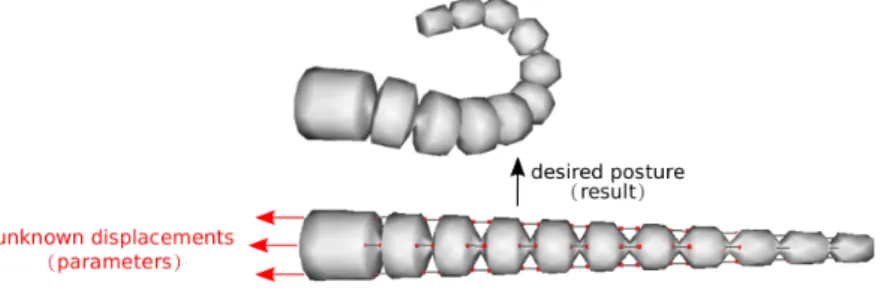
(22) Thèse de Eulalie Coevoet, Université de Lille, 2019. 22. CHAPTER 1. OVERALL INTRODUCTION. 1.2.4 Modeling and control To control the motion of robots, we have to solve an Inverse Problem (IP), that is the Inverse Kinematics (IK) or the Inverse Dynamics (ID) of the robot. The term IP is common in science, whether in mathematics, physics or mechanics. It is the opposite of what we call a forward or a direct problem. As we may use the word direct for other purposes, we choose in this manuscript the forward designation. Given a function f , the forward problem consists in computing from a parameter θ the result x = f (θ). This can be seen as the natural way. The corresponding IP is to compute the parameter θ = f −1 (x) from a target result x, if possible. For example, in our case, we aim at solving the IP of finding the actuation (a cable displacement for instance) that leads a soft robot into a desired posture (see Figure 1.8).. Figure 1.8: An IP involving the motion control of a cable-driven soft trunk.. Motion control Note that IK and ID respectively correspond to an IP based on, the kinematic description of the robot’s motion and the dynamic description. Kinematics describe the rotational and translational motion of bodies, without considering the forces that cause the motion nor the mass, while dynamics do. The methods presented in this thesis can be used with either description. Having said that, several difficulties are experienced in the modeling and control of soft robots. As already mentioned, soft robots have an infinite number of DoFs, they are hyperredundant, underactuated, and capable of continuous deformations, leading to the following difficulties: 1. In opposition to articulated rigid structures, it is hard to get an analytical model that describes the mechanical behavior with accuracy. 2. Infinite possible postures can lead to the same position of the end effector. Therefore the solution to their IK is generally non-unique.. © 2019 Tous droits réservés.. lilliad.univ-lille.fr.
(23) Thèse de Eulalie Coevoet, Université de Lille, 2019. CHAPTER 1. OVERALL INTRODUCTION. 23. 3. Many of their DoFs are not directly controllable. 4. Their kinematics do not only depend on their geometry, many new parameters such as material properties, have a direct influence on their posture (see Figure 1.9). In particular, unlike rigid robots, their kinematics are highly dependent on environmental factors, such as gravity and contact with obstacles (See Figure 1.10).. Figure 1.9: Spring-shape robot actuated with pressured air (left and middle-left: no actuation, right and middle-right: pressure actuation). With the same structural geometry, the kinematic relationship (output deformation due to input cavity volume) changes due to the stiffness difference in the material used for the construction of the structure. Left and middle-right: the robot is made of a single type of silicone Middle-left and right: the robot is made of two types of silicone with the black silicone being stiffer than the white one.. Figure 1.10: Tentacle robots with same geometry, that can be actuated with one cable. Without actuation and under gravity, the material properties as well as geometric configuration play a key role in the resulting deformation. The blue tentacle is made of a single silicone, while the blue and green tentacle is made with two different silicones, the green one being stiffer than the blue one. While the left image illustrates that the resulting deformation between the two tentacles is already a bit different, the right image exhibits that a different orientation of the tentacle leads to even larger different deformation between the homogeneous tentacle and the composite one.. As stated in many reviews (Trivedi et al. 2008, Kim et al. 2013, Rus & Tolley 2015), all these differences between traditional robotics and soft robotics have. © 2019 Tous droits réservés.. lilliad.univ-lille.fr.
(24) Thèse de Eulalie Coevoet, Université de Lille, 2019. 24. CHAPTER 1. OVERALL INTRODUCTION. an impact on the modeling tools and controllers generally in use in robotics. Traditional controllers cannot be directly applied on soft robots, and new IK and ID solutions have to be developed to control the motion of such flexible structures. Some solutions have been proposed by the community, such as controllers based on analytical solutions but with strong geometric assumptions, machine learning, Jacobian methods and optimization-based methods. We discuss all these solutions in chapter 2. Sensing When controlling the motion of a real robot, the use of sensors is necessary to enable a feedback closed-loop control; that is using feedback on the real robot’s shape to correct the model uncertainties (Zhang et al. 2016), or to feed algorithms from control theory and stabilize the process (avoid vibrations) (Santina et al. 2018). Note that sensors can also be used to calibrate the robot, when the robot parameters such as stiffnesses do not match precisely the reality, or to initialize cable lengths for instance. Depending on the application, sensors may need to be embedded into the soft structure, or can be external such as depth-cameras or motion capture systems. For example, Zhang et al. propose a feedback closed-loop control strategy based on visual-servoing in (Zhang et al. 2017). For applications where depth-cameras are not suitable, embedded sensors are required. Such sensors need to be flexible as proposed in (Vogt et al. 2013), or even stretchable as proposed in (Muth et al. 2014, Atalay et al. 2017), to leave the behavior of the robot unchanged. See Figure 1.11.. Figure 1.11: (left) Force sensor using embedded micro-fluidic channels from (Vogt et al. 2013). (middle) Silicone textile composite capacitive strain sensor from (Atalay et al. 2017). (right) Defsense, deformable input devices from (B¨ acher et al. 2016). Soft structures with embedded soft sensors are also proposed within the humancomputer interaction community. In (B¨acher et al. 2016), B¨acher et al. presented an optimization-based algorithm for the design and fabrication of deformable input devices. These devices are capable of continuously sensing their deformation, which could be very interesting for soft robotics closed-loop control. See Figure 1.11 (right).. © 2019 Tous droits réservés.. lilliad.univ-lille.fr.
(25) Thèse de Eulalie Coevoet, Université de Lille, 2019. CHAPTER 1. OVERALL INTRODUCTION. 25. In this thesis, all the experiments have been conducted with an opened-loop control. The results we obtained are already correct, even though it would improve them to use a closed-loop control strategy, with the use of sensors. We think a closed-loop strategy can be applied to the current work, without profound changes in the algorithms.. 1.3. Numerical simulation. Numerical simulation has been used in various domains, including robotics and computer graphics. Depending on the application, a simulation can intend to be as accurate as possible (e.g. for medical applications), or just close enough to a physical behavior for esthetic’s purposes (e.g. films and games). The methods we proposed are based on an accurate description of the soft structures using FEM, which has advantages and drawbacks. In this section we briefly introduce the FEM, and talk about the existing simulation softwares. In particular, we present SOFA, the simulation framework we used to develop our methods.. 1.3.1 Finite element method FEM, also called finite element analysis or finite element modeling, is used in the current work to analyze the continuous deformations of soft structures. FE method is one of the most popular methods in computational sciences. It is used to solve a wide variety of problems, such as elastic problems, fluid flow, and thermal problems to name just a few. See (Cook et al. 2007) or (Reddy 1993) for a detailed presentation of FEM. Using FEM can have numerous advantages, but also some limitations that we discuss below. Benefits Having an accurate representation of soft robots is interesting at several levels. First as a tool for design, to optimize prior the fabrication and reduce iterations of prototypes. Second, as a tool for solving the complex problem of motion control. FEM provides this accurate representation and has many advantages over most other numerical analysis methods, including versatility: there is no geometric restriction (in practice a very complex geometry can be difficult to mesh), FE mesh allows to improve the approximation (e.g. by adding points where large deformations occur and more resolution is required), material properties can differ from one element to the other (Cook et al. 2007). The reader can also refer to (Nealen et al. 2006) for a nice survey on numerical analysis methods, for the computer graphics community.. © 2019 Tous droits réservés.. lilliad.univ-lille.fr.
(26) Thèse de Eulalie Coevoet, Université de Lille, 2019. 26. CHAPTER 1. OVERALL INTRODUCTION. Limitations The principal drawbacks of FEM are the computational expenses. FEM simulations especially become costly when non-linear systems are involved. These non-linearities come from several levels: the non-linear deformations of the structure (rotation), and the non-linearity of the material law (non-linear elasticity). These computational expenses have often been a bottleneck for applications requiring real-time performance, as it is in the robotics community. Yet, computational power continues to increase and methods have been studied for improving the convergence speed and the stability of numerical solutions. For instance, work from computer graphics and medical simulation are showing FEM simulations with real-time performance. To mention just a few, the co-rotational model (Hauth & Strasser 2004), which deals with the geometrical non-linearities (non-linear deformations), and gives good approximations with the assumption of small deformations. The co-rotational model is a good solution to model linear elasticity. For non-linear elasticity and geometry requiring high resolution meshes, work on model reduction methods (Sifakis & Barbic 2012) can dramatically reduce the computation time. These methods consist in projecting the large FE system of equations onto subspaces of smaller dimensions. Note that a work on model order reduction for the control of soft robots has recently been proposed by our group (Goury & Duriez 2018). For this thesis we choose to work with a numerical model of the soft robots using FEM. Indeed, we think FEM is a great solution to model a broad-spectrum of soft robots with good accuracy, in particular when no simpler method is available. Yet, the method is complex to implement. Some simulation softwares make it easier by opening their code and allowing researchers to investigate new methods without having to deal with the FEM implementation. We discuss these softwares in the following section.. 1.3.2 Simulation software In the field of rigid robotics, one can use either dedicated products like WorkspaceLt, RoboticSimulation, NI-Robotics, RoboNaut, SimRobot, or general purpose open-source software like Gazebo (Koenig & Howard 2004). The cited tools rely on off-the-shelves simulation kernels such as Open Dynamics Engine, Bullet Physics, NVidia PhysX or DART. These simulation kernels come from the video-game industry and are often focused on articulated-rigid bodies. The same simulation kernels have been successfully used to model and simulate soft robots as in the NASA Tensegrity Robotics Toolkit (Caluwaerts et al.. © 2019 Tous droits réservés.. lilliad.univ-lille.fr.
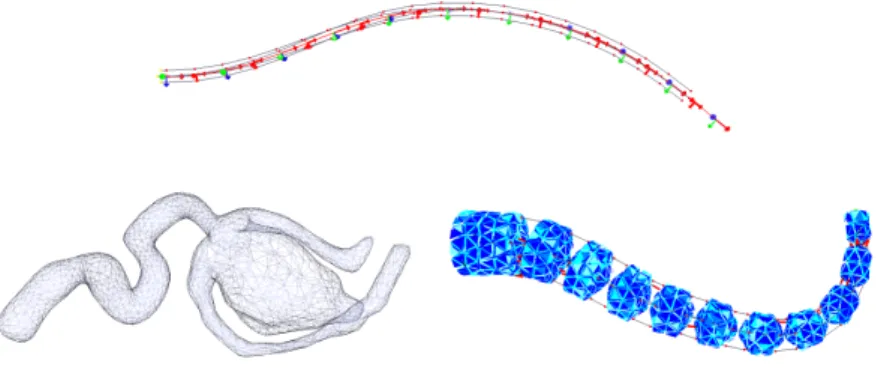
(27) Thèse de Eulalie Coevoet, Université de Lille, 2019. CHAPTER 1. OVERALL INTRODUCTION. 27. 2014) or in (Rieffel et al. 2009) with the use of PhysX to evaluate the candidate solutions of genetic algorithms. The video-game based simulation frameworks are fast and efficient to compute rigid-body simulations as well as some kind of soft bodies. They are also relatively easy to use, as required background knowledge in physical modeling is reduced. The counterpart is that very few of them are capable of modeling physically realistic deformable materials. Realistic simulation When a realistic deformable material simulation is needed, tools from the structural and multi-physics analysis field, as Abaqus or ComSol, are suitable. They rely on precise modeling formulations of continuous mechanics, and some of them are capable of handling multi-physics. The cost for such capabilities is the slow computation speed and the fact that a good understanding of physical modeling is required. The consequence is that they are only usable for offline simulation of soft robots, in combination with CAD software while designing the soft robotic parts. Simpler alternatives exist such as Voxelyze. Presented in (Hiller & Lipson 2014), it simulates soft materials undergoing large deformations and is associated with VoxCAD, a GUI simplifying the editing of the robot. Voxelyze relies on voxels to represent the object. It is used in (Cheney et al. 2014) to evaluate through simulation the walking capabilities of soft robots produced by genetic algorithms. In (Cheney et al. 2015), the same authors added interaction between the robot and its environment. Nevertheless, with a voxel simulation, it is not possible to approximate some geometrical shapes without an exaggerated number of voxels which leads to an increased computation time. In addition, with Voxelyze, the mechanical model is using beam theory on the lattice supporting the voxels. Such an approach may not capture the continuous material deformation in a realistic manner.. 1.3.3 SOFA framework For this work, we chose to use SOFA, an open-source framework for physicsbased simulation. Its development has first been motivated by the field of surgical and biomedical simulation (Faure et al. 2012). The interesting point of this framework is the focus on deformable objects and complex interactions. A tool like SOFA can simulate a large choice of mechanical models: from rigid-bodies or mass-spring, to one implementing realistic hyper-elastic material with FEM. It can operate on a wide range of geometrical descriptions from 1D (curve) and 2D (surface mesh) to 3D (voxels, multi-resolution octrees or hexahedral and tetrahedral mesh), see Figure 1.12. It is capable of handling collisions and contacts precisely, as well as to handle multi-physics behaviors. © 2019 Tous droits réservés.. lilliad.univ-lille.fr.
(28) Thèse de Eulalie Coevoet, Université de Lille, 2019. 28. CHAPTER 1. OVERALL INTRODUCTION. (Talbot et al. 2012, 2015). It is also capable of interacting with sensing hardware (Kinect, OptiTrack, LeapMotion), that are commonly used in robotics, as well as with haptic devices (Peterlik et al. 2011). A framework like SOFA can be considered as a bridge between video-game and structural analysis approaches.. Figure 1.12: SOFA simulations. (top) 1D beam representation of a soft catheter actuated with cables. (bottom-left) 2D shell representation of a pressurized vessel with an aneurysm. (bottom-right) 3D tetrahedral representation of our soft trunk actuated with cables.. The framework is mostly intended for research purposes. It is quite easy to connect new methods to the existing implementations of SOFA. In a way similar to Gazebo (Koenig & Howard 2004), SOFA has a scene-graph based simulation architecture, which is commonly used in 3D modeling tools. A scene contains the robot and its environment and is described in XML or with a Python script. SOFA is also a component based architecture. A robot is then an assembly of elementary components: some components are for rendering, others for contact or topology encoding, others for numerical integration or mechanical modeling. SOFA also introduced multiple model representation. Multi-model means that in a simulated object a property can be represented in multiple ways. A good example is the shape of a robot: a low resolution tetrahedral mesh can be used for FEM, while using a high resolution triangular mesh for the rendering, and a low resolution triangle mesh for the contact management. To connect the representations, SOFA introduces mappings. Given the position of the DoFs q of a representation, one can define a second representation with x = M (q), where M is a possibly non-linear mapping function. The strength of mappings is that constraints on a representation can be transferred to a second representation. Using this tool, we can gather actuators, effectors and contacts from different representations to obtain a full system, without having to change the implementation of the components. They are defined regardless of the geometrical dimension of the object (1D, 2D, 3D), geometrical. © 2019 Tous droits réservés.. lilliad.univ-lille.fr.
(29) Thèse de Eulalie Coevoet, Université de Lille, 2019. CHAPTER 1. OVERALL INTRODUCTION. 29. representation (voxel, curve, octree, tetrahedral mesh) or mechanical model. As already mentioned in section 1.2.1, if the robot is hybrid, SOFA offers a way to combine deformable model and rigid ones. This is done through this mapping mechanism which allows to transfer positions, velocities and forces between the deformable model and the rigid components. An other strength of SOFA is that it provides real-time performance for simulations of around 6000 DoFs (corresponding to 2000 nodes for a deformable object), which is sufficient for robots with simple geometry. Also, a GPU implementation is available for more complex geometry. SoftRobots plugin For this thesis we developed a plugin for SOFA dedicated to soft robots. It contains useful tools for the modeling, simulation and motion control of soft robots. It is presented in (Coevoet, Morales-Bieze & et al. 2017). The plugin is divided into two parts: (1) SoftRobots plugin: This part is open and hosted on github. It contains a lot of tools allowing to simulate the forward kinematics and dynamics of soft robots, with a large diversity of actuations. (2) SoftRobots.Inverse plugin: This second part is private. It contains all the tools necessary to solve the IP of soft robots motion control, and is an addition to the first part. All types of actuation proposed in the first plugin can, in the latter one, be optimized to solve the IK and ID problems. All the methods proposed in this manuscript are available in the plugin.. 1.4. Contributions. As mentioned in section 1.2.4, there is a need of new techniques for the modeling and motion control of soft robots. Moreover these controllers should handle contacts, as most of robotics applications involve interactions with an environment. The contributions of the thesis are listed below: • Inverse model of deformable structures: we first propose a solution, based on FEM for the problem of controlling the motion of soft structures, and in particular the motion of soft robots. We formulate the problem as an optimization problem with a quadratic form, a Quadratic Program (QP). We aim at providing generic solutions, that is without particular geometrical nor material assumptions. We also focus on proposing controllers with real-time performance. The results have been published in (Coevoet, Morales-Bieze & et al. 2017), and are presented in chapter 3. • Inverse model with contact handling: the formulation of the optimization when dealing with contacts takes the form a Quadratic Program. © 2019 Tous droits réservés.. lilliad.univ-lille.fr.
(30) Thèse de Eulalie Coevoet, Université de Lille, 2019. 30. CHAPTER 1. OVERALL INTRODUCTION with (linear) Complementarity Constraint (QPCC), as we use Signorini’s law to model the contact. We propose a solver to solve this problem in real-time and allow to control the motion of soft robots evolving in a moving and frictionless environment. The results have been published in (Coevoet, Escande & Duriez 2017), and are presented in chapter 4. • Inverse model with stick contact handling: the addition of friction introduces non-linear complementarity conditions which makes the problem more complex. With the assumption of sticking contact only, we propose a real-time solution that opens the control of some soft robots’ locomotion and manipulation. The results have been published in (Coevoet et al. 2019), and are presented in chapter 5.. The usefulness of this work is demonstrated with direct applications for the medical field and for the entertainments and the arts. The list of publications is given at the end of the manuscript.. 1.5. Organization of the manuscript. The remainder of the manuscript is organized as follows. The second chapter is dedicated to the state of the art, regarding the contributions of the thesis. We first discuss the current solutions proposed to solve the IK and ID problems of actuated structures in general. Second, we discuss in particular work that handles contacts in their controller. In the third chapter we present in detail the algorithms we propose for soft robots IK and ID solutions, including details about the modeling, the optimization problem, and some direct applications of the method. The fourth chapter is given to contact handling, where we detail formulations and the solver we propose to solve this complex problem with real-time performance. We also present some direct applications. The fifth chapter is dedicated to the addition of friction into the problem, and in particular the control of soft robots locomotion and manipulation. In each of these three latter chapters, we provide numerical and real experiments to show the efficiency of the proposed methods. We finally conclude the thesis in the sixth chapter.. © 2019 Tous droits réservés.. lilliad.univ-lille.fr.
(31) Chapter. Thèse de Eulalie Coevoet, Université de Lille, 2019. 2. State of the Art: Inverse Model and Contact Handling Contents 2.1 2.2. 2.3. Introduction . . . . . . . . . . . . . . . . . . Inverse kinematics and inverse dynamics . . 2.2.1 Analytical solutions . . . . . . . . . Constant curvature models . . . . . 2.2.2 Jacobian-based methods . . . . . . Jacobian pseudo-inverse . . . . . . Damped least squares . . . . . . . . Other Jacobian methods . . . . . . 2.2.3 Optimization-based methods . . . . Non-linear programming . . . . . . Quadratic programming . . . . . . Other optimization-based methods 2.2.4 Data-driven learning methods . . . Feed-forward neural network . . . . Gaussian processes regression . . . Deep neural network . . . . . . . . 2.2.5 Other methods . . . . . . . . . . . 2.2.6 Conclusion on IK and ID methods . IK and ID with contact handling . . . . . .. . . . . . . . . . . . . . . . . . . .. . . . . . . . . . . . . . . . . . . .. . . . . . . . . . . . . . . . . . . .. . . . . . . . . . . . . . . . . . . .. . . . . . . . . . . . . . . . . . . .. . . . . . . . . . . . . . . . . . . .. . . . . . . . . . . . . . . . . . . .. . . . . . . . . . . . . . . . . . . .. . . . . . . . . . . . . . . . . . . .. . . . . . . . . . . . . . . . . . . .. . . . . . . . . . . . . . . . . . . .. . . . . . . . . . . . . . . . . . . .. 33 33 33 34 35 35 36 36 38 38 39 39 40 41 42 42 43 44 45. 31. © 2019 Tous droits réservés.. lilliad.univ-lille.fr.
(32) Thèse de Eulalie Coevoet, Université de Lille, 2019. 32 CHAPTER 2. S.A: INVERSE MODELS AND CONTACT HANDLING. 2.4. © 2019 Tous droits réservés.. 2.3.1. Jacobian-based methods . . . . . . . . . . . . . . . . . . 45. 2.3.2. Optimization-based methods . . . . . . . . . . . . . . . . 45. 2.3.3 2.3.4. Data-driven learning methods . . . . . . . . . . . . . . . 47 Conclusion on contact handling . . . . . . . . . . . . . . 47. Conclusion . . . . . . . . . . . . . . . . . . . . . . . . . . . . . . . 49. lilliad.univ-lille.fr.
(33) Thèse de Eulalie Coevoet, Université de Lille, 2019. CHAPTER 2. S.A: INVERSE MODELS AND CONTACT HANDLING 33. 2.1. Introduction. Controlling the motion of a continuum or a soft robot is challenging, as it involves dealing with continuous deformations of the robot structure. In this chapter we review the contribution on IK and ID for the motion control of actuated bodies (hard or soft). These problems have been investigated by the robotics and the computer graphics communities. The reader can refer for example to: a book on control for traditional rigid robots (Craig 2005), a recent survey on control strategies for continuum and soft robotics (Thuruthel et al. 2018), and another great recent survey on IK problems from the computer graphics community (Aristidou et al. 2017). In computer graphics, IK and ID are used to make the animation of virtual actuated characters physically plausible, and then enhance the aesthetic’s of animations. These characters are either articulated figures, soft bodies with an embedded skeleton, or entirely soft bodies actuated with virtual muscles. They thus share the problematics of both traditional and soft robotics communities. Though they generally do not have to deal with real prototypes, nor real actuators, the algorithms they propose are of interest for us. In each section of this chapter, we discuss the solutions proposed by both robotics and computer graphics communities. The state of the art is reviewed as follows: first, we look at general IK and ID solutions for actuated structures in section 2.2, second, we review IK and ID solutions with contact handling in section 2.3.. 2.2. Inverse kinematics and inverse dynamics. Different methods are used to solve IK and ID problems of actuated structures. In this section we review analytical, Jacobian-based, optimization-based and data-driven learning methods. Because of the vastness of the subject, this is not an exhaustive review. For the sake of clarity, all presented publications are gathered and listed in Tables 2.1, 2.4, 2.2, 2.3, and 2.5 with respect to the IP resolution method proposed, the modeling method used, and the system controlled.. 2.2.1 Analytical solutions Traditional robot manipulators are often designed so that analytical (or closedform) solutions to the IK problem exist (see (Craig 2005) or (Paul 1981) for more detail). Also, in computer animation, several researchers have addressed the IK of anthropomorphic arm and leg with an analytical approach. For. © 2019 Tous droits réservés.. lilliad.univ-lille.fr.
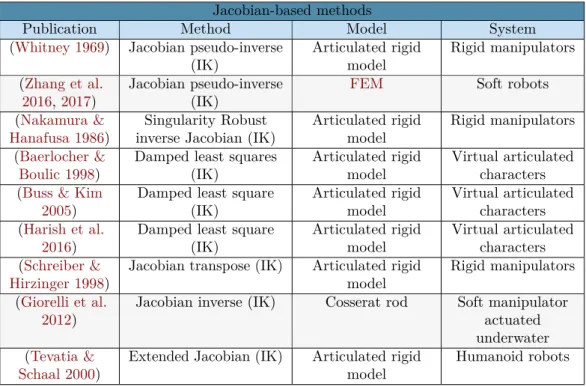
(34) Thèse de Eulalie Coevoet, Université de Lille, 2019. 34 CHAPTER 2. S.A: INVERSE MODELS AND CONTACT HANDLING example, Tolani & Badler (1996) provides an analytic solution for a 7DoFs simple model of the human arm, and a combination of analytical and numerical methods for an anthropomorphic arm in (Tolani et al. 2000). For hyperredundant robots, and in particular soft robots, it is more difficult and often impossible to get such solutions without making strong assumptions on the robot’s geometry. However, analytical solutions are appreciated for their low computational cost, because they are reliable and offer a global solution.. Constant curvature models For particular continuum robots, that is robot with rod-like shapes, the constant curvature model (for single-section) and the piecewise constant curvature model (for multi-section) have been proposed and widely employed to get analytical IK solutions (Hannan & Walker 2003) (Jones & Walker 2006) (Duindam et al. 2010). A review can be found in (Webster & Jones 2010). The models are based on a geometric approach that significantly simplifies the problem. The idea is to assume that each section of a multi-section rodlike robot or arm deforms with constant curvature. For example, in (Sears & Dupont 2006), Sears & Dupont present an analytic solution to the IK problem of steerable concentric tubes, based on a piecewise constant curvature representation of the tubes. In (Neppalli et al. 2009), Neppalli et al. propose an analytic solution to the IK problem of a multi-section continuum trunk, based on a constant curvature description of each section of the robot. They make additional simplifications by assuming that gravity loading produces no deformation on the robot, which often leads to quite inaccurate solutions. This is usually the case with analytical solutions. While these methods are simple and fast, not all continuum robots suit the assumption of segmented constant curvature.. Conclusion on analytical solutions As mentioned, for most soft robots, it is hard to get analytical solutions that describe the mechanical behavior with accuracy. Expect for continuum robots with particular geometry (i.e. rod-like shape), that can be approximated with constant curvature models. However, these methods have difficulty coping with environmental changes. The alternative is to use numerical methods, and iteratively approximate a good solution to the problem. In the following, all the methods we present fall into the class of numerical analysis.. © 2019 Tous droits réservés.. lilliad.univ-lille.fr.
(35) Thèse de Eulalie Coevoet, Université de Lille, 2019. CHAPTER 2. S.A: INVERSE MODELS AND CONTACT HANDLING 35. Publication (Tolani & Badler 1996) (Tolani et al. 2000). (Hannan & Walker 2003) (Jones & Walker 2006) (Duindam et al. 2010) (Sears & Dupont 2006) (Neppalli et al. 2009). Analytical solutions Method Model Analytical (IK) Articulated rigid model Combination of Articulated rigid analytical & model numerical methods (IK) Analytical (IK) Piecewise Constant Curvature Analytical (IK) Piecewise Constant Curvature Analytical (IK) Piecewise Constant Curvature Analytical (IK) Piecewise Constant Curvature Analytical (IK) Piecewise Constant Curvature. System Rigid manipulators Rigid manipulators. Continuum trunk manipulator Multisection Continuum Robots Steerable continuum Needles Steerable continuum concentric tubes Multi-section continuum trunk. Table 2.1: Publications are categorized according to the method used to solve the IP, the model used and the controlled system. Results for continuum or soft robotic systems are softly highlighted in gray.. 2.2.2 Jacobian-based methods Jacobian-based methods are the first numerical methods that we present. The Jacobian matrix gives the differential relationship between the actuator variables and end-effector positions. By inversing this matrix, one can solve the IK problem. However, the Jacobian matrix can neither be square (the number of actuator variables is larger that the number of end-effector positions, or vice versa) nor invertible (when singularities occur). IK singularities occur when there exists multiple solutions, that is multiple actuator configurations for a single end-effector position. There exists several methods based on the Jacobian matrix, such as Jacobian pseudo-inverse methods, Jacobian transpose methods, and damped least squares methods. In the following, we discuss some of these methods. A great review on Jacobian methods for computer graphics and real-time animation is given by Buss in (Buss 2004). Jacobian pseudo-inverse A generalized inverse of the Jacobian matrix is used when its inverse does not exist, that is when the matrix is singular or rectangular. In (Whitney 1969), Whitney investigates the use of the Jacobian pseudo-inverse to solve the IK of rigid manipulators. In (Zhang et al. 2016, 2017), Zhang et al. propose. © 2019 Tous droits réservés.. lilliad.univ-lille.fr.
(36) Thèse de Eulalie Coevoet, Université de Lille, 2019. 36 CHAPTER 2. S.A: INVERSE MODELS AND CONTACT HANDLING closed-loop systems for the control of soft robots. A Jacobian matrix for soft robots is formulated, based on the same FE modeling that we use in this thesis, and a pseudo-inverse of the Jacobian matrix is then used to solve their IK. Pseudo-inverse methods tend to have stability problems in the neighborhoods of singularities (Buss 2004): when the configuration is close to a singularity, large changes in actuators variables may occur, even for small movements in the target position. Other methods can be used to overcome this stability problems, such as damped least squares methods. Damped least squares Damped least squares methods are local optimization methods that can prevent infeasible solutions near singular configurations (Deo & Walker 1995). A review on these methods for robot manipulators IK can be found in (Deo & Walker 1995). In (Nakamura & Hanafusa 1986), Nakamura & Hanafusa introduce the Singularity Robust inverse method as an alternative to the pseudo-inverse of the Jacobian matrix. The method gives a solution even when inverse and pseudo-inverse matrices are not feasible at, or in the neighborhood of, singular points. They apply the controller to rigid manipulators. In (Baerlocher & Boulic 1998), Baerlocher & Boulic deal with task prioritization for the kinematic control of human-like articulated figures (virtual figures). They use damped least squares methods to solve the IK of articulated figures for the purpose of posture control and design. An extension of damped least squares called selectively damped least squares for IK solutions of articulated bodies is proposed in (Buss & Kim 2005). In (Harish et al. 2016), Harish et al. propose a parallelized design of the damped least squares IK for articulated bodies, and with prioritized end-effectors. The authors state that the algorithm is highly scalable and can handle complex articulated bodies at interactive frame rates. Note that for these methods to be stable, a constant damping factor has to be chosen carefully. Other Jacobian methods Other methods such as Jacobian transpose methods are interesting against pseudo-inverse methods in the sens that no matrix inversion is required and thus an iteration can be performed very quickly. However, these methods have poor convergence properties (Baerlocher 2001). Schreiber & Hirzinger use a Jacobian transpose method to solve the IK problem of a rigid manipulator. They introduce an heuristic measure for treating kinematic singularities in (Schreiber & Hirzinger 1998). A Jacobian method is compared to other methods in several works, for example (Aristidou et al. 2017). In (Giorelli et al. 2012), Giorelli. © 2019 Tous droits réservés.. lilliad.univ-lille.fr.
(37) Thèse de Eulalie Coevoet, Université de Lille, 2019. CHAPTER 2. S.A: INVERSE MODELS AND CONTACT HANDLING 37 et al. propose a method based on the Jacobian inverse and solve the IK problem numerically. They built a soft manipulator with a conical shape, inspired by the octopus arm. The IK do not take into account the effect of gravity on the manipulator. The robot is made of silicone and actuated with cables underwater. The authors stipulates that the gravity force and buoyancy, balance each other due to the similarity between the density of the silicone and that of water. The results are almost accurate, and the IK solver shows quite slow performance, as stipulated in (Giorelli et al. 2015). In (Tevatia & Schaal 2000), Tevatia & Schaal propose an extended Jacobian method for the real-time control of highly redundant robots, such as humanoid robots.. Publication (Whitney 1969) (Zhang et al. 2016, 2017) (Nakamura & Hanafusa 1986) (Baerlocher & Boulic 1998) (Buss & Kim 2005) (Harish et al. 2016) (Schreiber & Hirzinger 1998) (Giorelli et al. 2012) (Tevatia & Schaal 2000). Jacobian-based methods Method Model Jacobian pseudo-inverse Articulated rigid model (IK) Jacobian pseudo-inverse FEM (IK) Singularity Robust Articulated rigid inverse Jacobian (IK) model Damped least squares Articulated rigid (IK) model Damped least square Articulated rigid (IK) model Damped least square Articulated rigid (IK) model Jacobian transpose (IK) Articulated rigid model Jacobian inverse (IK) Cosserat rod. Extended Jacobian (IK). Articulated rigid model. System Rigid manipulators Soft robots Rigid manipulators Virtual articulated characters Virtual articulated characters Virtual articulated characters Rigid manipulators Soft manipulator actuated underwater Humanoid robots. Table 2.2: Publications are categorized according to the method used to solve the IP, the model used and the controlled system. Results for continuum or soft robotic systems are softly highlighted in gray.. Conclusion on Jacobian methods Jacobian methods are popular methods in the robotics and computer graphics communities. Each method has advantages and drawbacks over the others. In general, these methods are preferred for their simplicity and their low computational expend. However, a lot of these methods suffer from stability problems due to singularities, and incorporating constraints into these methods. © 2019 Tous droits réservés.. lilliad.univ-lille.fr.
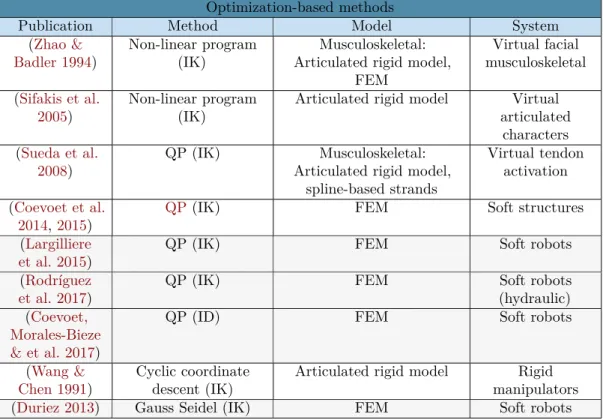
(38) Thèse de Eulalie Coevoet, Université de Lille, 2019. 38 CHAPTER 2. S.A: INVERSE MODELS AND CONTACT HANDLING is not straightforward. Some effort has been made to deal with actuation limitations (e.g. limits on cable displacement), see (Aristidou et al. 2017) for references. Other methods, such as optimization-based methods, are better suited to deal with singularities and constraints on actuators. In the next section we discuss those solutions.. 2.2.3 Optimization-based methods The IK and ID problem can be formulated as a constrained optimization (minimization or maximization) problem, also called programming problem. Models with large DoFs can be considered, and more design variables can be included in the optimization formulation. Singularity problems are often tackled by introducing additional constraints into the program or additional terms in the objective function. A large number of resolution methods have been developed to solve such constrained problems, together with products and open libraries that can be used as third-part. For quadratic program, we have used the open-source C++ library qpOASES. Depending on the nature of the program, typically linear or non-linear (objective function and/or constraints), the resolution may be very expensive. Note that in most cases, searching for a global solution is too expensive, so for real-time applications, local optimization methods are generally preferred. It is then possible to be stuck in a local optimum of the objective function. However, optimization-based methods usually return smooth motion without erratic discontinuities (Aristidou et al. 2017). Non-linear programming A non-linear program denotes the large class of programs which have at least, either the objective or some constraints being non-linear functions. These problems are usually more difficult to solve in real-time than linear programs. In (Zhao & Badler 1994), Zhao & Badler solve the IK of highly articulated figures by formulating a non-linear programming subject to linear constraints corresponding to the joints limits. Sifakis et al. build an anatomically accurate model of facial musculature, passive tissue and underlying skeletal structure in (Sifakis et al. 2005). They propose to determine muscle activations using a non-linear programming. In (Skouras et al. 2013), Skouras et al. optimize, among others, the location of cables on deformable objects to reach target animations. They model the objects with FEM and they use an augmented constrained optimization to formulate the IP. The final actuation (cable displacements) seems to be directly derived from the animation, that is by computing the cables length knowing their location on the animation. Note. © 2019 Tous droits réservés.. lilliad.univ-lille.fr.
(39) Thèse de Eulalie Coevoet, Université de Lille, 2019. CHAPTER 2. S.A: INVERSE MODELS AND CONTACT HANDLING 39 that this technique cannot work with cables passing through the structure. Similarly Bern et al. propose in (Bern et al. 2017) a method, reminiscent of IK, for the creation of animated soft tendon-driven toys: the location of the tendon’s path are computed so that the toy can perform desired motions. Quadratic programming A QP is a particular type of non-linear programming. It corresponds to an optimization program whose objective function has a quadratic form, and whose constraints are linear. In (Sueda et al. 2008), Sueda et al. propose a method to generate the motion of tendons and muscles under the skin of a traditionally animated character, and thus enhance the realism of hand simulations. The skeleton and tendons are simulated using a musculoskeletal model. The skin is attached to the skeleton, and the subcutaneous deformation from tendon motion is added as a post-process. They formulate the IP of tendons’ activation as a quadratic optimization. In (Coevoet et al. 2014, 2015), we propose to register anatomical deformable structures for the context of adaptive radiotherapy, and using a quadratic optimization. The method is based on a FEM modeling of the soft structures. The problematic and results of this work are discussed in detail in section 3.5.1. The same quadratic optimization is used in (Largilliere et al. 2015) and (Rodr´ıguez et al. 2017) for the control of soft robots, where in the first paper we propose a multi-rate solving of the IP, and in the second we propose to solve the IK of soft robots actuated with hydraulic. In (Coevoet, Morales-Bieze & et al. 2017), we propose a unified framework for the motion control of soft robots, again based on FEM and quadratic programming. The algorithms are detailed in chapter 3. Other optimization-based methods Cyclic coordinate descent method is an other popular optimization-based method to solve the problem of articulated chains IK. The approach consists in an iterative resolution of optimization problems, that is by solving the transformation of one joint variable at a time in a cyclic manner. See (Wang & Chen 1991) for the first introduction of the method, where Wang & Chen apply it on the control of a rigid manipulator. In (Duriez 2013), Duriez proposes to solve the motion control of soft robots with a method based on FEM, and an iterative Gauss-Seidel algorithm to solve the IK. The algorithm iterates over the actuator variables, optimizing each variable at a time while freezing the others.. © 2019 Tous droits réservés.. lilliad.univ-lille.fr.
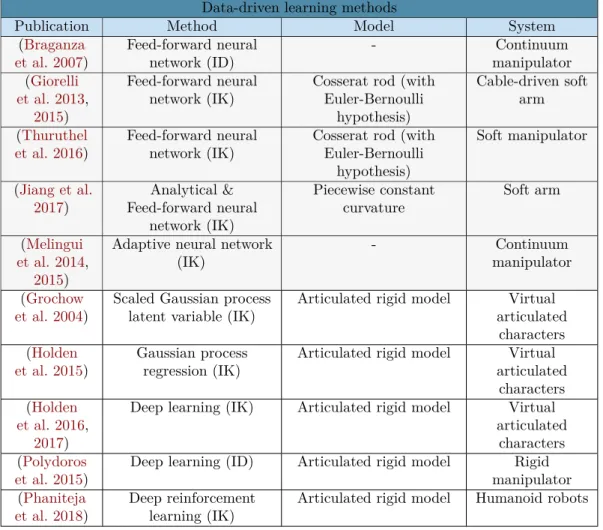
(40) Thèse de Eulalie Coevoet, Université de Lille, 2019. 40 CHAPTER 2. S.A: INVERSE MODELS AND CONTACT HANDLING. Publication (Zhao & Badler 1994) (Sifakis et al. 2005). Optimization-based methods Method Model Non-linear program Musculoskeletal: (IK) Articulated rigid model, FEM Non-linear program Articulated rigid model (IK). System Virtual facial musculoskeletal Virtual articulated characters Virtual tendon activation. (Sueda et al. 2008). QP (IK). (Coevoet et al. 2014, 2015) (Largilliere et al. 2015) (Rodr´ıguez et al. 2017) (Coevoet, Morales-Bieze & et al. 2017) (Wang & Chen 1991) (Duriez 2013). QP (IK). Musculoskeletal: Articulated rigid model, spline-based strands FEM. QP (IK). FEM. Soft robots. QP (IK). FEM. QP (ID). FEM. Soft robots (hydraulic) Soft robots. Cyclic coordinate descent (IK) Gauss Seidel (IK). Articulated rigid model FEM. Soft structures. Rigid manipulators Soft robots. Table 2.3: Publications are categorized according to the method used to solve the IP, the model used and the controlled system. Results for continuum or soft robotic systems are softly highlighted in gray.. Conclusion on optimization-based methods Optimization-based methods are particularly suited for constrained problems. Indeed we will see in the following section 2.3, where we review solutions for the special case of contact handling (often formulated as a constrained problem), that optimization-based methods are more employed than the others. However, although these methods have great stability and convergence properties, they can be computationally expensive depending on the complexity of the problem. Still, it is the direction we took in this thesis.. 2.2.4 Data-driven learning methods Data-driven learning methods provide another approach that can be less expensive to solve IK problems. The idea behind these methods is to constitute a database from pre-learned configurations, or pre-learned postures, and use it to find a feasible pose that matches end-effectors target. The methods. © 2019 Tous droits réservés.. lilliad.univ-lille.fr.
Figure
+7
Documents relatifs