
En vue de l'obtention du
DOCTORAT DE L'UNIVERSITÉ DE TOULOUSE
Délivré par :
Institut National Polytechnique de Toulouse (INP Toulouse)
Discipline ou spécialité :
Développement des Plantes
Présentée et soutenue par :
M. YONGYAO FUle mardi 3 décembre 2013
Titre :
Unité de recherche : Ecole doctorale :
CHARACTERIZATION OF TOMATO SIARF FAMILY AND SIARF8A
VARIANTS REVEALS A SELECTIVE TRANSCRIPTIONAL CONTROL OF
ARF8 BY ALTERNATIVE SPLICING AND MIRNA STRESS IN
AUXIN-MEDIATED FRUIT SET
Sciences Ecologiques, Vétérinaires, Agronomiques et Bioingénieries (SEVAB)
Laboratoire Génomique et biotechnologie des fruits (G.B.F.)
Directeur(s) de Thèse :
M. MONDHER BOUZAYEN M. MOHAMED ZOUINE
Rapporteurs :
M. LAURENT LAPLAZE, IRD MONTPELLIER Mme KARINE DAVID, UNIVERSITY OF OAKLAND
Membre(s) du jury :
1 M. MONDHER BOUZAYEN, INP TOULOUSE, Président
2 M. CHRISTIAN CHEVALIER, INRA BORDEAUX, Membre
2 M. MOHAMED ZOUINE, INP TOULOUSE, Membre
- 1 -
Comprehensive description of Sl-ARF gene
family members in the tomato and the central
role of Sl-ARF8A in regulating the flower to
fruit transition and in parthenocarpic fruit
formation
- 2 -
Aknowledgments
Formost, I would like to thank Prof. Mondher Bouzayen for gracefully allowing me to be part of their teams. To my two supervisors Prof. Mondher Bouzayen and HDR Mohamed Zouine for their guidance, advice, involvement and support in my work. I would have never made it without the help of Prof. Zhengguo Li and Dr. Alain Latche who was there in all the phases of the project.
A big thank you to Dr. Yingwu Yang, Ji Li, Dr. Isabelle Mila, Dr. Pierre Frasse, Dr. Corinne Audran-Delalande for their important contribution to the project and for sharing their knowledge with me.
I would like to thank Simone Albert, Dominique Saint-Martin and Lydie Tessarotto-Leronnier for doing all the transformation and Olivier Berseille for doing the sequencing. Thank you all the GBF team, for their support, advice and friendship, you all contributed to the accomplishment of the thesis.
All the microscopy was done at the Imagery platforme under the advice of Alain Jauneau, thank you very much.
Thank you our secratery Brigitte Lafforgue who brought me support in all the administrative jungle. And I would like to thank to all my colleagues from Chongqing University for their friendship and support.
My scholarship was granted by the Chinese Embassy in Paris and the Crous who contributed also to the aquision of a good room. Thank you for making my staying in France possible.
And last but not the least I would like to thank to my family and friends for bearing with me all these years and for being there for me all the way.
- 3 -
Résumé
La formation des fruits charnus est un processus de développement impliquant trois stades principaux : (i) la transition fleur/fruit ou nouaison, (ii) la croissance et enfin (iii) la maturation des fruits. Chacune de ces étapes correspond à une transition développementale associée à d'importants changements physiologiques et structurels. Parmi toutes les hormones, l'auxine est connue pour jouer un rôle important dans l‟initiation et la coordination du processus de nouaison et des phases précoces de développement du fruit. La mise en place de la réponse à l‟auxine nécessite l‟intervention de facteurs de transcription appartenant à la famille des ARF (Axin Response Factor) connus pour réguler l‟expression des gènes de réponse précoce à l‟hormone en se liant aux Cis-éléments de type AuxRE (Auxin Response Element) possédant le motif conservé de réponse à l‟auxine. Les ARF sont de ce fait des candidats forts pour faire partie du mécanisme moléculaire par lequel l'auxine intervient dans le processus de nouaison. Le projet de recherche réalisé au cours de la thèse a permis d‟isoler et de caractériser au total 22 gènes Sl-ARF chez la tomate (Solanum lycopersicum), la plante modèle pour l'étude du développement et de la maturation des fruits charnus. Les gènes Sl-ARF montrent des profils d‟expression distincts selon les tissus et organes considérés, suggérant des fonctions spécifiques pour les membres de cette famille multigénique. Il est de plus montré que certains gènes Sl-ARF sont régulés à la fois par l'auxine et par l'éthylène, suggérant qu‟ils participent potentiellement au dialogue entre les voies de signalisation des deux hormones. L'expression transitoire a révélé la capacité des Sl-ARF à agir comme activateur ou répresseur transcriptionnel des gènes de réponse à l'auxine. L‟étude des profils d'expression globale, réalisée par RNA-seq à l‟échelle du génome entier, a révélé pour la première fois l‟existence d‟un niveau important de régulation par épissage alternatif des ARFs pendant la transition fleur-fruit. La localisation nucléaire des protéines Sl-ARF8A / B a été déterminée par fusion avec le gène rapporteur GFP puis expression dans un système "signle cell". L‟étude d'expression a révélé des profils distinctifs entre ARF8A et ARF8B avec une augmentation notable des transcrits Sl-ARF8A suite à la pollinisation des fleurs. Le rôle physiologique du gène Sl-Sl-ARF8A a été par la suite abordé par une approche de génétique inverse fournissant un nouvel éclairage sur les événements moléculaires qui sous-tendent la mise à fruit. La surexpression de Sl-ARF8 dans la tomate engendre des phénotypes pléiotropiques touchant la croissance
- 4 -
végétative (réduction de la taille des plantes, altération du développement racinaire et des tiges latérales) et l‟appareil reproducteur avec la formation de fruits parthénocarpiques (absence de graines). L'analyse histologique a révélé une modification notable du placenta et des ovules chez les lignées de sur-expression de Sl-ARF8 et les études par RNA-Seq ont identifié plus de 2632 gènes différentiellement exprimés chez les surexpresseurs par comparaison avec les lignées non transformées. Au total, l‟étude réalisée au cours de la thèse fournit une description exhaustive de la famille des ARF chez la tomate et une caractérisation fonctionnelle du gène Sl-ARF8 qui souligne son rôle comme figure centrale du mécanisme de contrôle de la nouaison des fruits.
- 5 -
Abstract
The making of a fleshy fruit is a developmental process involving three main stages known as (i) fruit set, (ii) fruit growth and (ii) fruit ripening each corresponding to a transition step associated with major physiological and structural changes. Among other hormones, auxin is known to play a dynamic role in triggering and coordinating the changes associated with the process of fruit set and early fruit development. Auxin responses are mediated at the transcriptional level by Auxin Response Factors (ARFs) which regulate early auxin-responsive genes by specific binding to TGTCTC Auxin Response Elements (AuxREs). ARFs are therefore good candidates for being among the components of the molecular mechanism by which auxin mediates the fruit set. In the present study, a total of 22 Sl-ARF genes have been isolated and characterized in tomato (Solanum lycopersicum), a model plant for the study of fleshy fruit development and ripening. Expression profiling revealed distinctive patterns for Sl-ARF genes in different tomato tissues. Hormone treatment indicated that Sl-ARFs can be regulated both by auxin and ethylene with Sl-ARF2B, 5 and 9 likely to be involved in the cross-talk between the two hormones. Transient expression using a single cell system uncovered the ability of Sl-ARFs to act either as transcriptional activator or repressor in regulating the expression of auxin-responsive genes. Genome-wide expression profiling performed by deep RNA-Sequencing revealed for the first time the importance of the alternative splicing mode of regulation of ARF genes during tomato fruit set. The physiological significance of two closely related Sl-ARFs, Sl-ARF8A and Sl-ARF8B, was addressed in the present study via a reverse genetics approach providing new insight on the molecular events underlying tomato fruit set. Fusion to GFP reporter gene indicated that both Sl-ARF8A/B proteins are nuclear localized. Expression analysis by RT-qPCR revealed some distinctive features between Sl-ARF8A and Sl-ARF8B with a notable increase in Sl-ARF8A transcript upon flower pollination. Over-expression of Sl-ARF8A/B in tomato resulted in pleiotropic phenotypes, including dwarf plants, altered root and lateral shoot development and parthenocarpic fruits (seedless). Histological analysis revealed altered placenta and ovules development in SlARF8A-OX flowers and RNA-Seq profiling identified over 2632 differentially expressed (DE) genes in SlARF8A-OX flower buds compared to wild type control plants. Considering the dramatic change in gene expression of genes related to auxin, jasmonate and ethylene displayed in SlARF8A-OX lines, these phytohormones are likely to play an active role in coordinating the fruit set process. Altogether, the present
- 6 -
study provided a comphensive description of the tomato ARF gene family and a functional characterization of Sl-ARF8 defining this ARF member as a central figure of the control mechanism of the fruit set process.
- 7 -
中文摘要
植物浆果的发育包括三个主要的过程,即坐果,发育和成熟,其中,每一个过程都 有相应的生理和结构变化。植物激素生长素是公认的在坐果和果实早期发育过程中 起着重要的作用。生长素反应是通过生长素响应 因子 (ARF) 特异性的结合到 TGTCTC 生长素响应原件(AuxRE) 调节的. 因此,ARF 是很好的候选基因用于解释 生长素调节坐果的分子机理。在本研究中,一共有 22 个 ARF 基因从模式植物番茄 中被分离和鉴定。表达模型分析揭示了 Sl-ARF 在不同的番茄组织有独特的表达模 式。激素诱导处理表明 ARF 基因对生长素和乙烯有着显著的相应,其中 3 个基因 Sl-ARF2B,Sl-ARF5 和 Sl-ARF9 可能包含在生长素和乙烯之间的通路反应中。单细 胞转化表达表明 Sl-ARF 家族成员具有激活或抑制生长素早期相应基因的功能。另 外,通过RNA 测序分析第一次成功揭示了包含 Sl-ARF 家族在坐果过程中的选择性 剪接调节机制。为了提高对番茄 ARF 家族的认识,通过反向遗传学的方法进一步 分析了 Sl-ARF8A 和 Sl-ARF8B 两个同源基因的生理功能。GFP 融合基因表达显示 Sl-ARF8A 和 Sl-ARF8B 两个蛋白是定位于细胞核内的。定量 RT-PCR 分析表明, Sl-ARF8A 基因在授粉后呈现高水平表达,而 Sl-ARF8B 基因在开花授粉前已呈现出 高水平表达。超表达Sl-ARF8A 和 Sl-ARF8B 基因在番茄中产生了多效性影响,比如 矮化植株,侧芽发育,侧根生长和单性结实的果实等。通过组织切片学分析显示, 在 Sl-ARF8A 超表达的转基因系中发现了异常发育的胎座和胚珠。通过对转基因和 野生型花苞进行 RNA 测序,揭示了超过 2632 个差异性表达的功能基因。进一步对 生长素,茉莉酸和乙烯信号通路基因表达分析显示这些基因是差异性表达在 Sl-ARF8A 超表达系中,表明植物激素在坐果过程中发挥了很重要的作用。总之,该研 究全面分析和鉴定了番茄 Sl-ARF 家族,揭示了 Sl-ARF8A/8B 作为一个中心角色 在坐果过程中发挥着关键性的控制性作用。- 8 -
Table of contents
TITLE ... 1 AKNOWLEDGMENTS ... 2 RÉSUMÉ ... 3 ABSTRACT ... 5 -中文摘要 ... 7 TABLE OF CONTENTS ... 8 ABBREVIATIONS... 9 PUBLICATIONS ... 11MAIN COMPONENTS OF THE THESIS ... 12
CHAPTER I ... 14
BIBLIOGRAPHIC REVIEW AND GENERAL INTRODUCTION ... 14
-I.AUXIN ... -14
-II.THE AUXIN BIOSYNTHESIS PATHWAY IN PLANTS ... -14
-II. 2 The indole-3-pyruvic acid pathway ... 16
-III. AUXIN TRANSPORT AND THE ROLE OF PINPROTEINS ... -16
-III.1 The efflux carrier: PIN proteins ... 17
-III.2 A flexible PIN network ... 17
-IV.2Auxin receptors: the role of ABP1 ... 23
-IV.3 Auxin early response genes and auxin responsive element, AuxRE ... 26
-IV4. Auxin Response Factor (ARF) ... 31
-V.THE ROLE OF AUXIN ... -38
-VI. TOMATO AS A MODEL PLANT FOR FLESHY FRUIT DEVELOPMENT ... -38
-VI.1 Fruit set and phytohormones ... 39
-VI.2 Parthenocarpy and functional genes ... 41
OBJECTIVES OF THE STUDY ... 46
CHAPTER II ... 48
-CHARACTERIZATION OF THE TOMATO ARF GENE FAMILY UNCOVERS A MULTI-LEVELS POST-TRANSCRIPTIONAL REGULATION INCLUDING ALTERNATIVE SPLICING. - 48 -PLOS ONE - 2013 (IN PRESS) ... 48
-CHAPTER II: CHARACTERIZATION OF THE TOMATO ARF GENE FAMILY UNCOVERS A MULTI-LEVELS POST-TRANSCRIPTIONAL REGULATION INCLUDING ALTERNATIVE SPLICING. ... 49
CHAPTER III ... 87
-CHARACTERIZATION OF SL-ARF8A AND SL-ARF8B TOMATO GENES REVEALS THEIR CRITICAL ROLE IN AUXINMEDIATED FRUITSET ... 87
-CHAPTER III: CHARACTERIZATION OF SL-ARF8A AND SL-ARF8B TOMATO GENES REVEALS THEIR CRITICAL ROLE IN AUXINMEDIATED FRUITSET... 88
CHAPTER IV ... 117
MAIN CONCLUSIONS AND PERSPECTIVES ... 117
CHAPTER IV: MAIN CONCLUSIONS AND PERSPECTIVES ... 118
-- 9 --
Abbreviations
ABA: Abscisic Acid
ABP1: Auxin Binding Protein 1
ACC: 1-Aminocyclopropane-1-Acide Carboxilique ACO: 1-AminoCyclopropane-1-Carboxilique Oxydase ACS: 1-AminoCyclopropane-1-Carboxilique Synthase AD: Activation Domain
AFB: Auxin signalling F-Box proteins ARF: Auxin Response Factor
AuxRE: Auxin Response Element Aux/IAA: Auxin/ Indole-3-Acetic Acid CBP1: C-Terminal Binding Protein
cDNA: Complementary Desoxyribonucleic Acid CTD: Carboxy-Terminal Dimerization Domain CaMV: Cauliflower mosaic virus
CDK: cyclin-dependent kinase CYP707A: ABA 8′-hydroxylase DBD: DNA Binding Domain DE: Differently Expressed genes Dgt: Diageotropica
DPA: Days Post Anthesis DRM: dormancy-associated DST: downstream element EIL: EIN3-like
ERD: early response to dehydration ERF: ethylene response factor ETR: ethylene resistant ER: Endoplasmic Reticulum GFP: Green Fluorescent Protein GA: Gibberellic Acid
GUS: β-Glucoronidase GH3: Gretchen Hagen
- 10 -
GUS: ß-glucuronidase IAA: Indole-3-Acetic Acid IAR: IAA-alanine resistant JA: Jasmonate
MTT: 2:5-diphenyl monotetrazolium bromide NBP: NPA-binding protein
NCED: 9-cis-epoxycarotenoid dioxygenase NPH: NON-PHOTOTROPHIC HYPOCOTYL NS: neoxantin synthase
NLS: Nuclear Localization Signal NAA: α-Naphtalene Acetic Acid NPA: N-(napthyl) Phthalamic Acid PCR: Polymerase Chain Reaction PGP: p-glycoprotein part
PIN: In-Formed Protein
PP2C: protein serine/threonine phosphatases 2C
q RT-PCR: Quantitative Reverse Transcription Polymerase Chain Reaction RACE: Rapid Amplification of cDNA-ends by Polymerase Chain Reaction RT: Reverse Transcription
RD: Repression Domain
RNA-Seq: Deep RNA Sequencing Analysis SCF: Skp1/Cullin/F-box
SGN: Solanaceae Genomics Network SAUR: Small Auxin Up-regulated RNA
SKP2A: S-Phase Kinase-Associated Protein 2A SRDX: Superman Repression Domain X
RT - q PCR: Quantitative Reverse Transcription Polymerase Chain Reaction
Semi - q PCR: Semi-quantitative Reverse Transcription Polymerase Chain Reaction TIR1: Transport Inhibitor Response 1
X-Gal: 5-bromo-4-cloro-3-indolil- β-D-galactoside XTH: Xyloglucan endotransglucosylase
YFP: Yellow Fluorescent Protein 2:4-D: 2:4-Dichlorophenoxyacetic Acid
- 11 -
Publications
Articles
Mohamed Zouine, Yongyao Fu, Anne-Laure Chateigner-Boutin, Isabelle Mila, Hua Wang, Alain Latche, Jean-Claude Pech and Mondher Bouzayen, Characterization of the tomato ARF gene family uncovers a multi-levels post-transcriptional regulation including alternative splicing. Plos one, In press, 2013.
Yongyao Fu, Mohamed Zouine, Isabel Mila, Zhengguo Li, Yingwu Yang, Ji Li, Pierre Frasse, Jean-Paul Roustan, Alain Latche and Mondher Bouzayen, Characterization of Sl-ARF8A and Sl-ARF8B tomato genes reveals their critical role in auxin-mediated fruit-set.
in preparation, 2013.
These authors participated equally in the work.
Poster presentation
Yongyao Fu, Ji Li, Isabel Mila, Zhengguo Li, Mohamed Zouine and Mondher Bouzayen (2012) Characterization of Sl-ARF8 involved in tomato fruit set and development. November 6th, Grand Auditorium-UPS-Toulouse, France.
Zouine M, Frasse P, Maza E, Semin P, Yongyao F, Bouchez O, Marsaud N and Bouzayen M (2012) Transcriptomic profiling of tomato fruit set by deep sequencing uncovers de novo genes. April 18th-19th, 4th statseq workshop, Verona, Italy.
- 12 -
Main components of the thesis
Plant development relies on organ and tissues differentiation processes that are triggered and coordinated by a complex interplay between exogenous and endogenous factors among which hormones are the most prominent players. In this regard, fruit development offers a unique example of a series of developmental shifts tightly regulated by intricate signaling pathways that remain largely unknown. Indeed, the making of a fleshy fruit involves three main stages known as fruit set, fruit growth and fruit ripening. Understanding the molecular and genetic basis of the transition leading from flower to fruit may have an important implication on yield and fruit quality traits. Therefore, elucidating the fundamental mechanisms underpinning fruit set is essential for designing new approaches to improve crop yield and fruit quality.
The plant hormone auxin is known to play a key role in triggering the flower-to-fruit transition and recent studies enlarged our understanding of the auxin-dependent mechanism underlying the fruit set process. Transcriptional regulators such as ARFs (Auxin Response Factors) and Aux/IAAs (Auxin/Indole Acetic Acid factors) emerged as main actors in mediating auxin responses during the fruit set process. However, the components of these important mechanisms and their role in driving developmental processes in crop species remain largely unknown.
The aim of the thesis project is to better characterize the auxin signaling pathways in tomato, a model species for fleshy fruit research and an economically important crop, during the flower-to-fruit transition, the so-called fruit set. This developmental process strongly impacts fruit yield and quality. To further improve our understanding on how auxin regulates fruit initiation it is essential to better unveil the functional role of the molecular components involved in auxin responses. Auxin Response Factors are the last known downstream components of the auxin signal transduction pathway. These transcription factors are encoded by a large gene family and as such they are well suited to contribute to the diversity and specificity of auxin responses. Using tomato (Solanum lycopersicum) as a model plant, my PhD research project aimed at identifying and characterizing the tomato Sl-ARF family members and using advanced reverse genetics and genomics methodologies, it addresses the specific role of Sl-ARF8 in controlling the flower-to-fruit developmental transition.
The thesis manuscript comprises four main chapters. The first chapter is a general introduction to the topic providing a bibliographic review on auxin. It presents the actual knowledge regarding the biosynthesis, perception and signal transduction of the phytohormone. The main roles of auxin in regulating different plant growth and development
- 13 -
processes and the interaction with other phytohormones are also described. The last section of this chapter is dedicated to emphasizing the advantages of using tomato as plant model for my research project. It also summarizes the actual knowledge of the mechanisms regulating fruit set and early development.
Chapter II is presented in the form of an article recently published in PLoS ONE and deals with the comprehensive identification of the entire members of the ARF family in tomato with structural and functional features of the genes and encoded proteins. The work allows renaming of the tomato ARF family members to provide a consensus nomenclature for all ARF genes across plant species. The data brings new insight on the complexity of their expression control at the post-transcriptional level. The data shed new light on the distinctive spatio-temporal pattern of expression of ARF genes in the tomato using RT-qPCR and describes their differential responsiveness to auxin and ethylene. Transactivation assays defined tomato ARFs as repressors or activators of auxin-dependent gene transcription and in silico search predicted the putative target site for small interfering RNAs and identified potential small uORF regulatory elements in their 5‟-leader sequences. In addition, RNA-seq revealed that some Sl-ARF genes undergo alternative splicing mode of regulation. All together, the data bring new insight on the complexity of the expression control of Sl-ARF genes at the transcriptional and post-transcriptional levels.
Chapter III is dedicated to the characterization of Sl-ARF8 and shows that two functional copies of the gene (Sl-ARF8A and Sl-ARF8B) are present in the tomato genome. The overexpression of both Sl-ARF genes via stable genetic transformartion of tomato results in vegetative and reproductive phenotypes including the initiation of the fruit set process independently from pollination/fertilization. Expression studies carried out both by RT- qPCR analysis and through the analysis of Sl-ARF8A/B promoter-GUS fusion plants revealed that
Sl-ARF8A is up-regulated upon pollination/fertilization and that in contrast to Sl-ARF8B its
expression is negatively regulated by auxin and positively regulated by ethylene. Moreover, analysis of RNA-sequencing revealed over 2632 differently expressed genes in Sl-ARF8A overexpressing lines. Altogether, the data bring new insight into the ARF8-mediated control of the fruit set process and point out to the interactive role of Sl-ARF8 and Sl-IAA9 in relaying auxin signalling during the flower to fruit transition.
Chapter IV, summarizes in short the main scientific outcome of the thesis project and outline some perspectives open by the work.
- 14 -
Chapter I
Bibliographic review and general introduction
I.Auxin
The study of auxin is one of the oldest fields of plant experimental research. Early in 19th century, Charles Darwin carried out an interesting experiment and proposed that the plant growth was regulated by a matter which transmits its effects from one part of the plant to another [1]. After that, the term auxin was firstly found from human urine as calledauxin A and B and then the structural distinct compound was isolated from fungi called heteroauxin, which was finally determined to be indole-3-acetic acid (IAA) [2].
Auxin is a central hormone proved to play critical roles in a number of plant developmental and physiological processes, such as embryogenesis, apical dominance, gravitropism, phototropism, lateral root initiation, leaf elongation, shoot branching, flowering, fruit development and ripening [3]. Indole-3-acetic acid (IAA), which is the predominant naturally occurring auxin, coordinates plant growth and developmental responses through transcriptional regulation of gene expression. Some synthetic auxins, including 2,4-dichlorophenoxyacetic acid (2,4-D), 1-naphthaleneacetic acid (NAA), picolinic acid-type auxins (picloram) and benzoate-type auxins(dicamba) have been developed and are being widely used in agronomical practices [4].
II.The auxin biosynthesis pathway in plants
Auxin biosynthesis is fairly complex in plants (Fig. 1) and multiple pathways have been postulated to contribute to de novo auxin biosynthesis. As different plant species have specific strategies to regulate their metabolic pathways, it is likely that plants would share evolutionarily conserved core mechanisms for auxin biosynthesis for the reason that IAA is a fundamental substance in the plant life cycle. To date, two major pathways for IAA biosynthesis have been proposed: the tryptophan (Trp)-independent and Trp-dependent
- 15 -
pathways [5]. In Trp-dependent IAA biosynthesis, four pathways have been postulated in plants: (i) the indole-3-acetamide (IAM) pathway; (ii) the indole-3-pyruvic acid (IPA) pathway; (iii) the tryptamine (TAM) pathway; and (iv) the indole-3-acetaldoxime (IAOX) pathway. For the Trp-independent IAA biosynthesis, little is known about the molecular or biochemical pathway to IAA despite that many genes have been found in the Trp-dependent IAA biosynthesis [6]. In addition, among the pathway of Trp-dependent IAA biosynthesis, IAM or IPA is the major route(s) to IAA in flowering plants.
Fig. 1 Presumptive pathways for IAA biosynthesis in plants. Green arrows indicate the tryptophan synthetic pathway in the chloroplast.A thin dashed black arrow denotes the tryptophan-independent IAA biosynthetic pathway. Blue arrows indicate steps for which the geneand enzymatic function are known in the tryptophan-dependent IAA biosynthetic pathway. Red arrows indicate the indole alkaloid andserotonin biosynthetic pathway. Mustard-coloured arrows indicate the Brassicaceae species-specific pathway. Black arrows indicatesteps for which the gene(s) and enzymatic function(s) are unknown. Dashed mustard-coloured arrows indicate steps for which the geneand enzymatic function(s) remain poorly understood. Letters in italics show genes involved in the conversion process. Lower case lettersin italics indicate bacterial genes [6] .
II. 1 The indole-3-acetamide pathway
The IAA biosynthetic pathway via IAM was found to be in a bacteria-specific pathway. In hairy roots, where the plant pathogen Agrobacterium rhizogenes harbours, IAA is synthesized from Trp by a two-step reaction as a result of the expression of the integrated genes aux1 (iaaM/tms1) and aux2 (iaaH/tms2) of Ri TR-DNA [7]. Based on overexpression of aux1 gene of the Ri plasmid, the indole-3-acetamide hydrolase gene (GenBank accession
- 16 -
number AB457638) was isolated from Nicotiana sp. and named NtAMI1[8]. Fusion proteins of AtAMI1 and NtAMI1 have the enzyme activity which converts IAM to IAA, suggesting that AMI1 genes encode indole-3-acetamide hydrolase. In addition, the fusion protein of AMI1–GFP shows the AMI1 protein was confirmed to be located in the cytoplasm of plant cells [9]. So far, the AMI1 family has been found to be widely distributed in plants, including tobacco, tomato, grape, poplar, Arabidopsis , maize, sorghum, rice, and wheat [10].
II. 2 The indole-3-pyruvic acid pathway
The Tryptophan Aminotransferase of Arabidopsis 1 (TAA1) gene, encoding an amino transferase converting Trp to IPA was isolated based on the characterization of mutants that were defective in shade avoidance [11] and in ethylene responses [12]. Mutations in TAA1 gene result in dramatic reduction in IAA levels, which indicates that IPA-dependent IAA biosynthesis could be a critical pathway for the biosynthesis of free IAA. Furthermore, overexpression of TAA1–YFP and TAA1–GFP fusion proteins shows the TAA1 protein was located in the cytoplasm of plant cells [11,12]. In addition, Yamada et al. revealed that the Transport Inhibitor Response 2 (TIR2) gene was identical to the TAA1 gene [13]. Overexpression of TIR2 does not lead to some growth defects and the plants display normal sensitivity to exogenous Trp, which indicates that increasing endogenous IPA levels does not result in the synthesis of more IAA [13].
III. Auxin transport and the role of PIN proteins
Auxin molecules, like indole-3-acetic acid (IAA), function as mobile signals between cells, tissues and organs and, as such, they are involved in spatial and temporal coordination of plant morphogenesis and in plant responses to their environment. Auxin is actively moved around the plant by a series of transmembrane pumps or pump components [14]. Auxins, both native ones and their synthetic analogues, are weak organic acids. Their molecules undergo reversible dissociation, the equilibrium of which is pH dependent. Auxin molecules are partly dissociated when the pH value is about 5.5 at the extracellular space [15] (Fig 2). As such it can freely diffuse into the cell, where the pH is higher, resulting in ionisation. The auxin ions are then trapped in the cell and can only leave through active transport, energised by the electrochemical gradient across the plasma membrane. A widely discussed example of this is the so-called PAT-„polar transport stream‟, in which auxin synthesised in the young expanding leaves at the shoot apex is pumped in cell files associated with the plant vascular
- 17 -
system down the stem, into the roots, and to the root tip.The polar transport stream is a highly stable route for auxin movement down the plant, supplemented by phloem transport, which can be considered to be an expressway that delivers auxin in bulk to the root tip [16,17].
Fig. 2 Reversible dissociation of the molecule of native auxin – indole-3-acetic acid (IAA) [15]. PH=5.5
As a result, auxin physiology has benefited from the use of drugs that act specifically to inhibit polar auxin transport. Of which naphthylphthalamic acid (NPA) is the most response-specific chemical and has been widely used in agronomy.
III.1 The efflux carriers: PIN proteins
The PIN-FORMED (PIN) protein family is a group of plant transmembrane proteins with a predicted function as auxin transporters. In A. thaliana, there are eight sequences assigned to PIN proteins [18]. PIN are transmembrane proteins that belong to the group of secondary transporters. AtPINs share a limited sequence similarity with some prokaryotic and eukaryotic transporters [19,20]. PINs have a crucial role in the polar auxin efflux machinery: some pin mutants were shown to have serious defects in polar auxin transport [21,22]. PIN proteins are localized in the cells in a polar manner corresponding to the direction of the auxin flow [23,24,25]. The polar auxin transport inhibitors can phenocopy loss-of-function pin mutations in wild type plants [21,24,26]. Today, the auxin transporting activity of PINs had not been biochemically demonstrated [27]. However, the heterologous expression of AtPIN1 protein with GFP fusion demonstrated its preferential localization at transversal PMs [28]. Moreover, the auxin-specific efflux was shown to be directly proportional to the degree of PIN expression and this AtPIN related auxin efflux was sensitive to polar auxin transport inhibitors NPA [27]. These evidences for the auxin-efflux-catalyzing role of PINs points to their crucial role in polar-auxin-transport-regulated physiological processes.
III.2 A flexible PIN network
PIN proteins are transporters excreting compounds and functional redundancies between individual members of the PIN family and all PIN proteins seem to be subject to a multi-level regulation. As shown in Fig 3, various transporters, such as auxin influx carrier permease
- 18 -
AUX1; auxin efflux carriers of the PIN and PGP (P-glycoprotein part) type, are depicted together with PIN constitutive cycling. Plasma membrane H+-ATPase, involved in maintenance of the proton gradient across the plasma membrane, is included. The vesicle trafficking itself may serve as an auxin transport pathway as suggested by the question marks accompanying the arrows representing auxin flow into vesicles. NBP (NPA Binding Protein) is a hypothetical protein, which binds 1-naphthylphthalamic acid, the non-competitive inhibitor of auxin efflux of the phytotropin type and possibly also other polar auxin transport inhibitors, PATIs with high affinity.
Fig. 3 Scheme for the role of PINs in the polar auxin transport machinery in plant cells. pm, plasma membrane; vc, vacuole; nu, nucleus; er, endoplasmic reticulum; ga, Golgi apparatus; tgn, trans-Golgi network [15].
NBP is believed to be connected with actin filaments and its interaction with auxin efflux carriers may be mediated by another, metabolically very unstable component. Protein BIG seems to be a part of the endocytic path of constitutive cycling of PINs. PINs may interact with alternative auxin efflux carriers of the PGP type; however, the mechanism of such interaction is still not clear. Taken together, the PIN network underlies the directional auxin flux (polar auxin transport) providing any cell in the plant, which together with auxin signalling system, coordinates the plant growth and development.
- 19 -
IV. The auxin perception and signalling pathway in plants
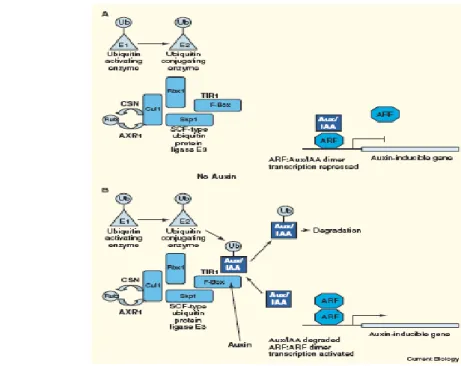
According to the current model, auxin signal is transduced by the SCF class E3 ubiquitin ligase-proteasome pathway. Firstly, auxin binds to TIR1/AFB nuclear receptors, which are F-box subunits of the SCF ubiquitin ligase complex, to promote Aux/IAA protein ubiquitination and subsequent degradation. Thereafter, the auxin signal is controlled by the quantitative and qualitative responses between Aux/IAA repressors and Auxin Response Factors (ARFs). ARFs regulate the downstream auxin-responsive genes by specific binding to auxin-response elements (AuxRE), located in their promoters. When auxin concentration is low, the regulatory complex of Aux/IAAs binding with ARFs inhibits the activity of ARF factors. Increased auxin accumulation promotes the degradation of Aux/IAA repressors and consequently activates auxin-responsive gene expression by removing the inhibition of ARF activity (Fig. 4). An alternative hypothesis is that Aux/IAAs prevent ARFs from reaching their AuxRE target sites by dimerizing with ARFs at low auxin concentrations. In the latter hypothesis, Aux/IAA proteins would be degraded when auxin concentrations are increased, allowing the binding of dimerized ARFs to AuxREs, and subsequently the activation of early auxin-response genes [29,30].
In addition, multiple pathways have been postulated that contribute to de novo auxin response. Auxin Binding Protein 1 (ABP1), as a candidate protein of auxin receptor [31,32], may control the local auxin distribution by regulating the localization of PIN transporters that are responsible for interdigitated growth. Nevertheless, the downstream components and molecular action of the ABP1 pathway remain poorly understood. Recently, S-Phase Kinase-Associated Protein 2A (SKP2A), has been identified as another candidate for a F-box-type auxin receptor [33], its binding to auxin might regulate the proteolysis of cell cycle transcription factors, such as E2FC and DPB [34] to trigger cell division. Another SKP2A-like protein might also be involved in the auxin signal pathway [33].
- 20 -
Fig. 4 The auxin response pathway in plants. Auxin-responsive genes are activated by members of the ARF family with Q-richtranscriptional activation domains. (A) Activationis blocked by dimerisation with members of the Aux/IAA family, which have a powerful transcriptional repression domain. (B) Auxin promotes degradation of the Aux/IAAs by binding directly to the F-box protein (TIR1 or its close relatives), promoting interaction between the F-box protein and the Aux/IAAs, releasing ARFs to form homodimers and promote transcription [17].
IV.1 Auxin receptors: TIR1 the heart of auxin signalling
The Transport Inhibitor Response 1 (TIR1) gene was firstly identified in a genetic screen for Arabidopsis plants tolerant to NPA, the auxin transport inhibitor [35]. Nevertheless, it was soon indicated that TIR1 functioned in auxin responsiveness, not auxin transport [36]. The TIR1 contained some recognisable motifs, which were an F-box domain and a set of leucine-rich repeats. F-box protein TIR1 contributes to a familiar and important protein degradation pathway, the ubiquitination pathway [37,38]. TIR1 is a component of a cellular protein complex known as SCFTIR1 (Skp1/Cullin/F-box) involved in ubiquitin-mediated protein
degradation. In auxin-mediated transcriptional control, the F-box protein TIR1 binds to ASK1 to determine the specificity for the protein to be ubiquitinated. Ubiquitins are added from the activated RBX1 and, once the target proteins are polyubiquitinated, they are recruited by the COP9 signalosome and the 26S proteasome where they are degraded [39] (Fig 5). The SCF regulatory proteins, auxin resistant 1 (AXR1), ECR1 and Ras-converting enzyme 1 (RCE1), are involved in the conjugation of CUL1, and mutations in these components confer auxin-resistant phenotypes and lead to defects in auxin-related developmental processes [40,41].
- 21 -
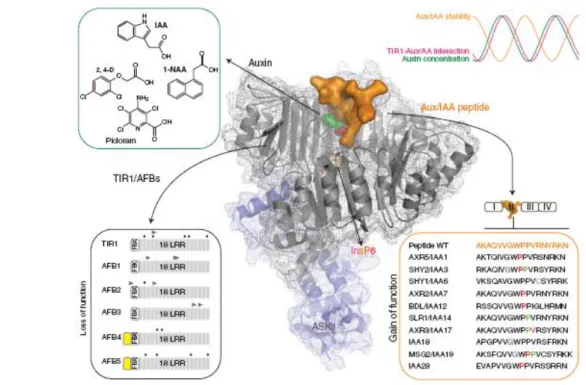
to the complex and they obtained crystal structures for the complex alone and for complexes bound to IAA along with an Aux/IAA peptide [42]. The crystal structures showed that the TIR1–ASK1 complex had a mushroom shape, with the leucine-rich-repeat domain of TIR1 forming the cap, and the F-box of TIR1 along with ASK1 forming the stem.
Fig. 5 The plant SCFTIR1complex ubiquitinates Aux/IAA transcription factors [39].
Auxin acts like “molecular glue” to stabilize the interaction between TIR1 (gray) and domain II of the Aux/IAA (orange) (Fig 6). Gain-of-function mutations in domain II of several Aux/IAAs result in reduced binding to TIR1 and stabilization of the Aux/IAA. A variety of loss-of-function mutations in TIR1/AFB proteins have been characterized, T-DNA insertions and point mutations, that results in an auxin-resistant phenotype.
A number of genetic and biochemical analyses have revealed that TIR1 itself binds auxin and acts directly as a receptor in this response. Indeed, partial or complete loss of function mutants in TIR1 subunits or its regulators exhibit auxin resistant phenotypes, suggesting that the targets of TIR1 are negative regulators of auxin signalling [43,44].
- 22 -
Fig. 6 Schematic diagram of auxin functioning as a „molecular glue‟ to enhance TIR1–substrate interactions. In contrast to an allosteric mechanism, auxin binds to the same TIR1 pocket that docks the Aux/IAA substrate. Without inducing significant conformational changes in its receptor, auxin increases the affinity of two proteins by simultaneously interacting with both in a cavity at the protein interface [42].
So far, it is possible to say that the SCFTIR1 complex (including the bound Aux/IAA
substrate) holds the binding site, although Aux/IAA proteins do not bind IAA, they might contribute to a composite binding site. The SCF TIR1 receptor system is always beautifully
functional. By controlling the free concentration of transcription factors, small errors are buffered, but once SCF TIR1 is activated and transcription promoted, amplification of many
auxin-regulated genes will be rapid and very specific.
Fig. 7 Regulation of ASK1-TIR1-Aux/IAA auxin receptor complexes. Indole-3-acetic acid (IAA) is the major natural auxin but other auxinic compounds, including a-Naphthalene aceticacid (1-NAA), 2,4-Dichlorophenoxyacetic acid (2,4-D) and 4-Amino-3,5,6-trichloropicolinic acid (picloram) promote auxin specific responses in the root or shoot of the plant. These compounds and other natural auxins may bind to the promiscuous auxin binding pocket of TIR1 with different affinities [45].
Response specificity is conferred at several complements, by the receptor‟s binding site for active auxins, by TIR1‟s specificity for Aux/IAAs and also by the specificity of auxin response elements for ARFs [45] (Fig 7).
- 23 -
IV.2 Auxin receptors: the role of ABP1
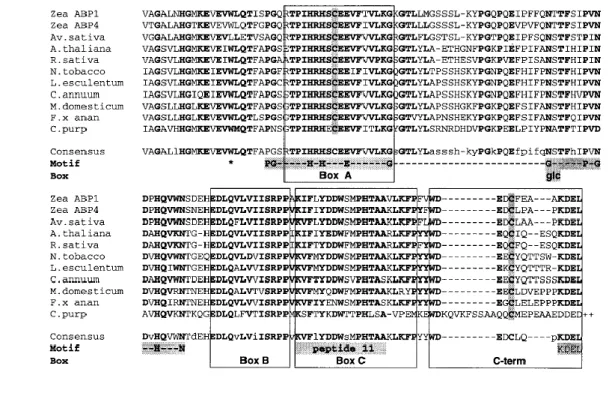
A huge step in the elucidation of auxin soluble receptors was made in 2005 after discovering of the receptor function of transport inhibitor resistant 1 (TIR1) protein. In addition, another putative auxin receptor, the AUXIN BINDING PROTEIN1 (ABP1) was isolated based on its capacity to bind auxin and is involved in a set of early auxin responses such as rapid activation of ion fluxes at the plasma membrane [46]. The ABP1 is encoded by a small gene family in Arabidopsis, and varies in the number of genes and their localization in different plants [47,48]. The protein has two conserved domains, Box A, responsible for auxin binding, and Box B, as well as a C-terminal KDEL tetrapeptide for ER targeting, are present in the ABP1 structure [46,49] as shown in Fig 8.
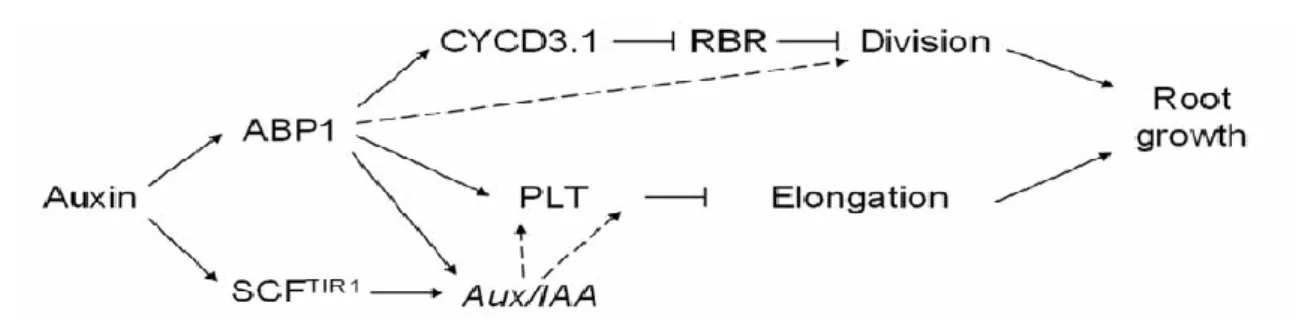
The ABP1 has long been characterized as an essential component of early auxin action at the plasma membrane but its role in downstream responses had remained elusive until recently. The identification of an Arabidopsis ABP1 gene knocked out exhibited developmental arrest at early embryogenesis stage [50]. Developmental map of gene expression in Arabidopsis revealed that ABP1 (At4g02980) exhibits a fairly constant expression in almost all tissues throughout vegetative plant development suggesting that its role is not restricted to embryo development [51,52]. It has also been shown that ABP1 is required for post embryonic shoot development and root growth in a context-dependent manner [53,54] as shown in Fig 9. Addition of ABP1 to protoplasts from tobacco leaf cells enhanced the sensitivity to auxin 100- to 1000-fold. It was suggested that an over-expression of ABP1 enhanced the sensitivity of guard cells to auxin [55].
- 24 -
Fig. 8 Pile-up of ABP1 sequences. ABP1s are listed against their genus names. Conserved residues are shown in bold type. A consensussequence is shown at the foot and lower case letters represent residues not conserved. Two boxes of completely conserved residues are outlined, Boxes A and B, and a third box with high identity is labelled Box C. Several sequence motifs are listed; glc represents N-glycosylationsites, KDEL the ER retention motif, the residues listed in the shaded boxes represent the core cupin motif and the peptide reported to carryphoto-activated IAA [49] is labelled peptide 11 [46].
The sequence and structure of ABP1 classify the protein as a soluble protein, but so far ABP1 has been exclusively found at the plasma membrane. Accordingly, the protein is localized in the ER, at least in higher plants, but a whole body of biochemical and functional evidence supports that ABP1 is located and acting at the outer face of the plasma membrane [46,56] as shown in Fig10.
- 25 -
Fig. 9 A model for ABP1 mediated auxin responses in roots. The permissive effect of auxin on cell division is dependent on ABP1. In root stem cells, the D-type CYCLIN/RETINOBLASTOMA (RBR) pathway acts downstream of ABP1 and controls the G1/S transition. In meristematic cells, ABP1 might also affect the D-type CYCLIN/RBR pathway but other critical regulators of the G1/S transitionphase are dependent on ABP1 activity. ABP1 contributes to the auxin control of cell elongation by modulating a zone of competence for PLETHORA and by acting on the auxin-mediated regulation of Aux/IAA transcriptional repressors. It is worthwhile noticing that expression of PLTs was reported to be regulated downstream of ARF transcription factors (Auxin Response Factors) and consequently of Aux/IAAs. ABP1 might act indirectly on PLT via Aux/IAAs regulation. It is well established that regulation of gene expression by auxin involves the TIR1 receptor which, within the SCFTIR1 E3 ligase, controls the degradation of Aux/IAA repressors. ABP1 and TIR1 might collectively control gene regulation and elongation [54].
Fig. 10 Hypothetic model for ABP1 targeting at the plasma membrane. ABP1 is located in the endoplasmic reticulum (ER) and at the outer surface of the plasma membrane. The protein is always associated with membrane fractions despite the absence of an intrinsic hydrophobic domain. The targeting of ABP1 to the Plm has beenhypothesized to result from the interaction of its C-terminal domain with another protein, thus masking the KDEL ER-retention motif. The identification of C-TERMINALBINDING PROTEIN 1(CBP1), as a protein interacting with a synthetic peptide corresponding to the C-terminus of Zm-ABP1, supports this suggestion. Interaction of ABP1 with the GPI-anchored protein CBP1 might promote targeting of ABP1 to the Plm with CBP1 acting as a carrier. Interaction of ABP1 with CBP1 is however not confirmed yet.The involvement of a third component for the transduction of the signal after binding of auxin to ABP1 cannot be ruled out [56].
ABP1 is important throughout the life of plants, including embryogenesis, and differentially affects the cells depending on the developmental context. All experimental data
- 26 -
support that ABP1 is a crucial component of auxin signaling and can be considered as the auxin binding subunit of a plasma membrane auxin receptor.
So far, there are two clear auxin perception receptors, one involving ABP1 and the other TIR1/AFBs, as shown in Fig 11. The broad variety of auxin effects is likely to require both ABP1 and TIR1 coordinately control the physiological events in plants. In addition, a recent research showed S-Phase Kinase-Associated Protein 2A (SKP2A), as another candidate protein for auxin receptor, containing in the auxin signal pathway [57].
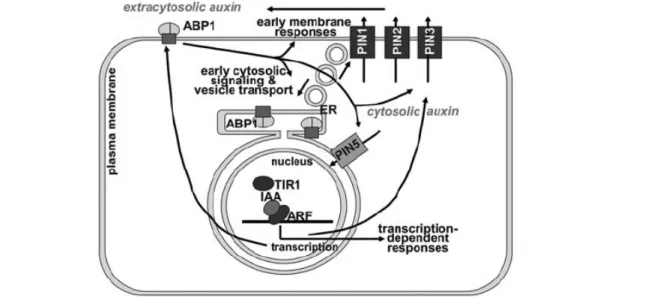
Fig. 11 Model of auxin signal transduction. The receptor ABP1 is depicted as a dimer in complex with a transmembrane “docking protein.” ABP1 triggers a number of typical signaling pathways in the cytosol (Scherer, 2011). These responses include the phosphorylationstatus of PIN proteins (not shown in drawing) and control of endocytosis/exocytosis balance (Kleine-Vehn & Friml, 2008). Several PIN proteins, including PIN 1, PIN 2and PIN 3 are integrated into cell polarity and auxin efflux transport toregulate extracytosolic auxin concentration and, thereby, polar auxintransport and tropisms. Indirectly, they may also regulate cytosolicauxin concentration as is assumed for PIN 5 which is localized to theER. This localization is postulated to increase nuclear auxin concentrationwhere it is sensed by the receptor TIR 1. Formation of the ternary complex [TIR 1 x auxin x IAA] leads to ubiquitination of IAA proteins and their hydrolysis by the proteasome. At least PIN 2 and PIN 3 are regulatedby phosphoryation and rapid transcriptional responses. TIR 1 is alsoassumed to be the relevant receptor for ABP1 transcriptional regulationso that ABP1, PIN s and TIR 1 are a completely interlocking system oftwo receptors linked by auxin transport. Other systems of two or morereceptors for one signal where one receptor is closely associated toregulation of proteasomal activity are known or likely in plants [32].
IV.3 Auxin early response genes and auxin responsive element, AuxRE
Auxin rapidly and transiently induce the expression of hundreds of genes with minutes [58] .The early auxin-responsive genes can be classified into three major families: SMALL
AUXIN-UP RNAs (SAURs), GRETCHENHAGEN (GH3)-related transcripts and Auxin/INDOLE-3-ACETIC ACID family members(Aux/IAA).
SAUR. Small auxin-up RNAs (SAURs) are the early auxin-responsive genes represented by a large multigene family in plants. SAURs were originally identified in auxin-treated soybean elongating hypocotyl sections [59]. Auxin induction of soybean SAURs was transcriptionally regulated and specific for active auxin [60]. Sequence analysis of three soybean SAUR cDNAs and genes revealed that the genes contain no introns [60].
- 27 -
Subsequently, Auxin-inducible SAURs have also been identified in mung bean [61],
Arabidopsis [62], tobacco [63], maize [64] and rice [65]. In Arabidopsis, there are over 70 SAUR genes which appear to be lack of introns with only one exception AtSAUR11. As like in
soybean, most of the SAUR genes in Arabidopsis are found in clusters. In rice, 58 OsSAUR gene family members were identified and also the coding sequences of OsSAURs do not possess any introns. The SAURs encode highly unstable mRNAs with a very high turnover rate due to the presence of a conserved downstream (DST) element in their 3-untranslated regions [66].
The SAUR proteins remain largely uncharacterized. Recently, It has been reported that
ZmSAUR2, a nuclear-localized Zea mays SAUR protein, are shortlived, with a half-life of
about 7 min [64]. Expression of SAUR19 subfamily members in Arabidopsis confers numerous auxin-related phenotypes indicative of increased and/or unregulated cell expansion [67]. In addition, the calcium-dependent in vitro binding of SAUR proteins with calmodulin has been demonstrated, which provides a link between the Ca2+/calmodulin second messenger system and auxin signalling [64,68].
GH3. Gretchen Hagen 3 (GH3) genes were a large multigene family and originally identified in Glycine max (soybean) as responsive to the phytohormone auxin [69]. GH3 mRNA is transcriptionally induced within 5 minutes of auxin treatment, and is specifically induced only by active auxins [70]. By contrast, soybean GH3 mRNA levels are unaffected by treatment with protein synthesis inhibitors [70,71]. Up to now, GH3 genes has been identified in many plant species [72], which can be devidied into four different types, Chlorophyta, Bryophyta, Coniferophyta, and Magnoliophyta. In Arabidopsis thaliana, several genes were identified in genetic screens for altered phytohormone-mediated responses, including DFL1 [73] and JAR1 [74].
All of the GH3 genes encode proteins with predicted molecular masses of 65–70 kDa. It has been shown plant GH3 proteins can be divided into three major clades, identified as Groups I, II, and III [74,75]. Groups I and II contained genes from many more species than Group III, the latter containing genes from only three species, Arabidopsis thaliana, Brassica
napus, and Gossypium hirsutum [72]. In Arabidopsis, Group I was composed of two proteins,
AtGH3.11(JAR1), that adenylated jasmonic acid (JA) in vitro and displayed JA-amino synthetase activity and AtGH3.10 (DFL2) that doesn‟t have these capabilities [76]. Group II contains most of the members, including AtGH3.2 (YDK), AtGH3.5 (AtGH3a), AtGH3.6 (DFL1), and AtGH3.17, which were able to adenylate indolacetic acid (IAA) and to catalyze IAA conjugation to amino acids through amide bounds [74,77]. In addition, AtGH3.6,
- 28 -
AtGH3.5 and AtGH3.17 might be the targets of the auxin response factor ARF8 [78]. There was no adenylation activity on the substrates tested found in group III.
Fig. 12 Maximum likelihood phylogenetic tree of Arabidopsis GH3 proteins and expression in response to biotic and abiotic stress [79].
Recently, GH3 genes showed different responses to a variety of stimulus [79] (Fig. 12). The
fin219 (far-red-insensitive 219) mutant was isolated as a suppressor of a mutation in a key
regulatory component of photomorphogenesis, COP1 [80]. The fin219 mutant plants display a long hypocotyl phenotype when grown under continuous far-red light. The dominant dfl1-D (dwarf in light 1) mutant was selected in a screen for hypocotyl length mutants from
Arabidopsis activation-tagged lines [73]. Both hypocotyl cell elongation and lateral root
formation are inhibited in the dfl1-D mutant in the light. Furthemore, Overexpression of
AtGH3.6, AtGH3.10, and AtGH3.2 [73,81,82] produced short hypocotyl in light (YDK also
in dark) but only adult plants overexpressing AtGH3.6 and AtGH3.2 resulted in a dwarf phenotype. Most recently, the GH3 family encodes the enzyme that catalyzes the conjugation of IAA with an amino acid to yield an inactive storage form of IAA [83,84]. In total, the above evidence suggests GH3 genes are clearly implicated in the regulation of plant phenotype, an agronomical trait of great relevance.
Aux/IAA. Aux/IAA gene was first isolated from soybean hypocotyls [85]. Subsequently, many Aux/IAA genes have been characterized based on the analysis of gain-of-function
- 29 -
mutants in Arabidopsis [86], tomato [87,88] , rice [89] and maize [90]. Aux/IAA genes are present as multigene families in plants. Arabidopsis contains 29 Aux/IAA genes and most of them are induced by auxin and show a range of induction kinetics except Aux/IAA 28 [91,92]. In rice, a total of 31 Aux/IAAs distributed on 10 of the 12 chromosomes (except chromosome 4 and 10) have been reported [93] . In tomato, it has been shown that a total of 26 Aux/IAAs distributed on 9 of the 12 chromosomes (except chromosome2, 10 and 11) and IAA4, IAA9, IAA22, IAA29 and IAA32 proteins were located in the nuclus of the tobacco protoplasts fused with –GFP (green fluorescent protein) or –YFP (yellow fluorescent protein), suggesting that Aux/IAA proteins are nuclar localized [94,95]. In maize, a total of 31 Aux/IAA genes were also identified, which are distributed in all the 10 chromosomes except chromosome 2 [96]. Until now, 17 IAA genes in potato genome, 35 Aux/IAA genesin Populus genome and several IAA genes in tobacco have been reported [97,98].
Aux/IAAs proteins generally range in size from 20 to 35 kDa. They are short-lived and localize to the nucleus as previous described. So far all the Aux/IAAs are characterized as repressor of auxin response [99]. It has been found four highly conserved domains (Fig 13). Domain I of Aux/IAA functions as an active repression domain and contains a conserved Leu-rich (LxLxL) motif that is located in the ethylene response factor-associated amphiphilic repression (EAR) motif [99]. Domain II contains a WPPV motif that is responsible for the stability of Aux/IAA proteins and directly binds to the TIR1/AFB auxin receptors in an auxin-dependent manner [100]. Domain III contains a predicted βαα fold, which has been characterized in DNA-binding domains of Arc and Met J repressor proteins [101]. Domains III and IV of the Aux/IAA proteins contain a protein-protein interaction domain that shares a homology with the C-terminal domain (CTD) of ARF proteins [102].
Fig. 13 Diagram of an Aux/IAA protein with conserved domains I, II, III and IV [111].
Aux/IAA family genes play an important role in many aspects of plant responses to auxin.
In Arabidopsis, it has been shown that iaa28-1 may act as transcription repressor in promoting lateral root initiation in response to auxin signals [103]. IAA14 was regarded as a fundamental
- 30 -
regulator in lateral root formation as its mutant completely lacked lateral roots [104]. In tomato, antisense down-regulation of Sl-IAA3 resulted in the alteration of auxin and ethylene-related phenotypes, such as apical dominance, auxin sensitivity, apical hook and petiole epinasty [87]. While Sl-IAA9 was down-regulated, the antisense lines exhibited simple leaves instead of compound leaves, and fruit development was triggered before fertilization, giving rise to parthenocarpy [88]. Most recently, it was shown that Sl-IAA15 was involved in trichome development as IAA15-inhibitedd lines displayed strong reduction of type I, V and VI trichomes[105]. Likewise, suppression of Sl-IAA27 gene revealed multiple phenotypes related to vegetative and reproductive growth, including higher auxin sensitivity, altered root development, reduced chlorophyll content in leaves, dramatic loss of fertility and enlarged placenta and small fruits [106]. Taken together, these phenotypes uncover specialized roles for Aux/IAAs in plant developmental processes, clearly indicating that Aux/IAA gene family members perform both overlapping and specific functions in plant.
AuxRE. The promoters of several auxin-responsive genes, like SAURs, GH3 and
Aux/IAAs, shared a common sequence which had been identified as a six-base pair sequence,
TGTCTC or variants [107,108]. This element known as Auxin Responsive Element (AuxRE), was first identified from the promoter region of the pea Ps-IAA4/5 gene[109]. AuxREs were functional in both composite and simple auxin-response elements (Fig. 14). In composite AuxREs, the TGTCTC element is only functional if combined with a coupling or constitutive element [110]. For simple AuxREs, which derived from the alteration of naturally occurring AuxREs, may function in the absence of a coupling element with the TGTCTC elements occurred as direct or palindromic repeats. And usually, the simple AuxREs are 5–10 times more auxin-responsive than natural AuxREs [111].
In the last two decades, natural AuxRE promoter-reporter constructs have often been used to study organ and tissue expression patterns of auxin-responsive genes. Synthetic AuxRE-reporter genes have been used to monitor cell and/or tissue responses to endogenous auxin in wild type and mutant plants carrying the reporter gene [112,113]. More recently, genome-wide profiling experiments have revealed a lot of auxin-induced genes, which contain AuxREs in putative regulatory regions [114,115].
- 31 -
Fig. 14 Composite and simple AuxREs. The TGTCTC elements or inverted GAGACA elements are indicated by arrows. The coupling or constitutive elements in the D1 and D4 promoter fragments of the GH3 gene are indicated by the underlines. P3 (4X) contains an everted repeat separated by 7 bp, which is identical to ER7, and an inverted repeat separated by 3 bp. ARF1 protein was shown to bind to the ER in a P3 (4X) probe (Ulmasov et al, 1997a). DR5 is a direct repeat, and DR5R is the inverse of the DR5 repeat; both are active AuxREs, indicating that the orientation of the DR has no effect on activity [111].
IV4. Auxin Response Factor (ARF)
Auxin response factors (ARFs) are transcription factors in the auxin signal pathway which bind with specificity to TGTCTC auxin response elements (AuxREs) to regulate the primary/early auxin response genes, such as GH3s, SAURs and Aux/IAA genes [116]. ARF is a large gene family recruiting Aux/IAA repressors to confer an auxin response to functional genes. ARF gene family functions by activating or repressing auxin response genes. Recent advances have revealed that ARF family genes play a critical role in a host of developmental process, such as embryo patterning [117], leaf expansion and senescence [118], lateral root growth [119], floral organ abscission and petal growth [120,121], fruit set and development [122,123,124] and apical hook formation[125], as well as various responses to environmental stimuli. In addition, ARF family genes are involved in the interactions between auxin and gibberellins [126], auxin and ethylene [127], auxin and ABA [128] and also brassinosteroid response [129]. Studies employing different species have indicated that a total of 23 ARF genes from Arabidopsis, 25 ARF genes from rice (Oryzasativa) [130], 39 ARF genes from Populus trichocarpa[97], 24 ARF genes from sorghum (sorghum vulgare) [131] and 31 ARF genes from maize [132] have been identified, respectively. Most recently, 22 ARF genes have
- 32 -
also been isolated from tomato (Solanum lycopersicum) genome comparing with AtARF genes [133,134].
A typical ARF protein consists of an amino-terminal DNA binding domain (DBD), a middle region (MR) that functions as an activation domain (AD) or repression domain (RD), and a carboxy-terminal dimerization domain (CTD) (Fig. 15) [135]. The ARF DBD is identified as a plant-specific B3-type, which requires additional amino-terminal and carboxy-terminal amino acids for efficient in vitro binding to TGTCTC AuxREs [136]. The modular nature of ARF DBDs has been checked by carrying out domain swap experiments with the DBDs of an ARF repressor and an ARF activator and the results showed DBDs targeted to AuxREs was independently of ARF MRs and CTDs [137]. The ARF MRs is located just between the DBDs to the CTDs and contains biased amino acids. The ARF ADs are rich in glutamine (Q), serine (S), and leucine (L) residues while ARF RDs are rich in proline (P), serine (S), threonine (T), and glycine (G) residues. The identification of ARF ADs and RDs were demonstrated by fusing the ARF middle regions to yeast GAL4 DBDs and the results indicated that ARF MRs function as repression or activation domains in an auxin-independent manner [138,139].
Fig. 15 The ARF family of transcription factors in Arabidopsis. The ARF family consists of five transcriptional activators (ARF5–8 and 19) with an AD that is enriched in glutamine (Q), serine (S), and leucine (L). The remainder of the ARF family is thought to consist of transcriptional repressors with an RD that is usually enriched in serine(S) and in some cases proline (P), leucine (L), and/or glycine (G). All of the ARFs contain a conserved DBD; however, the DBD in ARF10, 16, and 17 contains an additional 32–36 residues (indicated in blue within the DBD), and ARF23 contains only a truncated DBD. ARF3,13, and 17 lack the conserved CTD found in most ARFs [138].
- 33 -
ARF/Aux-IAA hetero-dimers (Fig. 16), which were based on the results in yeast two-hybrid assays with selected ARF CTDs and Aux/IAA proteins [107,108,140] as well as in protoplast transfection assays [138,139]. ARF activators with a CTD truncation activate auxin response genes constitutively in transfected protoplasts, suggesting that ARF CTDs is required for an auxin response but not ARF DBDs and MRs [137].
Fig. 16 Domain properties of auxin response factor (ARF) and auxin/ indoleacetic acid (Aux/IAA) proteins [141].
Since cloning of the first AtARF1 gene from Arabidopsis, 23 members of this family, distributed over all five chromosomes have been identified [141]. The function and characterization of most AtARFgenes was revealed by mutant analysis approach (Fig. 17 and 18), for example, arf1 and arf2 T-DNA insertion mutation indicated ARF2 regulated leaf senescence and longevity [118] as well as floral organ abscission, and ARF1 acted in a partially redundant manner with ARF2 and increased transcription of Aux/IAA genes in
Arabidopsis flowers as a transcriptional repressor [120]. The arf7 and arf19 mutations were
also found to enhance arf2 mutation phenotypes as transcriptional activators. And the
arf7arf19 double mutant had stronger auxin resistance than the single mutant and displayed
phenotypes not seen in the single mutant [127]. The arf8 mutants were reported to regulate fertilization and fruit development, such as arf8-1 showed a long-hypocotyl phenotype in either white, blue, red or far-red light conditions [78], arf8-3 mutant indicated a significantly larger petal than that of the wild type[121], arf8-4 mutant results in the uncoupling of fruit development from pollination and fertilization and gives rise to big and parthenocarpic fruit [122], and arf6 arf8 double mutant flowers arrested as infertile closed buds with short petals, short stamen filaments, undehisced anthers and immature gynoecia [142]. Up to now, the roles of most ARFs in Arabidopsis have been identified, in detail, ARF1 plays a role in developing flowers [120], ARF2 in developing floral organs and in light-grown or dark-grown seedlings [120,143,144], ARF3 and 4 in developing reproductive and vegetative tissues [145,146], ARF5 in developing embryos and vascular tissues [147,148], ARF6 in developing flowers [142], ARF7 in seedlings, roots, and developing embryos [149,150], ARF8 in seedlings and developing flowers and fruits [78,122], ARF10 in serrated leaves, curled stems,
- 34 -
contorted flowers and twisted siliques[151], ARF16 in the basal region of embryos, root caps, vascular tissue of roots, and leaves [152], and ARF19 in seedlings, leaves and lateral roots[150,153]. Furthermore, AtARF genes fall into related sister pairs on the chromosome and may have overlapping functions during different developmental processes, including
ARF1 and 2, 3 and 4, 5 and 7, 6 and 8, 7 and 19, or ARF10, 16 and 17 [142,154,155].
Fig. 17 Location of T-DNA Insertions in the ARF Gene Family Members. Boxes represent exons. T-DNA insertions with gray triangles denote lines whose characterization has been completed. T-DNA insertions with white triangles denote lines not yet characterized [144].
In tomato, it has been reported that down-regulation of Sl-ARF2B resulted in a color change in fruit break stage and partly pathenocarpic fruits (unpresented data). Also, down-regulation of Sl-ARF4 (DR12) in the tomato resulted in a pleiotropic phenotype including dark green and blotchy ripening fruit [156]. Recently, down-regulation of Sl-ARF7 gene in tomato produced parthenocarpic fruit, showing different form in contrast to wide type fruit [157]. Moveover, the mutant mSl-ARF10 (Sl-miR160a-resistant version) plant developed narrow leaflet blades, sepals and petals, and abnormally shaped fruit [158].
- 35 -
Fig. 18 Phenotypes of Mature Mutant Plants. Three wild-type (left) and three mutant plants (right) are shown. The plants were grown at the same time. White dots indicate the boundaries between the wild-type and the mutant plants [144].
Recently, the post-transcriptional regulation of ARF transcript abundance by several microRNAs (miRNAs) has been found to play specific roles in regulating plant growth and development [159]. For example, the miR160 is complementary to ARF10, ARF16, and
ARF17 and regulates gene expression by directing mRNA cleavage [160]. It has been shown
that over-expression of miR160 in Arabidopsis reduced root length, increased lateral root number and suppressed root gravitropism [152], while disruption of miR160, acting on ARF17 (mARF17), led to severe developmental abnormalities, as like prior description mARF10 in tomato. The miR167 is complementary to ARF6 and ARF8 and over-expression of miR167 mimicked the phenotypes of arf6arf8 double mutant, showing ectopic ovules and abnormal anthers [161,162]. Moreover, the phenotypic plasticity of adventitious rooting in
Arabidopsisis controlled by complex regulation of ARF6, 8 and 17, correspondence to
miR160 and 167 (Fig. 19) [163]. Taken together, the miRNA-based regulation of ARFs in auxin signal pathway is essential for Arabidopsis growth and development.
- 36 -
Fig. 19 A model Integrating the regulatory loops between ARF and miRNAs in the control of adventitious rooting based on results obtained in this study [163].
To investigate the roles of ARF transcription factors in auxin action, identification of the potential target genes under the direct transcriptional control of ARFs has been to the point. Recently, several methods including differential hybridization, protoplast transfection assays, transcript profiling using microarrays of auxin-induced genes, as well as microarrays from auxin signaling mutants, have been performed [147,164,165,166]. As been known, ARFs can bind specifically to the AuxREs within the promoters of early/primary auxin response genes, thus those genes containing the AuxRE sequences TGTCTC or GAGACA in their promoter regions have been of specific interests. Some reports have shown that ARF7 plays a major role in regulating a wide variety of early/primary auxin response genes in Arabidopsis seedlings [149,167]. ARF5 and 19 appear to be involved in activating expression of some
Aux/IAA genes (e.g. IAA1 and 19) [164,167]. In floral tissues, arf6 arf8 double mutants
display lower expression of a SAUR clade (SAUR62–SAUR67) as well as a subset of Aux/IAA genes, suggesting that ARF6 and 8 may activate at least some auxin response genes in reproductive organs [142]. In accordance, some ARF genes in Arabidopsis might bind to
GH3’s promoters to regulate gene expression. ARF8 was proved to regulate the expression of
three AtGH3 genes, AtGH3a, DFL1, and YDK1 [78]. These genes were down-regulated in
arf8-1 mutant and up-regulated in ARF8-sense lines, suggesting that ARF8 probably
maintains auxin homeostasis in vivo by positively regulate expression of GH3, which leaded to adenylating IAA to form IAA-AA. In addition, an auxin signal pathway containing
![Fig. 2 Reversible dissociation of the molecule of native auxin – indole-3-acetic acid (IAA) [15].](https://thumb-eu.123doks.com/thumbv2/123doknet/3555221.104178/18.892.163.752.227.300/fig-reversible-dissociation-molecule-native-auxin-indole-acetic.webp)

![Fig. 5 The plant SCF TIR1 complex ubiquitinates Aux/IAA transcription factors [39].](https://thumb-eu.123doks.com/thumbv2/123doknet/3555221.104178/22.892.113.702.257.562/fig-the-plant-scf-complex-ubiquitinates-transcription-factors.webp)
![Fig. 12 Maximum likelihood phylogenetic tree of Arabidopsis GH3 proteins and expression in response to biotic and abiotic stress [79].](https://thumb-eu.123doks.com/thumbv2/123doknet/3555221.104178/29.892.202.716.201.583/maximum-likelihood-phylogenetic-arabidopsis-proteins-expression-response-abiotic.webp)
![Fig. 13 Diagram of an Aux/IAA protein with conserved domains I, II, III and IV [111].](https://thumb-eu.123doks.com/thumbv2/123doknet/3555221.104178/30.892.158.728.853.976/fig-diagram-aux-iaa-protein-conserved-domains-iii.webp)