To link to this article:
DOI: 10.1016/j.powtec.2010.08.034
http://dx.doi.org/10.1016/j.powtec.2010.08.034
This is an author-deposited version published in:
http://oatao.univ-toulouse.fr/
Eprints ID: 4914
To cite this version:
Seyni, Abdoulaye and Le Bolay, Nadine and Lamure, Alain Matrix-filler
interactions in a co-ground ecocomposite: surface properties and behaviour in
water. (2011) Powder Technology, vol.208 (n° 2). pp. 390-398. ISSN
0032-5910
O
pen
A
rchive
T
oulouse
A
rchive
O
uverte (
OATAO
)
OATAO is an open access repository that collects the work of Toulouse researchers and
makes it freely available over the web where possible.
Any correspondence concerning this service should be sent to the repository
administrator:
[email protected]
Matrix–filler interactions in a co-ground ecocomposite: Surface properties and
behaviour in water
Abdoulaye Seyni
a, Nadine Le Bolay
a,⁎
, Alain Lamure
baUniversité de Toulouse, Laboratoire de Génie Chimique, UMR CNRS 5503, ENSIACET-4, allée Emile Monso, BP 44362-31432 Toulouse Cedex 4, France bUniversité de Toulouse, CIRIMAT-UMR CNRS 5085, ENSIACET-4, allée Emile Monso, BP 44362-31432 Toulouse Cedex 4, France
a b s t r a c t
Keywords: Co-grinding Ecocomposite Polystyrene StarchSize and morphology Surface properties Water uptake and diffusion
Ecocomposites made up of polystyrene and starch were produced by co-grinding. The mechanism by which the composite is formed was identified by following the particle size and morphology. The size reduction of the matrix particles is favoured by the presence of starch which adheres on polystyrene surface, playing the role of agglomeration inhibitor between matrix particles. Thus, the filler is well dispersed in the matrix, permitting a good homogeneity of the composite properties. The hydrophilic behaviour of starch is reduced by co-grinding, resulting of a decrease of the acid and non dispersive components of the surface energies. Consequently the interactions between the initially hydrophobic matrix and hydrophilic filler are enhanced without using a compatibilizer. Thus, the water-resistance of the co-ground composite materials is better compared to blends since blends pellets introduced in water are rapidly disintegrated while an adapted co-grinding time permits to avoid this problem. It was seen that the diffusion coefficient of water in the composite pellets decreases with an increase of the co-grinding time for the lower filler rates, while it is the opposite for high filler rates. Moreover, the diffusion coefficient increases with the filler ratio.
1. Introduction
Polystyrene, from its numerous applications (food containers, household appliances, audiovisual, toys…), represents one of the petrochemical polymers most widespread and thus generates many wastes. To control this problem, its wastes are recycled, or when it is possible, it is replaced by biodegradable polymers or it is combined with biodegradable materials. It is this last way that we propose to study.
Several technologies can be used to produce composite materials. In the case of blending particulate components, the homogenisation of the blend may be difficult when the materials have different sizes or densities and segregation may occur during handling. Other methods can also be applied, such as chemical synthesis or extrusion, but both have limitations, the first one from the need for choosing a solvent compatible with all involved materials, and the second one imposing a thermal compatibility between the products. Moreover, the use of particles of size close to the micrometer or lower is often difficult because of a marked risk of agglomeration. However, the lower the particle size, the higher the dispersion of a material in the other one, and the better the homogeneity of the composite properties.
Another process consists in co-grinding the materials to reduce the filler size and to increase the interactions between the products[1].
The process was applied with mineral fillers [2,3] or with non-degradable polymeric fillers [4,5], and it was shown that the mechanical properties of co-ground composites are enhanced compared to blends. In a recent work[6], we have used starch as filler in co-ground poly (vinyl acetate) composites. Starch is biodegradable, cheap and available, and does not depend on fossil sources. Unfortunately, it is reported in the literature that composites made up of a synthetic polymer matrix and starch filler produced by other processes offer mechanical properties lower than that of the matrix alone [7,8]. Indeed, starch is hydrophilic in opposite to the majority of the synthetic polymers which are hydrophobic. That then generates a weak interaction at the starch–matrix interface, leading to a loss of the mechanical properties because of a weak adhesion between materials. This is why the surface of the starch particles was chemically modified, which supports compatibility between the filler and the matrix[9,10]and thus improves the mechanical properties of the composite. Moreover, this chemical modification often makes the starch more hydrophobic, which confers a better stability of starch-filled composite materials to water[11]. However, the addition of a chemical agent is not favourable for environment, and co-grinding allows, without using a compatibilizer, to modify the matrix–filler interface, making possible on the one hand to increase the mechanical properties of the composite, and on the other hand to offer interesting water-resistance properties[6].
This paper presents results on the production of starch-filled polystyrene co-ground composites containing different starch rates. The mechanisms at the origin of the generation of such a composite
⁎ Corresponding author. Tel.: + 33 5 34 32 36 82; fax: +33 5 34 32 36 97.
E-mail address:[email protected](N. Le Bolay).
material were identified using size measurements and morphology of the particles. Moreover, since the interactions between the matrix and the filler are of great importance on the use properties of the composites, a study of the surface properties permits to understand how the matrix–filler interactions evolve during co-grinding. Finally, the behaviour of the composite materials in water was characterized. 2. Apparatus and experimental procedure
Dry batch grinding and co-grinding experiments were carried out using a laboratory tumbling ball mill Prolabo. It is composed of a cylindrical ceramic grinding chamber of a capacity of 5 l closed with a ceramic lid. Ceramic balls were used as grinding medium. Three diameters (5.5, 9.3 and 17.5 mm) were chosen to be adapted to all the particles sizes. Their proportions were respectively fixed at ¼, ¼ and ½. A ball filling rate of 20% of the chamber volume was chosen. As for the powder filling rate, it was fixed at 10% of the interstitial volume between the balls. The powder was either the matrix, or the filler, or a matrix–filler mixture in proportions defined by the operating conditions. The rotation speed of the mill was fixed at 100 rpm, i.e. at 75% of the critical speed.
During experiments, the mill was stopped at different times to take powder samples which were preserved in small flasks hermet-ically closed for the various analyses. For the analyses requiring little product (granulometry, SEM), small quantities of powder were taken in various zones of the chamber to be representative of the whole powder. The volume taken for each sample was low compared to the initial powder volume in order not to modify significantly the powder filling rate. For the other analyses, which require much powder, experiments were repeated with the same operating conditions and stopped at various times in order to recover the totality of the powder. The samples were maintained at room temperature in a desiccator between sampling and analyses which were done within 24 h.
The polystyrene (Goodfellow) used in this study is amorphous. The initial particles have a size between 20 and 630 μm, and their average size is 255 μm. Their shape is irregular. Their density is equal to 1050 kg m−3. Their glass transition temperature, fusion
tempera-ture and degradation temperatempera-ture are respectively 100, 270 and 350 °C. The filler was a waxy maize starch (Waxilys–Roquette), mainly composed of amylopectin (99%). It is a semi-crystalline polymer, with a density of 1330 kg m−3. The particles size varies from 4 to 32 μm (average size close to 13 μm); the small sizes correspond to individual particles while the big sizes are due to the presence of agglomerates. Its glass transition temperature determined by DSC is around 90 °C. A SEM micrograph of the two products is shown onFig. 1. Big particles are polystyrene while the small ones are starch.
Two series of experiments were realized. Indeed, each material was first ground alone to understand its fragmentation and agglomeration mechanism, as well as to characterize its own properties. Secondly, they were ground together to study the composite behaviour and properties.
A laser diffraction granulometer Malvern Mastersizer 2000 was used to measure the particles size distributions expressed in volume and the mean size, d50, corresponding to a cumulated volume percentage of 50%. The Mie theory was applied to minimise artefacts in the size distributions. Since several experiments were performed with the same operating conditions, the reproduction in the size measurements was verified, on the one hand on the same sample and on the other hand on samples taken at a same time of different experiments. The difference between the mean sizes was less than 1%. Powder samples were also observed with a scanning electron microscope Leo 435 VP.
To understand how matrix–filler interactions evolve during co-grinding, a sessile drop method was used to determine the product surface energy. A Digidrop Contact Angle Meter from GBX Scientific Instruments was used in this way. Cylindrical pellets with a diameter of 8 mm were realised by compacting powders in a Carver press. The protocol used consists in depositing a liquid drop of an accurate volume (3–5 μL) at the surface of the pellets and then in measuring the static contact angle (θ). A high resolution camera and software were used to capture and analyze the contact angle. This one was obtained by calculating the slope of the tangent to the drop at the liquid–solid interface. The accurate value of the angle (± 1°) was given by the software. In the present study, a few seconds were sufficient to obtain the stabilization of the interfacial forces and thus, the static contact angle was measured just after deposition of the liquid drop. In order to assess the homogeneity of the surface properties, 5 measurements were performed on different locations on the samples and the average contact angle was calculated. All the experiments were performed at room temperature and constant humidity (~50%). Various compression forces were applied at room temperature on the powder to form the pellets, and it was shown that a force of 30 kN during 15 min allows a better reproducibility in the angle measurements. Three liquids with known physico-chemical properties were used to determine the values of the energy components of the solids to be analyzed: α-bromonaphtalene which is a non-polar solvent, deionised water and formamide which have polar and non-polar components. Their characteristics are gathered in Table 1.
Finally, the behaviour in water of the ground and co-ground materials was studied by regularly weighting pellets of the materials immersed in flasks containing water. The pellets were prepared with the same operating conditions as previously described. The water
Fig. 1. SEM micrograph of the two products.
Table 1
Properties of the liquids at 20 °C.
ρ (kg m−3) μ (Pa s) γL(mJ m−2) γLW(mJ m−²) γAB(mJ m−²) γ+(mJ m−²) γ−(mJ m−²)
1-Bromonaphtalene 1484 4.89 ∙ 10−3 44.4 44.4 0 0 0
Formamide 1130 4.55 ∙ 10−3 58 39 19 2.28 39.6
uptake was studied during several months and was calculated by the equation:
WU =mt−mi
mi *100 ð1Þ
where miis the initial pellet mass before immersion in water,and mt,
the pellet mass after an immersion time t in water.
For several co-grinding times, three pellets were realised and immersed in water to study the reproducibility on the water uptake and a difference of less than 2% was determined between the results for same immersion times.
3. Experimental results
3.1. Evolution of the size and the morphology
Polystyrene and starch were first ground alone. The variation of their mean sizes with the grinding time is presented inFig. 2.
The starch size is not reduced during the process. Indeed, Schönert [12]has shown that the minimum size that can be reached when grinding macromolecules is several tens of μm. Since the initial mean size of starch is about 13 μm, i.e. lower than the limit size, particles tend to agglomerate and the mean size increases.
Concerning polystyrene, one can observe an increase of d50 at the beginning of the operation. This is due to the fact that polystyrene particles are compact and the ball mill energy is not sufficient to break the particles core. Consequently, chips are formed on the particles surface (Fig. 3), which tends to increase first the mean size. Then, chips are removed under the effect of the balls, what leads to a decrease of the mean size. These two phenomena occur several times and the mean size decreases progressively. At the end of the experiment, while particles fragmentation still happens, some agglomeration of small fragments on big ones occurs, but this phenomenon is not preponderant on fragmentation. Consequently, the mean size does not increase, but its reduction is lowered.
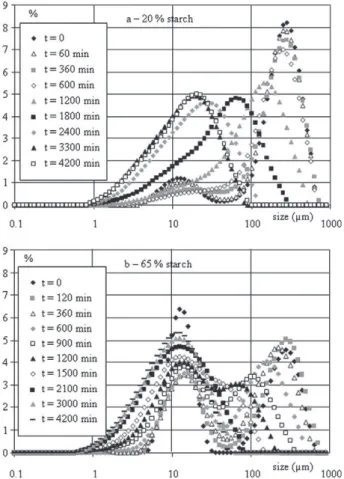
Polystyrene–starch mixtures, containing starch rates varying between 10 and 65 wt.%, were then co-ground. Two types of variation of the size distributions with the co-grinding time were observed, depending on the filler rate: variation ofFig. 4a for rates lower than 20 wt.% and variation ofFig. 4b for rates higher than 35 wt.%. These variations of the size distributions lead to the evolution, vs. the co-grinding time, of the mean size plotted inFig. 5for all the tested starch rates.
In both cases, the initial size distributions are constituted of two peaks, that of the left-hand side corresponding to starch particles and that of the right-hand side corresponding to polystyrene particles which are bigger.
For low starch rates, before 600 min of co-grinding the mode of the polystyrene peak does not evolve, while the proportion of the starch peak decreases slowly and a new peak appears around 50 μm. These evolutions can be explained by observing SEM micrographs which are not presented here. Indeed, polystyrene chips are formed as when the matrix is ground alone, and small starch grains stick on polystyrene and thus cannot be anymore detected by the granulometer. Consequently, the mean size does not evolve significantly during this period, and the curves are superimposed. Thus, the presence of the filler in small proportions seems not to have a significant effect on the co-grinding rate before 600 min. After that time, the size
Fig. 2. Variation of the mean size of starch and polystyrene particles ground alone.
Fig. 3. SEM micrographs of polystyrene chips formed at the particle surface.
Fig. 4. Variation of the size distributions of blends containing: a – 20 wt.% and b – 65 wt.% of starch.
distributions shift progressively towards the left and the mean size decreases all the more rapidly as the filler rate is high. This may be explained by the fact that when polystyrene is ground alone, agglomeration of small fragments on bigger particles occurs for long grinding times, slowing down the reduction of the mean size. On the contrary, filler grains, stuck on polystyrene particles at the beginning of the treatment, prevent matrix–matrix agglomeration and act as an agglomeration inhibitor. Finally, composite particles are produced, with the filler well dispersed in the matrix (Fig. 6).
When a starch rate higher than 35 wt.% is used (see example in Fig. 4b), the high filler proportion in the mixture generates an important agglomeration phenomenon of the filler grains on polystyrene particles. Consequently, one observes a significant decrease of the proportion of the starch peak in the size distribution between 0 and 360 min. Moreover, the polystyrene peak is enlarged, due to chips removal and to starch agglomeration on matrix particles. This has a great influence on the mean size. Indeed, the initial mean size decreases with an increase of the filler rate, because of the small size of its particles. Moreover, agglomeration induces an increase in the mean size between 0 and 360 min of co-grinding. After this time, the inhibition effect of starch on matrix–matrix agglomeration is all the more important as the filler rate is high, and the size reduction kinetics is enhanced.
3.2. Surface properties of the products ground alone and of blends The possibility of estimating solid surface tensions from contact angles relies on a relation which has been recognized by Young in
1805[13]. The contact angle, θ, of a liquid drop on a solid surface is defined by the mechanical equilibrium of the drop under the action of three interfacial tensions (solid–vapour γsv, solid–liquid γsl and liquid–vapour γl):
γs= γsl+ γlcos θ ð2Þ
The approach of surface tension components was pioneered by Fowkes [14]. He postulated that the total surface tension can be expressed as a sum of γddispersive and γndnon-dispersive surface tension components, each of which arises due to a specific type of intermolecular forces. Owens and Wendt[15]and then Kaelbe[16] extended Fowkes' concept to cases where both dispersion and hydrogen bonding forces may operate. They regarded the surface tension as being composed of two components such that:
γ = γd+ γp ð3Þ
where γpdenotes the polar component of surface tension due to both hydrogen bonding and dipole–dipole interactions. The total Owens' surface tension is given by:
ysl= yl+ ys−2 ffiffiffiffiffiffiffiffiffiffiffiffiffiffiyd s" ydl
q
−2qffiffiffiffiffiffiffiffiffiffiffiffiffiffiffiyys" yyls ð4Þ
The Lifshitz-van der Waals/acid–base (van Oss) approach[17]was claimed to be a generalization of the Fowkes approach by considering perceived acid–base interface at the interface. Van Oss et al. [17] divided the surface tension into three components: the so-called Lifshitz-van der Waals (LW), acid (+) and base (−) components, such that the total Van Oss' surface tension is given by:
γsl= γl+ γs−2 ffiffiffiffiffiffiffiffiffiffiffiffiffiffiffiffiffiffiffiffi γLWs γLWl q −2 ffiffiffiffiffiffiffiffiffiffiffiffiffiffiffi γþ s γ − l q −2 ffiffiffiffiffiffiffiffiffiffiffiffiffiffiffi γ− s γþl q ð5Þ For solid–liquid systems, combining Eq.(5)with Young's equation yields to: 1 + cosθ 2 γl= ffiffiffiffiffiffiffiffiffiffiffiffiffiffiffiffiffiffiffiffi γLWs γLWl q + ffiffiffiffiffiffiffiffiffiffiffiffiffiffiffiγþ s γ − l q + ffiffiffiffiffiffiffiffiffiffiffiffiffiffiffiγ− s γþl q ð6Þ By using Eqs.(2)–(6)we have calculated the different components of the surface energies with both Owens–Wendt and Van Oss' methods. The values of the energies are calculated with a precision of 1 mJ/m2. Since the study was long to implement and needed a lot of powder, only some significant grinding times were retained. They were chosen according to specific phenomena appearing with granulometric and SEM results. Because the angles (and consequently the surface energies) evolve mainly during the first 10 h, we chose not to use a linear scale of the grinding time when expressing the variation of the parameters vs. this time.
Fig. 5. Influence of the starch proportion on the evolution of the particles mean size during co-grinding.
Fig. 6. SEM micrograph of a mixture particle containing 20 wt.% of starch ground during
As an example,Fig. 7shows the variation of the contact angles between the three liquids and the pellets of starch ground between 0 and 4200 min.
The contact angles of water drops with the pellets increase during the first 360 min, because of a tendency of starch to become increasingly hydrophobic under the grinding treatment. Thereafter, one tends towards a thermodynamic equilibrium and the water angles evolve in a less significant way. On the other hand, the values of the angles measured with α-bromonaphtalene and formamide decrease during the first times because of an increased affinity between starch and these solvents.
As shown onFig. 8, Owens–Wendt and Van Oss' methods show that the dispersive and LW components are practically independent of the grinding time. As for the variations of the total surface energies deduced from both methods, they are similar after 1 h of grinding. On a contrary, both methods give divergent results for short grinding times; the discrepancy is correlated to the determination of polar components. Indeed, γsnddecreases while γsABincreases during the first hour.
To precise the origin of this difference, the acid–base component of Van Oss' method was decomposed into its two sub-components. Starch is constituted by glucose units and the preponderant basic behaviour is due to the presence of alcohol groups. During the first times of grinding, the drastic decrease, by a factor close to 2, of the basic component (from 56 to 29 mJ/m2in 2 h) indicates important conformation modifications of starch macromolecules. γs−evolves in the same way as γsnd. However, even if the values of the acid surface energy are very low and immaterial compared to the basic component, it is its increasing variation, from 0.3 to 1.4 mJ/m2(i.e. by a factor close to 4.5), which is responsible of the increase of the acid–base energy during the first grinding hour and consequently of the difference between γsABand γsnd.
The same kind of study was done with polystyrene. The contact angles between the three liquids and matrix pellets were higher than those measured with starch since polystyrene is more hydrophobic than starch, due to the structure of its molecule which contains only carbonaceous groups. Initial values of γsLW, γs− and γs+ were respectively determined at 40.6, 1.5 and 0.01 mJ/m2. The low electron donor effect may be attributed to the presence of phenyl groups, and in particular to electrons π. During grinding, γs−decreases rapidly to tend towards 0 mJ/m2, meaning that polystyrene becomes non polar. The influence of the time of co-grinding starch and polystyrene was also studied for different filler ratios. Fig. 9 represents the variations of the surface energies, with the starch ratio, for the simple polystyrene/starch blends (no grinding). It is first important to note that all surface energies of blends are intermediate between the pure polystyrene and starch ones.
The values of γsLWand γsdare not influenced by the filler ratio since these energies are similar for the two pure products. Moreover the
acid component of Van Oss' model is very low, whatever the filler rate, and remains lower than 1 mJ/m2as for the two pure materials. As for the other curves, they can be decomposed in three parts:
– Between 0 and 35 wt.% of starch, the total energy surfaces calculated with the two models are similar and increase slowly, due to a progressive increase of the non dispersive and basic attractive forces with the filler ratio. Indeed, when this ratio is raised, the starch particles are more present at the pellet surface on which the drops are deposited and these forces are higher for starch than for polystyrene.
– Between 35 and 50 wt.% of starch, we observe a great increase of the total Owens energy and of the non dispersive and basic attractive forces. This is due to the fact that a filler percentage of 50 wt.% corresponds to a saturation of the surface tension values because the surfaces of simple polystyrene/starch blend pellets are mainly constituted by the filler. Consequently, these different forces are close to those of starch. On the contrary, the variation of the total Van Oss and acid–base forces are less important since, as for starch, the acid surface energy moderates their evolution. Thus the two models do not give exactly the same results in this ratio range.
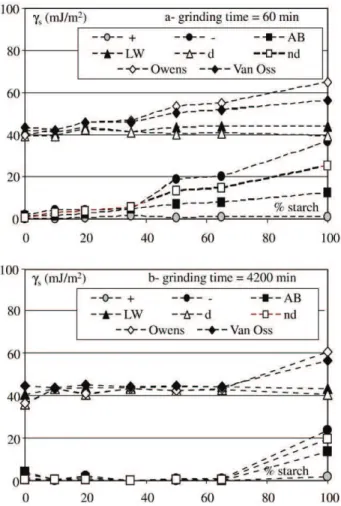
– Between 50 and 100 wt.% of starch, the energies do not evolve anymore because the lower starch ratio of this range already corresponds to a saturation of the pellets surface by the filler. When co-grinding is performed (see Fig. 10 where the same parameters are plotted vs. the starch percentage in the mixture for low and high co-grinding times), the same kind of evolution of the surface energies is observed: Liefshift-van der Waals and dispersive forces constant whatever the filler ratio; low values of the acid component of Van Oss' model; three parts in the curves, before 35%, between 35 and 50% and after 50% of starch which can be interpreted as previously. Nevertheless, the variation amplitude of the parameters of the two first curve parts is reduced as the grinding time increases. This can be attributed to the electron donor parameter of Van Oss' model or the non dispersive component of Owens' model, as it can be seen inFig. 11.
Indeed, they both decrease drastically when co-grinding is operated. Polystyrene particles are fragmented during the treatment on the contrary to those of starch. The proportion of the pellet surface occupied by the matrix (whose basic and non dispersive energies are very low compared to those of the filler) thus increases significantly with the co-grinding time, decreasing the mixture energies. Finally, interactions between carbonaceous groups of polystyrene and alcohol group of starch occurring during co-grinding may favour equilibrium
Fig. 8. Influence of the grinding time on the different surface energies of starch.
Fig. 9. Influence of the starch ratio on the surface energies of unground polystyrene/ starch blends.
in the electronic charges distribution. Obviously total energies evolve similarly, since they are functions of basic or non dispersive energies. 3.3. Water uptake and diffusion
3.3.1. Water uptake
The behaviour in water of the two products ground separately and co-ground for different times was characterised in order to study their resistance to water and degradability properties. The same grinding times as those for the characterization of the surface properties were retained.
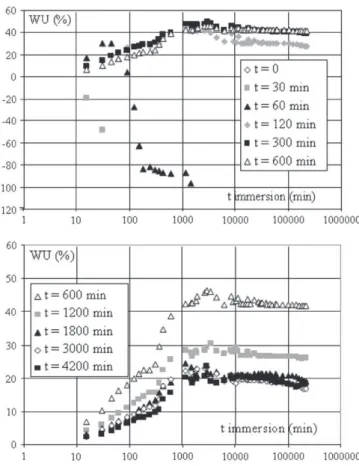
Figs. 12 and 13show the influence of the grinding and immersion times on the water uptake of starch and polystyrene respectively, when ground separately.
The chemical structure of a polymer influences its hydrophilic behaviour and consequently its water uptake[18]. This one is low for carbonaceous or fluorinated groups, medium for moderately polar groups (like esters or ethers) and high for groups which are hydrogen bonds donor (acid, alcohol or amide).
As for starch, no result can be presented for grinding times lower than 60 min because the pellets were rapidly disintegrated. The reason of this is the good affinity between starch and water, due to all the –OH groups of the molecule. The resistance to water of the pellets made up with starch ground for 120 and 300 min is better, probably because of a modification of the molecular chains and a better cohesion of the pellets, and WU reaches approximately 63% after 1000 min of immersion in water. After this time, it decreases. Angellier et al.[19]explained this decrease of WU by a partial release of starch in water. After 45 000 min of immersion (approximately a month), the consistency of the discs is modified since they swell and become
brown. The degradation of starch thus begins. Finally, a grinding time higher than 600 min has a negative effect on the water uptake of the pellets. They are progressively degraded and some particles tend to be removed from the surfaces, leading to negative values of the water uptake. An excessive degradation of the molecular chains by the balls may be at the origin of the problem.
Concerning polystyrene, since carbonaceous groups have little affinity with water, one can conclude that it absorbs very little water, as observed inFig. 13. Indeed, WU is lower than 1% for long immersion times. Moreover, long grinding times have a small negative effect on the water uptake, probably because the molecular chains of the
Fig. 10. Influence of the starch ratio on the surface energies of polystyrene/starch blends co-ground during: a – 60 min and b – 4200 min.
Fig. 11. Influence of the grinding time and the starch ratio on basic and non dispersive energies of co-ground mixtures.
Fig. 12. Water uptake of starch ground alone. –
polymer are cut under the effect of a prolonged treatment. Indeed, Molina–Boisseau and Le Bolay [20] showed that, when grinding polystyrene in an agitated bead mill or a vibrated bead mill, the polymer molecular weight does not evolve significantly as long as the particle size is reduced. As the limit size is reached, the molecular weight decreases drastically, in parallel to agglomeration phenomena. Mixture pellets were submitted to the same treatment. Two series of results are presented inFig. 14 and 15.Fig. 14corresponds to a mixture containing 10% of starch, whileFig. 15 corresponds to a mixture containing 35% of starch. Similar evolutions of the results as those ofFig. 15were obtained for 20, 50 and 65% of starch.
An addition of 10% of starch to the matrix leads to a great increase of the water uptake compared to polystyrene alone because of the affinity of starch with water. In the absence of co-grinding (t = 0), the curve is different from the others, undoubtedly because of a bad homogeneity of the mixture. When a co-grinding treatment is applied, the curves can be divided into three parts. For immersion times lower than 1000 min, WU increases with this parameter. A progressive diffusion of water in the pellets occurs, and the diffusion rate is all the more low as the co-grinding time is high because of a degradation of the molecular chains. Between 1000 and 100 000 min, the water uptake levels off, since equilibrium in water absorption is reached. Finally, after 100 000 min, a release of starch in water generates a decrease of WU.
For higher starch rates, a minimum co-grinding time is needed to avoid a rapid disintegration of the pellets. Indeed, pellets of blends produced by simple mixing of the two products (t = 0) disaggregate immediately (no curve is observed onFig. 15), because starch is not sufficiently dispersed and protected by the matrix. Pellets disaggre-gation is more progressive for 30 and 60 min of co-grinding. This has
been observed for all the filler rates greater than 20 and the higher the starch rate, the longer the co-grinding time needed to avoid pellet disintegration. If the co-grinding time is sufficient, the water uptake increases first with the immersion time and reaches then a plateau when the diffusion equilibrium is reached. The value of WU at equilibrium decreases with an increase of the co-grinding time because of a better protection of the filler by the matrix and a progressive cutting of the molecular chains, and increases with the starch rate because of the affinity between the filler and water. Finally, a release of starch in water leads to a small decrease of WU for long co-grinding times.
Since polystyrene has little affinity with water, the water uptake phenomena observed in this study can be attributed to the presence of starch but also to matrix–filler interactions. Furthermore, a simple blending of polystyrene and starch particles does not permit a good resistance of the pellets to water and a compatibilizer should be needed in this case. The implementation of co-grinding during an adapted time makes it possible to enhance the resistance of the composite to water without any compatibilizer.
3.3.2. Analysis of water diffusion in the pellets
When a hydrophilic polymer is immersed in water, the liquid molecules diffuse in the polymer, leading to a material swelling occurring more or less rapidly, depending on the polymeric chains relaxation. Above the glass transition temperature, the chains relaxation is rapid and water diffusion can occur into the polymer network, following the Fick's laws. Below the glass transition temperature, chains relaxation can be slow and one can observe deviations from Fickian behaviour. Alfrey et al.[21]proposed three models to describe the transport phenomena into glassy polymers:
– Diffusion is Fickian if the water diffusion rate is lower than the relaxation rate. The mechanism is controlled by diffusion.
Fig. 13. Water uptake of polystyrene ground alone.
Fig. 14. Water uptake of mixtures pellets containing 10% of starch.
– Water diffusion rate is higher than relaxation rate. The mechanism is controlled by relaxation.
– The two rates are comparable.
Friesch [22] has expressed the water diffusion mechanism according to the following equation:
mt−m
i
m∞−mi = kd t n
ð7Þ where miis the initial mass of the polymeric sample, mt, its mass at
immersion time t, m∞, its mass at equilibrium, n, the diffusional exponent and k, the system constant.
This equation is considered to be valid for (mt−mi) / (m∞−mi) b
0.6. The value of n depends on the diffusion mechanism. It is equal to 0.5 for Fickian diffusion, to 1 for a relaxation mechanism, and between 0.5 and 1 for the third case described above. Simplifying the second Fick's law, Crank[23]has expressed Eq.(7)as follows:
mt−mi m∞−mi =4 e ffiffiffiffi D π r ! ffiffi t p ð8Þ where e is the polymer sample thickness and D the diffusion coefficient.
Several authors[24–27] studied water diffusion in hydrophilic polymers using this equation, to determine the diffusion coefficient in their materials. We have tried to apply this model to our results for immersion times lower than 1000 min, i.e. for the increasing parts of the curves WU vs. immersion time.
The water uptake of polystyrene is so low that studying water diffusion in this hydrophobic material has no signification. It is thus impossible to determine a diffusion coefficient. As for the mixtures, in order to check if the mechanism of water penetration in the pellets is controlled by diffusion, we have plotted the variation of ln [(mt−mi) / (m∞−mi)] vs. the logarithm of the immersion time. Fig. 16shows the results obtained for mixtures containing 35% of starch. Similar evolutions were obtained with the other filler rates. The points are distributed on a straight line whose slope is equal to exponent n. Values of n where determined and are gathered inFig. 16 vs. the co-grinding time and for the various starch rates.
The values of n are relatively dispersed for the first co-grinding hours since they vary between 0.31 and 0.53. This dispersion undoubtedly results from a bad homogenisation of starch in the matrix and bad interactions between the two products. This is particularly remarkable for the two lowest filler rates, i.e. when the matrix is in majority and thus generates a barrier to water migration in the pellets, because of its lack of affinity with water. A better
dispersion of the filler in the matrix, obtained for longer co-grinding times or for a higher filler rate makes it possible to have an exponent closer to 0.5, value corresponding to a mechanism of water penetration controlled by diffusion. Thus, using Eq. (8), we have calculated the diffusion coefficient, D, for the different operating conditions (Fig. 17).
For the smaller filler rates (≤35%), the diffusion coefficient tends to decrease when the co-grinding time is increased, since the matrix protects the filler. On the contrary, the diffusion coefficient increases with the grinding time for high filler rates (≥50%) because starch is not well protected by the matrix. Finally, the diffusion coefficient increases with the filler rate since the barrier role of the matrix to water diffusion becomes less important.
It was not possible to realise the same work with the filler data for all the grinding times because of the disintegration of most of the pellets when immersed in water. However, we have teated the data obtained for 300 min of grinding and we have determined a diffusion coefficient equal to 1.1 ∙ 10−10m2/s, which is similar to the value obtained by Russo et al.[25]. The diffusion coefficient of the mixture is logically lower than that of starch since the hydrophobic matrix dereases the mixture coefficient.
The determination of the diffusion coefficient of the mixtures is based on the knowledge of the pellets mass at equilibrium, m∞, whose variation is presented inFig. 18.
The mass at equilibrium is all the more high as the filler rate is important since it is starch which presents an affinity with water. Moreover, one observes two phases in the curves evolution during
co-Fig. 16. Study of the water diffusion mechanism.
Fig. 17. Variation of the diffusion coefficient vs. the co-grinding time.
grinding. In the first moments, the mass at equilibrium increases, which can be attributed to the desagglomeration of the starch agglomerates initially present in the sample, which increases the interaction surface between the filler and water. Thereafter the mass at equilibrium decreases, i.e. when polystyrene particles are frag-mented thus increasing the hydrophobic material surface in contact with water.
4. Conclusions
A starch filler was introduced in a polystyrene matrix in order to modify its properties. A co-grinding process was used in this objective. A study of the evolution of the size and the morphology of the particles has permitted to explain the mechanism by which the composite material is produced.
The surface properties of the pure products and the composite were characterized. Starch is hydrophilic and its basic and non dispersive components of the surface energy are high, resulting of the presence of –OH groups. On the contrary, polystyrene is hydrophobic and its basic and non dispersive components are low. Co-grinding permits to reduce the energy components of starch which becomes less hydrophilic. Thus the interactions between filler and matrix are enhanced, what has a positive effect on the water-resistance of the co-ground composites compared to blends. Co-grinding permits to avoid the use of a compatibilizer to favour interactions between the two materials.
Nomenclature
D Diffusion coefficient m2/s d50 Mean size μm
e Polymer sample thickness m mi Initial pellet mass kg
mt Pellet mass at time t kg
m∞ Pellet mass at equilibrium kg n Diffusional exponent – t Grinding time s t immersion Immersion time s WU Water uptake % γ Surface energy mJ.m−2 ρ Liquid density kg.m−3
θ Contact angle between a liquid drop and the pellet surface ° μ Liquid viscosity Pa.s
Acknowledgment
The authors would like to thank Dr. Sonia Molina–Boisseau (CERMAV Grenoble) who provided the starch particles.
References
[1] C. Zapata-Massot, N. Le Bolay, Effect of the mineral filler on the surface properties of co-ground polymeric composites, Part. Part. Syst. Char. 24 (2007) 339–344. [2] C. Zapata-Massot, C. Frances, N. Le Bolay, On the use of scanning electron
microscopy for the modelling of co-grinding kinetics in a tumbling ball mill, Powder Technol. 143–144 (2004) 215–229.
[3] C. Zapata, N. Le Bolay, C. Frances, S. Molina-Boisseau, Production of small composite particles by co-grinding in a media mill – characterisation of the granulometric and the mechanical properties, Trans. IChemE, Part A, Chem. Eng. Res. Des. 82 (A5) (2004) 631–636.
[4] J. Pan, W.J.D. Shaw, Properties of a mechanically processed polymeric material, J. Appl. Polym. Sci. 52 (1994) 507–514.
[5] J. Pan, W.J.D. Shaw, Effects of processing parameters on material properties of mechanically processed polyamide, J. Appl. Polym. Sci. 56 (1995) 557–566. [6] A. Seyni, N. Le Bolay, S. Molina-Boisseau, On the interest of using degradable fillers
in co-ground composite materials, Powder Technol. 190 (2009) 176–184. [7] A.C. Albertsson, S. Karlsson, Degradable polymers of the future, Acta Polymer 46
(1995) 114–123.
[8] D. Danjaji, R. Nawang, U.S. Ishiaku, H. Ismail, Z.A.M. Ishak, Sago starch-filled linear low-density polyethylene (LLDPE) films: their mechanical properties and water absorption, J. Appl. Polym. Sci. 79 (2001) 29–37.
[9] S. Takagi, M. Koyama, H. Kameyama, Y. Tokiwa, Development of poly(ε-caprolactone)/gelatinized starch blends and their enzymatic degradation, in: Y. Doi, K. Fukuda (Eds.), Biodegradable plastics and polymers, Elsevier Science, Amsterdam, 1994, pp. 437–442.
[10] G.X. Zou, J.P. Qu, X.L. Zou, Optimization of water absorption of starch/PVA composites, Polym. Compos. 28 (2007) 674–679.
[11] H.P.S. Abdul Test, The effect of anhydride modification of sago starch on the tensile and water absorption properties of sago-filled linear low-density polyethylene (LLDPE), Polym.-Plast. Technol. Eng. 40 (2001) 249–263.
[12] K. Schönert, Size Reduction (Fundamentals) – Chap. 1. Ullmann's Encyclopedia of Industrial Chemistry, 1988, p. 5.1-5.14.
[13] T. Young, An essay on the cohesion of fluids, Philos. Trans. Roy. Soc. London 95 (1805) 65–87.
[14] F.M. Fowkes, Additivity of intermolecular forces at interfaces. I. Determination of the contribution to surface and interfacial tensions of dispersion forces in various liquids, J. Phys. Chem. 67 (1963) 2538–2541.
[15] D.K. Owens, R.C. Wendt, Estimation of the Surface Free Energy of Polymers, J. Appl. Polym. Sci. 13 (1969) 1741–1747.
[16] D.H. Kaelbe, Dispersion-Polar Surface Tension Properties of Organic Solids, J. Adhes. 2 (1970) 66–81.
[17] C.J. Van Oss, M.K. Chaudhury, R.J. Good, Interfacial Lifshitz-Van der Waals and polar interactions in macroscopic systems, Chem. Rev. 88 (1988) 927–941. [18] J. Verdu, Action de l'eau sur les plastiques, Tech. 'ingénieur, AM 3165 (2000) 1–8. [19] H. Angelier, S. Molina-Boisseau, L. Lebrun, A. Dufresne, Processing and structural properties of waxy maize starch nanocrystals reinforced natural rubber, Macromolecules 38 (2005) 3783–3792.
[20] S. Molina-Boisseau, N. Le Bolay, Characterisation of the physico-chemical properties of polymers ground in a vibrated bead mill, Powder Technol. 128 (2002) 99–106.
[21] T. Alfrey, E.F. Gurnee, W.G. Lloyd, Diffusion in glassy polymers, J. Polym. Sci., Part C 12 (1966) 249–261.
[22] H.L. Friesch, Sorption and transport in glassy polymers–a review, Pol. Eng. Sci. 20 (1980) 2–13.
[23] J. Crank, Mathematics of diffusion, 2nd ed.Oxford University Press, New York, 1975 45–50.
[24] N. Peppas, J. Sinclair, Anomalous transport of penetrants glassy polymers, Colloid Polym. Sci. 261 (1983) 404–408.
[25] M.A.L. Russo, E. Strounina, M. Waret, T. Nicholson, R. Truss, P.J. Halley, A study of water diffusion into a high-amylose starch blend: the effect of moisture content and temperature, Biomacromolecules 8 (2007) 296–301.
[26] C.Y. Tang, D.Z. Chen, T.M. Yue, K.C. Chan, C.P. Tsui, P.H.F. Yu, Water absorption and solubility of PHBHV/HA nanocomposites, Compos. Sci. Technol. 68 (2008) 1927–1934.
[27] X. Yu, A.R. Schmidt, L.A.B. Perez, J.S. Schmidt, Determination of the bulk moisture diffusion coefficient for corn starch using an automated water sorption instrument, J. Agric. Food Chem. 56 (2008) 50–58.