an author's https://oatao.univ-toulouse.fr/21359
http://dx.doi.org/10.5220/0005760301260133
De Rezende, Leiliane Pereira and Julia, Stéphane and Cardoso, Janette Possibilistic WorkFlow nets for dealing with cancellation regions in business processes. (2016) In: 18th International Conference on Enterprise Information Systems (ICEIS 2016), 25 April 2016 - 28 April 2016 (Roma, Italy).
Leiliane Pereira de Rezende
1,2, St´ephane Julia
1and Janette Cardoso
21Computing Faculty, Federal University of Uberlˆandia - UFU, Uberlˆandia - MG, Brazil 2DMIA Department, Institut Sup´erieur de l’A´eronautique et de l’Espace - ISAE, Toulouse, France
Keywords: WorkFlow Net, Possibilistic Petri Net, Cancellation Features, Reset Arcs, Process Monitoring.
Abstract: In this paper, an approach based on WorkFlow nets and possibilistic Petri nets is proposed for dealing with the cancellation features in business processes. Routing patterns existing in business processes are modeled by WorkFlow nets. Possibilistic Petri nets with uncertainty in the marking and the transition firing are used to deal with all possible markings when cancellation behaviour is considered. Combining both formalisms, a kind of possibilistic WorkFlow net is obtained. An example of a simplified version of a credit card application process is presented.
1 INTRODUCTION
Organizations are increasingly using Workflow Man-agement Systems (WFMS) to reduce costs and im-prove the performance and efficiency of important business processes (BP). BP represent the sequences of activities that have to be executed within an organi-zation to treat specific cases and to reach well defined goals (van der Aalst and van Hee, 2004). In the field of systems engineering, modeling plays a key role for understanding and controlling the behavior of the cor-responding systems. WFMS are used for the model-ing, analysis, enactment, and coordination of struc-tured BP by groups of people (van der Aalst, 2000). A workflow process corresponds to the automation of a business process, in whole or part, during which documents, information or activities are passed from one participant to another for a particular form of ac-tion, according to a set of procedural rules (Members, 1994).
Many researchers, such as (van der Aalst, 1998) (van der Aalst and van Hee, 2004) (Soares Passos and Julia, 2009), have indicated the Petri net theory as an efficient tool for the modeling and analysis of WFMS’s. In particular, an acyclic Petri net model used to represent a BP, the so-called WorkFlow nets (WF-nets), was proposed in (van der Aalst and van Hee, 2004). When considering the WF-nets, the main
property that has to be proven to guarantee the cor-rectness notion of the process model is the soundness property (van der Aalst and van Hee, 2004).
An important concept in WFMS is cancellation when the execution of some activities may lead to the termination of other activities in certain circum-stances (van der Aalst et al., 2003). Cancellation can be triggered by either a customer request (e.g., a cus-tomer wishes to cancel a purchase) or by exceptions (e.g., an order cannot be processed due to insufficient information). In general, cancellation results in one of two outcomes: disabling some scheduled activities or stopping currently running activities (Wynn et al., 2009).
In order to model cancellation in a process model, reset nets were proposed. They are Petri nets extended with special arcs (reset arcs) that can clear the tokens in selected places, i.e., everything is removed from these places for a particular instance (Dufourd et al., 1998). Reset nets have a natural application in busi-ness process modeling, where possible cancellation of activities needs to be modeled explicitly, and in WFMS where such process models with cancellation behaviors have to be enacted correctly (Wynn et al., 2009).
The reset nets are apparently an innocent exten-sion of Petri nets but they have rather dramatic con-sequences. Simple questions such as reachability be-come undecidable for reset nets with more than two reset arcs (Araki and Kasami, 1976) (Dufourd et al., 1998) (Dufourd et al., 1999) (Hofstede et al., 2010).
The first author received CAPES S cholarship - P roc. n◦.
99999.001925/2015-06.
Rezende, L., Julia, S. and Cardoso, J.
Consequently, the soundness property is also unde-cidable for reset WF-net as proven in (van der Aalst et al., 2009). This shows that, although cancellation regions form a very useful modeling construct, in-creasing the expressive power of Petri nets, they com-plicate to a certain extent the process of verification of workflow models (Verbeek et al., 2007). Considering this, Wynn et al., in (Wynn et al., 2009), proposed a set of reduction rules for workflow nets with reset nets to facilitate the verification of workflow models. The inspiration for such rules came from earlier reduction rules for Petri nets without reset arcs. Typically, a reduction rule will decrease the number of elements under consideration by removing certain transitions and/or places in the net while preserving some inter-esting properties (Verbeek et al., 2010). However, a reset arc can never be abstracted entirely from a re-set net. That is, if a net contains rere-set arcs, it is not possible to obtain a reduced net without any reset arc (Wynn et al., 2009). In addition, model translations normally introduce lots of “dummy” transitions that do not correspond to real events.
Note that it is far from trivial to express the de-sired behavior without reset arcs given that, to re-move them, all possible markings should be consid-ered, making the process model completely unread-able and intractunread-able (van der Aalst et al., 2009). Tak-ing this into account, an approach based on WF-nets and on possibilistic Petri nets is proposed to deal with all possible markings when the reset arcs are disre-garded through the use of pseudo-firings. In particu-lar, a kind of possibilistic WorkFlow net will be de-fined to consider, even without being explicitly enu-merated, all the possible cancellation situations dur-ing real time execution of the process model. In ad-dition, such an approach will preserve the decidabil-ity of the good properties of the model, such as the soundness property, given that the reset arcs are not consider in the process model.
The remainder of this paper is as follow: in section 2, the definition of WF-nets and soundness property are provided. In section 3, an overview of possibilis-tic Petri nets is given. In section 4, the possibilispossibilis-tic WorkFlow net is presented and a simplified version of a credit card application process illustrates the ap-proach. Finally, section 5 concludes this work with a short summary, an assessment based on the approach presented and an outlook on future work proposals.
2 WORKFLOW NET
A Petri net that models a workflow process is called a WorkFlow net (WF-net) (van der Aalst and van Hee,
2004). A WF-net needs to possess the following prop-erties (van der Aalst, 1998):
• It has only one source place, named Start and only one sink place, named End. These are special places, such that the place Start has only outgoing arcs and the place End has only incoming arcs. • A token in Start represents a case that needs to be
handled and a token in End represents a case that has been handled.
• Every activity t (transition) and condition p (place) should be on a path from place Start to place End.
As previously mentioned, an activity can be asso-ciated to a transition in a WF-net. However, in or-der to explicitly indicate the beginning and the end of each activity in execution, two sequential transitions plus a place to model an activity is used. The first transition represents the beginning of the activity, the place the activity, and the second transition represents the end of the activity (Wang et al., 2009).
Figure 1: WorkFlow net model of an activity.
As shown in figure 1, transition B represents the beginning of an activity execution; E represents the end of the activity execution. Place A1represents the
activity in execution. From a reachability analysis perspective, figure 1 can be reduced to a single transi-tion, which represents the entire activity execution as a single logic unit.
Soundness is a correctness criterion defined for WF-nets and is related to its dynamics. A WF-net is sound if, and only if, the following three requirements are satisfied (van der Aalst and van Hee, 2004):
• For each token put in the place Start, one and only one token appears in the place End.
• When the token appears in the place End, all the other places are empty for this case.
• For each transition (activity), it is possible to move from the initial state to a state in which that transition is enabled, i.e. there are no dead transi-tions.
A method for the qualitative analysis of WF-nets (soundness verification) based on the proof trees of linear logic is presented in (Soares Passos and Julia, 2009) and another based on a reachability graph is presented in (van der Aalst et al., 2011).
3 POSSIBILISTIC PETRI NET
Possibilistic Petri nets are derived from Object Petri nets (Sibertin-Blanc, 2001). As characterized in the approach presented in (Cardoso, 1999), a possibilis-tic Petri net is a model where a marked place corre-sponds to a possible partial state, a transition to a pos-sible state change, and a firing sequence to a pospos-sible behavior. The main advantage in working with pos-sibilistic Petri nets is that they allow for the updating of a system state at a supervisory level with ill-known information without necessarily reaching inconsistent states.A possibilistic Petri net model associates a possi-bility distributionΠo(p) to the location of an object o,
p being a place of the net. Πo(p) = 1 represents the
fact that p is a possible location of o, andΠo(p) = 0
expresses the certainty that o is not present in place p. Conventionally, a marking in a possibilistic Petri net is then a mapping:
M : O × P −→ {0,1}
where O is a set of objects and P a set of places. If M(o, p) = 1, there exists a possibility of there being the object o in place p. On the contrary, if M(o, p) = 0, there exists no possibility of there being o in p. A marking M of the net allows one to represent:
• A certain marking: each token is located in only one place (well-known state). Then M(o, p) = 1 and ∀pi6= p,M(o, pi) =0.
• An uncertain marking: each token location has a possibility distribution over a set of places. It can-not be asserted that a token is in a given place, but only that it is in a place among a given set of places. For example, if there exists a possi-bility at a certain time of having the same ob-ject o in two different places, p1 and p2, then
M(o, p1) =M(o, p2) =1.
A possibilistic marking will correspond in practice to knowledge concerning a situation at a given time.
In a possibilistic Petri net, the firing (certain or uncertain) of a transition t is decomposed into two steps:
• Beginning of a firing: objects are put into out-put places of t but are not removed from its inout-put places.
• End of a firing: that can be a firing cancellation (tokens are removed from the output places of t) or a firing achievement (tokens are removed from the input places of t).
A certain firing consists of a beginning of a firing and an immediate firing achievement. An uncertain
firing (or a pseudo-firing) that will increase the un-certainty of the marking can be considered only as the beginning of a firing (there is no information to confirm whether the normal event associated with the transition has actually occurred or not). To a certain extent, pseudo-firing is a way of realizing forward de-duction.
The interpretation of a possibilistic Petri net is de-fined by attaching to each transition an authorization functionηx1,...,xn defined as follows:
ηx1,...,xn: T −→ {False,Uncertain,True}
where x1, ...,xnare the variables associated with the
incoming arcs of transition t (when considering the underlying Object Petri net).
If o1, ...,onis a possible substitution for x1, ...,xn
for the firing of t, then several situations can be con-sidered:
• t is not enabled by the marking but the associated interpretation is true; an inconsistent situation oc-curs and a special treatment process of the net is activated;
• t is enabled by a certain marking and the inter-pretation is true; then a classical firing (with cer-tainty) of an object Petri net occurs;
• t is enabled by a certain marking and the interpre-tation is uncertain; then the transition is pseudo-fired and the imprecision is increased;
• t is enabled by an uncertain marking; if the inter-pretation is uncertain, t is pseudo-fired;
• t is enabled by an uncertain marking and the inter-pretation is true: a recovery algorithm, presented in (Cardoso et al., 1989), is called and a new com-putation of the possibility distribution of the ob-jects involved in the uncertain marking is realized in order to go back to a certain marking.
Concepts concerning possibilistic Petri nets will be illustrated through a practical example in section 4.
4 POSSIBILISTIC WORKFLOW
NET FOR CANCELLATION
As pointed out in the introduction, cancellation is an important concept in WFMS’s, which captures the in-terference of an activity in the execution of others in certain circumstances. In order to elaborate such a concept, in (Dufourd et al., 1998), reset arcs were in-troduced into the process model, thus allowing for an increase to its expressive power and to cancel the ex-ecution of the activities that belong to cancellation re-gion. However, reachability and, consequently, thesoundness property are undecidable for Petri nets (or WF-nets) with reset arcs.
To consider the concept of cancellation, such that the reachability and soundness property continue de-cidable, a model of the process based on WF-nets and on possibilistic Petri nets is proposed. Such a model, through the use of pseudo-firings, will then be able to deal with several markings that must be considered when the reset arcs are not considered.
The notions of cancellation activity and cancel-lation case can be generalized to the notion of the cancellation region, whereby an arbitrary region of a workflow specification can be subjected to a cancel-lation action (Wynn, 2006). In the model proposed in this paper, if an activity belongs to a cancellation region, its beginning and end transition will have a certain and uncertain interpretation attached to each. However, if an activity does not belong to a cancella-tion region, its beginning and end transicancella-tion will only have a certain interpretation attached to each. The cer-tain interpretation is related to the beginning and end conditions of an activity and the uncertain interpreta-tion to a cancellainterpreta-tion event. Note that if the process model has more than one cancellation region, the un-certain interpretation will be a disjunction of the can-cellation events related to each region.
To illustrate the approach, a simplified version of a credit card application process, presented in (Wynn et al., 2009), will be used. The process starts when an applicant submits a credit card application (with the proposed amount). Upon receiving an application (ra), a credit clerk checks whether the submitted ap-plication is complete (cc). If not, the clerk requests additional information from the applicant (rmi) and waits (WT) until this information is received (ri) be-fore proceeding. At the same time, a timer is set (to) so that if a certain period elapses before requested in-formation is received, another request for inin-formation is sent again. For a complete application, the clerk first checks the requested loan amount (cla). It is then followed by additional checks to validate the appli-cants income and credit history. Different checks are performed depending on whether the requested loan is large (pcl) or small (pcs). The validated application is then passed on to a manager to make a decision (md). In the case of an acceptance, the credit card approval activity can start (sa). The applicant is notified of the decision (na) and, at the same time, he/she is asked for his/her preference on any extra features (wef). The applicant can choose extra features such as rewards program or secondary cardholders (cf) before a credit card is produced and delivered (dcc). This indicates the completion of the approval activity (ca) and the process ends. For a rejected application, the applicant
is notified of the rejection (nr) and the process ends. An interesting feature of this process is that an ap-plicant can request to cancel an ongoing application (ON) at any time after it was received (ra) and before the manager makes a decision (md), i.e., the activities cc, rmi, ri, to, cla, pcs and pcl belong to a cancel-lation region and the activity pcr is responsible for capturing the withdrawal of an ongoing application.
The possibilistic WF-net with objects in Figure 2(a) depicts the credit card application process. The symbol < c > is an object belonging to the class “Credit”, as well as variables x and y, and all the model’s places. Each transition has an interpretation and an action attached to it defined by the designer. The interpretation is used to manage the occurrence of each event in the system by imposing restrictions on the firing of transitions. An action is an applica-tion that involves some specific methods applied on the attributes of the formal variables associated with the incoming arcs, allowing for the modification of some specific attributes of the object < c >. How-ever, in the process model presented in this article, the actions will not be described given that they do not interfere in the understanding of the approach.
Knowing that the activities cc, rmi, ri, to, cla, pcs and pcl belong to a cancellation region, their begin-ning and end transitions will have a certain and uncer-tain interpretation attached to each of them. All the other activities (ra, pcr, md, nr, sa, na, we f , dcc, c f and ca) will have only a certain interpretation. Table 1 shows the authorization functions (η) for each tran-sition belonging to the possibilistic WF-net shown in Figure 2(a). The certain and uncertain interpretations attached to each transition by the authorization func-tion are respectively represented by the columns with the subscription “true if ” and “uncertain if ”. The false interpretation is not represented in Table 1, but it is evaluated as true when the certain and uncertain in-terpretations are evaluated as false at the same time or, otherwise, it is evaluated as false. Finally, if a transi-tion does not have an uncertain interpretatransi-tion attached to it, the space concerning the uncertain interpretation in Table 1 is empty.
The conditions used in the interpretation of the transitions correspond to the following interpreta-tions:
• “begRA”, “begCC”, “begRMI”, “begRI”,
“begTO”, “begCLA”, “begPCS”, “begPCL”,
“begMD”, “begNR”, “begSA”, “begNA”,
“begW EF”, “begDCC”, “begCF” and “begCA” represent, respectively, the beginning of the execution of the activities ra, cc, rmi, ri, to, cla, pcs, pcl, md, nr, sa, na, we f , dcc, c f and ca;
• “endRA”, “endCC”, “endRMI”, “endRI”,
(a) Credit card application process
modeled by a possibilistic WF-net. (b) The uncertain marking obtainedafter the pseudo-firing of B.ri and B.to.
(c) The uncertain marking obtained after the pseudo-firing of the transi-tions.
Figure 2.
“endTO”, “endCLA”, “endPCS”, “endPCL”,
“endMD”, “endNR”, “endSA”, “endNA”,
“endW EF”, “endDCC”, “endCF” and “endCA” represent, respectively, the end of the execution of the activities ra, pcr, cc, rmi, ri, to, cla, pcs,
pcl, md, nr, sa, na, we f , dcc, c f and ca;
• “cancel” represents the request of an applicant to cancel an ongoing application.
Fig-Table 1: Authorization functions of the transitions. true if uncertain if ηx(B.ra) = x.begRA ηx(E.ra) = x.endRA ηx(B.pcr) = cancel ηxy(E.pcr) = cancel
ηx(B.cc) = x.begCC ∧ ¬cancel cancel
ηx(E.cc) = x.endCC ∧ ¬cancel cancel
ηx(B.rmi1) = x.begRMI ∧ ¬cancel cancel
ηx(B.rmi2) = x.begRMI ∧ ¬cancel cancel
ηx(E.rmi) = x.endRMI ∧ ¬cancel cancel
ηx(B.ri) = x.begRI ∧ ¬cancel cancel
ηx(E.ri) = x.endRI ∧ ¬cancel cancel
ηx(B.to) = x.begTO ∧ ¬cancel cancel
ηx(E.to) = x.endTO ∧ ¬cancel cancel
ηx(B.cla) = x.begCLA ∧ ¬cancel cancel
ηx(E.cla) = x.endCLA ∧ ¬cancel cancel
ηx(B.pcs) = x.begPCS ∧ ¬cancel cancel
ηx(E.pcs) = x.endPCS ∧ ¬cancel cancel
ηx(B.pcl) = x.begPCL ∧ ¬cancel cancel
ηx(E.pcl) = x.endPCL ∧ ¬cancel cancel
ηxy(B.md) = x.begMD ∧ ¬cancel ηx(E.md) = x.endMD ηx(B.nr) = x.begNR ηx(E.nr) = x.endNR ηx(B.sa) = x.begSA ηx(E.sa) = x.endSA ηx(B.na) = x.begNA ηx(E.na) = x.endNA ηx(B.we f ) = x.begW EF ηx(E.we f ) = x.endW EF ηx(B.dcc1) = x.begDCC ηx(B.dcc2) = x.begDCC ηx(E.dcc) = x.endDCC ηx(B.c f ) = x.begCF ηx(E.c f ) = x.endCF ηxy(B.ca) = x.begCA ηx(E.ca) = x.endCA
ure 2(a), an object in the place md indicates that the application was validated and passed on to a manager to make a decision, thus disabling any request on the part of the applicant to cancel it. However, an object in the place pcr indicates that the application received a request for withdrawal and, consequently, all activ-ities that belong to the cancellation region must be stopped if they are currently executing or disabled if they are scheduled.
If the applicant does not request the cancellation of the application, all the transition firings will be cer-tain and all the markings will be precise. However, if the applicant makes a request for cancellation, some pseudo-firing will have to occur until that the transi-tion E.pcr is enabled by a uncertain marking and the process can be canceled correctly.
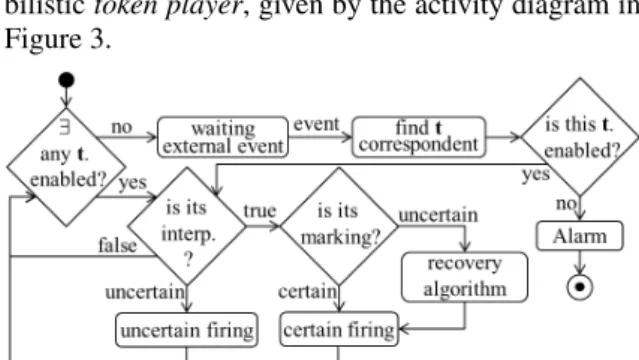
The general behavior of a WFMS based on pos-sibilistic WF-net models will be based on the
possi-bilistic token player, given by the activity diagram in Figure 3.
Figure 3: Possibilistic token player algorithm.
To illustrate a possible cancellation request, let us assume that the activities ra, cc and rmi have already been executed, i.e., the transitions B.ra, E.ra, B.cc, E.cc, B.rmi and E.rmi have already been fired with certainty. If the applicant requests the cancellation of the application, i.e., the condition “cancel” is true, the following scenario will occur:
• the transition B.pcr is enabled by a certain mak-ing and its interpretation is true (η<c>(B.pcr) =
true). Then, B.pcr is fired with certainty, i.e. the object < c > is removed from the place ON, a new object < c > is produced in the place pcr and the actions associated to the transition (when they ex-ist) are executed;
• the authorization functions (η<c>) attached to
transitions B.cc, E.cc, B.cla, E.cla, B.pcs, E.pcs, B.pcl, E.pcl, B.rmi1, E.rmi, B.ri, E.ri, B.to, E.to and B.rmi2 are all evaluated as uncertain. How-ever, only the transitions B.ri and B.to can be pseudo-fired as they are the only ones enabled by the object < c >. Then, both B.ri and B.to are pseudo-fired and, consequently, copies of the ob-ject < c > are produced in the places ri and to, respectively. Note that the object < c > is not removed from the place W T (uncertain marking) (Figure 2(b));
• considering the new marking, the transitions E.ri and E.to are enabled by an uncertain marking and the interpretation attached to them is uncertain (η<c>(E.ri) =η<c>(E.to) = uncertain). Then,
they are pseudo-fired and copies of the object <c > are produced in the places w1and w3,
re-spectively;
• considering the evolution of the marking, the following transitions B.cc, B.rmi2, E.cc, B.cla, E.cla, B.pcs, B.pcl and E.pcs will be pseudo-fired given that the interpretation attached to them is uncertain, therefore, they will be enabled by an uncertain marking. Consequently, copies of the object < c > will be produced in the places cc, rmi, w2, cla, w4, pcs, pcl and w5, respectively; Possibilistic WorkFlow Nets for Dealing with Cancellation Regions in Business Processes
• the transitions B.rmi1, E.rmi and E.pcl are enabled by an uncertain marking and the interpretation attached to them is uncertain (η<c>(B.rmi1) =η<c>(E.rmi) =η<c>(E.pcl) =
uncertain). However, such transitions cannot be fired due to the existence of the object < c > in their output places (rmi, W T and w5,
respec-tively) which, through their definition, prohibit the pseudo-firing as explained in (Cardoso et al., 1989);
• the actual marking of the process model is shown in Figure 2(c). For this marking, the transi-tion E.pcr is enabled by an uncertain mark-ing and the interpretation attached to it is true (η<cc>(E.pcr) = true). This situation occurs
because the applicant requested the cancellation of the application and all activities between ra and md must be canceled or disabled. Conse-quently, to go back to the certain marking, the recovery algorithm, presented in (Cardoso et al., 1989), is called. Such an algorithm will achieve the pseudo-firing of the transitions E.pcs, B.pcs, E.cla, B.cla, E.cc, B.cc, E.ri and B.ri and can-cel the pseudo-firing of the transitions B.pcl, B.to, E.to and B.rmi2. After the execution of the recov-ery algorithm, the transition E.pcr can be fired with certainty given that it is enabled by a cer-tain marking and its interpretation is true. There-fore, allowing for the execution of the actions at-tached to it and thus, finalize the cancellation re-quest and the workflow process (only the place end is marked at the end of the cancellation). Note that no action attached to a transition pseudo-fired is executed, even if its firing is achieved.
through of the use of pseudo-firing, which give a de-scription of a set of possible markings that are all reachable markings of the underlying WF-net. Such an approach was applied to an example of a simplified version of a credit card application process.
Other studies that deal with the problem of cancel-lation use reset arcs in the process model. Such arcs have as a consequence the loss of decidability over some important structural properties, such as reacha-bility. To avoid this loss, other works proposed tech-niques for reducing the size of the net and conse-quently the quantity of reset arcs. However, a reset arc can never be abstracted entirely from a reset net, consequently, the structural properties continue being undecidable. In addition, lots of “dummy” transitions that do not correspond to real events can be introduced to the process model. Comparing these studies with the approach presented in this paper, the main advan-tage is that, as the reset arcs are not used in the process model, the decidability of the structural properties of the model, such as soundness property, are guaran-teed. Furthermore, all the scenarios that correspond to a cancellation situation are considered during the real time execution, even without being explicitly enumer-ating in the process model.
As a future work proposal, the quality of this ap-proach should be explicitly validated through a kind of experimental approach that allows for the program-ming of transition pseudo firing. It would seem that the CPN Tools software resources (Beaudouin-Lafon et al., 2001), developed by the computing science group of Aarhus University in Denmark, allows in particular for the use of complex function calculus as-sociated with the model’s arcs. This should be able to program in a simple way some of the basic behaviors of a possibilistic token player implementing cancel-lation scenarios. In addition, it will be interesting to model and test a larger business process with more than one cancellation region.
ACKNOWLEDGEMENTS
The authors would like to thank Coordenac¸˜ao de Aperfeic¸oamento de Pessoal de N´ıvel Superior (CAPES), Fundac¸˜ao de Amparo a Pesquisa do Estado de Minas Gerais (FAPEMIG) and Conselho Nacional de Desenvolvimento Cient´ıfico e Tecnol´ogico (CNPq) for financial support.
Through the use of pseudo-firings, a fi ring se-quence is defined, w hich w ill t ransform t he mark-ing until the object < c > is localized in the place w5. Then, the process can be finalized with success
through the certain firing of the transition E .pcr af-ter the execution of the recovery algorithm. The ex-istence of this firing s equence i s g uaranteed b y the soundness property, which ensures that there does not exist dead transitions in this WF-net.
5 CONCLUSIONS
In this article, a possibilistic WorkFlow net model was presented with the purpose of dealing with cancella-tion features in business processes. Combining the routing structure of WF-nets and uncertain reasoning of possibilistic Petri nets, the authors presented an approach that is able to treat the cancellation events
REFERENCES
Araki, T. and Kasami, T. (1976). Some decision problems related to the reachability problem for petri nets. The-oretical Computer Science, 3:85 – 104.
Beaudouin-Lafon, M., Mackay, W., Jensen, M., Andersen, P., Janecek, P., Lassen, M., Lund, K., Mortensen, K., Munck, S., Ratzer, A., Ravn, K., Christensen, S., and Jensen, K. (2001). Cpn/tools: A tool for editing and simulating coloured petri nets etaps tool demonstra-tion related to tacas. In Tools and Algorithms for the Construction and Analysis of Systems, volume 2031, pages 574–577. Springer Berlin Heidelberg.
Cardoso, J. (1999). Time fuzzy petri nets. In Fuzziness in Petri Nets, pages 115 – 145. Springer.
Cardoso, J., Valette, R., and Dubois, D. (1989). Petri nets with uncertain markings. In Applications and Theory of Petri Nets, volume 483, pages 64 – 78.
Dufourd, C., Finkel, A., and Schnoebelen, P. (1998). Reset nets between decidability and undecidability. In Pro-ceedings of the 25th International Colloquium on Au-tomata, Languages and Programming, volume 1443, pages 103–115.
Dufourd, C., Janˇcar, P., and Schnoebelen, P. (1999). Bound-edness of reset p/t nets. In International Colloquium on Automata, Languages and Programming, volume 1644, pages 301–310.
Hofstede, A. H. M. t., van der Aalst, W. M. P., Adams, M., and Russell, N., editors (2010). Modern Business Pro-cess Automation - YAWL and its Support Environment. Springer Science & Business Media.
Members, W. M. C. (1994). Glossary – a workflow manage-ment coalition specification. Technical report, Coali-tion, Workflow Management.
Sibertin-Blanc, C. (2001). Cooperative objects: Princi-ples, use and implementation. In Concurrent Object-Oriented Programming and Petri Nets, volume 2001, pages 216–246.
Soares Passos, L. and Julia, S. (2009). Qualitative analysis of workflow nets using linear logic: Soundness verifi-cation. In Systems, Man and Cybernetics, 2009. SMC 2009. IEEE International Conference on, pages 2843 –2847.
van der Aalst, W. M. P. (1998). The application of petri nets to workflow management. Journal of Circuits Systems and Computers, 8:21–66.
van der Aalst, W. M. P. (2000). Workflow verification: Finding control-flow errors using petri-net-based tech-niques. In Business Process Management, Models, Techniques, and Empirical Studies, pages 161–183. van der Aalst, W. M. P., Hofstede, A. H. M. t.,
Kie-puszewski, B., and Barros, A. P. (2003). Workflow patterns. Distrib. Parallel Databases, 14:5–51. van der Aalst, W. M. P. and van Hee, K. (2004). Workflow
Management: Models, Methods, and Systems. MIT Press.
van der Aalst, W. M. P., van Hee, K., Hofstede, A. H. M. t., Sidorova, N., Verbeek, H., Voorhoeve, M., and Wynn, M. (2009). Soundness of workflow nets with reset
arcs. In Transactions on Petri Nets and Other Mod-els of Concurrency III, volume 5800, pages 50–70. van der Aalst, W. M. P., van Hee, K. M., Hofstede, A. H.
M. t., Sidorova, N., Verbeek, H. M. W., Voorhoeve, M., and Wynn, M. T. (2011). Soundness of workflow nets: Classification, decidability, and analysis. Form. Asp. Comput., 23:333–363.
Verbeek, H., van der Aalst, W. M. P., and Hofstede, A. H. M. t. (2007). Verifying workflows with cancella-tion regions and or-joins: An approach based on re-laxed soundness and invariants. The Computer Jour-nal, 50:294–314.
Verbeek, H., Wynn, M., van der Aalst, W. M. P., and Hof-stede, A. H. M. t. (2010). Reduction rules for re-set/inhibitor nets. Journal of Computer and System Sciences, 76:125 – 143.
Wang, J., Tepfenhart, W. M., and Rosca, D. (2009). Emer-gency response workflow resource requirements mod-eling and analysis. IEEE Transactions on SMC, Part C, 39:270–283.
Wynn, M., Verbeek, H., van der Aalst, W. M. P., Hofst-ede, A. H. M. t., and Edmond, D. (2009). Soundness-preserving reduction rules for reset workflow nets. In-formation Sciences, 179:769–790.
Wynn, M. T. K. (2006). Semantics, Verification, and Im-plementation of Workflows with Cancellation Regions and OR-joins. PhD thesis, Queensland University of Technology.