Science Arts & Métiers (SAM)
is an open access repository that collects the work of Arts et Métiers Institute of
Technology researchers and makes it freely available over the web where possible.
This is an author-deposited version published in:
https://sam.ensam.eu
Handle ID: .
http://hdl.handle.net/10985/13976
To cite this version :
Pablo FIGUEROA, Tiberio HERNANDEZ, Frédéric MERIENNE, Jean-Rémy CHARDONNET,
José Luis DORADO, J. Sebastian LOPEZ - Heterogeneous, distributed mixed reality Applications.
A concept - In: 2018 IEEE Conference on Virtual Reality and 3D User Interfaces, Allemagne,
2018-03-18 - IEEE VR - 2018
Any correspondence concerning this service should be sent to the repository
Administrator :
[email protected]
Heterogeneous, Distributed Mixed Reality Applications. A Concept
Pablo Figueroa* Universidad de los Andes, Colombia
Jos ´e Tiberio Hern ´andez† Universidad de los Andes, Colombia
Fr ´ed ´eric Merienne‡
LISPEN, Arts et M ´etiers, UBFC, HESAM, Institut Image, France
Jean-R ´emy Chardonnet§
LISPEN, Arts et M ´etiers, UBFC, HESAM, Institut Image, France
Jos ´e Dorado¶ Universidad de los Andes, Colombia
J. Sebasti ´an Lopez|| Universidad de los Andes, Colombia
ABSTRACT
This poster formulates the concept of heterogeneous distributed mixed reality (HDMR) applications in order to state some interest-ing research questions in this domain. HDMR applications give synchronous access to shared virtual worlds, from diverse mixed reality (MR) hardware, and at similar levels of functionality. We show the relationship between HDMR and previous concepts, state challenges in their development, and illustrate this concept and its challenges with an example.
Index Terms: Software and its engineering—Software organiza-tion and properties—Contextual software domains—Virtual worlds softwareInteractive games; Human-centered computing—Human computer interaction (HCI)—Interaction paradigms—Mixed / aug-mented reality
1 INTRODUCTION
We define the concept of heterogeneous distributed mixed reality (HDMR), a computer–mediated reality that can be accessed from different types of MR devices at similar levels of performance, de-spite the differences among devices. Heterogeneity is important due to the current explosion of MR devices in the market.
HDMR relates to several concepts and extends on them. It is a particular type of networked virtual environment [11], in which all clients perform the same set of tasks but from a different set of devices. In fact, even early distributed systems for military appli-cations such as [1] could have components of an HDMR, but the analysis at that time was concentrated on the technical issues of a real–time simulation and on clients with different sets of tasks. Current technology has solved many technical issues, and we want to concentrate our research in the issues that arise when we expose users to the same set of tasks through a different set of devices.
HDMRs can also be seen as a subset of Collaborative Virtual Environments (CVEs). In this field, interest has been concentrated on applications such as collaborative scientific visualization [6], asymmetric ways to collaborate in heterogeneous hardware plat-forms [3], or communication and awareness issues [9]. HDMRs are also collaborative applications, and they also deal with communica-tion and awareness issues. However, HDMRs restrict interaccommunica-tion to symmetric schemes, where all users are able to execute the same set of tasks, since these restriction allow users to perform any task from any hardware setup and involve interesting challenges.
*Member IEEE, e-mail: [email protected] †e-mail:[email protected]
‡e-mail:[email protected]
§Member IEEE, e-mail:[email protected] ¶e-mail: [email protected]
||e-mail: [email protected]
Portability promised to ease development for various hardware platforms with the use of several programming languages [2]. Al-though it can facilitate the development of HDMRs, it is not a guar-antee that affordances of different devices are taken into account.
Retargeting [4] is a technique that allows replacing devices and interaction techniques at a high level, dataflow based language, and reflect such changes in particular implementations. With this concept, it is possible to create families of MR applications [5], which are sets of applications that share a common set of tasks but with different interfaces. HDMRs are similar to these families, but they do not require to use of a dataflow language while taking into account current development methods.
Plasticity [7] takes into account variations on displays, user pref-erences, and devices in order to select at runtime the best interface possible. HDMRs do not concentrate on changes of the interface at runtime, but in the conditions that make such interface equivalent to all users from any particular hardware platform, given certain tasks. Finally, most users studies are carefully designed in order to identify significant differences between conditions in a controlled environment. In HDMRs, in contrast, we would like to show equiva-lences between different implementations of the same functionality, where each implementation could have subtle (i.e., pixel density) or huge differences (i.e., rendering capabilities) with others. Though some alternatives have been used in order to compare different en-vironments, such as simulation of future commodity environments in current and expensive high quality environments [10], this ap-proach could be too complex and expensive to follow for HDMRs, where hardware platforms are very different among implementations. Novel ways to compare such implementations are required.
2 A MODEL FORHDMR APPLICATIONS
HDMRs can be modeled as a family of programs in a software product line and can be analyzed in terms of features that vary among particular applications. The main abstract features we will consider in this analysis are output rendering, interaction techniques, and devices. We want HDMRs to have similar performance, shared development when possible, an interface that accommodates the capabilities and restrictions of devices, and a common set of tasks in all implementations. Besides these implementation issues, there are several interesting research questions related to HDMRs that we would like to address, such as the following:
• Since different output devices have different rendering capa-bilities, can we accommodate rendering to the output device capabilities and keep a certain level of user performance? • How much an avatars representation can vary without affecting
task performance and the user’s perception of self?
• Since different output devices have different affordances, can we accommodate interaction techniques to the output device affordances and keep a certain level of user performance?
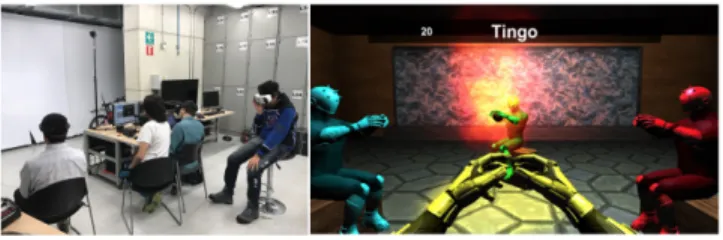
Figure 1: The hot potato, an heterogeneous, distributed mixed reality application.
• Since implementation of different interaction techniques with different devices may be necessary, should we hide those dif-ferences in the shared world, so users cannot identify from which hardware platform other users are connected? Or should we make explicit them in an HDMR output?
• How dependent are these variations from the tasks that the HDMR implements?
3 ANEXAMPLE
We implemented an HDMR environment to play hot potato. Four users could play together by using respectively a Hololens, an Oculus HMD with their wireless control, a Gear VR, and a standard PC (see Fig. 1). Players can move their head to see other players and pass the ball to another player. A player looses when he or she keeps the ball longer than a certain time. All clients shared the same visualization (see right side of Fig. 1) and the same visual feedback for the tasks. All HMDs use their own tracking devices for head movement. In the PC, such task is done with the horizontal movement of a mouse. Air tap [8] was used in the Hololens for passing the ball. The same task was done by pressing the button on the Oculus Remote for the Oculus, a tap in the touchpad of the Gear VR, or pressing a button in the PC’s keyboard.
We implemented these applications in Unity, plus the Photon En-gine and the Photon Unity Networking package for the management of distributed events. For comparison purposes, we measured the reaction time in each device, namely the time between receiving and passing the ball. We performed a user study with 20 volunteers (ages: 18-30) in groups of 2 or 3. Each subject received an introduction to all devices, and played 3 rounds in the 3 MR devices available, in random order. At the end of the test we collected data from 464 ball passes and we asked all participants to fill a questionnaire about their opinions regarding each interface.
Table 1: Reaction Time in Hot Potato
Device Average Max. Min. Gear VR 4.0 19.01 0.39 Hololens 7.50 40.00 0.73 Oculus 3.43 18.40 0.40
Table 1 shows data about reaction times in the 3 MR platforms. Although variability is very wide, we notice two important tenden-cies. Data from both the Gear VR and the Oculus are very similar, which says that their performances are equivalent. However, the reaction time in the Hololens seems bigger, compared to the other two platforms. We believe this is due to the recognition time that the air tap gesture requires, plus the fatigue due to the arm’s position. This can be solved by using a different input device in the Hololens, such as the one used for the Oculus. In this way, we could fulfill all requirements we have defined for an HDMR.
We asked users to mention the best and worst characteristics of each environment. In general, they noticed the already known differ-ences between these environments (i.e., resolution, field of view, and
difficulties with gesture recognition in the Hololens). Some subjects also reported difficulties with the trackpad in the Gear VR and with the weight of the Oculus Rift. We believe the latter refers to the relative weight of the Oculus in comparison to the Gear VR, and the fact the Oculus is wired, since the Oculus is actually lighter than the Hololens. In terms of preference of how to play this game, subjects preferred the Oculus, then the Gear VR and finally the Hololens. We believe subjects preferred the Oculus over the Gear, despite their similar performance, due to visual quality. We also believe that the Hololens did not get as good reception as the other platforms due to the input difficulties in the Hololens.
4 CONCLUSIONS ANDFUTUREWORK
We have presented the concept of Heterogeneous, Distributed Mixed Reality Applications, as a subset of Collaborative Virtual Environ-ments and its relation to other concepts in the literature. HDMRs provide users a similar experience of a virtual environment from several hardware setups, and accommodates the affordances and limitations of particular devices. An example shows some metrics that should be taken into account in the implementation of HDMR applications, and some challenges in the process of offering a similar experience among hardware platforms.
We believe the concept of HDMRs describe an interesting subdo-main of CVEs, and their study could provide guidelines and tools to support better their development. In the future, we expect to derive common practices from our developments of HDMRs, and study more related concepts, such as user adaptivity and software architectures for HDMRs, for example.
REFERENCES
[1] R. D. Bess. Image generation implications for networked tactical training systems. In Proceedings of IEEE Virtual Reality Annual International Symposium, pages 308–317, 1993.
[2] A. Bierbaum, C. Just, P. Hartling, K. Meinert, A. Baker, and C. Cruz-Neira. Vr juggler: a virtual platform for virtual reality application development. In IEEE Virtual Reality 2001, pages 89–96, 2001. [3] M. L. Chenechal, J. Lacoche, J. Royan, T. Duval, V. Gouranton, and
B. Arnaldi. When the giant meets the ant an asymmetric approach for collaborative and concurrent object manipulation in a multi-scale envi-ronment. In IEEE Third VR International Workshop on Collaborative Virtual Environments (3DCVE), pages 18–22, 2016.
[4] P. Figueroa, W. F. Bischof, P. Boulanger, H. J. Hoover, and R. Tay-lor. Intml: A dataflow oriented development system for virtual real-ity applications. Presence: Teleoperators and Virtual Environments, 17(5):492–511, 2008.
[5] P. Figueroa, J. Ferreira, and C. Castro. Development of mr application families: An intml-based approach. In Proceedings of the 2007 ACM Symposium on Virtual Reality Software and Technology, VRST ’07, pages 221–222, New York, NY, USA, 2007. ACM.
[6] C. Fleury, N. Frey, J. M. Vzien, and P. Bourdot. Remote collaboration across heterogeneous large interactive spaces. In IEEE Second VR In-ternational Workshop on Collaborative Virtual Environments (3DCVE), pages 9–10, 2015.
[7] J. Lacoche, T. Duval, B. Arnaldi, E. Maisel, and J. Royan. D3part: A new model for redistribution and plasticity of 3d user interfaces. In IEEE Symposium on 3D User Interfaces (3DUI), pages 23–26, 2016. [8] Microsoft. Gestures.
https://developer.microsoft.com/en-us/windows/mixed-reality/gestures, 1 2018.
[9] T. T. H. Nguyen and T. Duval. A survey of communication and aware-ness in collaborative virtual environments. In International Workshop on Collaborative Virtual Environments (3DCVE), pages 1–8, 2014. [10] D. Ren, T. Goldschwendt, Y. Chang, and T. Hllerer. Evaluating
wide-field-of-view augmented reality with mixed reality simulation. In IEEE Virtual Reality (VR), pages 93–102, 2016.
[11] S. Singhal and M. Zyda. Networked Virtual Environments: Design and Implementation. ACM Press/Addison-Wesley Publishing Co., New York, NY, USA, 1999.