Any correspondence concerning this service should be sent to the repository administrator:
Official URL:
http://www.interpore.org/events?task=view_event&event_id=16
This is an author-deposited version published in: http://oatao.univ-toulouse.fr/ Eprints ID: 9074To cite this version:
Allain, Hervé and Quintard, Michel and Soulaine, Cyprien and Prat, Marc and
Baudouy, Bertrand and Van Weelderen, Rob Superfluid Helium Flow in Porous
Media. (2013) In: 5th International Conference on Porous Media & Annual
Meeting , 21-24 May 2013, Prague, Czech Republic.
O
pen
A
rchive
T
oulouse
A
rchive
O
uverte (
OATAO
)
OATAO is an open access repository that collects the work of Toulouse researchers and makes it freely available over the web where possible.
Superfluid Helium Flow in Porous Media
H. Allaina, M. Quintardb,c, C. Soulaineb, M. Pratb,c, B. Baudouyd, R. Van Weelderena a CERN, TE-CRG, 1211, Geneva 23, Switzerland
b Université de Toulouse; INPT, UPS; IMFT (Institut de Mécanique des Fluides de
Toulouse); Allée Camille Soula, F-31400 Toulouse, France
c CNRS; IMFT; F-31400 Toulouse, France d CEA, IRFU, SACM, F-91191 Gif-sur-Yvette, France
Keywords: porous media, superfluid helium, averaging, experiments
Superfluid helium is primarily used in the field of applied superconductivity. Given the complexity of the magnet geometry and the scales involved, a real 3D simulation of heat transfer in such devices at the micro-channel scale is very difficult, even impossible. However, the repeatability or even periodicity of the structure suggests the possibility of a macro-scale description following a porous medium approach. Which macro-scale model may be used? This largely remains an open field while some answers have been proposed based on experimental or theoretical work [1,2].
While mathematical models describing the physics of superfluid helium are still under discussion, two-classes of models have been accepted as good candidates to reproduce some of the most requested features associated to the understanding of heat transfer in cryogenics situations. The first class corresponds to the so-called two-fluid models, with mass balance equations for a normal fluid and a superfluid, constituting the helium phase, coupled with the energy equation. While these
models have the structure of classical two-fluid models, specificities associated to the superfluid state
make the models differ significantly from their classical fluid counterparts. A Landau regime may be observed for small heat fluxes, while the two-fluid models are completed by additional non-linear terms for high fluxes in the so-called Gorter–Mellink regime. The second class can be viewed as a simple solution of the previous models and takes the form of a highly non-linear heat transfer equation [3]. Specific boundary conditions complete the analysis. In particular, the boundary conditions on an impervious and adiabatic boundary correspond to a classical no-slip condition for the normal fluid and a slip condition for the superfluid component. A typical solution of the
two-fluid model in the Landau regime is shown in Figure 1. This figure represents the temperature
field and velocity fields at steady-state in a tube (only half of the tube is represented) heated from the
left and in contact at the right end with a bath of superfluid He at constant temperature and pressure.
Figure 1. Temperature field, normal fluid velocity (arrows, top) and superfluid velocity (arrows, bottom)
The coupling between the two-fluid components is very strong and comes from several aspects, in particular:
1. the total mass balance involves the two components,
2. the gradient of the component pressures in the momentum balance equations are coupled through a Gibbs-Duhem equation involving the temperature gradient,
As a consequence, the upscaling problem becomes complicated. Several macro-scale models are proposed [1,2], based on a volume averaging theory and specific simplifying assumptions:
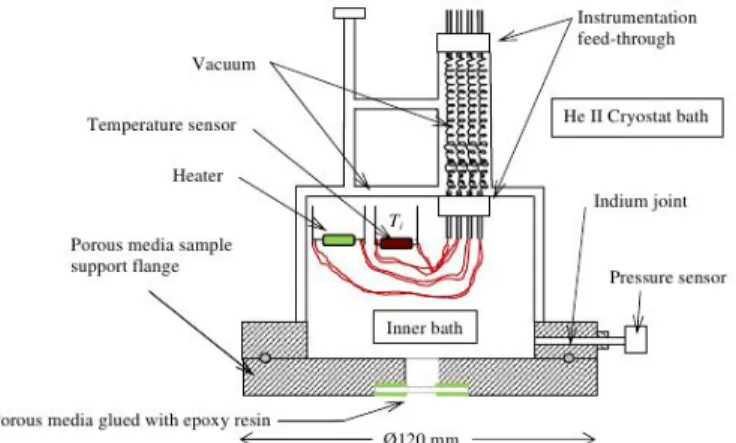
1. If the coupling through the total mass balance resolves into free-divergence flows, then the Landau model can be upscaled and leads to a macro-scale model involving a momentum balance equation of Darcy-type for the normal fluid, with the classical intrinsic permeability, and with additional terms, in particular one involving a pressure tortuosity. Experiments performed on several porous media [1], Figure 2, support this finding, for a range of temperature between 1.8 and 2.1 K, i.e., when the fraction of normal fluid is large enough. It is shown how this model can be extended to provide a macro-scale model valid in the Gorter-Mellink regime.
2. The upscaling of the non-linear diffusive model is more straightforward and has been applied successfully to model heat transfer in typical superconducting magnet structures such as the one depicted in Figure 3.
Figure 2. Experimental setup (outer bath not represented)
Figure 3. Sketch of a typical superconducting magnet
References
[1] Allain, H., Quintard, M., Prat, M. & Baudouy, B. Upscaling of superfluid helium flow in porous media International Journal of Heat and Mass Transfer, 2010, 53, 4852–4864.
[2] Allain, H., Weelderen, R. V., Baudouy, B., Quintard, M., Prat, M. & Soulaine, C. Investigation of Suitability of the Method of Volume Averaging for the Study of Heat Transfer in Superconducting Accelerator Magnet Cooled by Superfluid Helium Cryogenics, 2013, 53, 128-134.