OATAO is an open access repository that collects the work of Toulouse
researchers and makes it freely available over the web where possible
Any correspondence concerning this service should be sent
to the repository administrator:
[email protected]
This is an author’s version published in:
http://oatao.univ-toulouse.fr/23387
To cite this version:
Nesterenko, Alla
and Alric, Isabelle
and Silvestre, Françoise
and Durrieu,
Vanessa
Comparative study of encapsulation of vitamins with native and
modified soy protein. (2014) Food Hydrocolloids, 38. 172-179. ISSN 0268-005X
Comparative study of encapsulation of vitamins with native
and modified soy protein
A.
Nesterenko
a,b,I.
Alric
a,b, F.Silvestre
a,b,V. Durrieu
a,b,*a Université de Toulouse, INP-ENSIACET, LCA (Laboratoire de Chimie Agro-Industrielle), F-31030 Toulouse, France b INRA, UMR 1010 CAi, F-31030 Toulouse, France
ARTICLE INFO ABSTRACT
Keywords: Microencapsulation Soy protein oc-Tocopherol Ascorbic acid Acylation Cationization
Microencapsulation of hydrophobie (oc-tocopherol) and hydrophilic (ascorbic acid) vitamins by native (non-modified) and modified soy protein isolate (SPI) was carried out using a spray-drying technique. Proteins' functional properties were modified by acylation and cationization reactions in aqueous alkaline media. The results obtained demonstrated that SPI modification resulted in decreased emulsion droplet size and viscosity. Ali preparations with ascorbic acid (M) had lower viscosity and microparticle size than those with oc-tocopherol (T). Moreover, grafting of fatty acid chains ta SPI by acylation improved its amphiphilic character and affinity with hydrophobie substances. Thus, the microencapsulation effi ciency of T was increased from 79.7% ta 94.8% and the microencapsulation efficiency of M was reduced from 91.8% ta 57.3% compared ta native SPI. Conversely, attachment of quaternary ammonium cationic groups ta proteinic chains by cationization, increased SPI solubility and favored the M microencapsu lation. This study illustrated that an appropriate modification of SPI can improve the microencapsulation efficiency of suitable active cores.
1. Introduction
Over the past decades, environmental requirements have become of great importance. In order to replace synthetic polymers and animal derived products, there is an increasing interest in the industrial use of renewable resources and development of naturally occurring materials for new applications. Natural polymers such as vegetable proteins have attracted considerable research activities because of their availability, biodegradability, renewable character and various interesting functional properties. Among them, pro teins extracted from vegetable seeds (soybean, pea, barley, wheat, rice, oat, sunflower) have been reported as having good emulsifying and foaming capacities, water solubility, amphiphilic and film forming properties (Nunes, Batista, Raymundo, Alves, & Sousa, 2003).
Due to their good physico-chemical properties, vegetable pro teins represent a highly suitable wall-forming material for micro encapsulation of active components to use in the food industry, pharmaceutics and cosmetics (Nesterenko, Alric, Silvestre, & Durrieu, 2013). Microencapsulation allows the isolation of the
* Corresponding author. INRA, UMR 1010 CAi, F-31030 Toulouse, France.
E-mail address: [email protected] (V. Durrieu).
https://doi.org/10.1016/j.foodhyd.2013.12.011
active core substance from the surrounding environment within a wall or matrix material. This technique offers benefits for protec tion of sensitive compounds, controlled release of the core agent, masking of unpleasant taste and odor of the substances or trans formation of liquid core into solid powder. Different processes could be used to produce microparticles: spray-drying, spray cooling/chilling, supercritical fluid expansion, fluidized bed, gela tion, solvent evaporation, coacervation and extrusion (Augustin & Hemar, 2009; Dubey, Shami, & Bhasker, 2009; Gouin, 2004).
Spray-drying consists of the conversion of a liquid preparation (containing wall and core material) into a solid powder of micro particles using a stream of heated air. This technology, widely used in industry, is commonly employed for microencapsulation of various active substances with a vegetable protein matrix. Among vegetable proteins, soy proteins, pea proteins, wheat proteins and barley proteins had already demonstrated their effectiveness as carrier materials in microencapsulation by spray-drying (Nesterenko, Alric, Silvestre, et al., 2013).
Soy proteins represent an important component of soy bean seeds (35-40%). Iwo fractions are mainly present in extracted soy proteins: glycinin (11S globulin) and conglycinin (7S globulin). Soy protein isolate (SPI) showed interesting physico-chemical proper ties in particular gelling, emulsifying, fat-absorbing and water binding (Caillard, Remondetto, & Subirade, 2009; Hua, Cui, Wang, Mine, & Poysa, 2005; Nunes et al., 2003). The use of SPI as wall
material in microencapsulation by spray-drying had been reported by various authors. This natural polymer showed a high efficiency for coating different active substances: orange oil (Kim, Morr, & Schenz, 1996), fish oil (Augustin, Sanguansri, & Bode, 2006), stea rin/palm oil (Rusli, Sanguansri, & Augustin, 2006), phospholipid (Yu, Wang, Yao, & Liu, 2007), flavors (Charve & Reineccius, 2009), casein hydrolysate (Favaro-Trindade, Santana, Monterrey-Quintero, Trindade, & Netto, 2010; Ortiz, Mauri, Monterrey-Quintero, & Trindade, 2009), paprika oleoresin (Rascon, Beristain, Garcie, & Salgado, 2011) and soy oil (Tang & Li, 2013 ).
It is widely accepted that the antioxidant properties of r,.
tocopherol (vitamin E) and ascorbic acid (vitamin C) are responsible in part for their biological activity (Packer, Slater, & Willson, 1979). Nevertheless, environmental factors, such as oxygen, temperature, moisture and UV affect the stability of these compounds and involve their deterioration. Microencapsulation could be an effi cient method for the protection and stabilization of r,.-tocopherol (T) and ascorbic acid (M). However, the nature of the wall matrix particularly affects the degree of protection of the active core, the microparticles' stability and the retention efficiency.
Modifiable character is one of the important advantages of proteins. Modification of proteinic chains leads to changes in the properties and behavior of this natural polymer and diversification of protein functionalities. In microencapsulation, functionalization of proteinic chains makes it possible to obtain microparticles with new properties, different from those obtained with other wall materials.
Grafting of fatty acid chains to proteins by acylation is well known in order to enhance their hydrophobicity, surface-active functionality and emulsifying capacity (Matemu, Kayahara, Murasawa, Katayama, & Nakamura, 2011; Wong, Nakamura, & Kitts, 2006). In fact, the incorporation of hydrocarbon chains (hy drophobie part) into the protein macromolecules (hydrophilic part) allows the creation of amphiphilic structures with improved surface activity (Rondel, Alric, Mouloungui, Blanco, & Silvestre, 2009). On the other hand, the introduction of quaternary ammo nium groups to polysaccharides (Channasanon, Graisuwan, Kiatkamjornwong, & Hoven, 2007; Wang et al., 2012) or to ani mal derived proteins (Kiick-Fischer & Tirrell, 1998; Zohuriaan Mehr, Pourjavadi, Salimi, & Kurdtabar, 2009) by cationization is used to enhance their solubility, antibacterial properties as well as their hydrophilic properties (water absorption and swelling ca pacity). Nevertheless, there is no data in the literature dealing with cationization of vegetable proteins. Both acylation and cationiza tion reactions could be suggested as an effective way to obtain SPI with defined characteristics.
Therefore, the objective of this work was to study the influ ence of SPI modification by acylation and cationization, on the microencapsulation of hydrophobie (T) and hydrophilic (M) vi tamins by the spray-drying technique. In the context of "green" chemistry (Galuszkaa, Migaszewskia, & Namiesnik, 2013), modi fication reactions were carried out without any use of organic solvents and chemical catalysts. The effect of SPI modifications on both solution/emulsion and microparticle properties was also investigated.
2. Materials and methods 2.1. Materials
Soy protein isolate (SPI), 90% pure, was purchased from Lustre! Laboratoires SAS (Saint Jean de Vedas, France). The term 'native SPI' was used in this study for ail samples prepared with non-modified commercial soy protein isolate. Ali other chemicals were of analytical grade. r,.-Tocopherol, L-ascorbic acid, sodium hydroxide,
dodecanoyl chloride, glycidyltrimethylammonium chloride, cyclo hexane (HPLC grade), iodine and sodium thiosulfate were pur chased from Sigma (Saint-Quentin Fallavier, France).
2.2. SPI modifications
The acylation reaction was carried out on SPI using dodecanoyl chloride (DDC) following the Schotten-Baumann reaction as described previously (Nesterenko, Alric, Silvestre, & Durrieu, 2012). The molar ratio DDC/NH2 of protein used for the reaction was 0.5/1 and the sample obtained was named SPI-A.
The SPI cationization reaction was carried out in aqueous solu tion (5% w/w) at 40 °C or 70 °C using glycidyltrimethylammonium chloride (GTMAC). When the SPI solution reached reaction tem perature, pH was adjusted to 10.0 with 4 M NaOH and GTMAC was added (molar ratios GTMAC/NH2 were 1, 2 or 4). The pH of the solution was maintained at 10.0 during the 1 h reaction period. The reaction was ended by adjusting the pH of the solution to 7.0 using 4 M HCI. The mixture of cationized SPI was cooled, freeze-dried at 20 Pa (Cryo-Rivoire equipment, Cryonext, Saint Gely du Fesc, France) and stored at 4 °C. Samples obtained were named SPI-C. The degree of cationization (DC) was evaluated using the o-phtal dialdehyde method (OPA) (Church, Swaisgood, Porter, & Catignani, 1983; Goodno, Swaisgood, & Catignani, 1981) and defined as follows:
OC(%) = (no -nm) x 100
no (1)
where n0 is the molar quantity of amino groups per gram of native SPI, and nm the molar quantity of amino groups per gram of cat
ionized SPI.
2.3. SPI solubility profiles
Native SPI solubility was compared to the cationized sample (SPI-C) and the blank sample (SPI-Cbtank treated under cationization conditions without GTMAC). Solubility profiles of SPI were deter mined as described in a previous study (Nesterenko et al., 2012). Briefly, protein mixtures in deionized water (5% w/w) were pre pared at different pH values and stirred at 70 °C for 1 h. Suspensions were centrifuged at 10,000 x g for 15 min (Sigma Laborzentrifugen, Osterode, Germany). The soluble protein fraction in the superna tant was analyzed using the Kjeldahl method and solubility (S%, w/ w) was calculated from the following equation:
S(%) = protein con�ent in the �upern�tant x 100total protem content m solution
2.4. Microencapsulation by spray-drying
(2)
Protein based microparticles were prepared using a two-step procedure. An aqueous solution of protein (native or modified) was mixed with active core material. Then a liquid preparation (solution or emulsion) was spray-dried to obtain a microparticle powder.
2.4.1. Solution/emulsion preparation
The wall material (SPI) was dissolved in deionized water (8% w/ w) at 70 °C for 1 h under constant mechanical stirring (1000 rpm). In order to allow maximum protein solubilization, the pH of the solution was fixed at 10.5. Active material (T or M) was then mixed with SPI solution to obtain the preparation in which the protein/
active core ratio was 2/1 ( 11.5% of total solids ). Liquid preparations were homogenized with a high-pressure homogenizer (APV Sys tems, Albertslund, Denmark) at 50 MPa. The intense mechanical force developed during homogenization, contributed to protein structure modifications, such as unfolding of proteinic chains. Polar and non-polar regions of the protein were exposed to new envi ronments, which made them more surface-active (Rampon, Riaublanc, Anton, Genot, & McClements, 2003). Preparations with T were named SPI/T, SPI-A/T and SPI-C/T for native, acylated and cationized soy protein respectively. Preparations with M were named SPI/M, SPI-A/M and SPI-C/M for native, acylated and cationized soy protein respectively.
2.4.2. Solution/emulsion characterization
Light scattering and optical microscopy were used to check good dispersion of T in the proteinic solution and droplet size uniformity. Emulsions were analyzed after high-pressure homogenization for 1 h. The oil droplet size distribution of homogenized emulsions (SPI/T, SPI-A/T and SPI-C/T) and zeta-potential of protein solutions were measured using Zetasizer Nano-ZS equipment (Malvern In struments, Worcestershire, UK). To avoid multiple scattering ef fects, liquid preparations were diluted 100 times with deionized water before measurements. A relative refractive index 1Jon/ 1Jwater = 1.12 (1Joil = 1.49, 1Jwater = 1.33) was used to analyze the data, assuming that ail droplets were spherical in shape. The volume particle diameter (D43 or Dv) was taken and used as an indicator of
the emulsion size. Additionally, emulsions were visualized using an Eclipse E600 optical microscope (Nikon, Sendai, Japan), linked to a digital video camera (DXM1200, Nikon, Sendai, Japan) at a magni fication of lO00x.
Apparent viscosity of all liquid preparations after high-pressure homogenization was determined at 20 °C and shear stress variation between 0 and 1 N/m2 for 3 min, using a Rheometer CSLlO0 (Carri
Med LTD, Dorking, UK) with a 6 cm diameter plate-cone geometry and 0.035 rad angle. Liquid preparations were characterized as Newtonian fluids.
2.4.3. Microparticle preparation
Freshly homogenized liquid preparations were spray-dried using a Mini Spray Dryer B-290 (Büchi, Flawil, Switzerland) un der stable process conditions as follows: inlet air temperature at 124 ± 4 °C and outlet at 74 ± 4 °C, drying air flow rate of 35 m3,
spray flow rate of 0.47 m3 /h, liquid feed flow rate of
0.33 x 10⁻³ m3 /h and aspiration of 100%. Microparticles were
collected from the cyclone collector, shut hermetically in opaque packaging and stored at 4 °C. The spray-drying yield was defined as follows:
Spray - drying yield(%) __ m_p __ X 100
msPI+Core (3)
where msPI+Core the initial mass of solids added in liquid prepara tion including SPI and active core (T or M) and mp is the mass of
collected powder (dry matter). The moisture of obtained micro particles was determined with an infrared moisture balance (Sartorius, Goettingen, Germany) by drying the sample at 105 °C to constant weight during 5 min.
2.4.4. Microparticle characterization
The amount of T retained in microparticles during drying was determined using UV/VIS spectroscopy (Faria, Mignone, Montenegro, Mercadante, & Borsarelli, 2010). Briefly, about 5 mg of microspheres containing the T to be determined were dissolved in 10 mL of cyclohexane. The solution was stirred for 10 min and filtered through a 0.2 µm PIFE membrane filter. The absorbance of
the solution was measured using a UV Spectrometer (UV-1800, Shimadzu, Kyoto, Japan) at 298 nm. To determine M content of the dry microparticles, the AOAC (Association of Official Analytical Chemists) standard methodology with an iodometric titration procedure was used (AOAC, 2007). Each sample of microparticle was analyzed at least three times.
The microencapsulation process was monitored for both retention efficiency (RE) and Joad efficiency (LE). RE was defined as the percentage of estimated active core content in particles ob tained ( Coreexp) over theoretical core content ( Coretheo) in initial
liquid preparation.
RE(%) = Coreexp x 100Coretheo (4)
The difference between experimental and theoretical values was caused by active core Joss during spray-drying. LE, corre sponding to active core content per 100 g of powder, was calculated as:
LE(%) = mcexp x 100
mm (5)
where mc,xp is the estimated mass of core in microparticles, and mm
the mass of the analyzed sample of microparticles ( dry matter). Particle size distribution was determined by the scattering pattern of a transverse laser light using the Scirocco 2000 equip ment (Malvern Instruments, Worcestershire, UK). The volume particle diameter (D43 or Dv) was calculated as the mean of three
measurements per sample.
The morphology of the microparticles was observed with a scanning electron microscope LEO435VP (LEO Electron microscopy Ltd., Cambridge, UK) operated at a voltage of 8 kV. In order to examine the inner structure of prepared microparticles, the pow der was first frozen in liquid nitrogen and broken up in a mortar. Samples were deposited on conductive double-sided adhesive tape and sputter-coated with silver.
2.5. Statistical analysis
The experimental data was statistically analyzed using Minitab 16 software (State College, USA). A one-way analysis of variance (ANOVA) was performed to determine significant differences (P < 0.05) between the samples. Tukey's test was adopted as the multiple comparison procedure.
3. Results and discussions
3.1. SPI modifications 3.1.1. SPI cationization
During cationization in alkaline aqueous media, the GTMAC reacted with nucleophilic sites of the protein i.e. primary amino groups (N-terminal and lysine residues), which were the most reactive ones. The reagent used (GTMAC) is toxic because of the presence of an epoxy group. However, during cationization at pH 10.0 in water, the GTMAC unreacted with protein was hydrolyzed to (2,3-dihydroxypropyl)trimethylammonium chloride, and this sec ondary product did not have any toxicity. Indeed, it was used as an additive for care products to promote the retention of moisture (Baldaro, Pelizzari, Tenconi, & Li Bassi, 2008). The total hydrolysis of GTMAC under the experimental conditions employed for cationi zation of SPI, was verified by nuclear magnetic resonance (NMR) of hydrogen. Thus, cationized SPI was used for microencapsulation experiments without previous purification.
100 □40 'C 80 ■ 70 "C É 60 8 40 20 0 2 4
molar ratio GTMAC/NH2
A
0 --::-:. > -10 .§. ,i -20o
o...
-30 � -40 - "it-□ 40 'C ■70 "C -50 �---� 2 4molar ratio GTM ACINH,
B
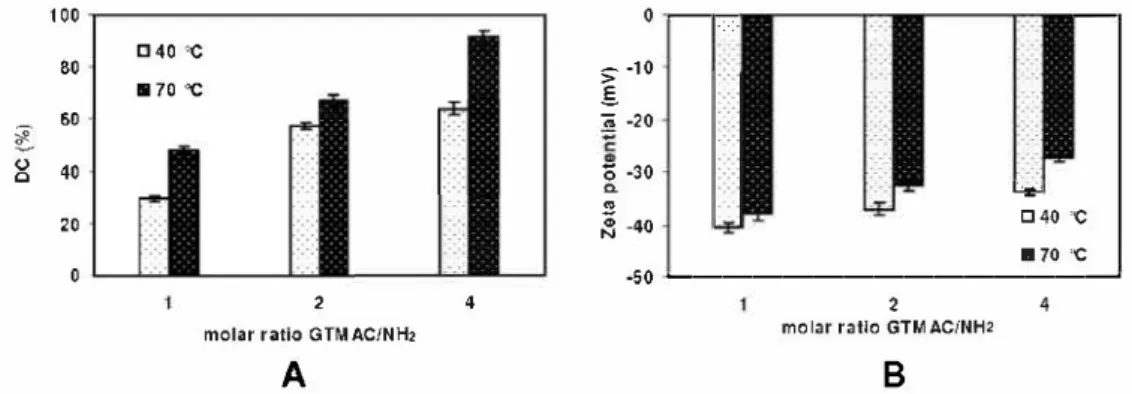
Fig. 1. The effect of SPI cationization conditions (temperature and molar ratio GTMAC/NH2) on (A) DC and (B) zeta potential at pH 10.0.
From the results presented on Fig. 1A, the degree of cationiza tion (DC) of SPI increased with the quantity of GTMAC in the re action media, and the temperature. Similar phenomena had been reported in a study dealing with cationization of starch using GTMAC (Kavaliauskaite, Klimaviciute, & Zemaitaitis, 2008).
The highest modification rate (DC = 91.6%) was obtained at a molar ratio GTMAC/NH2 of 4/1, after 1 h reaction time at 70 °c. To
confirm the presence of positively charged groups on SPI, zeta potential measurements were made. The zeta potential of native SPI at pH 10.0 was -44.4 mV, and as shown on Fig. 18, the zeta potential of SPI after cationization had increased. However, values obtained were negative because of the high amount of negative net charges (Cao-) on the proteinic chains in alkaline media (pH 10.0). After cationization, the majority of primary amino groups (NH2)
were replaced by positively charged functions. Thus, the augmen tation in zeta-potential with increase of DC confirmed qualitatively the presence of positively charged trimethylammonium groups on proteinic chains.
The effect of SPI cationization on its functional properties, especially the solubility profiles, was studied (Fig. 2). The solubility of SPI and SPI-C was compared to a blank sample (SPI-CbJank treated for 1 h at 70 °C and pH 10.0 without GTMAC). The blank sample was more soluble than native SPI for ail pH values. This observation could be related to the partial unfolding of proteinic chains during treatment at alkaline pH and high temperature. On the other hand, for native SPI and SPI-CbJank samples, the isoelectric point was in a pH range between 4.5 and 5.0. However, the attachment of posi tively charged groups to SPI by cationization resulted in an obvious
80 fÈ 60 :ci ·§ 40 -20 --o-SPI -¼- SPI-C/DC=91.6 % -0- SPI-C blank 0 +---,---,----,---.---,---i 0 2 4 6 8 10 12 14 pH
Fig. 2. Effect of cationization on the solubility profile of SPI.
shift of the protein isoelectric point into the alkaline range (pH of 6.0-6.5). After cationization, the number of net positive charges of the protein was increased and the number of basic NH2 functions
reduced. This affected the overall balance of acid to basic groups in the protein and resulted in the shift phenomenon.
The solubility of SPI-C was higher than the solubility of SPI at pH 1-10, which confirmed a significant contribution of polar cationic groups on protein affinity with water. At acidic pH, positive charges fixed to SPI by cationization increased the repulsion between pro teinic chains. This favored protein-solvent interactions and explained the increase in protein solubility. Conversely, in alkaline solution (pH> 10), the attraction between cationic ((CH3)3N+) and
carboxylic (Cao-) groups resulted in the decrease of protein-sol vent interactions. Thus the lowest protein solubility could be explained by the formation of more compact structures.
The cationized sample SPI-C (DC of 91.6%) obtained at 70 °C and molar ratio GTMAC/NH2 of 4/1, was used as wall material for
microencapsulation experiments.
3.1.2. SPI acylation
In agreement with our previous report (Nesterenko et al., 2012), soy protein ( degree of acylation of 33.2%) modified with dodeca noyl chloride (DDC) was the more efficient wall material for T microencapsulation compared to other modified proteins (hydro lyzed, hydrolyzed and acylated, acylated with octanoyl chloride and hexadecanoyl chloride). Therefore, SPI acylated with DDC (molar ratio DDC/NH2 of 0.5/1) was selected for the present study.
3.2. Microencapsulation with native and modified SPI
3.2.1. Effect of SPI modifications on solution/emulsion properties
The preparation of a feed liquid containing wall material and an active core, was the first step involved in the process of microen capsulation by spray-drying. In the case of T encapsulation, the liquid preparation was an oil-in-water emulsion, whereas it was a solution in the case of M coating. The proteinic matrix material used for T and M microencapsulation was native (SPI), acylated (SPI-A) and cationized (SPI-C) soy protein.
The different characterizations of solutions/emulsions and mi croparticles are summarized in Table 1. Structural modifications of proteinic chains affected the viscosity of liquid preparations and the mean droplet size in emulsions.
Fatty acid hydrophobie chains attached to water-soluble pro tein by acylation favored the improvement of the amphiphilic character of SPI. Moreover, the DDC unreacted with SPI was hy drolyzed to sodium dodecanoate having surfactant properties. This enhancement in surface-active properties of SPI resulted in lower emulsion viscosity for sample SPI-A/T compared to sample SPI/T. A similar result was reported earlier (Derkatch et al., 2007), and the
Table 1
Properties of liquid preparations and spray-dried microparticles based on native and modified SPI. Measured property Wall/core materialsg
SPI/T SPI/M SPI-A/T SPI-A/M SPI-C/T SPI-C/M Emulsion droplet size, Dv (µm) 1.1 ± 0.02" ND 0.7 ± 0.04c ND 0.9 ± 0.03b ND
Liquid preparation viscosity (mPa s) 15.0 ± 0.02" 8.9 ± 0.03c 8.o ± o.02ct 9.8 ± 0.04b 4.1 ± 0.03f 5.8 ± 0.04•
Spray-drying yield (%) 68 81 66 77 61 87
REh (%) 79.7 ± 1.0b 91.8 ± 0.7" 94.8 ± 2.2" 57.3±4.lc 38.3 ± 1.0d 92.3 ± 2.8"
LEi (%) 26.3 ± 0.6b 30.3 ± 0.2" 31.3 ± 0.7" 18.9 ± 1.4c 12.6 ± 0.3d 30.5 ± 0.9"
Mean particle size (µm) 9.3 ± 0.2" 5.2 ± 0.2c 7.7 ± 0.2b 4.8 ±0.SC 7.6 ± 0.3b 4.9 ± o.zc
a-f Different Ietters in the same line indicate a statistical difference between the mean values (P < 0.05 ).
g SPI, SPI-A and SPI-C: native, acylated ( degree of acylation - 33.2%) and cationized ( degree of cationization - 91.6%) soy protein isola te respectively; T: a-tocopherol; M:
ascorbic acid.
h RE: retention efficiency of a-tocopherol determined by UV spectroscopy and retention efficiency of ascorbic acid determined by iodometric titration.
i LE: load efficiency or active core content per 100 g of powder.
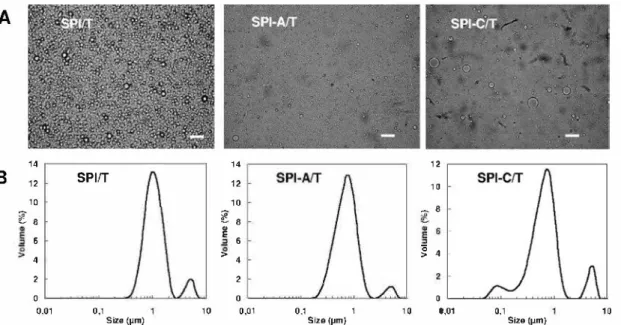
phenomenon of viscosity fall was attributed to the changes in the composition of interface layers in the emulsion. The SPI-A/T emulsion (with acylated protein) had a reduced oil droplet size compared to SPI/T emulsion (0.7 µm and 1.1 µm respectively). The uniformity of droplet size in emulsions obtained was observed by optical microscopy (Fig. 3A). The intense mechanical forces applied to the pre-emulsion during high-pressure homogenization resulted in partial unfolding of proteinic chains and oil droplet dispersion. The emulsion was stabilized by an adsorbed layer of surface-active proteins, forming a protective barrier around the dispersed oil droplets. This protein layer provided immediate and effective protection of the fine droplets against coalescence and gave a good stability to the emulsion. The decrease in droplet diameter observed for SPI-A/T emulsion compared to SPI/T emul sion, could be due to the increased surface activity of SPI after acylation, and thus better oil droplet dispersion. The same behavior was observed for sunflower protein/a.-tocopherol emul sion in our previous study (Nesterenko, Alric, Violleau, Silvestre, & Durrieu, 2013).
On the other hand, grafting of cationic quaternary ammonium groups to native SPI also involved a decrease in viscosity for both T and AA Iiquid preparations. After cationization, proteinic matrix chains became more hydrophilic (Kiick-Fischer & Tirrell, 1998; Zohuriaan-Mehr et al., 2009). This increase in hydrophilic
A
14 14B
12 SPI/T 12 10 10 ? - 8?.
8 6 � 6 4 > 4 2 2 0 0 0.01 0,1 10 0,01 Siz9 (µm) 0,1properties of SPI favored the mobility of proteinic chains in aqueous media and, presumably, could explain the decreased viscosity for samples SPI-C/T and SPI-C/AA. A decrease in the mean droplet size in the case of T based emulsions was observed. However, the optical micrograph of the SPI-C/T emulsion (Fig. 3A) showed the formation of coalesced T droplets with diameters from 5 to 10 µm. The improved hydrophilic character of SPI chains could reduce their affinity with hydrophobie T resulting in Jess efficient protein adsorption on the oil droplet surface and thus reduced protection against coalescence and emulsion stability.
Volume droplet size distributions of oil-in-water emulsions are shown in Fig. 3B. Ali the emulsions had droplet size distributions with explicit bimodal behavior. A second minor population with a size of about 5 ± 2 µm could be attributed to some coalesced droplets. The droplet size dispersion of SPI/T was narrower than that of SPI-A/T, which confirmed that the droplet size distribution was more uniform in the case of native protein based emulsion. It is important to note that this population of coalesced droplets was larger in the SPI-C/T emulsion, which confirmed the decrease in emulsion stability.
3.2.2. Effect of SPI modification on the microencapsulation process
A significant difference in spray-drying yield for emulsions with T (61-68%) compared to preparations with AA (77-87%) was
12 10 - 8 0 4 > 0 1 10 0,01 0.1 10 Siz9 (µm) SiZ9 (l'm)
Fig. 3. (A) Optical micrographs (scale bar - 10 µm) and (B) droplet size distributions of T based emulsions with native (SPI/Tl, acylated (SPI-A/Tl and cationized (SPI-C/Tl soy protein.
observed. This could be attributed to the hydrophobie and viscous character of a.-tocopherol that involved a higher microparticle accumulation inside the drying chamber. In addition, an increase in microparticle size for spray-dried T based emulsions (7.6-9.3 µm) compared to AA based solutions (4.8-5.2 µm), was also due to a microparticle agglomeration effect induced by the presence of surface oil. Nevertheless, these results demonstrated that native soy proteins could efficiently encapsulate hydrophobie (T) and hydrophilic (AA) core material with retention efficiencies of 79.7% and 91.8% respectively. Higher retention efficiency of AA compared to T could be attributed to the hydrophilic character of SPI and its better affinity to the hydrophilic core.
A wide range ofbiopolymers has been reported in the literature as efficient wall materials for ascorbic acid encapsulation by spray drying (retention efficiency varying from 85% to 101%). These include: maltodextrin and cashew tree gum (Moreira, Azeredo, Medeiros, Brito, & Souza, 2010), gum Arabie and rice starch (Trindade & Grosso, 2000), pea protein and carboxymethylcellulose (Pierucci, Andrade, Baptista, Volpato, & Rocha-Leao, 2006). The microencapsulation of a.-tocopherol by spray-drying has been studied with different natural wall materials such as maltodextrin and gum Arabie (Faria et al., 2010), pea protein and carboxymeth ylcellulose (Pierucci, Andrade, Farina, Pedrosa, & Rocha-Leao, 2007), and showed retention efficiency ranging from 73% to 87%. Compared to literature values, the retention efficiencies obtained in this study are highly satisfactory.
The results reported in Table 1 demonstrated that SPI acylation enhanced the RE of the hydrophobie active substance (T) from 79. 7% to 94.8% but reduced the RE of the hydrophilic active substance (AA) from 91.8% to 57.3%. During drying, the surface composition of
A
B
8ls
� .2 4 0 2 0 D,1 10 100 Size(um)microparticles was significantly influenced by the nature of feed liquid ingredients. In our case, the proteins were the most surface active components in the liquid preparation and they would adsorb to the air-liquid interface of the drying droplets. This pref erential adsorption combined with protein film forming properties, was responsible for the formation of a smooth protein skin on the microparticle surface Uayasundera, Adhikari, Aldred, & Ghandi, 2009). SPI acylation increased hydrophobie and surface-active character of proteinic chains. This modification was successful with regard toT encapsulation, because of hydrophobie interactions occurring between wall material and active core (Nesterenko et al., 2012; Nesterenko, Alric, Violleau, et al., 2013). After SPI acylation, the hydrophobie microdomaines were formed in water because of hydrophobie association between fatty acid moities (Lee, Jo, Kwon, Kim Y.H., &Jeong, 1998). Thus, the formation ofprotein film on the air-liquid interface was more effective, the exposure of oil to the microparticle surface was minimized, and T was better protected. Conversely, acylated SPI showed much Jess effectiveness in micro encapsulation of a hydrophilic compound (AA), because of the reduced affinity between core and wall material.
In contrast to the positive effect of SPI acylation on T retention efficiency, the attachment of polar trimethylammonium functions to SPI by cationization resulted in the decrease of RE values for this hydrophobie substance. This was due to the enhanced hydrophilic character of cationized SPI, which led to lower emulsion stability. More oil could be expected at the microparticle surface and the Joss of active core during spray-drying was increased. On the other hand, the enhanced spray-drying yield for SPI-C/AA preparation was observed because of better affinity between active core and modified wall material.
8
zs
Ë � 4 '.> 0 0,1 Size(µm) 10 1003.2.3. Effect of SPI modification on microparticle size and morphology
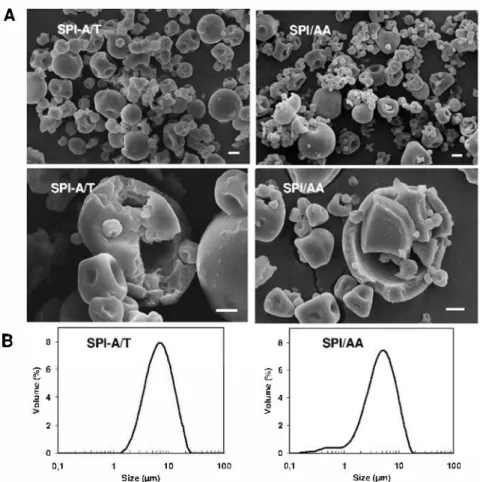
As can be clearly seen in Fig. 4A, the morphology of spray-dried microparticles was characterized by spherical shape with di ameters ranging from 1 to 10 µm. The surface of SPI microparticles was smooth and compact without presence of fissures. For the SPI A/T sample, the inner structure of partiel es showed the presence of small pores indicating that oil droplets were well distributed in the protein matrix. In the case of AA based microparticles, the disper sion of active core crystal powder in the protein matrix, involved the formation of a dense non-porous wall.
The microparticle size distributions displayed in Fig. 4B and results presented in Table 1, show that AA based microparticles (5.2 µm for SPI/AA) had lower average size compared to T based microparticles (9.3 µm for SPI/T). This variation in the particle size was most likely due to the agglomeration ofT based microparticles because of the presence of surface oil. Moreover, the difference in morphology of spray-dried droplets (homogeneous solution SPI/AA or heterogeneous emulsion SPI/T) and in density of active core materials affected the size of microparticles produced. As reported in the literature, the expected size of microparticles with vegetable protein produced by spray-drying, ranged from 2-3 µm (Pierucci et al., 2006; Pierucci et al., 2007) to 9-18 µm (Favaro-Trindade et al., 2010; Ortiz et al., 2009), which was comparable and within the particle size range obtained in this work.
4. Conclusions
This paper has demonstrated that some suitable modifications of proteinic matrix material can increase the microencapsulation efficiency of different active compounds. For this, soy protein isolate (SPI) was modified by acylation and cationization and used as wall material for a-tocopherol (T) and ascorbic acid (AA) microencapsulation using the spray-drying technique.
The attachment of a polar trimethylammonium function to SPI by cationization affected its hydrophilic properties, solubility and isoelectric point. Protein cationization resulted in reduced T retention and in enhanced spray-drying yield for AA based prep arations. SPI acylation led to lower emulsion droplet size and viscosity because of enhanced surface-active properties. Due to the better affinity between hydrophobie core material and acyl ated SPI, the retention efficiency was enhanced from 79.7% to 94.8%. Microparticles obtained had spherical shape and an internai morphology depending on the nature of the active core (porous for liquid core and dense for crystal core). Thus, native and modified SPI appear to be promising carriers for different delivery systems, such as nutraceutical, cosmetic or pharmaceutical products.
References
AOAC. (2007). Iodine in iodized salts. Method, 925.56 (18th ed.). Official Method of Analysis.
Augustin, M. A., & Hemar, Y. (2009). Nano- and micro-structured assemblies for encapsulation of food ingredients. Chemical Society Reviews, 38, 902-912. Augustin, M. A., Sanguansri, L., & Bode, O. (2006). Maillard reaction products as
encapsulants for fish oil powders.Journa1 of Food Science, 71(2), 25-32.
Baldaro, E., Pelizzari, R., Tenconi, M., & Li Bassi, G. (2008). Procedure for the prepa ration of puridied cationic guar. Patent N° W02008058769.
Caillard, R., Remondetto, G. E., & Subirade, M. (2009). Physicochemical properties and microstructure of soy protein hydrogels co-induced by Maillard type cross linking and salts. Food Research International, 42, 98-106.
Channasanon, S., Graisuwan, W., Kiatkamjornwong, S., & Haven, V. P. (2007). Alternating bioactivity of multilayer thin films assembled from charged de rivatives of chitosan. Journal of Colloid and Interface Science, 316, 331-343. Charve, J., & Reineccius, G. A. (2009). Encapsulation performance of proteins and
traditional materials for spray dried flavors. Journal of Agricultural and Food Chemistry, 57, 2486-2492.
Church, F. C., Swaisgood, H. E., Porter, D. H., & Catignani, G. L. (1983). Spectropho tometric assay using o-phthaldialdehyde for determination of proteolysis in milk and isolated milk proteins. Journal of Dairy Science, 66, 1219-1227. Derkatch, S. R., Levachov, S. M., I<uhkushkina, A. N., Novosyolova, N. V.,
I<harlov, A. E., & Matveenko, V. N. (2007). Rheological properties of concen trated emulsions stabilized by globular protein in the presence of nonionic surfactant. Colloids and Surfaces, 298, 225-234.
Dubey, R., Shami, T. C., & Bhasker, R. K. U. (2009). Microencapsulation technology and application. Defence Science Journal, 59( 1 ), 82-95.
Faria, A. F., Mignone, R. A., Montenegro, M. A., Mercadante, A. z., & Borsarelli, C. D. (2010). Characterization and singlet oxygen quenching capacity of spray-dried microcapsules of edible biopolymers containing antioxidant molecules. Jour nal of Agricultural and Food Chemistry, 58, 8004-8011.
Favaro-Trindade, C. S., Santana, A. S., Monterrey-Quintero, E. S., Trindade, M. A., & Netto, F. M. (2010). The use of spray drying technology ta reduce bitter taste of casein hydrolysate. Food Hydrocolloids, 24, 336-340.
Galuszkaa, A., Migaszewskia, Z., & Namiesnik, J. (2013). The 12 principles of green analytical chemistry and the SIGNIFICANCE mnemonic of green analytical practices. Trends in Analytical Chemistry, 50, 78-84.
Goodno, C. C., Swaisgood, H. E., & Catignani, G. L. (1981). A fluorimetric assay for available lysine in proteins. Analytical Biochemistry, 115, 203-211.
Gouin, S. (2004). Microencapsulation: industrial appraisal of existing technologies and trends. Trends in Food Science and Technology, 15, 330-347.
Hua, Y., Cui, S. W., Wang, Q,, Mine, Y., & Poysa, V. (2005). Heat induced gelling properties of soy protein isolates prepared from different defatted soybean flours. Food Research International, 38, 377-385.
Jayasundera, M., Adhikari, B., Aldred, P., & Ghandi, A. (2009). Surface modification of spray dried food and emulsion powders with surface-active proteins: a review.
Journal of Food Engineering, 93, 266-277.
Kavaliauskaite, R., Klimaviciute, R., & Zemaitaitis, A. (2008). Interaction of starch with glycidyltrimethylammonium chloride and properties of derived products. Carbohydrate Polymers, 73, 665-675.
Kiick-Fischer, K. L., & Tirrell, D. A. (1998). Controlling absorbency in gelatin net works: preparation and characterization of alkylated, crosslinked gelatin. Journal of Applied Polymer Science, 68, 281-292.
Kim, Y. D., Morr, C.V., & Schenz, T. W. (1996). Microencapsulation properties of gum arabic and several food proteins: spray-dried orange oil emulsion particles. Journal of Agricultural and Food Chemistry, 44, 1314-1320.
Lee, K. Y., Jo, W. H., Kwon, 1. C., Kim, Y. H., & Jeong, S. Y. (1998). Structural deter mination and interior polarity of self-aggregates prepared from deoxycholic acid-modified chitosan in water. Macromolecules, 31, 378-383.
Matemu, A. O., Kayahara, H., Murasawa, H., Katayama, S., & Nakamura, S. (2011 ). Improved emulsifying properties of soy proteins by acylation with saturated fatty acids. Food Chemistry, 124, 596-602.
Moreira, G. E. G., Azeredo, H. M. C., Medeiros, M. F. D., Brito, E. S., & Souza, A. C. R. (2010). Ascorbic acid and anthocyanin retention during spray drying of acerola pomace extract. Journal of Food Processing and Preservation, 34, 915-925. Nesterenko, A., Alric, 1., Silvestre, F., & Durrieu, V. (2012). Influence of soy protein's
structural modifications on their microencapsulation properties: a-tocopherol microparticles preparation. Food Research International, 48, 387-396. Nesterenko, A., Alric, 1., Silvestre, F., & Durrieu, V. (2013). Vegetable proteins in
microencapsulation: a review of recent interventions and their effectiveness. Industrial Crops and Products, 42, 469-479.
Nesterenko, A., Alric, 1., Violleau, F., Silvestre, F., & Durrieu, V. (2013). New way of biomaterials valorization: use of sunflower protein for a-tocopherol microen capsulation. Food Research International, 53, 115-124.
Nunes, M. C., Batista, P., Raymundo, A., Alves, M. M., & Sousa, I. (2003). Vegetable proteins and milk puddings. Colloids and Surfaces, 31, 21-29.
Ortiz, S. E. M., Mauri, A., Monterrey-Quintero, E. S., & Trindade, M. A. (2009). Pro duction and properties of casein hydrolysate microencapsulated by spray dry ing with soybean protein isolate. Food Science and Technology, 42, 919-923.
Packer, j. E., Slater, T. F., & Willson, R. L. (1979). Direct observation of a free radical interaction between vitamin E and vitamin C. Nature, 278, 737-738.
Pierucci, A. P. T. R., Andrade, L. R., Baptista, E. B., Volpato, N. M., & Rocha Leao, M. H. M. (2006). New microencapsulation system for ascorbic acid using pea protein concentrate as coat protector. Journal of Microencapsulation, 23, 654-662.
Pierucci, A. P. T. R., Andrade, L. R., Farina, M., Pedrosa, C., & Rocha-Leao, M. H. M. (2007). Comparison of a-tocopherol microparticles produced with different wall materials: pea protein a new interesting alternative. Journal of Microen capsulation, 24, 201-213.
Rampon, V., Riaublanc, A., Anton, M., Genot, C., & McClements, D.J. (2003). Evidence that homogenization of BSA-stabilized hexadecane-in-water emulsion induces structure modification of the nonadsorbed protein. Journal of Agricultural and Food Chemistry, 51, 5900-5905.
Rascon, M. P., Beristain, C. 1., Garcie, H. S., & Salgado, M. A. (2011 ). Carotenoid retention and storage stability of spray-dried paprika oleoresin using gum arabic and soy protein isolate as wall materials. Food Science and Technology, 44, 549-557.
Rondel, C., Alric, 1., Mouloungui, Z., Blanco, j.-F., & Silvestre, F. (2009). Synthesis and properties of lipoamino acid-fatty acid mixtures: influence of the amphiphilic structure. Journal of Surfactants and Detergents, 12, 269-275.
Rusli, J. K., Sanguansri, L., & Augustin, M. A. (2006). Stabilization of oils by microencapsulation with heated protein-glucose syrup mixtures. ]AOCS, 83, 965-971.
Tang, C. H., & Li, X. R. (2013 ). Microencapsulation properties of soy protein isola te and storage stability of the correspondingly spray-dried emulsions. Food
Research International, 52, 419-428.
Trindade, M. A., & Grosso, C. R. F. (2000). The stability of ascorbic acid micro
encapsulated in granules of rice starch and in gum arabic. Journal of Microen
capsulation, 17, 169-176.
Wang, J., Guo, J., Yue, T., Yuan, Y., Liu, X., & Kennedy, J. F. (2012). Cationization of
Ganodenna luddum polysaccharides in concentrated alkaline solutions as gene
carriers. Carbohydrate Polymers, 88, 966-972.
Wong, P. Y. Y., Nakamura, S., & Kitts, D. D. (2006). Functional and biological activities of casein glycomacropeptide as influenced by lipophilization with medium and long chain fatty acid. Food Chemistry, 97, 310-317.
Yu, C., Wang, W., Yao, H., & Liu, H. (2007). Preparation of phospholipid microcap sules by spray drying. Drying Technology, 25, 695-702.
Zohuriaan-Mehr, M. J., Pourjavadi, A., Salimi, H., & Kurdtabar, M. (2009). Protein and homo poly(amino acid)-based hydrogels with super-swelling properties.