HAL Id: hal-01273894
https://hal.inria.fr/hal-01273894
Submitted on 14 Feb 2016
HAL is a multi-disciplinary open access
archive for the deposit and dissemination of
sci-entific research documents, whether they are
pub-lished or not. The documents may come from
teaching and research institutions in France or
abroad, or from public or private research centers.
L’archive ouverte pluridisciplinaire HAL, est
destinée au dépôt et à la diffusion de documents
scientifiques de niveau recherche, publiés ou non,
émanant des établissements d’enseignement et de
recherche français ou étrangers, des laboratoires
publics ou privés.
Queues with Skill Based Parallel Servers and a FCFS
Infinite Matching Model
Ivo Adan, Marko Boon, Ana Bušić, Jean Mairesse, Gideon Weiss
To cite this version:
Ivo Adan, Marko Boon, Ana Bušić, Jean Mairesse, Gideon Weiss. Queues with Skill Based Parallel
Servers and a FCFS Infinite Matching Model. MAMA 2013 workshop of ACM Sigmetrics, 2013,
Pittsburgh, United States. pp.22-24, �10.1145/2567529.2567536�. �hal-01273894�
Queues with Skill Based Parallel Servers and
a FCFS Infinite Matching Model
Ivo Adan
∗Marko Boon
∗Ana Busic
†Jean Mairesse
‡Gideon Weiss
§1.
A QUEUEING SYSTEM
We consider the following skill based parallel service queue-ing system: Customers are of types C = {c1, . . . , cI}, servers are of types S = {s1, . . . , sJ}, and there is a bipartite graph G of compatiblities between C, S. The graph has arc (i, j) ∈ G if server type sj has the skill to serve customer type ci. Customers arrive in independent Poisson streams of rates λi, and have absolutely continuous patience distributions Fi. There are nj servers of type sj, and the service times are customer-server-type dependent, the service of a customer of type ci by a server of type sj has a random duration dis-tributed as Gij, with average mij. We use the terminology of queueing theory throughout, but this type of system, with minor modifications, is useful in modeling call centers, man-ufacturing systems, organ transplants, multimedia servers, and cloud computing [8].
Performance of such systems is highly dependent on the operating policy. We focus here on first come first served (FCFS), where a server is assigned to the longest wait-ing compatible customer, coupled with assign longest idle server (ALIS), where a customer is assigned to the compat-ible server that has been idle for the longest time. FCFS-ALIS is widely used, because it is fair to both customers and servers, it is simple to implement, it requires little in-formation about the parameters and the current state of the system, and it is robust under time varying conditions.
Our goal here is to develop a structured method to sup-port the design and efficient operation of skill based parallel service systems under FCFS. At this level of generality such systems are highly intractable, no analytic results are ex-pected, and asymptotics, e.g. using many server scaling are called for [12, 10, 7, 13]. We suggest an approximation based on a simplified look at the process — if we discard all arrival ∗
Department of Mathematics and Computer Science, Eindhoven University of Technology, P.O. Box 513, 5600 MB Eindhoven, the Netherlands, {i.j.b.f.adan, m.a.a.boon}@tue.nl Research supported in part by the Netherlands Organization for Scientific Research (NWO). †
INRIA/CNS, 23 avenue d’italie, CS 81321, 75214 Paris Cedex 13, France, [email protected].
‡
LIAFA, CNRS et Universite Paris 7, case 7014, 75205 Paris Cedex 13, France, [email protected]. §
Department of Statistics, The University of Haifa, Mount Carmel 31905, Israel, [email protected]. Research sup-ported in part by Israel Science Foundation Grant 711/09.
Copyright is held by author/owner(s).
times, identities of servers, and processing times, and con-sider just the sequence of customers in order of arrivals, and the sequence of services in the order in which they become available, we have two infinite sequences of customer types and of server types. Making the simplifying assumption that these are i.i.d., and using FCFS, we obtain the FCFS infinite matching model. This model, which is of interest in its own right, is tractable, using symmetry and reversibility, as we describe in Section 2. From it we calculate matching rates at which customers of type ciare served by servers of type sj under FCFS. In Section 3 we use these matching rates in the design of our queueing system, with specified perfor-mance measures. We demonstrate the effectiveness of this approach by an illustrative example.
This paper answers some questions raised in [10, 6]. It summarizes recent results from in [1, 2] and current research in progress [3, 4].
2.
FCFS INFINITE MATCHING
The model of first come first served (FCFS) infinite match-ing was introduced in [6], to answer some questions raised in [9, 10]. At that point the model looked highly intractable. It was followed by [1], where surprisingly it was found that the model is highly tractable, with a product form solution. A more general FCFS infinite matching model was described in [5]. The infinite matching model was found to be closely related to several queueing models with skill based parallel service [11, 2]. Here we present some novel results.
We consider two independent infinite random sequences: cm, sn, m, n ∈ T , cm chosen i.i.d. from C, S, with respec-tive probabilities αiand βj, and the bipartite compatibility graph G. T is either N = 1, 2, 3, . . . or Z = . . . , −2, −1, 0, 1, 2, 3 . . ..
Notation: We shall refer to sn as servers, to cm as cus-tomers. Let S(ci) be the server types compatible with ci. For subsets of types C, S let S(C) = S
ci∈CS(ci), and let
αC=Pc
i∈Cαi, βS=
P sj∈Sβj.
FCFS matching between the two sequences, for T = N is constructed as follows: s1is matched to the first compatible cm. Thereafter sn is matched to the first compatible cm which was not matched to any of s1, . . . , sn−1. We refer to the sequences with the matchings as the FCFS matching of sn, cm
, m, n ∈ N.
Definition 1. Let cm be matched with sn in the FCFS matching of the two sequences. The exchange transforma-tion replaces cmby ˜sm= sn, and snby ˜cn= cm (see Figure 1).
Let M be the location of the first unmatched customer, and M be the the location of the last matched customer, which was exchanged by a server. Consider the ordered sequence of servers and customers, z = cM, . . . , ˜sM with z = 0 if N = M = M − 1 (see Figure 1 where N = 4, M = 3, M = 6 and z = (c3, ˜s4, c5, ˜s6)). We define a Markov chain Z
N with state z, where ZN +1will be obtained when sN +1is matched and exchanged. c3 c5 c7 c8 c1 c2 c3 c4 s5 s6 s7 s8 s1 s2 s4 s6 C S
Figure 1: FCFS matching with exchange transfor-mation, Z4= z = (c3, ˜s4, c5, ˜s6)
Theorem 1. The stationary distribution of ZN is given by π(z) = B I Y i=1 αi#ciβj#sj (1) where #ci is the number of customers of type ciand #sjis the number of servers of type sj in z, and B is the normal-izing constant.
A necessary and sufficient condition for finite B and ergod-icity is complete resource pooling defined by:
αC< βS(C), for all non trivial subsets C ⊂ C. (2) We note that the clean and beautiful simplicity of this multi-Bernoulli product form of π masks the true complexity of the process, which is revealed if we examine what states are allowed: we note that each cmin the sequence z must be incompatible with all later ˜sn. The proof of Theorem 1 uses time reversal, and the symmetry in the process. It leads us to make the following conjecture:
Conjecture 1 (Reversibility). Let sn, cm, m, n ∈ Z, be two independent i.i.d. sequences, with FCFS matching between them. Let ˜sm, ˜cnbe obtained by the exchange trans-formation, with the corresponding matching. Then ˜sm, ˜cn are independent i.i.d. sequences, and the matching between them is FCFS in the reversed time direction.
We can in fact show that ˜sm, ˜cn are FCFS in the reversed time direction, and that each of these sequences is i.i.d, but we are still missing the proof that the sequence ˜smis inde-pendent of ˜cn.
From π one can obtain various marginal distributions of interest, and various performance measures. Most relevant for our queueing system are the matching rates rci,sj at
which customers of type ci are served by servers of type sj. The formula for that is:
rci,sj = βj X PJ B J −1 Y k=1 (β(k)− α(k)) −1 J −1 X k=1 φk α(k) β(k)− α(k)χk k−1 Y l=1 β(l)− α(l) β(l)− α(l)χl + φJ φJ+ ψJ J −1 Y l=1 β(l)− α(l) β(l)− α(l)χl ! , (3)
where the summation is over PJ, the set all the permutations of S. For more details on the notation used see [1].
If complete resource pooling does not hold the system de-composes uniquely to subsystems, (C(1), S(1)), . . . , (C(L), S(L)) defined recursively, the first of them being:
C(1) = arg minC⊆CβS(C) αC , S(1) = S(C(1)).
3.
A DESIGN ALGORITHM
We now present an algorithm for the design of the queuing system of Section 1. We assume that we want to operate it in ED (efficiency driven) mode, with overloaded servers, and controlled abandonments. We let:
Input: The compatibility graph G, the arrival rates λi, the patience distributions Fi, and the service-time distri-butions Gij, of which we only need the means mij. Quality of service decision: Partition customer types into
C(l), l = 1, . . . , L, where higher l implies more prefer-ential service. Let S(l)= S(C(l))\S
l0<lS(l 0
). Specify target waiting times W1> W2> · · · > WL.
Continue to design each subsystem separately. We drop the superscripts and use notation ci∈ C, sj∈ S, W within each subsystem:
Division of labor decision: Specify the fraction of ser-vices performed by each type of server, βj.
Calculations: Define total service rate ˆλ =P λi(1−Fi(W )) and let αi = λi(1 − Fi(W ))/ˆλ. Verify complete re-source pooling within the subsystem, and compute the matching rates rci,sj using (3). Calculate required
staffing:
nj= ˆλ X ci∈C(sj)
rci,sjmij (4)
Output: Number of servers of each type, nj, the matching rates rij, the cut-off waiting times Wi, and the aban-donment rates Fi(Wi).
The idea behind the algorithm is that if λ is large rela-tive to the typical waiting time W , there will be many cus-tomers in the system at all times, with a fraction F (W ) of abandonments, and the types of successive customers which will receive service will still be i.i.d. α. At the same time, with large λ the number of servers nj will be large, and the instants of service completions will be a superposition of many almost stationary, almost independent, point pro-cesses which should be approximately Poisson. As a result types of successive available servers will be i.i.d. β.
We now test our algorithm on simple graph G, to show that it performs quite well with moderate number of servers. C, S and G are shown in Figure 2. We use the following input data. The proportion of arrivals for the ci are α0 = (0.2, 0.5, 0.3). The patience distribution for all customers is exponential with mean 10, so Fi(t) = 1 − e−0.1t. The service time distributions Gi,j are as follows:
Service time distributions : Means Gi,j s1 s2 s3
c1 pareto(3, 3) :4.5 pareto(2, 3) :3 c2 exp(0.2) :5 exp(0.125) :8 c3 uniform(2, 6) :4 uniform(1, 5) :3
1
2
3
1
2
3
α0 1=15 α 0 2= 1 2 α 0 3=103Figure 2: The “almost complete” network. Nodes on the top row represent customer types, and the ones on the bottom row server types. The dashed arcs are present in the case of complete resource pooling, but vanish in the case of incomplete re-source pooling.
We explore two designs. The first proivdes equal service quality to all types of customers, the second design gives preferential service to types c1, c3 over type c2. We ran extensive simulations, of 100 runs with 100,000 customers each, for every experiment. Some of our results are:
First design: equal service quality
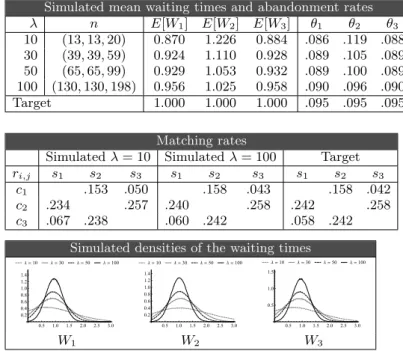
We choose common waiting time W = 1, so that abandon-ment rate is targeted as θi= Fi(Wi) = 1 − e−0.1 ≈ 0.095. This leaves α = α0 = (0.2, 0.5, 0.3). We choose β = (0.3, 0.4, 0.3). This satisfies complete resource pooling. The calculated matching rates are
[rij] = 2 4 0 1115176 111547 54 223 0 115 446 129 2230 54 223 0 3 5.
and the required staffing, as a function of the total arrival rate λ works out at:
n(λ) ≈ λ(1.305, 1.300, 1.981).
We use several values of λ. As expected the results improve as λ increases, but are already quite good for a moderate number of servers.
Second design: preferential service
Here we use a waiting time of W1= 2, for C(1)= {c2}, and waiting time W2 = 0.5 for C(2) = {c1, c3}. This partitions the servers into S(1)= {s
1, s3}, and S(2)= {s2} For S(1)we choose β1= β3 = 0.5, while of course for S(2) β2 = 1. The staffing calculations lead to
n(λ) ≈ λ(1.023, 1.712, 1.637).
Results of the simulation are given in the following tables.
4.
REFERENCES
[1] Adan, I.J.B.F., Weiss, G. (2012) Operations Research 60(2):475–489.
[2] Adan, I.J.B.F., Weiss, G. (2012) Eurandom Report 2012-011.
[3] Adan, I.J.B.F., Boon, M.A.A. Weiss, G. (2013) Design and evaluation of overloaded service systems with skill based routing under FCFS policies. In preparation.
Simulated mean waiting times and abandonment rates
λ n E[W1] E[W2] E[W3] θ1 θ2 θ3 10 (13, 13, 20) 0.870 1.226 0.884 .086 .119 .088 30 (39, 39, 59) 0.924 1.110 0.928 .089 .105 .089 50 (65, 65, 99) 0.929 1.053 0.932 .089 .100 .089 100 (130, 130, 198) 0.956 1.025 0.958 .090 .096 .090 Target 1.000 1.000 1.000 .095 .095 .095 Matching rates
Simulated λ = 10 Simulated λ = 100 Target ri,j s1 s2 s3 s1 s2 s3 s1 s2 s3
c1 .153 .050 .158 .043 .158 .042 c2 .234 .257 .240 .258 .242 .258 c3 .067 .238 .060 .242 .058 .242
Simulated densities of the waiting times Λ = 10 Λ = 30 Λ = 50 Λ = 100 0.5 1.0 1.5 2.0 2.5 3.0 0.2 0.4 0.6 0.8 1.0 1.2 1.4 Λ = 10 Λ = 30 Λ = 50 Λ = 100 0.5 1.0 1.5 2.0 2.5 3.0 0.2 0.4 0.6 0.8 1.0 1.2 1.4 Λ = 10 Λ = 30 Λ = 50 Λ = 100 0.5 1.0 1.5 2.0 2.5 3.0 0.5 1.0 1.5 W1 W2 W3
Table 1: Simulation results for equal service level.
Simulated mean waiting times and fractions of abandonment
λ n E[W1] E[W2] E[W3] θ1 θ2 θ3 10 (10, 17, 16) 0.685 2.404 0.687 .068 .221 .069 30 (31, 51, 49) 0.596 2.011 0.596 .059 .184 .059 50 (51, 86, 82) 0.504 2.017 0.505 .049 .183 .050 100 (102, 171, 164) 0.525 2.010 0.526 .051 .180 .051 Theoretical 0.500 2.000 0.500 .050 .180 .050
Table 2: Simulation results for preferential treat-ment.
[4] Adan, I.J.B.F., Busic, A., Mairesse, J., Weiss, G. (2013) Reversibility and further properties of FCFS infinite matching. In preparation.
[5] Busic, A., Gupta, V. and Mairesse, J. (2010) arxiv:1003.3477v1 [cs.DM], Advances in Applied Probability, to appear.
[6] Caldentey, R., Kaplan, E.H., Weiss, G., (2009) Advances in Applied Probability 41:695-730. [7] Gurvich I., Whitt, W. (2010) Operations Research
58:316–328.
[8] Harchol-Balter, M. (2013) Performance Modeling and Design of Computer Systems: Queueing Theory in Action Cambridge University Press, UK.
[9] Kaplan, E.H. (1988) Decision Sciences 19:383–391. [10] Talreja, R., Whitt, W. (2007) Management Science
54:1513–1527.
[11] Visschers, J., Adan, I.J.B.F., Weiss, G. (2012) Queueing Systems 70:269–298.
[12] Wallace R.B., Whitt, W. (2005) Manufacturing and Service Operations Management 7:276–294.