UNIVER ITÉ DU QUÉBE À MONTRÉAL
STRU TURE ET DIVERSITÉ FON TIONNELLE DES OMMUNAUTÉS D ARTHROPODES DE LA LITIÈRE FORESTIÈRE
THE SE PRÉSENTÉE
OMME EXIGE E PARTIELLE
D DO TORA T E BIOLOGIE
PAR
PIERRE-MAR BROU SEAU
UNIVERSITÉ DU QUÉBEC À MONTRÉAL Service des bibliothèques
Avertissement
La diffusion de cette thèse se fait dans le respect des droits de son auteur, qui a signé le formulaire Autorisation de reproduire et de diffuser un travail de recherche de cycles supérieurs (SDU-522 - Rév.07-2011 ). Cette autorisation stipule que «conformément à l'article 11 du Règlement no 8 des études de cycles supérieurs [l'auteur] concède à 1 Université du Québec à Montréal une licence non exclusive d'utilisation et de publication de la totalité ou d'une partie importante de [son] travail de recherche pour des fins pédagogiques et non commerciales. Plus précisément, [l'auteur] autorise l'Université du Québec à Montréal à reproduire, diffuser, prêter, distribuer ou vendre des copies de [son] travail de recherche à des fins non commerciales sur quelque support que ce soit, y compris l'Internet. Cette licence et cette autorisation n'entraînent pas une renonciation de [la] part [de l'auteur] à [ses] droits moraux ni à [ses] droits de propriété intellectuelle. Sauf entente contraire, [l'auteur] conserve la liberté de diffuser et de commercialiser ou non ce travail dont [il] possède un exemplaire.»
REMER IEMENT
Je oudrais tout d'abord remercier mes directeur Tanya Handa et Dominique Gra el qui m'ont fourni une aide précieuse tout au long de mon doctorat et mon fourni un milieu tra ail agréable et po itif. J'apprécie également leur disponibilité et la grande liberté qu'ils m'ont accordée tout au long du processus y compris la lib rté de me tromper à l'occasion!
Je riens aussi à remercier l'en emble des étudiants non gradués qui ont tra aillé sur mon projet dans le cadre d'un stage ou en tant qu'employé. ollecti ment leur aide représente une part considérable de tra ail effectué: hel ea Archambault Noémie Bonenfant Alexandre Bri ebois-Marquis E ick Mestre Étienne orrnandin Théo Pay Eugénie Potvin et Laura Jeanne Raymond-Léonard.
Je riens é alement à souligner mon appréciation pour l'ou erture et le soutien apporté par respon ables du Parc national du Mont t-Bruno Donald Rodrigue et Natali Ri ard ainsi que de la Réserve naturelle Gault au Mont St-Hilaire, Da id Manelli.
Je remercie également mes co11ègues de laboratoire qui ont contribué indirectement aux dé eloppement des idées lors de di eussions formelles et informelle : Eugénie Laura Laurent Nathaly Robin et Idaline.
Finalement je eux remercter me parents qui m'ont encouragé tout au long de me étude t qui m'ont outenu moralement et matériellement
TABLE DE MATIÈRES
LI TE D FIGURE ... IX
LISTE DES T ABLEAUX ... xiii
R·'sUMÉ ... o • • • • • • • • • • • • • • • ••• •• ••• • •••• • •• •• • • • • • • • • • •• •• • • • • •• • • •• • • • • • • • • • • •• •• x 1i INTROD TIO ... o ... 0 •• • • • •• •• • • • • • • • • • ••• • •• • 1 HAPITRE l 0 THE DEVELOPME T OF A FUN TIONAL TRAIT APPROA H FOR TERRE TRIAL ARTHROPOD ... oo···o···o···oo···o···l 1 . 1 Ab tract . 0 ... 0 ... 0 0 ... 0 0. 0 .... 0 ... 0 0 ... 0 0 ... 0 ... 0 ... 0 ... 0 .. 0 ... 14
1.2 Introduction ···o···o·o··o···oo···o···o··o····o···o··o·· 15
l.2 Inconsistent use ofarthropod functional traits in the literature ... l8 1.3 Traits-matcbing o···o···o··· 27
1 .4 Particularities of arthropods ···o···o··· 29
1.4.1 Tr a ting e rai taxa simultaneously ···o···o···oo··· 29
104.2 Larvae . adultso···o···o···o···o···o···o 30 1.4.3 Females s. mal .. oo···o···o···o···o···o····o··· 31
1.4.4 Ec logical prefer ne sand feeding guilds ... o ... o 32 l.5 Toward a trait-based approacb for terre trial arthropods ... 32
1.501 D terrnining a standard set oftraits to study ... 2
1.5.2 Data gatbering and repositories ... o···o·o···o··o··· 3
1.6 on elu ion... 4
HAPITRE 2 TRAIT-MAT HING AND PHYLOGE Y AS PREDI TOR OF PREDATOR-PREY INTERA Tl ON INVOL VING GROU D BEE TL .... oo···o ... 0 • • • • • • • • • o.... 7
2.1 Ab tract ···o··· 2.2 Introducti n ... 0 • • •
2. Mat rial and rn th ds ···o···o···o··· 42
2.4 R ult ···o···o···o···o··· 52
2.6 nclu i n... 0
2.7 Acknowledgments ... 6I HAPITRE 3 MAT HING PALATABJLITY TR ITS AND FE DING TRAJT OF THREE TROPHI LEVELS PARTIALLY EXPLAIN TH DlSTRIBUTlON OF ARTHROPODS IN FOREST LITTER ... 63
3.1 Ab tract ... 64
3.2 lntroducti n ... 65
.3 Ma teri al and M thods ... 68
3.4 Results ... 75 3.5 Discussion... 8 .6 onclusion ... 92 . 7 Acknowl dgment ... 92 0 IO G RALE ... 5 ANNE EA ADDITIONAL OTES 0 THE LI RATURE REVIEW OF TH FUNCTlONAL TRAIT APPROA H WITH TERRESTRIAL ARTHROPOD . 105 ... 1 3 L F RMATI 0 M TH DO GY ... l43 A E D D TERMINING TH MOOTH TERM IN THE G NERAL ADDITIVE MOD L GAM ... 15
A XEE GOOD S OF FIT OF TH DIFF RE T MOD L D T PR DI T PRED TOR/ PREY INT RA TIO ... 15
L 0 RARE
Il
APPENDI EB
ONTRIBUTION À LA 0 AISSAN E DE LA DIVERSITÉ DES
ARTHROPODES DU SOL DU QUÉBE ... 173
Figure
1.1
1.2
Ll TE DES FlGURES
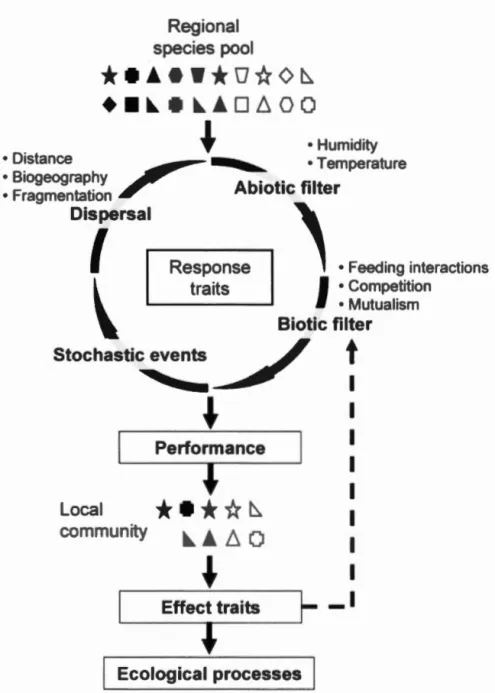
Hypothesiz d process leading to a local species and trait assemblage fr m a regional pool. The regional speci pool i first detennined by e olution biog ography and immigration/errugration witb other regi ns. To establish tbemsel es in the local cornmunity species need to go tbrough three filters acting imultaneously (represented as a cycling process with xarnples of lirniting factors selecting species based on tbeir re ponse traits. Performance repre ents growtb rate urvi al rate and fecundity. A feedback loop i expected between effect traits and the biotic filter represented a a dasbed line ... .
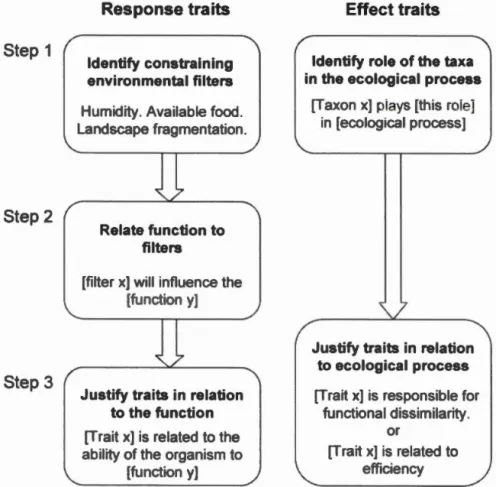
Scbematized representation of a step-by-step protocol to postulate cJear hypotbeses in re ponse and ffi ct trait studies of artbropods ... .
Pag
20
22
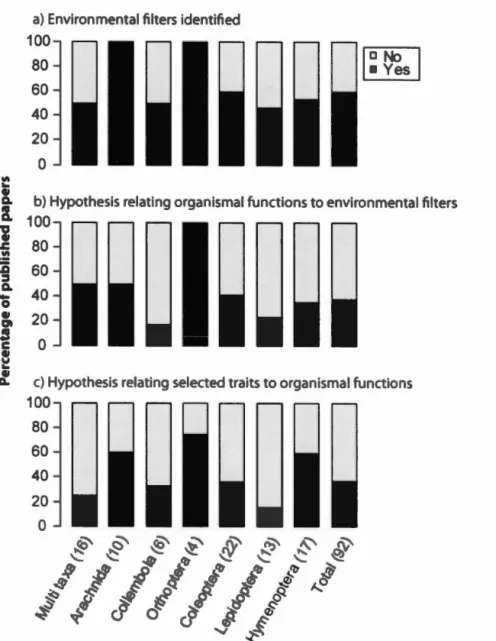
1.3 Percentage of publisbed papers on respons traits of terre trial
.1
.2
arthropod clearly identifying limiting en ironmental filters and bypotbe es linking trait organi mal functi ns and filters. umb r in parentbe e are th number of published paper per
taxa... 24 Principal cornponent analysis P A on th abundance of leaf
specie found in the forest litter in tlrree sites in outbem Québec: circl = Mont- t-Bruno· square = Mont- t-Hilaire· triangl = Mont-Écho ... . Principal c mponent analysis P A on the abundance of pr y
peci tl und in the fore t litter in three sites in outbem Qu'bec:
circ! = M.ont- t-Bruno· quar = Mont- t-Hilaire· triangle =
Mont- 'ch . Red = Diplop da Blue = ol optera Green =
Lepidoptera Pink = Dipt ra Dark green = Me ptera. "(La. "
a id the name indjcat a larval sta0 ... .
76
x Figure 3.3 3.4 3.5 3.6 3.7 3.
Redundancy analysis on the distribution of decompo er and predatory arthropods species of forest litter sampled in three ites in soutbem Québec: circle = Mont-St-Bruno· quare = Mont-St-Hilaire· triangle = Mont-Écho. Blue arrows = significant
ariables based on permano a ... .
Representation of RDA on the distribution of fi e feeding traits of decompo er arthropods of forest leaf litter sampled in three sites in outhern Québec based on their ommunity Weight Mean WM) and functional di persion (FOi ): circle = Mont-St-Bruno· quare = Mont-St-Hilaire· triangle = Mont-Écho. Blue arrows = significant ariables based on permano a ... .
R pre ntati n of RD n th di tribu ti n f thr fe ding trait of predatory arthropod comrnunities of forest leaf litter ampled in tbree site in outhem Québec ba ed on th.eir community weight mean ( WM and functional disp rsion FOis): circle = Mont- t-Bruno· quare = M nt-St-Hilaire· triangle = M nt-Écho. Blue arrows = significant ariables based on permano a ...
Procru te analyses on the community weighted mean (CWM of three palatability traits of leaf Iitter (red arrow) and fi e feeding traits (blu of arthropod d compo ers in three ites of uthem eb c, r for each ite s parately: circle = Mont- t-Bruno; square= Mont- t-Hilaire· triangl =Mont-Écho ... .
Procru te analy es on th functional di persion FOis) of three palatability traits of leaf litt r red arrow) and fi e tl eding trait
blue of arthr pod decompo ers in three ites of southern Quebec or for each it separately: circle = Mont- t-Bruno· square= M nt- t-Hilaire· triangle= Mont-Écho ... .
Procruste analy e on tb comn1unity w ight d mean CWM and functional di persion FOi f three palatability trait of prey r d arrow and thr e tl eding trait blue) f pr dator in three ite of outhem Quebec, or for each ite parat ly: circ] = Mont- t-Brun · quar = Mont- t-Hilaire· triangle = Mont-Éch . Only ignificant anal y e ar hown ... .
Page 81
82
83 5 6 87X1
Figure Page
D.l Pred]cted probability of interaction between a arabidae and a prey as a function of mandibular strength of the predator and the cuticular tou hness of tb prey ba ed on the matcbing-centrality formalism in a GAM rn d l with three different alues for the smooth term. Preructed probability of interaction decreases from
green to red... 1 4 D.2 Predicted probability of interaction between a arabidae and a
prey as a function of eye size of the predator and the speed of mo ement of the prey based on the matching-centrality formalism in a GAM mode! with three different alues for the smooth term. Predicted probability of interaction decrease from
green to red... 155 D.3
D.4
Predkted probability f interaction between a arabidae and a prey a a function of their respecti e body length based on the matching-centrality formalism in a GAM mode! with thre different alues for the smooth term. Predict d probability of interaction decrease from green to red ... . Predicted Predicted probability of interaction between a arabidae and a prey as a function of mand]bular gape of the predator and th body width of the prey based on the matching-centrality formali rn .in aGAM mode! with three different alues for the smooth term. Predicted pro babil ity of int raction decrea es from green to red ... .
156
--- - - - -
-Tableau 2.1
2.2
LI TE DES TABLEAUX
Li t of ground be tle species studied and summary of the
realized
+
and unrealized -) interactions observed in thefeeding experiment deri ed from the literature only realized (Lit. (Larochell & Lari ière 2003) or from forbidden links
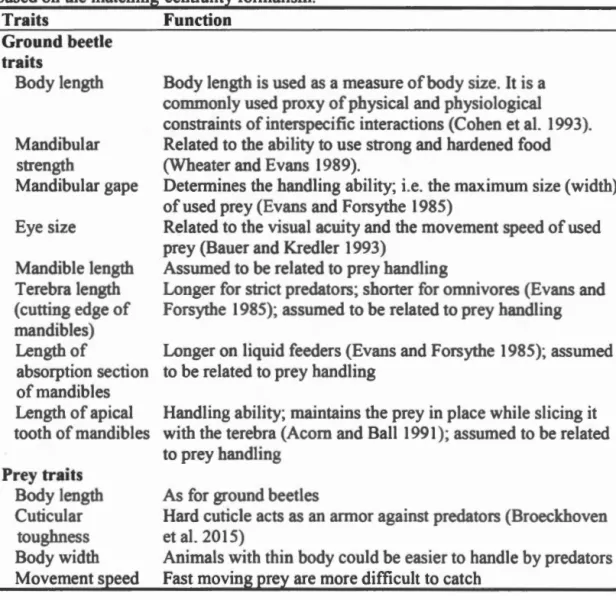
FL and the total of interactions includ d in the anal y is ... . Traits considered in the in esrigation of ground beetle/ pr y interactions ba ed on the matching-centrality formalism ... . 2. Goodnes of fit of two null models, of the two be t models out f
511 tested mode! best overall and best parsimonious and of ali
us d terms tested indi idually four trait-matches four
unmatched traü and a phylogenetic term to infer ground beetle/
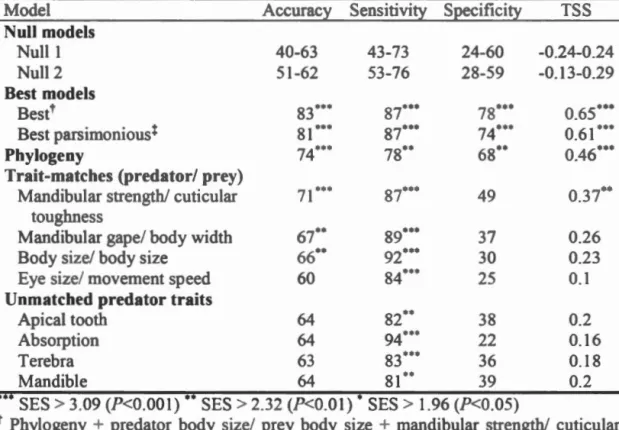
prey interaction bserved in a feeding xperiment. Null model 1
is a complete randomization of the ob rved interaction matrix while nul! model 2 is a randomization of prey pecies only. Value for the null model repre ent the lower and upper limit of a 95 % confidenc interval for 10 000 iteration . "Be t'' i the mode] with the hi h st T without li mit of terms wbile "Best parsimoniou " is the mod l with the lowest nurnber of t nns and a similar T to the 'best' model. ignificance of ea.ch g
odness-f-fit aspect wa determin d by calculating standardized effect
Page 4 47 SIZ ES ... ··· 54 .1 3.2
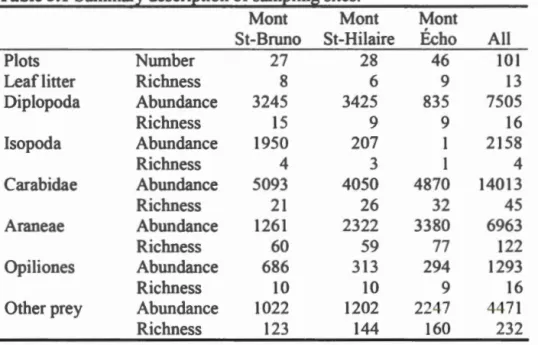
ummary description of ampling ites ... .
ummary stan t1 (F- alue and statistical ignifica.nce of
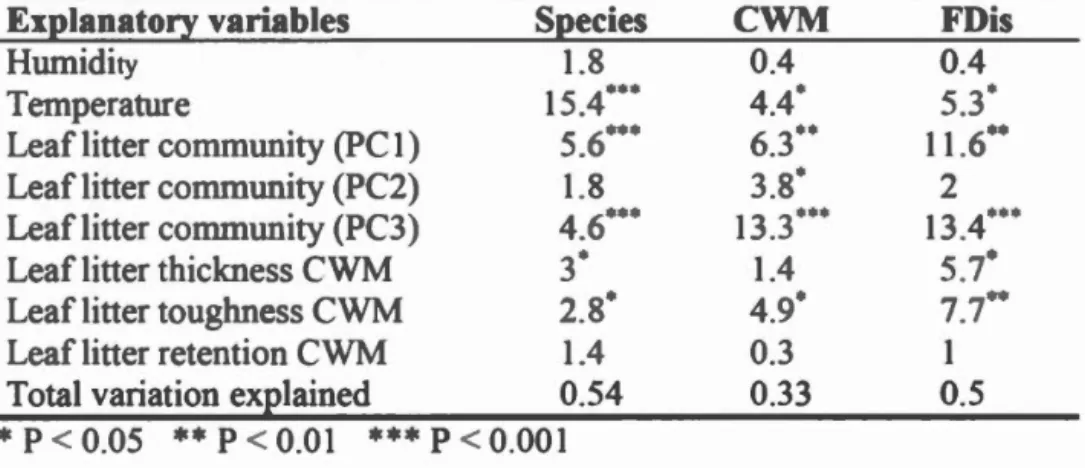
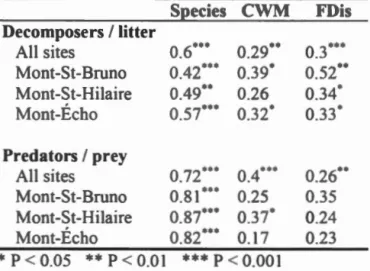
R dundancy Analy i RDA) perfl m1 d on de omp s r commumt1 s. pe i composition c mmunity weigbted mean WM and functional dispersion FDi of fi fi eding trait (body olum mandibular gape biting fi rce at th tip of th mandibles bitin0 fi rce of the rn rtar re ion of the mandible and the length/width rati of the mandibl s arec mpar d ... .
78
X1
Tableau
.3
.4
A.l
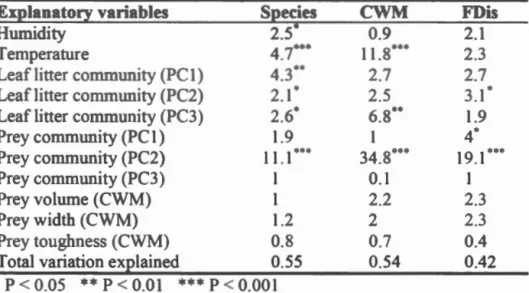
Summary tatistics F- alue and statistical significance) of Redundancy Anal is RDA) perforrn d on predator cornmunirie . Species compo iti n cornmunity weighted mean WM and funcrional di pers ion FDis) of fi e feeding traits (body olume biting force and the length/width ratio of the mandible ) are compared ... . orrelation between the P A of the functional structure (community weighted rn an ( WM) and functional dispersion Dis ) and species structure of arthropod de omposer and leaf litter commumtte and artbropod predators and prey communities ba edon Procru te analyses ... . xample f sentence id ntifyin the hyp th r lating the filter , the function and th trait in the tud f th functional trait approach with terr trial arthropod ... . A.2 ynthesi of the principal functional tralts found in the t nes trial arthrop d literatur and relation to their hypothesiz d function. Function were gr uped in r larion to their link with dispersal abiotic and biotic ecolo ical filt rs or associated ecosy t rn proce es. B dy siz was kept apart as it is related to the tbr e categori . Trait for whi h the function wa n t d crib d in re i wed literature were put at the end of the table. umb rs b side ta a refer to th r fer n e li t. For a b fun tion tralts ar ord red ba ed on their c mm nnes in th lit rature. In man ca es the link between th trait and the funcrion is pur ly hyp th tical. Type repres nt: M= Morphology P= Physiology L
Page
80
84
105
= Li fe hi tory B= B ha iour and F=Feeding... 107 B.l era trait alue of gr und be tle arabidae p ci u d in
a fe ding xp rim nt. Wb n multipl indi idual w re rn a ured the tandard d iation i gi en. Detail n trait mea ur rn nt are pr id d in Annex ... . B.2 Trait alue of th pr u d in the feedin xperim nt. The range of aJu i gi en and the nurnber f rn a ured pe imen are h wn in [ ] when multipl indi iduals wer mea ured in th nt. D tail on trait rn asur rn nt are pr id d in
- - - -- - - -- - -- - - -
x
Tableau Pa e
E.1 Goodness of fit for ali potential combinations of four trait-matche and four unmatcbed traits with and without a phylogenetic tenn. For eacb model interactions between 20 arabidae pecies and 11.5 prey species were predicted based on the matching-centrality formalism in a general additi e mode]
(GAM). Models are ordered by the true sklll statistic alue
TSS . H ighlighted models represent the best and the mo t
par imonious ones... 159
l.B Liste des espèce nouvelles pour le Québec trou er durant ce
projet et leur répartition dans le site échantillonnés: B
=
St-Bruno H = St-Hilaire, MÉ = Mont-Écho Au = Autre. Un '?'RÉ UMÉ
L'approche par traits fonctionnel est bien implantée dans l'étude de l'écologie
égétale mai demeure plus marginale en écologie animal . Le principe de
l'approche fonctionnelle est de r li r les traits (morphologiques phy iologiques phénologiques ou comportem ntaux) des organismes à de gradients en ironnementaux ou des proce us écosy témiques dan l'optique d'identifier les mécanismes impliqués. Depuis quelques années un intérêt grandissant pour l'étude des traits fonctionnels des animaux s'est dé eloppé pour répondre a de question sur la structure des réseaux trophiques et leur impact sur les services écosystérniques. L'objectif de cette thèse est d'identifier des traits fonctionnels des macroarthropodes de la litière forestière permettant de prédire leurs interactions et oir comment ces traits sont di tribué dans l'espace. Une in1portance particulière a été accordée aux trait reli' à l'alimentation. La pr mière étape a été d' ffi ctuer une revue de littérature sur l'utilisation de l'approche par traits fonctionnels chez les arthropode terrestres qui a r · élé plusieurs lacunes. Premièrement dans plu i urs publication il
y a un manqu de transparenc dan l'élaboration des hyp thè e . De façon plus
g 'nérale il y a un manque de cohésion entre les 'tudes limitant grandement les gén 'ralisations. ou y présentons un cadre de tra ail pro nant de la littératur sur
le végétaux p ur élaborer des hypothèses permettant d'identifier le mécanismes
impliqué dans l'as emblage d ommunauté trait répon es t le pr cessus ·co ystémiques traits ffets . D plus nou uggérons une plus grande inclusion de traits 1 ié à la biomécanique et gén ·ra li ables à un larg · enta il de taxa en prenant omme exemple les traits d'alimentation. L'objectif du deuxième chapitre était de cr' er un modèle prédictif des int raction prédateurs/ proie en ce ba ant ur leurs traits respectifs et leur phylogénie. ne expérience a été réalisée durant laquelle 20 espèce de carabes étaient mises en présence d'une grande ariété de proies (une à
une pour déterminer s'il y a ait un int raction entre elle . De traits comm la taille du prédat ur t de la proie la ~ rce d s mandibules du pr ·dateur t la dur té de la cuticul d la proie ont été utili és pour con truire le rn dele. e trait permettent de prédire corre t ment - 76% de int ra ti ons (r ·ali ées et non réa li ées combinées) de carabe mais ne permettent pa de bien prédire le int raction non réa li · e . Par
contr l'introduction d'une compo ante phyl génétique a i ant hyp tbétiqu rn nt
comme une appro imation pour de trait non mesur comm les défen
chimiqu am 'li r grandement la prédicti n des interaction n n r ·ali 'e . u final le mod' 1 pr 'dit rr ctement- 0 % d int ractions. Dans 1 chapitre 3, nous nou int 'r n à la di tribu ti on dans l'espac d trait d'ali rn ntation d dé mp urs et de pr 'dateurs i a nt dan la litière fore ti' re et c mment il arient a ec le facteur abiotiques et les traits d palatabilit · des res ources. Le macroarthrop d s
x 111
ont été échantillonnés dans 110 parc Iles réparties dan trois sites du ud du Québec.
Le diplopodes i opodes (décompo eurs araignées opilions et carabes prédateurs
ont été identifiés à l'espèce. Les traüs de palatabilité ont été mesurés pour les feuilles
de la litiere (épaisseur dureté rétention en eau et les proi s taille largeur dureté
et les traits d'alimentation pour les décomposeurs et prédateurs (taille force et taille
des pièces buccale . Les résultats montrent que les traits d'alimentation des
décomposeurs et des prédateurs co arient a c les facteur abiotique température et
humidité) du milieu. De plus les traits d'alimentation des consommateurs et de
palatabilité des proie co arient conjoint ment dans l'espace. L s r · ultats de cette thèse démontrent le potentiel que représ ote l'étude d s traits fonctionnels des
arthropodes pour comprendre la dynamique des réseaux trophique et l'assemblage des espèces. De plus des traits généralisabl à une grande ari 't · de taxa comme la
force des pièces buccales et la dureté d la cuticule ont été identifiés. Quelque
lacune 1 limitati ns de l'approche ont également mises en lumière· ce asp cts
devront être considérés dans les prochaines anné s pour rendre l'approche pleinement
fonctionnelle.
M ts clés: raits fonctionnelles arthrop d s r ·seaux trophiques int raction prédateur 1 proi
L
TROD TION
Le ol fore tier outient un ré eau trophique complex
champignon bactéries amibe flagellés némat d s
arthropode et petits rtébré Maraun et al. 2001
et dj rsifié campo é de
gastéropodes ann ·li des oleman et al. 2004 . Le
interactions entre ces différents organismes ont un impact plu ou moins direct sur le
processus de décomposition et de minéralisation de nutriments de V rie et al. 2013 .
Démêler l'en emble de ces interactions t quantifier leur importance est une tâche
hautement complexe mais néces aire pour comprendre et prédire leur dynamique
Gra el et a1. 2016 .
L'' colog]e en générale est dan un be oin de dé elopper une approche plus
pr · dicti e parti cu li· rement dans le contexte mondial des changements gl baux
McGill et al. 2006 Kerr t a1. 2007 W odward et al. 201 0). Dans le cas de
l'écologie du ol où la di ersit' st très éle ée a ec de nombreuses esp 'ces
microscopiques et ù la majorité des interactions s'effi ctu nt de façon cryptique les
outils prédictifs pourraient aus i aider à identifier les interactions inter pécifiques
Morales- a tilla et al. 20 15). n outi 1 potentiel sou ent é oqué est l'approche par traits fonctionnels (McGill et al. 2006 Morale - asti lia et a1. 2015 Gra 1 et al. 2016 . Par contre c tt approche a principalement ét' dé lopp 'e a ec 1 plantes et
e t ncore en c urs d dé eloppement pour les autres organismes.
r ·if' 1 d' mp iii 11
La d' c mp ition t un pr cess us 'co logique de base dans le cycl des nutriment
2
que l'azote et le carb n ( sont min'ralisés ( oûteaux et al. 1995 . n mili u forestier plus de 80% du mat'riel ég'tal n'est pas consommé par les herbi ores et
doit être décomposé ebrian 1999 . Les feuilles représentent la part la plus
importante d débris · g 'taux au sol (Gessner t al. 2010 . Les microbes (bactérie et champignon ) sont le organismes l s plus di ersifi 's du ol a c au-delà d 26000
peces par gramme d s 1 dans le ol for sti r R e ch et al. 2007 . Ll ont les principaux re ponsabl de la dégradation de la mati' re rganique et du r tour des nutriments aux plante ( ol man et al. 2004 . Les micr bes repré entent égal ment la
principale source de nourriture de plu ieurs membres de la microfaune amibes
rotifères nématodes) et de la mésofaune c llemboles acariens .
L'acri ité des animaux ba t 'riophages et fon0i or sa un impact ur la minéralisation
d nutriments. Par x mpl collemb le et le nématodes fongi r p u nt
a oir un effet p sitif ur la quantité de disponibl dan 1 ol en timulant la
croi sance des champiQll ns h n et Ferris 1 99 ra g et Bardgett 2001 Filser
2002 . es ffets vont ar1 r lon le espèce en pré ence mais le mécani me
au-delà des préférenc pé ifique (brouta ge sp 'cifique ragg et Bardgett 2001
rowther et A'Bear 2012 ont mal connu .
La macr faun e t constitué principal ment d'arthr pode , ann '!ides t
gast· r pode . Traditi nnellem nt leur rôle dans la décomposition e t perçu comme étant r lié à la fragrn ntation de la litièr Van D r Drift 1951 oleman t al. 2004
Da id et Handa 2010 mai ce r le t maintenant cont té (Da id 2014 pui que
leurs boul tte fécales n emblent pas se déc mpo r plu rapid ment que la litière ichol on t al. 1966 Rawlins t al. 2007 Fr uz et ... im k 2009 .
p ndant c étud boulette fécale de peu d' p ·ce de
d' c mp urs g · néralem nt n urri ur d feuille pr
d'arbre. De plu l'int · grit · tru turell des b ul ttes fécal
nant d'une s ul espèce
·tait c n rv 'e · i. . e 11 e n' nt pa 'té ·cras ·es u fragmenté ce qui ne fa ori e pas une max imi a ti n de la
3
surface de contact des fra ments · gétaux. Par ailleurs une étud r · cente démontre que dan c rtains cas le fèces peu ent se d ·composer plus rapidem nt que la Ji ti ère en fonction de transformations chimiques subie durant la dige tion mais les cau es e actes n ont pas c1aires ou li et al. 2016 .
Quoi qu'il en soit les macro-d 'triti ores ont généraJement un impact fa orable ur la flore microbienne en stimulant leur acti it' dans les fèces fraîches Rawlins et al. 2007) en relâchant de l'azote sous forme d'ammonium dans leurs déjections ârcarno et al. 2000 et en fracturant les cellule de la litière en la c nsommant Frouz t imek 2009). L'apport des fèces dépend à la fois de la nourriture con omm· e Coulis et al. 2016 et des caractéristiques d'ingestion t de di ge ti on des con ommat urs Frouz et imek 2009 . Des différences importantes sont bservées entre les grands groupes tax nomiques ( e.g. le tl' ce de ers de terr ont plu riches en que c ux des mill -pattes (Hedde et al. 2007 ) mais aussi ntre des e peces proches é oluti ement (Hedde et al. 2007 Frouz et .. imek 2009 ou lis et al. 2015 . Le fèces de décomposeurs ont un intérêt particulier puisqu'ils représ ntent un lien dir ct a c les microbes. L'impact d fèces ur 1 microbes et la décompo ition en général a dépendre de ces caractéristiques telle le ratio :N, le degré de fragmentation de débris égétau et leur c mpaction (Hedde t al. 2007 Frouz et Simek 200 Da id 2014 ouli t al. 2015 . es d 'jection des prédateur i ant dans la litièr foresti 're et 1 ur impact sur la flore microbienne ne s mbl nt pa a otr été étudié s. Par contre l fèc des prédateur nt c noues pour être très riches en N (R rnero et al. 2006 t don devraient tre fa orables à l'acti 1t · bactérienne à court tenn tout en possédant tr' p u d'élém nt r · calcitrants. Particulièr rn nt le N est ous forme de guanin dan les fèces d'araign · chmidt t al. 1 5 un amin acid facilement ab orbabl .
Les x rn pl pré enté dan c tte ectioo font le li n entre 1 di ffi' rents ni aux trophiqu d façon lin· air . enre d'obser ation t n ·ces aire p ur c mpr ndre
4
les interactions de ba e et le fonctionnement de écosystèmes. Dans la réa lit· les
int ractions ne sont pas linéaire . Par exemple les macroarthropodes n'utilisent
généralement pas la litière fraîche préférant la litière pr · décompo ée et conditionnée
par les microbe (Wolter 2000 De Oli eira et al. 2010 Da id 2014 . Pour pou oir
comprendre et prédire la dynamique de éco y tèm et son impact sur les processus
comme la d ·corn po iri n il est important d'étudier 1 systèmes dans 1 ur entière
complexité Duffy et al. 2007 .
Ré aux trophiqu du ol
Une façon implifiée d ir la d 'compo iri n t d con idér r que troi ru eaux
tr phiques ont direct ment impliqu · · l s plant fourni ant le matériel de ba e 1
microb et 1 s décompo eur . À ceu -ci s'ajoutent le prédateurs qui ne ont pas
dir ct ment impliqué dans la décomposition. Plusieur étud d'montrent
qu'augmenter la di er ité a un ou l'autre des ni eaux tr phiques peut augmenter la
ite e d déc mp iti n: di r it' de plante (H ctor et al. 2000 P · r z
Harguindeguy et al. 2008 , di ersit' d s microbes ll et al. 2005 Gra el et al.
20 Il) di rsité des d'corn po eur ri a ta a t al. 200 Handa t al. 2014 . Par
contre plu ieurs résultat contradictoires sont ·gaiement ob ervés Griffiths et al.
2000 Bonanomi et al. 2010 q et al. 2011, is nhau r t al. 2011 . P ur expliquer
ces résultats c ntradictoire plusieurs ont ·mi l'hypothè e que la di ersité
~ neri nnelle à un plus grand impact que la di r ité pécifiqu ur la it e de
d ·corn po iti n McTieman et al. 1997 He rn b r n et al. 2004 Hatten ch wiJer et
al. 2005 himel t Ha tt n hwil r 2007 11 . Par di r it'
fonctionn Ile nt ent nd la di r ité d ph· no logiques
ph i Jo iqu et comp rtementale d rgani rn s r pr nté dan une
5
En th' orie, une augm ntation de la di ersit' devrait a oir un impact positif sur le r ndement des processus écologiques en fa arisant la complém ntarit' entre les espèces (Loreau et al. 2001). La complémentarité peut s'exprimer d deux façons: 1 par un s 'paration de niche fa arisant une meilleur utili ati n des re source disponible .g. une ariation dans la température optimale d'acti ités ntre les e peces d'ab ill es augmentent le taux de fl urs pollinis · Fründ et al. 2013 · 2 par un processus de facilitation (De Oli eira Haett nschwil r & Handa 2010 . ependant la maj rité de études ont 'té réalisées sur un seul ni eau trophique (mais oir Naeem et al. 1994 . Déterminer l'impact de changements de di ersités à plusieurs ni eaux
trophiques peut être difficile puisque plu i urs méchanisme sont impliqué Duffy et
al. 2007 . D'une façon général il faut s'attendre à c qu'une augm ntation de la di r ité à un ni eau tropique augmente l'utilisa ti n des ress ure à ni eau précéd nt (Loreau 2010 . L'impact sur le ni eau inférieur est difficilemet pré isible mais l'impact de rait etre de moins en moin fort ur le ni eaux sub équent" donc
plus le ni au trophique est éloigné du processus étudié moins sa di ersité
foncti on elle de rait l'affecter (Lore au 2010 .
Peu d' 'tudes ont étudi · imultaném nt la di er it' spécifique ou fonctionnelle à plus d'un ni eau trophique dans la décomposition mais le peu de résultat ur 1 sujet semble démontrer un impact positif de la dj r ité d s décomposeurs (Handa et al. 20 14). n impact de la di er it' d décomp eur ur la décomposition e t plus probable i on onsidèr un système natur 1 où les feujlles présent nt dans la litiere possed nt d traits et des stades de décomp iti n différents· dan un tel scénario
une utili arion différente de ress ure par différentes e pèces de décomposeurs
risque d'ace ï 'r r la ite s de déc mpo iti n. Il n mble pa qu cett hypothè e ait ét' te t · e ju qu'à pr' nt. étude rn ttant n r lati n d d ·campo eur a ec d typ d'alimentation différ nt tendent à d ·montrer un ffet yn rg 'tiqu sur la ites e de d · omposition (Hatten chwil r t Ga er 2005 Zimmer et al. 2005 Partsch t al. 2006 D 01 i ira et al. 2010 ou li t al. 2015 . L'impa t d la
6
di ersité des pr 'dateurs n'a quant à lui jamais était formellement étudié majs certains résultats emblent démontrer que l'impact des prédateurs dépend a ant tout des proie utilisées Lawrence et Wi e 2004 chmitz et al. 2010 .
Les interactions réalisée jouent un rôle important dans la ites ede d'composition et la di ersité a probablement un effet positif sur la décomposition n fa ori ant la di ersification des interactions réalisées Kardol et aL 20 16). ependant identifier les interactions dan le réseau trophique du ol p ut représenter un défi majeur en con idérant la di ersité spécifique et la difficulté taxonomique qu'elle r pr' ente la petite taille de plusieurs esp ·ce et 1 s interactions s u ent cryptiques Bro e et cheu 2014 . T ut de mAme différents réseaux trophique du sol ont été décrits ( cheu 2002 Berg et Bengtsson 2007 H ltkamp et aL 200 mais les lien ont ou ent gros ier i.e. il nt décrits entr des groupes tax nomiques ou de guildes large (bact 'ries n'mat des omni or acari ns prédateur co1lemb les plutôt qu'entre les espèce . e manque d ré olution ta onomique p ut cr' er un biai d'interprétation en ayant une influence sur la structure et les propriétés de ré eaux trophiques (Sechi t al. 201 . Récemment Di 1 t al. 2014 ont publi' le ré eau trophique du ol d 16 forêt Il magne en ce basant à la fois ur d te t d'alimentation des donnée rn lé ulair s et i topiqu des trait écologiqu t d r lati n allom 'triques d taille. e d u d miers point ont particulièrem nt intér ssant pui qu'il r fl' tent deux aspects déterminant la probabilité d'int racti n entre deux la probabilité d'un r ncontre t 1 couplage des traits du prédateur t de la pr ie Gra el et al. 2016 . Dé elopper d util prédictifs pour l s interaction st n 'c a1re pour pou ir 'tudi r les r ·seaux trophique à large · cbell et pour prédire l'impact des introducti n t des pert d' p ces dans 1 s éc s st ·me · 1 trait [1 n ti nnels pourrai nt aid r à répondr à c b in Gra el t al. 201 M
7
Trait
fi
11 lionn 1 d arthr 'P de.L'approche par traits fonctionnels a principalem nt 'té d · eloppée a c les · gétaux
La orel et al. 2007 Vialle et al. 2007 Garni r et al. 20 16) et repose sur deux principe de bases: le "traits r'ponse " des organismes déterminent 1 ur capacité de survie et de reproduction dans un milieu en fonction d ses caractéristiques abiotiques et biotique Keddy 1992 · les "traits effets" des organi mes déterminent leur impact
sur 1 s proc écosystémique Chapin et al. 2000 . L'approche par traits
fonctionnels présente une capacité de généralisation plus grande que l'approche
tax nomiqu traditionnelle et facilite l'identification des mécanismes menant à
l'assemblage d s e pèces t déterminant les pr cessus ·cosy témique McGill et aL
200 hi pl y 2010 Lau ghlin 2014 .
hez les animaux les traits fonctionnels ont 'té étudjés dans un grand nombre de
group incluant les mammifères Da ies et al. 2007) les oiseaux ( r ci et al. 2008)
le poissons Mouillot et al. 201 les in ertébré aquatique (Poff et al. 2006 et du
sol (Hedde t al. 2012 nématodes Schratzberger t al. 2007 tc. ependant
peu d'études ont tenté d'unit! rmi é l'appr che fonctionnelle a ec 1 s animaux en
tenant compte de leurs particularité d'hétérotroph Luck et al. 2012 Pey t al. 2014b Fountain-Jone t al. 2015 . Une exception notable est chez le macro-in ert 'brés aquatiques sseglio-Polatera et al. 2000, Bêche et al. 200 Poff et al. 2006 pour 1 squels une culture de las ification d or anismes n fi nction de leur trait e t plu anci nne ummins 197 . Le cas d arthropodes t rr tr p se un
problème particulier de par 1 ur rande di r ité pécifiqu d fi rm et d nich .
Plu ieur 'tude nt utili é l'approch par trait fon tionnels a ec les principaux taxa
comm le acan ns Maal3 t al. 201 Mari t al. 201 arajgnée Bonte t al. 2006 Pod aiski t al. 201 coll mb 1 (Malm tram 2012 antorufl al. 2014 orthoptèr (Dziock et al. 201 1 D raison et al. 2015 c léoptères t al. 2001 Watts t Ma on 2015 abeille (H hn t al. 200 Fründ t al. 201 tc. mai une
8
approche collecti e générali able à l'ensemble des taxa est toujours manquante. L'approche par traits fonctionnels a c le arthropodes a principalement 'té utilisée pour décrire leur répon e à différentes perturbations ( man et al. 2013 Hedde et al. 201 Bachand et al. 2014 t dan quelques cas pour décrire leur impact sur les processus 'co ystémique He rn bergen et al. 2004, Fründ et al. 2013 Munyuli 2014 ulisetal.2015 .
Un aspect intéressant mai moins étudié est l'utilisation du couplage de trait entre différentes espèces pour décrire ou prédire leurs interaction potentielles Rohr et al. 2016 . L'int 'rêt est d'identifier les traits des res uree qut nt impo er une contrainte sur les traits d'alimentation du consommateur. Par exemple la 1 ngueur de la langue d'une abeille a d'terminer le fleur p tenti llem nt utili ' s n fonction d la profi nd ur d la cor Il Ibanez 20 12). hez 1 i eaux frugi ore la tai li du bec dét rmine la taille de fruit con ommés Dehling t al. 2014 c qui à un impact sur la taille des raines di per 'es par l'oiseau (Moran t atterall 2010 . bez le prédateurs le ra6o taille du prédateur 1 taille de la proie e t un coupla e de trait important u ent 'tudié (Bro e t al. 2006 Gra el et aL 201 . Le d mande éner étique p u ent égal ment contraindre les interacri n · ainsi 1 à nage rapide t à haut d mand én r 'tiqu ont tendanc à pri il' gi r de
haut t n ur caloriqu et lipidique pitz t al. 2014 . Finalement d traits biom 'canique comme la fore des pièces buccal p u ent égal rn nt c ntraindre la dureté des plant utilisées par les herbi ores Ibanez t al. 201 . Par c ntre les 'tudes ur le couplag de trait a c les artbr podes e limit nt aux
gr
upes h rbi or lnouye 19 O· Kunte 2 07· Ibanez 2012· lbanez et al. 201 · D rai n t al. rt et al. 201 t 1 trait d'alimentati n t de uln 'rabi lit· dans 1 s r la ti ns prédateur 1 pr ies nt mo in bi n c nnu. D plus, ju qu'a tr' r 'c mm nt L Pr t t al. 2017 aucun 'tude n'a ais anal ' si les ariatioo dand lealeur d traits ntr les mm unit' d'un ni eau tr phique pou ai d 't rmin' les ariati n de al ur de trait au autr ni eau tropbiqu .
Obje tifi
L'objectif de cette thèse est d'identifier des traits fonctionnels des macroarthropodes d la litière forestière penn ttant de prédir 1 urs int racti ns t oir comment ces trait ont distribués dans l'espace. ne importance particulière a 'té accordée aux traits reliés à l'alimentation pui qu'ils sont directement reliés aux interaction int r pécifiques et que cet aspect a été rarement traité dans la littérature a ant le début de ma thèse en 2011: depuis quelque tra aux 'y sont attardés ( e.g. Ibanez et al. 201 Deraison et al. 2015 . Idéalement l'ensemble des intéractions i.e. alimentaire compétition abiotique etc.) de raient être analysées pour déterminer l'importance r lati e de chaque. Par contre les connaissances actuelles ne permettent pas de la faire ans inclure des xp · rimentation pour bien identifi r les trait pertinents pour repré enter adéquatement chaque type d'interactions. Les trait d'alimentation nt été pr · ilégié car ils sont directement relié à l'utili ation des re sources (donc reli' à la compétition et sont mieux connu dans la littérature sur la morpholo ie foncti nnel1e des arthr pode .
L chapitre 1 est une r ue de la littérature critique ur l'urili ation d l'approche par traits~ ncrionnels a ec les arthr podes terre tre . L'objectifpremi r 'tait d faire une synthèse des djfférents traits utilisés dans la littérature et de oir c mment il 'taient reli' aux filtres environnementaux. ette revue a p rmis de mettre en lumière c rtain problèmes reliés à l'application de l'approch a e les arthr pode affectant particulièrement le potenti 1 de généralisation d certains r' ultats. n ce ba ant ur les ba es po ée par n s prédéc s urs dan l' 'tude de traits de arthrop d s t en é olo i il e t pr po é des recommandations quant à la 'le ri n des traü
'tudi' et ur la gén 'ralisation d traüs ntre taxa. ntr autres il est ug 'ré d'ac rder une plu grand pl ac aux trait biom 'caniqu en pré entant des mple reli' aux traits d'alim ntation. e chapitre t en ré i i n et era r oumis au ours d l'automne à~ urn 1 of Anim 1 ' ·olo
10
L'objectif dans le chapitre 2 est de dé elopper un modèle prédictif les interactions prédateurs-proies basé ur les traits fonctionn 1 t la phylogénie. L'hypothèse d d'part était que l'occurence des interactions est d 't rminé par le couplage des traits d'alimentation des prédateur et des traits de palatabil ité des proies. Par exemple la taille des prédateurs e t couplée à la tail.le des proies et la force des mandibules d s prédateur est couplée à la dureté de la cuticule de proi . De plus la phylogénie est introduite pour tenir compte de traits c mme le défen es chimiques des proies qui ont un effet di suasif sur certains prédateurs mais qui ont difficile à documenter et à introduire dans un principe de couplage de traits. L'hypothè e sous-jacente est que le pèces proche é oluti rn nt ont a oir de interacti ns a ec les même groupe d'espèces. ne expéri nee d'aJim ntation impliquant 20 e pèces de carab s a 't'
effectu ' pour récolt r 1 doon 'e d'int racti n . tt appr ch nous perm t
d'obtenir des information ur le int ractions réali ' mat égal ment sur celles non r 'alisées ce qui permet d mieux cerner l s contraintes d'interactions ntre prédateur et proie . De données d'interactions pro ena nt de la litt' rature ont également été utili 'es. e chapitre ra bient t soumis à Fun ti na/ •
Le troi i' rn hapitre st un 'tud sur la co ariation d traits d'alim ntation d s
macroarthrop caractéri tiqu abiotiqu t le
traits de palatabilité de 1 ur r uree. Les traits d ba ont très imilaire à
c u utilis' dans 1 chapitre 2 mais appliqu' à une plu grande di er ité d taxa.
L'hyp thè est qu le traü d palatabilité d s re urees a intluenc r la
di tributi n d'alimentation des con ommat urs c qut a r' ulter en une c aria ti n
et 'tudi'e pour d ux ni eau pr 1 macroarthr pod tr i si t du ud du
pac . La c ariation d trait d'interaction : d' c rn po ur -litièr et prédat ur
-nt t r 'parties dans
11
diplopodes et des isopodes les prédateurs par les carabes araignées et op il ions et les
HAPITRE 1
ON THE DEVELOPM T OF A F TIONAL TRAIT APPROA H FOR T RRESTRIAL ARTHROPODS
(En proce u de ré ision· rejeté sans préjudic dans Journal of Animal cology)
Pierre-Marc Brousseau1 Dominique Gra el2 and 1. Tanya Handa1
1. Département de sciences biologiques Uni ersité du Québec à Montréal Montréal Q H2X JY4 anada
2. anada Research haïr in Integrati e Ecology, Département de biologie Uni ersité de herbrooke herbrooke JlK 2Rl
14
1.1 Ab tract
The characterization f cological communitie with functional traits allows to con ider simultan ously the ability of a specie to survi e and reproduce in an en ironrnent, its interactions with other species, and its effects on the ecosystem. Despite its rec nt popularity in community ecology and biog ography functional trait ha e been studi d mainly by plant ecologi ts. Trait-based studies for other taxa including arthropods r main marginal. Arthropods repre ent a group for which a fun tional trait approach could be highly profitable becaus of th ir high di rsity, abundance ubiquity and role in many important cological processes. The literature re 1 w how that the appr ach i often used in the absence of a clear hypothe is-dri n approach which limits g n ralizations and tb ability t id ntify e ological m hani rn . T palliat the e probl rn , w pr po e a step-by- tep protoc 1 to po tulate clear hypoth sis b for selecting respon e or effect trait to tudie and integrate more generalizable trait . The functi na] approach with arthropod would benefit of th d lopment fa li t f trait determinin int r p ci fic int racti n . We
pr sent the c ncept of trait-matching with se eral e amples of arthropods traits
kn wn to be effl cti e predictor f their interacti n . Including th c ncept f trait-matching in functional approach with artbr pod could belp an wer que ti n related t re poo e and ffi ct trait . Th d el pm nt f a uc e fui functi nal trait approach for terrestrial anhr pods will neces itate an understanding f rele ant traits,
tandardized m asurement prot ol and op n a c to
har
thisinforrnati n. uch pr gr s will pro ide col g1 t with a n w t of tools to an wer
broad que tion in se eral fi Id includin0 the tudy of mmunity a mbly
1.2 Introduction
The u e f traits to understand the relationship of an organism to its en ironment ha been fundam ntal to ecology. While early studie on trait were limited to qualitati e
assessments of comrnunity structur e.g. Raunk:irer 1934 a new generation of studies i building on a wid range of quantitati e indices Mouillot et aL 2013
pro iding a more predicti e approach (Webb et aL 2010 and allowing for a gr ater empha is on understaniling function within ecosystem (La orel 201 . A "trait"
refers to any morphological physiological phenological or beha ioural cbaracteristic
measurable at the indi idual le el (Violle t aL 2007· Pey et aL 2014b). "Functional
traits" are "traits" eitber related to the performance growth rate sur i al or
reproduction probability of the organism to an ecologica] process
effect traits) (Vialle et aL 2007 or in some ca es to both La orel et aL 2013 .
While taxonomie tudie typically de cribe changes in community composition
functional trait studies aim to re eal the mechani ms behind these changes and their cons quences for ecological proce ses Shipley 201 O· ulp et aL 2011 . The appr acb builds n a higbly int grati e ision of the ecosystem. 1t considers simultaneou ly the ability of an organism to survi e and reproduce in an en ironment it interacti ns
with other organisms, and its contribution to ecosystem function Green Bobannan & Whitaker 2008). The concept transcend the notion of species making trait-based tudie more generalizable than taxonomie tudie by pro iding a cornm n currency to c mpare imilar communities from different re ions or en ironment with few
p ci s in common (M Gill t aL 2006 .
The description of ecol gical communities u ing functional traits is ba ed n two byp the s ba d r pecti ly n th Grinn llian and lt nian dim nsion of the nich ha e & Leib Id 200 . Fir t, th abi tic and biotic dimen ions f the eco yst rn act as filt rs selectin organism that ha e traits allowin them to urvt e and r produ e eddy 1 92 . ec nd organi m haring the ame trait ha a
16
similar effect on eco y tem pr ces es hapin et al. 2000 . o far the approach has been restr1cted mainly to plants e.g. ornelissen et aL 2003· Garnier & Na a 2012·
Reich 2014 but functional di ersity of ecosystem e ist at multiple trop hic le els
and increasing our knowledge of functional traits of animais bacteria and fungi is a priority Duffy et aL 2007· de B li et aL 2010· La or 1 et aL 2013).
The response tralt approacb is ba ed on the hypothesis that the en ironment (landscape abioric conditions and biotic interactions acts as a filter selecting
indi iduals ba ed on their traits (Diamond 1975· outhwood 1977· Keddy 1992
Figure 1.1 . pecies with the right traits in a gi en ituation will b more likely to increase their populari n ize througb hi her performance (growth survival
fecundity (McGill et aL 2006) and immigration rate (Pulliam 2000 . Respon e traits
are u ed a pro ies for pe~ rrnanc ioll t aL 2007 a perfonnanc an rarely be
rn asured dir ctly M Gill et aL 200 . As links are indirect measured r ponse traits
should be related to en ironroental filters (e.g. bumidity le el a ailable
n
od to diminish the risk of spurious interpretation. If int racrions between tralt anden ironmental factors are weil und r t od it i xpe t d that sp cie sbaring parricular traits will react similarly e en in differ nt geographical regions, thus r ling ec 1 ·cal mecbani rn in ol ed in community a embl hipl il &
Garnier 2006· bipley 2010· Laughlin 2014· adotte et aL 2015.
ffect traü d termine the impact of an organism on co y t rn proc es (Diaz &
ab id 2001 . col gical theory bas argued that c mmunities composed of sp ci es
with higb dissirnilarity b tw en their effect trait alue ould act compl mentarily
through nich paration and facilitati n Loreau & He tor 2001). It mean that a et f functionall diffl rent rgani rn can ha e a hi0ber ffici ne to a compli h a ta k (e.g. p llinati n decomp sition than e p ct bas d n their indi idual fficienc
L reau et aL 2001 . e eral xp ri rn nts ba e hown thi c mplem ntarity ffi ct
17
& Oakley 200 · De Qlj ira, Haettenschwiler & Banda 201 O· Gra el t al. 20 11· ou li et al. 2015). Effect traits cana Iso be used to e aluate the effici ney of different
organism to accomplish a task. For example hairiest pollinators are e pected to be b tter pollinators as they can transport a larg r amount ofpol1en ta ert et al. 2016 .
Arthropods are a key element of terres trial ecosysterns because of their high di ersity
abundance ubiqujty and their role in many important ecological processes including d composition Kocâr k 2003· Handa et al. 20 14) and pollination Aguilar et al.
2006 . They form the most di erse phylum of or ani ms with more than 1.2 million
species described worldwide and probably a many undescribed Grimaldj & ngel
2005 . The functional trait approach is therefore particularly uitable, allowing to
infer both abiotic (Kearney et al. 2010 and biotic niches (Eklof t al. 2013) where the
autoecology of peci is poorly k:nown Langlands t al. 2011 . ol1ecting sucb data
is time con uming xpensi e and for rare pecies practically impossible. till the
potential use of functional traits to predict the ecological impact and the niche of
arthropods remain largely unexplored. Also few papers summarize the
particularities f arthropods and h w functional trait h uld be implemented in
entomological tudies but see Pey et al. 2014b· Fountain-J ne Baker & Jordan 2015· M rettj t al. 2016 .
Our objecri e in this paper is to determine h w the functi na] trait approach was
integrated o far with terrestrial arthr pod and t propo olutions to impro the
outcornes of future re earch on the subject. T do thi w re i wed th literatur on
the use of a functional trait approach with arthr pods 1 to d termine if po tulated hypothe es permit to identify in ol ed ecot gical rn chani rn and 2) t ompile ali
the funcri nal traits of t rre trial arthr pods u ed in the publish d lit ratur u ing the
highligbt that the appr ach i often u d in the
ab ence of clearly p stulat d hyp thesi which limits gen raJizations and th abilit
weakly related to studied functions and cannot be gen raliz d througb taxa. To palliate the e problems we propose a st p-by-step protocol to postulate clear hypotbe is before selecting traits to studies and integrat more generalizable traits. We und rl:ine orne important aspects of arthropods tbat may impede the integration of functional traits if not bandled correctly sucb as tbeir bigh di er ity sex dimorphism and the diffl renee between lar al and adult stage . Finally we propo e a researcb agenda for the de elopment and application of the propo ed researcb approacb.
1.2 lnc n istent use of arthropod functi nal trait in the literatur
The literature r iew was done by earching publi bed studi son the Web of c1 nee and Google Sch lar with the criteria "traits"
+
"function*"+
ali principal ela s and rders ofterrestrial arthropods (e.g. "arthropods" "ins cts" "spid rs" "be tles" tc ..itation w r al o track d aero pap r . Only paper that were e plicitly traits or1ented were retained· i.e. papers that us d arthropod functional traits to study the re pons to a perturbati n or to an n 1r nm ntal fi1t r r poo e traits r their impa t on ecosy tem pr esses effi ct traits . We delib rat ly one ntrat d our r 1 w on tudies r fi rring t the fun ti nal trait appr a h and tb r for ign r d oth r tudies fi cusing on om aspect of rganism sucb a morphology but that ar not relating them to tb ir perfonnance or ec s t m pr c . We did n t include tudies wher the guild or trophic 1 el wa the only trait a th se typicall de rib a oup f pecie rather than a functional attribut p r . W al o r j ct d tudi ba d lu i ely on b d siz due t it mmonn and th difficult to formulate hypoth si relating tbi trait to a single en ironmental filt r ( e cti n 4 . The lit ratur re i w includ paper published b fi re January 2 17.
19
For ali published papers that included respon e traüs of arthropods we e aluated if
the elements present in the introduction material and methods and supplementary
materials permit to identify how the tudied traits are mechani tically related to the
subject of the study explicit examples in Table A.l). It mean that in a perfect
cenan we hould be ab! to say· 'if [trait x] ary between communities, [proce s y]
i in o1 ed in the structuring of the conununities'. More precis ly, we answered three
que tians Figure 1.2). First, we checked wbether environrnental filter abiotic
biotic and geographie) were clearly identified Bremner 2008). To a ess thi aspect,
we edfied if en ironmental gradients e pected to ary and thus act as filters, were
presented. Identified filter across studies were di erse and included humidity le el
temperature a ai1ab1e food di ersity of predators 1andscape fragmentation etc.
ase where filters were c1ear1y identified genera11y had a sentence in the form of
'We bypothesized a direct effect of [filter x] on [organisrn y] communitie '. Other
accepted forms were '[Perturbation z] is known to influence [filter x]'. ases where
the perturbation was related to the cornmunities without identifying any clear filters
(e.g. 'Land use will impact the community structure of [organism y]' were rejected.
Wben a gradient was identified, but that this gradient did not permit to identify the
filtering mechanism in ol ed the filter was considered as unidentified. For xample
it will bappen if a gradient of tloristic composition i identified with ut further
preci ion to determine if it affects eg tation structure di er ity of a ai1ab1e food
20
Regional species pool*••
*0*0~
··~
•o6oo
~
• Humidity • Distance , - • Temperature• Biogeography _A_b..._iotic filter
• Fragmentation Dispersal
1
~
Response traits ' • Feeding interactions1 •
Competition • Mutualism Biotic filter Stochastic events _ /t
...
.__~
-~
Performance Local Effect traits Ecological processes1
1
1
1
1
1
1
1
_l
Figure 1.1 Hyp thesiz d proc 1 adin t a local p cies and trait a mblag
fr rn a regi na! p 1. h r gi nal p ci s pool i fir t d t rmin d by luti n
bi ograph and immigrati ni migrati n with oth r rebi n . tabli b
th rn el s in th local c mmunity p ci ne d to through thr e fi lt r acting
imultane u ly r pr ent d a a yclin pr ess with arnpl f limiting fact rs
s lecting p ci ba ed n th ir r p ns traits. P rtl rrnan e repre ents gr wth rate
urvi al rat and tl cundity. A fe dback Jo p i e pect d b tween effect traits and the
21
econdJy we e aluated whether a clear bypothesis linking en ironmental filter to
organi mal functions was postulated aeem & Wright 2003). Functions w re
di erse and included d1 per al ab il ity feeding interactions thermal tolerance
fecundity etc. Table A.2 . For this aspect, we looked for sentences in the form 'We
bypotbesized that [fil ter x] will influence the [function y]'. We al o considered this
a pect fulfilled in sentences sucb as '[Filter x] can ha e a negati e/positi e impact n
pecies with a low/ high ability in [fonction y]'. It was consider d as unfulfilled if the
function was directly related to the perturbation but the filters were not clearly identified.
Finally we e aluated if the selection of ali traits was explicitly ju tified by linking
them to organismal functions and performance Luck et al. 20 12). W did not
e aluate if the traits were weil selected but only if they were adequately justified.
When adequately justified the information was often shown in a table with a column
'Traits' and a column 'Role' or 'Hypothesized mechanism'. Alternati ely it was sbown
in the text as a sentence of the forrn '[Trait x] is related to the ability of the organism
to [function y]'. a e wbere justifi.cations were considered as ague and thu
unfulfilled were examples uch as 'These traits are known to impact organi rn
performance' or '[Trait x] is related to [fonction y]' without pro iding any reference.
Only references explicitly demonstrating the mechanistic link between the trait and
the fonction were ace pted.
For tudies using effect traits of arthropod we aluated two questions Figure 1.2 .
Fir t we checked if the tudjed taxa were cl arly related to the eco1ogica1 proc Thi will gen rail y app ar in a s ntence of th form '[Taxon ] i kn wn to play a
role in [ecological process ]'. We al o accepted cases wbere the 'taxon x' was
replaced b 'guild x' when the taxon wa clearly related t thi guild.
condly we checked if the hypothesi r lating select d trait and the e ological
22
represent traits contributing to the functional dissimilarity and thus that are susceptible to create synergetic effect wben combined (e.g. pollinators with different phenology can pro ide ervices throughout the growing seasons) or they can be used
to compar the efficiency of different organisms. Otherwise this asp ct was
e aluated as for the respon e traits.
Step 1 Step 2 Step 3 Response traits ldentify constraining environmental filters Humidity. Available food. Landscape fragmentation.
Relate function to filters
[filter x] will influence the
[function y]
Justify traits in relation to the function [Trait x] is related to the ability of the organism to
[function y]
Effect traits
ldentify role of the taxa in the ecological process
[Taxon x] plays [this role] in [ecological process]
Justify traits in relation to ecological process [Trait x] is responsible for
functional dissimilarity.
or
[Trait x] is related to efficiency
Figure 1.2 chematized representati n of a tep-b - tep protocol to po tulate clear hypoth e in r p n and ffi ct trait studies of arthr pod .
Our r iew criteria i lded a total of 116 publi hed tudi Annexe A · the arlie tin 19 6 a tel la & peigbt 1 96) but o er thr e quarters of th rn 87) w re pub li bed
23
ince 201 O. tudies on effect traits wer underrepresented in the literature witb onl
twel e publi hed studies found. Howe er it is not wortby tbat traits are often
considered in th study of sorne ecological process and particularly for p llination
but witbout using a functional trait approach tang, Klinkhamer & an d r Meijden
2006· Ibanez 2012 . We excluded roughly one fiftb ofthese studi (n
=
18 from ther i wed response trait studies n
=
10 as they dealt with broader que ti onregarding con ervation e.g. Kotiaho et al. 2005 or olutionary proc s (e.g.
Blaimer et al. 2015 for which it was impo sible to answer our que ti ons r garding
trait selection and associated hypotheses.
Our analysis of whether studies were clearly hypothesis-dri en re ealed that only 2 % of respon e trait tudies n
=
8 clearly rn t all three criteria i.e. identifying en ironmental filter and postulating hypothes s linking traits organjsmal functions and filters). When each criterion wa con ider d indi idually 9 % of the papersclearly identified en ironmental filters 38 % offer d hypotheses linking traits to
en ironmental filters and re pondin organismal function and 7 % pro ided a justification for elect d traits Figure 1.3 . Effect trait tudies n
=
12 h w d a more consi tent approach witb ecological proce se and hypoth e bein clearly identified in 70 % of the case .24
"'
..
Gla) Environ mental filters identified 100 80 60 40 20 0 ~ ~
D. b) Hypothesis relating organismal functions to environ mental filters
,.,
Q. 100 "tJ1
80 .~ :E ::l Q.-
0 Gl"'
,.,
-
c Gl 1.1..
60 40 20 0 Gla. c) Hypothesis relating selected traits to organismal functions
100 80 60 40 20 0
Figure 1.3 Percentage of publlsh d pa pers on res pons trait ft rrestrial arthropods clearly identifying limiting en ironmental filters and hypothese linking traits
rgani mal function and fil ter . umber in parenthese are the number of publi hed papers p r taxa.
Within the 116 urv yed tudi we di tingui hed 149 diffi rent r poo or effe t trait a sociat d to 50 differ nt function . The w r sunllllarized m relation t hypothesized di per al abiotic and biotic en ironmental filter or a ociated
2
function bas d on gi en information and wer t apart in the category "function undescribed". Only 33 traits were repeated in at lea t three studjes and with at least
two taxa. W also clas ified each trait to the fi categori s morphology physiology
life hi tory beha iour and fi eding) de cribed b Moretti t al. (2016). Almost half of
in entoried traits were morph Iogical traits 7 J while only ten pbysiological trait
were found. The three other categories were represented with around 20 traits.
M rphometric traits a Iso repre nt 31 of the 33 traits that we were unable to assign to a clear function Table A.2 .
The e results point towards the Jack of a conceptual framework and c llecti e
approach to study the functional ecology of arthropods. Almost ali tudies were
conducted independently with the purpo e of increa ing knowledge in particular
re earch fi Ids e.g. land use fore t tire ecology of a particular taxon but not to
establish common goals that w uld optimize the us of a trait-based approach.
onsidering th high di er ity of arthropod it is not surprising that disparitie occur between tudie · howe er as mea ures of performance (growth rate repr duction and ur i al and ecological filters djsper al abiotic and biotic remajn th same
b tw n taxa me generaliries hould emerge and under tanding them would be
use fui.
The re ults of the literatur re iew on functional traits of t rrestrial arthropods
r ealed an incon i tency in tb u f th functional approach. Tb int r t b hi nd
th functional traü approa b i to permit gen ralizati n and h lp to de lop a
pr dicti ec logy bipl y Vil & Garni r 2006 . Howe er th e obj cti es can
only be r a h d if comrnon ais are identifi d and that th i nee re pect the right
a umption hiple et al. 2016 . While the a sumpti n wer well id ntified in
earli r tudi R ich, Walt r llsworth 1 97· a or 1 & Garni r 2002· a em &
Wright 200 · McGill et al. 200 · P tche & Ga t n 200 · hipl y et al. 2006 the
26
the approacb Didbam Leather & Basset 20 l · rupley et al. 20 16). With arthr pods o er three quarters of response trait studies Jack of clear hypotheses formulated
regarding en ironmental fihers organismal functions and selected traits Figure 1. .
Thi aspect can be easily resol ed by going back to the basis and by po tulatin0
hypoth sis allowing to identify in ol ed ecological mecbanisms Figure 1.2).
The litera ture re iew also r ealed an o er r presentation of morphological traits and
tbat few trait are replicat d acros studies and taxa (Table A.2 . Morphological traits are int re ting as they are easy to measure and can be measured on a high numb r of
specimens and pecies. Howe er they do not al ways represent functionally important
traits and sbould be used with caution Didham Leatber & Ba et 2016· hipley et al. 201 . Furth rmore ften the cannot be g neralized a the are associated witb di fu r nt functi n a cr s ta a. Fore ample 1 ngth f th fr nt leg of m-o und be tle
can be a sociat d with runnin ame trait is relat d
to prey type in orb-wea er piders Oli e 19 0 and to catching distance of prey in mantis (Michael Prindle & Turvey 1 85). A functional trait approach need to rely on fun tionall m anin fui i.e. r lat d to fitnes and o-en ralizabl trait Morettj et al. 2016; hipley et al. 201
The problem r late t trait ele rion i mor compl a it can nly b r sol ed on
the lon tenn througb perim ntation and agr ern nts betwe n researcher .
e ertheless thi a pect h uld n t be n gle ted in the sb rt t nn as th rele ance of
any functional trait tudy i higbly influenced by th sele tion f appropriat traits
ae rn & Wri0ht 200 · Bartomeus et al. 2016 . A fir t imp rtant t p wa mad b th publicati n of a li t f core trait with standardjz d pr t ol t rn a ur th rn
M retti et al. 2016 . W ncourage ba ing futur studi on this li t a much a
p s ibl this list is not xhausti and th r trait ar p cted t be
r quir d m orne circum tanc . An imp rtant missing part is a li t f traits