THÈSE
THÈSE
En vue de l’obtention du
DOCTORAT DE L’UNIVERSITÉ DE TOULOUSE
Délivré par : l’Université Toulouse 3 Paul Sabatier (UT3 Paul Sabatier)
Présentée et soutenue le 27 / 04 / 2016 par :
Edward Collett
Strategies of Auditory Categorisation in Cochlear Implant Users and Normal Hearing Listeners.
JURY
Pascal Belin Professeur d’Université Membre du Jury
Pascal Barone Professeur d’Université Membre du Jury
Olivier Deguine Professeur des universités Membre du Jury
Pascal Gaillard Maître de conférence Membre du Jury
Guillaume Lemaitre Chargé de Recherche Membre du Jury
Emmanuel Lescanne Professeur des universités Membre du Jury
Eric Truy Professeur des universités Membre du Jury
École doctorale et spécialité :
CLESCO : Neurosciences, comportement et cognition
Unité de Recherche :
Centre de Recherches Cerveau et Cognition (CNRS UMR 5549)
Directeur(s) de Thèse :
Pr Pascal Barone et Pr. Olivier Deguine
Rapporteurs :
Auditory categorisation involves the grouping of acoustic events along one or more shared perceptual dimensions which can relate to both semantic and physical attributes. Whilst previous work has established certain categories (for example living and non-living, mechanical, natural and sounds) and identified the importance of perceptions concerning the sound producing event (object and action) the research domain is still to be fully understood.
The process of categorising sounds also involves both high level cognitive processes and low-level perceptual encoding of the acoustical signal, both of which are affected by the use of a cochlear implant (CI), such that auditory abilities are often severely diminished in comparison to normal hearing listeners (NHL).Existing studies have shown that CI users perform better at identifying the auditory category compared to a specific sound, however these studies have used a fixed and limited number of categories. A Free-Sorting-Task (FST) is used in the current work to test categorisation performance in a more real-world manner, whereby participants may categorise sounds however they choose. Subsequent analysis consisted of Multiple Correspondence Analysis (MCA) and HCPC to determine the categories and strategies used by participants.
The FST was used to determine how CI users duration of implantation (from 0 to more than 14 months) would affect the categorisation of everyday sounds. Results showed that experienced listeners performed similarly to NHL, separating vocal, musical and environmental sounds. Experienced CI also showed ability to separate a set of vocal sounds by emotional content.
NHL were also tested with only environmental sounds and demonstrated categorisation based on the sound producing object or action even when sounds were vocoded with only 4 channels. However context information was not strongly perceived and did not aid the identification of sounds.
The presented work adds important research to the study of auditory cate-gorisation and is in agreement with previous works. Results of CI users show the potential of using the FST for further research and contains the possibility of using categorical perception as a useful tool in rehabilitation and assessment techniques.
The completion of this work would not be possible without the significant support and help of many people throughout the past three years.
My thanks go firstly to my supervisors Pascal Barone & Olivier Deguine, for their guidance, patience and refusal to give up on me even in difficult times.
Various researchers and colleagues have also given me considerable amounts of their time and energy throughout my time working on this project. Thank you to everyone at Mirail, especially, Julien Tardieu, Pascal Gaillard and Aurore Berland for the various discussions which greatly helped me with my research. Also a large thank you to Pr. El Mostafa Qannari of Oniris, Nantes and Brian Gygi for their very help and inspiration with certain aspects of the analysis.
Thank you to the members of the O.R.L at Hopital Purpan for always spend-ing to time to help me with various aspects of patient logistics. Thank you to Pr. Mathieu Marx, ML. Laborde, M. Tartayre, G. Iversenc and all other members of staff who are part of a fantastic team.
To the interns who assisted me, Charles, Yoan, Vivianne and Juliette, who put in much hard work collecting and data and carrying out testing, thank you for your considerable time and effort.
My thanks also to Advanced Bionics for funding my research over the last years and to all the members of staff at AB France and AB Hannover.
Finally thank you to anyone, friends and family, colleagues and acquaintances simply for being there. You may never know just how important you have been.
Edd.
List of Figures ix
List of Tables x
1 i n t r o d u c t i o n 1
1.1 Auditory Categorisation . . . 3
1.1.1 What is Categorisation? . . . 3
1.1.2 Similarity as a basis for categorisation . . . 6
1.1.3 Why is auditory categorisation important? . . . 6
1.2 Human auditory system . . . 9
1.2.1 Overview . . . 9
1.3 Cochlear implants . . . 14
1.3.1 Speech processing with a Cochlear Implant . . . 15
1.3.2 Musical processing . . . 17
1.3.3 Environmental sounds . . . 20
1.4 Clustering analysis . . . 28
1.4.1 MultiCorrespondence Analysis (MCA) . . . 28
1.4.2 Heirarchical Clustering based on Principal Components (HCPC) . . . 30
1.4.3 Comparing Clusterings . . . 32
1.5 Aims of the thesis . . . 34
2 au d i t o r y c at e g o r i s at i o n w i t h n o r m a l h e a r i n g l i s t e n e r s - with natural and ci simulated sounds 36 2.1 General Method . . . 38
2.1.1 Stimuli & Procedure . . . 38
2.1.2 Analysis . . . 40
2.2 NHL with natural and vocoded sounds . . . 45
2.2.1 Method - stimuli, subjects and process . . . 45
2.3 Results . . . 45
2.3.1 FST performance . . . 45
2.3.2 HCPC analysis - dendrograms . . . 48
2.3.3 Similarity comparison - co-occurrence matrices . . . 51
2.3.4 MCA analysis - factor maps . . . 51
2.3.5 MCA analysis - subject maps . . . 57
2.3.6 Categorisation Identification . . . 60
2.3.7 Acoustic Analysis . . . 61
2.4 Discussion . . . 62
2.5 Conclusions . . . 65
3 au d i t o r y c at e g o r i s at i o n w i t h c o c h l e a r i m p l a n t e d l i s t e n -e r s - how does implantation duration affect perception 67 3.1 Introduction . . . 67
3.2 Method & Materials . . . 70
3.2.1 Stimuli & Procedure . . . 70
3.2.2 Analysis of identification performance . . . 71
3.2.3 CIL participants . . . 71 3.3 Results . . . 77 3.3.1 Global performance . . . 77 3.3.2 HCPC analysis . . . 78 3.3.3 MCA analysis . . . 81 4 c o m pa r i s o n o f au d i t o r y c at e g o r i s at i o n b y n h l a n d c i l 114 4.1 Results . . . 115
4.1.1 Global performance - TCL statistics . . . 115
4.1.2 HCPC analysis (Dendrogram) summary . . . 116
4.1.3 Co-occurrence matrices . . . 120
4.1.4 MCA analysis summary - interpreting the dimensions . . 121
4.1.5 Identification of Categories and Sounds . . . 124
4.2 Discussion . . . 127
4.2.1 Does vocoding predict Cochlear Implanted Listener (CIL) performance? . . . 131
4.2.2 Influence of Cortical effects as a result of Deafness . . . . 133
4.3 Conclusion . . . 136
5 c at e g o r i s at i o n o f e n v i r o n m e n ta l s o u n d s a n d t h e e f f e c t s o f c o n t e x t 138 5.1 Introduction . . . 138
5.2 Method & Materials . . . 143
5.2.1 Participants . . . 143
5.2.2 Stimuli & Procedure . . . 143
5.3 Results . . . 145
5.3.1 Typicality . . . 146
5.3.3 Step3-FST-SIM - Free Sorting Task of CI simulated (Vocoded)
sounds . . . 152
5.3.4 Step4-FC-SIM - Fixed Categorisation of CI simulated (Vocoded) sounds . . . 155
5.3.5 Identification of Categories and Sounds . . . 159
5.3.6 Acoustic Analysis . . . 165
5.4 Discussion . . . 167
5.4.1 Categorisation of (Natural) Environmental sounds . . . . 167
5.4.2 Categorisation of Vocoded sounds . . . 168
5.4.3 Methodological Considerations . . . 171
5.5 Conclusion . . . 172
6 c at e g o r i s at i o n o f h u m a n v o i c e - the importance of age, g e n d e r a n d e m o t i o n 175 6.1 Introduction . . . 175
6.2 Method & Materials . . . 177
6.2.1 Participants . . . 177 6.2.2 Stimuli . . . 177 6.2.3 Procedure . . . 180 6.3 Results . . . 182 6.3.1 Categorisation Performance . . . 182 6.3.2 Stimuli Perception . . . 189 6.3.3 Acoustic Analysis . . . 191 6.4 Discussion . . . 191 6.5 Conclusion . . . 193 7 ov e r a l l d i s c u s s i o n 195 7.1 How are sounds categorised? . . . 196
7.2 Auditory Categorisation with CIL . . . 197
8 c o n c l u s i o n 202 9 a p p e n d i x a: category identification by nhl 204 9.1 Appendix - A1 - category descriptions for NS, 16C & 8C . . . 204 10 a p p e n d i x b: category and sound identification by cil 211
11 a p p e n d i x: c 217
Figure 1.1 Hierarchical description of sound producing events . . . . 7
Figure 1.2 Gaver’s map of everyday sounds . . . 8
Figure 1.3 Human auditory system . . . 9
Figure 1.4 Cross-section of cochlear channels . . . 11
Figure 1.5 Tonotopic arrangement of Basilar membrane . . . 12
Figure 1.6 Diagram of a Cochlear Implant . . . 14
Figure 1.7 Image of Cochlear Implant transmitter and electrode array 15 Figure 1.8 Indicator Matrix example . . . 29
Figure 1.9 MCA factor map example . . . 31
Figure 1.10 HCPC dendrogram example . . . 32
Figure 2.1 FST screen shot . . . 40
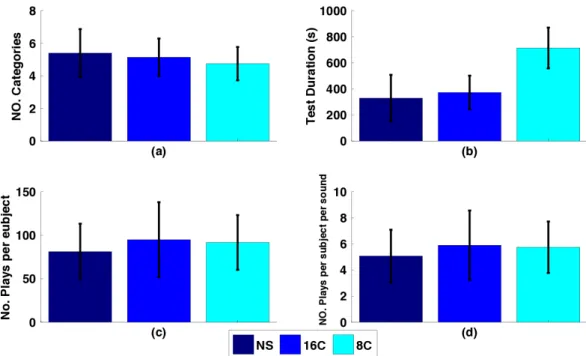
Figure 2.2 normal hearing listeners (NHL) performance statistics . . . 46
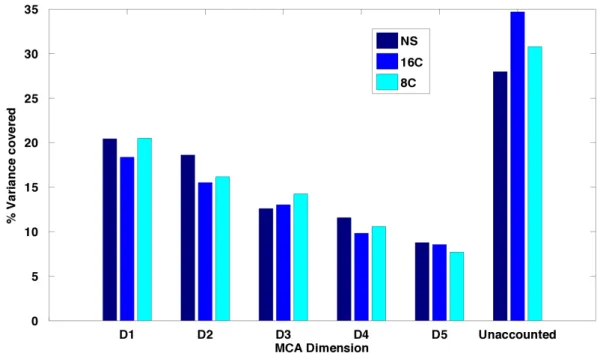
Figure 2.3 MCAvariance forNHL . . . 47
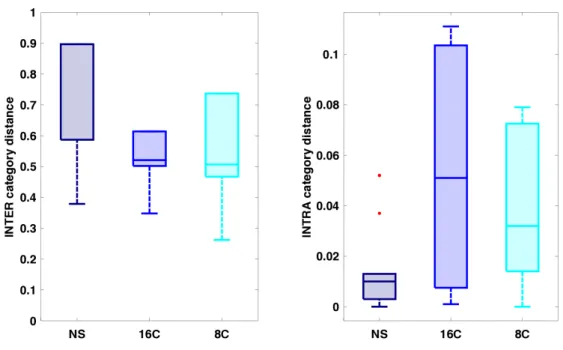
Figure 2.4 INTER and INTRA category distances . . . 49
Figure 2.5 HCPC Dendrograms forNHL . . . 50
Figure 2.6 Co-occurrence matrices forNHL . . . 54
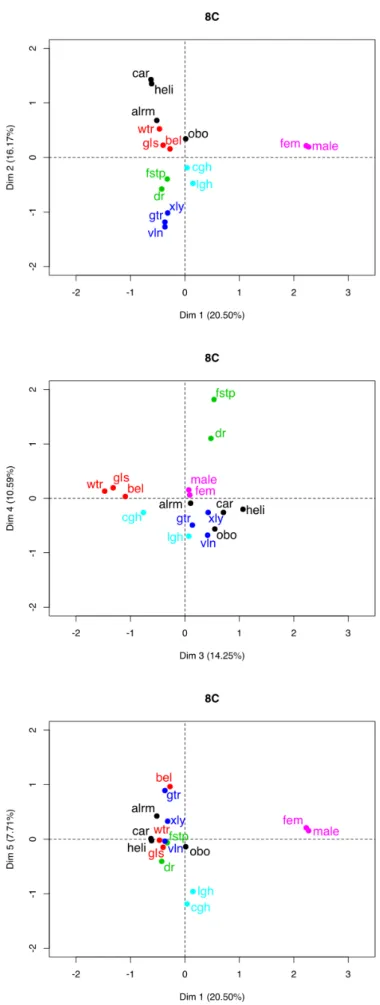
Figure 2.7 MCA Factor maps for NHL with NS stimuli . . . 55
Figure 2.8 MCA Factor maps for NHL with 16C stimuli . . . 56
Figure 2.9 MCA Factor maps for NHL with 8C stimuli . . . 58
Figure 2.10 Subject maps for NHL - Dim 1 & 2 . . . 59
Figure 2.11 Categorisation Identification forNHL . . . 60
Figure 3.1 Free Sorting Task (FST) performance statistics forCIL . . . 77
Figure 3.2 Dendrograms for allCILgroups . . . 80
Figure 3.3 Dimension statistics forCIL . . . 82
Figure 3.4 Subject maps for Dim 1 & 2 . . . 83
Figure 3.5 Factor maps for Experienced cochlear implant listeners (EXP) 85 Figure 4.1 Summarised statistics for FST performance . . . 116
Figure 4.2 Cophenetic Correlation values . . . 117
Figure 4.3 Dendrogram outputs of HCPC analysis for NHL & CI users118 Figure 4.4 Inter & Intra category distances for HCPC dendrograms . 119 Figure 4.5 Colour map of RV coefficient values participant groups . 121 Figure 4.6 % Variance covered by MCA dimensions . . . 122
Figure 5.1 Typicality measurements of 20 environmental sounds . . 147
Figure 5.2 HCPC dendrogram for Step2-FST-NS . . . 148
Figure 5.3 MCA Factor maps for Step2-FST-NS . . . 150
Figure 5.4 MCA Participant maps for Step2-FST-NS . . . 151
Figure 5.5 HCPC dendrogram for Step3-FST-SIM . . . 153
Figure 5.6 MCA Factor maps for Step3-FST-SIM . . . 154
Figure 5.7 MCA and HCPC analysis for Step-4-FC-SIM . . . 158
Figure 5.8 Categorisation identification for Step-4-FC-SIM . . . 160
Figure 5.9 Identification accuracy of individual sounds . . . 163
Figure 5.10 Co-occurrence matrices for Step2-FST-NS, Step3-FST-SIM & Step4-FC-SIM . . . 164
Figure 5.11 RMS in high and low frequency bands for CI simulated sounds . . . 166
Figure 6.1 Typicality ratings for Voice Categorisation stimuli . . . 181
Figure 6.2 Dendrogram of Voice categorisation - Natural Sounds . . 183
Figure 6.3 MCA factor maps - Voice categorisation with natural sounds186 Figure 6.4 MCA factor maps - Voice categorisation with natural sounds187 Figure 6.5 Results for Voice categorisation -CIL . . . 188
Figure 6.6 Perception accuracy across Voice stimuli . . . 189
Figure 6.7 Perception accuracy across Voice stimuli . . . 190
L I S T O F TA B L E S Table 2.1 Everyday sound stimuli used for testing . . . 39
Table 2.2 NHL participant information . . . 45
Table 2.3 Acoustic correlations with NHL user results . . . 61
Table 3.1 Stimuli used for theFST . . . 70
Table 3.2 Summary of etiological data and auditory performance for allCIL. . . 73
Table 3.3 Participant data forEXP . . . 74
Table 3.4 Participant data for Intermediate cochlear implant listen-ers (INT) . . . 75
Table 4.1 Table of RV coefficients for NHL and CIL. . . 120
Table 4.2 Pairwise similarity for NHL and CIL . . . 121
Table 4.3 Summary of MCA dimension interpretations . . . 125
Table 4.4 Summary of correlated acoustic variables . . . 126
Table 5.1 Participant information for Chapter5 . . . 144
Table 5.2 Context testing stimuli . . . 146
Table 5.3 Pairwise comparison of Similarity to pre-defined categories162 Table 6.1 Participant data for CI users tested with vocal stimuli . . 178
Table 6.2 Voice-categorisation stimuli description . . . 180
Table 9.1 Appendix A-1a: NHL in NS condition . . . 205
Table 9.2 Appendix A-1b: NHL in NS condition . . . 206
Table 9.3 Appendix A-2a: NHL in16C condition . . . 207
Table 9.4 Appendix A-2b: NHL in16C condition . . . 208
Table 9.5 Appendix A-3a: NHL in 8C condition . . . 209
Table 9.6 Appendix A-3b: NHL in 8C condition . . . 210
Table 10.1 Appendix B-1:EXP . . . 212
Table 10.2 Appendix B-1:EXP . . . 213
Table 10.3 Appendix B-2:INT . . . 214
Table 10.4 Appendix B-3:NEW. . . 215
Table 10.5 Appendix B-3:NEW. . . 216
Table 11.1 Typicality Ratings for 20 environmental sounds . . . 219
A C R O N Y M S
CA Correspondence Analysis
CCC Cophenetic Correlation Coefficient
CI cochlear implant
CIL Cochlear Implanted Listener
ES environmental sounds
ESP environmental sound perception
FST Free Sorting Task
HCPC Heirarchical Clustering based on Principal Components
IT Inferior Temporal Cortex
MCA MultiCorrespondence Analysis
MDS Multidimensional Scaling
NHL normal hearing listeners
NS Natural sounds
STG superior temporal gyrus
STS superior temporal sulcus
EXP Experienced cochlear implant listeners
INT Intermediate cochlear implant listeners
1
I N T R O D U C T I O N
In everyday life we encounter many different sounds on a daily basis, and often are situated in busy auditory environments, for example a sunday market, that involves many different sound sources. Paying attention to each individual sound, whether it be a nearby person talking, a passing car, coins rattling in your own pocket, would require a large amount of cognitive effort and as a result the auditory system makes use of certain processes to attain to only the most important/relevant information. One process that helps in this manner is auditory categorisation. By identifying or perceiving the category a particular sound belongs to, information about the sound ca be more efficiently extracted from the category knowledge. This also means that the effort required to iden-tify the specific sound is also removed.
This process has been studied in the perception of phonemes, to understand perceptual boundaries, for example when a //ba// sound becomes a //ga// sound and what acoustical properties are important for this change in percep-tion. Work has also been done to show how sounds can be categorises based on the material, size and shape of the sound producing object (references). Regard-ing the categorysation of more everyday sounds common results have shown categories corresponding to living and non-living objects, for example human and animal vocalisations, human action sounds, mechanical (including too and transport), nature sounds and electronic or synthesised sounds (references). Studies have even shown specific areas of the brain responsible for processing these different types of sounds [78,42,79].
The way in which sounds are grouped together to form these categories is based on perceptual similarities. In general it is considered that similarities concern information that is related to the perception of the sound producing event/object in terms of its size, material, action etc. or action, cited as causal similarities by Lemaitre. Another form of similarity is the semantic associations to the sound, for example concepts such as events (parties, sports events) or
emotional content (e.g. happy vs sad).
Perceptions of the physical sound signal are also of course important, for ex-ample the spectral content, harmonicity, frequency, sound power level, temporal modulations. However these appear to be useful/used in categorisation only when judging the quality or musicality of sounds, and this act of listening to the physical acoustical signal has subsequently been termed musical listening (Gaver) whilst the previous perceptions of causal and semantic information are perceived when a listener enters into everyday listening mode.
It seems that in general categories are based on causal information, which would make sense as often we may hear a sound before seeing it and want to use the information within the sound to inform us about the object/event that produced the sound. This may further be related or include how we may be able to interact with the object.
However the existing research of auditory categorisation is not exhaustive, there is for example no full classification system proposed beyond that of Gaver. And whilst certain broad categories have been demonstrated, there also lies the opportunity to study both sub and super category membership to more fully understand how we perceive auditory information. Finally the relatively small number of studies have also not dealt with how sounds are perceived in the real world, in different environments and under different task requierments.
Auditory categorisation also involves both high level cognitive processes and low-level perceptual encoding of the acoustical signal, both of which are affected by the use of a cochlear implant (CI). Used to rehabilitate people with severe (or complete) hearing impairments, these devices deliver a degraded auditory signal via electric impulses directly to the auditory nerve within the inner ear. Such patients also often have cortical brain reorganisation as a result of their hearing impairment.
It is known that patients with such devices can develop very good perception of speech sounds and the majority of work, both research and rehabilitation is targeted around restoring speech abilities. However, although the perception of environmental sounds is often cited as a benefit to CI users, the accurate percep-tion of these sounds is often lacking. Research is far behind that of speech, one
of the main reasons being that environmental sounds encompass a vast range of sound sources all with different acoustical characteristics. This makes it diffi-cult to study exactly which acoustic variables are important for environmental sound perception, and therefore difficult to make specific improvements within the CI device itself. it has also been shown that CI users ability to discrimi-nate vocal from environmental sounds is poor in comparison to NHL (massida).
So how does auditory categorisation function with CI users? Some studies of CI categorical perception have been conducted, and shown that categorical per-ception is more accurate than the identification of individual sounds. However these studies used fixed categories, therefore leaving the question of how CI users may use categorical perceptions of sounds in the real-world.
The presented work therefore seeks to combine the fields of auditory categori-sation with that of CI users auditory perceptions in order to further understand how the two domains of research overlap. It aims to investigate categorical perception in order to advance the understanding of CI users auditory abilities especially in dealing with different kinds of sounds. At the same time adding to the existing research to move forward with the understanding of auditory categorisation in in general. The following chapter introduces the theory and background information associated to the topics presented above in a more detailed manner for the reader to fully comprehend the context of the current work.
1.1 au d i t o r y c at e g o r i s at i o n
1.1.1 What is Categorisation?
Categorisation as a process is one of the ways in which we as humans try to simplify our lives and make things easier. It allows us to deal with the vast amount of sensory input that is encountered on a day by day basis such that we can make quick and efficient judgements about the world around us - the objects we are seeing or the sounds we are hearing. For example by categorising an object as a car we are able to understand that it is likely an object with four wheels, an engine that runs on fuel and something that carries people from position A to position B. We do not need to analyse in detail the specific object to know if all of these things are true. So instead of treating every stimulus,
every object as brand new we place it into a category of our own making in order infer knowledge about the category to the object without having to analyse in detail the object or stimulus in question.
Within the study of categorisation there are two commonly held theories of how we as humans go about categorising objects.
Prototype theory: which uses the idea of scaled category membership, for example for the category of birds, how “bird” or bird-esque is a particular bird? There exists a single representative or prototype of a particular stimulus inside your brain that is used to compare new stimuli. Such that if the new stimuli matches, then it is deemed to belong to the category. For example imagine a cow, you may form an image in your mind in which to describe certain qualities, that is your prototype. The prototype is therefore a mix of all the previously encountered stimuli in that category. When studying prototype theory it is very easy to obtain an idea of the strength of category membership or the proximity to the prototype by measuring reaction times of people asked to categorise certain objects. The faster the reaction time the stronger the category member-ship (or family resemblance as it is called) for example“violin” may be a more typical example of “music” than “bassoon” and therefore categorised more quickly. Prototype theory is often cited as being efficient due to the comparison of new stimuli with a single prototype and does not require the memorising or learning of many different category members - in difference to the exemplar theory.
Exemplar theory: the idea that categorising is based on comparing a new stimulus to previously encountered known examples.So for example the cate-gory of "fish” may be created by a person holding the memory of all the fish they have encountered in their life. By comparing a new new object to this category it is then possible to see if it has enough similarities in common with the category exemplars to be classified as a fish as well. Exemplar is useful as it can explain variability amongst category items. For example if the prototype of the category dog includes the requirements of an animal that has four legs and barks - what will be made of a three legged silent dog? Exemplar theory can also (to some extent) explain the creation of abstract (e.g. "beliefs” or "fears") and ad hoc (e.g. "things to take on holiday") categories through the combination
of previous experiences, which is not possible with prototype theory.
Overall it is most likely that a combination of the two processes working together is used in daily life as sometimes one works better than another. This allows for the efficiency of prototype theory but also the flexibility of exemplar theory. Most likely this involves using exemplars that are encountered in order to modify or update the currently held prototype of a category.
However although there has been a large amount of research on categorisa-tion it is still not fully understood how the categories we use in daily life come to be created as we are likely influenced by a number of wide ranging aspects. Not only will the frequency of encountering a specific stimuli modify the exem-plars and the prototype but the recency of encountering a certain stimuli will also affect the category recognition such that if you were to encounter a bird singing and then immediately afterwards hear an ambiguous yet melodious sounds you might categorise this as birdsong, when in fact it was a flute or recorder being played.
Finally there are a number of things that affect the individuals categories such that one persons categories can be completely different to another persons. This of course will depend on culture, language and of experience - exactly what exemplars has the person witness and learned in their life? This allows categorises amongst people to be different, to be broader or more narrow, to have different subcategories and to have different exemplars and prototypes.The experiences of people can also be influenced by expertise which may give them an ability to create different levels of subcategories and more easily distinguish the borders between two categories. For example a professional musician may have many subcategories of different kinds of instruments and be able to easily distinguish between them all where as a laymen may have broader categories of “brass”, “woodwind” and “percussion” or maybe even simply a category of "musical instruments".
This aspect of familiarity and the experiences that people have had in their lives which govern their use of different categories is a very important as-pect.Especially for this manuscript which has tested participants with many years of hearing impairment, such that their familiarity and experiences with auditory stimuli is vastly different to normal hearing listeners (NHL). In addition
to this the hearing impaired participants tested are users of cochlear implant (CI) devices which further alters the experience with the auditory environment. Ex-actly how and to what extent hearing impairment and use of aCImay affect listeners categorisation of sounds is not at all known and will be an important question throughout this work.
1.1.2 Similarity as a basis for categorisation
The two proposed theories of categorisation, exemplar and prototype, share one common aspect that they both work on the basis of comparing a certain stimu-lus to a pre-defined representation of that stimuli in the persons knowledge - be it a single prototype or a collection of exemplars. It would therefore appear that categorisation is based on similarity judgements, but whilst similarity plays a role in categorisation they are two different processes. In general similarity judgements are more strongly based on the perception of a stimulus where as categorisation involves a persons theories, goals and other higher level cognitive processes. The process of judging similarity has also been described as being too flexible, too reliant on perception and does not fit alongside explanations of categories based on theories or objectives. If similarity can be influenced by abstract or alternate theories it must therefore become unconstrained. Or if similarity is restricted to only the direct perceptions of a stimulus then it does not meet the necessary requirements to act as the basis of categorisation.
1.1.3 Why is auditory categorisation important?
As mentioned before the process of categorising stimuli allows us as humans to more easily cope with the barrage of sensual information that surrounds us in every day life. This of course applies to the auditory domain where we are nearly constantly aware of the sounds that are going on around us. Being able to categorise these sounds enables us to infer information about the sound and the sound producing object from its category membership. Categories that have been found amongst tests of auditory categorisation have taken the presumption to define four broad categories of sound - being speech, music, environmental (referring to any sounds that are not speech or music) and finally artificial
sounds, for example those of a computer or synthesiser [6]. Within specific studies of environmental sounds categories have also been found corresponding to warnings, water, vocalisations (both human and animal) [49,119,14,33,15]. Further studies have also identified that categories can be created based on the type of action or material that causes a sound for example hitting vs scraping or wood vs metal [57,77,79].
Figure 1.1: Hierarchical description of sound producing events taken from [37]. The first
level describes simple interactions of materials, the second level examples of these interactions split into solids, gasses and liquids, and the final level examples of actions within each class of material
Regarding environmental sounds, Gaver [37] initially proposed a mapping related to the interaction of materials, see figure1.1. At the first level it describes the cateogirsation of sounds in terms of “materials” which are split up into into vibrating objects (solids), liquids and aerodynamic sounds (gasses). The model then describes the interaction of materials at the second level. Thirdly comes the interactions of these materials and basic level interactions within each material set, which for solid sounds include hitting, scraping, for liquids splashing or dripping and for gasses motion caused by pressure changes, for example gusts of wind. More complex interactions are described at a higher level in terms of patterned events - i.e. the repetitive action of basic level events, also compound events which include the combination of basic level events and finally hybrid events that are made up from various materials and actions. These can be seen in figure1.2which gives a much more detailed look at Gaver’s Hi-erarchy. This has also been further developed in other studies [57,77,91,75,79].
Within his ecological approach to auditory perception, Gaver also described two different “modes” of listening. The first, termed Everyday listening refers to the perception of the properties of the specific sound generating source, i.e. how big the object may be, how fast it may be moving. In general everyday listening relies on the identification of a sound, be it correct or incorrect and
Figure 1.2: Gaver’s map of everyday sounds [37]. An more detailed expansion on
figure1.1whereby interactions of SOLIDS, LIQUIDS and GASSES are firstly
divided up into three large sections corresponding the separate materials. Within each section examples of different basic sound producing actions are shown with their underlying attributes, for example how the size and viscosity of a liquid dripping will affect the sound produced. Examples of sounds that are created via the interaction of basic actions are given, for example a bursting tyre and fire. Where material sections overlap examples of sounds that are produced via two or three materials are given, for example rain on a surface, which involves both liquid and solid actions.
does not appear reliant on acoustic qualities.
The second listening mode, Musical listening, refers to the perception of quali-tative aspects of the sound itself i.e.“what the sound sounds like”. This not only refers to acoustic characteristics of the sound, but also the sense of emotion or quality of the sound - e.g. the roughness or smoothness. More concerned with the perception of the raw acoustic signal rather than the sound producing object it has been seen to be encouraged by similarity judgements when directing par-ticipants to judge specifically similarity rather than simply categorise a sound. Musical listening and the focus on qualitative information about the sound also becomes important when identification fails, when there is no association of the sound to a specific object. In this sense it could be said that the
per-ception of the listener falls back to the most salient information about the sound.
As a conclusion, from the small amount of studies that have looked at audi-tory categorisation It would appear that categorisation is predominantly based on the properties of the sound-producing object or event ([49,52,76,6]). Rarely does it appear that the properties of the sound signal are used and when they are it is a result of identification being difficult or failing entirely.
1.2 h u m a n au d i t o r y s y s t e m
1.2.1 Overview
The human auditory system is responsible for turning the oscillations of air pressure (that constitute sound) into electronic pulses which are then delivered via the auditory nerve to the brain where, depending on the signal different regions of the brain extract different information - for example speech or music and give a a subjective perception of the original sound. Figure1.3shows the auditory system which consists of three main areas- outer ear, middle ear and inner ear, each of which are separately described below.
Figure 1.3: Graphic of the human auditory system taken from [26].
Outer ear:the visible part of the auditory system which consists of the pinna, ear canal and ear drum. Vibrations of air pressure are captured in the pinna,
which acts like a kind of funnel for the sound, then transmitted along the ear canal before hitting the ear drum (aka tympanic membrane). The ear drum is a membrane stretch across the ear canal, much like a drum skin stretched over the top of the drum. When the vibrations of air pressure hit the ear drum it causes it to physically vibrate and these physical vibrations are then passed on to . . . the middle ear.
Middle ear: contains the ossicles - three three tiny bones known as the malleus, incus and stapes.These bones form chain of levers connected by the malleus to the ear drum and the stapes to cochlear and their job is to transform the relatively large vibrations at the ear drum into smaller vibrations delivered to the cochlear/inner ear.
Inner ear: apart from the cochlear, a coiled tubular structure that resembles a snails shell, the inner ear also houses the balance organs - the semicircular canals and the vestibule which are responsible for the sense of balance and spatial position experienced by humans. This of course is not essential to the auditory system but performs essential functions. The cochlear itself deserves special attention as it involves a complicated arrangement of anatomy that turns physical vibrations into neural pulses and it is here where the electrode of a cochlear implant (CI) is inserted.
Physically the cochlear divided into three fluid filled sections, as seen in the cross section of figure1.4. As the upper section, Scala vestibuli is sealed at the oval window (which is connected to the stapes) it is here where vibrations first enter the cochlear and as vibrations travel through the cochlear they are able to traverse the two membranes (Reisnerr and Basilar membranes) that separate the three cochlear sections. The most important of these two membranes is the Basilar membrane.
Basilar MembraneStretching the entire length of the cochlear the membrane changes in form, at the ape (the beginning) the membrane is narrow and stiff, whilst at its end wider and more flexible. When vibrations pass through the cochlear the basilar membrane is set into motion in the form of a wave - imag-ine shaking out a bed sheet or the waves along a still lake. Depending on the
Figure 1.4: Cross section of the cochlear, showing the three fluid channels - scala vestibuli,
scala media and scala timpani. The organ of corti (in pink) is shown sitting
on top of the basilar membrane. Inner and outer hair cells are situated between the organ of corti and the tectorial membrane. Image taken from https://commons.wikimedia.org/wiki/File:Cochlea-crosssection.png
frequency of the sound/vibrations and due to the physical characteristics of the membrane the peak of this wave occurs at different positions. For example high frequency sounds peak at the beginning of the basilar membrane where it is stiff, and low frequency sounds peak at the end where the membrane is loose and more flexible. This arrangement of responses is described as being “tonotopic” and is illustrated in figure1.5. The final piece of the auditory system process concerns the creation of electric pulses which happens in the . . . . organ of corti.
Organ of Corti:sitting on top of the basilar membrane (see figure1.4) this is the sensory organ at the heart (excuse the pun) of the auditory system. Within the organ, and again stretching the length of the basilar membrane are tiny hair cells that respond to the motion of the membrane. For example when the motion is large enough, the tiny hairs on the tops of the cells are displaced causing the release of neural impulses that are carried by the auditory nerve to the central auditory system in the brain.
It is here that a very important theoretical point should be made that will have implications on the functionality of cochlear implants and discussion of results in later passages of this manuscript, and that is the theory concerning
Figure 1.5: Tonotopic arrangement of Basilar membrane. Image shows the basilar memrbanem that is narrow and stiff at its base whilst being wide and flexible at the apex. This infers a tonotopic property to the structure such that high frequencies (limit approx 20, 000 HZ) cause maximum response at the base and lower frequenceis (limit approx 20 Hz) at the apex. Image Taken from Berne and Levy Physiology 6th edition.
how the basilar membrane peaks and subsequent neural impulses are able to code or describe the properties of a sound. Whereas it is relatively to simple to imagine the strength of the neural response coding the intensity of a sound and the time at which a neural response occurs coding the temporal aspects of a sound, when it comes to spectral information there are two different (although complementing) theories that are briefly explained below.
In the coding of spectral information (the frequency content of a sound) there are two different theories that describe how this information is transmit-ted from the cochlear to the brain. In describing these two theories it is easier to imagine the most simple scenario of using a pure tone (i.e. a single frequency)
PLACE theory:as mentioned before the basilar membrane is tonotopic. Us-ing this idea place theory suggests that frequency information is extracted from the place at which peaks occur on the basilar membrane i.e. the location of the neurons that fire in response to a specific frequency. Complication with this theory is that regarding complex sounds the sensation of pitch (i.e. F0) may be induced by frequency components.
TIME theory:which suggests the pitch of a sound is related to the “pattern” of neural impulses.These impulses often occur at a particular phase of the sound (known as phase locking) such that the intervals between impulses correspond to the frequency of the sound. The pattern of these intervals can then be used to code the frequency. One problem with this theory is that phase locking is only possible for frequencies up to 5 kHz, although in the real world most everyday sounds (including musical instruments and the human voice) have fundamental frequencies much lower than this, so there that the Time theory is still capable of accounting for many aspects of frequency coding / pitch perception.
Whilst it is not within the scope of this research to pursue these two theo-ries in extravagant detail readers should be aware that recent research often concludes that the auditory system likely uses both of these processes in the coding of frequency information.
1.3 c o c h l e a r i m p l a n t s
The goal of a cochlear implant (CI) is therefore to transfer the acoustic vibra-tions of a sound into electric pulses that can be sent to the auditory nerve and subsequently the auditory cortex, enabling what may be called a “synthetic ” or electric auditory perception to be realised. In a sense the implant replaces the auditory system shown in figure1.3, as shown in figure1.6.
Figure 1.6: Labelled Diagram of a Cochlear Implant. Photographs/Images by courtesy of Advanced Bionics.
TheCIitself can be broken down into several different components as indi-cated in figure1.6. The function of each element is listed below:
1. Microphone: turns the analogue acoustic signal of a sound into a digital electrical signal fed to the sound processor.
2. Sound Processor: Here different coding strategies (discussed further be-low) are used to electric signal into a digital stimulus for activating the electrode array.
3. Transmitter / Receiver: The digital stimulus is then passed through from the transmitter to the receiver that is embedded below the scalp of the user.
Figure 1.7: Images of CI transmitter and electrode array for Advanced Bionic CI device. Photographs/Images by courtesy of Advanced Bionics.
At this point the digital signal consists of an arrangement of electrical pulses, shown in the left panel of figure1.7.
4. Electrode Array: a thin plastic element inserted into the cochlear on which sit a number of electrodes. Electric pulses stimulate directly the auditory nerve based on the coding strategy used by the processor, shown in the right panel of figure1.7.
1.3.1 Speech processing with a Cochlear Implant
The cochlear implant was itself designed specifically to restore speech pro-cessing abilities in both pre and post-lingually deaf humans. Speech has also been found to be considerably robust to spectral degradation and vocoding amongst NHL [125]. It is generally considered that most recipients are able to achieve the best improvements which often result in good speech perception in quiet conditions [108] however there are numerous difficulties when listening to competing sound sources, for example multiple talkers, or in complicated/noisy listening environments [35,100,129].
The biggest improvement amongst pre-lingually deafCIusers comes from implanting during infancy. It is generally held that earlier implantation leads to the best restoration of speech abilities and that the upper cut-off for this improvement lies between implantation at 4 and 12 years of age [106]. Implan-tation before 12 months old has also been recommended, for example [29] showed that infants implanted between 12-36 months were delayed by one year in their development of speech in comparison to infants implanted before 12 months old and [56] found that early implantation lead to faster development.
However development is also linked/affected by a range of socio-economic values such that whilst the age at implantation is important it is not the only factor in the restoration of speech abilities [104].
Improvement of auditory abilities are also seen in adult and elderly popula-tions (Dillon et al 2013) and amongst the pre-lingually deaf population most recipients show a benefit from receiving aCI[142]. However even after many years of being implanted these improvements in speech understanding are not as large as compared to those seen in post-lingually deafened populations [145]. Post-lingually deaf adults also benefit greatly from receiving aCIhowever they require a certain amount of rehabilitation in order to associate the newly perception of sounds to the original representations stored in memory [17]. Within this population the success ofCIdevices has also been linked to the du-ration of deafness as a result of the age at onset of deafness. For example Moon et al (2014) found that subjects who became deaf during adolescence had poorer speech performance. They also concluded that while the age at implantation can affect the success of rehabilitation post-implantation, as a result of cog-nitive abilities, it is not as strong a factor in predicting the success of the implant.
Overall the previous literature shows that CI can be a very successful tool in restoring speech abilities.For pre-lingually deafened CI users the biggest improvements are seen when implantation occurs at the earliest possible stage with benefits drastically reduced if implantation occurs after 12 years old. For post-lingually deafened CI users the age of deafness onset (and subsequent duration of deafness) is seen as a key factor in determining the success of implantation more so than the age of implantation.
WhilstCImay give significant benefits in speech perception there are certain aspects of voice perception that remain difficult for nearly allCIusers. Firstly the perception of prosodic information is reduced in CI users, for example intonation [92] and also emotion [89, 99]. [89] showed thatCI users correctly recognized emotionally content in half the stimulus presentation whilst NHL performed at 100%. However when reducing the amount of spectral information via vocoding the performance of both NHL andCIusers was seen to reduce. The perception of emotion has been linked to the changes in the fundamental frequency of a speaker and also intensity cues [58].
Secondly CI suffer from deficits in recognising the identity and gender of talkers [94,65,27,81]. Gender related information is linked to the anatomy of the human vocal anatomy, for example the size of the vocal tract and vocal folds which on average are larger for males compared to females.This in turn generates differences in the fundamental frequency (F0) and arrangement of formants in the voice which are used by NHL to accurately discriminate gender [128]. However these cues are often unavailable to CI users whom therefore struggle with gender discrimination, however when the difference in F0is large CIusers perform significantly better [81,93].
Considering all of the above it must be noted that there is a considerable amount of variation inCIperformance within all the studies undertaken. This variability is a result of many different mitigating factors concerning; the pa-tients existing auditory abilities - for example residual hearing, duration of deafness, age at implant ion, the use of sign language and lip-reading abilities; theCIitself - including insertion depth, the number of active electrodes (often only 4-7 are used by the user); and finally socio-economic status and home life ofCIusers [104].
1.3.2 Musical processing
For manyCIusers an expectation of receiving an implant is improved perception of music (cited as second most important acoustic stimulus to their lives[41]) , however manyCI users actually avoid music due to it being too noisy, and post implantation listening of music is reduced compared to pre-implantation withCIusers often stating their enjoyment of music has been reduced (Gfeller, LEa et al 2003, Feldmann and Kumpf , Leek et al.). Mizra et al (2003) reported similar findings and that the enjoyment of music rated from 1 to 10 (where 10 is like very much) also reduced from 8.7 to 2.6, therefore enjoyment is reduced (Tyler et al 2000). It is often cited that the main reason for difficulties with musical sounds and the reduction in enjoyment is linked to problems with the perception of pitch and recognition of timbre, attributes associated to the processing of the spectral fine structure. On the other side of the coinCIusers are reported to have temporal processing abilities similar to those of NHL and therefore have little or no problems in the perception of rhythm (REFERENCES).
Pitch
It is generally held thatCIusers perform much worse than NHL in pitch related tasks. For example in pitch-ranking i.e. placing in order a series of differently pitched tones, CI users have been shown to be unable to rank pitches that are 3 semitones apart and are only able to perform the task at roughly 65% accuracy for pitch intervals of 6 and 12 semitones (Looi 2008), although other data reports pitch ranking thresholds in the wide range of 4-24 semitones [36] or 1 to 12 semitones [41,102,60]. Not only are the pitch discrimination abilities ofCIvariable, but they are worse than NHL whom often performed at 81% in discrimination intervals of only 1 semitone [132]. Pitch perception is not simply the ability to distinguish different pitches and so has been tested in other ways. For example [30] tested the ability of CI users to discriminate between two short melodies, where in one melody the F0 of a note was altered for half its occurrences.This represents a level of pitch perception within the context of a melody and is therefore more similar to real-world situations of musical pitch perception. The results again showed thatCIusers performance was around chance.
TheCIworks by extracting the envelope of a sounds and delivering this signal via electrical stimulation/pulses into the cochlear subsequently the auditory nerve. In doing so most of the fine temporal information is lost such that CI can only perceive repetition rates up to 300 HZ [32] which is much lower than the 2-5kHz limit imposed on NH by the natural auditory system. So without the ability to access the fine temporal information it leaves the perception of pitch in complex tones/sounds difficult.Further complications/hinderences are added when considering the variability in the anatomy ofCIusers, the survival of auditory nerve, cause of deafness/hearing impairment. AlthoughCI’s aim to deliver a large number of frequency information ranging from 16-22 channels, the placement of electrodes and large stimulation given by the electrodes often leads to a greatly reduced number of channels being functional, sometimes as low as 3. This of course has implications to CI users ability to use place coding model of pitch perception, as the spatial resolution of stimulation is much poorer in comparison to a NHL.
Timbre
Timbre is often a difficult quality of musical perception to describe and to quan-tify. Most simply it can be thought of as the qualities of the sound produced
by different musical instrument. More complete it is the combination of the acoustic qualities of a musical or vocal sound that are separate/independent from the frequency and intensity (pitch and loudness) and yet which enable the sound to be perceived/recognised. In measuring the accuracy of timbre percep-tion studies often test musical instrument identificapercep-tion, finding that NHL score close to 100% where asCIusers perform at best 54% or less [39,95,102]. [86] compared the ability of 15CIand 15 HA participants in their ability to identify single musical instruments, solo instruments with background accompaniment, and musical ensembles.The mean percent-correct scores for the three respec-tive subtest were:CIgroup - 61%, 45%, and 43%; HA group - 69%, 52%, and 47%.
Melody
From the findings that pitch and timbre perception are poor inCIit is not sur-prising that the perception of melodies is less than for NHL, ranging from 17% to 60% for familiar songs in comparison to [41,64]. This can be improved with the addition of lyrics and rhythmic passages.For example in [39] identification of rhythmic melodies was 20% compared to only 10% for non-rhythmic melodies with identification 90% and 77% for NHL respectively. When sequences are formed of complex tones that contain resolvable harmonics, a pitch sequence advantage is observed, If there are no resolved harmonics, because of bandpass filtering or noise-vocoding , the pitch sequence advantage disappears [31].
Rhythm
In contrast to the processing of spectral aspects of musical perception (pitch and timbre), rhythmic cues are commonly well perceived byCI users whose performance is similar to NHL [32,88]. [64] showed thatCIusers also report similar performance in a tempo discrimination task, although when tasked with identify complex rhythmsCIusers performed 20% lower than NHL. [40] also showed that NHL could detect changes in rhythm at shorter duration of beat (607ms) compared to CI users (1070ms). Therefore in certain “difficult” situations the temporal processing abilities of the implant are not capable of competing with NHL.CIusers have also shown to perform similarly to NHL in perceiving temporal gaps (silence) and amplitude modulations. Therefore it appears that the perception of non-complex rhythms does not pose significant issues for CI users . Rhythmic information poses less problems for listeners, mainly because temporal cues are more easily coded by the implant. This could therefore lead to a preference for listening to the rhythm (temporal information)
within music making rhythm more enjoyable forCIusers and therefore widen the gap between ease of rhythmic perception and difficulties with pitch and timbre perception.
It would appear that the perception of music is not a trivial task forCIusers, with common difficulties in the access to fine spectral information meaning that pitch and timbre are difficult to perceive. This is especially true for complex sounds however there is a range of performance ofCIusers with some showing significant musical abilities (see cochlear implanted kids playing the piano). Studies have also shown that gross-temporal processing abilities similar to those of NHL especially in the detection of gaps and amplitude modulation leading to often good levels of rhythm perception.
1.3.3 Environmental sounds
Studies withCIL
Another reported benefit of a cochlear implant is in the perception of en-vironmental sounds (ES). Often classed as any non-linguistic or non-musical sound, certain es’s are amongst the first sounds thatCIusers report as hearing [137]. In a questionnaire of 22CIusers [146] also reported 77%CIusers found the main benefit of receiving their implant to be the perception/awareness of ES.[138]reported similar findings in a questionnaire of 53 experiencedCIusers. These sounds are important and of benefit for a number of reasons. Firstly certainESare important for warning or signalling purposes e.g. alarm sounds, telephones, doorbells. Secondly they can just be aesthetically pleasing, e.g. birdsong and waterfalls. Finally and possibly most importantly they contribute the awareness of a listener to give an improved sensation of the surrounding environment as well as aiding the interaction with objects. For example back-ground noises (e.g. air conditioning) are often the first sounds reported byCI users after switching on their implants. environmental sound perception (ESP) is therefore an important part of the quality of life forCIusers [146].
However due to the focus of research on understanding and improving speech perception forCI usersESP has only recently, and with limited scope, started to gain attention. The following text outlines these studies in terms of theCIusers that were tested, their performance and the testing method used.
In a general study on outcomes of receiving an implant [108] tested 40 pa-tients on the recognition of 40ESpresented at 70 dB(A). The average score of participants at both 9 and 18 months post implantation was 57%. [136] also tested 21 post lingually deafCIpatients at 1,9 1nd 18 months post-implantation. Testing was done using two lists of 18ESand result de in average scores of 30% correct after 1 month, 35% at 9 months and 37% at 18 months.
[111] tested 11 CI patients (mix of post & pre lingually deaf) who had at least one year of experience with their implant. The test consisted of identify-ing 40 sounds divide equally amongst 4 different auditory contexts/settidentify-ings (home, office, kitchen and outside). Testing used a closed-set 10-alternate choice paradigm such that for each context/setting participants were presented with each sound and had to chose from the 10 alternative possibilities, without feedback. Identification was found to be on average 79% (ranging from 87% for office to 78% for kitchen) but with individual participant performance ranging from 45% to 94%
.
[87] looked at ESP with two implant groups, firstly four subjects with 3 months experience (whom they also tested pre-implantation) and secondly 10 experiencedCIusers with at least 10 months implant experience. They tested 45 sounds (2 tokens for each sound = 90 total) that were subdivided into 9 categories Arriving Home, Bathroom, Household Appliances, Human, Kitchen, Nature, Office, Traffic, Other (included examples of music). Participants were played the sound and asked to identify it from a list of the 45 sounds. Experi-enced group performed at 59%. Pre-implant with hearing-aid was 40%, post implantation (3 months) 57%.
[59] tested non-linguistic sound perception with 22 post lingually deaf CI users with more than one year of experience. They were tasked with identi-fying 50 sounds and then categorise it in one of 5 a priori categories (nature, animal/insect, mechanical/alerting, human non-linguistic, musical) there were 10sounds from each category presented. Participants verbal responses were recorded and later interpreted by testers giving average Identification accuracy was 49% with categorisation accuracy higher at 71% correct.
[122] tested 17 CI users with average experience of 3.2 years whom were mixed post and pre lingually deaf. Participants were presented with 160
envi-ronmental sounds (40 different sounds of 4 tokens/examples), one at a time and asked to identify it from a list of 60 possible responses listed on a computer screen from which the participant could choose. Results showed identifica-tion performance of 45% correct ranging from 16-69%. Using the same test paradigm Shafiro (2015) tested the effects of training on another group of 14 post-industrial deafCIusers with average experience of 5 years implantation. Pretest results were 47% and post-training results were 62%.
The first obvious conclusion from these studies is that the performance ofCI users in identifyingES is low, especially in comparison to NH studies where ESP is nearly always close to 100 % . This remains true even for experienced CI users who have been implanted for a long time [119] and for whom it would be expected to improve onESPin similarity to improvements seen for speech perception with time. There is however evidence that training effects can improveESPforCIusers. [124] reported an improvement of 15.8 % points following 4 training sessions performed by participants at their homes over the period of one week. This is the only study to concretely test the effect of training and showed a positive effect of 46 % points for trained sounds and 50 % points for un-trained examples of the same sounds. However improvements to non-trained stimuli were small and non-significant (only 6% points). So although training effects generalised to non-trained examples of the trained sounds, training effects did not generalise to non-trained sounds.
Whilst identification performance was always seen to be low [111] did show that when presented with four pre-defined categories based on context (au-ditory environment) categorisation accuracy of the sounds was much higher. Indicating thatCIusers are able perceive certain information form the sounds and link this to the context in a fairly successful manner even if specific identifi-cation of the sound is not always possible.
Within these studies it is also possible to see the wide range of identification score, one of the issues with testing ESP. Highest identification was seen for sounds described as being temporally or spectrally distinct (examples) whilst those with lowest identification are sounds with a uniform envelope. This pro-vides some initial clues as to how future studies could pursueESPinCIusers and how rehabilitation schemes could be best designed. However no study has yet identified specific acoustic variables that account for the identification of ES,
most likely again because of the huge variance in the types of sound and the acoustic characteristics that are present when consideringES.
The perception ofESis said to be similar to speech in that both types of sound rely on a common ability of sound recognition [61], and also involve processing of both acoustic and lexical information [69]. [59] recorded a correlation ofES identification and speech performance, whilst [111] also concluded that iden-tification ability was loosely related to monosyllabic word recognition (NU-6 test). However [124] reported only non-significant improvements of speech performance (CNC and SPIN-R tests) during the ES training study. Overall whilst a link between speech andES performance may make sense these effects are minimal and not conclusive. However the hypothesis has been tested to a greater degree inCIsimulation studies and is discussed in more detail below.
There are some issues with the above studies. Firstly and of great significance is the fact that in testing ESP there are almost an infinite number of sounds that fall into this description and it cannot be possible to test them all. [87] also include examples of linguistic sounds, soundscapes and full musical ex-tracts in their study, which do not fall into the definition ofESused by many other studies. Some also only test a small number of sounds which makes it difficult to expand conclusions to all ES. Secondly in testing identification performance there is a variety of methods employed. In testing that used an open-set paradigm, whereby subjects are asked to identify a sound without any options, it is difficult to know what schema was employed by the experimenters for interpreting the descriptions given by subjects. There could be a case that the schema used by one study would give different results when compared to that of another study, and therefore be over or under-estimating the performance ofCIusers. Other studies use a closed-set paradigm, where a fixed number of options are presented to subjects which mean there is not need to interpret comments, however in doing so this presents subjects with options to choose from and may not allow the assessment of the subjects true perception. Finally the study of [111] provided subjects with categorical information about the sounds which could have helped subjects to identify the sounds.
It is therefore possible to conclude that from the the existing studies that have been conducted on ESP, many have used different paradigms, combined with the variety and amount ofESmakes it difficult to make detailed conclusions.
However it does appear thatESP is poor even after training and with experi-encedCIusers. Also although no specific acoustic variables have been identified that can account forESidentification (again influenced by variability of ES) it appears that more easily identified sounds are spectrally or temporally distinct, with sounds that have a uniform envelope structure being more difficult to identify.
CI Simulation studies
Another way of testing for the perception of sounds and also with regards to training effects is to test the more readily available normal-hearing subjects by using vocoder techniques to spectrally degrade sounds and simulate the hearing of a CI. IN similarity to studies concerning speech perception there is still much less known about the perception of environmental sounds in such tests. These studies have been used to assess training effects and also to try and find specific acoustic variables that may be able to explain the perception (both identification and categorised) ofES.
[84] tested training effects and perceptual learning with normal hearing subjects using spectrally degraded sounds that had been passed through an eight-channel sine wave vocoder. 5 groups of NH subjects (155 in total) were trained on different sounds, words (simple & complex), sentences (meaningful & anomalous/nonsense) or environmental sounds and then tested in an open-set identification task. 99ESwere tested covering a range of sounds: vehicles, ani-mals, insects, NLHS, musical instruments, tools, liquids, others. Pre-post gains for all stimuli conditions but generalisation was less uniform, training gener-alised toward “easier” tasks. ForESsounds generalised to ALL speech materials.
[51] tested the identification of 70ESunder different spectral degradations. Identification was quite robust under High/Low pass filtering (cut-off 300-8000 Hz) especially for high pass where ID never dropped below 70%. Also used octave band filters (fc 212 - 6788 Hz) and noted that performance with higher band cf’s was still good 70-80%. Using EMS (vocoder technique) the more channels added the better the ID. Also linked performance in EMN conditions of 1 & 6 channels to the number autocorrelation peaks, burst ratio and cross-correlation. They study also found that the most informative frequency region
for categorising the sounds was between 1200-2400 Hz.
[119] tested theESPof 60 sounds with 60 NHL under six different spectral-resolution conditions - 2, 4, 6, 8, 16, 24 and 32 channel envelope vocoding. ID improved with increasing number of channels i.e. increasing spectral resolution, but plateaued from 8 channels up, although was still not as good as original sound condition even at 32 channels. Some sounds train whistle and water draining also never reached above 70%. Shafiro 2008 also investigated the per-ception of ESby NH (seven) in CIsimulated conditions (4 channel vocoding) in a pre-post test training paradigm with 5 training sessions. Identification of non-vocoded sounds was 98% correct. In vocoding condition pre-test 33% rising to 63%. The biggest rise was for difficult-trained sounds (61% points )and within this group there was a difference seen for the trained sound tokens (86%) whilst non-trained exemplars rose 36% - showing the effects of specific stimulus training and/or familiarity with sounds.
These studies show that under spectral degradation the identification ofES is reduced for NH subjects and that with an increase in spectral information (the number of frequency channels) identification is seen to increase. Again the variability and range ofESPis demonstrated in similarity to studies ofCIusers. [51] shows that some sounds were robust to spectral degradation and only required one channel of frequency information (helicopter, galloping horse) whilst others were poorly identified whatever the number of channels / spectral resolution used (flute, electric saw). [119] also reported that sounds could be divided into those which could be correctly identified (at 70%) with 8 channels or less, and those with 16 channels or more. Sounds also be divided into one of these two groups based only on two acoustic variables, the number of bursts in the envelope and the std of the spectral centroid velocity. This suggests that clear temporal events within a sound and the speed of spectral dynamics are factors in deciding the amount of spectral resolution that is required for correct identification for vocoded stimuli and therefore are also possibly important for CIusers as well. Finally Shafiro 2004 (doctoral thesis) showed increasing spectral channels only helpedES which were more strongly spectral and those more temporal sounds actually decreased in identification. Along with increased spectral resolution being linked to increased identification performance the frequency region of 1200-24000 Hz was also identified as being important for
ESP[51], and this is also an important region for speech perception.
It is likely that the perception/identification ofESand speech sounds shares some common processing, for example both involve low level processing of acoustic information as well as higher order processing linking the attachment of semantic information to sounds [85,69]. [61] also identified a specific “fa-miliar sound recognition” ability important for the perception of both speech andES, especially in the case of degraded sound, whilst there is also evidence that the processing of both sound-types shares cortical areas [78]. [22] reported that training on anomalous speech sentences generalised to both meaningful sentences andES.However a more recent study by [84] did not find this, and instead found only that training on ES generalised to speech stimuli. They concluded that by training on stimuli with a syntactic structure but no semantic structure reduces the impact of top-down processes and forces the listener to focus on the acoustics of the sound and use bottom-up processes.Training on ES (non-speech) stimuli may therefore improve a listeners access to the spectro-temporal characteristics of stimuli and help when identifying vocoded speech. In similarity to studies on CI users training effects for ES were also reported by [84] and [120] whilst [51] found listeners who had heard sounds once more than naive listeners had improved identification score, with the largest improvements seen for temporally distinct sounds (footsteps, axe chop, scissors).
Overall the existing literature concerning the perception of environmental sounds forCIusers (also includingCIsimulation studies) is informative for a number of things. Training withESgreatly improves the identification ESwith large improvements seen for trained sounds and other examples of such sounds. There is a possible link between the perception ofESand speech performance of CIusers and that training withESmay also generalise to speech stimuli, however this is not conclusive. Although the identification ofESis reduced by the use of aCIorCIsimulations there is a variability amongstESsuch that some sounds remain well identified under all forms of spectral degradation whilst others never reach high levels of correct identification. This has regularly been linked to the complexity of the spectral-temporal information of a sound such where spectrally or temporally distinct sounds are often correctly identified where as those with more generic or uniform envelope shapes are poorly identified
likely as a result of the confusion between sounds that share these qualities.
However, more detailed conclusions are hard to make due to the difficulty in testingES. As mentioned there are a large number of differentESwith widely ranging acoustic information and the studies, whilst using similar sounds, all use stimuli-sets and test-paradigms that are different. In addition to this none of the studies take into account real-world effects ofESPthat may be important for listeners in identifyingES.For example the location of where different sounds are heard can affect its identifiability [52]. Also important is the familiarity of listeners to the sound stimuli ([6]) where one listener may be more familiar with a test stimulus than another listener and therefore have a better chance at identifying it. Finally the manner in which sounds are listened to could be very important. MostESare part of a sound scape, occurring in the background and not often the focus of listeners attention, which is of course different to the way in which speech is commonly listened to. Finally the use ofCIsimulations is informative and useful for the progression of research, however whilst this can give clues as to the functioning ofESPin human listeners there is still a large difference on the way NHL andCIusers perceiver sounds, both from a low level perceptual manner to a high order cognitive level. For example mostCIusers are often elderly where as NHL used for studies are often much younger and not often age-matched. [61] identified a number of things important for sound recognition, problem solving strategies to constrain/limit possible response options, the ability to focus attention on spectral and temporal information int eh signal, how efficiently a subject can locate stored information (semantic) about an auditory stimulus. These cognitive processes may be very different between listeners of differing age and add another element into the study of ESP.
![Figure 1.2: Gaver’s map of everyday sounds [ 37 ]. An more detailed expansion on](https://thumb-eu.123doks.com/thumbv2/123doknet/2135300.8713/19.892.168.784.108.531/figure-gaver-s-map-everyday-sounds-detailed-expansion.webp)