
arXiv:1004.1514v2 [astro-ph.EP] 12 Oct 2010
WASP-22 b: A transiting “hot Jupiter” planet in a hierarchical
triple system
P. F. L. Maxted
1, D. R. Anderson
1, M. Gillon
2,3, C. Hellier
1, D. Queloz
2, B. Smalley
1,
A. H. M. J. Triaud
2, R. G. West
4, D. M. Wilson
1, S. J. Bentley
1, H. Cegla
1,5,9A. Collier Cameron
6, B. Enoch
6, L. Hebb
6, K. Horne
6, J. Irwin
7, T. A. Lister
8, M. Mayor
2,
N. Parley
6, F. Pepe
2, D. Pollacco
9, D. Segransan
2, S. Udry
2, P. J. Wheatley
10,
ABSTRACT
We report the discovery of a transiting planet orbiting the star TYC 6446-326-1. The star, WASP-22, is a moderately bright (V=12.0) solar-type star (Teff = 6000 ± 100 K, [Fe/H]=
−0.05 ± 0.08). The lightcurve of the star obtained with the WASP-South instrument shows pe-riodic transit-like features with a depth of about 1% and a duration of 0.14 d. The presence of a transit-like feature in the lightcurve is confirmed using z-band photometry obtained with Faulkes Telescope South. High resolution spectroscopy obtained with the CORALIE and HARPS spec-trographs confirm the presence of a planetary mass companion with an orbital period of 3.533 days in a near-circular orbit. From a combined analysis of the spectroscopic and photometric data assuming that the star is a typical main-sequence star we estimate that the planet has a mass Mp= 0.56 ± 0.02MJupand a radius Rp= 1.12 ± 0.04RJup. In addition, there is a linear trend of
40 m s−1y−1 in the radial velocities measured over 16 months, from which we infer the presence
of a third body with a long period orbit in this system. The companion may be a low mass M-dwarf, a white dwarf or a second planet.
Subject headings: planetary systems
1
Astrophysics Group, Keele University, Staffordshire, ST5 5BG, UK
2Observatoire de Gen`eve, Universit´e de Gen`eve, 51
Chemin des Maillettes, 1290 Sauverny, Switzerland
3
Institut d’Astrophysique et de G´eophysique, Universit´e de Li`ege, All´ee du 6 Aoˆut, 17, Bat. B5C, Li`ege 1, Belgium
4
Department of Physics and Astronomy, University of Leicester, Leicester, LE1 7RH, UK
5Physics & Astronomy Department, Vanderbilt
Univer-sity, 6301 Stevenson Center, Nashville, TN 37235, USA
6
School of Physics and Astronomy, University of St. An-drews, North Haugh, Fife, KY16 9SS, UK
7
Department of Astronomy, Harvard University, 60 Gar-den Street, MS 10, Cambridge, Massachusetts 02138, USA
8Las Cumbres Observatory, 6740 Cortona Dr. Suite 102,
Santa Barbara, CA 93117, USA
9
Astrophysics Research Centre, School of Mathematics & Physics, Queen’s University, University Road, Belfast, BT7 1NN, UK
10
Department of Physics, University of Warwick, Coven-try, CV4 7AL, UK
1. Introduction
The WASP project (Pollacco et al. 2006) is cur-rently one of the most successful wide-area surveys designed to find exoplanets transiting bright stars (V < 12.5). Other succesful surveys include HAT-net (Bakos et al. 2004), XO (McCullough et al. 2005) and TrES (O’Donovan et al. 2006). There is continued interest in finding transiting exoplanets because they can be accurately characterized and studied in some detail, e.g., the mass and radius of the planet can be accurately measured. This gives us the opportunity to explore the relationships be-tween the density of the planet and other proper-ties of the planetary system, e.g., the semi-major axis, the spectral type of the star, the eccentric-ity of the orbit, etc. Given the wide variety of transiting planets being discovered and the large number of parameters that characterize them, sta-tistical studies will require a large sample of
sys-tems to identify and quantify the relationships be-tween these parameters. These relationships can be used to test models of the formation, structure and evolution of short period exoplanets.
A particular puzzle related to the properties of hot Jupiters is the wide range in their densi-ties. Very dense hot Jupiters such as HD 149026 are thought to contain a dense, metallic core (Sato et al. 2005). There is currently no gen-erally agreed explanation for the existence of hot Jupiters with densities 5 – 10 times lower than the density of Jupiter, e.g. WASP-17 b (Anderson et al. 2010), TrES-4 b (Mandushev et al. 2007) and WASP-12 b (Hebb et al. 2009). One possibility is that the planets are heated by tidal forces, and that these are driven by the presence of a third body in the system (Mardling 2007). Other possibilities include enhanced opacity in the atmosphere (Burrows et al. 2007), the distri-bution of heavy elements in the core (Baraffe et al. 2008) and kinetic heating from the irradiated at-mosphere into the interior (Showman and Guillot 2002).
Here we report the discovery of a hot Jupiter system, 22, identified using the WASP-South instrument and present evidence that it is a member of a hierarchical triple system.
2. Observations
The WASP survey is described in Pollacco et al. (2006) and Wilson et al. (2008) while a discussion of our candidate selection methods can be found in Collier Cameron et al. (2007), Pollacco et al. (2008), and references therein.
The WASP-South instrument consists of 8 cameras, each with a Canon 200-mm f/1.8 lens and a 2k×2k e2V CCD detector resulting in an image scale of approximately 14 arcsec per pixel. The star TYC 6446-326-1 (= 1SWASP J033116.32−234911.0) was observed 3133 times by one camera on the WASP-South instrument from 2006 August to 2007 January. A further 6282 obervations were obtained with the same camera from 2007 August to 2008 January. The star also appeared in the images obtained with a second camera during the second observing sea-son, so a further 5889 observations were obtained with this camera during that interval.
The WASP-South lightcurves of WASP-22
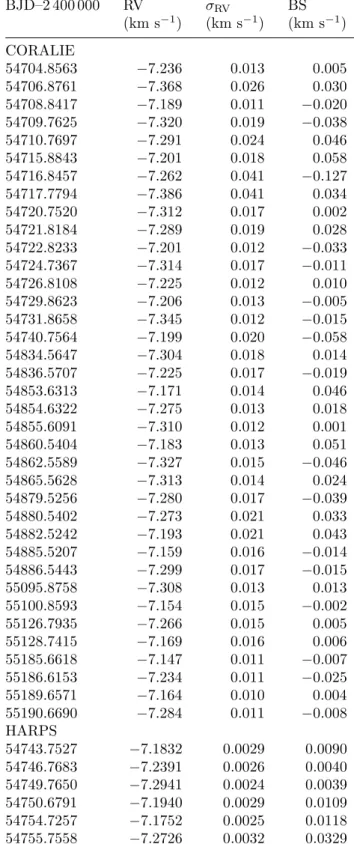
Table 1: Radial velocity measurements. BJD–2 400 000 RV σRV BS (km s−1) (km s−1) (km s−1) CORALIE 54704.8563 −7.236 0.013 0.005 54706.8761 −7.368 0.026 0.030 54708.8417 −7.189 0.011 −0.020 54709.7625 −7.320 0.019 −0.038 54710.7697 −7.291 0.024 0.046 54715.8843 −7.201 0.018 0.058 54716.8457 −7.262 0.041 −0.127 54717.7794 −7.386 0.041 0.034 54720.7520 −7.312 0.017 0.002 54721.8184 −7.289 0.019 0.028 54722.8233 −7.201 0.012 −0.033 54724.7367 −7.314 0.017 −0.011 54726.8108 −7.225 0.012 0.010 54729.8623 −7.206 0.013 −0.005 54731.8658 −7.345 0.012 −0.015 54740.7564 −7.199 0.020 −0.058 54834.5647 −7.304 0.018 0.014 54836.5707 −7.225 0.017 −0.019 54853.6313 −7.171 0.014 0.046 54854.6322 −7.275 0.013 0.018 54855.6091 −7.310 0.012 0.001 54860.5404 −7.183 0.013 0.051 54862.5589 −7.327 0.015 −0.046 54865.5628 −7.313 0.014 0.024 54879.5256 −7.280 0.017 −0.039 54880.5402 −7.273 0.021 0.033 54882.5242 −7.193 0.021 0.043 54885.5207 −7.159 0.016 −0.014 54886.5443 −7.299 0.017 −0.015 55095.8758 −7.308 0.013 0.013 55100.8593 −7.154 0.015 −0.002 55126.7935 −7.266 0.015 0.005 55128.7415 −7.169 0.016 0.006 55185.6618 −7.147 0.011 −0.007 55186.6153 −7.234 0.011 −0.025 55189.6571 −7.164 0.010 0.004 55190.6690 −7.284 0.011 −0.008 HARPS 54743.7527 −7.1832 0.0029 0.0090 54746.7683 −7.2391 0.0026 0.0040 54749.7650 −7.2941 0.0024 0.0039 54750.6791 −7.1940 0.0029 0.0109 54754.7257 −7.1752 0.0025 0.0118 54755.7558 −7.2726 0.0032 0.0329
Fig. 1.— WASP-South photometry of WASP-22 folded on the orbital period P = 3.532759 d. Up-per panel: all data. Lower panel: data within 0.12 phase units of mid-transit together with the model fit described in Section 3.1 (solid line).
0.98 0.984 0.988 0.992 0.996 1 1.004 0.98 0.99 1 1.01 1.02 Relative flux Orbital phase
Fig. 2.— Faulkes Telescope South z-band pho-tometry of WASP-22 (points) with the model fit described in Section 3.1 (solid line).
show transit-like features with a depth of approx-imately 0.012 magnitudes recurring with a 3.53-d period (Fig. 1). These were detected in the WASP photometry from the 2006 season using the de-trending and transit detection methods described in Collier Cameron et al. (2007), but judged to be “unconvincing” at that stage. The same 3.53-d pe-riodicity was detected in the 2007 data from both cameras, which was taken as strong evidence that the periodic transit signal was real. The spectral type of the star was estimated to be approximately G1 based on the catalogue photometry available for this star at the time. The duration and depth of the transit is consistent with the hypothesis that it is due to the transit of a planet-like com-panion to a main-sequence G1 star and the WASP lightcurves show no indication of any ellipsoidal variation due to the distortion of the star by a massive companion.
We also considered whether WASP-22 was likely to be a dwarf star given its J−H colour and J-band reduced proper motion, HJ. The
position of WASP-22 relative to the polyno-mial boundary between dwarfs and giants given in Collier Cameron et al. (2007) suggests that WASP-22 is a dwarf. We have also used the results of the RAVE survey DR2 (Zwitter et al. 2008) to calibrate the probability that a star is a dwarf given the observed values of J−H and HJ. The RAVE survey observed stars at a similar
range of magnitudes and galactic positions to the WASP survey and so it is well suited to this pur-pose. Stars listed in the survey with log g ≥ 3.5 were identified as dwarf stars, those with lower log g estimates were identified as giants. We then created a look-up table of the relative numbers of dwarfs and giants as a function of position in the HJ v. J−H plane. This criterion also suggested
that WASP-22 is likely to be a dwarf star because the ratio of dwarfs to giants in this region of the HJ v. J−H plane is dwarf:giant = 10:0.
The star was included as a “grade-A” candi-date in our programme of follow-up spectroscopic observations using the CORALIE spectrograph on the Euler 1.2-m telescope and the HARPS spectro-graph on the 3.6-m ESO telescope, both located at La Silla, Chile. We obtained 37 radial-velocity measurements during the interval 2008 August 27 to 2009 December 25 with CORALIE and 6 mea-surements with HARPS during the interval 2008
Oct 4 – 16. The CORALIE spectra have a to-noise ratio of 10 – 20, while the typical signal-to-noise ratio of the HARPS spectra is 50. The measurements are given in Table 1, where we also provide the bisector span, BS, which measures the asymmetry of the cross-correlation function. The standard error of the the bisector span measure-ments is 2σRV.
We also obtained photometry of TYC 6446-326-1 and other nearby stars on 2009 August 8 using the LCOGT 2.0-m Faulkes Telescope South (FTS) at Siding Spring Observatory. The Merope cam-era we used has an image scale of 0.279 arcsec-onds/pixel when used in the 2x2 binning mode we employed. We used a Pan-STARRS1z-band filter
to obtain 107 images covering one ingress of the transit. These images were processed in the stan-dard way with IRAF2 using a stacked bias image,
dark frame, and sky flat. Minimal fringing was present in the z-band images due to the deep de-pletion CCD in the camera, so no fringe correction was applied. The DAOPHOT photometry pack-age (Stetson 1987) was used to perform object de-tection and aperture photometry with an aperture size of 10 binned pixels in radius. The 5’ × 5’ field of view of the instrument contained 6 comparison stars that were used in deriving the differential magnitudes with a photometric precision of 3.1 mmag. The coverage of the out-of-transit phases is quite limited, but the data are sufficient to con-firm that transit-like features seen in the WASP-South data are due to the star TYC 6446-326-1 and to provide better measurements of the depth of the transit and the duration of ingress than is possible from the WASP-South data (Fig. 2). We note that the star 1SWASP J033121.40-234857.8 77 arcsec from WASP-22 is also a variable star. This star showed a dip in brightness of about 0.01 magnitudes lasting about 100 minutes during our observation of WASP-22.
We examined the power spectra of the WASP data from each camera and season separately to look for any intrinsic photometric variability due to magnetic activity in WASP-22. There is no pe-riodic signal consistently detected in all three data
1
http://pan-starrs.ifa.hawaii.edu/public
2
IRAF is distributed by the National Optical Astronomy Observatory, which is operated by the Association of Uni-versities for Research in Astronomy (AURA) under coop-erative agreement with the National Science Foundation.
sets so any such variability must have an ampli-tude less than a few milli-magniampli-tudes.
All photometric presented in this paper are available from the NStED database.3
3. WASP-22 Stellar Parameters
The individual HARPS spectra of WASP-22 were co-added to produce a single spectrum with a typical S/N of around 100:1 that we have anal-ysed to determine the atmospheric parameters of the star. The standard pipeline reduction prod-ucts were used in the analysis.
The analysis was performed using the uclsyn spectral synthesis package (Smith 1992; Smalley et al. 2001) and atlas9 models without convective over-shooting (Castelli et al. 1997). The Hα line was
used to determine the effective temperature (Teff),
while the Na i D and Mg i b lines were used as sur-face gravity (log g) diagnostics. The parameters obtained from the analysis are listed in Table 2.
The equivalent widths of several clean and un-blended lines were measured. Atomic line data was mainly taken from the Kurucz and Bell (1995) compilation, but with updated van der Waals broadening coefficients for lines in Barklem et al. (2000) and log gf values from Gonzalez and Laws (2000), Gonzalez et al. (2001) or Santos et al. (2004). A value for microturbulence (ξt) was
de-termined from Fe i using the method of Magain (1984). The ionization balance between Fe i and Fe ii and the null-dependence of abundance on ex-citation potential were used as an additional Teff
and log g diagnostics (Smalley 2005).
We have determined the elemental abundances of several elements (also listed in Table 2) from their measured equivalent widths. The quoted er-ror estimates include that given by the uncertain-ties in Teff, log g and ξt, as well as the scatter
due to measurement and atomic data uncertain-ties. There is no evidence from these data for any abundance anomalies in WASP-22.
The spectrum of WASP-22 shows a clear Li i 6708˚A line with EW = 32 ± 1 m˚A, indicating an abundance of log n(Li/H) + 12 = 2.23 ± 0.08 dex. We have compared this lithium abundance to the relations between effective temperature and age by Sestito and Randich (2005). For stars with
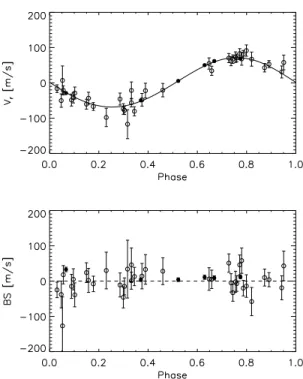
Fig. 3.— Radial velocity and bisector span mea-surements for WASP-22. Upper panel: Radial ve-locity relative to the centre-of-mass veve-locity in-cluding the long-term drift dγdt (points with error bars) compared to our model for the spectroscopic orbit (solid line). Lower panel: bisector span mea-surements. Data obtained with the HARPS spec-trograph are plotted with filled circles, CORALIE data with open circles.
Fig. 4.— Residuals from a Keplerian orbit fit to our radial velocity data without a linear trend in the model. Symbols are as for Fig. 3.
Teff ≈6000 K we find that this lithium abundance
implies a lower limit to the age of about 1 Gyr. The projected stellar rotation velocity (v sin i) was determined by fitting the profiles of several unblended Fe i lines. A value for macroturbulence (vmac) of 4.5 km s−1 was assumed, based on the
tabulation by Gray (2008), and an instrumental FWHM of 0.065˚A, determined from the telluric lines around 6300˚A. A best fitting value of v sin i = 3.5 ± 0.6 km s−1 was obtained. Inspection of
the Ca II H and K lines shows no indication of any emission due to chromospheric activity, as ex-pected for such a slowly rotating star. If we as-sume that the rotation axis of the star is approxi-mately aligned with the orbital axis of the planet’s orbit we can estimate that the rotation period of the star is Prot = 16 ± 3 d. The
rotation-colour-age relation of Collier Cameron et al. (2009) then yields an age estimate of approximately 3 ± 1 Gyr for this star. We have also compared the values of Teff and the stellar density ρ⋆ to the models of
Girardi et al. (2000) and find that the age of the star is likely to be less than 6 Gyr based on these models.
We did not see any indication of additional spectral lines in the spectrum nor any trend in equivalent widths that might suggest contamina-tion of the spectrum by another star. We estimate that the third body in this system discussed below contributes less than 5% of the light in the optical spectrum.
In summary, WASP-22 appears to be a slowly rotating, chromospherically inactive, main-sequence star that is slightly hotter than the Sun.
3.1. Planetary parameters
The amplitude of the radial velocity variation with the same period as the transit lightcurve (Fig. 3) and the lack of any correlation between this variation and the bisector span establish the presence of a planetary mass companion to this star (Queloz et al. 2001).
The CORALIE and HARPS radial velocity measurements were combined with the WASP-South and FTS photometry in a simultaneous Markov-chain Monte-Carlo (MCMC) analysis to find the parameters of the WASP-22 system. The shape of the transit is not well defined in the WASP-South or FTS photometry, so we have
im-posed an assumed main-sequence mass-radius re-lation as an additional constraint in our anal-ysis of the data. The stellar mass is deter-mined from the parameters Teff, log g and [Fe/H]
using the procedure described by Enoch et al. (2010), based on the compilation of eclipsing binary data by Torres et al. (2010). The code uses Teff and [Fe/H] as MCMC jump variables,
constrained by Bayesian priors based on the spectroscopically-determined values given in Ta-ble 2. Limb-darkening coefficients are taken from Claret (2000).
A careful analysis of the radial velocity data clearly shows a trend in the residuals as a func-tion of time (Fig. 4). We therefore adapted our MCMC analysis to include an extra parameter,
dγ
dt, which describes a linear trend in the
centre-of-mass velocity of the star.
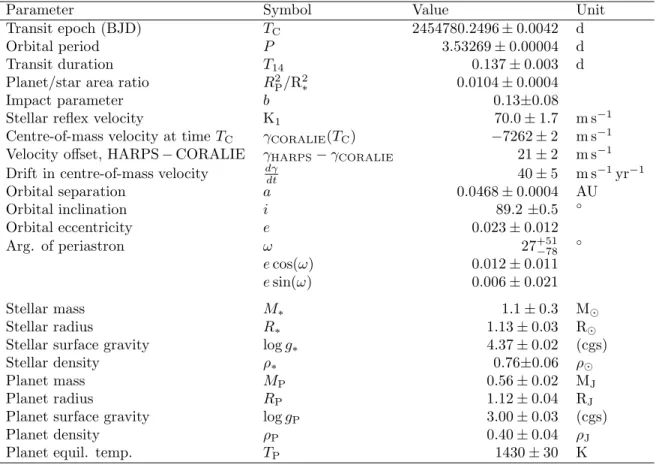
The parameters derived from our MCMC anal-ysis are listed in Table 3. We found that we did not need to account for any additional noise in the radial velocity data to due to stellar activity (“jit-ter”). The contribution to the total chi-squared from our 43 radial velocity measurements is 32.4. The surface gravity derived from our MCMC so-lution is consistent with the log g value from the analysis of the spectrum, but the large uncertainty on the latter value means that this is a rather weak constraint.
We considered the contribution of red noise to the standard errors quoted in Table 3. While the individual transits in the WASP data are af-fected by red noise, the analysis of the combined lightcurve covering many individual transits will not be strongly affected by red noise because there will be no correlation between the systematic noise from different nights. The FTS lightcurve is af-fected by red noise so we have investigated the effect of this using the “prayer bead” method. A separate MCMC analysis was performed in which synthetic FTS lightcurves were created from the model fit to the lightcurve and the residuals from this model after cyclic permutation at each step in the MCMC chain. We find that this does not significantly increase the error estimates for any of the parameters with the exception of the tran-sit epoch and period. The standard errors for these two parameters in Table 3 are taken from the “prayer bead” MCMC analysis.
We have included the parameters e sin(ω) and
ecos(ω) as free parameters in the solution because the orbit of the planet is not known to be circular, although the values of derived and their standard errors are quite consistent with this hypothesis. Imposing a circular orbit in the solution has a neg-ligible effect on the value of the other parameters derived, but would reduce the estimated errors on these parameters, perhaps unrealisitically so.
4. Discussion
Apart from the presence of a third body, WASP-22 is a typical hot Jupiter planetary system. WASP-22 b joins a growing number of planets discovered with masses ≈ 0.5MJup,
radii ≈ 1RJup orbiting solar-like stars with
pe-riods of about 3 days, e.g., 13 b, WASP-11 b/P-10 b, CoRoT-5 b, WASP-6 b, HAT-P-1 b, OGLE-TR-111 b, WASP-25 b, HAT-P-3 b, Kepler-8 b, etc.4
The third body we have detected from the lin-ear trend in the radial velocities contributes less than 5% of the flux in the optical spectrum, so it is at least 3 magnitudes fainter than WASP-22 at V. This rules out the possibilty that the companion is K-type dwarf star, but leaves the possibility that the companion is an M-dwarf or a white dwarf. There is good agreement be-tween the effective temperature we derive from the analysis of the optical spectrum and the ef-fective temperature derived using the infrared flux method (Blackwell et al. 1979). We estimate that we would have been able detect a cool compan-ion to WASP-22 if the 2MASS Ks-band
magni-tude (Ks = 10.318±0.020, Skrutskie et al. 2006)
were increased by more than 0.1 magnitudes. This also rules out a K-dwarf companion but not an M-dwarf companion or a white dwarf companion. For example, a K-dwarf companion to WASP-22 would produce K-band infrared excess of 0.1 mag-nitudes or more, in which case the effective tem-perature derived using the infrared flux method would be inconsistent with the value derived from the analysis of the optical spectrum.
There are few direct constraints on the prop-erties of the third body from the radial velocity data available to date. The observation that the trend is linear over 16 months suggests that the
4
orbital period is at least a few years. If the or-bit of the third body is approximately circular and coplanar with the inner orbit with a period of several years and an amplitude comparable to the velocity range observed so far, then it is pos-sible that the third body is a second planet, i.e., a configuration similar to the double-planet sys-tem HAT-P-13 (Bakos et al. 2009). Further radial velocity monitoring will be required to determine whether any or all of these assumptions is reason-able. This is certainly worth doing because the de-tection of a second planet in the WASP-22 system may make it possible to infer the interior structure of WASP-22 b using the method of Batygin et al. (2009). This method relies on an accurate mea-surement of the eccentricity for the orbit of the inner planet. The data available to date are only of sufficient quality to state that the eccentricity of the orbit is small (e . 0.06) so more data of the quality we obtain from HARPS will be required to measure a precise value for the eccentricity of WASP-22 b’s orbit.
The distance to WASP-22 is approximately 300pc so it may be possible to detect the compan-ion directly if it is a M-dwarf using high-constrast, high-resolution imaging.
5. Conclusion
The star WASP-22 (TYC 6446-326-1) has a hot Jupiter companion. A long-term linear trend in the mean value of the radial velocity shows that WASP-22 has a distant companion, i.e., it is a hier-archical triple system. The properties of the third body are poorly constrained by the data available to-date, but it may be an M-dwarf, a white dwarf or a second planet.
WASP-South is hosted by the South African Astronomical Observatory and we are grateful for their ongoing support and assistance. Funding for WASP comes from consortium universities and from the UKs Science and Technology Facilities Council.
REFERENCES
Anderson, D. R. et al. 2010, ApJ, 709, 159
Bakos, G., Noyes, R. W., Kov´acs, G., Stanek, K. Z., Sasselov, D. D., and Domsa, I. 2004, PASP, 116, 266
Bakos, G. ´A. et al. 2009, ApJ, 707, 446
Baraffe, I., Chabrier, G., and Barman, T. 2008, A&A, 482, 315
Barklem, P. S., Piskunov, N., and O’Mara, B. J. 2000, A&AS, 142, 467
Batygin, K., Bodenheimer, P., and Laughlin, G. 2009, ApJ, 704, L49
Blackwell, D. E., Shallis, M. J., and Selby, M. J. 1979, MNRAS, 188, 847
Burrows, A., Hubeny, I., Budaj, J., and Hubbard, W. B. 2007, ApJ, 661, 502
Castelli, F., Gratton, R. G., and Kurucz, R. L. 1997, A&A, 318, 841
Claret, A. 2000, A&A, 363, 1081
Collier Cameron, A. et al. 2009, MNRAS, 400, 451 Collier Cameron, A. et al. 2007, MNRAS, 380,
1230
Enoch, B., Collier Cameron, A., Parley, N. R., and Hebb, L. 2010, ArXiv e-prints
Girardi, L., Bressan, A., Bertelli, G., and Chiosi, C. 2000, A&AS, 141, 371
Gonzalez, G. and Laws, C. 2000, AJ, 119, 390 Gonzalez, G., Laws, C., Tyagi, S., and Reddy,
B. E. 2001, AJ, 121, 432
Gray, D. F. 2008, The Observation and Analysis of Stellar Photospheres (Cambridge University Press)
Hebb, L. et al. 2009, ApJ, 693, 1920
Kurucz, R. L. and Bell, B. 1995, Kurucz CD-ROM 23: Atomic line list (Smithsonian Astrophysical Observatory, Cambridge, MA)
Magain, P. 1984, A&A, 134, 189
Mandushev, G. et al. 2007, ApJ, 667, L195 Mardling, R. A. 2007, MNRAS, 382, 1768
Table 3: System parameters for WASP-22. The planet equilibrium temperature is calculated assuming a value for the Bond albedo A= 0. N.B. an assumed main-sequence mass-radius relation is imposed as an additional constraint in this solution so the mass and radius of the star are not independent parameters – see Enoch et al. (2010)) for details.
Parameter Symbol Value Unit
Transit epoch (BJD) TC 2454780.2496 ± 0.0042 d
Orbital period P 3.53269 ± 0.00004 d Transit duration T14 0.137 ± 0.003 d
Planet/star area ratio R2P/R 2
∗ 0.0104 ± 0.0004
Impact parameter b 0.13±0.08
Stellar reflex velocity K1 70.0 ± 1.7 m s−1
Centre-of-mass velocity at time TC γCORALIE(TC) −7262 ± 2 m s−1
Velocity offset, HARPS − CORALIE γHARPS−γCORALIE 21 ± 2 m s−1
Drift in centre-of-mass velocity dγdt 40 ± 5 m s−1yr−1
Orbital separation a 0.0468 ± 0.0004 AU Orbital inclination i 89.2 ±0.5 ◦ Orbital eccentricity e 0.023 ± 0.012 Arg. of periastron ω 27+51 −78 ◦ ecos(ω) 0.012 ± 0.011 esin(ω) 0.006 ± 0.021 Stellar mass M∗ 1.1 ± 0.3 M⊙ Stellar radius R∗ 1.13 ± 0.03 R⊙
Stellar surface gravity log g∗ 4.37 ± 0.02 (cgs)
Stellar density ρ∗ 0.76±0.06 ρ⊙
Planet mass MP 0.56 ± 0.02 MJ
Planet radius RP 1.12 ± 0.04 RJ
Planet surface gravity log gP 3.00 ± 0.03 (cgs)
Planet density ρP 0.40 ± 0.04 ρJ
McCullough, P. R., Stys, J. E., Valenti, J. A., Fleming, S. W., Janes, K. A., and Heasley, J. N. 2005, PASP, 117, 783
O’Donovan, F. T., Charbonneau, D., and Hillen-brand, L. 2006, in Bulletin of the American Astronomical Society, Vol. 38, Bulletin of the American Astronomical Society, p. 1212 Pollacco, D. et al. 2008, MNRAS, 385, 1576 Pollacco, D. L. et al. 2006, PASP, 118, 1407 Queloz, D. et al. 2001, A&A, 379, 279
Santos, N. C., Israelian, G., and Mayor, M. 2004, A&A, 415, 1153
Sato, B. et al. 2005, ApJ, 633, 465
Sestito, P. and Randich, S. 2005, A&A, 442, 615 Showman, A. P. and Guillot, T. 2002, A&A, 385,
166
Skrutskie, M. F. et al. 2006, AJ, 131, 1163 Smalley, B. 2005, Memorie della Societa
Astro-nomica Italiana Supplement, 8, 130
Smalley, B., Smith, K. C., and Dworetsky, M. M. 2001, UCLSYN User guide
Smith, K. 1992, Ph.D. thesis, University College, London
Stetson, P. B. 1987, PASP, 99, 191
Torres, G., Andersen, J., and Gim´enez, A. 2010, A&A Rev., 18, 67
Wilson, D. M. et al. 2008, ApJ, 675, L113 Zwitter, T. et al. 2008, AJ, 136, 421
This 2-column preprint was prepared with the AAS LATEX
macros v5.2.
Table 2: Stellar parameters of WASP-22 from our spectroscopic analysis. Parameter Value Teff (K) 6000 ± 100 log g 4.5 ± 0.2 ξt(km s−1) 1.2 ± 0.1 vsin i (km s−1) 3.5 ± 0.6 [Fe/H] −0.05 ± 0.08 [Mg/H] +0.06 ± 0.04 [Si/H] +0.17 ± 0.11 [Ca/H] +0.10 ± 0.11 [Sc/H] +0.12 ± 0.12 [Ti/H] +0.10 ± 0.07 [V/H] +0.07 ± 0.09 [Cr/H] 0.00 ± 0.08 [Mn/H] +0.02 ± 0.06 [Co/H] +0.09 ± 0.13 [Ni/H] +0.09 ± 0.06 log N(Li) 2.23 ± 0.08

![Table 2: Stellar parameters of WASP-22 from our spectroscopic analysis. Parameter Value T eff (K) 6000 ± 100 log g 4.5 ± 0.2 ξ t (km s −1 ) 1.2 ± 0.1 v sin i (km s −1 ) 3.5 ± 0.6 [Fe/H] − 0.05 ± 0.08 [Mg/H] +0.06 ± 0.04 [Si/H] +0.17 ± 0.11 [Ca/H] +0.10 ± 0](https://thumb-eu.123doks.com/thumbv2/123doknet/5476915.130132/9.918.509.736.475.789/table-stellar-parameters-wasp-spectroscopic-analysis-parameter-value.webp)
