1
Why do parties support emigrant voting rights?
Eva Østergaard-Nielsen,
Department of Political Science, Universitat Autonoma Barcelona Irina Ciornei,
Institute of Sociology, University of Bern Jean-Michel Lafleur,
Centre for Ethnic and Migration Studies (CEDEM), University of Liege
Forthcoming in European Political Science Review (accepted July 2019).
Abstract
Policies allowing enfranchisement of non-resident citizens (emigrants and their descendants) are now implemented in the majority of states worldwide. A growing number of case studies show that the extension of voting rights to non-resident citizens is often contested among country of origin political parties. However, there is no systematic comparative study of why different political parties support or oppose external voting rights and how this position is framed by the parties. Drawing on a unique dataset based on 34 debates across 13 countries, we estimate the extent to which ideology and party family are correlated with the positioning and framing of parties. Among the findings are that the more to the right is a party, the more it tends to support external voting rights, except in the case of radical right parties. The position on emigrant voting rights is largely framed along more pragmatic arguments.
Keywords: Migration, parties, frames, electoral rights, positioning
Acknowledgements: This research was supported by the project Emigrant Political Incorporation (EMINCOR) (H2020-MSCA-IF-660571-2014) and the project Migration and Transnational Social Protection in (post) crisis Europe’ (MiTSoPro) (ERC Starting Grant No. 680014). We extend a special thanks to our research
assistants Nicolas Fliess and Sophie Schneider as well as the referees and discussants in the conferences of the CES, EUDO and Globalcit conferences and the IBEI
2 Introduction
Policies allowing enfranchisement of non-resident citizens are implemented in the majority of states worldwide. Such rights are often controversial in the homeland. Indeed, the growing number of single case studies or focused comparisons show that the implementation or reform of external voting rights can be contested among country of origin political parties (Joppke, 2003; Lafleur, 2013; Paarlberg, 2019). However, there is a lack of systematic comparative studies of why different political parties support (or oppose) external voting rights and how these positions are motivated.
The analysis of how and why parties position themselves on emigrant voting rights is an important step towards understanding how not just governments, but also political parties face the challenge of democratic linkage with mobile citizens. It contributes to ongoing debates across several research fields. First, studies of state-diaspora relations have only recently begun to compare the role of political parties (Burgess, 2018; Koinova & Tsourapas, 2018; Østergaard-Nielsen & Ciornei, 2019; Paarlberg, 2019), but we have still little knowledge of the broader trends in party position and framing of sending country outreach policies. Second, a comparative analysis of party support of emigrant political rights, complements the rapidly growing literature on how ideology and party competition influence the position of political parties on immigrant rights (Alonso & Fonseca, 2012; Helbling, 2014). Joppke (2003) has linked support for emigrant rights with right-wing ideology. However, otherwise such analysis has not been extended to policies towards emigrants and the paper discusses to what extent this framework is applicable to the analysis of emigrant voting rights. Third, a series of theoretical studies has located the arguments for and against external voting rights in broader normative arguments regarding state-citizen relations in a transnational perspective (Bauböck, 2007; López-Guerra, 2005; Nohlen & Grotz, 2000; Rubio-Marin, 2006). It is therefore relevant to examine to what extent these broader frames are evoked by different political actors during policy debates on external voting rights.
In order to fill these gaps, we unpack the politics of the implementation or subsequent reform of external voting rights at the national level through a comparative analysis of party positions on and framing of external citizenship in 13 European countries (12 EU member-states and Switzerland). We develop a framework for
3
analysing the position on and framing of the extension of external citizenship among parties based on both deductive and inductive categories. Subsequently, we create a unique dataset based on the coding of a selection of parliamentary debates on implementation or reform of external citizenship. We then first analyse the distribution of positions across homeland political parties and estimate the extent to which a series of factors are significant for the positioning of parties. Second, we present an analysis of the frames motivating party position in the same debate. We draw on both primary and secondary data on party support for external voting, as well as Comparative Manifesto Project indicators on party position on a left-right scale and statistics on electoral results.
Explaining party support
The literature on emigrant voting suggests that broader structural explanations including enfranchisement as part of transition to democracy, regional patterns of policy diffusion as well as the leverage of well-organized emigrant lobbies contribute to the increase in countries granting emigrant voting rights (Caramani & Grotz, 2015; Rhodes & Harutyunyan, 2010; Turcu & Urbatsch, 2014). Some case-studies highlight the influence of a particular party, like the National Alliance in Italy, with an interest and commitment to the well-being of emigrants (Lafleur, 2013).We compliment these studies by further exploring in particular two dimensions relevant to understanding why certain parties decide to push for or at least be in favour of emigrant enfranchisement: ideology and party competition.
Ideology is a relevant first stop in the analysis of the party position on and framing of particular policy issues. That said, parties continuously renegotiate traditional left-right positions as new issues appear which cut across ideological divisions related to state-market relations and economic policy positions. One such issue is international migration. This issue is embedded in the broader post-industrial cleavage of open-closed societies (Caramani, 2011). Open-closed societies refers to opposition to or support of the consequences of globalization of the economy, a transfer of sovereignty to intergovernmental or the increase in power of supra-national institutions. While protest-parties, anti-migrant parties and neo-populist parties to the
4
right tend to have a clear position on migration, then main-stream parties often find it more difficult to position themselves (Odmalm, 2011).
Yet, although both issues of emigration and immigration relate to the decoupling of the territorial congruence of citizens and states, then immigrant rights and emigrant rights are not associated with the same ideological standpoint in the literature. Joppke (2003) refers to the extension of rights to immigrants as the ‘de-ethnicization’ of citizenship, while the extension of rights to emigrants is labelled a process of ‘re-ethnicization’ of citizenship (Joppke, 2003). His analysis of citizenship reform in Spain, France and Italy shows that while leftist parties have historically pushed for reforms in favour of immigrant inclusion, the rights of non-resident emigrant citizens have been promoted by the political right. However, a more recent study drawing on a broader global set of data shows that the political colour of the government is not significant for the implementation of external voting rights (Turcu & Urbatsch, 2014). It is therefore relevant to further explore to what extent the support for increased emigrant voting rights and participation is aligned with a left-right position of the party. In continuation, it is interesting to compare to what extent the frames which parties evoke to motivate their position relate to their overall ideology and position on other issues. Studies of party positioning on migration have noticed a so-called ‘issue-bundling’ as parties seek to align new political issues with their overall political profile (Bakker et al., 2012; Helbling, 2014). Most of the frames related to emigrant voting rights presented below are not immediately partisan (see Table 1). Yet, it could be expected that parties to the right, in particular the radical right, with a stronger nationalist outlook could be more likely to draw on ethnic frames in their support for political rights for co-nationals abroad. Meanwhile parties, mainly to the left, which place a stronger emphasis on immigrant rights would be more likely to refer to the frames related to territorial definitions of the demos or link the support or opposition to extending emigrants rights with voting rights for immigrants with reference to the equality frame.
In terms of party competition, a growing number of studies have questioned to what extent left-right positioning of parties can explain their stance on immigration by including a more systematic analysis of the dynamics of party competition. The basic argument is that the dynamics and directions of competition within the party system
5
influence the party positioning on immigration policies. For instance, one recent study finds the existence of a radical right anti-migrant party tends to make the centre-left become more restrictive in terms of the migration political positioning (Alonso and Fonseca 2012). A similar observation has been made for centre-right parties (Bale, 2003). Other studies dispute this argument saying that ideology remains the best predictor for positioning on migration issues among left-wing parties (Carvalho and Ruedin, 2018)
The argument of repositioning in the face of party competition has also been extended to the analysis of how parties frame their position. Party framing strategies are constrained not by their overall left-right ideological position but also by their governmental involvement (Helbling, 2014) and the simultaneous positioning and framing of other parties (Odmalm, 2011). For instance, Odmalm (2011) analyses how mainstream parties in Sweden have had to carefully balance their position on and framing of policies on migration. On the one hand they may wish to steer clear of a too exclusive position with reference to nationalist arguments, otherwise associated with radical right parties. On the other hand, they may wish to avoid a framing that is too inclusive in the name of international solidarity, otherwise associated with more left-wing parties. Centre-right and left parties will therefore carefully choose issues and frames that are not in tension with their overall position on other issues. They will want to avoid conflicting ideological pulls which can lead to voter-backlash and tension within the party.
It is, however, questionable if party positioning and framing on emigrant political rights follow the same dynamics as within the field of migration and immigrant issues. While issues of immigration and immigrant rights have become highly politicized in many EU-member-states during the last decades then issues of emigration seem much less salient. Radical right parties, which push the agenda on immigration issues, may not pursue emigrant issues with the same intensity and impact on the salience and positioning of other parties. Party competition might be less likely to decouple the link between ideology and support for emigrant voting rights than is the case for immigrant rights.
Finally, the political content of the reform of emigrant voting rights can influence the stance and argumentation of parties. We include a broad set of debates on
6
policies related to different levels and aspects of emigrant enfranchisement. Following the distinction between paradigmatic and incremental policy changes by Hall (1993), we suggest that emigrant policies can be divided according to the degree of change they impose: Paradigmatic policy changes in the emigrant voting rights refer to the recognition/abolition of external voting rights, recognition/abolition of special representation, expansion/reduction of the type of elections that citizens abroad can take part in. Incremental policy changes include expansion or restriction of length of residence abroad in order to participate in elections or changes in, for instance, voting modality and type of registration.
We explore if more paradigmatic policy changes could lead to a stronger alignment of party ideology and position, while more incremental policy changes regarding forms of vote and registration could be seen as less controversial and lead to less polarized positions among the parties. Moreover, the set of frames employed in the context of debating a paradigmatic proposal to extend voting rights to emigrants for the first time may be closer related to the demos-related and democratic-egalitarian categories of frames outline above. In contrast, a debate on an incremental proposal whether or not emigrants should be allowed to cast their ballot through a postal vote or by using the Internet might be closer related to the categories of electoral integrity or efficiency. It is therefore important to be able to connect individual and somewhat technical arguments about external voting to frames that give a specific meaning of what external voting means for those parties.
Research design
The analysis of party positions and arguments related to emigrant political participation and representation is based on the coding and analysis of parliamentary debates on 34 policy proposals in 13 European countries (see Appendix 1 and 3).1
Regarding the selection of countries, we focus on western Europe. Countries in this region share broad characteristics of party systems and emigration trajectories
1 All debates, including an overview of key features and sources, are listed in Appendix 3 (online Appendix). Denmark and Ireland have not yet implemented external voting, and we analyse the most relevant recent legislative proposals. The proposals in Spain, 2011 and United Kingdom 2000 aimed at restricting external voting rights and have been coded accordingly.
7
compared to for instance countries in Central and Eastern Europe which have experienced more intense outmigration patterns since the early 2000s. Even so there are notable differences among the emigration trajectories and stocks of emigrants among the 13 countries included (see Appendix 1). In southern European countries such as Spain, Italy and Portugal, low skilled labour migrants are still dominating the perceptions of the main emigrant profile, despite different recent outmigration and the presence of several generations of citizens abroad (Lafleur and Stanek, 2017). Importantly these countries see themselves as emigration countries as well as, more recently, immigration countries. In contrast, most of the other countries in our selection perceive emigration as a sum of individual decisions made by high-skilled workers (see among others Hampshire 2013 on the UK and Lafleur 2011 on Belgium) and have tended to have a rather indifferent expatriate narrative. Ireland is an exceptional case due to the very large-scale historical emigration and the presence of a sizeable Irish diaspora abroad which is still disenfranchised. Germany also differs from the majority of the rest of the cases by seeing part of its expatriate population as Aussiedlers resulting not from emigration but from historical factors such as border change (Klekowski von Koppenfels 2002).
We seek to identify common patterns of support across different families of parties across these different emigration trajectories and stocks of emigrant voters abroad. In order to do so, we focus on policy positions of parties and MPs and elaborate a set of possible frames to capture the core arguments voiced by MPs in parliamentary debates.
Policy positions on emigrant voting rights
Position in this context refers to the substantive view of the party on a specific issue (Bélanger & Meguid, 2008; Laver, 2001; Pogorelis et al, 2005). Studies so far rely on a variety of sources in order to infer party positions such as party manifestos, expert surveys, voters’ perceptions of party stances or roll-call voting (Krouwel & van Elfrinkhof, 2013). However, the policy area of emigrant citizenship and voting rights is, in contrast to issues of immigrant rights, not included in any of the broader databases of party positions currently available. A recent study (at the level of the European Parliament) suggests that parliamentary speeches may also constitute an important
8
source of information for the understanding of the ideology and positioning of parties (Proksch & Slapin, 2010). Following this suggestion, we examine the position of parties in a selection of recent debates on the granting or (substantial) reform of emigrant voting rights.
Framing of policy positions on emigrant voting rights
A growing body of literature focuses on how parties frame their position on different policies. In this optic, frames are the set of arguments which a party uses to explain and justify its stance towards a particular policy (Helbling, 2014). The analysis of frames can nuance the understanding of the positioning of parties and may point to linkages with their overall outlook.
Similarly to Helbling (2014), our strategy to develop frames has been both inductive and deductive. We used past empirical work to identify arguments used in political debates leading to the adoption of external voting laws in Europe and Latin America (Lafleur 2013). In addition, we have grounded our frame categorization in theories of democratic inclusion and citizenship and the literature on diaspora policies. This combination of inductive and deductive strategy helps us include potentially important arguments a priori while also enabling us to categorize arguments under more general frame categories.
Demos-related frames are those used by political parties to justify their position on external voting based on their vision of what constitutes a cohesive political community. They consist in mobilizing ideas and principles defining citizenship that are used as arguments to assess the legitimacy of granting or refusing citizens abroad a say in home country politics. From the normative theory literature and previous empirical analysis, we can identify three types of demos-related frames.
The first are territorial frames inspired by Dahl’s principle of full inclusion (Dahl, 1989) according to which the demos of a democratic polity comprises ‘all adults subject to the binding collective decisions of the association’ (p.129). In this frame, the residency requirement is not just a practical limitation to external voting. Actors question the idea that citizens abroad are affected by the laws passed by the representatives they elected (López-Guerra 2005).
Ethnic frames are the second type of demos-related frames and mirror the arguments of those who adopt the territorial frame. It consists in the use of a definition
9
of citizenship based on ancestry that disregards residency and contemporary connections with the homeland as legitimate criteria for the exclusion of citizens abroad from the electorate. Authors such as Gans (2003) have defended the extension of voting rights to citizens abroad because ‘(…) rights are based on the interests that all members of a national group might have in their nationality, and not only on the interests of those who are in fact citizens of the state’ (Gans, 2003).
Stakeholder frames represent an intermediary position between the two above-mentioned frames. Scholars like Bauböck (2007) and Owen (Owen, 2009) denounce the illusion that citizens abroad are not affected by decisions taken in the home country. However, Bauböck (2007) considers the principle of affected interest too vague as a basis to allocate political rights. He uses instead the concept of stakeholder, to suggest that beyond having a fundamental interest in the outcomes of the political process, citizens abroad must also have a claim to be represented as participants in that process. For this reason, arguments in favour of external voting that belong to the stakeholder frame may include additional conditions such as a period of prior residence in the home country.
Democratic-egalitarian frames are used to support or reject external voting on the basis of principles that supersede the interests of the nation-state. Political parties use universal principles such as democracy, human rights and equality as benchmarks to compare their own position on external voting with the external voting legislation of other states that are recognized as equally or more democratic. The underlying objective is thus to demonstrate that their position is the closest to the body of international principles and regulations that they consider define a modern democratic state. We identified two types of democratic-egalitarian frames.
First, human rights frames include arguments on the universal nature of voting rights and posit that the exclusion of external voters contradicts the indisputable right of citizens to regularly express their opinion on the government of their state of nationality. As illustrated by the work of Nohlen and Grotz (2000), specific arguments in the human rights frame include the idea that the full realization of the principle of universal suffrage commends that citizens abroad be allowed to vote.
Second, equality frames consist in comparing the position of citizens abroad with that of other individuals who also have claims for political participation towards the same
10
state. Most notably however, equal rights frames are also used to express conditional support in favour of external voting reforms in exchange for legislative reforms in the area of voting rights for foreigners residing on the national territory. Similarly, equality frames may be used to justify restrictions in external voting on the basis that dual citizens could be allowed to vote in the national elections of two countries.
Electoral integrity frames are the third category of frames we identified and rely on the idea that external voting legislation cannot overlook the impact of such practice on electoral processes and emigrants. Process protection frames consist in opposing or supporting external voting based on its anticipated impact on the reliability of the electoral process as a whole. Electoral integrity frames therefore often mobilize arguments on the level of accountability of actors involved in electoral processes abroad. Second, emigrant protection frames argue that campaigns and electoral processes abroad may trigger positive or negative reactions from the emigrants’ host country authorities. When countries in conflict or post-conflict situation organize elections abroad, these situations often triggers concerns about security or the importation of foreign conflicts in countries of residence (Lafleur, 2013). While a comparable situation is less likely to occur with EU migrants, political parties may argue that homeland voting call the emigrants’ loyalty towards their country of residence into question.
The fourth category of frames consists of utilitarian frames, which approach external voting primarily from a cost-benefit analysis that stronger transnational political connections would generate for the homeland. These frames focus on the expected impact that external voters would have on the home country’s public finances, parties’ performances and level of electoral participation (turnout).
Global diaspora frames use migrants’ contributions through remittances and investments to legitimize the implementation of external voting procedures, which often represent a high cost for the public finance. While few countries actually tax citizens abroad, political parties who support external voting may equate the ‘no taxation without representation’ argument to the situation of emigrants who send large amount of remittances to their homeland but are not entitled to vote from abroad. Less directly, global diaspora frames also posit that granting external voting rights stimulates emigrants’ connections with their homeland and therefore fosters the creation of a
11
global network of citizens abroad who can be activated in the economic or political interest of their homeland (Gamlen, 2008).
Partisan interest frames are based on the expected electoral gains or losses that the inclusion of external voters is expected to generate in comparison to an electoral process in which voters abroad would not be included. These frames are usually not used by parties to explicitly justify their opposition or support based on the negative or positive impact of external voters on their own electoral performances. Rather, political parties draw on these frames more indirectly to refer to the impact this vote is expected to have on their competitors. That is, the expected electoral gains of competitors can be used as an argument to discredit the adoption of external voting legislation on the basis that it would be guided by partisan interests only. Examples of such practice in Latin America and Europe have been documented in a non-systematic way in Europe and Latin America (see Lafleur 2011).
Emigrant-engagement frames are the last type of utilitarian frames and refer to positions on external voting that compare efforts and resources required in implementing external voting reforms with the expected voter turnout abroad. Low levels of participation among citizens residing abroad (or the expectation of it) are often equated with voters’ apathy. Insistence on the emigrants’ unwillingness to make effort to register and vote thus serves to justify opposition to external voting. Conversely, emigrant engagement frames also refer to arguments that equate low turnout with cumbersome bureaucratic procedures.
Finally we have identified policy learning frames. Recent political science work on the topic has shed light on regional dynamics and processes of democratization as variables explaining the international diffusion of external voting. The work of Turcu and Urbatsch (2014) in particular have shown that the adoption of external voting laws by neighbouring states strongly enhances the likelihood for one state to adopt similar legislation. Looking at the MENA region and Latin America, Brand (2014) and Escobar (2007) have underlined similar dynamics when noting that the diffusion of democracy in the region has usually been accompanied with trends of diffusion of external voting. Policy-learning frames are thus political parties’ positions on external voting that explicitly make reference to the necessity to adopt/reform external voting laws in order
12
to adhere to an international or regional practice deemed to epitomize a ‘modern’ electoral system.
13 Table 1. Categories of frames on emigrant voting rights in parliamentary discourses
Category
of frames Demos related Democratic-egalitarian Electoral integrity Utilitarian Policy-learning Specific
frame
Territorial Ethnic Stakeholder Human Rights Equality Process protection Emigrant protection Global diaspora Partisan interest Emigrant engagement Policy-learning Examples Some voters never lived in the homeland Common
destiny Expatriates have rights and obligations (taxes) towards their homeland Universal
suffrage Immigrant vote in exchange for emigrant vote Guarantees against fraud
Dual loyalty Economic
resource Authoritarian party is blocking external voting because they expect electoral losses Emigrant willingness to make efforts to cast a ballot from abroad Neighbouring country has better legislation Voters not affected by decisions of those they elect Voting from abroad perpetuates homeland identity Emigrant claim making Democracy more complete Equality between emigrants and co-nationals Oversight (supervision of processes abroad) Cooperation with destination countries Network Competing parties support external voting because they expect electoral gains Technical solutions increase participation Necessity to look beyond the borders for legislative inspiration
15 Data and methods
We searched for all policies related to emigrant voting rights between 1980 and 2015 and identified 34 policies with a related debate accessible through the parliamentary online search system.2 After detailing all the steps of the legislative process, we prioritized plenary debates at the stage of the second reading in the lower house.3 Akin to the method of (Closa & Maatsch, 2014), the unit of analysis are the statements of MPs during the debates (see also, Dolezal et al , 2010; Pennings & Keman, 2002).
Within each statement we coded a) the actor and her political party; b) the direction of the statement (against (1), ambiguous (2) and in favour (3) the proposal to extend (or in a few cases restrict) emigrant voting rights; c) the justification of the position, that is, both the general and more specific frame used (see table 1). If an intervention draws on several justifications these have been coded as separate entries. During the coding of frames we have revised our initial set of frames along the way and included more sub-frames. Consequently we have recoded for consistency.
One of the methodological challenges is that a party may not have a unitary position on a policy issue (Krouwel & van Elfrinkhof, 2013). In order to overcome this challenge, we have summarized all the position of MPs from the same parties and averaged the score. Subsequently, we categorised the party position as follows: a score between 1 and 1.66 is coded as against, 1.67-2.33 is coded as ambiguous, while parties who are in favour have a score higher than 2.33. In order to verify this score we identified all available roll-calls related to the debates. However, such information is only available in 53,8 % of the party observations and cannot be included in a systematic manner. We have verified that 69,2 % of our coding aligns with the roll-call.
2 This search included a revision of the information already compiled in the datasets of external voting legislation on the websites IDEA and Globalcit (see Appendix 1 for details) as well as search in online parliamentary databases for all cases to check for further electoral reforms.
3 The exceptions is France where we have coded the debates in the Senate where the main debates took place likely because of the long-standing presence of emigrant representatives in that chamber.
16
In 20,5 % of the cases the party takes an ambiguous position in the debate but ends up voting against or, more frequently, in favour. The final 10,3 % are parties that take a more positive view in the debate but end up voting against.4
With regard to the explanatory factors of party positions on emigrant voting rights, we rely on the Comparative Manifesto Project (CMP) and Parliaments and Governments (Parlgov) databases in order to determine party ideolog and party family. Concerning party ideology, we use the variable RILE that constructs an additive measure of left and right related statements by using factor loadings (Bakker et al., 2012; Jahn, 2010).5 For an alternative measurement of ideology, the analysis uses a nominal variable on party families as coded in the Parlgov dataset.6
Besides ideology we control for a series of other characteristics at the party and country level. One relevant party characteristic is government participation. Government parties may be the initiators of emigration related policy changes and therefore tend to position themselves in favour of these proposals. In terms of variables related to the debates, we systematically analyse the difference between party support for paradigmatic and incremental policy changes. The type of policy change is captured by a dummy variable that takes the value of 1 for paradigmatic changes and 0 for the incremental ones.
An obvious motive for support of emigrant voting rights is the expected electoral return among parties (Lafleur, 2011). Parties have been found to pay more attention to emigrant issues in their legislative work if they receive higher shares of emigrant votes (Østergaard-Nielsen and Ciornei, 2019). A recent study based on data from Africa argues that the electoral strategic interest of the incumbent government drives emigrant enfranchisement (Wellman, 2019). However, in the debates on the initial implementation of emigrant rights, emigrants have yet to express their political
4 The roll-call data has not been included in the dataset, but is available upon request. 5 The relationship between party positioning on emigrant voting rights and other issues such as the national way of life (per 601/2) or multiculturalism (per 607/8) in the CMP dataset is not significant. These regressions are uncertain because of missing observations in the CMP dataset.
17
preference through the ballot box. Moreover, several countries do not keep separate official statistics of the voting preferences from abroad. We are therefore only able to estimate the relationship between support for policies extending emigrant voting rights and emigrant electoral support in 12 debates across 7 countries.7
The influence of country-level factors on expansive emigrant voting legislation is captured by introducing the strength of the radical right. The total percentage obtained by the radical right at the elections preceding the policy debate is a relevant indicator for its capacity in influencing other parties on emigration issues. We use ordered logistic regressions with country fixed effects and robust SE and logistic regressions with robust SE respectively (Bryan and Jenkins 2016).
Findings
The policy changes cover a broad range of topics. As illustrated in the list of debates in Appendix 3, most of the proposals for paradigmatic policies on emigrant electoral rights (16) refer to the introduction of such rights and, in the case of France and Italy, special emigrant representatives in homeland parliaments. Proposals for incremental changes (18) focus, for example, on extending the limit of years abroad or improving registration and voting modalities of emigrants. All but five of the debates take place from 1990 , a fact which assures a certain degree of equivalence of party discourses and positions, in spite of the distinct topics debated. The extent to which these policy proposals polarize political parties varies across the cases. From a total of 145 parties the majority (74,5 %) are supportive of extending voting rights to emigrants, 15,2% have an ambiguous position while roughly 10,3% are against the recognition or extension of emigrant voting rights. This indicates that across our cases, emigrant voting rights are not always contested.
7 We have included data on electoral support from emigrants from the most recent election before the debate for: Austria (general election), Belgium (general election) France (presidential elections), Italy (EP elections), Spain (general election), Portugal (general legislative elections), the Netherlands (general election).
18 Party positions on emigrant voting rights
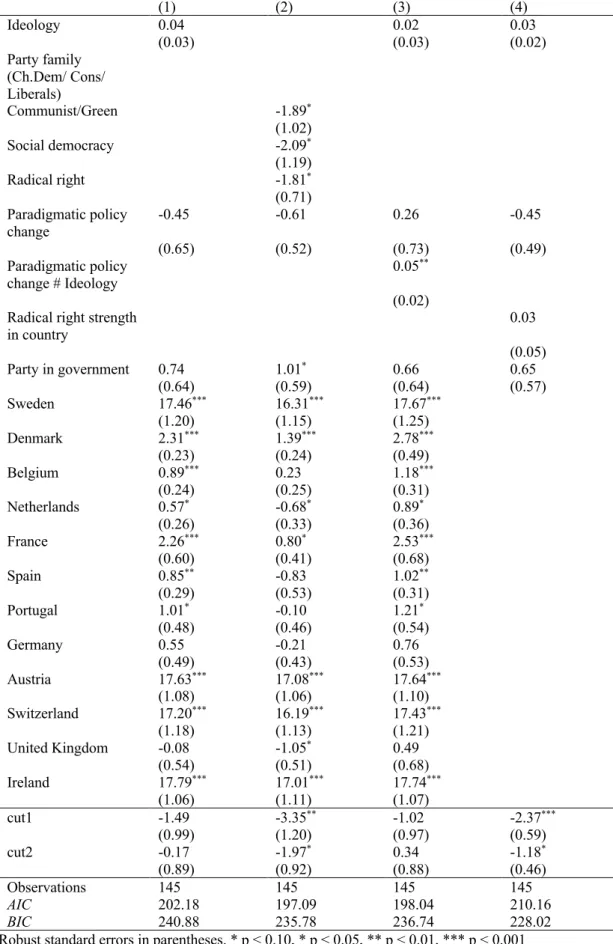
The impact and significance of the factors that influence party positioning are presented in Models 1-4 below (Table 2). Models 1-3 test party related determinants and use country fixed effects with robust standard errors in order to account for contextual influences. Model 4 introduces the variable on the percentage obtained by the radical right at the most recent election before the debate analysed.
The results in Model 1 show that the relationship between right-wing ideology and party position is positive but not significant when we analyse the entire set of debates. However, we find a significant relationship between party ideology and support for the extension of emigrant rights in Model 2, where we observe that the centre right party family, composed of Liberals, Conservatives and Christian Democrats are significantly more in favour than all other party families. Importantly, as shown in Model 3, the role of party ideology is mediated by the type of policy in question. The impact of ideology measured on a left-right space is significantly stronger and positive in the context of debates introducing paradigmatic changes to the enfranchisement of emigrants and insignificant in the context of incremental changes related to adjusting minor issues of access and voting modalities related to these rights. Thus, the marginal effect of ideology is 0.003 in contexts with incremental changes and 0.01 in the case of paradigmatic policy change debates. When calculating predicted probabilities, we observe that the probability to support external voting rights for a party on the left (rile=-30) is 79 per cent when paradigmatic changes are at stake and 78 per cent in relation to incremental ones. A party on the right (rile=30) has a probability of 80 to support incremental changes and 85 the paradigmatic ones.
A qualitative analysis of our data corroborates this finding. Parties debating paradigmatic policy changes tend to have more polarized positions than they do in incremental debates. For instance, a series of smaller parties were against the proposal to eliminate emigrant voting rights in local elections in Spain in 2011, while the debate on registration mechanisms in 1995 did not face any opposition.
Against our expectations, the radical right is not a main champion of emigrant political rights (Model 2). This suggests that the radical right anti-immigrant agenda is not necessarily complemented by a generous position towards emigrants. It is worth noting
19
here that although these parties are referred to as radical right, most of them, with the exception of the parties in Denmark and Italy, have a composite RILE score close to zero. Moreover, this result has to be interpreted with caution since our dataset only includes seven parties classified as radical right parties across a total of eight coded debates: the Swiss Peoples Party, the Austrian Freedom Party, the Danish People Party, The Danish Progress Party, the Flemish Block, the Flemish Peoples Union and the National Alliance and Northern League in Italy.
A qualitative and contextualized analysis of these parties shows a more complex and ambiguous situation of several of the radical right parties. In the case of Italy, the radical right party of the National Alliance was a long-standing advocate for emigrant voting rights (Lafleur, 2013). However, in the case of Belgium other electoral interests overshadowed the support for emigrant rights. The Flemish Peoples Union and the Flemish Block were against the implementation of external voting rights in 1998 because this policy proposal was part of a deal between governing parties which also included extending voting rights to non-national residents which these two parties strongly opposed.
20
Table 2. Determinants of party position on external voting rights. Ordered logistic regression
(1) (2) (3) (4) Ideology 0.04 0.02 0.03 (0.03) (0.03) (0.02) Party family (Ch.Dem/ Cons/ Liberals) Communist/Green -1.89* (1.02) Social democracy -2.09* (1.19) Radical right -1.81* (0.71) Paradigmatic policy change -0.45 -0.61 0.26 -0.45 (0.65) (0.52) (0.73) (0.49) Paradigmatic policy change # Ideology 0.05 ** (0.02) Radical right strength
in country 0.03 (0.05) Party in government 0.74 1.01* 0.66 0.65 (0.64) (0.59) (0.64) (0.57) Sweden 17.46*** 16.31*** 17.67*** (1.20) (1.15) (1.25) Denmark 2.31*** 1.39*** 2.78*** (0.23) (0.24) (0.49) Belgium 0.89*** 0.23 1.18*** (0.24) (0.25) (0.31) Netherlands 0.57* -0.68* 0.89* (0.26) (0.33) (0.36) France 2.26*** 0.80* 2.53*** (0.60) (0.41) (0.68) Spain 0.85** -0.83 1.02** (0.29) (0.53) (0.31) Portugal 1.01* -0.10 1.21* (0.48) (0.46) (0.54) Germany 0.55 -0.21 0.76 (0.49) (0.43) (0.53) Austria 17.63*** 17.08*** 17.64*** (1.08) (1.06) (1.10) Switzerland 17.20*** 16.19*** 17.43*** (1.18) (1.13) (1.21) United Kingdom -0.08 -1.05* 0.49 (0.54) (0.51) (0.68) Ireland 17.79*** 17.01*** 17.74*** (1.06) (1.11) (1.07) cut1 -1.49 -3.35** -1.02 -2.37*** (0.99) (1.20) (0.97) (0.59) cut2 -0.17 -1.97* 0.34 -1.18* (0.89) (0.92) (0.88) (0.46) Observations 145 145 145 145 AIC 202.18 197.09 198.04 210.16 BIC 240.88 235.78 236.74 228.02
21
Model 4 indicates that party competition, in the form of the presence of a strong radical right party in a country, does not have any impact on the positioning of other parties. The results show that in countries with higher levels of electoral success of the far right, party support for external voting rights is not higher than in countries where there is a weak radical right presence. This could follow from the observations that the radical right is not one of the main drivers of emigrant voting right, indicating that this issue does not have the same salience and politicisation dynamics as immigration issues.
Finally, most estimations also show that parties in government are more prone to support the expansion of external voting rights regardless of their ideological position. One explanation is that many of the successful proposals are presented by government parties, albeit other political forces support them or have initially originated them. Emigrant electoral support is not significant for support for extension of electoral rights, but this variable has only been identified for 40 % of the cases and hence these results are only reported in Appendix 2.
Other unobserved factors at the country level are significant for explaining party support, as country dummies suggest in Models 1-4. Thus, when compared to Italian parties, only Swedish, Portuguese and Austrian parties are more supportive of emigrant political right extensions. In the case of Sweden this could relate to the fact that this is an incremental debate on introducing postal voting rights and in the case of Austria the policy proposal followed a decision of the Constitutional Court to grant voting rights to emigrants.
Party frames on emigrant voting rights
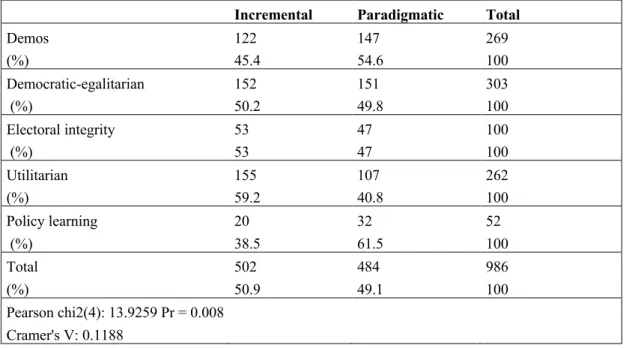
The arguments used by political parties to motivate their support for or opposition to emigrant voting rights cover all the categories of frames presented in table 1. Yet, there are differences between the frames used in paradigmatic changes and those used in the incremental ones. As shown in table 3, the demos related frames are evoked more during debates on paradigmatic changes of policies on emigrant voting (54,6 %) compared to debates on incremental changes (45,4 %). This is not surprising given that in particular paradigmatic policy changes deal with defining the relationship between the demos and political rights. In contrast, parties refer to the democratic-egalitarian
22
frames in the form of principles of universal suffrage and equality among resident and non-resident citizens in both contexts of paradigmatic and incremental policy changes. Frames related to the category of electoral integrity (process protection) and in particular utilitarian frames referring to emigrant engagement and partisan interest are more frequently encountered in debates on incremental policy changes. For instance, in the debates on postal voting in Sweden or Austria, MPs concerned with postal voting referred to the potential impact on the integrity of the secret ballot while arguments in favour of this measure refer to the extent to which it may increase emigrant turnout. Also the frame of partisan interest is slightly more frequent in incremental policy change debates, likely because parties have a better idea about their share of emigrant electoral support than is the case in paradigmatic debates.
Lastly, policy learning frames have mainly been invoked in paradigmatic debates where supporters of extending emigrant enfranchisement refer to the widespread implementation of these rights in other countries. In the 2001 debate in Denmark the centre-right argues that Denmark is ‘behind’ the rest of Europe in terms of enfranchising citizens abroad. In the Irish debate in 2015, the Sinn Fein MP laments that compared to the 150 countries with emigrant voting rights, the lack of such rights in Ireland ‘is an embarrassment for any government’.
Table 3. Party framing of external voting rights and type of policy change
Incremental Paradigmatic Total
Demos 122 147 269 (%) 45.4 54.6 100 Democratic-egalitarian 152 151 303 (%) 50.2 49.8 100 Electoral integrity 53 47 100 (%) 53 47 100 Utilitarian 155 107 262 (%) 59.2 40.8 100 Policy learning 20 32 52 (%) 38.5 61.5 100 Total 502 484 986 (%) 50.9 49.1 100 Pearson chi2(4): 13.9259 Pr = 0.008 Cramer's V: 0.1188
23
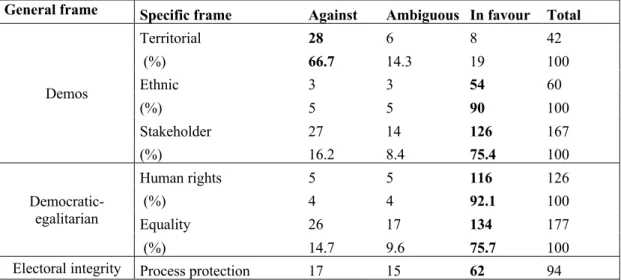
All frames are used to justify positions both for and against extension of emigrant rights but with some important exceptions (Table 4). Framing the access to political rights in terms of the demos-related frame of territorial presence is not surprisingly an argument against voting rights for non-resident citizens while the ethnic frame is almost exclusively used to justify supportive interventions. For instance, in the UK debate on granting emigrant voting rights in 1985 proposed by the Conservative led government, Labour MPs frequently referred to residential criteria in their opposition to the proposal. A Conservative MP countered with an ethnic framed argument that the overseas voters should be allowed to vote because ‘they are as much British as we are’. The stakeholder argument is mainly used to support extension of emigrant voting rights to emigrants who are somehow involved in the country of origin although a fourth of the use of this frame is also found in negative or ambiguous interventions. The French UMP representatives and German Liberals consider that in spite of living abroad, emigrants have a meaningful connection with their countries of origin by showing a special interest in staying involved or owning property. Yet, using the same frame, representatives of the French Socialists argue that emigrants do not have a stake in the politics of their countries of origin once they choose to emigrate. In a similar vein, the representatives of both the Spanish Socialist Workers Party (PSOE) and the People’s Party (PP) in Spain notice that citizens living abroad do not have any meaningful connection with the localities where they used to reside and should therefore be deprived of local voting rights.
Table 4. Party framing and positioning on external voting rights
General frame Specific frame Against Ambiguous In favour Total
Demos Territorial 28 6 8 42 (%) 66.7 14.3 19 100 Ethnic 3 3 54 60 (%) 5 5 90 100 Stakeholder 27 14 126 167 (%) 16.2 8.4 75.4 100 Democratic-egalitarian Human rights 5 5 116 126 (%) 4 4 92.1 100 Equality 26 17 134 177 (%) 14.7 9.6 75.7 100
24 (%) 18.1 16 66 100 Emigrant protection 2 0 5 7 (%) 28.6 0 71.4 100 Utilitarian Global diaspora 1 1 58 60 (%) 1.7 1.7 96.7 100 Emigrant engagement 9 7 138 154 (%) 5.8 4.5 89.6 100 Partisan interest 15 7 25 47 (%) 31.9 14.9 53.2 100
Policy learning Policy learning 2 1 49 52
(%) 3.8 1.9 94.2 100
Total 135 76 775 986
(%) 13.7 7.7 78.6 100
Pearson chi2(20): 190.5481 Pr = 0.000 Cramer's V: 0.3108
Likewise, the argument that emigrants should have equal rights with co-nationals or immigrants at home is employed in support of both the implementation of voting rights and the forms in which emigrants can cast their ballot from afar. In the case of the Belgian debate on the paradigmatic extension of voting rights to Belgians abroad in 1998, critical interventions warned that the proposed registration and voting modalities put the citizens abroad in a relatively unequal position compared to Belgians living within Belgium. And indeed, the following incremental debate in 2001, provoked by a turnout of only 18 Belgians abroad in the 1999 legislative election, proposed voting modalities more akin to those at home. The arguments related to process protection (electoral integrity) are evoked by parties to justify new types of voting modalities or among parties who worry about the guarantee of basic democratic criteria in cross border voting. For instance, in the Swiss debate in 2015 on allowing emigrants to vote electronically both members of the centre-left and centre-right voiced concern with the security and integrity of such a measure.
A cross-tabulation between the frames involved in the debates and party family shows how frames are related to the position of the party on a left-right scale of ideology (Table 5). The most frequently used frame among Communist and Socialist parties is that of demo-egalitarian (40,1% of all frames used) which is a much higher use of this frame compared to other groups of parties. The equality frame (24,8 %) dominates within this category as MPs refer mainly to equality with co-nationals but also in a minority of cases with reference to the still pending issue of voting rights for
25
immigrants (see below for further discussion). The human rights argument centres on democratic rights as a fundamental right regardless of residence or type of election. This is in line with recent studies showing that especially leftist parties frame their immigration arguments in terms of human rights (Helbling, 2014). The other main frames used by this party family is the demos related stakeholder argument.
The centre-left draws on stakeholder and equality frames akin to the leftist group, but their third most used frame is that of process protection. This frame is mainly used to present critical views on proposals for extending emigrant voting rights across both paradigmatic and incremental debates. In a minority of cases, these parties also use the partisan interest and process protection arguments. An illustrative example is the case of the 2008 debate on the representation of French abroad at the National Assembly that provoked critique from the Socialist bloc against constituency redecoupage, perceived as a gerrymandering strategy by the UMP.
The centre right block formed by liberals, Christian democrats and conservatives is the group that tends to drive the extension of emigrant voting rights. To that end MPs mainly draw on frames of emigrant engagement, equality and the stakeholder argument. Portuguese and French conservatives have been fervent supporters of policy measures that increase emigrant electoral participation. Similarly in Denmark centre right supporters for a constitutional change breaking with the determinant principle of territoriality for voting rights argued that in this day and age Danes abroad can be equally informed, sometimes even better informed, about Danish politics than those in the homeland.
Radical right parties are remarkably similar to the rest of the family groups in their use of frames. Interestingly, the radical right does not draw on ethnic frames. Instead their most used demos related frame is that of stakeholder and in general they use a similar argumentative strategy as the mainstream parties drawing on the frames of equality, emigrant engagement and process protection. For instance, the equality frame is used by both the National Alliance and Northern League in the 2001 Italian debate to argue in favour of postal voting modalities and special representation.
Across all party families, the three most commonly used frames relate to the more pragmatic arguments around emigrants as stakeholders, the need for equality among different groups within the polity and, in particular in incremental debates,
26
reference to the need to increase levels of emigrant engagement. The fact that parties use largely similar argumentative strategies across the political spectrum could be explained by the lack of politicisation of emigrant voting rights by these parties.
The debates on emigrant voting rights are only occasionally related to broader concerns with migration and immigrant policies. Interestingly, left, centre-left and centre-right parties use a different benchmark of equality in their arguments. In the vast majority of cases the framing of equality refers to the equality between citizens abroad and at home. However, in a minority cases MPs link the debate on extension of emigrant political rights with the enfranchisement of resident non-citizens, immigrants. The right-wing Italian National Alliance make this connection by arguing that voting rights for emigrants should take priority over voting rights for immigrants, However, in particular centre-left and leftist parties argue the other way around that a logical extension of this debate is to also enfranchise immigrants. For instance, in the 2007 German debate on extension of emigrant voting rights a representative from the Left party commented that it is disproportionate to grant voting rights to German passport holders who have not been around for decades, while denying the same right to immigrants who have been firmly rooted in Germany for decades. This indicates how the framing of support or opposition to emigrant political rights can form part of the broader ideological package of positions on, for instance, immigrant rights.
Conclusions
This article set out to explore the extent to which party support for emigrant voting rights is linked to their ideological outlook and dynamics of party competition. Our findings show that in the case of paradigmatic policy changes on emigrant voting rights, party support is correlated with overall ideological outlook. Compared to other party families, the centre-right (Christian-Democratic, Conservative and Liberal) is significantly more likely to support the enfranchisement of emigrants or legislative proposals that make it easier for emigrants to cast their vote. Meanwhile the left and centre left are not the main drivers of emigrant enfranchisement across our cases. Any internationalist outlook among these parties does not translate into a relatively stronger support for the strengthening of transnational political relations with citizens abroad. The link between centre-right party ideology and support for political inclusion of
27
emigrants confirms the argument of re-ethnicization of citizenship associated mainly with the right (Joppke, 2003). However, it stands in contrast to a recent broader global study (Turcu and Urbatch, 2014) which does not find that the political colour of the government is significant for whether a country enfranchises its emigrants or not. Our paper differs from both of these studies by tracing the level of support among all participating parties in 13 countries within the EU and by including also debates on reform of already existing legislation on voting rights. Further comparative analysis can explore to what extent the findings based on the European countries in this study extend to other parts of the world.
The extent to which party positioning and framing on emigrant voting rights is modified by party competition does not seem to follow the recent findings on similar dynamics regarding immigrant rights. In particular, our analysis indicates that an opposition to immigrant rights among radical right parties is not matched by a strong support for more emigrant rights. More contextualized studies could unpack to what extent radical right parties take up the theme of emigrant rights in broader national debates or to what extent the overall salience of the issue of emigrant rights is related to the presence of a radical right party. Finally, this could also be related to the fact that the issue of emigrant voting rights does not seem to be all that contested across our cases. The majority of parties are in favour and there are several incremental and even paradigmatic debates where all parties agree to extend emigrant voting rights.
In terms of framing, our findings allow us to point to a more complex understanding of emigrant rights across the different party families. We show that party support for ‘re-ethnicization’ of citizenship is not framed in ethnic terms to a very large extent and the centre-right barely evokes it at all. This is the case across both paradigmatic and incremental policy proposals. Instead, supportive arguments centre on the notion of emigrants as stakeholders, the importance of removing bureaucratic and logistical obstacles for voting and the injustice of citizens abroad not being equal to that of citizens at home. This illustrates how the framing is conducted with reference to arguments that are less controversial than the term ‘ethnic’ and instead signals a more pragmatic attitude to the democratic challenge of having part of the electorate (or potential electorate) residing abroad. Another frequently used set of arguments relate to democratic egalitarian frames. Interestingly the human rights frame based on a
28
universalist understanding of political enfranchisement is equally favoured by the leftist and centre-right parties. Yet, the equality argument is interpreted differently in the sense that the centre-right argues for equality among co-nationals while the left, in a minority of cases, also associates emigrant voting rights with the need for extending the enfranchisement of immigrants.
The overall pattern of positioning indicates how parties are, to different degrees, navigating the policy debates on emigrant voting according to their overall political profile but without a strong explicit linkage to their position on issues of immigrant rights and nationalism. The analysis of the framing similarly shows a strong prevalence for frames related to stakeholders, equality and turnout rates rather than frames related to ethnic belonging. Hence, analysing the position and framing of parties in relation to emigrant voting rights presents a more complex and nuanced but also more complete understanding of how parties face the challenge of democratic linkage with mobile citizens.
29 References:
Alonso, S. and Fonseca, S.C.D., 2012. Immigration, left and right. Party Politics, 18(6), pp.865–884.
Bakker, R., de Vries, C., Edwards, E., Hooghe, L., Jolly, S., Marks, G., Polk, J., Rovny, J., Steenbergen, M.A. and Vachudova, M., 2012. Measuring party positions in Europe. Party Politics, 21(1), pp.143–152.
Bale, T., 2003. Cinderella and her ugly sisters: the mainstream and extreme right in Europe’s bipolarising party systems. West European Politics, 26(3), pp.67-90. Bauböck, R., 2007. Stakeholder citizenship and transnational political participation: a
normative evaluation of external voting. Fordham Law Review, 75(5), pp.2393– 2447.
Bélanger, É. and Meguid, B.M., 2008. Issue salience, issue ownership, and issue-based vote choice. Electoral Studies, 27(3), pp.477–491.
Brand, L.A., 2014. Arab uprisings and the changing frontiers of transnational citizenship: Voting from abroad in political transitions. Political Geography, 41, pp.51–63.
Bryan, M. L., & Jenkins, S. P. (2015). Multilevel modelling of country effects: A cautionary tale. European Sociological Review, 32(1), 3-22.
Burgess, K., 2018. States or parties: emigrant outreach and transnational engagement. International Political Science Review, 39(3), pp.369–383.
Caramani, D., 2011. The Europeanization of electoral politics: An analysis of converging voting distributions in 30 European party systems, 1970-2008. Party Politics, 18(6), pp.803-823.
Caramani, D. and Grotz, F., 2015. Beyond citizenship and residence? Exploring the extension of voting rights in the age of globalization. Democratization, 22(5), pp.799-819.
Carvalho, J. and Ruedin, D., 2018. The positions mainstream left parties adopt on immigration: A cross-cutting cleavage? Party Politics.
Closa, C. and Maatsch, A., 2014. In a spirit of solidarity? Justifying the European financial stability facility (EFSF) in national parliamentary debates. JCMS: Journal of Common Market Studies, 52(4), pp.826–842.
30
Dolezal, M., Helbling, M. and Hutter, S., 2010. Debating Islam in Austria, Germany and Switzerland: Ethnic Citizenship, Church–State Relations and Right-Wing Populism. West European Politics, 33(2), pp.171–190.
Escobar, C., 2007. Extraterritorial Political Rights and Dual Citizenship in Latin America. Latin American Research Review, 42(3), pp.43–75.
Gamlen, A. 2008. The Emigration State and the Modern Geopolitical Imagination
Political Geography 27(8):pp,840-856
Gans, C., 2003. The Limits of Nationalism. Cambridge University Press: Cambridge University Press.
Hall, P.A., 1993. Policy paradigms, social learning and the state. The case of economic policy making in Britain. Comparative Politics, 25(3), pp.275-296.
Hampshire, J., 2013. An Emigrant Nation without an Emigrant Policy: The Curious Case of Britain. In: M. Collyer, ed. Emigration Nations: Policies and Ideologies of Emigrant Engagement. London: Palgrave Macmillan UK. pp.302–326. Helbling, M., 2014. Framing Immigration in Western Europe. Journal of Ethnic and
Migration Studies, 40(1), pp.21–41.
Jahn, D., 2010. Conceptualizing Left and Right in comparative politics: Towards a deductive approach. Party Politics, 17(6), pp.745–765.
Joppke, C., 2003. Citizenship between de- and re-ethnicization. European Journal of Sociology / Archives Européennes de Sociologie, 44(3), pp.429–458.
Koinova, M. and Tsourapas, G., 2018. How do countries of origin engage migrants and diasporas? Multiple actors and comparative perspectives. International Political Science Review, 39(3), pp.311–321.
Klekowski von Koppenfels, A., 2002. The Devolution of Privilege: The Legal Background of the Migration of Ethnic Germans. In: D. Rock and S. Wolff, eds. Coming Home to Germany? The Integration of Ethnic Germans from Central and Eastern Europe in the Federal Republic. Berghahn Books. pp.102–118.
Krouwel, A. and Van Elfrinkhof, A., 2013. Combining strengths of methods of party positioning to counter their weaknesses: the development of a new methodology to calibrate parties on issues and ideological dimensions. Quality & Quantity, 48(3), pp.1455–1472.
31
Lafleur, J.M., 2011. Why do states enfranchise citizens abroad? Comparative insights from Mexico, Italy and Belgium. Global Networks, 11(4), pp.481–501.
Lafleur, J.M., 2013. Transnational Politics and the State: The External Voting Rights of Diasporas. Routledge.
Laver, M., 2001. Estimating the policy position of political actors. Estimating the Policy Positions of Political Actors. London: Routledge.
López-Guerra, C., 2005. Should Expatriates Vote?*. Journal of Political Philosophy, 13(2), pp.216–234.
Lafleur and M. Stanek., 2017 (eds.) South-North Migration of EU Citizens in Times of Crisis. Cham: Springer International Publishing. pp.65–82.
Nohlen, D. and Grotz, F., 2000. External Voting: Legal Framework and Overview of Electoral Legislation. Boletín Mexicano de Derecho Comparado, 33(99), pp.1115–1145.
Odmalm, P., 2011. Political Parties and ‘the Immigration Issue’: Issue Ownership in Swedish Parliamentary Elections 1991–2010. West European Politics, 34(5), pp.1070–1091.
Østergaard-Nielsen, E. and Ciornei, I., 2019. Making the absent present. Political parties and emigrant issues in homeland parliaments. Party Politics, 24(2), pp.153-166.
Østergaard-Nielsen, E. and Ciornei, I., 2019. Political parties and the transnational mobilisation of the emigrant vote. West European Politics, 42(3), pp.618–644. Owen, D., 2009. Resident Aliens, Non-Resident Citizens and Voting Rights. Towards a Pluralist Theory of Transnational Political Equality and Modes of Political Belonging. In: G. Calder, P. Cole and J. Seglow, eds. Citizenship Acquisition and National Belonging Migration, Membership and the Liberal Democratic State. Houndmills: Palgrave Macmillan. pp.52-73.
Paarlberg, M.A., 2019. Competing for the diaspora’s influence at home: party structure and transnational campaign activity in El Salvador. Journal of Ethnic and Migration Studies, 45(4), pp.539–560.
Pennings, P. and Keman, H., 2002. Towards a New Methodology of Estimating Party Policy Positions. Quality and Quantity, 36(1), pp.55–79.
32
Pogorelis, R., Maddens, B., Swenden, W. and Fabre, E., 2005. Issue salience in regional and national party manifestos in the UK. West European Politics, 28(5), pp.992–1014.
Polyakova, A., 2015. The backward East? Explaining differences in support for radical right parties in western and eastern Europe. Journal of comparative politics, 8(1), pp.49–74.
Proksch, S.O. and Slapin, J.B., 2010. Position Taking in European Parliament Speeches. British Journal of Political Science, 40(03), pp.587–611.
Rhodes, S. and Harutyunyan, A., 2010. Extending citizenship to emigrants: democratic contestation and a new global norm. International Political Science Review, 31(4), pp.470–493.
Rubio-Marin, R., 2006. Transnational Politics and the Democratic Nation-State: Normative Challenges of Expatriate Voting and Nationality Retention of Emigrants. New York University Law Review, 81, p.117.
Turcu, A. and Urbatsch, R., 2014. Diffusion of Diaspora Enfranchisement Norms: A Multinational Study. Comparative Political Studies, 48(4), pp.407-437.
Wellman, E. I 2019. Emigrant Enfranchisement in Africa. Paper presented at the 2018 Annual Meeting of the American Political Science Association, Boston, August 30 - September 2, 2018, updated version.
33
Appendix 1. Main characteristics of external voting systems in included countries.
Country Type of election Voting method Special representation Year of implementation. Year of first election for emigrants.
Estimated Population abroad as share of the population1
_________
Registered voters abroad as share of overall numbers of voters in election/country. Turnout Abroad (last election) Austria Presidential, Legislative, Referendum Postal No 1990 1990 6.71% _________ 0.95% Not available
Belgium Legislative Mixed
(personal, postal, proxy, in-country) No 1998 1999 4.92% __________ 1.62% 10.59%2 Denmark3 No external voting
n/a No n/a n/a 4.57% n/a
France Presidential, Legislative, Referendum Mixed (personal, postal, proxy, electronic) Yes 11 Senators (Since 2008) 1976 1978 3.4% ________ 2.66% 44.28% (1st Round) 45.84% (2nd Round) 4
Germany Legislative Postal No 1985 1987 (1990 in
unified Germany). 5.12% __________ 0.88% Not available5 Ireland6 No external voting
34 Italy Legislative, Referendum Postal Yes 6 Senators, 12 Deputies (Since 2006) 2003 2006 5.10% __________ 8.34% 29.84%7 The
Netherlands Legislative, Referendum, Mixed (postal, proxy, in-country) No 1989 1994 5.96% ______ 0.63% 88.05%8 Portugal Presidential, legislative, referendums
Personal 9 Yes 4 Members of
Parliament (since 1976) 1976 1976 21.94% 3.09% 4.6910 Spain Legislative (national + regional) Mixed (personal, postal, fax, electronic) No 1985 1986 2.90% 5.56% 6.30%11 Sweden Legislative, referendum Mixed (personal, postal) No 1968 1968 3.51% 2.27% Not available Switzerland Legislative (national and partly regional), referendums Postal, electronic No 1989 1991 7.98% 1.93%12 25.75% United Kingdom
Legislative Mixed (postal,
proxy)
No 1985 1987 7.44% of the Population
Abroad
0.61% of the Electorate Abroad
not available
Own elaboration based on http://globalcit.eu/; https://www.idea.int/data-tools/data/voting-abroad and national electoral statistical sources and information on voting rights as detailed below.