Page 1
USE OF LIFE CYCLE ASSESSMENT TO DETERMINE THE
ENVIRONMENTAL IMPACT OF THERMOCHEMICAL CONVERSION
ROUTES OF LIGNOCELLULOSIC BIOMASS: STATE OF THE ART
Saïcha P. Gerbinet, Angélique Léonard
Laboratory of Chemical Engineering – Processes and sustainable development - University of Liège, Belgium, B6, allée de la chimie 3, 4000 Liège, [email protected], Phone : +32 4366 3547
Abstract: The biomass is a promising way to substitute fossil fuels. Lignocellulosic biomass
valorisation is part of second generation technologies. They are interesting in that they imply less competition with food crops for land and water, and they allow for the whole plant to be processed. Moreover, lignocellulose is abundant in cheap and non-food materials extracted from plants such as wood and energy crops.
In this work, the thermo-chemical route is being considered more extensively, especially the gasification process. This process converts carbonaceous biomass into combustible gases (CO, H2, CO2, CH4, and impurities) called syngas in the presence of a suitable oxidant. The syngas can be converted into a large range of products, such as diesel, via a Fischer-Tropsch process, or methanol, used for producing DME (dimethyl ether), both of which can serve as fuels in traditional motors. Syngas can also be used to produce ethylene and propylene, two building blocks for the chemical industry. Production of these four compounds is specifically investigated.
In order to insure that, under the principle of sustainability, the use of lignocellulosic biomass is a viable alternative, its environmental impact must be accurately quantified, using the Life Cycle Assessment (LCA) methodology. Within this context, this study focuses on the associated state-of-the art. The gasification technology will be described, as well as existing LCA analysis of gasification processes. Finally, the need for new research and development regarding LCA of lignocellulosic biomass gasification and subsequent synthesis processes will be established.
Keywords
Page 2
INTRODUCTION
The biomass is perceived as a promising way to substitute fossil fuels. Lignocellulosic biomass valorisation is part of second generation technologies. They are interesting compared to first generation technologies in the way they imply less competition with food crops for land and water, and they allow for the whole plant to be processed. Moreover, lignocellulose is abundant in cheap and non-food materials extracted from plants such as wood and energy crops (miscanthus, willow, etc.).
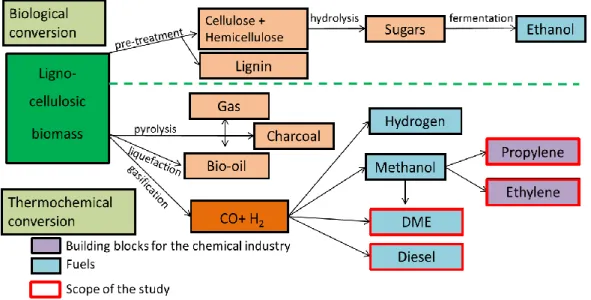
In this work, the thermo-chemical route is being considered more extensively, especially the gasification process. This process converts carbonaceous biomass into combustible gases (CO, H2, CO2, CH4, and impurities) called syngas in the presence of a suitable oxidant (air, oxygen or steam). The syngas can be converted into a large range of products, such as diesel, via a Fischer-Tropsch process, or methanol, used for producing DME (dimethyl ether), both of which can serve as fuels in traditional motors. Methanol can also be used to produce ethylene and propylene, two building blocks for the chemical industry. Production of these four compounds is specifically investigated (Figure 1).
Figure 1: Lignocellulosic biomass valorisation
In order to insure that, under the principle of sustainability, the use of lignocellulosic biomass is a viable alternative, its environmental impact must be accurately quantified, using the Life Cycle Assessment (LCA) methodology. Within this context, this study focuses on the associated state-of-the art. The gasification technology will be described, as well as existing LCA analysis of gasification processes.
Page 3
THECONVERSIONPROCESSES
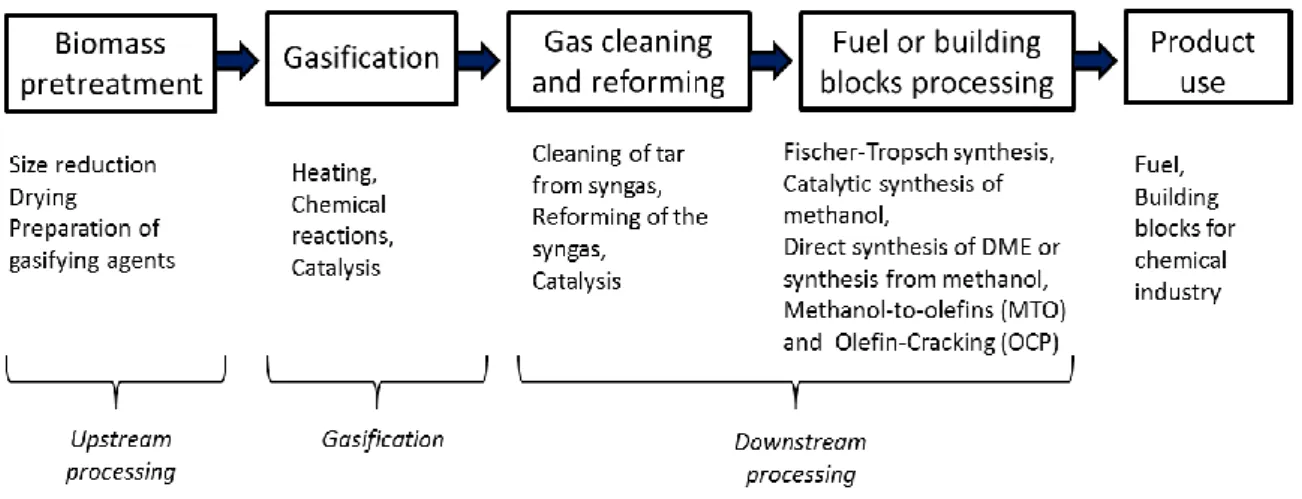
Biomass gasification is realized according successive steps (Figure 2) which include several processes and, for each process, various equipments are possible. The syngas use includes also several possibilities. So the entire chain for the lignocellulosic biomass valorisation is rather complex [1, 2].
Figure 2: Processes involved in biomass gasification
Biomass pretreatment makes it suitable for gasification operations. Size reduction allows to obtain appropriate particle sizes: particles too small (less than 20 mm) will block the air supply when particles too large will lead to poor heat transfer because of smaller active surface and pores. Drying is needed to achieve moisture content smaller than 20 % so that the process can work efficiently. Some lignocellulosic biomass like miscanthus have moisture content lower than 20% when they are harvested in autumn so drying is not necessary. Densification may also be helpful due to the low density of biomass.
The gasification is obtained by heating between 600 and 1000°C the biomass with an oxydizing agent. The most important reactions are:
(1)
(2)
(3)
The gasification is a well-known process when the feedstock use is coke but when biomass is used some adaptations have to be made.
The oxidizing agent can be air, oxygen or steam. When oxygen is used, the syngas will have higher heating value because it gas is not diluted by nitrogen. When steam is used, the hydrogen content in the syngas is higher. Generally, the reactor is autothermal but sometime allothermal reactors are used and, in this case, the heat supply can be in direct or indirect mode. The oxidizing agent flow rate has also its importance: the higher the equivalence ratio (ER) or the temperature or biomass conversion, the smaller the syngas tar content, the residence time and the syngas
Page 4 LHV. There exist several gasifier types presenting their own advantages and disadvantages. For example, the fixed-bed updraft gasifier is a simple and mature technology but the obtained syngas has a high tar content. Other possible reactor types are fixed-bed downdraft or multi-stage, fluidized-bed, etc.
The gas cleaning must be adapted to the gas use but generally, the following steps are necessary. The first step is the particles removal. These particles come from the biomass (ash and char) and the bed and can lead to plugging if they are note removed. A cyclone for the large particles can be used in combination with a wet scrubber. Barrier filters or electrostatic precipitators can also be used. After that, alkali removal can be done, for example, by cooling the gas and passing it through barriers filters. Generally, the nitrogen and sulfur compounds are in small amount, so their removal is not necessary. The tar elimination can be performed by primary (in the gasifier) or secondary methods. In this case, there are two possibilities: a wet scrubbing (water scrubbing followed by venturi scrubbing witch allow to condense tar compounds) or a hot scrubbing (cracking the tar compounds at high temperature).
When the gas cleaning is finished, a water shift reaction can be used to obtain the best H2/CO ratio depending on the application.
After that, chemical synthesis allows to obtain the desired product. Diesel can be obtained with a Fischer-Tropsch process. The reactions take place at temperature between 220 and 250°C with Co or Fe catalyst in a fluidized-bed reactor. The process is well established at an industrial level. The DME can be produced directly from the syngas. The reaction takes place at high temperature (240 °C) and high pressure (30 MPa) with a catalyst in a slurry reactor. But the DME can also be obtained from methanol. This one is produced from syngas in a fixed-bed reactor at temperature between 180 and 270°C, pressure between 50 and 100 bar using a Cu/Zn catalyst. After that the methanol is converted in DME using an alumina catalyst at temperature between 250 and 350°C. DME and diesel can be used as fuels. Finally, ethylene and propylene which can be used as building blocks for the chemical industry are also obtained from methanol with a combination of two processes: the methanol-to-olefin (MTO) process produces light and heavy olefins. The heavy olefins are converted to light olefins by cracking. Then, the Olefin cracking (OCP) takes place to convert the olefins into ethylene and propylene. Only the Fischer-Tropsch process is well known at an industrial scale. Nevertheless, there are pre-industrials or pilot plants for the other described process.
LIFECYCLE ANALYSIS(LCA)
Once the processes have been well-understood, a review of the existing LCA has been done. No study about the environmental impact of the production of ethylene or propylene from lignocellulosic biomass with gasification could be found. Most of the studies compare the production of biofuels between them or with their fossil equivalent. When compared with fossil fuels, generally, biofuels perform better in view of global warning potential and emissions but are worst for the energy consumption [3-7]. When compared with 1st generation biofuel, the biofuel studied there obtain generally better environmental performance [8-10]. But all these studies
Page 5 have at least one of these lacks: only well-to-tank analysis and no well-to-wheel, few impacts categories, no economic point of view, no sensitivity check, no incertitude study. Moreover, only one study takes into account direct land use change and no one considers indirect land use change. Nevertheless, the impacts related to land use can be important [11]. So, new research is necessary in this emerging field of biomass valorization.
CONCLUSION
The gasification is a promising way for lignocellulosic biomass valorisation. But the processes are complex and numerous, so a well-understanding is necessary. Moreover, to assess any environmental gain, new LCAs have to been performed. Our future works aim to determine the better use of lignocellulosic biomass in the Belgium context based on extended LCA of this processes, using data coming from industrial partners or research laboratories leading large scale biomass gasification experiments.
REFERENCES
[1] Kumar, A., Jones, D.D. and Hanna, M.A., 'Thermochemical Biomass Gasifiction: A Review of the Current Status of Thechnology'. Energies, 2 (2009).
[2] Ciferno, J.P. and Marano, J.J., 'benchmaking biomass gasificatin technologies for fuels, chemicals and hydrogen production', U.S.D.o. Energy, Editor (2002).
[3] van Vliet, O.P.R., Faaij, A.P.C. and Turkenburg, W.C., 'Fischer-Tropsch diesel production in a well-to-wheel perspective: A carbon, energy flow and cost analysis'. Energy
Conversion and Management, 50 (4) (2009) 855-876.
[4] Gill, S.S., et al., 'Combustion characteristics and emissions of Fischer-Tropsch diesel fuels in IC engines'. Progress in Energy and Combustion Science, 37 (4) (2011) 503-523. [5] Wu, M., Wu, Y. and Wang, M., 'Energy and emission benefits of alternative transportation liquid fuels derived from switchgrass: A fuel life cycle assessment'. Biotechnology
Progress, 22 (4) (2006) 1012-1024.
[6] Fleming, J.S., Habibi, S. and MacLean, H.L., 'Investigating the sustainability of lignocellulose-derived fuels for light-duty vehicles'. Transportation Research Part D:
Transport and Environment, 11 (2) (2006) 146-159.
[7] Reinhardt, G.A. and Falkenstein, E.v., 'Environmental assessment of biofuels for transport and the aspects of land use Competition'. Biomass & Bioenergy, 35 (2011). [8] Liu, G., et al., 'Making Fischer-Tropsch Fuels and Electricity from Coal and Biomass:
Performance and Cost Analysis'. Energy & Fuels, 25 (2011).
[9] Kalnes, T.N., et al., 'A Technoeconomic and Environmental Life Cycle Comparison of Green Diesel to Biodiesel and Syndiesel'. Environmental Progress & Sustainable Energy,
28 (1) (2009) 111-120.
[10] Grillo Reno, M.L., et al., 'A LCA (life cycle assessment) of the methanol production from sugarcane bagasse'. Energy, 36 (6) (2011) 3716-3726.
[11] Reinhart, G.A. and Falkenstein, E.v., 'Environmental assessment of biofuels for transport and the aspects of land use Competition'. Biomass & Bioenergy, 35 (2011).
Page 6
Résumer
INTRODUCTION
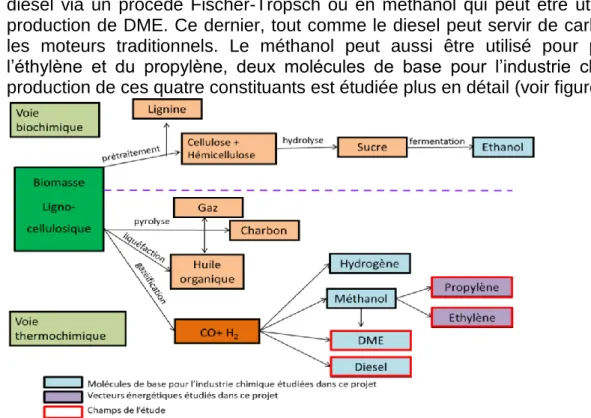
La biomasse est vue comme un moyen prometteur pour remplacer les combustibles fossiles. La valorisation de la biomasse lignocellulosique fait partie des technologies de seconde génération. Dans ce travail, c’est plus précisément la voie thermochimique qui est envisagée. Ce procédé permet de convertir de la biomasse carbonée en gaz combustible (CO, H2, CO2, CH4 et des impuretés) appelé gaz de synthèse grâce à la présence d’un oxydant adapté (air, oxygène ou vapeur d’eau). Le gaz de synthèse peut être converti en une large gamme de produits tels que du diesel via un procédé Fischer-Tropsch ou en méthanol qui peut être utilisé pour la production de DME. Ce dernier, tout comme le diesel peut servir de carburant dans les moteurs traditionnels. Le méthanol peut aussi être utilisé pour produire de l’éthylène et du propylène, deux molécules de base pour l’industrie chimique. La production de ces quatre constituants est étudiée plus en détail (voir figure 1).
Figure 1: Schéma de la valorisation de la biomasse lignocellulosique
Cependant, l’impact environnemental de cette utilisation de la biomasse doit encore être examiné pour s’assurer de la durabilité de ces procédés. C’est pourquoi la méthodologie d’Analyse du cycle de Vie (ACV) a été envisagée. En vue de sa réalisation, une étude bibliographique détaillée des procédés a été menée. Elle est suivie d’une recherche bibliographique sur les ACVs déjà publiées dans le domaine. LES PROCÉDÉS DE CONVERSIONS
La conversion de la biomasse lignocellulosique en carburant s’effectue en plusieurs étapes. La première est le prétraitement de la biomasse pour permettre sa gazéification. Ensuite l’étape de gazéification à haute température en tant que telle prend place. Le gaz ainsi produit doit être purifié et un reformage peut s’avérer
Page 7 nécessaire. Le gaz de synthèse ainsi obtenu peut ensuite être utilisé pour la production des molécules envisagées (voir figure 2). Pour chaque étape, il existe une multitude de possibilité de mise en œuvre. C’est pourquoi l’entièreté de la chaine est complexe et nécessite une étude détaillée.
Figure 2: Chaine de production liée à la gazéification de la biomasse lignocellulosique ANALYSE DU CYCLE DE VIE (ACV)
Une étude bibliographique des ACVs déjà réalisées précédemment a permis de mettre en avance quelques points de convergence dans les résultats mais également certaines améliorations à mettre en œuvre. Cependant, aucune étude n’a été trouvée concernant la production d’éthylène ou de propylène à partir de la gazéification de biomasse lignocellulosique. La plupart des études comparent les bio-carburants entre eux ou avec les combustibles fossiles. Dans ce derniers cas, les biocarburants envisagés ici ont généralement de meilleures performances du point de vue des émissions de CO2 et du potentiel du réchauffement climatique global, néanmoins, ce n’est plus le cas lorsque la consommation d’énergie est envisagée. En comparaison avec les biocarburants de 1er génération, les performances environnementales des produits étudiés ici sont généralement meilleures. Cependant, toutes les études possèdent au moins une de ces limitations : analyse seulement du berceau au tank de stockage (« well-to-tank ») et non jusqu’à la roue (« well-to-wheel »), peu de catégories d’impacts considérées, pas d’étude économique, pas d’étude de sensibilité ou d’incertitude, manque de transparence dans les données employées et pas de prise en compte l’impact (direct ou indirect) d’un changement d’affectation des sols.
CONCLUSION
Bien que la valorisation de la biomasse lignocellulosique semble une voie prometteuse, son impact environnemental doit encore être évalué c’est pourquoi de nouvelles ACVs sont nécessaires. Pour ce faire, les procédés étant complexes, une étude détaillée est indispensable. Nos travaux futurs visent à déterminer quel est le meilleur usage de la biomasse lignocellulosique dans le contexte belge en réalisant une ACV étendue se basée sur des données de nos partenaires industriels ou de laboratoires menant des expériences sur la gazéification à large échelle.