DISCUSSION PAPER SERIES
ABCD
www.cepr.org
Available online at:
www.cepr.org/pubs/dps/DP8336.asp
www.ssrn.com/xxx/xxx/xxx
No. 8336
SECURITY DESIGN: SIGNALING
VERSUS SPECULATIVE MARKETS
Gilles Chemla and Christopher Hennessy
ISSN 0265-8003
SECURITY DESIGN: SIGNALING VERSUS
SPECULATIVE MARKETS
Gilles Chemla, Imperial College, London, DRM/CNRS and CEPR
Christopher Hennessy, London Business School, ECGI and CEPR
Discussion Paper No. 8336
April 2011
Centre for Economic Policy Research 77 Bastwick Street, London EC1V 3PZ, UK Tel: (44 20) 7183 8801, Fax: (44 20) 7183 8820
Email: [email protected], Website: www.cepr.org
This Discussion Paper is issued under the auspices of the Centre’s research programme in FINANCIAL ECONOMICS. Any opinions expressed here are those of the author(s) and not those of the Centre for Economic Policy Research. Research disseminated by CEPR may include views on policy, but the Centre itself takes no institutional policy positions.
The Centre for Economic Policy Research was established in 1983 as an educational charity, to promote independent analysis and public discussion of open economies and the relations among them. It is pluralist and non-partisan, bringing economic research to bear on the analysis of medium- and long-run policy questions.
These Discussion Papers often represent preliminary or incomplete work, circulated to encourage discussion and comment. Citation and use of such a paper should take account of its provisional character.
CEPR Discussion Paper No. 8336
April 2011
ABSTRACT
Security Design: Signaling versus Speculative Markets*
We determine optimal security design and retention of asset-backed securities
by a privately informed issuer with positive NPV uses for immediate cash. In
canonical models, investors revert to prior beliefs if issuers pool at
zero-retentions (originate-to-distribute), and separating equilibria are
welfare-dominated since separation entails signaling via asset-retention and
underinvestment. However, we show speculative markets arise if and only if
issuers pool, creating previously overlooked costs. Pooling induces socially
costly information acquisition by speculators. Further, in pooling equilibria,
issuers never sell safe claims, leaving uninformed investors exposed to
adverse selection and distorting risk sharing. In such equilibria, issuers retain
zero interest in the asset, and speculator effort is maximized by splitting cash
flow into a risky senior ("debt") tranche and residual junior ("equity") claim.
Optimal leverage trades off per-unit speculator gains against endogenous
declines in uninformed debt trading. Issuer incentives to implement the
pooling equilibrium, with distorted risk sharing, are strong precisely when
efficient risk sharing, achieved through separation, has high social value. In
such cases, a tax on issuer proceeds can raise welfare by encouraging issuer
retentions. Taxation dominates mandatory skin-in-the-game as a policy
response, since the latter creates gratuitous underinvestment.
JEL Classification: G21, G32
Keywords: security design, issuer, type, pooling, separating, speculator
Gilles Chemla
Imperial College Business School
Tanaka Building
South Kensington Campus
London SW7 2AZ
Email: [email protected]
For further Discussion Papers by this author see:www.cepr.org/pubs/new-dps/dplist.asp?authorid=127839
Christopher Hennessy
London Business School
Regent's Park
London NW1 4SA
Email: [email protected]
For further Discussion Papers by this author see:* We thank seminar participants at Toulouse School of Economics, the
Bachelier Seminar, University of Bath, London Business School, London
School of Economics, the 2010 Rising Stars in Finance Conference, Inova
Lisbon, Bocconi and Princeton University for valuable feedback. We owe
special thanks to Franklin Allen, James Dow, Sebastien Pouget and Conrad
Raff for helpful discussions.
The canonical model of financing and security design under asymmetric information (see e.g. Tirole (2005) Chapter 6) considers the firm to have two choices: send credible signals or accept underpricing as uninformed investors set prices based upon prior beliefs. A potential weakness of this standard framework is that outside investors are assumed to be passive, doing nothing other than providing funding on an actuarially fair basis. Thus, in the canonical framework there is no role for demand-side factors to affect the choice between separation and pooling. This prediction is at odds with the empirical observation that the buy-side appears to play a critical role in security design.1
In this paper, we develop a theory of optimal financing which assigns a leading role to speculative markets in influencing security design, as well as issuer choice between signaling and pooling. In contrast to the canonical model, the proposed theory recognizes the fact that speculative markets can produce information. Consequently, a privately informed issuer need not choose between signaling and reversion to uninformed prices. Rather, in reality issuers must choose between signaling and reliance on speculative markets for information production. As discussed below, this alternative perspective radically changes predictions regarding optimal security design, securitization levels, and social welfare.
The setting for our model is as follows. A privately informed owner is contemplating the sale of optimally-designed asset-backed securities in order to fund a positive NPV project having constant returns. One may think of the issuer as being a bank facing capital requirements that lead to a preference for receiving immediate cash rather than holding risky assets. Alternatively, one can think of the issuer of the asset-backed securities as being a non-financial firm. Under this second interpretation, the security is a claim on a fixed asset already owned by the firm and not on assets purchased with the proceeds raised. See DeMarzo and Duffie (1999) for additional motivation for this setup.2
1See Allen and Gale (1994) for a comprehensive discussion of clientele-driven contract innovation.
2We follow DeMarzo and Duffie (1999) and take the underlying asset as given. We do not analyze which assets are
The underlying asset value is either or The owner faces a continuum of risk averse unin-formed investors who may have an insurance demand for buying claims due to endowment shocks. In addition, there is a speculator who can exert costly effort in order to acquire a signal regarding true asset value. The presence of the informed speculator discourages uninformed investors from buying securities, since they face adverse selection in competitive markets.
One possibility is for the owner to signal positive information by selling a senior debt claim secured by the asset having face value . The original owner then retains the residual junior claim. This retention is a costly signal in that it leads to underinvestment in the scalable growth option. Meanwhile, the low type sells the entire asset in the form of a pass-through security and invests at the first-best level. In this separating equilibrium, positive private information is credibly signaled by issuer retentions, implying there is no role for costly information acquisition and that the previously uninformed investors are insulated from adverse selection. Although a similar separating contract has been described in earlier papers, e.g. Myers and Majluf (1984), we are the first to recognize that the separating equilibrium has two attractive features from a social welfare perspective. First, there is no expenditure on socially wasteful information acquisition. Second, risk sharing is efficient. The other possibility for the high type to consider is a pooling equilibrium in which both types sell the entire asset and adopt identical security designs. The key difference between our pooling equilibrium and that considered in the canonical model is that the two owner types do not expect the same total revenues. This is because speculative markets can produce information and bring prices closer to fundamentals. If he opts to pool, the high type will promote speculator effort by choosing a securitization structure that maximizes the speculator’s gains. This is accomplished by bifurcating the underlying asset’s cash flow into a risky senior (debt) claim and a residual (equity) claim. The rational uninformed investors only trade the senior debt claim since this claim has lower adverse selection costs. The speculator hides behind uninformed demand in the risky debt market, and this is her only source of trading profits. The optimal debt face value trades off higher per-unit speculator profit against endogenous declines in uninformed demand.
The pooling equilibrium has an attractive feature in that expected investment is first-best since both types sell the entire underlying asset. However, in this equilibrium, socially wasteful infor-mation acquisition occurs. Further, risk sharing is distorted due to the adverse selection faced by uninformed investors. It follows that from a social welfare perspective the separating equilibrium dominates the pooling equilibrium whenever risk sharing is sufficiently important, e.g. when unin-formed investors face larger endowment shocks or are more risk averse. Our finding that separating equilibria may, in fact, dominate pooling equilibria is interesting inasmuch as the standard signaling model, e.g. Myers and Majluf (1984), implies it is socially preferable for issuers to pool by selling a pass-through (equity) security and investing at first-best, with security mispricing being of no social concern.
Another interesting prediction generated by the model is that privately-informed owners are less likely to implement the separating equilibrium, which entails efficient risk sharing, precisely when risk sharing has high social value. The argument is as follows. Suppose the high type is considering pooling. He knows that when the uninformed investors face large endowment shocks, or are more risk averse, they are more willing to trade despite facing adverse selection. The higher level of uninformed demand provides the speculator with increased cover for her trades, allowing her to earn greater profits. This promotes speculator effort, causing prices to move closer to fundamentals in the pooling equilibrium. It follows that the high type is more likely to “choose” the pooling equilibrium when risk sharing is socially important. Formally, we show that the equilibrium set always includes the separating equilibrium, with pooling equilibria being feasible only if endowment shocks are sufficiently large, or risk aversion is sufficiently high.
An important conflict highlighted by the model is that privately informed owners fail to in-ternalize the positive externality they confer to previously uninformed investors when they signal
private information via retention of claims on future cash flow.3 This creates the potential for
so-cially excessive levels of securitization, espeso-cially when risk sharing matters most.4 However, a tax
3
Pagano and Volpin (2010) identify externalities arising from another choice, coarse information disclosure.
4
on the gross proceeds from securitized asset sales can serve to move markets back to the separat-ing equilibrium when this equilibrium is socially optimal. Mandatseparat-ing that all securitizers maintain skin-in-the-game is an inefficient policy response to the problem identified here since this results in gratuitous underinvestment (by low types).
Our paper is most closely related to that of Gorton and Pennacchi (1990). In their economy, uninformed investors are also rational, being reluctant to trade informationally-sensitive securities. They show uninformed investors have an incentive to set up an intermediary that will pool endow-ments and bifurcate underlying cash flows into riskless debt and residual equity, with the former being used by uninformed investors as a store of value. Essentially, one can think of the uninformed investors as choosing financial structure in their model. In contrast, we determine the securities that will be chosen by privately-informed owners. This leads to very different optimal security designs. For example, we show that in pooling equilibria safe debt will never be issued, since the high type wants to promote information production by allowing the speculator to profit from trades in risky debt markets.
In a recent paper, Dang, Gorton and Holmström (2010) also analyze the interplay between se-curity design and risk sharing. They derive an “ignorance is bliss result” predicting that optimal security design actually minimizes incentives for information acquisition. In their economy infor-mation is problematic for three reasons: it is costly to produce; it creates adverse selection; and it reduces welfare due to an asymmetric benefit to positive news. In contrast, we show that privately-informed owners may have an incentive to promote information acquisition since this drives prices closer to fundamentals. Thus, in our model, the privately optimal security design does not minimize informational-sensitivity.
Boot and Thakor (1993) assume the asset must be fully securitized, so their model is silent on the issuer’s choice between pooling and separating via retentions, the main choice margin we analyze from a welfare perspective. The two models share the implication that tranching can be
U.K. Financial Services Authority, recently contended, “the argument that they created great allocative efficiency
used to promote information acquisition. However, the causal mechanisms are very different. In their model, the role of tranching is to relax speculator wealth constraints, as he buys the risky claim in a market with exogenous uninformed demand. We focus on the opposite lever. Specifically, in our model the role of tranching is to endogenously shift uninformed demand in order to stimulate information acquisition by an unconstrained speculator. The optimal structuring also differs. In their model, it is optimal to carve out a riskless senior claim. In the pooling equilibrium of our model, it is never optimal to issue a riskless claim since uninformed investors would then boycott the risky security market, resulting in zero information production.
Fulghieri and Lukin (2001) also analyze the role of security design in information production. Their model is silent on the question of pooling versus separation since the assumed fixed investment scale precludes separation. They also model uninformed demand exogenously, precluding analysis of risk sharing and social welfare.
DeMarzo and Duffie (1999) analyze optimal security design from the perspective of an issuer who places intrinsic value on immediate liquidity. In their model, the issuer chooses security design before observing asset value. After the structure is locked-in, the issuer observes asset value and decides how much to sell. Under technical conditions, e.g. monotonicity, debt is an optimal security since its low information-sensitivity results in low price impact. In contrast, we consider a setting where the issuer knows the asset’s value before choosing the security design. Further, we allow for a speculator to acquire information. Finally, the model of DeMarzo and Duffie is silent on risk sharing since they assume universal risk-neutrality.
Nachman and Noe (1994) analyze a setting, like ours, where the issuer is privately informed at the time the security is designed. In their setting, the scale of investment is fixed, and there is no possibility for separation or informed speculation. Under technical conditions, e.g. monotonicity, they show firms will pool at a debt contract, since debt minimizes the cross-subsidy from high to
low types.5
5
Axelson (2007) considers a setting where the issuer is uninformed, showing equity can be optimal as it aligns
Allen and Gale (1988) evaluate optimal security design in a setting with endogenously incomplete markets, with the firm having a monopoly on issuing securities due to the need for asset-backing. Our model is predicated upon a very different friction. Allen and Gale assume symmetric information, but firms incur a cost when introducing a security. Our model features asymmetric information, but no direct cost of introducing a security.
The remainder of the paper is as follows. Section I describes the economic setting. Section II abstracts from the security design problem in order to describe the market-making process. Section III analyzes optimal structuring in a setting where the entire asset must be securitized. Section IV considers the general setting in which issuers optimize both the security design and retentions.
I. Economic Setting
This section describes preferences, endowments, and the market-making process. To provide a benchmark, we finish this section by describing equilibrium if information were symmetric.
A. Preferences and Endowments
There are two periods, 1 and 2, with a single nonstorable consumption good available in each period. This consumption good is the numeraire. There is an underlying asset with type ( ) that is either high () or low (), with Owner being the only agent endowed with perfect knowledge of the type. The asset delivers units of the good in period 2 with perfect certainty, with ∈ (0 ) The uninformed prior probability of the asset being type is ∈ (0 1)
Owner possesses the only tangible real asset in the economy. Owner has no endowment other than this real asset. The tangibility of the asset allows courts to verify its value in period 2. In contrast, the endowments of the various agents are not verifiable by courts. Consequently, other
agents cannot issue securities and cannot short-sell.6 Further, there can be no endowment-contingent
contracts. Rather, courts can only enforce asset-backed payments contingent upon the observed 6We could allow the marketmakers to supply a limited amount of risk-free assets without changing the qualitative
value in { }. Since endowments are not verifiable by courts, Arrow securities are not possible and risk sharing may be inefficient. Allen and Gale (1988) also consider an incomplete markets setting in which security design influences risk sharing.
There is a continuum of uninformed investors having measure one. Our uninformed investors are analogous to the “liquidity traders” in the model of Gorton and Pennacchi (1990). To fix ideas, one can think of the uninformed investors as the analog of defined benefit pension funds. Such pensions want to transfer funds across periods and do not particularly value high upside potential. Rather, they are very averse to being unable to meet their obligations to pensioners. Given such preferences, and lacking the resources to gather inside information in securities markets, they naturally seek relatively safe stores of value.
In the model, uninformed investors may have an insurance motive for purchasing securities delivering consumption in period 2. The uninformed investors are sufficiently wealthy in aggregate
to buy the entire underlying asset since each has a first period endowment 1 ≥ Uninformed
investors face a common endowment shock, with their period 2 endowment 2 being either 0 or
− Just prior to securities market trading in period 1 uninformed investors privately observe a noisy signal regarding the size of their period 2 endowment. In particular, with probability one-half
they find that they are “invulnerable” to a negative shock and will have endowment 2 = 0 with
probability one. With probability one-half they are “vulnerable” to a negative shock. Conditional
upon being vulnerable, they face a probability ∈ (0 1] of 2 = −
Uninformed investors are risk-neutral over first period consumption 1and risk-averse over second
period consumption 2 They are indexed by the intensity of their risk-aversion as captured by a
preference parameter . The utility of uninformed investor- takes the form:
(1 2; ) ≡ 1+ min(0 2) (1)
The preference parameters have compact support Θ ≡ [0 max] Throughout, max is assumed to
security.7 The parameters have density with cumulative density This distribution has no atoms, with being strictly positive and continuously differentiable. We have here followed the tractable specification of risk-aversion employed by Dow (1998) in that second period utility is piecewise linear, and has a concave kink. Other smooth utility functions could be assumed at the cost of more complex aggregate demand functions. The essential assumption is that uninformed investors are averse to negative consumption in period 2, so they are potentially willing to buy stores of value even when facing adverse selection in securities markets.
There is a single speculator who is risk-neutral and indifferent regarding the timing of
con-sumption having utility equal to 1+ 2. In the first period, she is endowed 1 ≥ units of the
numeraire, so she can afford to buy the entire asset. Her second period endowment is irrelevant and normalized at zero.
The speculator is unique in that she receives a noisy signal of asset type and can exert costly
effort to increase signal precision. Letting ∈ { } denote the signal and the true asset type,
chooses ≡ Pr( = ) from the feasible set [12 1] Her non-pecuniary effort cost function is
strictly positive, strictly increasing, strictly convex, twice continuously differentiable, and satisfies
lim ↓1 2 () = 0 lim ↓12 0() = 0 lim ↑1 0() = ∞
If puts in any effort, the signal becomes informative since
1 2 ⇒ Pr[ = | = ] = Pr[ = ∩ = ] Pr[ = ] = + (1 − )(1 − ) (2)
The final set of agents in the economy is a continuum of market-makers having measure one. They are risk-neutral and indifferent regarding the timing of consumption having utility equal to
1+ 2. In the first period each market-maker is endowed with 1 ≥ units of the numeraire,
7
so they too can afford to buy the entire asset. Their second period endowment is irrelevant and normalized at zero.
B. The Market-Making Game
We characterize perfect Bayesian equilibria (PBE) of signaling games, requiring: all agents have a belief at each information set; strategies must be sequentially rational given beliefs; and beliefs are determined using Bayes’ rule and the equilibrium strategies for all information sets on the equilibrium path.
Section IV determines the nature of equilibrium in the full security design game—a game for which there can be pooling and separating equilibria supported by signals in the form of asset retention. A necessary precursor to that analysis is determining the nature of equilibria in the event that the types pool at the same security design. If the two types pool at the same security design, play passes to the market-making game. The market-making game is a proper signaling game played between the informed speculator and market-makers.
The market-makers and uninformed investors enter the market-making game holding their prior belief that the asset has high quality with probability The market-making game starts with choosing at personal cost (). Her choice of is not observable, but is correctly inferred by other
agents in equilibrium. Then privately observes the noisy signal ∈ { } regarding the asset
type. Next, uninformed investors privately observe whether or not they are vulnerable to a negative endowment shock in period 2. Market orders are then submitted, with market-makers setting prices competitively. To do so, in the market-making game market-makers form beliefs regarding the signal received by .
The market-making process is in the spirit of Kyle (1985) and Glosten and Milgrom (1985). The speculator and uninformed investors simultaneously submit non-negative market orders. Market-makers then set prices based upon observed aggregate demands in all markets. There is no market segmentation. At this information set, market-makers must have a belief about the signal for any aggregate demand configuration. Market-makers clear all markets, buying all securities not
purchased by uninformed investors or the speculator.
Since Owner is the only agent capable of issuing claims delivering goods in period 2, market-makers cannot be called upon to take short positions. To this end, we impose the following technical assumption.
1 : ≤ 2
The role of Assumption 1 is as follows. The aggregate demand of uninformed investors is weakly increasing in . Therefore, to avoid the possibility of aggregate demand exceeding supply for any security, the endowment shock must be sufficiently small. Sufficiency of Assumption 1 for ensuring no shorting by the market-makers is established below.
To summarize, the sequence of events in period 1 is as follows: Owner observes the asset type and chooses a structuring; the speculator exerts effort cost () and then observes her signal; uninformed
investors observe whether they are vulnerable to negative 2; the speculator and uninformed investors
simultaneously submit market orders; and finally market-makers observe aggregate demands in each
market and set prices competitively. In period 2 endowments (2) are realized, the asset value is
verified by the courts and the various claimants are paid. C. Symmetric Information Benchmark
If information were symmetric Owner would sell the entire asset as a pass-through security (an equity claim to the entire asset cash flow). The speculator would not put in any effort and
would simply consume her first period endowment of 1 The uninformed investors would not buy
any claims to second period consumption if invulnerable. If vulnerable, a subset of uninformed investors would submit buy orders for the equity which would be correctly priced at Specifically,
all uninformed investors with −1 would buy shares of equity ensuring 2 = 0 in the event
of a negative endowment shock and 2 = if not. The remaining vulnerable uninformed investors
would not buy any of the equity, implying 2 = − in the event of a negative endowment shock and
2 = 0 if not.
We set the stage for subsequent analysis by initially ignoring the security design problem alto-gether, focusing on how prices would be set by market-makers if both types were to sell the entire underlying asset in the form of a pass-through security.
Many of the results derived in this section are relevant for cases where the owner bifurcates the
asset into two securities. To handle bifurcation into two claims and , let ( ) and ( )
denote their respective period 2 payoffs as a function of the verified value in { } Security is treated as the default in the case of only one security being issued.
Since she cannot short-sell, the optimal strategy for the speculator is to place a buy order if and only if she receives a positive signal. She attempts hiding her buy orders behind those of uninformed investors. The optimal size of her buy order is equal to the size of the aggregate buy order placed by uninformed investors when they are vulnerable to negative endowment shocks. This latter quantity is denoted
An uninformed investor will not place a buy order if invulnerable to negative 2since the marginal
utility of any increase in 2 is then zero. An individual uninformed investor may place a buy
order if vulnerable since there is an insurance motive to avoiding negative consumption. However, uninformed investors are rational, weighing adverse selection costs against insurance motives when determining optimal demand. Each uninformed investor conditions demand on his idiosyncratic preference parameter .
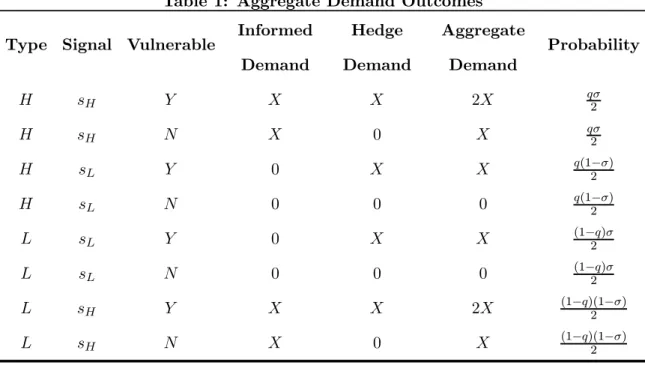
Table 1 lists the possible aggregate demand configurations confronting market-makers. After observing aggregate demand, market-makers form beliefs regarding the signal received by the spec-ulator based upon the observed aggregate demand , with:
Pr[ = | = 2] = 1 (3)
Pr[ = | = ] = 1 − − + 2
Pr[ = | = 0] = 0
Beliefs over can be mapped to beliefs over the asset type, with
where Pr[ = | = ] = 1 − − + 2 (5) Pr[ = | = ] = (1 − ) + − 2
Substituting (5) into (4) one obtains:
Pr[ = | = 2] =
1 − − + 2 (6)
Pr[ = | = ] =
Pr[ = | = 0] = (1 − )
+ − 2
Market-maker beliefs and equilibrium prices ( ) increase monotonically in aggregate demand with:
() = + ( − ) Pr[ = |] ∀ ∈ {0 2} (7)
⇒ (2) () (0)
To support the PBE conjectured in Table 1 it is sufficient to verify the speculator has no incentive to deviate regardless of the signal she receives. To that end, off the equilibrium path market-makers form adverse beliefs from the perspective of the speculator, setting prices based upon:
Pr[ = |] = 1 ∀ ∈ {0 2}
It is readily verified that the speculator has no incentive to change her signal-contingent trading strategy when confronted with such beliefs. While such beliefs off the equilibrium path are sufficient to support the conjectured PBE of the market-making game, it is worthwhile to briefly discuss their
plausibility. Note that any ∈ {0 2} must be due to the speculator placing a strictly positive
order. The chosen specification of beliefs off the equilibrium path is predicated on the intuitive notion that market-makers should view any such (positive) order as being placed by after having
observed . After all, if a negative signal is received, the speculator stands to incur a loss from
which would entail Pr[ = |] = 0. Conversely, if a positive signal is received, the speculator
stands to make a strictly positive trading gain provided Pr[ = |] 1
A. Expected Revenue
The expected revenue of the owner, conditional upon = , is given by:
[| = ] ≡ = +(−) ∙ Pr[ = | = 2] 2 + (1 − ) Pr[ = | = 0] 2 + Pr[ = | = ] 2 ¸ (8) Equation (8) can be rewritten as:
() = () + [1 − ()] (9) () ≡ 12 ∙ 2 1 − − + 2 + (1 − )2 + − 2 + ¸
Anticipating, the variable plays a critical role in the model. It measures the high type’s expectation of the market-makers’ updated belief. Some intuition regarding the interpretation of the variable is provided by the following equation for expected underpricing for the high type:
− [| = ] = ( − )[1 − ()] (10)
The preceding equation shows that 1 − is a proxy for expected underpricing from the perspective of the high type. To take a limiting example, if it were possible to achieve = 1 then each type would receive the correct type-specific asset valuation.
From Bayes’ rule one may relate the expected revenue of the low type, denoted (), to that
of the high type as follows
( ) = + (1 − ) = () + (1 − )() (11) which implies () = () + [1 − ()] (12) () ≡ µ 1 − ¶ [1 − ()]
Lemma 1 shows that the owner of the high value asset benefits from higher speculator signal precision, since increased signal precision drives prices closer to fundamental value. All but the most important proofs are presented in the appendix.
Lemma 1 The expected revenue of the owner of a high value asset is increasing in the precision of
the signal received by the speculator.
From Lemma 1 it follows that is increasing in , with
µ 1 2 ¶ = (13) (1) = 1 + 2
It is worth noting that if the speculator fails to put in effort ( = 12), then = and the expected revenue of each type reverts to the unconditional expected revenue () as in a standard analysis of pooling equilibria.
B. Incentive Compatible Information Acquisition
Consider next the incentives of the speculator. From Table 1 it follows that her expected gross trading gain is ( ) = · ⎡ ⎢ ⎣ ¡ 2 ¢ [ − (2)] +¡2 ¢ [ − ()] +³(1−)(1−)2 ´[ − (2)] +³(1−)(1−)2 ´[ − ()] ⎤ ⎥ ⎦ (14) = (1 − )(2 − 1)(− ) 2
It is readily verified that the speculator’s trading gain increases linearly in each of its arguments, and that the marginal benefit of signal precision is increasing in with
1( ) = (1 − )(− ) 0 (15) 2( ) = (1 − )(2 − 1)(− ) 2 0 11( ) = 22( ) = 0 12( ) = (1 − )(− ) 0
The incentive compatible signal precision, denoted satisfies:
0() = (1 − )(− ) (16)
Define the inverse function of 0 as follows
≡ [0]−1 We may rewrite the incentive compatible signal precision as
= [(1 − )(− )] (17)
From the implicit function theorem and the convexity of the effort cost function it follows that: = (1 − )(− ) 00() ≥ 0 (18) (− ) = (1 − ) 00() 0 = (− )(1 − 2) 00()
Since the incentive compatible signal precision plays a critical role, we summarize these findings in the following lemma.
Lemma 2 The incentive compatible signal precision of the speculator is increasing in the aggregate
demand of the uninformed investors when vulnerable (); increasing in the wedge between the value
of claim under high and low types (− ); increasing in for 12; and decreasing in
for 12
C. Aggregate Uninformed Demand: Pass-Through Security
The next step is to determine aggregate uninformed demand () for security in response to their being vulnerable to a negative endowment shock. Before conducting this analysis it is worth recalling that if there were symmetric information regarding the asset’s value, uninformed investors
whenever vulnerable to negative endowment shocks they would submit demand for units of
equity for an asset of type ∈ { } Such a demand would result in 2 = 0 if 2= −
Letting ∗() denote the optimal -contingent demand, aggregate uninformed demand is
≡ Z max
0
∗() () (19)
Each uninformed investor has measure zero and acts as a price-taker. If vulnerable, an individual uninformed investor expects the security to be overpriced since he knows a subset of uninformed investors will submit positive demands, pushing prices higher as market-makers revise upward their assessment of the probability of the asset being of high value. Despite facing adverse selection, an individual uninformed investor is willing to submit a buy order if is sufficiently high.
In order to characterize uninformed demand, it is useful to compute the expected price of the asset conditional upon uninformed investors being vulnerable to a negative endowment shock. With this in mind, for the remainder of paper let be an indicator function for uninformed investors being vulnerable to a negative endowment shock.
[ | = 1] ≡ − (20)
− = [ + (1 − )(1 − )] (2) + [(1 − ) + (1 − )] ()
= + (1 − ) + (1 − )(2 − 1)( − )
Equation (20) is consistent with the intuition that uninformed investors face adverse selection when submitting buy orders, since the asset is overpriced relative to its unconditional expected value. Additionally, the equation reveals there is no adverse selection if the speculator does not put in any effort ( = 12) Finally, it can be seen that adverse selection is increasing in the precision of the speculator’s signal. This latter finding is at the heart of the trade-off in the model. Structures that encourage information production by the speculator simultaneously worsen adverse selection as perceived by uninformed investors, biasing them away from first-best insurance against negative endowment shocks.
Recalling the functional form for uninformed investor utility in equation (1), consider the change in expected utility experienced by uninformed investors for various demand perturbations:
∈ µ 0 ¶ =⇒ ( | = 1) = [ + (1 − )] − − (21) ∈ µ ¶ =⇒ ( | = 1) = (1 − ) − − =⇒ ( | = 1) = − −
From the last line in (21) it is apparent that no uninformed investor ever buys more than units
of equity since this results in 2 0 with probability one and zero marginal consumption utility
in the second period. In order to further characterize optimal uninformed demand, we define two cutoff values for the preference parameter:
1 ≡ − [ + (1 − )] (22) 2 ≡ − (1 − )
From the demand perturbation equations (21) it follows that:
∈ [0 1] ⇒ ∗() = 0 (23) ∈ (1 2) ⇒ ∗() = ∈ [2 max] ⇒ ∗() =
Adverse selection distorts trading decisions and the level of insurance against negative endow-ment shocks. Uninformed investors with relatively low risk-aversion (low ) do not buy any insurance
against negative consumption. Such investors have 2= − if there is a negative endowment shock.
Information acquisition by the speculator results in an increase in the number of uninformed
in-vestors foregoing insurance. To see this, note that 12 implies 1 −1 with the former
representing the cutoff for the purchase of equity when there is asymmetric information and latter representing the cutoff for the purchase of equity under symmetric information.
Uninformed investors with intermediate parameters underinsure relative to the symmetric information case. Specifically, in the event of a negative endowment shock, at their optimal demand
2 = 0 if = but 2 = −( − ) if = Uninformed investors with high parameters
actually overinsure in that at their optimal demand 2 = 0 if = but 2 = ( − ) if =
Lemma 3 summarizes the properties of aggregate uninformed demand.
Lemma 3 If types pool by selling the underlying asset in the form of a pass-through security,
ag-gregate uninformed demand when vulnerable to a negative endowment shock is
= · ∙ (2) − (1) + 1 − (2) ¸ (24) 1 = −1 ∙ 1 +(1 − )( − )(2 − 1) + (1 − ) ¸ 2 = −1 ∙ 1 +(1 − )( − )(2 − 1) + (1 − ) ¸
Finally, we may pull together the incentive compatible signal precision from Lemma 2 and the uninformed demand from Lemma 3 to verify existence of equilibrium in the market-making game. We have the following proposition.
Proposition 1 In the market-making game, for any , there exists a unique equilibrium
pair ( ) satisfying () = ∈ µ 1 2 1 ¶ () = ∈ µ 0 
III. Optimal Structuring under Full Securitization
Section IV analyzes the full security design problem, including the question of optimal claim retentions and the potential for separating equilibria. In order to analyze the full problem, this
section considers the following instructive thought experiment. Suppose, for this section only, that the owner must sell the entire asset and is not allowed to retain any interest in it. What type of security designs would emerge in equilibrium? We note that this is precisely the question analyzed by Boot and Thakor (1993). However, they consider a setting with a wealth-constrained speculator and pure noise-trading. This precludes welfare analysis in their model. Further, we derive different optimal security designs.
If the owner must sell the entire asset, there is no possibility of a separating equilibrium. This is because the owner of a low type asset would find it optimal to mimic whatever structuring would be chosen by the owner of a high type asset, since any other structure would fully reveal the negative private information, leaving him to collect the minimum expected revenue It follows that with full securitization, one may confine attention to the securitization structure that gives the high type the highest pooling payoff.
An important simplifying result is that attention can be confined to two publicly traded securities without loss of generality. This result is stated as Lemma 4.
Lemma 4 Any outcome attainable with three or more publicly traded securities is attainable with
two publicly traded securities.
Following Nachman and Noe (1994) and DeMarzo and Duffie (1999)), attention is confined to securities with nonnegative payoffs that are weakly increasing in the asset value in period 2. Monotonicity is assumed for two reasons. First, monotone securities are commonplace. Second, if one of the securities, say security was decreasing, the owner of security could benefit at the expense of the owner of by making a clandestine contribution of additional funds to the asset pool. As argued by DeMarzo and Duffie (1999), only securities with monotone payoffs will be observed if such hidden contributions are feasible, and demanding monotonicity is then without loss of generality.
The major difference between the analysis of one and two securities is that uninformed investors insure themselves in the most efficient way possible. In particular, they buy the security that exposes
them to the lowest degree of adverse selection per unit payoff. Therefore, we begin the analysis of multiple securities with a focus on uninformed demand.
A. Uninformed Demand: Multiple Securities
Uninformed investors have positive demands only if vulnerable to a negative endowment shock. By the same reasoning applied in Section II, uninformed investors are concerned about overpricing of securities if vulnerable to a negative endowment shock since they correctly anticipate high aggregate demand.
Before proceeding, we first argue that if the original owner must sell off all cash flow rights, it is never optimal to issue a safe claim. To demonstrate this, suppose to the contrary Owner carves out
a safe claim with = ≤ Then all uninformed investors with −1 would use security
and only , to insure if vulnerable to a negative endowment shock, setting demand at = .
Such a financial structure would achieve first-best risk sharing. However, in the present setting, the goal of the owner (high type) is to encourage information production since this increases his expected revenue (Lemma 1). With safe debt available there will be no information production since there is no market in which the speculator can make trading gains. We state this result as Lemma 5.
Lemma 5 If the owner were to issue a safe claim, uninformed demand would be confined to that
claim, resulting in zero speculator effort ( = 12). Market-makers would then revert to their
prior probability of the asset being type If the owner must securitize the entire asset, he will never issue a safe claim.
Lemma 5 highlights an inherent conflict between private and public incentives in choosing se-curity design. In particular, the sale of a riskless claim would here achieve first-best risk sharing. However, if the owner must sell the entire asset, he necessarily finds it optimal to sacrifice risk sharing in order to encourage information acquisition. This prediction stands in stark contrast with those derived by Gorton and Pennacchi (1990) and Dang, Gorton and Holmström (2010), who predict that issuers will attempt to minimize informational-sensitivity.
In light of Lemma 5, the remainder of this section focuses on structures in which both claims are risky. To compute the optimal demand for each uninformed investor it is useful compute price expectations conditional upon vulnerability to a negative endowment shock. To this end, let:
− ≡ [| = 1]
− ≡ [| = 1]
Under this section’s working conjecture, to be verified, that all uninformed demand is concen-trated in a single security, say security , there is zero aggregate demand for since the speculator will also refrain from trading in that market given the lack of any cover provided by uninformed investors. Therefore, Table 1 continues to be the relevant table depicting aggregate demand (for security ). Since there is no market segmentation, the aggregate demand for security is also used by the market-makers in setting prices for security That is, the market-makers will set prices as a function of aggregate demand for as follows:
() = + (− ) Pr[ = |] ∀ ∈ {0 2} (25)
() = + (− ) Pr[ = |] ∀ ∈ {0 2}
Using Table 1 we arrive at the following expressions for the expected prices computed by unin-formed investors when vulnerable to negative endowment shocks:
− = [ + (1 − )(1 − )](2) + [(1 − ) + (1 − )]() (26)
= + (1 − )+ (1 − )(2 − 1)(− )
and
− = [ + (1 − )(1 − )](2) + [(1 − ) + (1 − )]() (27)
= + (1 − )+ (1 − )(2 − 1)(− )
Equations (26) and (27) are consistent with the intuition that uninformed investors perceive over-pricing for any security unless it is riskless. Further, the degree of perceived adverse selection is increasing in the precision of the speculator’s signal.
Assume without loss of generality that security is more informationally sensitive in the sense of taking a larger percentage claim in the event that = :
≥ (28) ⇒ − + (1 − ) ≥ − + (1 − ) ⇒ − (1 − ) ≥ − (1 − )
The two inequalities presented in (28) imply that security is viewed by uninformed investors as
having higher adverse selection costs per unit of 2 provided.
The intuition behind optimal uninformed demand is simple. For uninformed investors with sufficiently low, demand is zero for both securities, with adverse selection dominating insurance motives. For intermediate values of the agent partially insures, buying enough units of period 2 cash flow such that his consumption is zero if the actual asset type is , which implies that consumption is negative if the actual asset type is Finally, if is sufficiently high, the uninformed
investor completely insures in the sense of purchasing enough units of the security such that 2
reaches zero even if the actual asset type is which implies 2 0 if the asset type is Of course,
for any given level of insurance, uninformed investors seek the least costly security combination.
Let Φ be an indicator for 2 = − Second period consumption can then be expressed as a
function of the actual asset type with
2( Φ ) = + − Φ ∀ ∈ { }
The optimal portfolio is determined using perturbation arguments. Attention is confined to
portfolios satisfying 2( 1 ) ≤ 0 Otherwise, 2 0 regardless of the actual asset type,
despite the fact that the marginal utility of second period consumption is then equal to zero.
We have: [ | = 1] = [+ (1 − )] − − (29) [ | = 1] = [+ (1 − )] − −
If is sufficiently low, both perturbation gains listed in (29) are negative and optimal uninformed demand is zero. Specifically:
≤ − [+ (1 − )] ≡ 1 ⇔ (∗ ∗) = (0 0) (30)
Next, consider an arbitrary portfolio ( ) such that 2( 1 ) = where is arbitrarily
small. That is, we are considering points just above the kink that arises at portfolios such that
2( 1 ) = 0. Performing a perturbation one finds:
[ | = 1] = (1 − )− − (31) [ | = 1] = (1 − )− −
If is sufficiently high, such a perturbation increases the maximand. Further, since the maximand is piece-wise linear, it would then be optimal to fully insure against negative consumption, achieving
2(∗ ∗ 1 ) = 0 Finally, from the inequality in (28), the minimal cost means of achieving this
full insurance is to purchase only security Formally, we have:
≥ − (1 − ) ≡ 2 ⇔ (∗ ∗) = µ 0 ¶ (32)
The final case to consider is ∈ (1 2) From the perturbation arguments given above, we know
such uninformed investors partially insure, with 2(∗ ∗ 1 ) = 0 Now, consider the marginal
utility ( ) per unit of period 1 numeraire allocated to the purchase of each security (on the relevant region where the uninformed investor is partially insuring). From the inequality in (28) we know: = [+ (1 − )] − ≥ [+ (1 − )] − = (33)
It follows that security yields the highest marginal utility on the region of partial insurance, so that ∈ (1 2) ⇒ (∗ ∗) = µ 0 ¶ (34)
This establishes Proposition 2.
Proposition 2 (Full Securitization) There is zero uninformed demand for the riskier claim
When vulnerable to a negative endowment shock, aggregate uninformed demand for security B is
( ) = · ∙ (2) − (1) +1 − ( 2) ¸ (35) 1 = −1 ∙ 1 +(1 − )(− )(2 − 1) + (1 − ) ¸ 2 = −1 ∙ 1 +(1 − )(− )(2 − 1) + (1 − ) ¸
Proposition 2 can be contrasted with a result obtained by Boot and Thakor (1993). In their model, speculators make trading gains in the riskier levered equity claim. This results from their particular specification of noise trading. In our model, uninformed investors optimally insure them-selves using only the least information-sensitive claim. Consequently, in our model the speculator is unable to make trading gains in the market for the riskier claim. A similar effect is operative in the model of Gorton and Pennacchi (1990), since they too predict that uninformed investors will buy only the safest claim, which is riskless debt in their model.
B. Optimal Structuring
Lemma 1 shows that the expected revenue of a high type owner is increasing in In this section’s setting in which all cash flow rights must be sold, the objective of such an owner is to maximize
convexity of the effort cost function it follows that the optimal security design solves: 1 (36) (∗ ∗) ∈ arg max (− )( ) (37) () ≥ ( ) ≥ (38) ( ) ≤
Intuitively, the optimal security design under full securitization maximizes the product of the spec-ulator’s per-unit profit and endogenous uninformed trading volume. This creates a natural trade-off given that uninformed demand decreases with informational sensitivity. The constraint labeled ensures that security is, in fact, the low information-sensitivity security in which uninformed de-mand is concentrated. The three listed constraints ensure all other limited liability and monotonicity constraints are respected since they imply:
(0 ) ∈ [0 ] ∀ ∈ { } 0 ∈ (0 ] ≥
Conveniently, Program 1 is independent of the choice of provided ∈ (0 ] This is because
uninformed demand is homogeneous degree negative one in ( ) For example, if Owner were
to cut both state contingent payoffs in half, each uninformed investor would simply double his demands. Thus, examining the objective function in Program 1, the optimal policy is unique up to a scalar, since
Given this finding, let
≡
In this case, the aggregate demand defined in Proposition 2 simplifies as follows (with slight abuse of notation): = ( ) = · ∙ 1 − (1())−( − 1) ( 2()) ¸ (40) 1() ≡ −1 ∙ 1 +(1 − )(2 − 1)( − 1) 1 + ( − 1) ¸ 2() ≡ −1 ∙ 1 +(1 − )(2 − 1)( − 1) + (1 − ) ¸
Increases in reduce uninformed demand since both cutoffs are increasing in with:
01() = (1 − )(2 − 1) [1 + ( − 1)]2 0 (41) 02() = −1 ∙ (2 − 1) + (1 − ) ¸ 0
Making the substitution = throughout Program 1 allows us to simplify the optimal
structuring problem as follows.
Lemma 6 Suppose total securitized cash flow is worth if the asset is low quality and ≥ if the
asset is high quality. Total expected revenue received for the securitized claims, conditional upon the
asset being of high quality, is maximized with any ∗ ∈ (0 ] and ∗ = ∗∗ where ∗ solves
2 ∗ ∈ arg max () ≡ ( − 1) ∙ 1 − (1())− ( − 1) ( 2()) ¸ ≤
It is worth noting that Program 2 is relevant for arbitrary levels of securitization, including cases where the owner retains some interest in the asset. Full securitization of the asset pertains to the special case where one sets ( ) = ( ) in Program 2. The generality of Lemma 6 will prove useful in Section IV which considers partial securitization.
Lemma 7 establishes a sufficient condition under which the objective function in Program 2 is strictly concave.
Lemma 7 If the cumulative distribution function ( ) for uninformed investors’ preference
para-meter is weakly convex, then the maximand in Program 2 ( ) is strictly concave.
The intuition behind Lemma 7 is as follows. If is convex then marginal increases in result in ever larger reductions in aggregate uninformed demand. Further, the benefit to the speculator of the increase in per-unit profits stemming from an increase in is spread over a progressively smaller trading base. Consequently, the maximand is strictly concave. The remainder of the paper assumes
2 : is weakly convex. The Lagrangian for Program 2 can be written as:
L()≡() + µ − ¶ (42)
In Program 2, the optimal policy is characterized by a unique pair (∗ ∗) satisfying the following
first-order condition
0(∗) = ∗ (43)
and the complementary slackness conditions: µ − ∗ ¶ ∗ = 0 (44) ∗ ≥ 0
For the remainder of the analysis, we shall assume that is sufficiently high such that the
constraint does not bind if the asset is fully securitized. To this end, define ∗∗ to be the
unconstrained maximizer of the objective function : ∗∗≡ (0)−1(0) And we then adopt the technical assumption:
3 :
One can understand the role of Assumption 3 as follows. Think of Owner as progressively raising , bringing the low-information-sensitivity claim closer and closer to a linear claim. Doing so raises the per-unit profit of the speculator, but also diminishes demand for , with Assumption 2 implying the demand cost rises with Assumption 3 is predicated on the notion that the demand cost dominates before becomes linear. That is, Assumption 3 ensures that when Owner fully securitizes the underlying real asset, it is never optimal to package it as a pass-through security (equity).
Differentiating the maximand yields:
0() = ∙ 1 − (1) −( − 1) ( 2) ¸ (45) − ∙ − 1 ¸ ∙ (2) − (1) + (1) 0 1() + ( − 1)(2)02() ¸
The first term in (45) captures the gain from increasing informational sensitivity (via ), as it increases the speculator’s per-unit trading gain. The negative term captures the cost of increasing informational sensitivity in terms of reducing equilibrium uninformed demand, behind which the speculator hopes to hide her trading. Canceling terms one obtains:
0() = ∙ 1 − (2) µ 1 − 1 2 ¶ − (1) 2 − µ − 1 ¶ [ (1)01() + ( − 1)(2)02()] ¸ (46)
We have then established the following proposition which characterizes equilibrium security design in a pooling equilibrium with full securitization.
Proposition 3 If the entire asset is securitized, the equilibrium structuring consists of a claim with
low-information-sensitivity with ∗ ∈ (0 ] and ∗ = ∗∗∗ where ∗∗ is the unique
solution to 1 − (1) ∗∗ − (∗∗− 1) (2) ∗∗ = ∙ ∗∗− 1 ∗∗ ¸ ∙ (2) − (1) ∗∗ + (1)01(∗∗) + (∗∗− 1)(2)02(∗∗) ¸ (47) The second residual claim attracts zero aggregate uninformed demand. All informed trading gains are derived in the market for the low information-sensitivity claim.
The following corollary shows that under full securitization optimal structuring can be achieved by combining standard securities.
Corollary (Full Securitization) One optimal securitization structure consists of a liquid risky senior
debt tranche with face value ∗∗ and a residual illiquid junior (equity) claim. Another optimal
securitization structure consists of liquid equity and an illiquid call option on the underlying asset
with strike price ∗∗
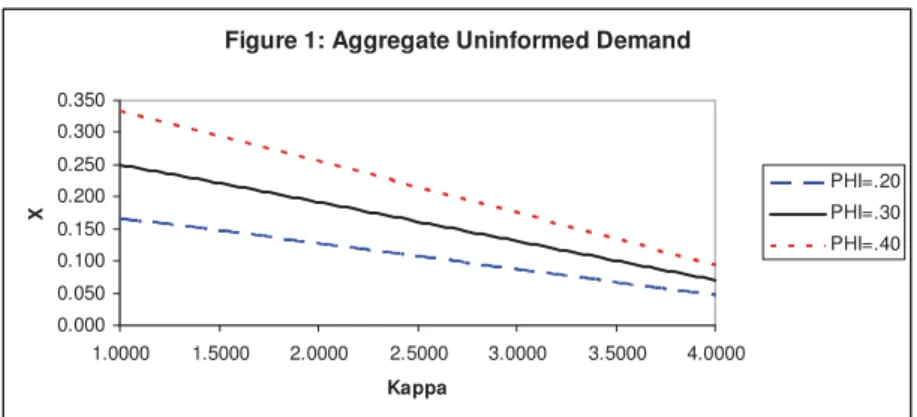
Since we have an analytical solution for uninformed demand, numerical illustrations are simple. Figure 1 depicts aggregate uninformed demand, conditional upon vulnerability, assuming that the distribution of parameters ( ) is the uniform distribution with support [0 8], = 12 and = 34. As shown in the figure uninformed demand declines monotonically in informational sensitivity, as measured by , since increases in induce marginal investors to either forego purchase of the security
(1 increasing) or to purchase less units (2 increasing). Consistent with the fact that aggregate
demand increases linearly in , Figure 1 also shows that increases in the magnitude of endowment shocks induce outward shifts in the uninformed demand curves. For these same parameter values, Figure 2 plots the objective function for Program 2, which pins down the optimal informational
sensitivity ∗∗ As shown in the figure, the optimal value of is actually independent of , reflecting
the fact that the maximand is linear in However, it is also apparent that higher values of result in correspondingly higher values of , which implies higher incentive compatible signal precision.
At this point it is worth recalling the working assumption that the only party capable of issuing securities is Owner. That is, other agents cannot issue securities or short-sell. Now recall that the market-markets clear markets for all securities, buying one minus the combined aggregate demand of the uninformed investors and the speculator. But is it possible for aggregate demand to exceed supply? To address this question, notice that the maximum aggregate demand coming from the uninformed investors and speculator is 2 We can write uninformed demand as:
( ) = µ ¶ ∙ (2) − (1) + 1 − (2) ¸
sufficiently small in relation to The no-shorting constraint is clearly easiest to satisfy at =
where the choice of was otherwise arbitrary when we ignored the no-shorting constraint.
From Assumption 1 it follows that the market-makers are never called upon to short-sell (even at suboptimal ) since
≤ 2 ⇒ 2( ∗ = ) 1 (48)
IV. Optimal Retentions and Security Design
Section III assumed the original asset owner must sell the entire asset. Such a setting is relevant when there is a forced asset sale due to antitrust enforcement, bankruptcy liquidation, or unbounded liquidity needs. This section considers a more general setting in which the owner chooses both the degree and design for securitization of the original asset.
The assumptions for the remainder of the paper are as follows. Owner is risk-neutral and values
consumption equally in both periods, having utility of the form 1+ 2 Further, Owner has access
to a linear production technology allowing him to convert each unit of numeraire received from investors in period 1 into 1 units of numeraire in that same period. In contrast to the original real asset, the value of this short-term production technology is not verifiable by courts, so this stream of cash flow cannot be securitized.
We consider this particular setup for three reasons. First, our interest is in analyzing optimal asset-backed securities, where a firm raises funds by selling claims against a specified asset. Second, this setup approximates a number of real-world settings. For example, one may think of a distressed bank as placing high, yet bounded, value on the immediate receipt of cash coming from securitization of an underlying asset. Finally, this setup allows us to retain our focus on the optimal securitization of a single real asset, here the original real asset with values in { } This allows us to address how the option to retain some cash flow rights affects the optimal structure.
If there were no intrinsic benefit to receiving funds immediately ( = 1), the owner of the high quality asset would not sell any claims on the real asset given asymmetric information. He would then obtain his first-best payoff by holding onto the entire asset. Conversely, if there were symmetric information and if were greater than one, then an owner of either asset type would sell all cash flow rights in the form of a pass-through security.
A. The Security Design Game
Maskin and Tirole (1992) show the equilibrium set of signaling games can be narrowed and Pareto-improved (from the perspective of the privately informed party) by expanding the set of feasible initial actions. Tirole (2005) describes an application of the formulation of Maskin and Tirole (1992) to security issuance by a privately informed party. We adapt the game of Tirole (2005) to our setting.
The sequencing of events is as follows. The entire security design game actually consists of two connected signaling games: an offer game and the market-making game. The latter game was already described in Section I. The offer game is a signaling game played between Owner and all outside investors. This game begins with Owner privately observing asset value. He then approaches the market-makers (e.g. investment banks) and publicly proposes a menu of two securitization
structures, say Σ ∈ {Σ1 Σ2}, that he would like the option to choose from subsequently. This
step resembles a shelf-registration in that Owner is locking in a pair of optional future financial configurations. Each structure stipulates all payoffs for claimants as a function of the verified asset value in period 2. The market-makers then agree to clear markets competitively for whatever structure Σ the owner subsequently chooses from his menu. All agents in the economy must have a belief regarding the asset type in response to any menu offer, including those off the equilibrium path. Beliefs at this stage are labeled offer beliefs. To support candidate PBE, menu offers off the equilibrium path are punished with outside investors inferring = with probability one.
The sole difference between this formulation and the game described by Tirole (2005) is that in our model market-makers cannot agree to providing cross-subsidies. Rather, they simply agree to
compete and clear markets for the securitization structure subsequently chosen by Owner. Using the terminology of Tirole (2005), competitive market-making implies that all investors in securities find them profitable type-by-type. This stands in contrast to a setting in which investors can pre-commit to subsequently buying some set of securities at a loss, a possibility allowed in the formulation of Tirole (2005).
In the next stage of the offer game, Owner selects a securitization structure Σ from the menu he initially proposed, with the choice being incentive compatible. After observing the selection of Owner, all other agents revise beliefs using Bayes’ rule where possible. The beliefs formed at this stage are labeled selection beliefs. It is worth stressing that both types can offer the same menu, but they do not necessarily select the same securitization structure from that menu. Indeed, in a separating equilibrium of the offer game, the initial securitization proposal is such that the Σ subsequently selected from the menu reveals the true asset type In any separating equilibrium securities are correctly priced and all agents trade in full knowledge of the true type. There is no incentive for the speculator to put in effort in a separating equilibrium of the offer game.
In a pooling equilibrium of the offer game, both owner types propose the same trivial menu with
Σ1 = Σ2 In such cases, no information is revealed about the asset type after the selection stage of
the offer game. If and only if a pooling equilibrium occurs in the offer game, play then passes to the market-making game described in Section I. Recall, all relevant players enter the market-making game holding their prior belief that Pr[ = ] = as is appropriate when the offer game reveals no information regarding Then a signaling game ensues between the speculator and market-makers, where market-makers use aggregate demand to form beliefs regarding the signal received by the speculator and set prices accordingly.
B. The Least-Cost Separating Equilibrium
The owner can credibly signal positive private information by retaining sufficient rights. To this
end, assume Owner designs a third security with value-contingent payoffs ( ) Owner holds
From Lemma 4 it follows that confining attention to no more than two publicly traded securities is without loss of generality.
We begin by evaluating the least-cost separating equilibrium (LCSE) from the perspective of the high type. Note that in the LCSE the speculator has no incentive to acquire information since the original owner’s private information is fully revealed by his financing choice.
The LCSE minimizes the low type’s incentive to mimic by giving him his first-best allocation in which he sells the entire asset in the form of a pass-through security. The LCSE makes the high type as well off as possible subject to the constraint that the low type does not want to mimic. In the LCSE, there is no need for the high type to sell more than one public security, call it security . The LCSE is then the solution to:
max () + : ≥ +
To determine the LCSE, we first ignore the monotonicity constraint and then verify it is slack. Clearly, in this relaxed program the optimal policy is to loosen the no-mimic constraint to the
maximum extent by setting ∗ = 0 implying ∗ = Further, the no-mimic constraint must bind
at the optimum, implying ∗ = and ∗ = − Since the neglected monotonicity constraint
is satisfied we have established the following proposition.
Proposition 4 In the least-cost separating equilibrium, a low type asset is sold in its entirety in the
form of a pass-through security. The owner of a high type asset sells only a safe senior (debt) claim with face value retaining the residual (levered equity) claim. Uninformed investors then achieve first-best insurance against negative endowment shocks by purchasing correctly priced claims. The speculator does not exert effort.