HAL Id: hal-00432874
https://hal.archives-ouvertes.fr/hal-00432874
Submitted on 7 Apr 2010
HAL is a multi-disciplinary open access archive for the deposit and dissemination of sci-entific research documents, whether they are pub-lished or not. The documents may come from
L’archive ouverte pluridisciplinaire HAL, est destinée au dépôt et à la diffusion de documents scientifiques de niveau recherche, publiés ou non, émanant des établissements d’enseignement et de
Using cartography to sustain inter-generation knowledge
transfer : the M3C methodology
Jean-Louis Ermine, Imed Boughzala, Thierno Tounkara
To cite this version:
Jean-Louis Ermine, Imed Boughzala, Thierno Tounkara. Using cartography to sustain inter-generation knowledge transfer : the M3C methodology. ICICKM 2005 : 2nd International Conference on Intel-lectual Capital, Knowledge Management and Organisational Learning, Nov 2005, Dubai, United Arab Emirates. pp.175-186. �hal-00432874�
Using Cartography to sustain Inter-Generation
Knowledge Transfer: the M3C Methodology
J-L Ermine- I. Boughzala- T. Tounkara
Proceedings of ICICKM’2005 (2nd International Conference on Intellectual Capital and Knowledge Management), Dubai, 222 november 2005, Dan Remenyi ed., ISBN
Using Cartography to sustain Inter-Generation Knowledge
Transfer: the M3C Methodology
Jean-Louis Ermine- Imed Boughzala- Thierno Tounkara National Institute of Telecommunications (INT)
http://www.int-evry.fr
9 rue Charles Fourier, 91011 Evry cedex FRANCE
33 1 60 76 45 77
[email protected] [email protected] [email protected]
Abstract: Knowledge transfer problem between two generations of professionals (usually from the old one to the new one) to a new dimension. Knowledge transfer is no longer reducible to classical solutions as face to face training, technical education, tutoring. Knowledge to transfer is professional knowledge (Business Knowledge). It involves the whole Knowledge Capital within an organization. Identify the knowledge components that are worthwhile to transfer is not an easy task. This is the problem addressed in this paper.
Keywords: Inter-Generation Knowledge Transfer, Knowledge Management, Knowledge Mapping, and Knowledge Capitalization.
1. Introduction
1.1. Knowledge Management for Knowledge Transfer
Knowledge Management problematic has been defined as the setting up of a management system of cognitive flow, which allows all organization’s components to use and enrich its corporate knowledge.
Knowledge Management allows then to locate, formalize, share, enrich and develop knowledge in the firm, specifically knowledge with critical and strategic characteristics (Boughzala and Ermine 2004, Ermine 2002). The aim is to stimulate the innovation and the creation capacity by a better productivity of knowledge.
A very serious problem is now rising in industrial countries: ageing of professional generations. This is a global problem but Knowledge Management focuses on some important aspects:
- How to identify critical knowledge that is worthwhile to transfer to new professional generation
- How to capitalize and transfer professional knowledge from a generation to another. In this paper we deal with the first question of identifying valuable knowledge in a company. We give a case study of knowledge capital analysis performed in Hydro Quebec Company in order to have a clear plan of transferring knowledge between generations.
Identifying valuable knowledge is the beginning of the solution, implementing devices for knowledge transfer is the next step, but it is another (tough!) story.
1.2. Cartography of knowledge
Knowledge cartography (or knowledge mapping) allows to enhance the value of the firm’s critical knowledge (Pachulski & al 2000, Saad & al 2003). It is a step to be performed before any operation of knowledge management. A cartography is an identification of the corporate knowledge. We refer to the definition of knowledge cartography given by (Speel & al 1999): “knowledge mapping is defined as the process, methods and tools for analyzing knowledge areas in order to discover features or meaning and to visualize them in a comprehensive, transparent form such that the business-relevant features are clearly highlighted”.
Companies wishing to manage their corporate knowledge must make a precise analysis in order to determine the knowledge they must preserve, develop, abandon etc. Cartography becomes then a decision support tool. In that purpose, there is a need of establishing specific criteria in order to evaluate, in the cartography, the most critical knowledge for the company. This is the so-called “cartography of critical knowledge”. It is such an analysis tool that we describe here. The M3C methodology described here is the result of various experiences (we describe one of them in this paper) and issues elaborated in a working group of the Knowledge Management Club (www.club-gc.asso.fr) (Aubertin & al 2003).
1.3. Content of the paper
The paper begins by giving a literature review of existing knowledge mapping methods and by underlining the contribution of the M3C methodology. Then, we present a case study performed in Hydro Quebec Company at Canada. Our goal is, using this case, to describe and to illustrate our “methodology of construction of the critical knowledge cartography” (cf. §4).
2. About knowledge mapping methods
Knowledge cartography helps to discover the location, value and use of organizational knowledge in the sense of (Tshuchiya 1993). It is a new research field in knowledge management and there are few academic papers.
Knowledge mapping methods can be categorized into two approaches: - approach oriented “ process”
This approach deals with knowledge cartography methods which use modeling, description and analysis of business processes to determine critical knowledge.
- approach oriented “ domain”
In this approach, we try to make a rising analysis from a mass of information in order to organize that one in logic different from the functional one. In fact, the goal is to make abstraction of the functional structure of the firm, grouping activities into knowledge domains. This task demands an important capacity of analysis because it’s a not a natural process.
2.1. GAMETH
GAMETH (Global Analysis METHodology) is an approach focusing on business processes that connects knowledge to action (Grundstein & al 2003).
GAMETH includes three main stages: - identifying the sensitive process;
- identifying the determining problems; - identifying the crucial knowledge.
The first stage of the GAMETH approach consists in determining the sensitive processes. A sensitive process presents stakes collectively recognized by the actors.
Independently of the company’s stakes, this process presents its own stakes and includes activities. The constraints and the dysfunction of these activities give rise to problems which can weaken them and put in danger the process they belong to. A risks assessment, practiced for the sensitive process, allows to determine the critical activities. The problems connected to these activities are called “determining problems”. Identifying them constitute the second stage of the GAMETH approach. Some of them can be solved easily by eliminating some constraints. The other ones lead to the knowledge necessary to their resolution. According to the value of this knowledge with regard to its vulnerability (scarcity, accessibility, cost and delay of acquisition) and to its influence on the company’s life, markets and strategy, this knowledge can be identified as “crucial knowledge”. Identifying crucial knowledge constitutes the third and last stage of the GAMETH approach.
2.2. The method proposed by Tseng and Huang
Tseng and Huang (Tseng and Huang 2005) propose a cartography method to determine crucial knowledge necessary for the design of a knowledge management system. The authors define “crucial knowledge” as: "the necessary knowledge to solve problems dealing with a given objective, and that should be capitalized ". Their approach is oriented "process" and is guided by problems. It is based on a quantitative analysis of collected information while interrogating some experts.
Different acquisition techniques are used (DELPHI, NGT…) to collect and classify the needs in knowledge for the problems-solving.
Tseng and Huang propose an algorithmic procedure from the data collected to determine four sets characterizing the importance of knowledge:
Set I (Vital knowledge): this type of knowledge is very important and should be located. Set II (The prompt acquisition knowledge set): this knowledge set is important for some
problems.
Set III (Seasonal knowledge): seasonal knowledge set is not important for the majority of the problems.
Set IV (Insignificant knowledge): this category of knowledge is not collected and no action is recommended unless there is a special need.
2.3. A method for the evaluation of tacit and/or explicit knowledge
Pomian and Roche propose to evaluate the corporate knowledge by distinguishing tacit and explicit knowledge (Pomian and Roche 2002).
Here, we present the criteria they use to analyze tacit and explicit knowledge: - Criteria of analysis for tacit knowledge
The principle of analysis consists in crossing the survey of the knowledge vulnerability with the criteria bound to their utility and their re-usability.
- Criteria of analysis for explicit knowledge
Pomian and Roche consider that the great part of explicit knowledge is contained in available documents. The stake of the analysis consists in ensuring the quality of documentary communication. Thus, they propose four criteria for documents analysis: legibility, clarity, relevance and accessibility.
However, the authors don't propose a method to identify and collect knowledge. They consider that the" operational manager" is able to give the list of the knowledge to be evaluated.
2.4. Knowledge trees
The goal of knowledge trees is to provide a cartographic representation of the knowledge considered as an element of a" human capital" for an organization (Authier and Lévy 1992). Knowledge trees are the expression and the consequence, evolving in real time, of training courses and experiences of all members of a given community. The underlying principles of their development are mathematical, philosophical and sociological.
The realization of these knowledge trees can guide and sustain knowledge transfer.
2.5. Contribution of the M3C methodology
M3C is based on an approach oriented “process”. The cartography and the evaluation of knowledge domains are based on knowledge acquisition from experts. Thus, M3C is also a knowledge engineering method and it completes other methods used for the modeling of descriptive and operational knowledge of an expert (Tounkara & al 2002).
M3C relies on robust models which have been performed in industrial research centers and also in industrial operational units (GTIE group, Schindler, DGA, PSA Peugeot Citroën…).
The cartography model we propose is characterized by a formal and a graphic model.
2.5.1. The formal model of the cartography
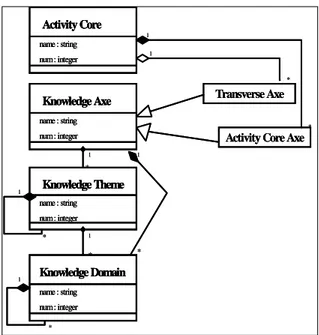
The formal model described with UML classes diagram (cf. Figure 1), is a hierarchical representation that classifies the knowledge domains of the firm in several levels.
A knowledge domain can be defined as a field of activity of a group of persons for who information and knowledge can be gathered together.
The central point of the cartography is the core activity or “core knowledge” which corresponds to the strategic knowledge capital, corresponding to its fundamental mission.
Around this central point, they are the knowledge axes, which define the strategic domains of knowledge, often corresponding to the different detailed missions of the organization.
The final knowledge domains in the classification are grouped according to a common finality on the same theme of knowledge, along the knowledge axes. According to the required precision, a domain can be divided into sub-domains and a theme into sub-themes.
Figure 1 : The formal model of the cartography
2.5.2. The graphic model
The graphic representation of the knowledge cartography is based on the principle of visualization, which makes easier the navigation and gives a global view of knowledge domain in the firm. For example, the choice of Ishikawa diagram allows presenting the hierarchy of different levels under the form of bones starting from the common trunk (Aubertin & al 2003). A tool of cartographic representation (as Mind Manager, for example) can be also used.
It can also be interesting to point out on the map the source of the knowledge that is the name of the owner of the knowledge as noted by Davenport in 1998 “knowledge maps typically point to people as well as to documents and databases. The employee with a good knowledge map has access to knowledge sources that would otherwise be difficult or impossible to find”. (Davenport and Prusak 1998).
2.5.3. The criticality model
The criticality of a domain is an evaluation of risks/opportunities. It may be for example risks of loss of knowledge that can have harmful consequences; interest to develop a domain to obtain advantages for the firm (productivity gains, new market shares…).
We need now to define what may be “objectively” the criticality of knowledge and to give a model of evaluation for identifying the most critical knowledge domains in the cartography. The Knowledge Management Club has elaborated a grid of generic evaluation called CKF (Critical Knowledge Factors) that is available for the members of the club. This grid has been performed and validated in many French and Foreign companies.
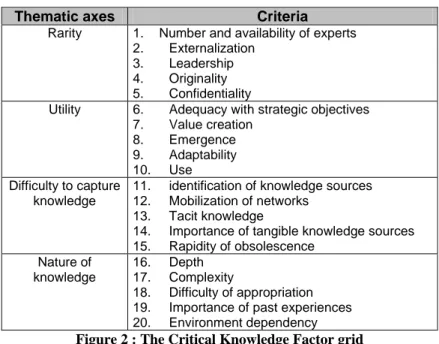
The CKF grid contains 20 criteria regrouped in 4 thematic axes (cf. Figure 2).
Activity Core name : string num: integer Knowledge Axe name : string num: integer Knowledge Theme name : string num: integer Knowledge Domain name : string num: integer Transverse Axe Activity Core Axe
1 1 1 1 1 * * * * * 1 * * 1 Activity Core name : string num: integer Activity Core name : string num: integer Knowledge Axe name : string num: integer Knowledge Axe name : string num: integer Knowledge Theme name : string num: integer Knowledge Theme name : string num: integer Knowledge Domain name : string num: integer Knowledge Domain name : string num: integer Transverse Axe Activity Core Axe
1 1 1 1 1 * * * * * 1 * * 1
Thematic axes Criteria
Rarity 1. Number and availability of experts 2. Externalization
3. Leadership 4. Originality 5. Confidentiality
Utility 6. Adequacy with strategic objectives 7. Value creation 8. Emergence 9. Adaptability 10. Use Difficulty to capture knowledge
11. identification of knowledge sources 12. Mobilization of networks
13. Tacit knowledge
14. Importance of tangible knowledge sources 15. Rapidity of obsolescence Nature of knowledge 16. Depth 17. Complexity 18. Difficulty of appropriation 19. Importance of past experiences 20. Environment dependency
Figure 2 : The Critical Knowledge Factor grid
Each criterion is evaluated according to a scale composed of 4 levels, representing the degree of realization of the criterion. Each evaluation of a criterion is based on one question. Each level is expressed by a clear and synthetic sentence by avoiding the vague terms and which lead to confusion (“rating description”) (cf. Figure 3)
Figure 3 : Evaluation grid of a factor
3. Hydro Quebec Case study
Inter-Generation Knowledge Transfer is an emerging problematic bound to massive retirements planned for the coming years. There is a great risk of knowledge loss. The massive retirements are principally due to the ageing of populations and also to the decrease of the demographic growth.
States as Canada and Belgium have already taken into account the necessity of knowledge transfer between generations.
Notation (1 to 4)
Theme: Nature of knowledge Criteria: Complexity
What is the extent of knowledge ?
Does the domain require an immense culture or is it specific ? Level 1 Specific
:
Knowledge is acute and specialised. Knowledge is restricted to one specific domain.« » . Level 2 Pluridisciplinary
Knowledge is at the junction of many domains. Its object belongs to an identified domain but it involves the intervention of many other domains.
Level 3 Transdisciplinary
Knowledge deals with a new problem which does not depend precisely to a defined domain. For its resolution we need methods and tools from diversified domains.
Level 4 Generalized
Knowledge deals with a general problematic in a system, an organisation, grouping many problems of various aspects which need transdisciplinarity for their resolution. We need to master deeply many point of views.
In this context, Hydro Quebec is implementing knowledge management projects to facilitate knowledge transfer to new generations who will be hired in its unities.
3.1. Hydro Quebec presentation
Hydro Quebec is one of the biggest electricity producer and distributor in North America. Hydro Quebec is a public company and his principal shareholder is the Quebec Government.
Hydro Quebec hires about 21000 employees and is confronted to difficulties bound to massive retirements and particularly departures of the most experimented employees:
- 500 per year from 2003 to 2008 - 800 per year from 2008 to 2011
We can notice also that the « age curve » is very unbalanced (cf. Figure 4)
Figure 4 : Age curve in Hydro Quebec Company
3.2. The study
The Hydro Quebec study is part of a bigger project « Expertise Management Plan » leaded by the Human Resources Department in collaboration with the CEFRIO1.
These were the objectives:
- Identifying strategic knowledge
- Making a vulnerability diagnostic of strategic knowledge
- Making recommendations about pertinent KM projects for capitalization, sharing, knowledge transfer, etc.
Te study lasted 6 months and concerned three operational units of Hydro Quebec. We performed M3C methodology to achieve objectives. Our global approach is described below:
- For each unity, we built and validated with experts the cartography of knowledge domains.
- We interviewed the experts to evaluate the criticality of each domain (over 30 interviews for the three domains). We used the Critical Knowledge Factors grid.
- With collected data, we made analysis and recommendations for future actions to achieve the « Expertise Management Plan ».
In the next point, we describe the M3C methodology as it has been performed in Hydro Quebec.
1
CEFRIO is a liaison and transfer centre comprising about 160 university, industrial and governmental members and 46 associate researchers. Its mission is to help Quebec organizations use information technologies in order to be more efficient, productive and innovative.
Number of Employees Age Majority of employees Number of Employees Age Majority of employees Number of Employees Age Majority of employees
4. The M3C methodology
The construction of knowledge cartography and the analysis of criticality may be a difficult operation and can mobilize a great number of persons, if it is realized for an objective of strategic decision. In addition of having concepts and tools, one needs a methodological and efficient process for building the cartography and the criticality analysis. In that purpose, we propose a new knowledge cartography method: M3C. We describe the M3C methodology as it has been performed in Hydro Quebec.
4.1. Framing
The goal is to define the real strategic objectives of the cartography within the global knowledge management plan. This enables also to fix the limits of the action field inside the corporate knowledge.
Framing consists also in replacing the cartography approach according to other transversal approaches in the Organization. Problematic of Quality Management, Skills Management and Information System Management are close to the Knowledge Management one.
In the four approaches, the processes and the roles performed by the actors are the articulation points. Quality defines procedures by determining the roles and the recorded information. The Skills Management organizes the necessary competencies to operate a role. Information System distributes computing resources according to the information needs of agents in order to help them accomplish their role. Finally, knowledge cartography detects and organizes the agents’ knowledge necessary to the implementation of their role in the Organization.
4.2. Location of knowledge domains
The location of knowledge domains consists, from documentation of reference and eventually interviews, in showing off knowledge domains by the successive analysis of activities, projects, products, etc.
This task demands a great capacity of analysis. Here, knowing the activities of the firm can be a brake. In fact, we try to make abstraction of the functional structure of the firm, grouping activities into knowledge domains.
The reference documentation is composed of:
The documents of organization (status, organization chart, description of department activities…);
The strategic documents (middle term plan, synthesis…);
The documents about the production (publications, studies, activities results…); The quality documents.
4.3. Construction of the first version of the cartography
This point deals with the construction of the physical representation of the knowledge cartography. The former step is concerned by a deep analysis of the activities of the firm. The analysis is put into form in order to make it accessible and mostly usable. The representation must be adapted to the operational vision of the concerned persons.
The construction of the map is an iterative process. Its validation is realized by the operational managers. These managers are able to locate, describe knowledge domains in the organization and they know the functional needs.
We realize a constant feedback in 3 phases: - Appropriation of the problem
- Co-construction of the representation - Validation of the map
In this context, it is vital to have a solid and constant representation structure, which allows to fix the ideas and to make the interviews efficient.
The cartography will be the basis for individual and collective interviews of experts concerned by the located knowledge domains. During these interviews, the cartography can be modified by experts.
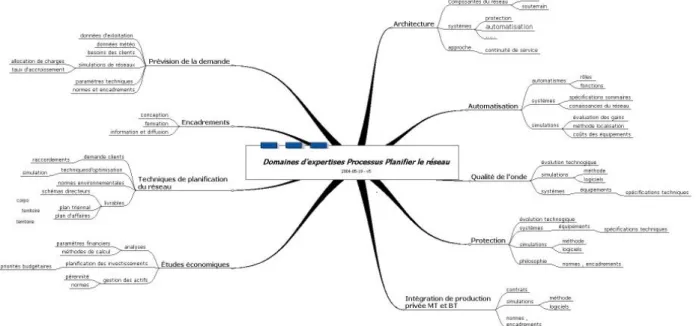
The map presented below is the first version we realized for one of Hydro Quebec unities: it evolved with corrections and additions of experts.
Figure 5 : Example of a Knowledge Map
4.4. Elaboration of the criticality criteria
Here, we refer to the Critical knowledge Factors grid established by the Knowledge Management Club. This grid must be adapted by taking into account some specificities of the organization, the expectations of the cartography project, the vocabulary used by the organization (as Quebecois expressions in Hydro Quebec case study).
The adaptation of the CKF grid can consist in: - adding new thematic axes,
- adding new criticality criteria,
- modifying the evaluation scale of a criterion, - modifying the definition of a criterion.
4.5. Sampling
The choice of experts to be interviewed, using the CKF grid, is important for the success of the cartography project. In this step, we constitute a representative sample of experts for each knowledge domain. Operational chiefs can help to make the good choices.
The diversity of profiles is important for the pertinence of the analysis and the interpretation of collected data. For each expert, we prepare a document to mention information such as:
- profile (diplomas, certificates, qualifications, etc.) - position, age, year of entry in the company
- past experiences (before the entry in the company) - experience in the knowledge domain
- role in the knowledge domain (contributor, user, etc.) - etc.
4.6. Collection of data
The evaluation of the criticality is tackled on the basis of the CKF evaluation grid. The choice of experts to be interviewed to fill this grid and the modality of data collection are tricky. The efficiency and the pertinence must be targeted, but we must avoid overcharging the operational managers.
Preparation of interviews
The preparation of an interview plan is suggested to ensure the homogeneity of all interviews. For a better understanding of the domain (vocabulary, past experiences …), we strongly recommend, during interviews, the participation of a person who belongs to the company. The recording of interviews is also very useful for the data analysis but we must ensure before the expert’s approval.
Individual and collective scoring
Interviews, using the CKF grid, can be performed individually (one expert) or collectively (a group of experts). The choice depends on parameters such as: context and cartography project type, experts’ availabilities, project deadline…
The goal is to evaluate each criterion of the CKF grid according to a scale composed of 4 levels (scoring as “0.5”; “2.5”; “3.5” are accepted). If the expert interviewed can’t answer to one question, we give “0” as evaluation: this score is not taken into account during the analysis step. We list below (cf. Table 1) the advantages and inconveniences of individual and collective interviews.
ADVANTAGES INCONVENIENCES
INDIVIDUAL INTERVIEWS (one expert)
Experts are more confortable. More qualitative data are collected.
Many interviews to perform (more time).
Additional step for the comparison of experts’ arguments.
COLLECTIVE INTERVIEWS (group of experts)
Exchanges and discussions between experts.
We are sure to ask the same questions to all experts of the group.
Knowledge domain analysis is faster.
Sometime, an expert can take the leadership and then there is a great risk to have poor arguing.
Difficulty to manage interviews. A collective interview takes more
time than an individual one.
4.7. Data analysis
The analysis of data recorded may represent a considerable volume: it depends on the number of knowledge domains to be evaluated and the number of experts to be interviewed. That’s why a tool is very useful for the processing and the representation of these data, particularly with radar diagrams (Kiviat diagrams for example) and graphs. The cartographic representation tool, with the visualization of different criticality factors, is important for the synthesis and the representation of the results.
Automatic analysis
After the data collection, we make an automatic analysis using an Excel tool we have developed. It’s an analysis tool that helps:
- to fill all the experts’ scorings in one single table;
- to get automatically, for a knowledge domain, the average of all experts’ scorings (average sorted by criterion and by thematic axe).
This tool also generates for each knowledge domain:
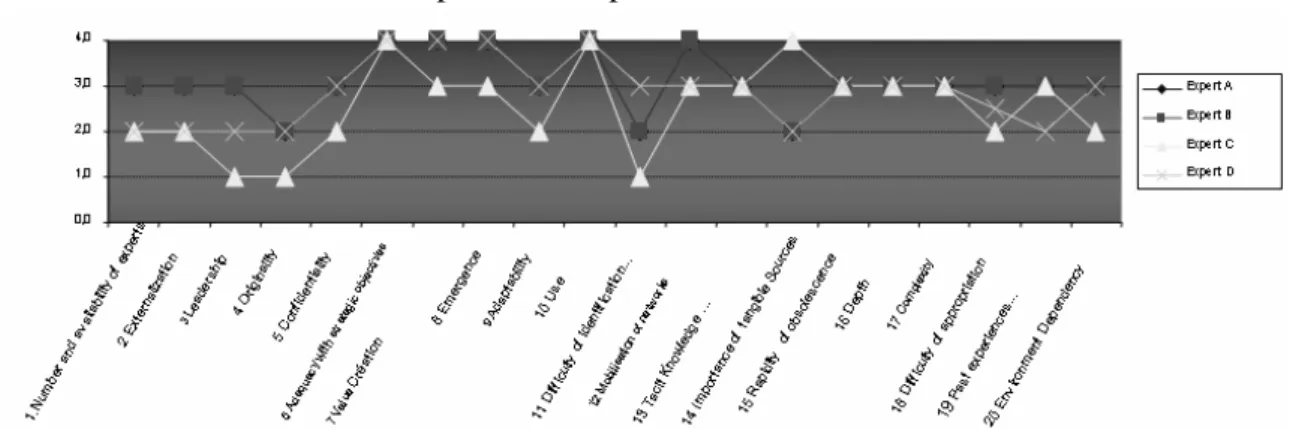
- Comparison curves (cf. Figure 6) which allow the visualization of gaps between experts while evaluating a same criterion; the goal is to locate criteria that need additional information before the interpretation step.
Figure 6 : Example of comparison curves generated by the Excel tool
- The whole radar diagrams (by criterion and by thematic axe, (cf. Figure 7) which are the visualization of each expert’s evaluation
- A final radar diagram which is a visual synthesis of the collective perception (all experts) about the knowledge domain criticality
0,0 1,0 2,0 3,0 4,0 1 Number and avalaibility of experts
2 Externalization 3 Leadership
4 Originality 5 Confidentiality
6 Adéquacy with strategic objectives 7 Value Creation 8 Emergence 9 Adaptability 10 Use 11 Difficulty to identify sources 12 Mobilization of networks 13 Tacit Knowledge 14 Importance of tangible sources 15 Rapidity of obsolescence 16 Depth 17 Complexity 18 Difficulty of appropriation 19 Past experiences 20 Environment dependency 0, 1, 2, 3, 4, Rarity Utility
Difficulty to capture Knowledge Nature of
The criticality of a knowledge domain with regards to a criterion (mcriterion) is obtained by
calculating the average of experts’ scorings.
ert ert criterion n m m exp exp
nexpert is the number of experts interviewed for the knowledge domain
The average criticality of a knowledge domain (M) is obtained by calculating the average of criticality values for each criterion:
i i i criterion i k m k M .ki is the coefficient corresponding to the criterion « i » used for the average calculation. This
coefficient is a weight given to the criterion according to its importance in the analysis.
Advantages and inconveniences of an automatic analysis are listed in the table below (cf. Table
2):
Advantages Inconveniences
- First global vision - Less effort : « economic» - A good basis for debates
Do not take into account divergences due, for example, to: - An interpretation of criteria different from an expert to
another
- The level of expertise of persons interviewed
- The position and the role of experts (Short/Long term vision, Technician/manager…)
Table 2 : Advantages and inconveniences of the automatic analysis “Polishing” step
“Polishing” consists in making interpretation of existing divergences between experts. In this step, analysts must:
- take into account the position, the role, the expertise level of the persons interviewed; - listen again the recorded interviews.
At the end of the “polishing” step, we obtain the final scorings and averages. A synthesis is written for each knowledge domain.
4.8. “Crossed” analysis
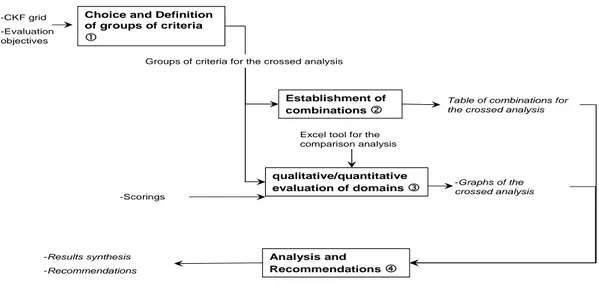
The “crossed” analysis is a strategic analysis of knowledge domains from combinations of groups of criteria. These combinations are defined with regards to the evaluation objectives. The goal is to highlight specificities concerning, for example:
- domains with great expertise - domains to be valorised - very vulnerable domains
Figure 8 : The crossed analysis methodology Choice and definition of groups of criteria
The first step consists in choosing the groups of criteria to cross. Each group of criteria must be defined with regards to its evaluation objective.
These are two examples of groups taken from the Hydro Quebec case study: groups of criteria Evaluation objective
Group 3 : nature of knowledge This group of criteria gives an idea of the complexity level of knowledge : o depth
o complexity
o difficulty of appropriation o tacit knowledge
Group 4 : Access This group evaluates the difficulty of access to knowledge from tangible and intangible sources:
o difficulty to identify sources o importance tangible sources o mobilization of networks
Table 3 : Examples of groups of criteria Establishment of pertinent combinations
The goal is, from the defined groups of criteria, to establish combinations that highlight specificities of knowledge domains.
Combinations Specificities
Combination : Nature (versus)
Access The goal is to identify knowledge domains that need to improve means for
training courses and/or knowledge transfer.
Table 4 : Example of combination Qualitative/quantitative evaluation
We use the Excel tool we developed: it generates a graph positioning the knowledge domains with regards to axes of the combination (cf. Figure 9).
Choice and Definition of groups of criteria Establishment of combinations qualitative/quantitative evaluation of domains Analysis and Recommendations -CKF grid -Evaluation objectives
Table of combinations for the crossed analysis
-Scorings
-Graphs of the
crossed analysis
-Results synthesis -Recommendations
Excel tool for the comparison analysis Groups of criteria for the crossed analysis
Figure 9: Graph for the qualitative/quantitative evaluation
Results synthesis and recommendations
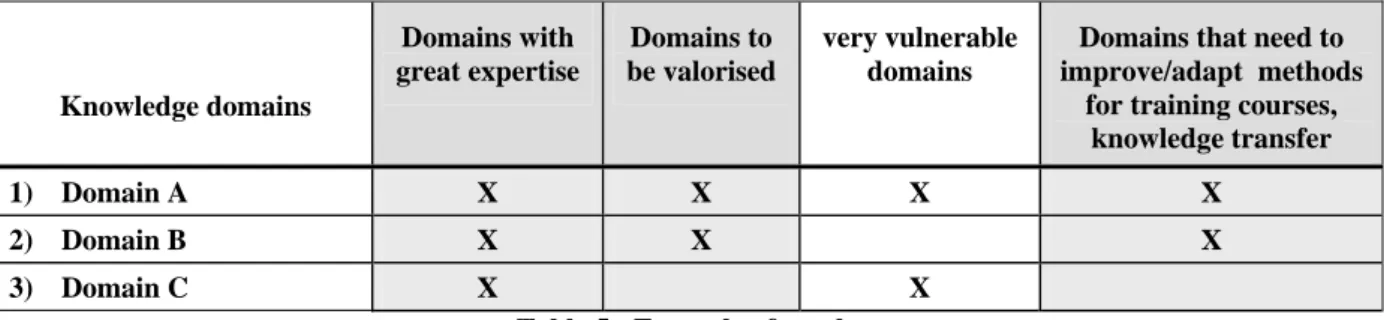
We list in a table, using the graphs of crossed analysis, knowledge domains concerned by specificities we want to highlight. This table is the basis for a more refined analysis and for recommendations. Knowledge domains Domains with great expertise Domains to be valorised very vulnerable domains
Domains that need to improve/adapt methods
for training courses, knowledge transfer
1) Domain A X X X X
2) Domain B X X X
3) Domain C X X
Table 5 : Example of results
5. Conclusion
Knowledge cartography is a new problematic. Its importance is increasing with the needs in Knowledge Management, especially in Knowledge Transfer between professional generations. There are few academic papers and experiments in this domain.
The M3C methodology and the tools, which have been exposed here, have shown their interest and their credibility. The Hydro Quebec case study has allowed to validate them. The basis is now ready for new developments in the cartography domain and in criticality studies.
The cartographic tool reveals itself to be interesting. More than the analysis of critical knowledge, it can be used as an access portal to the knowledge capital by pointing at the expert, the publications or the attached documents.
6. References
Aubertin G. , I. Boughzala, J-L. Ermine (2003) Cartographie des connaissances critiques Extraction des connaissances et apprentissage, Hermès.
Authier M. et Lévy P. (1992) Les arbres de connaissances, Editions la découverte.
Boughzala I. , J-L Ermine (2004) Management des connaissances en entreprise, Collection technique et scientifique des télécommunications, Hermes. 0,0 1,0 2,0 3,0 4,0 0,0 1,0 2,0 3,0 4,0 Nature Domain A Domain B Domain C Domain D Access
Club Gestion des Connaissances, J-L Ermine, H. Laude (2000) A Knowledge Maturity Model, Actes du Workshop “Knowledge Management; Theory and Practice” (J-L Ermine ed.), in PKDD’2000 (Principles of Knowledge Discovery from Data), 12 septembre 2000, Lyon, pp 13-18.
Davenport T. and Prusak L. (1998)Working knowledge: how organizations manage what they know, Harvard Business School Press.
Drucker P. (1993) Post-Capitalism Society, Oxford.
Ermine J.-L. (2002). La gestion des connaissances. Hermès sciences publications.
Godbout A. (1999) Cartographie des connaissances, la fondation de l’organisation des connaissances. Article de Godbout Martin Godbout et Associés.
Grundstein M. and Rosenthal-Sabroux C. (2003) A Way to Highlight Crucial Knowledge For Extended Company's employees. Annales du Lamsade Paris.
Nonaka I. and Takeuchi. (1995) The Knowledge Creating Company, Oxford University Press, 1995.
Pachulski A., Michel Grundstein, Camille Rosenthal-Sabroux (2000) GAMETH : A Methodology Aimed To Locate The
Company’s Crucial Knowledge. ECKM 2000, 26-27 octobre 2000, Bled (Slovénie).
Pomian J. et Roche C. (2002) Connaissance Capitale : Management des connaissances et organisation du travail, L’Harmattan. Saad I., Grundstein M., Rosenthal-Sabroux C. (2003) Locating The Company’s Crucial knowledge to Specify Corporate Memory
: A Case Study in Automotive Company, Workshop Knowledge Management and Organisational Memory, IJCAI’2003,
International Joint Conference on Artificial Intelligence, 9-16 aout, Acapulco.
Speel PH,. Shadbolt N., De Vries W., Van Dam PH, O’hara K. (1999) Knowledge Mapping for industrial purpose. Octobre 99, Banff, Canada. Conférence KAW99.
Tounkara T., Matta N., Ermine J-L. et Coppens C. (2002) L’appropriation des connaissances avec MASK, EGC’2002, Montpellier, 21-23 janvier.
Tseng B. and Huang C. (2005) "Capitalizing on Knowledge: A Novel Approach to Crucial Knowledge Determination," IEEE Transactions on Systems, Man, and Cybernetics Part A: Systems and Humans (to appear).
Tsuchiya S. (1993) Improving Knowledge Creation Ability through Organizational Learning, In Proceedings International Symposium on the Management of Industrial and Corporate Knowledge, UTC, Compiègne.
Jean-Louis Ermine obtains a Phd in pure mathematics at the University Denis Diderot of Paris in 1976, and a Research Director Title in computer science in 1990 at the University of Bordeaux. Since 2003, he works in the “Institut National des Télécommunications” as head of the Information Systems Department.
He is the inventor of the MASK method, a Knowledge Management methodology used in a lot of French and foreign companies since 1993. He has written more than 50 scientific articles and three books on Knowledge Management and Engineering. He worked in the French Atomic Energy Commission as a KM expert for more than 10 years. Since 2002, he is acts as a KM expert of the UN/IAEA (International Atomic Energy Agency). In 1999, he founded the French Knowledge Management Club, an association rallying a lot of French companies.