
Pépite | Contribution à la mise en place d’un processus automatique de création de vêtement et d’évaluation de son ajustement à partir d’une base de connaissance métier
153
0
0
Texte intégral
(2) Thèse de Kaixuan Liu, Lille 1, 2017. Study on knowledge-based garment design and fit evaluation system Abstract Fashion design and fit evaluation play a very important role in the clothing industry. Garment style and fit directly determine whether a customer buys the garment or not. In order to develop a fit garment, designers and pattern makers should adjust style and pattern many times until the satisfaction of their customers. Currently, the traditional fashion design and fit evaluation have three main shortcomings: 1) very time-consuming and low efficiency, 2) requiring experienced designers, and 3) not suitable for garment e-shopping. In my Ph.D. thesis, I propose three key technologies to improve the current design processes in the clothing industry. The first one is the Garment Flat and Pattern Associated design technology (GFPADT). Using this technology, users only input consumer’s body dimensions and garment style types. As a result, garment flats and patterns can be generated automatically and simultaneously. The second one is the 3D interactive garment pattern making technology (3DIGPMT). The proposed technology provides a “what you see is what you get” way to develop garment patterns. Using this technology, users can develop customized garments rapidly for a specific body shape without any pattern making knowledge. The last one is the Machine learning-based Garment Fit Evaluation technology (MLBGFET). The Bayes classifier, neural networks and decision trees are applied to construct fit evaluation models respectively. The inputs of the proposed models are the measuring values of digital clothing pressures at different key body positions generated from 3D garment CAD software while the output is the predicted result of garment fit level: very loose, loose, normal, tight, or very tight. To construct and train the proposed models, a number of data on digital clothing pressures and garment real fit level are collected and taken as input and output learning data respectively. By learning from these input/output data, the proposed models can predict garment fit rapidly and automatically without any real try-on. Therefore, it can be applied to remote garment fit evaluation in the context of e-shopping. Finally, I provide a number of knowledge-based garment design and fit evaluation solutions (processes) by combining the proposed three key technologies to deal with garment design and production issues of fashions companies. Keywords: parametric design; associated design; interactive design; construction design; pattern making; machine learning; decision trees; neural networks; Bayes classifier; garment fit prediction; digital clothing pressure. © 2017 Tous droits réservés.. lilliad.univ-lille.fr.
(3) Thèse de Kaixuan Liu, Lille 1, 2017. Contribution à la mise en place d’un processus automatique de création de vêtement et d’évaluation de son ajustement à partir d’une base de connaissance métier Résumé Le design et le bien aller d’un vêtement joue un rôle majeur pour l’industrie du textilehabillement. Les consommateurs sont en général attirés par un style ajustéet des couleurs très tendances. Ces critères sont essentiels car ils interviennent dans l’acte d’achat d’un vêtement. Afin de développer un produit ajusté à la morphologie du consommateur, designers et modélistes doivent modifier maintes et maintes fois son style et son patronage afin de satisfaire aux exigences de ce consommateur. Actuellement, il apparait trois inconvénients majeurs dans le processus de création et d’évaluation d’un vêtement : il est très coûteux en temps pour une efficacité moindre, il est subordonné à l’expérience des designers et modélistes, il n’est pas adapté au e-commerce. Afin de résoudre cette problématique, trois concepts à la fois technologiques et mathématiques ont étédéveloppées. Le premier s’appuie sur l’outil GFPADT (Garment Flat and Pattern Associated design technology) permettant de créer une correspondance entre le style du vêtement choisi et la morphologie du consommateur. L’objectif final est de générer automatiquement les différents patronages du vêtement à partir d’un style choisi tout en l’ajustant aux principales caractéristiques dimensionnelles du consommateur. L’efficacité de la création en 2D des patronages en fonction de la figure de style du designer est fortement accrue. Le second utilise l’interactivité entre deux espaces de conception 2D et 3D intégrée à l’outil 3DIGPMT (3D Interactive Garment Pattern Making Technology). Elle prend en compte le concept : “Ce que vous voyez, ce que vous obtenez”. Une première étape consiste à ajuster le vêtement directement en 3D sur un avatar représentatif du consommateur àpartir des caractéristiques principales du dessin de style avec une stratégie bien définie. La seconde étape utilise conjointement l’avatar et le vêtement en 3D afin de compléter le design de celuici avant sa mise àplat définitive. Cette stratégie de conception permet de développer rapidement un modèle de vêtement ajustépour des clients de différentes mensurations sans aucune connaissance du métier. Le dernier appelé MLBGFET (Machine learning-based Garment Fit Evaluation Technology) évalue l’ajustement du vêtement par un apprentissage automatique. Le classificateur de Bayes, le réseau de neurones et l'arbre de décision ont été respectivement appliqués afin de créer un modèle d'évaluation de l’ajustement. Les entrées du modèle sont les valeurs mesurées des composantes principales influençant l’ajustement du vêtement, telles que la pression numérique du vêtement pour différents zones. Les sorties sont les résultats de prédiction des conditions d’ajustement du vêtement, tels que sa validation par oui ou non. A. © 2017 Tous droits réservés.. lilliad.univ-lille.fr.
(4) Thèse de Kaixuan Liu, Lille 1, 2017. partir de cet apprentissage de données collectées, ce modèle peut prévoir rapidement et précisément si le vêtement s’ajuste sans le moindre essayage. Par conséquent, cet outil peut être appliquéàl'élaboration de vêtements, mais peut aussi être appliquée àla vente en ligne lors de l’évaluation de l’ajustement. Finalement, nous avons fourni des solutions de conception et d'évaluation de vêtements basées sur la connaissance en intégrant ces trois concepts basés sur des technologies clés pour résoudre certains problèmes de conception et de production de vêtements dans les entreprises de mode. Mots clés: conception paramétrique et associative, design interactif, dessin de style, modélisme, apprentissage automatique, arbre décisionnel, réseau de neurones, classifieur de Bayes, évaluation de l’ajustement du vêtement, pression vestimentaire.. © 2017 Tous droits réservés.. lilliad.univ-lille.fr.
(5) Thèse de Kaixuan Liu, Lille 1, 2017. 基于知识的服装设计与评估系统的研究及应用 摘要 服装设计与评估在服装行业起着至关重要的作用。一件服装的款式和合体性这 二个主要因素直接关系到客户是否购买该服装。为了开发一件合体的服装,设计师和 制板师需要多次调整服装的款式和纸样至到他们的客户满意为止。目前,这种传统的 服装设计与合体性评估有三个主要的缺点:1)非常耗时且效率低下 2)需要经验丰富 的设计师和制板师 3)服装的合体性需要制作出真实的服装并由真人试穿才能准确地评 估。 在该课题研究中,笔者提出三项关键的技术试图解决传统服装设计与评估所面 临的一些棘手的问题。第一项是服装款式和结构关联设计技术,在该技术的辅助下, 使用者只需要输入人体的主要尺寸参数和服装的款式参数,服装的款式图和此款式图 所对应的结构图会自动生成出来。该技术把传统属于分离状态的服装款式设计和结构 设计整合到一起,明显地提高了服装款式设计和结构设计的效率;第二项技术是 3D 交 互式服装纸样开发技术。该技术以一种“所见即所得”的方式开发服装的纸样。在该 技术的辅助下,使用者无需服装纸样开发的经验和知识就可以快速的为不同体型的客 户开发出合体性较好的服装纸样;第三项是基于机器学习的服装合体性评估技术。贝 叶斯分类器、决策树以及神经网络等机器学习算法分别应用于构建服装合体预测模型。 该模型的输入项是影响服装合体性的关键因素,如服装压力测量值;同时该模型的输 出项为服装合体性预测的结果,如松的、紧的、正常的等。通过从现有的服装压力测 量数据以及合体性评估数据中不断的学习,该合体性预测模型可以在不需要真实试穿 的情况下快速准确地预测服装的合体性。该技术可以很好地应用到服装产品的开发以 及服装网络销售。 最后通过整合服装款式和结构关联设计技术、3D 交互式的服装纸样开发技术以 及基于机器学习的服装合体性评估技术,本课题的研究为当前服装企业的设计、生产 以及销售所面临的一些棘手问题提供了基于知识的服装设计与评估系统的可行性解决 方案。 关键词:参数化设计;关联设计;交互设计;款式设计;结构设计;3D 服装设 计;制板;机器学习;决策树;神经网络;贝叶斯分类器;服装合体性评估;数字化 服装压力。. © 2017 Tous droits réservés.. lilliad.univ-lille.fr.
(6) Thèse de Kaixuan Liu, Lille 1, 2017. ACKNOWLEDGEMENT My Ph.D. study will be finished soon, along with the completion of my thesis. Despite the length and difficulty, I really enjoyed this process. I recall that at the start, I developed a huge amount of stress at the beginning of the Ph.D. study. A matrix of many factors; I quit my job, meanwhile my daughter was born, my wife’s health was a concern after giving birth, and my parents became older and older. Perhaps, our dreams became vague, along with our age. I almost, gave up on my dream pursuit because of the initial stress encountered. However, I am convinced that the only thing that kept me going was my dream. I got great exposure to the most cutting-edge research methods and techniques of my discipline during the Ph.D. study. With several efforts, I was able to finish my Ph.D. study. Firstly, I would like to thank my supervisor Prof. Xianyi Zeng of ENSAIT. Under Prof. Zeng’s guidance, my research sublimated from purely technological level to theoretical level. Prof. Zeng is a generous and kindly man. I have had and learned from many mistakes during my Ph.D. study; however, Prof. Zeng did not blame me for these mistakes. As a student, I greatly admire a senior scholar of his kind. At the same time, I also want to thank my other two supervisors Prof. Pascal Bruniaux and Associate Professor Xuyuan Tao of ENSAIT. The two supervisors also provided endless guidance and help for my Ph.D. research, such as experimental methods and thesis writing. I also want to thank Edwin Kamalha, a PhD student, who accorded me help in my English writing. I would like to appreciate Prof. Jianping Wang of Donghua University, Shanghai, China. Prof. Wang, amidst her heavy scientific research duties, she still found time to help with my Ph.D. research and writing my manuscripts. Prof. Wang not only cared about my studies but also looked after my life and family. From the patent application to Ph.D. thesis writing, from the first draft to finished draft, she reviewed repeatedly from article structure, overall layout, sentence format, etc. I would also like to thank China Scholarship Council (CSC); their fund gave me a chance to continue doing my research in France. After finishing my Ph.D. study, I will return to China to serve my motherland. Three years of study in France, I find myself deeply in love with this piece of land. I promise I will do my utmost to deepen the friendship between China and France. Lastly, I would like to thank my parents, wife, sister and daughter, their selfless support is my strong backup force. Especially, my wife, who stayed with me throughout my. © 2017 Tous droits réservés.. lilliad.univ-lille.fr.
(7) Thèse de Kaixuan Liu, Lille 1, 2017. Ph.D. study in France and took good care of me. Because of her, I completed my Ph.D. studies successfully. The completion of this thesis is the terminal point of my Ph.D. study; however, it is also a new starting point for my life. I will still hold fast to my dream in the future. “The body was not moved; however, the heart is already far. How far the dream is, how long the road is.” Kaixuan LIU January 20th, 2017. © 2017 Tous droits réservés.. lilliad.univ-lille.fr.
(8) Thèse de Kaixuan Liu, Lille 1, 2017 Contents. CONTENTS GENERAL INTRODUCTION ............................................................................................... 1 CHAPTER 1: STATE OF THE ART .................................................................................... 6 1.1 Traditional garment design processes............................................................................... 6 1.1.1 Fashion illustration drawing ...................................................................................... 6 1.1.2 Garment flat drawing ................................................................................................. 7 1.1.3 Garment pattern making and pattern grading ............................................................ 8 1.1.4 Production sheet making .......................................................................................... 10 1.1.5 Discussion ................................................................................................................ 11 1.2 3D garment design .......................................................................................................... 12 1.2.1 3D-to-2D .................................................................................................................. 12 1.2.2 2D-to-3D .................................................................................................................. 13 1.2.3 3D-to-3D .................................................................................................................. 15 1.2.4 Discussion ................................................................................................................ 15 1.3 Garment fit evaluation .................................................................................................... 16 1.3.1 Garment fit ............................................................................................................... 16 1.3.2 Garment fit evaluation by real try-on....................................................................... 17 1.3.3 Garment fit evaluation by virtual try-on .................................................................. 18 1.3.4 Discussion ................................................................................................................ 19 1.4 Knowledge-based fashion design and fit evaluation ...................................................... 20 1.5 Conclusion ...................................................................................................................... 21 CHAPTER 2: COMPUTATIONAL TOOLS FOR MODELING ..................................... 22 2.1 Linear regression ............................................................................................................ 22 2.1.1 Simple linear regression ........................................................................................... 22 2.1.2 Multiple linear regression ........................................................................................ 23 2.1.3 Discussion ................................................................................................................ 24 2.2 Bayes classifier ............................................................................................................... 25 2.2.1 Bayes theorem .......................................................................................................... 25 2.2.2 Naive Bayes classifiers ............................................................................................ 25 2.2.3 Discussion ................................................................................................................ 26 2.3 Decision Trees ................................................................................................................ 27 2.3.1 Decision tree ID 3 .................................................................................................... 27 2.3.2 Decision tree C4.5 .................................................................................................... 29. © 2017 Tous droits réservés.. lilliad.univ-lille.fr.
(9) Thèse de Kaixuan Liu, Lille 1, 2017 Contents. 2.3.3 Discussion ................................................................................................................ 31 2.4 Artificial Neural Networks ............................................................................................. 32 2.4.1 Basic principle ......................................................................................................... 32 2.4.2 Back Propagation Artificial Neural Networks ......................................................... 35 2.4.3 Discussion ................................................................................................................ 36 2.5 Conclusion ...................................................................................................................... 37 CHAPTER 3: GARMENT FLAT AND PATTERN ASSOCIATED DESIGN TECHNOLOGY ..................................................................................................................... 38 3.1 General scheme............................................................................................................... 38 3.2 Methodology................................................................................................................... 39 3.2.1 Relationship between garment flats, patterns and human body shapes ................... 39 3.2.2 Modeling the relationship between garment flats, patterns and human body shapes ........................................................................................................................................... 40 3.3 Example of application ................................................................................................... 43 3.3.1 Anthropometric data acquisition and processing ..................................................... 43 3.3.2 Jean flat and pattern associated design in the height direction ................................ 48 3.3.3 Jean flat and pattern associated design in the width direction ................................. 49 3.3.4 Jean style design ...................................................................................................... 51 3.3.5 Jean flat and pattern auto-generation system ........................................................... 56 3.3.6 Validation ................................................................................................................. 58 3.4 Discussion ....................................................................................................................... 59 3.5 Conclusion ...................................................................................................................... 60 CHAPTER 4: 3D INTERACTIVE GARMENT PATTERN MAKING TECHNOLOGY .................................................................................................................................................. 61 4.1 General scheme............................................................................................................... 61 4.2 Methodology................................................................................................................... 62 4.2.1 Ease allowance setting ............................................................................................. 62 4.2.2 3D garment modeling .............................................................................................. 63 4.2.3 3D garment adjustment ............................................................................................ 66 4.2.4 3D garment surface stretching and freezing ............................................................ 70 4.2.5 3D garment construction curves drawing ................................................................ 71 4.2.6 3D surface unfolding................................................................................................ 72 4.2.7 2D garment pattern adjustment (post-processing) ................................................... 73 4.3 Application ..................................................................................................................... 75 4.4 Discussion ....................................................................................................................... 76 4.5 Conclusion ...................................................................................................................... 77. © 2017 Tous droits réservés.. lilliad.univ-lille.fr.
(10) Thèse de Kaixuan Liu, Lille 1, 2017 Contents. CHAPTER 5: MACHINE LEARNING-BASED GARMENT FIT EVALUATION TECHNOLOGY ..................................................................................................................... 78 5.1 General principle and formalization ............................................................................... 78 5.1.1 General principle ...................................................................................................... 78 5.1.2 Formalization of the concepts and data ................................................................... 79 5.2 Learning data acquisition................................................................................................ 80 5.2.1 Preparation work for experiments ............................................................................ 80 5.2.2 Experiment I: Acquisition of the data on garment fit .............................................. 83 5.2.3 Experiment II: Acquisition of the data on digital clothing pressures ...................... 84 5.3 Modeling the relation between clothing pressures and garment fit level ....................... 86 5.3.1 Modeling with Naive Bayes..................................................................................... 86 5.3.2 Modeling with BP-ANN .......................................................................................... 88 5.3.3 Modeling with decision tree C4.5 ............................................................................ 90 5.4 Model validation ............................................................................................................. 91 5.5 Discussion ....................................................................................................................... 92 5.5.1 Influence of the difference between real and digital pressures on the prediction results ................................................................................................................................ 92 5.5.2 Application prospect ................................................................................................ 93 5.5.3 Limitation and future research ................................................................................. 94 5.6 Conclusion ...................................................................................................................... 94 CHAPTER 6: APPLICATIONS OF KNOWLEDGE-BASED GARMENT DESIGN AND FIT EVALUATION SYSTEM .................................................................................... 96 6.1 General scheme............................................................................................................... 96 6.2 Application 1: 2D garment products development for mass production ........................ 97 6.3 Application 2: 3D garment products development for made-to-measure ...................... 99 6.4 Application 3: 2D-3D-2D garment products development for mass customization .... 101 6.5 Application 4: Remote female jeans fit prediction for online shopping....................... 103 6.6 Conclusion .................................................................................................................... 104 GENERAL CONCLUSION AND PROSPECT ................................................................ 106 7.1 Research contributions ................................................................................................. 107 7.2 Innovations in design .................................................................................................... 108 7.3 Research prospect ......................................................................................................... 109 BIBLIOGRAPHY ................................................................................................................ 111 APPENDIX ........................................................................................................................... 125 Appendix 1: Anthropometric data (unit: 𝑐𝑚) ..................................................................... 125. © 2017 Tous droits réservés.. lilliad.univ-lille.fr.
(11) Thèse de Kaixuan Liu, Lille 1, 2017 Contents. Appendix 2: Measuring points of digital clothing pressure. .............................................. 129 Appendix 3: Garment fit levels and their corresponding digital clothing pressures (Unit: 𝐾𝑝𝑎): Part A ....................................................................................................................... 130 Appendix 4: Garment fit levels and their corresponding digital clothing pressures (Unit: 𝐾𝑝𝑎): Part B ....................................................................................................................... 133 Appendix 5: Published and submitted papers..................................................................... 136. © 2017 Tous droits réservés.. lilliad.univ-lille.fr.
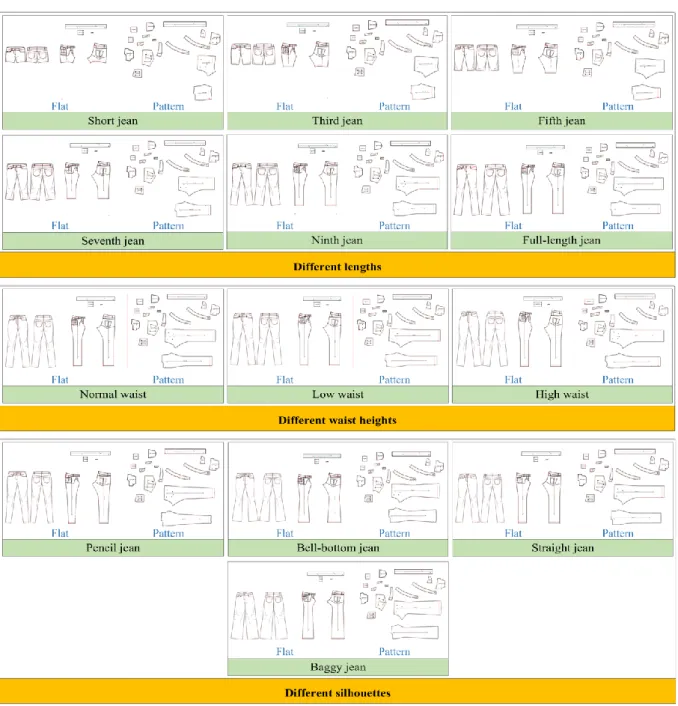
(12) Thèse de Kaixuan Liu, Lille 1, 2017 List of figures. LIST OF FIGURES Figure 0-1 Knowledge-based garment design and fit evaluation system. .................................. 2 Figure 1-1 Fashion illustrations.................................................................................................. 6 Figure 1-2 Garment flats. ........................................................................................................... 7 Figure 1-3 Garment patterns. ..................................................................................................... 8 Figure 1-4 Pattern grading from one initial pattern (standard size) to a number of sizes. ......... 9 Figure 1-5 Garment production sheet....................................................................................... 10 Figure 1-6 Relations between illustration and flat drawing, pattern making and grading, and production sheet making. ......................................................................................................... 11 Figure 1-7 3D-to-2D flattening. ............................................................................................... 12 Figure 1-8 2D-to-3D virtual try-on. ......................................................................................... 13 Figure 1-9 3D-to-3D fashion design. ....................................................................................... 15 Figure 1-10 Garment fit evaluation by real try-on. .................................................................. 17 Figure 1-11 Garment fit evaluation by virtual try-on. .............................................................. 18 Figure 1-12 Relations between fashion design, garment fit evaluation, garment sales. .......... 20 Figure 2-1 Naive Bayes classifiers. .......................................................................................... 25 Figure 2-2 One example of a decision tree. ............................................................................. 27 Figure 2-3 Biological neuron structure. ................................................................................... 32 Figure 2-4 Perceptron’s structure. ............................................................................................ 33 Figure 2-5 Activation functions. .............................................................................................. 33 Figure 2-6 BP network structure. ............................................................................................. 35 Figure 3-1 General scheme of GFPADT.................................................................................. 38 Figure 3-2 Relationship between flats, patterns and the human body shapes. ......................... 39 Figure 3-3 Legend of measurement dimensions. ..................................................................... 43 Figure 3-4 Relations between the basic jean flats, basic jean patterns and human body in the height direction. ........................................................................................................................ 48 Figure 3-5 Relations between the basic jean flats, patterns and human body in the width direction. ................................................................................................................................... 49 Figure 3-6 Jean style classification. ......................................................................................... 51 Figure 3-7 Jean silhouette design. ............................................................................................ 51 Figure 3-8 Jean waist design. ................................................................................................... 53 Figure 3-9 Jean length design................................................................................................... 54 Figure 3-10 Interactive interfaces of associated design system for jean flat and pattern 2016. .................................................................................................................................................. 56. © 2017 Tous droits réservés.. lilliad.univ-lille.fr.
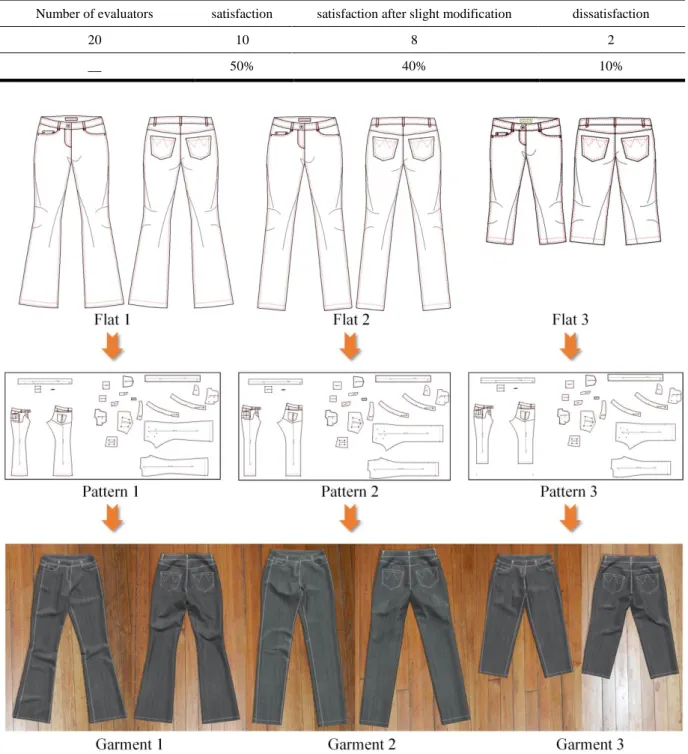
(13) Thèse de Kaixuan Liu, Lille 1, 2017 List of figures. Figure 3-11 Example of flats and patterns of different styles generated by ADSFP 2016. ..... 57 Figure 3-12 Flats and their corresponding patterns and garments. .......................................... 58 Figure 4-1 General scheme of 3DIGPMT. ............................................................................... 61 Figure 4-2 Ease allowance setting. ........................................................................................... 62 Figure 4-3 Pattern-based garment modeling [143]. ................................................................. 63 Figure 4-4 Sketch-based garment modeling [11]. .................................................................... 64 Figure 4-5 3D garment construction using 2D garment outline patterns. ................................ 65 Figure 4-6 Fit zones and design zones of fashion design. ........................................................ 66 Figure 4-7 3D garment adjustment approach. .......................................................................... 68 Figure 4-8 3D garment adjustment through 2D outline patterns. ............................................ 69 Figure 4-9 3D garment surfaces stretching and freezing. ........................................................ 70 Figure 4-10 3D construction curves drawing and 3D garment surfaces generation. ............... 71 Figure 4-11 3D-to-2D patterns unfolding. ............................................................................... 72 Figure 4-12 Pattern adjustment with different fabric elasticities. ............................................ 73 Figure 4-13 Garment pattern adjustment. ................................................................................ 74 Figure 4-14 Three application examples of 3DIGPMT. .......................................................... 75 Figure 5-1 General scheme of MLBGFET. ............................................................................. 78 Figure 5-2 Modeling the relation between digital clothing pressures and garment fit level 𝐹𝐿. .................................................................................................................................................. 79 Figure 5-3 Nine virtual bodies used for virtual try-on generated based on the nine subjects. . 81 Figure 5-4 The fabric used for pants making. .......................................................................... 81 Figure 5-5 The proposed five garment fit levels. ..................................................................... 82 Figure 5-6 Garment fit data collection by real try on (Output learning data). ......................... 83 Figure 5-7 Digital clothing pressure measurement by virtual try-on (Input learning data). .... 84 Figure 5-8 Modeling with Naive Bayes. .................................................................................. 86 Figure 5-9 Modeling with BP-ANN......................................................................................... 88 Figure 5-10 Decision tree generated by C4.5 algorithm for garment fit prediction................. 90 Figure 5-11 Legend of anthropometric measurement. ............................................................. 93 Figure 6-1 General scheme of the applications of knowledge-based garment design and fit evaluation system. .................................................................................................................... 96 Figure 6-2 Process 1: 2D garment products development for mass production. ..................... 97 Figure 6-3 Pants development using GFPADT and MLBGFET. ............................................ 98 Figure 6-4 Traditional pattern making and Process 1 for pants mass production. ................... 98 Figure 6-5 Process 2: 3D garment products development for made-to-measure. .................... 99 Figure 6-6 Pants development using 3DIGPMT and MLBGFET. ........................................ 100 Figure 6-7 Traditional pattern making and Process 2 for pants made-to-measure. ............... 101. © 2017 Tous droits réservés.. lilliad.univ-lille.fr.
(14) Thèse de Kaixuan Liu, Lille 1, 2017 List of figures. Figure 6-8 Process 3: 2D-3D-2D garment products development for mass customization. .. 101 Figure 6-9 Pants development using GFPADT, 3DIGPMT, and MLBGFET. ...................... 102 Figure 6-10 Traditional pattern making and Process 3 for pants mass customization. .......... 102 Figure 6-11 Process 4: Remote garment fit prediction for online shopping. ......................... 103 Figure 6-12 3D human model adjustment and virtual try-on. ................................................ 104 Figure 7- 1 General scheme of this thesis. ............................................................................. 106. © 2017 Tous droits réservés.. lilliad.univ-lille.fr.
(15) Thèse de Kaixuan Liu, Lille 1, 2017 List of tables. LIST OF TABLES Table 3-1 Anthropometric data (unit: 𝑐𝑚) ............................................................................... 44 Table 3-2 KMO and Bartlett test .............................................................................................. 45 Table 3-3 Rotated component matrix of anthropometric measurement ................................... 45 Table 3-4 Total variance explained .......................................................................................... 46 Table 3-5 Pearson correlation coefficients between 13 measuring items. ............................... 47 Table 3-6 Linear regression analysis and modeling ................................................................. 47 Table 3-7 Designer satisfaction survey on jean flats generated by ADSFP2016..................... 58 Table 5-1 Subjects and their corresponding 3D human body models’ body dimensions distribution (unit: cm)............................................................................................................... 80 Table 5-2 Waist girths, hip girths of 72 pairs of pants used in the experiments (unit: cm) .... 82 Table 5-3 Values of the fabric mechanical properties............................................................ 82 Table 5-4 Size distribution of 72 pairs of pants selected by the nine subjects ........................ 83 Table 5-5 Garment fitness data collected by real try-on (output learning data) ..................... 83 Table 5-6 Digital clothing pressures data collected by virtual try-on (input learning data) .... 85 Table 5-7 Comparison of prediction accuracy between the three models and traditional methods .................................................................................................................................... 91 Table 6-1 Comparison between the traditional method and Process 1 ................................... 99 Table 6-2 Comparison between the traditional method and Process 2 ................................. 101 Table 6-3 Comparison between the traditional method and Process 3 ................................. 103. © 2017 Tous droits réservés.. lilliad.univ-lille.fr.
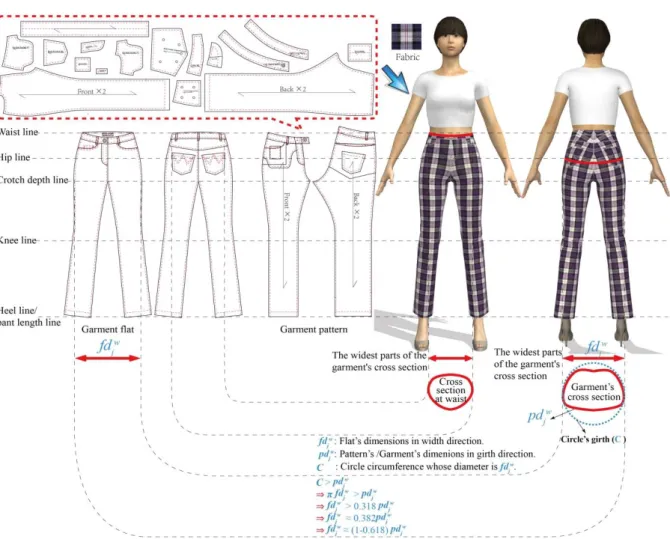
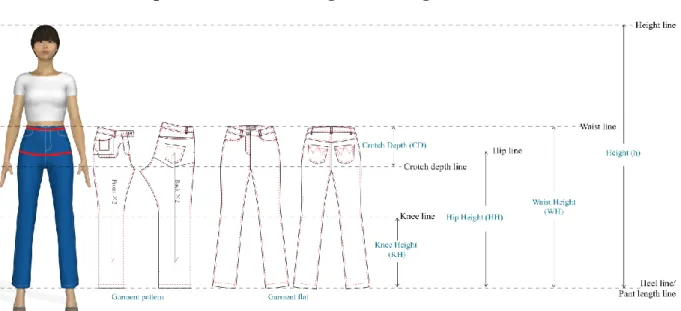
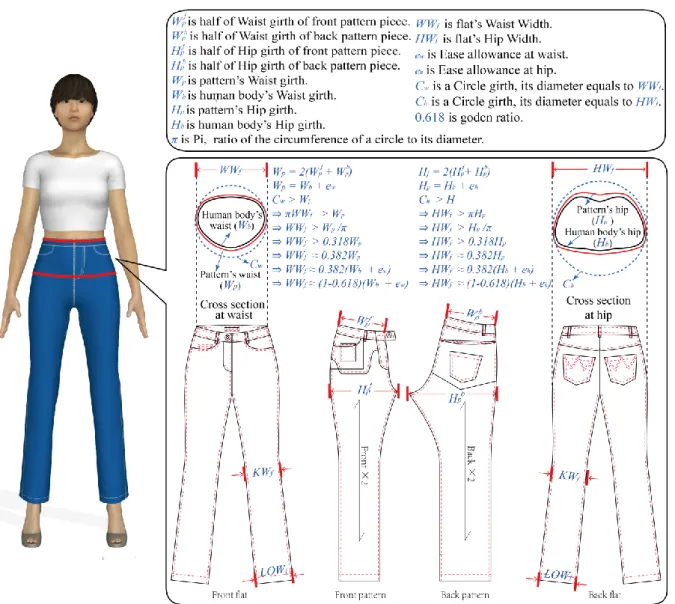
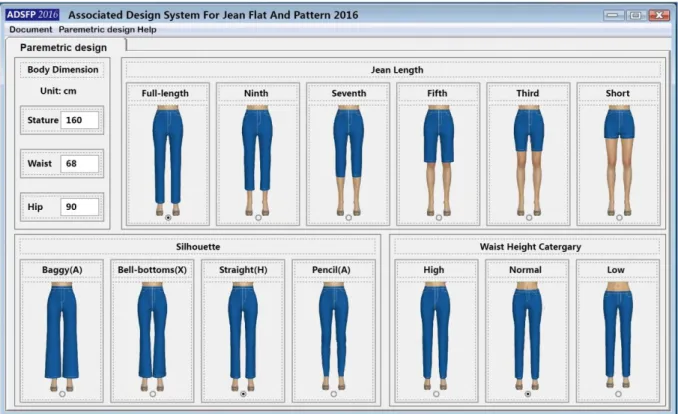
(16) Thèse de Kaixuan Liu, Lille 1, 2017 List of abbreviation. LIST OF ABBREVIATION 2D——two Dimensional 3D——three Dimensional 3DIGPMT——3D Interactive Garment Pattern Making Technology A——Abdomen circumference AH——Abdomen height BP-ANN ——Back Propagation Artificial Neural Networks CD——Crotch Depth CW——Crotch Width DWH——the Drop of Waist-to-Hip GFPADT——Garment Flat and Pattern Associated design Technology HH——Hip Height H——Hip circumference IL——Inside Length ID3——Iterative Dichotomiser 3 KH——Knee height K——Knee circumference MLBGFET——Machine learning-based Garment Fit Evaluation Technology h——Stature T——Thigh circumference WH——waist height W——Waist circumference. © 2017 Tous droits réservés.. lilliad.univ-lille.fr.
(17) Thèse de Kaixuan Liu, Lille 1, 2017 General introduction. GENERAL INTRODUCTION With the rapid economic development, the consumers’ demand for personalization is becoming stronger than before. The production models in clothing industry change from cottage industry type to mass production, then to mass customization in order to be adapted to the market changes and costumers’ requirements. Mass customization requires clothing enterprises producing customized garments rapidly according to different body shapes and individual requirements. However, the sophistication in consumers’ demands and fast fashion result in increased difficulties in clothing design. There are two ways to solve this issue in the clothing industry: 1) employing more designers; 2) changing current design methods or processes. Hiring more designers having rich experiences will increase the costs significantly. Obviously, changing current design methods or processes is an efficient way to overcome the difficulties in the modern clothing companies. The design department is one of the key departments in all fashion companies. Traditional fashion design and pattern making are strongly related to practical and empirical work. It takes several years and even more than ten years for a novice to master fashion design or pattern making skills. Therefore, the designers and pattern makers having rich experiences are scarce resources for a fashion company, and their demission will be a fatal strike for their company. To develop block patterns, fashion designers, pattern makers and technologists need repeated consultations and communications. After this stage, several testing specimens are carried out to evaluate whether the designed garment is fit or not. This process not only needs designers and pattern makers having concerned work experience for years but also is very time-consuming. Actually, the garment style and fit mainly depend on the skill level of designers and pattern makers. Therefore, how to develop garment products without experienced designers and pattern makers can be very useful for fashion companies. Thus, fashion companies can reduce their dependence on designers and pattern makers. In the background of globalization, the garment industry is still a typical low-tech, labor-intensive industry. Although the technologies of artificial intelligence such as machine learning, expert system have been widely used in a vast range of industrial fields for improving the quality of products, processes and management, they are rarely exploited in the field of fashion design and fit evaluation. This is mainly due to the uncertainties and imprecisions existing in the design knowledge, which is usually tacit and difficult to be -1© 2017 Tous droits réservés.. lilliad.univ-lille.fr.
(18) Thèse de Kaixuan Liu, Lille 1, 2017 General introduction. extracted and expressed. Actually, a number of researches have shown that the tacit design knowledge could also be extracted and expressed with mathematical modeling and simulation techniques. After modeling the designers’ knowledge, the novices can develop garment products rapidly and efficiently with the help of knowledge-based models in order to meet the complex market changes and the customers’ individual needs.. Figure 0-1 Knowledge-based garment design and fit evaluation system. In my Ph.D. research, I propose a knowledge-based garment design and fit evaluation system by integrating experts’ knowledge, experimental data and customers’ individual needs for supporting designer’s work. As shown in Figure 0-1, this system includes three new technologies: the Garment Flat and Pattern Associated design Technology (GFPADT), the three Dimensional Interactive Garment Pattern Making Technology (3DIGPMT) and the Machine learning-based Garment Fit Evaluation Technology (MLBGFET). GFPADT permits to use several key parameters, such as garment style and body dimensions, to generate garment flats and patterns rapidly. 3DIGPMT enables to use the way of “what you see is what you get” to develop garment patterns. Using this technology, users can develop customized garment products rapidly without any pattern making knowledge. MLBGFET permits to apply a number of artificial intelligent tools, such as neural networks and decision trees, to construct fit evaluation models. After learning from the experimental data on real and virtual try-on, the proposed models can predict garment fit level automatically without any real try-2© 2017 Tous droits réservés.. lilliad.univ-lille.fr.
(19) Thèse de Kaixuan Liu, Lille 1, 2017 General introduction. on. Finally, the three proposed technologies (GFPADT, 3DIGPMT and MLBGFET) are integrated into a knowledge-based garment design and fit evaluation system to help designers to develop and evaluate garment products. Compared with traditional fashion design and evaluation methods, the proposed knowledge-based garment design and fit evaluation system has the advantages of rapidity and simplicity. Also, users do not require specialized fashion design knowledge when making operations on this system. The aim of my Ph.D. research is to address a series of key issues encountered in the fashion design and provide several more efficient and more reasonable solutions for fashion companies. In practical applications, the proposed technologies have already brought economic benefits in a clothing enterprise in China. The overall layout of the thesis is organized as follows: CHAPTER 1: State of the art I expound the basic concepts of fashion illustration drawing, garment flat drawing, garment pattern making, 3D garment design, garment fit evaluation, etc. Then I present recent research progress in these fields in detail and analyze the disadvantages of the current fashion design and fit evaluation methods and processes. Finally, I raise the research purposes, significances and methods on the development of a knowledge-based garment design and fit evaluation system. CHAPTER 2: Computational tools for modeling For formalizing and modeling fashion designers’ knowledge, I propose a systematic approach combining the use of linear regression, Bayes classifiers, decision trees and artificial neural networks. Therefore, in this chapter, I first introduce the theoretical basis of the computational tools that are concerned in our approach. Then, the merits and faults of these computational tools are expounded. Finally, I construct different knowledge models according to the characteristics of different computational tools. For example, linear regressions are applied to model the relations between key design parameters, garment flats and patterns, while Bayes classifiers, decision trees and artificial neural networks are used to model the relation between digital clothing pressures and garment fit level. CHAPTER 3: Garment flat and pattern associated design technology Flat drawing and pattern making are two main parts of fashion design. Currently, flat drawing and pattern making belong to different departments in fashion companies. This phenomenon results in high cost and low efficiency in the garment products development. In this chapter, I proposed GFPADT to combine garment flat drawing and pattern making together. By extracting and analyzing experts’ knowledge and data, garment flats and patterns -3© 2017 Tous droits réservés.. lilliad.univ-lille.fr.
(20) Thèse de Kaixuan Liu, Lille 1, 2017 General introduction. are represented by several common parameters. After this stage, linear regression is applied to model the relation between garment flats, garment patterns and the parameters. Based on the theory of GFPADT, I have developed a software application named “Associated design system for jean Flat and Pattern 2016” (ADSFP 2016) to generate jeans’ flats and patterns. With the help of ADSFP 2016, garment flats and the corresponding patterns can be generated simultaneously and automatically. CHAPTER 4: 3D Interactive garment pattern making technology Garment pattern making is a highly technical work in fashion companies. In this chapter, I proposed 3DIGPMT to develop garment pattern with the way of “what you see is what you get”. For realizing the proposed method, the two Dimensional (2D)-to-three Dimensional (3D) virtual try-on technology is used to model 3D garment surfaces. After this stage, 3D-to-3D fashion design technology is used to adjust 3D garment to meet design requirements. Finally, the 3D-to-2D flattening technology is applied to unfold 3D garment’s surface into 2D garment patterns. Through human-computer interactions, the complexity of garment patterns making can be largely reduced. With the help of 3DIGPMT, users can develop customized garments for different body shapes without any professional skills. CHAPTER 5: Machine learning-based garment fit evaluation technology The fit of a garment has always been a key factor in determining whether a customer buys it. Therefore, how to evaluate garment fit is not only very important for designers, but also for consumers and retailers. In this chapter, I propose a machine learning-based method to evaluate garment fit. First, a Naive Bayes classifier, a decision tree C4.5 and a Backpropagation Artificial Neural Network (BP-ANN) are used for constructing fit evaluation models respectively. Then, the constructed models learn from the data of digital clothing pressures and garment fit level collected by virtual and real try-on. Finally, the trained models predict garment fit by inputting the corresponding digital clothing pressures. Compared with traditional garment fit evaluation methods, MLBGFET can predict garment fit rapidly and automatically without any real try-on. This technology can be well applied to made-tomeasure, mass customization, garment e-shopping, etc. CHAPTER 6: Applications of knowledge-based garment design and fit evaluation system Based on GFPADT, 3DIGPMT and MLBGFET developed in Chapter 3, Chapter 4 and Chapter 5, I proposed four applications (processes) for developing and evaluating garment products in the areas of mass production, made-to-measure, mass customization and online shopping. The first process aims at developing garment flats and patterns automatically -4© 2017 Tous droits réservés.. lilliad.univ-lille.fr.
(21) Thèse de Kaixuan Liu, Lille 1, 2017 General introduction. and simultaneously for mass production. The second one enables to make personalized garment patterns and evaluate their fit for made-to-measure. The third one permits to develop garment patterns rapidly for mass customization by combining the previous three technologies. The last one permits to evaluate garment fit rapidly and automatically without real try-on for garment e-shopping. As the garment experts’ professional knowledge has been modeled and successfully integrated into the proposed system, the users do not need to master any knowledge and experience in fashion design, pattern making and fit evaluation.. -5© 2017 Tous droits réservés.. lilliad.univ-lille.fr.
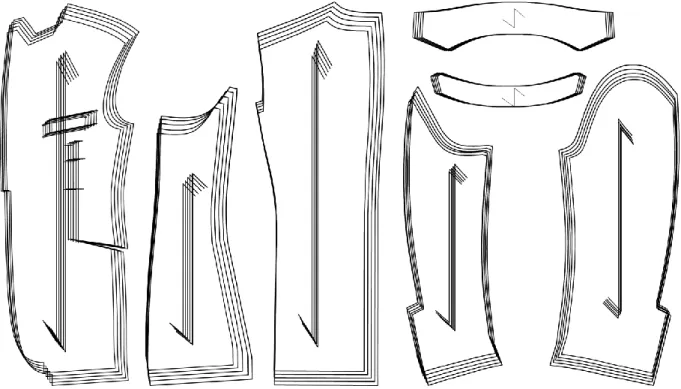
(22) Thèse de Kaixuan Liu, Lille 1, 2017 Chapter 1. State of the art. CHAPTER 1: STATE OF THE ART In this chapter, I state traditional methods of garment design and fit evaluation. By analyzing the current methods of fashion illustration drawing, garment flat drawing, pattern making, 3D garment design and fit evaluation, I clearly indicate the main drawbacks existing in the current design processes and provide a number of orientations to improve these processes.. 1.1 Traditional garment design processes Fashion design mainly includes three key parts: style design, construction design and process design. The main work of style design is fashion illustration drawing and garment flat drawing [1], the main work of construction design is pattern making [2], and the main work of process design is process sheet making. Fashion designers draw garment flats according to fashion illustration; pattern makers make garment patterns according to garment flats [3]; and technologists make production process sheets based on the garment flats and patterns. The three basic designs complement each other. 1.1.1 Fashion illustration drawing. Figure 1-1 Fashion illustrations. Fashion illustration, also called effect drawing, fashion drawing, is the transmission of fashion through a diagram. Fashion illustration has been used for nearly 500 years. Ever since clothes have been in existence, and there has been a need to translate an idea or image into a fashion illustration. Not only do fashion illustrations show a representation or design of a -6© 2017 Tous droits réservés.. lilliad.univ-lille.fr.
(23) Thèse de Kaixuan Liu, Lille 1, 2017 Chapter 1. State of the art. garment but they also serve as a form of art. Fashion illustration shows the presence of hand and is said to be a visual luxury [4-5]. In fashion companies, fashion illustration is a visual aid through which a design can be explained and communicated between concerned professional experts (designers and pattern makers). Fashion illustration drawing requires designers using the numerous materials like pencil, pen, ink, charcoal, watercolor, polaroid film, etc. All these materials are used to make the illustration sharper and next to real to make sure that convey the style in its best sense. Since fashion illustration is used to convey designs, the designers who prepare fashion illustrations should keep in mind that they should use colors and details that highlight the edges of the clothes to make it more attractive. There has to be a good balance between the colors and the sketching to achieve the masterpiece [6]. Fashion illustration drawing requires professional knowledge on fashion design such as aesthetics, ergonomics and painting. Because of this, fashion illustration is something that requires expert hands without which the illustration could not be presented in its best form. For an illustration to speak in words, it is very important to draw in such a way in which each angle of the illustration should express designers’ design concept. In order to emphasize some garment parts, designers usually use a number of exaggerations to draw fashion illustration on these parts. As shown in Figure 1-1, these fashion illustrations show designers’ concept using exaggeration. Instead, a garment flat should reflect real garment details as much as possible. This is one of the main differences between fashion illustration and garment flat drawing. 1.1.2 Garment flat drawing. Figure 1-2 Garment flats. Garment flat also called flat sketches, flat drawing, technical flat, or just “flat” in the fashion industry, is a black and white fashion technical drawing that shows a garment as if it was laid flat to display all seams, topstitching, hardware, and any other design details (Figure 1-2). Flats are used to concretely express designers’ ideas and garment details to related-7© 2017 Tous droits réservés.. lilliad.univ-lille.fr.
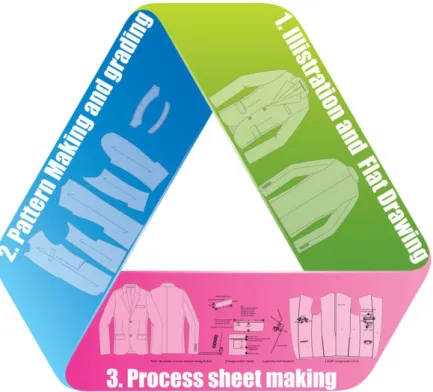
(24) Thèse de Kaixuan Liu, Lille 1, 2017 Chapter 1. State of the art. departments [7]. Generally, garment flats are applied to many places, for example, patternmaking documentation, technology packs, specifications, cost sheets, 3D virtual garment modeling [8, 7, 9-14]. In order to avoid misunderstanding in sampling and production, garment flats are drawn in detail [10, 13]. Actually, garment flats focus on the tangible apparel or the actual garment which is to be produced [12]. It is always about the actual garment, rather than a general idea of a garment. Like fashion illustration drawing, flat drawing also needs professional knowledge on fashion design. It is difficult for people without related skills to draw garment flats. Currently, there are two methods to draw garment flats. One is drawing by hand, which is called “manually drafted”; the other is the use of special design software, like Adobe Illustrator, CorelDraw, Kaledo style, that is called “computer-aided drafting”. Both of flat drawing methods require a superior drawing skills [15]. For avoiding distraction, flat drawing does not require much movement or shading. A neatly detailed garment flat simply means how well in detail you can illustrate your design requirements to related production departments [8]. Generally, the garment flat is drawn on white paper using black lines [8, 14], because black lines are easier for people to follow visual guidelines and provide a clearer representation of designers’ ideas. However, usually, there are still some misunderstandings of styles’ details between designers and pattern makers, no matter how accurate the garment flats are. 1.1.3 Garment pattern making and pattern grading. Figure 1-3 Garment patterns. -8© 2017 Tous droits réservés.. lilliad.univ-lille.fr.
(25) Thèse de Kaixuan Liu, Lille 1, 2017 Chapter 1. State of the art. In sewing and fashion design, garment patterns are templates from which the parts of a garment are traced onto fabric before being cut out and assembled (Figure 1-3). Patterns are usually made of paper and are sometimes made of sturdier materials like paperboard or cardboard if they need to be more robust to withstand repeated use. The process of making or cutting patterns is sometimes condensed to the one-word patternmaking but it can also be written pattern making, pattern cutting, construction design, pattern cutting, etc. Traditional pattern making process refers that pattern makers draw garment construction lines on a brown paper according to the garment flat provided by designers. After this, they cut the paper along the construction lines to acquire many paper pieces used for cloth cutting. The work of pattern making likes a bridge between fashion design and clothing making [16]. Pattern making, relying heavily on pattern makers’ experience obtained by many years related work, is considered as one of the highest technical works in the clothing companies. Currently, there are mainly two methods to make garment pattern: the traditional hands-on approach and the computer-aided process, both requiring sophisticated skills. A novice needs to take several years to be proficient in this technique. It results in that the current methods of pattern making are not easy to spread [17].. Figure 1-4 Pattern grading from one initial pattern (standard size) to a number of sizes. Pattern grading is the extension of pattern making. As pattern making is very timeconsuming, in order to save time and keep the ready-made patterns’ shapes, the ready-made patterns are enlarged or shrunk to fit different body size and shapes (Figure 1-4). This process. -9© 2017 Tous droits réservés.. lilliad.univ-lille.fr.
(26) Thèse de Kaixuan Liu, Lille 1, 2017 Chapter 1. State of the art. is called pattern grading. Pattern grading enables to proportionally increase and decrease pattern sizes according to specific instructions. It is an essential part of pattern making for the ready-to-wear garment production. Generally, pattern grading adjusts for people of different ages and genders. The fabric type also influences the pattern grading rules [18]. The cost of pattern grading is incomplete without considering marker making [19]. 1.1.4 Production sheet making. Figure 1-5 Garment production sheet. During garment making process, workers need a file to guide how to sew. That is the point of production sheet making. Production sheet provides detailed instructions about every aspect of a garment’s design and construction, like fabrics, trim, artwork or graphics, label information, packaging instruction, and even tiny-but-mega-important details like desired stitching should all be included in the production sheet to reduce the chances of misunderstandings (or shortcuts by the factory) (Figure 1-5). The production sheet tells the producer (factory) all the information that is needed to successfully transform your design into a product that is exactly how designers envisioned it. An excellent production sheet will reduce errors in production, reduce issues with communication, and ultimately can save fashion companies tons of money and frustration [20]. -10© 2017 Tous droits réservés.. lilliad.univ-lille.fr.
(27) Thèse de Kaixuan Liu, Lille 1, 2017 Chapter 1. State of the art. 1.1.5 Discussion. Figure 1-6 Relations between illustration and flat drawing, pattern making and grading, and production sheet making. Fashion designers draw fashion illustrations and garment flats to express their design concepts concretely, and pattern makers make patterns according to customers’ body dimensions and garment flats drawn by designers [21]. As garment flat drawing and pattern making affiliate with different departments in fashion companies, fashion designers and pattern makers should communicate repeatedly to modify garment flats and their corresponding patterns until they are satisfied. This process is time-consuming and inefficiency. Thus, some scholars proposed several new technologies to develop garment flat or pattern rapidly, such as, 3D-to-2D flattening technology [22-36], 2D-to-3D virtual try-on and modeling technology [37, 32-33], 3D-to-3D garment editing [38], parametric pattern making technology [39-40], rapid garment flat generation technology [7, 3]. However, none of the previous research studies involved how to combine the work of flat drawing and pattern making together. As shown in Figure 1-6, illustration and flat drawing, pattern making and grading, and production sheet making are all interrelated. This makes up the whole garment design and production. Generally, fashion illustration drawing and garment flat drawing belong to artistic design; however, pattern making and production sheet making are affiliated with engineering design. This leads to different approaches between garment flat drawing and pattern making. -11© 2017 Tous droits réservés.. lilliad.univ-lille.fr.
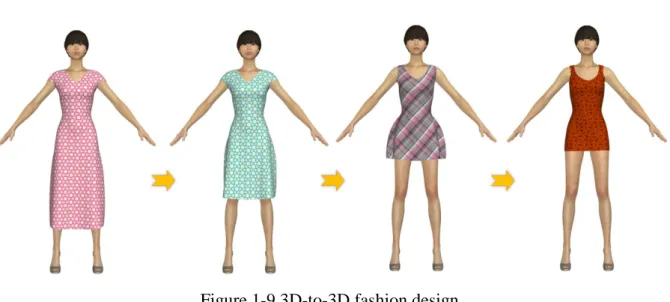
(28) Thèse de Kaixuan Liu, Lille 1, 2017 Chapter 1. State of the art. Most of style designers cannot make garment patterns; likewise, most of pattern makers are unable to draw garment flats. The gulf between garment flat drawing and pattern making results in that the two design processes belong to two completely separate departments in most of fashion companies. In this case, garment enterprises need to hire more manpower and to spend more money into these two departments. Moreover, the communication between these two departments can also lead to lower efficiency of the garment products development. If flat drawing and pattern making can be integrated together, the fashion design efficiency will be improved significantly. Therefore, I integrate garment flat drawing and pattern making together in this Ph.D. thesis. The corresponding work, i.e. Garment Flat and Pattern Associated design Technology (GFPADT) has been presented in Chapter 3.. 1.2 3D garment design 1.2.1 3D-to-2D. Figure 1-7 3D-to-2D flattening. In order to solve garment-fitting issues and reduce the complexity of the problem to an acceptable level, various three-dimensional (3D) to two-dimensional (2D) flattening methods have been proposed and developed to obtain garment patterns. Figure 1-7 shows a classical 3D pattern making approach. Firstly, a number of construction lines are drawn on the 3D garment’s surface (Figure 1-7(a)). Then a number of 3D surfaces are generated according to these lines (Figure 1-7(b)). Next, these 3D surfaces are flattened into 2D patterns after a meshing process of these different surfaces (Figure 1-7(c)). Finally, the unfolded patterns are modified slightly to meet the requirements of industrial production (Figure 1-7(d)). Due to a good application prospect of 3D-to-2D flattening technology, many scholars used this technology to develop garment pattern. Hinds et al. proposed a 3D mathematical model based on the gaussian curvature to unfold 3D surfaces into 2D patterns for garment pattern development in their research [22]. While Kang and Kim constructed a fitting 3D. -12© 2017 Tous droits réservés.. lilliad.univ-lille.fr.
(29) Thèse de Kaixuan Liu, Lille 1, 2017 Chapter 1. State of the art. garment for a special mannequin then unfolded the 3D garment to acquire its 2D patterns [17]. Jeong et al. used triangular meshes to construct a 3D garment surface and pieced these triangular meshes together in a 2D plane to obtain tight-fitting clothing pattern [24, 28]. Au et al divided the surface of a 3D virtual dummy into many areas according to the human body’s characteristic line and transformed the 3D surface of the prototype garment to a 2D cutting pattern [41, 27]. Daanen and Hong used a 3D body scanner to collect the point cloud of waistto-hip part; then the points in the 3D scan were converted to triangles and these triangles were thereafter merged with neighboring triangles of similar orientation until about 40 triangles remained; these triangles were sewn together to form a “patchwork”-skirt finally [42]. Choi and Nam studied the pattern unfolding issues of different upper lateral body types [25]. Jin et al. modeled a 3D garment with constrained contour curves and style curves. They then flattened the 3D garment’s surface based on these curves [26]. Bruniaux et al. constructed 3D garment construction curves around a 3D mannequin and generated 3D surfaces based on these curves. Next, they obtained garment patterns by flattening the obtained 3D surfaces [3033, 43]. Zhang et al. proposed a method to model the 3D upper garment with ease allowance for pattern making [34]. Yan et al. drew 3D garment construction curves on a 3D model of a disable female; then using these construction curves to simulate a 3D garment; the garment patterns were obtained by flattening the 3D garment finally [36]. However, there are four shortcomings existing in the aforementioned research studies: 1) the proposed methods are too complex to be realistically implemented in production processes; 2) they are limited to simple styles and can hardly be applied to complicated styles; 3) they are restricted to tight garments and involve little ease allowance; 4) they did not consider all factors affecting the appearance of a garment such as fabric mechanical properties in a virtual environment. 1.2.2 2D-to-3D. Figure 1-8 2D-to-3D virtual try-on. -13© 2017 Tous droits réservés.. lilliad.univ-lille.fr.
(30) Thèse de Kaixuan Liu, Lille 1, 2017 Chapter 1. State of the art. Virtual try-on technology was developed to evaluate garment fit [44-45], model 3D garment for animation, etc. This technology has been widely applied in the clothing and animation industry in the last ten years. Figure 1-8 shows a classical virtual try-on process. Fist, pattern maker makes a set of patterns using traditional methods (Figure 1-8a). Then these patterns are input into a virtual try-on software programme. Next, the patterns are arranged around an avatar (Figure 1-8b). These patterns are sewn together finally (Figure 1-8c). Currently, a number of commercial virtual try-on software, such as 𝐶𝑙𝑜 3𝐷 , 𝐿𝑒𝑐𝑡𝑟𝑎 3𝐷 𝑃𝑟𝑜𝑡𝑜𝑡𝑦𝑝𝑒, 𝑂𝑝𝑡𝑖𝑇𝑒𝑥, 𝑉 − 𝑆𝑡𝑖𝑡𝑐ℎ𝑒𝑟 3𝐷, are available on the market for fashion design and evaluation [46]. These 3D virtual try-on software systems follow the similar principles, i.e. showing virtual garment static and dynamical performance from identified human morphological and fabric properties and their interactions using complex mechanical and geometric modeling and simulation techniques [47]. They normally include four main modules: 1) a 3D parametric mannequin module, 2) a fabric properties module, 3) a virtual pattern-sewing module, and 4) a draping module [48-49, 46]. In order to model human body rapidly, the function of the 3D parametric mannequin module is to construct a personalized 3D human model from measures of a 3D body scanner or a measuring tape, related to a specific customer [50-51]. Several key body dimensions, such as height, waist circumference, hip circumference, control the parametric mannequin’s dimensions. By adjusting the key body dimensions, the 3D parametric mannequin module can create various body shapes and dimensions rapidly and automatically, in order to meet customers’ body shapes and dimensions. Then, the fabric properties module, usually based on a mechanical model, will permit to simulate different perceived properties (draping, texture, elasticity, bending, etc.) of a virtual fabric by adjustable fabric technical parameters according to the nature of the corresponding real fabric. After this, the virtual pattern-sewing module assembles the predefined garment patterns on the specific 3D human body and sews the patterns together by taking into account the performances of the simulated fabric. Finally, the draping module simulates gravity, wind, draping, etc. The combination of these four modules constitutes a virtual try-on system, permitting to simulate the process of real garment making. In a virtual 3D try-on process, consumers and designers can visualize the static and dynamic performances of the selected fabrics and garment fit effects in terms of comfort, expressed by simulated pressures between the human body and fabrics, and fashion styles [52].. -14© 2017 Tous droits réservés.. lilliad.univ-lille.fr.
(31) Thèse de Kaixuan Liu, Lille 1, 2017 Chapter 1. State of the art. 1.2.3 3D-to-3D. Figure 1-9 3D-to-3D fashion design. In order to model a 3D garment rapidly, a new method of 3D-to-3D fashion design enables to modify the prototype directly in order to obtain the expected styles. As shown in Figure 1-9, a long dress is transformed into other dresses through adjusting the length, collar, sleeve and so on. Currently, there are mainly two methods to realize 3D-to-3D fashion design: the first method: through a series of modifications of the 2D garment patterns, the 3D garment changes correspondingly [53-54]; the second method: through modifications of the surfaces on the 3D garment, I can obtain the expected style directly [55]. Like a procedure of sculpture, the second method requires operators to master experienced skills and the process of surface modification is complex and time-consuming. Instead, the first method is highly efficient and easy to operate. However, this method requires accurate 2D garment patterns and other technical parameters firstly. 1.2.4 Discussion With the development of 3D technology, the 3D fashion design will have the trend to replace the traditional fashion design methods in the future [56]. However, due to some technical restriction, the traditional fashion design and 3D fashion design will coexist for a very long time. Currently, designers should use both approaches in a complementary way to develop new garment products [56]. The 2D-to-3D virtual try-on technology can help designers to check whether the garment style is feasible [44]; the 3D-to-2D flattening technology can help pattern maker to develop garment patterns [57-58, 36]; and the 3D-to-3D fashion design can help designers to design 3D garments [55]. However, neither the 2D-to-3D virtual try-on technology nor 3D-to-3D garment transformation approach nor 3D-to-2D. -15© 2017 Tous droits réservés.. lilliad.univ-lille.fr.
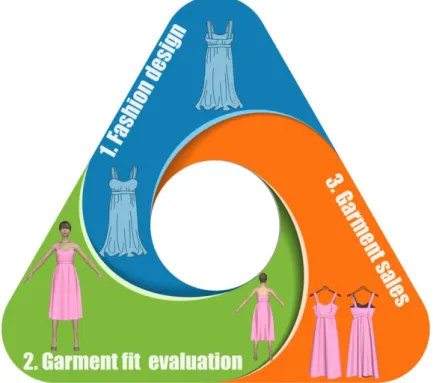
(32) Thèse de Kaixuan Liu, Lille 1, 2017 Chapter 1. State of the art. flattening technology can work alone effectively. Therefore, I wish to integrate the above three technologies together in my Ph.D. thesis. In this context, 3D Interactive Pattern Making Technology (3DIPMT) is proposed in Chapter 4.. 1.3 Garment fit evaluation 1.3.1 Garment fit The issue of garment fit always runs through the entire garment design, production and sale processes. In fashion design process, designers and pattern makers need to evaluate garment fit for garment products optimization. In garment retail field, the major issue that concerns the customers is garment fit [59-62]. No matter how beautiful garments are, how excellent fabrics are, customers still do not purchase the garments if they are unfit [63]. Currently, more and more people buy garments online [64]; however, the bottleneck, how to evaluate garment fit, hampers the development of clothing e-business [65]. Researches showed that more than 50% customers are dissatisfaction with garment fit [66-68]. High perdition accuracy of garment fit evaluation can decrease the return and exchange ratio significantly. In physical stores, the customers can try on garments to check whether the selected garments are fit or not. Unlike the physical stores, garments bought online cannot be tried on [69-70]; thus, customers or sellers only evaluate garment fit roughly according to the previous experience. The experience-based evaluation results are neither accurate nor scientific. Therefore, how to predict garment fit without real try-on is one of the main problems that must be solved for the clothing industry. There are many factors influencing garment fit; nevertheless, what is fit? Up to now, this concept has not been defined exactly. Cain pointed out ‘Fit is directly related to the anatomy of the human body and most of the fitting problems are created by the bulges of the human body’ [71]. H and E considered that ‘clothing that fits well, conforms to the human body and has adequate ease of movement, has no wrinkles and has been cut and manipulated in such a way that it appears to be part of the wearer.’ [72]. Shen and Huck believed that ‘clothing which fits, provides a neat and smooth appearance and will allow maximum comfort and mobility for the wearer.’ [73]. By summarizing the above fit definitions, I believe that clothing fit mainly includes two aspects: aesthetic fit and comfort fit. The comfort fit is mainly related to fabric materials and manufacturing processes, while the aesthetic fit is mainly determined by fashion styles. Meanwhile, the other design factors such as garment patterns and body dimensions influence both aesthetic fit and comfort fit. Due to the. -16© 2017 Tous droits réservés.. lilliad.univ-lille.fr.
(33) Thèse de Kaixuan Liu, Lille 1, 2017 Chapter 1. State of the art. limitation of time and energy, I only study the evaluation of the garment comfort fit caused by garment size, patterns and materials. The aesthetic fit is not considered here. 1.3.2 Garment fit evaluation by real try-on. Figure 1-10 Garment fit evaluation by real try-on. Traditional garment fit evaluation deals with both real and virtual try-on. In the aspect of real try-on, there are two frequently used methods for evaluating garment fit. One approach is the garment try-on with a physical mannequin (Figure 1-10(a)), in which a designer evaluates whether the garment is appropriate or not according to his/her experience. It is frequently used in the garment design processes. The other approach is the try-on with real human models (Figure 1-10(b)), in which the wearer directly evaluates the garment fit according to his/her feeling. It is frequently used in physical garment shops. As this method -17© 2017 Tous droits réservés.. lilliad.univ-lille.fr.
Figure
+7
Documents relatifs
