En vue de l'obtention du
DOCTORAT DE L'UNIVERSITÉ DE TOULOUSE
Délivré par :
Institut National Polytechnique de Toulouse (INP Toulouse) Discipline ou spécialité :
Réseaux, Télécommunications, Systèmes et Architecture
Présentée et soutenue par :
M. QIANKUN SU le vendredi 19 mai 2017
Titre :
Unité de recherche : Ecole doctorale :
Mobile Data Offloading via Urban Public Transportation Networks
Mathématiques, Informatique, Télécommunications de Toulouse (MITT) Institut de Recherche en Informatique de Toulouse (I.R.I.T.)
Directeur(s) de Thèse :
M. CHARLY POULLIAT MME KATIA JAFFRES RUNSER
Rapporteurs :
M. MARCO FIORE, CONSIGLIO NAZIONALE DE RECERCHE M. YACINE GHAMRI-DOUDANE, UNIVERSITE DE LA ROCHELLE
Membre(s) du jury :
Mme ISABELLE GUERIN LASSOUS, UNIVERSITE LYON 1, Président M. CHARLY POULLIAT, INP TOULOUSE, Membre
M. GENTIAN JAKLLARI, INP TOULOUSE, Membre Mme KATIA JAFFRES RUNSER, INP TOULOUSE, Membre
Acknowledgements
First of all, I would like to express my special appreciation and thanks to my advisors, Prof. Katia Jaffrès-Runser, Prof. Gentian Jakllari and Prof. Charly Poulliat, who gave me all the support and encouragement for needed to realize this thesis throughout my Ph.D. study. Besides, I owe my gratitude to the rest of my thesis committee, Prof. Marco Fiore, Prof. Yacine Ghamri-Doudane and Prof. Isabelle Guérin-Lassous, for their insightful comments and suggestions.
Secondly, I would like to acknowledge my sponsor, the joint program between the University of Toulouse and the China Scholarship Council (CSC), for giving me access to the laboratory, and research facilities and providing me with the financial security. Thanks to this, I can focus purely on my studies and research.
Finally, I am also thankful to my family for their understanding and mental support. Also, I would like to thank my friends who gave me advice in writing this thesis and encouraged me striving towards my goal.
Abstract
Mobile data traffic is increasing at an exponential rate with the pro-liferation of mobile devices and easy access to large contents such as video. Traffic demand is expected to soar in the next 5 years and a new generation of mobile networks (5G) is currently being developed to address the looming bandwidth crunch. However, significant 5G deployments are not expected until 2020 or even beyond. As such, any solution that offloads cellular traffic to other available networks is of high interest, the main example being the successful offloading of cellular traffic onto WiFi.
In this context, we propose to leverage public transportation networks (PTNs) created by regular bus lines in urban centers to create another offloading option for delay tolerant data such as video on demand. This PhD proposes a novel content delivery infrastructure where wireless ac-cess points (APs) are installed on both bus stops and buses. Buses act as data mules, creating a delay tolerant network capable of carrying content users can access while commuting using public transportation. Building such a network raises several core challenges such as: (i) se-lecting the bus stops on which it is best to install APs, (ii) efficiently routing the data, (iii) relieving congestion points in major hubs and (iv) minimizing the cost of the full architecture. These challenges are addressed in the three parts of this thesis.
The first part of the thesis presents our content delivery infrastructure whose primary aim is to carry large volumes of data. We show that it is beneficial to install APs at the end stations of bus lines by analyzing the publicly available time tables of PTN providers of different cities. Knowing the underlying topology and schedule of PTNs, we propose to
the-art Epidemic delay tolerant protocol. Simulation results for three cities demonstrate that our routing policy increases by 4 to 8 times the number of delivered messages while reducing the overhead ratio. The second part of the thesis addresses the problem of relieving conges-tion at staconges-tions where several bus lines converge and have to exchange data through the AP. The solution proposed leverages XOR network coding where encoding and decoding are performed hop-by-hop for flows crossing at an AP. We conduct a theoretical analysis of the deliv-ery probability and overhead ratio for a general setting. This analysis indicates that the maximum delivery probability is increased by 50% while the overhead ratio is reduced by 50%, if such network coding is applied. Simulations of this general setting corroborate these points, showing, in addition, that the average delay is reduced as well. Intro-ducing our XOR network coding to our content delivery infrastructure using real bus timetables, we demonstrate a 35% - 48% improvement in the number of messages delivered.
The third part of the thesis proposes a cost-effective architecture. It classifies PTN bus stops into three categories, each equipped with dif-ferent types of wireless APs, allowing for a fine-grained cost control. Simulation results demonstrate the viability of our design choices. In particular, the 3-Tier architecture is shown to guarantee end-to-end connectivity and reduce the deployment cost by a factor of 3 while de-livering 30% more packets than a baseline architecture. It can offload a large amount of mobile data, as for instance 4.7 terabytes within 12 hours in the Paris topology.
Résumé
La popularité des plateformes mobiles telles que smartphones et tablettes génère un volume croissant de données à transférer. La principale rai-son de cette croissance est l’accès simplifié aux contenus vidéo sur ces plateformes. La future génération (5G) de téléphonie mobile est en cours de développement et a pour objectif d’offrir une bande passante suffisante pour de tels volumes de données. Néanmoins, un déploiement en masse de la 5G n’est pas envisagé avant 2020. De plus, la croissance est telle qu’il sera forcément intéressant de développer des solutions alternatives et complémentaires capables de délester le réseau cellu-laire. L’exemple actuel le plus représentatif est le délestage de données cellulaires vers des réseaux d’accès WiFi par les principaux opérateurs mobiles.
Dans ce contexte, nous proposons de déployer un nouveau réseau de contenus qui s’appuie sur les réseaux de transport publics urbains. Cette solution déploie des bornes sans-fil dans les bus et sur certaines stations de bus pour offrir du contenu aux passagers des bus. Les bus enregistrent et transportent les données, et se comportent donc comme des mules qui peuvent s’échanger des données dans certaines stations de bus. L’ensemble des bus créé un réseau de transport de données tolérantes au délai telles que de la vidéo à la demande. La création d’un tel réseau soulève de nombreuses questions. Les questions traitées dans les trois parties de cette thèse sont les suivantes: (i) le choix des stations de bus sur lesquelles une borne sans-fil doit être déployée, (ii) le choix du protocole de routage des données, (iii) la gestion efficace de la contention dans les stations et enfin (iv) la réduction du coût d’une telle infrastructure.
Nous montrons pour cela qu’il suffit de déployer des bornes sans-fil aux terminus des lignes de bus. Ce résultat provient de l’analyse des réseaux de transports publics des villes de Toulouse, Helsinki et Paris. Connaissant les horaires et la topologie de ces réseaux de transport, nous proposons de pré-calculer les routes pour transmettre les données dans ce réseau. Nous montrons que ce routage statique permet de ré-duire drastiquement le nombre de réplications de messages quand on le compare à un routage épidémique.
La seconde contribution de cette thèse s’intéresse à l’échange des mes-sages au niveau des bornes sans-fil déployées aux terminus des lignes de bus. En effet, les protocoles d’accès actuels partagent équitablement la bande passante entre les bus et le point d’accès. Dans notre cas, il en résulte une congestion importante que nous proposons de résoudre en introduisant un codage réseau XOR de proche en proche. Les flux qui se croisent sont alors combinés par la borne. Les bus transportent des paquets codés qui seront décodés au prochain saut par la borne suiv-ante. Une analyse théorique de ce mode de communication montre que la probabilité de reception des messages peut-être augmentée au max-imum de 50% et la surcharge diminuée au maxmax-imum de 50%. Pour les 3 villes Européennees considérées, nous montrons par simulation que ce protocole permet d’augmenter de 35% à 48% le nombre de messages reçus.
La dernière partie de cette thèse a pour objectif de réduire le coût de déploiement d’une telle architecture. Elle classifie les terminus des lignes de bus en trois ensembles qui sont équipés par des bornes sans fil de nature différentes. Les résultats de simulation montrent que pour les trois villes il est possible de guarantir la connectivité de bout-en-bout tout en réduisant les coûts de déploiement d’un facteur 3. Cette architecture, dénommée 3-tier, transporte 30% plus de messages que
le déploiement initial proposé en première partie. Pour conclure, nous montrons qu’il est possible de décharger un grand volume de données avec notre architecture. Par exemple, pour Paris, notre architecture permet de délester jusqu’à 4.7 téraoctets de données en 12 heures de temps.
Contents
iii v ix xiii xvii xix Abstract Résumé Contents List of Figures List of Tables Acronyms Introduction 1 Motivation . . . 2 Outline . . . 4 Contributions . . . 41 State of the Art 7 1.1 Urban wireless infrastructures . . . 7
1.1.1 Cellular networks . . . 7
1.1.2 Mobile data offloading . . . ... . 8
1.1.3 Data offloading via femtocells . . . ...9
1.1.4 Data offloading via WiFi . . . ... . 10
1.2 Data offloading over vehicular networks . . . ...10
1.2.1 Offloading over Vehicular Ad-Hoc Networks . . . ...11
1.3 Delay Tolerant Networks . . . 14
1.3.1 Background on DTNs . . . 15
1.3.2 DTNs created by PTNs . . . 16
1.3.3 Routing in DTNs . . . 18
1.4 Network coding for DTN . . . 20
1.4.1 Background on network coding . . . 21
1.4.2 Network coding and DTNs . . . 24
1.5 Conclusion . . . 27
2 A Content Delivery Infrastructure Leveraging Urban PTNs 29 2.1 Scenario descriptions . . . 29
2.2 Where to install wireless APs . . . 31
2.2.1 GTFS . . . 32
2.2.2 Assign bus ID for trips . . . 38
2.2.3 Trace subset selection . . . 39
2.2.4 Bus stop selection . . . 41
2.3 Models and assumptions . . . 43
2.3.1 PTN model and topologies . . . 43
2.3.2 Traffic model . . . 44
2.3.3 Medium access control . . . 46
2.4 Our routing policy . . . 46
2.5 Performance evaluation . . . 48
2.5.1 Simulation setup . . . 48
2.5.2 Evaluation of Baseline . . . 49
2.6 Conclusion . . . 51
3 XOR Network Coding for the Content Delivery Infrastructure 53 3.1 Problem statement . . . 54
3.2 Using network coding for relieving congestion . . . 55
3.3 Theoretical analysis . . . 56
3.3.1 Scenario description . . . 56
3.3.2 The two-bus-line scenario . . . 58
CONTENTS
3.3.4 The overhead ratio . . . 61
3.3.5 Different overlapping intervals . . . ... . 63
3.3.6 Performance improvement in real PTNs . . . 64
3.4 XOR network coding implementation for PTNs . . . 67
3.4.1 Encoding procedure . . . 67
3.4.2 Decoding procedure . . . 68
3.5 Performance evaluation . . . 68
3.5.1 Simulation setup . . . 69
3.5.2 Evaluation for two bus lines . . . 69
3.5.3 Effect of the overlapping interval . . . ... 72
3.5.4 Evaluation of network coding benefits in real PTNs . . . 74
3.6 Conclusion . . . 77
4 Towards a Cost-effective Design 79 4.1 Introduction . . . 79
4.2 Router nodes selection . . . 82
4.2.1 Connected dominating sets . . . 83
4.2.2 2-Tier selection . . . 87 4.2.3 Evaluation of 2-Tier . . . 91 4.2.4 2-Tier-TH . . . 94 4.3 3-Tier Architecture . . . 98 4.3.1 Node centrality . . . 99 4.3.2 3-Tier selection . . . 104 4.4 Performance evaluation . . . 105 4.4.1 Simulation setup . . . 105 4.4.2 Evaluation of 2-Tier-TH . . . 106 4.4.3 Evaluation of 3-Tier . . . 111 4.4.4 Cost-effectiveness analysis . . . ...116
4.4.5 The amount of data offloaded by 3-Tier . . . ...116
4.5 Conclusion . . . 117
5 Conclusion and Perspectives 119 5.1 Conclusion . . . 119
5.2 Perspectives . . . 120
121 127 A The throughput improvements by NC
Publications
List of Figures
1.1 Cellular networks . . . 8
1.2 Femtocell networks . . . 9
1.3 VANETs . . . 11
1.4 WiFi bus solution . . . 13
1.5 A wireless infrastructure leveraging PTNs . . . 14
1.6 An example of village communication networks . . . 17
1.7 Illustration of routing data using intermittent contacts . . . 18
1.8 Network coding in butterfly network . . . 22
1.9 Random linear network coding . . . 23
1.10 Exchange two packets in two-way relay networks . . . 25
2.1 Content delivery using PTNs. . . 30
2.2 Bus line 67 in Toulouse, France. . . 31
2.3 Class diagram of GTFS. . . 33
2.4 An illustration of multiple stops grouped into a parent station. . . . 36
2.5 The timetable of bus route T2 in Toulouse. . . 39
2.6 Assign bus ID for the trips of bus route 34 in Toulouse. . . 40
2.7 The CDF of the duration of inter stops and waiting time at end stations. . . 42
2.8 The biggest connected component of public transportation networks. 45 2.9 Message reception at a station. . . 47
2.10 Message emission at a station. . . 48
2.11 Comparison of Baseline and Epidemic on the packet delivery. . . 50
3.1 Many bus lines converging in the same cross station. . . 54
3.2 Exchange two packets via a station. . . 55
3.3 The communication network model of two bus lines. . . 58
3.4 The overlapping waiting time at the cross station . . . 64
3.5 Delivery probability for Nb = 2 . . . 70
3.6 The overhead ratio for Nb = 2 . . . 71
3.7 The average latency for Nb = 2 . . . 72
3.8 The delivery probability as a function of the overlapping interval (Nb = 2). . . 73
3.9 The delivery probability for Nb = 4 . . . 74
3.10 Network coding benefit : number of delivered messages. . . 75
3.11 The overhead ratio in Paris. . . 76
4.1 The leaf nodes in three PTNs (in red). . . 81
4.2 An illustration of dominating sets for a graph, highlighted in red. . 83
4.3 An illustration of the procedures to construct a CDS using [1]. . . . 84
4.4 An illustration of routing data in 2-Tier . . . 87
4.5 A CDS (in red) calculated with Algorithm 4.1 in three PTNs. . . . 89
4.6 Number of messages delivered for Baseline, ALL-NC and 2-Tier. . . 90
4.7 The path length in G of the routes taken by the messages created during the simulation. . . 92
4.8 A CDS (in red) calculated with Algorithm 4.3in three PTNs (θ = 4). 97 4.9 An illustration of node centrality in a graph with different metrics. . 100
4.10 PageRanks for a simple network (image from Wikipedia). . . 102
4.11 Number of messages delivered for Baseline, ALL-NC, 2-Tier-TH with different θ. . . . 107
4.12 The number of delivered messages per node in 2-Tier-TH with dif-ferent θ. . . . 109
4.13 Number of messages delivered for Baseline, ALL-NC, 2-Tier-TH and 2-Tier. . . 110
4.14 The cost effectiveness of 3-Tier with the top n nodes in different met-rics performing NC. In Toulouse and Helsinki, Degree and PageRank performance clearly overlap. . . 113
LIST OF FIGURES
4.15 Packets delivered for ALL-NC, 2-Tier-TH, 3-Tier and Baseline. . . . 115
List of Tables
2.1 The descriptions of files in GTFS. . . 34
2.2 Investigated PTN topologies . . . 44
2.3 Simulation parameters. . . 49
3.1 Notations and definitions . . . 57
3.2 The throughput improvements achieved by network coding in Toulouse 66 3.3 The potential improvements: upper bound . . . 66
3.4 Model and simulation parameters . . . 69
4.1 Notations and symbols. . . 82
4.2 Number of wireless access points required to cover three different cities. The 2-Tier architecture reduces the required number of in-terfaces by approximately a factor of 3 using MCDS. . . 88
4.3 All non-CDS stations with deg(v) ≥ 2 in PTNs. . . . 93
4.4 Number of nodes in different categories in 3 different cities at the initialization phase. . . 96
4.5 Number of nodes that belong to MCDS and to TH-CDS . . . 96
4.6 Calculation of the betweenness centrality of node b in Figure 4.9. . . 101
4.7 The degree centrality of stations in the Toulouse topology. . . 104
4.8 Number of wireless access points required to cover 3 different cities for 2-Tier-TH with different θ. . . . 108
4.9 Number of wireless access points required to cover 3 different cities. 109 4.10 Top n nodes with different metrics in three cities. . . . 112
4.11 Number of wireless access points capable of performing network coding required to cover 3 different cities. The 3-Tier architecture reduces the number of such interfaces by over an order of magnitude.114
Acronyms
ICT Information Communications Technology
DTN Delay (or Disruption) Tolerant Network
VANET Vehicular Ad-Hoc Network
PTN Public Transportation Network
MAC Medium Access Control
AP Access Point
BS Base Station
NC Network Coding
RLNC Random Linear Network Coding
CDS Connected Dominating Set
MCDS Minimum Connected Dominating Set
BW Betweenness Centrality
PR PageRank
ONE Opportunistic Network Environment
Introduction
The world has experienced tremendous urban growth in recent decades with 70% of the world’s population expected to live in urban areas by 2050 [2]. Cities are responding to the environmental, transportation and infrastructure challenges this raises by becoming more intelligent, interconnected and efficient, making in-formation and communications technologies (ICTs) central to their success [3]. At the same time, the emergence of the smartphone as the main platform for Internet access has placed a big strain on the ICT infrastructure in urban areas. Globally, mobile data traffic has grown 4,000-fold over the past 10 years and will increase nearly 8-fold, at an annual growth rate of 53% between 2015 and 2020, reaching 30.6 exabytes per month by 2020 [4].
The explosive growth of demand for mobile capacity over the past decades has pushed researchers and industries to upgrade cellular networks, from the early analog telecommunications standards (1G) in the 1980s to the current mature mo-bile wireless technologies (4G) [5]. However, 4G is insufficient to meet the rapid demands of the mobile telecommunication markets since only incremental improve-ments and small amounts of new spectrum can be expected going forward[6]. A new generation mobile network (5G) is envisioned to address the looming band-width crunch. However, significant 5G deployments are not expected until 2020 or beyond due to still unresolved regulatory, spectrum availability and new infras-tructure deployment challenges [7].
In this thesis, we propose a novel content delivery infrastructure that relies on off-the-shelf technology and the public transportation network (PTN) to help relieve the bandwidth crunch in urban areas. Our proposition is to install WiFi access points at selected bus stations, with only a subset of them having Internet
access, and buses, using the latter as data mules. This will create a data-mule delay tolerant network capable of carrying content PTN customers can access while on the bus or waiting at selected stations. Data is updated onboard buses when they connect to wireless access points deployed at selected bus stops in the network. Similarly, data stored on buses can be pushed to the bus stop access points to be routed or disseminated further in the network. Mobile users connect to the platform on the bus to download different kinds of content, including videos, books, news, etc., and can as well publish new content.
The main advantage of the proposed content delivery infrastructure is its low cost since it relies on inexpensive WiFi technology and an extensive public trans-portation network already in place. Also, such a network has low packet loss as contents are transmitted while public vehicles park at stations rather than move. Thanks to the long contact duration between buses and stations, transferring large contents, like videos, becomes possible.
Throughout this work, we gradually improve the network performance of our content delivery infrastructure in terms of packet delivery and cost effectiveness by leveraging the structural properties of the underlying bus network and efficient network coding strategies.
Motivation
Growing urbanization leads to an increasing demand for public transport. A significant part of the mobile content is consumed in urban areas while people are commuting using public transportation. To deal with the explosive growth in mobile data traffic in urban areas, vehicular networks are used to offload data away from cellular networks. The most well-known example of such networks is Vehicular Ad-Hoc Networks (VANETs). However, they are designed to create networks for delay-sensitive communications and are mainly targeted for private transports. A solution for massive offloading using private electrical vehicles has been investigated in [8]. This solution works for long distance (country-wide) transport of bulk data. Data is carried by electrical vehicles and is exchanged at charging stations. Results are promising as 20% of vehicles in circulation in France equipped with only one Terabyte of storage can offload Petabyte transfers
in a week. The solution we propose in this manuscript is complementary and targets urban-scale offloading of delay-tolerant data.
Some works have been done to leverage public transportation networks to cre-ate a wireless infrastructure. For instance, DakNet [9] provides low-cost digital communication for isolated and non-connected villages in India and Cambodia by using public buses as data mules. Inspired by these works, in this thesis, we propose a novel content delivery infrastructure leveraging the existing public transportation networks (PTNs) of dense cities. WiFi access points are deployed on selected public bus stations and buses, using the latter as data mules, creating a delay tolerant network capable of carrying content that users can access while using the public transportation.
Our content delivery infrastructure is prone to congestion points as public transportation networks are built around the concept of hubs where many bus lines meet and exchange data. Legacy wireless medium access control protocols, including IEEE 802.11, are designed to share the channel fairly among radios. Traffic exchanges between buses and station are unbalanced, creating strong con-gestion points. To relieve concon-gestion points, we propose to use network coding, which has been shown to significantly improve the system throughput in such a situation.
Installing network coding enabled APs at all PTN end stations is expensive as it requires specialized hardware plus extended storage capabilities. In addition, network coding suffers from a new security thread, namely, pollution attacks. The attack spreads the pollution by combining legitimate messages with polluted ones and therefore limits the recovery probability of legitimate messages [10]. To address the challenge arising from constructing a cost-effective platform, we introduce a 3-Tier architecture that classifies a number V of PTN bus stops into three categories, each equipped with a different type of AP. To realize this architecture we address several challenges. First, we identify the minimum number of bus stops, V0, for guaranteeing end-to-end connectivity by using connected dominating sets. Second, among the bus stops, we select a very small subset V00, considered to be the most important, as the first tier. As such, the 3-tier architecture is composed of a first tier equal to V00 where network coding-enabled wireless AP is deployed, a second tier equal to V0− V00 where regular wireless AP is deployed, and a third tier equal
to V − V0 where no AP is deployed.
Outline
This thesis is organized as follows.
In Chapter 1, we introduce the general context and the main related works of my research on delay tolerant networks that leverage public transportation networks, including routing protocols, network coding.
In Chapter2, we give the details of the proposed content delivery infrastructure and highlight the routing protocol we recommend. We evaluate the performance of basic roll-out using real PTN schedules for Toulouse, Paris and Helsinki.
In Chapter3, we introduce network coding within our infrastructure. We derive for various scenarios a closed-form expression for the potential gain of network coding. We verify the theoretical analysis through intensive simulations.
In Chapter 4, we introduce a cost-effective architecture that guarantees end-to-end delivery and minimizes hardware cost by categorizing stations into three tiers, each of which is deployed with different types of wireless access points.
In Chapter 5, we conclude this work and also outline directions for future research.
Contributions
The main contributions of this thesis can be summarized as follows:
• A Content Delivery Infrastructure Leveraging Urban Public Transportation Networks [11] 1
◦ We propose a novel content delivery infrastructure that can relieve the wireless bandwidth crunch in dense urban centers.
◦ Based on our analysis of real traces of PTNs, we only deploy wireless access points at end stations rather than all bus stops which is way too much.
◦ We adapt to the underlying network topology of PTNs and messages is delivered following the shortest path, which avoids flooding unnecessary
message copies. Trace-based simulations show 4 to 8 fold improvement in delivered messages compared with a legacy routing protocol.
• XOR Network Coding for the Content Delivery Infrastructure [11]1 [12]2
◦ We leverage inter-session XOR hop-by-hop network coding to address the congestion points in major hubs. It has the advantage of high coding probability, low message delay and simple replication control.
◦ A theoretical analysis is carried out that indicates that the maximum delivery probability is increased by 50% and the maximum overhead ratio is reduced by 50% if our network coding strategy is applied. Our simulations verify these points, showing the average delay is reduced as well.
◦ We design encoding and decoding procedures for our content delivery in-frastructure. Trace-based simulations show our network coding scheme improves by 35%-48% in delivered messages.
• Towards a Cost-effective Design [11] 1
◦ We propose a cost-effective architecture to provide the end-to-end con-nectivity, high packet delivery and minimize hardware cost.
◦ The proposed architecture achieves a factor of 3 reductions in the num-ber of access points required while delivering 30% more messages than a baseline architecture.
◦ Trace-based simulations also show that the architecture can offload up to a large amount of data, as for instance 4.7 terabytes within 12 hours in the Paris topology.
1. Qiankun Su, Katia Jaffrès-Runser, Gentian Jakllari and Charly Poulliat, “An efficient content delivery infrastructure leveraging the public transportation network,” in 19th
ACM International Conference on Modeling, Analysis and Simulation of Wireless and Mobile Systems (MSWiM’16), Malta, Nov. 2016. pp. 338-347.
2. Qiankun Su, Katia Jaffrès-Runser, Gentian Jakllari and Charly Poulliat, “Xor network coding for data mule delay tolerant networks”, in 2015 IEEE/CIC International
1
State of the Art
This chapter introduces the context and main concepts relevant to the study of delivering contents using a public transportation network. As our infrastructure constitutes a delay tolerant network (DTN), we focus on major works related to DTN with a special emphasis on DTNs where node’s trajectories are predictable. We also introduce a list of related works on network coding in DTNs that we use to address congestion points arisen from our content delivery infrastructure.
1.1
Urban wireless infrastructures
Mobile data traffic is growing fast with the proliferation of mobile devices, in particular smartphones. According to the report from the Online Publishers Association (OPA) and research firm Frank N. Magid Associates, the Internet usage on mobile devices has exceeded PC usage since early 2014 [13]. Globally, mobile data traffic has grown 4,000-fold over the past 10 years and will increase nearly 8-fold at an annual growth rate of 53% between 2015 and 2020, reaching 30.6 exabytes per month by 2020 [4]. In past decades, a diversity of wireless communication technologies have been applied to different application scenarios, including cellular networking, wireless local area networking, personal networking or satellite communication. The best-known example of mobile wireless digital communication systems is cellular networks [14].
1.1.1
Cellular networks
A cellular network is a communication network distributed over land areas though cells where each cell contains at least a fixed location transceiver known as
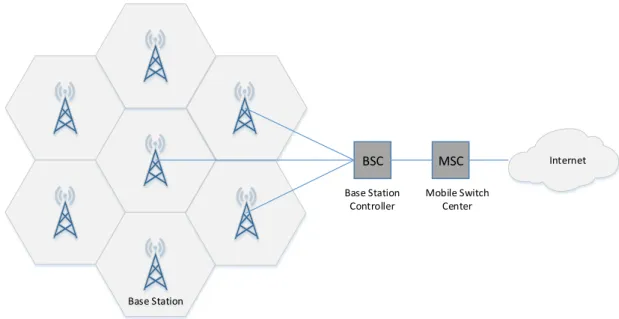
Base Station Internet BSC MSC Base Station Controller Mobile Switch Center
Figure 1.1 – Cellular networks
Base Station (BS), as depicted in Figure 1.1. These cells together provide radio coverage over city-wide/national/global areas. It allows user equipment, such as mobile phones, to move seamlessly even during transmission.
The explosive growth of demand for mobile capacity over the past decades has pushed researchers and industries to upgrade cellular networks, from the early analog telecommunications standards (1G) in 1980 to the current mature mobile wireless technologies (4G) in 2010 [5]. However, 4G is not sufficient to meet the rapid demands of the mobile telecommunication market since only incremental improvements and small amounts of new spectrums can be expected on it [6]. A new generation mobile networks (5G) is currently developed to address the looming bandwidth crunch. However, significant 5G deployments are not expected until 2020 or beyond due to still unresolved regulatory, spectrum availability and new infrastructure deployment challenges [7].
1.1.2
Mobile data offloading
The above-mentioned circumstances fostered the interest in the use of comple-mentary network technologies and innovative techniques to mitigate the burden on cellular networks, which is so-called mobile data offloading or simply data
1.1. URBAN WIRELESS INFRASTRUCTURES
Internet Broadband
Gateway Femtocell
Figure 1.2 – Femtocell networks
offloading [15]. It can reduce the amount of data being carried on the cellular bands and free bandwidth for other users. Femtocell and Wi-Fi technologies are two widely used mobile data offload technologies. According to the white paper of Cisco Visual Networking Index (VNI) [4], offloaded mobile traffic exceeded cellular traffic for the first time in 2015. Specifically, 51% of total mobile data traffic was offloaded onto the fixed network through femtocell or WiFi in 2015.
1.1.3
Data offloading via femtocells
Femtocell networks or home base stations are such networks where consumers install femto access points (a small, low-power cellular base station) inside their homes and backhaul data goes through a broadband gateway over the Internet to the cellular operator network [16, 17], as illustrated in Figure 1.2.
Femtocells are attractive to both mobile operators and consumers as they pro-vide improvements in both capacity and coverage, especially indoors [17,18]. The capacity is improved by a reduction in data being carried on the cellular bands and the freed capacity enhances the experience of customers on cellular networks. The coverage is also improved as femtocells eliminate signal attenuation during the transmission of cellular bands though buildings. As such, indoor users have a much better user experience with higher data rates. In addition, user equipment prolongs their battery life due to the reduced trasmitter–receiver distance.
However, femtocells operate in costly licensed and limited spectrum bands as macrocells (the widest range of cell sizes), which may lead to interference during data transmission [19]. Instead, WiFi technology allows data traffic to be shifted from expensive licensed bands to free unlicensed bands (2.4 GHz and 5 GHz) [18]. As WiFi works on the different frequency as cellular bands, it has no impact on existing cellular networks.
1.1.4
Data offloading via WiFi
WiFi is a wireless connectivity solution based on IEEE 802.11 standards that allows electronic devices to connect to a wireless local area network (WLAN). It has emerged as a promising and cost-effective solution to offload data traffic away from congested cellular networks for the following main reasons [20, 21, 22, 23]:
i) Most Internet-capable mobile devices (e.g., smartphones, tablets, laptops) have
the built-in WiFi capabilities; ii) No licensed spectrum is required. WiFi devices operate on free world-unified 2.4 GHz and 5 GHz bands; iii) WiFi has high data rates. Data rates up to 600 Mbps and 6.9 Gbps is achieved by IEEE 802.11n and 802.11ac respectively.
Femtocells and WiFi are complementary to each other. Femtocells provide a seamless service to users with low data rates while WiFi offers high data rates but QoS (Quality of Service) unguaranteed [18]. However, apparently, the mobility of both femtocell and WiFi networks is constrained on indoors (e.g., home, office). Once leaving the indoors, users access the Internet via cellular networks again.
Some studies have shown that it is possible to offload data while users are outdoors. In the following section, we present the main data offloading technologies that can handle the mobility of outdoor users and are candidates for providing larger bandwidth to future communications.
1.2
Data offloading over vehicular networks
Over the last few years, we have witnessed the rapid growth of vehicles in ur-ban areas together with the increase of internet-enabled devices integrated into the vehicles [24, 25]. The data created by these devices worsens congested
cellu-1.2. DATA OFFLOADING OVER VEHICULAR NETWORKS
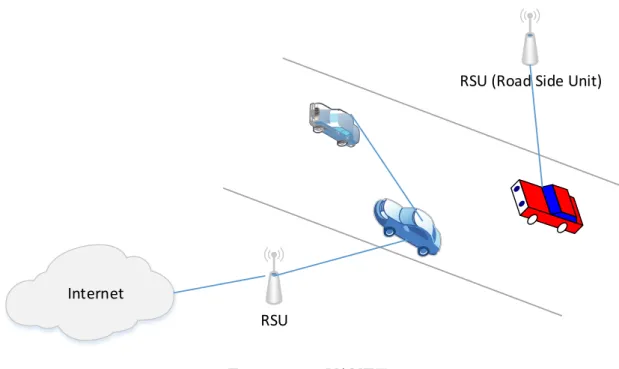
RSU
RSU (Road Side Unit)
Internet
Figure 1.3 – VANETs
lar networks. Several studies have been carried out using vehicular networks to shift bandwidth-hungry traffic from cellular networks. The most popular of such networks is Vehicular Ad-Hoc Network (VANET).
1.2.1
Offloading over Vehicular Ad-Hoc Networks
Vehicular Ad-Hoc Networks (VANETs) use cars as mobile nodes to create a mobile ad-hoc network. Rather than moving at random, vehicles tend to move in predefined road paths. It provides a wireless communication for private transports [26] where vehicles can communicate with either another vehicle or fixed equipment situated next to the road (that is so-called RSU, Road Side Unit), as shown in Figure 1.3.
A wide range of delay-sensitive applications can be explored in VANETs, in-cluding automatic collision warning, remote vehicle diagnostics, emergency man-agement and assistance for safe driving [24, 25]. VANETs are also used to offload data away from cellular networks [27][8]. As depicted in Figure 1.3, vehicles can download or upload contents (such as images, audio and video) through RSU rather than cellular bands when they pass through.
However, as vehicles in VANETs move in high velocities during data transmis-sion, it may lead to link failures and packet losses. The packet loss rates are around 20% as cars move [28]. Also, transmitting big files, such as audios and videos, be-comes very challenging because of short contact durations (typically within a few seconds) among vehicles or between the vehicle and the road side units.
Unlike VANETs mainly targeted for cars, we explore in this Ph.D. work a solution to offload a large volume of data while passengers use public transportation networks (PTNs). The goal of this work is to leverage PTNs to convey delay tolerant data. Our aim is different from the one of [8] where large data has to be transferred over very long distances. The data we consider in this work will be consumed by bus passengers while this is not the case in [8].
1.2.2
Offloading over public transportation networks
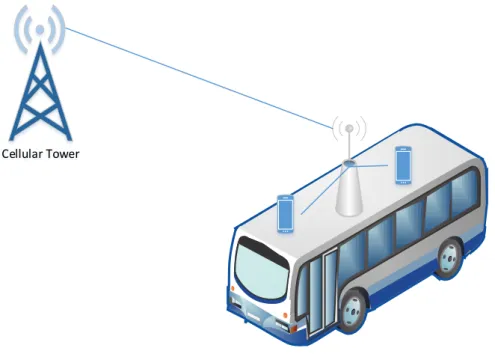
Growing urbanization leads to an increasing deployment of public transports. Currently, passengers onboard access to the Internet via cellular networks directly or indirectly. Main business solutions are to install a robust industrial 3G/4G router which connects to cellular networks, as illustrated in Figure 1.4. The ser-vice works like any fixed hotspot in a hotel, coffee shop or airport, providing customers an onboard Wi-Fi hotspot service to check email, surf the web and lo-cal entertainment during their journey. It is currently available mostly for some long-distance coaches but rarely in urban public transportation networks (PTNs). These solutions are heavily dependent on cellular networks and will bring lots of stress to the existing urban cellular infrastructure.
Some researchers explored the idea of leveraging public transportation networks to create a wireless infrastructure. Real implementations of such networks have been tested in the last decade.
DakNet [9, 29], developed by MIT Media Lab researchers, provides low-cost digital communication for remote villages in India and Cambodia by using public buses as data mules. In this case, a public bus carries a mobile access point (MAP) between remote villages and a hub with Internet access. Data automatically up-loads and downup-loads when the bus is in the range of the village or the hub. Due to inadequate infrastructures in remote villages, access points are deployed at all
1.2. DATA OFFLOADING OVER VEHICULAR NETWORKS
Cellular Tower
Figure 1.4 – WiFi bus solution
possible data mules (even in an ox cart) in DakNet. On the contrary, in urban public transportation networks, a public bus passes through a series of bus stops. It is way too much to install APs at all bus stops. Thus, we need to carefully select a subset of bus stops to be equipped with APs so that it can exchange a large amount of data.
The UMassDieselNet testbed [30] ran on 35 buses in Amherst, Massachusetts. It aimed at providing a real DTN environment for evaluating DTN related algo-rithms and protocols. This work has led to the design of the well known MaxProp routing protocol [30]. Each communication in this network is vehicle-to-vehicle communication. Each time two vehicles meet, they exchange some assistance val-ues (that indicates the order in which packets are transmitted and deleted) and packets with one another. The motivation of our work is different as we envision the PTN to become a content provider for its customers. And instead of leveraging vehicle to vehicle communications, we focus on the design of a fixed infrastructure to push and receive content to bus customers. In other words, no direct inter-vehicle communications are performed here and buses only communicate with the PTN access network while waiting at selected bus stops.
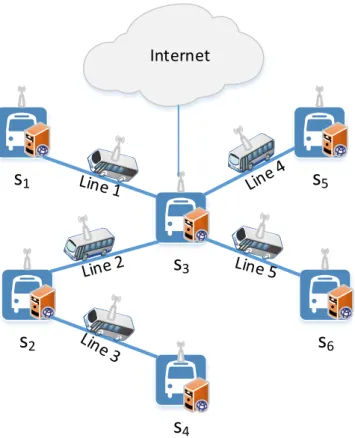
s
5s
3s
6s
1s
2s
4 InternetFigure 1.5 – A wireless infrastructure leveraging PTNs
More specifically, we propose a novel wireless infrastructure that leverages ex-isting public transportation networks (PTNs). As depicted in Figure 1.5, our solution proposes to install WiFi access points on both public bus stations (some of them have Internet access) and buses. Latter ones are used as data mules, cre-ating a delay tolerant network (DTN) capable of carrying content users can access while using the public transportation. A detailed description is given in Chapter2. As our infrastructure constitutes a delay tolerant network, we focus below on major works related to DTNs with a special emphasis on DTNs where node’s trajectories are predictable.
1.3
Delay Tolerant Networks
Benefiting from the delay-tolerant nature of non-realtime applications, a re-markable amount of such mobile contents can be offloaded away from cellular
1.3. DELAY TOLERANT NETWORKS
networks through delay tolerant networks [15, 18]. Examples of such networks have been introduced in Section 1.2.2.
1.3.1
Background on DTNs
Delay-tolerant networks are partitioned wireless ad-hoc networks with inter-mittent connectivity. DTNs are never fully connected at any point in time, but points of disconnection may be predictable as in vehicular networks following trans-portation schedules or networks with satellites traversing orbit. Communications in such networks often rely on the mobility of nodes to route messages and bridge partitions [31].
DTN provides interoperable communications with and among extreme and performance-challenged environments where continuous end-to-end connectivity cannot be assumed [32,33,34]. Examples of such environments include spacecraft, military/tactical, some forms of disaster response, underwater, and some forms of ad-hoc sensor/actuator networks [34]. We present below some of the most important characteristics of DTNs [32, 35,36, 37, 38].
Sparse. The participating nodes in DTN have a very low average number
of neighbors and suffer from frequent partitions. The network may never have an end-to-end path and transfer of data is done with the help of the mobility of nodes.
Dynamic. A DTN is a time-varying network where nodes move. In some
settings, nodes can move independently in any direction (e.g., random walk) or in an organized fashion (e.g., according to the roadside, traffic light, highway and so on in vehicular ad-hoc networks). Communication between nodes can occur only when they are within transmission range of each other. The contact duration between mobile nodes usually lasts for a very short period, limiting time to exchange messages among nodes. Also, data transfer while nodes move results in high packet loss.
Intermittent connection. DTNs lack of continuous network connectivity
which means that end-to-end paths between a pair of nodes are generally not available. Messages in DTNs can be opportunistically routed towards the des-tination through intermittent connections. Thus, DTN applications have to be tolerant of large delay.
Resource-constrained devices. Devices in DTNs may be resource-constrained,
such as limited bandwidth, buffer, battery and computing capability.
Applications of DTNs are those operating in mobile or extreme terrestrial en-vironments, or planned networks in space. Besides VANETs introduced in Sec-tion 1.2.1, we present below some of other most popular applications of DTNs [24, 39, 40,41].
Interplanetary internet. The interplanetary Internet (IPN) is consisting of
a set of network nodes that can communicate with each other in space. Communi-cation would be greatly delayed by regular disconnections and the great interplan-etary distances. DTN was originally designed to cope with such communications over long distances and through time delays.
Military applications. DTN is favored by the military due to its adaptability
to highly changing and challenging environments, such as battlefields. Nodes (e.g., tanks, airplanes, soldiers) form a military ad-hoc network, which can be used for the transmission of delay tolerant data (e.g., data collection, reporting, etc.).
Rural communication. As Information and Communication Technology (ICT) plays an important role in developing countries, many projects are built on DTN aimed at bringing ICT to rural areas that lack communication infras-tructure. Such projects include ICT4B (ICT for Billion) [42] sponsored by NSF (National Science Foundation) , TIER (Technology and Infrastructure for Emerg-ing Regions) and E-mail4B (an e-mail system for the developEmerg-ing world) [43].
1.3.2
DTNs created by PTNs
As introduced in Section1.2.2, our content delivery infrastructure is composed of fixed infrastructures (e.g., bus stops) and data mules (e.g., public vehicles), both of which are equipped with wireless transceivers and using mobile nodes as data mules, creating a delay tolerant communication network. All nodes in the network can be categorized into two types: i) fixed nodes, such as bus stations or stops; ii) mobile nodes, such as buses, tramway or subway cars. Except the characteristics mentioned above, DTNs created by PTNs have its special features:
• The network topology is stable. Bus stations or stops remain unchanged for a long time and the mobility of public vehicles follows a predefined schedule.
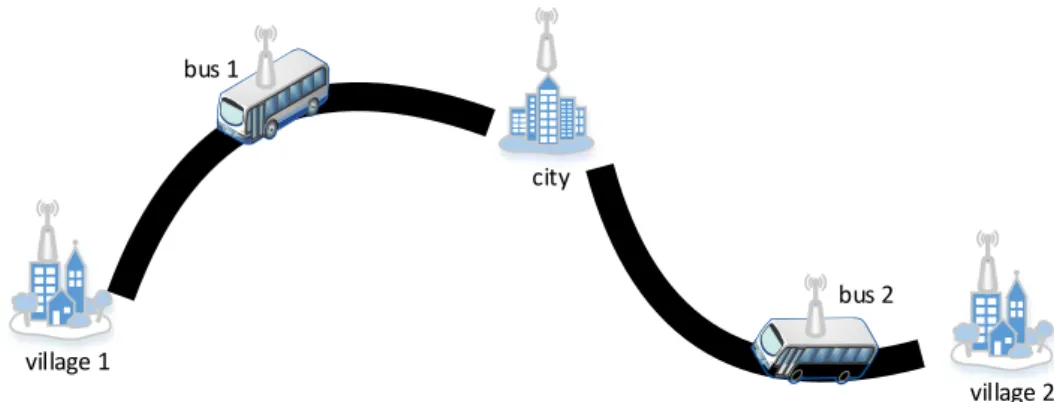
1.3. DELAY TOLERANT NETWORKS village 1 village 2 city bus 1 bus 2
Figure 1.6 – An example of village communication networks
• The mobility of nodes are predictable. Data mules travel on a fixed schedule back and forth between two stations.
Such general DTN-based infrastructure can offer a communication service that
i) either brings a common infrastructure to remote non-connected villages or ii)
relieve the stress on cellular networks in dense urban areas as proposed in this PhD.
Village Communication Networks (VCN) introduced in [9] offer connectivity to remote locations in underdeveloped countries or provides a disaster-relief commu-nication infrastructure. In this case, there is no decent commucommu-nication infrastruc-ture between remote villages and cities of a country. Communication among the inhabitants of these villages is made possible thanks to so-called data mules, as illustrated in Figure 1.6. These mules are for instance vehicles (e.g., buses, cars, etc.) carrying wireless transceivers and a given storage capacity. Each time a data mule visits a village or a city, it uploads the data dedicated to its inhabitants on a central server and downloads the data to be transferred to other remote destina-tions from this server. The mule carries the data from one village to another one, possibly fetching new data to a city connected to the Internet. In such a scenario, messages take time to be transferred which depends on the mules’ trajectory. This communication paradigm is reminiscent of legacy mail and thus, only asynchronous communications of non-delay-sensitive data are possible. It is possible in such a scenario to leverage the network created by bus lines to provide a communication infrastructure at low cost for developing countries. Real implementations of VCNs have already been tested in the last decade. DakNet [9], developed by MIT Media
S D R S D R S D R
(t1) Store (t2) Carry (t3) Forward
m
m
Figure 1.7 – Illustration of routing data using intermittent contacts
Lab researchers, provides low-cost digital communication for remote villages in India and Cambodia by using public buses as data mules.
In this dissertation, we envision to deploy a similar infrastructure this time in urban areas to create a novel content delivery infrastructure.
1.3.3
Routing in DTNs
Routing in DTN is a challenging problem because of the lack of continuous con-nectivity between distant nodes. Popular ad-hoc routing protocols such as AODV (Ad-hoc On-Demand Distance Vector) [44] or DSR (Dynamic Source Routing) [45] fail to route messages since there is no end-to-end path available at all times. Thus, specific protocols have been proposed to handle delay tolerant communications.
The simplest approach to delivering messages in DTNs is the so-called direct delivery. Messages are always held by the source node until it encounters the destination. Such an approach provides minimal overhead, but in most cases, it has the worst delivery probability. A message fails to be delivered if the source and the destination never meet within the time-to-live of the message. This can be illustrated with Figure 1.7 where the source S and the destination D never encounter each other eventually.
However, with the assistance of intermediate nodes or relay nodes, it is possible to deliver messages from a source to a destination even if there is no direct contact between them during the whole time. We continue with the example in Figure1.7
1.3. DELAY TOLERANT NETWORKS
receives a message from the source S at the time t1, then carries it while moving
to D, and finally forwards to the destination D at t3. Therefore, routing data
in delay tolerant networks usually leverages intermittent contacts between mobile entities using the store-carry-and-forward paradigm.
In such a case, transfer of data is done on a per-encounter basis: two nodes carry data and exchange it upon contact such as to rapidly diffuse a copy of it to the destination. This baseline protocol is the Epidemic protocol [46]. The protocol is similar to a viral infection process where nodes continuously replicate messages to newly discovered contacts until one copy reaches its destination. It is known to be way too resource consuming due to its elevated replication rate. Epidemic is natively better suitable for data dissemination than for routing. It provides the best delivery probability under such conditions: i) infinite memory at relay nodes; ii) sufficient contact duration between nodes. The two conditions make sure that messages between nodes can be completely exchanged. However, these strict demands make Epidemic impractical when it comes to the real world. On one hand, a limited buffer is quickly filled up with unnecessary message copies. On the other hand, the contact duration between mobile nodes may last for a very short period. There is thus not enough time to exchange all available messages among nodes. To limit the number of message replications and transfers, Spray and Wait [47] was proposed to make a trade-off between the performance and the overhead. It consists of two phrases: i) spray a given number of copies into the network; ii) wait till one of these nodes encounter the destination.
Replication-based protocols are efficient if little information on the connectivity of nodes is available. An abundance of dedicated protocols has been proposed for different scenarios in terms of network topology, mobility patterns and data flows [41, 48, 49]. The basic idea of these protocols is that the sending node carefully selects neighbor(s) as relay node(s) and message(s) to send, instead of blindly forwarding all messages to all neighbors.
Nodes in DTN may not know the availability of future encounters, but the network may benefit from learning such patterns over time [31]. A class of pro-tocols exploits the history of previous encounters among mobile nodes to select forwarding nodes. One representative protocol is PRoPHET [50] where a value so-called delivery predictability is dynamically calculated for every pair of nodes.
Based on this information, each node only replicates messages to the neighbors with a higher delivery predictability that indicates higher probability to reach the intended destination. MaxProp [30] is based on the same principle as ProPHET. It uses several mechanisms to define the order in which packets are transmitted and deleted.
These main routing protocols are designed when little a-priori knowledge of mobility patterns exists. However, if the mobility of nodes is known in advance, appropriate routing decisions can be made.
In our application scenario, the mobility of buses is predictable and thus, lead-ing to even more efficient routlead-ing solutions [30] where vehicle to vehicle communi-cations are exploited to create a data mule delay tolerant network. The difficulty with vehicle to vehicle communications, even in our predictable setting, is the harsh communication environment induced by buses moving and communicating at the same time. To favor stable and predictable transmissions, we opt for a design where buses carry data between carefully planned access points. Routing paths can be calculated a-priori knowing the bus line topology, final transfer being adjusted to actual arrival and departure dates of buses on the fly.
As all messages are relayed at bus stations, they become network-wide conges-tion points. To address such a challenge, we propose to leverage network coding at bus stations. A basic introduction to network coding for DTNs is given next.
1.4
Network coding for DTN
WiFi, the brand name for the IEEE 802.11 WLAN (Wireless Local Area Net-work) technology, uses Carrier Sense Multiple Access with Collision Avoidance (CSMA/CA) medium access. Bandwidth is thus divided equally among contend-ing nodes. Because of this, our content delivery infrastructure is prone to conges-tion bottlenecks as public transportaconges-tion networks are built around the concept of hubs where many bus lines converge. This can be illustrated by Figure 1.5. Four buses affiliated with the bus lines 1, 2, 4 and 5 cross at the station s3. Clearly,
there are 5 contending nodes (4 buses and s3) sharing the same wireless medium.
WiFi AP medium access shares equally the bandwidth among these nodes. As such, each of them gets one fifth of the communication bandwidth. To complete
1.4. NETWORK CODING FOR DTN
the data exchange among buses, the relay node s3 needs as much bandwidth as
the whole set of 4 buses together. In other words, s3 is only able to relay 1/5 of
packets of the 4 buses on the condition of heavy network load. Such an imbalance gets worse as the number of buses increases.
In this work, we propose to leverage network coding at bus stations to address such an imbalance.
1.4.1
Background on network coding
Network coding enables coding at the network layer: the nodes of a network combine several packets they receive together for transmission rather than sim-ply relaying the packets [51, 52]. It has been shown to significantly improve the throughput in regular networks [53], especially in wireless networks owing to the broadcast nature of wireless medium [54]. In this thesis, we leverage network coding at the contention points of our infrastructure to relieve the imbalance of bandwidth requirements between the buses and the station.
Ahlswede, et al. proposed network coding in 2000 [51]. They characterized the admissible coding rate region for multicast sessions and their results can be regarded as the Max-flow Min-cut Theorem for network information flow. With network coding, the upper bound (the maximum achievable throughput) can be achieved in multicast scenarios. This point can be easily illustrated using the famous butterfly network depicted in Figure1.8. The source node s aims to multi-cast two data bits b1and b2to both sink nodes t1 and t2. For the sake of discussion,
we assume that the capacity of each link is a unit value, i.e. 1. It is easy to check that the value of a max-flow from s to tl (l = 1, 2) is 2. In traditional routing
models, as depicted Figure 1.8-(a), the central link C → D would be only able to carry b1 or b2, but not both. Suppose the intermediate node C sends b1, then t1
receives b1 twice but not b2 at all. Sending b2 poses a similar problem for t2. The
achievable rates in this case are 1.5. However, with network coding, b1 and b2 can
be transmitted to both destinations simultaneously. As shown in Figure 1.8-(b), the intermediate node C transmits the network-coded bit b3that is combined from
b1 and b2 with modulo 2 addition, i.e. b3 = b1⊕ b2. Thus, at t1, b2 can be
s
A
B
t
1t
2D
C
b
1b
2b
1,
b
ib
2,
b
ib
1or b
2(a) Traditional routing models
s
1
2
t
1t
24
3
b
1b
2b
1,
b
3b
1=b
2b
1b
2= b
3b
2,
b
1=b
3b
2 (b) With network codingFigure 1.8 – Network coding in butterfly network
recovered at t2. Thus the admissible rate with network coding is 2, which is equal
to the max-flow capacity of 2. In summary, unlike traditional routing protocols where intermediate nodes just simply forward the exact same packets they receive, in network coding, the nodes of a network combine a set of packets (i.e. encode) into a new packet for transmission.
Following this work, Li et al. showed that linear network coding is sufficient to achieve the maximum capacity bounds in multicast traffic [52]. Linear coding regards a block of data as a vector over a certain base field and allows a node to apply a linear transformation to a vector before transmitting. Based on this work, Koetter et al. presented an algebraic framework for investigating the issues of network capacity for arbitrary networks and proposed polynomial time algorithms for encoding and decoding [55]. These results were extended to random linear network coding by Ho et al in [56, 57]. They presented a distributed random linear network coding approach for transmission and compression of information in networks.
1.4. NETWORK CODING FOR DTN
t
P
1P
2P
3...
P
nBuffer
α
11·P
1+ α
12·P
2+ α
13·P
3+ ...
+ α
1n·P
n= y
1α
21·P
1+ α
22·P
2+ α
23·P
3+ ...
+ α
2n·P
n= y
2α
31·P
1+ α
32·P
2+ α
33·P
3+ ...
+ α
3n·P
n= y
3 ...α
n1·P
1+ α
n2·P
2+ α
n3·P
3+ ...
+ α
nn·P
n= y
nRandom coefficients
Coded packets
n
1n
2n
i...
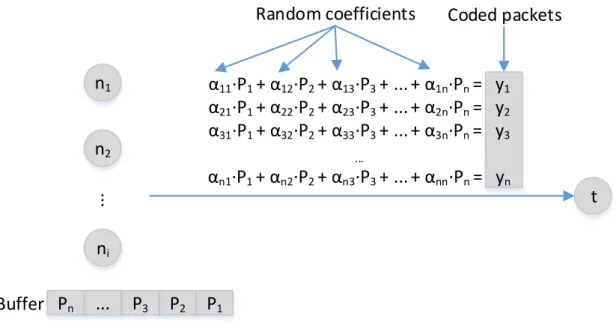
Figure 1.9 – Random linear network coding
Figure1.9 illustrates how random linear network coding works. On the encod-ing side, a node select a set of packets (say P1, P2, ..., Pn) and linearly combines
them together into a new network-coded packet y, y = Pn
i=1αiPi where network
code coefficients αiare chosen uniformly at random from a finite field Fq (q denotes
the size of finite field). Here, information is regarded as vectors of bits which are of equal length u, represented as elements in the finite field Fq, q = 2u [58]. It
is interesting to point out that random linear network coding is degenerated into XOR network coding that is illustrated in Figure 1.8when q = 2, i.e. F2 = {0, 1}.
On the decoding side, the destination node t receives enough coded packets yi
and recovers the native packets by solving the system of linear equations Eq. (1.1) (using algorithms such as Gaussian Elimination) created by these coded packets and their coefficients.
α11 α12 · · · α1n α21 α22 · · · α2n .. . ... ... ... αn1 αn2 · · · αnn · P1 P2 .. . Pn = y1 y2 .. . yn (1.1)
matrix. If the matrix A has full rank (all n rows are independent), the system has a unique solution given by x = A−1b, which means that all original packets
(P1, P2, ..., Pn) can be extracted at the node t. Formally, for a feasible multicast
connection problem on a network, the probability that all the receivers can decode the source processes is at least (1 − d/q)η for q > d, where d is the number of
receivers and η is the number of links carrying random combinations of source processes and/or incoming signals. This achieves capacity with probability ap-proaching 1 with the code length u [57].
In parallel, network coding has received a lot of attention in wireless networks especially due to the shared nature of the wireless media [59]. The benefits of network coding in wireless networks can be seen from the two-way relay network in Figure 1.10 where node A and node B want to exchange a couple of packets. The radio range does not permit them to communicate directly and thus they need to go through a router R. In traditional routing methods, it takes 4 transmissions to exchange two packets P 1 and P 2 between them as depicted in Figure1.10-(a). However, when it comes to heavy network load, as shown in Figure 1.10-(b), R can only drain half of packets received from A and B since R gets only a third of the channel capacity for the fair medium access. With network coding, the relay node R broadcasts the xor-ed packet P 3 = P 1 ⊕ P 2 in a single transmission. Both A and B can extract the desired packet by xor-ing P 3 with the packet they have previously sent. For instance, A obtains P 2 by calculating P 2 = P 1 ⊕ P 3. Similarly, P 1 can be recovered at B. Clearly, in this case, network coding mitigates the imbalance of bandwidth requirements. Such an important improvement can be achieved for N nodes with the same relay node if each node can overhear the packets emitted by the (N − 1) other nodes.
1.4.2
Network coding and DTNs
As we have explained in Section 1.3.3, main routing protocols in DTNs are replication-based as messages are allowed to be replicated for acquiring higher probability of message delivery. This brings new opportunities for network cod-ing in DTN. Instead of receivcod-ing the same copies of a message several times, a node can obtain a set of coded messages with different coefficients from multiple
1.4. NETWORK CODING FOR DTN t1 P2 t2 t3 t4 P1 P1 P2 A R B
(a) Light network load
t1 P2 t2 t3 P1 A R B P1 P2 Or
(b) Heavy network load
t1 P2 t2 t3 P1 A R B P1 P2
=
P3 P3 P2=
P1 P3 P1 P2=
(c) With network coding
Figure 1.10 – Exchange two packets in two-way relay networks
opportunistic paths if appropriate random linear network coding scheme is applied. The benefits of network coding in DTNs have been investigated for different scenarios [60][61][62] and will be introduced next.
1.4.2.1 Intra- and Inter-session network coding
One session (i.e. flow) is defined here by the sequence of messages sent by a source node to one (unicast) or more destination nodes (multicast). If only messages that belong to the same session are network coded together by the relay nodes, we refer to intra-session network coding. In contrast, inter-session network coding mixes messages that belong to different sessions together.
MORE and COPE are representative intra- and inter-session network coding approaches for wireless networks respectively, developed by MIT. In MORE [63], source nodes encode messages going to the same destination using random linear network coding. The destination recovers the original messages from a set of coded messages by solving the linear system created by these coded messages and their coefficients (i.e. decode). In COPE [54], the authors aim to improve the through-put of wireless mesh networks by using XOR network coding. Unlike traditional approaches in which intermediate nodes simply act as store and forward routers, relay nodes in COPE combine packets from different sessions using the XOR
oper-ator and then forward the XOR-ed packet to the next-hop in a single transmission. To increase the network coding probability, COPE relies on opportunistic listening where nodes snoop on all communications over the wireless medium and store the overheard packets for a limited period of time.
Recent works have presented intra- and inter-session network coding solutions for delay tolerant networks [61, 64, 65, 66, 67], where mobility of nodes is non-predictable. Most of these works have focused on people-centric DTNs where several unicast communications between mobile pairs of nodes exist. Gains in throughput have been shown most of the time for nodes moving with homoge-neous mobility models and when there are high resource constraints (e.g. limited bandwidth and buffer). But this is often at the cost of an increased computa-tion complexity or an important signaling load. Recent solucomputa-tions have leveraged social routing information to improve the coding procedure at relays [67]. The authors show how challenging it is to apply inter-session random network coding to people-centric DTNs without information on the underlying network topology. In the proposed solution, authors exploit properties of the social graph (given by the SimBet protocol) to improve the routing performance but at the cost of having all nodes memorizing and updating social graph structure information.
In this thesis, we aim to gain in throughput for all the flows of the bus network and focus on multiple unicast sessions or data flows that are the dominant traffic today. Our work proposes a simple implementation of XOR network coding rem-iniscent of the solution proposed by Kreishah et al. in [64]. We perform pairwise inter-session XOR network coding. Messages crossing at bus stations are simply xor-ed together mxor
c = ⊕Ki=1mi, reducing the bandwidth share imbalance. Details
on our implementation are given in Chapter 3.
1.4.2.2 End-to-end and hop-by-hop network coding
Network coding can be implemented in two different ways: i) messages are encoded at the source or relay nodes and only decoded at the destination, which we refer to as end-to-end network coding; ii) messages are encoded at each hop and decoded at the next hop, which we refer to as hop-by-hop network coding.
1.5. CONCLUSION
messages to encode together such as to maximize the probability of decoding at the destination. End-to-end network coding approach was mostly discussed for DTNs, especially in multicast or broadcast scenarios [60, 68]. For unicast applications in DTNs, the paper [61] investigates the benefits brought from random linear network coding (RLNC). Their scheme achieves better group delivery delay for a single group of packets originating from a same source and going to a same destination but at the cost of a large number of network transmissions.
On our side, we perform hop-by-hop network coding where messages are de-coded immediately at the next hop rather than the destination node so as to increase the coding probability, reduce the message delay and the complexity of replication control. Hop-by-hop network coding has been successfully implemented in practice for wireless mesh networks in COPE [54]. However, the opportunistic listening of COPE can’t be leveraged in our infrastructure. Buses can’t hear all ongoing communications as they are not present at all times at the station. But it is easy to apply the XOR scheme of COPE to pairwise communications crossing [64] at a node of the network. We adapt this XOR scheme to our content delivery network by exploiting the features of PTNs.
1.5
Conclusion
This chapter has introduced the background of this thesis. Designing routing protocols for DTNs is challenging. After investigating existing routing protocols, we learn that the basic idea of these protocols is how the sending node selects neighbor(s) as relay node(s) and message(s) to send. For our content delivery infrastructure, we propose to employ the features of PTNs to design our routing policy. To address the congestion points and gain in throughput for multiple uni-cast data flows in PTNs, we propose to leverage inter-session XOR hop-to-hop network coding.
2
A Content Delivery
Infrastruc-ture Leveraging Urban PTNs
In this chapter, we present the details of our content delivery infrastructure. To address the challenge arising from the bus stop selection, we analyze the publicly available traces of PTN providers to identify the bus stops that have long contact duration. The results show that public buses stop at intermediate bus stops for a very short period. In contrast, more than 50% of the buses stop at end-of-the-line stops for more than 9 minutes. Thus, we only deploy wireless APs at the final bus stops.
In terms of routing policy, we exploit the underlying network topology of PTNs and propose that messages be delivered following the shortest path by pre-calculating routing tables for each router. It can lead to a significant reduction of message replications and transfers. We corroborate this point through simulations using real traces from three major European cities: Paris, Helsinki and Toulouse. The results show that, compared with the Epidemic routing, our scheme improves by 4 to 8 times the number of delivered messages while reducing the overhead ratio.
2.1
Scenario descriptions
Based on the observation that a significant part of the mobile content is con-sumed in urban areas while people are commuting using public transportation, we propose a novel content delivery infrastructure to confront with the rapid urban-ization together with the looming bandwidth crunch in urban centers.