O
pen
A
rchive
T
OULOUSE
A
rchive
O
uverte (
OATAO
)
OATAO is an open access repository that collects the work of Toulouse researchers and
makes it freely available over the web where possible.
This is an author-deposited version published in :
http://oatao.univ-toulouse.fr/
Eprints ID : 15272
The contribution was presented at MMEDIA 2015 :
http://www.iaria.org/conferences2015/MMEDIA15.html
To cite this version :
Bertrand, Nicolas and Durou, Jean-Denis and Charvillat,
Vincent The DCP Bay: Toward an Art-House Content Delivery Network for
Digital Cinema. (2015) In: 7th International Conference on Advances in
Multimedia (MMEDIA 2015), 19 April 2015 - 24 April 2015 (Barcelona, Spain).
Any correspondence concerning this service should be sent to the repository
administrator:
[email protected]
The DCP Bay: Toward an Art-House Content
Delivery Network for Digital Cinema
Nicolas Bertrand, Jean Denis Durou and Vincent Charvillat
IRIT, UMR CNRS 5505 Universit´e de Toulouse, France
email: [email protected], [email protected], [email protected]
Abstract—Cinema theaters have arrived in the digital era. The Digital Cinema Initiatives has chosen Digital Cinema Package (DCP) as format for the distribution of feature films. No suitable economical nor technological model is proposed for DCP content delivery to art-house theaters. The existing solutions are too expensive or not adapted. Therefore, we conduct this research activity in cooperation with Utopia cinemas, a group of art-house French cinemas. Utopia’s main requirement (besides functional ones) is to provide free and open source software for DCP distribution. In this paper, we present a Content Delivery Network for DCP adapted to art-house. This network is operative since mid 2014 and based on torrent peer-to-peer technology inside a multi-point VPN.
Keywords–Digital cinema; Content Delivery Network; Peer-to-peer; VPN.
I. INTRODUCTION
Cinema theaters switched from 35 mm prints to digital era. The Digital Cinema System Specification (DCSS) [1], provided by Digital Cinema Initiatives (DCI), is now a world-wide standard. The specification describes how to create, distribute and project a Digital Cinema Package (DCP).
Our research is conducted in collaboration with Utopia cinemas, a network of five independent theaters in France. More independent theaters support this activity through the Ind´ependants, Solidaires et F´ed´er´es (ISF) association. Those theaters initiated this research because they need to understand the implications of changing to digital. Primarily, they are concerned about becoming dependent on a single company’s technology for presentation, and want us to provide Free and Open Source Software (FOSS) for Digital Cinema (DC). As exhibitors, they are mainly concerned in two parts: a projection system and a system for DCP reception in theaters in a dematerialized way.
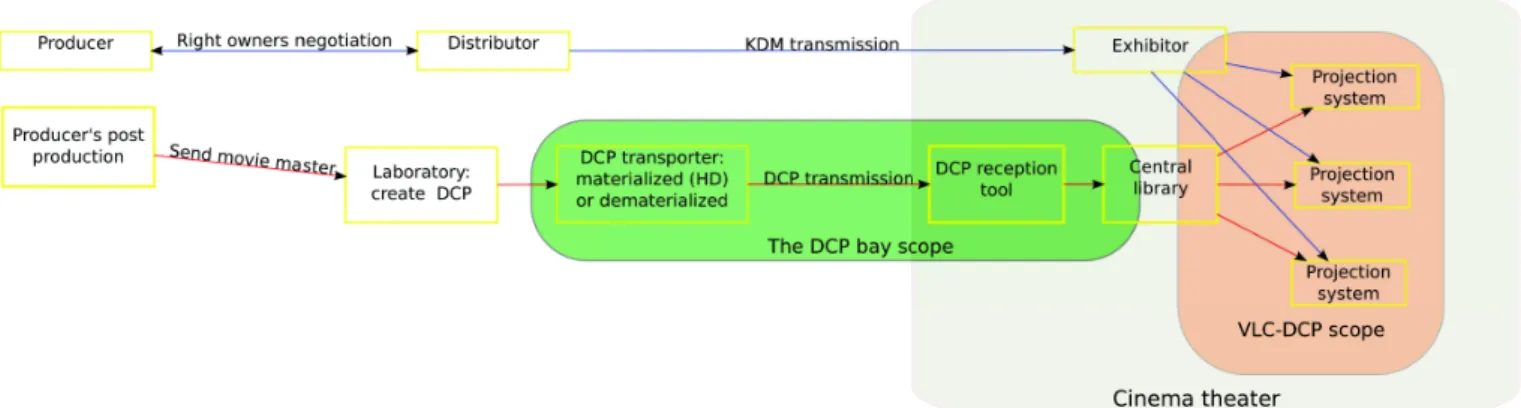
The first topic is addressed in [2]. It is a full software pro-jection system running under VLC, with JPEG2000 decoding optimization for DC (the VLC-DCP part in Figure 1). This paper is on the second part: the DCP transmission system. We designed a Content Delivery Network (CDN), peer-to-peer based, for DCP delivery to exhibitors. Our goal is to deliver on time a DCP to be used in the projection system (not to stream the content). A major requirement is also to design a CDN which fits independent distributors and theaters ecosystem: deliver many contents for many theaters in a cost effective way.
In Section II, we present the environmental reasons to propose our CDN. In Section III the CDN architecture is
presented. In Section IV the CDN is evaluated, and in Section V we analyse the evaluation results.
II. WHY AN ALTERNATIVECDNFOR ART-HOUSE THEATERS?
Once a movie is realized by producers, the movie shall be distributed. We study the case of distribution to theaters (not the video distribution as DVD or VOD). The distributors acquire the film rights per country. They negotiate per theater when and how long the movie will be screened (cf. Figure 1, blue arrows for right owners negotiation, red for DCP data flow). Our work is based on film distribution in France. Film industry in France is ruled by the Centre National du Cin´ema et de l’image anim´ee (CNC) who delivers permissions to dis-tribute a film. CNC distinguishes three classes of theaters (big, medium and small) and sets labels to films (art-house, research, etc.). We focus on distribution to medium and small theaters, with CNC art-house labels. Big (multiplex) theaters already have distribution solutions (mainly via satellites) adapted to their business (for instance distribution of more than 900 copies to exhibitors). At the opposite 60 % of the movies in 2013 have been screened in less than 100 theaters (CNC source) and the great majority of these films were art-house ones.
Technically, distributors don’t create (except for the very small ones) DCPs themselves. DCP mastering is done by cinema industry laboratories. Basically DCP mastering consists in creating a DCP according to DCSS standard (3 big steps: compress video, create container and encrypt DCPs). The DCP can then be delivered to exhibitors. In France, 2012 is the year which represents the switch from 35 mm prints to digital copies. At this time DCPs were transported like 35 mm prints: via mail transporters. The switch to dematerialized transfer is currently in progress. The dematerialized transfer was initiated by big Network Service Providers (NSP): in France, Orange via Globecast and TDF via Smartjog.
Globecast, for some theaters (big or representative ones), proposes free equipment (rent of 1, 2 or 4 ADSL network links and reception box), the DCP transfers are cost free also. The distributor is in charge to pay the transfers to theaters. The transfer cost is expensive for medium and small distributors, so a few switched to dematerialized. Taking en example, Utopia Bordeaux theater is on the top 5 of French cinemas playing art-house movies. The cinema was free of charge equipped with Globecast system: after 3 years of usage, they can receive less than 10 % of the screened film via this system. The remaining 90 % are received by hard disk via traditional mail delivery.
Figure 1. Overview of DC system. The figure represents the DCP distribution from distributors to exhibitors.
Furthermore, depending on the theater, Globecast offer is free or not (installation cost and DCP transfer cost).
Other issue: transporters try to deal with distributors for exclusivity on delivery. A theater shall then be equipped with several reception mechanisms to receive all DCPs. So, we have here an inter-operability problem. Inter-operability is one of the keywords of DCSS: creation of DCPs, projection system, security are largely described in the document. The transportation chapter is only one page long in a 160 pages document.
Affordable costs for art-house cinema and inter-operability are two main reasons to starting this project. In next section we will present our CDN: The DCP Bay.
III. THEDCP BAY
The fundamentals are to propose an open network design for DCP delivery to solve inter-operability issues and build it in a cost effective way for distributors and exhibitors. By inter-operability, we mean a standard public protocol for DCP transfer based on FOSS and independent (from NSP, from distributors and from theaters projection system).
A DCP can grow up to 400 GB (3 hours of a movie with a compression ratio of 250 Mb/s). The observed DCP mean size is around 200 GB. So, DCP distribution is challenging due to the large size of the content and on time delivery for first screening. The distributors can make available the DCPs to distribute from one month to 24 hours before the projection. We excluded solutions based on JPEG2000 scalability [3] and multiple-description-based distributed system [4] because the majority of DCPs to distribute are encrypted: it is not possible to access JPEG2000 data.
Our transfer system is peer-to-peer (torrent) based. Usage of torrent files is common and implementation is open. Torrent allows transfer of large files and ensures also the integrity of the system. For security and maintenance simplification all the peers are in a multipoint VPN called tinc. Tinc is a well known open source VPN simple to set up and with numerous functionalities [5].
A distributor delivers the DCPs to our platform (by secure FTP or by torrent or by traditional mail delivery). When a DCP is received in one of our servers, the integrity is verified (the information for hash verification is present in DCP meta-data) and the torrent file is created. The DCP is replicated in other
servers to create seeders. Then, the DCP can be delivered to theaters, the exhibitor selects the torrent to download in our torrent tracker (also inside the VPN), and starts the transfer via his torrent client interface. Once the DCP received, the exhibitor can transfer it to the DC library or DC projector server (usually via FTP). For running The DCP Bay (TDB) in a cinema, the exhibitor needs a dedicated machine. We do not impose to the theater a specific hardware, neither a specific NSP, but we ask to use a dedicated machine to not be dependent on any DC equipment provider.
Thanks to our VPN and peer-to-peer architecture, we can propose aggregation of network links to increase theater bandwidth. The aggregation solution is presented in Figure 2. For each network link, we have a modem. In the TDB theater
Figure 2. TDB network link aggregation. The TDB machine can receive torrent data from the 2 network links by specifying routes at VPN level. For
the torrent client all the machines are in the same VPN network (10.10.10.XXX).
machine at VPN level, two connections are made to two TDB servers, and we create separate routes via each modem. So, we receive data from seeder 1 via modem A, and data from seeder 2 via modem B. At torrent client level both seeders are viewed, via the VPN tunnel, and download rate for each seeder is limited by each network link. This mechanism can be extended to multiple seeders by balancing the connections between modems. This aggregation solution is easy to set up in the theater and does not need any specific connection from an NSP. We can even add network robustness by selecting separates NSP for each network link.
TDB have server machines in data-centers. We work with non profit NSPs (tetaneutral, aquilenet, LDN). In tetaneutral one machine, with 9 To of disk storage, is used for DCP
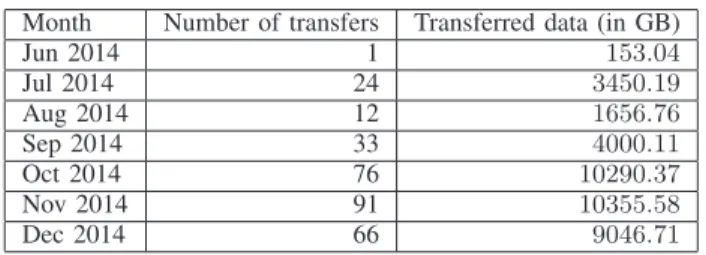
re-TABLE I. PROGRESSION OF TRANSFERRED DCPs
Month Number of transfers Transferred data (in GB)
Jun 2014 1 153 .04 Jul 2014 24 3450 .19 Aug 2014 12 1656 .76 Sep 2014 33 4000 .11 Oct 2014 76 10290 .37 Nov 2014 91 10355 .58 Dec 2014 66 9046 .71
ception via FTP, integrity verification, torrent creation, torrent tracker hosting and seeding. The second machine replicates the DCP of the first one and acts as a seeder also. The third one is a virtual machine for archiving ’old’ DCPs, and seeds only the archived DCP (16 To of disk storage). The machines in aquilenet and LDN act as cache machines. We send a DCP to these machines when we know that it will be transferred to many theaters at the same time.
IV. THEDCPBAY EVALUATION
TDB is operative since June 2014. Table I presents the number of DCPs transferred by month to the theaters. All the connected theaters (from one to five screens) are art-house ones but some of them have also mainstream movies. The theaters are connected with different connection types (optic fiber, VDSL, ADSL) or usage (shared, dedicated or aggregated lines). They can be equipped only by TDB, but also by others DCP transporters (Globecast, Smartjog, Cinego). This represents heterogeneous bandwidth and according to theater screening it implies several distribution scenarios.
A. Tinc VPN evaluation
All the DCPs transit (except the FTP transfers) via VPN and tunnels. All the traffic is made on the same tunnel. Data transit inside tunnels does not have the same performance as direct network transfer. We connected two machines directly via an Ethernet wire and both with gigabit connections and running under the same Linux kernel. We performed transfers of 1 GB files via wget commands. With direct connections we measured rates of 960 MB/s. Via the tunnel we measured rates of 220-250 MB/s. We deactivated the ciphering to not reduce VPN performances and only evaluate the tunnel performances. At a more macroscopic level, we measured also non constant rates between distant machines via tinc connections. This problem is probably due to NAT firewall rules on network link modems as mentioned in [6].
B. Torrent client evaluation
The selected torrent client is transmission, because it is a FOSS torrent application. And the software provides also a web interface to manage the downloads. All the theaters have their own torrent clients accessible via a web interface (example http://32.cinema.tdcpb.org for Utopia Tournefeuille). Compared to other FOSS torrent clients transmission is slower (in download time) than rtorrent in high speed networks. We measured the download bandwidth inside the tetaneutral local network. We downloaded a DCP from a server to a virtual machine. With transmission the maximum measured bandwidth was 96 MB/s. With the same DCP we measured with rtorrent download rates of 230 MB/s. After code reading
in transmission client there are some timer loops which explain the slower bandwidth.
C. Global TDB evaluation
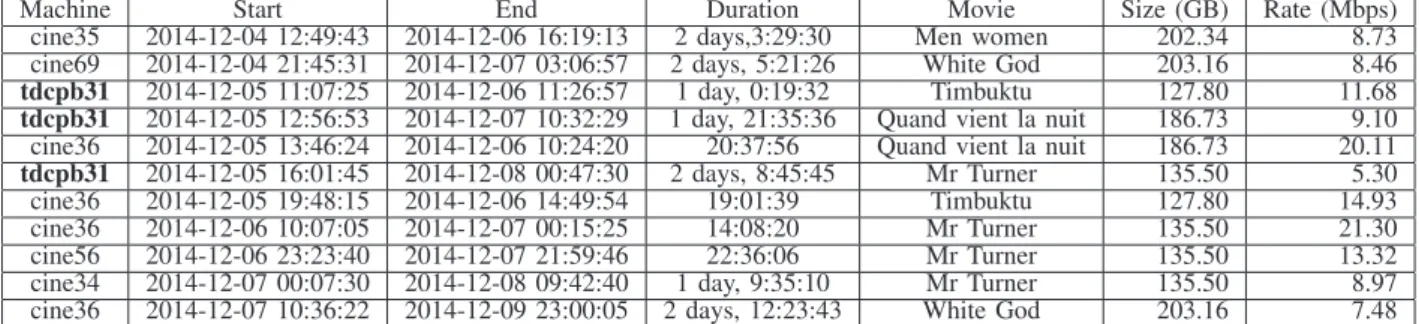
We use a torrent tracker, named XBTT, to log all the transfers. We can have the start and end times for the transfer of each torrent. A sample of DCP transfer is presented in Table II, which corresponds to the time window of Mr Turner transfer (2 days, 8:45:45). All the DCP transfers presented in this table have been ingested in a machine (utopian7) in the laboratory network and then transmitted to server tdcpb31 and to theaters (cineXX). In that case the DCPs are available to download for all the theaters. Since a DCP is available to download in utopian7, this machine can be considered as a primary seeder. The machine tdcpb31 is where all the DCPs are finally stored and located at tetaneutral. In Table II, DCPs are transferred to five theaters (noted cine35, cine69, etc.). The theaters have different download bandwidths, the cine36 is connected to 100 Mbps optical fiber. For cine36 in that case the maximum reached rate is 21.30 Mbps, so 5 times less than the theoretical bit-rate of 100 Mbps. This is partly explained by the optic fiber NSP (we did not reach more than 80 Mbps in direct download tests), due also to several DCPs downloaded at the same time for instance (Timbuktu), and also due to VPN tunnel limitations. The machine tdcpb31 is connected to a high speed network (with a 1Gbps Ethernet card). It is downloading (and partially uploading to other theaters) DCP from utopian7 (MrTurner, Timbuktu, Quand vient la nuit) and at the same time seeding to theaters (Men women, White God). The download rates of tdcpb31 are slow (11.68 Mbps) regarding the expected 1Gbps connections. The VPN tunnel does not support traffic rates greater than 10/15 Mbps when traffic is in both directions (upload and download). In a simpler case: no upload traffic in tdcpb31, and utopian7 is only uploading to tdcpb31. We measured download rate of 30 Mbps (not represented in Table II) and if we add a virtual machine in tetaneutral network, which also downloads the same DCP as tdcpb31 from utopian7 we reached rate of 58 Mbps for tdcpb31. The limitation is in the tunnel, not in the connection between utopian7 and tetaneutral.
V. TDB EVALUATION ANALYSIS
We designed a CDN for DCP delivery. Functionally, the system is fully operative, and in “beta-production” since 6 months. We found one experimental solution for DCP delivery. Now the problem is to find an optimized solution for an increase of payload (more theaters connected and more DCPs to transfer). Putting aside the problem of tunnel transfer limitation, which shall be addressed at a more “network” level, we need to evaluate if the system can distribute all the DCPs to all the theaters at an expected date (the first screening day). Figure 3 represents 8 months of film screening at cinema Utopia Bordeaux. Each Wednesday new films are projected. The number (and the size) of projected movies change each week. The blue bars represents in GB the amount of new films each week. The calculated size is the real one, sum of DCP sizes. The size of a DCP varies according to film duration and compression ratio. The red line represents in GB the total amount of data that can be transferred on a network link per week. From the logged transfers we extract a typical download payload of 8 Mbps. During the 8 months represented
TABLE II. DCP TRANSFER SAMPLE.
Machine Start End Duration Movie Size (GB) Rate (Mbps)
cine35 2014-12-04 12:49:43 2014-12-06 16:19:13 2 days,3:29:30 Men women 202.34 8.73 cine69 2014-12-04 21:45:31 2014-12-07 03:06:57 2 days, 5:21:26 White God 203.16 8.46 tdcpb31 2014-12-05 11:07:25 2014-12-06 11:26:57 1 day, 0:19:32 Timbuktu 127.80 11.68 tdcpb31 2014-12-05 12:56:53 2014-12-07 10:32:29 1 day, 21:35:36 Quand vient la nuit 186.73 9.10 cine36 2014-12-05 13:46:24 2014-12-06 10:24:20 20:37:56 Quand vient la nuit 186.73 20.11 tdcpb31 2014-12-05 16:01:45 2014-12-08 00:47:30 2 days, 8:45:45 Mr Turner 135.50 5.30 cine36 2014-12-05 19:48:15 2014-12-06 14:49:54 19:01:39 Timbuktu 127.80 14.93 cine36 2014-12-06 10:07:05 2014-12-07 00:15:25 14:08:20 Mr Turner 135.50 21.30 cine56 2014-12-06 23:23:40 2014-12-07 21:59:46 22:36:06 Mr Turner 135.50 13.32 cine34 2014-12-07 00:07:30 2014-12-08 09:42:40 1 day, 9:35:10 Mr Turner 135.50 8.97 cine36 2014-12-07 10:36:22 2014-12-09 23:00:05 2 days, 12:23:43 White God 203.16 7.48
Figure 3. Movies distribution at theater Utopia Bordeaux. 8 months of DCP screening are represented (real situation). Each week new films are presented. We represent in the blue bars the amount in GB of DCP to
receive.
in Figure 3 in 10 cases we cannot send all the DCPs in a week. A solution is some cases, can be to use the free payload of the previous weeks to start sending DCPs. This solution is limited in time by the availability of the DCPs from the distributor.
The availability of the DCPs can be short (from two weeks to less than one week) for movies in first screening week. Another solution is to increase the transfer payload, which can be achieved by adding a new network link and using the TDB aggregation method. Adding a new link is not always possible, it depends on theater localisation and infrastructure. For TDB, our goal is to distribute all the movies to a theater. If we cannot achieve all the transfers in dematerialized, we will send the remaining DCPs by physical transporter, which will increase our costs. A simple solution to minimize the costs is to send by transporter the largest DCPs, to free payload on the network link. For each theater, we have a distribution to achieve in time and the same movie can be distributed to multiple theaters at the same time. To achieve this goal we can adapt the mathematical model from [7] to our CDN model. The aim of the proposed model is to minimize the network operational cost and respect bandwidth constraints and download time. We will add to this model the DCP availability from distributor as input parameter.
VI. CONCLUSION
In this paper, we have presented our operative CDN for DCP distribution. The CDN will continue growing by
con-necting more theaters. We have demonstrated that we can create a FOSS CDN, which respects all the constraints of DC content delivery. Our system does not depend on any NSP provider and can be deployed in any network. And we also propose a network link aggregation for theaters without usage of dedicated NSP service.
We have raised some networking issues: the bandwidth limitation in the VPN tunnel. We will continue to investigate this issue to deeply understand tunnel limitations and increase our CDN global bandwidth. The proposed solution shall not (or slightly) increase the network operational cost and respect the FOSS requirement.
Future work will be to adapt the proposed model by [7] to peer-to-peer distribution and increase the storage capacity in data-centers. We are configuring a server with storage capacity based on ceph [8] distributed file system and erasure coding algorithms.
REFERENCES
[1] DCI, Digital Cinema System Specification, 1st ed., Digital Cinema Initiatives, Mar. 2012.
[2] N. Bertrand, J.-D. Durou, and V. Charvillat, “Lecture de DCP pour le cin´ema num´erique avec le lecteur multim´edia VLC et libav/ffmpeg,” in Actes de la conf´erence CORESA’13, vol. 1, Le Creusot, France, May 2013, pp. 185–190, in french.
[3] H. Sparenberg, T. Joormann, C. Feldheim, and S. Foessel, “Adaptive RAID: Introduction of optimized storage techniques for scalable media,” in Proceedings of the 20th IEEE International Conference on Image Processing, Sep. 2013, pp. 1826–1830.
[4] N. Blefari-Melazzi, D. Di Sorte, M. Femminella, L. Piacentini, and G. Reali, “Performance evaluation of a multicast-based solution for wireless resources discovery,” in Proceedings of the IEEE International Conference on Communications, vol. 5, May 2005, pp. 3254–3260. [5] S. Khanvilkar and A. Khokhar, “Experimental evaluations of open-source
Linux-based VPN solutions,” in Proceedings of the 13th International Conference on Computer, Communications and Networks, Oct. 2004, pp. 181–186.
[6] G. Sliepen, “The difficulties of a peer-to-peer VPN on the hostile Inter-net,” in Proceedings of the Free and Open Source Software Developers’ European Meeting - FOSDEM, 2010.
[7] D. Di Sorte, M. Femminella, G. Reali, and L. Rosati, “Definition and performance evaluation of a request routing algorithm to distribute digital cinema contents,” in Proccedings of the 4th International Telecommuni-cation Networking Workshop on QoS in Multiservice IP Networks, Feb. 2008, pp. 27–32.