OATAO is an open access repository that collects the work of Toulouse
researchers and makes it freely available over the web where possible
Any correspondence concerning this service should be sent
to the repository administrator:
[email protected]
This is an author’s version published in:
http://oatao.univ-toulouse.fr/23720
To cite this version:
Jacquemin, Leslie
and Mogni, Assad
and Zeitoun, Rawan
and Guinot,
Cécile and Sablayrolles, Caroline
and Saulnier, Luc and Pontalier,
Pierre-Yves
Performance evaluation of a semi-industrial production process of
arabinoxylans from wheat bran. (2015) Process Biochemistry, 50 (4). 605-613.
ISSN 1359-5113
Performance evaluation of a semi-industrial production process
of arabinoxylans from wheat bran
Leslie Jacquemin
a
,
b
, Assad Mogni
a
,
b
, Rawan Zeitoun
a
,
b
, Cécile Guinot
c
,
Caroline Sablayrolles
a
,
b
, Luc Saulnier
c
, Pierre-Yves Pontalier
a
,
b
,
.
• Université de Toulouse, INP-ENSIAŒT, LO\ (Laboratoire de Chimie Agro-industrielle), F-31030 Toulouse, France• INRA, UMR 1010 0\/, F-31030 Toulouse, France 'INRA, UR 1268 BIA, F-44316 Nantes, France
ARTICLE INFO ABSTRACT
A process for hemicellulose fractionation and purification from wheat straw and bran has been investi
gated. The aim was to define the efficiency of a pilot scale process combining twin-screw extrusion and
refining steps such as ultrafiltration and chromatography, to replace alcoholic precipitation.
Keywords: Arabinoxylans Polysaccharide extraction Twin-screw extrusion Ultrafiltration Resin chromatography
Extraction by twin-screw extrusion gave a complex extract containing only 22.7% c.arbohydrates. Evap
oration (EV) followed by ethanol precipitation
(P)and freeze-drying (FD), gave a 25.7% arabinoxylan yield
with 24.1 % arabinoxylan content. The other purification process studied was based on a combination of
ultrafiltration (UF). anion exchange chromatography (CHR) and freeze-drying (FD). without precipitation.
lt gave a 24.3% yield of arabinoxylans into the hemic.ellulosic. powders and 13.9% arabinoxylan content.
Despite the obvious interest of using ultrafiltration for demineralization and anion exchange chromatog
raphy for decoloration, the purity of the final powder is still too low, bec.ause of difficulties in achieving
separation of proteins and hemicelluloses and concentration of the solution, in the same step.
1. Introduction
Wheat straw and wheat bran are sources of cell-wall polysac
charides such as hemicelluloses, cellulose and lignin. Wheat straw
and bran hemicelluloses mainly consist of xylan type polymers.
which are the most abundant cell wall polymers after cellulose in
the majority of higher plants. They are formed of a linear chain
of(l-4)-linked �-o-xylopyranosyl units more or less branched by
side-chains on the 0-2. 0-3 position, or both, of the xylosyl units.
Xylans have different types of side chains and extent of substitu
tion according to the type of cells found in the various wheat bran
and straw tissues. Generally, xylose represents more than 50% (by
weight) of the polymer. Single units of a-L-arabinofuranose and
a-o-glucuronic acid (and its methyl ether, 4-0-methyl-glucuronic
acid) are the most frequent side-chains, and the polymers are
Abbreviations: EV, evaporation: P, precipitation; FO, freeze drying; UF, ultrafiltration; CHR, ion exchange chromatography: AX, arabinoxylans; GX, glu curonoxylans; GAX, glucuronoarabinoxylans; TMP, transmembrane pressure; MWCO, molecular weight eut-off.
* Corresponding author at: Université de Toulouse, INP-ENSIACET, LCA. 4 allée Emile Monso, BP44362, Toulouse Cedex 4, F-31030 Toulouse, France.
Tel.: +33 5 34 32 35 56; fax: +33 5 34 32 35 97.
E-mail address: pi[email protected](P.-Y. Pontalier).
http://dx.doi.org/10.1016/j.procbio.2015.01.015
referred to as arabinoxylans
(
AX), glucuronoxylans (GX) or glu
curonoarabinoxylans (GAX) depending on the presence of the
glycosyl units in the side chains. Xylopyranosyl and galactopyra
nosyl residues associated with arabinofuranosyl residues, are also
found as short side chains of 2-3 sugar units. ln addition, acetic
acid and hydroxycinnamic acids (ferulic and p-coumaric acids) are
found as esters. on xylosyl and arabinosyl residues. respectively.
Xylans or heteroxylans are one of the most abundant organic mate
rials on earth and have the potential to be incorporated into a wide
variety of applications, such as film-former substances, thickeners.
emulsifiers, stabilizers and binders in the food, pharmaceutical and
cosmetic industries
[1,2)
. Nowadays, xylans recovery is of crucial
importance and is widely studied by many industries. petrochem
ical (Shell, Total) and food (ADM, Terreos) for their applications in
biofuels
(3)
.
Much research has therefore been devoted to possible hemi
cellulose fractionation processes. and various extraction and
purification procedures to isolate xylans have been proposed.
For example. the influence of physical action such as ultrasound
on the extractability of xylan structures has been studied
(4-6).
Steam explosion treatment has also been investigated for recovery
of heteroxylans
(7), but it results in severe degradation of the
polymers with consequently low recovery yields
(8)
but is an
efficient tool for monomeric sugar recovery (9) which is attractive
for subsequent alcoholic fermentation or xylose transformation [10], but not for polymer isolation[8]. Alkaline reagents hydrolyze ester linkages and break hydrogen bonds between hemicelluloses and the other cell-wall components, liberating hemicelluloses in the aqueous media [1]. Different alkaline reagents (sodium, potassium, lithium, calcium and barium hydroxides) or oxidizing agents like hydrogen peroxide have been widely used[11–14].
However, although few authors have studied extraction of hemicelluloses on a pilot scale[15–18], it still needs to be devel-oped on an industrial scale[10]. Combining twin-screw extrusion with NaOH, improved fractionation of the hemicellulose polymer of corn fiber[19]. And because twin-screw extrusion is a continuous process that could be scaled up, it was investigated for straw/bran co-extraction using sodium hydroxide. This technique combines chemical, thermal and mechanical actions to recover extracted molecules from the plant tissue by continuous squeezing in a screw press[18] and it has proved to be a very good method for the alkaline extraction of hemicelluloses from wheat bran[20]. The technique gives lower extraction yields and selectivity than batch extraction, but it has the advantage of requiring less reagents and water[19–21]. Twin-screw fractionation leads to the production of complex solutions containing the biopolymers, but also their breakdown products and co-extracted molecules (proteins, lignin, and inorganic salts), thus it is important to develop purification steps. Classic procedure involves a combination of centrifugation, filtration and alcoholic precipitation[22,23]. Alcoholic precipita-tion is industrially integrated in many industrial polysaccharide production processes, like xanthan production[24]. Nevertheless, the problems link to alcohol recycling (costs and security) hinder the industrial development of xylans production.
Many different purification treatments have been studied such as microfiltration[16]and ultrafiltration[8,25]. Ultrafiltration was used to separate polysaccharides from co-extracted molecules, small oligosaccharides, monosaccharides and salts, in order to con-centrate the solution and reduce the alcohol volume used for precipitation[2,26–28]. This is a very attractive process because it results in the partial demineralization and removal of small molecules[8]. Hemicelluloses are purified because low molecular mass solutes pass through the membrane while large molecules are retained. Furthermore, xylans may be recovered from an aqueous solution or suspension in powder form by freeze-drying or spray drying[8]. But in some cases, the color of the extract remains dark after the ultrafiltration treatment, leading to the production of a dark-brown xylan powder. Thus, anion-exchange chromatography may be combined with ultrafiltration to improve purification prior to powder recovery[2,6].
The objective of this study was to define on a pilot scale the efficiency of a process combining twin-screw extrusion and refin-ing steps such as ultrafiltration and chromatography, to replace alcoholic precipitation for the production of fractions enriched in xylans. This publication is an in-depth follow up to previously pub-lished work[29].
2. Materials and methods
2.1. Extraction process
2.1.1. Raw material pre-treatments
The extrusion was carried out using same origin wheat bran and straw (Arteris, France). Before extrusion, the bran (25 kg) was suspended for 15 min in ten volumes of water at 40◦C in a 300 L capacity, stirred reactor. Here, the bran is washed from its starch that remains suspended in the wash water (starch milk). The latter and the bran were then separated three times by filtration to obtain starch-free bran, which was then dried at 45◦C for 24 h. Equipment
details have been previously described[30]. Wheat straw was first crushed using a hammer crusher (Electra BC-P) fitted with a 6 mm sieve.
2.1.2. Twin screw extraction
Experiments were carried out using a co-penetrating and co-rotating twin-screw extruder (Clextral BC45) (Fig. 1). The 1.4 m-long barrel of the extruder was composed of seven modules with a dedicated profile for alkaline treatment of plant matter. Four of them (C, D, E and G) were heated by induction belts (5 kW) and water-cooled (500–1000 L/h). There were two reverse-pitch screw elements with grooved peripheral slots in the screw for leakage flow, and a series of 1 cm-long bilobal elements with neutral pitch splayed at 90 degrees to each other, were used to knead the plant matter. The 10 cm-long filter element (F) mounted on the last sec-tion, was perforated with conical holes (1 mm inlet, 2 mm outlet). This filter element was used to optimize solid/liquid separation [18]. Wheat bran and sodium hydroxide were blended at room temperature for 1 h before extrusion. The initial liquid/solid ratio was 7 and was increased to 10 just before extrusion. The mixture was injected into the extruder (B) using an exocentric-screw pump (Nemo, 2NE40A). Straw was also added at this level using a screw feeder (A), and mixed with the alkaline dough in the first zone of the barrel through the neutral pitch element and the reverse-pitch screw element successively. Wash water was injected downstream from this zone (E) by a piston pump (Clextral, DKM K20-2-P32), and the mixture was carried through the second reverse pitch located just downstream of the filtration module.
This exact screw profile has been previously described[20]and the conditions of extrusion for optimal hemicellulose yields were as follows:
• bran/NaOH = 2 (the weight of NaOH pellets is equal to 51.3% of the bran organic content, and 7.2% of the total organic content (straw + bran));
• straw/bran = 6.2;
• screw rotation speed = 150 rpm; • wash water flow = 92 kg/h; • induction belt temperature = 50◦C.
Screw rotation speed and barrel temperature were monitored from a control panel. The extract was collected and kept in a cold room before further processing, while the refined cellulosic fibers were collected at the barrel outlet.
2.1.3. Liquid–solid separation
Two techniques were compared for the liquid–solid separa-tion of the extract produced during extrusion. Centrifuge filtrasepara-tion (Rousselet, RC50), relies on the particle size difference. Batches of 20 kg of extract were introduced into a 34 L capacity tank equipped with a 10m porosity, 0.50 m2surface area polypropylene mem-brane. Particles were separated at 2000 rpm for 10 min. This process is not continuous and requires manual cake removal.
A continuous centrifuge separator (Alpha-Laval, CLARA20 LAPX) equipped with 400m spaced discs was used for clarifying the extract. The latter was introduced continuously at a flow rate of 200 L/h via an impeller pump (Schneider, Reform B-FU). Clarifica-tion was at 11,130 g, and separated sludge was drawn off every 4 min.
2.2. Purification process 2.2.1. Evaporation
The extract was concentrated by evaporation in a 300 L reac-tor with heater jacket (Tournaire). A vacuum pump lowered the
Fig. 1. Twin-screw extruder configuration for the alkaline treatment of plant matter.
pressure to−100 mbar and steam injected into the jacket (Aura, MAXI120) heated the extract to 40◦C.
2.2.2. Ultrafiltration
Filtration apparatus comprised a 36 L capacity feed tank, a rheo-stat controlled bilobal-pump, a filtration cartridge and a pressure gauge to allow manual membrane pressure adjustment. Manome-ters measured inlet and outlet membrane module pressure, and the transmembrane pressure (TMP) is the average of these two values. The ultrafiltration (UF) membrane used for the alkaline extraction was of the hollow fiber polyethersulfone type (GE Healthcare, UFP-30-C9A) with a molecular weight cut-off (MWCO) of 30 kDa and a surface area of 1.15 m2. The module was 5.4 cm external diameter and 0.635 m long, with 1300, 0.5 mm-diameter fibers per module. Firstly, both permeate and retentate fluxes were recycled in order to maintain a constant concentration during ultrafiltration. This procedure has been used to determine the influence of the transmembrane pressure (TMP) and the circulation flow rate on the permeate flux, and define the optimal operating conditions for extract concentration. The latter was achieved by extracting the permeate flux while still recycling the retentate flux, and then the extract was concentrated by percolation through the membrane at room temperature. Permeate flow rate was measured gravimetri-cally with an electronic balance.
2.2.3. Anion-exchange chromatography
Chromatography was performed with a strong anion-exchange resin (Rohm and Haas, Amberlite IRA958-Cl). Before use, 2 L of resin was degassed for 24 h in 6 L of stirred, demineralized water. Chro-matography was on 12.5 L batches where the resin was stirred with the extract for 1 h, and separation between extract and resin performed by Büchner-filtration. Resin was then reconditioned for 30 min using deionized water and regenerated with 5 L of 2% sodium hydroxide solution. Adsorption was undertaken at 20◦C and at the extract pH of (11.9).
2.3. Powder recovery 2.3.1. Alcoholic precipitation
Hemicelluloses were recovered at different steps of the process after acidification of the extract and alcoholic precipitation. Acetic
acid was added to the extract up to pH 5.5, followed by 3 volumes of ethanol for 1 volume of solution. The mixture was then stored at 4◦C overnight. Aggregated hemicelluloses were recovered by squeezing the filtration cloth.
2.3.2. Freeze-drying
For freeze drying (Cryo Rivoire, PILOT27), extract and precipi-tated hemicelluloses were placed in aluminum trays. The samples were cooled to−40◦C and the pressure was decreased to 0.35 mbar allowing sublimation of moisture content, which then frozen in a cold-trap. The temperature was then gradually increased to 20◦C and dried samples recovered.
2.4. Analytical
Dry matter was gravimetrically determined at 105◦C over a period of 24 h. The ash content was determined by thermogravi-metric analysis after incineration at 550◦C for 5 h. Proteins were measured on an automated Kjeldahl device. The specific factor (5.7) used for the conversion of nitrogen content to protein content, uses the average molecular weight of the amino acids in the bran endosperm compared to the molar mass of nitrogen[31].
Individual neutral sugars were analyzed by gas-liquid chro-matography (GLC) after hydrolysis (2 h in 1 M H2SO4 at 100◦C), and conversion of individual sugars into aldidol acetates[30]. A pre-hydrolysis step in concentrated sulphuric acid (72% w/v) was carried out for 30 min at 25◦C on the initial bran and straw. Samples were then diluted with 2 N H2SO4and analyzed as above. An esti-mation of the three cell-wall components contained in the solids (cellulose, hemicelluloses, and lignins), was made using Van Soest and Wine’s ADF-NDF method[32–34]for solid fractions. Lignin con-centration was measured according to the Tapi norm T222 om 88 for acid-insoluble lignin. Matter treated with sulphuric acid was filtered on Whatman pre-weighed glass-fiber filters, washed with deionized water and dried at 105◦C overnight before weighing. Powder colors were determined (International Commission of Illu-mination) using a Spectro-colorimeter (Konica Minolta, CM-508I). The powder color was expressed three dimensionally using the L*a*b* system. The L value gives the relative powder luminance from total black (L* = 0) to total white (L* = 100). The a* value repre-sents the color spectrum between red (positive values) and green
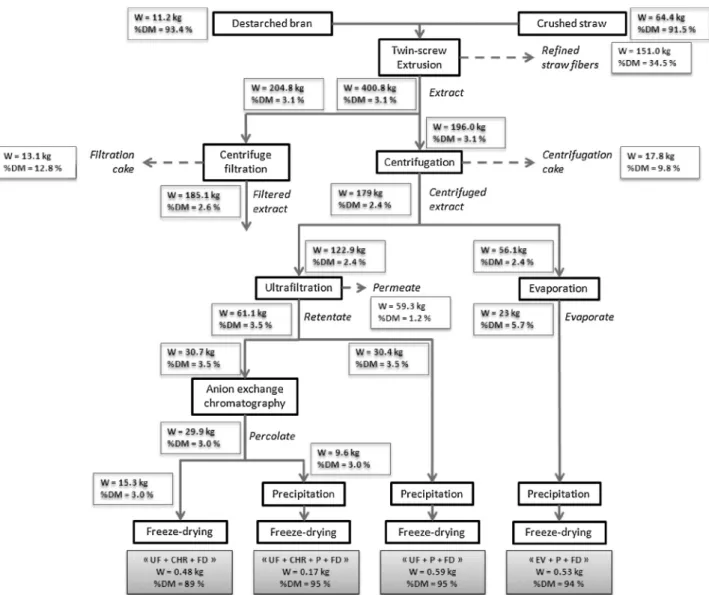
Fig. 2. Schematic representation of the processes evaluated. W = weight of matter involved in the unit process. %DM = percentage dry matter contained in the powder. EV = evaporation; UF = ultrafiltration; CHR = chromatography; P = precipitation; FD = freeze drying.
(negative values) and the b* value, that between yellow (positive values) and blue (negative values)[35]. All determinations were carried out in triplicate.
3. Results and discussion
3.1. General description of the process
The global fractionation scheme is presented inFig. 2. Pre-treatment (crushing and destarching), is first performed on a large quantity of straw and bran (64.4 and 11.2 kg respectively). Twin-screw extrusion is then carried out according to the conditions previously mentioned. During this fractionation step, thermal, mechanical and chemical actions are applied to the plant matter to extract molecules from the tissues by continuous squeezing in the screw press. Alkali/plant matter and straw/bran ratios, pH of the media, temperature, and screw rotation speed are thus crucial parameters[19]. The use of reverse pitch-screw elements induces a compression of the plant matter due to the decrease in the flow cross section. This phenomenon implies the formation of a dynamic plug at the end of the extruder, inducing compression, which improves the chemical action on the plant matter and leads to liquid–solid separation even with a low liquid–solid ratio. This step results in the production of two fractions; one solid, composed
of refined straw fibers, and the other liquid (extract), mainly con-taining water-soluble compounds. Although twin-screw extrusion combines extraction with a primary liquid–solid separation, remaining insoluble particles must be removed before the purifi-cation step. Two liquid–solid separation technologies have been investigated: centrifuge filtration and continuous centrifugation.
Purification of xylans is usually undertaken after evaporation (EV), by alcoholic precipitation (P). This option has been tested (named “EV + P + FD” in Fig. 2). However, because the costs of the precipitation step could hinder the industrial development of the process, substitution of this step by a combination of ultra-filtration (UF) and anion exchange chromatography (CHR), has also been examined. Here, ultrafiltration is also used to concen-trate the extract and freeze-drying is performed directly onto it (“UF + CHR + FD”). In order to evaluate the impact of each step on extract content, these have been precipitated and freeze dried after ultrafiltration (“UF + P + FD”) or precipitated and freeze dried after anion exchange chromatography (“UF + CHR + P + FD”).
3.2. Extraction
The twin-screw extruder provided a continuous fractionation process and the results are presented inTable 1. They show that extrusion allows an efficient liquid–solid separation by producing
Table 1
Composition of the different fractions before and after twin-screw extrusion.
Composition Straw Destarched bran Extract Refined straw fibers
Total mass used or produced (kg) 64.4 11.2 400.8 151.0
Dry matter flow rate (kg/h) 16.2 2.6 3.6 15.0
Dry matter (%) 91.5 93.4 3.1 34.5
Ash (wt% dry matter) 8.1 3.1 34.6 3.3
Organic matter (wt% dry matter) 91.9 96.9 65.4 96.7
Protein (wt% dry matter) 2.1 14.1 8.5 2.2
Cellulose (wt% dry matter) 39 15 n.d. 30
Hemicelluloses (wt% dry matter) 32 51 n.d. 28
Lignin (wt% dry matter) 9 6 n.d. 20
Total carbohydrates (wt% dry matter) 57.0 44.3 22.8 57.2
Arabinose 2.4 10.4 3.9 3.5 Xylose 22.2 18.7 9.0 21.5 Mannose 0.4 0.5 0.5 0.5 Galactose 0.8 1.0 0.8 0.8 Glucose 30.5 13.6 8.4 30.5 X/Aa 9.3 1.8 2.3 6.1 X/Ga 0.7 1.4 1.1 0.7
aX/A is the ratio between xylose and arabinose contents, X/G is the ratio between xylose and glucose contents.
two fractions: refined straw fibers, with a relatively high dry matter content (34.5%); and an extract containing mainly the water-soluble compounds (3.1% of dry matter content). The dry weight of the refined straw fiber fraction is composed mainly of cellu-lose (30%), hemicellucellu-loses (28%) and lignin (20%), which, apart from lignin content, are close to the initial straw composition (39%, 32% and 9% respectively). The carbohydrate composition of the refined straw fibers is also very similar to the initial straw composition, with about 30% glucose, 22% xylose and small amounts of galac-tose and mannose, with a slightly higher arabinose content. The X/G ratio is very similar (around 0.7) while the X/A ratio decreases from 9.3 in the straw to 6.1 in the refined straw fiber. The increase in the arabinose proportion suggests that bran residues contam-inate the straw fibers. This means that straw extraction remains low even if a part of its components could be co-extracted with those of the bran, and confirms that during twin-screw extrusion, straw is mainly needed to support bran material in the extruder to improve the liquid–solid separation. As bran is pre-soaked in alkali 1 h before the extrusion, hemicelluloses are mainly extracted from this[18,29].
Because of the large quantities of wash water introduced into the extruder, large amounts of extract are produced (400.8 kg) with low dry matter content. Similar results are usually found after extru-sion[19]. The dry matter of the extract is mainly composed of ash (34.6%), carbohydrates (22.7%), proteins (8.5%) and probably a frac-tion of lignin that was not determined. The extract X/A ratio, which is close to the bran ratio, confirms that hemicelluloses come mainly from bran. The extract also contains a large amount of glucose (8.4%) that comes from mixed linked-glucan that is co-extracted with xylans, but also from starch not removed by the destarching step.
Results obtained for the large-scale extrusion can be compared to results obtained for extraction in a stirred reactor, and for small-scale extrusion (Table 2).
Extrusion produces an extract containing a large amount of ash (34.6%), which comes from the considerable quantities of sodium hydroxide used during twin-screw extrusion (low bran/NaOH ratio). This value is smaller than in the extract obtained under stirred conditions, but is about 10% higher than the concentration obtained with small-scale twin-screw extrusion.
However, regarding final powder composition, results obtained on a large scale (several hours production) are very similar to those obtained on a small scale (20 min production). In fact, after pre-cipitation and freeze-drying, carbohydrates represent about 48% of the dry matter powder for both. This value is slightly lower com-pared to those obtained by extraction in a batch stirred reactor (52.0%) but similar to results obtained in another study[19], due
to the mechanical action of twin-screw extrusion which leads to the co-extraction of other molecules (e.g. proteins). Nevertheless, if only bran is considered, the organic matter yield is slightly higher in batch stirred conditions (35.0%) than during extrusion (29.3%), Mass balance indicates that a large part of the xylans, and also of the proteins, of the bran remains entrapped in the straw fiber. Thus, the produced raffinate presents interesting properties for biomaterial production as describe in a previous publication[36].
3.3. Liquid–solid separation
The liquid–solid separation step decreases the quantity of dry matter in the extract from 3.1% to about 2.5% (Table 3). This reduc-tion is mainly due to suspended material being removed, which is essential for the subsequent ultrafiltration step. And this implies a loss of organic matter, providing a yield of 61.7% for centrifugation and 67.6% for centrifuge filtration. The percentages of ash and pro-teins are increased while the sum of carbohydrates is decreased, showing that the particles in suspension are mainly composed of polysaccharides.
Concerning carbohydrate content, centrifuge filtration and cen-trifugation give quite similar results except for the arabinose and xylose that are slightly higher for centrifuge filtration (+0.4% and
Table 2
Comparison of large-scale extraction with previous results on a small scale, and using a stirred reactor.
Composition Extrusion Large scale Small scale [20] Stirred extraction[18]c Extract (after extraction)
Dry matter (%) 3.1 4.9 1.6
Ash (wt% dry matter) 34.6 23.1 54.0
Powders (after precipitation and drying)
Dry matter (%) 94.1 n.d. 93.0
Ash (wt% dry matter) 9.4 12.0 7.9
Protein (wt% dry matter) 12.9 14.1 5.0
Lignin (wt% dry matter) 10 18.4 n.d.
Total carbohydrates (wt% dry matter)
48.4 48.3 52.0
Organic matter yield (%) 29.3a/4.6b n.d. 35.0
X/A 2.8 2.1 1.9
aCalculation refers to bran, expressed as the dry weight of recovered matter in the extract/dry weight of this matter in bran.
bCalculation refers to (bran + straw), expressed as the dry weight of recovered matter in the extract/dry weight of this matter in (bran + straw).
c The results were obtained for stirred batch extraction of bran only with a liq-uid/solid ratio of 50, and a bran/NaOH ratio of 2.
Table3
Extract composition after centrifugation and centrifuge filtration.
Composition Extract
Total mass produced (kg) 400.8 Dry matter flow rate (kg/h) 3.6
Dry matter (%) 3.1
Ash (� dry matter) 34.6 Organic matter (wt% dry matter) 65.4
Protein (�dry matter) 8.5
Total carbohydrates (wtil: dry rnatter) 22.8
Arabinose 3.9
Xylose 9.0
Mannose 0.5
Galactose 0.8
Glucose 8.4
Organic matter yield (%)' (X+ A) yield (%)"
X/A' 2.3
XJG• 1.1
• Obtained with 196.0 kg from the 400.8 kg of extract. b Obtained with 204.8 kg from the 400.8 kg of extract.
Centrifuged extract 179.0• 4.5 2.4 42.9 57.1 10.3 19.9 3.0 6.9 0.4 0.6 8.9 61.7 61.9 2.3 0.8 Filtered extract 185.lb 0.5 2.6 41.6 58.4 10.9 20.8 3.4 7.5 0.3 0.7 8.8 67.6 69.8 22 0.9 ' Yield in organic matter of the centrifugation step ( content of organic matter in the extract after centrifugation/content of organic matter in the extract before centrifugation).
• (X+ A) is the sum of xylose and arabinose.
• X/A is the ratio between xylose and arabinose contents, X/Gis the ratio between xylose and glucose contents.
+0.6% respectively). Obviously, the liquid-solid separation involves
modification of the carbohydrate content of the extract. The galac
tose and mannose contents remain the same but a small decrease
in the arabinose fraction can be observed (-0.9% for centrifugation
and -0.5% for centrifuge filtration), as well as an increase in the
glucose fraction ( +0.5% and +0.4%). The most significant change con
cerns the xylose fraction that decreases from 9.0% to 6.9% (-2.1 %)
for centrifugation, and to 7.5% (-1.5%) for centrifuge filtration. Con
sequently, the X/G decreases from 1.1 to 0.8, which appears logical
because glucose content is increased while xylose is decreased. The
X/A ratio stays almost constant.
ln bath liquid-solid separation options. about 30% of ara
binoxylans are retained in the separation cake, indicating that
arabinoxylans are not only released in dissolved form, but also
linked to pieces of matter that are not dissolved.
Arabinoxylan yield is 61.9% for centrifugation and 69.8% for cen
trifuge filtration. This difference can be explained by the fact that
the centrifugation cake is more liquid because of frequent flushing
phases, which result in a higher loss in arabinoxylans. Centrifuge
filtration gives lower extract loss, and a better arabinoxylan yield.
However, the filtration cake has to be removed periodically by hand,
meaning that this step is not very efficient at this pilot process scale.
The difference in dry matter flow rate is significant ( 4.5 kg/h and
0.5 kg/h respectively): centrifugation is nine times more efficient
at treating the extract, showing that it is a better option in the
process design. Thus, the following results will only describe the
centrifugation option ( even though the extract from the centrifuge
filtration has in fact been fractionated using the same protocol as
centrifugation).
3.4. Concentration and purification
The concentration step is undertaken in order to reduce the
volumes to be treated, and therefore the costs of the subsequent
steps of the process
[2,26-28)
. Traditionally, concentration was
performed by evaporation, but ultrafiltration was also a well
established separation process in industry
(20)
, and membranes
can concentrate but also purify complex mixtures containing
polysaccharides. Law molecular mass solutes pass through the
membrane white large molecules are retained, allowing separation
of the arabinoxylans from co-extracted molecules. Therefore this
technique has been investigated for purification, especially dem
ineralization, in view of the large ash content of the centrifuged
extract ( 42.9%).
Ultrafiltration has been undertaken with a 30 kDa MWCO mem
brane, in the light of previous results
[ 18 )
. Membranes with a 10 kDa
MWCO are usually used in the literature, but this higher MWCO
has been selected because it allows bath, concentration of arabi
noxylans and partial demineralization, plus higher permeation flow
rates.
Firstly, membrane surface phenomena during ultrafiltration
were investigated, by studying the influence of the TMP on the per
meate flux when a steady state was reached. These measurements
were made at different circulation speeds (0.10, 0.12, 0.15, 0.23
and 0.27 m/s, corresponding respectively to 93, 114, 139, 209 and
247 kg/h extract circulation flow rates). This approach allows inves
tigation of the capability of ultrafiltration to achieve purification,
plus evaluation of possible membrane fouling.
The results (Fig. 3) showed increases in permeate flux with
transmembrane pressure (TMP) increase, but at the critical TMP,
a li mit permeate flux appears to be reached. lncreasing circulation
flow rate also increases permeate flux. These results indicate that
a polarization layer arises during filtration, created by the accumu
lation of retained molecules at the membrane surface, and acting
as an extra-resistance to permeate flow. Back-flushing allowed to
�u=0.10m/s-11-u = 0.23 m/s �u=0.12 m/s--u = 0.27 m/s �u=0.lSm/s
16.0
Ë
14.0 12.0 10.0 8.0 6.0 4.0 Il. 2.0--
/4
-/
-�
-
-
-�
/-
-O' / 0.0 0 0.5 1 1.5 2 2.5Transmembrane pressure (bar)
Fig. 3. Influence ofTMP and circulation flow rate on the permeate flux, during the ultrafiltration of the centrifuged extract, with complete recycling of the retentate and
Table 4
Composition of the extract after each concentration and purification step.
Composition Centrifuged extract Evaporate Retentate Percolate
Mass (kg) 179.0 23a 61.1b 29.9c
Dry matter (%) 2.4 5.7 3.5 3.0
Ash (wt% dry matter) 42.9 43.1 34.4 35.4
Organic matter (wt% dry matter) 57.1 56.9 65.6 64.6
Protein (wt% dry matter) 10.3 10.5 13.9 10.2
Total carbohydrates (wt% dry matter) 19.9 21.4 27.6 30.1
Arabinose 3.0 3.2 4.1 4.5 Xylose 6.9 7.4 10.0 11.1 Mannose 0.4 0.5 0.4 0.4 Galactose 0.6 0.6 0.8 0.8 Glucose 8.9 9.6 12.1 13.1 X/Ad 2.3 2.3 2.4 2.5
aObtained after evaporation of 56.1 kg of centrifuged extract. bObtained after ultrafiltration of 122.9 kg of centrifuged extract. c Obtained after percolation of 30.7 kg of retentate.
d X/A is the ratio between xylose and arabinose contents.
increase the permeate flux, by a factor of about 2, depending on the TMP, over a long period (more than two days). This result confirmed that fouling was not the main cause of the flux decline. Thus, the optimal conditions for concentration can be defined as the highest circulation flow rate (247 kg/h) with a pressure below the critical pressure (1.8 bars).
The centrifuged extract has been concentrated with a volume concentration rate of 2 by evaporation or ultrafiltration depend-ing on the process route. Only the ultrafiltration retentate has been percolated through the anionic resin (Fig. 2). The evaporated extract (evaporate) composition, and those of the extracts puri-fied by ultrafiltration alone (retentate), and ultrafiltration followed by anionic chromatography (percolate), are shown inTable 4. Con-cerning evaporation, concentration is effective since the dry matter content is about twice as high. Protein, ash and carbohydrate pro-portions remain stable and the recovery in dry matter is 97.4%. This low loss can be explained by the fact that very little extract is lost in the evaporation reactor.
Concentration by ultrafiltration reduces the ash content from 42.9% to 34.3%. The demineralization rate reaches 42.1% (weight of mineral content subtracted from the extract/weight of min-eral content of the extract introduced before ultrafiltration) and could be increased if the concentration was followed by a diafil-tration step[8]. The carbohydrates show a high recovery yield, meaning that the membrane is selective enough for this kind of compound. Thus, the carbohydrate concentration increases espe-cially for xylose, arabinose and glucose. All these results confirm that ultrafiltration can both concentrate and partially purify the extract. However, protein content increases showing that the mem-brane retains all large molecules. Two successive filtration steps
would therefore be required for polysaccharide purification: one to purify the extract from proteins, the other to evacuate the ash.
Percolation of the retentate on the resin induces a slight increase in ash, showing that the fixation mechanism is not ionic exchange. If it were, chloride ions would have been released from the resin and the ash proportion would have been higher. Studies were made to select the best decoloration resin. Under these pH con-ditions (the extract pH is high at 11), only strong anionic resin remained charged and could retain the charged lignin, and this resin also had a high backbone adsorption capacity, explaining why it was the most efficient. However, this treatment does not significantly change the carbohydrate composition, although it increases the purity. The actual L* values are as follows: 56.8 for (EV + P + FD), 58.9 for (UF + P + FD), 61.9 for (UF + CHR + P + FD) and 47.2 for (UF + CHR + FD). This L-value corresponds to the brightness of the powder, the higher the L value, the whiter the powder. The figures show that ultrafiltration and chromatography remove col-ored compounds, but that this combination is less efficient than the precipitation step.
The objective of this part was to study the possibility of replac-ing evaporation and alcoholic precipitation by a combination of ultrafiltration and anion exchange chromatography. Thus, after each step of the process, the purified extract has been freeze dried in order to evaluate the composition of the powder obtained, and the influence of each purification step on the composition of the final powder is given in Table 5. Direct precipitation of the extract after evaporation (EV + P + FD) leads to the production of a powder containing 90.6% organic matter, and the latter is mainly composed of carbohydrates (48.4%). Precipitation is a selective technique for separating large and small molecules, and therefore
Table 5
Composition of powders for each process route.
Composition EV + P + FD UF + P + FD UF + CHR + P + FD UF + CHR + FD
Mass (kg) 0.53 0.59 0.17 0.48
Dry matter (%) 94.1 95.5 95.4 89.6
Ash (wt% dry matter) 9.4 5.5 5.2 15.7
Organic matter (wt% dry matter) 90.6 94.5 94.8 84.3
Protein (wt% dry matter) 12.9 15.6 13.5 8.3
Lignin (wt% dry matter) 12.7 24.7 23.3 10.2
Total carbohydrates (wt% dry matter) 48.5 46.7 50.7 28.0
Arabinose 6.4 6.6 7.1 3.9 Xylose 17.8 17.6 18.8 10.0 Mannose 0.4 0.3 0.3 0.4 Galactose 1.1 1.2 1.2 0.7 Glucose 22.5 20.7 23.0 12.8 X/Aa 2.8 2.7 2.6 2.6
Table 6
Production and purification yields for each process route.
Yields EV + P + FD UF + P + FD UF + CHR + P + FD UF + CHR + FD Dry matter (%)a 30.9 32.3 28.5 47.2 Organic matter (%)a 29.3 31.7 27.9 39.6 (X + A) (%)a,c 25.7 24.6 25.4 24.3 Dry matter (%)b 4.7 4.9 4.3 7.2 Organic matter (%)b 4.6 5.0 4.4 6.4 (X + A) (%)b,c 4.5 4.3 4.4 4.2
(X + A) purityd(wt% dry matter) 24.1 24.2 25.9 13.9
Purification yield (%)e 88.1 93.4 87.2 77.8
aCalculation refers to bran, expressed as the dry weight of recovered matter in the powder/weight of this matter in bran.
b Calculation refers to (bran + straw), expressed as the dry weight of recovered matter in the powder/weight of this matter in (bran + straw). c (X + A) is the sum of xylose and arabinose.
d Content of (X + A) in the powder (wt% dry matter).
ePurification yield is the yield in (X + A) for the combination: (EV + P + FD), (UF + P + FD), (UF + CHR + P + FD) and (UF + CHR + FD).
for removing salts, but in this case it leads to the recovery of all the large molecules, i.e. the proteins (13.5%) and the lignins (23.3%). The monomeric sugars recovered are mainly glucose, arabinose and xylose. As glucose is retained, it can be assumed that here it is derived from a large polymer, starch or glucomannans for example. Ultrafiltration is an efficient tool for demineralization (UF + P + FD and UF + P + CHR + FD), reducing the ash content from 9.4% to 5.5%, but it does not change carbohydrate purity.
Chromatography (UF + P + CHR + FD) increases the purity of the extract recovered after precipitation, by reducing the protein and lignin content (from 15.6% to 13.5% and from 24.7% to 23.3% respec-tively).
The process combining ultrafiltration, chromatography and freeze-drying without involving ethanolic precipitation (UF + CHR + FD), leads to the production of a powder containing 1.7% ash. The organic fraction is composed of carbohydrates (28.0%) but also of protein (8.3%). The unidentified part of this fraction is considerable, but is composed of all the small molecules that are not recovered during precipitation. These results clearly indicate that ultrafiltration and anion exchange chromatography have a similar action to alcoholic precipitation, but that their efficiency is too low to be introduced instead of ethanolic precipitation.
For the classical process (EV + P + FD), the production yield is 25.7% in (X + A) and 29.3% in organic matter (Table 6). The recov-ery yield in arabinoxylans is high, considering the short residence time of the plant matter in the twin-screw extruder, but lower than the yields obtained with batch extraction[16]. Furthermore, extrusion is an unselective process and leads to the co-extraction of other molecules apart from arabinoxylans, with a high recovery yield. Thus, when combined with ultrafiltration, chromatography and precipitation, the extrusion process leads to a powder with an arabinoxylan purity of 25.9% maximum.
Ultrafiltration is an efficient tool for concentration of arabinoxy-lans, with a (X + A) yield of almost 100%, very similar to evaporation. Nevertheless, it also increases the protein content. Chromatogra-phy allows removal of the colored molecules but does not change the recovery yields, and the arabinoxylan powder purity remains the same. Therefore, the use of ultrafiltration and anion exchange chromatography before ethanolic precipitation does not change the recovery yield and only increases arabinoxylan purity by less than 2%.
However, a process without ethanolic precipitation (UF + CHR + FD) leads to a very similar (X + A) recovery yield (24.3%), but increases the organic recovery yield (39.6%), and thus the purity of the powder is twice as low as in the case of precip-itation (13.9% instead of 25.9%). A process without precipprecip-itation appears to be possible but would require an extra step to separate protein and hemicelluloses.
The typical lignocellulose refinery scenario is based on the prod-uct streams that (1) all isolated sugars are used to produce cellulosic
ethanol or biobased products, and (2) all the residues, including lignin and residual cellulose, are used as burning fuels to gener-ate steam and electricity. According to[37]three large obstacles to profitable biomass biorefineries are (1) high processing costs, (2) huge capital investment ($4–10/gallon of annual ethanol pro-duction capacity), and (3) a narrow margin between feedstock and product prices. Considering $50/ton for feedstock, it is a great challenge that the narrow margin between cellulosic ethanol and feedstock ($95/ton, i.e., $1.20–1.30/gallon of ethanol) will pay off the sum of capital depreciation ($4–10 capital investment per gallon of annual ethanol production), processing costs (steam, enzyme, electricity, etc.), and operating costs. Biorefinery designers must take advantage of synergies between the production of both biofuels and high-value biobased products because the latter would enhance the economy of biomass biorefineries. Complete utiliza-tion of the biomass: glucose to ethanol, xylose and other minor sugars for high-value products, lignin for polymeric materials, and acetic acid as a commodity can completely change the profits linked to the process. With such a scenario, the potential revenues of biore-fineries could be $145/ton of corn stover[37]. Such valorization could pay off costs of technology like ion chromatography in the purification process. Chromatography is used for beer stabilization through the removal of the phenolic compounds, at price similar to membrane filtration processes[38]. Membrane filtration cost has been evaluated at laboratory scale, and indicated that the pro-duction price would be about 0.7D /kg of xylans[39], which would correspond to 21D /ton of treated corn stover according to previous data[29].
4. Conclusions
The aim of this work was to evaluate at large scale the perfor-mance of a continuous hemicelluloses production process. From the experiments, it appears that extrusion is an interesting continu-ous process for lignocellulosic plant fractionation. After twin-screw extrusion, a part of the released molecules is still in particulate form that can be removed by liquid–solid separation.
The purification of the extract has been evaluated by combina-tion of ultrafiltracombina-tion and industrial chromatography and compared to the classic evaporation/precipitation process. Ultrafiltration appears to be an efficient alternative to evaporation, since it allows both concentration and purification. Ultrafiltration could be there-fore used instead of evaporation bethere-fore any other purification step like precipitation. Chromatography is efficient at decoloring the extract, and purifying it from proteins. This step is very specific to organic molecules and could be used for lignin and derivatives recovery.
The combination of ultrafiltration and chromatography without the ethanolic precipitation step, leads to the production of powders
with a high salt content and also proteins and lignins. This process remains attractive because demineralization could be improved by diafiltration before the concentration step and thus would increase the powder purity. Finally, from these results it appears that the laboratory scale purification technology of alcoholic precipitation could be replaced by a combination of ultrafiltration and chromato-graphic steps.
As proteins remain with xylans in the retentate, during ultra-filtration with the 10 kDa membrane, it should be interesting to evaluate the protein/hemicelluloses separation by ultrafiltration with a membrane with a higher MWCO. Furthermore, as part of the hemicelluloses remained entrapped in the solid residue, an extra liquid–solid extraction step will evaluated in order to increase the xylan recovery yield. This washing step would also produce a purer cellulosic residue that could be therefore useful for high value added biomaterial instead of particleboards.
Acknowledgment
The French National Research Agency (ANR) is gratefully acknowledged for the financial support allocated to the VAL-OWHEAT project.
References
[1]Fang JM, Sun RC, Salisbury D, Fowler P, Tomkinson J. Comparative study of hemicelluloses from wheat straw by alkali and hydrogen peroxide extractions. Polym Degrad Stab 1999;66(3):423–32.
[2]Andersson A, Persson T, Zacchi G, Stålbrand H, Jönsson AS. Comparison of diafiltration and size-exclusion chromatography to recover hemicelluloses from process water from thermomechanical pulping of spruce. Appl Biochem Biotechnol 2007;137–140(1):971–83.
[3]Spiridon L, Popa VI. Hemicelluloses major sources, properties and applica-tions. In: Naceur Belgacem M, Gandini A, editors. Monomers, polymers and composites from renewable resources. Amsterdam: Elsevier Science; 2008. p. 289–304.
[4]Ebringerová A, Hromádková Z. Effect of ultrasound on the extractibility of corn bran hemicelluloses. Ultrason Sonochem 2002;9(4):225–9.
[5]Hromàdkovà Z, Ebringerovà A. Ultrasonic extraction of plant materials inves-tigation of hemicellulose release from buckwheat hulls. Ultrason Sonochem 2003;10(3):127–33.
[6]Sun JX, Sun R, Sun XF, Su Y. Fractional and physico-chemical characterization of hemicelluloses from ultrasonic irradiated sugarcane bagasse. Carbohydr Res 2004;339(2):291–300.
[7]Glasser WG, Wright RS. Steam-assisted biomass fractionation. II. Fraction-ation behavior of various biomass resources. Biomass Bioenergy 1998;14(3): 219–35.
[8]Glasser WG, Kaar WE, Jain RK, Sealey JE. Isolation options for non cellulosic heteropolysaccharides (HetPS). Cellulose 2000;7(3):299–317.
[9]Sun XF, Sun RC, Fowler P, Baird MS. Extraction and characterization of original lignin and hemicelluloses from wheat straw. J Agric Food Chem 2005;53(4):860–70.
[10]Puls J, Saake B. Industrially isolated hemicelluloses. In: Gatenholm P, Tenkanen M, editors. Hemicelluloses: science and technology. Washington: American Chemical Society; 2004. p. 387.
[11]Derriche R, Berrahmoune KS. Valorisation of olive oil cake by extraction of hemicelluloses. J Food Eng 2007;78(4):1149–54.
[12]Sun R, Lawther JM, Banks WB. Influence of alkaline pre-treatments on the cell wall components of wheat straw. Ind Crops Prod 1995;4(2):127–45. [13]Curling SF, Fowler PA, Hill CAS. Development of a method for the
produc-tion of hemicellulosic gels from Sitka spruce. Carbohyd Polym 2007;69(4): 673–7.
[14]Sun RC, Tomkinson J, Wang YX, Xiao B. Physico-chemical and structural charac-terization of hemicelluloses from wheat straw by alkaline peroxide extraction. Polymer 2000;41(7):2647–56.
[15]Annison G, Choct M, Cheetham NW. Analysis of wheat arabinoxylans from a large-scale isolation. Carbohyd Polym 1992;19(3):151–9.
[16]Bataillon M, Mathaly P, Nunes Cardinali AP, Duchiron F. Extraction and purifi-cation of arabinoxylan from destarched wheat bran in a pilot scale. Ind Crops Prod 1998;8(1):37–43.
[17]Swennen K, Courtin CM, Lindemans GCJE, Delcour JA. Large-scale production and characterisation of wheat bran arabinoxylooligosaccharides. J Sci Food Agric 2006;86(11):1722–31.
[18]Zeitoun R, Pontalier PY, Marechal P, Rigal L. Twin-screw extrusion for hemi-cellulose recovery: influence on extract purity and purification performance. Bioresour Technol 2010;101(23):9348–54.
[19]Singkhornat S, Lee SG, Ryu GH. Influence of twin-screw extrusion on sol-uble arabinoxylans and corn fiber gum from corn fiber. J Sci Food Agric 2013;93:3046–54.
[20]Maréchal P, Jorda J, Pontalier PY, Rigal L. Twin screw extrusion and ultrafil-tration for xylan production from wheat straw and bran. In: Gatenholm P, Tenkanen M, editors. Hemicelluloses: science and technology. Washington: American Chemical Society; 2004. p. 864, 38–51.
[21]Montané D, Farriol X, Salvado J, Jollez P, Chornet E. Fractionation of wheat straw by steam-explosion pretreatment and alkali delignification. cellulose pulp and byproducts from hemicellulose and lignin. J Wood Chem Technol 1998;18(2):171–91.
[22]Gilarranz MA, Rodriguez F, Oliet M, Revenga JA. Acid precipitation and purifi-cation of wheat straw lignin. Sep Sci Technol 1998;33(9):1359–77.
[23]Swennen K, Courtin CM, Van der Bruggen B, Vandecasteele C, Delcour JA. Ultra-filtration and ethanol precipitation for isolation of arabinoxylooligosaccharides with different structures. Carbohyd Polym 2005;62(3):283–92.
[24]Garcia-Ochoa F, Santos VE, Casas JA, Gomez E. Xanthan gum: production, recov-ery and properties. Biotechnol Adv 2000;18:549–79.
[25]Jorda J, Marechal P, Rigal L, Pontalier PY. Biopolymer purification by ultrafiltra-tion. Desalination 2002;148(1–3):187–91.
[26]Nabarlatz D, Torras C, Garcia-Valls R, Montané D. Purification of xylo oligosaccharides from almond shells by ultrafiltration. Sep Purif Technol 2007;53(3):235–43.
[27]Persson T, Jönsson AS. Isolation of hemicelluloses by ultrafiltration of thermo-mechanical pulp mill process water–Influence of operating conditions. Chem Eng Res Des 2010;88(12):1548–54.
[28]Schlesinger R, Götzinger G, Sixta H, Friedl A, Harasek M. Evaluation of alkali resistant nanofiltration membranes for the separation of hemicellu-lose from concentrated alkaline process liquors. Desalination 2006;192(1–3): 303–14.
[29]Jacquemin L, Zeitoun R, Sablayrolles C, Pontalier PY, Rigal L. An “eco”- concep-tion of arabinoxylan extracconcep-tion and purificaconcep-tion from wheat straw and bran. Process Biochem 2011;47(3):373–80.
[30] Rigal L, Ioualalen R, Gaset A. Method for obtaining a starch-free bran extract, a refined product and material resulting from this method. World patent. WO/1998/031713.
[31]Sosulski FW, Imafidon GI. Amino acid composition and nitrogen-to-protein conversion factors for animal and plant foods. J Agric Food Chem 1990;38(6):1351–6.
[32]Englyst HN, Cummings JH. Improved method for measurement of dietary fiber as non-starch polysaccharides in plant foods. J Assoc Off Anal Chem 1988;71(4):808–14.
[33]Van Soest PJ, Wine RH. Use of detergents in the analysis of fibrous feeds. J Assoc Off Anal Chem 1967;50:50–6.
[34]Van Soest PJ, Wine RH. The determination of lignin and cellulose in acid deter-gent fiber with permanganate. J Assoc Off Anal Chem 1968;51:780–7. [35] Yang L, Akimoto M, Miyakawa M. Development of an imaging colorimeter for
skin color measurement and its clinical application. In: Proceedings of AIC 2003 Bangkok: Color communication and management; 2003. p 186.
[36]Rouilly A, Rigal L. Agro-materials: a bibliographic review. J Macromol Sci, Part C: Polym Rev 2002;42(4):441–79.
[37]Percival-Zhang YH. Reviving the carbohydrate economy via multi-product log-nocellulose biorefineries. J Ind Microbiol Biotechnol 2008;35:367–75. [38]Ottens S, Chilamkurthi S. Advances in process chromatography and
applica-tions in the food, beverage and nutraceutical industries. In: Syed SH, Rizvi WP, editors. Separation, extraction and concentration processes in the food bev-erage and neutraceutical industries. Cambridge: Woodhead Publishing; 2010. p. 109–47.
[39]Persson T, Nordin A-K, Zacchi G, Jönsson A-S. Economic evaluation of isolation of hemicelluloses from process streams from thermochemical pulping of spruce. Appl Biochem Biotechnol 2007;136–140:741–52.