To link to this article : DOI :
10.1016/j.euroecorev.2016.02.006
URL :
https://doi.org/10.1016/j.euroecorev.2016.02.006
To cite this version :
Attanasi, Giuseppe and Hopfensitz, Astrid and
Lorini, Emiliano and Moisan, Frédéric Social connectedness improves
co-ordination on individually costly, efficient outcomes. (2016)
European Economic Review, vol. 90. pp. 86-106. ISSN 0014-2921
O
pen
A
rchive
T
OULOUSE
A
rchive
O
uverte (
OATAO
)
OATAO is an open access repository that collects the work of Toulouse researchers and
makes it freely available over the web where possible.
This is an author-deposited version published in :
http://oatao.univ-toulouse.fr/
Eprints ID : 18999
Any correspondence concerning this service should be sent to the repository
administrator:
[email protected]
Social connectedness improves co-ordination on individually
costly, efficient outcomes
Giuseppe Attanasi
a,n, Astrid Hopfensitz
b, Emiliano Lorini
c, Frédéric Moisan
daBETA, Université de Strasbourg, France bToulouse School of Economics, France cIRIT, Université Paul Sabatier, France dUniversity of Cambridge, England
Keywords: Social ties Group identity Coordination Experiment a b s t r a c t
We study the impact of social ties on behavior in two types of asymmetric coordination games. Social ties are varied by making players interact with partners from different in-groups (fellow members of their own sports team, members of their sports club, students of their university). Subjective social ties are further measured by direct questionnaires. We find that smaller and more salient in-groups lead to significantly more group bene-ficial choices. The same effect is observed for players that report high values of their subjective social ties. We discuss the implication of these results for theories assuming that socially tied individuals follow some group beneficial reasoning.
1. Introduction
This paper analyzes behavior in asymmetric coordination games for different levels of social ties between players. Behavior in interactions requiring coordination is intrinsically difficult to predict. While participants in coordination problems clearly prefer to coordinate, reaching this state in the absence of communication is not trivial. Focal points help
in symmetric games but might not be strong enough when games are asymmetric (Crawford et al., 2008). Incidentally
human interactions are never completely void of information about interaction partners. When we interact with others, we take into account people's nationality, gender, political preferences, or favorite sports team. Group membership of others leads us to anticipate certain behaviors or influences our concerns for their welfare. These effects have, over the last years, received increased attention in economics and psychology. Specifically, recent experimental evidence has
investigated the importance of a joint social identity on coordination among multiple Pareto ranked equilibria (Chen and
Li, 2009).
The importance of social identity in economics has been pointed out by the seminal work ofAkerlof and Kranton (2000).
Social identity theory is based on the assumption that an individual is not characterized by one unique ‘personal self’, but rather by many ‘selves’ that correspond to overlapping circles of group identities. Different cues might trigger the
indivi-duals to act and feel on their personal, family or national ‘level of self’ (Turner et al., 1987). While social identity theory
clearly considers the importance of different levels or ‘strengths’ of social identity, the main experimental approach has
http://dx.doi.org/10.1016/j.euroecorev.2016.02.006
nCorresponding author at: Address: 61 Avenue de la Forêt Noire, 67085 Strasbourg, France. Fax: þ33 (0)3 68 85 20 70.
focused on identifying a ‘minimal group’ level, which allows us to observe discriminatory behavior.1Since the seminal work
byTajfel et al. (1971), results support the idea that even minimal group membership enhances behavior beneficial to group members, sometimes at the expenses of the out-group (i.e., people who are not members of the group).
A reasonable assumption is that the strength of a social tie between two individuals can be described through the level with which each of them commonly identifies with the same group(s). This interpretation relies on a gradual type of group identi-fication that extends the binary in-group/out-group classiidenti-fication presented above (one may instead identify with a given group up to a certain degree). In this case, the question is how behavior is changed when we interact with a person we know very well compared to an acquaintance, or a person we are only minimally tied with (e.g., a perfect stranger). What to expect is not immediately obvious. Stronger ties with others might lead to better predictions of others' intentions. For example, a stronger tie between two individuals might influence their concerns for each other's outcomes according to existing theories of social preferences (e.g.,Charness and Rabin, 2002;Fehr and Schmidt, 1999), which all assume individual intentions (what should I do?) to maximize the overall benefit of the group. Alternatively, stronger connectedness might induce another type of reasoning that
focuses on collective intentions (what should we do?) to reach the same group beneficial outcome (e.g.,Bacharach, 1999;Sugden,
2000,2003). Finally, a stronger social tie between two individuals might enforce some commonly known external norms, such
that the cost for deviating from them increases (Goette et al., 2012): not conforming to an in-group norm may lead one to
identify more as an out-group member and consequently deteriorate the quality of the social relationship.
Recent experimental evidence has observed that, for the case of symmetric games, an ‘enhanced’ minimal group paradigm
enables coordination among multiple Pareto ranked equilibria (Chen and Chen, 2011). Similarly,Gaechter et al. (2012)
observe that players scoring higher on a psychological measure of shared identity (‘one’-ness) are more likely to coordinate
on high effort levels in a weakest link game. Furthermore,Charness et al. (2007)have shown that coordination can increase
in a battle of the sexes game when a ‘host’ player (in-group member) interacts with a ‘guest’ player (out-group member). In this case, making these roles salient to the players (when they are both observed by the host's in-group members) leads coordination to favor an ‘aggressive’ host who faces a more ‘accommodating’ guest.
Asymmetric games have however not been investigated for the case of different levels of connectedness among interacting players. Yet stronger connectedness might favor coordination on outcomes that are considered as better for the group. For example, take a battle of the sexes game that does not offer symmetric payoffs dependent on which outcome the players agree on. Consider the classical example of Ann and Bob who have to choose between going to the opera or to a football game. Though Ann might prefer the opera and Bob the football game, Ann might have a higher utility from the football game than Bob from the opera. Thus the overall efficiency for the couple is higher when they coordinate on the football game.
In this paper, we study with an experiment how the level of connectedness with others influences coordination in asymmetric battle of the sexes games, where coordination comes at a cost for the individual. We investigate this effect in two games: an asymmetric battle of the sexes game (baseline game) and an extension of this game where, due to the presence of an outside option, one player has to make a conscious choice to enter the battle of the sexes game (entrance game). The entrance game enables us to investigate how social connectedness influences the interpretation of moves by the other.
Objective social ties are varied by making players interact with partners from different in-groups: fellow members of their own sports team, members of their sports club, students of their university. Sports team are exogenously assigned, according to gender and skill at playing volleyball. In this regard, our experimental design is different from other studies on
social ties where groups are formed endogenously (Leider et al., 2009;Goeree et al., 2010), while instead it shares features
with studies where groups are randomly assigned (Goette et al., 2012) or differ in terms of members’ characteristics
(Fershtman and Gneezy, 2001). Subjective social ties are further measured by direct questionnaires. These questionnaires are aimed at eliciting a subject's perceived self-connectedness to the group and perceived ties between other team members. Our results show that even in asymmetric games where one player has to accept an individual cost, coordination on a group beneficial outcome is increased with both stronger objective ties and stronger subjective ties. Higher social con-nectedness indeed enhances the focal value of such group beneficial outcome.
The rest of the paper is organized as follows.Section 2clarifies the concept of a social tie that we consider.Section 3presents the two versions of the asymmetric battle of the sexes game (the baseline and entrance game) studied in this paper. We further discuss how social ties are measured. Specifically we distinguish between objective ties (which refer to the type of partners a subject interacts with) and subjective ties (which correspond to a subject's own perception about social relationships within a
group). Section 4 gives the procedures of the experiment and Section 5 presents results from both coordination games,
depending on each type of social ties (objective and subjective).Section 6discusses the theoretical implications of our results.
2. Defining social ties
The concept of social ties that we consider relies on social identity theory (Tajfel and Turner, 1979;Hogg, 2003), according to which an individual's social identity is built upon a set of social features, each referring to a salient characteristic that can
1
Primarily based on this ‘minimal group paradigm’, a large body of evidence has been collected in psychology (e.g.,Brewer, 1979,1999;Tajfel and Turner, 1979) and in economics (e.g.,Bernhard et al., 2006;Buchan et al., 2006;Chavanne et al., 2011;Goette et al., 2012) on in-group vs out-group behavior.
be shared by individuals in a particular context (e.g., one may identify himself as a student of a specific university, a member of a particular sports club, a member of a political party, etc).
However, departing from this theory, we assert that the minimal criterion for the existence of a social tie between two individuals is for them to commonly believe that they share the same social features that define their social identities (Attanasi et al., 2014). Such a requirement clearly distinguishes social ties from unilateral ties where a person's perceived closeness with another may not be reciprocated (feeling close to someone, e.g., a political figure, is insufficient to be described as a social tie).
Beyond this basic definition, an important property of social ties lies on their quantitative aspect: two individuals can indeed be more or less socially connected with one another. In this case, we argue that the strength of a tie can be determined based on the quantity and importance of the social features that are shared by the two persons. Intuitively, sharing more social features of high importance (as commonly perceived by the two individuals) leads to a stronger social tie. This reasonable statement characterizes an informational dimension of social ties, in the sense that two individuals can be more socially connected simply by commonly acquiring relevant information about each other's social identities.
However, we believe that there exists another important aspect influencing the strength of a social tie between two individuals: the quantity and quality of past interactions between them. Indeed, a tie between two persons can reasonably become stronger if they interact frequently and/or share positive meaningful experiences (e.g., exchanging ideas, opinions, emotions, etc.) with each other. This characterizes an experiential dimension of social ties.
In this study, we aim at testing the effects of these two factors by (1) exogeneously manipulating individuals' knowledge about each other's social identities (objective social ties), and (2) measuring their own perception of social closeness with one another (subjective social ties).
3. Experimental design
In the following, we will introduce two coordination games to study social ties: the first is a variant of the battle of the sexes game that we call the ‘baseline game’; the second extends the previous game by adding an outside option and is named the ‘entrance game’.
3.1. The baseline game
The coordination game that we consider as baseline is an asymmetric battle of the sexes game. It is a simultaneous move game with two players (1 for row and 2 for column), each of which has to choose between two available actions, A and B.
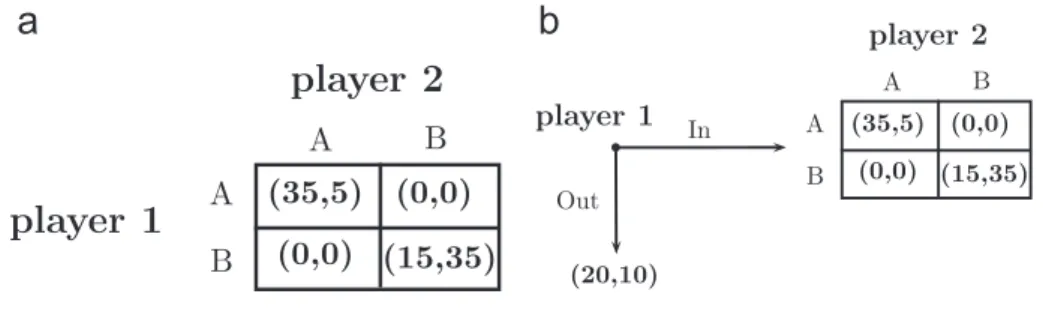
The corresponding payoff matrix is represented inFig. 1(a). As in the traditional battle of the sexes game, the worst scenario
for both players is to miscoordinate (i.e., playing A while the other plays B or vice versa). Furthermore, the players have diverging preferences regarding the best outcome for themselves: player 1 prefers coordination on (A,A) while player 2 prefers coordination on (B,B). However, unlike the classical battle of the sexes game, the lowest payoff is different in the two coordination outcomes: outcome (B,B) is worth more to player 1 than outcome (A,A) is worth to player 2.
In spite of this difference, the game theoretic properties of this asymmetric battle of the sexes game remain as in the classical
case: (A,A) and (B,B) are the only Nash equilibria in pure strategies, which also are the only Pareto optimal outcomes.2
The main feature of this game lies on the impact of group preferences on players' behavior. As in the classical battle of the sexes game, being self-interested is not sufficient to guarantee coordination success. However, in our asymmetric game, one can notice the existence of a unique group beneficial outcome, which is not present in the classical battle of the sexes game: out of the two Nash equilibria in pure strategies, the outcome (B,B) seems better for the group. Whether one considers the sum, the average, or the minimum value among the individual payoffs as a measure of the group's utility, this outcome
Fig. 1. Baseline and entrance game.
2There also exists a Nash equilibrium in mixed strategies, which consists of playing A with probability 7/8 for player 1 and playing B with probability
always outperforms every other solution. In fact, the asymmetry in the players' payoffs provides a clear possibility of favoring the group as a whole, at the same time allowing players to maximize their self interest (any coordination is always better than miscoordination). Both players may then consider this salient solution as a coordination device. However, one should note that, as the corresponding solution (B,B) favors player 2 more than it favors player 1 (what is best for the group is also best for player 2), coordination is not guaranteed. We will investigate whether participants in the role of player 1 detect and follow the salient outcome (B,B), and which factors weaken or strengthen the focus on it.
3.2. The entrance game
We extend the baseline game presented above to the ‘entrance game’ by adding an outside option (see Fig. 1(b)), i.e.
asymmetric battle of the sexes game with outside option. In this two-player game, prior to playing the coordination game itself, player 1 is offered the possibility of a fixed outside option. If he chooses to enter the coordination game (play ‘In’) both players play the asymmetric battle of the sexes game as described in the previous section. If he takes the outside option (play ‘Out’), the game ends with player 1 earning 20 and player 2 earning 10.
The outside option makes participation in the coordination game a voluntary decision by player 1. Entering the game can therefore be interpreted as a signal to play a certain strategy. How this signal is interpreted will depend on player 2's beliefs about player 1's motivations: specifically, if player 1 is expected to be self-interested or to take the group interest into account. Before expanding this forward induction argument, let us notice that the entrance game contains three Nash equilibria in
pure strategies: ((In,A),A), ((Out,A),B), ((Out,B),B).3 Considering subgame perfect Nash equilibria by backward induction
allows us to rule out the solution ((Out,A),B).4
Forward induction then allows us to restrict the set of subgame perfect Nash equilibria to those solutions that survive the iterated elimination of weakly dominated strategies. Initially player 1's strategy (In,B) is weakly (and strictly) dominated by any strategy involving Out. Then player 2's strategy B becomes weakly dominated by A. Thus player 1's strategies (Out,A) and (Out,B) are both weakly (and strictly) dominated by (In,A). Therefore, the unique forward induction solution is ((In,A),A). Indeed, assuming common knowledge that both players are fully rational and motivated by their own self interest, this solution should be played. When playing In, player 1 signals that he intends to play A in the subgame (if he intended to play B, he would have been better off playing Out in the first place). Therefore, as a best response, player 2's unique rational move
is to play A. Finally, since outcome ((In,A),A) is better for player 1 than selecting Out, he chooses (In,A).5This therefore
suggests that such a game introduces some ‘first mover’ advantage, assuming there is common knowledge that both players
are self-interested agents.6 Let us also point out that such a forward induction argument has already received wide
experimental support in the literature (e.g., Brandts and Holt, 1989;Cooper et al., 1992, 1993; Van Huyck et al., 1993;
Balkenborg, 1994;Brandts and Holt, 1995;Cachon and Camerer, 1996;Shahriar, 2014).
However, if players focus on some collective goals and expect others to do the same, entering the subgame will be associated with a choice of B. As a result, stronger social ties with a group might lead to either effect: a stronger belief in individual rationality of partners that are more identifiable (group members) or a stronger belief in collective rationality by group members. In the former case, ((In,A),A) will be played. In the latter case the outcome will be ((In,B),B).
Specifically, the entrance game will enable us to observe if players linked by stronger social ties are more likely to expect coordination in the subgame and therefore more likely to enter the second stage of the game (when acting as player 1). In turn, reactions by player 2 will allow us to investigate whether and how – via coordination on either (A,A) or (B,B) – this intention is understood. The baseline game will serve us as control to see whether the first stage is always needed to signal intentions. 3.3. Varying social ties
We vary the strength of social ties by considering partners that come from more or less strongly linked ‘in-groups’. This
manipulation aims at controlling for the informational dimension of social ties introduced inSection 2. More precisely, we
investigate three levels of ‘in-groups’ (objective ties).
The weakest level of social ties concerns our treatment university. In this treatment, participants know that they will interact with a fellow student from their own university. Note that this is the default in most laboratory experiments and therefore the possibility of social ties between such participants is assumed to be minimal.
Our strongest level of social ties concerns our treatment team in which two players from the same volleyball team interact. A team consisted of 7–9 players and met at least once per week for a two-hour training session. Note that inter-actions were anonymous in the sense that no participant could identify his interaction partner from the game. However it was common knowledge that both participants were members of the same team.
3Moreover, the entrance game also has Nash equilibria in mixed strategies, which consist of player 1 always playing Out (i.e., selecting either strategy
(Out,A) or strategy (Out,B) with probability 1) and player 2 playing B with probability 3/7.
4
There also exists a Nash equilibrium in behavioral strategies, which consists of player 1 always choosing Out first and playing B with probability 1/8 in the subgame; while player 2 plays B with probability 7/10.
5No Nash equilibrium in mixed/behavioral strategies does resist this forward induction argument.
A third treatment gives some intermediate level of social ties: club. Here both participants were members of the same volleyball club, but not playing in the same team. The club had around 70 members and members might interact before and after training with players that were not from their own team.
We further elicited through questionnaires how well the players saw themselves linked to their teammates and how they considered the relationship between their teammates. We use these subjective measures to determine social ties through
their experiential dimension as presented in Section 2. More specifically, participants responded to two types of scales
(subjective ties).
The first scale (direct scale) asked with respect to each team member ‘how do you think this person feels about you?’ (seeFig. 7in the Appendix for an example). Participants could choose between ‘likes me a lot’, ‘likes me’, ‘dislikes me’ and ‘is
indifferent’.7Answers to this measure allow us to determine how well the individual feels ‘liked’ and thus connected to his
team (index of subjective connectedness of the self to the group). Specifically, for every participant i, the corresponding coefficient of i's belief about self connectedness to the group G (iAG) is determined by:
kSi¼ Ni jGj $ 1
where jGj denotes the size of the team and Nidefines the number of individuals in G that participant i believes to strongly like
him. Specifically, Niindicates how many times the answer ‘the other likes me a lot’ was selected by i in the questionnaire. Note
that kS
i simply stands for the probability that individual i interacts with a person he believes to strongly like him.
Let us also define the average self connectedness KSwithin the group G as follows:
KS¼ P i A Gk S i jGj
We will use this measure later to determine whether an individual scores more or less high concerning beliefs about his own popularity compared to his team mates.
The second scale (indirect scale) aimed at eliciting ties between team members as perceived by the participant. To do so, each participant i was asked to indicate for any two members of his team whether he considered them to be ‘friends’ (for an
example, seeFig. 8in the Appendix). The scale was presented in a visual intuitive form with all team members' photographs
arranged in a circle, where participants were asked to indicate by a line any two members they thought to be friends
(excluding themselves).8In the example fromFig. 8, individual C responds to the questionnaire and indicates her belief that
F is friend with A and G, that G is also friend with E, and that D and B are friends.
Based on answers to this measure, we construct an index of the individual belief about the groups connectedness ki
G . Specifically, we hypothesize that in our game, behavior does not only depend on the individual's closeness to every other member, but also on the belief about every other member's closeness to each other. To illustrate this assumption, imagine a group of four individuals (Alice, Bob, Carol, and Daniel) and suppose it is common knowledge that Alice is equally close to Bob, Carol, and Daniel, while these three characters are not tied with each other. In the case where every individual is equally likely to interact with any other group member, Alice is indifferent between interacting with the three others (she is sure to interact with someone she is tied with). However, Bob, Carol, and Daniel are not indifferent: they all prefer to interact with Alice, which turns out to be a rather unlikely event with probability p¼1/3. As a result, Bob, Carol, and Daniel can be seen as weakly tied with the group. Concerning coordination, Alice thus needs to take this into account and should act as if she is a weekly tied participant (if she does not, she exposes herself to the risk of performing some group-regarding behavior that is not reciprocated).
For every participant i, the corresponding coefficient of i's belief about the group connectedness is calculated as follows: kGi ¼N$ i
M
where N$ irepresent the estimated number of links in the group G (according to i's beliefs) that do not involve i,9and M
corresponds to the maximum number of individual links that are possible in the group without individual i:
M ¼ jGj $ 1 2 " # ¼ðjGj $ 1Þ ' ðjGj $ 2Þ 2 Note that kG
i resembles the concept of a local clustering coefficient, which characterizes the probability that two randomly
selected neighbors of i are tied with each other (Watts and Strogatz, 1998;Newman, 2003). As an illustrative example from
Fig. 8in the Appendix, assuming the corresponding answer was made by individual C, we would obtain kGC¼214.
7
Participants also answered for each team member whether they ‘liked a lot’, ‘liked’ or ‘disliked’ this person. Answers were strongly correlated with the indirect question.
8
During the experiment, participants were notified that any link that would involve themselves in this question would simply be ignored.
Let us also define the average group connectedness KGwithin some group G as follows: KG¼ P i A Gk G i jGj : 4. Experimental procedure
Participants in our experiments were students from the University of Toulouse (Capitole) who were also members of the main university volleyball club. During a preliminary meeting, every active member of the club was proposed to participate
in our study. Upon acceptance, every participant was then photographed for later use in the questionnaire (seeFigs. 7and8
in the Appendix for examples).
The experiment was run in November 2011 during two training sessions. In total, 70 subjects participated (37 men and 33 women). At the beginning of the academic year (September 2011), volleyball players within the club were divided by the coach into 9 single-sex teams: 5 male teams and 4 female teams. Each team had between 7 and 9 members. Students of the same gender were ranked according to their initial skills at playing volleyball: the best players were assigned to team 1, the next best players to team 2, and so on. The coach enforced assignment to teams such that no switch between members of different teams was allowed along the academic year. For instance, any player's request to join a particular team because a friend belonged to that team would be declined.
Another 43 students were recruited from the same university as partners for the game played with another university student. Data from these observations are not discussed in this paper.
The experiment was run by paper and pencil during training sessions. Subjects first filled out a demographic ques-tionnaire and answered to the direct and indirect scales for social ties. Social ties were elicited before the games were played to prevent an impact of game behavior on social tie measures. Presenting the questionnaire before the game further ensures that participants were aware of their social ties to the team and that they were aware that other participants had also been asked the same questions. This common knowledge assumption is indeed part of the minimum criterion for the existence of a social tie, as defined inSection 2.
Every participant was then asked to report strategies for the baseline game and the entrance game according to three different types of reference groups. All treatment comparisons are therefore on a subject level. Indeed, within-subject comparison seems necessary for our research question, since social ties are necessarily individual characteristics. To control for order effects between the baseline game and the entrance game, the order of games was counterbalanced across
subjects. The detailed instructions of both games are described inSections B.2andB.4of the Appendix.
The three in-group treatments (team, club and university) were played by every subject and the order was inverted for half of the sessions. However, since answers were given by paper and pencil, participants were free to answer these questions in any order they wished. Participants responded by meta-strategy method for each possible treatment, i.e., all subjects had to indicate their decision if assigned the role of player 1, as well as their decision if assigned the role of player 2. This was made for both the baseline and the entrance game, and for each possible treatment, i.e. if playing with a university
student, a club member, or a teammate (12 decisions as a whole).10Participants were informed that only upon answering all
questions, their role, the game, and the treatment selected for payout would be randomly determined.
The experiment lasted approximately one hour. Earnings were payed out during the next training sessions in December
2011. The payment method, which was specified to all subjects in the instructions (see Section B.1from the Appendix),
consisted of randomly drawing one role (i.e., player 1 or player 2), one game (i.e., entrance game or baseline game), one treatment (i.e., university, club, or team), and one co-player (depending on the treatment). A subject's payoff was therefore defined according to his choice made as the selected player in the selected situation (which corresponds to the selected treatment in the selected game), and the selected co-player's choice in the same situation. Each effective payment was made
individually and anonymously through random draws taken in front of the concerned participant.11Earnings included a
5 euros show-up fee. Mean earnings were about 19 euros12(standard deviation of 12 euros, with a maximum of 40 euros
and a minimum of 5 euros).
10We acknowledge that our strategy elicitation method might lead to an experimental demand effect: a subject being asked similar questions that
only differ for the interaction partner – team, club, or university member – he could report different strategies for different partners. However, the fact that the strategy elicitation is monetarily incentivized should mitigate this problem. Furthermore, the experimental demand in our study is not easy to detect, and does not necessarily require different strategies if matched with different partners. For instance, subjects with low subjective ties (e.g., group con-nectedness) should not choose strategy (In,B) in the entrance game independently of the treatment (seeFig. 5inSection 5).
11The random selection of the co-player was made through a random code name to preserve anonymity among subjects. 12Approximately 25 US dollars at the time of the experiment (1 euro¼ 1.4 US dollars).
5. Results
We will start the analysis by considering differences across the three treatments (determining different types of part-ners). In addition to this exogenous variation of ties to the interaction partner, we will in a second part consider whether similar patterns can be observed when considering the subjective measures of social ties as defined above (through coef-ficients ki
S and ki
G
). Since we observe no significant effect of team gender and team rank over subjects' behavior in all role-game-treatment situations, we will in the following pool data from the nine different teams.
5.1. Objective social ties
We first present descriptive statistics concerning the players' behavior in both the baseline game and the entrance game, for the three treatment scenarios (i.e., team, club and university). Note that in this case, the social ties are considered objective, as their strength is exogenously controlled by changing the type of a participant's interaction partner. Since we observe no order effect regarding which game or treatment was presented first, we will in the following pool data from the different sessions.
5.1.1. Baseline game
We present choices in the baseline game, depending on whether the corresponding co-player is a teammate, a club
member, or a fellow university student inFig. 2(detailed results can be found inTable 4of the Appendix).
Let us recall the predictions concerning the impact of social ties for player 1 and player 2. Specifically, for player 2, the own payoff maximizing outcome coincides with the outcome that is best for the group (i.e. (B,B)). Meanwhile player 1 faces a choice between the own payoff maximizing outcome (A,A) and the outcome that is considered as best for the group (B,B). Increasing social ties is therefore expected to increase the percentage of players 1 choosing option B. This is indeed what we
observe. As we see inFig. 2, an increasing percentage of players 1 select option B when the social tie with the interaction
group increases. We can reject the null hypothesis that player 1 is making the same choice when paired with a university student as when interacting with a teammate (Wilcoxon signed rank test, p¼0.002). For the intermediate level of the social tie (i.e. the club treatment), behavior is situated between the two extremes.
When acting in the role of player 2, subjects clearly favor option B in all types of interactions.13Varying the strength of
the social tie has no impact on choices by player 2. While this is in line with the prediction that self interest and group interest are not at conflict for player 2, it also implies that player 2 does not seem to anticipate player 1 being influenced by the strength of the social tie. We will next use our observations from the entrance game to see whether player 2 is more likely to take the treatment difference into account when he knows that player 1 has to make an active choice to participate in the coordination game.
5.1.2. Entrance game
We present choices concerning both roles in the entrance game, depending on whether interacting with a teammate, a
club member, or a fellow university student inFig. 3. For player 1, we focus on strategies (In,A), (In,B), and Out.
Our first observation is that participants interacting with a team member in contrast to a university student are sig-nificantly more likely to enter the second stage of the entrance game (Wilcoxon signed rank test: p¼0.004). Recall that agents will only enter the second stage of the game if they believe that this will lead to an outcome that is on some dimension preferable to the outside option. Under the assumption that others will maximize own income and that others expect the agent to do the same, this might lead to the forward induction reasoning that results in choosing A in the
Fig. 2. Behavior in the baseline game for all players in each type of matching. Significance levels based on Wilcoxon signed rank tests: po0:01 (
nnn
); p o0:1 (
n
). Data recorded by meta-strategy method, thus each bar consists of 69 observations.
subgame. If however agents focus on some collective goals and expect others to do the same, entering the subgame will be associated with a choice of B. As a result, stronger social ties with a team might lead to either effect: a stronger belief in individual rationality of partners that are more identifiable (teammates) or a stronger belief in collective rationality by team members.
Fig. 3(a) for player 1 allows us to reject the hypothesis that social ties promote forward induction focused on individual
rationality. Indeed, the proportion of subjects selecting strategy (In,A) is similar in all treatments. On the other hand,Fig. 3
(a) shows that subjects are significantly more likely to choose (In,B) when interacting at the team level than at the university level (39% vs 20%, Wilcoxon signed rank test: p¼ 0.003). This shows a significant fraction of participants that switch from selecting Out when interacting with a fellow university student, to selecting (In,B) when interacting with an individual from their team.
We further observe no significant difference between player 1's behavior in the second stage of the entrance game
(i.e., after choosing In) and choices in the baseline game fromSection 5.1.1. Among the subjects who played In in the first
stage, we observe that option B is selected by: 63% (team), 56% (club) and 48% (university) of participants. As this behavior is
very similar to that in the baseline game fromFig. 2(Wilcoxon signed rank tests: p¼0.405 in team treatment, p¼0.527 in
club treatment, p¼0.257 in university treatment), we conclude that the outside option of the entrance game has only a negligible effect on player 1's behavior in the coordination game. In other words, right after playing In, player 1 tends to
consider the subgame as a new independent game. We will get back to this observation inSection 5.3when discussing the
joint meta-strategy behind the veil of ignorance about whether the agent will act as player 1 or 2.
We now turn to the question of whether choices in the role of player 2 are also unaffected by the outside option. Matched with fellow university students, we observe that choices as player 2 are indeed influenced by the outside option as forward induction would assume. Specifically 64% of players 2 choose B in the entrance game, while 74% choose this option in the
baseline game fromSection 5.1.1(Wilcoxon signed rank test: p¼0.07). We further observe fromFig. 3(b) that, when playing
with a team member, player 2 chooses B significantly more often than when interacting with a university student (Wilcoxon signed rank test: p¼0.049). These results therefore confirm the hypothesis that social ties help people to coordinate on the most group beneficial outcome ((B,B) in the baseline game, (In,B,B) in the entrance game).
5.2. Subjective social ties
We will now extend our analysis to include the subjective measures of social ties as defined inSection 3.3. As discussed
previously, each participant in our experiment was asked to provide subjective information about whether he believed his teammates to like him, and how much he considered his teammates to be friends with each other. Using these answers, we
calculate two subjective measures of social ties for each individual i: ki
S and ki
G .
To analyze the relation between these measures and behavior in our games, we categorize participants as ranking either above (high rank: HSand HG) or below (low rank: LSand LG) the average answers in their own team (i.e., KSand KGrespectively). By doing so, we avoid the possible confound that some teams might be more closely tied than others, since we focus on the relative part of the measure.14
Table 1 summarizes the classification with respect to the group average concerning (a) self connectedness (KS) and
(b) group connectedness (KG). The two measures show no statistically significant correlation (Pearson's chi-squared test:
χ2¼ 1.464, p ¼ 0.226). We therefore consider these two types of measures separately throughout the following analysis.
Fig. 3. Behavior in the entrance game. Significance levels based on Wilcoxon signed rank tests: po0:01 (
nnn); po0
:05 (
nn). Data recorded by meta-strategy
method, thus 69 observations per treatment and player role.
14
The goal of the next sections is to identify subjective measures that allow us to replicate the previous observed results for the objective variation of social connectedness. While the previous section focused on a comparison between participants
Fig. 4. Player 1's behavior in the baseline game. (a) Team treatment. (b) University treatment. Significance levels based on Mann–Whitney tests: po0:05 (nn). Data recorded by meta-strategy method, thus 69 observations per treatment.
Fig. 5. Player 1's behavior in the entrance game. (a) Team treatment. (b) University treatment. Significance levels based on Mann–Whitney tests: po0:05 (nn); po0
:01 (
nnn). Data recorded by meta-strategy method, thus 69 observations per treatment.
Table 1
Classifications based on subjective reports relative to (a) average self connectedness (KS), and (b) average group connectedness (KG).
Category Condition N (a) HS kSiZKS 38 LS kS ioKS 31 (b) HG kGiZKG 30 LG kG ioKG 39
paired with team members, club members, or fellow university students, this section will compare behavior at the team level for participants scoring either high or low on the different subjective measures.
5.2.1. Baseline game
We start our analysis with observations from the baseline game. Recall that in Section 5.1.1 we found a significant
treatment effect for choices of player 1. We will thus focus, in the following, on choices by player 1 when interacting with another team member. Our comparison will be between individuals categorized as either ‘high’ or ‘low’ for either our
measure of self connectedness (HSand LSrespectively) or group connectedness (HGand LGrespectively). As a control, we will
also present results concerning choices when interacting with a fellow university student. Recall that both connectedness measures were recorded with respect to team members. A good measure of the social connectedness at the team level should therefore show no effect on choices when interacting with an individual at the university level.
Fig. 4(a) summarizes choices for self and group connectedness at the team level (see alsoTables 5and6in the Appendix).
We observe an effect for both self and group connectedness, marginal in the first case (Mann–Whitney test comparing HSvs
LS: p¼0.109) and significant in the latter (Mann–Whitney test comparing HGvs LG: p¼0.018). In both cases, participants
reporting high values concerning connectedness are more likely to choose the group beneficial outcome B.
Looking at choices by the same subsets of participants in the university treatment (seeFig. 4(b)), we can now disentangle
whether the effect is due to an increased concern for others in the team or whether the measures also pick up some other effect. Indeed in both cases, the same tendency observed in the team treatment is also observed in the university treatment
(Mann–Whitney test in the university treatment: HSvs LS: p¼0.115; HGvs LG: p¼0.042). Both measures thus seem to be
related to individual characteristics that lead agents to make more group beneficial choices in general. One possible interpretation could be that self/group connectedness among our participants may be correlated with other-regarding traits. An alternative interpretation is that these individuals can more easily detect (B,B) as the unique group beneficial outcome that might help solve the coordination problem. Following this interpretation, they play B to maximize the welfare of the group in the ‘team’ treatment and to maximize their own individual payoff in the ‘university’ treatment. Indeed, it is worth recalling that, besides being the fairest outcome, (B,B) is also a Nash equilibrium in the baseline game. To distinguish between these two hypotheses, we will next analyze the results from the entrance game.
5.2.2. Entrance game
Recall that in the entrance game, a treatment effect was observed as well for player 1 as for player 2 when interacting
with a team member (seeSection 5.1.2). The focus by both players on action B is striking given that the outcome ((In,B),B) is
not a Nash equilibrium.
As in the previous section, we now present behavior by player 1 and player 2 in the team treatment inFigs. 5(a) and6
(a) respectively (see alsoTables 7–12 in the Appendix). We observe fromFig. 5(a) that both the group and the self
con-nectedness measures are correlated with player 1's decision to select strategy (In,B) (self concon-nectedness: 50% vs 26%; Mann– Whitney test: p¼0.042; group connectedness: 57% vs 26%; Mann–Whitney test: p¼0.009). However, when we turn to
behavior as player 2, we observe a difference between the two measures (seeFig. 6(a)). Recall that player 2 in this game has
to understand the possible reasons that might lead player 1 to enter the game. Behavior as player 2 seems very similar no matter the subjective reports of self connectedness (proportion of players 2 selecting B: 76% vs 77%). Thus believing that one
Fig. 6. Player 2's behavior in the entrance game. (a) Team treatment. (b) University treatment. Significance levels based on Mann–Whitney tests: po0:05 (nn). Data recorded by meta-strategy method thus 69 observations per treatment.
is liked by many other players is not sufficient to conclude that these other players would in an anonymous interaction take a risky choice (B vs A) with any person from the team. Meanwhile, we observe that the group connectedness measure is significantly correlated with player 2's choice (proportion of selecting B: 90% vs 67%; Mann–Whitney test: p¼0.024). Thus players that believe in a high interconnectedness in their team are more likely to believe that player 1 enters the game so as to play the group beneficial outcome.
As before, we can also compare these results to behavior when interacting with a fellow university student. We observe fromFigs. 5(b) and6(b) that there exists no significant correlation between the connectedness measures and choices at the university level. This clearly indicates that subjective beliefs concerning self and group connectedness are related to behavior (as player 1 and player 2) only when interacting with a team member. It thus seems that subjective beliefs about self and group connectedness are rather correlated with an ability to identify the focal nature of the (B,B) outcome and not
with other-regarding traits (see hypotheses at the end ofSection 5.2.1).
Results in Figs. 5 and 6 further show that subjects who perceive low social connectedness within their team behave
similarly with a teammate and a random university student in the entrance game. This observation clearly indicates that increased coordination on the group beneficial outcome in the team treatment is not driven by some notion of group identity, but instead results from the subjective perception of social closeness (and in particular group connectedness). In other words, sharing the same social features that characterize the players' social identities (informational dimension of social ties) is alone insufficient to induce effective coordination in this context. Sharing some positive experience is also required.
5.3. Behind the veil of ignorance
Recall that in our experiment, strategies were elicited by meta-strategy method for the case of being selected as either player 1 or player 2. This allows us to add to the previous discussion, an analysis of behavior in the ‘original position’ of the
meta-game before actual roles were assigned (Rawls, 1971).
To analyze behavior in the meta-game, we need to consider equilibria for the higher order symmetric game. We will
denote strategies for this game as (x1, x2), where x1indicates the choice when assigned to the role of player 1 and x2the
choice for the role of player 2.
In the baseline game, four distinct strategies exist: (A,A), (B,B), (A,B) and (B,A). The payoff matrix concerning expected
earnings from the transformed baseline game can be found inTable 13of the Appendix. We can easily see that there exist
three different Nash equilibria in pure strategies: (1) both players selecting (A,A); (2) both players selecting (B,B); and (3) one player selecting (A,B) while the other chooses (B,A). Note that the third solution is not consistent with making a decision in Rawls' original position, since the latter implies to select the same strategy that one expects others to select. Furthermore, of all the above strategies, only (A,A) and (B,B) are evolutionary stable.
Observed behavior of meta-strategies for the baseline game is shown inTable 2. When interacting with another
uni-versity student, 39% of participants select strategy (A,B) in this game. Note that this is coherent with participants expecting their interaction partner to act differently (e.g., to choose (B,A)). In other words, participants seem to strongly identify with each player role (i.e., they do not use Rawls' original position to make their decision): when they act as player 1, they do not consider what they would do as player 2, and vice versa.
However we observe a change in behavior when we consider the team treatment. A Wilcoxon signed rank test indeed indicates that (B,B) is selected significantly more often in the team treatment (57%) than in the university treatment (34%,
p o0:001). Considering the independence of strategies played in the role of player 1 and player 2 further emphasizes this
result. We observe no correlation in the case of the university treatment (Pearson's chi-squared test, χ2¼ 0.384, p ¼ 0.535)
but a significant correlation in the team treatment (Pearson's chi-squared test, χ2¼ 5.694, p ¼ 0.017). For further details, see
Table 15in the Appendix. In other words, these results suggest that increasing social ties leads people to take Rawls' original position into account.
Similar results can be obtained for the entrance game. In this case, six distinct strategies need to be considered (see Table 14in the Appendix for the payoff matrix).15The transformed entrance game has three pure-strategy Nash equilibria: (1) both players selecting ((In,A),A); (2) both players selecting (Out,B); (3) one player selecting ((In,A),B) while the other
Table 2
Meta-strategies in the original position of the baseline game across treatments (69 observations per treatment).
Strategies Treatment (%)
team club university
(A,A) 13 13 12
(A,B) 19 29 39
(B,A) 10 10 14
(B,B) 58 48 35
chooses (Out,A). As in the baseline game, the latter solution is not consistent with making a decision in Rawls' original position. In this case, of the six strategies available, only ((In,A),A) is evolutionary stable.
Similarly to the baseline game, we observe that, in the entrance game, social ties still lead people to act as if they were in
the original position (see Table 3). A Wilcoxon signed rank test again reveals that ((In,B),B) is selected significantly more
often in the team treatment (35%) than in the university treatment (13%, po 0:001). More precisely, in the case of the
university treatment, we observe no correlation between players' choices in both roles (Pearson's chi-squared test,
χ2¼ 0.950, p ¼ 0.622). However in the team treatment, a significant correlation is observed (Pearson's chi-squared test,
χ2¼ 8.897, p ¼ 0.012). For further details, seeTable 16in the Appendix. Specifically note that in the team treatment, the fairest outcome ((In,B),B) becomes the modal choice.
Finally we consider the implications of these results with respect to our subjective measures of connectedness in the particular case of interactions between teammates. In the context of the baseline game, being closely tied with other team members according to the group connectedness measure makes participants select (B,B) significantly more often (73% in
group HG; 46% in group LG; Mann–Whitney test: p¼0.024). On the other hand, this effect does not replicate through the
alternative self connectedness measure (63% in group HS; 52% in group LS; Mann–Whitney test: p¼0.337). Furthermore,
looking at behavior in the entrance game reveals similar results: being closely tied with other team members according to
the group connectedness measure makes participants select ((In,B),B) significantly more often (57% in group HG; 18% in
group LG; Mann–Whitney test: po0
:001). Unlike in the baseline game, using the self connectedness measure replicates this
effect (47% in group HS; 19% in group LS; Mann–Whitney test: p¼0.016). These results, which are illustrated in greater details
throughFigs. 9and10in the Appendix, indicate that both self and group connectedness lead to a behavior more in tune
with choices that should be taken in Rawls' original position.
6. Discussion
The experimental study presented in this paper provides evidence that an increase of (objective) social ties through exogenously assigned groups involving real social interactions can help individuals solve asymmetric coordination problems
with a unique clearly identifiable best outcome for the group.16 This evidence is stronger for group members perceiving
higher (subjective) social ties among them.
In this section, we will discuss whether and in which measure relevant theories in the literature can explain the effect of social ties observed in our study.
Theories of social preferences cannot fully explain the effect of social ties that we observe. For example an increase in
inequity aversion (Bolton and Ockenfels, 2000;Fehr and Schmidt, 1999) would predict the choice of Out for player 1 in the
entrance game. Our results show the opposite tendency. Alternatively, assuming that social ties correlate with stronger
reciprocal fairness (Charness and Rabin, 2002) would predict high degrees of miscoordination in the baseline game.17Again
we observe the opposite result. Intuitively, such theories of social preferences are not best candidates to reasonably explain coordination in the above games, because they all rely on the assumption that people make decisions with the individual
intention to promote fairness (e.g., acting as a benefactor). This kind of benefactor behavior (Bacharach, 1999) is indeed not
sufficient because it still requires each player to think about each other's possible actions in order to coordinate (in the baseline game, one may think that B is the fairest option if the other chooses B, and that A is the fairest option if the other chooses A). For more details, seeAttanasi et al. (2014).
Coordination on the (B,B) outcome in the baseline game, and on the ((In,B),B) outcome in the entrance game can
however be explained by theories of team reasoning (Bacharach, 1999;Sugden, 2000,2003). When an individual engages in
Table 3
Meta-strategies in the original position of the entrance game across treatments (69 observations).
Strategies Treatment (%)
team club university
((In,A),A) 12 7 10 ((In,A),B) 12 16 12 ((In,B),A) 4 9 7 ((In,B),B) 35 22 13 (Out,A) 7 17 19 (Out,B) 30 29 39
16It is worth noting that our results cannot be generalized to other interactive situations that do not satisfy this constraint. For example, it is not
difficult to define an asymmetric coordination game where a particular outcome maximizes the total payoff of the pair whereas another maximizes equality in payoffs. In this case, what is the most group beneficial outcome is not clear anymore, and therefore, social ties may not be sufficient to increase coordination in this context. We however postpone further investigation of such scenarios to future work.
17According to the model inCharness and Rabin (2002), both outcomes (A,A) and (B,B) are always Nash equilibria of the baseline game, no matter how
team reasoning, he identifies himself as a member of a group and conceives that group as a unit of agency acting in pursuit
of some collective objective (Sugden, 2000). In other words, such an individual will act for the interest of his group by
identifying and implementing a strategy profile that maximizes the collective payoff of the group. This type of thinking is clearly distinct from that assumed in the theories of social preferences previously discussed. Under Bacharach's concept of
unreliable team interaction (Bacharach, 1999), which relies on such team reasoning, a given player identifies with a team with
a certain probability p and chooses the action which maximizes the team benefit. With probability 1$p the player is self-interested and maximizes his own benefit. In the context of our experiment, given a sufficiently high probability of team reasoning, the players should coordinate on the (B,B) outcome in the baseline game, and on the ((In,B),B) outcome in the entrance game. Following this theory, our results imply that players in the team treatment are more likely to use team reasoning than in the university treatment (especially when they believe in strong group connectedness within their team). However, note that the theory only considers binary types of reasoning: either one follows team reasoning, or not. Yet, given the multiple levels of self evoked by social identity theory, we might consider a more gradual notion of group identification. As a result, existing theories of team reasoning fail to fully capture the possibility of different levels of social connectedness (seeAttanasi et al., 2014for more details regarding team reasoning and its main limitation in the context of social ties).
Another theory, which can explain the observed behavior in our experiment, is the theory of empathetic preferences (see Binmore, 1994,1998,2005). Binmore argues that an individual may be equipped with some empathetic preferences, which consist in combining his actual own preferences with his preferences when imagining himself to be in the other person's position. For example, in the context of the baseline game, an empathizing player 1 would compare his own preferences
while being himself (i.e., player 1) with his preferences while being player 2.18If making a decision based on such an
interpersonal comparison of preferences, player 1 is said to empathize with player 2. The idea is thus linked to Rawls'
concept of original position (seeSection 5.3). According to the analysis of the meta-strategies discussed inSection 5.3, we
can thus say that players empathize more with each other in the presence of social ties. However, also Binmore's theory cannot fully capture the concept of gradual social ties as it does not quantify the degree of empathizing behavior, that is, how choices are altered for intermediate levels of empathy.
As an alternative, the model of homo moralis (Alger and Weibull, 2013, p. 2276) can also be used to interpret our results.
Homo moralis faces a trade-off between maximizing his own material payoff, and doing ’the right thing,’ that is, "choose a strategy that, if used by all individuals, would lead to the highest possible payoff.” Given our experimental findings, the degree of morality seems to be stronger in the presence of stronger social ties. It should however be noted that this model
assumes a symmetric game structure and thus strictly has to be related to the findings discussed in Section 5.3 (i.e.,
assuming participants make their decision behind the veil of ignorance).
Finally, in contrast with the above theories that can be described as some kind of hard-wired psychological mechanisms,
the concept of social norms (Bicchieri, 2006) can also be considered to justify the effects of social ties observed in our
experiment. Indeed, such a normative approach follows the idea that a person's utility can be directly influenced by the conformity of his own choices with internalized rules that have been socially defined (i.e., deviating from such norms is costly to the individual). In particular, equilibria of coordination games can be seen as ‘norms’ insofar as they are unintended collective outcomes of individual choices (Bicchieri, 2006, p. 51).
It has recently been argued that prosocial behavior could be driven by the desire to adhere to social norms (e.g.,Krupka
and Weber, 2013): sociality is driven not by preferences over payoffs of others, but rather by preferences for following well-established social rules. These norms specify the most socially appropriate action for an agent in a given strategic setting. Hence, different norms can be active in different contexts, and, within the same context, different subjects can be sensitive
to different norms. Following this approach,Kimbrough and Vostroknutov (2016)have elicited individual norm-sensitivity
and shown how it relates to play in different social dilemma games. Furthermore, Goette et al. (2012)have shown that
membership to real groups as well as minimal groups can lead to different behaviors in terms of norm enforcement: in-group norm violators are more leniently punished than out-in-group defectors.
Therefore, discussing which norm appears to be active in our experimental game is worth doing. In the context of our experiment, members of a particular volleyball team may learn, throughout repeated training sessions, to enforce the norm of ‘maximizing team benefit’ (after all, team performance, not individual performance, is what matters most in such team sports). This rule may then be enforced by subjects when asked to play the above coordination games with one of their teammates. This kind of normative interpretation is plausible to justify increased coordination in the team treatment of our experiment. However, how it can account for the increased coordination between players with intermediate levels of ties is less obvious (Fig. 3(a) illustrates that, in the entrance game, players 1 select (In,B) more often in the club treatment than in the university treatment). As for the previously discussed theories, the main challenge of such normative approach is to fully capture the gradual nature of social ties (e.g., can different levels of ties trigger different social norms?). We postpone such a relevant analysis to future work.
18Binmore points out that, when projecting himself to be in player 2's position, player 1 must not consider his own preferences as player 1, he must
instead imagine himself while having player 2's preferences: since player 2 prefers outcome (B,B) to outcome (A,A), player 1 should share this preference when putting himself in player 2's position, even though he prefers (A,A) to (B,B) as player 1.
Acknowledgments
We thank seminar participants at Norms, Actions and Games (London), the Thurgau Experimental Economics Meeting, the ESA meeting in New York for comments, and the Institute for Advanced Studies Toulouse (IAST) for support. Funding through the ANR 2010 JCJC 1803 01 TIES is gratefully acknowledged.
Appendix A. Measurement of subjective connectedness
Figs. 7and8illustrate the kind of questions that were used in our experiment. Note that the individuals' faces have been voluntarily blurred to ensure anonymity.
Appendix B. Experimental instructions B.1. Preliminary instructions
We are going to present two games that you will have to play with some unknown participants. One of these games will then be drawn in order to determine your actual earnings.
Each game considers two players. You will be asked to take a decision as player 1 and as player 2. At the end of the experiment, we will randomly assign one of these two roles to you.
Fig. 8. Measuring individual C's belief of the group connectedness. Fig. 7. Measuring an individual's self connectedness with another team member.
Your actual earning will then depend on your decision in the role that will be assigned to you as well as your partner's decision in the selected game. Therefore, each of your decisions is important. So please take every question seriously by carefully answering them.
Moreover your participation to this experiment relies on the fact that you answered every single question.
If anything is unclear or if you have any question, please do not hesitate to raise your hand so that we can bring you the clarification that you need.
B.2. Instructions of the baseline game
During this experiment, you will interact with some randomly selected player in a game that is defined as follows. In the first stage, some initial amount are given to both you and your opponent:
(
20 euros for player 1(
10 euros for player 2No decision needs to be taken by any player during this stage.
In the second stage, every player will then have to choose simultaneously between two distinct moves A and B. In the second stage:
(
If every player chooses to play A, 5 euros will be withdrawn from player 2's initial amount and 15 euros will be added toplayer 1's initial amount. Thus player 1 will get 35 euros while player 2 will get 5 euros.
(
If every player chooses to play B, 5 euros will be withdrawn from player 1's initial amount and 25 euros will be added toplayer 2's initial amount. Thus player 1 will get 15 euros while player 2 will get 35 euros.
(
If the players' choices are different from each other, then both players' amount will be reset to zero (each will thus get0 euro).
The following table summarizes the various choices and payoffs from the second stage:
This simultaneous decision ends both the second stage and the game. All along the game, both players will remain anonymous to one another. You will receive the corresponding amount if this game is eventually being selected.
These instructions concern the three situations described below. B.3. Questions for the baseline game
In the context of the previous game, you will play with X19(select one answer per question).
(
Please indicate your choice if you are acting as player 1:In the second stage, you play:
(
Please indicate your choice if you are acting as player 2:In the second stage, you play:
Note that the three previous pair of questions (with, as opponent: a university student, a club member, or a teammate) are independent from one another. Please make sure to answer each of them.
19
Depending on the matching process, X may stand for “a university student”, “a club member”, or “a teammate”. Each subject answered the following two questions (as player 1 and as player 2) for all three values of X (SeeSection 4for details about the matching process).
B.4. Instructions of the entrance game
During this experiment, you will interact with some randomly selected player in a game that is defined as follows. In the first stage, some initial amount are given to both you and your opponent:
(
20 euros for player 1(
10 euros for player 2Then, the two following options become available to player 1:
(
The ‘Out’ option implies that every player keeps their initial amount and the game ends.(
The alternative option (‘In’) implies entering a second stage where each player will have to take another decision. In thelatter case, both players will then have to choose simultaneously between two distinct moves A and B. In the second stage:
(
If every player chooses to play A, 5 euros will be withdrawn from player 2's initial amount and 15 euros will be added toplayer 1's initial amount. Thus player 1 will get 35 euros while player 2 will get 5 euros.
(
If every player chooses to play B, 5 euros will be withdrawn from player 1's initial amount and 25 euros will be added toplayer 2's initial amount. Thus player 1 will get 15 euros while player 2 will get 35 euros.
(
If the players' choices are different from each other, then both players' amount will be reset to zero (each will thus get0 euro).
The following table summarizes the various choices and payoffs from the second stage:
This simultaneous decision ends both the second stage and the game. All along the game, both players will remain anonymous to one another. You will receive the corresponding amount if this game is eventually being selected.
These instructions concern the three situations described below. B.5. Questions for the entrance game
In the context of the previous game, you will play with X20(select one answer per question).
(
Please indicate your choice while you are acting as player 1:In the first stage, you play:
In the second stage (assume that you played ‘In’ first), you play:
(
Please indicate your choice while you are acting as player 2:In the second stage (assume that your opponent played ‘In’ first), you play:
20
Depending on the matching process, X may stand for ‘a university student’, ‘a club member’, or ‘a teammate’. Each subject answered the following two questions (as player 1 and as player 2) for all three values of X (SeeSection 4for details about the matching process).
Note that the three previous pair of questions (with, as opponent: a university student, a club member, or a teammate) are independent from one another. Please make sure to answer each of them.
Appendix C. Additional tables
Throughout this section, all figures include Wilcoxon signed rank test results concerning mean rank differences in behavior across treatments (i.e., team, club, university). Moreover, some tables also include Mann–Whitney test results that
allow comparing behavior across the subsets of subjects inTable 1. Note that in all statistical tests, only p values lower than
0.2 are displayed in the tables. p values larger than 0.2 are classified as not significant (n.s.).
Table 4
Choosing B in the baseline game for each player in each type of matching (69 observations).
Players Matching types (%) Wilcoxon signed rank test (p values)
team club university team vs university team vs club club vs university
1 68 58 49 0.002 0.090 0.109
2 77 77 74 n.s. n.s. n.s.
Table 5
Choosing B in the baseline game based on subsets of self connectedness HS(kS
iZKS) and LS(kSioKS).
Subsets Player Matching types (%) Wilcoxon signed rank test (p values)
team club university team vs university team vs club club vs university
HS(38 obs.) 1 76 68 58 0.008 n.s. 0.102 2 79 74 74 n.s. n.s. n.s. LS(31 obs.) 1 58 45 39 0.058 n.s. n.s. 2 74 80 74 n.s. n.s. n.s. HSvs LS(p values) 1 0.109 0.053 0.115 2 n.s. n.s. n.s. Table 6
Choosing B in the baseline game based on subsets of group connectedness HG(kG
iZKG) and L
G(kG ioKG).
Subsets Player Matching types (%) Wilcoxon signed rank test (p values)
team club university team vs university team vs club club vs university
HG(30 obs.) 1 83 73 63 0.014 0.179 0.179 2 83 83 73 0.179 n.s. 0.083 LG(39 obs.) 1 56 46 38 0.035 n.s. n.s. 2 72 72 74 n.s. n.s. n.s. HGvs LG(p values) 1 0.018 0.024 0.042 2 n.s. n.s. n.s. Table 7
Player 1's behavior in the entrance game (69 observations).
Choices Matching types (%) Wilcoxon signed rank test (p values)
team club university team vs university team vs club club vs university
(In,A) 23 23 21 n.s. n.s. n.s.
(In,B) 39 30 20 0.003 0.157 0.035