OATAO is an open access repository that collects the work of Toulouse
researchers and makes it freely available over the web where possible
Any correspondence concerning this service should be sent
to the repository administrator:
[email protected]
This is an author’s version published in:
http://oatao.univ-toulouse.fr/26083
To cite this version:
Gani, Rafiqul and Bałdyga, Jerzy and Biscans, Béatrice and Brunazzi,
Elisabetta and Charpentier, Jean-Claude and Drioli, Enrico and Feise, Hermann
and Furlong, Andrew and Van Geem, Kevin M. and de Hemptinne,
Jean-Charles and ten Kate, Antoon J.B. and Kontogeorgis, Georgios M. and
Manenti, Flavio and Marin, Guy B. and Mansouri, Seyed Soheil and Piccione,
Patrick M. and Povoa, Ana and Rodrigo, Manuel Andres and Sarup, Bent and
Sorensen, Eva and Udugama, Isuru A. and Woodley, John M. A multi-layered
view of chemical and biochemical engineering. (2020) Chemical Engineering
Research and Design, 155. A133-A145. ISSN 0263-8762
A multi-layered view of chemical and biochemical
engineering
Raftqul Gani
a,
•
, Jerzy Baldyga
b,
l,
Béatrice Biscans
C, Elisabetta Brunazzi
d,
Jean-Claude Charpentier
e, Enrico Drioli
f
, Hermann Feise
g
,
Andrew Furlong
h,Keuin M.
Van
Geem
i, Jean-Charles de
Hemptinnej,
Antoon
J.B.
ten Kate
k,
Georgios M. Kontogeorgis
1,
Flavio Manenti
m,
Guy B. Marin
i,
Seyed Soheil Mansouri
1, Patrick M. Piccione
n, Ana Pouoa
0,Manuel Andres Rodrigo
P
, Bent Sarup4, Eua Sorensen
'
, Isuru A. Udugama
1
,
John M. Woodley
1
a SPEED Company, Skyttemosen 6, DK-3450 Allerod, Denmark
b Faculty of Chemical and Process Engineering, Warsaw University of Technology, ul. Warynskiego, 100 645 Warsaw, Poland
c Crystallization Engineering and Solid and Particle Processes, LGC -CNRS Université de Toulouse, France d Department of Civil and Industrial Engineering, University of Pisa, Largo Lazzarino 2, 56122 Pisa, Italy
e Laboratoire Réactions Et Génie Des Procédés CNRSIENSIC, Université De Lorraine, École Nationale Supérieure Des Industries Chimiques, 1, Rue Grandville B.P.20451 54001 Nancy Cedex France
f Institute on Membrane Technology (CNR-ITM), clo University of Calabria, Via P. Bucci Cubo 17 /C, 87030 Rende CS, Italy
g President, European Federation of Chemical Engineering, clo DECHEMA e.V., Theodor-Heuss-Allee 25, 60486
Frankfurt am Main, Germany
h Cogent Content Ltd., 29 Hawthorne Drive, Thomton, Leicestershire, LE67 lAW, UK
i Laboratory for Chemical Technology (LC1), Department of Materials, Textiles and Chemical Engineering, Ghent University, Technologiepark 125, 9052 Ghent, Belgium
i IFP Energies Nouvelles, 1 Et 4, Avenue De Bois-Préau, 92852, Rueil-Malmaison Cedex, France
k Nouryon RD&I, Zutphenseweg 10, 7418 A} Deventer, Netherlands
1 Department of Chemical and Biochemical Engineering, Technical University of Denmark, DK-2800 Kgs Lyngby, Denmark
m Politecnico Di Milano, Dipartimento CMIC "Giulio Natta", Piazza Leonardo Da Vinci 32, 20133 Milano, Italy 0 Pharmaceutical R&D, F. Hoffmann-La Roche AG, Grenzacherstrasse 124, 4070 Base!, Switzerland
°
Centre for Management Studies, Instituto Superior Técnico, Universidade De Lisboa, Av. Rovisco Pais, 1049-001 Lisboa, PortugalP Department of Chemical Engineering, Universidad De Castilla- La Mancha, Campus Universitario sin. 13071
Ciudad Real, Spain
q Alfa Laval Copenhagen NS, Maskinvej 5, DK-2860 Skiborg, Denmark
r Department of Chemical Engineering, University College London, Torrington Place, London WClE 7JE, UK
ARTICLE INFO ABSTRACT
The contents of this article are based on the results of discussions the corresponding author has had since 2015 with the co-authors, who are members of academia and industry in Europe, on the scope and significance of chernical and biochernical engineering as a dis cipline. The result is a multi-layered view of chemical and biochemical engineering where the inner-layer deals with the fundamental principles and their application; the middle layer deals with consolidation and expansion of the principles through a combination of • Corresponding author.
E-mail address: [email protected] (R. Gani).
1 Deceased.
science and engineering, leading to the development of sustainable technologies; and the outer-layer deals with integration of knowledge and collaboration with other disciplines to achieve a more sustainable society. Through this multi-layered view several important issues with respect to education, research and practice are highlighted together with current and future challenges and opportunities.
Keywords:
Chemical and biochemical engineering Research Education Practice Multi-layered view 1. Introduction
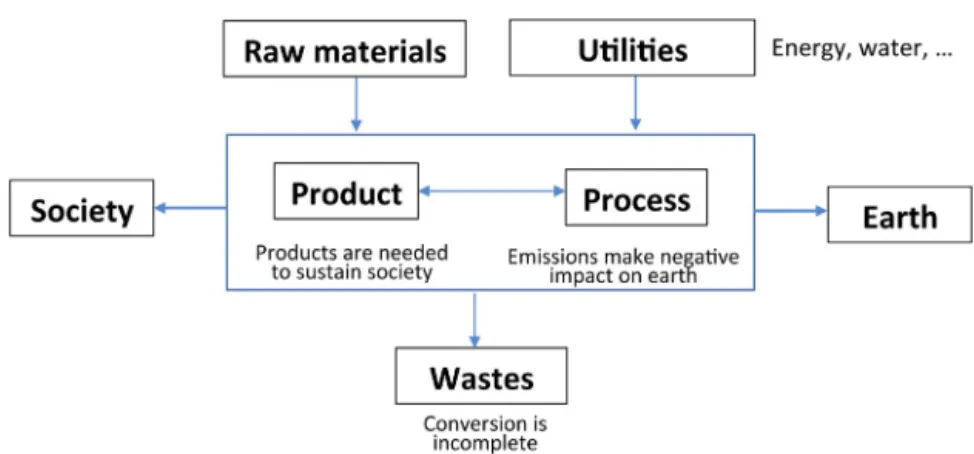
Industrial chemical technology revolutionized the modern world in the 20th Century, and now in combination with industrial biotech-nology it is set to do the same in the 21st Century. Underpinning these developments is the discipline of chemical and biochemical engineering (C&BE). The discipline applies, among others, the fun-damental principles of thermodynamics, reaction stoichiometry and kinetics, biochemistry and cell biology as well as transport phenom-ena together with the laws of conservation of mass, energy and momentum to create better materials, products and processes that are useful to society. In other words, at a technical level chemical and biochemical (C&B) engineers work with unit operations (be it at industrial scale, pilot scale, micro-scale or nano-scale) for the purposes of chemical and/or biochemical synthesis followed by downstream separations, which are all based on phenomena such as thermody-namics, reactions (chemical, biochemical, or thermal conversions), transport (mass, heat and momentum). In this way, C&B engineers solve problems related to synthesis, design, analysis, implementation, operation-control, optimization, etc., of chemical and biochemical pro-cesses needed to manufacture the products required by society. This implies that the scope and significance of C&BE is potentially enor-mous. In a given case, the scope is defined by the raw materials that can be converted to the desired products through the corresponding man-ufacturing processes where resources such as energy are consumed, water is used and the environment is affected. Nevertheless, the con-version of the resources to products is in all cases incomplete and therefore the issue of recycle and regeneration of resources becomes increasingly important and urgent (Negro et al., 2018). Over the past decades, as the demand for better and more versatile products and their corresponding flexible manufacturing processes has increased, so has the need for increased knowledge on related topics that is per-haps not well understood in the context of application of C&BE based technologies but are nevertheless very important. Moreover, society currently faces grand challenges like climate change, growing global population and resource limitations that require innovative solutions regarding the way products and services are provided. In this way, C&BE is also an evolving discipline.
Historically, chemical engineering came into existence more than a century ago by synthesizing the fundamental scientific disciplines of chemistry, physics and mathematics with mechanical engineer-ing competences required for industrial processes and contributengineer-ing, thereby, to the world’s economic progress (Wei et al., 1979). Indeed, while chemical engineering has made enormous contributions as a discipline (and profession), it has also embraced rapid and dynamic technological changes and has frequently been at the center of emerging new developments (Butz and Tauscher, 2002). Today, per-haps more than at any other time in history, we face formidable challenges (Negro et al., 2018). But these challenges also represent unique opportunities such as exploring and exploiting new abundant resources (Wang and Krupnick, 2015); substituting and/or improv-ing the exploitation of resources in current use (Christensen et al., 2008); delivering sustainable solutions related to energy (Chu and Majumdar, 2012), water (Gleick, 2016), environment (Allen et al., 2018) and food (Papargyropoulou et al., 2014); contributing to avoid danger and risk, for example, climate change (Monastersky, 2013) or accidents (Brunaud et al., 2019) and, optimizing the operation, distribution and safety of manufacturing processes (Grossmann, 2005).
The objective of this paper is to present a multi-layered view of chemical & biochemical engineering, through which its scope and sig-nificance, as well as its future role can be better understood. This view highlights the important outcomes of chemical and biochem-ical engineering as a discipline as well as a profession. The inner core fundamental layer involves process-product related activities where application of the fundamental concepts of C&BE help to design, build and operate manufacturing processes that convert specific raw materials to desired products. The middle interface consolidation layer involves resources-efficiency related activities where improved under-standing of the concepts and combination of science and engineering lead to the development of new technologies that when applied, lead to more sustainable engineering solutions. The outer unifying layer involves society-challenges related activities where industrial devel-opment helps to address challenges that when resolved would lead to a more sustainable society. Here, integration of knowledge, such as ideas, disciplines etc., play a major role. The main issues, challenges and opportunities at each level are discussed with respect to education, research and practice related to each layer.
2.
The multi-layered view
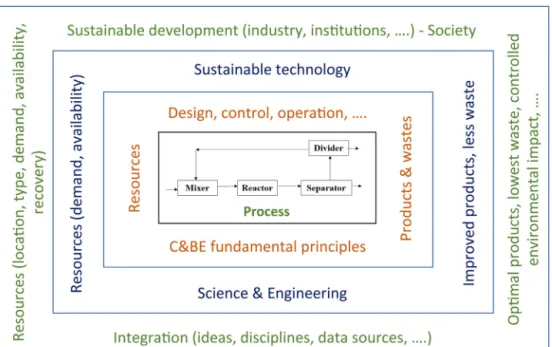
The multi-layered view is shown in Fig. 1, where three inter-connected layers are highlighted. The concept can be understood through the following logic; Horizontal – left: input of resources to the system, right: outcome in terms of con-version to products; Vertical – bottom: (intellectual) input from C&BE, top: impact on the system due to increased knowledge and available products. Layers – innermost: core topics defining the discipline, outermost: topics that define the contributions of C&BE to society.
InFig. 1, moving from left to right adds material, economic and societal value. That is, from resources (raw materials as well as utilities such as energy and water) higher valued products are obtained (inner-layer); considering demand and availability of these same resources, the products are further improved and the processes become more efficient (middle-layer); adding also considerations (for the same resources) such as resource location, type, recovery, etc., the optimal products with lowest wastes and controlled environmental impacts, etc., are obtained at various scales (plant, indus-trial parks, country, region, etc.). To obtain these incremental improvements, a better understanding of the concepts that lead to new technologies is needed. Moving from bottom to the top of the figure, input of knowledge leads to problem solutions. That is, fundamental knowledge of C&BE helps to design, build and operate the manufacturing process (inner-layer); combination of science and engineering gives a better understanding that leads to the development of sustainable technologies (middle-layer); integration of knowledge from different disciplines providing new ideas and data sources contribute to sustainable development of society (measured in terms of institutions, industry, ecology, etc.).
These layers are strongly interactive, that is, demands from the outer layers require increased know how from the
Fig. 1 – The multi-layered view of chemical and biochemical engineering (note: increasing details of the same resources (raw materials and utilities such as energy and water) are considered, moving from inner to outer layers).
inner layers to meet them. For example, as the need for structured products like food, detergents, cosmetics, etc., grows, as pointed out by Cordiner (2004) and Hill (2004), the numerous operational steps involved with the pro-cessing of these products provide opportunities as well as challenges to find better, more reliable and innovative alter-natives (Zhang et al., 2016). First, however, the involved phenomena-microstructure-property-process relations need to be understood sufficiently through focused experimental work and subsequent experiment-based process analysis. The fundamental understanding gained together with experimen-tal evidence could then be used to conceptualize and derive mathematical models for faster and more reliable process development. Also, as one moves from the inner layers to the outer, the scope and significance of the problems tackled, the solutions found and the knowledge required broadens. There-fore, the three layers together highlight aspects of incremental education, research and practice, as well as the impact on our society and on the global environment. Note that even though a topic or keyword is not listed in a specific layer, it does not mean they are not used in that layer. For example,
the terms “resources” and “science & engineering” are listed in the core and middle layers, respectively, to highlight their key-roles in employing the fundamental principles as well as consolidation and expansion of the scope and significance of C&BE. Also, to find innovative solutions and to minimize the ecological impact and/or to maximize the societal benefits, even though resources such as energy, water, material, etc. are needed, human resources are also needed to develop tech-nologies, methods, tools, etc., to design, construct and operate the processes and to distribute and/or supply the manufac-tured products. Similarly, the developments from the inner layers help to achieve sustainable industrial development and to educate-train the stake-holders by addressing the grand challenges through appropriate interdisciplinary and/or mul-tidisciplinary approaches.
2.1. Inner core fundamental layer: processes and
products
At the fundamental level, C&BE involves the conversion of specific raw materials to desired chemicals-based products
Fig. 2 – Relationships between product-process design and product design-product application. The dashed lines indicate the link between the design and application problems (Zhang et al., 2016).
through appropriate processing routes while also utilizing resources such as energy, water, materials, man-power, etc. to achieve the desired objectives. However, successful develop-ment of a desired chemical or biochemical product requires an economically feasible manufacturing process and vice versa. For best success, both the product and the process should be optimal. To achieve this, the knowledge input is process engineering that may include aspects of chemical kinetics; transport phenomena; unit operations; process integration; control and many more. Adjacent areas such as organic chemistry, analytical sciences, biology, mechanical engineer-ing must also be drawn on, as appropriate. The connection between the product and the process is highlighted through Fig. 2(Zhang et al., 2016), where in addition to the traditional product-process connection, the application of the product for performance evaluation is considered, for example, use of a solvent for solvent-based separation or use of a solvent for product delivery, for instance, in delivery of an insect repel-lant as a liquid lotion. Note that the objective of the process is to produce the product defined by its molecular structure (for single species products), purity, state, etc., while the objective of the product is to deliver its functions (product application). The objective of product design, in this case, is to identify the molecular structure (for single species products) with the desired properties.
2.2. Middle interface layer: science and engineering
Raw materials and economically feasible processing routes are no longer sufficient to launch a successful product-process. Use of resources such as energy and water need to be optimized together with efficient management of raw materials supply-demand, economics, products distribution and environmental impacts. Safety issues, both related to risk avoidance for plant workers as well as for the neighborhood, is also of increasing concern. Innovative solutions for ser-vice provisions therefore need to be determined. This requires additional knowledge in terms of the integration of science and engineering leading to the development of innovative solution approaches to process integration and intensification as well as new ways to manage supply chains and to monitor economic, ecological and societal impacts of manufacturing processes and product use. The outcome could be sustain-able technologies in terms of a reduced ecological footprint together with greater societal benefits while maintaining prof-itability. The inputs from fundamental sciences, the rational use of computational tools and focused experimental valida-tion need to play important roles at this level. The improved understanding of the phenomena at all scales (including the core layer) need to be considered and integrated in order to be able to optimize the production processes such that signifi-cantly improved innovative solutions are obtained, employing new and more efficient unit operations. The combination of science and engineering in product-process development needs to play a key role, where increasing scientific focus may lead to smaller equipment sizes while increasing engineering focus may lead to larger scales of sustainable technologies. For example, in the area of micro-structured products, the key to success is to first identify the desired end-use prop-erties of a micro-structured product at the small-scale, and subsequently to control product quality and production effi-ciency by manipulating the microstructure formation at the process scale leading not only to a novel product but also
to less waste and lower energy consumption (Charpentier, 2003).
2.3. Outer unifying layer: improved social benefits
It is expected that within the next 20 years, the popula-tion on earth would stabilize to around 9 billion (Pereira et al., 2010); requiring 6–7 times increase of world GDP; which will require 5–6 times increase of existing production capacities for most commodities (steel, chemicals, lum-ber, etc.); 3.5 times increase in energy demand (7 times increase in electricity demand); very large increase in water demand. Costs related to CO2 emissions are estimated to
be 7 GTC/yr to 26 GTC/yr (Vooradi et al., 2018) together with concomitant increase in knowledge requirement. Therefore, in the outer layer, the grand challenges (Anon, 2020ahttp://www.engineeringchallenges.org/challenges.aspx) in terms of availability of resources and raw materials need to be reconciled with sustainable development of society (Anon, 2020bhttps://sustainabledevelopment.un.org/). An alternative way to meet the sustainable development goals is to focus on improving the quality of manufactured products (or related services), which as a result would drive down the need for quantity while also ensuring that society (the consumer) gets to at least maintain their current quality of life and comfort.
To achieve this objective, a larger vision of the true needs of society with respect to the limited availability of resources needs to be implemented. With respect to C&BE, this requires integration of chemical and biochemical engineering know-how together with other disciplines (e. g., sociology, ethics, political sciences, economics) and with many of the main actors (such as decision makers and decision influencers) of society.Prausnitz (2007)has emphasized this aspect together with the special role of the human dimension in C&BE. The outcome is a set of optimal products generating minimum wastes and consuming less resources (raw material, energy, water, etc.) through more sustainable processes, that con-tributes to the education, training and practice of C&BE, and thereby, to sustainable development of society.
2.4. Interaction between layers
Referring toFig. 1, the application of C&BE and the associated challenges identify opportunities and help to set targets for improvements in education, training and practice. To achieve these targets, science and engineering need to come together to develop techniques, methods and tools through which sus-tainable and innovative products-processes can be designed and/or developed in the middle layer. However, to develop the techniques of the middle layers, the available knowledge in the core layer in terms of theory, concept and data need to be enhanced. The movement is from the core layer to the outer layers with feedback towards the inner layers for adjust-ment and/or refocus of targets. For example, education gives the C&B engineer knowledge to practice and understand the fundamentals, which they employ for research in the mid-dle layer to develop new techniques, which they employ in practice in the outer layer for the sustainable development of society. However, as the needs of society change, the funda-mental concepts and the targets from the inner layers also need to be adjusted. Note also that education, research and practice may be applied at all layers, depending on the level or type of the institutions at which they are conducted. That is, the desires (targets) placed on C&BE on the outer layer for
expected improved social benefits are related to the technical and economic constraints placed by the middle layer as well as the understanding of the fundamental principles in the core inner-layer. This means all three layers are interconnected as any desire or constraints from the outer and/or middle lay-ers respectively, could influence the scientific requirements placed on the inner layer while any development in the inner layer influences the outer layers and their ability to fulfil the constraints and/or desires.
2.4.1. Education
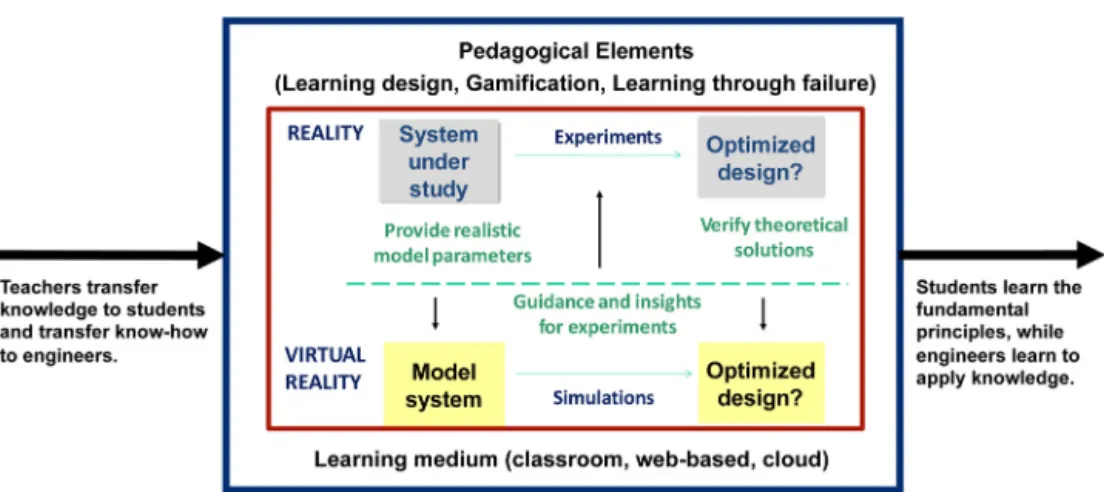
The key question in C&BE education is what skills, outcomes and knowledge are needed for the three cycle (BSc, MSc and PhD) education program in the subjects of C&BE. One option for the case of BSc and MSc degrees could be that the actions in the core layer ofFig. 1 be linked to the core curriculum (for example, BSc), while the middle and outer layers could be linked to the advanced (related to the inner-core topics) and/or specialization topics not included in the inner-core (for example, an extended BSc or MSc). What is necessary is that C&BE students understand the basic concepts, scope and sig-nificance of the middle as well as the outer layers. One way to incorporate the additional knowledge from the outer lay-ers into C&BE education is through design and/or evaluation projects, where concepts such as ethics, sustainability, sus-tainable development and/or circular economy are included. The PhD degree on the other hand is concerned with mainly research and development at all layers based on the knowl-edge gained at the BSc and MSc levels, posing of new problems, addressing of current challenges and/or exploring available opportunities. An important issue is the depth of knowledge gained at each layer. The outcomes of the BSc and MSc educa-tion are knowledge and understanding; engineering analysis; design and practice; investigations; transferrable skills; and ability to solve problems. Therefore, topics from the middle and outer layers ofFig. 1are needed as a complement to the core curriculum. In this regard, the use of virtual laboratories (or innovative pedagogies) to cope with the growing number of students, combined with a lack of adequate pilot-scale educa-tional facilities is an alternative worth considering. The drivers for developing a virtual laboratory are highlighted inFig. 3. Innovative pedagogical techniques that currently exist should be employed, both to motivate the younger generation that is keen on using new technologies as well as to benefit from a renewed content that addresses more explicitly their needs (adequate use of tools such as process simulators, data bases, social media, remote or distant learning, etc.).
Another key issue is how to equip C&BE students to adapt to innovative technologies that may come from areas outside of the scope of C&BE. That is, how to widen the C&BE curriculum with non-traditional topics such as: life science related topics (biochemical engineering, molecular biology and genetic engineering; pharmaceutical engineering; biomedical engineering; product engineering; material engi-neering; environmental engineering); interdisciplinary fields (energy and fuel engineering; membrane science, aerosol, colloids and interface, organometallic chemistry; catalysis); and management related to advanced technology (operations management; change management; knowledge manage-ment) without sacrificing the core or fundamental topics from the inner layer? As the C&B engineers increase their knowl-edge and abilities, they are moving to the outer layers, gaining expertise in a wider range of disciplines. For example, they can increase their core competences in sciences related to
sep-aration; mixing of solids, gaseous and liquid materials; and transforming materials to more useful forms with the help of energy and/or catalysts, be they biogenic or non-biogenic. With this expertise the C&B engineers should be able to design and operate industrial plants and play an important support-ive role in a wide range of other sectors, from manufacturing to mining and health care, for example.
With respect to non-technical skills C&B engineers need to develop skills in ethics, business, and administration that can help them, for example, in project management, budgeting, and economics. Also, ability to work as part of teams in mul-ticultural and diverse environments needs to be developed. Adaptation is an important skill in a rapidly changing society and C&B engineers should have the ability to handle different situations as well as respond to emergencies, if necessary. In general, courses on process and plant design, combined with or without product design, are well suited to meet these types of learning objectives. Further enhancing of the fundamentals is very important, especially across the different disciplines of chemical engineering as emphasized byWu and Prausnitz (2019)on the particular role thermodynamics plays in connec-tion to chemical engineering.
2.4.2. Research
Research activities are needed in every layer. Scientific advances in the inner core topics could provide a better under-standing of the underlying principles leading to increased availability of data, more reliable theory-models and there-fore, the development of more flexible model-based methods and tools. This in turn could increase the scope and signifi-cance of C&BE. The objective of research activities in the outer layer is to understand the needs of the key societal stakehold-ers and to translate them to specific targets for development. In the middle and core layers, the objectives are to develop and apply techniques and technologies to realize the targets through appropriate combination of science and engineering, and new developments and understanding of the fundamen-tal principles. That is, in the outer layer, the focus could mainly be on tackling the global challenges to ensure the sustain-able survival of people (9+ billion) on earth with an acceptsustain-able standard of living by, for example, improving the standard of living and safety with minimal environmental and health impacts. Therefore, concepts such as sustainability, circular economy and resource recovery need to be integrated into product development, process design and retrofit activities, to name a few.
In the middle layer the established targets from the outer layer could result in the following developments/trends for technologies, which by no means is an exhaustive list, and also are not listed in terms of any priority:
• Use of industry 4.0 technologies of AI, machine learning and big data in improving manufacturing operations with the aim of reducing resource usage and improved pro-duction efficiencies (Venkatasubramanian, 2019). To this end concepts such as digital twins, hybrid-modeling tech-niques, novel sensors that are currently under development should receive more attention (Rosen et al., 2015). To achieve appropriate rather than indiscriminate application of data science, awareness of digital technologies amongst chemi-cal engineers should be fostered; project activities should also be undertaken using conscious decisions to balance first principles and data driven methods (Piccione, 2019).
Fig. 3 – The drivers for developing a virtual laboratory.
• Development of flexible and smart manufacturing tech-nologies so that manufacturing plants can be “re-tooled” to produce multiple products and change production (Kang et al., 2016) as preferences and desires from the outer layer change. Concepts such as disposable reactors (Glindkamp et al., 2009), micro reactors (Rossetti and Compagnoni, 2016) as well as non-invasive measurement techniques such as image analysis (Forte et al., 2019) and tomography (Tapp et al., 2003) currently under development in the inner layer could enable this movement.
• Innovative and efficient processing through intensifica-tion that can significantly reduce the energy and resource demand are concepts that are already developed (Tian et al., 2018), but their industrial implementation need to increase. Process intensification is a promising technology that can lead the way towards more sustainable process alternatives. • Better management of sources of energy in terms of har-vesting, storing and using renewable sources of energy is necessary. Electrification by taking advantage of intermit-tent renewable energy sources, such as solar and wind; energy storage in the form of chemicals can contribute to balancing supply and demand if chemical processes could be run even periodically. In this context electricity stor-age in the form of chemical bonds (hydrogen, ammonia, methanol, and dimethyl-ether) is an opportunity and a challenge. Another option is to consider transformation of chemical and electrical energy not only for fuel cells but also for innovative alternatives such as redox flow batteries.
In the core layer, the constraints from the middle layer and desires (targets) of the outer layer require fundamental research results from the core layer, for example (not listed in any priority):
• Conversion of raw materials through chemical- and/or bio-catalysis using new synthesis paths, which can give important commodity chemicals at reduced energy and/or increased atom efficiency should always have high prior-ity. For example, use of green electrons in electro-chemical conversion of water, CO2, and N2 into fuels and base
chemicals like hydrogen, carbon monoxide, methanol, di-Methyl-ether, light olefins and ammonia (Van Geem et al., 2019).
• Separation principles that can discover new ways to sep-arate chemicals from difficult separation problems at reduced and/or low energy consumption, high separation efficiency, minimal use of external separating agents that
are energy intensive, and/or extract important new ingre-dients from plants or biomass should continue to attract attention of researchers. Combining more than one separa-tion technique into hybrid operasepara-tions where each technique performs at its highest efficiency is an option worth inves-tigating.
• Selection and design of functional materialsCheng et al. (2011)that can have a reduced maintenance or replacement requirements, substitute the function of multiple materi-als and/or address any un-satisfied need of the outer layer are important for discovery of new processing routes and/or separation principles. Use of ionic liquids as environmen-tally acceptable separation agents and MOFs (Metal Organic Frameworks) and COFs (Covalent Organic Frameworks) for gas separations are alternatives worth investigating along with membranes.
• Better understanding of the phenomena and the domain system involving complex chemical and biochemical systems is necessary to develop more comprehensive mod-elling of the process (Klatt and Marquardt, 2009) and the associated properties of chemicals and materials. Of partic-ular interest are the modelling of properties of structured products, solids and polymers; multiphase operations with complex chemical systems, such as electrolytes; as well as the complexity of living systems and the difficulties in understanding them.
2.4.3. Practice
Fundamentally, industry rewards and exemplifies the benefits of C&BE by translating the discipline to value – and offering interesting and challenging careers to motivated individuals who pursue employment in the field. The mechanism for such value creation is exemplified in the various layers ofFig. 1, starting with the outer layer: identifying which grand chal-lenges it needs to address to achieve sustainable industrial development and thereby, improving circularity. Industry is ideally placed to do so by drawing on the skills from the inner layers, since it will have the economic and ecological insights and remit to ensure that important technologies are adopted in economically viable ways, thereby ensuring sustainable development. The combination of science and engineering to help develop commercially successful technology, in a sense, is the very definition of industry’s remit, in addition to main-tenance of its existing operations. To achieve this goal, at the innermost layer, skills such as handling of resources, feasi-bility of products, economic feasifeasi-bility, etc., will need to be developed. In doing so, industry will of course link to both
Table 1 – Forms of industrial practice and their activities. Practice form (type
of company)
What they do or use What they need or consume What they give to society or results
Manufacturing Apply production technologies Resources (material, utility, human-power)
Manufactured products that society needs
Engineering Use technics, methods, data Resources (human-power) Production technologies for
manufacturing
Equipment Design-develop production
equipment
Resources (material, utility, human-power)
Equipment for manufacturing industry
Software Develop knowledge (theory,
concepts) based tools
Resources (human-power) Tools with implemented methods and data
Consulting Solve problems using the
needed data, methods & tools to help apply-develop technologies
Resources (human-power), knowledge (theory, concepts, data)
Problem solutions (technology, methods, tools)
academic and government institutions to: a) set developmen-tal challenges; b) identify collaboration opportunities to make efficient use of limited resources; c) encourage transfer tech-nology; d) identify and share the capability challenges needed by practicing C&B engineers. It is also important to point out that in the next decades, increasing industry-industry part-nerships are to be expected as well, especially in supply chain, mirroring the need for a greater set of organizational rela-tionships within any company. The demand from the world’s ever-growing population is towards more socially responsible corporations, which may be a factor that should be considered by the players from the industrial sectors.
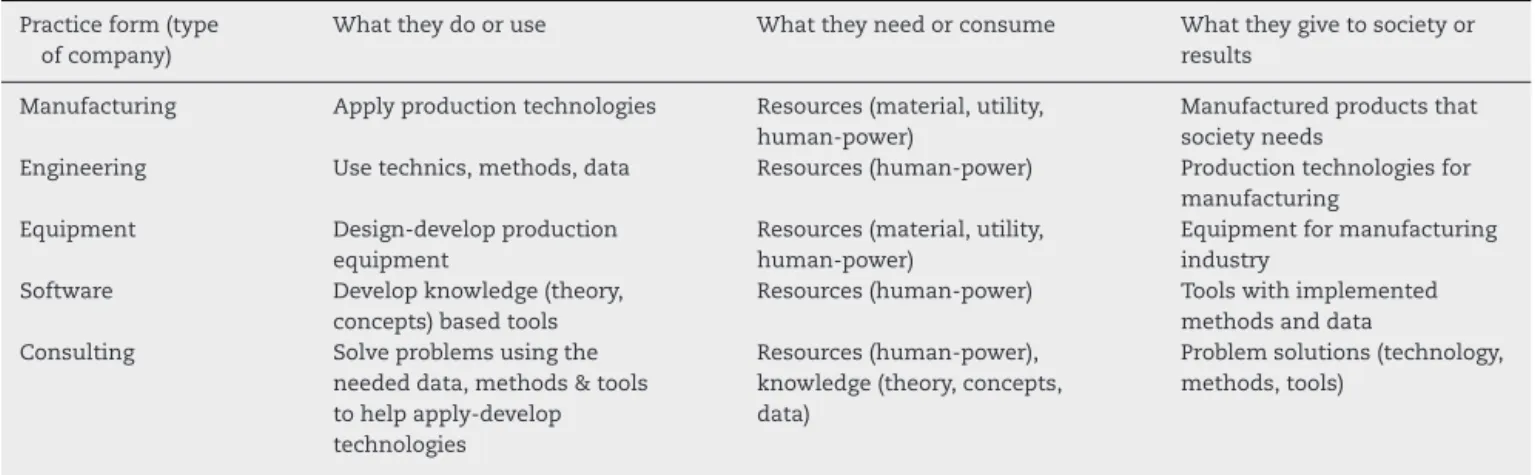
Table 1lists forms of industrial practice in terms of what they do or use, what they need or consume and what they give to society or results. It can be noted that the different types of industrial practices are connected to each other. That is, the result (what they give) from one layer is used as input by another. The manufacturing companies will produce products that society needs using technologies developed by engineer-ing companies and where equipment designed-developed by equipment companies are employed. Also engineering com-panies use tools developed by software comcom-panies as well as research results from academia. The services of consulting companies are needed by all other companies. The objective for all of them, however, should be to achieve sustainable development and/or circularity.
Several routes could be followed in order to achieve the above objectives. C&BE subject to constraints (recycling and re-use of matter and energy, sustainable and safe processes, intelligent and personal products, full techno-commercial evaluations including real-world issues like tax laws, envi-ronmental, health and safety regulations) implies a top-down approach, which points to upstream scientific and techno-logical developments. In a complementary way, a bottom-up research could also be considered for methodological and paradigm developments, in order to tackle the future chal-lenges. Innovation will be the result from both approaches. To encourage diversity, gender issues must also be tackled.
3.
Perspectives
The scope and significance of C&BE is enormous and it is not the objective of this article to provide a comprehensive list. However, perspectives on a few selected topics that we think have attracted current attention and could also be important in future are discussed briefly. It is important to note that the way in which industrial plants are built and operated in the
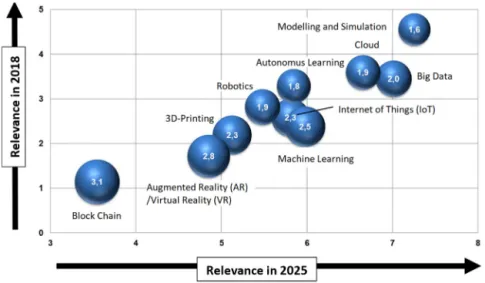
C&BE sector is changing due to concepts such as disposable reactors and micro reactors (Roberge et al., 2008) allowing far more flexibility in the manufacturing process. Conversion of batch to continuous processing is steadily becoming more rou-tine. Combining these concepts with the emerging fields of 3-D printing and functional materials allow for smart manu-facturing practices to be established. Moreover, the influence of industry 4.0 (Kolberg and Zühlke, 2015), which encapsu-lates concepts of big data and artificial intelligence is changing the goal post of efficient process operations (Piccione, 2014). Fig. 4shows the engineering challenges within the next 10 years. According to this figure the relevance of various digital applications (model-based approaches) today and in 2025 are highlighted with a score showing how they will become more important in the coming years (Keller, 2018). Specific activi-ties to help bridge chemical engineering and data science are available (Piccione, 2019).
Likewise, digitalization has been an integral part of C&B development in the past decades be it the use of “digital” process controls as opposed to “pneumatic” controls; the development of process simulations; process synthesis and other tools in the domain of process systems engineering (PSE). These developments are now part of the standard set of “tools” that C&B engineers use routinely in their day-to-day work. With computing power still doubling roughly every few years, as predicted by Moore’s law (Schaller, 1997), the speed and reliability of PSE methods & tools continue to improve, allowing C&BE engineers to solve problems of increased com-plexity at higher fidelity in real time. In addition, Industry 4.0 and the big data concepts are becoming ever more prominent in the domain of C&BE. (Venkatasubramanian, 2019;Piccione, 2019).
The perspectives of C&BE are highlighted through the following two issues and their discussions in terms of oppor-tunities and challenges.
3.1. Current scope & significance of C&BE
3.1.1. Products and their manufacturing processes (core)
The main questions here (related to chemicals-based prod-ucts) are what to make, when or why to make it and how to make it? The first two questions are related to the products and the last question is related to the associated process. Even though the chemicals-based products and their manufactur-ing processes are related, the education, research and practice do not always address the same issues. Using the classification of chemical products byCussler and Moggridge (2001),Table 2
Fig. 4 – Industry 4.0 relevance in the next 10 years (Keller, 2018).
Table 2 – Types of chemicals-based products and their characteristics (adapted from Cussler and Moggridge, 2001).
Characteristics Product types
Commodity-based Molecule-based Microstructure-based
Key issue Cost Speed Function
Basis for success Unit operations Chemistry Microstructure
Risk of failure Feedstock Discovery Science
highlights the main reasons. It can be noted that until recently, most of the C&BE activities were focused on the production of commodity chemicals where process is the key. With the expansion of C&BE to molecular and functional products and chemicals-based devices, the scope and significance of C&BE education, research and practice related to products and their sustainable processes have also increased.
Other issues that could also play a major role in defining the scope and significance of C&BE are briefly highlighted below: • The challenge is to design and develop novel and innovative
chemical products of better quality and longer durability and the opportunity is the need for these products some of which can be developed through integrated experiment and model-based techniques, leading to reduction in time and cost in their development (Liu et al., 2019;Zhang et al., 2018).
• Interest in bio-based economy through new bio-catalytic processes converting biomass to valuable raw materials is increasing rapidly (van Dam et al., 2005). Direct biological production through genetically modified cells and protein engineered enzymes is showing promise, while, combined hybrid biochemical and chemical transformations contin-ues to be attractive (Davy et al., 2017;Sanford et al., 2016; Woodley, 2019).
• The separation and conversion of by-products needs to be strengthened, in particular, in bio-based productions with inspiration from traditional chemical engineering pro-cesses. Also, the introduction of intensified process designs and the introduction of separation technologies to capture secondary by-products of value which are currently dis-carded, need to be considered (Atasoy et al., 2018).
3.1.2. Resources (middle)
The main questions to ask here are which resources to use, for what purpose and how sustainable are they? Not count-ing the manpower resources, asFig. 5highlights, C&BE uses
two types of resources – a) those that are converted to use-ful chemicals-based products through a specific processing route, for example, crude oil or biomass; and b) those that are needed to operate the processing routes, for example, energy (fossil fuel, solar, wind-power, etc.), water and material (met-als, catalysts, solvents, etc.). Choice of the processing route and the form of resource are important issues (see below) that are the subject of much research, but not so much in educa-tion and practice. There is actually a third type of resources – the human resource, the development of which is related to education and their use is related to practice.
Other issues that could also play a major role are briefly highlighted below:
• Fundamental transition from fossil to alternative sources of energy over the next decades through increased use of green energy sources and increased energy efficiency has started (Dresselhaus and Thomas, 2001). Moreover, the improvement of energy usage through a combination of renewable and non-renewable resources need to be further investigated (Agrawal, 2019) in particular the storage and management of energy. Since the global energy and mobil-ity still rely on oil derivatives, the efficient usage of these resources through the introduction of hybrid technologies or the complete elimination of its use in some sectors (such as automobile industry) will allow the remaining resources to be stretched (Ediger et al., 2007).
• Even though competition for existing material and energy resources would remain, the supply chain issues related to water will need to be carefully monitored. The management of water resources through designing processes to be water efficient and recovery of water through recovery technolo-gies implicitly as a part of the engineering process design (Gleick, 2016). Opportunities for environmentally efficient acquisition of materials such as rare earth metals and their
Fig. 5 – Use of resources by C&BE.
efficient use, recovery and recycle needs to be investigated (Binnemans et al., 2013).
• The efficient cultivation of food and livestock, which enable the reduction of need for limited arable land available and the development of technologies to reduce the food waste through targeted application of process and materials tech-nologies (Kummu et al., 2012). In parallel, analytics should play an increasing role in mapping occurrences of unwanted trace chemicals in our food and environment (for example, air and water) combined with their adverse health effects, which in turn, puts increasing demands on product formu-lation and their production process.
3.1.3. Societal (outer)
Based onFig. 5, the following question could be asked – is C&BE addressing the challenges related to climate change, energy, water and food or is it adding to the problem? Surely, as the Barcelona Declaration from 2017 (Negro et al., 2018) outlined, we all have the responsibility to address these challenges. Some notable developments are highlighted below:
• Strong demand for renewable energy sources and stor-age technology is an area of active interest to the society and must be addressed. This also means the adaptation of potential renewable energy technologies as well as stor-age technologies, which would benefit from government subsidies as well as support from the public, making their implementation easier.
• Health-care demands new advanced instrumentation and materials, and the push for a bottom-up approach for improved early diagnosis and treatment of disease (Aguado et al., 2018). This push can also be used in moving from a treatment oriented medical system to a predictive and precision-based early diagnostic system to allow the move towards prevention based medical systems. Here model-based approaches and data-driven tools developed within PSE discipline can facilitate future developments.
• Sustainable production and distribution of food and other products becomes very important (Validi et al., 2014), especially considering the steady increase of the human population and the scarcity of resources in general. This has knock-on effects on energy usage, water usage as well as land usage. To this end from a societal point of view the holistic and complete management of the Water – Energy - Food nexus as well as the efficient management of land usage would be important.
3.2. Future scope & significance of C&BE
3.2.1. Improvements of processes based on current needs
Energy related issues will continue to dominate research and development with C&BE (Vooradi et al. (2018). New routes to fuels, fine chemicals and pharmaceuticals that are all based on ‘green’ feedstocks would contribute to tackling the grand challenges of energy, water, food and environment. Waste and its hazards would also be minimised. Therefore, there is a need for systematic identification of optimal processing pathways that lead to more sustainable production processes and supply chains (You et al., 2012). Achieve a state of clean, zero-waste producing processes in operation. The topics that could also play a major role are highlighted below:
• Intensification of chemical and biochemical processes will provide the means to develop novel more sustainable pro-cess alternatives (Stankiewicz and Yan, 2019). However, issues related to design and control of such multi-functional unit operations need to be addressed at different levels of aggregation, i.e., phenomena, task and unit operations levels through systematic approaches that allow identifi-cation of novel intensified alternatives (Tula et al., 2019). Rapid developments in lab-on-a-chip technology could lead to (micro/nano) sensors and measuring devices as well as high-speed analysis methods for single cell genomics, tran-scriptomic, and proteomics.
• New reactor concepts, and designs controlling reactions in space and time will lead to increased productivity, reduced waste, lower environmental impact and lower cost of manufacturing (Hessel et al., 2013). In this essence, combining flow chemistry approaches with PSE methods and tools could lead to interesting new developments. In this combined mind-set, flow chemistry and microchem-istry would allow developments in reaction engineering, while PSE methods and tools would reduce the time, cost and resources for experiments by systematically reducing the search space of alternatives to be tested through a model-based approach. The routine availability of contin-uous manufacturing approaches for many unit operations and their integration could lead to additional flexibility operational flexibility.
• Multi-scale modelling and optimization of phenomena from atomic scales into unit operations and supply chain management with side-by-side modelling and experimen-tation approaches need to play a leading role. In this context, for example, computational chemistry can be used to bring understanding at molecular level and assist
in developing new products. This can be used to reli-ably develop new unit operation concepts for production and supply chains for distribution of such novel products. Thereby, reducing the experimental costs and efforts and leading towards a more rapid product development from concept to implementation. However, solving such prob-lems requires development of innovative solution strategies in line with advances in computer science.
3.2.2. Development of processes for future needs (products)
Energy will continue to play an important role in the devel-opment of processes for the future. Energy demands and how they are supplied through sustainable conversion and storage technologies, such as the combination electrolyz-ers/fuel cells and new battery technologies with regard to large scale battery implementation to store renewable energy gen-erated (for example, Redox flow batteries) will attract much attention, including the storage of large amounts of energy. The topics that could also play a major role are highlighted below:
• New catalysts and technologies for enabling high-efficiency materials production, for example the development of direct process pathway to convert hydrogen peroxide to propylene oxide technologies, which was in principle enabled through the development of a new catalyst and related process technologies. In addition, recent devel-opments in electrified methane reforming for greener industrial hydrogen production seem to be very promising (Wismann et al., 2019). Smart material assembly through molecular control will be a critical enabler for this theme. • Recovery/recycling of used product as precursor or source
of raw material, which allows the realization of the zero-waste objective of circular economy (Geissdoerfer et al., 2017). Development of processes, approaching the ‘zero-waste’ target at minimum energy consumption (Straathof et al., 2019). Use the concept of atomic economy in the devel-opment of new processes and in the re-design of existing technologies. Re- thinking processes based on the concept of circular economy, not only raw materials and products but also equipment and energy supply.
• Computational science to enable more developments of in silico techniques leading to “quality by understanding” of products and processes that rely on detailed, scalable quantitative descriptions. In a related vein, sustainabil-ity requirements, especially with respect to environmental impact, keep increasing. It will be important to come up with frameworks that can be flexibly and quickly adapted in optimization methods.
• New manufacturing and associated field techniques will be required to realize the potential of personalized health care. Electrochemical technologies which avoids the use of reagents to oxidize or reduce a raw matter and change them by electricity, avoiding the formation of undesirable by-products and/or wastes. Nature inspired approach to reactor and catalysis engineering (Coppens, 2012) and more nature inspired chemical engineering leading to new design methodologies for sustainability (Trogadas and Coppens, 2020) point to exciting new developments. A major chal-lenge and opportunity here are to understand and learn from the living systems to develop these new and innovative design methodologies.
3.2.3. Sustainable technologies
Circular economy requires, or is completely engaged and linked with, circular-engineering, especially to meet the soci-etal grand challenges. In future, instead of using the concept of circular economy, it could be more relevant or appropri-ate to use the concept of the circular economy-engineering (especially in our case, the circular economy-C&BE).
The topics that could also play a major role are highlighted below:
• CO2 management including capture, conversion,
utiliza-tion and storage need to be integrated with new (catalytic) chemistries and materials for separation or recovery. These concepts control the chemical reaction pathways at molec-ular level, aiming at 100% atom efficiency and zero waste. This could be aided by converting by-products such as CO2
into secondary products or, or by transforming it into car-bonates with later deep storage to prevent its accumulation on the surface of earth, provided no adverse effects are caused by the deep storage.
• Feedstocks management, in particular, use of biologi-cal feedstocks through a combination of techniques — recycling of (communal) wastes and conversion of com-plex biomass feedstocks into chemicals, purification and desalination technologies for drinking water supply and recyclable construction materials (building, cars, etc.), to name a few, need to be studied (Clomburg et al., 2017; Sheldon, 2014).
• Energy management, such as affordable, robust, sustainable-across-the-entire-lifecycle solar power as probably the only likely long-term sustainable energy source for humanity needs more attention. At the same time sustainable management of all energy sources for opti-mal demand-supply of energy should be incorporated with concepts such as circular economy, smart manufacturing and zero-emission.
• Water management, in particular, supply and distribution of water for different needs and applications, such as, water that is safe for drinking, water for washing-cleaning, water for industrial manufacturing, water for heating-cooling and many more, needs urgent attention. While there is an abun-dance of water on earth, this availability is not uniform geographically and requires further processing before use. Therefore, new technologies for energy efficient water treat-ment, reduction of fresh water demand, etc., allowing better management of water resources are needed.
4.
Conclusions
Because of their broad interdisciplinary knowledge and their key role in developing, operating and managing the industrial pillars of society as well as their professional link to many sectors, chemical and biochemical (C&B) engineers are in a pivotal position to help society shape a sustainable future. As professional experts and active responsible citizens, they can provide guidance, information and leadership to a society that has to meet the grand challenges of this century. Their expertise will be an essential contribution to the necessary interdisciplinary effort that includes all actors of society. C&B interdisciplinary and multidisciplinary engineers are in a piv-otal position to help society shape a sustainable future with the zero-waste and minimum energy consumption objectives of circular economy. They will be engaged in future, in the
design of the factory of the future with the use of indus-try 4.0 technologies to improve manufacturing operations by reducing resources and energy usage and improved produc-tion, thus leading to the design of sustainable technologies, that is, circular economy-engineering.
An important immediate activity is to define the grand challenges that society faces now, and hence to identify the main opportunities for C&BE. C&B engineers can exploit their services in education, industry or government to serve society – whether by finding sustainable (economic, social, ecologic) and/or technical solutions to the grand societal challenges; safeguarding the industrial economic base (products, pro-cesses, jobs) in competition with other regions and their geopolitical difference; or by promoting good engineering sense in the evaluation of new opportunities and challenges. By raising the recognition of the value engineers bring to soci-ety, young people will be motivated and encouraged to study and practice C&BE. Their conceptualization skills across many disciplines and ability to break problems down into unit oper-ations and physicochemical processes will for sure be value adding.
As experts in the management of mass flows, energy effi-cient operations as well as the management of supply chains and the interactions between man and nature, the impact of C&B engineers should not be restricted to shaping a sustain-able industrial system, but should reach far into planning and implementing future smart cities and regions as well as pro-viding strong support to the health care of the future. They should be in a position to influence the decision makers as well as help make important decisions on issues such as edu-cation policy, research directions, environmental and safety regulations, resources management and many more. It should be noted that while techno-economic solutions can be found to make a desired product and its manufacturing process more sustainable, unless the decision makers restrict the demand or production rate, the product might still become unsustainable because of increased consumption and consequent depletion of resources.
Finally, we hope we have given a global view of C&BE, which the reader may interpret differently at specific geographical locations. We expect the educators and practitioners of C&BE to use the multi-layered view to find the balance of topics at each level that suits best their particular needs and back-ground at their geographical location.
Declaration of interests
The authors declare that they have no known competing financial interests or personal relationships that could have appeared to influence the work reported in this paper.
References
Agrawal, R., 2019. Chemical engineering for a solar economy. Chem. Eng. Sci. 210, 115215,
http://dx.doi.org/10.1016/j.ces.2019.115215.
Aguado, B.A., Grim, J.C., Rosales, A.M., Watson-Capps, J.J., Anseth, K.S., 2018. Engineering precision biomaterials for personalized medicine. Sci. Transl. Med. 10, eaam8645,
http://dx.doi.org/10.1126/scitranslmed.aam8645.
Allen, M.R., Dube, O.P., Solecki, W., Aragón-Durand, F., Cramer, W., Humphreys, S., Kainuma, M., Kala, J., Mahowald, N.,
Mulugetta, Y., Perez, R., Wairiu, M., Zickfeld, K., 2018. Framing and context. In: Masson-Delmotte, V., Zhai, P., Pörtner, H.-O., Roberts, D., Skea, J., Shukla, P.R., Pirani, A., Moufouma-Okia,
W., Péan, C., Pidcock, R., Connors, S., Matthews, J.B.R., Chen, Y., Zhou, X., Gomis, M.I., Lonnoy, E., Maycock, T., Tignor, M., Waterfield, T. (Eds.), Global Warming of 1.5◦C. An IPCC Special Report on the Impacts of Global Warming of 1.5◦C Above pre-Industrial Levels and Related Global Greenhouse Gas Emission Pathways, in the Context of Strengthening the Global Response to the Threat of Climate Change, Sustainable Development, and Efforts to Eradicate Poverty.
https://www.ipcc.ch/site/assets/uploads/sites/2/2019/05/ SR15 Chapter1 Low Res.pdf.
http://www.engineeringchallenges.org/challenges.aspx. https://sustainabledevelopment.un.org/.
Atasoy, M., Owusu-Agyeman, I., Plaza, E., Cetecioglu, Z., 2018. Bio-based volatile fatty acid production and recovery from waste streams: current status and future challenges. Bioresour. Technol. 268, 773–786,
http://dx.doi.org/10.1016/j.biortech.2018.07.042.
Binnemans, K., Jones, P.T., Blanpain, B., Van Gerven, T., Yang, Y., Walton, A., Buchert, M., 2013. Recycling of rare earths: a critical review. J. Clean. Prod. 51, 1–22,
http://dx.doi.org/10.1016/j.jclepro.2012.12.037.
Brunaud, B., Laínez-Aguirre, J.M., Pinto, J.M., Grossmann, I.E., 2019. Inventory policies and safety stock optimization for supply chain planning. AIChE J. 65, 99–112,
http://dx.doi.org/10.1002/aic.16421.
Butz, P., Tauscher, B., 2002. Emerging technologies: chemical aspects. Food Res. Int. 35, 279–284,
http://dx.doi.org/10.1016/S0963-9969(01)00197-1.
Charpentier, J., 2003.The future of chemical engineering in the global market context: market demands versus technology offers. Kem. Ind. 52, 397–419.
Cheng, F., Liang, J., Tao, Z., Chen, J., 2011. Functional Materials for Rechargeable Batteries. Advanced Materials 23 (1695), 1715, http://dx.doi.org/10.1002/adma.201003587.
Christensen, C.H., Rass-Hansen, J., Marsden, C.C., Taarning, E., Egeblad, K., 2008. The renewable chemicals industry. ChemSusChem 1, 283–289,
http://dx.doi.org/10.1002/cssc.200700168.
Chu, S., Majumdar, A., 2012. Opportunities and challenges for a sustainable energy future. Nature 488, 294–303,
http://dx.doi.org/10.1038/nature11475.
Clomburg, J.M., Crumbley, A.M., Gonzalez, R., 2017. Industrial biomanufacturing: the future of chemical production. Science 355, aag0804,http://dx.doi.org/10.1126/science.aag0804. Cordiner, J.L., 2004. Challenges for the PSE community in
formulations. Comput. Chem. Eng. 29, 83–92, http://dx.doi.org/10.1016/j.compchemeng.2004.07.024. Coppens, M.O., 2012.A nature inspired approach to reactor and
catalysis engineering. Curr. Opin. Chem. Eng. 1 (3), 281–289. Cussler, E.L., Moggridge, G.D., 2001.Chemical Product Design.
Cambridge University Press, USA.
Davy, A.M., Kildegaard, H.F., Andersen, M.F., 2017. Cell factory engineering. Cell Syst. 4, 262–275,
http://dx.doi.org/10.1016/j.cels.2017.02.010.
Dresselhaus, M.S., Thomas, I.L., 2001. Alternative energy technologies. Nature 414, 332–337,
http://dx.doi.org/10.1038/35104599.
Ediger, V., Hos¸gör, E., Sürmeli, A.N., Tatlıdil, H., 2007. Fossil fuel sustainability index: an application of resource management. Energy Policy 35, 2969–2977,
http://dx.doi.org/10.1016/j.enpol.2006.10.011.
Forte, G., Albano, A., Simmons, M.J.H., Stitt, H.E., Brunazzi, E., Alberini, F., 2019.Assessing blending of non-newtonian fluids in static mixers by planar laser-induced fluorescence and electrical resistance tomography. Chem. Eng. Technol. 42 (8), 1602–1610.
Geissdoerfer, M., Savaget, P., Bocken, N.M.P., Hultink, E.J., 2017. The circular economy – a new sustainability paradigm? J. Clean. Prod. 143, 757–768,
http://dx.doi.org/10.1016/j.jclepro.2016.12.048.
Gleick, P.H., 2016. Water strategies for the next administration. Science,http://dx.doi.org/10.1126/science.aaj2221.
Glindkamp, A., Riechers, D., Rehbock, C., Hitzmann, B., Scheper, T., Reardon, K.F., 2009. Sensors in disposable bioreactors status and trends. In: Eibl, R., Eibl, D. (Eds.), Disposable Bioreactors. Advances in Biochemical
Engineering/Biotechnology, 115. Springer, Berlin, Heidelberg, http://dx.doi.org/10.1007/10 2009 10.
Grossmann, I., 2005. Enterprise-wide optimization: a new frontier in process systems engineering. AIChE J. 51, 1846–1857, http://dx.doi.org/10.1002/aic.10617.
Hessel, V., Kralisch, D., Kockmann, N., Noël, T., Wang, Q., 2013. Novel process windows for enabling, accelerating, and uplifting flow chemistry. ChemSusChem 6, 746–789, http://dx.doi.org/10.1002/cssc.201200766.
Hill, M., 2004. Product and process design for structured products. AIChE J. 50, 1656–1661,http://dx.doi.org/10.1002/aic.10293. Kang, H.S., Lee, J.Y., Choi, S., Kim, H., Park, J.H., Son, J.Y., Kim, B.H.,
Noh, S.D., 2016. Smart manufacturing: past research, present findings, and future directions. Int. J. Precis. Eng. Manuf. Technol. 3, 111–128,
http://dx.doi.org/10.1007/s40684-016-0015-5.
Klatt, K.-U., Marquardt, W., 2009.Perspectives for process systems engineering – personal views from academia and industry. Comput. Chem. Eng. 33, 536–550.
Keller, W., 2018. Berufe 4.0 – Wie Chemiker und Ingenieure in der Digitalen Chemie Arbeiten, Berufe 4.0 – Ergebnisse, White Paper, VWC.https://www.gdch.de/fileadmin/downloads/ Netzwerk und Strukturen/Fachgruppen/Vereinigung fuer Chemie und Wirtschaft/whitepaper initiative berufe 4.0 2018.pdf.
Kolberg, D., Zühlke, D., 2015. Lean automation enabled by industry 4.0 technologies. PapersOnLine 48 (3), 1870–1875, http://dx.doi.org/10.1016/j.ifacol.2015.06.359.
Kummu, M., de Moel, H., Porkka, M., Siebert, S., Varis, O., Ward, P.J., 2012. Lost food, wasted resources: global food supply chain losses and their impacts on freshwater, cropland, and fertiliser use. Sci. Total Environ. 438, 477–489,
http://dx.doi.org/10.1016/j.scitotenv.2012.08.092.
Liu, Q., Zhang, L., Liu, L., Du, J., Tula, A.K., Eden, M., Gani, R., 2019. OptCAMD: an optimization-based framework and tool for molecular and mixture product design. Comput. Chem. Eng. 124, 285–301,
http://dx.doi.org/10.1016/j.compchemeng.2019.01.006. Monastersky, R., 2013. Global carbon dioxide levels near
worrisome milestone. Nature 497, 13–14, http://dx.doi.org/10.1038/497013a.
Negro, C., Garcia-Ochoa, F., Tanguy, P., Ferreira, G., Thibault, J., Yamamoto, S., Gani, R., 2018. Barcelona declaration – 10th world congress of chemical engineering, 1–5 October 2017. Chem. Eng. Res. Des. 129, A1–A2,
http://dx.doi.org/10.1016/j.cherd.2017.12.035.
Papargyropoulou, E., Lozano, R., Steinberger, K., Wright, J., Ujang, N., Bin, Z., 2014. The food waste hierarchy as a framework for the management of food surplus and food waste. J. Clean. Prod.,http://dx.doi.org/10.1016/j.jclepro.2014.04.020. Pereira, H.M., Leadley, P.W., Proenca, V., Alkemade, R.,
Scharlemann, J.P.W., Fernandez-Manjarres, J.F., Araujo, M.B., Balvanera, P., Biggs, R., Cheung, W.W.L., Chini, L., Cooper, H.D., Gilman, E.L., Guenette, S., Hurtt, G.C., Huntington, H.P., Mace, G.M., Oberdorff, T., Revenga, C., Rodrigues, P., Scholes, R.J., Sumaila, U.R., Walpole, M., 2010. Scenarios for global biodiversity in the 21st century. Science 330, 1496–1501, http://dx.doi.org/10.1126/science.1196624.
Piccione, P.M., 2014. Industrial reflections on modelling of fine chemicals and seeds. Process/Product design. Chem. Eng. Res. Des. 34, 212–224,
http://dx.doi.org/10.1016/B978-0-444-63433-7.50022-5. Piccione, P.M., 2019.Realistic interplays between data science and
chemical engineering in the first quarter of the 21st century: facts and a vision. Chem. Eng. Res. Des. 147,
668–675.
Prausnitz, J.M., 2007.Athena, Hercules and Nausica: three dimensions of chemical engineering in the twenty-first century. Fluid Phase Equilib. 261 (1–2), 3–17.
Roberge, D.M., Zimmermann, B., Rainone, F., Gottsponer, M., Eyholzer, M., Kockmann, N., 2008. Microreactor technology and continuous processes in the fine chemical and pharmaceutical industry: is the revolution underway? Org. Process Res. Dev. 12, 905–910,
http://dx.doi.org/10.1021/op8001273.
Rosen, R., von Wichert, G., Lo, G., Bettenhausen, K.D., 2015. About the importance of autonomy and digital twins for the future of manufacturing. IFAC-PapersOnLine 48, 567–572,
http://dx.doi.org/10.1016/j.ifacol.2015.06.141. Rossetti, I., Compagnoni, M., 2016.Chemical reaction
engineering, process design and scale-up issues at the frontier of synthesis: flow chemistry. Chem. Eng. J. 17 (296), 56–70.
Sanford, K., Chotani, G., Danielsen, N., Zahn, J.A., 2016. Scaling up of renewable chemicals. Curr. Opin. Biotechnol. 38, 112–122, http://dx.doi.org/10.1016/j.copbio.2016.01.008.
Schaller, R.R., 1997. Moore’s law: past, present and future. IEEE Spectr. 34, 52–59,http://dx.doi.org/10.1109/6.591665. Sheldon, R.A., 2014. Green and sustainable manufacture of
chemicals from biomass: state of the art. Green Chem. 16, 950–963,http://dx.doi.org/10.1039/c3gc41935e.
Stankiewicz, A.I., Yan, P., 2019. The missing link unearthed: materials and process intensification. Ind. Eng. Chem. Res. 58 (22), 9212–9222,http://dx.doi.org/10.1021/acs.iecr.9b01479. Straathof, A.J.J., Wahl, S.A., Benjamin, K.R., Takors, R., Wierckx,
N., Noorman, H., 2019. Grand research challenges for sustainable industrial biotechnology. Trends Biotechnol. 37, 1042–1050,http://dx.doi.org/10.1016/j.tibtech.2019.04.002. Tapp, H.S., Peyton, A.J., Kemsley, E.K., Wilson, R.H., 2003.
Chemical engineering applications of electrical process tomography. Sens. Actuators B Chem. 92, 17–24.
Tian, Y., Demirel, S.E., Hasan, M.M.F., Pistikopoulos, E.N., 2018. An overview of process systems engineering approaches for process intensification: state of the art. Chem. Eng. Process. Process. Intensif. 133, 160–210,
http://dx.doi.org/10.1016/j.cep.2018.07.014.
Trogadas, P., Coppens, M.O., 2020. Chapter 2 - Nature-inspired chemical engineering: a new design methodology for sustainability. In: Szekely, G., Livingston, A. (Eds.), Sustainable Nanoscale Engineering. , pp. 19–31,
http://dx.doi.org/10.1016/B978-0-12-814681-1.00002-3. Tula, A.K., Eden, M.R., Gani, R., 2019. Computer-aided process
intensification: challenges, trends and opportunities. AIChE J. 66, e16819,http://dx.doi.org/10.1002/aic.16819.
Validi, S., Bhattacharya, A., Byrne, P.J., 2014. A case analysis of a sustainable food supply chain distribution system—a multi-objective approach. Int. J. Prod. Econ. 152, 71–87, http://dx.doi.org/10.1016/j.ijpe.2014.02.003.
van Dam, J.E.G., de Klerk-Engels, B., Struik, P.C., Rabbinge, R., 2005. Securing renewable resource supplies for changing market demands in a bio-based economy. Ind. Crops Prod. 21, 129–144,http://dx.doi.org/10.1016/j.indcrop.2004.02.003. Van Geem, K.M., Galvita, V.V., Marin, G.B., 2019.Making chemicals
with electricity. Science 364 (6442), 734–735. Venkatasubramanian, V., 2019. The promise of artificial
intelligence in chemical engineering: Is it here, finally? AIChE J. 65, 466–478,http://dx.doi.org/10.1002/aic.16489.
Vooradi, R., Bertran, M.-O., Frauzem, R., Anne, S.B., Gani, R., 2018. Sustainable chemical processing and energy-carbon dioxide management: review of challenges and opportunities. Chem. Eng. Res. Des. 131, 440–464,
http://dx.doi.org/10.1016/j.cherd.2017.12.019.
Wang, Z., Krupnick, A., 2015. A retrospective review of shale gas development in the United States: what led to the boom? Econ. Energy Environ. Policy 4 (1),
http://dx.doi.org/10.5547/2160-5890.4.1.zwan.
Wei, J., Russel, T.W.F., Swartzlander, M.W., 1979.The Structure of the Chemical Processing Industries: Function and Economics. McGraw-Hill, New York.
Wismann, S.T., Engbæk, J.S., Vendelbo, S.B., Bendixen, F.B., Eriksen, W.L., Aasberg-Petersen, K., Frandsen, C.,
reforming: a compact approach to greener industrial hydrogen production. Science 364, 756–759, http://dx.doi.org/10.1126/science.aaw8775.
Woodley, J.M., 2019. Accelerating the implementation of biocatalysis in industry. Appl. Microbiol. Biotechnol. 103, 4733–4739,http://dx.doi.org/10.1007/s00253-019-09796-x. You, F., Tao, L., Graziano, D.J., Snyder, S.W., 2012. Optimal design
of sustainable cellulosic biofuel supply chains: multiobjective optimization coupled with life cycle assessment and input-output analysis. AIChE J. 58, 1157–1180, http://dx.doi.org/10.1002/aic.12637.
Zhang, L., Babi, D.K., Gani, R., 2016. New vistas in chemical product and process design. Annu. Rev. Chem. Biomol. Eng. 7, 557–582,
http://dx.doi.org/10.1146/annurev-chembioeng-080615-034439. Zhang, L., Fung, K.Y., Wibowo, C., Gani, R., 2018. Advances in
chemical product design. Rev. Chem. Eng. 34, 319–340, http://dx.doi.org/10.1515/revce-2016-0067.
Wu, J., Prausnitz, J.M., 2019.110th anniversary: molecular thermodynamics – an endless frontier. IECR 58, 9707–9708.