Whole blood and apheresis donors in Quebec, Canada:
Demographic differences and motivations to donate
Johanne Charbonneau
*, Marie-Soleil Cloutier, Élianne Carrier
Centre Urbanisation Culture Société, Institut National de la Recherche Scientifique, Montréal, Canada
A R T I C L E I N F O Article history:
Received 13 May 2015
Received in revised form 4 June 2015 Accepted 8 June 2015 Keywords: Apheresis donors Motivations Sociodemographic variables Questionnaires A B S T R A C T
This study sought to compare demographics and donation motivations among plasma/ platelet donors (PPDs) and whole blood donors (WBDs), in a voluntary and non-remunerated context. Motives to donate blood and demographic characteristics were collected through questionnaires completed by 795 WBDs and 473 PPDs. Comparison of WBDs and PPDs under chi-square tests showed that 17 out of 23 motivators were statistically different accord-ing to various demographic variables. These results demonstrate the existence of specific donor profiles both for WBDs and PPDs. Agencies should develop new recruitment strat-egies tailored to these donors, especially if they wish to convince WBDs to convert to apheresis donation.
© 2015 The Authors. Published by Elsevier Ltd. This is an open access article under the CC BY-NC-ND license (http://creativecommons.org/licenses/by-nc-nd/4.0/).
1. Introduction
A thorough understanding of donor motivations and be-haviors is necessary to the development of effective strategies for recruiting new blood donors and inducing them to con-tinue the practice of blood donation over the long term. Numerous factors (aging population, strict donor deferral criteria, new therapeutic treatments, and the limited shelf life of blood products) contribute to the need for constant renewal of the blood donor population[1–5]. The situa-tion is especially critical with regard to plasma-derived therapeutic products[6–8]. Most plasma around the world currently comes from US commercial centers that collect blood plasma from paid donors[6,8,9]. Héma-Québec, the organization responsible for blood-product supply in Quebec, is attempting to increase its degree of self-sufficiency by ap-pealing to non-remunerated volunteer donors[10]. Demand for IVIG in Quebec has increased annually by 8.3% since 2003
[11]and in 2013–2014, the rate of IVIG self-sufficiency was only 14.5%. According to the most recent annual report, one of Héma-Québec’s aims is to open new permanent blood centers devoted to the collection of plasma for fraction-ation[11]. Also, a fractionation plant is due to open in Montreal in 2019[12].
In such a context, recruitment to the active pool of plas-mapheresis donors becomes a crucial issue. Apheresis donation differs in many ways from whole-blood dona-tion (WBD). Whereas a whole-blood donor may donate once every 56 days, a plasma donor may donate every 6 days, and a platelet donor every 14 days. In addition, plasma and plate-let donation (PPD) processes take longer (a minimum of 45 minutes for plasmapheresis and up to 3 hours for plateletpheresis as compared to 15 minutes or less for whole-blood donation), due to the return of saline and red blood cells (RBC). In Quebec, 86% of the agency’s blood supply is obtained through 2000 annual mobile drives held locally across the province. This grassroots collection system is based on community drives organized on a volunteer basis by local associations in residential areas, municipal ser-vices, the educational sector or businesses. As for apheresis donation, it is only offered at five fixed sites, in major cities or nearby suburbs. Fixed sites are located in shopping centers
* Corresponding author. Centre Urbanisation Culture Société, INRS, 385, Sherbrooke Est, Montréal, Canada. Tel.:+1 514 499 6603, +15144994000; fax:+1 514 499 4065.
E-mail address:[email protected](J. Charbonneau).
http://dx.doi.org/10.1016/j.transci.2015.06.001
1473-0502/© 2015 The Authors. Published by Elsevier Ltd. This is an open access article under the CC BY-NC-ND license (http://creativecommons.org/ licenses/by-nc-nd/4.0/).
Contents lists available atScienceDirect
Transfusion and Apheresis Science
(4 out of 5), near a residential neighborhood (Montreal), main workplaces (Quebec) or highways. Two of these sites were opened recently. Given these differences, it is reason-able to suppose that whole blood and apheresis donors may also differ in terms of their socio-demographic character-istics and motivations.
Few analyses have examined the socio-demographic profile of plasma and platelet donors. A number of studies have been conducted in contexts of PPD remuneration
[13–16]. These surveys have observed that plasma and plate-let donors in these contexts are most frequently young male students with high levels of education and low income, who are primarily motivated by remuneration.
In surveys conducted in the context of volunteer, non-remunerated donation[17–22], researchers have observed higher proportions of men among apheresis donors. Ac-cording to Bove et al.[17], data compiled by the Australian Red Cross Blood Service reflected a higher proportion of older, retirement-aged men in the active pool of plasma-pheresis donors. Higher proportions of men among platelet donors have also been noted[19,22,23]. However, a survey conducted by Veldhuizen and van Dongen[21]revealed equivalent numbers of men and women among plasma donors registered in the program for 3 years or less. Indeed, some researchers have observed a higher rate of discon-tinuation of the practice among women due to their greater number of complications and reactions following plasma donation[24,25]. It should also be mentioned that in Quebec, women with a history of pregnancy are no longer able to donate platelets by apheresis. Nevertheless, they can con-tinue to donate whole blood and plasmapheresis, but their plasma will be used for drug products such as albumin and immunoglobulins. Overall, beyond the question of gender, there has been little interest in the socio-demographic char-acteristics of PPDs.
Studies focusing on WBDs usually provide socio-demographic profile comparisons of WBDs (first-time and repeat donors), lapsed blood donors (LBDs), and/or non-donors, or they present surveys that take only specific characteristics, such as gender, into account when analyz-ing donor motivations[26–35]. Such analyses have tended to stress, for example, the fact that there were fewer blood donors among 30- to 39-year-olds and 40- to 49-year-olds, or that there were more women and people over the age of 35 years among LBDs. According to Piliavin and Callero
[32], as well as Glynn et al.[19], there were fewer regular donors in populations with lower levels of education. On the contrary, Germain et al.[28]noted that there were more people with a higher level of education among LBDs than among regular donors. In comparing WBDs, LBDs and non-donors, Alessandrini[35]noted fewer WBDs among parents of young children.
Few researchers have cross-analyzed socio-demographic characteristics with donor motivations [19,25,27,30, 33,34,36,37]. Existing studies have shown that women tend to be more motivated by the fact that blood donation helps improve receiver health[27], and tend to give blood for al-truistic and humanitarian reasons as well as to help meet the need for blood products[19,21]. Men appeared to be influenced more by a need for recognition[25], by their spouse/partner[21], or by the impression that donating
blood is good for their own health[19,30]. Sojka and Sojka
[33], however, observed no motivational differences between men and women in their survey. Guiddi et al. [36] ob-served that men and women’s motivations became increasingly similar as the number of donations increased. External influences (e.g.: family or peers) or practical con-siderations (e.g.: convenience) appeared to be more important to young donors[19,30], while the oldest donors seemed motivated more by altruism or a sense of duty
[30,37]. According to Nguyen et al.[30], less-educated in-dividuals were the most interested in achieving high donation goals. Glynn et al.[19]observed that telephone reminders were important for the oldest donors as well as for women. The only surveys that cross-referenced the socio-economic profiles of apheresis donors with their motivations were those conducted in the context of remunerated do-nation. Since money is the main motivation for remunerated donors, it becomes difficult to compare these results with voluntary and non-remunerated donor motivations.
As noted by Bednall and Bove[38], few researchers have attempted to study apheresis donation in the context of vol-unteer non-remunerated donation. Our review of the existing work showed that even less research has examined the socio-demographic profiles of such donors. Studies that have used these profiles to analyze donor motivations are rarer still. Those that do exist are primarily or only interested in comparing men’s and women’s motivations. In response to these gaps in the literature, our study seeks to compare donor demographics and motivations for donation among plasma/platelet and regular whole-blood donors.
2. Materials and methods 2.1. Sample selection
Sampling was done by accessing and extracting infor-mation from Héma-Québec’s donor inforinfor-mation system (Progesa, Mak System, Paris, France). Since 1987, this com-puterized database has included personal information such as date of birth, gender, home address, dates of all previ-ous donations, types of donations, previprevi-ous and current deferrals, and screening-test results for all donors. Two1groups of donors were defined on the basis of their
do-nation history: current whole-blood donors (WBDs) were those who had given two allogenic donations during their previous history and one donation during the 6 months pre-ceding the survey; current plasma and platelet donors (PPDs) were those who had given three plasma or platelets dona-tions during their previous history and one during the 6 months preceding the survey. For the purpose of this study, we applied two additional criteria. We restricted sample selection by retaining only individuals aged 18–55 years, and we oversampled the number of women. This survey had two objectives, one of which one was to better understand the integration of blood donation into daily life and especially any barriers to the practice and reasons for its discontinuation. Thus, we were very interested in the
1 A third group of lapsed donors was also recruited for this survey but
perspective of adults and especially that of women in their thirties and forties since they are the most affected by both health and lifestyle issues that can affect their practice
[14,24,35,39]. This explains our more restrictive criteria, even if it is not the focus of the present analysis.
The initial targeted sample was 500 subjects (250 men, 250 women) for the WBDs and 250 subjects (125 men, 125 women) for the PPDs. To achieve this target, 2000 WBDs were randomly selected from the database. The situation was different for PPDs since the absolute number was smaller: the Progesa database contained 1968 donors who met our criteria (453 women and 1515 men). All the women were selected and 547 men were randomly selected to achieve our target of 1000 mailed questionnaires. Partici-pants’ residential postal codes were used as geographical markers to ensure the sample’s geographical representa-tiveness. Sampling was conducted on March 25, 2014.
2.2. Development of the questionnaire
Data were collected using a self-administered mailed questionnaire (available upon request to the authors). This questionnaire was developed specifically for the study, which had a two-fold objective: (1) to learn more about blood-donation motivators; and (2) to acknowledge the practical aspects of the blood-donation experience.2
The first question concerned blood donation motiva-tors. Our primary source of inspiration in selecting and
formulating answer choices for this question was the in-depth analysis of motivators from four qualitative research projects completed by our team between 2009 and 2012
[40]. We also conducted a review of survey tools used by other researchers to study blood-donation motivators, in-cluding the meta-analysis by Bednall and Bove[38]and the results presented in 24 other separate studies (seeTable 1). The second part of the questionnaire (results not shown here) was also written based on the results of our previ-ous qualitative studies and on studies that have examined time/work schedule and work–family balance. Typical ques-tions on demographic characteristics were also included.
The first version of the questionnaire was submitted to a pre-test, involving 16 donors in four focus groups. Par-ticipants were recruited by phone by the research assistant. Groups ranged in size from 3 to 6 participants (27–53 years old; 7 women, 9 men). During each focus group, partici-pants were first asked to complete the questionnaire. Each participant’s responses were then shared with the group, and discussed at length, one question at a time. The average focus group took approximately 1.5 hours. Each partici-pant was given CAN$20 at the end of the focus group as a token of appreciation. The final version of the question-naire consisted of 25 questions and took approximately 20 minutes to complete. Interviewed individuals were given the opportunity to choose five answers out of 22 when asked about motives for donating blood. Furthermore, they were permitted to add their own reasons, outside the sug-gested list. They were not, however, asked to indicate a chief motive or to rate their answers. The questionnaire was first developed in French and then translated into English. Ques-tionnaires were mailed based on language-preference information taken from the donor information system (French= 2868, English = 130).
2 When, where, and for how long donors give blood; what forms of
trans-portation they use; what activities precede or follow their visits to blood drives; their overall itinerary during the course of their most recent do-nation day; has their practice changed over the past few years and why; and diverse time constraint considerations.
Table 1
Question on motivators for donating blood.
Time use and blood donation questionnaire (Charbonneau and Cloutier, 2014) Question 1: “Which of the following elements motivate you to donate blood?” (Check off up to five answers)
References
A blood drive is being held near where I live or near my workplace/place of study [38,41]
My blood can save lives [38,42–45]
It’s a positive thing to do and requires little effort [22,29,38,41,46]
It’s my civic duty/a way to help out the community [20,32,38,41,42,45–48]
I give thinking that a member of my family or a close friend could need blood someday [21,38,41,49,50]
Helping other people is in my nature [38,46,47,51]
My religious practice or convictions have encouraged me to donate [38,46]
I think there is a strong need for blood products [17,22,28,38,41,45,46,48,52]
Someone close to me has received one or more blood transfusions in the past [17,18,20,21,28,38,41,46,48]
It gives me confidence that others will give if I need it later [20,38,41,49,50]
I like to have goals (20, 50, 100, 200 donations, etc.) [20]
It gives me a sense of pride [21,38,46]
I receive telephone reminders from Héma-Québec [21,38,46]
When I see posters and advertising [38]
I join people that I know (donors, staff) at the blood drive [14,17,18,46,49,53]
It’s an activity that encourages me to monitor and take care of my health [17]
It gives me energy in the following days [22,38,42,45,52]
I have a rare and sought-after blood type [41,47,54]
I feel recognition from people around me [17,38,46,52]
Blood donation is a tradition in my family [17,18,38,46,49,50]
My coworkers also give blood [50]
I like to be accompanied [49]
2.3. Survey procedures
An introductory letter signed by an executive officer at Héma-Québec was included in the mailing package, along with a letter explaining the study (signed by the head re-searcher), the questionnaire, the consent form and a pre-stamped return envelope. Questionnaires were anonymous (no individual identifiers retained) but return envelopes were supplied with a code, permitting the questionnaire to be tracked back to the original database. The research ethics committees of the local university and Héma-Québec ap-proved the study. The initial questionnaire mail-out began on April 25, 2014. There were two successive waves (PPDs: May; WBDs: July–August). We received the last com-pleted questionnaire on January 28, 2015.
Of the 3000 mailed questionnaires, 1361 were returned fully or partially completed. Forty-three (43) question-naires were also returned owing to incorrect addresses, or because recipients had moved or were deceased. Ninety-three (93) questionnaires were eliminated from our analysis because they were returned without the consent form or had too much missing data. The response rate was 40% for the WBD group, and 48% for the PPD group. As has been found elsewhere[55,56], response rates were higher among female WBDs (46% versus 34% for men). Older donors (50– 56 years old) had the highest response rates (11% for WBDs and 15% for PPDs) while the 30- to 39-year-old group had the lowest response rates for WBDs (8%) and PPDs (9%), al-though differences with other age groups were small. Analyses were performed using 1268 admissible question-naires (795 WBDs and 473 PPDs).
2.4. Statistical analysis
Data entry on ACCESS began in July 2014, alternating with mail-out of the final wave of questionnaires. Descriptive sta-tistics were carried out for demographic variables and motivations. Next, chi-square tests were completed to de-termine which motivations stood out across the two groups. Analyses were performed with SAS version 9.4.
3. Results
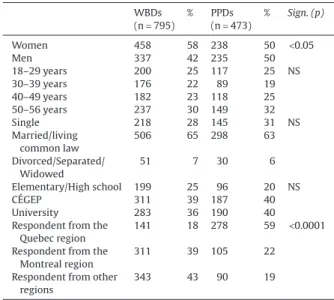
The final WBD sample had significantly more women (58%) (Table 2). Age groups were similar for WBDs and PPDs, with 25% of respondents belonging to the 18- to 29-year-old category, respectively 22% and 19% of respondents belonging to the 30- to 39-year-old category; almost a quarter of respondents to the 40- to 49-year-old and a third to the 50- to 56-year-old age groups. In terms of civil status and education, the majority of respondents were married or living under common law (65% for WBDs and 63% for PPDs) and both samples were well educated (36% of WBDs and 40% of PPDs had university degrees). The geographi-cal origin of respondents varied significantly between the two groups. WBD respondents came mostly from the greater Montreal region and elsewhere in Quebec (respectively 39% and 43%). In part due to the small number of collection sites and the recent opening of two of them, most PPDs came from the greater Quebec City region (59%).
Table 3presents the proportion of respondents in the whole sample and the two sub-samples (WBDs and PPDs) that selected each of the motivators. The motivator indi-cating the highest percentage was “My blood can save lives”, with 81% of all respondents having included this motiva-tion in their list. A significantly greater propormotiva-tion of WBDs (83%) also chose this motivator. Comparison of WBDs and PPDs according to their reported motivators shows that results for 12 motivators were statistically different between the two groups. A greater proportion of WBDs selected “It’s a positive thing to do and requires little effort” (62%), “I give thinking that a member of my family or a close friend could need blood someday” (47%) and “A blood drive is being held near where I live or near my workplace/place of study” (34%). Three other less important motivators in terms of percent-age are also higher for WBDs: “It gives me energy in the following days” (5%), “When I see posters and advertising” (5%) and “My coworkers also give blood” (2%). On the other hand, 61% of PPD respondents chose “Helping other people is in my nature” as one of their five most important moti-vators. Almost half of them selected “I think there is a strong need for blood products” (47%) and “It give me a sense of pride” (45%) as a major motivation while a quarter of them stated that “I receive telephone reminders from Héma-Québec” (28%) and “I like to have goals” (23%) were important motivators.
Almost every sub-category in each of the four demo-graphic variables (gender, civil status, age group, education) was statistically different for at least one motivator and one sub-group of donors (WBDs or PPDs).Table 4presents the sub-categories that have the highest percentage for each mo-tivator with a statistically significant difference. First, half of the female WBDs and almost as many of the married/ common law PPDs found “I give thinking that a member of my family or a close friend could need blood someday” to
Table 2
Comparison of WBD and PPD respondents. WBDs (n= 795) % PPDs (n= 473) % Sign. (p) Women 458 58 238 50 <0.05 Men 337 42 235 50 18–29 years 200 25 117 25 NS 30–39 years 176 22 89 19 40–49 years 182 23 118 25 50–56 years 237 30 149 32 Single 218 28 145 31 NS Married/living common law 506 65 298 63 Divorced/Separated/ Widowed 51 7 30 6 Elementary/High school 199 25 96 20 NS CÉGEP 311 39 187 40 University 283 36 190 40
Respondent from the Quebec region
141 18 278 59 <0.0001
Respondent from the Montreal region
311 39 105 22
Respondent from other regions
343 43 90 19
NS: not significant.
The number of respondents did not always total 795 and 473 due to missing data.
be one of their main motivators. Similarly, almost half of WBDs and PPDs aged 50–56 rated “I think there is a strong need for blood products” among their first motivators. Both single and younger (18–29 years old) PPD respondents
selected “It gives me a sense of pride” in greater propor-tion whereas “It’s my civic duty/a way to help out the community” was more frequently selected by male PPDs. Both WBD and PPD university graduates and female PPDs
Table 3
Proportions of WBD and PPD respondents for each selected motivators.
Motivators All donors
(n= 1268) WBDs (n= 795) PPDs (n= 473) p from Khi-2
My blood can save lives 81% 83% 77% <0.05
It’s a positive thing to do and requires little effort 58% 62% 52% <0.001
Helping other people is in my nature 53% 49% 61% <0.0001
I give thinking that a member of my family or a close friend could need blood someday 44% 47% 40% <0.05
I think there is a strong need for blood products 41% 38% 47% <0.01
It gives me a sense of pride 38% 33% 45% <0.0001
It is my civic duty/a way to help out the community 31% 32% 28% NS
A blood drive is being held near where I live or near my workplace/place of study 24% 34% 8% <0.0001
I receive telephone reminders from Héma-Québec 22% 18% 28% <0.0001
I like to have goals (20, 50, 100, 200 donations, etc.) 17% 13% 23% <0.0001
I have a rare and sought-after blood type 16% 17% 14% NS
Someone close to me has received one or more blood transfusions in the past 16% 16% 16% NS
It gives me confidence that others will give if I need it later 11% 12% 11% NS
It’s an activity that encourages me to monitor and take care of my health 8% 8% 9% NS
Other reason 7% 6% 8% NS
I feel recognition from people around me 6% 6% 7% NS
Blood donation is a tradition in my family 6% 6% 6% NS
It gives me energy in the following days 4% 5% 3% <0.05
When I see posters and advertising 4% 5% 1% <0.0001
My coworkers also give blood 2% 2% 1% <0.05
I join people that I know (donors, staff) at the blood drive 2% 1% 2% NS
My religious practice or convictions have encouraged me to donate 1% 1% 1% NS
I like to be accompanied 0% 1% 0% NS
Table 4
Statistically significant demographic sub-categories for each selected motivators.a
WBDs PPDs
I give thinking that a member of my family or a close friend could need blood someday
Women (50%)* Married (45%)***
I think there is a strong need for blood products 50–56 (46%)** 50–56 (52%)*
It gives me a sense of pride Single (54%)*
18–29 (60%)**
It’s my civic duty/a way to help out the community Men (32%)*
A blood drive is being held near where I live or near my workplace/ place of study
University (39%)** Women (11%)**
University (12%)***
I receive telephone reminders from Héma-Québec 50–56 (24%)*
University (23%)***
I like to have goals (20, 50, 100, 200 donations, etc.) Men (16%)*
Single (18%)** 18–29 (23%)*** Men (29%)** Single (29%)* 18–29 (32%)* CEGEP (30%)**
I have a rare and sought-after blood type Married (19%)*
Someone close to me has received one or more blood transfusions in the past
50–56 (20%)*
It gives me confidence that others will give if I need it later Elementary (18%)**
It gives me energy in the following days Elementary (9%)*** Men (4%)*
I join people that I know (donors, staff) at the blood drive Men (2%)*
My coworkers also give blood Men (4%)** Divorced/Separated/Widowed (7%)***
My religious practice or convictions have encouraged me to donate Divorced/Separated/Widowed (4%)*
Blood donation is a tradition in my family Single (10%)*
18–29 (12%)**
I feel recognition from people around me Men (10%)*
When I see posters and advertising 30–39 (3%)*
Elementary (3%)***
aThe sub-categories with the highest proportion for each motivator is the one shown in this table.
* p< 0.05. ** p< 0.01. *** p< 0.0001.
chose “A blood drive is being held near where I live or near my workplace/place of study” in greater proportions than other demographic sub-categories. Telephone reminders were chosen in greater proportion by WBDs and PPDs aged 50–56 and by WBD university respondents (24% and 23% each). The motivator “I like to have goals” was the one with the most statistically significant sub-categories: male, single and younger respondents (18–29 years old) from both groups, as well as CEGEP3PPDs all selected this motivator
in greater proportion. The rare blood-type motivator was chosen in greater proportion by married/common law WBD respondents while the “Someone close to me has received one or more blood transfusions in the past” motivator was chosen significantly more often WBDs aged 50–56. WBD re-spondents with low education (elementary or high school degree) rated two motivators in greater proportion: “It gives me confidence that others will give if I need it later” and “It gives me energy in the following days”. This last moti-vator was also chosen more often by male PPDs, even if proportions were lower than other motivators (only 4%). Similarly, two others motivators – “I join people that I know at the blood drive” (2%) and “My coworkers also give blood” (4%) – were chosen in greater proportion by male WBDs. Seven percent of divorced PPDs selected “My coworkers also give blood” and their WBD counterparts chose “My reli-gious practice or convictions have encouraged me to donate” more often (4%) than other sub-categories. Around 10% of younger (18–29) and single PPDs chose “Blood donation is a tradition in my family” while a similar proportion of male PPDs chose “I feel recognition from people around me” as an important motivator. Lastly, only 3% of PPDs in their thir-ties (30–39) and those with a low education chose “When I see posters and advertising” as a motivator. However, these last six motivators were nonetheless selected by only a small proportion of their respective groups.
4. Discussion
Despite the growing demand for plasma-derived ther-apeutic products and several countries’ desire to reduce their dependency on imported products, little research has been conducted to date involving apheresis donors’ demograph-ics. This study sought to compare donor demographics and motivations for donation among plasma/platelet and regular whole-blood donors.
4.1. Different motivations according to donor type
The greatest number of respondents, regardless of donor type, chose the altruistic motivation of “My blood can save lives”. The results confirm those of other researchers who have highlighted the importance of prosocial motivations for blood donors[38]. The second most popular motivator among WBDs was the belief that giving blood “is a posi-tive thing to do and requires little effort”. Emphasizing how
little effort is required may be interpreted as a reference to other types of charitable activities that call for a much more intensive form of commitment. Giving blood – which could take as little as 15 minutes – once a year because a drive is held at one’s workplace or place of study may be con-sidered a fairly simple form of community service. Indeed, we observed that proportionally more WBDs donated blood because there was a place where they could give blood near their home, workplace or place of study.
Among PPDs, the second most popular motivator was the belief that “helping others is in my nature”. In their com-parison of WBDs and plasma donors, Veldhuizen and van Dongen[21]suggested that “different donor profiles for whole-blood and plasma donors already exist before the very first donation experience” (p. 1684). When one considers the answers selected by the highest percentages in the two groups, one notes that WBDs attributed greater impor-tance to their families’ potential need for blood products, while PPDs tended to be motivated more by the fact that donating blood gave them a sense of pride. This result un-derscores the unique nature of plasma/platelet donation, which is far more demanding than whole-blood donation. When behaviors are demanding, individuals must truly believe that there is a benefit to this behavior in order to take action[47,57]. In short, donors who engage in this type of donation practice seem driven more by benevolence than by altruism[58].
What more can we learn when we compare these results with the socio-demographic characteristics?
4.2. Men and women: different profiles
The decision to oversample the number of women in our survey afforded numerous advantages for the comparison of male and female donors. As there may be far fewer women among PPDs, samples may be too small to make in-teresting comparisons[17,22]. Our results revealed that, of WBDs, it was primarily the women who donated thinking that a member of their family (or a friend) could need blood, who generally considered there to be a strong need for blood products, and who viewed giving blood as a positive thing to do that required little effort. It was female WBDs who were the least motivated overall by the achievement of do-nation goals. Males who donated whole blood differed from donors in general only due to the fact that they seemed to be the least motivated of all donors by the impression that there is a considerable need for blood products.
On the other hand, women who donated plasma or plate-lets seemed to be the most aware of all groups of the need for blood products, but appeared less motivated than male PPDs by the idea that giving blood was a civic duty, or by the fact that they had a blood type that was rare and sought after. Despite the fact that plasma and platelet donation cannot be carried out at mobile drives and must be done at collection centers, and that such centers would proba-bly be farther from home for many donors, female PPDs still attributed considerable importance to the proximity of the centers, certainly more so than did male PPDs. Female PPDs also relied more on telephone reminders than did the men. For their part, male PPDs were by far the most highly
3 In Quebec, CEGEP (for Collège d’Enseignement Général et Professionnel)
comes between high school and university, and is composed of profes-sional technical programs (3 years) and general pre-university programs (2 years).
motivated by the achievement of donation goals and by the recognition they received from those around them.
The PPD results closely resemble those obtained by Veldhuizen and van Dongen[21]and Glynn et al.[19]which, although related to WBD populations, showed that men had a greater tendency than women to cite self-centered reasons (e.g.: goals, rare blood type) or the influence of subjective norms (e.g.: recognition around me) while women would instead cite the practical utility of blood products (e.g.: strong need for blood products). Both men and women also pri-oritized the altruistic motivation “My blood can save lives”, but examination of other prosocial motivations supports the notion that men perceive blood donation more as an ab-stract altruistic gesture (e.g.: civic duty), while women focus more on the fact that it is a positive thing to do that re-quires little effort. When combined with the importance attributed to the proximity of the blood-collection loca-tion and telephone reminders, these results would suggest that women’s motivations are shaped to a greater degree by daily constraints. Future research should pay greater at-tention to the obstacles faced by women to give blood.
4.3. The importance of civil status
Comparison of motivations based on donors’ civil status provides support for the argument that the circumstances of everyday life influence donors’ motivations. The divorced/ separated/widowed PPD group contained the fewest individuals who stated that giving blood “is a positive thing to do and requires little effort”, while the single WBD group chose this statement the most. Married or common-law donors (WBD+ PPD) were far more likely to think that a “member of my family or a close friend could need blood someday”, while single individuals (the group that appre-ciated achieving donation goals the most) also had a greater tendency to think about the fact that they themselves might need blood products in the future. Family influence in this last group (for PPDs) was linked more to the family of origin, as more of these donors remembered giving blood as being a tradition in their families.
4.4. The influence of age on motivations
Even though population selection was limited to donors between the ages of 18 and 55, we noted certain differ-ences in the motivations cited by the youngest and the oldest donors in our study. Donors 50 years of age and older were the ones most motivated by the notion that “blood can save lives” or by thinking “there is a strong need”. With advanc-ing age, the probability of witnessadvanc-ing situations that highlight the utility of blood donation increases[59]. The youngest donors were the least likely to cite the fact that they knew someone personally who had received a blood transfu-sion. A sociological life-course perspective[60–62]may therefore be useful in interpreting these results. For example, it helps us understand why people in their thirties (PPDs), the donors most likely to have young children in their fami-lies, are also the group most motivated by the idea “that a member of my family or a close friend could need blood someday”. But this is also the period of life when balancing daily activities is most demanding: this is the age group for
whom telephone reminders, posters and advertising are im-portant motivators. The life-course paradigm stresses that young people construct their own autonomous identities through the practice and frequency of activities during early adulthood[40,61–64]. From this perspective, it is not sur-prising that the youngest donors would proportionally more frequently choose “It gives me a sense of pride” or “I like to have goals”. These donors are also the ones most likely to acknowledge their families’ influence on their blood do-nation practice, as other researchers have previously demonstrated[19,30].
4.5. Level of education: further evidence of the importance of the context of individuals’ everyday lives
The results of the WBD survey by Nguyen et al.[30]
showed less highly educated individuals to be those most interested in achieving aspirational goals when giving blood. In our study, this was the most frequently chosen motiva-tion of PPDs with CEGEP diplomas. WBDs with an elementary or high-school level education tended to be mo-tivated more by self-centered factors (“If I need it later”; “It gives me energy in the following days”) that also enabled them to increase their sense of social status (“I have a rare and sought-after blood type”; “It gives me a sense of pride”). More WBDs and PPDs with university degrees considered giving blood to be a civic duty, a more abstract prosocial mo-tivation than the social momo-tivations chosen by donors who had an elementary or high-school level education and who referenced people around them more directly (“A member of my family could need blood someday”; “Someone close to me has received a blood transfusion in the past”).
Of PPDs, those participants with elementary or high school education were the most likely to consider it to be in their nature to give blood. They also had a greater ten-dency than participants with university degrees to consider giving blood a positive thing to do requiring little effort. PPDs with university degrees more frequently cited the collec-tion center’s proximity as a motivating factor. The plasma/ platelet collection center in Quebec City – where 59% of our PPD samples come from – is close to the university, and also to a large hospital complex and several businesses (insur-ance, law and accounting firms, for example). It is more likely to find blood donors with advanced degrees in these work-places. A large number of WBDs with university degrees also stated that they were motivated by the proximity of blood collection services. We also know that numerous drives are held in universities.
4.6. Recommendations
Cross analysis of socio-demographic characteristics and motivations demonstrates the existence of highly specific donor profiles. Our results suggest that agencies should develop new donor recruitment strategies more carefully tailored to these different potential clienteles, especially if they wish to convince WBDs to convert to apheresis dona-tion. For example, strategies emphasizing the importance of the need for blood products would be more effective with women or older groups, while strategies stressing the positive benefits for donors would find a more attentive
audience among men, young people, students, single or less highly educated people. It would appear that for some of these groups, giving blood helps improve self-esteem, affirm one’s identity, and heighten one’s sense of social status. Ar-guments that point to the potential benefits of blood donation for family and friends are also likely to convince specific segments of the population: women, individuals who are married or in common-law relationships, and parents of young children, as well as individuals who are less edu-cated or less active in the workforce. Our results also suggest that the location of plasma and platelet collection centers can be highly strategic. While the motivations most fre-quently cited by donors may still be prosocial, reasons “of convenience” are of noticeable importance for certain groups of donors such as women, people who are at an age when balancing family and professional responsibilities is most demanding, divorced/separated individuals, and those with university degrees.
4.7. Limitations
Our data have some limitations and weaknesses that must be discussed. First, our study was conducted on a sample of blood donors in Quebec, Canada, who may differ from blood donors in other countries. Moreover, we chose to restrict our study to donors between the ages of 18 and 55. This survey also tries to better understand the integra-tion of blood donaintegra-tion into daily life and especially any barriers to the practice and reasons for its discontinuation among women in their thirties and forties, and this is why our sample is age-specific. A complementary study using semi-structured interviews was conducted to better un-derstand the motivations and blood-donation practices of PPDs; this second study involved an older population (up to 70 years of age), and results are to be published later.
We should also point out the fact that we decided to place plasma and platelet donors together in the same group. While the growing need for blood products primarily con-cerns plasma derivatives, we believe that plasma and platelet donation practices and motivations are sufficiently similar for these two types of donors to be grouped together. Indeed, we know that donors increasingly make both plasma and platelet donations. It should also be noted that this group-ing helped increase the number of potential respondents in our survey.
Our results were also constrained by the fact that mo-tivations were self-reported, which may have biased results in favor of socially desirable answers[15,17,65]Another of our study’s limitations is that we did not specifically explore the motivations for first donations as other studies have done. This was because our previous studies[38]had dem-onstrated the difficulty of collecting reliable information on this topic when the first donation was several years prior, but it may account for why motivations associated with donors’ social context – in particular, the influence of family – are less prominent in our results. We should also mention the non-standard formulation of the statements chosen to represent the different motivators, which makes compari-son of our results with those of other studies on the same topic somewhat difficult.
5. Conclusion
At a time when numerous countries are seeking to develop increased self-sufficiency in plasma-derived prod-ucts, it is extremely important to acquire a better understanding of apheresis blood donation. Our survey per-mitted us to produce one of the very rare comparisons of WBDs and PPDs. These results offer points for blood-collection agencies to ponder in developing new blood donor recruiting and retention strategies.
Acknowledgments
This study was made possible by a grant from the Héma-Québec Foundation. We acknowledge and thank Yves Grégoire (Héma-Québec) and Nathalie Vachon (INRS) for their assistance in data collection and data processing.
References
[1] Ali SA. Beliefs about the effect of using blood donation payments: survey results from Norway. Oslo: Universitetet I Oslo; 2013.
[2] Carter MC, Wilson J, Redpath GS, Hayes P, Mitchell C. Donor recruitment in the 21st century: challenges and lessons learned in the first decade. Transfus Apher Sci 2011;45:31–43.
[3] Drackley A, Newbold KB, Paez A, Heddle N. Forecasting Ontario’s blood supply and demand. Transfusion 2012;52:366–74.
[4] Greinacher A, Fendrich K, Alpen U, Hoffmann W. Impact of demographic changes on the blood supply: Mecklenburg-West Pomerania as a model region for Europe. Transfusion 2007;47:395– 401.
[5] Riley W, Schwei M, McCullough J. The United States’ potential blood donor pool: estimating the prevalence of donor-exclusion factors on the pool of potential donors. Transfusion 2007;47:1180–8.
[6] Lamb M. Source plasma: future outlook. Transfusion 2009;49:1520–6.
[7] Mahony BO, Turner A. The Dublin Consensus Statement on vital issues relating to the collection of blood and plasma and the manufacture of plasma products. Vox Sang 2010;98:447–50.
[8] Robert P. Global plasma demand in 2015. Pharma Policy Law 2009;11:359–67.
[9] Farrugia A, Penrod J, Bult JM. Payment, compensation and replacement–the ethics and motivation of blood and plasma donation. Vox Sang 2010;99:202–11.
[10] WHO. Expert consensus statement on achieving self-sufficiency in safe blood products, based on voluntary non-remunerated blood donations (VNRBD). Vox Sang 2012;103:337–42.
[11] Héma-Québec. Rapport annuel 2013–2014. 2014. p. 72.
[12] Tison M. L’usine de Green Cross sera plus importante que prévu. La Presse+. Montreal: La Presse; 2015. p. Screen 2.
[13] Anderson L, Newell K, Kilcoyne J. “Selling blood”: characteristics and motivations of student plasma donors. Sociol Spectr 1999;19:137–62.
[14] Ringwald J, Lange N, Rabe C, Zimmermann R, Strasser E, Hendelmeier M, et al. Why do some apheresis donors donate blood just once? Vox Sang 2007;93:354–62.
[15] Trimmel M, Lattacher H, Janda M. Voluntary whole-blood donors, and compensated platelet donors and plasma donors: motivation to donate, altruism and aggression. Transfus Apher Sci 2005;33:147–55.
[16] Weidmann C, Kluter H. Blood collection and donor motivation in Germany. ISBT Sci Ser 2013;238–41. International Society of Blood Transfusion, Amsterdam.
[17] Bove LL, Bednall T, Masser B, Buzza M. Understanding the plasmapheresis donor in a voluntary, nonremunerated environment. Transfusion 2011;51:2411–24.
[18] Cataldo JF, Cohen E, Morganti JB. Motivation of voluntary plasmapheresis donors. Transfusion 1976;16:375–9.
[19] Glynn SA, Smith JM, Schreiber GB, Kleinman SH, Nass CC, Bethel J, et al. Repeat whole-blood and plateletpheresis donors: unreported deferrable risks, reactive screening tests, and response to incentive programs. Transfusion 2001;41:736–43.
[20] Schneider T, Fontaine O, Huart JJ. Ethiques, motivations des donneurs d’aphérèse plasmatique. Transfus Clin Biol 2004;11:146–52.
[21] Veldhuizen I, van Dongen A. Motivational differences between whole blood and plasma donors already exist before their first donation experience. Transfusion 2013;53:1678–86.
[22] Julius CJ, Sytsme SR. Comparison of demographics and motivations of highly committed whole blood and platelet donors. J Clin Apher 1993;8:82–8.
[23] Guo N, Wang J, Ness P, Yao F, Dong X, Bi X, et al. Demographics of apheresis platelet donors in five blood centers in China. Transfusion 2012;52:560–6.
[24] Tomita T, Takayanagi M, Kiwada K, Mieda A, Takahashi C, Hata T. Vasavagal reactions in apheresis donors. Transfusion 2002;42:1561–6.
[25] Yuan S, Ziman A, Smeltzer B, Lu Q, Goldfinger D. Moderate and severe adverse events associated with apheresis donations: incidences and risk factors. Transfusion 2010;50:478–86.
[26] Cloutier MS, Apparicio P, Dubé J, Charbonneau J, Delage G. Regional variation in the modeling of donation frequency: the case of Héma-Québec, Canada. Transfusion 2012;52:2329–38.
[27] Duboz P, Lazaygues C, Boëtsch G, Chiaroni J. Donneurs de sang réguliers ou donneurs occasionnels: différences sociodémographiques et motivationnelles. Transfus Clin Biol 2012;19:17–24.
[28] Germain M, Glynn SA, Schreiber GB, Gelinas S, King M, Jones M, et al. Determinants of return behavior: a comparison of current and lapsed donors. Transfusion 2007;47:1862–70.
[29] Misje AH, Bosnes V, Gasdal O, Heier HE. Motivation, recruitment and retention of voluntary non-remunerated blood donors: a survey-based questionnaire study. Vox Sang 2005;89:236–44.
[30] Nguyen DD, DeVita DA, Hirschler NV, Murphy EL. Blood donor satisfaction and intention of future donation. Transfusion 2008; 48:742–8.
[31] Ownby HE, Kong F, Watanabe K, Tu Y, Nass CC. Analysis of donor return behavior. Transfusion 1999;39:1128–35.
[32] Piliavin JA, Callero PL. Giving blood: the development of an altruistic identity. Baltimore: Johns Hopkins University Press; 1991.
[33] Sojka BN, Sojka P. The blood donation experience: self-reported motives and obstacles for donating blood. Vox Sang 2008;94:56–63.
[34] Veldhuizen I, Ferguson E, de Kort W, Donders R, Atsma F. Exploring the dynamics of the theory of planned behavior in the context of blood donation: does donation experience make a difference? Transfusion 2011;51:2425–37.
[35] Alessandrini M. Community volunteerism and blood donation: altruism as a lifestyle choice. Transfus Med Rev 2007;21:307–16.
[36] Guiddi P, Alfieri S, Marta E, Saturni V. New donors, loyal donors, and regular donors: which motivations sustain blood donation? Transfus Apher Sci 2015;52:339–44.
[37] Schlumpf KS, Glynn SA, Schreiber GB, Wright DJ, Randolph Steele W, Tu Y, et al. Factors influencing donor return. Transfusion 2008; 48:264–72.
[38] Bednall TC, Bove LL. Donating blood: a meta-analytic review of self-reported motivators and deterrents. Transfus Med Rev 2011;25:317–34.
[39] Hollingsworth B, Wildman J. What population factors influence the decision to donate blood? Transfus Med 2004;14:9–12.
[40] Charbonneau J, Cloutier M-S, Quéniart A, Tran N. Le don de sang: un geste social et culturel. Québec: P.U.L.; 2015.
[41] Kuruvatti J, Prasad V, Williams R, Harrison MA, Jones RP. Motivations for donating blood and reasons why people lapse or never donate in Leeds, England: a 2001 questionnaire-based survey. Vox Sang 2011;101:333–8.
[42] James AB, Demmons DG, Schreiber GB, Hillyer CD, Shaz BH. Contribution of attitudinal factors to blood donation in
African American church attendees. Transfusion 2011;51:158– 65.
[43] Fernandez-Montoya A. Altruism and payment in blood donation. Transfus Sci 1997;18:379–86.
[44] Schreiber GB, Schlumpf KS, Glynn SA, Wright DJ, Tu Y, King MR, et al. Convenience, the bane of our existence, and other barriers to donating. Transfusion 2006;46:545–53.
[45] Shaz BH, Hillyer CD. Minority donation in the United States: challenges and needs. Curr Opin Hematol 2010;17:544–9.
[46] Szymanski LS, Cushna B, KJackson BCH, Szymanski IO. Motivation of plateletpheresis donors. Transfusion 1978;18:64–8.
[47] Hupfer ME. Helping me, helping you: self-referencing and gender roles in donor advertising. Transfusion 2006;46:996–1005.
[48] Yuan S, Hoffman M, Lu Q, Goldfinger D, Ziman A. Motivating factors and deterrents for blood donation among donors at a university campus–based collection center. Transfusion 2011;51:2438–44.
[49] Henrion A. L’énigme du don de sang. Approche ethnographique d’un don entre inconnus. Liège: Université de Liège; 2003.
[50] Zaller N. To donate or not to donate: an analysis of blood donors and blood donation knowledge, attitudes and practices in Northwestern China. Maryland: The Johns Hopkins University; 2004.
[51] Masser B, White KM, Hyde MK, Terry DJ. The psychology of blood donation: current research and future directions. Transfus Med Rev 2008;22:215–33.
[52] Glynn SA, Kleinman SH, Schreiber GB, Zuck T, Combs SM, Bethel J, et al. Motivations to donate blood: demographic comparisons. Transfusion 2002;42:216–25.
[53] Pagliariccio A, Guermandi G, Marinozzi M, Piani M. Can better information increase hemapheresis? Transfus Apher Sci 2003; 28:149–53.
[54] Harrington M, Sweeney MR, Bailie K, Morris K, Kennedy A, Boilson A, et al. What would encourage blood donation in Ireland? Vox Sang 2007;92:361–7.
[55] Moore DL, Tarnai J. Evaluating nonresponse error in mail surveys. In: Groves RM, Dillman DA, Eltinge JL, Little RJA, editors. Survey nonresponse. New York: John Wiley & Sons; 2002. p. 197–211.
[56] Curtin R, Presser S, Singer E. The effects of response rate changes on the index of consumer sentiment. Public Opin Q 2000;64:413–28.
[57] Godin G, Germain M. How to motivate whole blood donors to become plasma donors. J Blood Transfus 2014;2014:6.
[58] Ferguson E, Farrell K, Lawrence C. Blood donation is an act of benevolence rather than altruism. Health Psychol 2008;27:327–36.
[59] Godin G, Germain M. Predicting first lifetime plasma donation among whole blood donors. Transfusion 2013;53:157S–61S.
[60] Abbott A. Time matters: on theory and method. Chicago: University of Chicago Press; 2001.
[61] Arnett JJ. Emerging adulthood: the winding road from the late teens through the twenties. New York; Oxford: Oxford University Press; 2004.
[62] Gaudet S. Comprendre les parcours de vie à la croisée du singulier et de la structure sociale. In: Burlone N, Gaudet S, Lévesque M, editors. Penser la famille, penser les transitions de vie… Repenser les politiques publiques. Québec: PUL; 2013. p. 15–50.
[63] Bidart C. Les temps de la vie et les cheminements vers l’âge adulte. Lien social et politiques 2005;54:51–63.
[64] Charbonneau J, Bourdon S. Regard sur les jeunes et leurs relations. Québec: PUL; 2011.
[65] Goette L, Stutzer A, Frey BM. Prosocial motivation and blood donations: a survey of the empirical literature. Transfus Med Hemother 2010;37:149–54.