OATAO is an open access repository that collects the work of Toulouse
researchers and makes it freely available over the web where possible
Any correspondence concerning this service should be sent
to the repository administrator:
[email protected]
This is an author’s version published in:
http://oatao.univ-toulouse.fr/23381
To cite this version:
Anaya Castro, Maria Antonieta
and Ayala-Zavala, Jesus Fernando and
Muñoz-Castellanos, Laila and Hernández-Ochoa, León and Peydecastaing,
Jérôme
and Durrieu, Vanessa
β-Cyclodextrin inclusion complexes
containing clove (Eugenia caryophyllata) and Mexican oregano (Lippia
berlandieri) essential oils: Preparation, physicochemical and antimicrobial
characterization. (2017) Food Packaging and Shelf Life, 14 (Part B). 96-101.
ISSN 2214-2894
{3-Cyclodextrin inclusion complexes containing clave (Eugenia caryophyllata)
and Mexican oregano
(Lippia berlandieri)
essential oils: Preparation,
physicochemical and antimicrobial characterization
Maria Antonieta Anaya-Castroa,c, Jesus Fernando Ayala-Zavalah, Laila Mufioz-Castellanosa, Lean Hernândez-Ochoaa, Jérôme Peydecastaingc, Vanessa Durrieuc,*
a Facultad de Ciencias Quimicas, Universidad Autonoma de Chihuahua, Circuito Universitario N° 1, Nuevo Campus, Chihuahua 31125, Mexico b Centro de Investigaci6n enAlimentaci6ny DesarroUo, AC, Carretera a la Victoria km 0.6, Apartado Postal 1735, Hermosillo, Sonora 83000, México
c Laboratoire de Chimie Agro-Industrielle (LCA), Université de Toulouse, lNRA, INPT, Toulouse, France
ARTICLE INFO ABSTRACT
Keywords:
Molecular inclusion j3-Cyclodextrins
Mexican oregano essential oil Clove essential oil
Mexican oregano and clove essential oils are widely used as antimicrobial, insecticidal, antifungal and anti
oxidant compounds. To reduce tbeir volatility and tbeir hydrophobicity, tbey were encapsulated in /3-cyclo
dextrin (/3-CD) complexes by co-precipitation method, and the physicochemical and microbiological properties
of tbese inclusion complexes were characterized. Different essential oil (EO) to /3-CD weight ratios were tested
(4:96, 8:92, 12:88, and 16:84 w/w) and encapsulation efficiency and rate were determined. GC-MS and GC-FID
analysis were also performed to determine tbe main oil constituents, which were eugenol and carvacrol in clove
and Mexican oregano essential oils respectively and to quantify tbeir ratio in inclusion complexes. 1 H NMR
spectroscopy confirmed essential oil inclusion. The 4:96 ratio (clove essential oil:/3-CD) gave tbe highest eugenol content and greatest microencapsulation efficiency; and tbe 8:92 and 12:88 ratios (Mexican oregano essential
oil: /3-CD) tbe highest carvacrol content. Complexes antimicrobial activity was tested against two food-related
microorganisms: Listeria monocytogenes ATCC 19114 and Escherichia coli ATCC 25922 by means of agar disk
diffusion assay. The results demonstrated tbe inclusion of tbe majority of biologically active clove and Mexican
oregano essential oil molecules, providing increased stability by reducing tbeir volatility and preserving their
biological properties.
1. Introduction
Syntbetic antimicrobials have long been used as safe preservatives to control a variety of microbial risks. Nevertbeless, tbese compounds are not entirely satisfactory for consumers seeking natural and healthy foods, and tbe replacement of syntbetic products witb more natural alternatives has received increasing interest in recent years. The essential oils ob tained from spices are among tbese alternatives, as tbeir active compo nents (including terpenes, aldehydes, acids, alcohols, phenols, esters and ketones) are well known for tbeir antimicrobial activity (Ortufio, 2006;
Hu, Gerhard, Upadhyaya, Venkitanarayanan, & Luo, 2016). Nevertbeless, tbey have limitations such as their volatility, oxidation, and easy de gradation by light and temperature. EO of Mexican oregano (Lippia ber
landieri) and clove (Eugenia caryophyUata) are some of the most effective
antimicrobials, particularly against strains of E. coli; tbeir main compo nents are carvacrol, thymol, and eugenol respectively and tbeir pre cursors. The properties of tbese EO, and particularly tbeir antimicrobial
• Corresponding author.
E-mail address: [email protected] (V. Durrieu).
and antioxidant activities have been extensively studied (Burt, 2004; Arana-Sanchez et al., 201 O; Guarda, Rubilar, Miltz, & Galotto, 2011), and some recent works deal with tbeir encapsulation to improve their sta bility.
Indeed, microencapsulation is extensively used in pharmaceutical, food and cosmetic industries due to tbe advantages offered by this technology to protect active ingredients through tbe creation of a physical barrier between the nucleus and the shell materials against adverse reactions (lipid oxidation, degradation, evaporation, nutri tional deterioration) and external medium (pH, humidity, light, tem perature) (Xiao, Liu, Zhu, Zhou, & Niu, 2014). Molecular inclusion in cyclodextrin complexes has been demonstrated as a relevant method, partieularly for volatile and hydrophobie molecules (Cevallos, Buera, & Elizalde, 2010).
Cyclodextrins are toroïdal shape oligosaccharides, produced en zymatically from starch, with hydrophobie cavities and hydrophilie exterior, which allows a wide range of compounds to be encapsulated
(Almenar, Auras, Rubino, & Harte, 2007; Del Valle, 2004; Vyas et al., 2008). During the formation of an inclusion complex, water molecules are displaced to the outside of the lipophilic cavity, on account of the presence of new lipophilic guest molecules that induces a new equili brium. The extended use of cyclodextrins takes place in the pharma ceutical, cosmetics, food, chemical and several other industries and in the USA they belong to the GRAS (generally recognized as safe) list of FDA (Food and Drugs Administration) (Vyas et al., 2008; de Carvalho & Pinto, 2012). In particular, 13-CD permits the encapsulation of mono and sesquiterpenes, main compounds of various EO (Astray, Gonzalez Barreiro, Mejuto, Rial-Otero, & Simal-Gândara, 2009).
Recently, studies on oregano and clove EO encapsulation using 13-CD have been reported (Arana-Sânchez et al., 2010; Guarda et al., 2011; Wang et al., 2011; Santos, Kamimura, Hill, & Gomes, 2015; Gong et al., 2016), demonstrating the inclusion of major component molecules (thymol, eugenol or carvacrol) in the 13-CD cavities, the antimicrobial and antioxidant properties of the formed microparticles, and evaluating the active compounds release kinetics. This proves the continuing im portance of studies about encapsulation of these molecules.
In this context, the aim of this work was to prepare inclusion complexes of these EO in 13-CD by precipitation method, to characterize them and to confirm their antimicrobial activity. This antimicrobial product, which is easy to handle, with an improved stability and water solubility, could then be used as a natural food preservative, especially in the area of food-packaging.
2. Materials & methods 2.1. Materials
Clove (Eugenia caryophyllata) was purchased in Commercial Cardona, Chihuahua, Mexico, and clove EO was obtained by hydro distillation. Essential oil of Mexican oregano (Lippia berlandieri) was acquired from CIRENA (Research Center for Natural Resources, Salaices, Mexico). GC standards were purchased from Fluka Chemical Corp. 13-cyclodextrin (Cavamax W7 food grade) was kindly provided by Wacker Biochem, (Mexico), Trypticase Soy Agar (TSA) and Mueller Hinton agar by Bioxon (Mexico). All other reagents used were analy tical grade.
2.2. Extraction of clove essential oil
A modified Schilcher apparatus was utilized in the hydrodistillation process. The flow rate was 10 to 15 mL/min. Cooling water was kept at 19 °C to prevent the higher molecular weight components from being stuck in the cooler. 200 g of clove was added to 4 L of water and in troduced in a boiling flask. The system was heated to 100 °C for 5 h. 2.3. Preparation of EO: fi-CD inclusion complexes
The precipitation method (Bhandari, D'Arc, & Thi Bich, 1998) was used to prepare inclusion complexes of clove essential oil: 13-CD and Mexican oregano essential oil: j3-CD. By magnetic stirring at 55 °C a sample of 10 g of j3-CD was dissolved in 100 mL of an ethanol:water (1:2) mixture. The amounts of each essential oil ratio needed to obtain essential oils: j3-CD weight ratios of 0:100, 4:96, 8:92, 12:88, and 16:84, respectively, were previously dissolved in ethanol (10% w/v) and then slowly added to the warm j3-CD solution, maintaining stirring and warming. The final solution was covered and stirred for a further 4 h and kept overnight at 4 °C. The obtained complexes were recovered by filtration and then dried in a convection oven at 50 °C for 24 h. Sub sequently, they were placed in a desiccator for 24 h. The samples were weighed to equilibrium, and stored at 25 °C. All the ratios were pre pared in triplicate.
Process efficiency (PE), entrapment efficiency (EE) and drug loading (DL) were calculated using Eqs. (1)-(3).
Total weight of obtained inclusion complexes (mg) PE =---X 100
initial �CD weight (mg) + initial EO weight (mg) (1) EE = --=---=-=---'--=-X 100 weight of entrapped EO (mg)
initial EO weight (mg) (2)
weight of entrapped EO (mg)
DL=---�--'---��--��--X 100
weight of obtained inclusion complexes (mg) (3)
Weight of entrapped EO was determined by GC-FID analysis. 2.4. Gas chromatography-mass spectrometry (GC-MS) analysis conditions
Identification of volatile components of clove and Mexican EO was carried out by gas chromatography coupled to a mass spectrometer (GC-MS) Perkin-Elmer Auto Systems XL. The capillary column selected was PE-5 (stationary phase methylphenyl silicone 5%), with dimensions of 60 m in length and 0.25 mm diameter nonpolar. The operating conditions for each of the two oils were as follows. Column temperature was raised from 55 to 120 °C at a rate of 8 °C/min, and held there for 1 min, and then the temperature was raised from 120 to 200 °C at a rate of 8 °C/min, and held at this final temperature for 9 min. Carrier gas was helium at a flow rate of 1 mL/min, and identification of the com pounds was based on comparison of their mass spectra with the Saturn library and NIST 98 library data from GC-MS system.
2.5. Gas chromatography equipped with flame ionization detector (GC-FID) analysis conditions
Quantification was determined using a Varian 3900 chromatograph equipped with a FID detector (Varian) and a Varian CP-SII8CB capillary column (30 m x 0.25 mm, film thickness 0.25 µm) and one meter of precolumn. Column temperature was raised from 55 to 65 °C at a rate of 1 °C/min, and held there for 5 min, then the temperature was raised from 65 to 200 °C at a rate of 7 °C/min, and held there for 1 min, finally the temperature was raised from 200 °C to 290 °C at 10 °C/min and held there for 5 min. Carrier gas was helium at a flow rate of 1 mL/min, injector and detector temperatures were set at 220 and 290 °C, re spectively, and 1 µL of the extract was injected automatically. EO ex traction from j3-CD complexes was carried out by sonication (Ayala Zavala et al., 2008). Each EO was dissolved separately in di chloromethane (500 mg/L). On the other hand, 20 mg of samples were dissolved in 2 mL of deionized water and 4 mL of dichloromethane was added. The mixture was sonicated for 30 min and the organic phase recovered. After repeating five times, the total volume of the organic phase was used for quantification of molecules. To quantify the major constituents of essential oils, standard calibration curves with carvone as internai standard were used.
2.6. Moisture determination
Moisture determination was carried out by drying a sample (3-4 g) of pure 13-CD, and essential oil complexes in a vacuum oven (Shel Lab 1410, Oregon, USA) at 70 °C for 24 h and at < 6.7 kPa pressure. The percentage of moisture content was calculated by weight difference between the initial and the final samples.
2. 7. 1 H NMR spectroscopy
1H NMR spectra of both EO:j3-CD complexes and free 13-CD were performed with a Bruker FOURIER 300 spectrometer (Bruker Instruments Inc. USA.) operating at 300 MHz. Solutions were prepared using D20.
2.8. Moisture sorption-desorption isotherms
both EO were determined by Dynamic Vapor Sorption (DVS), using a DVS Advantage automated vapor sorption analyzer (Surface Measurement Systems Ltd., London, U.K.), exposing the samples to different values of relative humidity (0, 15, 30, 45, 60 and 90%) at 24.8 °C, and following the methodology described by Argyropoulos, Alex, Kohler and Müller (2012).
2. 9. Scanning electron microscopy (SEM)
The morphology of the complexes and {3-CD was assessed by LEO435VP scanning electron microscope (LEO Electron microscopy Ltd., Cambridge, UK) operated at 8 kV. The samples were placed on conductive double-faced adhesive tape and sputter-coated with silver. 2.10. Antimicrobial activity
2.10.1. Microbial inoculum preparation
Two microorganisms were used due to their relationship with food: the Gram-positive L. monocytogenes ATCC 19114 and the Gram-negative E. coli ATCC 25922. These strains were obtained from the culture col lection of the Faculty of Chemical Sciences (Autonomous University of Chihuahua, Mexico) and maintained on slants ofTrypticase Soy Agar at 4 °C. The preparation of the inoculum consisted of a saline suspension from selected colonies isolated of TSA plates after 24 h incubation. T hen, turbidity of the suspension was adjusted to the concentration of 1 x 10⁸ CFU/mL using the 0.5 McFarland nephelometer standard. 2.10.2. Agar disk diffusion assay
Samples antimicrobial activity was performed by the agar disk dif fusion method (Gortzi, Lala, Chinou, & Tsaknis, 2007). Treatments consisted of dissolving 0.5, 1 and 2 g of samples in 10 mL of ethyl al cohol, respectively, to obtain solutions with concentrations of 50, 100 and 200 mg/mL. These treatments were compared with the quantity equivalent of free EO contained in inclusion complexes. As controls, dises with ethyl alcohol and {3-CD were used.
Subsequently, sterile blank filter dises of 5 mm diameter were dis pensed over the surface of Mueller-Hinton agar petri dishes (previously seeded by spreading with the inoculum of each bacterium). Then, 4 µL of each treatment were added. This was performed in triplicate. The plates were inverted and placed in an incubator at 35 °C over a period of 15 min after applying the disks. After 24 h of incubation, each plate was examined and the resulting inhibition zones were measured. 2.11. Statistical analysis
Data collected was analyzed by one-way ANOVA with a confidence level of 0.95 and Tukey-Kramer multiple mean comparisons. Data was analyzed using the MINITAB Release16 statistical package (Minitab Inc., USA).
3. Results and discussion
3.1. Composition and quantification of the essential oils
Gas chromatography (GC-MS) analysis was used to determine the EO composition, and the quantification of their main volatile com pounds was performed by GC-FID analysis. Eugenol was the major volatile detected in the clove EO, with eugenyl acetate and {3-car yophyllene in lower amounts. The main molecule detected in Mexican oregano EO was carvacrol, in addition to minor constituents such as p cymene, {3-caryophyllene and thymol. Both eugenol and carvacrol ex hibit high antimicrobial and antioxidant activities and are approved food additives by the U.S. Food and Drug Administration (Santos et al., 2015; Gong et al., 2016).
The contents of eugenol and carvacrol in clove and oregano OE respectively, were used as a mode! for evaluating the efficiency in the
Table 1
Total volatiles amount, process efficiency, entrapment efficiency and drug loading of inclusion complexes at various EO:j3-CD ratios.
Proportion Essential Process Entrapment Drug Loading oil: jl-cyclodextrin Efficiency Efficiency (w/wo/o)" (w/wo/o) (w/wo/o)" (w/wo/o)'
Mexican Oregano: j3-Cyclodextrin
4:96 89.22 ± 0. 99b 57.26 ± 2.75' 2.29 ± 0.11d 8:92 93.69 ± 0.77a 77.57 ± 3.01• 6.20 ± 0.24' 12:88 93.10 ± 1.24• 65.55 ± 2.06b 7.86 ± 0.24" 16:84 88.71 ± 0.33b 46.99 ± 0.63d 7.51 ± 0.10b Clove:j3-Cyclodextrin 4:96 88.10 ± 1.11< 63.63 ± 8.60" 2.54 ± 0.34c 8:92 94.98 ± 0.92• 50.62 ± 1.81b 4.05 ± 0.14b 12:88 92.17 ± 0.38b 38.01 ± 1.76' 4.56 ± 0.21• 16:84 88.67 ± 0.42c 30.12 ± 1.34d 4.82 ± 0.21• a,b,"Values with different superscript letters in the same column (each essential oil) were
significantly different P < 0.05 (Tukey-Kramer multiple mean comparisons). * Values given are averages of three replicate samples.
inclusion process (Table 2). Overall, the most efficient ratios, com bining the highest entrapment efficiency (Table 1) and a high level of eugenol (clove EO) or carvacrol (Mexican oregano EO) (Table 2) were 4:96 for the clove EO and 8:92 for the Mexican EO. These ratios were used to characterize the inclusion complexes by 1H NMR spectroscopy, SEM and moisture sorption isotherms.
3.2. Characterization of EO: jl-CD inclusion complexes
Process efficiency (PE), entrapment efficiency (EE) and drug loading (DL) of inclusion complexes are given in Table 1. PE (%) was significantly higher (P < 0.05) for the 12:88 and 8:92 ratios com pared to the 4:96 and 16:84 for both EO:{3-CD complexes. On the other hand, it is important to emphasize that increasing the amount of es sential oil reduced the EE, probably because of the saturation of the matrix, as suggested by Ayala-Zavala et al. (2008). EE values showed that optimum EO: {3-CD ratios at 8:92 for Mexican oregano EO (71 %) and 4:96 for clove EO (61 %). These values are on the same range and even slightly higher than those obtained by Abarca, Rodriguez, Guarda, Galotto, and Bruna (2016), with the same method of inclu sion.
For both essential oils, the maximal DL value was reached for the 12:88 ratio, as lower values were obtained for the 16:84 ratio sug gesting that the maximum essential oil inclusion was reached (Del Toro Sânchez et al., 2010). Mexican oregano EO gave higher EE, allowing a
Table 2
Recovery of carvacrol and eugenol at various EO:j3-CD ratios. Proportion Essential oil:jl-cyclodextrins (w/wo/o) Mexican oregano: j3-cyclodextrin 4:96 8:92 12:88 16:84 Clave: j3-cyclodextrin 4:96 8:92 12:88 16:84
Relative major volatile of ail volatiles (w/w%) Carvacrol 66.13 ± 5.39c 71.22 ± o.8o•b 73.63 ± 0.93" 68.78 ± 0.72bc Eugenol 97.61 ± 0.61" 97.94 ± 0.35" 97.27 ± 0.28" 96.32 ± 0.88b
Ratio of major volatile in inclusion complexes (w/wo/o)" Carvacrol 1.51 ± 0.07d 4.42 ± 0.18' 5.79 ± 0.14" 5.17 ± 0.05b Eugenol 2.49 ± 0.35' 3.97 ± 0.14b 4.44 ± 0.20• 4.64 ± 0.24"
a,b,"Values with different superscript letters in the same column (each essential oil) were
significantly different P < 0.05 (Tukey-Kramer multiple mean comparisons). * Values given are averages of three replicate samples.
maximum DL around 7%, concordant with the values obtained by
Kamimura, Santos, Hill and Gomes (2014) who obtained carvacrol DL around 7-8% in hydroxypropyl-beta-cyclodextrin.
The difference in DL observed between the two EO (7% for Mexican oregano EO and less than 5% for clove EO) could be attributed mainly to the structural differences between the two major components of the EO: carvacrol for Mexican oregano EO and eugenol for clove EO. To a greater degree than their molecular weight, the difference on their structural conformation, and particularly the more linear structure of eugenol, could involve Jess favourable interactions with j3-CD as de scribed by Lawtrakul, Inthajak, and Toochinda (2014).
3.3. 1H NMR spectroscopy
The NMR technique was successfully used to study the structural properties of j3-CD complexes, particularly in solution. Chemical-shift changes in the 1H NMR spectra were used to confirm the complex formation process, the most significant variations usually being ob served for the H-atoms located within the j3-CD cavity. The induced shift (�d) refers to the difference in chemical shifts in the presence or absence of the other reagents, calculated using the following equation:
�li = li(complex)--licrreeJ (4)
The positive and negative signs showed downfield and upfield shifts, respectively.
The 1H chemical shifts of free and complexed j3-CD prepared with clove EO (4:96) and Mexican oregano EO (8:92) are shown in Table 3. H-3 and H-5 protons, situated inside the cavity, and the H-6 proton, were shifted upfield, with values of �li = -0.03, -0.04 and -0.02 respectively (clove EO:j3-CD complexes), and values of �li = -0.03, -0.8 and -0.05 for inclusion complexes of Mexican oregano EO, due to the insertion of the aromatic ring of EO molecules (mainly eugenol and carvacrol) inside the j3-CD lipophilic cavity, and in accordance with the literature (Locci, Lai, Piras, Marongiu, & Lai, 2004; Terekhova, Kumeev,&Alper, 2007, Gong et al., 2016).
On the other hand, in the clove EO: j3-CD complexes, protons lo cated on the exterior of the cavity (H-1 and H-4) were comparatively unaffected, as was H-2. Concerning Mexican oregano EO:j3-CD com plexes, chemical shifts of H-1 and H-4 protons were equal but not pronounced, and the H-2 proton was unaffected. The chemical shift results for free and complexed j3-CD protons demonstrated that guest molecules of both EO were included inside the cavity through hy drophobie interactions, confirming the formation of inclusion com pounds between volatile molecules of clove Mexican oregano EO with the j3-CD molecule.
3.4. Moisture so,ption isotherms
The sorption and desorption isotherms of j3-CD and clove EO:j3-CD complexes (4:96 weight ratio) and Mexican oregano EO:j3-CD com plexes (8:92 weight ratio) at 24.8 °C are shown in Fig. 1. Moisture sorption of j3-CD molecules showed an increase in water absorption Table 3
beginning at 45% RH up to 60% RH which is the highest moisture absorption and which stayed constant until 90% RH (about 0.17 mg of water absorbed per mg of j3-CD). These readings agreed with reports of water content of j3-CD of about 14-15% from other research (Ayala Zavala et al., 2008; Del Toro-Sanchez et al., 2010). Moreover, sorption isotherms of inclusion complexes from both EO showed lower water absorption than the free j3-CD, which was more marked in the case of Mexican oregano EO: j3-CD complexes, confirming that increasing the relative humidity also increases water absorption. The samples attained 0.11 and 0.12 mg of water absorbed per mg of both EO: j3-CD com plexes, respectively, at 90% RH, which was Jess than for the j3-CD molecule. The isotherms correspond to type II and, as reported by
Suihko et al. (2001), are characteristic of hydrophilic polymers having both surface adsorption and also absorption in the solid phase. The decrease of the water absorption capacity of j3-CD in the inclusion complexes can be explained by interactions with guest molecules, re sulting in lower values of moisture sorption in the complexes formed (Fig. 2).
3.5. Mo,phology
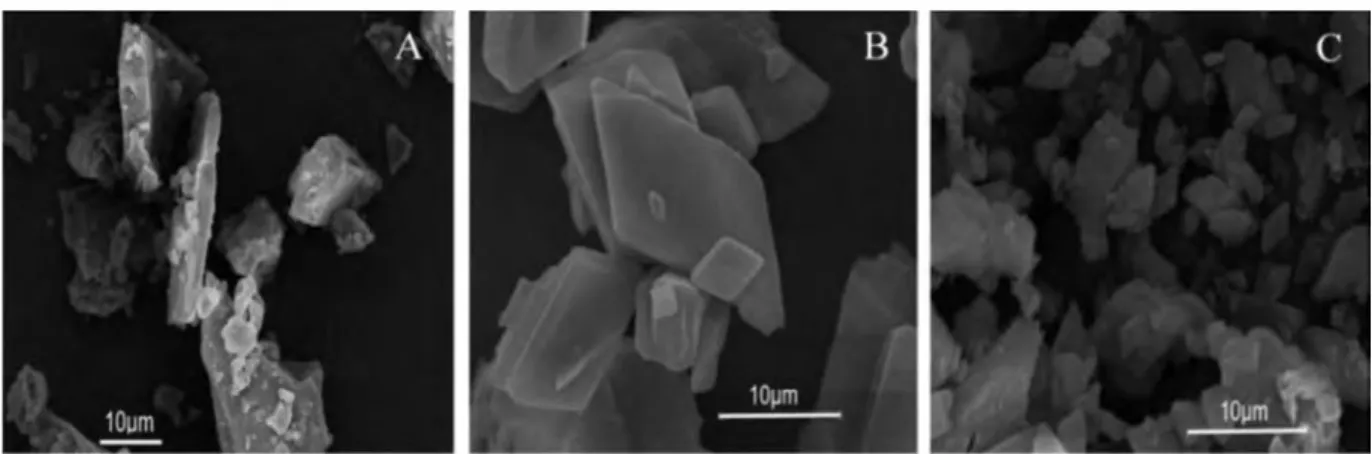
Analyses of both inclusion complexes and j3-CD surface morpholo gies were made by SEM. Fig. 3 shows free j3-CD with various sizes of rectangular shaped crystals. Furthermore small particles on the surface of the crystals can also be seen, a fact mentioned by other authors (Songkro et al., 2012). As can be seen from the micrographs, the morphology of j3-CD had completely changed after forming inclusion complexes with EO of clove (Fig. 3b) and Mexican oregano (Fig. 3c). The samples appeared as rhomboid shaped crystals, and for Mexican oregano EO: j3-CD complexes, small aggregates of irregular size amor phous pieces were present. The complexes showed no visible fractures, cracks or pores, indicating good protection and adequate protection of EO.
3. 6. Antimicrobial activity
Zones of inhibition (in millimeters) obtained from the different amounts of free EO and corresponding complexes are presented in
Table 4 and Fig. 3. Concerning free EO, both Mexican oregano and clove EO demonstrated their antimicrobial activities against L. monocytogenes A TCC 19114 and E. coli ATCC 25922. According to the statistical analysis, no significant difference was observed as a func tion of the EO amount. Mexican oregano EO seemed to be more effi cient than clove EO, with larger inhibition zones, for both micro organisms.
This antimicrobial activity was preserved with the inclusion of these EO in j3-CD, as confirmed by the results given in Table 4, for 0.5 g and 1 g of complexes, with similar values than those of free EO. Lower ef fectiveness of treatment of 2 g of samples against two microorganisms was observed, and could be attributed to a too high amount of com plexes in a small volume, involving a supersaturation of the solution preventing the complete dissolution of the complexes and thus the re lease of the EO.
1H NMR chemical shifts (B) of the free Jl-CD and EO:jl-CD complexes in D2O. t.B represents the chemical shift differences (ppm) between the two states (free or complexed Jl-CD).
H-atom B/ppm Free jl-CD H-1 5.04 H-2 3.55 H-3 3.93 H-4 6.62 H-5 3.82 H-6 3.85 Clove EO:jl-CD B (ppm) 5.03 3.55 3.89 3.61 3.76 3.82 t.B (complexed-free) (ppm) -0.01 0 -0.04 -0.01 -0.06 -0.03
Mexican oregano EO: jl-CD B (ppm) 5.02 3.55 3.88 3.60 3.7 3.79 t.B (complexed-free) (ppm) -0.02 0 -0.05 -0.02 -0.12 -0.06
a)
0.20 0.16 :!! 0.16 cO 0.14 .!:!!ë-:,
0.12 : .É 0.10s�
0.0B .il ... 0 0 0.06 ::ii "' 0.04 0.02 0.00 20 40 60 �Sorption p-CDSorption cl□,a EO:
!>-CD
-Sorption Mexican
80 100
oregano EO: p-eo
Relative humidity (%)
b)
0.20 0.18 :;;- 0.16c=
0 0 0.14 :0 c. ... � 0 0.12..
"' .g � ,.o 0.10 :i:E 0.08 tl - 0.06 ·- 0 0 "':: s
0.04 0.02 0.00 20 40 60 �oesorptionp.co
---Desorption clove EO: P..CD 80 100 Desorption Mexican oregano EO: P-CD Relative humld!ty (%)Fig. 1. Moisture sorption (a) and desorption (b) isotherms of free {:1-CD, clove E0:{:1-CD complexes (4:96) and Mexican oregano E0:{:1-CD complexes (8:92).
Fig. 2. Scanning electron micrographs of (A) free {:1-CD, magnification x 1500; (B) clove E0:{:1-CD complexes, magnification x 5000; and (C) Mexican oregano E0:{:1-CD complexes, magnification x 5000.
These results confirm that the biological activity of both Mexican oregano and clove EO was preserved after inclusion process, with no particular alteration from j3-CD. Previous works with other en capsulation processes such as spray drying (Arana-Sânchez et al., 2010), lyophilization (Wang, Lu, Lv, & Bie, 2009) or freeze-drying (Santos et al., 2015) have also proved that encapsulation did not alter the antioxidant nor the antimicrobial activities of such EO, and even
could improve them, due to the enhanced water solubility of the complexes.
4. Conclusion
Inclusion of clove and Mexican oregano EO in j3-CD was successfully conducted with good entrapment efficiency of their major compounds,
Fig. 3. Antimicrobial activities of E0:{:1-CD complexes (with 4:96 ratio for Clove E0:{:1-CD complexes and 8:92 ratio for Mexican oregano E0:{:1-CD complexes) against E. coli ATCC 25922 (A) and against L. monocytogenes ATCC 19114 (B).
Table 4
Antimicrobial activities (measured as inhibition zone in mm) of free EO and EO:{3-CD complexes against L. monocytogenes ATCC 19114 and E. coli ATCC 25922.
Mexican oregano EO Mexican oregano EO: {3-CD (8:92)
sample weight 0.031 g 0.062 g 0.125 g 0.5 g lg 2 g L. monocytogenes ATCC 19114 E. coli ATCC 25922 mm of inhibition• 6.00 ± 2.00• 4.67 ± 1.15• 7.17 ± 0.76. 5.00 ± 1.00• 7.33 ± 1.15• 5.67 ± o.58• 5.oo ± 1.oo•b 6.50 ± 3_97• 5.67 ± 2.08•b 4.67 ± 2.08• 2.00 ± nl.OOb 3.33 ± o.58•
Clove EO Clove EO: {3-CD (4:96)
L. monocytogenes ATCC 19114 E. coli ATCC 25922 sample weight mm of inhibition
.
0.012 g 3.33 ± o.58• 3.oo ± o.oo•b 0.0245 g 0.049 g 4.00 ± o.oo• 4.67 ± 3.67 ± o.58• 4.67 ± 0.5 g lg 2 g o.58• 4.00 ± 2.00• 0.83 ± 0.29b 0.50 ± o.oob o.58• 4.33 ± 2.31• 2.67 ± 1.15ab 0.50 ± o.oob a,b,cSuperscripts with the same letters in the same line were not significantly different P > 0.5 (Tukey-Kramer multiple mean comparisons).* Values given are averages of three replicate samples.
eugenol and carvacrol respectively, as confirmed by GC-MS, GC-FID and 1H NMR spectroscopy. Inclusion complexes ofboth EO were able to inhibit L. monocytogenes ATCC 19114 and E. coli ATCC 25922, de monstrating that j3-CD inclusion process could an important option to increase and facilitate future applications of such EO, particularly as natural food additives, offering more stability, facilitating its handling and increasing their solubility in aqueous media.
Acknowledgment
The authors would like to thank the Mexican Council of Science CONACyT for providing its financial support.
References
Abarca, R. L., Rodriguez, F. J., Guarda, A., Galotto, M. J., & Bruna, J. E. (2016). Characterization of beta-cyclodextrin inclusion complexes containing an essential oil component. Food Chemistry, 196, 968-975.
Almenar, E., Auras, R., Rubina, M., & Harle, B. (2007). A new technique to prevent the main post harvest diseases in berries during storage: Inclusion complexes {3-cyclo dextrin-hexanal. International Journal of Food Microbiology, 118(2), 164-172.
Arana-Sânchez, A., Estarr6n-Espinosa, M., Obledo-Vâzquez, E. N., Padilla-Camberos, E., Silva-Vâzquez, R., & Lugo-Cervantes, E. (2010). Antimicrobial and antioxidant ac tivities of Mexican oregano essential oils (Lippia graveolens H. B. K.) with different composition when microencapsulated in {3-cyclodextrin. Letters ÙI Applied
Microbiology, 50(6), 585-590.
Argyropoulos, D., Alex, R., Kahler, R., & Müller, J. (2012). Moisture sorption isotherms and isosteric heat of sorption of leaves and stems of lemon balm (Melissa officmalis L.) established by dynamic vapor sorption. L WT - Food Science and Technology, 47(2), 324-331.
Astray, G., Gonzalez-Barreiro, C., Mejuto, J. C., Rial-Otero, R., & Simal-Gândara, J. (2009). A review on the use of cyclodextrins in foods. Food Hydrocolloids, 23(7), 1631-1640.
Ayala-Zavala, J. F., Soto-Valdez, H., Gonzâlez-Leôn, A., Alvarez-Parrilla, E., Martfn Belloso, O., & Gonzâlez-Aguilar, G. A. (2008). Microencapsulation of cinnamon leaf (Cinnamomwn zeylanicwn) and garlic (Alliwn sativum) oils in {3-cyclodextrin. Journal
of Inclusion Phenomena and Macrocyclic Chemistry, 60, 359-368.
Bhandari, B. R., D'Arc, B. R., & Thi Bich, L. L. (1998). Lemon oil to {3-Cyclodextrin ratio effect on the inclusion efficiency of {3-Cyclodextrin and the retention of oil volatiles in the complex. Journal of Agricultural and Food Chemistry, 46, 1494-1499.
Burt, S. (2004). Essential oils: Their antibacterial properties and potential applications in foods-A review. International Journal of Food Microbiology, 94, 223-253.
Cevallos, P. A. P., Buera, M. P., & Elizalde, B. E. (2010). Encapsulation of cinnamon and thyme essential oils components (cinnamaldehyde and thymol) in beta-cyclodextrin: Effect of interaction with water on complex stability. Journal of Food Engineering, 99, 70-75.
de Carvalho, L. B., & Pinto, L.d. M. A. (2012). Formation of inclusion complexes and controlled release of atrazine using free or silica-anchored {3-cyclodextrin. Journal of
Inclusion Phenomena and Macrocyclic Chemistry, 74, 375-381.
Del Toro-Sanchez, C. L., Ayala-Zavala, J. F., Machi, L., Santacruz, H., Villegas-Ochoa, M.
A., Alvarez-Parrilla, E., et al. (2010). Controlled release of antifungal volatiles of thyme essential oil from {3-cyclodextrin capsules. Journal of Inclusion Phenomena and
Macrocyclic Chemistry, 67, 431-441.
Del Valle, E. M. M. (2004). Cyclodextrins and their uses: A review. Process Biochemistry,
39, 1033-1046.
Gong, L., Li, T., Chen, F., Duan, X., Yuan, Y., Zhang, D., et al. (2016). An inclusion complex or eugenol into {3-cyclodextrin: Preparation, and physicochemical and an tifungal characterization. Food Chemistry, 196, 324-330.
Gortzi, O., Lala, S., Chinou, 1., & Tsaknis, J. (2007). Evaluation of the Antimicrobial and Antioxidant Activities of 0riganwn dictamnus Extracts before and after Encapsulation in Liposomes. Molecules, 12, 932-945.
Guarda, A., Rubilar, J. F., Miltz, J., & Galotto, M. J. (2011). The antimicrobial activity of microencapsulated thymol and carvacrol. International Journal of Food Microbiology,
146, 144-150.
Hu, Q., Gerhard, H., Upadhyaya, !., Venkitanarayanan, K., & Luo, Y. (2016). Antinmicrobial eugenol nanoemulision prepared by gum arabic and lecithin and evaluation of drying technologies. International Journal of Biological Macromolecules,
87, 130-140.
Kamimura, J. A., Santos, E. H., Hill, L. E., & Gomes, C. L. (2014). Antimicrobial and antioxidant activities of carvacrol mixroencapsulated in hydroxypropyl-beta-cyclo dextrin. L WT - Food Science and Technology, 57, 701-709.
Lawtrakul, L., Inthajak, K., & Toochinda, P. (2014). Molecular calculations on {3-cyclo dextrin inclusion complexes with five essential oils compounds from Ocimum basi licwn (sweet basil). Science Asia, 40, 145-151.
Locci, E., Lai, S., Piras, A., Marongiu, B., & Lai, A. (2004). 13C-CPMAS and 1H NMR study of the inclusion complexes of {3-cyclodextrin with carvacrol, thymol, and eugenol prepared in supercritical carbon dioxide. Chemistry&Biodiversity, 1, 1354-1366.
Ortuno, M. F. (2006). Practical Hanbook of Essential oils and perfume. Murcia, Espana: Aiyana Ediciones30-45.
Santos, E. H., Kamimura, J. A., Hill, L. E., & Gomes, C. L. (2015). Characterization of carvacro beta-cyclodextrin inclusion complexes as delivery systems ofr antibacterial and antioxidant applications. L WT - Food Science and Technology, 60, 583-592.
Songkro, S., Hayook, N., Jaisawang, J., Maneenuan, D., Chuchome, T., & Kaewnopparat, N. (2012). Investigation of inclusion complexes of citronella oil, citronellal and ci tronellol with {3-cyclodextrin for mosquito repellent. Journal of Inclusion Phenomena
and Macrocyclic Chemistry, 72, 339-355.
Suihko, E., Korhonen, O., Jiirvinen, T., Ketolainen, J., Jarho, P., Laine, E., et al. (2001). Complexation with tolbutamide modifies the physicochemical and tableting proper ties of hydroxypropyl-{3-cyclodextrin. International Journal of Pharmaceutics, 215, 137-145.
Terekhova, 1. V., Kumeev, R. S., & Alper, G. A. (2007). Inclusion complex formation of a and {3-cyclodextrins with aminobenzoic acids in aqueous solution studied by 1 H NMR.
Journal of Inclusion Phenomena and Macrocyclic Chemistry, 59, 301-306.
Vyas, A., Saraf, S., & Saraf, S. (2008). Cyclodextrin based nove! drug delivery systems.
Journal of Inclusion Phenomena and Macrocyclic Chemistry, 62, 23-42.
Wang, Y., Lu, Z., Lv, F., & Bie, X. (2009). Study on microencapsulation of curcumin pigments by spray drying. European Food Research and Technology, 229, 391-396.
Wang, T., Li, B., Si, H., Lin, L., & Chen, L. (2011). Release characteristics and antibacterial activity of solid state eugenol/{3-cyclodextrin inclusion complex. Journal of Inclusion
Phenomena and Macrocyclic Chemistry, 71, 207-213.
Xiao, Z., Liu, W., Zhu, G., Zhou, R., & Niu, Y. (2014). A review of the preparation and application of flavour and essential oils microcapsules based on complex coacerva tion technology. Journal of the Science of Food and Agriculture, 94, 1482-1494.