HAL Id: tel-01172022
https://tel.archives-ouvertes.fr/tel-01172022
Submitted on 6 Jul 2015
HAL is a multi-disciplinary open access
archive for the deposit and dissemination of
sci-entific research documents, whether they are
pub-lished or not. The documents may come from
teaching and research institutions in France or
abroad, or from public or private research centers.
L’archive ouverte pluridisciplinaire HAL, est
destinée au dépôt et à la diffusion de documents
scientifiques de niveau recherche, publiés ou non,
émanant des établissements d’enseignement et de
recherche français ou étrangers, des laboratoires
publics ou privés.
A formal approach to distributed application synthesis
and deployment automation
Jakub Zwolakowski
To cite this version:
Jakub Zwolakowski. A formal approach to distributed application synthesis and deployment
automa-tion. Software Engineering [cs.SE]. Univeristé Paris Diderot Paris 7, 2015. English. �tel-01172022�
Universit´e Paris Diderot – Paris 7
Sorbonne Paris Cit´e
École Doctorale Sciences Math´ematiques de Paris Centre
Laboratoire Preuves, Programmes et Syst`emes (PPS)
DOCTORAT
informatique
Jakub Zwolakowski
A formal approach to distributed application
synthesis and deployment automation
Une approche formelle `a la synth`ese des applications distribu´ees
et leur d´eploiement automatique
Thèse dirigée par
Roberto Di Cosmo et Stefano Zacchiroli
Soutenue le 23 Avril 2015
Jury
M.
Jean-Bernard Stefani : Président
M.
Roberto Di Cosmo
:
Directeur
M.
Stefano Zacchiroli
:
Co-directeur
Mme
Laurence Duchien
:
Rapporteuse
M.
Maurizio Gabbrielli
:
Rapporteur
M.
Paul Anderson
:
Examinateur
M.
Manuel Carro
:
Examinateur
M.
François Armand
:
Examinateur
CONTENTS
1 Résumé 1 1.1 Le travail fait . . . 2 1.2 La structure du document . . . 4 2 Introduction 7 2.1 Work done . . . 8 2.2 Document structure . . . 10 3 Context 13 3.1 Motivation . . . 13 3.2 Introduction . . . 133.3 Relevance of the study for the Aeolus project . . . 14
3.4 Object of the survey . . . 15
3.5 Methodology . . . 16
3.6 Summary of capabilities and limitations . . . 17
3.7 Conclusion . . . 19
4 Aeolus model for distributed systems 20 4.1 Motivation . . . 20
4.2 Design principles of the Aeolus model . . . 21
4.2.1 Expected expressivity . . . 21
4.2.2 Need for simplicity . . . 21
4.2.3 Conclusion . . . 22
4.3 Presentation of the Aeolus model . . . 22
4.3.1 Introduction . . . 22
4.3.2 Software components . . . 23
4.3.3 Component internal state . . . 24
4.3.4 Collaboration of components . . . 27
4.3.5 Non-functional requirements . . . 33
4.3.6 Conflicts between components . . . 37
4.3.7 Configuration . . . 38
4.3.8 Universe . . . 41
4.3.9 Reconfigurations . . . 43
4.3.10 Summary . . . 47
4.4 Formalization of the Aeolus model . . . 48
4.4.2 Configuration validity . . . 50
4.4.3 Reconfigurations . . . 51
4.5 Properties of the Aeolus model . . . 53
4.5.1 Reconfigurability problem . . . 53
4.5.2 Architecture synthesis problem . . . 55
4.5.3 Restricting the model . . . 56
4.5.4 Results . . . 56
4.6 Expressivity of the Aeolus model . . . 57
4.6.1 Distributed WordPress case . . . 57
5 Synthesis of a component architecture 65 5.1 Motivation . . . 65
5.2 The architecture synthesis problem . . . 65
5.2.1 Problem definition . . . 66
5.2.2 Discussion . . . 66
5.2.3 Stateless model . . . 67
5.2.4 Request language . . . 71
5.2.5 Stateless configuration validity . . . 73
5.2.6 Optimization . . . 74
5.2.7 Conclusion . . . 78
5.3 Constraint solving approach . . . 79
5.3.1 Search for solutions . . . 79
5.3.2 The basic idea . . . 80
5.3.3 Encoding . . . 84
5.3.4 Final configuration generation . . . 93
5.3.5 Conclusion . . . 101
5.4 Conclusion . . . 102
6 Synthesis of a cloud-based architecture 103 6.1 Motivation . . . 103
6.2 Introduction . . . 103
6.2.1 What we have . . . 103
6.2.2 What do we want now? . . . 104
6.2.3 Our approach . . . 105
6.2.4 Conclusion . . . 108
6.3 Extending the architecture synthesis problem . . . 108
6.3.1 Machine park . . . 108
6.3.2 Component co-location . . . 109
6.3.3 Decisions . . . 110
6.4 Extending the stateless model . . . 111
6.4.1 Locations . . . 111
6.4.2 Repositories and packages . . . 113
6.4.3 Resources . . . 117
6.4.4 Cost . . . 118
6.4.5 Extended specification . . . 118
6.5 Extended stateless Aeolus formal model . . . 119
6.5.1 Universe and configuration . . . 120
6.5.2 Specifications . . . 126
6.5.3 Optimization . . . 127
6.5.4 Conclusion . . . 132
6.6 Adapting the constraint solving approach . . . 132
6.6.1 Constraint problem . . . 133
6.6.2 Encoding . . . 134
6.7 Conclusion . . . 144
7 The Zephyrus tool 145 7.1 Motivation . . . 145
7.1.1 Scope . . . 145
7.1.2 Implementing the theory in practice . . . 146
7.1.3 Conclusion . . . 146
7.2 General information and work schema . . . 147
7.2.1 Zephyrus building blocks . . . 147
7.2.2 The basic workflow . . . 147
7.2.3 The input/ output formats . . . 148
7.2.4 The principal arc of the workflow . . . 149
7.2.5 Elaborating the Zephyrus workflow . . . 149
7.2.6 Overview of the Zephyrus workflow . . . 150
7.3 Practical considerations . . . 152
7.3.1 Introduction . . . 152
7.3.2 What is fast enough? . . . 152
7.3.3 How to improve efficiency? . . . 153
7.3.4 Working on the constraint problems . . . 154
7.3.5 Conclusion . . . 156
7.4 Zephyrus workflow details . . . 157
7.4.1 Introduction . . . 157
7.4.2 Reading the input . . . 157
7.4.3 The abstract I/O internal format . . . 165
7.4.4 The internal Zephyrus model representation . . . 166
7.4.5 Pre-process the model . . . 166
7.4.6 Translate to the abstract constraint problem form . . . 167
7.4.7 A concrete constraint problem form . . . 168
7.4.8 Solve . . . 171
7.4.9 Read the solution found by solver . . . 172
7.4.10 Generate the final configuration . . . 173
7.4.11 Validate . . . 175
7.4.12 Generate the output . . . 175
7.4.13 Workflow variants . . . 178
7.4.14 Conclusion . . . 178
7.5 Improving the efficiency . . . 179
7.5.1 Reducing the input . . . 179
7.5.2 Trimming the component types . . . 180
7.5.3 Trimming the packages . . . 181
7.5.4 Trimming the locations . . . 187
7.5.5 Improving the generated constraint problem . . . 188
7.5.6 Choosing and adapting the solver . . . 191
7.5.7 Conclusion . . . 192
7.6 Conclusion . . . 194
8 Experimentation and validation 195 8.1 Motivation . . . 195
8.2 Architecture synthesis efficiency . . . 195
8.2.1 Flat distributed WordPress scenario . . . 196
8.2.2 Basic flat WordPress benchmarks . . . 200
8.2.3 Flat distributed WordPress scenario with Webservers . . . 202
8.2.4 Advanced flat WordPress benchmarks . . . 203
8.2.5 Fully distributed WordPress scenario . . . 210
8.2.7 Machine park trimming benchmarks . . . 214
8.2.8 Advanced distributed WordPress benchmarks . . . 217
8.2.9 Optimization benchmarks . . . 223
8.2.10 Conclusion . . . 225
8.3 Integration in the Aeolus tool-chain . . . 226
8.4 Industrial validation in Kyriba . . . 227
8.4.1 Continuous integration in Kyriba Corporation . . . 227
8.4.2 Zephyrus adoption . . . 228
8.4.3 Conclusion . . . 230
8.5 Conclusion . . . 231
9 Related work 232 9.1 Aeolus formal model . . . 232
9.1.1 Black-box/ grey-box with an interface . . . 232
9.1.2 Interface automata . . . 232 9.1.3 Petri nets . . . 233 9.1.4 Pi-calculus . . . 233 9.1.5 Fractal model . . . 233 9.1.6 SmartFrog model . . . 234 9.1.7 UML validity . . . 234 9.1.8 Reconfigurations . . . 234
9.2 Tools and methods for mastering cloud complexity . . . 234
9.2.1 Managing networks of interconnected machines . . . 235
9.2.2 Computing the (optimal) final configuration . . . 235
9.2.3 Other tools related in one or more aspects . . . 235
10 Conclusion 238 10.1 Aeolus formal model . . . 238
10.1.1 Contributions . . . 238 10.1.2 Future work . . . 239 10.2 Zephyrus model . . . 239 10.2.1 Contributions . . . 239 10.2.2 Future work . . . 240 10.3 Constraint-based approach . . . 241 10.3.1 Contributions . . . 241 10.3.2 Future work . . . 241
10.4 The Zephyrus tool . . . 242
10.4.1 Contributions . . . 242
10.4.2 Future work . . . 243
ACKNOWLEDGEMENTS
Research
First of all, I would like to enormously thank my supervisor, Roberto Di Cosmo. He pushed and pulled me through this thesis in his calm, gentle and respectful way, usually managing to give me a nudge exactly when I needed one to keep advancing. And he successfully guided me to this happy ending :) I never really understood how he managed to take care of me while simultaneously being responsible for around 5 million more important things (directing IRILL being only one of them), but somehow he was able to find time to see me regularly and he was always there for me at short notice when I needed a rescue in some unexpected administrative urgency. Grazie mille Roberto!
Second of all, I would like to thank very much my co-supervisor, Stefano Zacchiroli. I really
appre-ciate the time and effort which he put into reading my whole bloated thesis manuscript from the beginning
to the end so carefully (I cannot even imagine how he must have suffered during this task. . . ) and hunting
down all the mistakes and issues big and small. Also I would like to thank him in particular for being
patient enough to only look at me with mild irritation, instead of ripping my head off straight away, when
on multiple occasions I showed complete ignorance of important topics (especially those related to free software) or just said something plainly stupid ;) Grazie mille Stefano!
Third of all, I would like to immensely thank Ralf Treinen. Considering his importance in the context of my PhD studies he should probably be appointed the position of my honorary second co-supervisor :) From the strictly scientific point of view, his contributions to the research on which my thesis is based are undeniably substantial. From a more human point of view, his constant interest in my advancements and the amount of direct help he provided me in various situations were very valuable. All that not even mentioning the fact that without him I would most probably never have become a PhD student. . . Danke schön Ralf!
Fourth of all, I would like to thank a lot Michael Lienhardt. It were his brilliant ideas which made many parts of the approach presented in this thesis actually possible (long live binding unicity constraints!)
and it was his talent for clearly formalizing stuff which made implementing this approach so
straightfor-ward. Also I would like to thank him for all our fruitful face-to-face discussions after the team meetings, which led to concretizing so many of these concepts. Merci beaucoup Michael! (Je dois aussi avouer que pendant certain temps peut-être je te détestais un petit peu pour intervenir si brutalement dans mon code. . . Mais je t’ai pardonné. Et c’est ça qui compte à la fin ;) )
Also I would like to thank all the people from the other Aeolus project teams:
• Antoine Eiche from Mandriva, author of the Armonic tool, who almost single handedly did the extremely hard work of implementing all the elegant abstractions of our model in practice, and thus proved that the model itself (together with the whole approach) is worthwhile and can be successfully applied in the real world.
• The whole Bologna team: Gianluigi Zavattaro, Jacopo Mauro and Tudor Lascu, very competent and hard working people, who contributed so much to many things on which the work presented in this thesis is based.
• As for the Aeolus team from Nice Sophia Antipolis I will restrain myself here to saying: thank you Jean-Charles, Arnaud and Mohamed. You are nice people :) And I am sure that one day you will find an actually motivating research project (i.e. one which involves more bin packing than this one, I assume).
Also I would like to thank Alexis Agahi for his faith in the Aeolus approach and the Zephyrus tool and his great motivation in introducing it and adopting in practical situations in the Kyriba Corporation.
Jury
I would like to express my sincere gratitude to those who have kindly agreed to be in my defence jury: especially big thanks are due to Laurence Duchien and Maurizio Gabbrielli for taking on their shoulders
the heavy duty of reading my manuscript in detail and writing the official reviews; thanks to Jean-Bernard
Stefani for accepting the responsibility of becoming the jury’s president; thanks to Paul Anderson and Manuel Carro for travelling from afar in order to assist in this event; and finally thanks to François Armand for sacrificing his valuable time to be here.
These who had an impact on my thesis and
/ or who contributed to my
life during the thesis
I would like to infinitely thank Maud, who supported me and had to put up with me through around 97% of my PhD studies :) Without her I would certainly not have come to Paris and not have studied at Paris 7 in the first place. Also I would not have survived the French bureaucracy, not have learned to speak and write French so well and so quickly, and maybe even not have decided to accept the offer of beginning this thesis. Merci beaucoup Maud! Pour ça et pour toutes les autres choses.
PPS and around
My life in the PPS laboratory during these three years and half has been a bliss. I would like to thank everybody who has contributed to the great scientific and personal atmosphere which I have experienced here.
D’abord Odile mérite ici un remerciment spécial. Je ne sais pas si elle se rend bien compte à quel point c’est important d’avoir une personne à la fois compétente et sympathique (et n’essayant pas d’abuser son pouvoir!) qui s’occupe de choses administratives, mais elle est exactement la personne qu’il faut :) Elle a rendu beaucoup des aspects de ma vie dans le labo tranquille et facile pendant toute ma thèse et j’en suis énormément reconnaissant. Merci beaucoup Odile!
Without question the most special thanks go to Shahin and Ioana, with whom I have shared the best
office ever. Though Shahin is (surprisingly) not the best person in the world, if he just put some effort and
got his act together he might very well get there ;) Either way, he is really great and I am very happy that he was there during these years to let us bask in his awesomeness and incidentally organize the social life all around :) And big thanks to Ioana, who is a smart, cool, sweet person with a good heart and an admirable self-discipline. She is also a little bit our adopted child (with Shahin). However, although we have been sincerely trying very hard, we did not succeed to mold her in our image. . . maybe for the best :)
Special thanks to Lourdes, Guillaume, Jehanne (even though she is from LIAFA) and Juliusz, who were always around. I had a lot of great moments with them, both in the lab and outside :)
And very special thanks to Jovana. Maybe she has not been there for a long time, but somehow she quickly became very important ;) And she should keep in mind that now, as she has taken my place literally, she has a certain moral responsibility to take it also figuratively!
Thanks to all these who are working here now, both fellow PhD students, post-docs, les permanents and interns: Étienne, Matthieu, Flavien, PiM, Giulio, Hadrien (who should really read Winnie the Pooh!), Pierre B., Thibaut, Béatrice, Pablo (and Elisa!), Marie, Amina, Ludovic, Pierre V., Cyrille, Christine (car que ferions-nous sans elle?), Yann, Jean, as well as Bruno, François (both from LIAFA), and Florent (technically from the 7th floor, but I have only seen him in PPS ;) ).
Thanks to all those who were here before and left in the meantime: Guillaume (Munch-Maccagnoni), Fabien, Gabriel (the first PhD defence in PPS that I actually understood!), Alexis, Stéphane (but these thanks are only for the period after he finally stopped wearing that pullover ;) ), Sergueï, Jonas, Antoine and Mehdi.
Also thanks to the other PPS dwellers who I never actually had a longer conversation with (i.e. other
than “Bonjour! – Bonjour!”), but who still looked great hanging out in the background and/ or discussing
their research with each other :)
Additionally, special thanks are due to the members of the honourable FFSPPS initiative. Especially: Bingo, Hermes, Bianca, Kentucky, Nelson, Jinx, and others. Obviously for the reasons of personal security they must remain anonymous, hence their real names will not be revealed here. Baldy halal no!
Not PPS
Huge thanks to Samy and Rafa, my two favourite logicians. And my two favourite Americans. And both among my absolutely favourite people :) I am really really really happy that we became friends.
And thanks to all the other friends: Jean-Philippe, Benoît, Seb, Nico, Luis and Shadi, and Nadja. Thanks to the remaining members of the legendary Les Trois Colloques who I have not mentioned yet: Romain and Tristan. And of course thanks to the new colloque (who is also my flat-mate now): Nikita. And thanks to Lillian and Garrett. I have greatly enjoyed spending time with each of you :)
And, obviously, thanks to Ronimo Games for the awesome Awesomenauts ;)
Last but not least
I would also like to thank my best friends back home: Adam and Kasia. The week of sailing we did each summer, and in fact any amount of time I spent with them, always helped me to clear my mind, restore my energy and regain my balance. Dzieki Kasiu i Adasiu!
Finally, I would like to thank very much my mum and my stepfather, who both came to Paris for this defence. My mum is constantly in touch with me and she has been supporting me all the time during my thesis. Dziekuje Ci mamo za ciagle wsparcie! I dziekuje Ci Jacku, ˙ze przyjechales!
Those I forgot about
Abstract
Complex networked applications are assembled by connecting software components distributed across multiple machines. Building and deploying such systems is a challenging problem which requires a signif-icant amount of expertise: the system architect must ensure that all component dependencies are satisfied, avoid conflicting components, and add the right amount of component replicas to account for quality of service and fault-tolerance. In a cloud environment, one also needs to minimize the virtual resources pro-visioned upfront, to reduce the cost of operation. Once the full architecture is designed, it is necessary to correctly orchestrate the deployment process, to ensure all components are installed, started and connected in the right order.
In this work, we describe the different variants of the Aeolus formal model and the Zephyrus tool
de-veloped during the Aeolus research project, which attempts to tackle the scientific challenges related to the administration of modern distributed systems and solve them in practice. The various parts of the Aeolus model allow us to express a high-level specification of the desired system, the set of available components together with their requirements, and the maximal amount of virtual resources to be committed. The as-sociated Zephyrus tool, based on this formal model, is capable of automating the assembly of complex distributed applications: it synthesizes the full architecture of the system, placing components in an opti-mal manner using the miniopti-mal number of available machines. Other tools developed in the Aeolus project can then be used to automatically deploy the complete system in a cloud environment.
Résumé
Des applications reparties complexes sont assemblées en connectant des composants logiciels
dis-tribués sur plusieurs machines. Concevoir et déployer tels systèmes est un problème difficile, qui
né-cessite un niveau important d’expertise: l’architecte système doit s’assurer que toutes les dépendances des composants sont satisfaits, éviter les composants incompatibles et ajuster la quantité de répliques du chaque composant pour tenir compte de la qualité de service et la tolérance aux pannes. Dans un environ-nement cloud il faut aussi minimiser les ressources virtuelles utilisées, afin de réduire le coût. Une fois l’architecture complète est conçue, il est nécessaire d’orchestrer correctement le processus de déploiement, en assurant que tous les composants sont installés, démarrés et connectés dans le bon ordre.
Dans ce travail, nous décrivons le modèle formel Aeolus et l’outil Zephyrus, développés au cours du projet de recherche Aeolus, qui tente d’aborder les défis scientifiques liés à l’administration des systèmes distribués modernes et de les résoudre en pratique. Le modèle Aeolus nous permet d’exprimer une spéci-fication de haut niveau du système souhaité, l’ensemble des composants disponibles avec leurs exigences et la quantité maximale de ressources virtuelles à engager. L’outil Zephyrus, basé sur ce modèle formel, est capable d’automatiser l’assemblage des applications distribuées complexes: il synthétise l’architecture complète du système en plaçant les composants de manière optimale sur les machines disponibles. Autres outils développés dans le projet Aeolus peuvent ensuite être utilisés pour déployer automatiquement le système complet dans un environnement cloud.
CHAPTER 1
RÉSUMÉ
Le paysage informatique a subi un changement radical depuis l’arrivée de la première génération d’offres technologiques connues collectivement comme Cloud Computing. Même si ce terme est loin d’être précis,
la promesse générale de la technologie sous-jacente est d’offrir des ressources informatiques (par exemple
la puissance de calcul, l’espace de stockage) dans une façon flexible et moins coûteuse: les ressources peuvent être louées à la place d’être acquises dès le départ, et peuvent rapidement être mises à l’échelle (agrandies ou diminuées) en fonction des besoins de l’utilisateur final.
Mais des défis importants doivent encore être confrontés. Après avoir navigué à travers l’hype initiale, typique pour les premières années de chaque nouvelle technologie, les utilisateurs ont découvert que la possibilité de louer des dizaines de milliers de machines virtuelles pendant quelques semaines par année n’est qu’une première étape. Le déploiement, la configuration, la maintenance et l’évolution des applica-tions et systèmes qui fonctionnent sur ces machines virtuelles nécessitent toujours des mois de travail des administrateurs et ingénieurs système hautement qualifiés et coûteux.
Cette thèse contribue à automatiser une partie de ce travail, en présentant une approche innovatrice à la synthèse des architectures basées sur des composants distribués, particulièrement pertinentes pour le développement et déploiement des applications dans le Cloud.
Le travail présenté dans cette thèse a été réalisé dans le cadre d’Aeolus, un projet de recherche et développement financé par l’ANR qui a impliqué le laboratoire PPS de l’Université Paris Diderot, le labo-ratoire I3S de l’Université de Nice-Sophia Antipolis, et le projet Inria Focus. Le projet Aeolus a été lancé en 2010 et a pris fin en 2014, il a été organisé autour de trois axes de recherche principaux:
Tâche 1 Concevoir un modèle abstrait de Cloud, qui englobe les paquets logiciels installés sur chaque ma-chine (virtuelle), ainsi que les dépendances dynamiques entre les logiciels, mama-chines et services. Tâche 2 Concevoir un puissant langage des requêtes de reconfiguration de haut niveau permettant d’exprimer
des sophistiquées demandes de reconfiguration de logiciels fonctionnant sur des groupements de ma-chines (virtuels).
Tâche 3 Développer des algorithmes de solveurs spécialisés, permettant de répondre efficacement aux
re-quêtes de reconfiguration en les traduisant en plans de reconfiguration de bas niveau, similaires à des actions mises en œuvre par des outils populaires de déploiement de logiciel.
Dans le cadre de ce programme de recherche, notre travail est spécifiquement axé sur la modélisation des applications distribuées, la synthèse des architectures des applications à partir d’un langage de spéci-fication de haut niveau à travers un encodage dans des contraintes numériques, et la mise en œuvre de ces idées dans un outil sophistiqué et flexible, Zephyrus, qui est maintenant utilisé dans le cadre d’une chaîne
complète d’outils mis au point par la société Mandriva1.
1.1
Le travail fait
Mon implication dans le travail lié avec le projet Aeolus a commencé lors de la première année de mon doctorat, en aidant dans la recherche sur l’état de l’art dans les technologies de Cloud existants. Nous étions intéressés à la fois par les solutions industrielles employées en pratique et aussi par toutes les études scientifiques potentiellement applicables à la gestion de configuration de Could et à l’automatisation de déploiement. Notre objectif était de comprendre quel est exactement le niveau actuel des connaissances
théoriques et du savoir-faire pratique dans les différents domaines touchant aux objectifs du projet Aeolus,
discerner les approches et les idées les plus pertinentes dans notre contexte particulier, qui pourraient nous inspirer ou sur lesquels nous pourrions nous appuyer, et de déterminer où les meilleures possibilités d’amélioration se présentent.
La partie de cette recherche à laquelle j’ai contribué le plus se portait sur quelques populaires et
am-plement utilisés outils de gestion de configuration distribuée de l’état de l’art. J’ai effectué une étude
approfondie concernant un ensemble limité des outils de ce genre, en essayant d’atteindre plusieurs objec-tifs:
• analyser les solutions existantes qui marchaient bien et les cas d’utilisation typiques qu’elles arrivent à aborder, afin de mieux comprendre la problématique de la gestion de configuration des logicielles
distribuées, et aussi pour reconnaître des difficultés qui apparaissent habituellement dans ce contexte
et les méthodes typiques utilisées pour les résoudre;
• extraire et comparer les modèles, implicites ou explicites, utilisés dans chacun de ces outils pour représenter le système distribué, sa configuration et les changements de cette configuration;
• évaluer ces outils dans le contexte de l’intégration potentielle dans le projet Aeolus comme le back-end du déploiement de bas niveau.
Cette étude, qui a mené à la rédaction du rapport technique “Distributed System Administration Technolo-gies, a State of the Art” [125], est décrite plus en détail dans le chapitre 3.
Toutes ces premières enquêtes nous ont aidé considérablement à établir le modèle Aeolus: un modèle à composants, simple or expressive, visant à décrire formellement les systèmes distribués modernes et leurs reconfigurations du point de vue administratif, sur le niveau des services qui fonctionnent dans le système et des relations entre eux. Ce modèle a été inspiré par multiples idées prises de diverses sources (voir le chapitre 9 pour plus de détails) et développé en tenant compte nos connaissances sur les exigences typiques liées avec l’administration du système et l’état de l’art dans les technologies de gestion de la configuration. Le modèle Aeolus est basé sur un compromis fondamental entre l’expressivité et la simplicité. Il a été conçu pour inclure le strict minimum nécessaire pour modéliser toutes les fonctionnalités que nous avions jugé essentiels: les dépendances et les conflits entre les services, le cycle de vie des services, certaines contraintes non-fonctionnelles comme la redondance et la capacité, etc. Il est ainsi assez expressif pour capturer la plupart des propriétés importantes dans les vrais des systèmes distribués, tandis que dans le même temps il reste aussi simple et abstrait que possible, afin d’être adapté pour une étude formelle de la complexité des problèmes liés à l’automatisation de déploiement. Avant tout, il abstrait les détails concernant la localisation des services sur les machines (virtuelles).
Le modèle formel Aeolus et ses propriétés ont été décrites dans trois articles: Towards a Formal
Com-ponent Model for the Cloud[36], Component Reconfiguration in the Presence of Conflicts [33] et Aeolus:
a Component Model for the Cloud[34]. Quoique je n’aie pas contribué directement à ces papiers, ni au
développement du modèle lui-même, dans le chapitre chapitre 4 je le présente et je discute en détail tous ses éléments et propriétés, comme il est fondamental dans l’approche décrite dans le reste de ce document. L’étude de la complexité des reconfigurations de logiciels utilisant le modèle Aeolus a rendu des ré-sultats assez limitants. Le formellement défini problème de reconfiguration (voir la section 4.5), qui con-siste essentiellement à chercher un moyen de reconfigurer un système distribué donné dans l’intention d’atteindre une certaine nouvelle configuration souhaitée, s’est avéré être indécidable dans le modèle
Aeo-lus complète (et plutôt difficile à résoudre dans toutes sauf les plus simplifiées versions du modèle). Pour
en deux parties presque orthogonales. Ensuite, nous (ici “nous” fait référence à l’équipe du projet Aeo-lus situé à Paris) nous sommes concentrés sur le sous problème de la synthèse de l’architecture (voir la section 5.2), qui consiste à chercher une nouvelle configuration pour un système distribué donné, qui est correcte, satisfaite une certaine requête et est optimale en fonction de critères fournis. Simultanément une autre équipe de projet Aeolus (l’équipe INRIA Focus) a tenté d’attaquer le sous problème complémentaire de la planification du déploiement optimal.
Dans le chapitre 5 je présente en détail notre approche au problème de la synthèse de l’architecture basée sur les contraintes, dont j’ai participé à la conception. Cette approche se compose de trois étapes de base:
1. d’abord nous encodons une instance donnée du problème de synthèse de l’architecture sous une forme d’un ensemble des contraintes de domaine fini,
2. puis nous résolvons le problème à contraintes généré de telle manière en utilisant un solveur externe, 3. et enfin nous traduisons la solution du problème des contraintes en forme de la solution du problème
initial.
L’obstacle le plus difficile que nous avons dû confronter lors de l’élaboration de cette approche était
com-ment encoder correctecom-ment les exigences de redondance et de capacité entre les services sous une forme de contraintes, puis comment établir de quelle manière ces services devraient être liés ensemble pour as-surer la correction de la solution produite. Ceci a été réalisé en utilisant une combinaison de deux idées ingénieuses: les contraintes que nous appelons unicité des liaisons (voir la section 5.3.3) et une méthode que nous appelons le matching algorithm (voir la section 5.3.4) utilisé pour générer les liaisons correctes entre les instances de services.
Tous les éléments de cette approche basée sur les contraintes ont été formalisés et prouvés corrects. Une variante spéciale du modèle Aeolus a été introduite à cette fin, ensemble avec une syntaxe des requêtes qui nous permet de spécifier les propriétés de notre configuration souhaitée.
À l’époque, un programme prototype mettant en œuvre cette approche a été développée. Il a été écrit en OCaml [79] et basé sur la bibliothèque de résolution de contraintes FaCiLe [14]. Ce programme a ensuite évolué en un outil beaucoup plus sophistiqué et complexe, appelé Zephyrus, dont je suis le développeur principal. Dans les chapitres 6, 7 et 8, nous parlons de l’ensemble de la théorie derrière Zephyrus, nous décrivons les détails concernant l’outil lui-même (c’est-à-dire sa mise en œuvre et l’utilisation), et nous présentons les résultats d’une validation expérimentale de son utilité dans plusieurs contextes. Bien que ces trois chapitres sont ordonnés d’une manière spécifique, cet ordre n’est censé que faciliter la lecture et la compréhension de ce document et n’indique pas de séquence temporelle (comme c’était le cas pour chapitres pour les chapitres précédents), en fait nous devrions plutôt les considérer comme simplement décrivant trois aspects de la même chose.
L’outil Zephyrus et le variant étendu du modèle Aeolus, appelé le modèle Zephyrus, ont été dévelop-pés à cause de la nécessité d’adapter notre approche fondamentale (basée sur les contraintes) à des con-sidérations pratiques. Grâce au fait que toute la démarche avait été déjà bien établie, nous avons pu l’ajuster en toute sécurité et rendre notre modèle plus expressif d’une manière contrôlée, comme nous avons compris quel genre d’éléments pourraient y être ajouté sans briser notre méthode de l’encodage en contraintes. Ainsi, nous avons étendu le modèle avec un nouveau trait important: une description des ma-chines disponibles où les services peuvent être déployés, avec les repositoires de paquets installés sur ces machines, ainsi que les ressources fournies par chaque machine et consommées par les services. En plus du modèle amélioré, un langage de requêtes beaucoup plus riche a été proposé (permettant de spécifier
des propriétés plus avancées concernant la solution désirée). Aucun changement radical ou difficile à notre
approche de base n’a été nécessaire afin de l’adapter à ces modifications. Toute cette approche élargie est présentée en détail et prouvée correcte dans le rapport technique Optimal Provisioning in the Cloud [31] ainsi que décrit dans le chapitre 6 de cette thèse.
L’outil Zephyrus est un prototype de recherche, développé de façon incrémentale. Il a rapidement évolué côté à côté au modèle formel, il était constamment évalué dans divers contextes et adaptait en
permanence aux différents besoins. D’un côté il est basé sur de solides fondements théoriques de modèle
formelle étendue. De l’autre côté c’est un outil qui fonctionne dans le monde réel, qui donc contient une énorme quantité de savoir-faire pratique et des solutions concrètes aux problèmes de bas niveau, comme:
• la lecture, le traitement et l’écriture de l’entrée et de la sortie structurés, en plusieurs formats (par exemple, la configuration du système distribué peut être sortie sous une forme graphique d’un dia-gramme de déploiement);
• prétraitement et post-traitement complexe, visant à augmenter l’efficacité de la résolution des
prob-lèmes à contraintes et d’améliorer ainsi les performances de Zephyrus (y compris le prétraitement avancée des métadonnées des paquets logiciels, effectué par l’outil coinst [25]);
• le soutien pour des divers solveurs de contraints en back-end, la simulation de l’optimisation multi objectif avec l’optimisation simple objectif, la mise en œuvre de la méthode portfolio, qui utilise
plusieurs différentes solveurs de contraintes en parallèle;
et beaucoup d’autres. Ce visage pratique terre-à-terre de Zephyrus est présenté, avec tous les détails néces-saires, dans le chapitre 7.
L’approche de Aeolus à la synthèse de l’architecture et l’outil Zephyrus qui la met en œuvre ont été
validés expérimentalement de plusieurs façons. Zephyrus a fait s’est prouvé efficace et utile non seulement
dans une série de scénarios artificiels, mais aussi dans un environnement industriel d’une entreprise réelle (dans la société Kyriba), et en tant qu’un composant de la chaîne d’outils complète Aeolus, développée par la société Mandriva. Tous ces résultats sont décrits dans le chapitre 8, et la partie la plus essentielle d’entre eux a été publié dans l’article Automated Synthesis and Deployment of Cloud Applications [24] dans la
conférence internationale ASE2.
1.2
La structure du document
Ce document est divisé en plusieurs chapitres, chacun d’entre eux dédié à décrire un certain aspect du
travail effectué et les résultats associés:
• Chapitre 2: Introduction
Dans l’introduction, nous établissons une esquisse de base de notre sujet, nous expliquons comment le travail présenté ici s’inscrit dans la perspective plus large du projet Aeolus et nous fournissons un résumé du contenu de cette thèse.
• Chapitre 3: Context
Dans ce chapitre, nous effectuons une analyse de l’état de l’art dans le domaine de la gestion des
logiciels distribués. Nous présentons plusieurs technologies existantes, nous établissons les faits essentiels concernant leurs capacités et leurs limites, et nous les évaluons dans le contexte de projet Aeolus et de ses objectifs. De plus, nous introduisons un certain nombre des concepts généraux qui nous servent comme une base pour les chapitres suivants.
• Chapitre 4: Aeolus model for distributed systems
Dans ce chapitre, nous présentons le modèle Aeolus pour les systèmes distribués, ainsi que les ré-sultats théoriques associés. Nous commençons dans les sections 4.2 et 4.3 en introduisant étape par étape tous les éléments du modèle, en fournissant les intuitions derrière ces éléments, en discutent les décisions de conception liées et en établissant la correspondance entre le modèle lui-même et la réalité qu’il est censé modeler (c’est-à-dire le système distribué). Puis nous passons à formaliser l’ensemble du modèle Aeolus dans la section 4.4 et à parler de ses propriétés formelles dans la sec-tion 4.5 en définissant formellement plusieurs problèmes intéressants le concernant. Enfin, dans la section 4.6, nous montrons comment un véritable système distribué – une ferme WordPress – peut être représenté dans le modèle Aeolus, ce qui sert comme un exemple de l’expressivité du modèle.
• Chapitre 5: Synthesis of a component architecture
Dans ce chapitre, nous nous concentrons sur le problème de la synthèse de l’architecture et nous pro-posons une approche qui nous permet de le résoudre en pratique. Tout d’abord, dans la section 5.2, nous discutons minutieusement le problème lui-même. Nous introduisons un variant spécial sans états du modèle Aeolus, ainsi que quelques formalismes supplémentaires, qui nous permettent en-semble de spécifier précisément des instances du problème de la synthèse de l’architecture. Ensuite, dans la section 5.3, nous présentons notre approche, basée sur les contraintes, à la résolution de telles instances, en expliquant en détail chaque étape du processus. Tous les éléments de cette approche ont été formalisés et prouvés corrects.
• Chapitre 6: Synthesis of a cloud-based architecture
Dans ce chapitre, nous nous appuyons sur nos résultats du chapitre précédent, en les étendent afin de rendre notre approche applicable aux environnements distribués réels. Nous commençons dans la section 6.2 en évaluant notre situation et indiquant clairement nos nouveaux objectifs. Puis, dans la section 6.3, nous présentons les principaux problèmes qui doivent être résolus pour atteindre ces objectifs et les plus importantes décisions de conception prises dans ce contexte. Par la suite, dans la section 6.4, nous montrons – dans la façon informelle et semi-formelle – comment ces décisions ont été mises en œuvre en étendant le modèle Aeolus sans états. Dans la section 6.5, nous formal-isons complètement ce modèle Aeolus sans états étendu (aussi connu comme le modèle Zephyrus) et nous étendons également tous les formalismes définis dans le chapitre précédent. Enfin, dans la sec-tion 6.6, nous montrons comment nous avons ajusté notre entière approche basée sur les contraintes afin de l’adapter à la résolution des instances du problème de la synthèse de l’architecture étendu. • Chapitre 7: The Zephyrus tool
Dans ce chapitre, nous présentons et décrivons en détail l’outil Zephyrus, qui est un des résultats pratiques du projet Aeolus. L’outil est basé sur notre modèle Zephyrus théorique et il met en œuvre notre approche basée sur les contraintes à la synthèse de l’architecture.
Nous introduisons Zephyrus dans la section 7.2 en présentant quelques informations de base sur l’outil lui-même et sur son flux de travail, et aussi nous mentionnons toutes les technologies externes
qui sont utilisées dedans. Puis, dans la section 7.3, nous parlons des principes concernant l’efficacité
de Zephyrus et nous présentons quelques idées de base à propos des possibles angles d’amélioration. Dans la section 7.4, nous suivons le workflow de Zephyrus étape par étape afin de montrer comment il fonctionne et comment il est utilisé en pratique (au moins sur le niveau basique). À la fin, dans la section 7.5, nous proposons et discutons en détail les techniques qui ont été utilisées, ou qui
pourraient être utilisés, dans Zephyrus pour améliorer son efficacité.
• Chapitre 8: Experimentation and validation
Dans ce chapitre, nous présentons les résultats de plusieurs tentatives de valider expérimentalement l’utilité et l’efficacité de Zephyrus, indépendamment, et ensuite dans le contexte de l’ensemble de l’approche Aeolus. Nous commençons, dans la section 8.2, en décrivant et en discutant plusieurs séries des tests basés sur des scénarios de référence fondés sur le cas d’usage ferme WordPress, que
nous avons utilisés pour évaluer l’efficacité de Zephyrus dans la résolution des instances du problème
de la synthèse de l’architecture de la taille et de la structure différentes. Puis, dans la section 8.3,
nous présentons brièvement autres outils développés dans le cadre du projet Aeolus et nous montrons comment Zephyrus s’inscrit dans le contexte de la chaîne d’outils Aeolus. Enfin, dans la section 8.4, nous présentons comment Zephyrus a été utilisé avec succès dans un cas d’utilisation industrielle à Kyriba Corporation.
• Chapitre 9: Related
Dans ce chapitre, nous tentons de mentionner systématiquement tous les articles scientifiques et toutes les technologies existantes qui ont inspiré notre travail, ou qui peuvent être considérés comme y liés dans une certaine façon.
• Chapitre 10: Conclusion
Dans ce chapitre, nous récapitulons les effets de notre travail et nous essayons d’identifier au moins
une partie des angles intéressants pour le développement ultérieur de nos résultats théoriques et pratiques.
CHAPTER 2
INTRODUCTION
The IT landscape underwent a radical change due to the availability of a first generation of technology of-ferings that go under the name of Cloud Computing. Even if this term is far from being precise, the general
promise of the technology behind it is to offer cheaper and flexible IT resources (e.g. computing power,
storage), which may be rented instead of acquired upfront, and quickly scaled up and down according to the end-user’s needs.
Important challenges still need to be faced though. After navigating through the hype, typical of the first years of every new technology, users found out that the possibility of renting tens to thousands of virtual machines for a few weeks a year is just a first step: deploying, configuring, maintaining, and evolving the software applications and the systems on these virtual machines still requires months of work for highly qualified and expensive system engineers and administrators.
This thesis contributes to automating part of this work, by presenting an innovative approach to the synthesis of distributed component architectures that are particularly appropriate for the development and deployment of applications for the Cloud.
The work presented in this thesis has been performed in the framework of Aeolus, an ANR funded research and development project that involved the PPS Laboratory of University Paris Diderot, the I3S laboratory of the University of Nice-Sophia Antipolis, and the Inria Focus project. Aeolus was started in 2010 and ended in 2014, and was organised around three main research lines:
Task 1 Design an abstract model of a Cloud, which encompasses the software packages installed on every (virtual) machine, as well as the dynamic dependencies among software, machines, and services. Task 2 Design a powerful high-level reconfiguration request language allowing to express sophisticated
reconfiguration requests of software running on (virtual) machine pools.
Task 3 Develop specialised solver algorithms allowing efficiently satisfy reconfiguration requests by
trans-lating them into low-level reconfiguration plans, close to the actions implemented by common software deployment tools.
In the framework of this research program, our work is specifically focused on the modeling of dis-tributed applications, the synthesis of application architectures from a high level specification language, through an encoding into numerical constraints, and the implementation of these ideas into a sophisticated
and flexible tool, Zephyrus, that is now used as part of a complete toolchain developed by the Mandriva1
company.
2.1
Work done
My involvement in the work associated with the Aeolus project began at the first year of my PhD program by assisting in the research concerning the state of the art in existing cloud technologies. We were interested both in the industrial solutions employed in practice and in all the scientific studies potentially applicable in cloud configuration management and deployment automation. The aim was to understand what is exactly
the current level of theoretical knowledge and practical know-how in different areas touching the Aeolus
project’s aims, discern the approaches and ideas most relevant in our particular context, that could inspire us or that we could build on, and determine where are the best opportunities for improvement.
The part of this research to which I have contributed the most was investigating some of the popular and widely used state of the art distributed software configuration management tools. I have performed an extensive study concerning a limited set of few such tools, attempting to achieve several objectives:
• analyse the existing working solutions and the typical use cases that they can deal with in order to understand better the whole distributed software configuration management problematic, as well as to recognise some issues naturally associated with it and the habitual methods of solving them; • extract and compare the, implicit or explicit, models used in each of these tools to represent the
managed distributed system, its configuration, and changes of that configuration;
• appraise these tools in context of potential integration in the Aeolus project as the low-level deploy-ment back-end.
This study, which culminated in writing a technical report “Distributed System Administration Technolo-gies, a State of the Art” [125], is described more in detail in chapter 3.
All these initial inquiries helped us considerably in establishing the Aeolus model: a simple yet expres-sive component model aiming to formally describe modern distributed systems and their reconfigurations from the administrative perspective, on the level of services operating in the system and relationships between them. This model was inspired by multiple ideas taken from various sources (see chapter 9 for de-tails) and developed taking into account the knowledge we had about about common system administration requirements and the state of the art configuration management technologies.
At the heart of the Aeolus model there is a fundamental trade-off between expressivity and simplicity.
It was designed to include the bare minimum necessary to model all the features which we considered essential: service dependencies and conflicts, life-cycle of services, certain non-functional constraints like redundancy and capacity, etc. It is thus expressive enough to capture the most important properties of real-life distributed systems, while in the same time it remains as simple and abstract as possible in order to be suitable for a formal study of the computational complexity of problems related with deployment automation. Above all it abstracts away from the details of the actual placement of services on the (virtual) machines.
The Aeolus formal model and its properties have been described in three published papers: Towards a
Formal Component Model for the Cloud[36], Component Reconfiguration in the Presence of Conflicts [33]
and Aeolus: a Component Model for the Cloud [34]. Although I have not contributed directly to these papers nor to the development of the model itself, in chapter 4 I present it and discuss in detail all its elements and properties, as it is fundamental to the approach described in the rest of this document.
Studying the computational complexity of software reconfigurations using the Aeolus model has yielded mostly quite limiting results. The formally defined reconfiguration problem (see section 4.5), which basi-cally consists of searching for a way to reconfigure a given distributed system to make it reach a certain new desired configuration, has proven itself to be undecidable in the full Aeolus model and rather difficult to solve in all but the most simplified versions of the model. In order to proceed we have thus decided to apply the divide and conquer principle and split this problem in two almost orthogonal parts. Then we (here “we” refers to the Aeolus project team located in Paris) have focused on the architecture synthesis sub-problem (see section 5.2), namely searching for a new configuration for a given distributed system, which is valid, satisfies a certain request and is optimal according to provided criteria. Simultaneously another Aeolus project team (the INRIA Focus team) was attempting to tackle the complementary sub-problem of optimal deployment planning.
In chapter 5 I present in detail our constraint-based approach to the architecture synthesis problem, which I assisted in designing. It consists of three basic steps:
1. first we encode a given architecture synthesis problem instance into the form of a set of finite-domain integer constraints,
2. then we solve the constraint problem generated in such way using an external solver,
3. and finally we translate the constraint problem’s solution back to the form of the original problem’s solution.
The most challenging issue which we had to face when developing this approach was how to properly encode the redundancy and capacity requirements concerning services in form of integer-based constraints, and then how to establish in what manner these services should be bound together to assure correctness of the generated solution. This was achieved using a combination of two ingenious ideas: the so-called
binding unicityconstraints (see section 5.3.3) and a method called the matching algorihm (see section 5.3.4)
used to generate correct bindings between instances of services.
All the pieces of this constraint-based approach have been formalized and proven correct. A special stateless variant of the Aeolus model was introduced to this end, together with a request syntax which lets us specify the properties of our desired configuration.
At the time, a prototype program implementing this approach has been developed. It was written in OCaml [79] and based on the FaCiLe constraint solving library [14]. This program later evolved into a much more sophisticated and complex tool called Zephyrus, of which I am the main developer. In chapters 6, 7, and 8 we discuss the whole theory behind Zephyrus, we describe the details concerning the tool itself (i.e. its implementation and usage), and we present the results of experimental validation of its usefulness in several contexts. Although these three chapters are arranged in a specific way, this order is only supposed to facilitate reading and understanding this document and does not indicate a temporal sequence (like the previous chapters did), in fact we should rather view them as simply describing three aspects of the same thing.
The Zephyrus tool and the related extended variant of the stateless Aeolus model, called the Zephyrus model, were developed because of the need to adapt our basic constraint-based approach to practical con-siderations. Thanks to the fact that the entire approach was already well established, we were able to tweak it quite safely and to make our model more expressive in a controlled way, as we understood what kind of elements could be safely added there without ruining our constraint encoding method. Thus we have ex-tended the model with a significant new feature: a description of the available machines where services can be deployed, including package repositories installed on these machines, as well as computing resources provided by each machine and consumed by services. In addition to the enhanced model, a much richer request language was proposed (permitting to specify some more advanced properties concerning the de-sired solution). No radical or challenging changes to our basic approach were necessary in order to adapt it to these modifications. This whole extended approach is discussed in detail and proven correct in the technical report Optimal Provisioning in the Cloud [31] as well as described in chapter 6 of this thesis.
Zephyrus is a research prototype tool developed in a incremental manner. It evolved rapidly alongside
the formal model, it was constantly evaluated in various contexts and adapted continuously to different
needs. From one side it is based on strong theoretical foundations of Zephyrus model we can see it as basically a direct implementation of the associated extended formal constraint-based approach. From the other side it is a real-world tool which contains a huge amount of practical know-how and concrete solutions to low-level problems, like:
• reading, processing and outputting structured input and output in several formats (e.g. the distributed system configuration can be outputted in a graphical form of a deployment diagram);
• complex pre-processing and post-processing aiming at increasing solving efficiency and thus
im-proving Zephyrus performances (including advanced package meta-data pre-processing performed by the coinst tool [25]);
• handling various solver back-ends, simulating multi-objective optimization with simple-objective
optimization, implementing the portfolio solving method which uses several different constraint
solvers in parallel;
and many many other. This practical down-to-earth face of Zephyrus is presented, together with all the necessary details, in chapter 7.
The Aeolus approach to the architecture synthesis and the Zephyrus tool which embodies it have been
validated experimentally in multiple ways. Zephyrus has proven itself to be efficient and useful not only in
a series of artificial benchmark scenarios, but also in real corporate industrial environment (in the Kyriba corporation), and as a component of the complete Aeolus tool-chain developed by the Mandriva company. All these results are described in chapter 8, and the most essential part of them has been published in
the article Automated Synthesis and Deployment of Cloud Applications [24] in the ASE 2 international
conference.
2.2
Document structure
This document is divided into several chapters, each of them focused on describing a certain aspect of the performed work and its results:
• Chapter 2: Introduction
In the introduction we establish a basic outline of the topic, explain how the work presented here fits into the broader perspective of the Aeolus project and provide a summary of the contents of this thesis.
• Chapter 3: Context
In this chapter we perform a survey of the state of the art in the field of distributed software manage-ment. We present several existing technologies, establish essential facts concerning their capabilities and limitations, and assess them in the context of the Aeolus project and its goals. Moreover, we introduce some basic background information which serve as base for the subsequent chapters. • Chapter 4: Aeolus model for distributed systems
In this chapter we present the Aeolus component model for distributed systems, as well as the as-sociated theoretical results. We begin in sections 4.2 and 4.3 by introducing step by step all the elements of the model, providing the intuitions behind them, discussing related design decisions and establishing the correspondence between the model itself and the reality it is supposed to model (i.e. a distributed system). Then we move on to formalize the entire Aeolus model in section 4.4 and discuss its formal properties in section 4.5 by defining and investigating several interesting problems concerning it. Finally, in section 4.6 we show how a real distributed system – a WordPress farm – can be represented in the Aeolus model, which serves as an example of the model’s expressivity. • Chapter 5: Synthesis of a component architecture
In this chapter we focus on the architecture synthesis problem and we propose an approach which lets us solve it in practice. First, in section 5.2 we discuss in depth the problem itself. We introduce a special tailored stateless variant of the Aeolus model, as well as some more formalisms, which together let us specify precisely instances of the architecture synthesis problem. Next, in section 5.3, we present our constraint-based approach to solving such instances, detailing each step of the pro-cess. All the elements of this approach have been formalized and proven correct.
• Chapter 6: Synthesis of a cloud-based architecture
In this chapter we build on our results from the previous chapter, extending them in order to make our approach applicable to actual real-life distributed environments. We begin in section 6.2 by assessing our situation and clearly stating our new goals. Then, in section 6.3, we outline the main
problems which need to be resolved to reach these goals and the fundamental design decisions taken to this end. Subsequently, in section 6.4, we show – informally and semi-formally – how these decisions have been implemented through extending the stateless Aeolus model. In section 6.5 we fully formalize this extended stateless Aeolus model (also known as the Zephyrus model) and we also extend accordingly all the formalisms defined in the previous chapter. Finally, in section 6.6, we show how we have adjusted our entire constraint-based approach in order to adapt it to solving instances of the extended architecture synthesis problem.
• Chapter 7: The Zephyrus tool
In this chapter we present and describe in detail the Zephyrus tool, which is one of the practical outcomes of the Aeolus project. It is based on our theoretical Zephyrus model and it implements our constraint-based approach to architecture synthesis.
We introduce Zephyrus in section 7.2 by presenting some basic information about the tool itself and its workflow, as well as mentioning all the technologies used in it. Then, in section 7.3, we discus
some principles concerning Zephyrus efficiency and we preview some ideas related to improving it.
In section 7.4 we follow the Zephyrus workflow step by step in order to show how Zephyrus works and how it is used in practice (at least on a basic level). At the end, in section 7.5, we propose and discuss in detail the techniques which have been used or could be used in Zephyrus in order to
improve its efficiency.
• Chapter 8: Experimentation and validation
In this chapter we present results of several attempts to validate experimentally usefulness and e
ffi-ciency of the Zephyrus tool, both on its own and in the context of the whole Aeolus approach. We begin, in section 8.2, by describing and discussing several series of benchmarks based on the
Word-Press farm use case which we have used to assess the Zephyrus efficiency in solving architecture
synthesis problem instances of different size and structure. Then, in section 8.3, we briefly introduce
other tools developed in the scope of the Aeolus project and we show how Zephyrus fits in the Aeolus tool-chain context. Finally, in section 8.4 we present how Zephyrus was used successfully in a large industrial use case at Kyriba Corporation.
• Chapter 9: Related work
In this chapter we attempt to mention systematically all the scientific papers and all the existing technologies which have inspired parts of the presented work or may be considered as related to it in some way.
• Chapter 10: Conclusion
In this chapter we recapitulate the effects of our work and we try to identify at least some of the
interesting angles for further development of our theoretical and practical results.
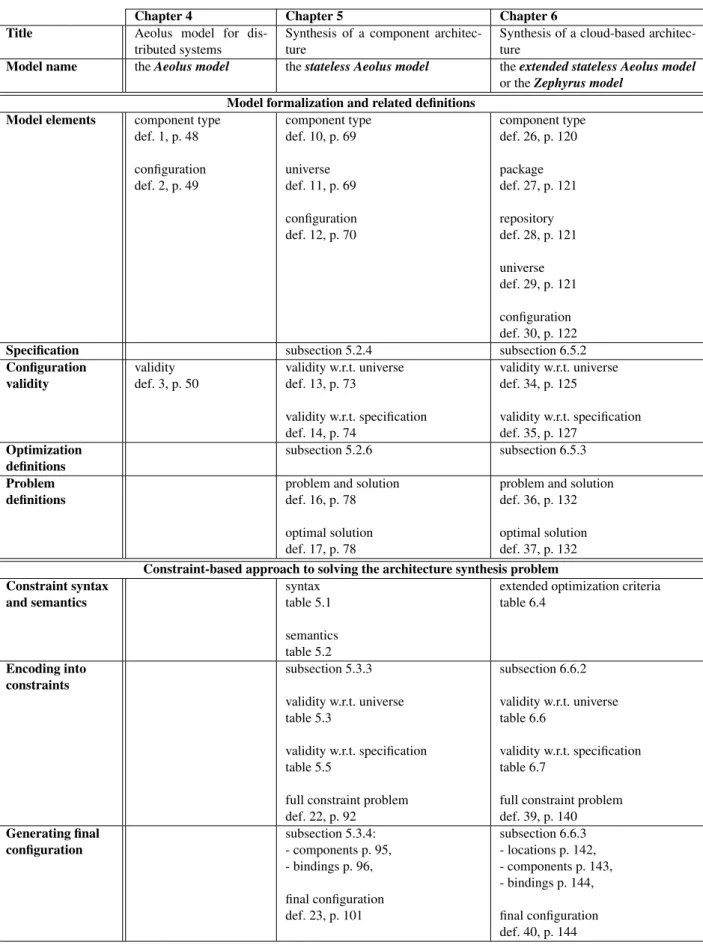
In order to facilitate comparisons between formal definitions concerning the three models introduced in this document, as well as our constraint-based approach to the architecture synthesis, table 2.1 points to
Chapter 4 Chapter 5 Chapter 6 Title Aeolus model for
dis-tributed systems
Synthesis of a component architec-ture
Synthesis of a cloud-based architec-ture
Model name the Aeolus model the stateless Aeolus model the extended stateless Aeolus model or the Zephyrus model
Model formalization and related definitions Model elements component type
def. 1, p. 48 configuration def. 2, p. 49 component type def. 10, p. 69 universe def. 11, p. 69 configuration def. 12, p. 70 component type def. 26, p. 120 package def. 27, p. 121 repository def. 28, p. 121 universe def. 29, p. 121 configuration def. 30, p. 122 Specification subsection 5.2.4 subsection 6.5.2 Configuration validity validity def. 3, p. 50 validity w.r.t. universe def. 13, p. 73 validity w.r.t. specification def. 14, p. 74 validity w.r.t. universe def. 34, p. 125 validity w.r.t. specification def. 35, p. 127 Optimization definitions subsection 5.2.6 subsection 6.5.3 Problem definitions
problem and solution def. 16, p. 78 optimal solution def. 17, p. 78
problem and solution def. 36, p. 132 optimal solution def. 37, p. 132 Constraint-based approach to solving the architecture synthesis problem Constraint syntax and semantics syntax table 5.1 semantics table 5.2
extended optimization criteria table 6.4 Encoding into constraints subsection 5.3.3 validity w.r.t. universe table 5.3 validity w.r.t. specification table 5.5
full constraint problem def. 22, p. 92 subsection 6.6.2 validity w.r.t. universe table 6.6 validity w.r.t. specification table 6.7
full constraint problem def. 39, p. 140 Generating final configuration subsection 5.3.4: - components p. 95, - bindings p. 96, final configuration def. 23, p. 101 subsection 6.6.3 - locations p. 142, - components p. 143, - bindings p. 144, final configuration def. 40, p. 144
CHAPTER 3
CONTEXT
3.1
Motivation
At the beginning of the Aeolus project, we set out to analyse and understand the current state of the related technology in the field of distributed software management, and to identify the best opportunities for improvement.
We have studied the state of the art in cloud technologies and distributed software management tools. A technical report on this topic was prepared, establishing essential facts concerning the capabilities and limitations of the existing technology in the context of the Aeolus project and its goals.
We synthesise here the findings of this report, which is an important starting point for the rest of this document, as it introduces the background information needed to understand several aspects of the work done in the Aeolus project.
My contribution
This chapter is a short summary of the results presented in the technical report “Distributed System Ad-ministration Technologies, a State of the Art” [125], that I wrote in 2012.
Considering the fast pace at which the technologies examined here evolve currently, some details present in the report may be outdated. However, most of its conclusions remain valid, as we are not aware of any spectacular and game-changing breakthroughs in this field having happened in the meantime.
3.2
Introduction
The term distributed configuration management refers to the problem of managing the configuration of software components on multiple hosts, which are usually working together in a computer network. In most cases this task is pursued by system administrators, who are responsible for planning and carrying out all the required modifications: installing, removing, upgrading and configuring software. Traditionally they perform these operations “by hand”, accessing the machines either directly or through the network (e.g. using SSH [124]).
When the demand for computing resources increases, be it in the case of simple workstations or expen-sive web servers, the number of hosts to manage grows. With them, the number of software components and the number of their relationships and dependencies raises as well.
The resulting increasing complexity issue has been partially offset by the progress of technology.
computing, make it easier and less expensive to create big networks of machines. But the work of a quali-fied system administrator is not as easily scaled up. Hence the popularity of solutions aimed to help system administrators to handle the resulting complexity.
A distributed configuration management tool is a piece of software, which helps a system administrator to:
• define, store and maintain reusable configuration artefacts,
• automate the process of enforcing configuration changes on multiple hosts at a time.
A basic improvised tool of this kind could be as simple as a shell script, that is used to execute the same administration command on a set of remote machines, which are reachable via SSH.
Modern distributed configuration management tools are far superior to this example and offer much
more in terms of both functionalities and efficiency. Most of them feature some kind of a specialized
abstract language used to describe configurations, offer a centralized and structured way to store
configura-tion descripconfigura-tions, and allow to easily define which parts of the global configuraconfigura-tion are relevant for which groups of machines. Moreover, such configuration management tools take care of the process of deploying the desired configuration on the hosts without requiring per-machine human interaction.
Typically in these advanced tools all the configuration information is stored on the central server and distributed between hosts not by pushing it from server to hosts, but rather by so-called pulling. Each host
queries the server periodically about its new desired configuration (and/ or how to attain it) and then it
applies required changes locally. This way the whole system is more scalable, as some part of work is shifted form the configuration server to the hosts.
An important concern associated with distributed configuration management is service orchestration. This broad term contains all the aspects of automated coordination and management of services dispersed between multiple hosts. As services running on different machines participate in implementing a single coherent service relevant for end-users, each service should be changed in accordance with others. For instance, a depended upon service should not be shut down (e.g. for upgrade purposes) before the services that depend on it, and vice-versa for its start-up (e.g. at the end of its upgrade). Proper coordination is not an easy task, as services not only depend on each other and cooperate in various ways, but also depend on a whole range of software components that should be locally installed on the machines where the services
run. Modern distributed configuration management tools offer a varying degree of service orchestration
capabilities.
3.3
Relevance of the study for the Aeolus project
One of the important axes of the Aeolus project was to develop a formal model of complex distributed component-based software systems that, as it happens with the so called “clouds”, can change in size over time due to the addition and removal of new (virtual) hosts. The formal modelling of such systems was then intended to be used to automatically plan software reconfigurations starting from high-level request submitted by system administrators.
To achieve that goal, the formal modelling should not be separate from the reality of existing technolo-gies. It would have indeed be pointless to create a very expressive formal model, if instances of it could not faithfully represent the reality of actual clouds, or local networks, for the purposes of planning software upgrades or other reconfigurations.
The purpose of this study was thus to review and compare the state of the art of technologies for distributed configuration management. In particular, we focused on those technologies that were applicable
to deploy FOSS1 components on UNIX-like machines, as they constituted the technological milieu of
interest for Aeolus. The review and comparison was meant to be useful for Aeolus for several reasons: • Aeolus aimed at developing real and useful technology. To that end we needed to start from what
was really used by actual system administrators at the time and ensure that all the use cases, which
the existing technologies had been developed to solve could be grasped by the formal models Aeolus was going to develop.
During this study we have also found many recurrent concepts that existed throughout all reviewed technologies. They have formed a sort of informal “ontology” that corresponded to the way of think-ing of system administrators. Such knowledge was very helpful as guidance durthink-ing the development of Aeolus formal models.
• We had anticipated that, during the lifetime of Aeolus we were going to need to test the tools, that were going to be developed as part of the project, on real data and compare the outcome of planners with what system administrators would have done “by hand”. Knowing existing technology allowed us to evaluate the feasibility of obtaining test data as translation from languages supported by existing tools to Aeolus-specific languages that were developed by Aeolus partners.
• On the other end of the spectrum, we hoped that we could reuse existing technologies as low-level deployment tools. If that turned out to be feasible, we imagined assembling fruitful pipelines where Aeolus planners could be used to solve complicate reconfiguration headaches (e.g. major upgrades of a FOSS distribution on all the machines that constitute a private cloud), and existing distributed con-figuration management tools would be used only for the actual deployment of concon-figuration changes.
3.4
Object of the survey
We have chosen some of the most popular distributed configuration management tools available on the FOSS market for UNIX-like machines, and we have studied their functionality and architectures. The work has been based mostly on the available documentation for the tools and on already existing examples of their use, like provided patterns and solutions. In certain cases we also applied some amount of practical experimentation.
The purpose of this research can then be summarized as:
• To better understand the problem of distributed configuration management, by analysing existent working solutions.
• To extract the models used, explicitly or implicitly, by each tool and grasp the similarities and di
ffer-ences between them.
• To spot interesting mechanisms, methods and solutions of sub-problems employed in the researched tools.
• To examine and appraise the tools in context of potential application in the Aeolus Project as the low-level deployment layer.
We have considered the following distributed configuration management technologies: 1. CFEngine3 (by CFEngine)
Third version of one of the first true distributed configuration management tools. Flexible, versatile and robust, but lacking the focus and ease of use of its competitors. It works on a rather low level of abstraction. We can find many basic CFEngine3 ideas and solutions reused in other tools.
2. Puppet (by Puppet Labs) and MCollective
A very popular tool. It models the configuration of managed hosts by introducing the concept of abstract resource layer. Also it features a high focus on declarativity. When extended with MCol-lective, it gains a broader perspective and some capabilities of service orchestration.
3. Chef (by Opscode)
In a nutshell, Chef is Puppet reworked from another point of view, abandoning the principle of declarativity and giving more direct control to the administrator. Also, it introduces several interest-ing mechanisms permittinterest-ing a certain level of service orchestration.