Université de Montréal
Feature selection and term weïghting beyond word frequency for calis for tenders documents
Par
Qing Ma
Département d’informatique et de recherche opérationnelle faculté des arts et des sciences
Mémoire présenté à la Faculté des études supérieures En vue de l’obtention du grade de Maître ès science (M.Sc.)
en informatique
Décembre, 2006
ieo
W
e
g
de Montréal
Direction des bibliothèques
AVIS
L’auteur a autorisé l’Université de Montréal à reproduire et diffuser, en totalité ou en partie, pat quelque moyen que ce soit et sur quelque support que ce soit, et exclusivement à des fins non lucratives d’enseignement et de recherche, des copies de ce mémoire ou de cette thèse.
L’auteur et les coauteurs le cas échéant conservent la propriété du droit d’auteur et des droits moraux qui protègent ce document. Ni la thèse ou le mémoire, ni des extraits substantiels de ce document, ne doivent être imprimés ou autrement reproduits sans l’autorisation de l’auteur.
Afin de se conformer à la Loi canadienne sur la protection des renseignements personnels, quelques formulaires secondaires, coordonnées ou signatures intégrées au texte ont pu être enlevés de ce document. Bien que cela ait pu affecter la pagination, il n’y a aucun contenu manquant.
NOTICE
The author of this thesis or dissertation has granted a nonexclusive license allowing Université de Montréal to reproduce and publish the document, in part or in whole, and in any format, solely for noncommercial educational and research purposes.
The author and co-authors if applicable retain copyright ownership and moral rights in this document. Neither the whole thesis or dissertation, nor substantial extracts from it, may be printed or otherwise reproduced without the author’s permission.
In compliance with the Canadian Privacy Act some supporting forms, contact
information or signatures may have been removed from the document. While this may affect the document page count. it does flot represent any bas of content from the document.
faculté des études supérieures
Ce mémoire intitulé
Feature selection and term weighting beyond word frequency
for cails for tenders documents
présenté par: Qing Ma
a été évalué par un jury composé des personnes suivantes:
Esma Aïmeur, président-rapporteur Jian-Yun Nie, directeur de recherche
Philippe Langlais, membre du jury
La classification de textes est un processus qui assigne automatiquement des documents des textes aux catégories prédéfinies. Afin de classifier des textes, nous devons extraire de bonnes caractéristiques à partir d’eux. Les méthodes telles que la sélection de caractéristiques et la pondération qui permettent de distinguer les bonnes caractéristiques et des mauvaises, ont été développés pour améliorer le résultat de classification.
Dans notre travail, nous étudions le problème de la classification des documents d’appel d’offre.
À
la différence du document typique(les nouvelles), les documents de l’appel d’offre contiennent un bon nombre d’information procédurale indépendant du sujet des documents. Information de position, entités nommées et concepts sont les trois facteurs qui peuvent distinguer de bonnes caractéristiques des mauvaises dans les documents d’appel d’offre. Dans ce mémoire, nous proposons les méthodes de sélection de caractéristiques et les méthodes de pondération de poid qui comptent l’information de position, les entités nommées et les concepts pour mesurer l’importance de la phrase.Pour vérifier l’effet des deux méthodes proposées, nous avons entrepris des expérimentations en utilisant les classificateurs Naïve Bayes et SVM sur les documents de l’appel d’offre de type f30. Nous obtenons le meilleur résultat quand nous employons les méthodes de pondération qui combinent tous ces facteurs pour les classificateurs Naïve Bayes et SVM. On observe une légère amélioration sur les resultants de classification après des expériences avec la methode de sélection de caractéristiques. Nous observons également que la méthode sélection de caractéristiques par le filtrage de
grande marge que le classificateur SVM.
Text classification is a process that automatically assigns text documents to predefined categories. In order to classify text documents, we must extract good features from them. Methods such as feature selection and term weighting, that allow to distinguish good feature and bad features in a document, have been developed to improve the classification resuit.
In our study, we investigate the problem of classification of cali for tender (CFT) documents. Unlike the typical news document, CfT documents contain lots ofprocedural information unrelated to the subject of the documents. Sentence position information, named entities and concepts are factor that can distinguish good features and bad features in the CfT documents. In this paper, we propose feature selection methods and term weighting methods that rely on position information, named entities and concepts to measure importance of sentence.
To verify the effect of both proposed methods, we conducted experiments using Naïve Bayes and $VM classifiers on FBO cail for tender documents. We obtain the best result when we use term weighting methods that combine all factors for the Naïve Bayes and SVM classification. Only slight improvement is observed afier we conduct feature selection experiments. We also observe that for both feature selection by sentence filtering and term weighting method improves the performance of Naive Bayes classifier by a bigger margin than the performance of SVM classifier.
TABLE 0F CONTENTS
ACKNOWLEDGEMENTS ABSTRACT 4 RESUMÉ 5 TABLE 0F CONTENTS 7 LIST 0F FIGURES 11 LIST 0F TABLES 13 CHAPTER 1 INTRODUCTION 15CHAPTER 2 CLASSIFICATION, FEATURE SELECTION AND TERM
WEIGHTING-AN OVERVIEW 22
2.1 Overview ofAutomatic Classification 23
2.2 Text Classification Methods 23
2.1.1 Naive Bayes Classification 24
2.2.1.1 Bayes Theorem 25
2.2.1.2 Naïve Bayes probabilistic model 26
2.2.1.3 Naïve Bayes Classifier 27
2.1.2 Support Vector Machine (SVM) 28
2.3 Methods to improve the classification 31
2.3.1 Feature selection 31
2.3.1.1 Information Gain 32
2.3.1.2 Other feature selection methods: 35
2.3.2 Term Weighting Methods 36
2.3.2.1 Document Indexing and Terni weighting 36
2.3.2.3 Summary of Classification Approaches and Description ofOur
Application 38
CHAPTER 3 RELEVANCE INDICATORS 40
3.1 Named Entities 42
3.1.1 Information Extraction overview 42
3.1.2 Named Entity Recognition 44
3.1.3 GATE information extraction system 45
3.1.4 Named Entities in Call for tender documents 48
3.2 Concept Extraction 49
3.2.1 Concept Definition 50
3.2.2 Concept Extraction Techniques 50
3.3 Position Information 52
CHAPTER 4 US1NG SPECIFIC FEATURES 0F CfT TO IMPROVE TERM
WEIGHTING 54
4.1 Identification of Important Sentences by Specific f eatures 54 4.1.1 Identification of Important Sentences by position 54 4.1.2 Identification of Important Sentences by Concepts 57 4.1.3 Identification of Important Sentences by NE 62 4.2. Term Weighting and Feature Selection Methods 64 4.2.1 Methods to improve classification results 64
4.2.1.1 Feature Selection Methods 64
4.2.1.2 Term Weighting Method 65
4.2.2 Feature selection and term weighting using named entities 67 4.2.3 Feature selection and term weighting using concepts 67 4.2.4 Feature selection and term weighting using position information 68 4.2.5 term weighting method using combined factors 69
CHAPTER 5 EXPERIMENTS 71
5.1 Test collection 71
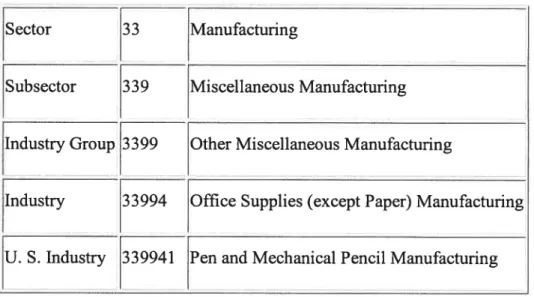
5.2 NAICS Classification System 73
5.3 Distribution ofthe documents 75
5.4 Classifiers 75
5.5 Evaluation of Classification Experirnent 77
5.6 Baseline classifiers 79
5.7 Text Classification Using Position Information $0 5.7.1 Sentence Filtering By Position Information: $0 5.7.2 Term Weighting Using Position Information $3
5.8 Text Classification Using Concepts 86
5.8.1 Sentence Filtering Using Concepts 86
5.8.2 Term Weighting According to Concepts $9
5.9 Text Classification using Named Entities 91
5.9.1 Sentence Filtering UsingNE 91
5.9.2 Term Weighting According to Named Entities 94 5.10 Term Weighting Combining Various f actors 95 5.10.1 Naïve Bayes Classification With Combined f actors 97
5.10.2 SVM with combined factors 97
5.11 Overail Comparison of Classification Results 99
5.11.1 Naïve Bayes Classification Result: 99
5.11.2 $VM Classification Resuit: 102
5.11.3 Discussion 104
LIST 0F FIGURES
2.1: SVM Classification (McCulloch, 2004) 30
3.1: Annie NE extraction Process (Cunningham et ai, 2006) 47 4.1: Identification of important sentence according to its position 56
5.1: SampleCFTonFBO 72
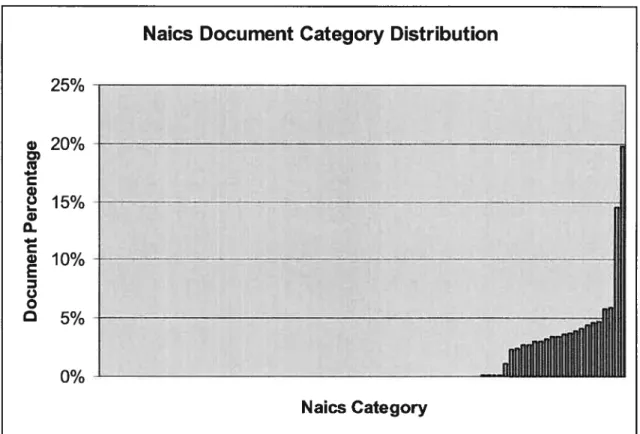
5.2: Naics Document Category Distribution 75
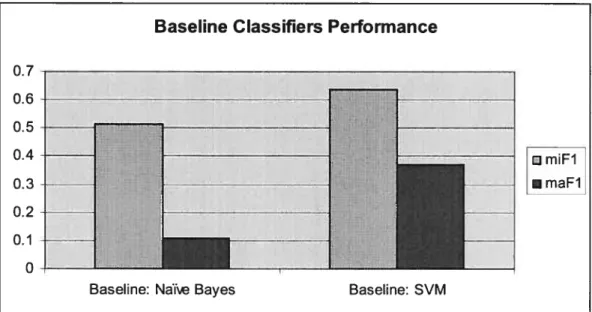
5.3: Baseline Classifiers Performance 79
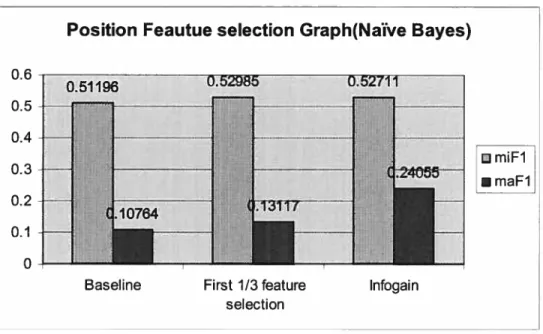
5.4: Feature selection by position (Naive Bayes) $1
5.5: Position feature selection ($VM) 82
5.6: Term Weighting by Position (Naïve Bayes) 84
5.7: Position Term Weighting Boosting Value Experiment (Naïve Bayes) 85
5.8: Term Weighting by Position (SVM) 86
5.9: Concept feature selection and term weighting (Naïve Bayes) 88 5.10: Concept feamre selection and term weighting (SVM) 88 5.11: Concept Feature selection threshold value experiment (Naïve Bayes) $9 5.12: Concept Term Weighting by Concepts (Naive Bayes) 91 5.13: NE feature selection and term weighting experiments (Naive Bayes) 92 5.14: NE feature selection and term weighting experiments (SVM) 93 5.15: Term Weighting by NE with different Boosting factors (Naïve Bayes) 94 5.16: Ail factor Term Weighting Boosting F actor Experiments(Naïve Bayes) 96 5.17: Term weighting incorporating all factors (Naive Bayes) 97
5.18: Term weighting with ail factors (SVM) 98
LIST 0F TABLES
4.1: Identification of important sentence according to its position 55
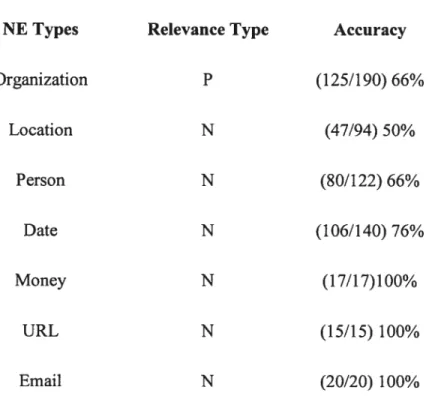
4.2: Concept Type and Accuracy 62
4.3: NE Experiments on identification of important sentences 63
5.1: Sample NAICS Category 74
5.2: Contingency matrix 77
5.3: Baseline Classifiers Performance 79
5.4: Position feature selection (Naive Bayes) 80
5.5: Position feature selection (SVM) $1
5.6: Term Weighting by Position (Naive Bayes) $4
5.7: Term Weighting by Position ($VM) $5
5.8: Concept feature selection and term weighting (Naïve Bayes) 87 5.9: Concept feature selection and term weighting ($VM) 8$
5.10: Term Weighting by Concepts (Naive Bayes) 90
5.11: NE feature selection and term weighting experiments (Naive Bayes) 92 5.12: NE feature selection and term weighting experiments (SVM) 93 5.13: Term Weighting by NE with different Boosting factors (Naïve Bayes) 94 5.14: Ail factor Term Weighting Boosting f actor Experiments(Naïve Bayes) 96 5.15: Terrn weighting incorporating ail factors (Naive Bayes) 97
5.16: Term weighting with ail factors (SVM) 98
5.17: Naïve Bayes Classification Resuit 99
5.18: Average Term Weighting and Feature Selection (Naive Bayes) 101
f irst, I’d like to thank my thesis supervisor, Jian-yun Nie. Thank you for everythng you’ve done for me. You are an amazing scientist. Your encouragement is a constant inspiration for me. Without you, my work wouldn’t be possible.
Also, I’d like to thank ail the people from RALI group who has helped me and supported me throughout my research: francois Paradis, Shi Lixin, Graham Russeii, etc. Thank you for helping me with my research whenever I had problems. Words cannot express my gratitude.
Special thanks to my family, which I value most in my life; you are my source of strength, love, happiness, and support. My father, Hewu Ma, my mother Shijin Yang, are aiways behind me good times and bad times. Thank you for listening to me and making me believe that nothing is impossible. I dedicate this dissertation to ail of you.
Qing Ma January 2007
CHAPTER 1
INTRODUCTION
Text classification is a very dynamic area ofresearch in artificial intelligence. The purpose of text classification is to classify text documents into a pre-defined set of categories. There are many algorithms, both supervised and unsupervised, such as SVM (Joachims, 1998), Naïve Bayes (McGallum et al., 1998), KNN (Yang et ai, 2002), that can be used to accompiish this task.
In this thesis, we are interested in the classification of cail for tender (CFT) documents. It’s a type of document in which an authority (or solicitor) specifies his/her requirement for goods or services so that a contractor can submit a tender. As e-commerce develops rapidly, more and more industries are interested in finding out business opportunities on-une. For example, fedbizopps.gov or merx.ca are two large websites where government cails for tenders are published. Online CFT is an important source of business opportunities. However, most CFT are flot well organized. It is difficuit for users to locate the ones that are relevant to them. Therefore, automatic classification of the CFT document is required in order to organize automatically calls for tenders into a class hierarchy, so that users can browse through.
In previous studies on automatic classification, it is found that the performance of classifiers usually depends on two important aspects. The first is the classification algorithm and the second is the relevance of the features used in the algorithms. As there are many classification algorithms which can be used for the purpose of CFT classification, we will focus on the second problem in this thesis. In previous studies, features are usually words (except stopwords) extracted from documents. In many cases, the frequency of occurrences of words is also used to weight the importance of them. This strategy works well for the classification of general documents, for example, newspaper articles. In some other cases, it is found that word extraction according to their frequencies alone is not sufficient: some of the words represent important meanings of the documents, while some others do not. These latter are considered to be irrelevant features or noise. However, there have flot been many studies focusing on the extraction of relevant words or features for specific documents such as CFT. In the case of CFT, it is especially crucial to extract relevant features and filter out irrelevant ones, because the important meanings (the subject of the calls, i.e. the goods or services required) are flot described by repetitive words, thus by words with high frequency. Instead, the subject is usually described by one or a few sentences. On the other hand, there is a large portion in CFT documents specifying the procedure for a submission. This part of the document is not directly related to the subject of the call, and is flot useful for CFT classification. We call this part “procedure noise”. b illustrate the problem of “procedural noise”, here is an example of call for tender:
“Landfill Disposal Services. Landfill Disposal Services for solid waste generated and delivered by various Navy installations within Navy Region
Northwest. Contractor shah accept and dispose of solid waste delivered to facility. Commodities types include but flot be limited to, municipal solid waste, creosote pilings, sou, concrete, asphait, asbestos, treated lumber. asphait & concrete with rebar, construction demolition and land clearing debris, siudge cake/filter press dewatered solids, petroleum contaminated sous and truck wastes. Landfiht service provider shah ensure compliance with ail federal, state, and local laws or regulations related to refuse disposai and can be licensed by Washington State Utility and Transportation Commission. Electronic monthÏy billing services to include record of Dailp transaction detail by date, time, net weight in tons, commodity delivered and vehicle ident
fl
cation rntmber. Estimated monthly dehivety ofwaste. 2500 Tons. This procurement will be classfled under XØ( Code (North American industiy classflcation svstem): XVX Size standardfor this code is 10.5liThis acquisition is being solicited using commercial procedures in accordance with FAR Part 12. Firm Fixed Price Contract for the period of 27 July through 30 September 2002. To be eligible for award, prospective offerors must be registered in Central Contractor Registration
(CCR) Internet site: http://www.ccr.grn’. Link to fedBizOpps document.
The underlined part is related to the subject of the cal!. The text in italics is the standard procedural submission information present in many CFT documents. Those types of information are irrelevant to the subject ofthe cal! for tender document, although
they are useful for users to determine later if they are eligible. For CFT classification, our purpose is to organize ail the CFTs according to the subject of the calls. Therefore, the procedural part of CFT should be filtered out.
The problem of irrelevant or noise features also occurs in traditional classification. Two main techniques have been used to select good features from a set of candidate ones: feature selection and term weighting. Both feature selection and term weighting methods try to distinguish relevant and irrelevant features in the document. Traditionally, the feature selection methods involve eliminating irrelevant contents by using statistical method such as information gain (InfoGain) or document frequency (DF) threshold. For term weighting, traditionally one uses the frequency of words in the document: the more a word occurs in a document, the more it is considered to be important and related to the subj ect. However, previous studies show that it’ s difficuit to eliminate the irrelevant features in the eau for tender documents effectively by using those standard methods (Paradis, 2005) due to the very fact that there is only a concise description of the subject, while a lengthy description of the submission procedure is usually included.
The goal of this dissertation is to identify better factors to help determine relevant/irrelevant features in the call for tender documents, so that the classification performance can be improved. In this study, we examine three types of feature: position of the sentence, named entities contained in the sentence and concepts in the sentences. These factors are strongly related to the general characteristics of CFT. In general, important sentences that describe the subject appear at the beginning of a CFT. Therefore, the position of the sentence is an indicator of relevance or irrelevance of
sentence. Named entities (NE) such as organization, place, email address, date, money, etc., are frequently used in CfT. Some named entities are helpflfl in suggesting relevance of a sentence, while some other can suggest irrelevance. As an example, the contact URL address of the authority oflen appears in the procedural part of CfT; thus a sentence containing such a NE is usually irrelevant to the subject. for example, in the CFT document shown above, the sentence “To be eligiblefor award, prospective offerors must be registered in Central Contractor Registration (CO?, Internet site: http://wwwccr.ov. Link to fedBizOpps document. “, which contains a URL address, is
an irrelevant sentence. Therefore URL can be an indicator of irrelevance ofthe sentence.
The description of the subject of the cali oflen use terms that correspond to specialized concepts. For example, “Landfihl Disposai Services”, ‘treated lumber” in the above example correspond to a concept. The occurrence of specialized concepts in a sentence is also a useful indicator on the relevancy ofthe sentence to the subject.
Therefore, in this dissertation, I will exploit mainiy position, named entities and concepts or combination of ail these factors to distinguish relevant and irrelevant sentences to the subject, and to assign better weights to terms (or features). We hope that with this refined feature selection and weighting, the classification result of the CFT documents can be improved compared to the classification using traditional feature selection and term weighting methods.
We will evaluate and compare feature selection and term weighting method by conducting experiments using SVM and Naïve Bayes classifiers. $pecifically, we seek the answers to the following questions empirically:
1. Can feature selection or term weighting method based on these additional factors lead to better performance with commonly used classification algorithms such as Naïve Bayes and SVM for CfT documents? How do they compare to traditional feature selections such as the approach based on information gain?
2. Which method can achieve better classification performance for Naïve Bayes and SVM classifiers, feature selection or term weighting method?
3. Which factors among concepts, location information and named entities seem to have the most impact to improve the performance of SVM and Naïve Bayes classifiers?
This study has been carried out within a research project in collaboration with Nstein Technologies, entitled “Matching Business Opportunities on the Internet” (MBOI). It aims to automatically identify business opportunities on the Internet for small businesses. The whole research for MBOI project covers the following aspects: automatically collecting calis for tenders on the Web, matching calis for tenders and the need of an enterprise, classifying cails for tenders, searching calls for tenders in different languages. The study described in this thesis is only concerned with the aspect of classification of caIl for tender documents.
Although our focus is on a specific type of document — CfT, we argue that the
general idea to exploit specific characteristics of documents should also be used on other types of documents. Therefore, this study can be seen as a case study of this general idea. We will show in our experiments that by incorporating specific factors to determine the
relevance/irrelevance of sentences, and to weigh terms accordingly, we can achieve better classification performance.
The rest of this thesis is organized as follows. in Chapter 2, I will first introduce the classical classification algorithms - SVM and Naïve Bayes, as well as the basic
feature selection and term weighting method for classification. In chapter 3, I will describe the three relevance distinguishing factors studied in this thesis. These factors will also be related to some previous studies on feature selection and term weighting rnethod using similar factors. Chapter 4 will present the feature selection and term weighting methods I use in this thesis to improve the classification and I will discuss them in detail. In Chapter 5, we discuss the experiments carried out with those methods and the empirical results in our experiments. The final section presents some conclusions and recommendation for future research.
CHAPTER 2
CLASSIFICATION, FEATURE SELECTION AND
TERMWEIGHTING
-AN OVERVIEW
We are ail faced with an overflow of information in our everyday life. The development of different medium sucli as Internet and TV contributes to this phenomenon. The question is how we can transform information into something useful for us. Information needs to be extracted, analyzed and organized before it is delivered to us. Information retrieval (or search engine) is a useful tool for this purpose: It allows the users to find documents related to a query describing his/her information requirement. However, it is also how that users ofien cannot describe their information need with the appropriate words. In some cases, a better solution is to offer the users with a well organized document structure, so that they can browse. The structure can correspond to the semantic categories of documents, which are defined manually by domain experts. The purpose of document classification is to assign appropriate categories to documents.
Manual classification lias been used for a long time before computer is popularized. However, the classification by human is a very slow and tedious process. The amount of pages needed to be indexed grows much faster than human indexers can process. Therefore, it’s important to classify information by using automatic classification techniques that leam from human classification examples, and is able to
classify new documents based on what it lias leamt. In this chapter, we will review the general problem of automatic classification and the basic methods used for it.
2.1 Overview of Automatic Classification
The automatic classification is a procedure that consists of constructing a mode! that tries to correctly predict class of different objects. The model is built based on a set of variables describing different characteristics of the objects (i.e., independent variables) and on a training set of previously labeled item. In text classification, words are usually used as such variables (in some cases, feature extraction is used, which tries to generate more abstract features from words and documents). Once the mode! is built, it can be used to classify new objects whose class information previously unknown.
General classification methods can be applied to many different areas such as texts and bio-information. In text classification, we try to assign a document to one or more categories (classes), based on its contents. Document classification can be used to deal with problems such as spam filtering and web pages classification.
2.2 Text Classification Methods
Text classification methods can be divided into two categories: supervised classification where some extemal mechanism (such as human feedback) provides information on tlie correct classification for documents, and unsupervised document classification, wliere the classification must be done entirely automatically without reference to extemal information. In this thesis we only deal with supervised document classfication. We assume that there is a set of manually labeled texts that we can use as our training data.
Many different algorithms have been developed for document classification over the years. The most commonly used ones include Naïve Bayes Algorithm, k-Nearest Neighbor (KNN), Support Vector Machine (SVM), Rocchio, etc. For our study we only used Naive Bayes and SVM classifier. Both classifiers are known to perform well in text classification and are good choices as classification baseline. However, Naïve Bayes is known to be sensitive to feature selection and term weighting but $VM is flot. This fact aise helps us to know better about the effect of our proposed terrn weighting and feature selection method.
2.1.1 Naive Bayes Classification
Naïve Bayes (NB) algorithm has been wideiy used for document classification, and shown te be fast and produce very good performance (Mitchell, 1996). The basic idea is to use the joint probabilities of words (used as features) and categories te estimate the probabilities of categories given a document. NB algorithrn computes the posterior probability that the document belongs to different classes and assigns it to the ciass with the highest posterior probability. Bayes Theorem is the basis of the NB algorithm. The posterior probability of class is computed using Bayes rule and the testing sampie is assigned te the class with the highest posterior probability. In the following, we will provide more details ofthis algorithm.
2.2.1.1 Bayes Theorem
Bayes’s theorem is a result in probability theory. It relates the conditional and marginal probability distribution of random variables. As we know, the probability of an event A conditional on another event B is generaÏly different from the probability of B conditional on A. However, there is a definite relationship between the two, and Bayes’s theorem is the statement ofthat relationship.
Let B be the data record (case) whose class label is unknown. Let A be some hypothesis, such as “data record B belongs to a specified class C.” For classification, we want to determine P(AB) -- the probability that the hypothesis A holds, given the
observed data record B.
P(AIB) is the posterior probability of A conditioned on B. For example, if we use A to express the statement that a fruit is an apple, and B the statement that it is red and round, then P(AB) expresses the probability that a fruit is an apple, given the condition that it is red and round. In contrast, P(A) is the prior probability, or a priori probability, of A. In this example P(A) is the probability that any given data record is an apple, regardless of how the data record looks like. The posterior probability, P(AB), is based on more information (such as background knowledge) than the prior probability, P(A), which is independent of B.
Similarly, P(BjA) is posterior probability of B conditioned on A. That is, it is the probability that B is red and round given that we know that it is true that B is an apple. P(B) is the prior probability of B, i.e., it is the probability that a data record from our set of fruits is red and round. Bayes theorem is useful in that it provides a way of calculating
the posterior probability, P(AIB), from P(A), P(B), and P(BjA). Bayes theorem is as follows:
P(AIB)=
P(BA)F(A) F(3)In the next section, we will see how Bayesian theorem can be used to derive the Naïve Bayes probabilistic model.
2.2.1.2 Naïve Bayes probabilistic modet
The probability model for a classifier is a conditional model which is represented by the following formula:
P(CIWi....Wn)
over a dependent class variable C with a small number of outcomes or classes, conditional on several feature variables W1 through W
Using Bayes Theorem, we can write:
Since the denominator is a constant and doesn’t depend on the C, we can derive the following formula:
P(C)F(W IC)F(W2 IC,J1’)F(W3,...W C,,W,)
We assume that each feature I4’ is independent of every other feature W. for j
j,
the joint probability can be expressed as:P(C,...,J1)=F(C)flP(Il’
IC)
The conditional distribution over the class variable C can be expressed as follows:
P(CI
W)=±F(C)flP(WIC)P(C)flP(WIC)where Z is a scaling factor dependent on features W W,.
2.2.1.3 Naïve Bayes Classifier
The Naïve Bayes classifier can be derived from the Naïve Bayes probability model.
The naive Bayes classifier combines this model with a decision rule. One common rule is to pick the hypothesis that is the most probable; this is known as the maximum posteriori (MAP) decision rule. Assume that a document is represented by a set of words . .W appearing in it. These words are called features. The corresponding
classifier is the classification function C(Ï4Ç...kJ’)defined as follows:
C( W
)
argmax P(C=c)Naïve Bayes assumes that ail attributes of examples are independent of each other given the context of the cÏass. While this assumption is clearly false, in most real-world tasks, Naive Bayes ofien performs very well in classification. This paradox is explained by the fact that classification estimation is only a function of the sign (in binary cases) of the function estimation; the function approximation can stiil be poor whule classification accuracy remains high (Friedman 1997; Domingos and Pazzani 1997). Because of the independence assumption, the parameters for each attribute can be leamed separately, and this greatly simplifies leaming, especially when the number of attributes (W) is large. Document classification is just such a domain with a large number of attributes. The attributes of the examples to 5e classified are words, and the number of different words can be quite large indeed—usually in the order ofhundreds ofthousands.
Studies comparing classification algorithms have found the Naïve Bayes classifier to be comparable in performance to classification trees and to neural network classifiers. They have also exhibited high accuracy and speed when applied to large databases.
2.1.2 Support Vector Machine (SVM)
Support vector machines (SVMs) are a set of related supervised learning methods used for classification. This method was originally introduced by Vapnik in 1995 for two class recognition problem (Vapnik, 1995).
Its basis is the Structural Minimization Principle. Defined in a vector space, it tries to find a decision surface that separates the data points of two classes. The decision surface in a linearly separable space is a hyperplane. Given training examples labeled
either “yes” or “no”, a maximum-margin hyperpiane is identified which spiits the “yes” from the “no” training examples, such that the distance between the hyperpiane and the closest examples is maximized. This idea can also be generalized to high dimensional space and data points that are not linearly separable.
The decision surface can be written as W X—b =O. X is an arbitrary data point
to be classified, and the vector for W and the constant b are leamed from a training set of linearly separable data. Let D={ (y1,x1
)}
denote the training set where y. E {±1} is thecorrect classification resuit for x (+1 for being a positive example and -1 for being a negative example of the given class). The SVM problem is to find w so as to satisfy the following constraints:
w•x1-b>=+1 for y+l (1)
w•x1-b<=-1 for y1-l (2)
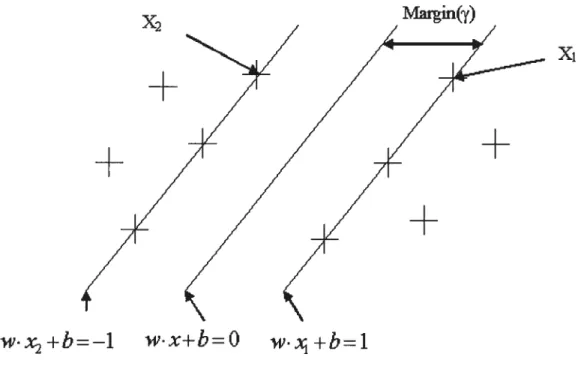
The following figure illustrates the hyperpiane that separates positive and negative examples.
w•x2+b=—1
X2 Margin(y)
Figure 2.1: $VM Classification (McCulloch, 2004)
Xl
The parameters of the maximum-margin hyperpiane are derived by solving a quatratic programming (QP) problem. There exist several specialized algorithms such as Platt’s SMO algorithm that quickly solves the QP problem that arises from SVMs. The algorithms can also be extended for solving linearly non-separable cases by either introducing sofi-margin hyperplanes or using the kemel-trick.
Hyperpiane, illustrated by figure 2.1, is determined by the distance between the data points that have exactly the distance ]/w from the decision plane. These data points are called support vectors and are the only elements that have an impact in the training set. Even if all other data points are removed, the algorithm will still leam the same decision function. This property sets SVM apart from other algorithms: with other algorithms, ail the data points are needed to optimize the decision function.
+
+
+
+
When applied to text classification, previous studies show that SVM ofien classifier outperforms other classifiers. SVM generalizes well in high-dimensional feature space. It acknowledges text properties such as most relevant features and sparse document vectors. Also, most text classification tasks are iineariy separable. Ail these properties make $VM a suitable classifier for document classification task.
2.3 Methods to improve the classification
The performance of the classification is crucial for users to access information correctly. The information needs to be classified quickly and accurately. There exist several methods to improve the resuit of classification. In text classification, two important methods are feature selection and term weighting.
2.3.1 Feature selection
Feature selection is a process commonly used in machine leaming. It consists of selecting a subset of the features available from the data for application of a leaming algorithm.
High feature dimensionality is one of the main obstacles in text categorization. There are 10000 features and more for even a medium-sized collection, which exceed the number of available training samples. The number of features is too high for many classification algorithms to handie. Therefore, it is necessary to reduce the number of features without sacrificing the classification accuracy. In a word, feature selection can help increase the classification efficiency.
Feature selection is also very helpful to increase the classification quality. Words extracted from a document are flot aiways relevant to the main theme of the document.
There might be “noise” in the documents, which is the presence of non-relevant and repetitive data. This type of information can ofien degrade the performance of many classifiers. Previous studies have shown that feature selection can improve the classification performance of many algorithms including Naïve Bayes, KNN, neural networks (Yang et al, 1997). In our application, calls for tenders usually contain much procedural information, which is the information on the submission procedure of the tender, and is non-relevant to the subject of the call for tenders and can be seen as noise in the document.
Many feature selection techniques have been developed and they have produced good classification results. Most of the automatic feature selection methods include the removal of non-informative terms according to corpus statistics and construction of new features which combine low level features into high level orthogonal dimensions (such as the features extracted from Latent Semantic Analysis — LSI). The most popular one is the
technique of information gain.
2.3.1.1 Information Gain
Information Gain (InfoGain) is a measure based on entropy. Entropy is ameasure of the expected amount of information conveyed by an as-yet-unseen message from a known set (Quinlan, 1993).
The amount of information conveyed by a message, in bits, is the negative base two logarithm of the probability of that message. For example, if there are 8 equally probably messages, receiving any one of them conveys -log2(1/8) 3 bits of information. Less probable messages convey more information, and vice versa. The expected amount
of information conveyed by any message is simply the sum over ail possible messages, weighted by their probabilities.
In the context of supervised leaming, the possible “messages” are prediction of the classes into which the data fall, and the probability of a class is the portion of the training cases which is labeled with that class. The entropy of the training set is the expected amount of information conveyed by the label of a case. A training set evenly spiit across the classes therefore has maximal entropy (1 if there are two classes), while one containing only examples ofone class has entropy O.
If the data can be divided into subsets by some useful test (i.e., by examining one of the features), each subset will have less entropy than the whole set. The spiit entropy for some feature is the sum of the entropies of the subsets resulting from the spiit, weighted by their sizes as fractions ofthe size ofthe original set.
The information gained by splitting on some feature is simply the original entropy minus the split entropy of the feature. In growing a decision tree, the feature offering the greatest information gain is selected at each step.
More precisely, given a set E of classified examples and a partition F{ E1, ..., E,1
}
of E, the information gain is defined as
G(E, F)= entropy(E) - entropy (E,)* E.
1/
EIntuitively spoken the information gain measures the decrease of the weighted average impurity of the partitions E1, ..., E,1, compared with the impurity of the complete
In document classification, information gain measures the number of bits information obtained for category prediction by knowing the presence or absence of a term in the document.
If
{Ç}
}
is a set of categories, the information gain of a tenn t can be definedas
—
F.(ci)log 1.(ci)+J.(t)”1].(c
I
t)iog I.(c t)+ PQ)’F(c.
I
)ÏogF.(c1 t)If we have a corpus, we can compute the information gain for each unique term. Then we can remove those features whose information gain is less than a predefined threshold, or keep the k terms with the highest information gains. The computation includes the estimation of the conditional probabilities of a category given a term, and the entropy computations in the definition. The probabiiity estimation lias a time compiexity of 0(n) and a space compiexity of 0( J’W) where N is the number of training documents, and Vis the vocabulary size.
The information gain method is one of the widely used feature selection techniques. Aiso previous studies have shown that among different dimensionality reduction (a.k.a. feature selection) techniques, information gain is one of the most effective (Yang et ai, 1997).
2.3.1.2 Other feature selection methods:
Other statisticai feature selection methods inciude Document Frequency (Df) thresholding method, mutual information (MI) method, 2
statistic (CHI) method, Term Strength (TS) method (Yang et ai, 1997).
There are other non-statisticai feature seiection techniques available. Sentence filtering is one selection method that takes place prior to the indexing process of the training phase. It consists of rejecting or retaining sentences in a document based on the importance of the sentences in the document. There has been some eariy work on passage filtering based on character n-grams (Cavnar, 1993). The automatic summarization (Orasan et ai, 2004) is one technique used to identify the most meaningful sentences. For example, the relevancy of a sentence can be estimated based on its position, length, the ftequency of the terms and its similarity with the titie. Named entities are also used in some of the studies related to text classification. However, in most cases, the use of named entities in classification is restricted to replacing common strings such as dates or money amounts with tokens corresponding to the class name, to increase the ability ofthe classifier to generalize. In the project in which I participate — MBOI, one previous study
used named entities as indicators ofreievance of passage in the filtering process (Paradis, 2005). However, the classification result didn’t show significant increase.
For conventional method like Naïve Bayes, feature selection usually improves classification accuracy of classifier and avoids “overfitting” (Yang et aI, 1997).
Compared to Naïve Bayes, SVM has the ability to generate well in high dimensional feature spaces (Joachims, 1998), since $VMs use overfitting protection that does flot
depend on the number of features. Generaiiy the performance improvement of SVM classifier using feature selection method hasn’t been proved to be significant in terms of classification quality. However, it can stiil reduce the complexity ofthe calculation.
2.3.2 Term Weightmg Methods
Term weighting consists of adjusting the termweight of the vector space model in the document indexing process. In vector space model, a document is represented as a vector of features using Term frequency (TF) and Inverted Document Frequency (IDF). This model simply counts Tf without considering the importance of the sentence in which it appears. As we have shown in our earlier exampie, sentences in a document have different importance for identifying the content ofthe document. Thus, by assigning a different weight according to the importance of the sentence, we can achieve better resuits.
2.3.2.1 Document Indexing and Term weighting
In the indexing phase, the features of the documents are extracted and indexed. The indexed document is commonly represented using the vector space model (Saiton et al., 1975). This model represents documents as a vector whose components are ail the possible index terms. Each index term has an associated weight that indicates the importance of the index term in the document (or query). The weight is usuaily represented by combining two factors: the importance of each index term in the document and the importance of the index term in the collection. The importance of each index term can be measured by the number of times that the term appears in the document. This is called the term frequency which is denoted by the symboi
f
Theimportance of the term in the whole set of document is represented by the rarity of the index term in the whole set of document. For example, an index term that appears in every document in the collection is not very useful, but a term that occurs in only a few documents may indicate that the term best represents the document in which it appears. This factor is usually called the inverse document frequencyor the idffactor.
Mathematically the inverse document frequency (idf) can be expressed as:
idf=log N/N
where N= Number of Documents in the collection;
N1 = Number of documents that contain the term.
By combining these two factors, we can obtain the weight of an index term i as:
W=fx idf
= if x logN/N1
For terms that are relevant, we would like to assign a high weight W and for terms that are considered irrelevant, we assign a lower weight. However, the above ‘f*idf is flot always enough. So, a few alternative methods have been proposed.
2.3.2.2 Other term weighting methods
In previous studies surveyed, most of the term weighting rnethods measure the relevance of the terms regardless of the location of the terms in the documents. A term appearing in the titie of a document is considered in the same way as a term in the body of the document. However, some studies consider the position infonnation of the terrns.
The titie is ofien indicator of relevant terms. (Mock et al., 1996) is a study which used the title of a document in order to choose the relevant terms. The terms in the subject of the news articles were assigned highest weight, followed by terms in the text body section. The terms in the author section are assigned the lowest weight. The resuit shows an improvement of classification result.
Another study used two kinds of text summarization techniques to assign weight to terms. One method assigns higher weights to the sentences that are more similar to the title. Another method first measures the importance of terms by IF, IDF, and 2 statistic values. Then we assign a higher importance to the sentence with more important terms. Both methods proved to make significant improvement on Naïve Bayes, SVM, Rocchio, KNN classifier (Ko et al, 2002).
2.3.2.3 Summary of Classification Approaches and Description of Our Application
We concur that automatic classification is a process that organizes information and helps to make information useful to everyone. The performance of the classifier is crucial because it allows users to get information quickly and accurately. The performance of the classifiers can be improved by the feature selection and term weighting methods. Both methods rely on techniques of distinguishing relevant and irrelevant features. For feature selection, most existing techniques use corpus statistics to distinguish between informative terms and non-informative terms. For term weighting, most of the methods measure the relevance of the terms using word frequency regardless of other factors.
Even though there have been a few alternative term weighting methods that exploit the position information, there have flot been extensive investigation on alternative factors other than tenn frequency. In this thesis, we will investigate several alternative factors.
Our application problem is the classification of eau-for-tender documents (CFT) downloaded from the web, according to one of the existing norms such as NAICS (North American Industry Classification System). The ability to classify call for tender documents into different domains of activity allows suppliers (users) to find the ones that are relevant to their business. As we showed earlier, an important problem in CFT classification is that this type of documents oflen contains procedural information irrelevant to the main theme. It’s very difficult to eliminate this type of features effectively by using standard feature selection and term weighting methods: the irrelevant terms can appear quite frequently in a document, so the standard methods would assign quite high weights to these terms.
We also showed in the earlier example that the position of terms in the document, certain concepts and named entities extracted from catis for tenders can be indicators of the irrelevant procedural part or the relevant part of a CFT. In this thesis, we will propose feature selection methods and term weighting methods using additional information such as position information, named entities and concepts to improve the performance of ciassifiers. In the next chapter, we will describe the factors we use in this study.
CHAPTER 3
RELEVANCE
INDICATORS
Caïls for tenders ofien contain lengthy procedural information unrelated to the subject in the document.
The following is another example of cali for tender document:
“CITY 0F GREATER SUDBURY EXPRESSION 0F TNTEREST FOR COMPUTER HARDWARE FOR POLICE SERVICES The Greater Sudbury Police Services Board requires a vendor of record to supply a quantity of rugged mobile computers for use in Police Vehicles. Expression oflnterest packages may be obtained at the City of Greater Sudbury, Supplies Services
Department, Main Floor, Tom Davies Square, 200 Brady Street, Sudburv, ON P3A 5F3 OR may be downloaded from our website at www.city.greatersudbury.on.ca. If you download the document from our website, please ensure you sign up to receive addendums. Ifyou do not sign up, you wiÏl not receive addendums. Your expression ofinterest package must be returned to the City of Greater Sudbury, Supplies Services Department, Main Floor, Tom Davies Square, 200 Brady Street, Sudbury, OI’L P3A 5F3 NO LA TER THAN 11:00 a.m. (our time), Friday, June 6th, 2003, using one of the methods indicated in the expression of interest document. Questions regarding any aspect of this expression of interest must be forwarded by
e-mail to stephanie.cundari(citygreatersudbury.on.ca or byfax to (705) 67]-087]. The deadiine for questions is 4:30 p.m. on Tuesday, June 2003. Addendums must be issued 48 hours prior to the close of this expression of interest. Answers to questions will be sent to alt bidders in an addendum format. The City reserves the right to accept or reject any or ail Expressions
oflnterest.”
The part of document in italics is the procedural information that is unrelated to the subject of the document. From the document above, we see that the subject is ofien introduced in the first few sentences of the document. Therefore most of the noise is present in the later part of the document. So the first intuition is to make use of the position information to detect if a sentence contains useful information for the classification purposes.
Also, we see that some named entities are also very important in distinguishing relevant and irrelevant information. Named entities such as email and URL present the point of contact of contracting authority which is part of the procedure submission information unrelated to the subject. E.g. “Questions regarding any aspect of this
expression of interest must be forwarded by e-mail to
stephanie.cundaricity.greatersudbury.on.ca”. In the same way, there are a number of other types of named entity appearing in the irrelevant parts of CFT, such as DATE, LOCATION, and 80 on. If a sentence contains such named entities, it has a high chance
to be irrelevant for classification.
Another important factor is concept. A concept is an abstract or generic idea generalized from particular instances(Merriam-Webster “concept”, 2006). Specialized
concept ofien presents product services, which are subjects of the document. For example, the sentence “Greater Sudbury Police Services Board requires a vendor of record to supply a quantity of rugged mobile computers for use in Police Vehicles.” contains the specialized concept “rugged mobile computers”. which is related to the subject of the whole document. We observe that sentences containing such concepts are usually relevant sentences.
The sample call for tender document shows that position information of the features, presence of concepts and named entities are three factors that can help to distinguish relevant features and irrelevant features in a document. Ah three factors can be used in sentence filtering and term weighting methods to improve the performance of the classifiers. In sentence filtering, we can use those factors to determine whether a sentence is important or not. In term weighting, we can use those factors to determine the how important the sentence is and then modify the weighting of terms in the sentence accordingly.
Before describing in detail how we use these additional characteristics in our method for term selection and weighting, let us first describe the common methods used to extract the characteristics we require.
3.1 Named Entities
3.1.1 Information Extraction overview
Information Extraction (JE) is a language-engineering process that extracts structured or semi-structured data determined by a set of pre-defined extraction criteria. The data can then be used to be displayed to users or used for other application. As an
application for information extraction, for example, JE system can scan a set of unstructured written resumes, automatically extract the name, address field of each applicant. Those fields can then be inserted into database.
Currently, there are five types of information extraction: Named Entity recognition (NE), Coreference Resolution (CO), Template Element construction (TE), Template Relation construction (TR), and Scenario Template production (ST) (Grisbman & Sundheim, 1996). The task of NE recognition is to find entities in the document such as organizations, locations, persons, date/time, money/percentage, etc. The task of CO is to identify relations between entities in texts. For example, for the sentence “poor David, I pity him!!“ coreference resolution would tie “David” with “him”. TE is used to add
descriptive information to NE resuits using CO. For example, afler NE identifies Shanghai as a location, TE will add the information that this is in China. TR is to find relations between TE entities. ST is to Fit TE and TR resuits into specified event scenarios. For example, TE will identify Jacques Cartier as a French explorer and Quebec as a city of Canada. $T will identity facts like Jacques Cartier first discovered Quebec in 1534. In this thesis, only Named entities recognition is used for the research because NE is the indicator of the relevance of a sentence to the subject of a document. Other information extraction processes are flot used.
Information extraction system is evaluated in Message Understanding Conference (MUC). Message Understanding Conference is a DARPA sponsored conference in which participating lE systems are rigorously evaluated. Information extracted by the systems from blind test sets of text documents are compared and scored against information manually extracted by human analysts (Grishman & Sundheim, 1996).
3.1.2 Named Entity Recognition
Named entity recogliition (NER) is an information extraction task that extracts from unstructured documents information of predefined categories such as the names of persons, organizations, locations, expressions of times, quantities, monetary values, percentages, etc. for example, a NER system producing MUC-style output might tag the sentence as following,
Jim bought 300 shares ofAcme Corp. in 2006.
<ENAMEX TYPE ‘PERSON”>Jim</ENAMEX> bought <NUMEX TYPE=”QUANTITY”>300</NUMEX> shares of <ENAMEX TYFE= “ORGANIZA TION”>Acme Corp. </ENAMEX> in <TIMEX TYPE= “DATE “>2006</TIMEX>.
There are two major approaches to NER. One uses linguistic grammar rules and the other one is based on statisticaÏ model. The grammar rule-based systems typically obtain better resuits, but takes lots of manual work from linguists. In contrast, the statistical NER systems require much training data, but can be ported to other languages much more rapidly and require less work overall(Wikipedia “NER”, 2006).
In the following section, I will describe the NER system GATE, the system used in our NE experiments.
3.1.3 GATE information extraction system
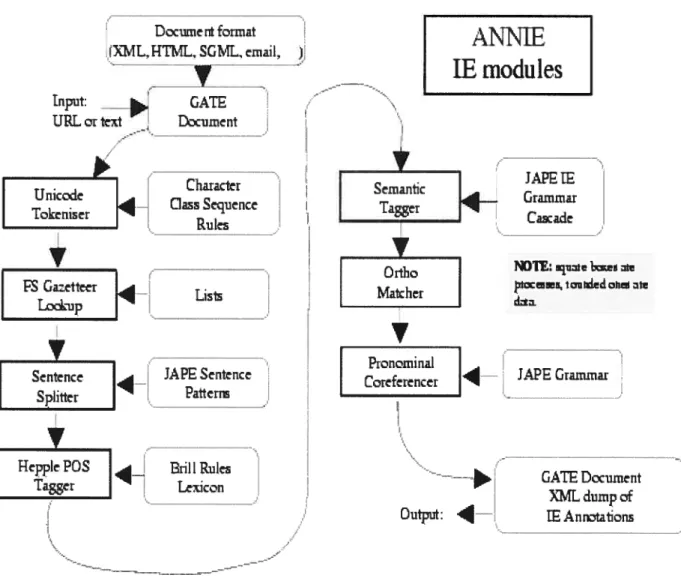
The NER system used in this thesis is GATE ANNIE system. GATE system is an infrastructure deveioped by researchers at the University of Sheffield since 1995 for developing and depioying sofiware components that process human language. It has been used in a wide variety of research and development projects. ANNIE(A Nearly-New lE) is the information extraction component of GATE. It is deveioped by Hamish Cunningham, Valentin Tablan, Diana Maynard, Kalina Bontcheva, Marin Dimitrov and others from the natural language group of the University of Sheffieid. It is an open source, robust Information Extraction (JE) system based on finite state automates. It consists of the foilowing main language processing tools: tokenizer, sentence spiitter, Gazetteer lists, POS tagger, semantic tagger (Cunningham et ai, 2006). Ail the components form a pipeline that take document corpus as input and output extracted named entities.
First, the tokeniser splits text into simple tokens, such as numbers, punctuation, symbols, and words of different types (e.g. with an initial capital, ail upper case, etc.). Then the gazetteer lists are searched to find all occurrences of matching words in the text. The gazetteer lists used are plain text files, with one entry per line. Each list represents a set ofnames, such as names ofcities, organizations, days ofthe week, etc.
Beiow is a smaii portion of the list for units ofcurrency:
Ecu
European Currency Units FFr
German mark German marks
New Taiwan dollar New Taiwan dollars NT dollar
NT dollars
The sentence spiitter spiits the text into sentences. This module is required for the
POS (Part-of-speech) tagging. The P05 tagger is a modified version of the Brui tagger (Brui, 1993), which produces a part-of-speech tag as an annotation on each word or symbol. Neither the spiitter nor the tagger is a mandatory part of the JE system, but the extra linguistic information they produce increases the power and accuracy of the TE tools.
The semantic tagger consists of pattem-action rules, executed by the finite-state transduction mechanism. It recognizes entities like personal names, organizations, locations, money amounts, dates, percentages, and some types of addresses.
The ANNIE system supports multiple languages through Unicode.
ANNIE can be used and customized in GATE’s graphical development environment and integrated in other applications through its API (Application Programming Interface).
Character Class Seqiience Rules
ANME
E modules
JAPE4—
Granimar Caade NO1tUtfh iuidon drtafigure3.1: Annie NE extraction Process (Cunningham et ai, 2006).
GÂTE Dccument XML dump of tE AnrDtation
The GATE ANNIE named entity recognition system has been used in the MUC-6 Named entities recognition task and many other experiments on question answering and text summarization. In MUC-6, Location, Organization, Money, Date, Time, Person and Percent are extracted for the task. The officiai score shows that the precision of the system is 94%, the recali is 84% and the f-measure is 89%. (Gaizauskas et ai, 1995). Given that human annotators do not perforrn to the 100% level (rneasured in MUC by
Dcciimentformat XML,HTML.SGMLemail, Input: GÂTE URLortext Diiment
V
Seniantic TaggerV
Usts lAPE Sentence PafterrE P5 Gaettee71 LipJ
y
Sentence SphtterV
Drtho MatcherV
ProncmimilCoreferencer
4
lAPEGramniarJ
1epp1ePDS 4 BnIl Rule
Tagger xicn
inter-annotator comparisons), NE recognition can now be said to firnction at human performance levels.
3.1.4 Named Entities ïn Cail for tender documents
CFT (Cail for tender) documents are semi-stmctured documents. They don’t have a standard format. However, each CfT document aiways contains standard information such as contracting authority, delivery and closing date of the CFT, URL and email address of the contract authority, etc. This type of information is examples of named entities that can be extracted using information extraction system.
By analyzing the type of information named entities in CFT documents contain, we can predict whether or flot NE or the part ofthe document containing NE is related to the subject ofthe document. In this thesis, we consider the following named entities:
1. Organization:
Organization is usually the contracting authority of the CFT document. The organization, when located at the beginning of the CfT document, can be an indicator of the subject of the CfT document. eg. CITY 0F GREATER SUDBURY EXPRESSION 0F NTEREST FOR COMPUTER HARDWARE.
2. Location:
The location is the location of the delivery place or the location of the contracting authority.
It can be the opening or the closing date of the eau for tender. Also the delivery date is a possibility.
4. Money:
The value indicates the contract or the business size required in the cal! for tenders.
5. Person:
The contact person for the cal! for tender.
6. URL:
This is the URL of the cal! for tender document or the URL of the contracting authority. It can be strong indicator of the non-relevance of the part of the document containing it, especially if it is located towards the end of the document. In this case, it oflen refers to the standard point of contact of the CFT without revealing the subject of the document.
7. Email:
This is the email address of the contracting authority. It can be a strong indicator of non relevance for the same reasons as for URL.
3.2 Concept Extraction
Similar to the NE, another factor whose presence can indicate the relevance ofthe sentence is concept.
3.2.1 Concept Definition
A concept is an abstract or generic idea generalized from particular instances(Merriam-Webster “concept”, 2006). Concepts can be categorized into simple concepts and complex concepts. Simple concepts are concepts that consist of only one word (eg. statement, software, president, etc). Complex concepts have more than one word (eg. financial statement, management software, US president, etc).
Since the concepts present ideas of the document, they can be seen as positive indicators of relevance to the subject. Part of the document that doesn’t contain concept can be considered to be less relevant.
3.2.2 Concept Extraction Techniques
There are many concept extraction systems. Most systems are rule-based systems including the Nstein NConcept Extractor that is used in my research. Because it is a commercial product, the detail of its concept extraction method is flot available. But we lmow it is an extraction system that uses a combination of linguistic-based and statistics backed processes to locate and retrieve concepts (Lemay, 2006). In the academic field, some simple systems extract concepts by detecting words with high frequency in the document - i.e. high «(term frequency). Altematively, other methods extract concepts by
detecting words with high value of tfidf (terrn frequency and inverse document frequency), which corresponds to detecting words that not only have high frequency in the current document but also are relatively rare in a large collection of documents. More complex concept extraction methods can involve for example the method of Lin. Lin used a concept generalization taxonomy in the form of WordNet. For example, If “laptop” or “hand-held computer” are found in a text, we can infer that the text is about
“portable computer”, which is the parental concept. Then if “mainframe computer” is mentioned in the text, the concept “digital computer” , which is the parental concept of both “portable computer” and “mainframe compter”, can also be inferred. In order to find the most appropriate concept generalization, Lin used a ratio-based method to determine cutoff points to retain the appropriate level of generality for the important concepts extracted by WordNet. The details ofLin’s method can be referred to (Lin, 1995).
The tool to extract concept in the thesis is Nstein NConcept Extractor, a tool based on text mining linguistic and statistic processes (Lemay, 2006). The following example shows the output of a NER by this tool:
“Landfill Disposal Services. Landfill Disposai Services for <Complex>solid waste</Complex> generated and delivered by various Navy installations within Navy Region Northwest. Contractor shail accept and dispose of <Complex>solid waste</Complex> delivered to facility. Commodities types include but not be limited to, municipal <Complex> solid waste<Complex>, creosote pilings, <Simple>soil<Simple>, <Simple>concrete, <Simple>asphalt, construction demolition and land clearing debris, sludge cake/filter press dewatered solids, petroleum contaminated sous and truck wastes. Landfill <Complex>service provider</Complex>shall ensure compliance with all federal, state, and local laws or regulations related to refuse disposal and can be licensed by Washington State Utility and Transportation Commission. Electronic monthly billing services to include record of Daily transaction detail by
date, time, net weight in tons, commodity delivered and vehicle <Complex>identification number</ Complex>.”
The tags <Simple> and <Complex> respectively mean Simple and Complex Concept. This is the system we will use in this study.
3.3 Position Information
Similar to the presence of concept information, position information of the features can also indicate whether the feature is relevant to the subject ofthe document.
In the research of automatic summarization, documents are oflen split into sentences and sentence position is considered to be very important to determine whether the sentence can be part of the summary of the document. One important sentence heuristic assumes that relevant sentences are generally sentences lying at the beginning and the end of a document, in the first and last sentences of paragraphs, and also immediately below section headings. This heuristic using position gave very good results in several summarization experiments (Edmundson, 1969; Kupiec, 1995).
Altematively to sentence selection, term weighting can also benefit from the position information of the sentence: We can assign weights according to the position of the sentence in which words appear. For example in the study by Mock (Mock et al., 1996), the terms in the subject of the news articles were considered to be the most relevant and assigned the highest weight, followed by terms in the text body section. The terms in the author section are assigned lowest weight. The result shows an improvement of classification result.
In the cali for tender document, as shown as an earlier example in this chapter, the subject of the tender is oflen introduced in the first few sentences. The last few sentences usually give information on procedures of tender submission. Therefore, the first few sentence of a paragraph will be considered to be more relevant than the last few sentences.
In the next chapter, we will describe the experiment that tries to reveal the utility of the three factors as indicator of relevance and then discuss the result. We will also describe the approaches to exploit the three types of information we introduced. Two alternative methods will be proposed: using these types of information to select important sentences and filter out the other sentences, or using them to modify the traditional term weighting methods.
CHAPTER 4
USING SPECIFIC FEATURES 0F CFT TO IMPROVE TERM
WEIGHTING
In chapter 3, named entities, concepts and position information are presented as tbree specific features that are susceptible to determine the relevant part of the document.
In section 4.1 of this chapter, I will describe the experiments conducted that further confirm the utility of each of the three factors to determine relevant sentences. Then in section 4.2, I will describe the feature selection and terni weighting methods that incorporate these factors to improve the performance of classifiers.
4.1 Identification of Important Sentences by Specific Features
4.1.1 Identification of Important Sentences by position
It’s very important to understand how useful position information is and determine the position of the most relevant sentences ofthe cail for tender documents.
Those are the purposes of this experiment. Then we can conduct classification experiments by either filtering out irrelevant sentences or increasing the term weights of features in relevant sentences.
A set of 1000 sentences from different documents has been selected and manually annotated as being important (Y) or non-important (N). This set of 1000 sentences were selected by Francois Paradis and featured in his classification experiment(Paradis, 2005).
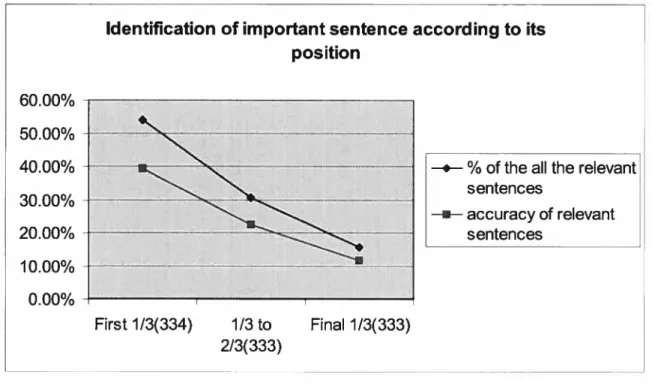
The position of each sentence is studied to evaluate the part of the document that with the most relevant sentences. Table 1 presents the accuracy of the relevant sentences for each section of the document, which indicates percentage of relevant sentences in this section of the document. For example, if there are 334 sentences in total in this section of the document and there are 131 relevant sentences. The accuracy of relevant sentences is 13 1/334, 39.34%. Also the percentage of ah the relevant sentences, which measures the percentage of relevant sentences of this section over all the relevant sentences, is presented in the table.
% of ail the relevant accuracy of relevant
sentences sentences
First 113 (334) 53.91% (131/243) 39.34% (131/334)
1I3 to 2I3( 333) 30.45% (74/243) 22.22% (74/333)
Final 1I3 (333) 15.64% (38//243) 11 .41% (38/333)
Figure 4.1 Identification of important sentence according to its position
The result shows the percentage of relevant sentences and the accuracy of relevant sentences for first 1/3 sentences, from 1/3 to 2/3 and the final 1/3 sentences of each the cal! for tender document. We see that the first 1/3 of the document contains most relevant sentences (53.91%) and the final 1/3 has the least number of relevant sentences (15.64%). Also, out ofthe 334 sentences ofthe 1/3 ofthe document, 39.34% are relevant compared to only 11.41% for the last 1/3 of the document. Therefore, this preliminaiy test shows that the first 1/3 of sentences ofthe document contain more relevant sentences than the rest ofthe document.
Identification of important sentence according to its position
60.00% 50.00%
40.00% —.— % of the ail the relevant
sentences 30.00% —w— accuracy of relevant 20.00% sentences 10.00% 0.00% First 1/3(334) 1/3 to Final 1/3f 333) 2/3(333)