HAL Id: hal-00732811
https://hal.archives-ouvertes.fr/hal-00732811
Submitted on 17 Sep 2012
HAL is a multi-disciplinary open access
archive for the deposit and dissemination of
sci-entific research documents, whether they are
pub-lished or not. The documents may come from
teaching and research institutions in France or
abroad, or from public or private research centers.
L’archive ouverte pluridisciplinaire HAL, est
destinée au dépôt et à la diffusion de documents
scientifiques de niveau recherche, publiés ou non,
émanant des établissements d’enseignement et de
recherche français ou étrangers, des laboratoires
publics ou privés.
Towards automated service composition using policy
ontology in building automation system
Ngoc Son Han, Gyu Myoung Lee, Noel Crespi
To cite this version:
Ngoc Son Han, Gyu Myoung Lee, Noel Crespi. Towards automated service composition using policy
ontology in building automation system. SCC ’12 : 9th IEEE International Conference on Service
Computing, Jun 2012, Hawai, United States. pp.685-686, �10.1109/SCC.2012.42�. �hal-00732811�
Towards Automated Service Composition using Policy Ontology in
Building Automation System
Son N. Han, Gyu Myoung Lee, Noel Crespi Department of Wireless Networks and Multimedia Services
Institut Mines-Telecom, Telecom SudParis 91011 Evry Cedex, France
{son.han, gm.lee, noel.crespi}@it-sudparis.eu
Abstract—Automated service composition is critical for suc-cessfully implementing Building Automation Systems which facilitate Web services over physical devices. In this paper, we propose a new service composition model using a policy ontology represented by Semantic Web languages. Our pro-posed model can be a powerful tool to automatically compose services with associating meaningful policies.
Keywords-service composition; semantic web; policy; ontol-ogy; building automation system;
I. INTRODUCTION
In building automation industry, there are several com-munication protocols and a variety of products from various vendors available on the market. It is a challenge for coordinating heterogeneous devices or appliances, in which, topologies, communication protocols, security policies, and such are dynamic and different from one to another. An approach from the Internet of Things (IoT) paradigm is to make physical devices accessible as Web services that are identified by Uniform Resource Identifiers [1]. Many innovative architectures for automation systems based on the concept of Web services and Service-Oriented Computing have been proposed [2]. In order to successfully deploy Web services for automatic control systems like Building Au-tomation System (BAS), we need an automatic mechanism to combine separate services into a composite one to meet the diversity of user’s requirements. This can be achieved by a process called automated Web service composition. Semantic Web [3] visions the possibility of semantically un-derstanding between services. So that practical and powerful applications can be written by using semantic annotations and suitable inference engines to automatically compose Web services.
So far, there have been several efforts to use semantics for BAS by designing ontologies [4], [5]. However, these approaches aim at different frameworks of BAS rather than Web service-based. In [4], a comprehensive ontology on the domain of BAS was proposed. However, BAS ontology with knowledge and terms for describing BASs makes a little impact on the process of service composition that is usually governed by composition rules.
In this paper, we propose a model for automated service composition using a policy ontology that is represented by Semantic Web languages. Policies are means to dy-namically regulate the behavior of system components. By changing policies, a system can be continuously adjusted to accommodate variations in externally imposed constraints and environment conditions. The adoption of a policy-based approach for controlling a system requires an appropriate policy representation. In our approach, we aim at repre-senting policies semantically by Semantic Web languages, putting them all together in a Building Automation Policy Ontology (BAPO). In the following sections, after outlining the BAPO-based service composition model, we present a design of BAPO and an algorithm for Workflow Generation.
II. BAPO-BASEDSERVICECOMPOSITIONMODEL
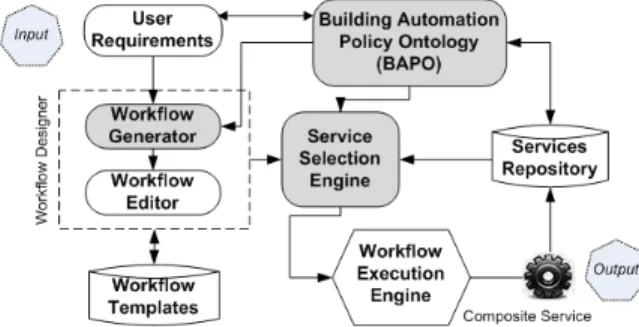
Figure 1 shows the main components of BAPO-based service composition model. User gives input requirements semantically into User Requirements unit and the system automatically generates an output composite service and then store it back in the Services Repository. BAPO is written in Web Ontology Language (OWL) [6] to describe policy concepts and relationships between them, which are represented in classes and properties respectively. BAPO covers all necessary types of policies and is updated con-stantly. Workflow Designer consists of two parts: Workflow Generator is for automatically generating service workflow with reference to Workflow Templates database and Work-flow Editor is to assist users for designing workWork-flow or
correcting workflow generated from Workflow Generator. The workflow created in Workflow Designer is stored in Workflow Templates database for future use. Service Selec-tion Engine is the implementaSelec-tion of selecSelec-tion algorithms to automatically select an appropriate service among avail-able ones from Services Repository. In Services Repository, services are described by Semantic Annotations for WSDL (SAWSDL) [7]. SAWSDL provides semantic descriptions of policies of Web services in service profiles. The profiles are therefore used for advertising registry, discovery, and matchmaking for the Service Selection Engine to find the service that meets required policies.
III. BAPO DESIGN ANDWORKFLOWGENERATION
ALGORITHM
A. A BAPO Design
BAPO consists of information about classes and proper-ties in the domain of building automation policies. Classes describe concepts of policy and properties of each class describing various features and attributes of the concept. For example, in Figure 2 class UserPreferencePolicy has five subclasses with is-a relationship. That means all properties from UserPreferencePolicy are included in subclasses. We designed BAPO version 1.0 by Protege ontology editor software [8]. Figure 2 partly shows the class hierarchy of BAPO with some of its classes without their properties. All classes are derived from the root OWL class owl : T hing. B. A Workflow Generation Algorithm
We made an algorithm for automatic generation of a workflow following user’s requirements. User can use a Web-based application to give semantic requirements that are instances of BAPO classes. By representing policies in BAPO, the following algorithm can easily generate the desired workflow.
Definition: Semantic Requirement
A semantic requirement is an instance of a class in BAPO
Figure 2. BAPO 1.0 Class Hierarchy
Algorithm: Workflow Generation
Input: User Uk semantic requirements {sr1, sr2, ..., srn}
Output: Service workflow {s1, s2, ..., sn}
Given user BAPO and Services Repository BEGIN
Denote {C1, C2, ..., Cn} are concept classes of semantic
requirements
For each Ci find a list of services {sij} that satisfy Ci and
user Uk AuthenticationPolicy
Repeat
- Pick one in each list sij to form a set
- Match them with ServiceLocationPolicy
- Continue if there is ServiceLocationPolicy conflict Until exist one perfect match.
END.
For example, one employee working in an office at the building want to remotely turn on heater and light in his office 10 minutes before his arrival. He can have access to the Web-based application and semantically ask for such composite service.
IV. CONCLUSION ANDFUTURERESEARCH
We have proposed a preliminary model for automated service composition in BAS. We have already built the first version of BAPO and implemented an algorithm for workflow generation. We still have a substantial workload to fulfil including continuously updating the BAPO, designing related algorithms for Service Selection Engine, developing a prototype system as well as the Web-based application with a graphical user interface.
REFERENCES
[1] A. Kamilaris, V. Trifa, and A. Pitsillides, “Homeweb: An appli-cation framework for web-based smart homes,” in Telecommu-nications (ICT), 2011 18th International Conference on, may 2011, pp. 134 –139.
[2] F. Jammes and H. Smit, “Service-oriented paradigms in indus-trial automation,” Indusindus-trial Informatics, IEEE Transactions on, vol. 1, no. 1, pp. 62 – 70, feb. 2005.
[3] T. Berners-Lee, J. Hendler, and O. Lassila, “The semantic web,” Scientific American, pp. 29–37, May 2001.
[4] C. Reinisch, W. Granzer, F. Praus, and W. Kastner, “Inte-gration of heterogeneous building automation systems using ontologies,” in Industrial Electronics, 2008. IECON 2008. 34th Annual Conference of IEEE, nov. 2008, pp. 2736 –2741. [5] S. Runde, H. Dibowski, A. Fay, and K. Kabitzsch, “A semantic
requirement ontology for the engineering of building automa-tion systems by means of owl,” in Emerging Technologies Factory Automation, 2009. ETFA 2009. IEEE Conference on, sept. 2009, pp. 1 –8.
[6] “Web ontology language.” [Online]. Available: http://www.w3.org/2004/OWL/
[7] “Semantic annotations for wsdl and xml schema.” [Online]. Available: http://www.w3.org/2002/ws/sawsdl/spec/