This is an author-deposited version published in :
http://oatao.univ-toulouse.fr/
Eprints ID : 3587
O
pen
A
rchive
T
OULOUSE
A
rchive
O
uverte (
OATAO
)
OATAO is an open access repository that collects the work of Toulouse researchers and
makes it freely available over the web where possible.
To link to this article
: DOI:
10.1016/j.biortech.2008.12.047
URL : http://dx.doi.org/
10.1016/j.biortech.2008.12.047
To cite this version
:
Rouilly, Antoine and Geneau-Sbartaï, Céline and Rigal, Luc
(2009)
Thermo-mechanical processing of sugar beet pulp. III.
Study of extruded films improvement with various plasticizers
and cross-linkers.
Bioresource Technology, vol. 100 (n°12). pp.
3076-3081. ISSN 0960-8524
Thermo-mechanical processing of sugar beet pulp. III. Study of extruded films
improvement with various plasticizers and cross-linkers
A. Rouilly
*, C. Geneau-Sbartaï, L. Rigal
INRA, UMR 1010, F-31077 Toulouse, France
Université de Toulouse, INPT, ENSIACET, Laboratoire de Chimie Agro-Industrielle (LCA), 118 Route de Narbonne, F-31077 Toulouse, France
Keywords: Sugar beet pulp Film
Extrusion Plasticizers Glycidyl methacrylate
a b s t r a c t
Thermoplastic sugar beet pulp (thermo-mechanical processing was discussed in previous studies) was formed into film strips by extrusion. Film tensile properties are discussed according to the molecular structure of external plasticizer. Sorbitol, fructose and adipic acid have a marked antiplasticizing effect, while urea and xylitol gave higher ultimate tensile stress than glycerol for a comparable strain at break. Xylitol can be considered as the best plasticizer with UTS and EL of, respectively, 4.9 MPa and 11.3% and water absorption (85% RH, 25 °C) was less than 25%. Glycidyl methacrylate was directly used in the extru-sion process as cross-linker. In high humidity atmosphere (97% RH, 25 °C), film water absorption was then kept under 40% while tensile strength and strain were improved of 50% and with a 30 min UV post-treatment the mass gain in absorption was even less than 30% after 5 days.
1. Introduction
Sugar beet pulp (SBP) is the by-product of the sugar extraction process. It consists mainly of cell-wall polysaccharides: arabinans and arabinoxylans hemicelluloses (Sun and Hughes, 1999), highly methylated and acetylated pectins (Oosterveld et al., 2000) and cellulose microfibrils (Dinand et al., 1996). Due to such composi-tion, it is therefore only used as a food complement for animal feed (Bach Knudsen, 1997). However expensive drying process, low protein content and large amounts available have led to investiga-tions to find some alternative uses for this material. Adding value to isolated compounds was first considered: alimentary fibres (Michel et al., 1988), cellulose microfibrils (Dinand et al., 1999), pectins (Oosterveld et al., 2001; Turquois et al., 1999) or ferulic acid (Micard et al., 1994). Raw pulp has as well been proposed as cultivation substrate (Yoo and Harcum, 1999), for divalent cations complexation (Dronnet et al., 1998), as source of polyols for the production of urethanes and polyurethanes (Pavier and Gandini, 2000), as source of fibre in biodegradable composites (Baar et al., 1997; Turbaux, 1997; Liu et al., 2007; Leitner et al., 2007; Moham-ed et al., 2008) or for paper manufacture (Wong and Bregola, 1997; Fiserova et al., 2007). Development of SBP-based materials has been considered through the breakdown of the cell structure by chemical or enzymatic hydrolysis (Berghofer et al., 1992) or by thermo-mechanical processing.
In previous studies, we have demonstrated that, in specific con-ditions, SBP cellular structure could be broken down by twin-screw extrusion processing. SBP becomes then thermoplastic and could be described as a composite made of cellulose micro-fibrils embed-ded in a matrix constituted of hemicelluloses and pectins that can be molded by injection (Rouilly et al., 2006a,b). Physical chemical properties of extruded pulp (EP), such as hydration and glass tran-sition in relation with ‘‘melt” viscosity have then been studied to define optimal conditions for its thermo-mechanical processing in low moisture conditions (Rouilly et al., 2006a,b). In this last study, we used original DSC methods to, on the one hand, charac-terize precisely the interaction levels between EP and sorbed water, and, on the other hand, to predict processing temperature according to EP water content.
Even more than for bio-based molded objects there is an indus-trial need for biodegradable films especially for packaging applica-tions. But, due to average plastic properties, most of natural polymers-based films are produced by casting or thermoforming (Rouilly and Rigal, 2002) while extrusion is a continuous, fast and energy efficient process (Fishman et al., 2000). Scientific work has then been focused on composites made of mixtures of natural and synthetic biodegradable polymers (Averous, 2004). Studies of film extrusion of natural polymers concern essentially starch or soy protein blends (Fishman et al., 2000, 2004; Zhang et al., 2001) and nothing has been made about raw agricultural by-prod-ucts processing and non-starchy polysaccharides use.
But once SBP cellular structure breakdown is achieved, SBP is thermoplastic and has a particularly fine microstructure as
* Corresponding author. Tel.: +33 5 62 88 56 54; fax: +33 5 62 88 57 30. E-mail address:[email protected](A. Rouilly).
cellulose is in a microfibrillar state. It is then a perfect cheap sub-strate to investigate possible film extrusion.
In the present work, we have then studied film formation from EP and the improvement of films properties through the use of var-ious plasticizers and cross-linkers.
2. Methods 2.1. Material
The sugar beet pulp (DM = 89.9%) originated at the Cagny site (France) was transformed following the previously defined twin-screw extrusion procedure (Rouilly et al., 2006a,b).
Glycerol, sorbitol, galactose, adipic acid, fructose, trimethylol-propane, urea, xylitol, ethyleneglycol, triethyleneglycol TEG, tetra-ethyleneglycol TEEG, triethanolamine, dimethylsulfoxyde DMSO, 1.3-dimethylurea, ethanolamine, diethanolamine, glycidyl methac-rylate and sodium persulfate were provided by Aldrich (St. Quentin Fallavier, France) and were of analytic purity and used as received. 2.2. Mixture preparation
Extruded pulp (EP) was grinded trough a 1 mm grid. It was then mixed with water (30 parts for 100 parts of EP, corresponding to a moisture content of 44.4% w/w on a dry basis), plasticizers and cross linkers in a planetary mixer Perrier 32.00 mixer (Montrouge, France). The mixtures were then stored in hermetical containers at 4 °C for 24 h before the extrusion.
The experiments with various plasticizers were carried out with a plasticizer ratio of 30 parts for 100 parts of EP.
For the addition of glycidyl methacrylate (GMA), the mixtures were prepared adding 25 parts of GMA and 0.5 parts of sodium persulfate (initiator) to the reference blend (100 parts, 30 parts of glycerol and 30 parts of water) .
2.3. Extrusion
Film forming was carried out on a Polylab Haake system (Kar-lsruhe, Germany) consisting of a single-screw extruder (18 mm diameter screw and 1.8 compression rate) fitted with a 50 mm wide sheet die. Operating conditions are summarized inTable 1.
Test specimens (dumbbell shaped for tensile test and circular for water absorption test) were then cut in films with punch die cutters. 2.4. Tensile properties
A TA-XT2 texture analyzer (RHEO Stable Micro Systems, Lon-don, UK) was used to assess the mechanical properties of the films. The test samples, seven specimens per film, were 65 mm long and 5 mm wide. They were equilibrated at 25 °C and 60% RH until con-stant weight. Their thickness was measured at five points with a digital micrometer (model IDC-112B, Mitutoya Corp., Tokyo, Japan) and the mean value recorded. A speed of 1 mm/s was used, with an initial grip separation of 55 mm.
Ultimate tensile stress (UTS), Young’s modulus (E) and elonga-tion (EL) were then calculated for each specimen.
2.5. Water adsorption
Film pieces equilibrated at 60% RH were placed in a hermetic container above a saturated KCl solution (85% RH) during 25 days for plasticizers comparison and a saturated solution of K2SO4 (97% RH) during 6 days for cross-linked films until some of them were not any more handleable. They were regularly weighted and their mass gain calculated in relation to their initial mass. Re-ported values are the average of three experiments.
2.6. Post treatment
UV treatment of GMA containing films was done by exposing the test specimens under a 254 nm radiation for 2, 10 and 30 min. Specimens were turned upside down at half-treatment. 2.7. Water contact angle
Circular test specimens (10 mm diam.) were used to make the measurement. Milli-q water was used to depose a drop (3
l
L) onthe surface of the disk and the static contact angle was measured with a goniometer (GBX Instruments, France), equipped with an automatic camera registering still images every 0.1 s. Contact an-gles were measured automatically using the triple point calcula-tion method. Three specimens were used for each sample. Two contact angle measurements were done per specimen.
3. Results and discussion 3.1. Plasticizer effect
3.1.1. Influence of glycerol content
The study of glycerol content influence on films mechanical properties was the first step of the process set up. Without any
Fig. 1. Picture of an extruded pulp film strip (left) and optical micrographs of films microstructure (right). Table 1
Operating conditions of the EP film extrusion.
Parameter Value
Barrel temperatures (°C) 50/100/110/110(die) Screw speed (rpm) 25 (50*)
Torque (Nm) 3.5–10.4 Die pressure (bars) 45–82 Average film thickness (mm) 0.2–0.7
external plasticizer, extrusion was possible but flow was irregular and after drying the formed strips were brittle, while the use of glycerol allowed to get continuous film (Fig. 1).
As sugar beet pulp is a crude material, films were not totally homogeneous. Two types of inclusions were observed on optical micrographs: black spots and larger bright zones. If their origin is not completely determined, the bright areas could be residues of beet vascular bundle and the black inclusions aggregates of cooked low molecular weight sugars (Fig. 1).
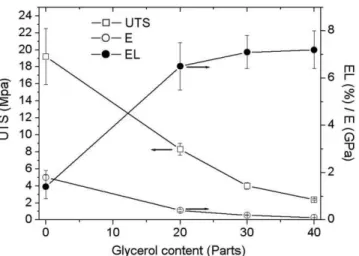
Adding 20, 30 and 40 parts of glycerol to the reference com-pound led to a large decrease of both ultimate tensile stress and Young’s modulus associated, as expected, to an increase of the strain (Fig. 2). This increase reached a plateau value around 7% as soon as 20 parts were added while UTS dropped to 2.4 MPa.
Most of biopolymer films described in the literature are protein-based (Rouilly and Rigal, 2002) and their maximum strain can reach 300% by adding glycerol (Micard et al., 2000). For polysac-charide-based films elongation remains smaller (Arvanitoyannis and Biliaderis, 1999; Nakatsuka et al., 1978) especially for films made from pectin. For example in the work of Pavlath et al. (1999), elongation of pectic films made by casting never exceeded 8% for a plasticizer content of 40 parts. In small amount, glycerol affinity to polysaccharides is good enough for it to penetrate the
network and weaken the polymer–polymer interactions but also maybe too strong to allow large scale chain movement.
However trials on specific gluten plasticizers, especially trieth-anolamine, showed that strong interactions between the biopoly-mer and the plasticizer can impressively increase film strain without strength reduction (Irissin-Mangata et al., 2001). There is so a second crucial parameter which has to be steric hinderance. A bulky molecule may interact more easily with many macromol-ecules instead of being linked to only one.
3.1.2. Influence of plasticizer molecular structure
Regarding the complex structure of thermoplastic EP, a com-plete study of plasticizer/polymer interaction was very difficult to investigate. The aim of our experiments was then to compare different available molecules, some of them being not usual in this kind of study, to evaluate a possible improvement of EP-based materials. All blends have been prepared with a constant mass ra-tio of plasticizer (30 parts for 100 parts of EP) and as plasticizers molecular weight varies roughly from 60 to 180 the molecular ra-tio was not kept constant. This would be discussed later.
When compared to a film made without any external plasticizer (reference), adding plasticizer caused a decrease of the ultimate tensile strength from 19.2 MPa for the reference to 1.2 MPa with diethanolamine while the strain varied from 1.4% to 11.8% with xylitol (Fig. 3). More precisely, three different trends appeared.
The first three plasticizers (sorbitol, galactose and adipic acid) affected only very slightly the strength and did not bring more elongation to EP films. They act at this concentration as antiplast-icizers (Gaudin et al., 1999) and did not bring more relative motion to biopolymer chains. Second consequence of this effect, the diffu-sion of small molecules in the polymer network is hindered ( Shim-azu et al., 2007) as observed on the water adsorption experiments (Fig. 4). The water mass absorbed after 25 days (600 h) was less than 13% for galactose and adipic acid. Sorbitol had an intermedi-ate absorption behavior, the mass gain reached 23%. On molecular structure level, adipic acid is the only molecule with an apolar moi-ety explaining a weaker compatibility with the highly hydrophilic EP. Concerning the two sugars, their molecular weight is twice more than glycerol one and so their molecular ratio is twice smaller explaining the antiplasticizing effect. However molecular structure affected as well the plasticizing effect: galactose, sorbitol and fructose have almost the same molecular weight but their effect on film properties was different. Galactose really acted as antiplasticizer (no strain increase and low water absorption),
sor-Fig. 2. Tensile properties of EP films according to glycerol content (parts for 100 parts of EP).
bitol with this ratio seemed to have an intermediate effect, high water absorption and low elongation, the ratio used corresponds to the 27% concentration found as limit value on starch/sorbitol films (Gaudin et al., 1999), while fructose had a more marked plas-ticizing effect, elongation of films made with fructose reached 8.0% (Fig. 3).
A second group of molecules, which includes fructose, appeared in the study of films mechanical properties. These molecules (fruc-tose, trimethylolpropane, urea, xylitol, triethylene glycol TEG and tetraethylene glycol TEEG) caused a decrease of film UTS but lim-ited to 4 MPa correlated with a real increase of elongation. Among them three plasticizers gave some interesting results. Films con-taining fructose showed good elongation and good strength (respectively 8.0% and 10.4 Mpa), this positive effect of fructose has already been reported in pea starch films (Zhang and Han, 2008). With xylitol the elongation was the highest while UTS re-mained relatively high (respectively 11.2% and 4.9 MPa) and finally urea gave some unexpected results (5.3 MPa and 9.0%), while it was never considered as a good plasticizer for starch (Ma and Yu, 2004). In this group, linear molecules (TEG and TEEG) gave some average results with low strain resulting from a smaller steric hin-derance. Considering water absorption, if fructose, xylitol and trimethylolpropane gave some similar results as sorbitol with mass gain remaining lower than 25% (Fig. 4), films made with urea ab-sorbed more than 30%. This could indicate an important difference related to the way urea interacts with polyols by hydrogen bonding from the oxygen of the carbonyl function.
The last group, comprising triethanolamine, glycerol, DMSO, 1.3-dimethylurea, ethylene glycol, ethanolamine and diethanola-mine, gave the worst results. If the strain at break of films contain-ing triethanolamine, glycerol and 1.3-dimethylurea were quiet good (respectively 7.2%, 9.3% and 8.6%) the drop of the ultimate tensile strength was high (respectively 2.4, 2.1 and 2.1 MPa). The other films were discarded of the water absorption study. 3.2. Chemical cross-linking of extruded films
Water sensitivity is the major drawback of polysaccharide-based materials and chemical cross-linking is a promising way of improving this. Compound choice is driven by reaction conditions (temperature, catalyst. . .) but by toxicity also as all reactive com-pounds tend to be toxic. Dialdehydes are some interesting candi-dates as they are reactive and their reaction with free hydroxyl groups borne by polysaccharides does not generate any
co-prod-ucts. Unfortunately experiments conducted using 1.5 to 15 parts of glyoxal (ethanedial, less toxic of all dialdehydes and efficient to enhance cotton protein-based material (Marquié et al., 1997)) to the basic pre-extrusion mixture (100 parts EP, 30 parts glycerol, 30 parts water), did not improve the water resistance of films. Competition between water, glycerol and polysaccharide hydrox-yls was definitely not in the advantage of biopolymers.
The choice of not modifying the process by adding a compli-cated post treatment finally led us to a different kind of cross-link-ing uscross-link-ing glycidyl methacrylate (GMA).
GMA is a bifunctional compound bearing epoxy and acrylic moieties. It is then commonly used to functionalize synthetic poly-mers or compatibilize polar and apolar polypoly-mers (Pan et al., 2002; Tedesco et al., 2002). The epoxy moiety reacts around 40–60 °C with any nucleophilic function and by free radical addition be-tween acrylic groups covalent cross-linking can be initiated. GMA has been used on bio-based polymers: starch and polycaprolactone (Kim et al., 2001), gelatin (Koepff et al., 1993), chitosan ( Elizalde-Pena et al., 2007; Noble et al., 1999), pectin (Maior et al., 2008) or to treat wood (Devi and Maji, 2007) and can be directly added in a reactive extrusion process (Alyamac and Yilmazer, 2007).
Even if GMA has a poor water solubility, it was directly added to the reference mixture in the planetary mixer. Operating extrusion conditions were identical excepting the screw speed which had to be increased to 50 rpm to ensure a good flow of the mixture.
Addition of GMA improved greatly films tensile properties even before UV treatment, UTS and EL reached respectively 6.6 MPa and 11.3% without a significant change of the Young’s modulus (Table 2). Strength increase was attributed to covalent cross-linking and was confirmed by UV treatment which resulted in an another slight improvement of film properties. The strain increase was more surprising. The possible synthesis of a new plasticizer by reaction between GMA and water could be a reason but it could not be confirmed. And as water absorption is really decreased with GMA this should only be a side effect (Fig. 5).
Water sensitivity of the extruded films was really improved by GMA. In an atmosphere almost saturated in water, the mass gain after more than 5 days remained under 40% while it reached 70% and diverged for the sample made only with glycerol. UV treat-ment efficiency was particularly remarkable for duration of 30 min, the mass gain at the end of the experiment was less than 30% and tended to a plateau value. In addition, when soaked in water for a week, this sample did not dissolve. For a shorter expo-sure, UV did not seem to really enhance film properties (Fig. 5).
However, the treatment did not improve the surface properties to-wards water. It caused a decrease of the water contact angle from 45° to value around 35° (Table 2). This phenomenon has been attributed to a displacement of glycerol towards the outer part of the cross-linked polymer network. The decrease of free hydroxyl groups with the chemical grafting of GMA could hinder glycerol– polysaccharide interactions. This was also observed during the water absorption experiments: glycerol seeped towards sample surface and was then responsible for the larger results deviation of contact angle measurement.
4. Conclusion
Sugar beet pulp can be formed into film strips by extrusion. Being an industrial by-products and a crude material, it can be a promising alternative to classical polysaccharides used for this kind of application (i.e. starch or cereal flour). Films get average mechanical properties due to the small molecular weight of EP polysaccharides (Rouilly et al., 2006a,b) and heterogeneous microstructure.
The use of an external plasticizer is necessary to ensure regular flow in the die. Glycerol is most common plasticizer but did not give the best results when compare to other molecules. Sorbitol, fructose and adipic acid have a marked antiplasticizing effect. Among common plasticizers, urea and xylitol gave higher ultimate tensile stress than glycerol for a comparable strain at break. Xylitol can be considered as the best plasticizer for EP films with UTS and EL of, respectively, 4.9 MPa and 11.3% and water absorption (85% RH, 25 °C) was less than 25%.
Improving water resistance of EP films without modifying the extrusion process was possible using glycidyl methacrylate as cross-linker. In high humidity atmosphere (97% RH, 25 °C), water
absorption was kept under 40% while tensile strength and strain were improved of more than 50% and with a 30 min UV post-treat-ment the mass gain in absorption was even less than 30% after 5 days.
References
Alyamac, E., Yilmazer, U., 2007. Reactive extrusion of poly(ethylene terephthalate)-(ethylene/methyl acrylate/glycidyl methacrylate)-organoclay nanocomposites. Polymer Composites 28, 251–258.
Arvanitoyannis, I., Biliaderis, C., 1999. Physical properties of polyol-plasticized edible blends made of methyl cellulose and soluble starch. Carbohydrate Polymers, 47–58.
Averous, L., 2004. Biodegradable multiphase systems based on plasticized starch: a review. Journal of Macromolecular Science Polymer Reviews 44, 231–274. Baar, A., Gebel, W., Imhof, U., Mihalik, H., 1997. Process for producing mouldings
with a barrier layer made of biodegradable material, and mouldings produced according to this process. WO Patent n 97/10293.
Bach Knudsen, K., 1997. Carbohydrate and lignin contents of plant materials used in animal feeding. Animal Feed Science and Technology 67, 319–338.
Berghofer, E., Grzeskowiak, B., Mundlinger, N., Schleining, G., Zenz, H., 1992. Biologisch abbaubares Verpackungs- und/oder Hüll-Material und Verfahren zu seiner Herstellung. EP Patent n 0,506,650.
Devi, R., Maji, T., 2007. Effect of glycidyl methacrylate on the physical properties of wood–polymer composites. Polymer composites 28, 1–5.
Dinand, E., Chanzy, H., Vignon, M., 1996. Parenchymal cell cellulose from sugar beet pulp: preparation and properties. Cellulose 3, 183–188.
Dinand, E., Chanzy, H., Vignon, M., 1999. Suspensions of cellulose microfibrils from sugar beet pulp. Food Hydrocolloids 13, 275–283.
Dronnet, V., Axelos, M., Renard, C., Thibault, J., 1998. Improvement of the binding capacity of metal cations by sugar beet pulp. 2. Binding of divalent metal cations by modified sugar beet pulp. Carbohydrate Polymers 35, 239–247. Elizalde-Pena, E., Flores-Ramirez, N., Luna-Barcenas, G., Vasquez-Garcia, S.,
Arambula-Villa, G., Garcia-Gaitan, B., Rutiaga-Quinones, J., Gonzalez-Hernandez, J., 2007. Synthesis and characterization of chitosan-g-glycidyl methacrylate with methyl methacrylate. European Polymer Journal 43, 3963– 3969.
Fiserova, M., Gigac, J., Butas, R., 2007. Influence of sugar beet pulp on bond strength and structure of paper. Wood Research 52, 59–74.
Fishman, M., Coffin, D., Konstance, R., Onwulata, C., 2000. Extrusion of pectin/starch blends plasticized with glycerol. Carbohydrate Polymers 41, 317–325. Fishman, M., Coffin, D., Onwulata, C., Konstance, R., 2004. Extrusion of pectin and
glycerol with various combinations of orange albedo and starch. Carbohydrate Polymers 57, 401–413.
Gaudin, S., Lourdin, D., Le Botlan, D., Ilari, J., Colonna, P., 1999. Plasticisation and mobility in starch–sorbitol films. Journal of Cereal Science 29, 273–284. Irissin-Mangata, J., Bauduin, G., Boutevin, B., Gontard, N., 2001. New plasticizers for
wheat gluten films. European Polymer Journal 37, 1533–1541.
Kim, C., Cho, K., Park, J., 2001. Grafting of glycidyl methacrylate onto polycaprolactone: preparation and characterization. Polymer 42, 5135–5142. Koepff, P., Braeumer, K., Babel, W., 1993. Biologisch abbaubares, wasserresistentes
polymer-material. DE Patent n 42,10,334.
Leitner, J., Hinterstoisser, B., Wastyn, M., Keckes, J., Gindl, W., 2007. Sugar beet cellulose nanofibril-reinforced composites. Cellulose 14, 419–425.
Liu, L., Finkenstadt, V., Liu, C., Coffin, D., Willett, J., Fishman, M., Hicks, K., 2007. Green composites from sugar beet pulp and poly(lactic acid): structural and mechanical characterization. Journal of Biobased Materials and Bioenergy 1, 323–330.
Ma, X., Yu, J., 2004. The plasticizers containing amide groups for thermoplastic starch. Carbohydrate Polymers 57, 197–203.
Maior, J., Reis, A., Muniz, E., Cavalcanti, O., 2008. Reaction of pectin and glycidyl methacrylate and ulterior formation of free films by reticulation. International Journal of Pharmaceutics 355, 184–194.
Marquié, C., Tessier, A., Aymard, C., Guilbert, S., 1997. HPLC Determination of the reactive lysine content of cottonseed protein films to monitor the extent of cross-linking by formaldehyde, glutaraldehyde, and glyoxal. Journal of Agricultural and Food Chemistry 45, 922–926.
Micard, V., Renard, C., Thibault, J., 1994. Studies on enzymic release of ferulic acid from sugar beet pulp. Lebensmittel-Wissenschaft Und Technologie 27, 59–66. Micard, V., Belamri, R., Morel, M., Guilbert, S., 2000. Properties of chemically and
physically treated wheat gluten. Journal of Agricultural and Food Chemistry 48, 2948–2953.
Michel, F., Thibault, J., Barry, J., 1988. Preparation and characterization of dietary fibre from sugar beet pulp. Journal of the Science of Food and Agriculture 42, 77–85.
Mohamed, A., Finkenstadt, V., Palmquist, D., 2008. Thermal properties of extruded/ injection-moulded poly(lactic acid) and biobased composites. Journal of Applied Polymer Science 107, 898–908.
Nakatsuka, R., Suzuki, S., Tanimoto, S., Funatsu, E., 1978. Protein–starch binary mouldings composition and shapes articles obtained therefore. US Patent n 4,076,846.
Noble, L., Gray, A., Sadiq, L., Uchegbu, I., 1999. A non-covalently cross-linked chitosan based hydrogel. International Journal of Pharmaceutics 192, 173– 182.
Table 2
Tensile properties and water drop contact angle of films containing GMA according to UV exposure duration.
Film UV treatment duration (min)
UTS (Mpa) E (Mpa) EL (%) a(°)
Reference – 4.0 ± 0.4 179 ± 12 7.1 ± 0.7 44.6 ± 0.9 GMA – 6.6 ± 0.5 160 ± 14 11.3 ± 0.9 31 ± 6 – 2 6.7 ± 0.1 174 ± 13 11.2 ± 0.9 38 ± 2 – 10 6.8 ± 0.4 159 ± 11 11.5 ± 0.9 34 ± 3 – 30 6.9 ± 0.5 164 ± 13 11.6 ± 1.1 33 ± 3
Fig. 5. Water absorption kinetic of GMA containing EP films in high relative humidity atmosphere (97% RH, 25 °C).
Oosterveld, A., Beldman, G., Schols, H., Voragen, A., 2000. Characterization of arabinose and ferulic acid rich pectic polysaccharides and hemicelluloses from sugar beet pulp. Carbohydrate Research 328, 185–197.
Oosterveld, A., Pol, I., Beldman, G., Voragen, A., 2001. Isolation of feruloylated arabinans and rhamnogalacturonanes from sugar beet pulp and their gel forming ability by oxidative cross-linking. Carbohydrate Polymers 44, 9–17.
Pan, L., Inoue, T., Hayami, H., Nishikawa, S., 2002. Reactive blending of polyamide with polyethylene: pull-out of in situ-formed graft copolymers and its applications for high-temperature materials. Polymer 43, 337–343.
Pavier, C., Gandini, A., 2000. Oxypropylation of sugar beet pulp. I. Optimisation of the reaction. Industrial Crops and Products 12, 1–8.
Pavlath, A., Voisin, A., Robertson, G., 1999. Pectin-based biodegradable water insoluble films. Macromolecular Symposium 140, 107–113.
Rouilly, A., Rigal, L., 2002. Agro-materials: a bibliographic review. Journal of Macromolecular Science Part C: Polymer Reviews 42, 441–479.
Rouilly, A., Jorda, J., Rigal, L., 2006a. Thermo-mechanical processing of sugar beet pulp. II. Thermal and rheological properties of thermoplastic SBP. Carbohydrate Polymers 66, 117–125.
Rouilly, A., Jorda, J., Rigal, L., 2006b. Thermo-mechanical processing of sugar beet pulp. I. Twin-screw extrusion process. Carbohydrate Polymers 66, 81–87.
Shimazu, A.A., Mali, S., Grossman, M.V.E., 2007. Plasticizing and antiplasticizing effects of glycerol and sorbitol on biodegradable cassava starch films. Semina-Ciencas Agrarias 28, 79–88.
Sun, R., Hughes, S., 1999. Fractional isolation and physico-chemical characterization of hemicelluloses and cellulose from sugar beet pulp. Carbohydrate Polymers 36, 293–299.
Tedesco, A., Barbosa, R., Nachtigall, S., Mauler, R., 2002. Comparative study of PP-MA and PP-GMA as compatibilizing agents on polypropylene/nylon 6 blends. Polymer Testing 21, 11–15.
Turbaux, M., 1997. Composite ecological and recyclable material for moulding granules. FR Patent n 2,745,818.
Turquois, T., Rinaudo, M., Taravel, F., Heyraud, A., 1999. Extraction of highly gelling pectic substances from sugar beet pulp and potato pulp: influence of extrinsic parameters on their gelling properties. Food Hydrocolloids 13, 255–262. Wong, E., Bregola, M., 1997. Use of sugar beet pulp for making paper or cardboard.
WO Patent 97/30215.
Yoo, S., Harcum, S., 1999. Xanthan gum production from waste sugar beet pulp. Bioresource Technology 70, 105–109.
Zhang, Y., Han, J.H., 2008. Sorption isotherm and plasticization effect of moisture and plasticizers in pea starch film. Journal of Food Science 73, 313–324. Zhang, J., Mungara, P., Jane, J., 2001. Mechanical and thermal properties of extruded