The minimum reload s-t path/trail/walk
problems
Laurent Gourv`es1,2, Adria Lyra3,4, Carlos Martinhon3⋆, and J´erˆome Monnot1,2
1. CNRS, UMR 7024, F-75775 Paris, France
2. Universit´e de Paris-Dauphine, LAMSADE, F-75775 Paris, France
3. Fluminense Federal University, Inst. of Computation, 24210-240, Niter´oi, RJ, Brazil 4. CEFET/RJ - Federal Center of Technological Education Celso Suckow da Fonseca,
Adrian´opolis street, 1317, Santa Rita, 26041-271, Nova Igua¸cu, RJ, Brazil {laurent.gourves, monnot}@lamsade.dauphine.fr, [email protected], [email protected]
Abstract. This paper deals with problems on non-oriented edge-colored graphs. The aim is to find a route between two given vertices s and t. This route can be a walk, a trail or a path. Each time a vertex is crossed by a walk there is an associated non-negative reload cost ri,j, where i
and j denote, respectively, the colors of successive edges in this walk. The goal is to find a route whose total reload cost is minimum. Polynomial algorithms and proofs of NP-hardness are given for particular cases: when the triangle inequality is satisfied or not, when reload costs are symmetric (i.e. ri,j= rj,i) or asymmetric. We also investigate bounded
degree graphs and planar graphs.
1
Introduction
In the last few years a great number of applications have been modelled as problems in edge-colored graphs. More recently, we find interesting applications involving edge-colored graphs and connection (or reload) costs arising at each vertex, according to the pair of colors of the edges used by a walk through that vertex [8, 5, 6, 4]. Despite their apparent importance in the telecommunications and transportation industry, reload costs have not been extensively studied in the literature.
In [8, 4], each color is viewed as a subnetwork and is used to model a cargo transportation network which uses different means of transportation or data transmission costs arising in large communication networks. In all these models, the transportation or communication costs between the subnetworks usually dominate the costs within individual subnetworks. Some applications in satellite networks are also discussed in [5] where the various subnetworks may represent different products offered by the commercial satellite service providers. In [5], terrestrial satellite dishes are required to first capture the radio signals and then special electric-to-fiber converters are required to transform the electric signals from the satellite dishes to optical pulses that can be sent over optical
fibers. These interface costs are referred to as reload costs and depend on the technologies being connected. As another example, suppose at a road network with many tolls one may be interested in paying as little as possible. Each different road between points of toll will be associated to a different color. In addition, suppose we pay a fee (reload cost) each time we change from one road to another. The objective in this case will be to find a path between two different places minimizing the total toll cost (we will call it, the minimum toll cost s-t path problem).
In our case, we will be particularly concerned with problems involving reload paths, trails and walks with both symmetric and asymmetric costs between a fixed source s and destination t (with obvious applications in transportation and communication networks as mentioned above).
1.1 The model
Let Ic= {1, 2, ..., c} be a given set of colors with c ≥ 2. In this work, Gc denotes
a simple connected non-oriented edge-colored graph containing two particular vertices s and t. Each edge has a color of Ic.
We recall here some standard graph terminology: the vertex and edge sets of Gcare denoted by V (Gc) and E(Gc), respectively. The order of Gcis the number
nof its vertices and the size of Gcis the number m of its edges. For a given color i,
Ei(Gc) denotes the set of edges of Gccolored by i. We denote by N
Gc(x) the set of
all neighbors of x in Gc, and by Ni
Gc(x), the set of vertices of Gc, linked to x with
edges colored by i. The degree of x in Gcis d
Gc(x) = |NGc(x)| and the maximum
degree of Gc, denoted by ∆(Gc), is ∆(Gc) = max{d
Gc(x) : x ∈ V (Gc)}.
A non-oriented edge between two vertices x and y is denoted by [x, y] while its color is denoted by c([x, y]). Given a graph G = (V, E), a walk ρ from s to t in G (called s-t walk) is a sequence ρ = (v0, e0, v1, e1, . . . , ek, vk+1) where v0= s,
vk+1 = t and ei = [vi, vi+1] for i = 0, . . . , k. A trail from s to t in G (called s-t
trail) is a walk ρ = (v0, e0, v1, e1, . . . , ek, vk+1) from s to t where ei6= ejfor i 6= j.
A path from s to t in G (called s-t path) is a trail ρ = (v0, e0, v1, e1, . . . , ek, vk+1)
from s to t where vi6= vj for i 6= j.
We are also given a c × c matrix R = [ri,j] (for i, j ∈ Ic) whose entries
define the reload cost (or connection cost) when changing color i for color j. It is assumed that each entry ri,j of R is a non-negative integer (i.e. ri,j ∈
N). Here, we will both consider symmetric and asymmetric matrices. We say that a matrix R satisfies the triangle inequality, if and only if, for all edges ei, ej, ek∈ E(Gc) which are adjacent to a common vertex, we have rc(ei),c(ej)≤
rc(ei),c(ek)+ rc(ek),c(ej)(see [8, 4] for similar definitions). Given a path/trail/walk
ρ = (v1, e1, v2, e2, . . . , ek, vk+1) between vertices s and t, we define the reload
cost of ρ as: r(ρ) = k−1 X j=1 rc(ej),c(ej+1) (1)
Given a (non-colored) digraph D = (V,−→E), an arc from x to y is denoted by (x, y). The length of the path, trail or walk ρc in Gc (resp. D), denoted by |ρc|,
is the number of its edges (resp. arcs).
An instance of the minimum reload s-t path/trail/walk consists of a simple connected edge-colored graph Gc, a pair s, t ∈ V (Gc) and a c×c matrix R = [r
i,j]
associating a non-negative cost to each pair of colors. The objective is to find a path/trail/walk ρ between s and t with minimum reload cost. For instance, in the minimum toll cost s-t path problem, ri,j = rj for i, j ∈ Ic with i 6= j and
ri,i = 0 where every rj is a non-negative integer. Finally, notice that if c = 1
(i.e. there is only one color in Gc), these 3 problems are equivalent to finding an
s-t path of minimum length in Gc. Thus, we will assume c ≥ 2.
1.2 Related work
To the best of our knowledge, reload cost optimization has been mainly stud-ied in the context of spanning trees [8, 5, 6, 4], but also very recently for some variants of paths, tours and flow problems [2]. In [8], the authors consider the problem of finding a spanning tree of minimum diameter with respect to the reload costs and they propose inapproximability results for graphs of maximum degree 5 and polynomial results for graphs of maximum degree 3. In [4], the author discusses inapproximability results for the same problem when restricted to graphs with maximum degree 4. In [5, 6], the authors give several formulations with computational results to solve the reload cost spanning tree problem.
In [2], the authors consider several models for reload cost paths, tours and flow problems, which have several applications in telecommunication, transporta-tion, and energy distribution. In particular, they study the following model: given a directed arc-colored graph Dc = (V,−→E) where each arc e ∈ −→E has a
non-negative cost w(e) and a color c(e) ∈ Ic, and given a non-negative integer
reload cost matrix R = [ri,j] for i, j ∈ Ic, they want to find an oriented s-t trail
ρ = (s, e1, v1, e2, . . . , ek, t) of Dc minimizing Pi=1k w(ei) +Pk−1i=1 rc(ei),c(ei+1).
They prove that this problem, called here the minimum reload+weight directed s-t trail problem, is solvable in polynomial time.
The minimum reload s-t path (resp., trail) problem is also related to the problem of deciding whether a simple connected edge-colored graph Gc has a
properly edge-colored s-t path (resp., s-t trail). A path or trail in Gc is called
properly edge-colored if each pair of successive edges differ in color. The properly edge-colored s-t path (or trail) problem and some of its variants, including the determination of a longest properly edge-colored s-t path (or trail) for a partic-ular class of graphs, and the determination of two or more properly edge-colored s-t paths (or trails), have been considered in [1]. For instance, if we set for the reload cost ri,i= 1 and ri,j= 0 for i, j ∈ Ic with i 6= j, then there exists an s-t
path (resp., s-t trail) with reload cost 0 in Gc, if and only if, Gc has a properly
1.3 Contribution and organization of the paper
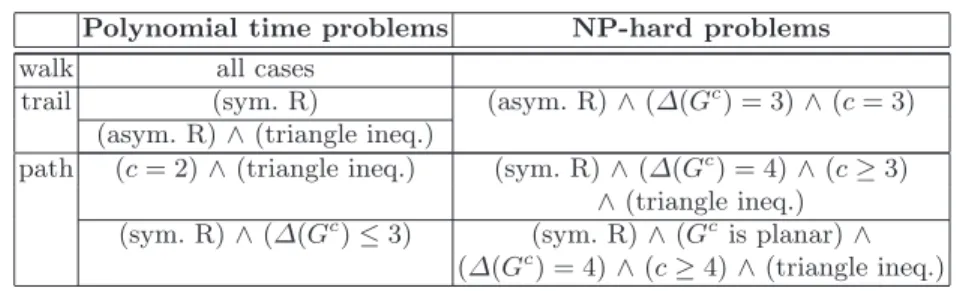
In Section 2, we discuss the case of finding a minimum reload s-t walk, either with symmetric or asymmetric reload cost matrix. In Section 3 we deal with paths and trails when reload costs are symmetric. We prove that the minimum reload s-t trail problem can be solved in polynomial time for every c ≥ 2. In addition, we show that the minimum reload s-t path problem is polynomially solvable either if c = 2 and the triangle inequality holds (here R is not necessarily a symmetric matrix) or if Gc has a maximum degree 3. However it is NP-hard when c ≥ 3,
even for graphs of maximum degree 4 and reload cost matrix satisfying the triangle inequality. We conclude the section by showing that, if c ≥ 4 and the triangle inequality is satisfied, the minimum symmetric reload s-t path problem remains NP-hard even for planar graphs with maximum degree 4. In Section 4 we deal with asymmetric reload costs. For a reload cost matrix satisfying the triangle inequality, we construct a polynomial time procedure for the minimum reload s-t trail problem and we prove that the minimum asymmetric reload s-t trail problem is NP-hard even for graphs with 3 colors and maximum degree equal to 3. Table 1 summarizes the main results given in the paper.
Table 1.Summary of main results.
Polynomial time problems NP-hard problems walk all cases
trail (sym. R) (asym. R) ∧ (∆(Gc) = 3) ∧ (c = 3)
(asym. R) ∧ (triangle ineq.)
path (c = 2) ∧ (triangle ineq.) (sym. R) ∧ (∆(Gc) = 4) ∧ (c ≥ 3)
∧ (triangle ineq.) (sym. R) ∧ (∆(Gc) ≤ 3) (sym. R) ∧ (Gc is planar) ∧
(∆(Gc) = 4) ∧ (c ≥ 4) ∧ (triangle ineq.)
2
Walks with reload costs
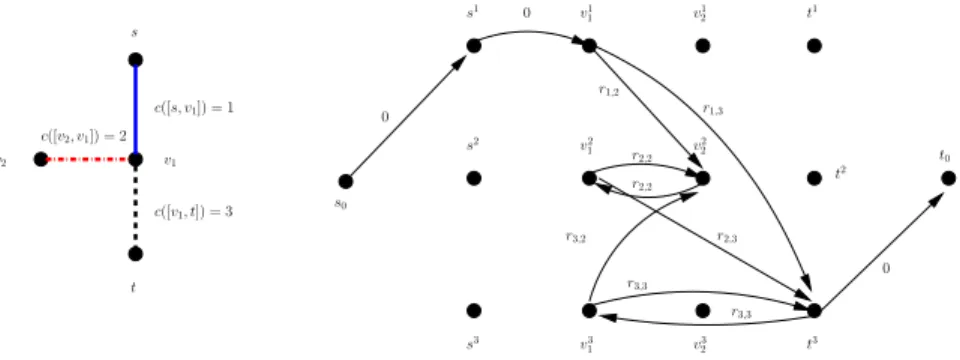
Choosing a walk instead of a path can help in reducing the reload costs. For in-stance, Figure 1 illustrates two different s-t walks, ρ1= (s, e1, v1, e2, v2, e2, v1, e3,
t) and ρ2 = (s, e1, v1, e3, t), with reload costs ri,j = 1 for i, j ∈ {1, 2, 3} except
for r1,3 = r3,1= 4. The reload cost of ρ2 is r(ρ2) = r1,3= 4 whereas the reload
cost of ρ1is r(ρ1) = r1,2+ r2,2+ r2,3= 3. Notice that the minimum reload cost
of an s-t walk is a lower bound on the minimum reload cost of an s-t trail which is a lower bound on the minimum reload cost of an s-t path since a path is a trail which is a walk.
We already know that the minimum reload s-t walk problem is polynomial since we have:
Remark 1. There is a polynomial reduction from the minimum reload s-t walk problem to the minimum reload+weight directed s-t trail problem (see Subsec-tion 1.2 for a descripSubsec-tion of this problem).
ρ1 t s c(e2) = 2 e2 e1 t s v2 e3 c(e1) = 1 c(e3) = 3 v1 ρ2 t s
Fig. 1.Two different reload s-t walks.
Thus, using the result of [2], our result follows. Here, we propose another polynomial method to solve the minimum reload s-t walk problem. Notice that the construction used differs from the one given in [2] for solving the minimum reload+weight directed s-t trail problem.
Let Gcwith V (Gc) = {s, t}∪{v
1, . . . , vn} be a simple edge-colored connected
graph with colors in Ic. We reduce the minimum s-t walk problem to the
compu-tation of a shortest s0-t0 path in an auxiliary digraph H = (V′,
−→
E′) whose arcs are weighted by w. The digraph H contains |Ic| directed subgraphs Hℓfor ℓ ∈ Ic.
The vertex set of each subgraph Hℓ is {v1ℓ, . . . , vnℓ}. There is an arc from v ℓ i to
vℓ′
k if and only if, there is a walk (vj, e1, vi, e2, vk) in Gc such that c(e1) = ℓ and
c(e2) = ℓ′. This construction can be done within polynomial time. An example
is given in Figure 2. r1,2 s1 v1 1 v12 t1 s2 v2 1 v22 v3 1 s3 v3 t3 2 s0 t0 t s v1 v2 0 0 t2 r1,3 c([s, v1]) = 1 c([v1, t]) = 3 c([v2, v1]) = 2 0 r2,2 r2,3 r3,2 r2,2 r3,3 r3,3
Fig. 2.Transformation of Gc into a digraph H.
Formally, the digraph H is built as follows:
• V′= {s
0, t0} ∪ {sℓ, vℓ1, . . . , vnℓ, tℓ: ℓ ∈ Ic}
• For any pair of edges [vj, vi] ∈ Eℓ(Gc) and [vi, vk] ∈ Eℓ
′
(Gc), with ℓ, ℓ′ ∈ I c
and vi∈ V (Gc)\{s, t} (possibly with vj= vk), add arcs (viℓ, vℓ
′
k) and (v ℓ′
i , vℓj)
(resp., to tℓ) for every ℓ ∈ I
c. Moreover, add arc (s0, sℓ) to
−→
E′ (resp., (tℓ, t 0)
to−E→′), if and only if, there exists [s, vi] ∈ Eℓ(Gc) (resp., [vi, t] ∈ Eℓ(Gc)).
• If vi 6= s, t and vj 6= s, t, then w(vℓ ′ i , v ℓ j) = rℓ′,ℓ for arc (vℓ ′ i , v ℓ j) ∈ −→ E′. If vi ∈ {s, t} or vj ∈ {s, t}, then w(vℓ ′ i , vℓj) = 0 for arc (vℓ ′ i , vℓj) ∈ −→ E′. Finally, w(s0, sℓ) = 0 for arc (s0, sℓ) ∈ −→ E′ and w(tℓ, t 0) = 0 for arc (tℓ, t0) ∈ −→ E′. Theorem 1. For any simple connected edge-colored graph Gc and any pair s, t
of vertices of Gc, the minimum reload s-t walk problem can be solved in
polyno-mial time.
3
Paths and trails with symmetric reload costs
Let R be a symmetric matrix with non-negative integer reload costs. Here, we prove that the minimum reload s-t trail problem can be solved in polynomial time for every c ≥ 2. In addition, we show that the minimum reload s-t path problem can be solved in polynomial time either if c = 2 and the triangle inequality holds (here R is not necessarily a symmetric matrix) or if Gc has a maximum
degree 3. However the problem is NP-hard when c ≥ 3 for graphs satisfying the triangle inequality and with maximum degree equal to 4. We conclude the section by showing that, if c ≥ 4 and the triangle inequality is satisfied, the minimum reload s-t path problem remains NP-hard even for planar graphs with maximum degree 4.
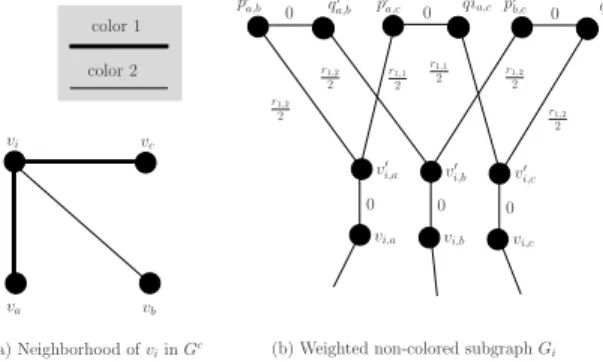
In the sequel, we show how to turn the minimum reload s-t trail problem into a minimum perfect matching problem in a weighted non-colored graph G defined as follows.
Given two vertices s and t in V (Gc) = {v
1, . . . , vn}, set W = V (Gc) \ {s, t}.
Now, for each vi ∈ W , we define a subgraph Gi with vertex and edge sets as
illustrated in Figure 3. Formally:
• V (Gi) = {vi,j, v′i,j: vj ∈ NGc(vi)} ∪ {pij,k, qij,k: j < k and vj, vk ∈ NGc(vi)}
• E(Gi) = {[vi,j, v′i,j] : vj ∈ NGc(vi)} ∪ {[vi,j′ , pij,k], [pij,k, qij,k], [qj,ki , vi,k′ ] : j < k
and vj, vk ∈ NGc(vi)}
The non-colored graph G = (V′, E′) edge weighted by w is constructed as
follows:
• V′= {s′, t′} ∪ (S
vi∈WV(Gi)), and
• E′ = {[vi,j, vx,y] : j = x and i = y} ∪ {[s′, vi,j] : vj = s and [vi, vj] ∈
E(Gc)} ∪ {[v
i,j, t′] : vj= t and [vi, vj] ∈ E(Gc)}
• w([v′
i,j, pij,k]) = 12rc([vi,vj]),c([vi,vk]), w([v
′
i,k, qij,k]) = 12rc([vi,vk]),c([vi,vj]) and all
remaining edges have a weight 0.
After G is constructed, we have to find a minimum weighted perfect matching M∗ in G. A matching is a set of edges pairwise non adjacent. A matching M is called perfect if M touches all vertices of G. The weight of matching M
vi vc va vb v′ i,a vi,a v′ i,b vi,b v′ i,c vi,c pi
a,b qia,b pia,c qia,c pib,c qb,ci
r1,2 2 r1,2 2 r1,2 2 r1,2 2 r1,1 2 r1,1 2 color 2 color 1 0 0 0 0 0 0
(a) Neighborhood of viin Gc (b) Weighted non-colored subgraph Gi
Fig. 3.Reduction of the minimum reload s-t trail to a minimum perfect matching.
is w(M ) = Pe∈Mw(e) (computing a minimum weighted perfect matching is polynomial, see [7] for a good reference on general matchings). Notice that G has a perfect matching since Gcis assumed to be connected. We can prove that
perfect matchings in G will be associated to reload s-t trails in Gcand vice-versa.
Formally:
Theorem 2. For any simple connected edge-colored graph Gc and any pair s, t
of vertices of Gc, the minimum reload s-t trail problem can be solved in
polyno-mial time.
Corollary 1. For any simple connected edge-colored graph Gc of maximum
de-gree 3 and any pair s, t of vertices of Gc, the minimum symmetric reload s-t
path problem can be solved in polynomial time.
Now, we deal with graphs Gc colored with two colors. We show that the
minimum reload s-t path problem is polynomial if the reload cost matrix R satisfies the triangle inequality. In the sequel, notice that R is not assumed to be symmetric.
Theorem 3. For any simple connected edge-colored graph Gc with c = 2 colors
and such that the associated matrix R of reload costs satisfies the triangle in-equality and for any pair s, t of vertices of Gc, the minimum symmetric reload
s-t path problem can be solved in polynomial time.
A possible application of Theorem 3 is the following. Consider a (2, 2)-matrix Rsatisfying r1,1= r2,2 = 0. It is easy to see that the involved reload cost matrix
R satisfies the triangle inequality, and then one can apply Theorem 3 (on the other hand, this restriction becomes NP-hard for a (3, 3)-matrix with ri,i = 0,
see the proof of item (i) of Corollary 2). We also deduce that the minimum toll cost s-t path problem (see Section 1) is polynomial for two colors since it is a subproblem of the case considered above. Notice that, the minimum toll cost s-t path problem for rj = 1 ∀j ∈ Ic, is equivalent to minimizing the number of
color flips in an s-t path. Actually, the minimum toll cost s-t path problem is polynomially solvable (without constraints on the number of colors).
Theorem 4. For any simple connected edge-colored graph Gc and any pair s, t
of vertices of Gc, the minimum toll cost s-t path problem can be solved in
poly-nomial time.
Now, we show that the previous restrictions on Gc are almost the best ones
to obtain polynomial cases for the minimum reload s-t path problem.
Theorem 5. The minimum symmetric reload s-t path problem is NP-hard if c≥ 3, the triangle inequality holds and the maximum degree of Gc is equal to 4.
Proof. We are given a set C of CNF clauses defined over a set X of boolean variables. An instance of the (3, B2)-sat problem, called 2-balanced 3-SAT, is such that each clause has exactly 3 literals, each of them appearing exactly 4 times in the clauses twice negated and twice unnegated. Deciding whether an instance of (3, B2)-sat is satisfiable is NP-complete [3]. We are going to reduce (3, B2)-sat to the existence of an s-t path with reload cost at most L. Let I be an instance of (3, B2)-sat. We say that Cj is the h-th clause of xi iff xi appears
in Cj and xi appears in exactly h − 1 other clauses Cj′ with j′< j. We say that
xi is the ℓ-th variable of Cj, if and only if, xi and exactly ℓ − 1 other variables
xi′ with i′< iappear in Cj. We build Gc – instance of the s-t path with reload
cost at most L – as follows. We have Ic = {1, 2, 3} and L = 11|X | + 3|C|. The
matrix R is defined as r1,2 = r2,1 = M where M > L. The other entries of R
are set to 1.
The graph Gc has a source vertex s and a sink vertex t. In addition, for each
xi∈ X (resp. Cj ∈ C) we build a gadget as depicted on the left (resp. right) of
Figure 4. The gadget of a variable xi consists of a left part (vertices fi0 to fi4
and d0
i to d3i), a right part (vertices t0i to ti4 and k0i to k3i), an entrance ai and
an exit bi. The left (resp. right) part corresponds to the case where xi is set to
false(resp. true). The gadget of a clause Cj consists of an entrance qj, an exit wj and three vertices u1j, u2j, and u3j which correspond to the first, second and
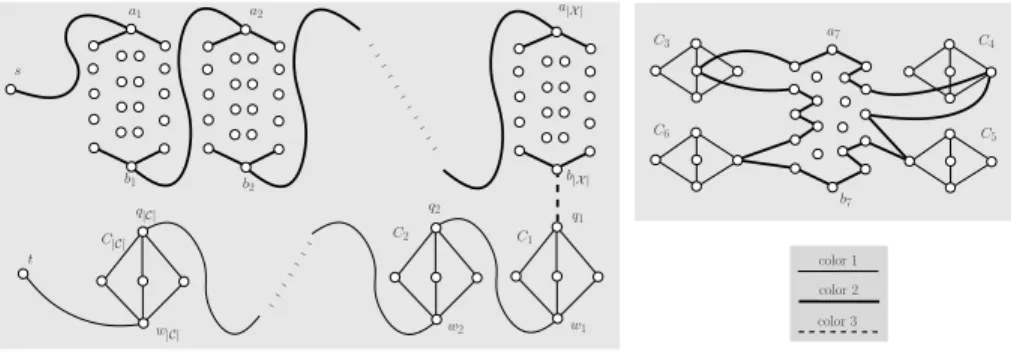
third variable of Cj respectively. We link the gadgets by adding the following
edges (see Figure 5):
– [s, a1],[b1, a2],[b2, a3],. . . ,[b|X |−1, a|X |] with color 2 (bold) ;
– [b|X |, q1] with color 3 (dashed) ;
– [w1, q2],[w2, q3],. . . ,[w|C|−1, q|C|], [w|C|, t] with color 1 (thin).
For each pair xi, Cj such that xi is the ℓ-th variable of Cj and Cj is the
h-th clause of xi we proceed as follows. If xi appears negated in Cj then add
[th−1i , u ℓ j], [thi, uℓj], [f h−1 i , d h−1 i ] and [f h i , d h−1
i ] with color 2 (bold). If xi appears
unnegated in Cj then add [fih−1, u ℓ j], [fih, uℓj], [th−1i , k h−1 i ] and [t h i, kh−1i ] with
color 2 (bold). It is not difficult to see that each vertex’s degree is at most 4. Moreover the triangle inequality holds.
Since r1,2 > L and r2,1 > L, any s-t path ρc with reload cost at most L
starts at s, enters the gadget of x1and visits the variable-gadgets in turn. When
b|X | is reached, ρc uses [b|X |, q1] and visits the clause-gadgets in turn. Finally t
is reached from w|C|. Then exactly 11 (resp., 3) vertices are visited when passing
ai fi0 fi1 fi2 fi3 fi4 t0i t1i t2i t3i t4i bi d0i d1i d2i d3i ki0 ki1 k2i k3i qj u1j u2j u3j wj color 1 color 2
Fig. 4.Gadgets for a variable xi (left) and a clause Cj(right).
a1 b1 a2 b2 a|X | b|X | q1 w1 q2 w2 q|C| w|C| a7 b7 C3 C5 C4 C6 s t C1 C2 C|C| color 1 color 2 color 3
Fig. 5. Left: How the gadgets are linked. Right: How to link the gadget of x7 if it
appears in C3 = (x1 ∨ x7 ∨ x8), C4 = (x3 ∨ x5 ∨ x7), C5 = (x7 ∨ x8∨ x9) and
If a truth assignment τ satisfies I then Gc admits an s-t path ρ
cwith reload
cost 11|X | + 3|C|. Indeed, if xiis false (resp. true) in τ then ρcgoes across the
left (resp. right) part of xi’s gadget. Since τ satisfies I we know that at least one
literal per clause is true. If the ℓ-th literal of Cj is true (choose ℓ arbitrarily if it
is not unique) then ρc passes through uℓj. Conversely an s-t path ρc with reload
cost 11|X | + 3|C| induces a truth assignment that satisfies I: set xi to false
(resp. true) if ρc passes through the left (resp. right) part of xi’s gadget. ⊓⊔
Corollary 2. The two following statements hold:
(i) In the general case, the minimum symmetric reload s-t path problem is not approximable at all if c ≥ 3, the triangle inequality holds and the maximum degree of Gc is equal to 4.
(ii) If ri,j≥ 1 for every i, j ∈ Ic, the minimum symmetric reload s-t path problem
is not O(2P(n))-approximable for every polynomial P if c ≥ 3, the triangle
inequality holds and the maximum degree of Gc is equal to 4.
Corollary 3. The minimum symmetric reload s-t path problem is NP-hard if c≥ 4, the graph is planar, the triangle inequality holds and the maximum degree is equal to 4.
4
Paths and trails with asymmetric reload costs
We now deal with asymmetric reload costs. We mainly prove that the minimum reload s-t trail problem is NP-hard in this case.
Theorem 6. The minimum asymmetric reload s-t trail problem is NP-hard if c≥ 3 and the maximum degree of Gc is equal to 3.
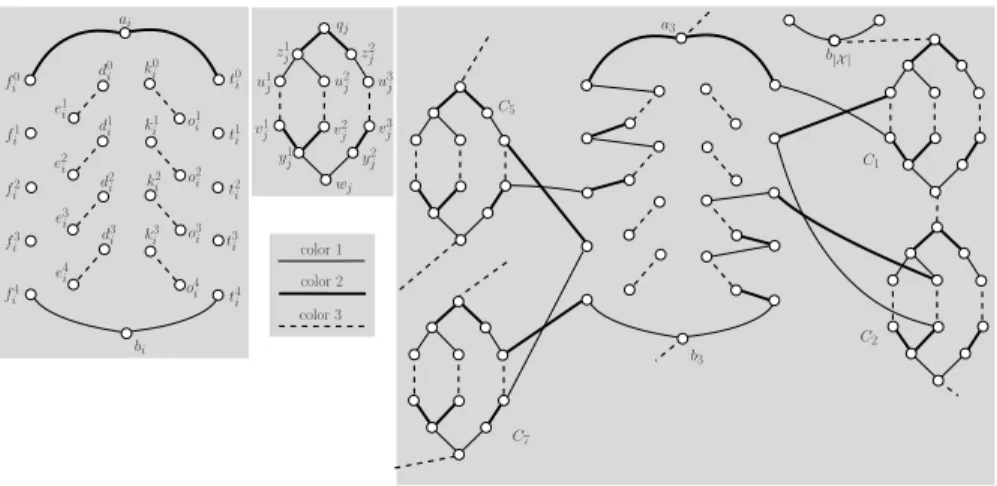
Proof. This proof is similar to the one of Theorem 5, i.e. we reduce (3, B2)-sat to the existence of an s-t path with reload cost at most L. Hence we use the same notations and only describe how Gcis built upon I. A trail must be a path
in the graph of Gc since a vertex’s maximum degree is 3. Hence we only deal
with paths in this proof.
We have Ic = {1, 2, 3} and L = 15|X | + 6|C|. The matrix R is defined as
r1,2 = r2,3 = r3,1 = M where M > L. The other entries of R are set to 1.
The graph Gc has a source s and a sink t. In addition, for each x
i ∈ X (resp.
Cj∈ C) we build a gadget as depicted on the left (resp. middle) of Figure 6. The
gadget of a variable xiconsists of a left part (vertices fi, di and ei), a right part
(vertices ti, ki and oi), an entrance ai and an exit bi. The left (resp. right) part
corresponds to the case where xi is set to false (resp. true). The gadget of
a clause Cj consists of a left part (vertices u1j and vj1), a middle part (vertices
u2
j and vj2), a right part (vertices u3j and vj3), an entrance qj, an exit wj and
four intermediate vertices z1
j, zj2, y1j and yj2. The left, middle and right parts
correspond to the first, second and third variable of Cj respectively.
We link the gadgets by adding the following edges with color 3 (dashed): [s, a1], [b1, a2], [b2, a3], . . . , [b|X |−1, a|X |]; [b|X |, q1]; [w1, q2],[w2, q3], . . . , [w|C|−1,
ai f0 i f1 i f2 i f3 i f4 i t0 i t1 i t2 i t3 i t4 i bi d0 i d1 i d2 i d3 i e1 i e2 i e3 i e4 i k0 i k1 i k2 i k3 i o1 i o2 i o3 i o4 i qj u1 j u2j u3j v1 j v2j v 3 j wj z1 j zj2 y1 j y2j color 1 color 2 color 3 C1 C2 C5 a3 b3 b|X | C7
Fig. 6.Left: Gadgets for a variable xi. Middle: Gadget of a clause Cj. Right: x3appears
in the four clauses C1= (x3∨ x5∨ x6), C2= (x1∨ x3∨ x4), C5 = (x1∨ x2∨ x3) and
C7= (x1∨ x2∨ x3).
q|C|], [w|C|, t] (this construction is similar to the one described in the left part of
Figure 5 except for the colors of the edges). For each pair xi, Cj such that xi is
the ℓ-th variable of Cjand Cj is the h-th clause of xiwe proceed as follows. If xi
appears negated in Cj then add [th−1i , v ℓ
j] with color 1 (thin), [t h i, u ℓ j] with color 2 (bold), [fih−1, d h−1
i ] with color 1 and [f h i, e
h
i] with color 2. If xiappears unnegated
in Cj then add [fih−1, v ℓ j] with color 1, [f h i, u ℓ j] with color 2, [t h−1 i , k h−1 i ] with color 1 and [th i, o h
i] with color 2. Now G
c is fully described. An example is given
on the right of Figure 6. It is not difficult to see that each vertex’s degree of Gc
is at most 3.
As in the proof of Theorem 5 it is not difficult to see that a truth assignment that satisfies I corresponds to an s-t path with reload cost 15|X | + 6|C| in Gc
and vice-versa. ⊓⊔
Corollary 4. The minimum asymmetric reload s-t path problem is NP-hard if c≥ 3 and the maximum degree of Gc is equal to 3.
Corollary 5. The two following statements hold:
(i) In the general case, the minimum asymmetric reload s-t trail/path problems are not approximable at all if c ≥ 3 and the maximum degree of Gc is equal
to 3.
(ii) If ri,j≥ 1 for every i, j ∈ Ic, the minimum asymmetric reload s-t trail/path
problems are not O(2P(n))-approximable for every polynomial P if c ≥ 3 and
the maximum degree of Gc is equal to 3.
We know that the minimum symmetric reload s-t trail problem is polyno-mially solvable (see Theorem 2). We now prove that this result also holds with asymmetric reload costs if the triangle inequality is satisfied.
Theorem 7. For any simple connected edge-colored graph Gc and any pair s, t
of vertices of Gc, the minimum asymmetric reload s-t trail problem can be solved
in polynomial time, if the triangle inequality holds.
5
Conclusion
In this paper we give a rather complete description of the complexity of the minimum reload s-t walk/trail/path problems. When c = 2, we do not know the complexity of the minimum symmetric reload s-t path and the minimum asym-metric reload s-t trail problems if the matrix of reload costs does not satisfy the triangle inequality. These open problems seem important to better understand the complexity of the properly edge-colored s-t trail/path problems when Gc
does not have a properly edge-colored s-t trail/path. In this case, one could be interested in seeking an s-t trail/path with a minimum number of vertices for which the adjacent edges have the same color.
Finally, notice that if we study the min-max reload s-t walk/trail/path prob-lems, all the results presented here also hold. In this case, we replace the reload cost of a path/trail/walk ρ = (v1, e1, v2, e2, . . . , ek, vk+1) between vertices s and
t defined as in (1) by r(ρ) = max{rc(ej),c(ej+1): j = 1, . . . , k − 1}.
Acknowledgements
We are very grateful to the anonymous referees for their insightful comments and suggestions.
References
1. A. Abouelaoualim, K. C. Das, L. Faria, Y. Manoussakis, C. A. Martinhon and R. Saad. Paths and trails in edge -colored graphs In Proc. of LATIN 2008, vol. 4957, pp. 723-735, 2008.
2. E. Amaldi, G. Galbiati and F. Maffioli. On minimum reload cost paths, tours and flowsIn Proc. of the Cologne Twente Worshop (CTW 2008), 2008.
3. P. Berman, M. Karpinski and A. D. Scott. Approximation Hardness of Short Sym-metric Instances of MAX-3SAT, in Electronic Colloquium on Computational Com-plexity (ECCC) vol. 49, 2003.
4. G. Galbiati. The complexity of a minimum reload cost diameter problem, In Dis-crete Applied Mathematics (article in press), 2008.
5. I. Gamvros. Satellite network design, optimization and management PhD thesis, University of Maryland, 2006.
6. I. Gamvros and L. Gouveia and S. Raghavan. Reload Cost Trees and Network Design In Proc. of the International Network Optimization Conference (INOC 2007), 2007.
7. A. M. H. Gerards. Matching: Network Models, North Holland, Amsterdam, 1995. 8. H. C. Wirth and J. Steffan. Reload cost problems: minimum diameter spanning