HAL Id: tel-01794776
https://pastel.archives-ouvertes.fr/tel-01794776
Submitted on 17 May 2018HAL is a multi-disciplinary open access
archive for the deposit and dissemination of sci-entific research documents, whether they are pub-lished or not. The documents may come from teaching and research institutions in France or
L’archive ouverte pluridisciplinaire HAL, est destinée au dépôt et à la diffusion de documents scientifiques de niveau recherche, publiés ou non, émanant des établissements d’enseignement et de recherche français ou étrangers, des laboratoires
Cache, process and forward in Information-centric
networking
Leonce Mekinda Mengue
To cite this version:
Leonce Mekinda Mengue. Cache, process and forward in Information-centric networking. Networking and Internet Architecture [cs.NI]. Télécom ParisTech, 2016. English. �NNT : 2016ENST0075�. �tel-01794776�
2016-ENST-0075 EDITE - ED 130
Doctorat ParisTech
T H È S E
pour obtenir le grade de docteur délivré par
TELECOM ParisTech
Spécialité “Informatique et Réseaux”
présentée et soutenue publiquement par
Léonce MEKINDA
le 01/12/2016
Cache, Process and Forward
in Information-Centric Networking
Mécanismes de Cache, Traitement et Diffusion dans
les Réseaux Centrés sur l’Information
Jury
M. Emilio LEONARDI, Professeur,Politecnico di Torino Rapporteur
M. Fabio MARTIGNON, Professeur,Université Paris-Sud Rapporteur
Mme Neiva LINDQVIST, Senior Researcher,Ericsson Examinateur
M. James ROBERTS, Senior Researcher Examinateur
M. Dario ROSSI, Professeur,TELECOM ParisTech Examinateur
M. Alain SIMONIAN, Research Engineer,Orange Labs Examinateur
M. Thomas BONALD, Professeur,TELECOM ParisTech Directeur de thèse
M. Luca MUSCARIELLO, Principal Engineer,Cisco Systems Co-directeur de thèse
TELECOM ParisTech
Acknowledgement / Remerciements
Thank you Prof. Emilio Leonardi and Prof. Fabio Martignon to have consented to evalu-ating this manuscript. I am deeply honoured by the participation of Dr. Neiva Lindqvist, Dr. James Roberts, Prof. Dario Rossi and Dr. Alain Simonian in my Ph.D. evaluation committee.
I would thank Luca, who offered me this unique opportunity to fulfill a lifetime accom-plishment, believed in me and inspired me along this journey. Thanks to Thomas, who honoured a young scientist in accepting to relentlessly oversee his humble work. I also hereby praise Giovanna’s brilliance and precious insights.
Deep thanks to Philippe Olivier who kindly reviewed this manuscript. Nabil, Eric, Chris-tian, Mustapha, Adam, Nancy, Yannick, Felipe, Yassine, Deborah, Claudio, Bruno, Or-ange TRM team as a whole and beyond, I am definitely indebted to your kindness. To all LINCS researchers go my immense admiration and gratitude.
Abstract
This thesis investigates how making content caching and forwarding latency-aware can improve data delivery performance in Information-Centric Networks (ICN). We in-troduce a new very effective contribution to the existing content caching toolset. The designed mechanism leverages retrieval time observations to decide whether to store an object in a network cache, based on the expected delivery time improvement. We demon-strate that our distributed latency-aware caching mechanism, LAC+, outperforms state of the art proposals and results in a reduction of the content mean delivery time and standard deviation of LRU caches by up to 60%, along with a fast convergence to these figures.
In a second phase, we conjointly optimize the caching function and the multipath request forwarding strategies as both coexist in ICN at network level and should rein-force each other. To this purpose, we introduce the mixed forwarding strategy LB-Perf, directing the most popular content towards the same next hops to foster egress caches convergence, while load-balancing the others.
Third, we address ICN fairness to contents. We show that traditional ICN caching, which favors the most popular objects, does not prevent the network from being globally fair, content-wise. The incidence of our findings comforts the ICN community momen-tum to improve LFU cache management policy and its approximations. We demonstrate that in-network caching leads to content-wise fair network capacity sharing as long as bandwidth sharing is content-wise fair.
Finally, we contribute to the research effort aiming to help ICN Forwarding Informa-tion Base scale when confronted to the huge IoT era’s namespace. We propose AFFORD, a novel view on routing in named-data networking that combines machine learning and stochastic forwarding. More specifically, we show that compressing the Forwarding In-formation Base into bitwise trie-indexed Artificial Neural Networks accelerates next hop lookup and reduces Forwarding Information Base’s size by orders of magnitude.
Keywords: Information-Centric Networks; Performance evaluation; Cache management; Transport protocol; Forwarding; Machine learning.
Résumé
Ce travail de thèse s’est tout d’abord attaché à comprendre comment la prise en compte du temps de téléchargement, autrement dit, de la latence, lors de la mise en cache ou de la transmission de données pouvait contribuer aux performances du téléchargement dans les réseaux de caches dont ICN. Nous y introduisons un mécanisme distribué novateur qui décide de l’opportunité de conserver un objet en considérant que plus il a été long à télécharger plus intéressant il semble de le soumettre au cache sous-jacent. Nous montrons que ce nouveau mécanisme surpasse en de nombreux points l’état de l’art, que ce soit du point de vue de la réduction du temps moyen de téléchargement à partir de caches LRU, et de son écart-type (jusqu’à −60% ), que de celui de la vitesse de convergence vers ceux-ci. La grande simplicité dudit mécanisme pourrait permettre son intégration immédiate aux sein d’architectures réseaux existantes car ne nécessitant aucun amendement de protocole. Dans une seconde phase, nous avons optimisé conjointement les fonctions de mises en cache et de distribution multi-chemin de requêtes de contenus, qui d’ailleurs coexistent dorénavant au sein de la couche réseau en ICN, afin qu’elles se renforcent mutuellement. Troisièmement, nous avons étudié l’équité vis-à-vis des contenus au sein des réseaux de caches et plus particulièrement, d’ICN. Il en ressort qu’ICN tel quel préfigure un réseau α-équitable malgré le recours extensif à des algorithmes de gestion de caches qui favo-risent les contenus les plus populaires. Seule suffit une allocation équitable de la bande passante entre les contenus pour que l’équité d’ICN soit complète.
Notre dernière contribution vise à aider au passage à l’échelle d’ICN dans contexte où deviennent réalités l’Internet des Objets et son espace de nommage illimité. Nous avons proposé une approche nouvelle au routage dans les réseaux centrés sur l’information, nommée AFFORD, qui combine apprentissage automatique et diffusion aléatoire. Nous montrons que comprimer la base d’information de transmission (FIB) ICN, en la segmen-tant en plusieurs réseaux de neurones indexés par un arbre préfixe, accélère la recherche de nom et réduit la taille de la structure FIB de plusieurs ordres de grandeur.
Mots-clés : Réseaux Centrés sur l’Information ; Evaluation de performances ; Gestion de caches ; Protocoles de transport ; Distribution multi-chemin ; Apprentissage automatique.
Contents
Abstract iv Résumé v List of publications 3 1 Introduction 5 1.1 Today’s Internet . . . 81.1.1 An architecture that no longer fits its usage . . . 8
1.1.2 The rampant threat of host-centric Internet collapse . . . 8
1.1.3 The dawn of HTTPS-by-default . . . 8
1.1.4 Excessive latency . . . 9
1.1.5 Weak multipath support . . . 10
1.1.6 A non-native relief by CDNs . . . 11
1.2 5G, an opportunity . . . 11
1.3 Information-Centric Networking . . . 12
1.3.1 Content-Centric / Named-Data Networking . . . 12
1.3.2 NDN operations . . . 13 1.3.3 NDN security . . . 14 1.3.4 NDN routing . . . 15 1.3.5 NDN forwarding . . . 16 1.3.6 Mobility in NDN . . . 17 1.3.7 Caching in NDN . . . 18 1.4 Problem statement . . . 22
1.5 Our contributions . . . 22
1.5.1 LAC/LAC+: Latency-aware caching . . . 23
1.5.2 FOCAL: joint Forwarding and Caching with Latency-awareness . 23 1.5.3 Fairness in Information-Centric Networking . . . 24
1.5.4 AFFORD: Ask For Directions, machine learning-based routing . 24 1.6 Mathematical foundations . . . 25
1.6.1 Elements of probability theory . . . 25
1.6.2 Queuing theory fundamentals . . . 27
1.6.3 Lyapunov optimization . . . 31
1.6.4 Nonlinear optimization . . . 31
1.6.5 Cache performance analysis . . . 32
1.6.6 Performance analysis of Networks of Caches . . . 35
2 LAC/LAC+: Latency-Aware Caching Strategies in ICN Can delivery in ICN be faster ? 37 2.1 Introduction . . . 39 2.2 Related work . . . 40 2.3 Latency-aware heuristics . . . 41 2.4 Analysis . . . 42 2.4.1 Assumptions . . . 43 2.4.2 Miss ratio . . . 44 2.4.3 Lower bound . . . 47 2.5 Simulation . . . 52
2.6 Conclusion and future work . . . 58
3 FOCAL: Joint Forwarding and Caching with Latency-awareness in ICN Can delivery in ICN be much faster ? 59 3.1 Introduction . . . 61
3.2 Related work . . . 63
3.3 Problem statement . . . 64
3.4 Optimal algorithm design . . . 66
3.4.2 Numerical solutions . . . 72
3.4.3 Maximizing the hit ratio of dynamic caches through optimal bundling 75 3.5 FOCAL . . . 82
3.5.1 Latency-aware caching strategies . . . 82
3.5.2 Latency-aware forwarding strategies . . . 84
3.6 Performance analysis . . . 89
3.7 Simulation . . . 97
3.7.1 Linear topology with forwarding branches . . . 99
3.7.2 Fat tree with direct access to content repositories . . . 105
3.7.3 US backbone-like scenario . . . 106
3.8 Conclusion . . . 107
4 On the Fairness of ICN Can ICN be fair ? 111 4.1 Introduction . . . 113
4.2 Related work . . . 114
4.3 Cache Network Model . . . 115
4.3.1 Model assumptions . . . 115
4.3.2 Cache network capacity . . . 118
4.3.3 Problem formulation . . . 119 4.3.4 Solution . . . 121 4.4 Toy examples . . . 125 4.4.1 Client/Server tandem . . . 125 4.4.2 Client/Cache/Server bus . . . 126 4.5 Evaluation . . . 130 4.5.1 Client/Cache/Server bus . . . 131 4.5.2 A simple network . . . 131 4.6 Conclusion . . . 135
5 Supervised Machine Learning-based Routing for NDN Can ICN scale ? 137 5.1 Introduction . . . 139
5.2 Related work . . . 141
5.3 AFFORD . . . 142
5.3.1 AFFORD supervised learning . . . 143
5.3.2 AFFORD forwarding . . . 147 5.4 Analysis . . . 148 5.5 Evaluation . . . 149 5.5.1 Tiny-size FIB . . . 150 5.5.2 Medium-size FIB . . . 152 5.5.3 Big-size FIB . . . 152
5.6 Conclusion and future work . . . 153
6 Conclusion and future work 155 Bibliography 159 Appendices 177 A ZIMPL Mathematical Programs 177 A.1 ZIMPL code for section 3.4.2 . . . 178
A.2 ZIMPL code for section 3.4.3.0 . . . 179
Appendices 179 B Résumé étendu 181 B.1 Information-Centric Networking . . . 183
B.1.1 Content-Centric / Named-Data Networking . . . 184
B.1.2 Fonctionnement de NDN . . . 184
B.1.3 Transmission dans NDN . . . 185
B.1.4 Caching in NDN . . . 186
B.2 Contributions . . . 189
B.3 LAC/LAC+: Algorithmes de gestion de cache sensibles à la latence . . . 189
B.3.1 Description . . . 190
B.4 FOCAL: Transmission and gestion de cache conjointes et sensibles à la
latence . . . 196
B.4.1 Algorithmes de gestion de caches sensibles à la latence . . . 197
B.4.2 Stratégies de transmission sensibles à la latence . . . 197
B.5 Équité dans les réseaux centrés sur l’information . . . 203
B.5.1 Cache Network Model . . . 203
Publications
The content of this thesis was published in two workshop [Carofiglio et al.,2015a] [Carofiglio et al.,2015b], two conference [Carofiglio et al.,2015c] [Mekinda and Muscariello,2016] proceedings and a journal [Carofiglio et al.,2016]. A chapter was submitted to a confer-ence [Bonald et al.,2017]. All are peer-reviewed international venues.
List of publications
Bonald, T., Mekinda, L., and Muscariello, L. (2017). On the Fairness of Information-Centric Networking. In 36th Annual IEEE International Conference on Computer Communications, IEEE INFOCOM 2017 (Under review). San Francisco, CA, USA. Carofiglio, G., Mekinda, L., and Muscariello, L. (2015a). Analysis of latency-aware caching strategies in information-centric networking. In ACM SIGCOMM CoNEXT Workshop on Content Caching and Delivery in Wireless Networks. Heidelberg, Ger-many.
Carofiglio, G., Mekinda, L., and Muscariello, L. (2015b). FOCAL: Forwarding and caching with latency awareness in information-centric networking. In IEEE Globe-com 2015 Workshop on Information Centric Network Solutions for Real-World Ap-plications, IEEE GLOBECOM 2015 ICNS. San Diego, CA, USA.
Carofiglio, G., Mekinda, L., and Muscariello, L. (2015c). LAC: Introducing latency-aware caching in information-centric networks. In IEEE 40th Conference on Local Computer Networks, IEEE LCN 2015, pages 422–425. Clearwater Beach, FL, USA. Carofiglio, G., Mekinda, L., and Muscariello, L. (2016). Joint Forwarding and Caching
in Information-Centric Networking. Computer Networks.
Mekinda, L. and Muscariello, L. (2016). Supervised Machine Learning-based Routing for Named Data Networking. In IEEE GLOBECOM 2016. Washington, DC, USA.
Chapter 1
Introduction
Contents
1.1 Today’s Internet . . . . 8
1.1.1 An architecture that no longer fits its usage . . . 8
1.1.2 The rampant threat of host-centric Internet collapse . . . 8
1.1.3 The dawn of HTTPS-by-default . . . 8
1.1.4 Excessive latency . . . 9
1.1.5 Weak multipath support . . . 10
1.1.6 A non-native relief by CDNs . . . 11
1.2 5G, an opportunity . . . . 11
1.3 Information-Centric Networking . . . . 12
1.3.1 Content-Centric / Named-Data Networking . . . 12
1.3.2 NDN operations . . . 13 1.3.3 NDN security . . . 14 1.3.4 NDN routing . . . 15 1.3.5 NDN forwarding . . . 16 1.3.6 Mobility in NDN . . . 17 1.3.7 Caching in NDN . . . 18 1.4 Problem statement . . . . 22
1.5 Our contributions . . . . 22
1.5.1 LAC/LAC+: Latency-aware caching . . . 23
1.5.2 FOCAL: joint Forwarding and Caching with Latency-awareness 23 1.5.3 Fairness in Information-Centric Networking . . . 24
1.5.4 AFFORD: Ask For Directions, machine learning-based routing . . . 24
1.6 Mathematical foundations . . . . 25
1.6.1 Elements of probability theory . . . 25
1.6.2 Queuing theory fundamentals . . . 27
1.6.3 Lyapunov optimization . . . 31
1.6.4 Nonlinear optimization . . . 31
1.6.5 Cache performance analysis . . . 32
Information-Centric Networking (ICN) [Jacobson et al., 2009b] is an emerging net-work communication paradigm intended to alleviate the unsustainable growth of the cur-rent Internet load. As key traits, (i) it replaces inside the network layer the “where” with the “what”, in achieving routing and forwarding on content names; (ii) it uses exten-sively in-network caching. While less and less of the IP traffic remains cacheable due
to end-to-end communication channel encryption [Naylor et al., 2014], ICN through, for
example, its NDN [Zhang et al., 2014] implementation offers a promising alternative in
ignoring user identity (no host address) and authenticating content provider from data packets (digital signature). Therefore, every content item can remain cacheable without sacrificing user privacy and content verification. This is important because inserting cache memories across the communication data path between different processing elements has been demonstrated over time to be a reliable way of improving network performance by localizing - especially popular - content at network edge and so reducing link load and retrieval latency.
Such a latency minimization, or building for virtual zero latency as commonly re-ferred to, is one of the pillars of 5G network architecture design and is currently fostering research work in this space.
This thesis is a contribution to this effort. It tackles various aspects of NDN: (i) we propose, analyze and implement two latency-aware caching algorithm LAC and LAC+ that significantly shrink content delivery time; (ii) we propose, analyze and implement a joint latency-aware caching and forwarding algorithm, FOCAL, aiming at the perfor-mance enhancement of caching algorithms; (iii) we analyze the fairness of ICN, given the caching ubiquity it entails; (iv) and we propose an artificial neural network-based forwarding approach to help NDN’s FIB scale in a global Internet namespace.
The remaining of the chapter will present in more details the Internet as we know it, with its weaknesses; What are the additional challenges 5G introduces; Where ICN can help; Then comes a statement of the problems this thesis addresses, an overview of our contributions and finally a few mathematical prerequisites for understanding the modeling part of our work.
1.1
Today’s Internet
1.1.1
An architecture that no longer fits its usage
The Internet basically interconnects machines to transfer data in a client-server commu-nication mode. For this, it relies on the TCP/IP protocol stack, which provides machine addressing and communication primitives. While this architecture has been successful in the earlier Internet stages, for remote access (Telnet, SSH), file transfer (FTP), Inter-net Relay Chat (IRC) sending and fetching e-mails (SMTP, POP3, IMAP4 protocol) or browsing the textual World Wide Web (HTTP) etc., it no longer fits the Internetwork
actual usage. [Cisco, 2016] reports that the Internet is getting overwhelmingly used for
multimedia content browsing or video downloading/streaming nowadays (more than 80% of the total traffic), making the host serving content by far less relevant than content itself.
1.1.2
The rampant threat of host-centric Internet collapse
Very few hosts and edge networks would afford the thousands of parallel flows and the
resulting congestion most viral videos generate. Moreover, since [Floyd and Fall,1999]
urged to curate TCP-unfriendly, unresponsive or bandwidth greedy flows, no definitive solution has emerged to durably protect the host-centric Internet from congestion collapse in case of competing congestion control algorithms, best-effort protocols or misbehaving senders and receivers [Papadimitriou et al.,2011;Habib et al.,2016]. This weakness has even been the ground for an effective means of cyberwarfare known as Distributed Denial
of Service (DDoS) attacks [Ben-Porat et al., 2013]. They is a worrying increase of such
attacks, predicted to reach 107a year by 2017. According to [Cisco,2016], modern DDoS
generates in average ∼ 1 Gbps of malicious traffic very few organizations can resist.
1.1.3
The dawn of HTTPS-by-default
A host-centric Internet impedes massive multicast delivery over reliable transport, as a consequence of resource limitation at content servers but not only. Transport Layer Secu-rity (TLS)’s point-to-point cryptosystem prevents secure sessions from being replicated and diffused from the network edge. It is typically a barrier experienced by any ISP who tries to scale-down some YouTube traffic. Actually, half the World Wide Web traffic is
carried over SSL/TLS and major Internet actors like Google, Netflix and Facebook have
defaulted to HTTPS [Naylor et al., 2014]. The same paper emphasizes that
HTTPS-as-unique-vector nullifies value-added services like in-network caching, thus would yield a minimum 15% traffic increase if a solution is not found. [Paschos et al.,2016] pertinently objected that the current use of content provider representatives such as caching black-boxes to handle encryption matters within operators networks might not be satisfactory. The example of Google Global Cache is illustrative. They leave operators helpless in their legitimate intend to conduct their own network optimization.
Multi-context TLS (mcTLS) [Naylor et al.,2015] has recently been proposed to
recon-cile TLS with middleboxes, in a way some may not agree with. mcTLS security protocol grants trusted middleboxes access to the traffic, unencrypted. Not prone to that obvious
privacy exposure is [Sherry et al.,2015]’s BlindBox, which enables Deep Packet
Inspec-tion (DPI) over encrypted traffic. Blindbox HTTPS scans encrypted traffic for encrypted keywords. For this, during a rather slow HTTPS connection setup, it encrypts its ruleset without disclosing neither the rules to the endpoints (thanks to oblivious transfer [Naor and Pinkas, 1999]) nor the private key shared by the communicating endpoints to the middlebox (thanks to Yao garbled circuits [Yao,1986]). Its slow minute-scale initializa-tion restricts the scope of the protocol to persistent secure tunnels. More important for our study, since BlindBox HTTPS does not provide means for translating the encrypted payload from one secure session to another, it does not enable caching.
1.1.4
Excessive latency
In an extensive survey, [Briscoe et al., 2014] reviewed the roots of Internet latency in
a broad sense. They identified (i) structural delays like those caused by sub-optimal routes or name resolution; (ii) processing delays generated by protocol stacks or operating systems; (iii) physical/link layer-related delays due to medium acquisition, signal prop-agation, scheduling, queuing, bufferbloats; (iv) those resulting from network/transport protocol operations like NAT setup, connection initialization and Head-of-Line locking occurring during packet loss recovery. A few remedies still need to convince a majority of Internet stakeholders.
Standard TCP algorithms like New Reno and Cubic are prone to unnecessary delay. These algorithms only react to packet loss, which often occurs at route bottlenecks due
to tail drops, i.e., when full transmission buffers start dropping incoming packets. Al-though a wider adoption of Active Queue Management (AQM) and Explicit Congestion Notification (ECN) would have prevented packet drops and subsequent retransmissions, TCP flavours exploiting these techniques, DataCenter TCP (DCTCP) for example, remain underemployed.
Also, TCP Fast Open (TFO) [Radhakrishnan et al.,2011] offers to save a Round Trip
Time (RTT) in relaxing the three-way handshake by conveying data to applications in an opening SYN packet, and mitigating security risks with a cryptographic cookie. However, it cannot detect duplicated connections since a TFO cookie encloses the client’s IP address the server encrypted and sent during a precedent full handshake.
Quick UDP Internet Connections (QUIC) [Hamilton et al., 2016] seems to gather
in-sights from all previous attempts in turning protocol bootstraps into 0-RTT handshakes by means of a source-address token similar to TFO’s cookie. QUIC conveys Forward Error Correction (FEC) packets to avoid as much as possible the retransmission of lost packets. Congestion control may consist of CUBIC (by default) or TCP-Reno or Packet pacing. A few works have demonstrated that the expected content delivery time improvements only
show up in very lossy networks [Carlucci et al., 2015;Megyesi et al., 2016]. Moreover,
[Lychev et al.,2015] highlighted QUIC’s fundamental vulnerability to rather simple DoS
attacks exploiting source-address token replay, or off-path byte injection attacks dropping client connections.
Interestingly, [Singla et al., 2014, 2015] pointed out that fiber distance is up to two times longer than road distance, inflating the latency encountered in upper network layers. They examine the possibility of deploying nationwide lightspeed microwave networks. Our work will not address this aspect. We will focus on algorithmic improvements given physical deployments.
1.1.5
Weak multipath support
Reliable multipath forwarding is unnatural in the current Internet due to the fact that pack-ets do not mandatorily follow the same paths back and forth. This IP feature, which hap-pens to be a limitation for multipathing reliable transport protocols like TCP, imposes at least some tunneling overhead to guarantee a successful merge of subflows into their orig-inal master flow [He and Rexford,2008;Qadir et al.,2015]. It appears to be efficient only
for long-lasting flows. Such a poor multipath support is rather unfortunate, as multipath forwarding is an interesting means of exploiting multiple routes for bandwidth aggrega-tion, load balancing and failover purposes, especially in challenging environments like
those covered by Delay-and-Disruption-Tolerant Networking (DTN) [Cerf et al.,2007].
1.1.6
A non-native relief by CDNs
The precarious situation we portrayed justifies the extensive resort to overlay networks, CDNs. A Content Delivery Network or CDN consists in content caches and replica spread closer to the users. They are populated in order to anticipate the users needs and accelerate the delivery of content of interest. In fact, almost half the Internet traffic crosses CDNs and [Cisco,2016] predicts a steady growth to that trend, reaching two-thirds by 2020. It is thanks to CDNs that the Internet still scale, by the confinement of a significant part of the traffic near the Internetwork edge. CDNs have somewhat paved the way to Information-Centric Networking, this thesis’ cornerstone. However, the key difference is that CDNs are overlay, often commercially-operated networks. They often rely on DNS tricks or IP anycast to redirect request towards the closer content replica, so unnatural to the IP world that it inflates network complexity.
1.2
5G, an opportunity
The Fifth Generation Mobile Networks is the next major evolution of mobile systems. It is envisioned to fulfill unprecedented goal in terms of latency, data rate, number of devices and energy consumption. Among key requirements were identified [Maternia and El Ayoubi, 2016]: at least 1 Gbps of user data rate, very low latency : 1-10 ms end-to-end round trip delay, up to a hundred times more connected devices, 90% less energy consumption, up to 10 years of battery life and more than 99% availability. Several
research works [Paschos et al., 2016; Augé et al., 2015; Kutscher, 2016] point towards
1.3
Information-Centric Networking
Information-Centric Networking aims at re-engineering the Internet to make it fit its cur-rent and future challenges. First introduced by [Jacobson et al.,2009b], this new paradigm advocates the shift from a host-centric layer-3 communication model to a named-content-centered scheme.
This seminal work acknowledged that, decades ago, networking aimed at sharing scarce and expensive resources such as high-speed tape drives or supercomputers. Ad-dressing machines into packet headers to tell the network where to convey them to, made sense then. The purpose of networking has fundamentally changed since, as computing power and data storage have been democratized. Nowadays, the Internet shares con-tent/information and must be told what to deliver.
Whereas the World Wide Web, peer-to-peer (P2P) and CDNs have paved the way for named-data distribution over the existing Internet, ICN breakthrough dwells in its ubiquity. ICN ambitions to be run either as an overlay infrastructure like its predecessors or as a layer-3 protocol, capable of replacing IP wherever IP operates today.
The ICN research community expects that revamping networking with this updated mindset shall provide intrinsic security, mobility support, as well as enhanced scalability and robustness.
Among the architectures that adopted this approach, there are Data-Oriented
Net-work Architecture (DONA) [Koponen et al.,2007] and Network of Information (NetInf)
[Ahlgren and al.,2008]. They differ from the two most prominent architectures, CCN and
NDN, in requiring content names to be published and subscribed for into a tree of trusted Resolution Handlers (DONA) or a Distributed Hash Table (NetInf).
1.3.1
Content-Centric / Named-Data Networking
Content-Centric Networking (CCN) [Jacobson et al.,2009b] and Named-Data
Network-ing (NDN) [Zhang and al.,2010;Zhang et al.,2014] are two prominent and very similar
Information-Centric Networking architectures. NDN started as a fork of CCN’s codebase CCNx, to be almost entirely redeveloped later on. However, from the architectural point of view, CCN and NDN have not diverged. In both architectures, content chunks are identified by unique names, requested via Interests packets and retrieved as Data
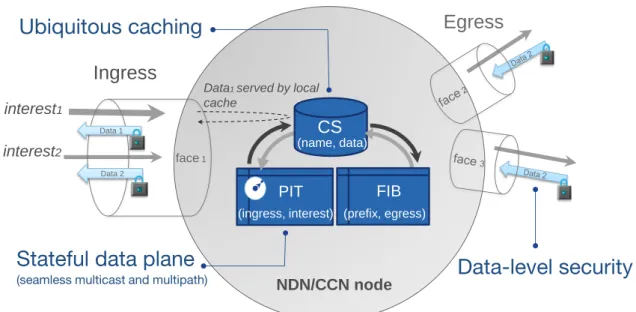
pack-ets through (inter)faces. Because every packet encloses its name, it can be persisted at every hop into a Content Store, a cache, and delivered from the local node to subsequent requesters.
Ingress
Egress
Data1served by local cache interest1 interest2 PIT Data 1 Data 2 NDN/CCN node face 1 (ingress, interest) FIB (prefix, egress)
Ubiquitous caching
Stateful data plane
(seamless multicast and multipath)
Data-level security
(name, data) CS
Figure 1.1 – An NDN/CCN node
1.3.2
NDN operations
As depicted in Fig.1.1, every crossed node, NDN/CCN keeps track in a Pending Interest Table (PIT) of the faces Interests originate from, the time this occurred and the content name they request. If a content chunk is found into the Content Store, called a cache hit event, it is delivered using the state information from the corresponding PIT entry. On the other hand, if that content chunk is not yet or no longer available in the Content Store, this event is denoted as a cache miss. Therefore, a Longest Prefix Match of the content name is looked for into the node’s Forwarding Information Base (FIB). The FIB, populated by a name-based routing protocol, provides for every routable name prefix, egress faces to the missing chunk. Then, the Interest packet gets forwarded according to the configured strategy that might be, for example, Best Route, Broadcast, Load Balancing (LB) or Load Balancing with Persistent Forwarding (LB-Perf) we analyze in this thesis. When the
corresponding Data packet comes back, it is handled by a cache management mechanism such as LAC+ we advocate in this work, and finally sent back to its sequesters while the related PIT entry is deleted. Because of their prominence, common fundamentals and overall operations, both NDN and CCN will be referred to as NDN for conciseness throughout the document.
1.3.3
NDN security
A raison d’être of NDN is the need to build next-generation network protocols with secu-rity in mind. Still, part of the protection brought by NDN is implicit, being a consequence of its architecture. NDN’s explicit security features are the product of decades of research and real-world deployments in public-key cryptography.
Implicit security induced by NDN’s architecture
First, NDN flow balance that requires every single Data packets to be requested by a single matching Interest packet. As a consequence, it mitigates those of Internet DoS that amplify attackers probes. PIT aggregation and caching also contribute to DoS mitigation in filtering storms of interests that address the same object. ICN stateful forwarding plane may help alleviating routing information poisoning in allowing distributed Round-Trip Time (RTT) or Pending Interest- based forwarding strategies [Carofiglio et al.,2013c].
However, one of the most harmful DoS attack against an ICN router would be flooding the PIT with unsatisfiable Interests. Since the identity of the attacker is unknown, it may seem hard to find targeted countermeasures to this threat. Fortunately, NDN allows, by bounding the number of pending Interests per face and per prefix, and backpropagate a flooding containment to the faces directly in touch with the attackers [Gasti et al.,2013].
Not carrying source address helps customer’s identity privacy, especially in dense networks, but does not seals it. The first hop router still able to unambiguously identify the customer attached to its ingress face.
Explicit security features in NDN
Beyond these features induced by NDN architecture, every data packet’s name and pay-load are cryptographically signed for three major benefits: Data integrity ensuring that the
data has not been altered, Producer authentication verifying the identify of who signed the packet, Data validation ensuring data is the genuine reply to the expressed Interest.
While the current Internet security model (IPsec, SSL/TLS) secures entire sessions, ICN applies its data-centric approach to security in securing the data itself. This fine-grained perspective allows different trustees for different pieces of content. On a Web page, the tier signing a chart is not necessarily the text writer or the video producer. Content-centric security also allows every network stakeholder to check signature, not only communicating endpoints. This, for instance, mitigates the spread of tampered con-tent since every intermediate router can check what it stores and forwards. Every Data packet refers to the certificate that signed it. A data packet conveying a public key might be such a certificate in its own right, being itself signed. The choice of a trust model is flexible. Examples are the classical Public Key Infrastructure (PKI) [Housley et al., 2002], or Certification Authority-free alternatives such as PGP’s Web of Trust [Blaze et al., 1996] or the Simple Public-Key Infrastructure/Simple Distributed Security Infras-tructure (SPKI/SDSI) [Ellison et al.,1996].
However, it might be argued that per-packet signature verification is impracticable at
high wire speed due to its computational complexity [Ghali et al., 2014]. Merkle hash
trees [Merkle, 1987] offer the ability to sign and verify signature on a group of packets hashes once, at a parent node. Given that the cost of Public-key algorithms such as RSA-2048 is, at its best, an order of magnitude higher than the cost of hash functions like
SHA-1 [Jang et al.,2011], the improvement must be striking.
Data confidentiality is not an NDN feature per-se but is of the responsibility of the ap-plications. However application-led encryption for data confidentiality is to the detriment of content caching.
1.3.4
NDN routing
NDN can reuse current Internet’s routing protocols such as OSPF or BGP, differing by advertising name prefixes instead of IP addresses. However, the default NDN routing
pro-tocol is Named-data-based Link State Routing (NLSR) [Hoque et al., 2013]. In NLSR,
every router pulls, via Interest packets, routing updates encapsulated in signed Data pack-ets, in conformance with NDN conversational model. By extending Dijstra’ shortest path algorithm, NLSR supports multiple next-hops per prefix while OSPF can only compute
single paths. Moveover, NLSR restricts the synchronization of link state information with neighbours only to minimize the dissemination cost.
While NLSR ultimately makes every router aware of every prefix, [Hemmati and Garcia-Luna-Aceves,2015] recently proposed for scalability purpose, the Link State Con-tent Routing protocol (LSCR). LSCR’s key innovation is to restrict the awareness of each router to the nearest prefix replica.
An interesting alternative being explored is hyperbolic routing [Kleinberg,2007]. The argument is that due to its heterogeneity and strong clustering, NDN namespace has an underlying hyperbolic topology, like the World Wide Web and various complex networks
[Krioukov et al.,2010]. Hyperbolic routing maps nodes and prefixes onto an hyperbolic
metric space and proposes to route packets towards the neighbour that is the closest to the prefix, only by distance calculation between two hyperbolic (radius, angle) coordinate pairs. Instead of updating every router with the whole network topology (nodes, pre-fixes and link states), routers just maintain a list of their neighbours coordinates, a list of prefixes coordinates for deducing next hops. The expected benefit is much less routing information updates, since coordinates do not change upon network conditions or topol-ogy changes and because of NDN forwarding plane ability to dynamically select alternate hops. A weakness of this approach is that the best hyperbolic distance might be much longer than the shortest path. Moreover, this type of coordinate-based greedy forwarding still not guarantees content delivery as there might be local minima cases where none of a node’s neighbours is closer to the destination than the node itself. [Papadopoulos et al., 2010] sees a solution to this last issue in forwarding trapped packets to the closest-to-the-destination node among the least visited neighbours.
1.3.5
NDN forwarding
An IP router has no visibility on the receiver’s flow-control window and sender’s conges-tion windows. It can not regulate ongoing TCP sessions that are end-to-end by design. The specificity of NDN forwarding plane is its stateful nature. The innovative PIT struc-ture keeps track, hop-by-hop, of pending Interests and their incoming faces i.e., every ongoing transfer. Every Data packet takes the exact reverse path of the route their Interest counterpart took. Since a nonce field uniquely identifies Interest packets addressing the same object, the PIT structure can detect and drop looping Interests.
Given these architectural assets, every NDN node provides one on more forwarding algorithms within what is called a strategy layer.
Two types of algorithms essentially operate in that layer: a receiver-located controller, often of the Additive-Increase-Multiplicative-Decrease (AIMD) kind; and hop-by-hop In-terest shapers or, when multiple egress faces exist for a given prefix: load balancers, broadcasters or best route selectors.
The purpose of a receiver-located controller is to fully use the available bandwidth by managing a global congestion window. It might be complemented by some Active Queue Management to sense forthcoming capacity exhaustion and decrease the congestion win-dow with a per-route probability that is proportional to a smoothed Round-Trip Delay [Carofiglio et al.,2013c].
Thanks to the Interest/Data perfect symmetry, flow and congestion control are feasi-ble at each hop by means of Interest shaping. Hop-by-hop Interest shaping leverage rapid and distributed decision making on bursty traffic [Carofiglio et al., 2012; Wang et al., 2013b]. Observe that it is more convenient to buffer Interest packets than Data consid-ering their incomparable size difference. Moreover, NDN’s native multipath support can balance traffic load over several egress faces or adaptively choose different delivery paths on events such as congestion or link failure [Carofiglio et al.,2013c].
1.3.6
Mobility in NDN
User mobility in IP is complex because a wireless link failure may disrupt ongoing TCP sessions. Part of the problem is the lack of native multipath support in TCP, that would have allowed mobiles to connect simultaneously to several networks for a seamless
han-dover [Raiciu et al., 2011]. Conversely, NDN possesses some native multipath support.
This owes to its connection-less conversational model, made reliable and symmetric by the hop-by-hop states maintained in the PIT.
Producer mobility is becoming a stringent need in today’s Internet where applica-tions like Facebook Live and Periscope have democratized video streaming from mobiles. Whereas content producer mobility in IP relies on tunnels to anchors, in NDN, anchor-less mobilityhas been proven feasible [Augé et al.,2015]. It exploits ICN ubiquitous caching to alleviate producer temporary unavailability, and a Temporary FIB at every router on the path to the producer’s former location to reroute traffic.
1.3.7
Caching in NDN
[Imbrenda et al.,2014] demonstrated by means of real traces that a negligible amount of
cache space in customer premises (100MB) may reduce the load within Fiber-To-The-Home (FTTH) networks by 25%, whereas a 100GB cache downstream a backhaul link might offload it by 35%. Once questioned, it reinforces on-path in-network caching in its legitimacy. It makes clear that it would be useless to deport all caching memory to
the very edge of the network, as suggested in [Fayazbakhsh et al., 2013;
Garcia-Luna-Aceves et al.,2014], due to existing-but-insufficient redundancy within the traffic at that stage. The multistage approach of on-path caching combines exploiting intra-customer’s traffic redundancy, with inter-customer/ inter-domain redundancy that traffic aggregation
unveils. From the architectural viewpoint, NDN matches what [Paschos et al., 2016]
foresees for next-generation wireless networks, advocating the penetration of CDN within the Radio Access Network (RAN), spanning mobile devices and base stations, to track any form of traffic redundancy.
Hence, while IP routers are incapable of serving buffered packets to a session other than the one that requested them, cached packets in NDN are entirely reusable since they are uniquely named. Caches are expected to be in every single NDN node. They are a key part of the architecture. Even if caches are supposed to be much bigger than today’s routers packet buffers, they remain obviously finite. A management policy must decide about the items to keep in the Content Store and those to evict. First-In-First-Out, (evict the) Least Frequently Used (LFU) or various enhancements to the (evict the)
Least Recently Used policy (p-LRU, LRU+LCD) [Laoutaris et al.,2004] have often been
appointed to that office.
The performance of a Named-Data Network bears a clear dependency upon the chosen cache management policy. We hereafter describe a few.
Least Frequently Used policy
LFU consists in evicting the object that has accounted the least downloads during the last time window. This way, only the most popular objects of that period remain into the cache. Assuming stationary popularity distribution i.e., that content popularity does not change over time, this is among the most effective policies for load reduction. However, it suffers from two weaknesses:
(i) Insensitivity to the network state. LFU handles every content it sees only based of its local popularity. It simply ignores the true purpose of caching, improving the user Quality of Experience (QoE).
Example 1.3.7.1. Consider a Gigabit Ethernet home network, hosting a
Network-Attached Storage (NAS). The NAS allows the family to share their favourite music, pictures and videos. From their subnetwork, while half the kids would like to browse the NAS, the other half is captivated by the latest viral videos on the Internet. LFU
on the kids NDN router will treat both content categories the exact same way and equally populate its Content Store with material from the NAS, and
hard-to-retrieve Internet videos from saturated servers. This is clearly suboptimal.
(ii) Delayed reaction to popularity variations. LFU needs to collect statistics during a relatively long time frame to hold meaningful popularity figures about every content. For this reason, it performs excellently when there exists a stationary content popularity distribution. In that case, the long-term average of a given content’s ratio of downloads is the probability that any given download conveys it. The latter condition characterizes the Independent Reference Model (IRM) for cache performance analysis we will develop later in this chapter. Under the IRM hypothesis, no surprise that LFU is often
regarded as the ultimate blueprint [Martina et al., 2013]. However Shot Noise Models
(SNM) [Leonardi and Torrisi,2015;Olmos et al.,2015] where objects are published and
end up perishing offer more realistic but less tractable alternatives that do not favor LFU. We address both shortcomings with the Latency-Aware Caching + policy (LAC+) we introduce in the next section.
First-In-First-Out policy
Here, the oldest content in the cache is evicted first. Requesting an object and finding it in the cache (what is called a hit event) does not change its fate as it leaves the cache unmod-ified. Such a behaviour does not exploit content popularity to the fullest, since the cache has no means of marking solicited objects by altering its state accordingly. However, a content’s hit ratio in a FIFO cache still reflects that content’s popularity. Popular objects still have higher hit ratio because of the slow down of the eviction dynamics due to more frequent hits and more frequent insertion after miss events.
A FIFO cache is often implemented as a queue: every new insertion shifts other ob-jects one position to the cache exit. Its simplicity makes it the default cache management policy in NDN. Moreover, from an engineering standpoint, chunk lookup has lower com-plexity in chunk-oriented queues thanks to less fragmentation: packet retransmissions leave a sequence of chunks, contiguous.
Least Recently Used policy
The Least Recently Used policy evicts the object whose last access is the oldest. A simple implementation of this policy consists in moving an object found in a FIFO cache, to its front. This is referred to as the Move-To-Front (MTF) algorithm [Starobinski and
Tse, 2001]. The MTF mechanism confers a much better hit ratio on LRU than FIFO’s
thanks to a more efficient popularity sampling. The most popular objects tend to stay longer in the cache owing to a sort of Time-To-Live reset on object access unveiled by
[Choungmo Fofack et al., 2012]. LRU seamless adaptation to popularity changes and its
simplicity makes it a much better real-world alternative to LFU, explaining somehow why
it has been so often studied [Jelenkovi´c and Kang, 2008; Fricker et al., 2012;Leonardi
and Torrisi, 2015]. LRU’s main drawback remains its lower hit ratio, asymptotically eγ ≈ 1.78 times away from LFU, where γ is Euler’s constant. [Jelenkovi´c,1999].
LRU and Leave-a-Copy-Probabilistically policy (p-LRU)
Take an LRU cache and decide, instead of always inserting every newly downloaded ob-ject on a miss event, to do so with a fixed probability p. This is the p-LRU policy. As surprising as is may seem, doing so, voluntarily by computationally enforcing that proba-bilistic insertion with the assistance of a Pseudo-Random Number Generator (PRNG), or due to some involuntary data corruption [Bianchi et al., 2013], increases cache hit ratio. In fact, the closer to zero p, the closer to LFU the p-LRU system [Martina et al., 2013]. This is an important result that drove the design of our policies LAC and LAC+.
However, as p tends to zero, so few items get stored that p-LRU, p → 0 can only work under the stationary popularity assumption.
LRU and Leave-a-Copy-Down policy (LRU+LCD)
Consider that every downloaded objects crosses a sequence of LRU caches. A policy that consists in storing an object only if it does not come from farther than the preceding cache is called Leave-a-Copy-Down. In other words, if the download path of content k traverses caches 1, · · · , n, LCD is the slight alteration to LRU that inserts content k in cache n (after a miss event) only if the search for that content in cache n − 1 resulted in a hit event [Laoutaris et al.,2004]. When gathered inside the same machine, a sequence of k LRU+LCD caches form what is called an LRU-k cache. However, in LRU-k, the first k − 1 caches just store object identifiers, not actual content.
Theory predicts that LRU+LCD converges to LFU as n grows large [Martina et al., 2013]. In practice, the convergence is quite fast: we observed in most cases that n = 4
suffices to persist the most popular items in the nth cache. LCD works as a multistage
filter where the most popular objects make it through all stages.
Nevertheless, there are two main weaknesses to the LRU+LCD algorithm:
(i) It does not support traffic split. LCD filtering is jeopardized if upstream caches do not contain the same set of objects. It means that the content popularity distri-bution of the miss traffic reaching every egress cache must be identical for LCD to work properly. The reason of this limitation is that every path will isolate the most popular subset of a subset of the catalog, but the union of both subsets inside the cache where the split occurred is not guaranteed to be the most popular subset of the whole catalog. The only multipath forwarding strategy that is LCD-compliant is a content-blind Load Balancing. Later in this thesis, it will be observed that LRU+LCD underperforms under our Persistent forwarding. It owes to the present limitation.
(ii) It does not support content split. Consider a cascade of LRU caches op-erating at content level, whereas the traffic consists of content chunk. LRU+LCD will fail unless we extend the download path by a factor equaling, approximately, the average number of chunks per content. This limitation can be observed when trying to sample content popularity from data packets by means of an LRU-k filter. The solution that con-sists in identifying some content with one of its chunks, chunk 0, for example, is not satisfactory. Indeed, this does not cope with packet retransmission or partial transfers.
RANDOM policy
RANDOM is probably the simplest eviction policy to implement: choose randomly into the cache the content to replace. All objects in the cache have equal probability to be evicted. [Gallo et al., 2012] demonstrated that the policy still offers some traffic reduc-tion and is even suitable for high speed routers. However, its hit ratio per content is
significantly less than LRU’s but equal to FIFO’s [Gelenbe,1973] under the Independent
Reference Model (IRM) assumption we will describe later in the chapter.
1.4
Problem statement
This thesis aims at providing answers to the following questions: 1. Can content delivery in ICN be faster ?
2. Can content delivery in ICN be fair ?
3. Can ICN Forwarding Information Base (FIB) scale ? In a nutshell, our answers to these questions are:
1. Yes ICN can even be 60% faster, by using for example our joint caching and for-warding mechanism, FOCAL.
2. Yes ICN can be fair, just share bandwidth fairly between contents.
3. Yes ICN’s FIB can scale, for example using our AFFORD mechanism that intro-duces Artificial Neural Networks into the content forwarding realm.
We will elaborate on these problems and propose solutions throughout the document, starting from the next section with an brief introduction on our contributions.
1.5
Our contributions
1.5.1
LAC/LAC+: Latency-aware caching
We designed a family of randomized dynamic cache management policies leveraging in-network retrieval latency for cache insertion. The locally monitored metric is the time elapsing at a given node between request forwarding and corresponding packet
recep-tion. The cache management mechanisms LAC and LAC+ [Carofiglio et al.,2015a,c] we
propose consist in the following: every time an object is received from the network, it is stored into the cache with an overall low probability that significantly increases if the content exhibits an exceptional retrieval latency. As such, it is an add-on laying on top of an LRU cache and feeding it at a regulated pace. This way, it implicitly prioritizes popular and long-to-retrieve objects, instead of caching every object regardless. The un-derlying trade-off such a caching mechanism tackles is between a limited cache size and delivery time minimization. As caching intrinsically aims to relieve the fallouts of net-work distance or traffic congestion, it must be aware of both popularity and delay factors to efficiently handle that cache size / delivery time tradeoff. An overall low probability of insertion samples popular objects whereas data retrieval latency is a simple, locally measurable and consistent metric for revealing either haul distance or traffic congestion.
The applicability of our latency-aware cache management policy is broad: Information-Centric Networking networks, data centers, content-distribution networks or multiproces-sor server optimization.
We authored two C++ implementations of LAC and LAC+, one for the CCN Packet
Level Simulator (CCNPL-Sim1) and another for the NS-3 -based NDN Simulator (NDNSim)
that shares code with the NDN Forwarding Daemon. Chapter 2 substantiates LAC and LAC+ algorithms.
1.5.2
FOCAL: joint Forwarding and Caching with
Latency-awareness
Caching needs to be supported by proper packet forwarding [Rossini and Rossi, 2014;
Dehghan et al.,2015] as the performance of the first is driven by the request arrival pro-cess the second is responsible for. At the same time, the traffic to be forwarded is the miss traffic of the local cache. From this observation it appears clearly that caching and
forwarding must be jointly optimized.
It is the purpose of FOCAL [Carofiglio et al., 2015b,2016]. It adopts LAC+ caches,
fed by a novel forwarding strategy LB-Perf that persistently directs the most popular objects through the same interfaces, regularly making sure they can afford it, while load balancing the rest of the traffic.
Chapter 3 substantiates FOCAL. It shows how FOCAL is deduced from the optimal solution of a latency minimization problem. Moreover, we analyze FOCAL stability, thoroughly evaluate its CCNPL-Sim C++ implementation on various network topologies and analyze its sensitivity to various settings.
1.5.3
Fairness in Information-Centric Networking
Chapter 4 investigates the fairness of content throughput allocation when caching
be-comes ubiquitous throughout a network [Bonald et al., 2017]. As caching the most
pop-ular objects is the trend our own caching algorithms enforce, will there be a severe dis-tortion to fairness caching algorithms have to be designed to resorb ? It turns out that ensuring the most popular objects occupy storage, as LFU does, is the caching side of the solution to α-fair throughput allocations problems. α-fair content-level packet scheduling is the complementary part of the solution.
In other words, caching policies do not need to be designed for fairness as previous work suggested. Not focusing on cache hit ratio but on the throughput fairness, show that α-fairness in ICN can be handled in a similar way as in traditional networks, through packet scheduling.
1.5.4
AFFORD: Ask For Directions, machine learning-based
routing
The last contribution of this thesis addresses the prohibitive cost of performing a Longest Prefix Match over a huge FIB. Indeed, considering the unlimited namespace of the an-ticipated Internet of Everything, it would be hard to forward packets at every node based on an exact knowledge of paths to destinations. With Ask For Directions (AFFORD)
[Mekinda and Muscariello, 2016], we propose to train a trie of small Artificial Neural
probable next hops.
Chapter 5 substantiates the novel AFFORD routing approach.
1.6
Mathematical foundations
Little introduction or reminder on a few mathematical concepts should ease the reading of this document.
1.6.1
Elements of probability theory
A stochastic process {X(t)}t≥0 is a sequence of random variables X(t) on the same
probability space, indexed by time instants t [Tucker,2013].
Continuous-Time Markov Chain
Also known as Markov process, a CTMC [Bertsekas et al.,1992] is a stochastic process
{X(t)}t∈R+, taking values from a countable state space S = {in: n ∈ N}, and such that:
1. The time Tithe process spends in every state i ∈ S is such that Ti ∼ Exp(νi).
2. The process leaves every state i ∈ S to enter another state j with probability Pij
such thatP
jPij = 1.
Let qi,j ≡ νiPij and pj = limt→∞P[X(t) = j|X(0) = i]. pj, in the special case of
regular CTMC (almost sure finite number of transitions over any finite time interval),
exists and is independent of the initial state i. The global balance equations for a CTMC are:
pj ∞ X i=0 qji = ∞ X i=0 piqij, ∀j.
The detailed balance equations for a CTMC, which hold for birth-death processes, are:
Note that birth-death processes are Markov processes where qij = 0 for |i − j| > 1.
Let j ≡ i + 1, qij is called a birth rate and qji is called a death rate. If ∀i, qji = 0, the
process is called a pure birth process.
Counting Process
A counting process {X(t)}t≥0is a stochastic process whose sample path is a non-decreasing,
right-continuous step function taking nonnegative integer values i.e., X(t) ∈ N and (s ≤ t ⇒ X(s) ≤ X(t)). Also, X(0) = 0 a.s.. Since X(·) increases by jumps only, occurring at specific times called jump times, it is a kind of jump process.
Renewal Process
A renewal process [Cinlar,2013] {Sn}n∈N∗is a stochastic process where:
1. Snis elapsed time up to the nth jump of a companion counting process {X(t)}t≥0.
Sn, ∀n, are called renewal times.
2. the sojourn or holding times, i.e., the inter-jump times Tn, of its companion
count-ing process are independent and identically distributed with mean m.
Theorem 1.1 (Elementary Renewal Theorem). For a renewal process,
lim
t→∞
X(t)
t =
1
m a.s. by the Strong Law of Large Numbers and
lim t→∞ IE[X(t)] t = 1 m. Poisson Process
A stochastic process {X(t)}t≥0is a Poisson process with intensity (or rate) ν if
1. {X(t)}t≥0is a counting process.
2. The number of arrivals that occur in disjoint time intervals are independent.
3. The number of arrivals in any interval of length τ is said to be Poisson distributed with parameter ντ i.e.,
∀n ∈ N, τ > 0, P[X(t + τ ) − X(t) = n] = (ντ )
n
n! e
−ντ
Then, inter-arrival times Tnare exponentially distributed with parameter ν i.e.,
∀τ ≥ 0, P[Tn ≤ τ ] = 1 − e−ντ.
This distribution is memoryless, in the sense thatP[Tn > τ + t|Tn > t] = P[Tn > τ ].
Due to its exponential sojourn times Tnand non-decreasing states, a Poisson process
is a pure birth process with constant birth rates. The arrival times of a Poisson process i.e., the sums of the X(t) sojourn times form a renewal process.
A Poisson process, defined earlier as a counting process may also be interpreted through its increments during time intervals. As such, it is an homogeneous (or station-ary) Poisson point process defined on the real line. It is said to be stationary because of its constant intensity ν, which implies that the distribution of points does not depend on the interval position on the real line. As such, it is translation-invariant. Otherwise, the process is called an inhomogeneous Poisson point process.
1.6.2
Queuing theory fundamentals
Throughout this thesis, our usage of the latency owes to queuing delays. It is the time an object (packet or flow), also referred to as customer, spends in the queuing system [Bertsekas et al.,1992;Médard,2008].
A queuing system is characterized by a stochastic process {N (t)}t≥0giving the
num-ber of customers in the system at time t.
Parameters
The queue has two main parameters, the number of customer arrivals resp. departure up to time t, α(t) , resp. β(t). We usually consider known the long-term arrival rate
λ = limt→∞α(t)/t and the service time random variable X such that the mean service
rate µ = (IE[X])−1.
Properties
The long-term average number of customers in the system. We denote it ¯ N = lim τ →∞ 1 τ Z τ 0 N (t)dt.
Provided that the system is assumed ergodic, the long-term average number of
cus-tomers equals the mean number of cuscus-tomers as t → ∞ : ¯N = limt→∞IE[N (t)].
Further-more, the long-term arrival rate equals the long-term departure rate i.e.,
λ = lim
t→∞
β(t) t < µ.
The long-term average of the time spent waiting in the queue denoted ¯W .
The long-term average of the time spent in the system. Denoted ¯T , it is the also known as the long-term average delay encountered by any customer waiting in the queue, then being served. it is also called mean sojourn time. Let Tkbe the time spent in
the system by a given customer k. The cumulative time spent by all the customers in the system divided the total number of arrivals at the infinity gives ¯T i.e.,
¯ T = ¯W + IE[X] = lim t→∞ 1 α(t) α(t) X k=1 Tk.
The steady-state probability of finding n customers in the system is assumed to exist and equals
pn = lim
t→∞P[N(t) = n].
Theorem 1.2 (Little’s theorem). The long-term average number of customers in
the system equals
¯
N = λ ¯T .
Thanks to its broad applicability, Little’s theorem also holds for the long-term average number of customers waiting in the queue, or those being served. Furthermore, it holds
for a given class of customers.
Kendall’s notation
Queues are classified according to the following compound expression:
<Arrival type>/<Service Type>/<Number of servers>[/<Buffer size>][-<Discipline>]. Arrival and service types may be, for example, Markov or Memoryless, which implies exponential inter-arrival times, or Deterministic or General.
By default, the buffer size is deemed infinite. Among service disciplines, there are First-In-First-Out (FIFO) the default discipline handling customers sequentially, or Processor Sharing (PS) handling all customers simultaneously.
FIFO service discipline
M/G/1/∞-FIFO. In M/G/1, customers arrive according to a Poisson process but the service times obey to a law that is not necessarily exponential. The Pollaczek-Khinchin formula is a key result for understanding such a system.
Theorem 1.3 (Pollaczek-Khinchin formula). Let ¯W be the long-term average time spent by a customer waiting in the queue. Define the load of the queue ρ = λ/µ. The waiting time of an M/G/1 queue is
¯
W = λIE[X
2]
2(1 − ρ).
The related delay/sojourn time follows by adding the mean service time: ¯ T = λIE[X 2] 2(1 − ρ) + IE[X]. By Little’s theorem, ¯ N = λ 2IE[X2] 2(1 − ρ) + ρ.
The Pollaczek-Khinchin formula is the general framework for expressing the first-moments of more specific queues.
M/M/1/∞-FIFO. In M/M/1, X ∼ Exp(µ). The second moment of X is IE[X2] = 2/µ2. It follows that ¯ W = ρ µ − λ; T =¯ 1 µ − λ; N =¯ ρ 1 − ρ = λ µ − λ.
The same results could have been derived by modeling the M/M/1 queue as a Continuous-Time Markov Chain, observing from the detailed balance equations that its steady-state measure is a geometric probability mass function. This second way remains the easiest way to obtain the queue’s stationary distribution.
pn= ρn(1 − ρ).
M/D/1/∞-FIFO. In M/D/1, X = 1/µ a.s. The second moment of X is IE[X2] = 1/µ2.
It follows that ¯ W = ρ 2(µ − λ); ¯ T = 1 2(µ − λ); ¯ N = λ 2(µ − λ).
Processor sharing service discipline
The Egalitarian Processor Sharing discipline (PS) consists in serving the n customers in the system with equal rates µ/n. As such, it is an idealization of the Round-Robin scheduling algorithm. Customers are served immediately upon arrival. The PS discipline is known to be insensitive to the distribution of the service time X beyond the mean. This implies that the system’s first-order properties will simply depend on mean values such as IE[X].
PS insensitivity is clear from the following M/G/1-PS mean properties, which by the way coincide with those of M/M/1-FIFO:
¯
T = 1
µ − λ; N =¯
λ µ − λ.
Processor sharing queues have proven to be useful models for performance analysis of fluid approximations of the traffic, under fair bandwidth sharing. TCP sessions whose arrival is assumed to follow a Poisson process have been modeled this way [Fredj et al., 2001].
1.6.3
Lyapunov optimization
As in [Georgiadis et al., 2006], we verify the stability of a queuing network under some optimization policy by use of a Lyapunov function. A Lyapunov function is a nonnegative scalar measure on a vector representing the state of the system at a given time. In our context, that state is the vector process of all queue backlogs (or unfinished work). The expected change in the Lyapunov function between two consecutive epochs is called the Lyapunov drift. It is aimed to be bounded by a small negative value whenever the sum of queue backlogs grows sufficiently large, to ensure the system stability. The minimiza-tion of a quadratic Lyapunov funcminimiza-tion drift in a queuing network is demonstrated to be throughput optimal and leads to the backpressure algorithm.
1.6.4
Nonlinear optimization
In this thesis, we tackle nonlinear optimization problems, either featuring a nonlinear objective function to be minimized or maximized, or encompassing nonlinear constraints. Such problems are of the following form:
Minimize f (x) subject to : gi(x) ≤ 0 i = 1, · · · , N gj(x) = 0 j = N + 1, · · · , M.
where f and gi, i = 1, · · · , M are continuously differentiable functions from Rn to R
[Bertsekas,1999].
Define the function L(x, λ) ≡ f (x) + PM
i=1λigi(x) called the Lagrangian of the
problem. λ ≡ (λi) is a vector of the so-called Lagrangian multipliers. Define x∗ as a
local minimum and λ∗ ≡ (λ∗
i) as the vector of optimal multipliers.
Definition 1.1. Vector x∗ is said to be regular, if the constraint gradients ∇gi(x∗), ∀i
are linearly independent.
assump-tion that x∗is regular, there exists a unique vector of multipliers λ∗such that ∇xL(x∗, λ∗) = ~0. (stationarity condition)
Furthermore, the primal feasibility conditions hold: gi(x∗) ≤ 0 i = 1, · · · , N
gj(x∗) = 0 j = N + 1, · · · , M.
The dual feasibility conditions also hold:
λ∗i ≥ 0 i = 1, · · · , M as well as the complementary slackness conditions:
λ∗igi(x∗) = 0 i = 1, · · · , M.
The complementary slackness conditions aim at enforcing that at any local minimum, every constraint i is either saturated, (meaning that gi(x∗) = 0) or inactive (meaning that
λ∗i = 0).
Definition 1.2 (Convex set). A convex set within an Euclidean space is a region
such that a line segment joining any pair of points lies entirely in that region.
Definition 1.3 (Convex function). A twice continuously differentiable function is
convex on a convex set iif its Hessian matrix is positive semi-definite on the interior of that convex set.
If the Lagrangian function is convex on its domain, KKT optimality conditions are also sufficient; hence x∗is also a global minimum.
To tackle a maximization problem, just replace f (x) by −f (x) to convert it into its minimization counterpart where the above KKT conditions pertain.
1.6.5
Cache performance analysis
A substantial part of our work involves modeling caches. In this section, we present the fundamentals of cache performance analysis.
The IRM hypothesis
The Independent Reference Model (IRM) assumes an immutable set of independent content-k request processes, ∀content-k, that must all be homogeneous Poisson processes [Martina et al., 2013]. As the superposition of independent Poisson processes, the aggregate request traf-fic itself follows a Poisson process. This stationary traftraf-fic model, though simple and incapable of accounting for any temporal locality, has been effective on real ISP traffic
at short timescale (∼ 24 hours) [Imbrenda et al., 2014]. Authors found discrete Weibull
with shape 0.24 to better fit the empirical popularity distribution than the usual Zipf law with skewness 0.7 ≤ α ≤ 0.85.
At a longer scale, documents get published and perish, resulting in catalog dynam-ics that only more sophisticated models can capture. Thus, Shot Noise Models (SNM)
[Traverso et al., 2013; Olmos et al., 2014] have been introduced to render the reality
of time-varying content popularity, at the cost of a diminished tractability. In SNM, a Poisson cluster request process aggregates independent content-k request processes, ∀k, which are inhomogeneous Poisson processes of rising-and-vanishing intensities.
In this thesis, similarly to recent works in the field, [Garetto et al., 2015, 2016], our models assume stationary traffic. Nevertheless, whereas others use some form of renewal traffic (general or ON-OFF-modulated homogeneous Poisson processes), we assume ex-ponentially distributed inter-request times i.e., IRM, reasonable at short timescale.
Che’s approximation
Some exact cache performance analysis exist, based on the stationary distribution of a
Markov process [Gelenbe, 1973]; but they are impeded by their intractable
computa-tional complexity that grows exponentially with the cache and the catalog size [Dan and Towsley, 1990]. A prominent approach for taming the complexity of cache analysis, in-troduced in [Che et al.,2006], is referred to as Che’s approximation.
Under IRM and according to Che’s approximation of the LRU cache hit ratio content k hit probability in a cache of size x is
hk(τx) = 1 − e−qkτx.