The Hudson Bay Lithospheric Experiment (HuBLE): insights into
Precambrian plate tectonics and the development of mantle keels
I. D. BASTOW
1*, D. W. EATON
2, J.-M. KENDALL
3, G. HELFFRICH
3, D. B. SNYDER
4,
D. A. THOMPSON
5, J. WOOKEY
3, F. A. DARBYSHIRE
6& A. E. PAWLAK
21
Department of Earth Science and Engineering, Imperial College London, London SW7 2AZ, UK
2Department of Geoscience, University of Calgary, Alberta, Canada T2N 1N4
3
Department of Earth Sciences, University of Bristol, Bristol BS8 1RJ, UK
4
Geological Survey of Canada, Natural Resources Canada, Ottawa, Ontario, Canada K1A 0E9
5School of Earth and the Environment, University of Leeds, Leeds LS2 9JT, UK
6
Centre de Recherche GEOTOP, Universite´ du Que´bec a´ Montre´al,
Montre´al, Que´bec, Canada H3C 3P8
*Corresponding author (e-mail: [email protected])
Abstract: Hudson Bay Lithospheric Experiment (HuBLE) was designed to understand the pro-cesses that formed Laurentia and the Hudson Bay basin within it. Receiver function analysis shows that Archaean terranes display structurally simple, uniform thickness, felsic crust. Beneath the Palaeoproterozoic Trans-Hudson Orogen (THO), thicker, more complex crust is inter-preted as evidence for a secular evolution in crustal formation from non-plate-tectonic in the Palaeoarchaean to fully developed plate tectonics by the Palaeoproterozoic. Corroborating this hypothesis, anisotropy studies reveal 1.8 Ga plate-scale THO-age fabrics. Seismic tomography shows that the Proterozoic mantle has lower wavespeeds than surrounding Archaean blocks; the Laurentian keel thus formed partly in post-Archaean times. A mantle transition zone study indi-cates ‘normal’ temperatures beneath the Laurentian keel, so any cold mantle down-welling associ-ated with the regional free-air gravity anomaly is probably confined to the upper mantle. Focal mechanisms from earthquakes indicate that present-day crustal stresses are influenced by glacial rebound and pre-existing faults. Ambient-noise tomography reveals a low-velocity anomaly, coincident with a previously inferred zone of crustal stretching, eliminating eclogitization of lower crustal rocks as a basin formation mechanism. Hudson Bay is an ephemeral feature, caused principally by incomplete glacial rebound. Plate stretching is the primary mechanism responsible for the formation of the basin itself.
Gold Open Access:This article is published under the terms of the CC-BY 3.0 license.
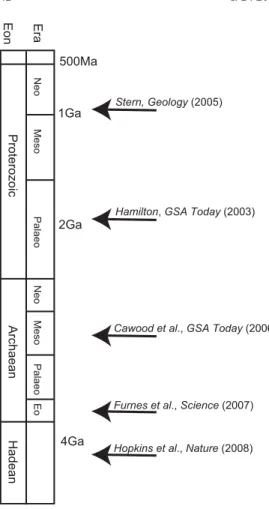
Much of the geological record can be interpreted in the context of processes operating at the present-day plate boundaries. While the plate tectonic para-digm works well to explain processes and products during the Phanerozoic era, during Precambrian times, when the oldest rocks were forming, condi-tions on the younger, hotter, more ductile Earth were probably very different, making analogies with modern-day tectonics less certain. The pre-cise onset of ‘continental drift’ is disputed; it has, for example, been estimated to be as early as c. 4.1 Ga (e.g. Hopkins et al. 2008), or as late as c. 1 Ga (e.g. Stern 2005) – a time span covering approximately two-thirds of Earth history (Fig. 1). Gathering evidence preserved deep within the plates in stable Precambrian regions (shields) is thus essential to improve our understanding of early Earth processes.
Cratonic regions are readily identified in global tomographic images where they are characterized by their deep-seated, fast wavespeed lithospheric keels. Roots can extend to depths of≥250 km into the upper mantle, in contrast to the oceans and Pha-nerozoic continents where the plates are usually ≤100 km thick (Fig. 2; e.g. Ritsema et al. 2011). The tectosphere, or lithospheric mantle beneath a craton (e.g. Jordan 1988), is thus thought to have a thermochemical signature that differs from aver-age lithospheric mantle, and keel formation is com-monly associated with Archaean processes, such as the extraction of komatiitic magmas (e.g. Griffin et al. 2003), to explain the intrinsic low density of the tectosphere. It is estimated that the chemical lithosphere must be more viscous than normal mantle by a factor of c. 20 (Sleep 2003), enabl-ing it to survive thermal and mechanical erosion
From: Roberts, N. M. W., Van Kranendonk, M., Parman, S., Shirey, S. & Clift, P. D. (eds) 2015. Continent Formation Through Time. Geological Society, London, Special Publications, 389, 41 – 67. First published online November 27, 2013, http://dx.doi.org/10.1144/SP389.7
during multiple Wilson cycles over billions of years. Precisely how keels formed remains poorly under-stood, however.
The geological record of northern Canada spans more than 2 billion years of early Earth history (c. 3.9 – 1.7 Ga; Hoffman 1988), making it an ideal study locale for the analysis of Precambrian Earth processes. In the heart of the Canadian Shield lies Hudson Bay, a vast inland sea, which masks a sig-nificant portion of the Trans-Hudson Orogen (THO), a Palaeoproterozoic collision between the Archaean Superior and Western Churchill cratons. The THO signalled the final stages of assembly of Laurentia at c. 1.8 Ga (Fig. 3: Hoffman 1988; St-Onge et al. 2006; Eaton & Darbyshire 2010). The region is underlain by one of the largest continental keels on Earth (Fig. 2) and is also the site of one of the largest negative geoid anomalies (e.g. Hoffman 1990). The cratonic keel beneath the Hudson Bay region extends beneath both Archaean and Protero-zoic terranes. How these various lithospheric
subdivisions of the Canadian shield were assembled in Precambrian times, how the deep cratonic keel formed beneath them, and how the Hudson Bay basin subsequently developed within the shield, have each been difficult questions to address until recently. Hypotheses have been based principally on evidence from the geological record and poten-tial field maps (e.g. gravity and magnetics), and seis-mological studies of the deeper mantle were limited by the availability of data from only two or three permanent seismic stations.
To address outstanding research questions exem-plified by the Hudson Bay region, a broadband seismograph network in the Hudson Bay region was deployed by the Hudson Bay Lithospheric Exper-iment (HuBLE); stations have operated since 2003. The purpose of this contribution is to review the results of HuBLE, and to synthesize their impli-cations for Precambrian processes, the formation of the Laurentian keel, and the reasons for the Pha-nerozoic development of the Hudson Bay basin. In addition to reviewing already-published HuBLE constraints (e.g. Thompson et al. 2010; 2011; Bas-tow et al. 2011a, b; Pawlak et al. 2011, 2012; Stef-fen et al. 2012; Snyder et al. 2013; Darbyshire et al. 2013), this contribution presents the results of a new P-wave relative arrival-time tomographic study of mantle wavespeed structure beneath the region.
Tectonic setting
The Canadian Shield lies in the heart of Precam-brian North America. Comprising several Archaean terranes brought together during a series of orogens during the Palaeoproterozoic, the region is one of the largest exposures of Precambrian rocks on Earth (Hoffman 1988). The major phase of moun-tain building in the region was believed to have occurred at c. 1.8 Ga during the THO (Hoffman 1988; St-Onge et al. 2006). The Superior craton formed the indenting lower plate to the collision; the Churchill plate, presently lying to the north of the Superior craton, was the upper plate. Extensive geological mapping in recent years has added con-siderable detail to this two-plate picture (Fig. 3).
It is now thought that northern Hudson Bay comprises seven distinct crustal blocks, including the Superior, Rae, Hearne, Chesterfield, Meta Incognita, Sugluk and Hall Peninsula (Fig. 3; see e.g. Snyder et al. 2013; Berman et al. 2013, for a more detailed review). The Superior craton to the south is a collage of Meso- to Neoarchaean microcontinents and oceanic terranes amalgamated 2.72 – 2.66 Ga. The Ungava Peninsula bounds east-ern Hudson Bay and exposes 3.22 – 2.65 Ga felsic orthogneiss and plutonic rocks that underlie c. 2.0 – 1.87 Ga volcanic and sedimentary rocks of Hopkins et al., Nature (2008)
Furnes et al., Science (2007) Cawood et al., GSA Today (2006)
Hamilton, GSA Today (2003) Stern, Geology (2005) 4Ga 2Ga 1Ga 500Ma Eon Era Proterozoic Archaean Hadean Palaeo Meso Neo Palaeo Meso Neo Eo
Fig. 1. Estimates of the onset of modern-style plate tectonics.
the Cape Smith fold belt (e.g. St-Onge et al. 2009, and references therein).
The Rae craton comprises Meso- to Neoarcha-ean, amphibolite- to granulite-facies, tonalitic to gra-nitic orthogneisses and NE-striking c. 2.9 – 2.7 Ga greenstone belts (e.g. Jackson 1966; Wodicka et al. 2011a). The Rae is intruded by 2.72 – 2.68 Ga tonalite, with voluminous c. 2.62 – 2.58 Ga mon-zogranitic plutons (e.g. Bethune et al. 2011, and references therein) extending from northwestern Saskatchewan at least as far east as Melville Penin-sula (Wodicka et al. 2011a). Zircon inheritance and Nd model ages of up to 3.6 Ga confirm the
ancient nature of the northern Rae domain (e.g. Whalen et al. 2011).
The Hearne craton is characterized by c. 2.7 Ga mafic to intermediate volcanic rocks (e.g. central Hearne supracrustal belt; Davis et al. 2004) cut by c. 2.66 Ga granitic plutons associated with regional metamorphism (Davis et al. 2004). The Hearne is distinguished from Rae by its relatively young (Mesoarchaean) volcanic rocks, and by its lack of Archaean magmatism or tectonism post 2.66 Ga. The Chesterfield block (C.B. in Fig. 3; Davis et al. 2006) comprises c. 2.7 Ga supracrustal rocks and tonalite plutons, but lacks both the komatiitic Shear velocity anomaly (%)
Depth = 225 km 225 250 275 300 km Canadian Canadian Shield Shield Congo Congo Craton Craton W. African W. African Craton Craton Fennoscandia Fennoscandia Siberia Siberia Australia Australia Antarctica Antarctica China China Arabia Arabia LAB Depth (a) (b) -2 -1 0 1 2 Sao Sao Francisco Francisco Craton Craton
Fig. 2. (a) A slice at 225 km depth through the global shear wave tomographic model of Ritsema et al. (2011). The regions of fast wavespeed delineate the cratons world-wide. (b) A global view of the lithosphere– asthenosphere boundary (LAB) based on the model of Ritsema et al. (2011). The depth of the LAB can be defined in several ways (e.g. Eaton et al. 2009), but is defined here as the depth to the 1.75% fast contour. Areas of apparently thick lithosphere that are an artefact of high-wavespeed subducting slabs in the mantle are not plotted and thus appear as black (in oceanic regions) or white (in continental regions).
assemblages and evolved isotopic character of the Rae craton. The Chesterfield block is intruded by 2.6 Ga granitic plutons (Davis et al. 2006) that are thought to have formed after its c. 2.64 Ga accre-tion to the Rae craton (Berman et al. 2007). Smaller and less well understood domains in NE Hudson Bay include the Meta Incognita, Sugluk and Hall Peninsula blocks (Fig. 3).
The Meta Incognita microcontinent (Fig. 3) includes Palaeoproterozoic (2.40, 2.34 – 2.31, 2.15, 1.95 Ga) and lesser Neoarchaean (2.68 – 2.6 Ga) components (St-Onge et al. 2006; Wodicka et al. 2011b), overlain by Palaeoproterozoic clastic car-bonates of the c. 1.9 Ga Lake Harbour Group (Scott 1997; Wodicka et al. 2011b). The Sugluk block (e.g. Corrigan et al. 2009, and references therein) includes Mesoarchaean crust that crops out on SW Baffin Island and nearby islands in
Hudson Bay. It is inferred from evolved Nd signa-tures to underlie the northern tip of Quebec (e.g. Corrigan et al. 2009) where it is heavily intruded by younger c. 1.86 – 1.82 Ga plutons (St-Onge et al. 2006). Corrigan et al. (2009) suggested that it may extend west under Hudson Bay to merge with a gravity high referred to as the ‘Hudson protoconti-nent’ (Roksandic et al. 1987; Berman et al. 2005). Hall Peninsula, southeastern Baffin Island, exposes Mesoarchaean crust (2.92 – 2.8 Ga zircon crystalli-zation ages; Scott 1997) which, given its spatial dis-tribution, is tentatively considered a separate crustal block (e.g. Whalen et al. 2010). Amalgamation of Meta Incognita and the Sugluk block is postulated to have occurred in an intra-oceanic setting shortly before c. 1.9 Ga (Wodicka et al. 2011b). The Hall Peninsula block was also considered to be a part of this composite block, which is referred to by
−110˚ −100˚ −90˚ −80˚ −70˚ −60˚ 60˚ 70˚ Rae Rae Trans Hudson Orogen Soton. Is. Hearne Hearne Hudson Strait
Baffin Island
Baffin Strait
SUPERIOR
SUPERIOR
PLATE
PLATE
CHURCHILL
CHURCHILL
PLA
PLA
TE
TE
Foxe Basin C.B. C.B. B.S. M.I. M.I. S.T.Z. Sugluk Sugluk Ch.B. Ch.B. H.P.H.P. Superior/Hearne Rae Greenstone Terranes Arc Material Granite Fold Belts
Sedimentary Rocks Phanerozoic Cover
ARCHAEAN PALAEOPROTEROZOIC RECENT
Grenville Ungava Peninsula C.S.F.B. M.P.
Hudson
Hudson
Bay
Bay
Baker Lake/Thelon Groups
Diamond Prospect
Fig. 3. Seismograph networks in northern Hudson Bay superimposed on regional geology. Ch.B., Chesterfield Block; C.B., Cumberland Batholith; B.S., Baffin Suture; C.S.F.B., Cape Smith Fold Belt; H.P., Hall Peninsula; M.I., Meta Incognita; STZ, Snowbird Tectonic Zone. Yellow triangles are HuBLE-UK stations. White triangles are POLARIS network stations. Blue triangles are permanent stations.
Snyder et al. (2013) as the Meta Incognita – Sugluk – Hall Peninsula (MISH) block. This composite block, as well as the adjacent Rae, is intruded by voluminous charnockitic rocks of the 1.865 – 1.845 Ga Cumberland Batholith, thought to have formed by deep crustal melting subsequent to litho-spheric delamination (Whalen et al. 2010). Younger, c. 1.83 Ga plutons form late syn- to post-tectonic plutons across southern Baffin and South-ampton Islands (e.g. St-Onge et al. 2006).
The crustal blocks surrounding Hudson Bay region have been affected by four major tectonic/ metamorphic events between 2.56 and 1.8 Ga (see Berman et al. 2010a, for a detailed summary and metamorphic maps). The oldest event, the 2.56 – 2.50 Ga MacQuoid orogeny, affected the Chester-field block and adjacent southeastern flank of the Rae craton. The 2.5 – 2.3 Ga Arrowsmith orogeny (Berman et al. 2005, 2010a; Schultz et al. 2007) affected much of the western side of the Rae craton from northern Saskatchewan through Boothia Pen-insula to northern Baffin Island (Berman et al. 2010a, 2013). The 2.0 – 1.9 Ga Thelon orogeny (Hoffman 1988) affected the westernmost Rae craton, including northern Boothia Peninsula (Ber-man et al. 2010a). The most widespread tectonic/ metamorphic reworking of the Hudson Bay region occurred during the 1.9 – 1.8 Ga Hudsonian orogeny (e.g. Hoffman 1988; Berman et al. 2010b) when accretion of microcontinents to the SE flank of the Rae craton occurred c. 1.9 – 1.87 Ga. These tectonic events are known collectively as the Snowbird phase of the Hudsonian orogeny (Berman et al. 2007).
Proposed under-thrusting of the Superior cra-ton beneath the Churchill collage and the Cape Smith belt was initiated by c. 1.82 Ga (St-Onge et al. 2006). Palaeozoic events include deposition of carbonate rocks, presently estimated to be up to 1.5 km thick, on crystalline basement rocks of Hud-son Bay, western Southampton Island, and nearby Coats and Mansel islands. At least five separate, potentially diamondiferous, kimberlite fields are known to have erupted during the Mesozoic and Cenozoic, providing mantle xenoliths and garnet xenocrysts that sample the mantle below the study area (Fig. 3).
Previous seismological studies
of the Canadian Shield
The first constraints on the seismic structure of the Hudson Bay region were presented in the early 1960s by Brune & Dorman (1963) using surface-wave dispersion computed from two-station paths typically thousands of kilometres long. Hobson (1967) and Ruffman & Keen (1967) subsequently
studied crustal structure using controlled source data recorded by both land and sonobuoy recorders. Since then, several studies have mapped wave-speeds beneath the Canadian Shield using surface waves in regional to global-scale models. In general the global models use data from permanent seismograph networks, resulting in reduced resol-ution beneath the Bay region; the two or three seis-mograph stations contributing to the inversions yield a limited number of surface wave paths across the shield (e.g. Megnin & Romanowicz 2000; Shapiro & Ritzwoller 2002; Lebedev & van der Hilst 2008). They indicate that Hudson Bay is underlain by a c. 200 – 300 km deep fast wavespeed mantle keel (e.g. Lebedev & van der Hilst 2008; Li et al. 2008; Nettles & Dziewonski 2008; Ritsema et al. 2011). Continent-scale models such as those of Bedle & van der Lee (2009) and Yuan et al. (2011) also indicate a deep-seated, fast wavespeed mantle keel beneath the Canadian Shield.
Some of the tomographic inversions take seismic anisotropy into account, but the results are variable. The model of Debayle et al. (2005), for example, yields east – west fast anisotropic directions beneath the Bay region, while the model of Marone & Romanowicz (2007) indicates NW – SE fast direc-tions in the same depth interval, rotating to NE – SW at 300 km. Yuan et al. (2011) presented a con-tinent-scale model of seismic heterogeneity within the North American craton, using joint inversions of long-period waveforms and SKS splitting data. They found evidence for a two-layered lithosphere. The 150 – 200 km-thick upper layer has fast polariz-ation directions correlated with trends in surface geology, and was interpreted as the chemically depleted ‘lid’ of the shield. The lower lithospheric layer, with different anisotropic characteristics, was interpreted by Yuan et al. (2011) as a signifi-cantly younger, less-depleted thermal boundary layer. The Yuan et al. (2011) model attributes aniso-tropic fast polarization directions at asthenospheric depths to anisotropic fabric development owing to absolute plate motion. This model places the lithosphere – asthenosphere boundary (LAB) at a depth of c. 200 km depth everywhere beneath the Bay region and throughout the entire Canadian Shield, based on the anisotropic stratification of the upper mantle model.
S to P receiver function studies (Rychert & Shearer 2009; Abt et al. 2010; Miller & Eaton 2010; Kumar et al. 2012) provide support for an abrupt change in seismic wavespeed at c. 80 – 150 km depth across much of North America. If interpreted in the context of the two-layered litho-sphere hypothesis of Yuan et al. (2011) or Darby-shire et al. (2013), this feature probably represents a mid-lithospheric discontinuity beneath cratonic North America.
The c. 200 – 260 km lithospheric thickness in central and northern Canada inferred in the sur-face wave studies is corroborated by estimates of the thermal boundary layer, as inferred from joint interpretation of surface heat flow and S-wave travel time delays (e.g. Le´vy et al. 2010). Although based on sparse data coverage, heat flow data from northernmost Ontario and central-northern Quebec are the lowest anywhere across the Canadian Shield. The thickness of the thermal lithosphere beneath the Canadian Shield varies regionally by up to c. 100 km (Artemieva 2006; Le´vy et al. 2010).
Previous studies of the mantle transition zone beneath the Canadian Shield were limited to imaging the receiver-side structure using a small number of permanent stations located large dis-tances apart (Bostock 1996; Chevrot et al. 1999), geographically restricted temporary networks (Li et al. 1998) or global studies utilizing mid-point reflections from distant source – receiver combi-nations (e.g. Gossler & Kind 1996; Gu et al. 1998; Flanagan & Shearer 1998; Gu & Dziewonski 2002; Lawrence & Shearer 2006). Several of these studies showed that the transition zone structure was uni-form across the region (less than +5 km; Bostock 1996), yet sparse geographical coverage of receiver functions or lower resolution (PP and SS precur-sors) meant that it was unclear whether this pattern was true beneath large swathes of the shield.
On a more local scale, the Teleseismic Western-Superior Transect (TWIST; see Kendall et al. 2002 for a review) experiment deployed 11 short-period and 14 broadband seismometers along a 600 km line in the Superior region of SW Hud-son Bay in May – November 1997. A further three broadband stations were deployed further north on the Hudson Bay coastline (e.g. Kay et al. 1999). TWIST data were used in regional seismic tomo-graphic imaging of upper mantle wavespeed struc-ture (Sol et al. 2002) in an SKS study of mantle anisotropy (Kay et al. 1999) and a receiver func-tion study of crustal structure (Angus et al. 2009). The tomographic study did not yield evidence for differences between Archaean and Protero-zoic mantle wavespeed. In contrast, the splitting study revealed marked differences between the two domains, with null measurements characteriz-ing the Proterozoic coastal areas, while moderate to large splitting was found to parallel Archaean Superior trends.
The HuBLE seismograph networks
Preliminary discussions began in the early 1990s concerning a Hudson Bay Lithospheric Experiment designed to study crust – mantle dynamics beneath
Hudson Bay, to determine the reason for this intra-cratonic basin, and to understand the Precam-brian processes that shaped the central Canadian Shield. Four co-ordinated activities were discussed: a network of three-component broadband stations deployed for several years, deep seismic reflec-tion profiling along 600 km profiles, ocean-bottom seismometers and single-component land stations to record the large air-gun array to be used in the profiling. International co-ordination and funding of the marine profiling has not yet been achieved, but the network of three-component broadband stations has now been completed by the Canadian and UK components of HuBLE.
The Geological Survey of Canada began de-ploying POLARIS (Portable Observatories for Lithospheric Analysis and Research Investigating Seismicity; Eaton et al. 2005) around western Hudson Bay in 2004. More stations were deployed over the next three years such that 17 POLARIS stations were operating west and north of Hudson Bay by autumn 2007. The University of Western Ontario added four POLARIS stations in Inuit com-munities of northern Quebec in summer 2005. An additional 12 POLARIS stations were established in northernmost Ontario, south of Hudson Bay, by the Geological Survey of Canada from 2003 to 2005. All of the POLARIS stations use Gu¨ralp CMG-3ESP seismometers and Nanometrics Libra, Trident or Taurus data loggers; most sites are extre-mely remote, use satellite telemetry for real-time data acquisition and are powered by solar panels (Snyder et al. 2013).
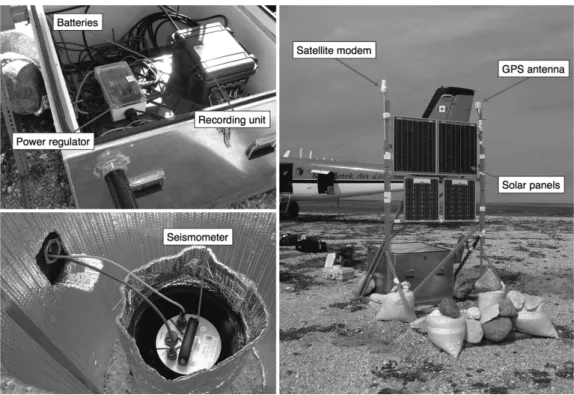
The UK component of the HuBLE project was deployed in the summer of 2007 by personnel from the University of Bristol, in collaboration with the Geological Survey of Canada. These 10 stations were situated mainly around the islands of northern Hudson Bay, providing excellent azi-muthal coverage around the Bay when combined with the existing POLARIS and a few permanent Canadian National Seismograph Network stations (Fig. 3). Figure 4 shows a completed HuBLE-UK Natural Environment Research Council seismo-graph station in northern Hudson Bay. Each site was equipped with a Gu¨ralp CMG-3TD broadband seismometer, recording at 40 samples per second (sps). Gu¨ralp data collection modules were used at the stations, which were powered by up to six solar panels (providing 100 – 140 W power) and three 100 A h deep-cycle batteries. Each remote site was equipped with an iridium satellite modem that provided access to state-of-health data from the stations. Utilizing modems over the iridium network provides pole-to-pole global coverage of both short message and short data burst services. In the case of the Gu¨ralp data collection module, this allowed the UK base-station to access weekly
reports of remote-system state of health. Where problems were diagnosed, low-latency two-way communication for reconfiguration of the remote systems was also utilized via simple terminal inter-action. Further details of the UK component of the HuBLE field campaign can be found in Bastow et al. (2011a).
Nunavut, the homeland of the Inuit, is the most sparsely populated region of Canada, so centres of population and infrastructure are few and far between. Wherever possible, seismograph stations were deployed in secure compounds such as air-ports and weather stations with mains power sup-ply. Elsewhere, vast tracts of wilderness meant that remote, independently powered recording sites had to be designed. Transportation to these locations was by chartered helicopters or light aircraft with large tundra tyres that permitted landing on rela-tively flat and well-drained glacial deposits (Fig. 4). Some stations shared logistics with exploration companies by co-location at their camps. All HuBLE-UK stations have now been removed and, with the exception of a few vaults left at airports for potential future re-occupation, no trace of the stations’ existence remains at the sites.
HuBLE: the salient results
This section reviews the findings of the major phases of HuBLE. The ‘Crustal structure’ section presents the crustal studies of Thompson et al. (2010) and Pawlak et al. (2011, 2012), which adopted receiver function and ambient noise tomo-graphic methods to constrain fundamental par-ameters such as crustal thickness and seismic wavespeed structure across the Bay region. The ‘Seismicity in northern Hudson Bay’ section looks at seismicity in northern Hudson Bay and its impli-cations for the state of crustal stress in the region. The section entitled ‘Mantle seismic anisotropy: evidence from SKS splitting’ reviews the seismic anisotropy studies of Bastow et al. (2011b) and Snyder et al. (2013), who performed shear wave splitting of SKS phases to study mantle anisotropy. The ‘Surface wave tomography’ section reviews various regional surface wave studies conducted across the Bay region (e.g. Darbyshire 2005; Dar-byshire & Eaton 2010; DarDar-byshire et al. 2013). Finally, the section entitled ‘Mantle transition zone structure’ summarizes the work of Thompson et al. (2011), who performed a receiver function study of
Fig. 4. HuBLE-UK remote station construction. 20 – 40 W solar panels on a steel frame re-charged 3× 100 A h batteries that powered the seismometer and recording equipment. The GPS antenna provided continuous accurate timing information for our data. Twice-weekly remote communications with the stations were conducted via the satellite modems. All field equipment were provided by Natural Environment Research Council’s seismic equipment pool, SEIS-UK. Modified after Bastow et al. (2011a).
the mantle transition zone with a view to improving understanding of its thermal structure.
Crustal structure
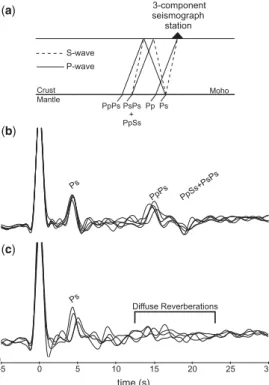
Receiver function analysis captures P- to S-wave conversions that occur at velocity contrasts in the crust and mantle recorded in the P-wave coda from distant (teleseismic) earthquakes (Fig. 5a; Langs-ton 1979; Helffrich 2006). The abrupt change in wavespeed usually encountered at the Moho makes receiver function analysis a particularly powerful means of studying the properties of the crust. The arrival-times of P to S conversions and subsequent reverberent phases from the Moho can be used to constrain bulk crustal properties: crustal thickness (H ) and Vp/Vsratio (k) (Zhu & Kanamori 2000). These parameters can be related subsequently to
bulk crustal composition via Poisson’s ratio (e.g. Christensen 1996). Thompson et al. (2010) carried out such a study of crustal structure in northern Hudson Bay, providing for the first time detailed constraints on crustal architecture across the bound-aries between many of the tectonic subdivisions that comprise the Canadian Shield.
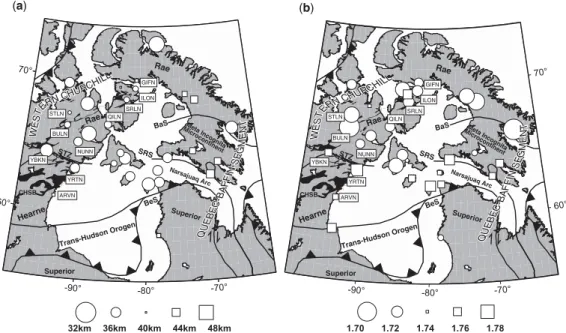
Receiver functions from within the Palaeoarch-aean Rae domain reveal remarkably simple crust, with high-amplitude, impulsive Moho conversions and reverberations (Fig. 5b). The crust is also seis-mically transparent, with little evidence for inter-nal architecture. The Rae domain has the thinnest crust (c. 37 km; Fig. 6a) and the lowest Vp/Vs ratios (Fig. 6b;≤1.73) in the region. More northerly stations display slightly thicker crust, up to c. 42 km. In contrast to the Rae, the crust and Moho of the Hearne domain crust is more complex (thus mak-ing Hk analysis more challengmak-ing), with evidence for internal architecture (Fig. 5c). Crustal thickness within the Hearne is c. 38 km and the mean Vp/Vs ratio is c. 1.76 (Fig. 6b). Uncertainties in the Thomp-son et al. (2010) study are of the order +2 km for crustal thickness, and +0.03 for Vp/Vsratio.
Within the Palaeoproterozoic Quebec – Baffin segment of the THO, bulk crustal properties are more variable than in the neighouring Archaean Hearne and Rae domains. Higher Vp/Vs ratios (.1.75) are found around the Hudson Strait than further north within Baffin Island and further west towards NW Hudson Bay (c. 1.73: Fig. 6b). The thickest crust (c. 43 km) underlies stations in cen-tral and southern Baffin Island (Fig. 6a). Thompson et al. (2010) also found evidence, particularly in the northern Rae domain, for a Hales discontinuity in the shallow lithospheric mantle at c. 60 – 90 km depth (Hales 1969).
Ambient-noise tomography uses the cross-correlation of diffuse wavefields (e.g. ambient noise, scattered coda waves) to estimate the Green’s function between pairs of seismograph stations (e.g. Shapiro et al. 2005). This technique is a pop-ular tool for crustal studies and was particpop-ularly useful in the HuBLE project to glean information on crustal structure beneath Hudson Bay. Pawlak et al. (2011, 2012) used 21 months of continuous recording at 37 stations around Hudson Bay to measure dispersion characteristics of fundamental-mode Rayleigh wave group velocity. The sig-nals extracted contain preferred azimuths that are indicative of stationary coastal noise sources near southern Alaska and Labrador. Tomographic meth-ods are then used to reconstruct a velocity model that is best resolved in areas of dense, crossing path coverage.
An important feature of the tomographic models is a prominent low-velocity region beneath Hud-son Bay (Fig. 7). At mid-crustal depths (i.e. longer
Ps PpPs PpSs+PsPs Ps Diffuse Reverberations PpPs 3-component (a) (b) (c) seismograph station Moho S-wave P-wave PsPs + PpSs Pp Ps Crust Mantle time (s) -5 0 5 10 15 20 25 30
Fig. 5. Receiver functions from the Rae and Hearne domains. (a) Ray diagram of phases used in the Hk
analysis. (b) Stacked receiver functions for stations in the Palaeoarchaean Rae domain. Note the similarities in Moho Ps (a P-to-S conversion from the Moho) arrivals. (c) Stacked receiver functions for stations in the Meso-to-Neoarchaean Hearne domain, where significantly more variable Ps arrival times and amplitudes are seen. The increased complexity of the Moho into the Hearne domain is evident particularly in the reverberated phases, which have lower amplitude and are much less coherent than within the Rae domain. Modified after Thompson et al. (2010).
-90° -80° -70° 70° 60° CHSB Rae Hearne Trans-Hu dson Or ogen Superior STZ YRTN ARVN SRLN STLN NUNN BULN QILN ILON GIFN YBKN SRS BaS BeS Meta Incogn ita Micro co ntinent Narsajuaq Arc Superior Rae 1.70 1.72 1.74 1.76 1.78 QU EB EC -BA FF IN SE GM E NT QU EB EC -BA FF IN SE GM E NT WE ST ERN C HURC HILL WES TER N CHU RCHI LL (b) (a) -90° -80° -70° 60° 70° CHSB Rae Hearne Superior STZ YRTN ARVN SRLN STLN NUNN BULN QILN ILON GIFN YBKN SRS BaS BeS Met a Inco gnita Microco nti nen t Narsajuaq Ar c Supe rior Rae 32km 36km 40km 44km 48km QU EB EC -BA FF IN SE GM E NT QU EB EC -BA FF IN SE GM E N T WEE SST ERN CHUR CHHILL WE S TER N CHUR CHILL Trans-Hud son Oro gen
Fig. 6. Crustal thickness (a) and Vp/Vsratio (b) in the Hudson Bay region determined using the method of Zhu &
Kanamori (2000). Black regions are 2.6 – 2.7 Ga greenstone belts. BaS, Baffin Suture; BeS, Bergeron Suture; SRS, Soper River Suture. Modified after Thompson et al. (2010).
Fig. 7. A comparison of anisotropic tomographic inversion result for 10 s period (left), with the lithospheric stretching factor (b) for the Hudson Bay basin (Hanne et al. 2004). The contrast between slow wavespeeds beneath the Trans Hudson Orogen and the neighbouring Archaean Superior craton persists to at least a 40 s period (see Pawlak et al. 2011, figs 11 & 12). Modified after Pawlak et al. (2011, 2012).
periods than shown in Fig. 7), the Pawlak et al. (2011) study reveals that fundamental-mode Ray-leigh velocity within the Superior craton (3.18 + 0.03 km s21) is significantly greater than the vel-ocity within the Trans Hudson Orogen beneath Hudson Bay (3.10 + 0.03 km s21). Rayleigh-wave anisotropy inferred from azimuthal analysis of ambient noise (Pawlak et al. 2012) reveals an arcuate pattern of fast directions interpreted to be indicative of the double-indenter geometry of the Superior craton. At most periods, their results suggest a significant change in anisotropic direction across the inferred primary suture beneath Hud-son Bay. The region of lowest velocity beneath Hudson Bay (Fig. 7) corresponds remarkably well with the pattern of lithospheric stretching proposed by Hanne et al. (2004): c. 3 km of crustal thinning.
Seismicity in northern Hudson Bay
Northern Hudson Bay is a region of moderate intra-plate seismicity, mainly within the Boothia Uplift – Bell Arch structure (Basham et al. 1977), where earthquakes up to Mw ¼ 6.2 have been documented. Using data from the HuBLE network, focal mechan-isms for five moderate earthquakes in the time period 2007 – 2009 have been determined by fitting
surface waveforms (Fig. 8: Steffen et al. 2012). These small earthquakes, of depth 3 – 17 km, have thrust-fault mechanisms, consistent with previ-ously determined focal mechanisms for this region as well as model predictions for glacial isostatic adjustment. Steffen et al. (2012) performed a stress inversion using available focal mechanisms and found a maximum compressive stress direction, SHmax, oriented approximately NNW – SSE. This orientation is surprising, as it is rotated by about 908 from previous glacial isostatic adjustment model estimates, which assume a background stress field in North American with SHmaxoriented NE – SW. These results indicate that existing crustal fault zones exert a strong influence on the local stress field.
Mantle seismic anisotropy: evidence
from SKS splitting
Seismic anisotropy – the directional dependence of seismic wavespeed – can be measured from the waveforms of teleseismic earthquakes via analysis of shear-wave splitting (e.g. Silver & Chan 1991). When a horizontally polarized shear wave, such as SKS, enters an anisotropic medium it will split into two orthogonally polarized waves. Splitting
Fig. 8. Focal mechanisms for earthquakes between 2007 and 2009 and from studies that predate HuBLE (grey). Solid black lines show faults; the dashed line shows the Phanerozoic zero edge; the dashed – dotted line shows the Snowbird Tectonic Zone. After Steffen et al. (2012).
can be quantified by the time delay (dt) between the two shear waves, and the orientation (w) of the fast shear wave. These splitting parameters can sub-sequently be used to understand the preferential alignment of minerals in the crust and/or mantle, or the preferential alignment of fluid or melt (e.g. Blackman & Kendall 1997). Many processes can lead to such anisotropy, including flow of the asthe-nosphere parallel to absolute plate motion (e.g. Bokelmann & Silver 2002; Assumpc¸a˜o et al. 2006), mantle flow around deep continental keels and slabs (e.g. Fouch et al. 2000; Di Leo et al. 2012), and a pre-existing fossil anisotropy frozen in the lithosphere (e.g. Bastow et al. 2007). Bastow et al. (2011b) and Snyder et al. (2013) used shear wave splitting of SKS phases at HuBLE and POLARIS stations in the Hudson Bay region to infer patterns of seismic anisotropy in the Laurentian crust and mantle (Fig. 9).
In the northern part of Hudson Bay, Bastow et al. (2011b) found no significant variation in splitting parameters at most stations across the HuBLE net-work. One exception was permanent station FRB on Baffin Island, for which more than a decade of data were available. Here, significant back-azimuthal variation in w and dt was found, raising the possibility that complex patterns of anisotropy exist beneath the region (Fig. 10). In a parallel analysis of SKS splitting, Snyder et al. (2013) pro-posed that two layers of anisotropy exist beneath
the Bay, one paralleling near-surface tectonic trends and an underlying fabric paralleling present-day plate motion.
Surface wave tomography
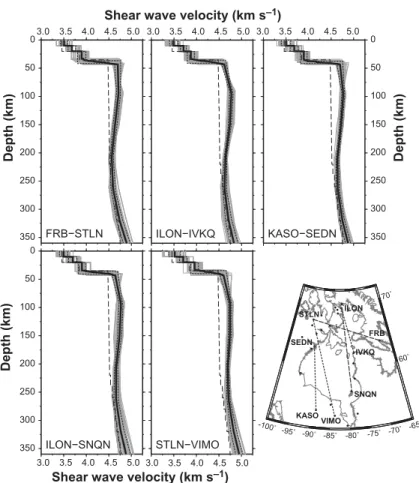
Studies of fundamental-mode Rayleigh wave dis-persion were carried out for two-station paths across the Hudson Bay region by Darbyshire & Eaton (2010). The dispersion curves clearly indi-cated a thick, fast lithospheric keel beneath the region, with phase velocities significantly greater than those associated with global reference models. The phase velocities were also systematically higher than the Canadian Shield average (Brune & Dorman 1963), corroborating global tomographic models that place the centre of the high-wavespeed lithospheric keel beneath Hudson Bay (e.g. Nettles & Dziewonski 2008). Each two-station disper-sion curve was inverted for a 1D shear wavespeed profile representing the average structure along the inter-station path. The period ranges recovered from the dispersion analysis allowed for reliable models from lower-crustal depths (c. 35 – 40 km) to mantle depths of c. 300 km. Each path-averaged model showed a prominent high-wavespeed anom-aly, interpreted as the lithospheric ‘lid’ in the upper mantle.
Different proxies for lithospheric thickness exist in the literature because fundamental-mode
&"! Rae Superior Plate STZ Hudson Bay Hudson Strait Hearne Foxe Basin Soton. Is. Baffin Island Cumberland Batholith Coats Is. Mansel Is. Nottingham Is. NOTN SHWN CTSN MNGN MANN SHMN KIMN DORN CRLN PNGN FRB QILN IVKQ WAGN BULN CMBN CDKN YRTN NUNN SEDN (1s) APM -70° -75° -80° -85° -90° -95° 62° 64° 66°
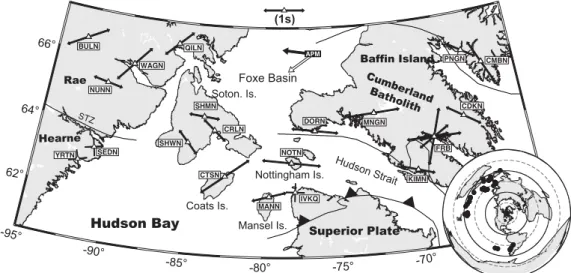
Fig. 9. Shear wave splitting parameters (arrows) and null results (solid lines) from HuBLE-UK and neighbouring POLARIS stations (triangles) in northern Hudson Bay from the study of Bastow et al. (2011b). STZ, Snowbird Tectonic Zone. Solid black lines are sutures. B.S., Baffin Suture. Inset: Back-azimuth and distance distribution of earthquakes used in study. Concentric circles indicate 308 intervals from centre of network at 758W, 638N. APM-absolute plate motion from the HS3-Nuvel-1A model (Gripp & Gordon 2002) in both hotspot reference frame (white APM arrow) and no-net rotation reference frame (black APM arrow).
surface wave models are essentially insensitive to first-order discontinuities (see e.g. Eaton et al. 2009). In some studies, negative gradients in the models are used, although these can be difficult to constrain. Other authors choose (somewhat arbitra-rily) a contour of positive Vsanomaly with respect to the global reference (e.g. PREM, ak135). The 1.5 – 2.0% anomaly range is commonly used (see Darbyshire & Eaton (2010) for a more detailed dis-cussion). Using a proxy based on the depth to the 1.7% fast anomaly, the depth to the base of the litho-sphere was interpreted to vary from c. 190 km beneath the Hudson Strait area to at least 240 – 280 km beneath central Hudson Bay. Within the lithospheric lid, maximum seismic wavespeed ano-malies varied from c. 4 to 7%, which is fast relative to the global reference (Fig. 11).
The lithosphere – asthenosphere boundary depth variations inferred from the surface-wave analysis, and from interpretation of previous studies in the Canadian Shield, indicate that the lithosphere is thickest beneath central Hudson Bay (and sig-nificantly thicker than in the Superior craton to the south). There appeared to be no spatial correla-tion between lithospheric thickness, path-averaged seismic wavespeed anomalies and surface ages (Archaean v. Proterozoic). This result is similar to interpretations of the Fennoscandian (Bruneton et al. 2004) and Australian (Simons et al. 1999; Fishwick et al. 2005) lithosphere, but contrasts with systematic changes in lithospheric thickness between Archaean and Proterozoic domains in central Asia (Lebedev et al. 2009) and southern Africa (Li & Burke 2006).
The dispersion curves from a total of 172 inter-station paths across the Hudson Bay region were combined in a tomographic inversion by Darbyshire
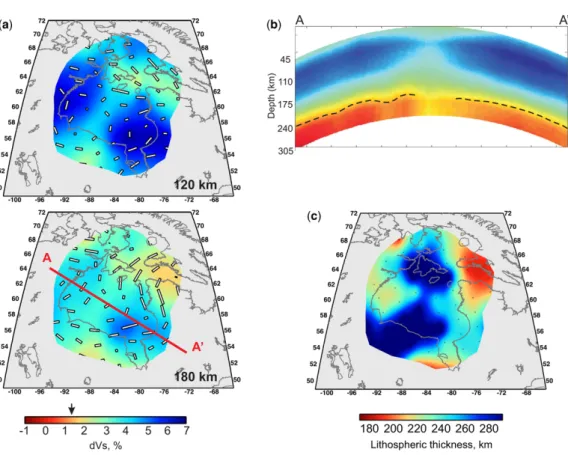
et al. (2013), solving simultaneously for isotropic phase velocity heterogeneity and azimuthal aniso-tropy. The resulting phase velocity maps were sub-sequently used as the basis for a full 3D model of shear wave velocity and anisotropy beneath the region (Fig. 12). The model confirmed the earlier findings of a thick, fast lithospheric keel, but high-lighted internal velocity variations and stratifica-tion of seismic anisotropy within the cratonic lithosphere.
In the uppermost mantle, probably associated with the intracratonic basin, seismic velocities immediately beneath the Bay are relatively low compared with those beneath the surrounding Archaean landmass, and anisotropic fast directions wrap around the Bay. In contrast, in the 70 – 160 km depth range, the model shows two high-velocity cores beneath the central Superior and Churchill cratons, separated by a near-vertical cur-tain of lower-velocity material. In this depth range, no large-scale coherency in anisotropic pattern is evident. In contrast, the model also images a basal lithospheric layer with a significantly more homo-geneous velocity structure than the mid-lithosphere. Anisotropy within this layer is coherent, with a pattern strongly reminiscent of the inferred geome-try of the THO structure (Darbyshire et al. 2013).
Mantle transition zone structure
The seismic discontinuities observed at depths of c. 410 and 660 km define the mantle transition zone (TZ), and are commonly attributed to phase tran-sitions in the olivine system (olivine to wadsleyite, the ‘410’, and ringwoodite to perovskite+ mag-nesiowu¨stite, the ‘660’, respectively; Bina & Wood 1987; Helffrich 2000; Ita & Stixrude 1992).
0 30 60 90 120 180 210 240 270 300 330 360 0.0 0.5 1.0 1.5 2.0 180 210 240 270 300 330 360 t (s)
FRB Splitting Parameters
(degrees)Back-azimuth (degrees) Back-azimuth (degrees)
Fig. 10. Shear wave splitting parameters at permanent Canadian National Seismograph Network station FRB (Fig. 9). Back-azimuth dependence ofwanddt might be the result of a dipping layer of anisotropy beneath Baffin Island. Back-azimuthal variations in splitting parameters could also result from multiple layers of seismic anisotropy beneath the region (e.g. Snyder et al. 2013). Modified after Bastow et al. (2011b).
Described by their Clapeyron slopes, the ‘410’ and ‘660’ will vary in depth if temperature conditions are varied. The opposite Clapeyron slopes of these discontinuities result in a thickened transition zone in cold regions; hot regions will act to thin it (e.g. Helffrich 2000). By analysing the nature of tran-sition zone seismic discontinuities using receiver function analysis, Thompson et al. (2011) explored the thermal and chemical state of the mantle beneath the Hudson Bay region.
Thompson et al. (2011) showed that, beneath a significant portion of cratonic North America, the TZ seismic discontinuities are unperturbed compared with the global mean, with the impli-cation that there is no seismically detectable ther-mal variation at TZ depths beneath one of the deepest and most laterally extensive continental keels on the planet (Fig. 13).
A new relative arrival-time upper
mantle tomographic model for northern
Hudson Bay
Overview
Using teleseismic data recorded by HuBLE and sur-rounding POLARIS seismograph stations since 2007 a new study of P-wave mantle velocity struc-ture using least-squares tomographic inversion of relative arrival-times is presented using the method of VanDecar et al. (1995). Body wave tomographic methods such as this benefit from particularly good lateral resolution of velocity anomalies. The study thus presents an excellent opportunity to examine whether variations in seismic wavespeed exist between Phanerozoic and Archaean mantle juxta-posed during the THO. This study, which samples
0 50 100 150 200 250 300 350 3.0 3.5 4.0 4.5 5.0 FRB−STLN 3.0 3.5 4.0 4.5 5.0 3.0 3.5 4.0 4.5 5.0 0 50 100 150 200 250 300 350 3.0 3.5 4.0 4.5 5.0 Depth (km) 0 50 100 150 200 250 300 350 -100˚ -95˚ -90˚ -85˚ -80˚ -75˚ -70˚ -65˚ 60˚ 70˚ FRB STLN IVKQ ILON−IVKQ KASO−SEDN 3.0 3.5 4.0 4.5 5.0 ILON KASO SEDN ILON−SNQN SNQN STLN−VIMO VIMO Depth (km) Depth (km)
Shear wave velocity (km s–1)
Fig. 11. One-dimensional shear wave velocity profiles for selected paths across Hudson Bay derived from surface wave dispersion. Grey lines are individual model solutions in the Monte-Carlo modelling scheme; the mean and 1 standard deviation bounds of the ensemble are solid black and dotted black lines, respectively. The black dashed line is the ak135 global reference model. Inset: inter-station paths and station names. Modified after Darbyshire & Eaton (2010).
only Precambrian geology, is particularly valuable because most studies of cratons using the method include data from stations deployed within youn-ger (Phanerozoic) terranes. In Tanzania, for exam-ple, the high wavespeed Tanzania craton contrasts with the neighbouring East African Rift (Ritsema et al. 1998). In SE Canada, the high wavespeed Superior craton contrasts with lower wavespeeds associated with the Phanerozoic Great Meteor Hotspot and Appalachian terranes (e.g. Eaton & Frederiksen 2007; Frederiksen et al. 2007; Ville-maire et al. 2012). In contrast, the major anomalies illuminated in this study will probably be older than c. 1.8 Ga. After presenting the results of this new tomographic study, these new constraints are discussed in light of other tomographic studies in the region that used complementary methods such as surface wave dispersion (e.g. Darbyshire & Eaton 2010).
Method of relative arrival-time
determination
Manual picking of the first arriving P-wave phase identifiable across the seismograph network was performed on waveforms that were filtered with a zero-phase two-pole Butterworth filter with corner frequencies 0.4 – 2 Hz. Subsequently, phase arrivals and relative arrival-time residuals were more accu-rately determined using the multi-channel cross-correlation technique (MCCC) of VanDecar & Crosson (1990); we selected a 3 s window contain-ing the initial phase arrival and typically one or two cycles of P-wave energy to cross-correlate. The chosen bandwidth is similar to that used in other teleseismic tomographic studies in both tec-tonically active (e.g. Bastow et al. 2008) and shield (e.g. Frederiksen et al. 2007) regions. The filter bandwidth is designed to retain as high a
Fig. 12. (a) Depth slices through the anisotropic surface-wave tomographic model of Darbyshire et al. (2013). The colour scale represents the percentage deviation of shear wavespeed from the iasp91 global reference model and the pale yellow bars indicate the direction and relative strength of azimuthal anisotropy across the region. The arrow on the colour scale shows the 1.7% positive wavespeed anomaly used as a proxy for the base of the seismological lithosphere (‘LAB’). (b) Cross-section through profile A – A′of the tomographic model. The black dashed line shows the inferred depth to the ‘LAB’ proxy. (c) Lithospheric thickness across the Hudson Bay region inferred from the tomographic model, using the 1.7% ‘LAB’ proxy.
frequency as possible since our inversion procedure adopts ray theory (the infinite frequency approxi-mation). All waveforms with cross-correlation coef-ficients ,0.85 were eliminated from the analysis.
The MCCC method also provides a means of quantifying the standard error associated with each arrival time. In this study relative arrival times determined in this way have mean standard devi-ation of 0.02 s. In line with other studies using the MCCC method (Tilmann et al. 2001; Bastow et al. 2005), we regard the MCCC-derived estimates of timing uncertainty as optimistic.
Relative arrival-time residuals tRES for each station are given by:
tRESi= ti− (tei− te), (1)
where tiis the relative arrival time for each station i; teiis the expected travel time based on the IASP91 travel time tables (Kennett & Engdahl 1991) for the ith station; and teis the mean of the IASP91 pre-dicted travel times associated with that particular event. The final travel time dataset comprises 3682 P-wave travel times (Fig. 14).
Analysis of travel-time residuals
International Seismological Catalogue travel-time data for permanent station FRB (Fig. 15) in Iqa-luit, Baffin Island (Fig. 3) show that the mean absolute delay time with respect to the IASP91 travel-time tables for P-wave arrivals is amongst the earliest of all permanent stations; mantle seismic wave-speeds beneath FRB are therefore amongst the fastest worldwide (Poupinet 1979). All P-wave velocity anomalies shown in this tomographic study should thus be considered markedly fast com-pared with normal mantle, with red low-velocity regions slower and blue high-velocity regions faster than the background mean of the shield, not the global average.
Model parameterization and inversion
procedure
Upper mantle wavespeed structure is imaged using regularized, least-squares inversion of Canadian relative arrival-time residuals following the method of VanDecar et al. (1995). The parameterization 100 200 300 400 500 600 700 800 35 40 45 50 55 60 65 70 75 80 Latitude
A
′
A
Depth (km) −130 −120 −110 −100 −90 −80 −70 −60 LongitudeB
B
′
100 200 300 400 500 600 700 800 Depth (km) (a) (b) (c) −140˚ −120˚ −100˚ −80˚ −60˚ −40˚ 40˚ 60˚ 80˚ A A’ B B’ LAB LABFig. 13. (a) The orientation of two receiver function transects plotted in (b) and (c). (b) A north– south transect through 788W showing the 1.0 Hz migrated data (S40RTS corrected). The dashed black line is the +1.75% contour, sometimes chosen as a proxy for lithospheric thickness (Fig. 2b). (c) Corresponding east – west transect showing same data as the north– south transect. Modified after Thompson et al. (2011).
Fig. 14. Back-azimuth and distance distribution of earthquakes used in study. Concentric circles indicate 308 intervals from centre of network at 758W, 638N. Dark grey dots are direct P-arrivals; white dots are core phases (e.g. PKP).
scheme consists of 23 knots in depth between 0 and 1800 km, 50 knots in latitude between 50 and 788N and 85 knots in longitude between 46 and 1148W: a total of 97 750 knots parameterizing slowness. Knot spacing is 35 km in the innermost resolvable parts (58 – 718N, 63 – 1008W, 0 – 350 km depth). Outside this region, knot spacing increases to 50 km between 350 and 500 km, to 100 km between 500 – 1000 km, and then to 200 km at 1800 km depth. Structural interpretations are thus limited to features of spatial wavelength ≥70 km in the upper part of the model.
The parameterization scheme continues out-side the area of interest so that an unwarranted and spurious structure is not mapped into the region where structural interpretations will be made: an Occam’s Razor approach (VanDecar et al. 1995). In the regularized least-squares inversion procedure, slowness perturbations, source terms and station terms are determined simultaneously (VanDecar et al. 1995). The source terms are free parameters used in the inversion procedure to account for small variations in back-azimuth and incidence angle caused by distant heterogeneities and source mis-locations. The station terms account for travel-time anomalies associated with the region directly beneath the station where the lack of crossing rays prevents the resolution of crustal structure. Since the inverse problem is under-determined (more
unknowns than observations), even in the absence of errors, a unique solution cannot be found. A model is therefore chosen that contains the least amount of structure necessary to satisfy the arrival-time data (e.g. Constable et al. 1987).
By investigating the trade-off between the root mean square (RMS) residual reduction (the percen-tage difference between the initial and final RMS misfit to the travel-time equations) and RMS model roughness, a preferred model is selected that fits the data well but does not account for more relative arrival-time residual reduction than can be justified by the a priori estimation of data noise levels. All models in this study account for 95% (from 0.384 to 0.02 s) of the RMS of the relative arrival-time residuals. Estimates of RMS timing uncertainty (0.02 s) are thus treated as optimistic bounds when fitting the data. Subtracting the station terms from the delay times reduces the RMS of the relative arrival-time residuals from 0.384 to 0.369 s; these corrected residuals reflect more accurately the pro-portion of the delay-time anomalies that will be mapped into the region of the model where tectonic interpretations are drawn.
Resolution
The resolving power of the inversion technique in this study is assessed by analysing the ability of
TIK FBC FRB KLS NAO NDI UME WRA BNG DAR ELT KLG MEK OUL BLC MTN ROL UPP GWC KIC LIC DBQ FLO KIR LHC MBT OTT WRS YAK APA FAY GOT SEM CPO HFS KJN LAW MUN SKA SUD CMC HYB KNA NUR POO SOD ALE BOM CAR DRV FAV FCC GIL KBL RES SFA ATL CNN MHT NOR TRI TRO BOD COL CTA FFC KRR LPA OBN SHI ASM ATH KUL MBC SLM SVE TUL YKC BRS BUL GAR KEV MNT SCH WMO WSC CLK INK IRK KER LAH LHN PAL PUL SES SIC SHL WIL BOZ CSC GDH MOS SCP SNA BHA EDM JCT KIS LND MIR NP- ZAK BAN LPB PEK OUE SYO AAM EDI GBA ILT KRK MED NEW NVL PRE ROC STJ BUB DDI EGL GEO HLE IAS SAM SOC BAB CIR CLL DSH EBH EIL HAL KON KRV NIL ORV RBA SEO SOP VLS BFD EAB EDU PLG PNS PNT PYA AIA EAU HHM MDR MOY NHA NTI SCB SDB SIM ALM BDB BLA BMO BRG CHG CNG EBL ISK LUB ORT WES AVE CIN CLE GLP LJU LPS MIN MOX PTO STU TAS VLA ADE BRA BUH BUT CBM ESK GMA LAO RBZ TIR VIC BER BNS DMK HEE HLW KEW LBF LON LOR PAS PRK RCD RMP SSC TAN BSF EKA FGU FLN FRI HAU IST KRA MAW SPA TAM WLS BYR CHA GRR SKO SSF UZH ANR BAC BES BNH CDF CHC COP GRC KAR KHC KHO LVV MBO MES PRU SIA ALO BRW CAN FRU IFR ISO JAS MAK MCC MNL SLC TOO WDC ALB BAS FSJ FUR SPF TNS TUM UBO BYI DUR FRE GRS KOD LAR LPF LWI MNY NRR SAO TCF TUC VOU WIN BUC DOU DUG JOS LAN LMR LSF PRS RSL VAL VKA TNP DEV EUR KSA NIE PHC PRA TAU VIE VRI ASH EBR LRG MMA MNV SNG SOF SPO GOL GRF MRG TOL AAB BCN BKS DAC LNS MSH STR TEH TIF ZAG ANK ERZ KAS LFF MHC PVL ROM SFF SRI TFO ALI BEO BUD CRC HAM JER KAT LPO UCC VIS ARH BMM DBN SBA SLD GCA HKC LIS LSM MDC MOO UNM PRI SAV SIT BOG LHA PRZ TAB TAC UKI AOU BRK RIV SRO STC TRR WIT CHT COR FHC KRL FOC CMC NAI VHM PLV SEA LUX WRM CAL AAE BAK
-1.5 -1.0 -0.5 0.0 0.5 1.0 1.5 2.0 P-wave Travel-Time Anomaly (s)
15 10 5 Number of Stations Hudson Bay e lt n a M d e e p s e v a W w o l S e lt n a M d e e p s e v a W t s a F
Fig. 15. P-Wave travel-time delays for permanent seismograph stations. Note the extremely early arrivals at station FRB in Iqaluit. Modified after Poupinet (1979).
the ray geometry to retrieve a checkerboard model using raypaths through a 1-D Earth. In the checker-board test, positive and negative slowness-anomaly (Vp¼ +5%) spheres described by Gaussian func-tions across their diameter are placed in two layers at 175 and 400 km depth (Fig. 16a, b). The check-erboard approach permits assessment of model sensitivity by highlighting areas of good ray cover-age, and the extent to which smearing of anoma-lies occurs. These synthetic velocity structures are inverted to use identical model parameteriza-tion and inversion regularizaparameteriza-tion as during the inversion of the observed data. A Gaussian residual time error component with a standard deviation of 0.02 s is added to the theoretical P-wave travel times (the standard deviation of noise estimated for the observed data). Lateral resolution of the anomalies in Figure 16b and c is good, with c. 30% amplitude resolution not uncommon in regularized, under-determined tomographic inver-sions such as this. Vertical resolution is good in some parts of the model (e.g. beneath the central Rae domain; Fig. 16e), but moderate in others. For example, vertical smearing in areas such as southern Baffin Island (Fig. 16f ) is considerable, meaning that the model cannot be used to place tight depth constraints on wavespeed variations.
The HuBLE P-wave velocity model
Cross sections and depth slices through the new P-wave velocity model are shown in Figure 17. Depth sections at lithospheric depths (Fig. 17a, b) indicate relatively little heterogeneity, with peak-to-peak amplitudes of ,1%. This compares with peak-to-peak anomalies of c. 3% in active areas such as the Ethiopian Rift (e.g. Bastow et al. 2005). Across the Snowbird Tectonic Zone (Rae – Hearne boundary), for example, there is almost no discernible variation in seismic wavespeed (Fig. 17a, b, e), although it is acknowledged that this could be partly the result of poor resolution at the edge of the model (Fig. 16b).
One area where relatively strong variations in seismic wavespeed can be observed is the Quebec – Baffin segment of the THO (Fig. 17a, b, e). Here, fast wavespeeds associated with the southern edge of the Churchill plate (i.e. Baffin Island) con-trast with slower wavespeeds beneath the Baffin Strait, with a subvertical to south – north-dipping boundary between the two (Fig. 17e). This region corresponds to a region of active seismicity and Palaeozoic faulting (e.g. Steffen et al. 2012). The depth extent of the low-wavespeed anomaly beneath the Baffin Strait (Fig. 17e) is c. 300 km, implying that it may extend through most or all of the lithosphere (allowing for a finite amount of ver-tical smearing in the model; Fig. 16). It must be
noted, however, that resolution in this part of the velocity model is moderate: amplitude recovery is low and vertical smearing is clearly evident in the resolution tests (Fig. 16).
Discussion
Causes of seismic heterogeneity in
tomographic models
A number of factors can affect seismic velocity in the mantle, including temperature, partial melt and composition (Karato 1993; Goes et al. 2000; Goes & van der Lee 2002). Variations in seismic aniso-tropy may be manifest as velocity heterogeneities. However, temperature is often cited as the main source of mantle heterogeneity in the upper mantle (e.g. Goes & van der Lee 2002).
The markedly fast wavespeeds observed in global and continent-scale tomographic images of the Canadian Shield mantle indicate strongly that the lithosphere beneath the Hudson Bay region is cold relative to the global average (e.g. Darbyshire et al. 2007; Nettles & Dziewonski 2008; Darby-shire & Eaton 2010). Composition is also an im-portant contributing factor, however: shields are generally associated with cold, depleted, mechani-cally strong mantle material characterizing their tectospheric ‘roots’ (e.g. Jordan 1978). It is often commonly assumed that the Archaean cores of the continents are characterized by the seismically fast-est and thickfast-est lithosphere on Earth, with thinner and slower wavespeed structure characterizing Pro-terozoic regions (Durrheim & Mooney 1994). More recent seismic studies of mantle structure in Aus-tralia (Simons et al. 1999; Fishwick et al. 2005; Fishwick & Reading 2008), Canada (Darbyshire & Eaton 2010) and Fennoscandia (e.g. Bruneton et al. 2004) question this simple correlation between surface geology age and underlying mantle structure and we revisit this issue in the ‘Implications for the formation of the Laurentian keel’ section.
As indicated in the ‘Analysis of travel-time residuals’ section, when interpreting tomographic images derived from relative arrival-time data (Fig. 17), it is essential to appreciate the background velocity structure of the region, which is represented in the tomographic images by the dVp¼ 0% con-tour. Studies of Precambrian lithosphere commonly include data from Phanerozoic terranes as well (e.g. Tanzania: Ritsema et al. 1998; SE Canada: Ville-maire et al. 2012). These models illuminate high-/ low-velocity anomalies that are sometimes genu-inely fast/slow compared with the global mean. However, our study area’s mean wavespeed struc-ture is all fast compared with the global average (Fig. 15), with no stations lying off-shield. Both
Fig. 16. (a, d) 175 km depth slice and cross-section through the synthetic checkerboard model. Spheres of diameter 90 km (defined by Gaussian functions across their diameter) of dVp¼ +5% peak anomaly are distributed in layers of depth 175 and 400 km in order to simulate relatively short length-scale velocity heterogeneity in the uppermost mantle beneath the study area. (b, c) Depth slices through the retrieved checkerboard model at 175 and 400 km depth. (e, f ) Cross-sections through the retrieved checkerboard model. The grey bands at the top of the cross-sections preclude the view of the uppermost unresolved part of the model where ray paths are almost all parallel and vertical. Areas of low ray-density (fewer than 10 rays per 30 km3) are black. Note the different colour scales used in (a) and (d) compared with (b), (c), (e) and (f ).
I.
D.
BASTOW
ET
AL.
at Universite du Quebec - Montreal on April 22, 2016
http://sp.lyellcollection.org/
Fig. 17. Depth slices through the P-wave velocity model at (a) 175 km, (b) 250 km, (c) 350 km and (d) 400 km. (e and f ) Cross-sections through the P-wave velocity model. Areas of low ray-density (fewer than 10 rays per 30 km3) are black.
THE HUDSON BAY LITHOS PHERIC EXPERIMENT 59
at Universite du Quebec - Montreal on April 22, 2016
‘low’- and ‘high’-velocity anomalies presented in Figure 17 are thus fast compared with the global mean.
The c. 1.8 Ga elapsed since the last major tec-tonic event (the THO) means that lithospheric thermal anomalies associated with magmatism in the region will have long since dissipated. The vel-ocity anomalies in Figure 17 imaged are thus proba-bly sensitive to variable composition across the network.
Implications for the assembly of the Canadian
Shield: evidence for modern-style plate
tectonics?
Whether or not modern-style plate tectonics oper-ated throughout Precambrian times is deboper-ated: its onset has been estimated to be as early as the Hadean (e.g. Hopkins et al. 2008) or as late as c. 1 Ga (e.g. Stern 2005) – a time span of approximately two-thirds of Earth history (Fig. 1). At crustal depths, the receiver function study of Thompson et al. (2010) revealed that crustal character has a strong age dependence, with the implication that crustal formation processes have evolved over time. The low bulk crustal Vp/Vs ratios of the Palaeoarchaean Rae domain crust (Fig. 6b) are indicative of felsic-to-intermediate composition to rocks in the mid to lower crust (e.g. Christensen 1996). Crustal formation hypotheses involving island arc accretion are thus not easily applied to the Rae domain because arcs are believed to have a basaltic bulk composition (Rudnick 1995). Nair et al. (2006) explain low bulk crustal Vp/Vsratios in the Kaapvaal craton through delamination of the basaltic lower crust during collision in an island-arc setting, thereby favouring the uniformi-tarian view that modern plate tectonics can be used to describe crustal formation in Archaean times. In the Rae domain, however, there is a paucity of evidence to support subduction-related hypotheses. For example, extensive linear orogenic trends in surface geology and potential field maps, which are usually associated with island-arc accre-tion, are not in evidence (e.g. Eaton & Darbyshire 2010). The absence of greenstone terranes associ-ated with collisional tectonics in the Rae domain (e.g. Hartlaub et al. 2004) also makes accretionary crustal formation models difficult to invoke. The felsic, uniform thickness (c. 37 km; Fig. 6a) Rae domain crust, with its remarkably sharp Moho and paucity of evidence for intra-crustal reflectivity (Fig. 5b) thus lacks evidence for modern-style plate tectonics. Models favouring vertical tectonic processes, such as crustal delamination or plume activity, were thus considered better suited to the observations by Thompson et al. (2010).
The Meso-to-Neoarchaean Hearne domain has a slightly more complex crust (Fig. 5c) with higher Vp/Vsratios than the Rae. These properties were interpreted by Thompson et al. (2010) as a poten-tially transitional period between non-plate tectonic and plate tectonic processes. Receiver function results from the Quebec – Baffin segment of the THO, however, map out the first-order shape of the Superior plate under-thrusting Meta Incognita, the southern tip of the Churchill collage (Fig. 3; Thompson et al. 2010). The elevated Vp/Vsratios in this region (Fig. 6b) are considered to be representative of the rifted margin of the Superior craton. Markedly thicker crust (c. 43 km; Fig. 6a) compared with that observed in the Archaean domains is coincident with widespread medium to high-grade metamorphic geology outcropping at the surface (e.g. St-Onge et al. 2006) and can be explained by crustal thickening owing to stacking of accreted terranes during continent – continent col-lision, analogous to the present-day Tibetan Plateau, followed by erosion (Thompson et al. 2010), con-sistent with the hypothesis of St-Onge et al. (2006). From SKS splitting analysis of seismic aniso-tropy, Bastow et al. (2011b) and Snyder et al. (2013, with support from receiver functions) showed that fast polarization directions in northern Hudson Bay parallel THO structural trends at the surface (Fig. 9). Relatively large splitting delay times (dt up to 1.45 s) require a relatively thick ani-sotropic layer (and thus major plate-scale defor-mation), which Bastow et al. (2011b) cited as evidence that plate tectonics was in operation by Palaeoproterozoic times at the latest. Corroborat-ing this conclusion, Snyder et al. (2013) presented evidence for gently dipping lithospheric layers deep beneath the SE Rae craton, consistent with under-thrusting beneath the Hearne and Meta Incognita Sugluk blocks (Fig. 3). The new tomo-graphic images presented in this study also yield evidence for plate-scale under-thrusting beneath Meta Incognita (Fig. 17a, b, f ). In contrast there is little evidence in our new wavespeed maps for such large-scale tectonic processes across the Rae – Hearne domains to the west of Baffin Island (Fig. 17a, b, g).
Taken together, the results from the receiver function, SKS and tomography studies support a model for secular evolution in processes of crustal formation formation, with non-plate tectonic pro-cesses during the Palaeoarchaean evolving towards fully developed plate tectonics by the Palaeoproter-ozoic (Thompson et al. 2010).
Based on joint tomographic inversion of ambient-noise and teleseismic Rayleigh-wave dis-persion measurements, Pawlak et al. (2012) docu-mented systematic variations in anisotropic fabric moving from the upper crust, to the lower crust
and uppermost mantle beneath Hudson Bay. In par-ticular, while anisotropic fabrics in the upper crust and uppermost mantle are consistent with tectonic fabrics created during the THO, lower-crustal fabrics exhibit a more uniform north – south orien-tation. By analogy with models for crustal evolution in the modern Himalayan orogen, Pawlak et al. (2012) interpreted this pattern as evidence for frozen channel flow in the lower crust that formed during the culmination of the orogenic cycle. This model furnishes additional evidence that modern-style plate tectonics was in operation c. 1.8 Ga during the THO.
Implications for the formation
of the Laurentian keel
The tectosphere or lithospheric mantle beneath cratons commonly extends to depths of 250 km or more into the mantle. These ‘keels’ have remained stable, resistant to thermal and mechanical erosion during multiple Wilson cycles over billions of years. Archaean processes, such as the extraction of komatiitic magmas (e.g. Griffin et al. 2003), are often invoked to explain the intrinsic low density, but the Laurentian keel does not fit easily into the Archaean formation paradigm: it extends below both Archaean and Palaeoproterozoic terranes. Pre-cisely how the keel beneath Hudson Bay formed is thus unclear. Is the present-day keel a relict of initial craton formation in the Archaean (e.g. Sleep 2003), or do later tectonic processes (specifically the THO) also play a role, perhaps resulting in a vertically stratified lithosphere? Stratification of cratonic lithosphere has been inferred previously from both geophysical (Fishwick & Reading 2008; Angus et al. 2009; Abt et al. 2010; Yuan & Roma-nowicz 2010) and geochemical/thermobarometric studies (Griffin et al. 2003, 2004). The upper litho-spheric layer has been interpreted as a highly melt-depleted peridotite chemical boundary layer; the lower, more fertile layer has been described as a thermal boundary layer, formed at a later stage in keel evolution (e.g. Lee et al. 2011). S to P con-verted phases isolated in receiver function studies, initially interpreted as the LAB (Rychert & Shearer 2009), are strong evidence for the latter hypothe-sis, and have been cited as evidence for mid-lithospheric discontinuities beneath the Canadian shield (Abt et al. 2010; Yuan & Romanowicz 2010). The new tomographic images presented in this study (Fig. 17) provide compelling evidence that Palaeoproterozoic mantle associated with the THO has been trapped between the Archaean cores of the Superior plate in the south and the Churchill collage (including Meta Incognita and the Sugluk block: Fig. 3) in the north. Depth resolution in
such body wave models is never as good as lateral resolution (Fig. 16), but the inferred trapped low-wavespeed material between the Superior craton and the Churchill collage in Figure 17e is certainly a deep-seated lithospheric feature, not the smeared result of crustal structure.
The surface wave study of Darbyshire et al. (2013), which solved simultaneously for isotropic phase velocity heterogeneity and azimuthal aniso-tropy, also suggested a multi-stage assembly of the central Laurentian keel in the Archaean and Palaeoproterozoic. The Darbyshire et al. (2013) model (Fig. 12) shows that, in the uppermost mantle, probably associated with the development of the intracratonic basin, seismic wavespeeds immediately beneath Hudson Bay are lower than beneath the surrounding Archaean blocks, and ani-sotropic fast directions wrap around the Bay. In con-trast, in the 70 – 160 km depth range, the model shows two fast-wavespeed cores beneath the cen-tral Superior and Churchill cratons, separated by a near-vertical corridor of lower-wavespeed mate-rial. The geometry of this heterogeneous pattern prompted Darbyshire et al. (2013) to suggest that it arises from the terminal collision of the Superior and Churchill cratons, trapping more juvenile Pro-terozoic mantle between them during the THO. In this depth range, no large-scale coherency in aniso-tropic pattern is evident. However, in the deepest parts of the lithosphere the model reveals signifi-cantly more homogeneous velocity structure than the mid-lithosphere. Anisotropy within this layer is coherent, with a pattern strongly reminiscent of the inferred geometry of the THO suture. Given this distinctive deformation pattern, the basal layer is postulated to have accreted to the base of the Archaean cratonic lithosphere during or shortly after the terminal phases of the THO (Darbyshire et al. 2013).
Neotectonics, and implications for the
development of the Hudson Bay basin
The Hudson Bay basin is the least studied of four major Phanerozoic intracratonic basins (includ-ing Williston, Illinois and Michigan) in North America and the mechanism by which it formed remains ambiguous. A number of hypotheses have been proposed over the years, each of which the HuBLE project has tested.According to one hypothesis, subsidence occurred as a result of convective down-welling within the mantle (e.g. James 1992; Peltier et al. 1992). This explanation has also been championed to explain the long-wavelength negative gravity anomaly beneath Hudson Bay (Simons & Hager 1997; Mitrovica 1997; Tamisiea et al. 2007). The