COSMETIC SURGERIES ON 3-MANIFOLDS
THESIS
PRESENTED
AS A PARTIAL REQ UIREMENT
FOR THE DOCTORATE IN MATHEMATICS
GEOMETRY AND TOPOLOGY GROUP
BY
HUYGENS CHRISTIAN RAVELOMANANA
Avertissement
La diffusion de cette thèse se fait dans le respect des droits de son auteur, qui a signé le formulaire Autorisation de reproduire et de diffuser un travail de recherche de cycles supérieurs (SDU-522 - Rév.01-2006). Cette autorisation stipule que «conformément à l'article 11 du Règlement no 8 des études de cycles supérieurs, [l'auteur] concède à l'Université du Québec à Montréal une licence non exclusive d'utilisation et de publication de la totalité ou d'une partie importante de [son] travail de recherche pour des fins pédagogiques et non commerciales. Plus précisément, [l'auteur] autorise l'Université du Québec à Montréal à reproduire, diffuser, prêter, distribuer ou vendre des copies de [son] travail de recherche à des fins non commerciales sur quelque support que ce soit, y compris l'Internet. Cette licence et cette autorisation n'entraînent pas une renonciation de [la] part [de l'auteur] à [ses] droits moraux ni à [ses] droits de propriété intellectuelle. Sauf entente contraire, [l'auteur] conserve la liberté de diffuser et de commercialiser ou non ce travail dont [il] possède un exemplaire.»
CHIRURGIES COSMÉTIQUES SUR UNE 3-VARIÉTÉ
THÈSE
PRÉSENTÉE
COMME EXIGENCE PARTIELLE
DU DOCTORAT EN MATHÉMATIQUES
CONCENTRATION GÉOMÉTRIE ET TOPOLOGIE
PAR
HUYGENS CHRISTIAN RAVELOMANANA
I am grateful to my advisor Steven Boyer for his guidance and support during the course of the doctoral program. I would like to thank all the members of the CIRGET research group in Montréal, including faculties, post-docs and students, from whom I have learned enormously via discussions, courses and seminars. I would like to thank Olivier Collin for his various help through the course of the program. The atmosphere in CIRGET was friendly and very enjoyable. In this view, it is a great pleasure to thank David Gay for recommending me to this group.
This thesis benefited from many inspiring discussions with other mathematicians: Ken Baker, Jennifer Hom, David Gay, C. McA. Gordon, Yi Ni, Andras Stipsicz, Zhongtao Wu. I would like to thank Andras Stipsicz for reading and giving feedback on the Heegaard Floer theory part of this work.
I would like to thank Manon Gauthier, Stéphanie Girard, Alexandra Haedrich, Mélissa Ipotési, Chantal Lessard, Gaëlle Pringet, for helping me to navigate through the bureaucracy and for their nice attitude. I would like to thank Gisèle Legault and Jérôme Tremblay for their help with software and computing.
This work would not have been possible without the support of my family. I dedicate this thesis to my sisters, my brother and to the memory of my mother and my father. To all of my friends, thank you for your encouragement and all the time we spent together.
"Raha sendra ka lavitra indray Ny vohitry ny any aminay, Ny fo no mandefa vinany Iampita ny bonga any ho any."
ACKNOWLEDGEMENTS LIST OF FIGURES LIST OF TABLES RÉSUMÉ .. ABSTRACT INTRODUCTION CHAPTER I
BACKGROUND ON COSMETIC SURGERIES 1.1 Dehn surgery . . .
1.2 Exceptional fillings 1.3 Cosmetic surgeries CHAPTER II
SURVEY ON TOROIDAL SURGERIES 2.1 Intersection graphs
2.2 Toroidal surgeries . CHAPTER III
THE CASSON INVARIANT 3.1 The Casson-Walker invariant 3.2 The Casson-Gordon invariant
3.3 A preliminary result on the Casson invariant . CHAPTER IV
HEEGAARD FLOER HOMOLOGY . . . . . . . 4.1 Three-manifold Heegaard Floer homologies .
lll Vll Vlll lX X 1 10 10 19 23 29 29 31 41 41 44
46
48 49 4.1. l Heegaard diagrams, Whitney disks and Spinc structures 49 4.1.2 Definition ofHF
,
HF004 .1. 3 Three-manifolds Y wi th b1 (Y)
> 0 . .
4.1.4 Examples of Heegaard Floer homology 4.1.5 Cobordisms and absolute Q-grading 4.1.6 The correction term4.2 Knot Floer homology . . . .
4.2.1 Knots and Heegaard diagrams .
4.2.2 Definition and properties of the knot Floer homology CHAPTER V
EXCEPTIONAL COSMETIC SURGERIES ON S3 5.1 Results from Heegaard Floer theory .
5.2 Proof of Theorem A . .. . . .
5.3 Cosmetic surgeries on some special classes of knots 5. 3.1 Algebraic knots. .
5.3.2 Alternating knots. 5.3.3 Arborescent knots. CHAPTER VI 66
68
72 78 83 84 859
1
92 101 107 107 108109
EXCEPTIONAL COSMETIC SURGERIES ON Z-HOMOLOGY SPHERES 114 6.1 Cosmetic surgeries on hyperbolic knots in integer homology spheres 115 6.2 The knot complement problem for E(2, 3, 5) . .. . . .
CHAPTER VII
COSMETIC SURGERIES AND CHARACTER VARIETIES 7 .1 Preliminaries . . . . . . . . . . . . .
7.2 Twisted cohomology and tangent spaces 7.3 Character varieties and Culler-Shalen norm 7.4 Proof of theorem B CONCLUSION .. BIBLIOGRAPHY 128 132 133 135 138 143 152 154
Figure
0.1 Thesis flow chart . . . . 1.1 W(l), W(2), W(- 5/2), W(-5) . 2.1 The links L1, L2 and L3 . . . • .
Page 9 21 32 2.2 The intersection graph for the manifold M4 (Gordon and Wu, 2008). 33 2.3 The intersection graph for the manifold M5 (Gordon and Wu, 2008). 34 2.4 The intersection graph for the manifold M14 (Gordon and Wu, 2008). 35 4.1 Heegaard diagram for L(2, 1). . . . . . . . . . . . . . . . . . . 69 4.2 Heegaard diagram for S1
X S2, Πcurve (red),
/3
curve (green). 705.1
[
O]
and [oo] tangles. . 1095.2 A Montesinos tangle. 109
5.3 Sum, product and inversion of tangles. 110 5.4 Numerator and denominator closure of a 2-tangle. 110
Tableau
1.1 Distance table.
5.1 Slopes of exceptional truly cosmetic surgeries on S3 . .
Page 22 102
Cette thèse étudie les chirurgies cosmétiques exceptionelles le long des noeuds hyperboliques dans une 3-variété orientée. On utilise principalement l'homologie de Heegaard Floer, les invariants de Casson, les résultats sur les chirurgies excep-tionelles puis les variétés de caractères dans P5L2(C). ous y montrons certaines restrictions sur ces types de chirurgies. Pour les noeuds hyperboliques dans
5
3 on montre que la pente d'une telle chirurgie doit être ±1 et que la variété obtenue est d'un type précis.À
partir de cela on montre qu'il ne peut pas y avoir de chirurgie cosmétiques exceptionelles le long de certaines familles de noeuds dans5
3. Pour les noeuds hyperboliques dans une sphère d'homologie entière on donne une liste de résultats possibles. On prouve également que la 3-variété orien-tée obtenue à partir d'une chirurgie non-trivial sur un noeud non-trivial dans la sphère de Poincaré ne peut pas lui être homéomorphe en préservant l'orientation, comme conséquence on donne une réponse au problème du complément orientée d'un noeud dans ~(2, 3, 5). Pour le cas plus générale des sphères d'homologie rationelles, on prouve que sous certaines conditions sur la variété des caractères dans P5L2(C), le nombre de pentes pouvant produire une chirurgie cosmétique dont la variété obtenue est une "petite variété de Seifert" est au plus deux. Mots-clés: théorie des noeuds, 3-variétés, chirurgies de Dehn, noeuds hyper-boliques.
This thesis studies cosmetic surgeries along hyperbolic knots in an oriented 3-manifold. Restrictions on the type of surgeries obtained are proven. The tools used are Heegaard Floer theory, the different Casson invariants, and known r e-sult about exceptional surgeries and PSL2(C)-character varieties. For hyperbolic knots in S3 we prove that the slope of exceptional truly cosmetic surgeries must be ±1 and the manifold obtained is of a certain type. From this we deduce that there are no exceptional truly cosmetic surgeries along certain families of hyperbolic knots in S3
. For the case of integer homology spheres we give a list of possible output of such surgeries. We also prove that the oriented manifold obtained by a non-trivial surgery on a non-trivial knot in the Poincaré homology sphere cannot be orientation preserving homeomorphic to the Poincaré sphere. As a consequence we give an answer to the oriented knot complement problem in E(2, 3, 5). For the general case of a rational homology sphere, modulo constraints on its PSL2(C)-character variety, we prove that the number of slopes which could produce small Seifert manifolds as cosmetic surgery is at most two.
The complement of a tubular neighbourhood of a knot in a closed oriented 3-manifold is a 3-manifold with torus boundary. Gluing back a solid torus along this boundary gives a new oriented 3-manifold. This procedure, called Dehn surgery, named after M. Dehn, is a fondamental tool in constructing 3-manifolds. It had been introduced in 1910 by Dehn (Dehn, 1910) for knots in 83 and has since been generalized to knots and links in closed oriented 3-manifolds. The surgeries will be parameterized by slopes, which are isotopy classes of simple closed curves on the torus boundary of M. In the early 1960's A. Wallace (Wallace, 1960) and W.B.R Lickorish (Lickorish, 1962) have independently shown that every closed oriented 3-manifold can be obtained by surgery on some link in 83.
The goal of this thesis is to understand under which circumstances two distinct Dehn surgeries on the same knot in a closed oriented 3-manifold give rise to the same oriented 3-manifold. Here, by "the same" we mean the existence of an (orientation preserving) homeomorphism between them. Such surgeries are called ( truly) cosmetic surgeries. For the trivial knot, it is known that there can be infinitely many distinct surgeries which give the same output. Thus we restrict ourselves to the case of non-trivial knots and the case when the knot complement is not homeomorphic to D2 x 81
. Gordon and Luecke prove in (Gordon and Luecke, 1989) that on a non-trivial knot in 83, resp.
8
2 x 81, only the trivial surgery can give back 83, resp. 82 x 81. From this result follows the fact that knots in 83 and 82 x 81 are determined by their complements. By contrast Mathieu, in (Mathieu, 1992), gives an infinite family of distinct Dehnsurgeries on a trefoil knot in 53 which give homeomorphic manifolds. Sorne re-lated results concerning knot complements have also been proved by D. Matignon. In particular he shows in (Matignon, ) that the only non-hyperbolic knots in lens spaces ( excluding 53 and 52 x 51) which are not determined by their complement are the axes of L(p, q) when q2 ±1 modulo p. In (Matignon, 2010) he also gives an infinite family of pairs (M, K), where M is a lens space and K
c
M is a hyperbolic knot, which produce a manifold homeomorphic to M by a non-trivial Dehn surgery. Rong (Rong, 1993) classified knots in irreducible Seifert fibred 3-manifods, other than lens spaces, whose complements are Seifert fibred and which are not determined by their complements. In (Bleiler et al., 1999) Bleiler, Hodgson and Weeks described an oriented hyperbolic 3-manifold with toms boundary having two distinct Dehn fillings which give two oppositely ori-ented copies of the lens spaceL(
49, 18). Using a Casson-type invariant, Boyer and Lines (Boyer and Lines, 1990) showed that the non-vanishing of the second derivative of Alexander polynomial of the knot evaluated at 1 is an obstruction for having truly cosmetic surgeries. Recently, with help of Heegaard Floer theory and Casson invariant, new criteria for cosmetic surgeries on knots in5
3, and more generally knots in L-space homology spheres, have been established. Zhongtao Wu proved (Wu, 2011c) that if two rational surgeries on a non-trivial knot in an L-space homology sphere give orientation preserving homeomorphic manifolds, then the rational numbers must be of opposite sign. Yi Ni and Zhongtao Wu (Ni and Wu, 2013) gave a refinement of this result for knots in 53.Let M be a compact irreducible 3-manifold with boundary a toms. From the work of W. Thurston (Thurston, 1982) we know that Mis either hyperbolic (i.e admits a complete fini te volume Riemannian metric in its interior), or contains an essential toms, or is atoroidal and Seifert fibred. We are concerned with the case where M is a knot complement in a closed oriented 3-manifold. As
discussed above, Matignon, Rong and Mathieu have various results related to cosmetic surgeries on non-hyperbolic knots. As opposed to this approach, our main interest will be on hyperbolic knots in integer homology spheres and, in some cases, rational homology spheres. It is known (Thurston, 1979) that all but finitely many surgeries on such knots give hyperbolic manifolds. The finite exceptions are called exceptional surgeries. Due to their more topological nature we will focus on these exceptional cosmetic surgeries. Thus our work will be a study of cosmetic surgeries among exceptional surgeries on hyperbolic knots in integer homology spheres.
Concerning exceptional surgeries, work has been clone by various authors:
(Culler et al., 1987), (Gordon, 1998), (Gordon and Luecke, 1996), (Lackenby, 1997), (Boyer and Zhang, 1998), (Boyer and Zhang, 2001), (Boyer et al., 2001), (Wu, 1996), (Wu, 2011a), (Wu, 2011b), (Brittenham and Wu, 2001), (Gordon and Wu, 2008), (Ichihara and Masai, 2013). Our work will build on all of these established re -sults on the subject. One of the famous results in this area is the cyclic surgery theorem (Culler et al., 1987): "If M is an irreducible 3-manifold with incompress -ible torus boundary which is not a Seifert fibred space, then there are at most 3 slopes which can give a 3-manifold with cyclic fondamental group and the dis -tance between them is 1". Here the distance between two slopes is their minimal geometric intersection number. A similar result was proven by Boyer and Zhang for finite surgeries (Boyer and Zhang, 2001): "Under the same conditions, the dis -tance between two slopes which give a 3-manifold with finite fondamental group is at most 3". On the other hand Gordon and Luecke have worked on exceptional surgeries which produce toroidal manifold. In particular pairs of toroidal slopes with distance greater or equal to 4 have been completely described by Gordon (Gordon, 1998) and Gordon-Wu (Gordon and Wu, 2008). We will be using all of this to narrow clown the possibility of having cosmetic exceptional surgeries.
Together with these classical results and techniques we will be using Heegaard Floer theory. These are homology theories for 3-manifolds and knots introduced by Ozsvath and Szabô ( Ozsvath and Szabô, 2004d; Ozsvath and Szabô, 2004c; Ozsvath and Szabô, 2004b; Ozsvath and Szabô, 2006a; Ozsvath and Szabô, 2003a) and, independently, by Rasmussen for knots (Rasmussen, 2003). They are con -structed as Lagrangian Floer theory for some special totally real submanifolds in a symplectic manifold which is naturally associated to an oriented 3-manifold or to an oriented knot. We will mainly use the correction term, the reduced Heegaard fioer homology H Fred and the renormalized Euler characteristic for the case of exceptional surgeries on knots. We will then give a very concrete charac -terisation of truly cosmetic exceptional surgeries on hyperbolic knots in S3 and a list of families of knots which do not admit such surgeries. For the more general case of knots in integer homology spheres we will give the list of possible types of manifolds obtained after truly cosmetic exceptional surgeries together with some restrictions on the slopes used. Using work of Rasmussen on Heegaard Floer theory we will also settle the oriented knot complement problem for the Poincaré sphere as consequence of a slightly more general result. We also study the case when a surgery on ~(2, 3, 5) gives -~(2, 3, 5).
Finally our last result will be about exceptional cosmetic surgeries on rational homology sphere which yield small Seifert manifolds. This will require a totally different approach since in this particular situation we will be using the theory of (P)SL2(C)-character variety. This theory is about counting representation n1(M)--+ (P)SL2(C) of a 3-manifold group into (P)SL2(C). It was pioneered by Culler and Shalen (Culler and Shalen, 1983), (Shalen, 2002) and was the source of some breakthroughs in the study of the topology of 3-manifolds. We will study cosmetic surgeries via the Culler-Shalen semi-norm.
Summary of the main results We begin our exploration of cosmetic surgery with the case of hyperbolic knots in S3
. Ni and Wu's result combined with the progress made on exceptional surgeries on S3 help us to provide a new characterization of cosmetic surgeries on hyperbolic knots.
Theorem A (H. Ravelomanana). Let K be a hyperbolic knot in S3, and r, r' E
Qu
{OO}
two distinct exceptional slopes on oN (K).
Ifs K ( r) is homeomorphic ta Sx(r') as oriented manifolds, then the surgery must be toroidal and non-Seifert fibred. Moreover{r,r'}=
{+1,-1}.As a consequence of this we establish that certain families of hyperbolic knot in S3 do not admit exceptional cosmetic surgery. This is done with support of the work done by Némethi (Némethi, 2007), Ichihara and Masai (Ichihara and Masai, 2013).
Corollary 5.3.3 (H. Ravelomanana). There are no exceptional truly cosmetic surgeries on an alternating hyperbolic knot in S3.
Corollary 5.3.5 (H. Ravelomanana). There are no exceptional truly cosmetic surgeries on arborescent knots in S3.
Next we go into the slightly more general world of knots in integer homology spheres. In this part we use a combination of results on exceptional surgeries, Heegaard Floer theory, PSL2(C) character varieties, and some elementary topo l-ogy to give a description of what could be an exceptional cosmetic surgery.
Proposition 6.1.7 (H. Ravelomanana). Let Y be a Z-homology sphere, K
c
Y a hyperbolic knot and M =Y\ N(K). Assume we use a preferred basis{µ,
ÀM} for 7r1 ( 8M). Let r=
p/ q and r'=
p/ q' be exceptional slopes such that 0<
p and q<
q'. If M(r) is homeomorphic ta M(r') as oriented manifolds, then the surgery gives either(a) a reducible manifold in which case p
=
1 and q'=
q+
1,(b) a toroidal Seifert fibred manifold in which case p
=
1 and q'=
q+
1,(c) an atoroidal small Seifert manifold with infinite fundamental group in which case we have the following possibilities
• p
= 1
and Jq -q'I
::;
8.• p = 5, q' = q
+
1 and q=
2 [mod 5]. • p=
2, and q'=
q+
2 or q'=
q+
4.( d) a toroidal irreducible non-Seifert fibred manifold in which case p
=
1 and Jq' - qJ ::; 3.As spin off of this, we give a particular attention to the Poincaré homology sphere. We obtain that ~(2, 3, 5) cannot be obtained, as an oriented manifold, by a non-trivial surgery along a non-trivial knot in ~(2, 3, 5). Therefore we can answer the oriented knot complement problem for the Poincaré sphere.
Theorem 6.2.1 (H. Ravelomanana). Let K be a non-trivial knot in ~(2, 3, 5) and let r E Q. The result of an r-surgery along K is never orientation preserving homeomorphic to ~(2, 3, 5).
Theorem 6.2.3 (H. Ravelomanana). Non-trivial knots in ~(2, 3, 5) are deter-mined by their oriented complements.
Theorem 6.2.1 generalises to L-space Z-homology spheres.
Theorem 6.2.2 (H. Ravelomanana). Let K be a non-trivial knot in an oriented L-space Z-homology sphere Y and let r E Q. The result of an r-surgery along K is never orientation-preserving homeomorphic to Y .
For the case when a surgery on .E(2, 3, 5) gives -.E(2, 3, 5) we have the following result.
Theorem 6.2.7 (H. Ravelomanana). Let K be a non-trivial knot in .E(2, 3, 5). If K admits a non-trivial surgery which gives -.E(2, 3, 5) then the surgery slope is 1/2 and the result of+ 1-surgery along K is an L-space which admits a tight contact structure.
Finally we use the theory of Culler-Shalen seminorms to give a bound on the num-ber of small Seifert cosmetic surgeries on hyperbolic knots in a rational homology sphere Y. This bound is obtained modulo some hypothesis on the PSL2 (C)-character variety of Y . Here C (a) will denote the set of slopes cosmetic to the given slope a.
Theorem B (H. Ravelomanana). Let Y be a rational homology sphere. Assume that
Hom ( 7r1
(Y),
P SL
2 (C))
contains only diagonalisable representations, no side of the PSL2(C)-Culler-Shalen ball of M is parallel to ÀM, and a is small-Seifert.Then C(a) ::; 2.
Structure of the thesis This thesis is organized as follows.
Chapter 1. We survey exceptional surgeries, cosmetic surgeries and give the necessary topological background for the subject.
Chapter 2. We briefl.y review some known results on toroïdal surgeries and prove some useful lemmas in the subject.
Chapter 3. We review the theory of the Casson invariant and its variants. We also prove a result of Boyer and Lines that there are no cosmetic surgeries along
a knot whose Alexander polynomial has the property that its second derivative evaluated at 1 does not vanish. This is a fact that we will be using later.
Chapter 4. We give a survey on Heegaard Floer theory focusing on the defini-tions and the principal results we will need later.
Chapter 5. We discuss the case of exceptional cosmetic surgeries on hyperbolic knots in S3
. We review some more specialized material and results from Heegaard Floer theory. We give a proof of Theorem A together with some corollaries. From this we deduce a list of families of knots in S3 which do not admit exceptional truly cosmetic surgeries.
Chapter 6. We study the more general case of exceptional cosmetic surgeries on integer homology spheres. We establish a proposition which characterizes such surgeries according to the "geometric type" of the output and list all the possible slopes. The last section of the chapter is devoted to the oriented knot complement problem for E(2, 3, 5) and to the case when a surgery on E(2, 3, 5) gives -E(2, 3, 5).
Chapter 7. Finally in Chapter 7 we use the theory of (P)SL2(C)-character varieties to study exceptional cosmetic surgeries on a rational homology sphere which produce small Seifert fibred manifolds.
Chapter 1 Chapter 7 Chapter 2 Chapter 5 Chapter 3 Chapter 6 Chapter 4
BACKGROUND 0 COSMETIC SURGERIES
1.1 Dehn surgery
ln this chapter we fix some notations and conventions and we briefiy outline the necessary background on Dehn surgery1 exceptional surgery and cosmetic surgery. We also give a quick survey on the state of the exceptional surgery problem and the cosmetic surgery conjecture. At the end we give some preliminary lemmas.
In what follows, all manifolds will be orientable. We will be precise when a choice of orientation matters. If M is an oriented manifold, we will denote by - M the same topological manifold but with the opposite orientation. Let M1 and M2 be two oriented manifolds, we will use the following notations:
M1 ~ M2 means that the two manifolds are homeomorphic,
M1 ~
+
M2 means that there is an homeomorphism which preserve orientations, M1 ~ - M2 means that there is an homeomorphism which reverse orientations.Let us begin with some definitions.
Definition 1.1.1. A slope on 31 x S1 is a primitive element of H
1(31x31; Z) / { ±1} representing the isotopy class of a simple closed curve on 31
x
31.Let M be a compact, connected, oriented 3-manifold and let Tc 8M be a torus. Definition 1.1.2. A Dehn filling of M along T is a manifold M(f, T) obtained by filling T with a solid torus via a diffeomerphism f : f) (51 x D2
) ---+ T, i.e M(f, T) := (S1
x
D2) Ut M.We also refer to the process of constructing M(f, T) as doing a Dehn filling on M along T. The construction of M(J, T) can be done in two steps. The solid torus 51 x D2 in M(J, T) is the union of two components, a closed regular neig hbour-hood A of the disk { *} x D2 and the closure 51 x D2 \ A of the complement of A. We first attach A to M via f, this process is a 2-handle attachment along a tubu-lar neighbourhood off ( { *} x 8D2
). Such an attachment is uniquely determined by the isotopy class in T of the attaching 1-sphere that is
f (
{
*
}
x 8D2). The second stage is to obtain M(J, T) by attaching the 3-ball B to AU M along its 2-sphere boundary. Since any homeomorphism of the 2-sphere extends over the 3-ball, the manifold M(J, T) is completely determined by the 2-handle attachment AUM.Therefore M(J, T) is uniquely determined by the T isotopy classa off ( { *} x 8D2 ), that is, by the slope a on T determined by
f
(
{
*} x 8D2). The curve 51 x {O} C 51 x D2 C M(J, T) is called the core of the Dehn filling. We will write M(a, T) := M(f, T) and, if the boundary component T is clear from the context, we will simply use the notation M(a) for M(J, T).Given a set of torus boundary components T1, · · · , Tk C 8M, and slopes a1, · · · , ak on each component Ti, i
=
1, · · · , k; we can do Dehn filling along each ~ to get a new manifold M(a1, · · · , ak)·Let K be a knot in a connected oriented 3-manifold Y. We denote
N (
K) a regular neighbourhood ofK
and YK := Y\N
(
K
)
.
Definition 1.1.3. A Dehn surgery of slope a on K is the oriented 3-manifold YK(a) obtained by doing a Dehn filling of Yx along 8N (K ) with slope a.
The manifold YK(a) inherits a preferred orientation from the orientation of Y. Indeed, the orientation on Y induces an orientation on YK. Choose the orientation of the filling solid torus 51 x D2 so that the orientation on
f
(
8 ( 51 x D2)) is the opposite of the orientation on 8Yx. Then, after gluing, we get an orientation of the whole manifold YK(a)=
51 x D2 Ua YK. Therefore a Dehn surgery gives an oriented manifold.A Dehn surgery along a link L
c
Y is defined in similar fashion.Meridian and longitude. The knot K determines a distinguished slope µ called the meridian of K, up to orientation. It is the class of an essential simple closed curve on 8N(K ) which bounds a disk in N (K ). A simple closed curve which represents a meridian is called a meridian curve. The trivial Dehn surgery along K is the Dehn surgery on K with slope µ.
If 'Y is a slope which can be represented by a simple closed curve which inte r-sects transversally a meridian curve once, then the pair {µ,'Y} forms a basis of H1(8N(K ); Z) and / is called a longitude for K. Such choice of basis gives a correspondence:
{Slopes on fJM} /
{
±
}
~Ql
U { oo} a =pµ+q'Y~
'f!.
q
In this case we can represent a slope a as an integer point in the ffi.2 plane or an element of
Ql
U { oo} with the convention that 1/0 = oo represents the meridian. This correspondence is not canonical in general because it depends on the choice of longitude. Since two longitudes differ by an integer multiple of the meridian µ,the choice is infinite. However if the knot K is null-homologous, for instance if Y is an integer homology 3-sphere, then K bounds a Seifert surface F and the curve F
n
8N(K) is an essential simple closed curve which intersect a meridian curve transversally and exactly once. The isotopy class of this curve does not depend on the choice of Seifert surface F. Therefore we have a canonical longitude, denoted ÀK, and the correspondence above becomes canonical.Rational longitude. Let K be a knot in a rational homology 3-sphere Y. In this situation there is also a canonical longitude ÀM called the rational longitude. Indeed the knot K has fini te order in H1 (Y, Z) so there is an integer n and a surface I;
c
Y such that nK = ar;. The intersection of r; with 8N(K) is n-parallel copies of a curve ÀM· The isotopy class in 8N(K) of this curve does not depend on the choice of the surface I;. We call the slope ÀM the rational longitude of K. In terms of homology, ÀM is the unique slope on 8M with the property that the image of ÀM in H1(M; Z) by the morphism induced by the inclusion o(Y \ K)---+
Y \ K is of finite order. For more details on the homological point of view see (Watson, 2009).Distance between two slopes. The distance, denoted
6(
a,
;3), between twoslopes a and ;3 on T is their minimal geometric intersection number. That is
6 ( a, ;3)
=
min { ~C1n
C2 : C1, C2 simple closed curve representing a and ;3 respectively }The distance has the following straightforward properties:
•
6
(a,
;3)=la·
;31.
• !J.(a,(3)
=
1 iff {a,(3} forma basis ofH1
(8M;Z).
• If we fix a basis {µ,À} of H1
(T;
Z), then for a = pµ+
qÀ and (3 = p' µ+
q' À tJ.(a, !3)=
lpq' - qp'I·When M is a compact, connected orientable 3-manifold with torus boundary there is a formula relating the order of the first homology of the filled manifold to the distance of the filling slope from the rational longitude.
Lemma 1.1.4. (Watson, 2009) Let a be a slope on éJM. There is a constant cM such that
If we denote i éJM --t M the natural inclusion then the constant cM is the quantity
where ord(i*ÀM) is the order of i*ÀM in the homology of M.
Surgery on a link. Assume that Y is an integer homology sphere. Let
L
=
K1 U· · · UKm be a link in Y. Each component of Lhasa canonical longitude,therefore every surgery on L can be described by an m-tuple (pi/ q1 , · · · , Pm/ qm)
of elements in QU
{
oo }. By a framed link we mean the data of the link L with such an m-tuple. The m-tuple itself will be called the framing of the link. A framed link will be denoted by calligraphie letter, like L. We will write Y(I,) for the result of a Dehn surgery on a framed link L. The framing matrix of a framed link [, in Y is the matrix F([,) defined bywhere lk(, ) denotes the linking number. The framing matrix gives a presentation for H1(Y(L), Z), in particular
ldet (F(L))I
=
IH1(Y(L); Z)I.For the case of a 2-component link, the framing matrix has the form
For more details we refer to (Saveliev, 2002).
Lens spaces. We shall fix here the convention for lens spaces. Let p-=!= 0 and q be two coprime integers. The "lens space" L(p, q) is the oriented 3-manifold obtained by gluing two solid tori Vi and V2 via a homeomorphism
f :
8Vi---+
8V2 which takes a meridian m on 8Vi to a torus knot (p, q) on 8V2 . In particular L(p, q) is obtained by (p/q)-surgery along the unknot in S3. A knot in a lens space is said to be an "axis", if its complement is homeomorphic to a solid torus. For instance the cores of the solid tori Vi andVi
are axes in L(p, q). Indeed, up to isotopy there are at most two axes in L(p, q). Recall that L(p, q) ~ +L(p, q') if and only if q=
q1±1 [mod p].
Seifert fibred spaces. Let p, q be two coprime integers where p ~ 1, and let D2
= {
z
E C 1 lzl :::; 1} be the unit disk in C. Lete
be the rotatione
:
D2---+
D2 defined by B(z) = e2inq/p z. The "fibred solid torus of type (p, q)'', denoted by v(p,q), is the quotient space
v; _ D2 x [0,1] (p,q) - (z,
1
)
rv (B(z),0)
endowed with the (smooth) foliation by circles (called fibres) induced from the
[ü,
1]-factor in D2 x[ü,
1]
.
Topologically each v(p,q) is homeomorphic to the solid torus D2 X S1' however different pairs of integers may give distinct circle-fibration structures. ln general there is a fibre preserving homeomorphism between V(p,q) and V(p1,q1) if and only
if p
=
p' and q'=
±q [mod p]. The integer pis called the index of V(p,q)·Definition 1.1.5. • A Seifert structure or Seifert fibration on an oriented 3-manifold M is a smooth foliation of M by circles (called fibres) such that each each fibre </> has a closed tubular neighbourhood, consisting entirely of fibres, which is fibre-preserving homeomorphic to some fibred solid torus V(p,q). The index p 2:: 1 of this fibred solid torus is called the index of</>.
• A fibre </> of index p is called an exceptional fibre if p
>
1, and a regular fibre otherwise. We say that an exceptional fibre is of type (p, q) if it has a tubular neighbourhood which is fibre-preserving homeomorphic to V(p,q). • A 3-manifold M is called Seifert fibred if there exists a Seifert structure onM.
• Two Seifert fibrations on M are said to be equivalent or isomorphic if there exists a fibre preserving diffeomorphism between the two.
In V(p,q) all fibres are regular except the core fibre </>0
= (
{O} x [O, 1])/((0, 0)=
(0, 1)) which has index p. Assume Mis compact, it follows that exceptional fibres are isolated and lie in the interior of M. The boundary éJM is foliated by regular fibres and so it consists of a collection of tori.
The orbit space B of a Seifert fibred space M is the space of leaves of the given foliation. It can be given the structure of a compact 2-orbifold whose boundary consists of the fibres lying on éJM. The cone points of the 2-orbifold B corre-spond to singular fibres and have index equal to the index of the corresponding
fibres in M. The geometry of the 2-orbifold B is determined by its topologi-cal surface type B and the indices p1 , p2, · · · , Pn of its cone points. We denote B
=
B(p1,P2, · · · ,Pn)·The manifold M equipped with a Seifert fibration with base 2-orbifold of genus ±g (here -g indicates that B is non-orientable of genus g) and b boundary com-ponents, and with n singular fibres of type (p1, q1), (P2, q2), · · · , (Pn, qn) will be denoted by
M(±g, b; (P1, q1), (P2, q2), · · · , (Pn, qn)).
If Mis closed we just use the notation M(±g; (p1, q1), (p2, q2), · · · , (Pn, qn)). The collection (±g, b; (P1, q1), (P2, q2), · · · , (Pn, qn)) is called the unnormalized Seifert invariant. Reversing the orientation of M has the effect of changing the invariant ( ±g, b; (P1, q1), (p2, q2), · · · , (Pn, qn)) to ( ±g, b; (P1, -q1), (p2, -q2), · · · , (Pn, -qn)) · Theorem 1.1.6. (Neumann and Raymond, 1918). Let M and M' be two closed Seifert manifolds with associated Seifert invariants M(g; (p1 , q1 ), · · · , (p8 , q8 )) and M(g'; (p~, qD, · · · , (p~, q~)) respectively. Then M and M' are orientation preserv-ing homeomorphic by a fibre preserving homeomorphism if and only if, after rein-dexing the Seifert invariants if necessary, there exists an integer k such that
• Pi
=
p~ for i=
1, · · · , k and Pi=
pj for i, j>
k. • qi= q~
[mod Pi] for i=
1,- · · , k.According to the theorem, the rational number e(M) := -
L
:=l
qif
pi is an in-variant of the Seifert structure. It is called the Euler number of M. It has the property thatUsing the last theorem, with the appropriate orientation, the Seifert invariant of Seifert fibration has the following unique normal form up to permutation of indices
We can also replace (1, q0 ) by the Euler number
e(M)
to get the invariantFor most Seifert manifolds the Seifert structure is "unique". Indeed, if M is a com-pact 3-manifold with infinite fondamental group and is distinct from 52 x 51
, 51 x D2, 51 x 51 x [O, 1], and the twisted interval bundle over the Klein bottle, then the Seifert structure on Mis unique up to isotopy, see (Neumann and Raymond, 1978) for details.
In terms of fondamental group, by thinking of a Seifert fibred space M as a circle bundle with base space the 2-orbifold B, we have the following short exact sequence
where nr'"b(B) is the orbifold fondamental group of B, (</>) is a cyclic group gen-erated by a regular fibre.
Finally, a particular type of Seifert manifold will be of interest to us. It is the class of small Seifert manifolds. They are the Seifert manifolds which are fibred solid tori or which admit the structure of a Seifert fibred space whose base 2-orbifold is the 2-sphere with at most three cone points. They are all irreducible except for 51 x 52
. If not stated otherwise, we will always assume that a given Seifert manifold is distinct from 51 x 52.
When the base 2-orbifold is the 2-sphere with at most 2 cone points, then the manifold is topologically the union of two solid tori, so it is either a lens space or 51 x 52. When a closed small Seifert fibred space Y has base 2-orbifold 52 with exactly three exceptional fibres, then Y contains an essential surface (see Definition 1. 2.1 below) if and only if H1 (Y) is infini te.
1. 2 Exceptional fillings
A compact, connected orientable 3-manifold M will be called irreducible if every properly embedded 2-sphere in M bounds a 3-ball. Otherwise M will be called
reducible. It will be called boundary irreducible if every simple closed curve on aM which bounds a disk in M bounds a disk in aM, and otherwise boundary reducible. All embedded surfaces in a 3-manifold we will be considering will be bicollared if not stated otherwise. From now on we will use the following definition.
Definition 1.2.1.
A
properly embedded non-empty surfaceF
in a compact,ori-entable 3-manifold M is said to be essential if it is a 2-sphere which does not
bound a 3-ball or if it has the following three properties:
1. F has no 2-sphere components,
2. the inclusion morphism K 1 (Fi) -t 7r1 (M) is injective for every component
Fi of F,
3. no component of F is parallel into
a
M. 1Let F C M be a properly embedded surface with boundary and T be a torus component of aM. Each component of aF
n
T is a simple closed curve on T1 A component of F is parallel into M if there is an isotopy of this component onto a
and they all determine the same slope. A slope r on T is called boundary slope if it is the slope of a boundary component of an essential surface in M. If the corresponding surface is a punctured torus then the slope will also be called a toroidal slope.
If all the components of éJM are tori or éJM is empty, M is said to be hyperbolic if its interior admits a complete finite volume Riemannian metric of constant sectional curvature -1. Recall that if M is hyperbolic then it is irreducible, boundary irreducible, contains no essential tori or annuli and is not a Seifert fibred manifold. Thurston's hyperbolization theorem implies that the last statement is an equivalence. A hyperbolic structure on M is unique up to isometry by the Mostow-Prasad rigidity theorem.
Fix M a hyperbolic 3-manifold with éJM a union of tori. In this section we will discuss the notion of Dehn filling of M. Let T be a component of éJM. By studying metric completions of incomplete "hyperbolic" 3-manifolds, W. Thurston discovered that, except for a finite number of slopes, all the Dehn fillings of M
along T give hyperbolic manifolds.
Theorem 1.2.2. (Thurston, 1979) Let M be a compact connected oriented 3 -manifold with boundary a union of tori. Let T be a component of éJM. If int(M) admits a complete finite volume hyperbolic structure, for all but finitely many slopes a on T, M(a) is hyperbolic and the core of the Dehnfilling is isotopie to the unique shortest geodesic in this manifold.
Let's consider the set E(M, T) of non-hyperbolic slope on T. A slope in E(M, T) is called an exceptional slope. By the above theorem it is a finite set, and one goal of Dehn filling theory is to understand this set of slopes. One of the main "techniques" in this study is to find a bound on the distance ,ô. ( r, s) between two
Theorem 1.2.3. (Lackenby and Meyerhoff, 2013) Let M be a compact orientable 3-manifold with boundary a torus, and with interior admitting a complete finite-volume hyperbolic structure. If r and s are exceptional slopes on 8M, then their intersection number ~(r, s) is at most 8.
This bounds is achieved by the figure-8 exterior, indeed E(figure-8)
=
{
oo, 0, ±1, ±2, ±3, ±4}.It has been conjectured by Gordon that the distance of two exceptional slopes is less than 5 for almost all hyperbolic 3-manifold with torus boundary.
Conjecture 1.2.4. Let M be an hyperbolic 3-manifold with boundary a torus. If
a and f3 are two exceptional slopes on 8M, then ~(a, /3) ::; 5 unless M is one of W(l), W(2), W(-5/2), or W(- 5), see Figure 1.1.
Figure 1.1 W(l), W(2), W(-5/2), W(-5)
The conjecture is known to be true if the two slopes are both toroïdal. This is the work of Gordon in (Gordon, 1998). We will give a survey on toroïdal surgery in chapter 2.
For non-toroïdal exceptional surgeries there are three principal results.
Theorem 1.2.5 (Cyclic surgery theorem, (Culler et al., 1987)). Let M be a com
that 8M is a torus and let r,s be two slopes on 8M. Jf 7r1(M(r)) and 7r1(M(s)) are cyclic, then fl(r,s)::; 1.
Theorem 1.2.6 (Finite surgery theorem, (Boyer and Zhang, 2001)). Let M be
a compact orientable hyperbolic 3-manifold with torus boundary. If r, s are two
slopes on 8M such that 7r1(M(r)) and 7r1(M(s)) are finite, then fl(r, s) ::; 3. Theo rem 1.2. 7. (Gordon and Luecke, 1996) Let M be a compact orientable ir-reducible 3-manifold with torus boundary. If r, s are two slopes on 8M such that M(r) and M(s) are both reducible, then 6 (r,s)::; 1.
We summarize all the results about the bounds on 6 (r, s) for r, s E E(M) in table 1.1. We call a slope r E E(M):
• reducible, if M(r) is reducible,
• toroidal, if M ( r) contains an essential torus,
• cyclic, if 7r1M(r) is cyclic, finite, if 7r1M(r) is finite but not cyclic, • small Seifert, if M(r) is a small seifert manifold.
reducible cyclic fini te toroidal small Seifert
reducible 1 1 1 3 4
cyclic 1 2 8 8
fini te 3 8 8
toroidal 8 8
small Seifert 8
1.3 Cosmetic surgeries
Cosmetic surgery addresses the question: when do two surgeries along the same
knot, but with distinct slopes, produce the same manifold? Such a situation does happen, but observations suggest that for generic knots and 3-manifolds this should be very rare.
Definition 1.3.1. Two Dehn fillings
M(a)
andM(
/3),
wherea
=f=./3,
are called cosmetic if there is a homeomorphism h : M (a) --+ M (/3). They are called truly cosmetic if h can be chosen to be orientation-preserving. We also call two Dehnsurgeries cosmetic (resp. truly cosmetic) if the corresponding Dehn fillings are
cosmetic (resp. truly cosmetic).
Example 1.3.2. Here are some examples of cosmetic fillings for two distinct slopes.
• If K is an amphicheiral knot in S3
and
M
=
S3\ N(K), then
M(a)
isorientation reversing homeomorphic to
M(-a).
• It was shown by Mathieu (Mathieu, 1992) that if M is the complement
of the trefoil knot in S3 then we have an infinite family of pairs of dis-tinct slopes which give homeomorphic manifolds. Precisely, for any positive
integer k,
M (18k+9)
~
-M (18k+9) .3k
+
1 3k+
2These Dehn filling manifolds are Seifert fibred with normalized Seifert in
-variants
(O; k - 3/2; (2, 1), (3, 1), (3, 2)). Such manifolds do not admit orientati on-reversing homeomorphisms. Therefore the fillings are not truly cosmetic.
• If M is the complement of the unknot in 53
, M is a solid torus, then the
Dehn filling manifolds are lens spaces and
for pairs of relatively prime integers
(p,
q1) and(p,
q2 ).For the first and the third examples one can find a homeomorphism of M which takes one slope to the other. In general we define the following equivalence for slopes.
Definition 1.3.3. Let M be a compact connected oriented 3-manifold with torus boundary. Two slopes on âM are called equivalent if there exists an orientation
-preserving homeomorphism of M which takes one to the other.
The following conjecture is Conjecture (A) in problem 1.81 of the Kirby list of problems in low-dimensional topology (Kirby, 1997).
Conjecture 1.3.4 (Cosmetic surgery conjecture). Let M be a compact
con-nected oriented irreducible 3-manifold with torus boundary and which is not a
solid torus. Let a and
f3
be two inequivalent slopes on âM. If M(a) ~ M(/3),then the homeomorphism is orientation-reversing. Equivalently, two surgeries on
inequivalent slopes are never truly cosmetic.
Gordon and Luecke (Gordon and Luecke, 1989) have proved the first major result toward the resolution of the conjecture.
Theorem 1.3.5. (Gordon and Luecke, 1989) There is no non-trivial surgery on a non-trivial knot in 53 or 52 x
5
1 which gives back 53 or5
2 x5
1.
For the case where b1 (Y)
>
0 and the core of the Dehn filling is homotopicallyTheorem 1.3.6. (Lackenby, 1997) Let Y be a compact oriented 3-manifold with
H 1 (Y,
Q)
=J. 0. Let K be a homotopically trivial knot in Y, su ch that M=
Y \ N(K) is irreducible and atoroidal. Let M(p/q) be the Dehn filling along K with slope p/q. Then there is a natural number C(Y, K) which depends only on
Y and K such that, if
l
ql
>
C(Y, K) thenM
(p
/
q) is orientation-preserving homeomorphic to M(p'
/
q') iff p / q=
p' / q'.The assumption that K is homotopically trivial can be dropped and replaced by K homologically trivial and Y reducible or K having fini te order in 7r1 (Y) (Lackenby, 1997). Taut sutured manifold theory is used to construct the bound C(Y,
K).
Relatively recent results has been proven by Zhongtao Wu and Yi i, in 2011, for the case of S3 and L-space Z-homology spheres.
Theorem 1.3.7. (Ni and Wu, 2013) Suppose K is a nontrivial knot in S3
, r, r' E
Q U {
oo}
are two distinct slopes such that S K ( r) is homeomorphic to S K ( r') asoriented manifolds. Then r, r' satisfy
(a)
r =
-r';
(b) supposer
= p
/ q, where p, q are coprime integers, then: q2 -1 [ mod p] ; (c)T(K)
=
0, whereT
is the concordance invariant defined by Ozsvath-Szab6and Rasmussen.
Theorem 1.3.8. (Wu, 2011 c) Let r and r' be two distinct rational numbers with
rr'
>
0, let K be a non-trivial knot in an L-space Z-homology sphere Y and letYi Ni has also studied cosmetic surgeries for manifolds Y with b1 (Y)
>
O. For this he used the Thurston norm with Heegaard Floer homology.Theorem 1.3.9. (Ni, 2011) Suppose Y is a closed 3-manifold with b1(Y)
>
O.Let K be a null-homologous knot in Y , so that the inclusion map Y - K
-+
Yinduces an isomorphism H2(Y - K) ~ H2(Y) and we can identify H2(Y) with H2 (Y - K). Suppose r E Q U {
oo}
and let Y K ( r) be the manifold obtained byr-surgery on K. Suppose (Y, K) satisfies that
xy(h)
< XY
-K(h), for any nonzero element h E H2(Y).where XM is the Thurston norm in M. The conclusion is: if two rational numbers
r, s satisfy that YK(r) ~ ±YK(s), then r
=
±s.We can replace the assumption on the Thurston norm with another condition to obtain the following.
Theorem 1.3.10. (Ni, 2011) Suppose Y is a closed 3-manifold with b1(Y)
>
O. Suppose K is a null-homologous knot in Y . Suppose Xy=
0, while the restriction of XY-K on H2(Y) is nonzero. Then we have the same conclusion asTheorem 1. 3. 9. then r
=
±s.We will be mainly interested in truly cosmetic surgeries along hyperbolic knots Kin a rational homology sphere Y. By Theorem 1.2.2, YK(r) is hyperbolic for all except a finite number of slopes r on 8N(K). Let r and s be such hyperbolic slopes. Assume YK(r) is homeomorphic to YK(s). Then by Mostow rigidity there is an isometry h between YK(r) and YK(s). This isometry takes the unique shortest geodesic in YK(r) to the unique shortest geodesic in YK(s). Apart from a finite number of slopes, the shortest geodesic is isotopie to the core of the Dehn filling, and if this is true for the slopes r and s we can assume that h takes the core
of the Dehn filling in Y K ( r) to the core of the Dehn filling Y K ( s). Therefore h takes the meridian r to the meridian s. In particular h restricts to a homeomorphism of Yx which takes r to s. Moreover a homeomorphism of a one-cusped orientable hyperbolic 3-manifold which changes the slope of some peripheral curve has to be orientation reversing. Therefore the two slopes r and s are not equivalent. One
can then deduce the following, see (Bleiler et al., 1999).
Proposition 1.3.11. (Bleiler et al., 1999) Let M be a compact connected ori-ented hyperbolic 3-manifold with boundary a torus. Let r and s be distinct slopes on ôM, such that M(r) (resp. M(s)) is hyperbolic and the core of the Dehnfilling solid torus is isotopie to the shortest geodesic in M(r) (resp. M(s)), which we assume is unique. If M ( r) is homeomorphic to M ( s), then there is an orie ntation-reversing homeomorphism of M which takes r to s but no orientation preserving one. In particular, apart from a finite number of slopes, there are no truly cos-metic fillings of M with two inequivalent slopes.
For cosmetic fillings on a complete finite volume hyperbolic 3-manifold M, the remaining cases are then:
• One of the Dehn filling manifolds has a hyperbolic structure but the core of the Dehn filling is not isotopie to the shortest geodesic.
• The Dehn filling manifold is not hyperbolic.
The second possibility is the case of an exceptional filling. We will focus on this last situation, that is cosmetic surgeries or fillings which are also exceptional. Using Lemma 1.1.4, we can deduce the following two preliminary lemmas on cosmetic fillings. Let M be a compact, connected, oriented hyperbolic manifold
with boundary a torus and assume b1 ( M)
=
1. Fix a canonical basis{µ
,
>w} for H1 ( [) M), where ÀM is the rational longitude.Lemma 1.3.12. Let p/q and p/q' be exceptional slopes such that 0
<
p andq
<
q'. If M(p/q) and M(p/q') are homeomorphic then we must be in one of thefollowing cases:
(a) p
=
1 andlq
-
q'I
:S
8.(b) p E
{7
,
5}
and q'=
q+
1.(c) pE{4,3} andq'E{q+l,q+2}.
( d) p
=
2 and q' E { q+
2, q+
4}.Proof. We have the bound 6.(p/q,p/q')
=
lpq' - qpl=
plq -q'I
:S
8, so p:S
8. Ifp
= 1
thenlq
- q'I
:S
8. If p E {8, 7, 6, 5} thenlq
- q'I
:S
1 and q'=
q+
1. On the other hand p and q (resp. p and q') must be relatively prime, thus since one of q and q+ 1 is even and p cannot be 6 or 8. Similarly if p E { 4, 3} thenlq-
q'I
:S
2 and q' E { q+
1, q+
2}. If p=
2 then 1 q - q' 1:S
4 and q' E { q+
1, q+
2, q+
3, q+
4} but we must have q=
q' [mod 2] so q' E {q+
2, q+
4}. 0 For the case of reducible or cyclic fillings we have the following lemma.Lemma 1.3.13. Assume the hypotheses of Lemma 1.3.12. If M(p/q) is cyclic
or reducible and is homeomorphic ta M (p / q') then p
=
1 and q'=
q+
1.Proof. The distance between two reducible slopes or two cyclic slopes is at most
one, so 6.(p/q,p/q')
=
lpq' - qpl=
plq' -ql
:S
1. It follows that p=
1 andSURVEY ON TOROIDAL SURGERIES
In this chapter we give a very brief survey on some results about toroïdal
surg-eries on hyperbolic manifolds. Our references are (Gordon and Luecke, 1995),
(Gordon, 1998), (Gordon and Luecke, 2004), and (Gordon and Wu, 2008). We
begin in section 2.1 by giving some basic background on intersection graphs. In
section 2.2 we give a summary of results about toroïdal Dehn filling and we prove
some lemmas needed for later on.
2.1 Intersection graphs
Litherland was the first to introduce the method of intersection graphs in 1980
as a combinatorial way of studying Dehn surgeries in the solid torus. It was then
extensively used by C. McA. Gordon, J. Luecke, M. Scharlemann, and Ying-Qing Wu.
Throughout this chapter, M will be an oriented hyperbolic 3-manifold, with a torus Ta as a boundary component. We will use a, b to denote the numbers 1 or 2, with the convention that if they both appear in a statement then
{a
,
b}=
{ 1, 2}. We are interested in the transverse intersections of two properly embedded surfaces in M with boundaries on Ta. Let F1 and F2 be such surfaces. We assumeâF1 (resp. âF2 ) represents the slope r1 (resp. r2 ). In our particular situation we assume that the two slopes are also toroidal.
We denote by Fa the essential torus in M(ra) obtained by capping off âFa with meridian disks. Let na be the number of boundary components of Fa on T0. Choose Fa in M(ra) so that na is minimal among all essential tori in M(ra)· Minimizing the number of components of F1 n F2 by an isotopy, we may assume that F1 n F2 consists of arcs and circles which are essential on both Fa. Denote by
la the attached solid torus in M(ra), and by ui (i
=
1, ... ,na) the components of ~Fan la, which are all disks, labeled successively when traveling along la· Similarly ~
let vJ be the disk components of Fb n lb·
Definition of intersection graph We associate to the pair of surfaces { F1 , F2}
a pair of graphs
{f
1, f 2} where rais a graph on Fa defined as follows.• The vertices of ra are the ui 's. They are drawn like disks. We associate a sign to each vertex of ra as follows: the surface Fa and the curve la are oriented and intersect transversally, so if the orientation on M(ra) is the same as the orientation of the couple (Fa, la) then we say that the vertex is positive, otherwise we say that it is negative.
• The edges of ra are the arc components of F1 n F2 .
A face of ra is the closure of a connected component of Fa\ ra· A disk face of ra is a face which is a disk. The minimality of the number of components in F1 n F2 and the minimality of na imply that ra has no trivial loops, and that each disk
~
Three-manifolds from intersection graphs From the data of F1 and F2 we
can construct a sub-manifold X(F1, F2 ) of M by taking a regular neighbourhood
N(F1
UF2 UTo) of F1 U F2 UT0 and capping off its 2-sphere boundary componentswith 3-balls. Note that X(F1, F2 ) may not be unique.
Now if we start with a pair of graphs
{f
1, f 2}. We can still construct a manifold X(F1 , F 2) by building the abstract "2-complex" F1 U F2 U T0 thickening it and capping off the 2-sphere components of its boundary by 3-balls. Lemma 21.1 of (Gordon and Wu, 2008) and Theorem 1.1 of (Gordon, 1998) tell us that if the two slopes r1 , r2 corresponding to F1 and F2 are toroidal then the boundary ofX(F1, F2 ) consists of union of tori. 2.2 Toroidal surgeries
In this section we summarize the principal results on toroidal surgeries on
hy-perbolic 3-manifolds. The list is not exhaustive as we state only what we need for the rest of the thesis. We also prove Lemma 2.2.2, Lemma 2.2.3, and Lemma 2.2.4 which will be useful for Chapter 6.
The following theorem is from Gordon and Ying-Qing Wu.
Theorem 2.2.1. (Gordon and Wu, 2008) There exist fourteen 3-manifolds Mi,
1 ::; i ::; 14, such that
(1) Mi is hyperbolic, 1 ::; i ::; 14;
(2) éJMi consists of two tari T0, T1 if i E {1, 2, 3, 14}, and a single torus T0 otherwise;
(3) there are slopes ri, si on the boundary component T0 of Mi such that M(ri) and
M(si) are toroidal, where 6(ri, si)
=
4 if i E {1, 2, 4, 6, 9, 13, 14}, and 6(ri, si)=
5 if i E {3, 5, 7, 8, 10, 11, 12};(4)
if M is a hyperbolic 3-manifold with toroidal Dehn fillings M(r), M(s) where 6(r, s)=
4 or 51 then (M, r, s) is equivalent either to (Mi, ri, si) for some 1 ::; i::; 141 or ta (Mi(t), ri, si) where i E {1, 2, 3, 14} and tis a slope on the boundarycomponent Ti of Mi.
Here we de.fine two triples (Ni, ri, si) and (N2 , r2, s2) ta be equivalent if there is a
homeomorphismfrom Ni to N2 which sends the boundary slopes (ri, si) to (r2, s2) or (s2, r2)·
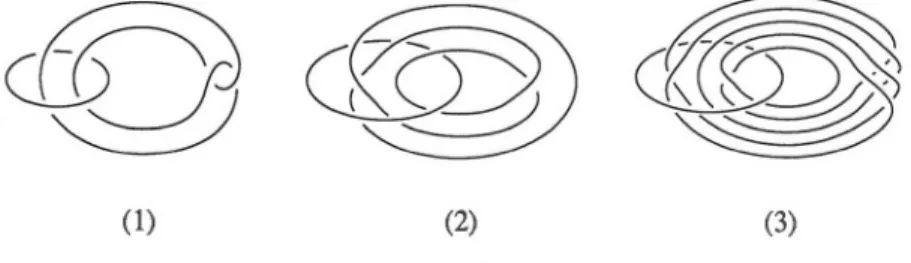
The manifolds Mi, M2 , M3 are the exteriors of the links Li, L2 and L3 in 53 which are shown in the following figure
(1) (2) (3)
Figure 2.1 The links Li, L2 and L3 .
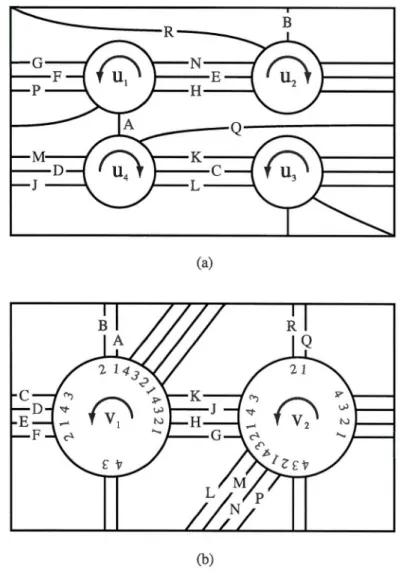
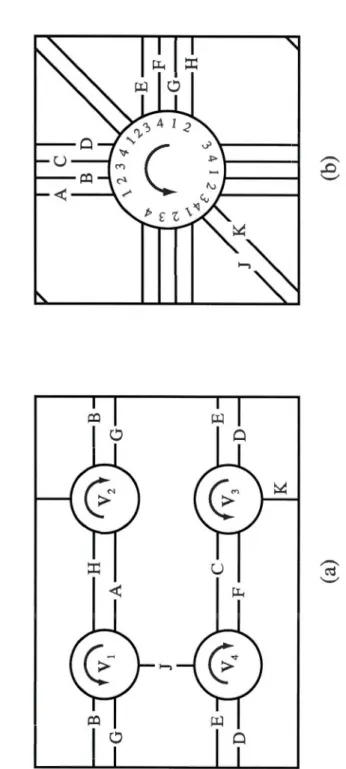
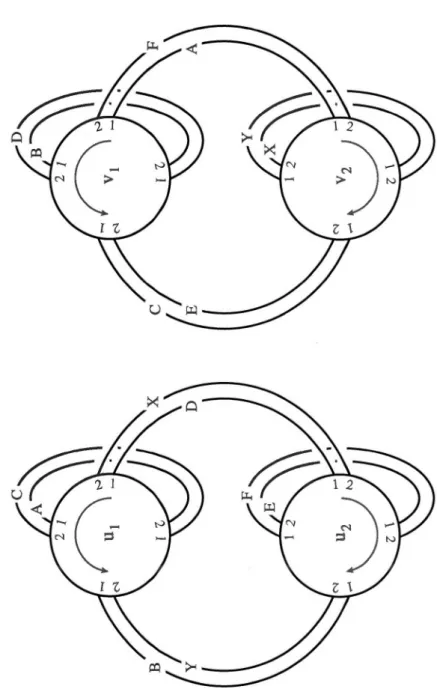
M4 , · · · , Mi4 are the manifolds X(Fi, F2) corresponding to the intersection graphs given in (Gordon and Wu, 2008), and ri, si are the boundary slopes of the corre -sponding surfaces Fi, F2. We will reproduce here, in Figure 2.2, Figure 2.3 and Figure 2.4, the intersection graphs for M4, M5 , and Mi4 as in (Gordon and Wu, 2008). The nine manifolds M6 , · · · , Mi4 can be constructed as branched covers of a tan-gle Qi
=
(Wi, Ki), for each i=
6, ... , 14, where Wi is a 3-ball for i=
6, ... , 13, and an 52 x I for i=
14. More precisely Mi is the double branched cover of Wi with branch set Ki. For more details we refer to (Gordon and Wu, 2008) section 22.(a)
(b)
Figure 2.2 The intersection graph for the manifold M4 (Gordon and Wu, 2008).
In Figure 2.2 and Figure 2.3 each graph is on the torus Fa which we draw as a
".> 4 1 <