O
pen
A
rchive
T
OULOUSE
A
rchive
O
uverte (
OATAO
)
OATAO is an open access repository that collects the work of Toulouse researchers and
makes it freely available over the web where possible.
This is an author-deposited version published in :
http://oatao.univ-toulouse.fr/
Eprints ID : 15826
To link to this article : 10.1111/fwb.12606
URL:
http://dx.doi.org/10.1111/fwb.12606
To cite this version :
Cornut, Julien and Ferreira, Verónica and Gonçalves, Ana Lúcia
and Chauvet, Eric and Canhoto, Cristina Fungal alteration of the elemental
composition of leaf litter affects shredder feeding activity. (2015) Freshwater Biology,
vol. 60 (n° 9). pp. 1755-1771. ISSN 0046-5070
Any correspondence concerning this service should be sent to the repository
administrator:
[email protected]
Fungal alteration of the elemental composition of leaf litter
affects shredder feeding activity
J U L I E N C O R N U T *† ‡ , V E R !ON I C A F E R R E I R A‡ , A N A L !UC I A G O N C! ALVES§ , E R I C C H A U V E T *† A N D C R I S T I N A C A N H O T O§
*Universit!e de Toulouse, INP, UPS, EcoLab (Laboratoire Ecologie Fonctionnelle et Environnement), Toulouse, France
†
CNRS, EcoLab, Toulouse, France ‡
MARE - Marine and Environmental Sciences Centre, Department of Life Sciences, University of Coimbra, Coimbra, Portugal §
Centre for Functional Ecology, Department of Life Sciences, University of Coimbra, Coimbra, Portugal S U M M A R Y
1. Leaf litter from riparian vegetation provides the main source of matter and energy for food webs of small forest streams. Shredding macroinvertebrates mostly feed on this litter when it has been colonised and conditioned by microorganisms, especially by aquatic hyphomycetes. Since shredders feed selectively, they must make foraging decisions based on the physical and chemical characteristics of the food resource, which can change depending on the identity of fungal species.
2. Here, we addressed the effect of changes in fungal assemblage structure on the elemental composi-tion of oak (Quercus robur) leaf litter and how variation in litter quality affects the feeding of a stream
shredder. Leaf discs were incubated in microcosms for 2 weeks, inoculated with various fungal assemblages comprised of three species each, and offered to a shredder (Schizopelex festiva,
Trichop-tera: Sericostomatidae) as food.
3. This shredder ate more leaves with a high mycelial biomass, which depended on fungal assem-blage composition. Leaf litter conditioned by different fungal assemassem-blages resulted in different litter N and P concentrations. Mycelial biomass was positively related to litter P concentration, with the lowest and highest P concentrations differing by 40% at most, but not to litter N concentration, even though the lowest and highest N concentrations differed by as much as 35%. The caddisfly larvae ate more leaves with a low C/P ratio.
4. These findings suggest a key role of litter P concentration in eliciting fungal conditioning effects on shredder-mediated litter decomposition.
Keywords: ecosystem functioning, fungal community composition, leaf litter stoichiometry, Schizopelex
fes-tiva, species identity
Introduction
One challenge that all organisms face is to acquire suffi-cient energy and elements to maintain bioenergetic pro-cesses (Frost et al., 2005). A growing body of evidence
indicates that organisms meet an imbalanced mixture of elements from their resources (Sterner & Elser, 2002; Frost et al., 2005). Elemental constraints can therefore
strongly affect consumer growth and reproduction
(Bruning, 1991; Sterner & Schulz, 1998; Aerts & Chapin, 2000; Smith, 2002; Frost et al., 2005), with important
con-sequences for the dynamics of populations (Elser et al.,
1998; Chenet al., 2004), interspecific interactions (DeMott
& Gulati, 1999; Denno & Fagan, 2003) and key ecosys-tem processes (Sterner et al., 1997; Cebrian, 1999; Frost et al., 2005).
In small woodland streams, the primary source of car-bon (C) and energy for aquatic food webs is terrestrially
derived organic matter supplied by the riparian vegeta-tion, whose shade also limits instream primary produc-tion (Vannote et al., 1980). Leaf litter decomposition in
these streams is therefore an important ecosystem pro-cess, which depends on the activity of shredding inver-tebrates and microorganisms (Hieber & Gessner, 2002; Pascoal & C!assio, 2004). The latter, especially aquatic hyphomycetes, convert leaf C into biomass and immobi-lise nutrients, which increases the palatability of leaf detritus for shredding invertebrates (Gessner, Dobson & Chauvet, 1999; Grac!a, 2001). Therefore, the microbially conditioned leaf litter often allows a higher survival, growth rate and/or reproductive output and thus enhances shredder fitness (Grac!a, 2001).
Early studies showed that aquatic hyphomycete spe-cies differ in degradative capabilities when they are inoculated individually onto leaf litter (Suberkropp, Arsuffi & Anderson, 1983; Suberkropp & Arsuffi, 1984; Butler & Suberkropp, 1986). This suggests that commu-nities dominated by distinct fungal species would decompose leaf litter at different rates and therefore dif-ferentially improve the food quality of leaf detritus. Beyond interspecific variations due to those qualitative differences in enzymatic capabilities, Danger & Chauvet (2013) recently reported a strong plasticity in the elemental composition of several aquatic hyphomycete species.
Overall, these points could have important conse-quences for consumer–resource interactions, the supply of C and nutrients up the food web, and nutrient recy-cling. Detritivores are able to discriminate among leaves colonised by different fungal species (Arsuffi & Suberk-ropp, 1984; Gonc!alves et al., 2014). Detritivores and
pri-mary consumers, in general, are among the organisms most affected by variation in resource quality. Detriti-vores face a world where the resources (mainly leaf lit-ter) they consume are often of poor quality. Factors such as leaf toughness, structural constituents or secondary leaf compounds, and low nitrogen (N) concentration can affect detritivore performance (Schlief & Mutz, 2006; Dangeret al., 2012). Several mechanisms for overcoming
low nutritional quality have been suggested (Sterner & Hessen, 1994). Consumers could actively select resources with higher concentrations of the limiting mineral nutri-ent (Kimmerer & Potter, 1987; Butler, Suttle & Neill, 1989) or could increase their uptake of food with low nutritional quality to access sufficient amounts of the limiting nutrient (Fink & von Elert, 2006). However, Frost & Elser (2002) suggested that such compensatory mechanisms probably cause additional energetic costs, which reduce their adaptive value. To our knowledge,
the mechanisms underlying feeding preferences of detri-tivores have been poorly explored.
Here, we assessed whether changes in the composi-tion of aquatic hyphomycete assemblages would influ-ence the nutrient concentration of decomposing oak leaf litter, and whether these variations in litter quality would affect the feeding activity of a stream detritivore. We hypothesised that variation in leaf litter resource quality, defined here as leaf litter elemental composition, would change consumer feeding performance, with con-sequences for the rate of leaf litter breakdown as a major ecological process in detritus-based headwater streams. We tested this hypothesis by conducting an experimen-tal laboratory study, in which the structure of litter-associated fungal assemblages was manipulated in microcosms simulating a stream environment. The con-ditioned litter was then fed to a stream detritivore, the larva of the shredderSchizopelex festiva (Trichoptera:
Ser-icostomatidae). We predicted that fungal assemblages comprising aquatic hyphomycete species that exhibit high degradative capabilities (Zemeket al., 1985) would
also better enhance leaf litter nutritional value, resulting in an increased shredder feeding activity and litter decomposition rates.
Methods
Microcosm set-up and fungal assemblages
Leaf litter, fungal assemblages and microcosms. Oak leaves
were collected at abscission in autumn 2008 using a sus-pended net in the riparian zone of the Alzeau river, Montagne Noire (south-western France; 02°13023″ E, 43°25051″ N; altitude 743 m a.s.l) and dried at room tem-perature. Before use, leaves were soaked in distilled water for 3 h and ~8000 leaf discs were cut from them with a 12-mm ∅ cork borer, avoiding primary and sec-ondary veins. Once cut, leaf discs were oven-dried (65 °C, >24 h), weighed individually (!0.01 mg) and dis-tributed among 63 mass classes of 0.1 mg range (from 2.10–2.20 to 8.20–8.30 mg). Eight mass classes, among which two thickness levels were distinguished, were selected: 3.30–3.40, 3.40–3.50 mg [Thin, Early assemblage treatment]; 3.50–3.60, 3.60–3.70 mg [Thin, Late assem-blage]; 3.90–4.00, 4.00–4.10 mg (Thick, Early assemblage); and 4.10–4.20, 4.20–4.30 mg (Thick, Late assemblage).
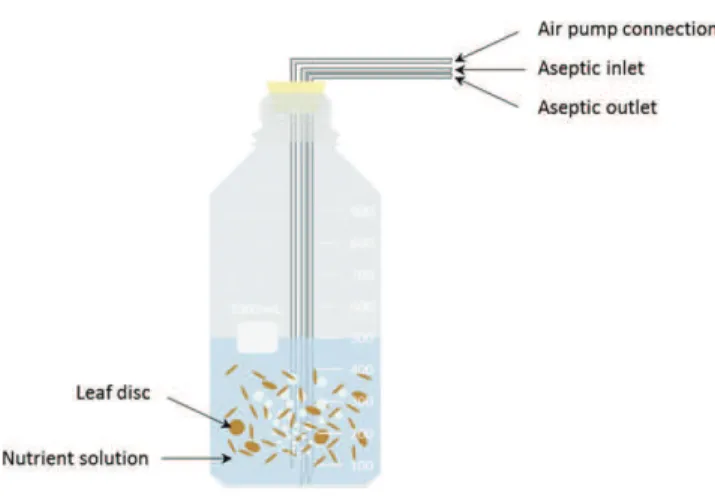
Leaf discs were conditioned in laboratory microcosms designed to simulate the stream environment. Each microcosm consisted of a 1-L glass flask with a sealed cap through which passed three tubes: one tube was con-nected to an air pump and allowed continuous aeration
(~670 mL min"1) that created turbulence and kept the leaf discs in permanent agitation, the second tube allowed the aseptic filling of the microcosm with 500 mL of new nutrient solution every 2 days, and the third tube allowed the aseptic drainage of medium and recovery of conidial suspensions (Fig. 1). The nutrient solution con-tained sterile distilled water in which was dissolved 75.5 mg L"1 CaCl
2, 10 mg L"1 MgSO4.7H2O, 0.5 g L"1 morpholino-propane sulphonic acid, 5.5 mg L"1K
2HPO4 and 100 mg L"1 KNO
3; pH was adjusted to 7.0 (Dang, Chauvet & Gessner, 2005).
Six species of aquatic hyphomycetes, frequently reported to be dominant in leaf litter in streams, were used to condition the leaf discs to be later offered to the caddisfly larvae: Anguillospora filiformis (noted as Anguillospora), Articulospora tetracladia (Articulospora), Clavariopsis aquatica (Clavariopsis), Tetrachaetum elegans
(Tetrachaetum), Tetracladium marchalianum (Tetracladium)
and Tricladium chaetocladium (Tricladium) (Gessner et al.,
1993; Suberkropp, 2001; Ferreiraet al., 2006a). The fungal
strains were isolated from single conidia trapped in nat-urally occurring foam or released from leaf litter accu-mulations, collected from streams in southern France.
Growing colonies were kept at room temperature (~20 °C), in 9-cm ∅ Petri dishes with ~10 mL of sterile growth medium (2% malt and 2% agar), until they were used to induce conidial production.
Conidial inoculations (<1 day old) were produced at 15 °C, under light conditions, by agitation of agar plugs taken from the leading edge of 14- to 30-day-old colo-nies in 25 mL of nutrient solution (prepared as described previously). An aliquot of each specific conid-ial suspension, based on conidconid-ial density, was used to inoculate the microcosms. Eight microcosms were inocu-lated with an assemblage composed of aquatic hyph-omycete species tending to be early colonisers (Early assemblage: Anguillospora, Tetrachaetum and Tricladium),
and eight microcosms were inoculated with an assem-blage composed of aquatic hyphomycete species tending to be late colonisers (Late assemblage: Articulospora, Clavariopsis and Tetracladium) (Gessner et al., 1993;
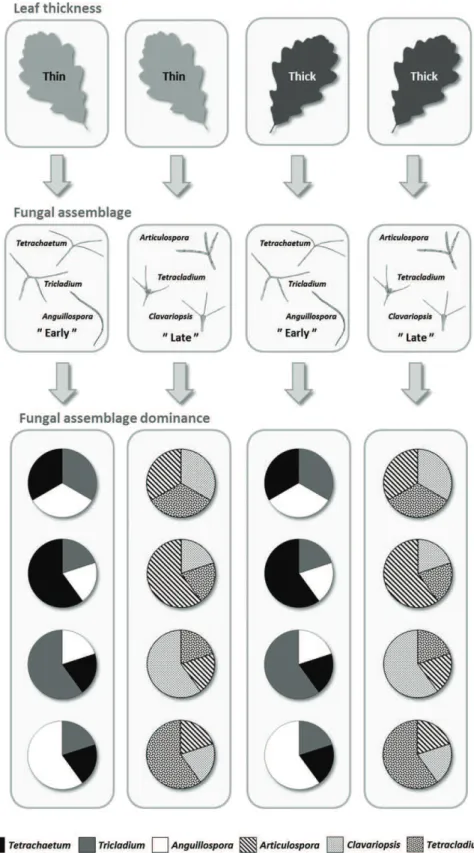
Nikol-cheva, Cockshutt & B€arlocher, 2003). The use of only three species allowed us to assess the importance of the dominant species identity on the decomposition process (Ferreira & Chauvet, 2012) and, more specifically, the extent to which this affected the food quality of leaf detritus. For each assemblage type (Early and Late), there were four dominance treatments: an even treat-ment, in which microcosms were inoculated with even proportions of conidia from each species (i.e. 33.3%), and three uneven treatments in which microcosms were inoculated with species 1, species 2 or species 3 as domi-nant (i.e. 60% and 20% for each of the two other species, cf. Fig. 2; Ferreira & Chauvet, 2012).
Conditioning. Five groups of 155 discs were set apart
from the selected mass classes, weighed (!0.01 mg), placed inside each microcosm with 150 mL of distilled water and autoclaved (20 min at 121 °C). In parallel, three groups of five leaf discs of the selected mass clas-ses were weighed (!0.01 mg), placed inside glass tubes with 10 mL of distilled water, given the same treatment and used to create a correction factor for mass loss due to leaching during sterilisation. After cooling to room temperature, the water from the microcosms (n = 20)
was replaced with 500 mL of a sterile nutrient solution (described above) added to microcosms through the tub-ing system, which was otherwise closed with a clamp, and aerated for 24 h to allow further leaching. Nutrient solution was changed and the microcosms inoculated with conidial suspensions. Eight microcosms were inoc-ulated with an early assemblage, and eight were inocu-lated with a late assemblage; a total of ~155 000 conidia were inoculated into each microcosm (Fig. 2). For the first 6 h, the microcosms were aerated for periods of 20 min interspaced by periods of 20-min quiescence; after this, microcosms were aerated continuously until the end of the experiment. The nutrient solution was
Fig. 1 Laboratory microcosm designed to simulate stream condi-tions and used to inoculate and grow aquatic fungi axenically on leaf discs. Each microcosm consisted of a 1-L glass flask equipped with three sealed tubing systems running through the cap: one tube was connected to an air pump and allowed continuous aera-tion that created turbulence and kept the leaf discs in permanent agitation (air pump connection), the second tube allowed the asep-tic filling of the microcosm (asepasep-tic inlet), and the third tube allowed the aseptic drainage of medium and recovery of conidial suspensions (aseptic outlet).
replaced after 24 h and then every 2 days for the duration of the experiment (14 days). Microcosms were incubated at 15 °C under a 12-h light:12-h dark photoperiod. All manipulations of microcosms took place under aseptic conditions in a sterile laminar flow cabinet.
After 2 weeks, the 155 leaf discs from each microcosm were sampled. Ninety discs were promptly used in the invertebrate experiment. Three sets of five leaf discs were used for respirometry trials and then frozen at "20 °C, lyophilised, weighed (!0.01 mg) and used for ergosterol extraction. Three sets of 10 leaf discs were
Fig. 2 Experimental design for condi-tioning oak leaf discs and contribution of each aquatic hyphomycete species to the initial conidial inoculum (%). Fungal
spe-cies:Anguillospora filiformis
(Anguillos-pora), Articulospora tetracladia
(Articulospora), Clavariopsis aquatica (Clav-ariopsis), Tetrachaetum elegans (Tetrachae-tum), Tetracladium marchalianum
(Tetracladium) and Tricladium chaetocladi-um (Tricladichaetocladi-um).
used for determination of DM, ground and used for determinations of phosphorus (P), N and C concentra-tions. Four microcosms (i.e. two microcosms per thick-ness level) were kept sterile and were used as controls for abiotic decomposition.
Mass loss and leaf physical–chemical characteristics.
Spe-cific leaf disc area (SLA) was determined for 96 discs as the area-to-mass ratio, and results were expressed as mm2 mg"1. Toughness was determined for the same leaf discs with a penetrometer after discs had been soaked in distilled water for 1 h, with results expressed as the mass (g) required to force an iron rod (1.89 mm2 ∅) through the discs (Grac!a, B€arlocher & Gessner, 2005).
To characterise initial litter chemical composition before and after autoclaving, three sets of 10 air-dried and autoclaved litter discs were oven-dried (105 °C, 24 h) to allow estimation of initial DM and ground with a mortar and pestle (0.5 mm powder size) and subsam-ples weighed (!0.01 mg) to be analysed for C, N [IRMS Thermo Delta V advantage with a Flash EA (1112 ser-ies)], and P concentrations (APHA, 1998). Results were expressed as percentage of dry mass (% DM). After the end of the experiment, three sets of 10 leaf discs from each microcosm were oven-dried (105 °C, 24 h), weighed (!0.01 mg) to determine remaining dry mass (DMr) calculated as the difference between initial mass and final mass, and used to estimate leaf litter elemental quality after conditioning.
Fungal sporulation. Each of the seven times the nutrient
solutions were changed, 40 mL of the suspension from each microcosm was sampled, stored in 50-mL Falcon tubes and preserved with 2 mL 37% formalin until pro-cessed. When preparing filters for conidial counting and identification, 150 lL of polyethylene glycol p-(1,1,3,3-tetramethylbutyl)-phenyl ether (Triton X-100, 0.5%) was added to the suspension and mixed with a magnetic stirring bar to ensure a uniform distribution of conidia, and an aliquot of the suspension was filtered (25 mm ∅, pore size 5 lm, Millipore SMWP; Millipore Corp., Bedford, MA, U.S.A.). Filters were stained with 0.05% trypan blue in 60% lactic acid, and spores were identified and counted under a compound microscope at 320 9 (Leitz Diaplan, Wetzlar, Germany) according to Grac!a et al.
(2005). Cumulative conidial production over time was calculated by summing the numbers of conidia produced at the current and preceding sampling dates. The total conidial mass was calculated by multiplying the number of conidia from each species by the average mass of indi-vidual conidia obtained from the literature (Chauvet &
Suberkropp, 1998) or calculated from biovolume data (B€arlocher & Schweizer, 1983). Results were expressed as lg of conidia released mg"1initial leaf DM.
Fungal respiration. At the end of the experiment, three
subsets of five discs from each microcosm were used to determine fungal oxygen consumption rates using a closed six-channel dissolved oxygen measuring system (Strathkelvin 929 System, North Lanarkshire, U.K.) con-nected to a computer. The oxygen electrodes were cali-brated against a saturated solution of sodium sulphite in 0.01M sodium borate (0% O2) and a 100% O2-saturated nutrient solution at 15 °C. Leaf discs were incubated in 3-mL chambers filled with a sterile 100% O2-saturated nutrient solution, stirred with a magnetic bar, and kept at 15 °C by circulation of water originating from a tem-perature-controlled water bath.
Additional chambers without leaf discs were used as controls. After a 1-h trial, leaf discs were enclosed in small sterile zip lock bags and promptly frozen at "20 °C for later DM determination and ergosterol extraction. Oxygen consumption rates were determined by the difference in the O2 concentration in the sample and the control (chamber with no leaf discs) over a 20-min interval during which O2 consumption over time was linear, corrected for chamber volume, time and disc mass. Results were expressed as mg O2 g"1 leaf DM h"1.
Mycelial biomass. The three subsets of five leaf discs
from each microcosm, frozen after the respirometry trial, were lyophilised, promptly weighed (!0.01 mg) to deter-mine DM, and used for ergosterol extraction as a surro-gate for mycelial biomass (Gessner & Chauvet, 1993; Grac!a et al., 2005). Lipid extraction and saponification
were carried out in 10 mL KOH/methanol (8 g L"1) at 80 °C for 30 min. The extract was then purified by solid phase extraction (Waters Oasis HLB 3-cc cartridges; Waters Corp., Milford, MA, U.S.A.; Grac!a et al., 2005)
and quantified with high-performance liquid chromatog-raphy (HPLC; Dionex DX-120, Sunnyvale, CA, U.S.A.) by measuring absorbance at 282 nm. The HPLC system was equipped with a LiChroCART 250-4 LiChrospher 100 RP-18 (5 lm) column (Merck, Darmstadt, Germany) maintained at 33 °C. The mobile phase was 100% metha-nol, and the flow rate was set to 1.4 mL min"1. Fungal biomass was estimated from ergosterol using either spe-cific ergosterol–fungal DM conversion factors (Articulospora, 4.2 mg ergosterol g"1 fungal DM;
Anguil-lospora, 10.9; Clavariopsis, 4.6; Tetracladium, 4.6; Tetrachae-tum, 4.7) or a general 5.5 mg ergosterol g"1 fungal DM
conversion factor (Tricladium; no specific conversion
fac-tors were available) (Gessner & Chauvet, 1993; Suberk-ropp, Gessner & Chauvet, 1993), applied to the relative contribution of each species to total ergosterol mass based on specific relative contribution to total reproduc-tive output. Results were expressed as mg mycelial bio-mass g"1 leaf DM.
Consumption test. Here, we tested whether changes in
the composition of aquatic hyphomycete assemblages, identity of the dominant species and leaf thickness would influence the nutrient concentration of decomposing leaf litter. We also evaluated whether this variation in nutrient concentrations affected the feeding activity of shredders by offering leaf discs inoculated in the 20 microcosms considered above (two thickness levels 9 two assem-blages types 9 four dominance types + four sterile con-trols) to the detritivoreSchizopelex festiva.
Similar-sized, early-instar larvae were collected from depositional areas in Ribeira de M!uceres, Serra do Cara-mulo (central Portugal; 40°32001″ N, 08°09015″ W; alti-tude 210 m a.s.l), during winter 2010, and transported to the laboratory in plastic containers with stream water and sand. Individuals were kept in plastic containers with stream sand and aerated stream water, fedad libi-tum chestnut litter conditioned in the stream for
2 weeks, and acclimated at 15 °C under a 12-h light:12-h dark photoperiod for 2 weeks before being used. The diameter of the case opening (CO, mm) of each individ-ual was measured under a stereoscopic microscope at 16 9 (Wild M38, Heerbrugg, Switzerland), at the begin-ning of the experiment, and individual DM (g) was esti-mated by the application of the regression model DM = 0.0002 9 CO3.2068 (r2=0.92, P < 10"3, n = 30). For the feeding experiment, the invertebrates were allo-cated to plastic containers (7 cm diameter 9 8.5 cm high), with a standard amount (two tea spoons; ~19 g) of ashed stream sediment (<0.5 mm; 550 °C, 8 h) cover-ing the bottom, and 200 mL of filtered stream water (47 mm ∅, pore size 0.7 lm, Millipore APFF04700; Milli-pore Corp.), aerated for the duration of the experiment (Grac!a et al., 2005). One pre-measured S. festiva larva
was allocated to each of 300 plastic containers (20 treat-ments 9 15 replicates) and allowed access to three con-ditioned leaf discs, while three other leaf discs were enclosed in a fine mesh bag that hung from the plastic containers’ edge and served as a control for mass loss due to leaching and microbial activity. After 48 h, when remaining litter in most containers was <50% of initial disc area, the remaining litter mass was recovered, oven-dried (105 °C; 24 h) and weighed (!0.01 mg). The litter
DM eaten by the larva during the elapsed time (Le, g) was calculated asCF"EF, whereCFis the final DM (g) of control litter discs and EF is the final DM (g) of litter exposed to the larva (this assumes that control and exposed litter had the same initial mass after the condi-tioning step). Relative consumption rates (g leaf DM g"1 individual DM h"1) were calculated as Le/(DMII9 t), where DMIIis the invertebrate initial DM (g) and t is the time elapsed (h).
Data analysis. Phosphorus and N concentrations of
ini-tial and autoclaved oak leaf discs, and iniini-tial SLA, were compared between thin and thick discs by t-tests. A
three-way factorial ANOVA was used to assess differ-ences in mycelial biomass, respiration rate and percent-age of leaf mass loss at the end of the conditioning period and relative consumption rate of S. festiva larvae
among treatments [leaf thickness (i.e. Thin or Thick), assemblage type (i.e. Early or Late) and dominance treat-ment as the main effects] (Zar, 1996). When significant differences were detected among treatments, Tukey’s HSD tests were then carried out for post hoc pairwise
comparisons. No statistical analysis was performed on total conidial production and conidial biomass produc-tion because there was only one value per microcosm. The relationships between the specific relative conidial production and conidial biomass production after 2 weeks of incubation and the specific relative conidial abundance in the inocula were assessed across treat-ments within each assemblage type by linear regression. The relationship between mycelial biomass (expressed as log-transformed data) across dominance treatments and relative consumption rate of S. festiva larvae was
assessed using simple linear regression analysis. Simi-larly, relationships between mycelial biomass across dominance treatments and relative consumption rate of
S. festiva larvae and elemental composition ratios of leaf
litter were examined with simple linear regression analyses. Data were log-transformed to improve homo-scedasticity when necessary. All analyses were per-formed with STATISTICA 6 software (StatSoft Inc., 2001). For all analyses, a significance threshold of
P = 0.05 was used.
Results
Initial litter chemical composition, toughness and specific leaf area
The thinnest leaf discs (mass classes 3.30–3.40, 3.40–3.50; and 3.50–3.60, 3.60–3.70 mg) had on average 10.6%
higher initial P concentration than leaf discs exhibiting the highest thickness (mass classes 3.90–4.00, 4.00– 4.10 mg; and 4.10–4.20, 4.20–4.30 mg), although the dif-ference was not significant (Table 1; P = 0.23). Leaching
by autoclaving affected thick and thin leaf discs differ-ently, with greater losses in P concentration observed for the thinnest leaf discs (52.2%) compared with the thick-est ones (29.6%; Table 1). Although leaching increased the relative difference in P concentration between the two sets of leaf discs to 24.9%, this still remained non-significant (Table 1, P = 0.11). Leaf disc thickness did
not significantly affect initial N concentration (P = 0.08)
in spite of a relative difference of 11.2% between thick-ness levels (Table 1). However, leaching by autoclaving significantly increased the relative difference in N con-centration between the two sets of leaf discs to 19.7% (Table 1; P = 0.01). Carbon concentrations before and
after autoclaving were similar between thin and thick
leaves (Table 1, <0.3% difference; P = 0.38 and 0.55,
respectively). Based on a set of leaf discs randomly cho-sen, disc toughness was negatively related to SLA (linear regression, P < 0.001, r2=0.27, n = 96, leaf disc mass
from 2.2 to 6.7 mg or leaf disc SLA from 51.88 to 16.96 mm2mg"1). However, the relationship remained weak in spite of a large difference between the extreme leaf disc mass or SLA values.
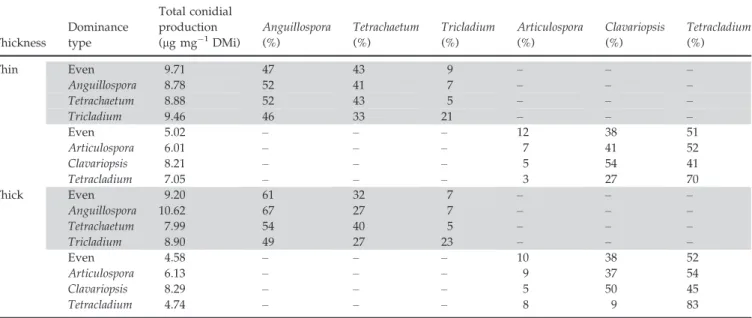
Aquatic hyphomycete assemblages. Overall, conidial
bio-mass production from early assemblages was consis-tently higher than that from late assemblages, whatever the disc thickness (i.e. 1.4 and 1.5 times higher in the thin and thick discs, respectively; Table 2). Manipulation of the specific number of conidia inoculated into the microcosms allowed us to anticipate the identity of the dominant species in the Anguillospora (Early
assem-blage), Clavariopsis (Late assemblage) and Tetracladium
Table 1 Phosphorus (P), nitrogen (N) and carbon (C) concentrations (mean ! 1 SE) of initial and autoclaved thin and thick oak leaf discs. Grey-shaded text shows early assemblages and unshaded late assemblages
Thickness Litter state P (% DM) N (% DM) C (% DM)
Thin Initial non autoclaved 0.027 ! 0.000 0.86 ! 0.01 46.72 ! 0.09
Initial autoclaved 0.011 ! 0.002 0.87 ! 0.07 47.44 ! 0.15
Initial non autoclaved 0.030 ! 0.003 0.93 ! 0.06 47.24 ! 0.14
Initial autoclaved 0.017 ! 0.003 1.04 ! 0.07 48.07 ! 0.24
Thick Initial non autoclaved 0.024 ! 0.002 0.96 ! 0.07 47.15 ! 0.01
Initial autoclaved 0.017 ! 0.003 1.18 ! 0.02 47.77 ! 0.11
Initial non autoclaved 0.028 ! 0.001 1.06 ! 0.07 47.11 ! 0.20
Initial autoclaved 0.019 ! 0.001 1.20 ! 0.10 47.48 ! 0.12
Table 2 Total production of conidial biomass and relative contribution of the leaf-associated fungal species to the total production of conid-ial biomass at two leaf thickness levels and two assemblage types for the four dominance types over 2 weeks. Grey-shaded text shows early
assemblages and unshaded late assemblages. Fungal species:Anguillospora filiformis (Anguillospora), Articulospora tetracladia (Articulospora),
Clavariopsis aquatica (Clavariopsis), Tetrachaetum elegans (Tetrachaetum), Tetracladium marchalianum (Tetracladium) and Tricladium chaetocladium
(Tricladium) Thickness Dominance type Total conidial production (lg mg"1DMi) Anguillospora (%) Tetrachaetum (%) Tricladium (%) Articulospora (%) Clavariopsis (%) Tetracladium (%) Thin Even 9.71 47 43 9 – – – Anguillospora 8.78 52 41 7 – – – Tetrachaetum 8.88 52 43 5 – – – Tricladium 9.46 46 33 21 – – – Even 5.02 – – – 12 38 51 Articulospora 6.01 – – – 7 41 52 Clavariopsis 8.21 – – – 5 54 41 Tetracladium 7.05 – – – 3 27 70 Thick Even 9.20 61 32 7 – – – Anguillospora 10.62 67 27 7 – – – Tetrachaetum 7.99 54 40 5 – – – Tricladium 8.90 49 27 23 – – – Even 4.58 – – – 10 38 52 Articulospora 6.13 – – – 9 37 54 Clavariopsis 8.29 – – – 5 50 45 Tetracladium 4.74 – – – 8 9 83
(Late assemblage) treatments for both thickness levels. Early assemblages were dominated by Anguillospora
(Table 2), even when this species was represented by only 20% conidia in the initial inocula (see Methods). Conidial biomass production by Tetrachaetum across
treatments was also not related to its abundance in the inocula (r2= 0.37; P = 0.11), and Tetrachaetum generally
codominated with Anguillospora (Table 2). Tricladium
conidial production across treatments was related to its initial abundance (r2 =0.93; P < 0.001), but was the
spe-cies contributing the least to the total conidial pool within each treatment. Late assemblages were domi-nated by Tetracladium, except for Clavariopsis treatments
whereClavariopsis dominated. Conidial biomass
produc-tion by Tetracladium across treatments was related to its
abundance in the inocula (r2= 0.81; P < 0.01). Articulos-pora was consistently outcompeted by the other two
spe-cies, even in the Articulospora treatments. Nevertheless,
each of the three species tended to produce relatively more conidial biomass in the microcosms where they were inoculated with the highest number of conidia (Table 2).
Litter mass loss. Mass loss of oak leaf discs after
incuba-tion in microcosms for 2 weeks varied between 13.2% (Thin, Early assemblage, Even) and 49.7% (Thin, Late assemblage, Tetracladium). Interestingly, leaf
decomposi-tion by late assemblages was much faster than that
pro-moted by early assemblages, in both leaf thickness levels (P < 0.001; Tables 3 & 4). Decomposition rate was affected
by species dominance identity within thickness level (i.e. Thin and Thick;P = 0.006) but also by dominant species
identity within assemblage type (i.e. Early versus Late;
P < 0.001; Tables 3 & 4). Mass loss was negatively
affected by litter thickness (P < 0.001, Tables 3 & 4).
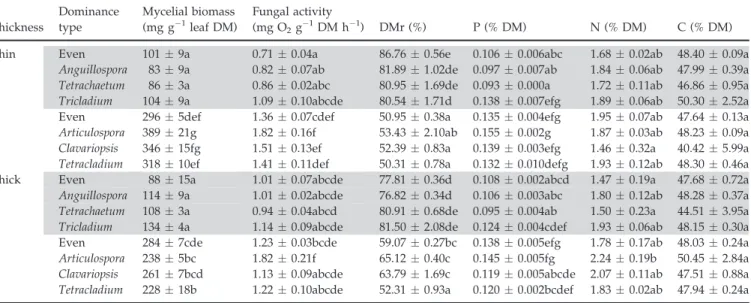
Fungal biomass, respiration and leaf litter quality for consum-ers. After 2-week conditioning, fungal biomass on leaf
discs varied between 83 (Thin, Early assemblage, Anguil-lospora) and 389 mg g"1 leaf DM (Thin, Late assemblage,
Articulospora) (Table 3). Higher fungal biomass accrual
(~three times) was obtained in microcosms where leaf discs were inoculated with late assemblages (P < 0.001;
Tables 3 & 4), with the difference being more pro-nounced between assemblage types in the thin than in the thick discs (P < 0.001; Tables 3 & 4). Interestingly,
the increase in disc thickness led to a significant increase in fungal biomass in microcosms with early assem-blages, whereas it resulted in a decrease in fungal bio-mass with late assemblages (P < 0.001; Table 4). Mycelial biomass accrual was affected by changes in identity of the dominant species: thin discs in micro-cosms inoculated withArticulospora as the dominant
spe-cies had higher values than thin discs in microcosms inoculated with Anguillospora or Tetrachaetum as the
dominant species (Table 3).
Table 3 Mycelial biomass, fungal activity, dry mass remaining and elemental composition (mean ! 1 SE) of oak leaf discs at two leaf thick-ness levels and two assemblage types for the four dominance types over 2 weeks. Grey-shaded text shows early assemblages and unshaded
late assemblages. Treatments with the same letter are not significantly different (Tukey’s HSD,P > 0.05). Fungal species: Anguillospora
filifor-mis (Anguillospora), Articulospora tetracladia (Articulospora), Clavariopsis aquatica (Clavariopsis), Tetrachaetum elegans (Tetrachaetum), Tetracladium marchalianum (Tetracladium) and Tricladium chaetocladium (Tricladium)
Thickness Dominance type Mycelial biomass (mg g"1leaf DM) Fungal activity (mg O2g"1DM h"1) DMr (%) P (% DM) N (% DM) C (% DM)
Thin Even 101 ! 9a 0.71 ! 0.04a 86.76 ! 0.56e 0.106 ! 0.006abc 1.68 ! 0.02ab 48.40 ! 0.09a
Anguillospora 83 ! 9a 0.82 ! 0.07ab 81.89 ! 1.02de 0.097 ! 0.007ab 1.84 ! 0.06ab 47.99 ! 0.39a
Tetrachaetum 86 ! 3a 0.86 ! 0.02abc 80.95 ! 1.69de 0.093 ! 0.000a 1.72 ! 0.11ab 46.86 ! 0.95a
Tricladium 104 ! 9a 1.09 ! 0.10abcde 80.54 ! 1.71d 0.138 ! 0.007efg 1.89 ! 0.06ab 50.30 ! 2.52a
Even 296 ! 5def 1.36 ! 0.07cdef 50.95 ! 0.38a 0.135 ! 0.004efg 1.95 ! 0.07ab 47.64 ! 0.13a
Articulospora 389 ! 21g 1.82 ! 0.16f 53.43 ! 2.10ab 0.155 ! 0.002g 1.87 ! 0.03ab 48.23 ! 0.09a
Clavariopsis 346 ! 15fg 1.51 ! 0.13ef 52.39 ! 0.83a 0.139 ! 0.003efg 1.46 ! 0.32a 40.42 ! 5.99a
Tetracladium 318 ! 10ef 1.41 ! 0.11def 50.31 ! 0.78a 0.132 ! 0.010defg 1.93 ! 0.12ab 48.30 ! 0.46a
Thick Even 88 ! 15a 1.01 ! 0.07abcde 77.81 ! 0.36d 0.108 ! 0.002abcd 1.47 ! 0.19a 47.68 ! 0.72a
Anguillospora 114 ! 9a 1.01 ! 0.02abcde 76.82 ! 0.34d 0.106 ! 0.003abc 1.80 ! 0.12ab 48.28 ! 0.37a
Tetrachaetum 108 ! 3a 0.94 ! 0.04abcd 80.91 ! 0.68de 0.095 ! 0.004ab 1.50 ! 0.23a 44.51 ! 3.95a
Tricladium 134 ! 4a 1.14 ! 0.09abcde 81.50 ! 2.08de 0.124 ! 0.004cdef 1.93 ! 0.06ab 48.15 ! 0.30a
Even 284 ! 7cde 1.23 ! 0.03bcde 59.07 ! 0.27bc 0.138 ! 0.005efg 1.78 ! 0.17ab 48.03 ! 0.24a
Articulospora 238 ! 5bc 1.82 ! 0.21f 65.12 ! 0.40c 0.145 ! 0.005fg 2.24 ! 0.19b 50.45 ! 2.84a
Clavariopsis 261 ! 7bcd 1.13 ! 0.09abcde 63.79 ! 1.69c 0.119 ! 0.005abcde 2.07 ! 0.11ab 47.51 ! 0.88a
Fungal respiration after incubation for 2 weeks was strongly affected by changes in identity of the dominant species in the inoculum (P = 0.001; Table 4) and varied
between 0.71 mg O2g"1 DM h"1 (Thin, Early assem-blage, Even) and 1.82 mg O2g"1 DM h"1 (Thin, Late assemblage, Articulospora and Thick, Late assemblage, Articulospora). Overall, leaf litter thickness did not affect
respiration rate (P = 0.84; Tables 3 & 4), and higher
val-ues for fungal respiration were consistently obtained in microcosms inoculated with late assemblages (P < 0.001;
Table 3). As previously shown for fungal biomass, the increase of leaf litter thickness led to a significantly higher fungal respiration in microcosms with early assemblages, conversely to late assemblages (P = 0.002;
Table 4). Fungal respiration showed a significant
posi-tive correlation with mycelial biomass (r² = 0.66; P < 0.001).
Leaf litter conditioned by different fungal assemblages resulted in different N and P concentrations on leaves, with a tendency for higher concentrations when leaf discs were inoculated with the late assemblage (P < 0.001 for P, P = 0.03 for N).
Consumption of leaf discs by a stream detritivore
Larval mortality during the short-term feeding assay was very low (1.0%). Larval consumption rate averaged 0.071 g leaf DM g"1 individual DM h"1 across treat-ments, but there were clear differences between disc thickness levels, fungal assemblages and dominance
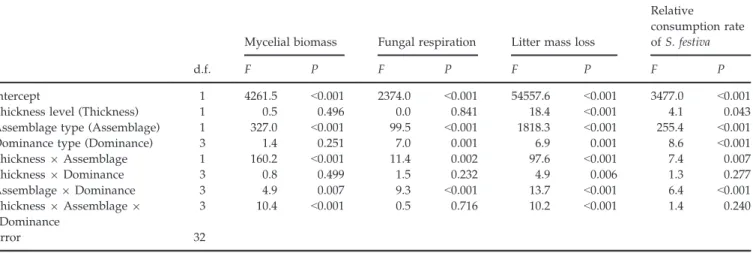
Table 4 Summary table for three-way ANOVAs performed on mycelial biomass and fungal respiration associated with oak leaf discs, litter
mass loss over 2 weeks and relative consumption rate ofSchizopelex festiva caddisfly larvae
d.f.
Mycelial biomass Fungal respiration Litter mass loss
Relative
consumption rate ofS. festiva
F P F P F P F P
Intercept 1 4261.5 <0.001 2374.0 <0.001 54557.6 <0.001 3477.0 <0.001
Thickness level (Thickness) 1 0.5 0.496 0.0 0.841 18.4 <0.001 4.1 0.043
Assemblage type (Assemblage) 1 327.0 <0.001 99.5 <0.001 1818.3 <0.001 255.4 <0.001
Dominance type (Dominance) 3 1.4 0.251 7.0 0.001 6.9 0.001 8.6 <0.001
Thickness 9 Assemblage 1 160.2 <0.001 11.4 0.002 97.6 <0.001 7.4 0.007 Thickness 9 Dominance 3 0.8 0.499 1.5 0.232 4.9 0.006 1.3 0.277 Assemblage 9 Dominance 3 4.9 0.007 9.3 <0.001 13.7 <0.001 6.4 <0.001 Thickness 9 Assemblage 9 Dominance 3 10.4 <0.001 0.5 0.716 10.2 <0.001 1.4 0.240 Error 32
Fig. 3 Relative consumption rate (RCR) ofSchizopelex festiva caddisfly larvae for
thin and thick oak leaf discs, for each fungal assemblage type and species dom-inance treatment. Grey bars represent early assemblages, and open bars repre-sent late assemblages. Treatments within each thickness level were compared with three-way ANOVA, followed by Tukey’s HSD; different letters indicate significant
differences among treatments (P < 0.05).
Fungal species:Anguillospora filiformis
(Anguillospora), Articulospora tetracladia
(Articulospora), Clavariopsis aquatica (Clav-ariopsis), Tetrachaetum elegans (Tetrachae-tum), Tetracladium marchalianum
(Tetracladium) and Tricladium chaetocladium (Tricladium).
types (Table 4). The relative consumption rate of caddisfly larvae was two-three times higher on late than on early assemblages for both thickness levels. Interestingly, for both thin and thick discs, species dominance identity was the prime factor affecting larval consumption within early but not within late assemblages (Fig. 3). In parallel, fungal biomass (r² = 0.71; P < 0.001) and fungal activity
measured as oxygen consumption (r² = 0.62; P < 0.001)
consistently explained the relative consumption rate of caddisfly larvae (Figs 3 & 4; Table 3).
Relationship between leaf litter quality and invertebrate consumption rate
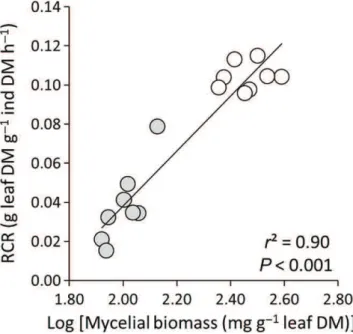
There was a strong and positive relationship between relative consumption rate of S. festiva larvae and
myce-lial biomass across all treatments (r² = 0.90, P < 0.001;
Fig. 4). Caddisfly larvae consumption rate and mycelial biomass were also related to litter P concentration (r² = 0.63, P < 0.001 and r² = 0.63, P < 0.001,
respec-tively), with P concentration differing between thickness and fungal assemblage treatments by 40% at most. In contrast, caddisfly larvae consumption rate and myce-lial biomass were not significantly related to litter N concentration (r² = 0.23, P = 0.06 and r² = 0.07, P = 0.31,
respectively), even though N concentration differed between thickness and fungal assemblage treatments by
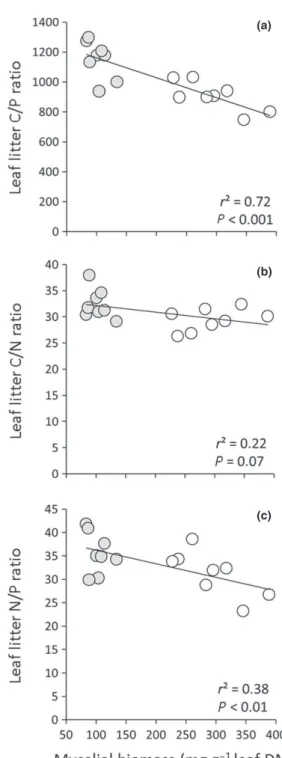
as much as 35%. Caddisfly larvae consumption rate and mycelial biomass were strongly related to C/P leaf litter ratio (r² = 0.71, P < 0.001 and r² = 0.72, P < 0.001,
respectively; Figs 5a, 6a). In contrast, although being significantly related to caddisfly larvae consumption rate (r² = 0.39, P = 0.01; Fig. 5b), C/N leaf litter ratio
was not related to mycelial biomass (r² = 0.22, P = 0.07;
Fig. 6b). Caddisfly larvae consumption rate and myce-lial biomass were weakly related to N/P leaf litter ratio (r² = 0.26, P = 0.04 and r² = 0.38, P < 0.01, respectively;
Figs 5c, 6c).
Discussion
Changes in community structure as an early outcome of anthropogenic induced stresses are expected to precede a reduction in species richness (Ellisonet al., 2005;
Hille-brand, Bennett & Cadotte, 2008). Recent laboratory experiments and field studies have shown that changes in dissolved nutrient concentration and temperature induce shifts in fungal species abundance (Dang et al.,
2005; Artigas, Roman!ı & Sabater, 2008; Ferreira & Chau-vet, 2011). While these studies have suggested that changes in abundance of particular species could strongly alter nutrient transfer efficiency in food webs, the relationship between leaf litter elemental composi-tion and changes in associated fungal community struc-ture has not been investigated. Thus, it is relevant to assess whether these changes have the potential to affect ecosystem processes. Here, we show how changes in decomposing litter quality, due solely to differences in the species composition of the fungal assemblage, can affect the feeding activity of a stream detritivore, which might ultimately affect its growth and survival (Arsuffi & Suberkropp, 1986; Chung & Suberkropp, 2009). Our data suggest that changes in assemblage structure have a strong influence on the feeding activity of S. festiva
caddisfly larvae through changes in fungal biomass accumulation and on the elemental composition of its resource.
Manipulation of the relative abundances of fungal species inoculated did not determine the identity of the dominant species in all fungal assemblages, but only in six of 16. Nevertheless, we obtained sixteen different fungal assemblages that differed in the relative proportion of each species. The strong discrepancies between the specific relative conidial production over the incubation time and that initially present in the inoc-ulum might be attributed to differences in conidial traits (e.g. shape and size) likely to influence the probability of their settlement and germination (Dang, Gessner &
Fig. 4 Relative consumption rate (RCR) ofSchizopelex festiva
cad-disfly larvae as a function of mycelial biomass. Grey symbols repre-sent early assemblages, and open circles reprerepre-sent late
assemblages. Line and correspondingr2- andP-values are shown
Chauvet, 2007; Kearns & B€arlocher, 2008). Moreover, aquatic hyphomycete assemblage structure in our study was based on specific reproductive output, which might not necessarily reflect specific mycelial biomass in the
(a)
(b)
(c)
Fig. 6 Leaf litter (a) C/P, (b) C/N and (c) N/P molar ratios as a function of mycelial biomass. Grey symbols represent early assem-blages, and open circles represent late assemblages. Lines and
cor-respondingr2- andP-values are shown for simple linear regression.
(a)
(b)
(c)
Fig. 5 Relative consumption rate (RCR) ofSchizopelex festiva
cad-disfly larvae as a function of leaf litter (a) C/P, (b) C/N and (c) N/ P molar ratios. Grey symbols represent early assemblages, and open circles represent late assemblages. Lines and corresponding
leaf litter. A recurrent and unique problem with micro-bial systems is the difficulty of keeping track of individ-ual species. Recent advances in molecular approaches, although prone to uncertainty, can circumvent such obstacles by allowing the quantification of species contri-bution to total fungal biomass (B€arlocher, 2007, 2010; Krausset al., 2011).
Our study contrasts with other studies suggesting functional redundancy among aquatic hyphomycete assemblages (B€arlocher & Grac!a, 2002; Pascoal, C!assio & Marvanov!a, 2005; Ferreira, Gulis & Grac!a, 2006b; Ferre-ira & Chauvet, 2012). Conversely, they agree with stud-ies that have demonstrated the important role played by the identity of dominant species in the relationship between community evenness and ecosystem processes (McKie et al., 2008; Gonc!alves & Canhoto, 2009; Swan,
Gluth & Horne, 2009).
Thereby, our results demonstrated that experimental changes in fungal community structure [i.e. assemblage type (Early versus Late), species identity and evenness] resulted in an increased nutritional quality of leaf litter which, in turn, translated into an increased proportion of leaf litter consumed by a detritivore. Changes in fun-gal community structure associated with leaf litter can alter the nutritional quality of leaf detritus via a number of mechanisms that are not mutually exclusive and that may act synergistically.
First, changes in fungal species composition can trans-late into an increased biomass and activity of fungi asso-ciated with leaf detritus, which are often differentially ingested by invertebrate detritivores (Suberkropp, 1992) or assimilated at a higher efficiency than non-living detritus (Grac!a, Maltby & Calow, 1993a). It is widely accepted that the degree of conditioning (usually defined by measures of microbial biomass or activity) is often the main factor affecting resource quality and con-stitutes the standard by which all types of shredders dis-criminate among leaves. The diversity of feeding patterns exhibited by shredders reported by numerous studies (e.g. Suberkropp et al., 1983; Suberkropp &
Arsuffi, 1984; Butler & Suberkropp, 1986; Arsuffi & Suberkropp, 1989; Friberg & Jacobsen, 1994), with a few others reporting ambiguous or less well-defined pat-terns, suggests that this factor alone does not determine foraging behaviour. For example, there was no correla-tion between palatability and protein increase or mass loss (as indicator of overall enzymatic activity; B€arlocher & Kendrick, 1973). Grac!a, Maltby & Calow (1993b, 1994) reported that no leaf parameter was correlated with resource preference of Gammarus pulex in experiments
where leaf discs were conditioned by different pure
cul-tures of individual fungal species. Similarly, consump-tion by Gammarus tigrinus of leaf discs conditioned by
six pure cultures of individual aquatic hyphomycete species was not correlated with leaf protein, phenols, lipids or ergosterol concentrations (Rong, Sridhar & B€arlocher, 1995).
Second, heterotrophic microorganisms contain high concentrations of nutrients (Sterner & Elser, 2002; Cross
et al., 2005), which may directly affect the growth and
production of consumers (Iversen, 1974; Urabe, Clasen & Sterner, 1997). Leaf litter nutrient concentration has been shown to increase shredder consumption rates in headwater streams (Iversen, 1974; Irons, Oswood & Bryant, 1988).
Regression analysis in our study indicated that leaf lit-ter quality was affected by the amount of fungal bio-mass associated with the leaf discs. There was quite strong variation in fungal biomass, depending on differ-ent fungal assemblages (e.g. 4.7 times between the two extreme values). In line with previous studies, fungal colonisation led to nutrient immobilisation (Gulis & Suberkropp, 2003), which in our case translated into lower C/P ratios, without significantly affecting C/N ratios.
Interestingly, several studies that documented forag-ing preferences of caddisfly larvae (i.e. three families,
five genera; Suberkropp et al., 1983; Arsuffi &
Suberk-ropp, 1984; Suberkropp & Arsuffi, 1984; Arsuffi & Suberkropp, 1986) reported that all caddisfly species examined had similar preferences when offered leaf lit-ter colonised by the same aquatic hyphomycete species. This similarity among trichopterans contrasts strongly with different ranked responses of different groups of detritivores (i.e. Amphipoda, Plecoptera, Diptera and Gastropoda) to leaves colonised by various fungi (Arsuf-fi & Suberkropp, 1989), and our (Arsuf-findings suggest that stoichiometric imbalances between consumers and resources might affect consumer feeding activity.
Heterotrophic microorganisms also contain biochemi-cals, such as polyunsaturated fatty acids (PUFA) (Brett & Mueller-Navarra, 1997; Arce Funcket al., 2015), which
are almost exclusively synthesised by autotrophic organ-isms. Animals can convert from one form of PUFA to another through elongation and desaturation, but very few can synthesise PUFA de novo. Accordingly, most
consumers depend on PUFA supplied through their die-tary intakes to meet their physiological requirements (Arts, Brett & Kainz, 2009). Polyunsaturated fatty acids are essential for invertebrates owing to their involve-ment in a wide range of physiological processes, such as regulation of cell membrane properties or as precursors to many hormones (Brett & Mueller-Navarra, 1997).
Despite the pivotal role played by aquatic hyphomycetes as the main basal food sources in stream food webs, data on their lipid composition are extremely scarce (but see Cargill et al., 1985 and Arce Funck et al., 2015).
Accordingly, further investigation in this direction might deepen our understanding of the role of aquatic hypho-mycetes in forested headwater stream ecosystems.
Lastly, changes in dominance/evenness and/or iden-tity of species among assemblages are likely to result in qualitative differences in enzymatic capabilities among species belonging to early- or late-successional stages and may alter leaf detritus degradation and, in turn, modulate the digestibility of detritus to consumers (B€arlocher, 1985; Sinsabaugh, Linkins & Benfield, 1985; Suberkropp, 1992). Based on a study by Gusewell &€ Gessner (2009), and given the N/P ratio of the nutrient solution adopted in our study (31.3 on a molar basis) and the overall nutrient supply used in our microcosms, we assume that the fungal assemblages were likely to be N-limited, constraining them to maintain N content in their own biomass at a basal metabolic level. This was apparent from the absence of a significant relationship between C/N leaf litter ratio and mycelial biomass. In contrast, P limitation for fungi is expected to be reached at higher N/P ratios than that used here (G€usewell & Gessner, 2009). Accordingly, the negative relationship between C/P leaf litter ratio and mycelial biomass among treatments was mainly due to P immobilisation by fungi, which might be related to an increase in fungal decomposition activity and biomass. In addition, fungi growing in P-unlimited conditions, as was the case here, might store P in excess in their own biomass, mainly in membranes or in vacuoles (Beever & Burns, 1980), thereby reducing C/P leaf litter ratios. It is important, however, to note that these results have been obtained with assemblages of heterotrophic decomposer assem-blages solely composed of fungi. Hodge, Robinson & Fit-ter (2000) proposed that bacFit-teria should dominate decomposition processes on substrates with low C/N ratios, while the contribution of fungi should prevail on substrates with high C/N ratios, due to the contrasting N requirements of these organisms (but see Hieber & Gessner, 2002). Similarly, fungi are known to have lower nutrient requirements and have lower metabolic activity than bacteria (Hieber & Gessner, 2002; Cross et al., 2005).
Accordingly, the relative P requirements of fungi should be lower than those of bacteria (Smith, 2002), so that fungi are expected to become P-limited at higher N/P ratios than bacteria. Consequently, it is likely that the presence of bacteria in our experiment altered the observed patterns regarding the elemental composition
of leaf detritus, potentially leading to changes in the feed-ing activity of shredder-mediated litter decomposition.
Relatively few studies have explored stoichiometric detritivore–resource relationships in running waters (Crosset al., 2003, 2005; Hladyz et al., 2009; Danger et al.,
2012, 2013; Lauridsen et al., 2012, 2014). In this study,
lit-ter C/P was a betlit-ter predictor of caddisfly larvae feed-ing performance than C/N or N/P, suggestfeed-ing that P rather than N might have been limiting for these con-sumers. Accordingly, our results differ from those of Ferreira et al. (2010), which indicated that invertebrates
prefer litter with higher N than P concentration, and also with the notion that litter N concentration generally determines invertebrate litter choice because it is often the limiting nutrient for primary consumers (Evans-White, Stelzer & Lamberti, 2005). In contrast, our results agree with the growth rate hypothesis, which proposes that consumer growth rather tends to be limited by the resource P concentration (Elseret al., 2003).
Organisms require a mixture of energy, vitamins, bio-chemicals and minerals to grow and reproduce. Imbal-anced supply of one or more of these elements slows the growth of animals (Elser et al., 2000a, 2003; Frost &
Elser, 2002) and alters their physiology, life history and behaviour (Sterner & Elser, 2002; Frost et al., 2005).
While we did not assess the elemental body composition of our invertebrates, Crosset al. (2003) and Hladyz et al.
(2009) found similar molar C/N ratios for shredders: 6.7 [mean for 11 shredder species including six genera: Leuc-tra and Tallaperla (Plecoptera), Tipula (Diptera), Fattigia, Lepidostoma and Pycnopsyche (Trichoptera), the mean also
included multiple size classes for Tallaperla and Fattigia]
and 6.7 [mean for four shredder species: Protonemura meyeri (Plecoptera), Gammarus duebeni (Amphipoda), Halesus radiatus (Trichoptera) and Potamophylax cingula-tus (Trichoptera)] or 6.5 (mean for two Trichoptera
spe-cies: Halesus radiatus and Potamophylax cingulatus),
respectively, which suggests very narrow constraints on tissue N concentration across even distantly related and geographically separated taxa (Hladyz et al., 2009).
Molar C/P ratios were also quite similar in both studies [498 and 487 (values from caddisfly larvae only) on average, respectively]. In accordance with the elemental body composition values of caddisfly shredders from the literature (Cross et al., 2003; Hladyz et al., 2009), our
results show that C/N imbalances between S. festiva
caddisfly larvae and oak leaf litter were relatively high (i.e. range from 4.0 to 5.7 times) and, therefore, consum-ers were particularly limited by N. In parallel, C/P imbalances between consumers and resources were rela-tively low when compared to C/N (i.e. range from 1.5
to 2.6 times) and may explain why shredders responded more strongly to litter C/P rather than C/N ratio.
Meeting nutrient requirements is particularly challeng-ing for leaf-shreddchalleng-ing invertebrates because their food resources exhibit a dramatic imbalance from their body composition (Cross et al., 2003, 2005). According to the
principles of ecological stoichiometry, the nutritional requirements of a given consumer are defined by its nutrient concentration and relative growth rate (Sterner & Elser, 2002; Crosset al., 2003). Consequently,
consum-ers (or specific life stages) with high body N or P con-centration and high growth rates require food that is high in N or P, to maintain optimal growth (Crosset al.,
2003). Here, we show that the higher sensitivity regard-ing food P rather than N content in S. festiva caddisfly
larvae may be explained by its early life stage. High growth rates during early stages of development are cor-related with a high content of (P-rich) ribosomal RNA and associated high body P demand (Elseret al., 2000b).
These results are in accordance with predictions of eco-logical stoichiometry and have considerable empirical support, as underlined by Cross et al. (2003), who
sug-gested that differences in ontogeny, life history strategy and relative allocation of structural biomolecules may all contribute to changes regarding the nutritional require-ments of a given consumer.
In conclusion, we demonstrated that changes in fungal community structure affected the elemental composition of leaves, which significantly affected the feeding perfor-mance of S. festiva caddisfly larvae. Stimulated (Late
assemblages) or reduced (Early assemblages) feeding activities of caddisfly larvae were related to changes in aquatic hyphomycete community structure. We showed that microbial identity can regulate leaf litter decomposi-tion. Changes in consumption rates can potentially alter growth and mortality rates, and body elemental compo-sition, and therefore influence shredder population dynamics, which will directly affect the processes in which these organisms are involved (e.g. litter decompo-sition, nutrient cycling). The relationship between fungi and invertebrates under changing environments remains to be explored in further studies to identify cascading effects on aquatic food-web structure and related ecosys-tem processes.
Acknowledgments
This work was completed at IMAR-CMA, Department of Life Sciences, University of Coimbra with funding by the Portuguese Foundation for Science and Technology (FCT) to VF (References SFRH/BPD/34368/2006, SFRH/
BPD/76482/2011, programme POPH/FSE) and to ALG (Reference SFRH/BD/47089/2008, SFRH/BPD/94820/ 2013), and by the National Center for Scientific Research (CNRS) to JC, as well as by the Pessoa exchange pro-gramme between Portugal and France (PHC 22808 TB) from the French Ministry of Foreign and European Affairs. We are grateful to Michael Danger, Manuel A.S. Grac!a and Mark Gessner whose comments led to signifi-cant improvements of the manuscript, and Elsa Rodri-gues, Cristina Docal and Ana Virg!ınia L!ırio for their expert technical assistance. Comments provided by three anonymous referees on an early version of the manu-script were most appreciated.
Author contribution
J.C., V.F., A.L.G., E.C. and C.C. designed the experiments; J.C., V.F and A.L.G. carried out the experiments; and J.C., V.F., A.L.G., E.C. and C.C. wrote the manuscript.
References
Aerts R. & Chapin F.S. (2000) The mineral nutrition of wild plants revisited: a re-evaluation of processes and patterns.
Advances in Ecological Research, 30, 1–67.
APHA (1998) Phosphorus: automated ascorbic acid reduc-tion method, 4500-P, F. In:Standard Methods for the Exami-nation of Water and Wastewater (20th ed.), (Ed. M.A.H.
Franson), pp. 148–149. American Public Health Associa-tion, Washington, DC.
Arce Funck J., Bec A., Perri#ere F., Felten V. & Danger M. (2015) Aquatic hyphomycetes: a potential source of poly-unsaturated fatty acids in detritus-based stream food webs.Fungal Ecology, 13, 205–210.
Arsuffi T.L. & Suberkropp K. (1984) Leaf processing capabilities of aquatic hyphomycetes: interspecific differences and influ-ence on shredder feeding preferinflu-ences.Oikos, 42, 144–154.
Arsuffi T.L. & Suberkropp K. (1986) Growth of two stream caddisflies (Trichoptera) on leaves colonized by different fungal species. Journal of the North American Benthological Society, 5, 297–305.
Arsuffi T.L. & Suberkropp K. (1989) Selective feeding by shredders on leaf-colonizing stream fungi: comparison of macroinvertebrate taxa.Oecologia, 79, 30–37.
Artigas J., Roman!ı A.M. & Sabater S. (2008) Effect of nutri-ents on the sporulation and diversity of aquatic hypho-mycetes on submerged substrata in a Mediterranean stream.Aquatic Botany, 88, 32–38.
Arts M.T., Brett M.T. & Kainz M.J. (2009)Lipids in Aquatic Ecosystems. Springer, Dordrecht.
B€arlocher F. (1985) The role of fungi in the nutrition of stream invertebrates. Botanical Journal of the Linnean Soci-ety, 91, 83–94.
B€arlocher F. (2007) Molecular approaches applied to aquatic hyphomycetes.Fungal Biology Reviews, 21, 19–24.
B€arlocher F. (2010) Molecular approaches promise a deeper and broader understanding of the evolutionary ecology of aquatic hyphomycetes. Journal of the North American Benthological Society, 29, 1027–1041.
B€arlocher F. & Grac!a M.A.S. (2002) Exotic riparian vegeta-tion lowers fungal diversity but not leaf decomposivegeta-tion in Portuguese streams.Freshwater Biology, 47, 1123–1135.
B€arlocher F. & Kendrick B. (1973) Fungi and food prefer-ences of Gammarus pseudolimnaeus. Archiv f€ur Hydrobiolo-gie, 72, 501–516.
B€arlocher F. & Schweizer M. (1983) Effects of leaf size and decay rate on colonization by aquatic hyphomycetes.
Oikos, 41, 205–210.
Beever R.E. & Burns D.J.W. (1980) Phosphorus uptake and utilization by fungi.Advances in Botanical Research, 8, 127–
219.
Brett M.T. & Mueller-Navarra D.C. (1997) The role of highly unsaturated fatty acids in aquatic foodweb processes.
Freshwater Biology, 38, 483–499.
Bruning K. (1991) Effects of phosphorus limitation on the epidemiology of a chytrid phytoplankton parasite. Fresh-water Biology, 25, 405–417.
Butler N.M., Suttle C.A. & Neill W.E. (1989) Discrimination by freshwater zooplankton between single algal cells dif-fering in nutritional status.Oecologia, 78, 368–372.
Butler S.K. & Suberkropp K. (1986) Aquatic hyphomycetes on oak leaves: comparison of growth, degradation and palatability.Mycologia, 78, 922–928.
Cargill A.S., Cummins K.W., Hanson B.J. & Lowry R.R. (1985) The role of lipids as feeding stimulants for shredding aquatic insects. Freshwater Biology, 15, 455–
464.
Cebrian J. (1999) Patterns in the fate of production in plant communities.The American Naturalist, 154, 449–468.
Chauvet E. & Suberkropp K. (1998) Temperature and spor-ulation of aquatic hyphomycetes.Applied and Environmen-tal Microbiology, 64, 1522–1525.
Chen Y., Williams K.A., Harbaugh B.K. & Bell M.L. (2004) Effects of tissue phosphorus and nitrogen in Impatiens wallerana on western flower thrips (Frankliniella occidental-is) population levels and plant damage. HortScience, 39,
545–550.
Chung N. & Suberkropp K. (2009) Effects of aquatic fungi on feeding preferences and bioenergetics of Pycnopsyche gentilis (Trichoptera: Limnephilidae). Hydrobiologia, 630,
257–269.
Cross W.F., Benstead J.P., Frost P.C. & Thomas S.A. (2005) Ecological stoichiometry in freshwater benthic systems: recent progress and perspectives. Freshwater Biology, 50,
1895–1912.
Cross W.F., Benstead J.P., Rosemond A.D. & Wallace J.B. (2003) Consumer-resource stoichiometry in detritus-based streams.Ecology Letters, 6, 721–732.
Dang C.K., Chauvet E. & Gessner M.O. (2005) Magnitude and variability of process rates in fungal diversity-litter decomposition relationships.Ecology Letters, 8, 1129–1137.
Dang C.K., Gessner M.O. & Chauvet E. (2007) Influence of conidial traits and leaf surface structure on attachment success of aquatic hyphomycetes on leaf litter.Mycologia,
99, 24–32.
Danger M., Arce Funck J., Devin S., Heberle J. & Felten V. (2013) Phosphorus content in detritus controls life-history traits of a detritivore.Functional Ecology, 27, 807–815.
Danger M. & Chauvet E. (2013) Elemental composition and degree of homeostasis of fungi: are aquatic hyphomycetes more like metazoans, bacteria or plants? Fungal Ecology,
6, 453–457.
Danger M., Cornut J., Elger A. & Chauvet E. (2012) Effects of burial on leaf litter quality, microbial conditioning and palatability to three shredder taxa.Freshwater Biology, 57,
1017–1030.
DeMott W.R. & Gulati R.D. (1999) Phosphorus limitation in
Daphnia: evidence from a long term study of three
hype-reutrophic Dutch lakes. Limnology and Oceanography, 44,
1557–1564.
Denno R.F. & Fagan W.F. (2003) Might nitrogen limitation promote omnivory among carnivorous arthropods? Ecol-ogy, 84, 2522–2531.
Ellison A.M., Bank M.S., Clinton B.D., Colburn E.A., Elliott K., Ford C.R. et al. (2005) Loss of foundation species:
consequences for the structure and dynamics of forested ecosystems. Frontiers in Ecology and the Environment, 9,
479–486.
Elser J.J., Acharya K., Kyle M., Cotner J., Makino W., Mar-kow T. et al. (2003) Growth rate-stoichiometry couplings
in diverse biota.Ecology Letters, 6, 936–943.
Elser J.J., Chrzanowski T.H., Sterner R.W. & Mills K.H. (1998) Stoichiometric constraints on food-web dynamics: a whole-lake experiment on the Canadian Shield. Ecosys-tems, 1, 120–136.
Elser J.J., Fagan W.F., Denno R.F., Dobberfuhl D.R., Folarin A., Huberty A.et al. (2000a) Nutritional constraints in
ter-restrial and freshwater food webs.Nature, 408, 578–580.
Elser J.J., Sterner R.W., Gorokhova E., Fagan W.F., Markow T.A., Cotner J.B. et al. (2000b) Biological stoichiometry
from genes to ecosystems.Ecology Letters, 3, 540–550.
Evans-White M.A., Stelzer R.S. & Lamberti G.A. (2005) Tax-onomic and regional patterns in benthic macroinverte-brate elemental composition in streams. Freshwater Biology, 50, 1786–1799.
Ferreira V. & Chauvet E. (2011) Synergistic effects of water temperature and dissolved nutrients on litter decomposi-tion and associated fungi. Global Change Biology, 17, 551–
564.
Ferreira V. & Chauvet E. (2012) Changes in dominance among species in aquatic hyphomycete assemblages do not affect litter decomposition rates. Aquatic Microbial Ecology, 66, 1–11.
Ferreira V., Elosegi A., Gulis V., Pozo J. & Grac!a M.A.S. (2006a) Eucalyptus plantations affect fungal communities associated with leaf litter decomposition in Iberian streams.Archiv f€ur Hydrobiologie, 166, 467–490.
Ferreira V., Gonc!alves A.L., Godbold D.L. & Canhoto C. (2010) Effect of increased atmospheric CO2on the
perfor-mance of an aquatic detritivore through changes in water temperature and litter quality. Global Change Biology, 16,
3284–3296.
Ferreira V., Gulis V. & Grac!a M.A.S. (2006b) Whole-stream nitrate addition affects litter decomposition and associ-ated fungi but not invertebrates.Oecologia, 149, 718–729.
Fink P. & von Elert E. (2006) Physiological responses to stoichiometric constraints: nutrient limitation and com-pensatory feeding in a freshwater snail. Oikos, 115, 484–
494.
Friberg N. & Jacobsen D. (1994) Feeding plasticity of two detritivore-shredders.Freshwater Biology, 32, 133–142.
Frost P.C. & Elser J.J. (2002) Growth responses of littoral mayflies to the phosphorus content of their food.Ecology Letters, 5, 232–240.
Frost P.C., Evans-White M.A., Finkel Z.V., Jensen T.C. & Matzek V. (2005) Are you what you eat? Physiological constraints on organismal stoichiometry in an elementally imbalanced world.Oikos, 109, 18–28.
Gessner M.O. & Chauvet E. (1993) Ergosterol-to-biomass conversion factors for aquatic hyphomycetes. Applied and Environmental Microbiology, 59, 502–507.
Gessner M.O., Dobson M. & Chauvet E. (1999) A perspective on leaf litter breakdown in streams.Oikos, 85, 377–384.
Gessner M.O., Thomas M., Jean-Louis A.M. & Chauvet E. (1993) Stable successional patterns of aquatic hyphomyce-tes on leaves decaying in a summer cool stream. Mycolog-ical Research, 97, 163–172.
Gonc!alves A.L. & Canhoto C. (2009) Decomposition of eucalyptus and alder mixtures: responses to variation in evenness. Fundamental and Applied Limnology/Archiv fur€
Hydrobiologie, 173, 293–303.
Gonc!alves A.L., Chauvet E., B€arlocher F., Grac!a M.A.S. & Canhoto C. (2014) Top-down and bottom-up control of litter decomposers in streams. Freshwater Biology, 59,
2172–2182.
Grac!a M.A.S. (2001) The role of invertebrates on leaf litter decomposition in streams: a review. International Review Hydrobiology, 86, 383–393.
Grac!a M.A.S., B€arlocher F. & Gessner M.O. (2005) Methods
to Study Litter Decomposition: A Practical Guide.
Springer-Verlag, New York.
Grac!a M.A.S., Maltby L. & Calow P. (1993a) Importance of fungi in the diet ofGammarus pulex and Asellus aquaticus.
II. Effects on growth, reproduction and physiology. Oeco-logia, 96, 304–309.
Grac!a M.A.S., Maltby L. & Calow P. (1993b) Importance of fungi in the diet of Gammarus pulex and Asellus aquaticus
I: feeding strategies.Oecologia, 93, 139–144.
Grac!a M.A.S., Maltby L. & Calow P. (1994) Comparative ecology of Gammarus pulex (L.) and Asellus aquaticus (L.)
I: population dynamics and microdistribution. Hydrobiolo-gia, 281, 155–162.
Gulis V. & Suberkropp K. (2003) Effect of inorganic nutri-ents on relative contribution of fungi and bacteria to car-bon flow from submerged decomposing leaf litter.
Microbial Ecology, 45, 11–19.
G€usewell S. & Gessner M.O. (2009) N: P ratios influence lit-ter decomposition and colonization by fungi and baclit-teria in microcosms.Functional Ecology, 23, 211–219.
Hieber M. & Gessner M.O. (2002) Contribution of stream detritivores, fungi, and bacteria to leaf breakdown based on biomass estimates.Ecology, 83, 1026–1038.
Hillebrand H., Bennett D.M. & Cadotte M.W. (2008) Conse-quences of dominance: a review of evenness effects on local and regional ecosystem processes.Ecology, 89, 1510–
1520.
Hladyz S., Gessner M.O., Giller P.S., Pozo J. & Woodward G. (2009) Resource quality and stoichiometric constraints on stream ecosystem functioning. Freshwater Biology, 54,
957–970.
Hodge A., Robinson D. & Fitter A. (2000) Are microorgan-isms more effective than plants at competing for nitro-gen?Trends in Plant Science, 5, 304–308.
Irons J.G., Oswood M.W. & Bryant J.P. (1988) Consumption of leaf detritus by a stream shredder: influence of tree species and nutrient status.Hydrobiologia, 160, 53–61.
Iversen T.M. (1974) Ingestion and growth in Sericostoma personatum (Trichoptera) in relation to the nitrogen con-tent of ingested leaves.Oikos, 25, 278–282.
Kearns S.G. & B€arlocher F. (2008) Leaf surface roughness influences colonization success of aquatic hyphomycete spore.Fungal Ecology, 1, 13–18.
Kimmerer T.W. & Potter D.A. (1987) Nutritional quality of specific tissues and selective feeding by a specialist leaf-miner.Oecologia, 71, 548–551.
Krauss G.J., Sol!e M., Krauss G., Schlosser D., Wesenberg D. & B€arlocher F. (2011) Fungi in freshwaters: ecology, phys-iology and biochemical potential. FEMS Microbiology Reviews, 35, 620–651.
Lauridsen R.B., Edwards F.K., Bowes M.J., Woodward G., Hildrew A.G., Ibbotson A.T. et al. (2012)
Consumer-resource elemental imbalances in a nutrient-rich stream.
Freshwater Science, 31, 408–422.
Lauridsen R.B., Edwards F.K., Cross W.F., Woodward G., Hildrew A.G. & Jones J.I. (2014) Consequences of infer-ring diet from feeding guilds when estimating and inter-preting consumer-resource stoichiometry. Freshwater Biology, 59, 1497–1508.
McKie B.G., Woodward G., Hladyz S., Nistorescu M., Preda E., Popescu C. et al. (2008) Ecosystem functioning in
stream assemblages from different regions: contrasting responses to variation in detritivore richness, evenness and density.Journal of Animal Ecology, 77, 495–504.