REPRESENTING AND MANAGING CHAINS OF CUSTODY IN CYBER
FORENSICS USING LINKED DATA PRINCIPLES
THESIS
SUBMITTED
AS A PARTIAL REQUIREMENT
OF A DOCTORA TE IN COGNITIVE INFORMA TICS
BY
TAMERGAYED
Avertissement
La diffusion de cette thèse se fait dans le respect des droits de son auteur, qui a signé le formulaire Autorisation de reproduire et de diffuser un travail de recherche de cycles supérieurs (SDU-522 - Rév.1 0-2015). Cette autorisation stipule que «conformément à l'article 11 du Règlement no 8 des études de cycles supérieurs, [l'auteur] concède à l'Université du Québec à Montréal une licence non exclusive d'utilisation et de publication de la totalité ou d'une partie importante de [son] travail de recherche pour des fins pédagogiques et non commerciales. Plus précisément, [l'auteur] autorise l'Université du Québec à Montréal à reproduire, diffuser, prêter, distribuer ou vendre des copies de [son] travail de recherche à des fins non commerciales sur quelque support que ce soit, y compris l'Internet. Cette licence et cette autorisation n'entraînent pas une renonciation de [la] part [de l'auteur] à [ses] droits moraux ni à [ses] droits de propriété intellectuelle. Sauf entente contraire, [l'auteur] conserve la liberté de diffuser et de commercialiser ou non ce travail dont [il] possède un exemplaire.»
REPRÉSENTATION ET GESTION DE CHAINES DE TRAÇABILITÉ EN
CYBERCRIMINALITÉ EN UTILISANT LES PRINCIPES DES DONNÉES LIÉES
THÈSE
PRÉSENTÉE
COMME EXIGENCE PARTIELLE
DU DOCTORAT EN INFORMA TIQUE COGNITIVE
PAR
TAMERGAYED
I would like to thank my wife Dalia Habashy and my kids Anthony and Carol for all of their moral supports throughout this prograrn. Family is so important, and you have been there every step of the way.
The first person I would like to thank at the university is my supervisor Hakim Lounis, who dedicated himself wholehearted to my research. He tried to understand my ideas and helped me to improve them by painstakingly reading this dissertation line by line and correcting my mistakes. I admire his patience, his comprehension, and his great support and devotion to me and my research. I also wish to express to him my most sincere gratitude for his emotional support.
Also, I want to thank my co-superviser Moncef Bari, who accepted to work with me and supported my ideas. I wish to thank him for his great support, care, and patience toward my questions about cognitive field. Thank you very much.
Lastly, I would like also to thank all people who participated directly or indirectly in the realization of this work.
1 dedicate this research to the tate and beloved Mother Beatrice Sawares. She devoted her whole !ife to me and my brother. Words are not enough to express my feelings of gratitude to you. Y ou stood behind me through every success in my !ife. Thank you, Mum. We will al ways remember you.
With the ad vent of digital technologies, tangible Chains of Custody (CoCs) that refer to the chronological documentation of physical or electronic evidence now need to undergo a radical transformation from documents to electronic representation. This is especially true in cyber forensics, where all evidence is of a digital nature. That fact requires judges to understand the field of Information and Communication Technologies (ICT), in addition to their legal knowledge.
This research proposes a novel framework to record, electronically, all information related to a cyber forensics investigation through the technology used by semantic web to create linked data. This technology is known as the web aspects.
The novel framework can help the technicians to record and represent the tangible chains of custody related to their investigation process in arder to be provided to the judge in a court of law. It is assumed that the forensic information is prior improved, and the technicians who collected this information will use this framework to represent and transform the tangible documents into electronic data. Another level of improvements will be provided by this framework to annotate the forensic information using provenance vocabularies imported from the semantic web, and secure this represented information using Public-key Infrastructure (PKI).
On the other hand, this framework can also be applied to other domains, not on1y in the cyber forensics field. The cyber forensics domain is considered, in this dissertation, as a case study to explain how these aspects can be used and highlight various advantages of using such aspects to represent forensic information. In the
selected case study, such concepts are applied to represent the Chain of Custody documents generated from the forensic process.
The proposed framework can be applied in various domains, where information needs to be represented and need full traceability combined with a totally secure remote access in order to facilitate its consumption and ensure its confidentiality (i.e., understandable, descriptive, interlinked, and discoverable). For example, it can be applied in the domain of medicine, where doctors can record and represent different information about their patients. It can also be used by governrnental agencies that address citizenship and immigration to record and manage information about citizens and immigrants, etc.
The actual dissertation discusses this framework as a first step to implement a system for role players (technicians, prosecutors and defendants) andjudges to facilitate their legal procedures and help them to understand the digital evidence of cyber forensics presented to them in form of tangible documents. The framework contains a set of modules. Each module can be extended to accommodate different technologies provided recently by the field of Information and Technology (IT).
The work presented in this research does not implement all technologies. Instead, it opens the door for researchers who want to extend and enhance each module to add more and better technologies.
Each module of this framework touches on a certain discipline. For example, in the current dissertation, discussed is a module related to semantic vocabularies. It is based on sorne vocabularies imported from the semantic web; this does not mean that this module is limited to such vocabularies. More vocabularies from the semantic web can be imported to foster and extend the said module. Another module in the framework concems provenance metadata, where a lot of work is related to this
sector of research. These works can also be used to extend and ameliorate the objectives of this module within the framework.
In addition, the PKI module of the framework is a module responsible to authenticate and bend the publication of data from an open to a closed scale. Further research may propose other security options to be added to the digital certificates used in the PKI.
Thus, what will be presented in this dissertation is a first version of this proposed framework. It opens the door to more extensions in a future work.
Nevertheless, the current version of this framework can serve technicians to record and represent their forensic investigation, and can be used by prosecutors/defendants or their attorney, and judges in a court of law to consume and understand the forensic information related to all digital evidence provided to them.
TABLE OF CONTENTS
FOREWORD ... vii
LIST OF FIGURES ... xvii
LIST OF TABLES ... xxiii
ABBREVIA TI ONS AND ACRONYMS ... xxv
RÉSUMÉ ... xxix ABSTRACT ... xxxi INRODUCTION ... 1 CHAPTERI RESEARCH PROBLEM ... 7 1.1 Introduction ... 7 1.2 CoC challenges ... 14
1.2.1 Accommodation with digital technologies ... 15
1.2.2 F ostering t!1lstworthiness among role players and judges ... 16
1.2.3 Judges' awareness of digital evidence ... 17
1.2.4 Security of tangible CoCs information ... 18
1.3 Research hypotheses ... 19
1.4 Thesis organization ... 20
CHAPTER II STATE OF THE ART ... 23
2.1 Introduction ... 23
2.2 Accommodation with digital technologies ... 26
2.2.1 Semantic web and web of data ... 27
2.2.2 Cyber forensics and digital evidence ... 59
2.3 Fostering trustworthiness among role players and judges ... 68
2.3.2 Open Provenance Model (OPM) ... 72
2.3.3 Named Graph (NG) ... 73
2.4 Judges awareness of the digital evidence ... 76
2.4.1 Browsing pattern ... 77
2.4.2 Crawling pattern ... 78
2.4.3 Querying pattern ... 78
2.4.4 Reasoning pattern ... : ... 79
2.4.5 Linked Education (LE) ... 79
2.5 Security of COC information ... 80
2.5.1 PKI and digital certificates ... 82
2.5.2 Purposes and advantages ... 83
2.5.3 Protocols ... 84
2.5.4 Types and exchanges ... 85
2.6 Conclusion ... 86
CHAPTER III RESEARCH METHODOLOGY ... 89
3.1 Introduction ... 89
3.2 Representing COC using LDP ... 90
3 .2.1 Wh y LDP for representing forensic information? ... 92
3.2.2 Correspondence between forensic phase and ontology ... 100
3.2.3 Creating proprietary terms ... 102
3.3 Ad ding provenance metadata to the e-CoC ... 103
3.4 Consumption patterns ... 107
3.5 Adapting Public-Key Infrastructure to Linked Opened Data (LOD) ... 108
3.5.1 Why use the PKI approach? ... : ... 113
3.6 Proposed framework ... 115
3. 7 The framework environrnent ... 119
3.8 Conclusion ... 120 CHAPTERIV
LIGHTWEIGHT ONTOLOGY AND ANNOT A TING THEM USING
PROVENANCE METADATA ... 121
4.1 Introduction ... 121
4.2 Selection of terms ... 123
4.3 Defining proprietary terms ... 125
4.3 .1 Creation of ontology object (vocabulary) ... 125
4.3 .2 Creation of new terms ... 128
4.4 Publication of proprietary terms ... 139
4.5 Annotation using provenance metadata ... 144
4.6 Conclusion ... 146
CHAPTER V CONSUMPTION PATTERNS ... 149
5.1 Introduction ... 149
5.2 Browsing and serializing ... 151
5.3 Crawling ... 163
5.4 Reasoning ... 166
5.5 Querying ... 170
5.6 Conclusion ... 172
CHAPTER VI LINKED CLOSED DATA USING PUBLIC-KEY INFRASTRUCTURE ... 173
6.1 Introduction ... 173
6.2 Creation phases ... 175
6.2.1 Creation of self-signed certificate ... 176
6.2.2 Creation of server certificate ... 177
6.2.3 Creation of client certificate ... 179
6.3 Installation of the digital certificates ... 180
6.3 .1 Installation of self-signed certificate: ... 181
6.3 .2 Installation of server certificate ... 181
6.3.3 Installation of client certificate ... 183
6.5 Heartbleed: an error in the OpenSSL tool ... 187
6.6 Conclusion ... 188
CHAPTER VII APPLYING THE CF-COC SYSTEM ON A COMPLETE FORENSIC PROCESS ... 191
7.1 Introduction ... 191
7.2 Identification of role players and judge ... 195
7.3 Publishing CoCs using CF-CoC ... 197
7.3 .1 The acquisition phase ... 203
7.3 .2 The authentication phase ... 215
7.3.3 The analysis phase ... 230
7.4 Adding provenance information to e-CoCs ... 245
7.4.1 Adding provenance metadata to the acquisition phase ... 246
7 .4.2 Adding provenance metadata to the authentication phase ... 246
7.4.3 Adding provenance metadata to the analysis phase ... 247
7.5 Applying the consumption patterns on the e-CoC ofKruse model case study248 7.5.1 Browsing the e-CoC ofKruse model case study ... 249
7.5.2 Crawling the e-CoC of Kruse model case study ... 252
7.5.3 Reasoning the e-CoC ofKruse model case study ... 253
7.5.4 Querying the e-CoC ofK.ruse model case study ... 267
7.6 Conclusion ... 268
CHAPTER VIII CONCLUSION AND FUTURE WORK ... 271
8.1 Introduction ... 271
8.2 Organization and scopes ... 272
8.3 Contribution to the computer science dimension ... 274
8.4 Contribution to the cognitive dimension ... 275
8.5 Limitations and future work ... 276
8.5.1 Framework modules ... 276
8.5.3 Creating ontologies for cyber forensics ... 277
8.5.4 Machine consumption ... 278
8.5.5 Linked Education ... 278
Figure 1.1 ·1.2 1.3 2.1 2.2 2.3 2.4 2.5 2.6 2.7 2.8 2.9 2.10 2.11 2.12 3.1 3.2 3.3 3.4 3.5 3.6 3.7 3.8 Page
Conceptual dia gram of CoC ... 9
Abstract scenario of cyber investigation ... 12
Expansion of a cyber forensics term ... 17
Disciplines hierarchy of the state of the art ... 25
Web. of documents ... 27
Web of data ... 28
RDF Models ... 35
Part of the Linking Open (LOD) Data Project Cloud Diagram 2014 ... 39
Activity diagram ofKruse model ... 60
Use case diagram ofKruse model ... 61
RDF triples ... 74
Named Graph for RDF model ... 74
Graph identifier with metadata ... 75
Digital certificate ... 82
Sharing SSLITLS certificates ... 85
Correspondence of forensic phases and LD resources ... 93
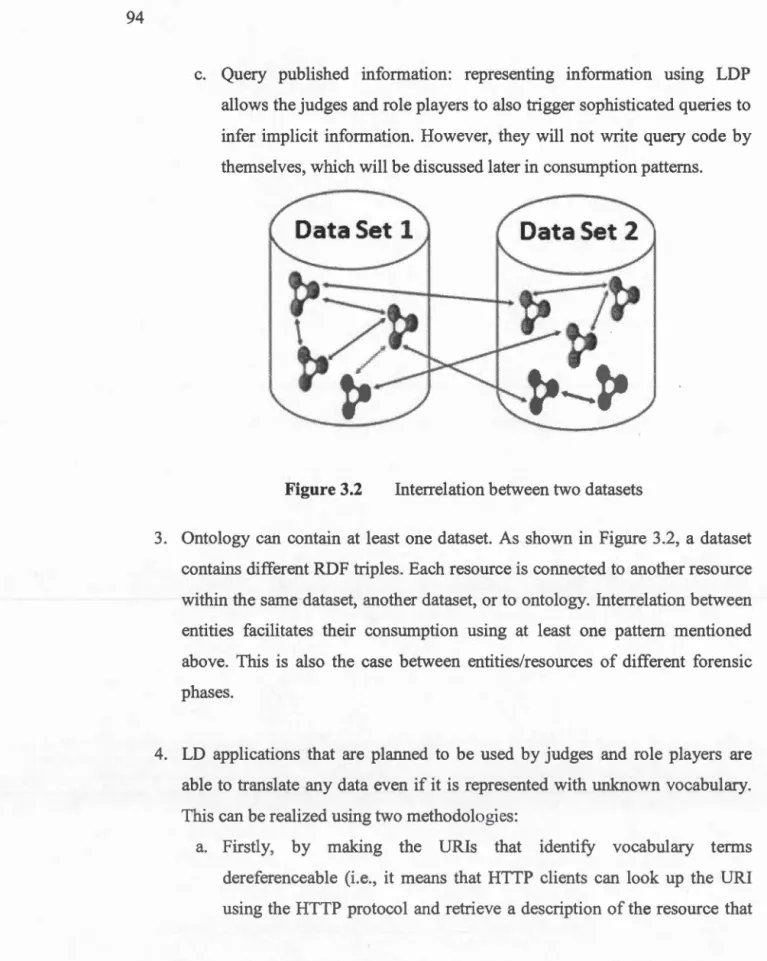
rn·terrelation between two datasets ... 94
RDF model for AFF4 vocabulary ... 99
Correspondence between cyber forensic phase and Ontology ... 101
Named Graphs for the Kruse Model.. ... 105
Client/Server certificate ex change between two datasets ... 111
Use cases dia gram of CF -CoC ... 116
XVlll
3.9 User interface ofCF-CoC systern ... 119
4.1 Activity diagrarn of creating and annotating proprietary terrns ... 121
4.2 Screen for creating an ontology ... 126
4.3 RDF screen mode! ofthe acquisition ontology ... 127
4.4 Screen for creating a proprietary terrn ... 128
4.5 Screen for creating the "RoleP!ayer" class ... 130
4.6 Screen for creating the "FirstResponder" class ... 131
4.7 Screen for creating the "Digita!Media" class ... 132
4.8 Screen for creating the ''preserve" property ... 134
4.9 Screen for creating the ''preservedBy" property ... 135
4.10 Screen for creating the "SN" property ... 136
4.11 T-Box of"SN' property ... 137
4.12 The T-Box of the ''preserve" property ... 138
4.13 Class diagrarn of e-CoC ... 139
4.14 Screen for publishing RDF triples ... 141
4.15 Screen showing domain and range of a proprietary terrn ... 142
4.16 A-Box ontology ofthe forensic preservation task (e-CoCAcq) ... 144
4.17 Screen for ad ding provemi.nce rnetadata to the NG ... 146
5.1 Use case dia gram of consumption patterns ... 149
5.2 Screen for consumption patterns ... 150
5.3 Screen forbrowsing ... 152
5.4 Screen of all forensic phases ... 153
5.5 Screen for viewing provenance vocabulary ... 154
5.6 e-CoCs for two forensic phases ... 155
5.7 RDF/XML of e-CoC for preservation task in the acquisition phase ... 156
5.8 Screen showing resources of preservation task in theacquisition ... 157
5.9 Screen for "FirstResponder" resource expansion ...... 158
5.11 Screen for "Persan" definition ... 159
5.12 Screen for "SN' resource expansion ... 160
5.13 Screen for RDF instances of"SN' property ... 161
5.14 Screen for "preserve" res ource expansion ... 162
5.15 Screen for RDF instances of"SN' property ... 162
5.16 Screen for crawling resources/literals ... 164
5.17 Screen for crawling the ''preserve" term ... 164
5.18 Screen for crawling using the "PDA device" ..................... 165
5.19 Screen for reasoning on a forensic phase ... 166
5.20 Screen for reasoning on ''preserve" and "SN' ... 169
5.21 Screen showing aU RDF triples ... 171
5.22 Screen for querying upon subject slot ... 172
6.1 Procedures for creating a digital certiflcate using the OpenSSL tool... 175
6.2 The CA self-signed certiflcate ... 177
6.3 The server digital certiflcate ... 178
6.4 The client digital certiflcate ... 180
6.5 Access to ÇF-CoC host server using HTTP ... 182
6.6 Access to CF-CoC host server using HTTPS ... 183
6. 7 Redirection to the restricted resources ... 186
7.1 The tangible Co Cs of the Kruse model.. ... 193
7.2 Screen showing sorne client certiflcates ... 196
7.3 Screen for creating "SuspectedDevice" class ... 203
7.4 RDF Model for "SuspectedDevice" class ... 204
7.5 Screen for creating "recover" property ... 204
7.6 RDF Model for the "recover" property .: ... 205
7. 7 Screen for crea ting the "DeletedFiles" class ... 206
7.8 RDF Model for the "DeletedFiles" class ... 206
7.10 RDF Model for the "containsRecover" property ... 208 7.11 Screen for creating the "backup" property ... 209 7.12 RD F model for the "backup" property ... 21 0 7.13 Screen for crea ting the "backup Ta" property ... 211 7.14 RDF model for the "backupTo" property ... 212 7.15 Screen of publishing a triple using the "containsRecover" predicate ... 214 7.16 e-CoC of the acquisition phase ... 214 7.17 RDF/XML of the e-CoC of the acquisition phase ... 215 7.18 Screen for crea ting the "Authenticator" class ... 216 7.19 RDF model for the "Authenticator" class ... 216 7.20 Screen for creating the "PrimaryDevice" class ... 217 7.21 RDF model for the "PrimaryDevice" class ... 217 7.22 Screen for crea ting the "authenticatePrimary" property ... 218 7.23 RDF model for the "authenticatePrimary" property ... 219 7.24 Screen for creating the "JmagefilePrimary" class ... 220 7.25 RDF Model for the "JmagefilePrimary" class ... 221 7.26 Screen for creating the "hashingPrimary" property ... 221 7.27 RDF model for "hashingPrimary'' property ... 222 7.28 Screen for crea ting the "checksumPrimary" property ... 223 7.29 RDF mo del for the "checksumPrimary" property ... 224 7.30 Screen for creating the "chckalgorithmPrimary" property ... 225 7.31 RDF model for the "chckalgorithmPrimary" property ... 225 7.32 e-CoC of the authentication phase ... 227 7.33 Screen for mapping the source deviee ... 228 7.34 Screen for mapping the backup deviee ... 228 7.35 e-CoC of acquisition and authentication phases ... 229 7.36 Screen for creating the "Analyzer" class ... 230 7.3 7 RDF model of the "Analyzer" class ... 231
7.38 Screen for creating the "analyze" property ... 231 7.39 RDF model of the "analyze" property ..... 232 7.40 Screen for creating the "dataSize" property ... 233 7.41 RDF model ofthe "dataSize" property ... 233 7.42 Screen for creating the "analyzedBy" property ... 234 7.43 RDF model of the "analyzedBy" property ... 234 7.44 RDF model of the "tota!Size" property .... 235 7.45 Screen for creating the "HiddenPartition" class ... 236 7.46 RDF model of the "HiddenPartition" class ... 236 7.47 Screen for creating the "contains" property ... 237 7.48 RDF model of the "contains" property ... 237 7.49 Screen for creating the "hiddenContains" property ... 238 7.50 RDF model of the "hiddenContains" property ..... 238 7.51 Screen for creating the "hiddenUsing" property ... 239 7.52 RDF model of the "hiddenUsing" property ... 240 7.53 RDF/XML Code for an AFF4 format.. ... 241 7.54 e-CoC of the analysis phase ... 242 7. 55 RD F model for an AFF 4 result ... 24 2 7.56 e-CoC ofthe complete case study ... 244 7.57 Provenance graph for the acquisition phase ... 246 7.58 Provenance graph for the authentication phase ... 247 7.59 Provenance graph for the analysis phase ... 248 7.60 Screen for displaying the acquisition phase resources ... 249 7.61 Screen of the backup task in the acquisition phase ... 250 7.62 Screen for displaying the resources of the authentication phase ... 251 7.63 Screen for displaying the resources of the analysis phase ... 251 7.64 Screen for crawling using the keyword "Robert' ............................ 252 7.65 Screen for crawling using the keyword "LaptopHD" ...... 253
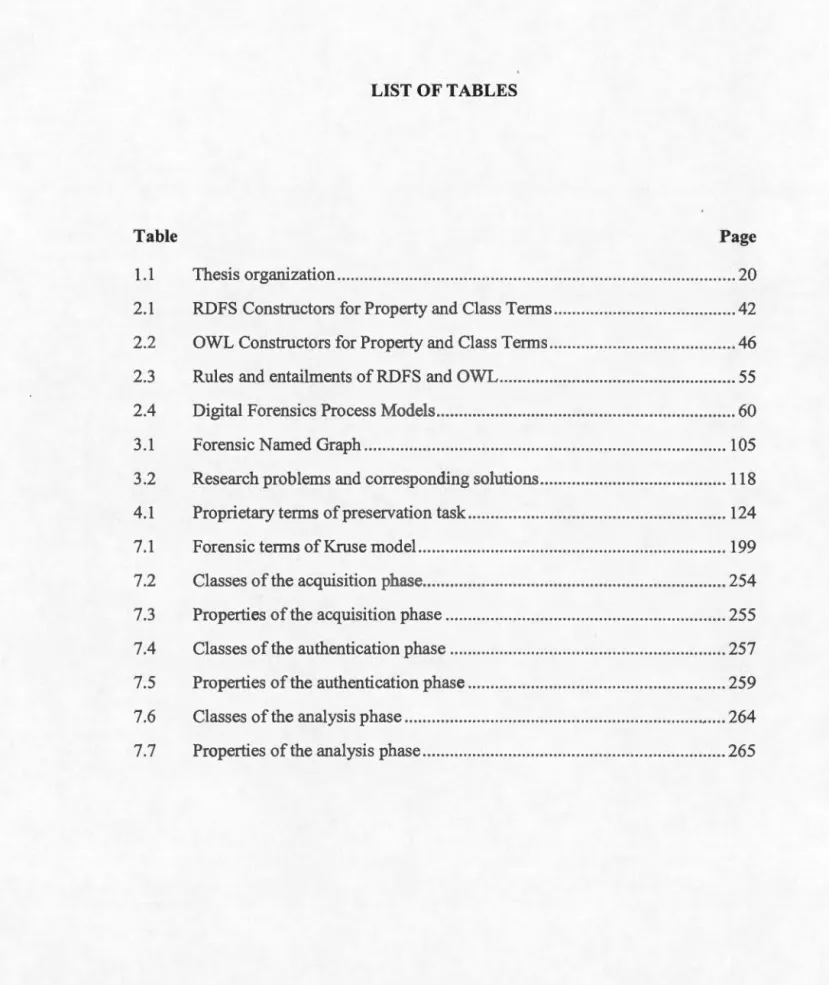
Table Page 1.1 Thesis organization ... 20 2.1 RDFS Constructors for Property and Class Terms ... 42 2.2 OWL Constructors for Property and Class Terms ... 46 2.3 Rules and entailments ofRDFS and OWL ... 55 2.4 Digital Forensics Process Models ... 60 3.1 Forensic Named Graph ... 105 3.2 Research problems and corresponding solutions ... 118 4.1 Proprietary terms of preservation task ... 124 7.1 F orensic terms of Kruse model.. ... 199 7.2 Classes of the acquisition phase ... 254 7.3 Properties of the acquisition phase ... 255 7.4 Classes of the authentication phase ... 257 7.5 Properties of the authentication phase ... 259 7.6 Classes of the analysis phase ... 264 7. 7 Properties of the anal ysis phase ... 265
A-Box AFF CA CDESF CF CF-CoC CoC Co Cs CRC CVE DC DCMI DEB DEMF DFRW Assertion Box
Advanced Forensic Format Certificate Authority
Common Digital Evidence Storage Format Cyber Forensics
Cyber Forensic- Chain of Custody Framework Chain of Custody (tangible)
Chains of Custody
Cyclic Redundancy Check
Common Vulnerabilities and Exposures Dublin Core
Dublin Core Metadata Initiative Digital Evidence Bag
Digital Evidence Management Framework Digital Forensics Research Workshop
DSL e-CoC e-CoCs EJBCA e-Justice EWF FCC FDE FM FOAF FTP GPS GUID HTML HTTP ICT JSON IP
Digital Subscriber Line
Electronic Chain of Custody
Electronic Chains of Custody
Énterprise Java Bean Certificate Authority
Electronic Justice
Encase Expert Witness Format
Federal Communication Commission
Federal Rules ofEvidence
Flowthing Model
Friend of a Friend Vocabulary
File Transfer Protocol
Global Positioning System
Global Unique Identifier
Hyper Text Markup Language
Hyper Text Transfer Protocol
Information and Communication Technology JavaScript Object Notation
LCD Linked Closed Data
LDP Linked Data Principles
LE Linked Education
LSC Legal Services Cooperation
MDA Message Digest Algorithm
MMC Microsoft Management Console
NFO Nepomuk File Ontology
NG Named Graph
NIE Nepomuk Information Element Ontology
NIST National Institute of Standards and Technology
OWL Ontology Web Language
PC Persona} Computer
PHP Persona} Home Page
PKI Public-key Infrastructure
RDF Resource Description Framework
RDFID Radio Frequency Identification
RDFS Resource Description Framework Schema
SHA SIN SKOS SPARQL SSL SSN SWP SWSE T-Box TEL TLS URI URL USDOJ USB USDOJ W3C XSD
Secure Hash Algorithm Social Insurance Number
Simple Knowledge Organization System
SP ARQL Protocol and RDF Query Language (recursive acronym)
Secure Socket Module Social Security Number
Semantic Web Publishing
Semantic Web Search Engine
Terminology Box
Technology-Enhanced Learning
Transport Module Security
Unified Resource Identifier
Unified Resource Locator
United State Department of Justice (USDOJ)
Universal Serial Bus
United States Department of Justice National Institute
World Wide Web Consortium
Les acteurs d'un processus judiciaire accumulent et enregistrent les informations et preuves accumulées durant leurs enquêtes, afin de les présenter à un juge dans une cour de justice. Lorsque ces informations sont enregistrées et consignées, elles constituent des artéfacts tangibles appelés chaînes de traçabilité (CoC). Les données fournies dans ces documents jouent un rôle vital dans le processus d'enquête, parce qu'elles répondent à des questions sur la façon dont les preuves sont collectées, transportées, analysées et conservées, depuis leur saisie jusqu'à leur production devant un tribunal. Des métadonnées de provenance accompagnent aussi ces données contenues dans les CoCs, afin de répondre aux questions sur leur origine et d'instaurer une confiance entre les différents acteurs du processus judiciaire, avec comme objectif ultime, le fait de rendre ces CoCs recevables devant une cour de justice.
Aujourd'hui, avec l'avènement de l'ère numérique, les enquêtes sont non seulement appliquées aux crimes physiques, mais font aussi référence à des preuves qui sont de nature numérique et peuvent ne pas être compréhensibles par des juges. Il en découle la nécessité que ces CoCs, documents tangibles, subissent une transformation radicale, du format papier vers des données électroniques, afin de tenir compte de cette évolution et de produire donc, des CoCs électroniques (e-CoCs), lisibles, compréhensibles et exploitables aussi bien par les humains que par les machines. Le Web sémantique offre un cadre pertinent pour représenter et manipuler les CoCs, car il utilise des principes de Web connu sous le nom de Web des données (Principes des données liées, LDP), qui fournissent des informations utiles en RDF (Resource Description Framework, un modèle de graphe destiné à décrire de façon formelle les ressources du Web et leurs métadonnées), à travers des identifiants uniformes de ressources (URI). En outre, il comprend différents vocabulaires de provenance qui peuvent être utiles pour exprimer et promouvoir les métadonnées judiciaires. Ces principes sont utilisés pour publier les données publiquement sur le Web et donc proposer des données liées ouvertes, connues sous l'appellation de Linked Open Data (LOD). Cependant, l'aspect public des données d'enquêtes et de leurs métadonnées ne serait pas souhaité. Elles doivent obéir à certaines restrictions d'accès pour être partagées uniquement entre acteurs autorisés. Ces LDP peuvent être configurés pour publier des données sur une petite échelle, en utilisant l'approche de l'infrastructure à clé publique (PKI). Ainsi, la CoC représentée sera publiée sur une échelle restreinte
et ne pourra être consommée que par les acteurs concernés, à travers différents patrons de consommation de données.
Cette thèse fournit un cadre complet expliquant comment les CoCs et les données de provenances sont représentées et publiées en utilisant LDP, et comment l'infrastructure PKI peut être utilisée pour restreindre l'accès à ces données/ressources, afin d'être partagé à une échelle restreinte. L'évaluation de ce cadre se fera à travers une expérimentation empirique appliquée sur un modèle judiciaire complet.
MOTS-CLÉS: chaînes de traçabilité, cybercriminalité, données liées ouvertes, principes des données liées, patrons de consommation de données, infrastructure à clé publique.
Role players of any forensic investigation process record chronologically all forensic data resulted from their investigation in order to be presented to the judge in a court oflaw. When these results are recorded and posted, they are called Chains ofCustody (CoCs). The forensic data provided within these documents play a vital role in the process of forensic investigation, because they answer questions about how evidence is collected, transported, analyzed, and preserved since its seizure until its production in court. Provenance metadata also accompany these forensic data to answer questions about their origin and foster trustworthiness among role players and judges in order to make the tangible CoCs admissible in a court of law.
Nowadays, with the ad vent and evolution of the digital age, the forensic investigation is not only applied to physical crimes, but also to digital evidence and may not be understandable by judges in the courts of law. This fact increases the need that these tangible documents undergo a radical transformation from paper to electronic data in order to accommodate this evolution and pro vide electronic-CoC ( e-CoC) readable, understandable, and consumable by humans and machines.
The semantic web is a fertile land to represent and manage tangible CoCs, because it uses web principles known as Linked Data Principles (LDP), which provide useful information in Resource Description Framework (RDF) format upon Unified Resource Identifiers (URI) resolution. In addition, it includes different provenance vocabularies that can be useful to express and foster the forensic metadata. Generally,
the power of LDP resides in publishing data publicly without any access restriction on the web. However, the openness of cyber forensics data and their metadata would not be convenient. Cyber forensics data should ohey sorne access restriction in order to be shared only among role players and judges. Public-key Infrastructure (PKI) can be applied to restrict the access to sorne or all resources of the represented data and bends the LDP from open to closed consumption, while maintaining the resolution of such restricted resources. The judge will in turn consume the restricted represented data using different LDP consumption patterns. A role player can also be the consumer of such represented resources published by other role players.
This thesis provides a complete framework explaining how forensic and provenance data are represented and pub li shed using LDP, and how PKI can be used to restrict the access to these data/resources in order to be shared on a closed scale. The
evaluation of the framework will be done through an empirical experimentation applied in a complete forensic model.
KEYWORDS: Chains of Custody, Cyber Forensics, Linked Open Data, Linked Data Principles, Consumption Patterns, Public-key Infrastructure.
The his tory of forensic investigation tasks dates back thousands of years. These tasks deal with gathering and examining evidence about the past in order to prosecute criminals in the future. With the advent of Information and Communication Technology (ICT), forensic investigation is not only concentrated on physical crimes, but also on digital evidence. A new type of forensic investigation, known as computer/cyber digital forensics, has emerged.
One of the most essential parts of the digital forensic process is the Chain of Custody (CoC). CoC is a chronological document accompanying all digital evidence, in order to avoid later allegations of tampering with such evidence. CoC provides useful information about the digital evidence produced during a forensic process by answering the five "Ws" and one "H" questions. The five "Ws" ask "When," "Who," "Where," "Why," and, "What," while the "H" asks "How."
Today, cyber forensics is a daily growing field that requires accommodation for the continuous changes in digital technologies. The tangible CoC information also needs to undergo a radical transformation from paper to electronic data (e-CoC), which is readable and consumable by computers.
The semantic web is a fertile land to represent this information because it is rich with different vocabularies and provenance metadata that can be useful to represent and manage such forensic information.
Nowadays, the semantic web is the web of data. However, ·it is not just concentrated on the interrelation between web documents, but also between raw data within these
documents. This data interrelation is based on four aspects provided by Tim
Berner-Lee in 2006 known as the Linked Data Principles (LDP). These aspects allow the
data being represented to be published in a structured way that can facilitate their
consumption.
This dissertation provides a novel framework that uses the LDP to represent the
tangible CoC in order to be consumed in a court of law. The framework provided in
this dissertation is elaborated through a set of modules. Generally, it presents how the
semantic web and its technologies presented in vocabularies and metadata are a fertile
land to represent the tangible CoCs from their publication by the role players
throughout the cyber forensics investigation, until ·their consumption by judges in a court of law.
In addition, the framework provided in this dissertation uses a Public-key
Infrastructure (PKI) to ensure the identity and the authentication of each technician
participating in the investigation process, and to protect and foster the published
information related to the case in question from unauthorized access. This idea argues
that not all information published on the web of data should be on an open scale. However, LDP need to be bent and adapted for publishing data with access
restrictions in order to be shared on a closed scale. This is known as the Linked
Closed Data (LCD).
This thesis is organized as follows: Chapter 1 discusses the research problems.
Chapter 2 presents the state of the art. Chapter 3 concems the research methodology. Chapters 4, 5, and 6 discuss the proposed framework. Chapter 7 applies the system to a complete forensic process. Finally, Chapter 8 summarizes the thesis and presents future prospects for this work.
The main benefits of this thesis comprise of transforming the tangible CoC into electronic CoC to:
• Accommodate with the new technology ofknowledge representation;
• Poster trustworthiness among role players and judges by adding provenance metadata imported from the semantic web;
• Help judges understand and consume the electronic CoC using different consumption patterns; and
• Secure the represented resources in order to be used on a closed scale using the PKI.
Ali ideas behind this thesis are published and discussed in different international conferences. Thus, the following paper introduced the idea of using the semantic web to produce an electronic chain of custody:
Gayed, T. F., Lounis, H. et Bari, M (2012a). Computer forensics: toward the construction of electronic chain of custody on the semantic web. International conference on software engineering and knowledge engineering, 406-411.
In the same year, 2012, we published the complementary work of the above paper. In this work we introduced the benefit ofusing the semantic web is to improve the CoC:
Gayed, T. F., Lounis, H. et Bari, M (2012b). Cyber forensics: representing and (im) proving the chain of custody using the semantic web. International conference on advanced cognitive technologies and applications, 19-23.
In the following 2013 paper, we mention explicitly ali advantages and rewards of using the LDP and the semantic web vocabularies to accommodate the tangible documents within the current era of technology:
Gayed, T. F., Lounis, H. et Bari, M. (2013b). Cyber forensics: representing and managing tangible chain of custody using the linked data princip/es. International conference on advanced cognitive technologies and application, 87-96.
On the other hand, in another paper, we discuss the steps to represent forensic resources applied to the preservation task of the Kruse madel:
Gayed, T F., Lounis, H et Bari, M (2013a). Representing chains of custody along a forensic process: a case study on Kruse mode!. International conference on software engineering and knowledge engineering, 674-680.
The year after, in 2014, two papers were published. The first one explains how to
create custom tenns using the Resource Description Framework Schema (RDFS).
This is illustrated by using the acquisition phase imported from the Kruse madel as a case study:
Gayed, T F., Lounis, H et Bari, M (2014b). Creating proprietary terms using lightweight ontology: a case study on acquisition phase in a cyber forensics process. International conference on software engineering and knowledge
engineering, 7 6-81.
The second paper is about how the PKI is exploited to publish data using LDP on a. closed scale:
Gayed, TF., Lounis, H et Bari, M (2014a). Linked closed data using PK!: a case study on publishing and consuming data in a forensic process. International
. conference on advanced cognitive technologies and applications, 77-86.
In 2015, a journal publication combined all ideas together has been released. It
illustrates a complete scenario of using the LDP to publish and consume forensic resources, on a closed scale, using the PKI approach:
Gayed, T F., Lounis, H. et Bari, M (2015). Representing and Publishing Cyber
Forensic Data and its Provenance Metadata: From Open to Closed Consumption.
Finally, while recent, our work is already referenced by sorne authors in the field narnely, in joumals such as "Elsevier Digital Investigation" and "International Journal of Computer Applications."
RESEARCH PROBLEMS
1.1 Introduction
The field of Computer/Digital forensics is growing on a daily basis. It combines computer science concepts with evidentiary rules and legal standards to prosecute criminals of digital evidence in a court of law (Casey, 2014). At the most basic level, the digital forensic process has three major phases: acquisition, authentication, and analysis (Kruse II et Heiser, 2001; Kahn et al., 2008). Simply said, the acquisition is a phase where evidence is collected and extracted from the suspected digital deviees (e.g., laptop, mobile phones, etc.). Authentication is the phase that ensures that the collected evidence is not altered and keeps its integrity. The analysis phase takes the acquired images to analyze and identify them into pieces of evidence in order to draw conclusions.
In an adversarial system there usually exist two advocates representing their parties' positions before a jury or judge. The parties are the state and the accused. The evidence related to a crime is usually collected by the police or by a party whose services were retained by the police and handed over to the prosecution. The prosecutor will decide which pieces of evidence to present at trial while the accused will try to contest the validity/eligibility of a given piece of evidence.
The information collected by an authorized party is recorded chronologically in tangible documents. These documents will be called tangible Chains of Custody
(CoCs), because they keep track and provide useful information related to the
collected evidences by answering the five "Ws" and one "H" questions.
A CoC is one of the most essential parts of any forensic investigation process
(Ballou, 201 0). It accompanies all digital evidences in order to a void later allegations
of tampering. Thus, the Chain of Custody is essential in this context.
The following points summarize the process since the collection of evidence until the judge' engagement:
1. Technicians whose services were retained by the authorities of the police
investigation ( e.g., first responders, expert witnesses, police officers, bail iffs
and investigators) will proceed with the collection of evidence;
2. The collected evidence will be forwarded to the prosecutor who will choose
which elements to present at trial;
3. The evidence will be th en disclosed to the accused or his attorney;
4. If the accused disputes the addressed evidence, a session will held to verify
the admissibility of the collected evidence;
5. In this session, the judge will hear the testimony of technicians to determine if there were flaws in the chain of custody imposing rejection of evidence.
From the above process, we have four actors: technician, prosecutor,
defender/accused and judge. ln this dissertation, the first three actors will be called
role players, and the fourth actor will be the judge.
Figure 1.1 depicts the conceptual diagram of a tangible CoC. The forensic process
defines the role of technicians. The forensic process presented in this figure contains
analysis. Three types oftechnicians are needed to work on these forensic phases: first responder, authenticator and analyzer.
The main role oftechnicians is to collect evidence. Each technician may participate to one or more forensic phase(s). The sirnplest case, each technician is assigned to one forensic phase. In each phase, a technician can accomplish one or more forensic task(s) and each task in a forensic phase can be accomplished by one or more technicians. Each technician is responsible for creating his own chain of custody for each task assigned to hirn. Creating a chain of custody means that a technician records chronologically all collected evidence in tangible documents.
This dissertation depicts how the tangible documents of the chain of custody will be transformed into electronic information consumable by human and machines. Chapter 7 presents a complete case using the Kruse model, which contains three forensic phases. Each phase is assigned to a technician. Technicians will use a system called CF-CoC, as proposed in this dissertation, to publish such information and annotate them using different provenance metadata. Role players (technicians, prosecutor, and defendants or their attorney) and judge will be able to consume the published/electronic information. In addition; the system applies a secure approach to restrict the access and consumption to the published resources using digital certificates.
Because the field of cyber forensics is growing on a daily basis and requires the accommodation for the continuous changes in digital technologies, the tangible CoC information also needs to undergo a radical transformation from paper to electronic data (e-CoC), which is readable and consumable by computers. This transformation is achieved by representing the information in a form that is understandable and that can be processed by computers.
The semantic web will be a flexible solution to achieve this goal, because it is based on an infrastructure that provides a means for publishing vocabularies that can be read by humans and processed by machines. This infrastructure is called "Resource Description Framework" (RDF) (Beckett et McBride, 2004). It allows the encoding, exchange, and reuse of structured metadata. It also contains several semantic markup languages developed under the auspices of the World Wide Web Consortium (W3C), such as RDF Scheme (RDFS) (Word Wide Web Consortium (W3C), 2014) and Web Ontology Language (OWL) (McGuinness et Van Harmelen, 2004), which are based on XML (Bray et al., 2008). RDF data models are semantically encoded using RDFS and OWL (Berry et al., 2003).
Today, the semantic web is the web of data, which is not just concentrated on the interrelation between web documents, but also between the raw data within these documents. This data interrelation is based on standardized web technologies: (Bemers-Lee et al., 2001; Campbell et MacNeill, 2010) the HTTP (Fielding, 2014), URI (Bemers-Lee et al., 2014), and RDF (Beckett et McBride, 2004). It is designed to represent information in a machine-readable format by introducing different representation languages based on XML (Bray et al., 2008) or JSON1 (JavaScript Object Notation), more recently. The latter is a lightweight data-interchange formats easily to understand by humans and machines. These technologies allow publishing structured data, so that it can be interlinked and navigable between each other.
In addition, the author will consider the semantic web as a fertile land for representing and describing the tangible CoCs since it is rich with different provenance vocabularies that are useful to describe the forensic information. These vocabularies can provide answers to the five Ws and one H questions related to the origin of this data. Sorne examples of widely deployed provenance vocabularies are the Dublin Core (DC) (Dublin Core Metadata Initiative, 2015), Friend of a Friend (FOAF) (Brickley et Miller, 2014), and Ontology Metadata Vocabulary (OMV) (Hartmann et al., 2005), which contain different predicates that can elaborate the published data with extra information and metadata.
Thus, representing forensic information using the technologies of the semantic web will be useful for each technician in the forensic process. It will allow technicians to record and publish their forensic investigation results in a structured and unifi.ed format. Furthermore, publishing data in such a format can facilitate the consumption of these data by the prosecution, defense and the judge in a court of law. This point will be discussed in detail in Chapters 2 and 3.
1
However, the accommodation with the digital era, and the digital nature of evidence in cyber forensics are not the only reasons to represent tangible CoCs into electronic data. There exist other problems related to the tangible CoCs that need to be resolved. As well, the next sub-sections discuss all the research problems that are considered to have incentivized this research.
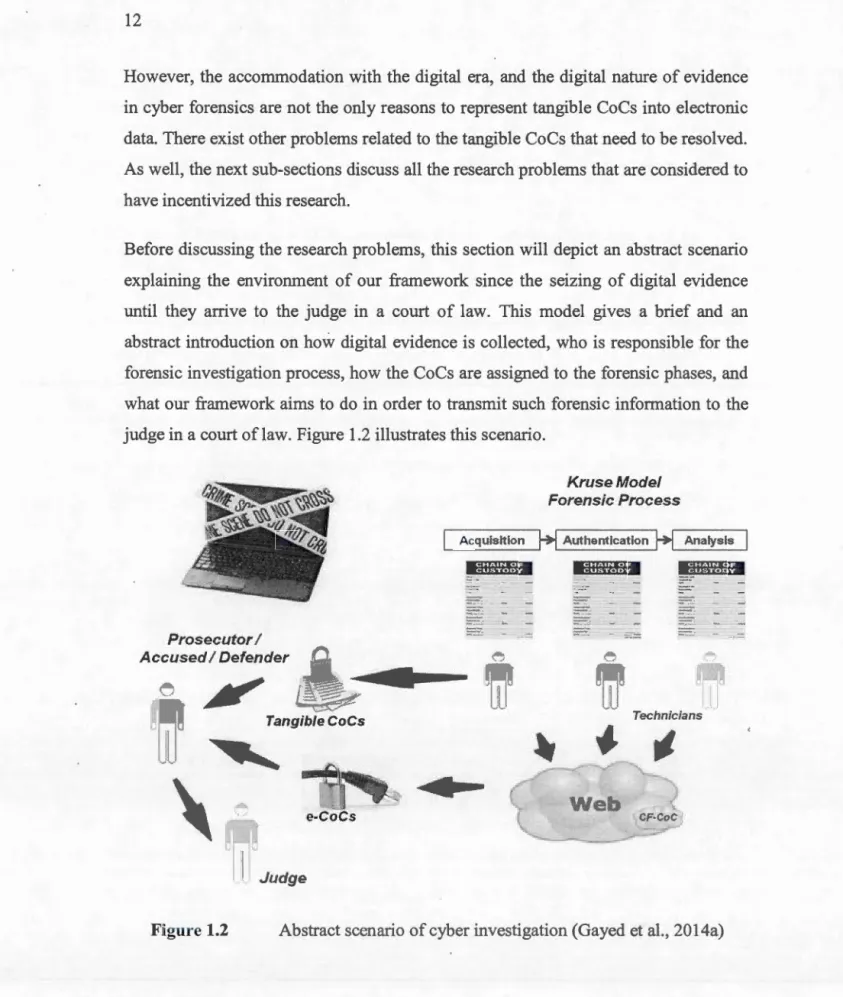
Before discussing the research problems, this section will depict an abstract scenario
explaining the environrnent of our framework since the seizing of digital evidence
until they arrive to the judge in a court of law. This model gives a brief and an abstract introduction on how digital evidence is collected, who is responsible for the
forensic investigation process, how the CoCs are assigned to the forensic phases, and
what our framework aims to do in order to transmit such forensic information to the judge in a court oflaw. Figure 1.2 illustrates this scenario.
Prosecutor 1 Accused 1 Defender ' / Tangible CoCs 11 Judge
•
Acquisition KruseModel Forensic Process Authentication TechniciansWhen a user performs an action using any digital deviee, such as computer, laptop, digital camera, smart phone, etc., if this action is committed in violation of a law, it is an illegal act and can be considered an infraction or even a crime, and its evidence is of digital nature. The performer of this act is then called the perpetrator of the crime. Sorne acts are country dependent. This means that the committed acts can be considered crimes in sorne countries and not in others.
Any discovered crime should ohey a scientific investigation using certain forensic processes (Kohn et al., 2008). This investigation aims at gathering and examining information about the past in order to be used in the future in the court of law. Each phase in a forensic process is assigned to a person that is qualified to play a certain role in the forensic investigation, such as first responders, expert witnesses, police officers, bailiffs and investigators. ( e.g., the first responder is a person who is qualified first-hand to seize, preserve and collect all the necessary information on the crime scene). The role players may be technician, the prosecution or the defense. One or more technicians may be assigned to a forensic phase. Technicians are the orres who are responsible to record and save all investigation results that are achieved during their forensic phase. Once they finish their tasks, they provide the collected information to the prosecutor to choose which elements to put into evidence as part of his prosecution.
For simplicity, Figure 1.2 considers that each forensic phase is assigned to a technician that creates his own CoC, describing all forensic information he collected and all results he deduced using different forensic tools.
The classical way used by technicians is to record their information in tangible documents, seal them in an envelope, and provide them to the prosecutor. The latter selects and prepares the evidence that he wants to use to prosecute the accused. The selected evidence will then be disclosed to the accused or his attorney. The recording task is usually performed manually and does not include any computers, except for
sorne classic tasks ( e.g., word processing, printing and filling in documents, using emails, etc.).
The novel proposed system will reside somewhere on a web cloud and will be owned for instance, by a neutral si de, which is not on conflict of interest with the prosecutor and defender, to facilitate the cyber investigation and justice process. The proposed
framework will use web technologies to aid (i) the technicians to securely record (i.e.,
publish/represent) electronically the information related to their CoCs, (ii) prosecutor/defender to consume this information and append his prosecution
elements and communicate with the defender/accused and finally, (iii) in case of
dispute the judge to consume the represented information.
Once the technicians transform the tangible CoCs from paper to electronic form, the transformed (i.e., represented) information should ohey sorne access restrictions,
especially since the information being published will be shared in a public manner,
which is due to the nature of the used aspects (i.e., LDP) of the web. Thus, the
framework should provide a secure way to let the technicians publish their
information, and after they finish their task, they should be able to share the published
information with the prosecutors.
1.2 CoC challenges
As mentioned, CoCs documents record all information related to digital/physical evidence. They are also known as testimony documents, since they ensure and guarantee that all evidence related to the crime case in hand are not altered
throughout the forensic investigation. Failure to record enough information related to
the evidence may lead to its exclusion from legal proceedings. Furthermore, if the
CoCs were not properly established and cast doubt on the acquired evidence (Casey, 2014). In such a case the judge will need to hear the testimony of the technicians to determine if there were flaws in the chains of custody imposing their rejection.
1.2.1 Accommodation with digital technologies
Today, technicians are still providing the forensic information describing their investigation process with the information that resulted from various forensic tools in the form of tangible documents. Most of the evidence manipulated in the digital forensics field is of digital nature. Even if the digital evidence and their investigation results are provided on digital deviees and have a digital format, their testimony descriptions are provided within tangible documents. This is due to the fact that the audiences of these documents, in all countries, are prosecutors, defenders and judges who are mainly competent in the legal field. Thus, these documents should take an appropriate form that accommodates the audience receiving them.
Since the 1990s, the US DOJ (Department of Justice) National Institute has been trying to encourage and support all research that can prevent crimes and can improve criminal policy justice and practice (Sherman et al., 1997; Losavio et al., 2006).
AU information describing the investigation process such as those that are recorded by technicians and those that ·resulted from forensic tools need to be unified and stored together to facilitate their interoperability and consumption.
In addition, all forensic information resulting from a forensic phase and published by a technician should be interlinked with other forensic information resulted from another forensic phase and published by another technician. This is because the forensic information is a co-operative task, where all technicians should participate
together in order to draw dependent conclusions. The investigation of a technician player may depend on the results and conclusion drawn by another technician.
1.2.2 Fostering trustworthiness among role players and judges
The problem is not only to represent the information included in tangible CoCs to
solve the issues mentioned above. It is also to express information about where the
CoC information came from. Judges can find the answers to their questions in the
CoC, but they need to also know the provenance and origins of those answers.
Provenance of information is crucial to guarantee and ensure the trustworthiness and
confidence of the shared information among role players (technicians, prosecutors and defenders) and judges. Trustworthiness starts by identifying actors in order to build a secure channel to share information. However, when the objective is mainly focused on the information itself, the latter should be illustrated through various
provenance information.
Hence, this dissertation will distinguish between forensic information and provenance information (Gayed et al., 2012a). Forensic information should be responsible to answer the five Ws and one H questions related to the case in hand, while provenance information should be responsible to answer questions about the origin of these answers (i.e., what information sources were used, when were they updated, how reliable the source was). This will be accomplished through the use of different provenance metadata of the semantic web. Providing answers to such questions fosters the trustworthiness among publishers (i.e., role players) and consumers (i.e., judges and role players) and makes the e-CoC admissible in a court oflaw.
1.2.3 Judges' awareness of digital evidence
In the literature, sever al works have been provided to identify the judges' understanding of ICTs underlying digital evidence (Losavio et al., 2006; Insa, 2007; Rogers et al., 2007). These works aim to design specialized training and education programs to ameliorate their ICT knowledge and make them better able to evaluate scientific and technical evidence presented in a court of law.
There exists different terms related to physical evidence, which are well-known by anyone. For example, the word "gun," is a common word that does not need to be interpreted and explained to understand. However, this is not the case in cyber forensics. In cyber forensics, terms are mostly related to information technology and such terms need to be interpreted and expanded to get and understand their meaning (see Figure 1.3).
What?
How?
Why?
Hash
~
Un
i
que Numeric Value
H
Generated by a
H
To
identify
Code
or Stream of Characters
Hash Function
.
certain object
Figure 1.3 Expansion of a cyber forensics term
For example, as shown in Figure 1.3, a tenn called "Hash Code" is expanded to
provide what is meant by a hash code, how it is generated, and why it is used. Along this path we may have another expansion path. For example, the How rectangle can be nested with more information to explain what a hash function is, and so on. This is called "linked information" or "descriptive information", where each piece of information can be dereferenceable to provide more information.
Judges are more specialized in, as well as better understand the legal domain and procedures than the field of ICT. Most judges do not have the required knowledge conceming information technologies, or the knowledge that they currently have is not enough to evaluate and take the proper decision for the case in question. One solution that has been proposed in the literature is to organize a training program to teach judges about the field ofiCT (Kessler, 2010).
The dissertation argues against this solution's direction, because it will not be an easy task to teach judges the different concepts of ICT. Instead, it discusses the solution of providing a descriptive e-CoC, where technicians can publish the results of their investigation. The prosecutor, defender and judge (in case of dispute or contest from the defender) can consume such results in a descriptive and understandable way and thus take the proper decision regarding the case in question.
While consuming the represented information, a judge should have the ability to consume forensic information in a descriptive way. It is important that judges can find and discover more information about different resources, especially those that are unknown to them. LDP use the URI to identify different resources (i.e., subjects
or things). These resources should have dereferenceable nature. This means that each resource can be expanded to other resources in arder to get more information and navigate among other related resources. Representing the data using such a structure is an example of a new area of research called Linked Education (LE).
1.2.4 Security of tangible CoCs information
Usually, the CaC documents must be affixed securely when they are transported from one place to another. This is achieved in a very classical way: seal them in plastic
etc.), label them, and sign them into a locked evidence room with the digital evidence and deviees themselves to ensure their integrity. The e-CoCs also need to be secured, from their publication by the technicians until their consumption by judges. LDP are used to publicly publish the data on the web and need to be adapted and bended with access restrictions.
1.3 Research hypotheses
This dissertation will verify a set of hypotheses. Each hypothesis is related to a research problem. The following hypotheses are mentioned in this section in the same order as research problems.
Hypothesis 1:
The semantic web can be a fertile land to create interlinked e-CoCs, which are readable and consumable by people and machines, and the forensic information resulting from a forensic tool can be interoperable with these interlinked Co Cs.
Hypothesis 2:
Provenance metadata expressed in the formats used by the semantic web can be useful to answer the questions about the origin of the CoC data, and then foster trustworthiness among role players and judges.
Hypothesis 3:
Representing the CoC resources using the linked data principles can provide a descriptive e-CoC and then improve the subject matter and the understanding of the digital evidence.
Hypothesis 4:
PKI can be applied to the Linked Data (LD) to securely publish and consume the data among role players and judges, as weil as transform the open data to closed data.
This dissertation will discuss a novel framework that solves the research problems mentioned in Section 1.2 and verifies the correctness of the proposed hypotheses by
applying this proposed framework to a complete forensic process. The framework is
named Cyber Forensics-Chain ofCustody (CF-CoC). Before moving on to Chapter 2, the next section depicts how this thesis is organized with respect to the research problems and hypotheses.
1.4 Thesis organization
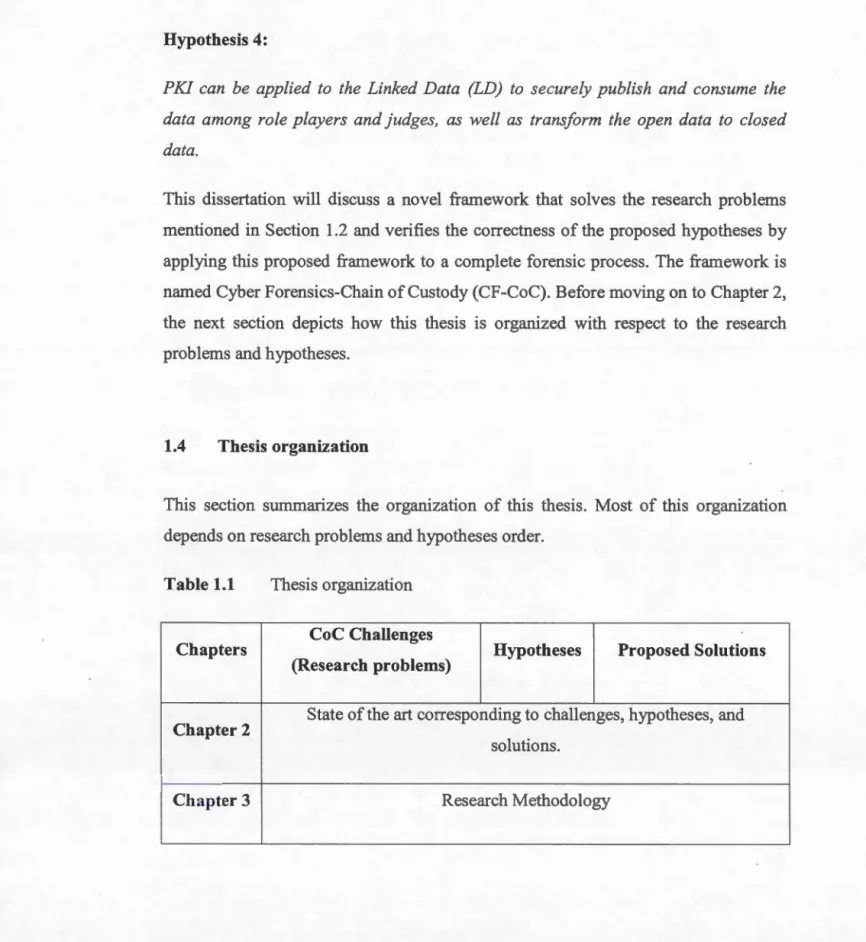
This section summarizes the organization of this thesis. Most of this organization depends on research problems and hypotheses order.
Table 1.1 Thesis organization
Chapters CoC Challenges Hypotheses Proposed Solutions
(Research problems)
State of the art corresponding to challenges, hypotheses, and Chapter 2
solutions.
Accommodation with Hypothesis Representing CoC using
digital technologies #1 LDP
Chapter 4
F ostering the
Hypothesis Adding provenance trustworthiness arnong role
#2 metadata to the e-CoC
players and judge
Judges awareness about the Hypothesis
Consumption patterns
Chapter 5
digital evidence #3
Security of CoCs Hypothesis
Adapting PKI to LOD
Chapter 6
information #4
Chapter 7 Applying the CF-CoC system to a complete forensic model
Chapter 8 Conclusions and future work
The above table contains four colurnns: the first is the chapter number (i.e., excluding the current chapter), the second column indicates the challenges that encounter the tangible CoCs (i.e., excluding Chapter 2, which explains the state of the art of this research, and Chapter 3, which illustrates the research methodology). The third colurnn is about the hypotheses of this research, of which there are four. Chapter 4 provides the solution related to the first two hypotheses. Chapter 5 is dedicated for the third hypothesis, and finally, Chapter 6 depicts the PKI to answer the last hypothesis.
STATE OF THE ART
2.1 Introduction
Technology and law are two different fields, but with the rapid evolution of technology occurring today, both fields are increasingly becoming related to one another and intersecting (i.e., marriage of law and technology). The convergence may occur from two scopes, whether the law converges with technology or technology converges with law.
First scope, if law converges toward technology, then we are going to exploit the law and its power to provide legal and secure electronic services for people who use the technology in their daily lives. This is known as "IT Law", and consists of law and legal aspects to govem the information technology. The "IT law" is not the same of
"IT aspects of law üself'. The latter are used to deliver legal services to people through the IT field.
Second scope, if technology converges to the law, then we are going to discuss what the technology can do to facilitate and enhance the legal procedures over alllevels of ajudicial system. This is known today as the field ofelectronicjustice (e-justice). Many works have been provided in literature on both scopes. For example, in the first scope, a work presented in (Yoo, 2005) discussed how the US Supreme Court cleared the way to the Federal Communications Commission (FCC) to resolve how to fit the
leading broadband technologies, such as Digital Subscriber Line (DSL) services and
cable modems. Another example is provided in the field of e-commerce, where all
e-transactions should be protected and controlled by legal procedures and law2.
On the other hand, in the second scope, the work presented in (Cabral et al., 2012), discussed the use of technology to enhance access to justice. In this work, the authors discussed the enhancement of delivering of legal services to all private and public sectors of the United States. The Legal Services Corporation (LSC), which is responsible for these services, intended to increase the quantity and quality of services through technology, by developing web-based business processes using smart phones.
Another example of using technology to serve the law is the use of statistical data-mining techniques to detect credit card fraud (Chan et al., 1999) and using anomaly detection methods to identify potential terrorist activities (Seifert, 2004).
Researches related to both scopes are numerous and are not limited to those
examples. Other examples can be found in the journal of technology and law3 to
name but one source.
This thesis lies under the second scope, where the technology of the semantic web will be exploited to, (i) aid role players to maintain and represent the CoC, and, (ii) help judges understand digital evidence.
The state of the art related to the proposed framework goes over different disciplines,
such as semantic web, Cyber Forensics (CF), provenance of information, and security. Therefore, the state of the art in this chapter will have different facets. Each facet discusses the related works of each discipline apart.
2
http://www.hg.org/ecornmerce-law.html
3
http://jolt.law.harvard.edu
L _ _ _ _ _ _ _ _ _ _ _ _ _ _ _ _ _ _ _ _ _ _ _ _ _ _ _ _ _ _ _ _ _ _ _ _ _ _ _ _ _ _ _ _ _ _ _ _ _ _ _ _ _ _ _ . _ _ _
-25
The main classification of the state of the art, as shown in Figure 2.1, is organized according to the research problems that were proposed in the first chapter.
State of the Art
Accommodation with Fostering Trustworthiness
JudgesAwareness
of Digital Evidences
Secu rity of Co Cs
Information
digital technologies
Between Role Players &
\
Judges
l
1 '---
1- 1
j
Semantic Web &
Web of Data
Linked Open
Data
Cyber Forensics &
Digital Evidences
OWL
Reasoning
RDFS
Defining Proprietary
Terms
Provenance of
Pattern
Public Key
Information Consumption Infrastructure
Provenance
Open
Named
Vocabularies Provenance Graph
Mo del
Forensic lmproving
Knowledge
Forensic Browse Crawl Query
&
Linked
Pro cesses Co Cs Representation of Formats
Reasoning Education
Figure 2.1